• An addendum to Rule 3 regarding fan-translated works of things such as Web Novels has been made. Please see here for details.
  • We've issued a clarification on our policy on AI-generated work.
  • Our mod selection process has completed. Please welcome our new moderators.
  • Due to issues with external spam filters, QQ is currently unable to send any mail to Microsoft E-mail addresses. This includes any account at live.com, hotmail.com or msn.com. Signing up to the forum with one of these addresses will result in your verification E-mail never arriving. For best results, please use a different E-mail provider for your QQ address.
  • For prospective new members, a word of warning: don't use common names like Dennis, Simon, or Kenny if you decide to create an account. Spammers have used them all before you and gotten those names flagged in the anti-spam databases. Your account registration will be rejected because of it.
  • Since it has happened MULTIPLE times now, I want to be very clear about this. You do not get to abandon an account and create a new one. You do not get to pass an account to someone else and create a new one. If you do so anyway, you will be banned for creating sockpuppets.
  • Due to the actions of particularly persistent spammers and trolls, we will be banning disposable email addresses from today onward.
  • The rules regarding NSFW links have been updated. See here for details.

Grounds (Waifu Catalog)

Created
Status
Incomplete
Watchers
36
Recent readers
226

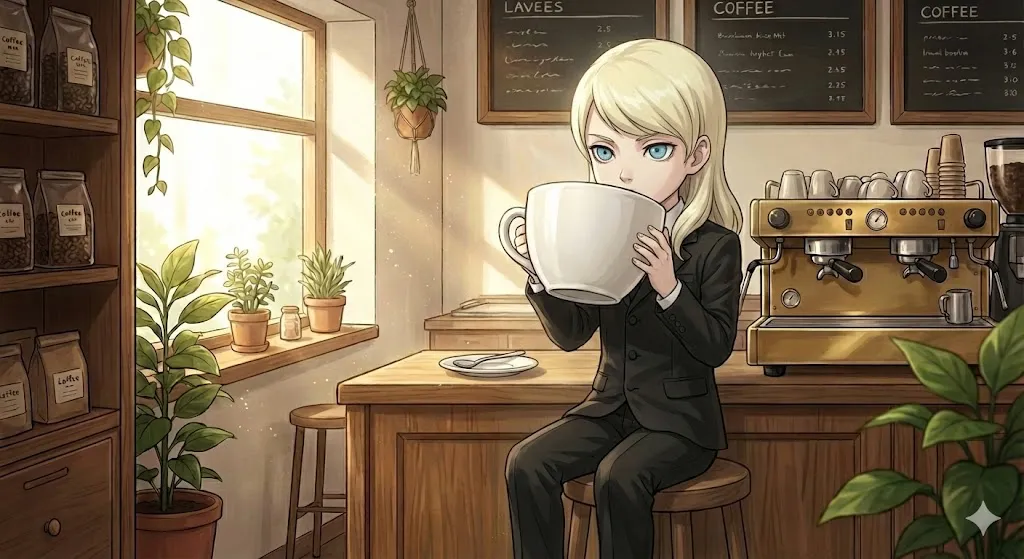
A disgraced princess, a cosmic horror, and a deadman walk into a coffee shop.

The coffee is bitter. The door locks from the inside. And for the broken things who stumble through, it's the only safe place left in the multiverse.
Welcome to the "Slightly Used" section.
Chapter 1: The Door New

Eifa

No thoughts. Just meme.
Joined
May 1, 2022
Messages
5
Likes received
23


My name is Malty S. Melromarc.

I think.

It's been a while since anyone called me that. The Company uses numbers. The contractors use… other things. Pet names. Degradations. Sometimes nothing at all, because why would you name something you don't intend to keep?

I was the First Princess of Melromarc, once. I remember that. I hold onto it sometimes, in the dark, turning the memory over like a worn stone — Ī ⱳⱥꞩ ꞩꝋᵯēꝋꞥē, Ī ⱳⱥꞩ ꞩꝋᵯēꝋꞥē, Ī ⱳⱥꞩ ꞩꝋᵯēꝋꞥē — but the edges have gone smooth now. Hard to grip. Hard to remember why it mattered.

I was cunning.

I was beautiful.

I was going to be queen.

Funny, the things you think will save you.


The cell is cold.

It's always cold. I don't know why I still notice. You'd think after enough time the body would simply… adjust. Accept. Stop sending signals that no longer serve any purpose.

But I still feel it. The cold. Settling into my bones like an old friend who's overstayed their welcome but refuses to leave.

I'm sitting in the corner. I don't remember moving to the corner. I do that sometimes now — lose time, find myself somewhere I don't recall choosing to be. The Company medics said it was within acceptable parameters for a unit of my… history.

Acceptable parameters.

Everything is within acceptable parameters here. The scars. The damage. The way I sometimes forget how to swallow and have to remind myself, step by step, like a child learning for the first time. ₳₵₵Ɇ₱₮₳฿ⱠɆ. As long as the product still functions. As long as it can still be sold.

I pull my knees to my chest.

I'm naked. I've been naked for… I don't know. A while. Clothing costs resources, and resources aren't wasted on units in transit. I used to be ashamed of that. Used to try to cover myself with my hands, curl into shapes that hid the worst of it, maintain some pathetic scrap of dignity.

I don't bother anymore.

What's the point?

They've already seen everything. Everyone has already seen everything. My body stopped being mine so long ago that modesty feels like a language I used to speak but have since forgotten. I know the words exist. I just can't remember what they mean.


There are scars.

I try not to look at them, but they're hard to avoid when they cover so much. Curse marks that twist across my ribs in patterns that still ache when the weather changes — except there is no weather here, just the same sterile recycled air, so maybe the aching is just memory. Phantom pain from a body that hasn't accepted what's been done to it.

Weapon wounds. Training accidents, some contractors called them. Let's see how much the princess can take. The Company healed the ones that impaired function. The rest they left. Cost-benefit analysis. I wasn't worth the credits.

And other damage. In other places.

I don't think about that.

I don't.

Sometimes my mind tries to go there anyway — drags me back to rooms I don't want to remember, to hands I can still feel even now, to sounds that come back in the quiet moments when there's nothing else to fill the silence—

I dig my nails into my palms. Focus on the small sharp pain. Anchor myself here, in this cold cell, in this present moment that is terrible but at least is *now* and not *then*.

Breathe.

Don't think. Don't remember. Just breathe.

The cell is cold.

I am tired.

These are the only facts that matter.


I don't know how long I have been sitting there.

Time moves strangely in Company facilities. No windows. No clocks. Just the endless hum of machines and the occasional distant sound of footsteps that never seem to come for you until suddenly they do.

I used to count seconds. Minutes. Tried to maintain some grip on the passage of hours. But the numbers got away from me eventually, slipped through my fingers like water, and now I just… exist. In the gaps between things.

Waiting.

Always waiting.

The worst part isn't the fear. Fear requires energy, requires some part of you to still believe that what comes next might be different from what came before. Fear is almost hopeful, in its own twisted way.

No.

The worst part is the tiredness.

The bone-deep exhaustion that comes from being afraid for so long that your body simply gives up on the emotion. Can't sustain it. Let it drain away until all that's left is this gray, heavy nothing that sits in your chest like a stone.

I am so tired.

I am so tired of being passed from hand to hand.

I am so tired of learning new rules, new preferences, new ways to minimize the damage.

I am so tired of hoping that this one might be different, might be better, might at least be *quick* — and being wrong, every single time.

I am so tired of being wrong.

The door will open eventually. It always does. And someone will take me somewhere, and something will happen, and I will survive it or I won't, and either way the universe will continue on without noticing or caring.

That's the truth they don't put in the catalog.

*Slightly Used.*

*Previously Owned.*

No one tells you that the cruelest thing isn't the pain. The cruelest thing is learning that you can survive it. That the human mind is horrifyingly adaptable. That you will live through things you were certain would kill you, and then you'll live through the next thing, and the next, and the next, and there is no limit to what a person can endure when the alternative is simply… stopping.

And you can't stop.

You can never stop.

You just keep going, and going, and going, until you can't remember what you were going toward in the first place.


The door opens.

I don't react.

Once, I would have flinched. Scrambled to my feet. Tried to make myself small, or large, or whatever shape seemed most likely to invite mercy. I learned quickly that there is no right shape. No correct response. What pleases one contractor enrages another. What earns you gentleness from one earns you punishment from the next.

So I stopped trying to predict.

I just… wait.

"Unit M-7749. Transfer authorized."

The agent's voice is flat. Bored. This is just paperwork to them. I am paperwork to them.

I don't look up.

"Follow."

I stand.

My legs shake. They've been shaking for a while now — the last contractor preferred me weakened, kept me on the edge of starvation because he said it made my eyes look more desperate and he liked that — but the Company's medics corrected the muscle atrophy during processing. Immobile units are harder to transport. The shaking is just… leftover what my body remembers what it's supposed to feel even though the physical cause has been removed.

I follow the agent.

One foot in front of the other. Simple mechanics. Don't need will or desire or any of the things that used to feel important. Just… movement. The body knows how to move even when the mind has checked out.

The hallway is long.

White walls. White floor. White lights that buzz faintly overhead, a sound so constant I've stopped consciously hearing it but can't quite ignore. Other doors line the corridor. Other cells. Other units in transit, waiting for their own agents, their own transfers, their own next chapters in stories that none of them asked to be part of.

I wonder, sometimes, if any of them were famous in their worlds. Heroes. Villains. People who used to be someone.

𝐈⃥⃒̸ 𝐰⃥⃒̸𝐚⃥⃒̸𝐬⃥⃒̸ 𝐚⃥⃒̸ 𝐩⃥⃒̸𝐫⃥⃒̸𝐢⃥⃒̸𝐧⃥⃒̸𝐜⃥⃒̸𝐞⃥⃒̸𝐬⃥⃒̸𝐬⃥⃒̸.⃥⃒̸

The thought surfaces and sinks again, a dead thing floating briefly before the water closes over it.

𝐈⃥⃒̸ 𝐰⃥⃒̸𝐚⃥⃒̸𝐬⃥⃒̸ 𝐠⃥⃒̸𝐨⃥⃒̸𝐢⃥⃒̸𝐧⃥⃒̸𝐠⃥⃒̸ 𝐭⃥⃒̸𝐨⃥⃒̸ 𝐛⃥⃒̸𝐞⃥⃒̸ 𝐪⃥⃒̸𝐮⃥⃒̸𝐞⃥⃒̸𝐞⃥⃒̸𝐧⃥⃒̸.⃥⃒̸

I keep walking.

The agent doesn't even look at me. I'm just cargo being transported from point A to point B. You don't make conversation with cargo.

I used to try, in the beginning. Asked questions. Demanded answers. Insisted on my rights, as if rights were something that existed here, as if anyone cared about the protests of a product that had already been bought and paid for.

The agents taught me better.

One of them knew healing magic. Could hurt you as much as she wanted and then undo the damage before the next shift. She had three hours with me before my transfer. I don't remember what question I asked to set her off.

I remember the three hours.

I remember every second of them.

I don't ask questions anymore.


The hallway ends.

The agent stops in front of a door that looks like every other door then press something on their tablet. The door slides open with a soft hiss.

"Inside. Wait for processing."

I walk through.

The door closes behind me.


This room is different.

Not much. Not enough to matter. But different.

There's a desk. A chair behind it. A figure sitting in the chair, face obscured by the folder they're reading. The lighting is the same sterile white as everywhere else, but something about the arrangement suggests… an office. A workspace. A place where decisions are made rather than simply carried out.

I stand just inside the door, naked and scarred, and I wait.

The figure doesn't acknowledge me.

Pages turn. Slow. Methodical. The soft sound of paper against paper fills the silence. I can see their hands — human-looking, though that means nothing here — and the glint of a ring on one finger.

I wait. And wait. Ⱥnd waīⱦ. And w̳͍̮͈ͥ̒ͮ́̎͆̓͝͝a̴̸̴̡̢̨̱̱͇͉̯͔̰͍͍̠̿ͦ̎ͥ̎̀̆͂̊͒̎͆̒̽͘͜͝į̸̷̧̪̮̼̗͍̙́̏̍̍̅ͪ͑͋ͬ̔t̸̸̶̡̧̡̛̛̪̝̩͉͈̤͈͉̞̬̯̗̹͎̀ͣͣͥ̀̈͗̽͑̎̂̐̏͒̓ͧ̌̔͘̕͟͝͠͝ͅ..

Eventually, the figure speaks.

"Malty S. Melromarc."

It's not a question. It's an inventory check.

My throat clicks shut. I've learned the hard way that sound is dangerous. Speak, and you're insolent. Stay silent, and you're sullen. There is no right answer, only different varieties of pain.

So I went still. It's safer to be a statue than a person.

The figure turns to another page. Their eyes move down the text. I can't read their expression — they haven't looked up yet, haven't bothered to see what they've purchased — but something in the air shifts.

A pause.

Longer than the others.

"…I see."

Two words. Neutral tone. But something in them lands differently. Like they've found an unexpected line item in an otherwise routine report.

I wonder what the file says. What notes the previous contractors left. There's a place for that, I've learned. A review section. Feedback.

P̸r̷o̴d̸u̶c̷t̶ ̵p̸e̷r̵f̸o̵r̶m̷e̶d̶ ̵a̵s̸ ̵e̸x̷p̴e̶c̴t̸e̶d̸. W̴o̵u̶l̸d̵ ̶r̶e̸c̸o̷m̵m̷e̸n̶d̸ ̵f̴o̷r̶ ̴u̶s̷e̷r̸s̵ ̵w̶h̷o̶ ̴e̵n̸j̷o̵y̶—

I don't wonder too hard.

Some things are better not to know.

The figure reaches for something on their desk. A stamp. Old-fashioned. Out of place in this world of tablets and digital interfaces. They press it to the final page with a soft *thunk* — decisive, final, the sound of one chapter ending and another beginning.

"Approved."

The word settles into me like sediment sinking to the bottom of a still pond.

Approved.

Sold.

Again.


The figure gestures toward the wall behind me.

"Door."

I turn.

There's a door where there wasn't one before.

It's wrong. Everything about it is wrong. The frame is wooden — actual *wood*, dark and worn and ancient-looking — set into the sterile white wall like a wound. The handle is brass, tarnished with age. A small bell hangs above it, the kind you'd see in a shop from a world that still believed in quaint things.

I stare at it.

The door does not explain itself.

"Your new contractor is waiting," the figure says. They've already returned to their paperwork. Already moved on to the next file, the next unit, the next transaction.

I'm no longer their concern.

Another contractor.

Another set of preferences to learn.

Another chapter in a story I never wanted to be part of.

I walk to the door.

My hand finds the handle.

It's warm.

That's wrong too. Everything here is cold. But the brass is warm under my fingers, almost alive, and the grain of the wood is rough against my palm, and for a moment I just stand there, touching something that feels real in a way nothing has felt real in so long—

I push.

The door swings open.

The bell chimes.

And—


Color.

That's the first thing. Color. Warm wood and soft light and green — plants in the window, actual living plants, leaves catching sunlight that streams through glass that isn't reinforced or monitored or anything except —

I stumble forward without meaning to. The door swings shut behind me with a soft click. The sound of the Company — that constant low hum, the buzz of lights, the recycled air that tasted like nothing — cuts off like someone flipping a switch.

Silence.

No.

Not silence.

Quiet.

The soft gurgle of water through an espresso machine. The distant sound of something — music? — playing too softly to identify. The creak of old floorboards under my feet.

I'm in a coffee shop.

I'm standing in the middle of a coffee shop.

The absurdity of it hits me so hard I forget how to breathe.

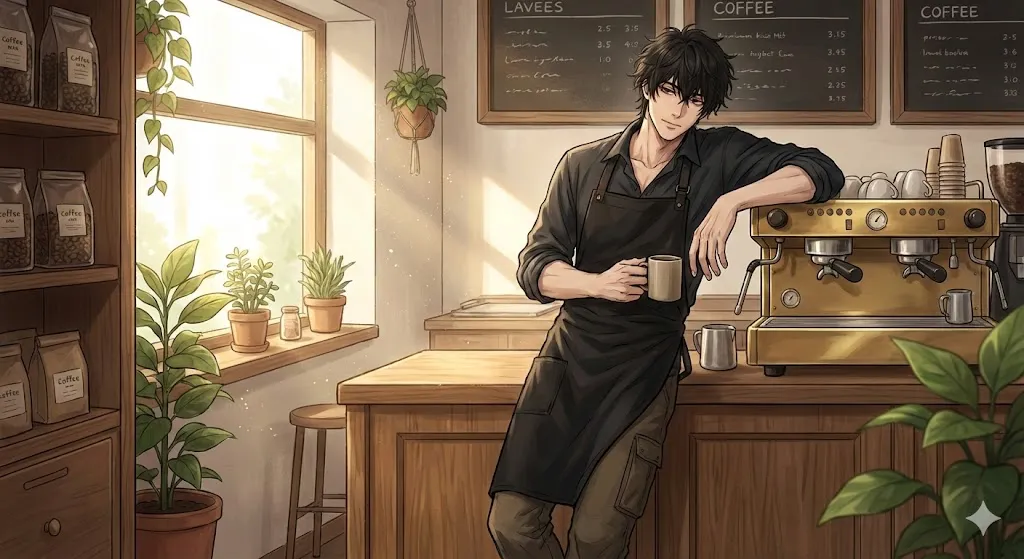
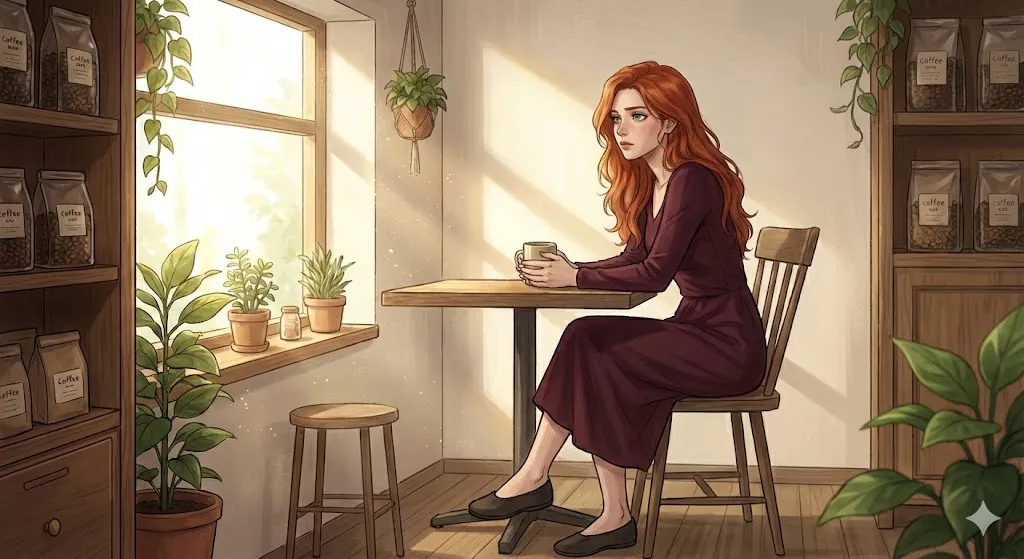
Small tables with chairs tucked neatly beneath them. A long counter with brass fixtures and glass jars filled with beans. A chalkboard menu on the wall, covered in handwriting I can't read. Flowers — flowers — in tiny vases on each table, yellow and white and pink, so aggressively cheerful it almost hurts to look at them.

Sunlight.

Warmth.

The smell of fresh coffee and something sweet, cinnamon maybe, or vanilla, something that makes my stomach clench with a hunger I'd forgotten I was capable of feeling.

"Ah."

The voice comes from behind the counter.

I flinch. Can't help it. The reflex outruns the thought, and by the time I register someone is here, my body has already obeyed the instinct. I curl inward, protecting my neck, making myself a smaller target. A prey animal caught in open ground.

"Welcome."

I look up.

The man behind the counter is… not what I expected.

I'm not sure what I expected. Someone cruel. Someone hungry. Someone with that particular gleam in their eyes that I've learned to recognize.

But this man is just… making coffee.

He's maybe thirty. Maybe older. The kind of face that doesn't commit to an age. Pleasant features. Soft eyes. An apron tied neatly over clothes that look comfortable rather than expensive. He's holding a cup, pouring something into it with the careful attention of someone who takes this single task very seriously.

He looks at me.

I stand frozen in the doorway — naked and scarred and so utterly out of place in this warm, bright space — and he looks at me the way you'd look at a customer who's come in from the rain.

Calm.

Unhurried.

His eyes traveled over me once. I feel the assessment — the curse marks, the weapon scars, the other damage that the Company didn't bother to fix because I wasn't worth the credits — but there's no heat in it. No hunger. No possessive satisfaction at what he's purchased.

Just observation. Clinical. Like a doctor noting symptoms.

"Oh," he says. Mild. Unsurprised. "That won't do."

And between one heartbeat and the next, I'm clothed.

I can't help it.

I gasp.

The fabric is soft — so soft it almost hurts— and warm and it covers me, a simple dress in deep burgundy that falls past my knees and has sleeves and I'm wearing shoes, actual shoes with soft soles, and I can't remember the last time I—

I press my hands against the fabric. Feel it shift under my palms. Real. Solid. Present.

The scars are still there underneath. I can feel them. But they're covered now. And if I don't look at them, I can almost pretend they didn't exist.

My eyes burn.

I don't cry. I don't remember how to cry. But something in my chest cracks, just a little, at this small and incomprehensible kindness.

"Better," the man says.

He's already turned back to his coffee. Like he didn't just— like this is normal — like—

"Sit wherever you'd like." He gestures vaguely at the empty tables. "I'll bring you something in a moment."

I don't move.

I can't move.

This is wrong. This is a trick. This is the part where the kindness reveals itself as setup, where the warmth turns cold, where I learn what he actually wants and it's always something, it's ⱥłⱳⱥɏꞩ—

"OH!"

The shout comes from somewhere in the back.

I flinch again. The voice is bright, loud, completely wrong for this moment — someone excited, someone who actually sounds happy — and my brain cannot make it fit into any pattern I know.

"She's here already!?"

Crash.

The sound of something falling over. Hurried footsteps. A door banging open.

And then—

A girl bursts into the shop.

She's young. A teenager, maybe. Blonde hair, bright eyes, a school uniform visible under a small apron that's already coming untied. She's carrying two cups of coffee and she's moving way too fast and her foot catches on the doorframe and she's falling, she's definitely falling—
The stumble turns into a spin. The spin turns into a pivot. Suddenly she's upright, both cups perfectly level.

Too smooth.

I've watched the Cardinal Heroes fight. I used to think that was grace. But compared to this? The Heroes look like puppets—jerked around by stats and invisible strings.

This girl moves like she's the one holding the handle.

Then she bounces forward, all teenage energy and cheer, and the impression dissolves.

Mostly.

"Hi!" She beams at me. All teeth. "You must be the new one!"

I stare at her.

She doesn't seem to mind.

"I'm—" She pauses. Glances at the man behind the counter. "What am I going by this time?"

"Lucy," he says. Doesn't look up from his cup.

"Right! Lucy!" She deposits the coffees on the nearest table with more enthusiasm than precision. "Come sit! You look like you need—" She tilts her head, considering. "Coffee. Definitely coffee. And maybe a nap. And probably some food? You're very thin. Not in a fun way. In the concerning way."

She pulls out a chair and pats the seat expectantly.

I don't move.

The man continues making coffee.

The sunlight continues streaming through the windows.

The girl — *Lucy* — continues smiling, patient and bright.

None of this makes sense.

"I don't—" My voice cracks. Splinters. How long since I spoke? The words feel like stones in my mouth. "I don't understand."

Lucy's smile softens. Not pity. Not the performed sympathy I've seen from contractors who wanted to seem kind before showing their true face.

"That's okay," she says.

She sits down, props her chin on her hand, and looks at me like I'm an interesting puzzle rather than a broken thing.

"You don't have to understand yet. You just have to sit."

She pushes the second coffee cup toward the empty chair.

"Drink something. It'll help."

"Help with *what*?"

The question comes out sharper than I meant. There's an edge — something old, something that remembers being a princess who didn't take orders from serving girls.

The moment it leaves my mouth, I flinch.

Shoulders up. Eyes down. Body bracing for impact — a slap, a shock, whatever correction comes for speaking out of turn. The response is automatic. Pathetic. I hate it, hate that I can't stop it, hate what they made me into.

Nothing comes.

I risk a glance upward.

Lucy's still smiling. Not the sharp smile that precedes pain. Not the cold smile that means you've made a mistake and you'll pay for it later. Just... the same smile. Warm. Unbothered. Like I hadn't just snapped at her. Like I'm allowed to have edges.

That's wrong.

That's so wrong it makes my skin crawl.

I know how to navigate cruelty. I know the rhythm of punishment and appeasement, how to read the temperature of a room, when to grovel and when to be silent. I was *good* at it. I survived because I was good at it.

I don't know what to do with this.

"Good question," Lucy says, as if nothing happened. As if I didn't just bare my teeth at her like a cornered animal.

She leans back, coffee cradled in both hands. The sunlight catches her hair, turns it gold, and for just a moment—

Something else looks out from behind her eyes.

Something that has watched stars die.

Then she blinks, and she's just a teenager with a coffee cup.

"We'll figure it out together," she says. "But first—" She taps the rim. "Drink. Trust me. He's weirdly good at it."

"I heard that," the man says from behind the counter.

"You were supposed to hear it! It was a compliment!"

He makes a noncommittal sound. Continues his work.

Lucy grins at me.

I stand in the middle of a coffee shop, wearing a dress I didn't choose, holding onto reality by my fingernails, and a monster in a school uniform offers me a cup of coffee like it's the most normal thing in the world.

My legs move without my permission.

I cross the shop. Lower myself into the chair. My hands find the cup — warm, solid, *real* — and wrap around it like holding on for dear life.

The coffee smells good.

Everything smells good.

I don't trust it.

I don't trust any of this.

But I'm so tired. And the chair is soft. And the sunlight is warm. And for the first time in longer than I can remember, nothing is hurting me.

"There's a price," I say. My voice is steadier now. Still cracked, still rough, but *mine*. "There's always a price. Everything in the catalog has a price. So what do you *want* from me?"

The question hangs in the air.

Lucy tilts her head.

"What do you want?" she asks.

I don't answer.

I don't know how.

Wanting things is dangerous. Wanting things gives people leverage. Wanting things means having something that can be taken away, and I have learned — in rooms I won't think about, in ways I won't remember — that the safest thing is to want nothing at all.

Lucy nods, like my silence is answer enough.

"That's okay too," she says. "You don't have to know yet. That's kind of the whole point."

She sips her coffee.

The man behind the counter starts on a new cup.

The bell above the door stays silent.

And I sit in a coffee shop that shouldn't exist, holding a cup I didn't ask for, wearing kindness I didn't earn, and I wait for the trap to spring.

It doesn't.

The sunlight stays warm.

The coffee stays hot.

And somewhere, deep beneath the exhaustion and the fear and the gray heavy nothing that has lived in my chest for so long—

Something stirs.

Not hope.

I won't call it hope.

But for the first time in longer than I can remember — I don't want to run.


A/N: My first story up here and it comes from a random bout of brain-fart I had a while ago. Discussion appreciated I suppose.
 
I wasn't expecting Hurt/Comfort from a Waifu Catalogue fic, but weirder things have happened; taking in Slightly Used waifus and helping them to recover is a good premise and your writing style really sells the emotions - or lack thereof - that Malty is feeling. I also like your choice of Malty as the PoV character, since a character that's so widely hated is perfect for a waifu that's been traded from one abusive Contractor to another.

All in all, good shit. I hope to see more.
 
*Pulls out a tray of baked chicken penne, a cocoa milkshake and a tissue box*

Welp, this seems to got me both hooked and dreading for the big sad.
 
Chapter 2: The Space Between New


I sleep.

I don't mean to. Sleep is dangerous — sleep is when they come, when things happen, when you wake up somewhere else with new marks on your body and no memory of how they got there. I learned to sleep in fragments. Minutes at a time. Never deep enough to dream.

But the chair is soft.

And the coffee is warm.

And nothing hurts.

My eyes close for just a moment — just to rest them, not to sleep, never to sleep — and when they open again, the light through the windows has changed. Gone golden. Late afternoon, maybe. Or early evening. Time moves strangely here.

I jerk upright.

Stupid. Ꞩⱦᵾꝑīđ. How long was I—*

"Oh good, you're awake."

Lucy is sitting across from me. Same seat. Same smile. Like she never moved. Like she's been watching me sleep this whole time.

I should be afraid of that.

I'm too tired to be afraid.

"You drool a little," she says cheerfully. "It's cute."

"I don't—" I touch my mouth. Dry. She's lying. But why would she—

"Made you check though."

She grins. I stare at her. Something that might be irritation flickers through the exhaustion, a pale ghost of a feeling I used to have in abundance.

"Come on." She stands, stretches like a cat. "I'll show you your room."


The coffee shop has a back.

This seems obvious. All buildings have backs. But when Lucy leads me through the door behind the counter — the one she burst through earlier, all stumbling grace and impossible coordination — I expect a kitchen. A storage room. Something finite.

Instead, there's a hallway.

It stretches.

And stretches.

And ƨϝʁԍϝcμԍƨ.

Doors line both sides, each one different. Wood and metal and glass and materials I don't recognize. Some have numbers. Some have symbols. Some have nothing at all, just blank faces that seem to watch as we pass.

"The space is… flexible," Lucy says, noticing my expression. "It's as big as it needs to be. No bigger, no smaller."

"That doesn't make sense."

"Lots of things don't make sense." She shrugs. "You get used to it."

I don't respond. My feet keep moving. One step, then another. The hallway doesn't end.

"How far does it go?"

"Depends on where you're trying to get."

"That's not an answer."

"Sure it is. Just not a satisfying one."

We pass a door that's covered in frost. Another that radiates heat. One that hums with something that sounds almost like music, too faint to identify.
"What about others?" I ask, glancing at the endless row of doors. "Does anyone else even come here?"


Lucy's smile flickers. Just for a moment.

"Sometimes. Not right now. You're the only one here at the moment."

The only one.

I don't know if that's comforting or terrifying.


My room is—

Normal.

That's the wrong word. Nothing here is normal. But the room Lucy shows me is *aggressively* ordinary. A bed with clean sheets. A window that looks out onto— something. A garden, maybe. The view shifts when I'm not looking directly at it. A small desk. A wardrobe.

A door.

With a lock.

On the inside.

"Bathroom's through there." Lucy points to another door. "Towels are in the cabinet. Clothes in the wardrobe — should fit, the space is good at guessing sizes. If you need anything else, just…" She pauses. "Actually, I don't know. Wish really hard? It usually works."

I'm not listening anymore.

I'm staring at the lock.

"It works," Lucy says. Softer now. "The lock. It's real. No one can come in unless you let them."

My hand reaches out without permission. Touches the brass mechanism. Turns it.

*Click.*

Such a small sound.

I turn it back. *Click.* And again. *Click. Click. Click.*

"Malty."

I stop.

Lucy is watching me with those eyes that are sometimes young and sometimes ancient and right now are just… kind. Simply kind.

"No one's going to hurt you here," she says. "I know you don't believe that yet. That's okay. You don't have to believe it. It's still true."

I want to laugh. I want to scream. I want to ask her how many times I've heard those words before, from how many mouths, in how many rooms that turned into prisons the moment I let my guard down.

I don't do any of those things.

I just stand there, hand on the lock, and wait for her to leave.

She does.

The door closes behind her.

I lock it.

Then I sit on the floor with my back against the wall, facing the door, and I wait for something to happen.


Nothing happens.

I waited for hours. Or what feels like hours. The light through the window changes, cycles, does something that might be a sunset and might be something else entirely. My legs cramp. My back aches. The bed sits there, soft and unthreatening, and I don't touch it.

Beds are dangerous.

Beds are where things happen.

So I stay on the floor, and I watch the door, and I wait.

The lock doesn't turn.

No one tries the handle.

The silence is absolute — not the heavy silence of a predator waiting, but the gentle silence of a space that simply has nothing to say.

Eventually, my body betrays me again.

I sleep.


I woke up on the floor.

Same position. Same room. Same lock, still engaged.

Nothing has changed.

I check myself — automatic, reflexive, a habit I don't remember developing. No new marks. No soreness I can't account for. My dress is still in place. My body is still mine.

Still ᵯīꞥē.

The thought is strange. Foreign. I turn it over in my mind as I shut my eyes once more.

When was the last time I woke up and my body was still mine?

-----

I didn't leave the room that first day.

There's food outside the door when I finally unlock it — just a crack, just enough to see — a tray with bread and fruit and something that smells like soup. Still warm. I don't know how long it's been there. I don't know who left it.

I don't eat it.

Could be drugged. Could be poisoned. Could be—

But I bring it inside. Close the door. Lock it again.

I stare at the food for a long time.

My stomach hurts.


The second day, I left the room.

Not because I'm brave. Because I'm hungry enough that the fear of starving outweighs the fear of poison, and if they wanted to drug me they could do it through the air, through the water, through a hundred methods I couldn't prevent, so what does it matter if I eat or don't eat, it's all ̸t̶h̸e̴ ̸s̷a̵m̶e̸,̵ ̷i̶t̵'̶s̸ ̵a̸l̶l̸—

I stop.

Breathe.

The thoughts are spiraling again. Running in circles. I recognize the pattern now, can feel when my mind starts chasing its own tail, and sometimes — *sometimes* — I can stop it before it drags me down.

Not always.

But sometimes.


The coffee shop is different in the morning.

Brighter. The sunlight has a quality to it that feels new, like the world was just created and hasn't had time to grow old yet. The man — my contractor, my owner (the word sticks in my throat even as a thought) — is behind the counter again.

Still making coffee.

Does he ever do anything else?

"Good morning," he says without looking up.

I don't respond.

He doesn't seem to expect me to. Just continues his work, hands moving with practiced precision, steam rising from cups I'm not sure anyone will drink.

I sit at the same table as before. The one Lucy put me at. It feels… claimed. Mine, in some small way.

A cup appears in front of me.

I didn't see him move. Didn't hear footsteps. But there's coffee on the table, and he's back behind the counter, and—

"It's not drugged."

I flinch at his voice. He's looking at me now. Those eyes that are warm on the surface and something else underneath.

"I know you won't believe that," he continues. "So I'll just say it once, and you can decide what to do with the information. Nothing I give you will ever be drugged, poisoned, or otherwise altered without your knowledge and consent. If I need to sedate you for some reason, I'll tell you first. If I need to administer medication, we'll discuss it."

He returns to his work.

"The food in your room is the same. Eat or don't. That's your choice."

Choice.

There's that word again.

I wrap my hands around the cup. It's warm. I don't drink.

But I don't push it away either.


"He's weird, right?"

I was startled. Lucy has appeared beside me — I didn't hear her approach, and I should have heard her approach, I *always* hear them approach — sliding into the seat across from me like she belongs there.

"Sorry!" She holds up her hands. "Didn't mean to scare you. I forget to make noise sometimes."

*Forget to make noise.*

What kind of person forgets to make *noise*?

"He's weird," she continued, apparently taking my silence as agreement. "The whole—" she gestures vaguely at the man behind the counter, "—thing. The coffee obsession. The way he talks. But he's good at what he does."

"What does he do?"

The question comes out before I can stop it. The first thing I've voluntarily asked since arriving.

Lucy tilts her head as if thinking about something.

"He fixes things."

"Things."

"People." She shrugs. "People are things too, in a way. Complicated things with too many moving parts that break in weird places. He's good at finding the broken parts."

"And then what?"

"Then he helps you figure out what to do about them." She leans back, a coffee cup appearing in her hands from nowhere. "He doesn't fix them for you, if that's what you're asking. That's not how it works. He just… shows you where they are. What shape they're in. What your options might be."

I absorb this. Try to fit it into the framework I know — contractors want things, everything has a price, kindness is just cruelty wearing a mask.

It doesn't fit.

"Why?" I ask.

"Why what?"

"Why does he do this? What does he get out of it?"

Lucy's smile changes. Deepens. For a moment, something vast looks out from behind her eyes — something that has watched civilizations rise and fall, that exists on a scale where human concerns are barely visible.

"That," she says, "is a very good question."

She doesn't answer it.


We sat in silence for a while.

It's not uncomfortable, surprisingly. Silence with another person usually feels like a held breath, like waiting for the other shoe to drop. But Lucy just sips her coffee and looks out the window, and I sit with my untouched cup, and neither of us speaks.

"You're wondering what I am," she says eventually.

I don't deny it.

"I'm lots of things." She traces a finger around the rim of her cup. "Depending on who you ask. Depending on when. Names are slippery. Identities even more so."

"That's not an answer."

"You keep saying that." She smiles. "Maybe you should accept that I don't give the kinds of answers you're looking for."

I should let it go. I should stay quiet, stay small, stay safe. But something in me — some remnant of the princess I used to be, the schemer, the liar — pushes forward.

"You're bad at it," I say.

Lucy blinks. "Bad at what?"

"The act."

I lean forward, keeping my voice low.

"I spent my whole life wearing masks. I know what a performance looks like. And you…" I gesture at her apron, at the teenager's disguise. "You're overdoing it. You're trying too hard to seem harmless."

Lucy's smile stays fixed, but her eyes sharpen.

"Yesterday," I continued. "When you came through the door. You stumbled. But you didn't fall. You caught yourself with a pivot that shouldn't be physically possible. I've watched high-level adventurers move. I've seen the Sword Hero fight. Even he obeys gravity."

I take a breath. My heart is hammering, but I force the words out.

"You didn't just recover. You decided not to fall. And then you bounced up and smiled like a clumsy schoolgirl, hoping I wouldn't notice the difference."

I glance at the man behind the counter, then back to her.

"And you're not afraid of him. You don't serve him. You treat him like an equal. Maybe even a pet project." I shake my head. "Waitresses don't look at their bosses like that."

Something shifts in Lucy's expression. Respect, maybe. Or amusement.

"Clever," she says. "I wondered if you'd notice that."

"So?"

"So." She sets down her cup. Look at me directly, and for a moment the mask of a cheerful teenager slips entirely. "Let's just say that I'm here because I choose to be. Not because anyone compelled me. Not because anyone could compel me. I work with him, not for him. And if you're wondering whether I'm dangerous—"

She leans forward.

"Yes. Very. But not to you. Not to anyone in this place."

The words should frighten me.

They don't.

"Why are you here?" I ask. "Why are you doing this?"

Lucy is quiet for a long moment. The sunlight shifts around her, catching her hair, and for just a heartbeat I see something else behind her — wings, maybe, or fire, or a darkness so absolute it makes the void look bright.

Then it's gone.

"Because I know what it's like to fall," she says simply. "To be cast out of everything you knew. To have your name become a curse in the mouths of those who once called you brother."

She picks up her cup again. Sips.

"And because someone, somewhere, somewhen—" She glances toward the man behind the counter. "—didn't give up on me when they probably should have."

I don't know what to say to that.

I don't think I'm meant to say anything.


The man — I still don't have a name for him, and something tells me that's intentional — finishes whatever he's doing behind the counter and walks over.

He sits at the table.

Not across from me — at the third seat, forming a triangle. Equal distance from both of us.

"You've been here two days," he says. Not a question.

"Yes."

"You haven't eaten."

"…No."

He nods. Doesn't lecture. Doesn't push.

"When you're ready," he says, "we'll begin."

"Begin what?"

"Talking." He folds his hands on the table. "About whatever you want to talk about. Or nothing at all. The pace is yours."

I wait for the catch. The condition. The *but*.

It doesn't come.

"I don't—" I stop. Start again. "What do you want from me?"

"Nothing."

"That's not—"

"Possible? True?" He tilts his head, and for a moment I see it — the thing that Lucy mentioned, the strangeness, the sense that he's looking at me like a puzzle rather than a person. "Let me rephrase. What I want is for you to get better. What that means, what *better* looks like — that's for you to define. Not me."

"And if I can't? If I'm—" ฿ⱤØ₭Ɇ₦ 𝗿⃥𝘶̸𝗶⃥𝘯̸𝗲⃥𝘥̸ "—if it doesn't work?"

"Then it doesn't work." He shrugs. "And we figure out what comes next. But I don't think that's going to be the case."

"Why?"

Something flickers across his face. Not quite a smile. Not quite anything I can name.

"Because you're still asking questions," he says. "People who've given up don't ask questions. They just wait for things to happen to them."

He stands.

"Whenever you're ready. No rush."

He returns to the counter.

Lucy catches my eye and shrugs, as if to say: *I told you he was weird.*

And somewhere in my chest, beneath the fear and the exhaustion and the gray heavy nothing—

Something stirs.


That night, I eat.

Not much. A few bites of bread. Some of the fruit. Enough to quiet the ache in my stomach without committing fully to the idea that this food is safe, that this place is safe, that anything is safe.

But I eat.

And when I sleep — on the bed this time, not the floor, a concession so small it feels revolutionary — I dream of hallways that stretch forever and doors that lead everywhere and nowhere.

And a voice, soft and ancient, that whispers:

Take your time. We're not going anywhere.


A/N: Pretty much the prelude for what is coming next chapter. Just started playing Disco Elysium as well, which reminds me of one of the fever dream I had. Discussion welcomed as always.
 
Just as I expected, Lucy is Lucifer. With that mystery finally solved, now we can focus on the cafe owner.

*Eats a spoonful of chicken penne*
 

Users who are viewing this thread

  • Back
    Top