Random dude from Earth lands in Lungmen, selling things that may or may not be magical. The cart is normal, don't think too hard on it. It's not an SCP, trust me, bro.

Navigation
Install the app
How to install the app on iOS
Follow along with the video below to see how to install our site as a web app on your home screen.
Note: This feature may not be available in some browsers.
More options
-
An addendum to Rule 3 regarding fan-translated works of things such as Web Novels has been made. Please see here for details.
-
We've issued a clarification on our policy on AI-generated work.
-
Our mod selection process has completed. Please welcome our new moderators.
-
Due to issues with external spam filters, QQ is currently unable to send any mail to Microsoft E-mail addresses. This includes any account at live.com, hotmail.com or msn.com. Signing up to the forum with one of these addresses will result in your verification E-mail never arriving. For best results, please use a different E-mail provider for your QQ address.
-
The rules regarding NSFW links have been updated. See here for details.
You are using an out of date browser. It may not display this or other websites correctly.
You should upgrade or use an alternative browser.
You should upgrade or use an alternative browser.
Selling (Somewhat) Magic Goods in Arknights
- Thread starter Paracsus
- Start date
- Created
- Status
- Incomplete
- Watchers
- 405
- Recent readers
- 0
- Threadmarks
- 27
-
Statistics (20 threadmarks, 69k words)
User Total Paracsus 20 Threadmarks Reader mode RSS -
Loading…
-
Loading…
More options
Who Replied?
Pilot
Paracsus
Know what you're doing yet?
- Joined
- Dec 20, 2023
- Messages
- 194
- Likes received
- 3,330
A Whole New World
Arno arrived without fanfare.One moment, he had been staring at a screen too late at night, half-asleep and barely processing the music in the background. The next, the world tilted—not violently, but decisively, like a book being closed.
He didn't fall through a wormhole, or die in a sudden attack or simply meet God, or any of the traditional isekai tropes. No, those would have been preferable since they would have at least given him a sort of key to what happened.
Instead, he woke up on the side of the alley.
Cold stone pressed against his palms when he tried to push himself up. The air smelled wrong—sharp, metallic, threaded with something faintly acrid. He sucked in a breath and immediately regretted it. This wasn't his apartment.
This wasn't a dream.
Dreams didn't ache like this.
When Arno finally lifted his head, the sky above him was unfamiliar. Too wide. Too clear. Structures rose in the distance—tall, angular buildings layered with lights and signage that had an unfamiliar alphabet, but one that he could somehow read perfectly.
Lungmen.
The name bounced in his mind without context or explanation. He didn't question it just yet. Questioning came when he had the time and headspace to think.
A shape loomed beside him.
Arno turned, heart hammering, and froze.
A cart stood there as if it had always belonged, its wooden panels unscuffed, its metal fittings dull but solid.
His phone was gone.
His bag was gone.
Everything he owned—except the clothes on his back—had been replaced by this.
He stood slowly, muscles tight, and approached the cart. The moment his hand brushed the latch, a sensation pressed into his awareness. Not a voice. Not words.
This is yours.
The door opened.
Inside was space. Too much space. Warm light spilled outward, revealing shelves already stocked with goods. Food. Medical supplies. Household items. All simple. All mundane. All very, very real.
Arno stepped back, breathing hard. "No," he said, because saying it out loud made it more solid. "This isn't real."
The world did not respond.
People passed nearby—citizens going about their day, not looking at him, not reacting to the impossible arrival that had just occurred. To them, the cart was ordinary. To them, he was ordinary.
That scared him more than panic would have.
He closed the cart.
When he opened it again, the interior was unchanged.
Night came. Then in the morning, hunger followed. Thirst after that.
Eventually, survival won.
Arno sold his first item that day: a bottle of juice, priced low enough that the buyer didn't hesitate. The coins felt heavy in his palm. Real.
That night, he slept inside the cart.
He didn't sleep well.
Learning Curve
The cart taught him nothing directly.
That became clear within the first few weeks.
It didn't offer instructions, or a ledger, or a system window floating obligingly in his vision. There were no levels to grind, no quests to complete, no rewards that announced themselves with certainty. If there were rules, they existed the way city ordinances did—visible only after violation.
Arno learned by repetition.
He learned first that the cart favored necessity over comfort. Food always came plain: rough bread, dried meat, rice packed in coarse sacks, bottled juice with barely any sweetness. Nothing spiced. Nothing indulgent. Even hunger relief felt deliberately unromantic.
That, at least, made sense.
Pricing taught him restraint. Setting prices too high dulled demand, but worse, it dulled the cart. The next morning's stock felt thinner, the shelves arranged with less patience, as if correcting him. Pricing too low created different problems. People lingered. Bought more than they needed. Returned too quickly.
The cart disliked that.
When Arno ignored the warning and sold three bundles of dried meat to the same customer in one afternoon, the next day's restock replaced meat with more bread instead. Less valuable. Slower to move. A nudge, not a punishment.
He stopped pushing.
He learned that stock did not accumulate. Unsold goods vanished overnight unless the cart deemed them worth repeating. Meat never spoiled, but it also never carried over. Bread was always fresh. Juice bottles were always sealed. The cart wanted turnover, not hoarding.
That rule extended to money.
Coins stored inside the cart remained. Coins carried on his person felt… heavier. More real. When he tried to leave a portion inside overnight, he woke to find the amount unchanged, but the cart's hum uneasy. He learned to keep his earnings with him.
Ownership mattered.
Time inside the cart moved differently, but not kindly. Sleep restored his body, but not his nerves. Hunger dulled without disappearing. Fatigue softened, but mental strain lingered. Whatever force governed the cart preserved functionality without mercy.
It wanted him operational.
Arno mapped Lungmen slowly. Not by landmarks, but by tolerance. Streets where guards passed regularly. Alleys where merchants could stay unbothered for hours. Corners where people bought food quietly and left without comment.
He stayed away from crowds.
Food attracted attention. Necessities always did.
Customers rarely spoke, but when they did, Arno listened. About shortages. About raids. About days when patrols tightened or vanished entirely. He learned which rumors preceded trouble and which were just noise.
The cart seemed to approve of caution.
On days when he closed early because the street felt wrong, the shelves the next morning felt stable. Full. Predictable. On days when he stayed too long out of stubbornness, something was always off—less juice, more bread, stock that sold slower.
He learned to trust instinct over profit.
The first real test came when a man tried to force a bulk purchase. Meat. Enough for resale. Arno felt the pressure immediately—an internal resistance, the cart's awareness sharpening.
"No," Arno said, calmly.
The man left angry. The cart settled.
That night, Arno realized something important.
The cart was not a store.
It was a filter.
It distributed only what the city could absorb without disruption. Food that filled bellies but didn't change power. Supplies that patched wounds but didn't win fights. Enough to survive, never enough to dominate.
Arno lay on the narrow bed, staring at the warm-lit ceiling, and understood that this phase—this quiet, grinding routine—was intentional.
The cart wasn't waiting for him to succeed.
It was waiting to see if he could be trusted not to break the balance.
So Arno sold bread.
He sold juice.
He sold meat and bandages and soap.
And he learned how to stay invisible.
Two Months After Arrival
Two months was enough time to learn which streets in Lungmen were safe, and which ones only pretended to be.Arno parked his cart where he always did—half a block from the tea shop with the flickering sign, close enough to the foot traffic to matter but far enough from the main road to avoid attention. It wasn't a prime location. That was the point.
The cart looked ordinary, if a bit large. Wooden panels, reinforced corners, a metal-rimmed wheel on each side. The kind of carriage a traveling merchant might have used decades ago. People glanced at it and decided it wasn't worth more thought than that.
Arno lifted the latch and opened the side panel. The interior unfolded into something that still unsettled him, even after two months. The space stretched deeper than it should have, wide enough to stand in without crouching, shelves extending back into a dim, warm-lit corridor.
He didn't think about how it worked.
Thinking too hard about the cart had taught him that much.
The shelves were already stocked when he woke up that morning. They always were.
Simple things, as usual.
Food came first. Dried meat sealed in plain paper. Rough bread loaves that tasted better when warmed. Bottles of juice, faintly sweet and faintly artificial. Hard candies and soft ones, individually wrapped.
Below them were medical supplies. Clean cloth bandages. Adhesive strips. Alcohol wipes. A mild herbal salve that smelled faintly of camphor and mint. It worked—he'd seen it work—but it never did anything dramatic.
That seemed to be a pattern.
The rest of the shelves held odds and ends: soap bars, candles, matches, sewing kits, spare buttons, cheap notebooks, pencils, hand towels, playing cards. Items that filled small gaps in people's lives.
Arno sold what the cart gave him.
He didn't know why it chose these things. He didn't know if it would ever choose differently. Once, early on, he'd tried to ask.
All he got was a prompt in his head, telling him to not question it. Repeated queries only got either the same answer, or silence.
So he'd stopped asking.
He arranged the goods carefully, hands steady from repetition. Two months of this had taught him that consistency mattered. The cart never reacted to enthusiasm, or ambition, or clever ideas. It reacted to routine.
Sell. Restock. Sleep. Repeat.
The first customer arrived just after noon, a courier with tired eyes and a scraped palm.
"Bandages?" the man asked.
Arno nodded and held one up. "Cloth or adhesive."
"Cloth."
He paid, left, and didn't look back.
That was most transactions. Quiet. Efficient. Forgettable.
Arno preferred it that way.
By mid-afternoon, he'd sold half the bread and most of the candies. The juice went faster on humid days. The soap sold well when rumors of inspections spread. He didn't know why the cart stocked what it did, but he was learning when people wanted them.
That felt important.
Every so often, Arno felt the cart shift beneath his feet—not physically, but conceptually. A low hum, like something paying attention. Watching numbers he couldn't see. Counting progress in a way that never quite surfaced.
It didn't tell him how close he was to anything.
But sometimes, after particularly good days, the shelves felt… fuller. More stable. As if the cart approved.
He tried not to think about what that might mean.
A Lungmen Guard patrol passed by in the early evening. Arno kept his eyes down, hands busy rearranging stock that didn't need rearranging. The cart's hidden mechanism stirred at the edge of his awareness, ready to fold in on itself if he needed it to.
He didn't.
The guards didn't stop.
Good.
As the sun dipped and the streetlights flickered on, Arno began packing up. Unsold goods went back onto the shelves. Nothing ever spoiled. Nothing ever carried over unless it was meant to.
When he closed the cart, the space folded inward. From the outside, it became smaller, simpler. Just another locked carriage parked against the curb.
Inside, the light warmed. A narrow bed. A small table. A kettle that always had water.
Home.
Arno sat down, exhaled, and counted the day's earnings. Enough to eat. Enough to restock tomorrow.
Enough to keep going.
Somewhere, deep within the cart, something shifted—slowly, patiently—waiting for him to reach whatever invisible line it had drawn.
Arno didn't know what came after.
He just hoped it wouldn't demand more than he could give.
AN: Hello! My name is Paracsus, and this is my first fanfic on this site. This is also the first longform fanfic I have ever made, so please tell me if there are any points in this fic where I can make some improvements. I am also just a casual player of Arknights so I don't wanna force Arno (my OC) to be forced to deal with the crazier stuff this game has, like the Collapsals, the Dragon Gods, Kazdel, and Priestess. I just wanna have him dip into the street level stuff and keep the story somewhat simple.
I've written the first few of these chapters a looooong time ago, and only just decided now to finally post it after sitting on this for more than a year now. After some major revisions and touching up. Gonna post the others later, and I'm only doing this as a hobby so I won't have an exact posting schedule.
Anyway, this fic was inspired by a handful of other shopping fics that I have read before. Those namely being:
Corner Case, by Kencord
What Are You Buying?, by Infonticus
Late Night Diner at Rhodes Island, by setarium
The Traveler's League: The Merchant, by WolfSpatial; and
Multidimentional Merchant, by Wrathkal
Major shout out to these fanfics and the writers who made them, I highly recommend watching these if you can. Thank you!
Last edited:
Chapter 2
Paracsus
Know what you're doing yet?
- Joined
- Dec 20, 2023
- Messages
- 194
- Likes received
- 3,330
Learning the Shape of the Days
The first week taught Arno that panic was expensive.Not in currency, but in energy, in attention, in the way Lungmen noticed things that moved too fast or hesitated too long. He learned quickly that the city did not reward urgency. It tolerated it, sometimes, but it remembered.
So he slowed down.
He spent the earliest mornings inside the cart, sitting at the narrow table while the city woke outside. The interior adjusted itself to him without comment. The kettle heated when he touched it. Water refilled overnight. The bed remained made unless he slept in it. His clothes, once placed on the small shelf built into the wall, were clean when he reached for them again.
There was no abundance on display, no excess meant to impress. The cart provided what he needed within reason, as if it were unwilling to invite curiosity even from him.
Arno tested its limits only once.
On the fourth day, after waking with a dull ache behind his eyes, he asked aloud if there was medicine.
The pressure in his head returned, not painful but firm, directing him toward the shelves near the rear of the space. A small packet sat there, unremarkable and sealed. He took it, followed the instructions printed in plain text, and the headache faded over the next hour.
He did not ask again.
Instead, he observed.
The cart never gave him luxuries. Meals were filling but repetitive. The lighting remained warm but subdued. There were no windows inside, only a sense of time passing conveyed by subtle shifts in brightness. When he slept, he slept deeply. When he woke, his body felt rested in a way that bordered on unnatural.
It did not make him stronger. It did not make him faster.
It simply kept him functional.
That, he learned, was valuable.
During the first month, he moved the cart often. Different streets. Different districts. He paid attention to how long people lingered, which patrols doubled back, where vendors were tolerated and where they were pushed out. Lungmen was not hostile to commerce, it was greatly welcomed. However, it was also territorial about space.
He watched other merchants as carefully as they watched him.
Most sold specialized goods: electronics, cooked food, trinkets, services. His cart stood apart by virtue of its generality. He offered nothing rare, nothing that undercut existing businesses too aggressively. When confronted, he deferred. When questioned, he answered briefly.
He learned that selling bread early in the morning drew a different crowd than selling it near dusk. That bandages sold best near transit hubs, while soap moved faster in residential areas. That candies worked as impulse purchases, especially among workers too tired to care about nutrition. Even with this knowledge, Arno chose to stay where the middle to lower class citizens were. Doing so allowed him to gain a decent customer base without feeling threatened by more opulent rivals.
He adjusted prices slowly, in increments small enough that no one complained.
Coins accumulated in a compartment beneath the counter, while bills stayed under in a safer place. The cart accepted them without ceremony, sliding them away into a space he never accessed. When he needed money, it returned exactly what he required. Never more. Never less.
That bothered him less as time went on.
By the middle of the second month, Arno stopped thinking of his life as temporary.
That realization unsettled him more than his arrival had.
He developed habits. He woke at the same hour each day, even when he did not need to. He cleaned the cart's exterior every third morning, wiping dust and grime from the panels so that it blended better with its surroundings. He rotated his stock according to patterns he could not fully explain but trusted anyway.
Some evenings, he sat inside and listened to the city through the cart's walls. Traffic. Voices. Distant sirens. Music bleeding from open windows several floors up. The city felt layered, compressed, constantly negotiating with itself.
He did not miss his old world the way he thought he would.
That absence felt like something he would examine later, when survival no longer required his full attention.
Customers began to recognize him.
Not by name, at first. By presence. By reliability. By the fact that he was there when expected and gone when he was not. A woman who worked night shifts bought juice from him twice a week. A delivery runner preferred his bandages over the ones sold near the main road. A pair of students stopped by for candy on Fridays.
They did not ask where he came from.
He did not offer.
When the cart folded inward at night, it did so completely. From the outside, it appeared locked, dormant, indistinct. Inside, Arno prepared meals, washed his hands, and sat at the table with nothing to do but think.
That was when the weight of it pressed in.
He thought about how the cart never malfunctioned. How the goods replenished without explanation. How the space inside remained stable regardless of where he parked. He thought about how the city had accepted him without resistance, as if he had been accounted for long before he arrived.
He did not feel watched.
He felt tracked.
Not in a threatening way. In the manner of infrastructure. Like a utility quietly measuring flow.
When those thoughts became too heavy, he slept.
By the end of the second month, Arno had chosen his street.
Not because it was optimal, but because it was predictable. The buildings cast long shadows in the afternoon. Foot traffic followed a rhythm he could map in his head. Patrols passed without variation.
The tea shop owner had stopped commenting on his presence. That, more than anything, marked his success.
On the morning he realized he no longer flinched at the sound of armored boots, Arno paused with his hand on the cart's latch.
He stood there longer than usual, aware of the way the city's air moved around him, aware of the fact that he knew how to live here now.
The cart waited.
Whatever came next would come when it was ready.
Until then, Arno sold what was placed in front of him, slept when night arrived, and learned the shape of his days by repeating them.
In Lungmen, that was not complacency.
It was competence.
What Appears After Closing
The change did not happen while the cart was open.
Arno noticed that first.
He had closed at the usual hour, folding the awning inward and locking the exterior panels until the cart looked like any other unattended carriage resting against the curb. The street outside continued its evening rhythm without acknowledging him. Lights flickered on in the surrounding buildings. The tea shop's shutters came down with a metallic clatter. Somewhere farther down the block, a radio played low music distorted by distance and walls.
Inside, the cart gave him something new.
It appeared without much fan fair, but Arno noticed it immediately since it occupied a previously empty space. It was not much to look at, simply a cardboard box without any brands to indicate where it came from. Arno cautiously grabbed the box and shook it a few times, as if that sound would tell him if the contents were dangerous.
It did not.
He stepped fully inside and let the door close behind him. The sound sealed with a soft, final click that carried more weight than usual.
The familiar rows of food, medical supplies, and household items remained exactly where they had been that morning. Bread still sat on the middle shelf. Bandages remained stacked in their neat rows. Candies, soaps, and bottled drinks occupied their usual places.
But now, he had something new. Opening the box yielded two new items that he had never seen before.They were not highlighted. They did not glow. If Arno had not already known the cart well, he might have missed them entirely.
The first item inside the cardboard box was a small, decorative box, pale cream in color with soft pastel patterns along the edges. Inside were six individually wrapped candies, each square and wrapped in wax paper stamped with a simple emblem. Butter candies.
The second was a slim package no larger than a deck of cards, decorated to resemble a cigarette case. Inside were sugar sticks shaped and wrapped like cigarettes, their tips faintly tinted pink. Sugarettes.
Between them lay a folded slip of paper.
Arno did not touch anything at first.
He stood in the center of the cart, letting his breathing slow, letting his eyes move deliberately from one object to the next. He had learned early that the cart did not reward haste. It did not respond to panic. It simply waited.
Finally, he picked up the paper.
The texture was thicker than normal receipt paper, slightly fibrous, like something meant to endure handling. The writing was printed in clean, plain lettering.
Butter Candies
Consumed orally.
Effect: induces a state comparable to light rest and recovery.
Duration: approximately three hours.
Aftereffect: increased fatigue once the effect concludes.
Below that, separated by a small line:
Sugarettes
Ignitable sugar sticks.
Produces scented smoke upon use.
Effect is non-harmful and temporary.
There were no prices. No warnings beyond what was stated. No explanation for why these had appeared now.
Arno folded the paper and set it on the table.
He sat down, hands resting flat against the wood, and stared at the new stock. His first instinct was caution. He had survived two months by respecting limits he did not fully understand. New items meant new variables.
But the cart had not given him anything dangerous before.
And the paper had been clear.
He reached for the butter candies.
The box was light, the cardboard firm. He opened it carefully and unwrapped one square. The candy was pale yellow, faintly glossy, and smelled like cooked sugar and dairy. He placed it in his mouth and let it dissolve slowly.
The effect was subtle at first.
Warmth spread through his chest, not heat exactly, but a loosening sensation, as if tension he had not noticed was being unwound. His shoulders relaxed. The faint ache in his wrists from setting up and tearing down the cart each day receded. His breathing deepened without effort.
It did not feel like stimulation.
It felt like relief.
Arno leaned back in his chair, eyes closing briefly. The cart's interior seemed sharper when he opened them again, colors more defined, edges clearer. The fatigue he had carried since morning receded, replaced by a sense of physical readiness, like waking from a short nap that had been timed perfectly.
He stood and walked the length of the cart, testing his balance, his awareness. Everything responded as expected. There was no disorientation, no rush, no artificial sharpness.
Three hours later, the effect ended.
It was unmistakable.
The warmth faded first. Then heaviness settled into his limbs, more pronounced than the fatigue he had felt before. His eyelids grew heavy. His body demanded rest with an insistence that bordered on discomfort.
Arno did not resist it.
He lay down on the bed and slept.
When he woke, the fatigue had passed, leaving him restored but wary. The experience had been precise. Controlled. Balanced by design.
He sat up and reached for the sugarettes.
The package opened easily. He removed one stick and examined it under the light. It looked exactly like a cigarette, down to the paper wrapping and the colored tip. He lit it using a match from the shelf.
The sugar caught quickly.
He inhaled cautiously and exhaled.
A cloud of smoke drifted from his mouth, thick and pale, carrying the unmistakable scent of roses. The smoke spread gently through the air, curling upward before thinning and dispersing. It lingered for a short while, then vanished without leaving residue.
His throat did not burn. His lungs did not protest. There was no lingering taste beyond sweetness.
Arno extinguished the stick and watched the last traces of smoke fade.
"Smells of rose. Interesting." He muttered.
By the time he returned the items to their place on the shelf, his understanding had shifted. The cart had not given him tools for conflict or escape. It had given him comforts that bordered on utility. Items that made long days easier. Items that could smooth the edges of exhaustion and stress.
Items that people in Lungmen would buy without thinking twice.
He placed the slip of paper in a drawer beneath the table. Tomorrow, he will decide how to price them.
For now, he turned off the lights and prepared for sleep, aware that something fundamental had changed, not in the city, but in the quiet agreement between him and the cart.
It had not asked more of him.
It had simply offered something new.
And in Lungmen, that alone was worth paying attention to.
Last edited:
The Cart
Paracsus
Know what you're doing yet?
- Joined
- Dec 20, 2023
- Messages
- 194
- Likes received
- 3,330
AN: Hello, again. Just wanna establish some things about the Cart. Essentially, the cart looks like this, but the difference is that it doesn't need to be pulled by anything. It is effectively a car that also works as Arno's home. It is alot bigger on the inside of the cart as opposed to outside, but it has a perception filter so that people will not be able to see the inside. When they see Arno standing in it, all they see are a few shelves of extra stock (extra food, cigarettes, drinks,etc.), when in reality it leads to the interior of the "house". Whenever Arno needs to restock on mundane goods, he just pulls the stock from a compartment (read: pocket dimension) that is under the counter, so as to avoid suspicion.
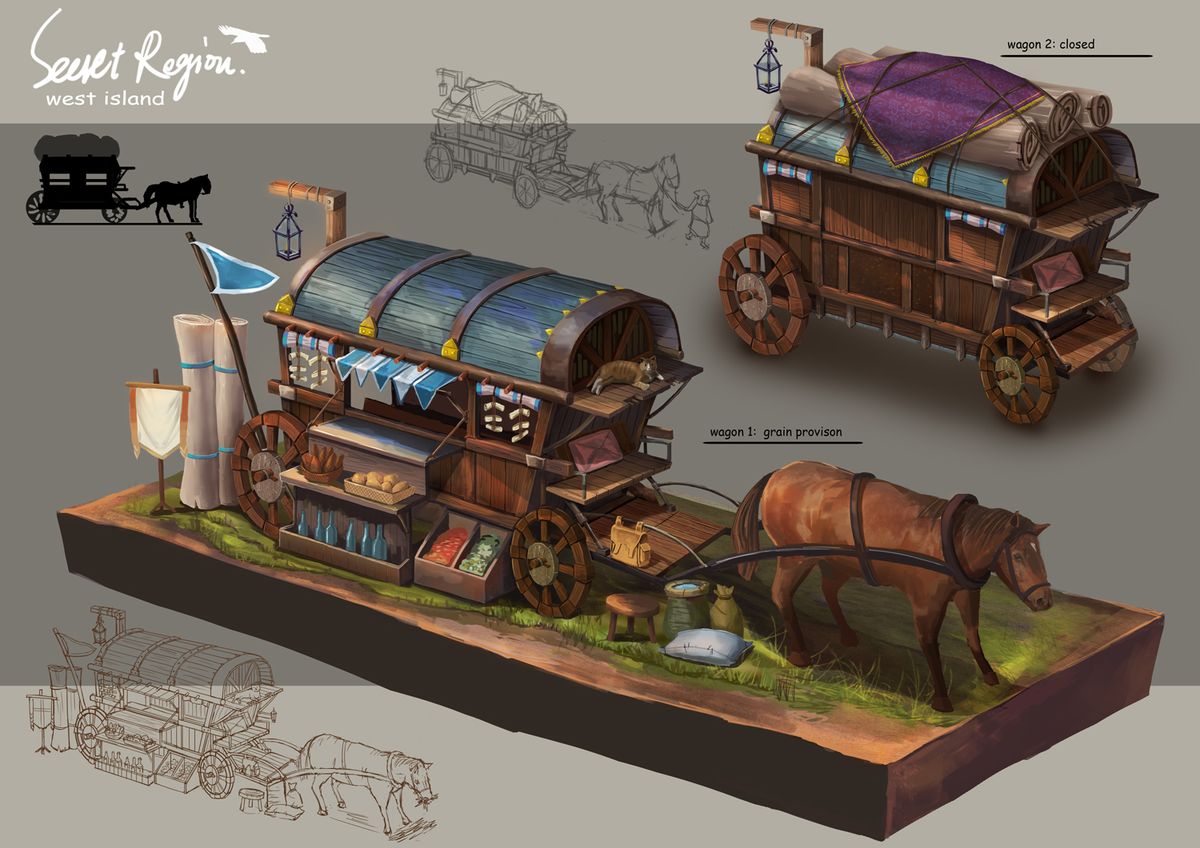
The Cart has it's own set of rules and guidelines that Arno follows, which will be adressed as the story goes on. One of which is that to prevent Arno from living eternally as a hermit, the facilities and food is very simple so as to encourage him to go out and explore while also feeling somewhat like a home; safe and cozy. This is the interior:

The windows exist, but are not visible to the public. They are there so as Arno will be able to see what is happening outside, and to let natural light into the house.
Another thing is that the Cart is shown have a mind of it's own, but is not exactly either sentient or sapient. It knows when Arno is trying to stay inside, or (as mentioned in a previous attempt) trying to get a shortcut to wealth by selling in massive bulk. The perception filter that it has also acts as a cloaking device; when Arno closes and turns in for the night, it effectively becomes invisible and untraceable to others in order to protect him and itself. It also knows when the area in general is not safe, so it moves to a nearby safe location.
It also prevents reselling. What happens when people try? Stay tuned, dear consumers.
Edit: I changed the picture of the interior because some facilities like the shower weren't exactly visible. But everything else still remains simple.
The Cart has it's own set of rules and guidelines that Arno follows, which will be adressed as the story goes on. One of which is that to prevent Arno from living eternally as a hermit, the facilities and food is very simple so as to encourage him to go out and explore while also feeling somewhat like a home; safe and cozy. This is the interior:
The windows exist, but are not visible to the public. They are there so as Arno will be able to see what is happening outside, and to let natural light into the house.
Another thing is that the Cart is shown have a mind of it's own, but is not exactly either sentient or sapient. It knows when Arno is trying to stay inside, or (as mentioned in a previous attempt) trying to get a shortcut to wealth by selling in massive bulk. The perception filter that it has also acts as a cloaking device; when Arno closes and turns in for the night, it effectively becomes invisible and untraceable to others in order to protect him and itself. It also knows when the area in general is not safe, so it moves to a nearby safe location.
It also prevents reselling. What happens when people try? Stay tuned, dear consumers.
Edit: I changed the picture of the interior because some facilities like the shower weren't exactly visible. But everything else still remains simple.
Last edited:
Chapter 3
Paracsus
Know what you're doing yet?
- Joined
- Dec 20, 2023
- Messages
- 194
- Likes received
- 3,330
New Stock
Arno did not announce the additions.He learned early that drawing attention to change invited questions, and questions tended to linger longer than customers. When he opened the cart the next morning, the shelves looked the same as they always had. Bread, bandages, juice, soap. The same arrangement, the same spacing.
The only difference was that two small sections were no longer empty.
The butter candies sat in their plain boxes near the other sweets, understated and easy to miss. The sugarettes occupied a narrow space beside the hard candy jars, their packaging decorative enough to catch the eye without standing out as novelty.
Arno adjusted the prices once, then left them alone.
The first few hours passed without comment.
Customers came for their usual purchases. Bread before work. Bandages for scrapes and cuts. Soap for a family moving apartments. What was perhaps a college student bought sugarettes without asking what they were, assumed they were candy, and left with a puzzled expression after reading the label.
It wasn't until mid-afternoon that someone stopped and stared.
A man lingered in front of the cart longer than most. Middle-aged, tired posture, jacket that smelled faintly of oil and smoke. He picked up the sugarettes, turned the package over, then looked at Arno.
"These light up?"
"They do," Arno said.
"And the smoke?"
"Smells like flowers."
The man squinted, skeptical, then shrugged. "I'll try one."
He came back the next day.
He didn't say anything. He just nodded once, set a few coins on the counter, and took a pack without much fanfare.
By the end of the week, Arno noticed the pattern. The sugarettes sold almost exclusively to smokers.
Not casual ones, either. People who had the habit worn into them. People who reached for their pockets automatically when stressed or tired. People who already knew where they could and could not smoke without getting fined or reprimanded.
They lit what they thought was simply a novelty item, which you could say actually was. Same motions of putting it in their mouth, lighting it, and taking a puff.
The difference came after.
There was no coughing. No harsh edge to the breath. The lingering smell that clung to clothes and hair was not the usual neither acrid not stale, but gentle and pleasant. The smoke drifted away quickly, leaving only a faint sweetness behind.
Some customers laughed the first time they tried one. Others frowned, unsettled by how familiar it felt without the usual weight attached to it. A few stood there quietly, staring at the dissipating smoke as if waiting for something else to happen.
Nothing did.
Word spread in the way small things always did in Lungmen. Quietly. Through repetition rather than excitement.
By the second week, Arno saw familiar faces returning specifically for the sugarettes. A delivery driver who bought a handful of packs and handed them out to coworkers. A woman who smoked during breaks but didn't want the smell following her home. A man who said nothing at all, just stood nearby and smoked two in a row before leaving.
No one asked how they worked. No one asked where they came from.
They only asked if he had more.
The butter candies moved more slowly at first.
They appealed to a different kind of customer. People who did not think much of the seemingly innocent box before buying. A dock worker bought one box and came back three days later to buy another, explaining without prompting that they helped him get through double shifts.
"They don't wake you up," he said. "They just make it easier."
"Be careful. It doesn't replace proper food and rest. Use it sparingly." Arno warned.
Others followed. Night-shift workers. Couriers. People who sat too long at desks and carried tension in their shoulders. The candies didn't spark conversations the way the sugarettes did. They were discussed in casual but low voices, passed hand to hand with quiet recommendations.
Arno watched carefully.
He noticed who bought them and when. He noticed that people didn't overindulge. One candy, sometimes two, never more. The after-tiredness discouraged excess without needing enforcement. People adjusted on their own.
That, more than the sales, reassured him.
The cart did not change again.
No new items appeared. No slips of paper followed. The shelves remained stable, as if waiting to see how this settled into the existing rhythm.
Arno kept his routines unchanged.
He opened at the same time. Closed at the same time. Restocked as usual. He did not upsell. He did not explain more than necessary. When asked if the sugarettes were safe, he answered truthfully.
"They don't hurt."
That seemed to be enough at the time.
One evening, as the streetlights flickered on and the crowd thinned, Arno noticed something he hadn't expected.
People lingered.
Not at the cart, but near it. Smokers stood a short distance away, sharing sugarettes, talking more than they used to. Conversations stretched a little longer. Breaks felt less rushed. The street did not grow louder, but it felt fuller.
The tea shop owner watched from her doorway, arms crossed.
"Your candy smoke's popular," she said.
Arno inclined his head. "It seems to be."
She studied the people outside, then him. "Doesn't stink. I don't mind."
High praise, again. She bought a box, saying it was for her nephew before leaving.
That night, after closing, Arno sat inside the cart and counted the day's earnings. More than usual. Quite the increase since he started selling the new candy. Enough that the money returned to him felt heavier in his hands.
He placed them away and sat still for a long moment.
The cart remained unchanged. No hum. No shift. No signal of approval or warning.
Outside, someone laughed. Smoke scented faintly of roses drifted past the cart and vanished into the air.
Arno leaned back in his chair.
The city had accepted the new stock.
For now, that was enough.
Exusiai found the cart because she was bored.

She had finished her deliveries early, which meant she was supposed to wait. Waiting was not something she excelled at. She wandered instead, drifting off her usual route, boots tapping against the pavement as she scanned the street for anything that might distract her for five minutes.
That was when she noticed the smoke.
It wasn't thick, and it wasn't dark. It drifted lazily upward from the edge of the block, pale and faintly pink in the late afternoon light. What caught her attention wasn't the color, though.
It was the smell.
"Hey," she said, stopping mid-step. "Do you smell that?"
Texas, walking a half step behind her, took a whiff. "Flowers," she said after a moment.
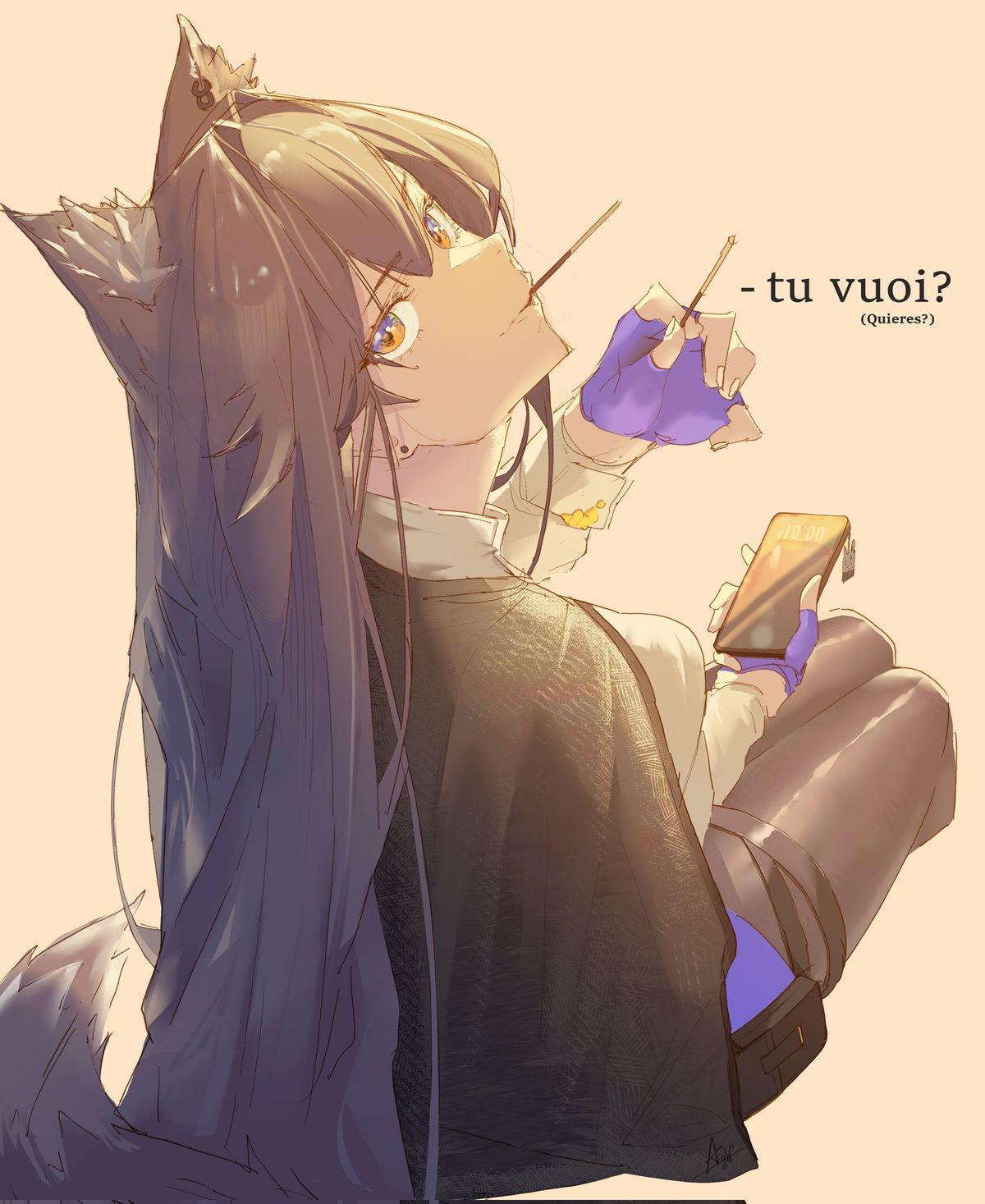
"Right? But not like perfume." Exusiai sniffed again, exaggerated. "More like candy."
They rounded the corner together and saw the source.
A small cluster of people stood near a modest cart parked against the curb. No signs, no bright lights, no shouting vendor. Just a few people standing around, some talking, some smoking.
Exusiai's eyes locked onto what one of them was holding.
"Are those cigarettes made of sugar," she asked, delighted.
The man smoking one glanced at her, shrugged, and took another drag. "They burn. They don't stink. That's enough for me."
Exusiai was already at the cart.
Arno looked up as she approached, his expression shifting only slightly in acknowledgment. He had seen all types by now. Loud ones included. The bright halo and wings also helped.
"Hi!" Exusiai leaned over the counter, eyes scanning the shelves. "Okay, first of all, I love your vibe. Second, are those actually candy cigarettes?"
"They're sugar," Arno said. "They light like normal cigs."
"That is incredible."
Texas hung back, eyes moving over the cart rather than the people. She took in the layout, the spacing, the way nothing was crowded or overstated. Her gaze paused briefly on the butter candies before returning to the sugarettes.
"Do they do anything else," she asked.
"They make smoke," Arno replied. "It doesn't do much else. Smells nice though."
Exusiai laughed. "Sold."
She bought two packs without hesitation. Outside, she lit one immediately, took a dramatic inhale, and blew out a thick cloud of rose-scented smoke.
"Oh wow," she said. "That's actually really nice."
Texas accepted one when Exusiai offered, examining it before lighting it herself. She smoked without comment, posture relaxed, eyes half-lidded as the smoke dispersed.
"It doesn't cling," she said finally.
"Nope," Exusiai said, grinning. "This is genius."
They didn't linger long. Penguin Logistics schedules were flexible, but not nonexistent. Before leaving, Texas returned to the cart and pointed at the butter candies.
"What are those."
Arno gave her a box. "Butter Candies. They help make things easier after a long day."
Texas nodded and bought two boxes. 'Gonna share this with the others back at HQ'.mm
They left without another word.
Penguin Logistics headquarters was loud even when it wasn't busy.
Exusiai burst through the door first, holding up the sugarettes like a trophy. "Okay, everybody stop what you're doing for exactly one minute."
Croissant looked up from a crate. "That better be food."

"It's candy," Exusiai corrected. "But also smoke."
Sora leaned forward immediately. "Smoke candy?"
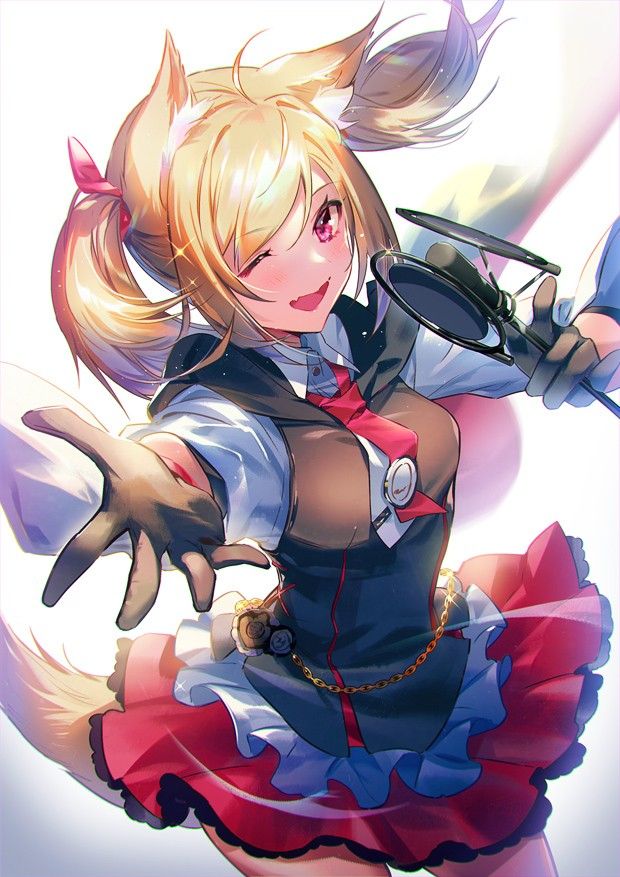
Texas set the butter candies on the table and took a seat, posture easy. "They don't smell bad."
Exusiai lit another sugarette and blew smoke toward the ceiling. It spread, fragrant and soft, then vanished.
Croissant blinked. "That's not awful."
"Right?" Exusiai said. "And no ash. No stink. You could smoke this indoors."
There was a pause.
From behind the curtain at the back of the room, a familiar silhouette emerged. Emperor hopped into view, sunglasses gleaming.
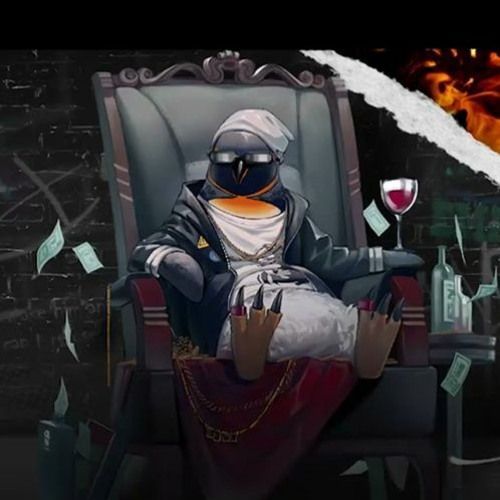
"Smoke," he said slowly, "that does not offend my refined sensibilities."
Exusiai bowed dramatically. "Your Eminence, we have discovered art."
Emperor walked closer, inspected the package, and took one of the sugarettes. He lit it with practiced flair and inhaled deeply.
"Hm," he said. "Acceptable. Marketable. Surprisingly tasteful."
Texas slid the butter candies toward Croissant. "Try one when you're tired."
Croissant did, chewing thoughtfully. A few minutes later, her shoulders dropped.
"Oh," she said. "That's… nice."
Sora smiled. "These would sell really well."
Emperor exhaled a final rose-scented cloud and crossed his wings. "Who sells these?"
"A guy," Exusiai said. "Quiet. Cart. No branding."
Emperor nodded. "Interesting."
That was all he said.
The candies were shared. The sugarettes passed around. Theories were thrown around about how they worked. Some sillier than others.
Back on the street, Arno closed his cart as night settled in, unaware that his small, careful addition had already found its way into one of Lungmen's most influential courier hubs.
For now, that knowledge would wait. The cart remained still.
The notice did not arrive with urgency.
It was slipped beneath the cart's wheel sometime between closing and dawn, a thin rectangle of official paper that did not crinkle when folded. Arno found it when he arrived in the morning, kneeling to unlock the brace and spotting the edge of red ink against the pavement.
He picked it up, unfolded it once.
—----
Lungmen Commerce Oversight Division
Routine Market Observation
NOTICE OF ROUTINE MARKET OBSERVATION
Reference No.: LCOD–SV–RMO–11743
This notice is issued pursuant to the authority granted under the Lungmen Municipal Commerce Act, Article XII, Sections 4 and 9.
Records indicate that a mobile vending unit operating within the Lower Commercial District has been observed engaging in the sale of consumable novelty goods that produce visible smoke when activated in public spaces. Said observation was conducted during standard market hours by authorized personnel of the Lungmen Commerce Oversight Division.
At the time of observation, no violations of municipal safety ordinances were recorded. No hazardous emissions were detected beyond permissible regulatory thresholds, and no complaints or formal objections were filed by nearby licensed establishments or residents. The goods in question were not found to interfere with pedestrian traffic, public order, or commercial operations in the surrounding area.
This notice does not constitute a citation, warning, or directive to cease operations. No penalties are being issued, and no immediate corrective action is required.
Vendors operating within Lungmen are reminded that continued commercial activity remains contingent upon sustained compliance with all applicable public safety, air quality, and trade regulations, including accurate representation of goods offered for sale and non-disruptive conduct within shared commercial zones.
The Lungmen Commerce Oversight Division reserves the right to conduct further observation should product distribution patterns, public usage behaviors, or reported effects change in a manner deemed materially relevant to regulatory oversight.
Your cooperation in maintaining Lungmen's commercial standards and public environment is acknowledged.
Issued by the Lungmen Commerce Oversight Division, Department of Small Vendors and Street Trade Regulation, under the authority of the Upper Lungmen Administrative District.
Authorized and certified by Inspector Wei Lanting, Senior Market Compliance Officer, Lungmen Commerce Oversight Division.
Affixed with the official vermilion seal of the Lungmen Commerce Oversight Division.
—---
No summons. Just a statement.
It informed him, in polite and careful language, that his cart had been observed selling novelty consumables that produced smoke in public spaces. It clarified that no violation had been recorded. It reminded vendors that continued operation depended on adherence to municipal safety standards. It ended by thanking him for his cooperation.
There was no signature.
Arno read it twice, then folded it neatly and placed it beneath the counter, between the spare soap bars and the ledger he rarely needed to open. He did not look around for watchers. Lungmen did not work that way. Observation came first. Response later.
He opened the cart as usual.
The morning passed quietly. The butter candies are sold in singles, sometimes pairs. The sugarettes went faster. A man in a municipal jacket bought a pack without comment, smoked half of one across the street, then left it extinguished on the curb rather than finishing it.
That, too, Arno noted.
Near noon, the tea shop owner crossed the street with two cups in her hands. She set one on the edge of the cart without asking.
"You're getting popular," she said. "Are they asking questions yet?"
"Not the kind that matter."
She hummed, satisfied, and returned to her shop.
Later that afternoon, a familiar figure paused at the corner.
Texas stood with her hands in her pockets, posture relaxed but eyes alert. She didn't approach right away. She watched the cart from a distance, tracking who stopped, who lingered, who left with what.
When the crowd thinned, she crossed the street.
"Still have those," she said, nodding at the sugarettes.
"Yes."
She bought a pack and didn't open it. Instead, she rested her elbows on the counter.
"Emperor wants to talk," she said. Not a demand. Not a threat. Just information.
"Who's Emperor?" Arno asked. This is the first time he's heard of someone like that. 'Is that really his name?'
His thoughts probably reflected on his face because his companion responded, "He's my boss. He's the CEO of Penguin Logistics." Texas' lips slightly quirked upwards. "And yes, that's his name."
Arno met her gaze. "About what."
"You, and your products." Texas said. "Eventually. Not today."
She straightened and turned to leave, then paused. "He likes things that don't make noise. But he likes them better when he understands where they stop."
Arno inclined his head. "I don't plan to move."
Texas considered that, then nodded once. "Good."
She left without lighting anything.
That evening, as the street quieted and the sugarette smoke thinned to almost nothing, Arno counted his stock more carefully than usual. Nothing was missing. Nothing had multiplied. The cart remained obediently unchanged.
But the city felt closer now.
Not hostile. Not eager. Just aware.
Arno closed the cart at the usual hour, secured the brace, and sat inside with the light low. Outside, footsteps passed. Somewhere nearby, someone laughed softly, then stopped.
He did not add anything new to the shelves.
He did not remove anything either.
For now, the balance held.
And in Lungmen, balance was never permanent—but it was always worth keeping for as long as possible.
Chapter 4
Paracsus
Know what you're doing yet?
- Joined
- Dec 20, 2023
- Messages
- 194
- Likes received
- 3,330
What People Say Instead
Arno stopped explaining after the third day.Not because anyone asked him to stop, but because no one seemed to need him to continue. When customers pointed at the butter candies or the sugarettes, he told them the price, took their bills, and counted out change from the drawer beneath the counter. If they asked what something did, he answered in the smallest way possible.
"They're candy."
"They don't hurt. Not like the usual stuff."
That was all.
Lungmen Dollars passed from hand to hand in creased bills, some worn soft from years of use, others crisp enough to snap faintly when unfolded. Arno smoothed them automatically before storing them away. When someone paid with a larger bill, he counted change carefully, placing it flat on the counter instead of directly into their hands. One bill at a time. No mistakes.
A dock worker bought a box of butter candies on his lunch break and came back two days later with a coworker. He didn't say what they did. He just nodded toward the shelf and said, "Those ones."
A woman in office attire stood near the cart one afternoon, sugarette between her fingers, and explained to a colleague that they didn't leave a bad smell on her jacket. She said it casually, like it was obvious. The passerby bought a pack without much convincing.
Smokers lingered longer than they used to.
They leaned against railings or stood in small groups a short distance away, sharing light and conversation. Sugarettes were passed around with the same easy familiarity as real cigarettes, lit and extinguished without ceremony. The smoke drifted upward, pale and faintly sweet, disappearing before it could cling to anything for long.
No one argued about them. No one argued with him.
By the end of the week, Arno noticed that people rarely asked prices for the new items anymore. They knew. They came with exact bills folded and ready, sometimes already holding out the amount before reaching the counter. When they didn't, Arno counted out the change without comment.
Five-dollar bill. Two ones back. A coin-sized bill folded twice and tucked away.
Routine settled in.
What surprised him was how little effort it took.
He no longer scanned every face for threat the way he had during the first weeks. He still paid attention, but it was different now. He recognized patterns. The courier who always arrived just before sunset. The smoker who never lit up until he stepped away from the cart. The student who pretended not to care but always bought candy when he thought no one was watching.
They didn't know his name. He didn't know most of theirs.
That seemed to work fine. He was simply called "Mr. Seller" or something of the same effect.
Some evenings, Arno caught himself preparing stock without thinking about it at all. His hands moved on memory alone, arranging bread and bandages, stacking candy boxes so their labels faced outward. He adjusted prices once, slightly, rounding them to cleaner numbers so change came easier.
The cart did not object.
At night, when the exterior folded inward and the street outside dimmed, Arno sat at the table and listened to the city. He could tell what time it was by sound alone now. When deliveries ended. When bars let out. When the streets emptied enough for quiet conversations to carry.
He realized one evening, while counting bills and smoothing them into neat stacks, that he had stopped measuring time in days since arrival.
He thought in terms of opening hours instead.
In what sold well on humid afternoons. In how long it took for the street to wake up after rain. In which customers paid with small bills and which preferred larger ones.
The thought did not frighten him nearly as it should have.
It settled somewhere behind his ribs and stayed there.
One afternoon, a man buying bandages hesitated before leaving. He glanced at the butter candies, then back at Arno.
"Those," he said. "They good?"
Arno met his eyes. "People come back for them."
The man nodded, paid with a ten, waited for his change, and left with a box tucked under his arm.
That was enough.
The cart did not change again. No new items appeared. No notes followed. The shelves remained steady, stocked with the same quiet reliability as before.
Outside, Lungmen adjusted.
People waited for the cart to open. Vendors nearby stopped treating the space as temporary. Patrols passed without slowing. The street accepted Arno's presence the way it accepted a lamppost or a signpost: something useful, something expected.
When Arno closed shop at the end of the day, he folded the awning inward and locked the panels without haste. Bills were stored away. Change accounted for. The counter wiped clean.
Inside, the lights warmed.
He removed his jacket, set it on the shelf, and sat down at the table with nothing urgent left to do.
Tomorrow, he would open again. And tomorrow, a new set of conversations to be had.
The trouble didn't reach Arno directly.
It began in places he never saw and never asked about. Narrow rooms above noodle shops where deals were made quietly, hands moving fast enough that no one lingered on details. Alleyway exchanges where someone swore they had the real thing and smiled too quickly when asked where it came from. Tables in teahouses where boxes were slid across polished wood with the promise that it was "from the same merchant," just acquired differently.
That was where the failures happened.
The smell was often close enough to confuse people at first. Sweetness bloomed, but it felt artificial. Like a cheap, mass produced cologne. Smoke curled and filled the lungs, yet that smoke was sickly and acrid. All it did was put pressure on the body, forcing the lungs to breathe something it could not accept as easily. Just like regular cigarettes.
The butter candies failed differently.
People expected sugar and comfort, something light that perked them up for an hour or two. The counterfeit versions delivered that much—an initial sweetness, a brief lift behind the eyes. Just enough to fool someone unfamiliar.
Then the crash came.
Too fast. Too harsh.
The sweetness turned sour in the mouth, like the taste of overripe fruit. Limbs dragged. Joints ached. A dockhand nearly dropped a crate when his grip failed without warning. An office clerk nodded off at her desk in mid-sentence. A woman commuting home woke up three stops too late with a pain in her chest and no idea how long she'd been unconscious.
The worst was a sanitation worker found slumped over behind his station. He'd popped a fake butter candy during a break and never stood up again. People thought he simply fell asleep, only to panic and call paramedics when he fell of his chair and didn't get up. He was breathing, barely, but his pulse had dipped low by the time paramedics arrived. They revived him. He never touched another piece of that candy again.
That wasn't how it was supposed to feel.
The real ones gave you hours of lightness, just enough to forget the fatigue until it was time to rest. The fakes tore through that rhythm and left people feeling hollowed out.
People remembered that.
They started asking each other where the candies came from before asking what they did.
By the time people realized something was wrong, the transaction was already done, and the seller was gone.
And Lungmen, ever practical, turned its suspicion toward the only thing that didn't move: Arno's cart.
He noticed the change before anyone said it out loud.
Customers hovered longer at the counter. They examined packaging carefully, turned boxes over, sniffed the sugarettes, rolled the candy boxes in their hands like they might weigh differently. No one said "fake." Not at first. But the implication drifted in the air like dust.
"These the same ones?" someone asked one afternoon, motioning vaguely toward the shelf.
"Yes," Arno said.
"You always get these from the same place?" a man asked, tapping a sugarette pack.
"Yes." Arno said again, straightening and turning his attention fully to the customer.
"You ever had a bad batch?"
"No," Arno said simply. "I test them first."
The man nodded, not convinced, yet paid anyway.
Nearby, two people argued. One insisted the candy he'd tried last week made him crash after two hours. The other asked where he got it.
There was a pause.
"Oh," the second said. "Yeah, that's not from here."
The argument ended there.
The first complaint came from someone who didn't want to complain.
A factory worker approached with a half-creased butter candy box, soft at the corners from being folded too many times. "Think someone sold me bad ones," he said. "Didn't last. Knocked me out halfway through shift."
Arno looked at the box, not touching it. "Did you buy it here?"
The man hesitated. "Not… directly."
"Then I can't help you."
The man gave a small, tired nod and walked away without pressing further.
But not everyone was satisfied so easily.
The questions sharpened. Customers grew bolder.
"You don't change anything?" a woman asked, watching his hands move over Lungmen Dollar bills.
"No."
"You don't adjust for demand?"
"I sell what I have."
"That's it?"
"That's it."
The simplicity unsettled more than any defensiveness could have.
One evening, as the air cooled and the lamps came on overhead, two men lingered by the cart without buying. Their voices were low, but clear.
"People getting scammed left and right," one muttered. "Shouldn't be so easy to fake."
"Maybe it's the source," the other said, eyes flicking toward Arno. "Too many tricks. Too convenient."
When Arno began to close, one of them stepped forward.
"People are talking," he said.
"They usually are," Arno replied.
"They say your things aren't consistent."
"They're consistent," Arno said, "for the people who buy them from me."
The man smiled, humorless. "That's a strange rule."
"It's a reliable one."
No reply came. They left.
But the worst was still ahead.
A woman slammed a sugarette box onto the counter hard enough to rattle the glass jars. Heads turned. People paused mid-step.
"Explain this," she said, loud enough for half the street to hear.
Arno picked up the box. The seal had been peeled and reapplied. Off-center. The corner paper had warped where glue had touched the wrong surface. A rush job.
"This wasn't sold here," he said calmly.
Her face flushed. "How do you know that?"
Arno tapped the edge of the seal with one finger. "Because this was removed and reapplied. Whoever did it didn't line it up properly." He tilted the box just enough for her to see the uneven edge. "And the print on the name isn't consistent. It's been touched up by hand."
She opened her mouth, but he was already reaching beneath the counter.
He brought out an unopened box of sugarettes and set it beside hers. The difference was immediate. The seal lay perfectly flat, the lettering clean and uniform.
Arno broke the seal and smoked one.
The scent spilled out at once—warm, floral, unmistakable. It carried just far enough that a few new customers turned their heads from nearby.
He closed the box and slid it back toward her. "Mine doesn't smell like that."
For a moment, she said nothing.
"I'm not saying you're lying," Arno added, his voice steady. "I'm saying this didn't come from my cart."
Her jaw tightened. "You sell things without explanations," she snapped. "No labels. No warnings. You expect people to just trust you."
Arno met her eyes. "Only if they want to. If they have issues with what I sell and how they sell things, they can either bring it up with me," He motioned to the open area, full of other merchants.
"Or they can walk away. I have already been cleared by an inspector recently; I even have a document saying that my products are safe and clean." He said, bringing out the notice he received from before.
That answer drew a murmur from the small crowd forming nearby.
She cursed under her breath and left, but the damage had already been done. Not because she'd been wrong, but because she'd been loud.
After that, the rumors stopped drifting and began to settle. Not around the goods themselves, but around Arno.
"Don't buy it secondhand."
"Only the ones from his cart work."
"If it didn't come from him, it's not real."
People compared notes in low voices. Someone would mention a failed sugarette, and another would immediately ask where it had been bought. The answer always ended the same way.
"Not from him."
"That explains it."
The language sharpened over time.
"Resellers ruin them."
"Whatever they're copying, they're getting it wrong."
"Looks right, tastes weird, not the same."
Eventually, no one bothered dancing around it.
If it didn't come from Arno's hands, it was assumed to be fake.
That assumption came from both sides of loyalty and undeniable proof. Every story of failure traced back to someone trying to turn his goods into something else—breaking seals, repackaging, selling at a markup, or worse, attempting crude imitations.
And every story of success ended the same way.
"I bought it from the cart."
By the end of the month, Lungmen had reached its own quiet conclusion. Arno wasn't selling unreliable goods.
Everyone else was.
After his reply, resellers approached Arno and offered more than the listed price to buy extras. They asked if he could sell in bulk, if he'd cut a deal for resale. A man even tried to slip a box back onto the shelf after buying it, hoping to blur the line. Only to get caught immediately by both Arno, and some loyal customers and fans of the genuine article.
He was summarily arrested and banned. The cart will then forever remain invisible to him and those under him.
Arno refused them all, quietly and with little explanation.
Those who tried to make a profit were the angriest when it failed. They stood at a distance and muttered about deception and clever wording, about how it was unfair to sell something that couldn't be exploited or copied.
But none of them could point to a single customer who had paid at the cart and walked away unsatisfied.
That fact spread faster than the rumors ever had.
By the end of the month, the rule was understood, even if no one could explain it.
"If you wanted it, you came yourself."
"If you wanted it to work, you paid directly."
"And if you didn't like that, you went elsewhere."
Arno kept doing exactly what he always had.
He sold bread and candy, bandages and candy. He accepted Lungmen Dollar bills, counted out proper change, and closed at the same hour each night. He never defended himself and never corrected anyone's assumptions.
In Lungmen, survival wasn't about winning arguments.
It was about staying still long enough that the city adjusted around you.
Chapter 5
Paracsus
Know what you're doing yet?
- Joined
- Dec 20, 2023
- Messages
- 194
- Likes received
- 3,330
Friendly Visit
The following afternoon, just as the late sun gilded Lungmen's streets, the familiar sound of boots echoed down the alley. Arno glanced up from arranging a neat stack of bills. Two figures approached his cart, moving with a casual but deliberate energy that immediately drew attention.
"Hey!" a bright voice called out, carrying over the hum of the street. Exusiai bounced forward first, eyes wide with curiosity and a hint of worry. "Mr. Seller! Are you okay? We… heard things."
Arno's gaze flicked to her, calm and measured. "I'm fine," he said quietly, counting out change as though nothing unusual had happened.
Behind her, Texas walked with a steady, controlled stride. Hands tucked into her coat pockets, she scanned the cart and the surrounding street with quiet attentiveness. "Rumors," she said plainly, her tone professional but not cold. "About your products. We wanted to check that everything's all right."
"They've been sold as usual," Arno replied. His hands moved over the coins and bills with practiced ease. "Nothing has changed."
Exusiai leaned closer, her energy unrestrained. "Yeah, but people have been spreading stuff—saying your candies or those… uh, smoke things don't work or whatever. You didn't get harassed, right? They didn't bother you too much?"
Texas's gaze softened ever so slightly as she added, "We just want to make sure you're safe. The rumors… people can be unpredictable."
Arno shook his head, giving a faint shrug. "I've handled the inquiries. There's no threat."
Exusiai grinned, undeterred. "Good. That's good to hear! Still, don't ignore us checking in, okay? You shouldn't have to deal with all that alone."
Texas inclined her head once, a subtle nod that carried both agreement and professionalism. "We'll be around," she said evenly. "Keep to your routine, and let us know if anything escalates."
Arno gave a slight, almost imperceptible nod in acknowledgment. He didn't ask for protection, didn't ask for conversation. He simply returned to his work, arranging the sugarettes and butter candies on the shelves with the same careful precision as before.
Exusiai hopped lightly in place for a moment, then leaned against the counter with her chin on her hands, watching him. "You know," she said softly, "it's okay to take a little breath once in a while. Even if the street doesn't notice, we do."
Texas's lips quirked in a faint, almost imperceptible smile. "And we will notice if things go wrong. Consider it… insurance."
Arno's hands paused over a fresh box of sugarettes. He looked up briefly, then nodded, just enough to acknowledge their presence. That was enough.
For a while, the three of them stayed near the cart. The city moved around them, unaware, and yet, for the first time in days, Arno felt the weight of the rumors ease slightly—not because they had stopped, but because someone had noticed, and that alone made the street feel less hostile.
Exusiai lingered longer than Texas, perched lightly on the edge of the counter as if she were a bird unwilling to leave its perch. "Seriously," she said, leaning forward with a grin that didn't quite reach her eyes, "you've been standing there handling all of that by yourself. That's not… well, it's not normal for Lungmen. People usually get eaten alive by this kind of attention."
Arno's hands were steady as he adjusted a box of sugarettes, aligning the corners with quiet care. "It's manageable," he said, voice low, almost deliberately even. He didn't look up.
Texas, still standing a short distance away, gave a faint exhale through her nose. "He's right," she said, voice neutral, but with a note that suggested she had considered the matter carefully. "It's not ideal, but there hasn't been direct interference. Not yet. That's the difference."
Exusiai leaned back, brushing a strand of hair from her face. "Difference or not, it's weird seeing someone handle that kind of rumor without breaking a sweat. You really are something else, you know?"
Arno finally looked up at her, eyes meeting hers for the briefest moment. The calm in his gaze was unshakable, almost impervious. "I focus on what I can control," he said simply. Then he returned his attention to the shelf, lining up the boxes with a practiced hand.
Texas's posture softened subtly, just enough to show that she recognized the effort it must have taken. "People will talk regardless," she said. "You can't stop that. But you can handle it. That's what matters."
Exusiai huffed, half in frustration, half in admiration. "That's a boring answer, you know? But… okay, fair. You've got your method." She leaned closer again, lowering her voice. "Just… promise me you won't try to do it all alone if it gets worse. It's not like anyone's coming to tell you what to sell or how, just… make sure you're okay."
Arno's lips pressed briefly together, then parted in the smallest acknowledgment. A nod so slight it might have been missed if someone blinked. That was the promise she would take for now.
Texas stepped a little closer, letting her gaze sweep the immediate area around the cart, the emptying street, the slow movements of the other merchants packing up for the day. "I don't mean to hover," she said evenly, "but it's useful to know the environment isn't turning against you without notice. And we can handle complications if they arise."
Arno's hands paused on the counter. For a moment, he considered the words, weighing the intention behind them. He didn't respond, only resumed stacking the boxes. His silence carried more meaning than any words might.
Exusiai pushed off lightly from the counter, bouncing on her heels. "Fine, fine. I'll leave you alone for now. But don't think we're not watching. Mr. Seller," she said with a grin, "we're friendly spies. You can't get rid of us that easily."
Texas offered the faintest, almost imperceptible smile, a small tilt of the head, before stepping back and allowing the space around the cart to settle. "We'll check in again. Don't take it personally," she said, her tone brisk but not unfriendly.
Arno's hands moved over the bills and boxes, arranging them as he always did. The street settled around him, the voices of neighbors fading as the afternoon light softened. For the first time in days, he didn't feel the weight of the rumors pressing in—not because the rumors had stopped, but because someone else had acknowledged their presence.
Exusiai's energy lingered faintly in the air as she bounced away down the street, calling over her shoulder, "See you tomorrow, Mr. Seller!"
Texas followed, quiet and steady, a calm shadow behind her companion. Arno returned to his work, counting coins and smoothing bills, methodical, focused, letting the cart's small hum of magic wrap around him like a familiar room.
The day waned. The shadows lengthened. And the rumors, once threatening, now seemed to pulse faintly at the edges of the street rather than pressing directly into him.
For Arno, that was enough.
The next morning, the city hummed with its usual rhythm. Arno moved with the same careful precision, arranging boxes, checking seals, counting bills. The memory of the previous afternoon's visit lingered, not as a distraction, but as a subtle weight—an acknowledgment that he wasn't entirely alone in watching over the cart.
By mid-morning, the sound of light, rhythmic footsteps approached again. Arno didn't need to glance up to know who it would be; the rhythm was familiar. Exusiai bounced onto the curb, her long hair catching the sunlight. "Morning, Mr. Seller! Hope you slept well."
Arno looked up briefly, hands paused on a fresh stack of butter candy boxes. "I did."
Texas followed, her movement more measured, eyes scanning the street, the surrounding stalls, the few pedestrians moving lazily past. "We came to make sure nothing escalated overnight," she said evenly. Her tone was calm, professional, carrying no unnecessary energy. "Everything appear normal?"
Arno tilted his head slightly, the faintest gesture of acknowledgment. "Normal," he said. The word held no cheer, no complaint—simply fact.
Exusiai leaned on the counter, propping her chin on her hands with a grin that didn't quite hide concern. "You know, it's weird seeing you handle all that alone. You don't even flinch. People try to stir things up, but you just… keep doing your thing."
"Routine," Arno said simply, arranging a stack of sugarettes. The sound of bills sliding together, the boxes shifting, carried its own quiet authority.
Texas observed him for a moment, expression unreadable. Then she stepped closer to the counter, resting her hand lightly on its edge. "It doesn't mean you have to face it alone, Arno. We can—" She stopped, careful with her words, "—keep watch. Make sure things don't get out of hand."
Exusiai nudged her lightly. "See? Told you. Friendly spies." Her grin widened. "I'm just saying, it's nice to have people who've got your back."
Arno didn't respond immediately. His hands moved steadily over the coins and bills, stacking, smoothing, counting. After a moment, he gave a faint nod, enough to acknowledge their concern without giving it weight. That was enough communication for him, and for them.
Texas inclined her head once, a gesture of agreement and silent acknowledgment, then shifted back slightly, surveying the street around them. "We'll check in from time to time," she said. "No interference. Just observation."
Exusiai, never subtle, leaned closer again. "And if anyone tries to make trouble, we'll know. Right, Texas?"
Texas's lips twitched slightly, the hint of a smile. "We'll know."
For the next hour, the three of them stayed near the cart. Exusiai chatted lightly, bouncing from topic to topic, commenting on the street, the other vendors, the sun catching the edges of the awning. Texas kept her distance, eyes scanning, a steady presence that seemed to anchor the space around them.
Arno moved among them in silence, arranging boxes, counting bills, adjusting labels. The cart hummed faintly, the magic almost imperceptible but familiar, wrapping around the space like a protective membrane. He didn't speak more than necessary. He didn't need to. Their presence alone was enough to make the street feel less tense, the air around him lighter.
A customer approached—a courier delivering supplies from across the city. He glanced at the cart, then at Arno, and handed over a few Lungmen Dollar bills without hesitation. Arno counted the change carefully, sliding it across the counter with quiet precision. Exusiai watched the interaction with a grin, and Texas observed the street. No one else approached. No one interfered.
When the courier left, Exusiai clapped her hands lightly. "See? Everything's fine! You're doing great, Mr. Seller!"
Arno returned to stacking boxes, a faint acknowledgment, no more.
Texas's gaze lingered on the cart for a moment longer, then shifted toward the street. "Lungmen will test anyone who tries to exploit your goods," she said. "The system will handle itself as long as you keep doing what you've been doing."
Exusiai bounced a little on the curb, energy contained but ready to spill. "Yep. And we'll be here to make sure you don't get caught off guard."
Arno smoothed the top of a sugarette box, then shifted his attention to the butter candies, adjusting them so their labels faced outward evenly. The street moved around him. Vendors continued their routines. Passersby went about their business. The rumors lingered in the corners of conversation, but for now, nothing pressed directly against the cart.
He didn't need to comment. He didn't need to defend. Their presence, even quiet, was enough to remind him—and anyone who cared to notice—that the cart, and its operator, remained untouchable.
The day moved forward. Light shifted, shadows lengthened. Arno continued with the same steady rhythm, counting bills, stacking boxes, keeping his world small and methodical. And outside, just beyond the reach of his routine, Exusiai and Texas remained as watchful companions, keeping their promise in their own ways—bubbly and bright on one side, calm and steady on the other.
The morning sun climbed higher, spilling light over Lungmen's streets. Arno adjusted the display, stacking the sugarettes and butter candies just so. The quiet of the day was punctuated by the distant clatter of carts and vendors calling to each other.
Exusiai stretched lightly, the energy in her movements almost bouncing the small awning above the cart. Texas, standing with the usual calm precision, checked the street around them one last time.
"Another job," Exusiai said cheerfully, tossing a glance at Arno. "We'll be back before you know it. Don't work too hard while we're gone, Mr. Seller!"
Arno's hands stilled over a stack of butter candy boxes. "Be careful," he said quietly. The words were simple, but carried the weight of genuine concern.
Texas's eyes flicked toward him, expression calm but attentive. "We will. Don't worry."
Exusiai grinned. "Yeah, we've survived worse. You'll be fine here, right?"
He gave the faintest nod, but before they left, he reached beneath the counter and pulled out a small package wrapped in neat brown paper, tied with a thin string. The label read simply: Windrunner's Fuel.
FLASHBACK
Arno remembered the quiet of the cart that morning, just after dawn. The street had not yet fully awakened; shutters rattled open on nearby shops, the smell of frying breakfast drifted from a noodle stall down the way, and the air carried a faint coolness that promised the heat would come by noon.
He had been unpacking a fresh batch of merchandise when his hands brushed against a small, unmarked crate tucked beneath the larger boxes of sugarettes. It wasn't part of the usual stock. Curious, he had set aside the bandages and candies he was arranging and lifted the crate onto the counter.
Inside were neat rows of individually wrapped bars, the wrapping crisp white paper with a thin, elegant string binding each one. A simple black icon of a stylized gust of wind sat in the corner of each wrapper. Windrunner's Fuel the label said. Nothing more. Together with the box was a familiar slip of paper dictating the effects of the product.
Windrunner's Fuel
Consumed Orally
Effect: Increases speed, dexterity, and agility of the consumer
Duration: approximately one hours.
Aftereffect: none.
Warning: Does not Stack with other speed enhancers!
He picked one up, feeling the slight weight in his palm. It was denser than a simple candy bar, but not so much as to be cumbersome. Breaking the string and peeling back the paper released a warm, sweet aroma of toasted oats, honey, and roasted nuts. Cranberries and raisins dotted the surface like tiny jewels, glinting in the morning light. He inspected it for imperfections, noting the careful cut of the bar, the even distribution of ingredients, the way it seemed designed to hold together without crumbling.
Arno tasted it, just a small bite at first. The granola was chewy, the honey sticky but light, balancing the tartness of the dried fruit and the subtle crunch of seeds and nuts. Each mouthful felt substantial, filling without heaviness. He could imagine someone biting into it during a long run or a hurried delivery, a source of energy that was practical, satisfying, and reliable.
The effect was immediate. A lightness emerged from within, as if he could suddenly get snatched away by a simple gust, yet he still felt grounded enough that it did not leave him unbalanced. His arms and legs, filled with a new energy that subtly wanted to be tested. Arno exited the cart and decided to take a jog out in the city.
He had never run so fast or so far in his life, both before and after arriving in Terra. He felt like he could run forever.
He came back soaked with sweat, but strangely happy.
END FLASHBACK
Arno held out the package to Exusiai and Texas. "Take these with you," he said, his voice steady. "Windrunner's Fuel. They'll help in a pinch, give you some energy when you need it. Just… consider them a gift."
Exusiai's eyes lit up, and she grabbed the package eagerly. "Hey! Thanks, Mr. Seller! You didn't have to, but I'm definitely not complaining." She slipped the bar into a pocket of her jacket. "I'll make sure to eat it before we get into trouble!"
Texas took hers calmly, examining the wrapper. "Practical," she said, nodding once. "We'll take care."
Arno gave a small, almost imperceptible nod in return. "That's all I ask. Please be careful."
The two of them waved, then turned down the street, their steps confident and purposeful. Arno watched them go, a faint tension loosening from his shoulders now that he knew they were equipped for whatever the morning might bring.
He returned to the cart, checking over the sugarettes and butter candies, smoothing out the edges of each box. The street hummed around him, indifferent yet alive. And for a brief moment, he allowed himself to imagine the city as less of a threat, a little less unpredictable, with allies just a few blocks away.
Interlude: The Flight of Exusiai
Paracsus
Know what you're doing yet?
- Joined
- Dec 20, 2023
- Messages
- 194
- Likes received
- 3,330
Breakneck
The contract was meant to be an easy one.
Escort, transfer, withdrawal. Penguin Logistics had done it a hundred times in tighter corridors and worse districts. Lungmen's streets were familiar ground—loud, crowded, forgiving if you knew how to move.
This street wasn't forgiving.
Texas felt it first.
Her steps slowed by half a beat, sword hand loosening at her side as her eyes traced the rooftops above them. Too still. Too deliberate. A merchant's awning fluttered in the wind, but no one stood beneath it.
"Something's wrong," she said quietly.
Exusiai was already scanning ahead, SMG resting comfortably in her hands, finger off the trigger but ready. "Yeah," she said. "Street's pretending too hard."
The first Arts bolt shattered the pavement beside them.
Blue-white light cracked against stone, heat blooming outward as the illusion of normalcy collapsed. Shouts followed—boots pounding, metal scraping, the unmistakable hum of Originium Arts being drawn.
"Front!" Croissant barked, shield slamming down just in time as a volley of crossbow bolts clanged against reinforced plating.
Bison moved with her, shield raised, bracing the impact as sparks flew.

Texas surged forward.
Her blade cleared its sheath in one smooth motion, steel flashing as she closed the distance on an Arts caster perched near a stairwell. The caster barely had time to react before Texas was there, blade knocking the focus staff aside and striking with decisive precision.
"Scatter," Texas ordered.
They didn't hesitate.
Croissant and Bison held the center, shields locked, forcing the attackers to commit or reroute. Texas flowed through the chaos, sword carving open paths, controlling space rather than chasing kills.
Exusiai ran.
She vaulted a railing, wings flaring instinctively to adjust her balance, and hit the street running. Bolts whistled past her, clattering harmlessly against walls where she'd been a second before.
She fired back in short, controlled bursts—not to kill, but to force heads down, to create space. The SMG barked sharply, louder than most weapons in Lungmen, drawing attention she couldn't afford for long.
"Okay," she muttered, breath quickening. "This is getting spicy."
She ducked into a side alley, boots skidding over damp stone, then burst through a hanging tarp into a narrow service corridor. Her movements were fast—usually fast enough.
Not today.
They were keeping pace.
Arts flared behind her, heat licking the air as another bolt scorched the wall inches from her shoulder. A crossbow thunked, the bolt embedding itself where her head had just been.
Her legs burned.
"That's new," she hissed, sprinting up a maintenance stairwell two steps at a time. "Usually I'm better at this part."
At the top, the space opened into a rooftop walkway overlooking a canal. No crowds. No cover. Just distance—and enemies closing from both sides.
Exusiai skidded behind a concrete pillar, chest heaving.
"Texas," she said into the comm, forcing levity into her voice. "You wouldn't happen to be done slicing people yet, would you?"
A pause. Then Texas's voice, calm but strained. "Still engaged. You'll need to disengage on your own."
"Copy that," Exusiai said. "No pressure."
Footsteps echoed from the stairwell.
Her hand brushed her jacket pocket.
She froze."…oh."
She pulled out the bar. Plain foil. Clean print. Nothing flashy. Windrunner's Fuel.
She remembered Arno's voice, steady and understated. Helps in a pinch.
Exusiai snorted. "Buddy, you have no idea how good your timing is."
She tore it open and took a bite.
Honey-sweet. Toasted grain. Something warm and grounding, like proper food instead of emergency rations. It didn't spike—it settled. The burn in her lungs eased. Her legs stopped trembling. Her heartbeat smoothed out.
"…oh wow."
She didn't question it.
She ran.
Her stride lengthened naturally, footfalls lighter, sharper. Balance came easier. Corners stopped fighting her. She vaulted the canal railing, cleared the gap cleanly, and hit the far side, already accelerating. She felt light as a feather, like she could go anywhere the wind (and her legs!) could take her.
Bolts followed—too slow.
Arts flared—misjudged.
She weaved through buildings and obstacles like the slums had shifted half a step in her favor. Rooftops blurred beneath her boots, wings adjusting just enough to keep her centered, never slowing her down.
She laughed as she ran, exhilaration cutting through the tension. Halo and wings glowing as bright as her mood.
"This is amazing!"
The pursuit thinned. Then fractured. Then vanished entirely.
A few blocks away, Exusiai finally slowed, landing lightly on a quiet rooftop overlooking a laundry-lined street. She bent forward, hands on her knees, waiting for the inevitable crash.
It didn't come.
Her breathing steadied. Muscles loose. No tremor. No dizziness.
She straightened, staring at the empty wrapper in her hand.
"…okay," she said. "That is definitely not normal granola."
Her comm crackled.
"Status," Texas said.
Exusiai grinned, wide and bright. "Clear. No injuries."
Another pause. "How?"
Exusiai tucked the wrapper carefully into her pocket, gaze drifting toward the distant streets.
"I owe someone a thank-you," she said lightly. "I'll explain later."
The city carried on below her, unaware.
And Exusiai, still warm with borrowed momentum, leapt back into the flow.
Penguin Logistics headquarters eased into its familiar post-mission lull, the tension of the streets bleeding out slowly rather than all at once. Gear was unbuckled and set aside with practiced motions, not rushed, but not careless either. Croissant hauled a crate back into its proper place with a grunt, rolling her shoulders afterward as if reminding herself the fight was over. Bison stood nearby, shield resting upright against the wall, posture still formal despite the safety of home. Texas remained by the central table, arms folded, sword already secured, her attention calm but alert.
Exusiai, by contrast, had not settled at all.
She paced, wings twitching in small, restless flicks, energy buzzing through her like the mission hadn't quite ended yet. She opened her mouth once, closed it, then finally clapped her hands together sharply.
"Okay," she said, voice bright and insistent. "We need to talk about the chase."
Bison groaned, long and theatrical, without even turning around. "I knew it. I knew you were gonna make this a thing."
Texas's gaze shifted fully to Exusiai, unreadable but focused. "You broke contact earlier than expected," she said evenly. "You didn't request backup. Explain."
Exusiai hopped up onto the edge of the table and sat cross-legged, boots knocking softly against the metal as she settled. "Right, so you remember when I split off to draw them away?" she began, tone casual but animated.
Bison nodded immediately. "You were pursued by multiple hostile units," he said. "At least one Arts caster and several crossbowmen."
"Exactly," Exusiai replied, pointing at him with a grin. "And they weren't sloppy about it. They kept pace. They anticipated my turns. That's not normal for street thugs."
Croissant finally turned, brow furrowing. "That's already bad news."
"Yeah, it gets worse before it gets fun," Exusiai said. She leaned back on her hands, wings flexing slightly as she spoke. "I ran my usual routes—alleys, maintenance stairs, rooftops. Stuff that normally shakes people loose. Didn't work. They stayed on me, forced me upward, and I ended up cornered on a rooftop by the canal."
Her grin sharpened. "No crowd. No cover. Bad angles. The kind of spot where I usually start improvising prayers."
Texas's eyes narrowed a fraction. "And you didn't."
"Nope," Exusiai said. "Because that's when I remembered I had something in my pocket."
She reached into her jacket and placed an empty foil wrapper on the table. It looked unremarkable—plain print, clean edges, nothing flashy or tactical about it.
Texas stepped closer, gaze dropping to it. "Food."
"Granola bar," Exusiai confirmed. "Sweetened. Oats, nuts, dried fruit. Arno gave it to us the other day."
The implication didn't linger long before Exusiai ruined it by hopping up onto the table, boots planted between discarded wrappers and half-finished drinks.
"Okay, but listen," she said, leaning forward like she was pitching a business idea instead of recounting a near-disaster. "I wasn't even trying to go that fast. I just… did. Like my legs stopped arguing with me."
She gestured broadly, nearly knocking over a cup Croissant had abandoned earlier. "Usually there's that moment where your brain goes, hey, maybe slow down before you eat pavement. That didn't happen. Everything just lined up."
Croissant watched her with narrowed eyes, not suspicious—evaluating. "So you're saying it didn't feel like pushing past your limit."
"Exactly," Exusiai said, snapping her fingers. "It felt like my limit moved."
Bison shifted his weight, clearly replaying the escort in his head. "That explains why they couldn't box you in. They were predicting normal movement."
"Joke's on them," Exusiai said cheerfully. "I was having a great time."
Texas exhaled quietly through her nose, something just short of a laugh. "You were grinning when you regrouped," she said. "I assumed that meant trouble."
"It always means trouble," Exusiai agreed. "But this time it was successful trouble."
Croissant folded her arms again, rocking back on her heels. "And this Arno guy just… hands these out?"
"Not like samples," Exusiai said quickly. "More like—" she searched for the word, then shrugged. "A precaution. He didn't hype it up or anything. No sales pitch. Honestly, I thought it was just really good trail food."
Texas nodded once. "That tracks."
Croissant gave her a look. "Of course it does."
Texas didn't rise to it. "He doesn't oversell," she said. "Anything."
Bison glanced between them. "So you're both carrying one."
"I was," Exusiai said, holding up the empty wrapper. "Past tense."
Texas tapped her pocket again, more deliberately this time. "I still am."
There was a brief pause—not heavy, just thoughtful—as Croissant processed that.
"…okay," she said finally. "New rule. If Angel Speed decides to eat mystery granola again, she tells us before sprinting three districts away."
Exusiai saluted. "Yes ma'am."
"And," Croissant added, pointing at Texas, "you don't get to be mysteriously prepared without saying anything either."
Texas's mouth twitched. "I said I hadn't used it."
"That's not the same thing and you know it."
Exusiai laughed, hopping back down from the table. "Look, nobody's saying we rely on it. I'm just saying—if things go sideways, it's nice knowing we've got an option that doesn't explode, glow, or get us arrested."
"That bar doesn't solve problems," Texas said calmly. "It buys space."
"Which is sometimes the same thing," Exusiai shot back.
Croissant sighed, rubbing her temples. "I can't believe I'm saying this, but… fine. We keep track of it. Quietly."
Her eyes flicked to the wrapper, then to Texas's pocket. "No testing it for fun."
Exusiai crossed her heart dramatically. "Scout's honor."
"That means nothing," Croissant said.
"Rude."
The tension eased, conversation drifting back toward cleanup, reports, and the next job already lining itself up in Emperor's absence. But the granola bar—empty or not—stayed on the table a little longer than everything else.
Not as a miracle. Not as a secret weapon. Just as something worth remembering.
Exusiai hopped off the table, stretching as her wings flared once and settled. "Yeah. No need to make it a big deal."
She folded the empty wrapper and slipped it back into her pocket instead of discarding it.
"But still," she added lightly, glancing at the others, "next time things get messy?"
Croissant grinned. "We're makin' a stop."
Texas didn't object.
Somewhere in Lungmen, a cart would open the next morning like it always did—bread lined up neatly, bandages stacked cleanly, candy sitting quietly on its shelf.
Penguin Logistics now knew better than to judge danger by appearances alone.
Meanwhile—
Rumors moved faster than official reports ever did.
They slipped through the slums in half-finished sentences and exaggerated gestures, carried by people who hadn't seen the whole thing but had felt the aftershock of it. A chase that went wrong. Thugs scrambling. An angel-shaped blur clearing rooftops like gravity had briefly loosened its grip.
By the next morning, the story had already changed twice.
Some said a courier outran Arts fire without slowing. Others swore they saw wings flare once and never again, like the city itself had blinked. A few insisted it had to be drugs, or Arts, or some new Penguin Logistics trick they weren't supposed to talk about.
No one agreed on the details. Everyone agreed on one thing: whoever she was, she got away clean.
Arno heard it while counting change.
The cart was open as usual, shelves neat, spacing exact. Bread, bandages, juice, soap. Butter candies and sugarettes sat where they belonged, undisturbed. He listened without looking up as two customers talked near the edge of the curb, voices low but animated.
"—told you, she was fast. Like she didn't even touch the ground."
"No way. That's an exaggeration."
"Really? But nobody caught her."
Coins clinked softly as Arno set them into their place. His hands slowed just enough to register the pattern in the story—the route, the timing, the description that didn't quite match rumor but wasn't invention either.
An angel.
A chase.
Penguin Logistics.
He exhaled, quiet and controlled, tension he hadn't realized he was carrying easing from his shoulders.
So she'd used it.
Arno didn't smile, not outwardly. But the tightness in his chest loosened, replaced by something steadier. Relief, tempered by confirmation. The bar had done what it was meant to do—not more, not less. It had helped someone get out of danger and then get on with their day.
No one mentioned food.
No one mentioned candy.
No one mentioned anything being sold.
Good.
He finished counting, slid the bills away, and adjusted a box that was already straight. The cart remained quiet, its presence unassuming, its inventory unchanged to any passing eye.
Later, someone else brought it up—this time a delivery driver buying bandages.
"People are saying Penguin Logistics pulled off something big last night," he said casually. "You hear that?"
"I hear things," Arno replied.
The driver laughed, satisfied with that answer, and moved on.
Arno watched the street resume its rhythm. Footsteps. Voices. Smoke that smelled faintly of flowers drifting past and fading. The city absorbed the story the way it always did—not with ceremony, but with use.
Whatever had happened out there, it hadn't tipped into spectacle. Not yet.
And for now, that was enough.
Last edited:
Chapter 6
Paracsus
Know what you're doing yet?
- Joined
- Dec 20, 2023
- Messages
- 194
- Likes received
- 3,330
In a Hurry
Arno did not put the new item on the shelf.The cart opened as it always did, its contents arranged with the same quiet care. Bread stacked evenly. Bandages bundled up and placed in a tidy manner. Juice bottles wiped clean of condensation. Butter candies and sugarettes rested in their familiar places, unchanged and unremarkable to anyone passing by.
Nothing new announced itself.
The Windrunner's Fuel stayed beneath the counter, wrapped in plain foil and stacked no higher than a hand's breadth. There was no sign. No price tag visible from the street. No slip of paper explaining what it was or why someone might want it.
Arno had learned better than to introduce something so preposterous with just words and pictures alone.
The first person he offered it to was a courier.
The man arrived late-morning, breath shallow, one strap of his satchel slipping off his shoulder as he leaned against the cart. "You still got water?" he asked, already fumbling for bills.
Arno handed him a bottle, then paused. He took in the courier's posture, the way his eyes flicked down the street every few seconds.
"You're in a hurry," Arno said.
The courier huffed out a laugh. "When am I not? If I don't, I won't have time to take a break, much less have a proper lunch later."
Arno reached beneath the counter and placed a small, foil-wrapped bar beside the bottle. Unassuming. Easy to overlook.
"What's that?" the courier asked.
"Food," Arno replied. "Good for people who need to be somewhere else quickly."
No flourish. No promise. Just a statement.
The courier hesitated, then shrugged and paid for both. He tore into the bar as he stepped away, already moving again, chewing as he went.
Arno watched him disappear into the flow of the street. He did not watch him come back.
By early afternoon, the pattern repeated.
A bike messenger with sweat-darkened gloves and a cracked helmet. A delivery runner from the lower wards, legs already shaking from overuse. A woman carrying a stack of documents bound in red string, glancing anxiously at the sun's position.
Arno never interrupted customers who were not rushing. He never suggested it to anyone browsing or lingering. Only to those whose movements already betrayed urgency.
"Is this a new product or something?" one asked, turning the bar over in her hands.
"Yes," Arno said. "It helps when time matters."
"How much?" another asked.
Arno named a price. Higher than bread. Lower than panic.
Some declined. Some accepted without question. Those who bought it rarely stayed long enough to talk. They ate quickly, wiped their hands, and left with the same single-minded focus they'd arrived with—only steadier.
No one asked what it did. They didn't need to.
By the third day, word began to form—not loudly, and not in detail.
"If you were in a hurry, someone might tell you to check the quiet cart.
"If you were late, someone might suggest asking the vendor if he had "that thing."
"If you were desperate, they might say, "He might have something, if you don't waste time."
Arno never corrected them.
The supply was small. When the stack beneath the counter thinned, he stopped offering it. No apologies. No explanations. He simply shook his head and returned to selling what was visible.
"It'll be back?" someone asked once.
"Maybe," Arno said.
Exusiai passed by once that week, boots tapping lightly against the pavement as she slowed near the cart. She didn't stop at first, didn't call out—just caught Arno's eye and flashed a grin that was too wide to be casual. Texas walked beside her, hands in her coat pockets, expression neutral, gaze forward. As they passed, her eyes flicked briefly to the counter, then to Arno, sharp and assessing.
They made it only a few steps.
Exusiai skidded to a stop, wings glowing bright. "Nope. Can't. I've been holding this in all week," she said, already turning back. "Hi. We're stopping."
Texas sighed quietly and turned as well, taking up a position beside her without comment.
Arno looked up from the cart, where he'd been arranging neatly wrapped goods. "Good morning," he said. "You seem energetic."
"Energetic?" Exusiai planted her hands on the counter, leaning forward like she was about to tell a secret she physically could not keep anymore. "I ran through half a district, dodged a mess of angry people, didn't trip once, didn't get winded, didn't crash afterward, and slept like a baby that same night. I think that qualifies as more than energetic."
Texas glanced at her. "She's been recounting this to anyone who will listen."
"And some who won't," Exusiai added cheerfully. "But listen—this is the important part. Nothing bad happened. No shaking, no headache, no 'this really suuuuucks' moment. I kept waiting for it. It just… didn't come."
She straightened, gesturing as if retracing the route in the air. "I could think the whole time. I wasn't pushing past my limits. It felt like my body was doing exactly what I asked it to, and then stopping when I was done."
Arno listened without interrupting, his attention fixed on her rather than the street. "I'm glad you're unharmed," he said at last.
"That's underselling it," Exusiai replied. "I told the others everything."
Texas nodded once. "She did."
"Sora poked my legs to see if they'd fall off," Exusiai continued. "Bison asked about timing, ingredients, and aftereffects. Croissant immediately wanted to know if it could be reproduced."
Arno's hands paused for a fraction of a second before resuming their work. "And what did you say?"
"The same thing you told me," Exusiai said. "That it's for emergencies. That you didn't explain it. That's it. No big pitch."
Texas met Arno's gaze. "I confirmed it. You gave us both one. No explanation.I still haven't used mine," she added calmly.
"That's because you're boring," Exusiai said, grinning. "But yeah. I told them where I got it. Not hyping it up—just saying you don't sell junk."
Arno inclined his head slightly. "I appreciate that."
Exusiai rocked back on her heels, hands clasped behind her head. "So don't be surprised if they show up. Not storming the place or anything. Just… curious."
Texas nodded. "They trust her judgment."
"And mine," Exusiai added quickly.
"That remains to be seen," Texas said, deadpan.
They lingered a moment longer. Exusiai's excitement softened into something more genuine. "Anyway," she said, quieter, "thanks. Really."
"You're welcome," Arno replied. "I'm just glad that you're safe and sound. You've been…kind to me. I like having you around."
"D'awwwww! We like seeing you too!" Exusiai cooed, while Texas nodded in agreement.
They left together, Exusiai already talking again, her voice carrying down the street.
Signs of Abuse, and the Steps to Stop It
Later that week, the excitement finally broke the surface.It started with voices carrying farther than they should have. Not shouting, but animated—people talking over one another, finishing each other's sentences, laughter bursting out mid-explanation. Couriers gathered in twos and threes near the curb, glancing at the cart, then at the street ahead as if measuring distance by instinct. Messengers bounced on their heels while waiting their turn, fingers curled tight around Lungmen Dollar bills already counted and flattened.
"Hey, you still have those bars?"
"I heard you have to ask for them."
"Is it true you only sell one at a time?"
Arno listened to it all without rushing. When someone finally stood in front of him and asked outright, he reached beneath the counter and set one down, plain wrapping intact.
"Before you buy," he said, voice calm but firmer than usual, "listen carefully."
The chatter around the cart faded.
"This is for people who are in a hurry," Arno continued. "That's it. Not for passing around. Not for kicks, and most certainly not for petty crime.."
A few people exchanged looks.
"If I find out it's being used for something I didn't give it for," he added, meeting their eyes one by one, "I'll stop selling it."
Someone laughed, soft and disbelieving. "C'mon, man. It's just food."
Arno didn't smile. "I'm serious. One slip up, and I will know, and I'm stopping all sales of it. Don't make me regret this."
They bought it anyway.
For a few days, things continued much as before—quick sales, fast departures, satisfied returns. Then the tone shifted. People began asking for extras. Asking for friends. Asking if they could buy in advance. One courier tried to slide extra bills across the counter without saying why. Another asked, jokingly, if Arno cared what happened after the purchase.
Arno declined. Every time.
By the end of the week, word reached him anyway.
It came through sideways comments, through conversations that stopped when he looked up. Someone mentioned a runner who had "borrowed" one and didn't feel the same effect. Another complained that a bar they bought secondhand "wasn't as good as people said." A third muttered something about being cheated. It seems that the resellers never learn.
He also heard other things. Children in slums being given the bars to try and steal from others. More unsavory people using it to chase their victims. Even some reckless people using it to race each other in the busy streets, putting others at risk.
The next morning, he made good on his promise.
Arno opened the cart as usual. Bread. Bandages. Candy. Sugarettes. But when asked, none of the rumored granola bars were to be found.
The reaction was immediate.
"What do you mean you're out?"
"Just for today, right?"
"I'll pay extra."
"I didn't even do anything wrong!"
Arno shook his head each time. "Not today. Not after the things I've been hearing and seeing. I told you what would happen if it was misused, I'm just preventing it from happening again."
One day turned into two. Then three. People were still hopeful that he was bluffing. That he'd cave since it was costing him money not to sell.
Merchants always thought of profit and loss, didn't they?
By the fourth day, people were waiting when he opened. Some tried to bargain. Some tried to explain themselves. A few tried flattery. One messenger, someone who he heard boast to his friends about his unmatched delivery rate, practically pleaded, hands pressed together, swearing it wouldn't happen again.
Arno listened to all of it. Then answered the same way every time.
"I warned you that I would do this. No, I will not sell a single crumb of those bars for the foreseeable future. For now, if you do not want anything from my other available products, please leave."
The frustration grew loud enough that nearby vendors started paying attention. The tea shop owner leaned out her door and raised an eyebrow. A courier kicked at the curb in annoyance before storming off. More than one person stood staring at the cart as if expecting the Arno to cave to their demands through sheer will.
He didn't. He was unfazed. Two full weeks passed.
When the bars returned, they did so quietly.
Arno gave a recommendation to the first courier of that day, someone who was actually in a hurry. When that first courier asked, hopeful, he nodded—but held up a hand before the exchange.
"I'm selling again," he said. "But less."
The courier froze. "Less?"
"You didn't listen the first time," Arno replied. "So now there's less to go around."
No anger in his voice. No satisfaction either. Just fact.
The word spread fast.
Some people groaned. Others nodded, embarrassed. A few looked relieved, as if the rule made things easier somehow. The excitement didn't fade—but it sharpened, edged now with restraint. People asked more carefully. Bought more thoughtfully. Left without lingering.
And this time, when Arno warned them, they listened.
That night, after the street finally emptied and the lanterns dimmed, Arno closed the cart the way he always did.
Latch secured. Counter wiped. Shelves checked once more—not because anything would change, but because routine mattered. Outside, Lungmen settled into its late rhythm: distant footsteps, a vendor laughing somewhere down the block, the soft hiss of steam from a stall packing up for the night.
Arno leaned back in the cramped space of the cart, letting the familiar scent of wood and grain settle around him like a cushion. He traced the rim of the teacup absently, again and again, though he didn't drink. Steam curled upward lazily, but it did little to loosen the knot in his chest.
He stared at the shelves. Neat stacks of bread, sugarettes, candies. Plain packages of granola bars tucked beneath the counter. Everything is orderly. Everything is quiet.
And yet, the chaos outside lingered.
Couriers running recklessly. Messengers ignoring his instructions. Children racing each other with bars clutched in their hands. What had been meant as a small convenience—a tool—had turned into a game. People didn't see the limits. Didn't think about the consequences. They rarely ever did.
"I gave them something simple," he murmured to the empty space. "And they found a way to misuse it."
Exusiai came to mind, bright and reckless but careful when it mattered. Texas, reserved, disciplined. He'd trusted them, and they hadn't disappointed him. This wasn't about them.
This was about everyone else.
While he had no control over what the cart supplied, allowing the sale in the first place had still been his choice. He could have set stricter limits. Sold fewer. Delayed release. Maybe even refused entirely, tried to bargain with the cart for something less disruptive.
He hadn't.
The cup touched the table with a sharper clink than he intended. Arno pressed his palms to his face, jaw tight, a dull ache building behind his eyes.
"It was supposed to help," he whispered. "Not make me watch people hurt themselves because they won't listen."
He had spent the past two weeks turning customers away—refusing sales, repeating warnings, standing firm. Their frustration had pressed in from every direction: disbelief, entitlement, the insistence that it was just food. He had hoped denial would teach restraint.
He was sure it had. But not everybody is willing to listen.
The cart remained silent, patient as ever. No judgment. No reassurance. Just presence.
Still, the question refused to let go.
Could it stop misuse?
Could it enforce boundaries humans wouldn't respect?
Could responsibility be built into something this small?
Arno inhaled slowly, then let the question leave his mouth before he could talk himself out of it.
"Can you… make it stop working if people don't listen?"
All he got was silence. That same silence that would answer him when he first wanted,needed answers on how and why he ended up in Lungmen in the first place.
Arno was half-convinced that all he would get is silence and inaction when he felt it.
The air shifted.
Not with sound, but with pressure—like a change in weather inside a sealed room. The lantern flickered once. The shelves creaked softly, wood settling where it hadn't needed to before.
Something slid across the counter.
Paper.
Arno straightened immediately.
A single sheet lay there, crisp and pale, edges perfectly squared. No ink smudges. No handwriting. The text was clean, uniform, unmistakably new.
He picked it up.
The moment his fingers touched it, that familiar sensation clicked into place—the sense of acknowledgment, of a system registering input.
The title was simple:
CART PROTOCOL ENFORCEMENT NOTICE
Applicable Entity: Merchant Cart
Primary Operator: Arno
Authorization: Absolute
Due to repeated risk vectors involving misuse, replication attempts, and unauthorized redistribution, the following rules are now bound to Cart Protocols.
Rule Set: Product Integrity and Ownership Enforcement
All products dispensed by the cart are bound to the point of sale and the Primary Operator at the moment of transaction. Any item transferred, resold, stolen, or otherwise obtained without direct purchase from Arno will enter a non-functional state.
Transferring of ownership of the product for the sake of profit or abuse will not be tolerated.
Products may not be dismantled, reverse-engineered, dissected, or replicated. Physical alteration, chemical analysis, or arcane inspection will yield no actionable data. Components will degrade into inert material when separation is attempted.
Abuse, hoarding, coercive acquisition, or theft of products will trigger immediate nullification. Affected items will cease to function entirely and cannot be restored, repaired, or reactivated by any known means.
These limitations apply regardless of intent, affiliation, or rank.
Enforcement: Automatic
Circumvention: Impossible
Appeal: Not Permitted
Duration: Permanent
Compliance is not optional.
Failure, the page explained, would not be immediate or dramatic. Effects would diminish, distort, or fail outright. Balance would be removed. Results would feel wrong.
There was no punishment listed.
Just consequences.
At the bottom of the page, one final line stood alone:
Enforcement will be automatic. Vendor discretion remains unchanged.
Arno let out a slow breath.
"…so you can," he murmured.
The cart did not respond. It didn't need to.
He folded the paper once, then again, and tucked it carefully into the inner pocket of his coat. Not to show anyone. Just to know it was there.
Outside, someone laughed in the distance. Somewhere else, a courier sprinted past, late but hopeful. The city kept doing what it always did—pushing, testing, learning only when forced to.
Arno stood, stretched his shoulders, and reached for the light switch.
"Alright," he said softly, more to himself than anything else. "That helps."
He extinguished the light.
The cart settled into stillness once more, patient as ever, waiting for the next morning—and for whoever would listen this time.
Chapter 7
Paracsus
Know what you're doing yet?
- Joined
- Dec 20, 2023
- Messages
- 194
- Likes received
- 3,330
Dead Weight
The plan had been simple in the way bad plans always were.Get in. Grab what could be carried. Run before anyone important noticed. The alley they chose sat between two neglected buildings, narrow enough to funnel sound and dark enough that most people avoided it on instinct alone. Rusted fire escapes clung to the brick like old scars, and rainwater pooled in shallow depressions along the ground, reflecting nothing but broken light.
When the sirens cut through the air, sharp and sudden, no one was surprised.
"Now," one of them hissed, already moving.
They scattered forward, boots slapping wet stone, breath coming fast. The man in front tore open the wrapper as he ran, teeth catching the foil and ripping it free without slowing. He had been careful—careful enough to buy it himself that morning. No resale. No shortcuts. Straight from the quiet cart everyone had been whispering about.
Windrunner's Fuel.
He chewed as he ran. The taste was exactly as described: sweet grain, a warmth that settled into the stomach instead of spiking the blood. It felt solid. Reliable. Like real food eaten at the right time.
For half a heartbeat, relief washed through him.
Then he pushed harder.
And nothing answered.
His legs moved, but only as much as they ever had. Each step felt thick, delayed, like his body had suddenly decided to remember every hour of exhaustion it had been ignoring. The distance ahead didn't shrink. The turn at the end of the alley arrived too fast. His breath caught, burning sharp in his throat as panic rose faster than speed ever could.
"What the hell—?" he gasped, stumbling.
The others surged past him, confusion flickering across their faces when they realized he wasn't keeping up. One of them looked back, eyes wide with disbelief.
"Didn't you eat it?"
"I did," he snapped, chest heaving. "I did!"
The alley spilled into open street.
Blue lights flared against brick and glass, harsh and unavoidable. Boots thundered behind them, measured and relentless, the sound of people who knew they didn't need to hurry.
He made it three more steps before his legs gave out.
He dropped to one knee, then both, palms scraping against the pavement as his lungs fought for air that wouldn't come fast enough. His heart hammered uselessly, every beat loud in his ears. Nearby, the crumpled wrapper lay where it had fallen, plain and unremarkable, its promise already spent.
The Lungmen Guard reached him without effort.
They didn't ask about the bar. They didn't need to. They hauled him up by the arm and marched him away while the others scattered into side streets, slower than they'd hoped, faster than they deserved.
By the time evening settled in, the details had already started to blur.
The theft itself faded first. Then the chase. What remained was the part people cared about.
"I heard it just didn't work."
"Same bar everyone's been lining up for?"
"Yeah. Guy swore he bought it himself."
"He did. I saw him there that morning."
That was the piece that mattered.
Because if it hadn't been a fake—if it hadn't been resold or tampered with—then the failure had to come from somewhere else.
"He did something to it," someone said.
"Must've set rules."
"You don't sell stuff like that without strings."
By nightfall, the story had sharpened into something almost coherent. Not that the bar was broken, but that it decided. That it worked until it didn't. That when someone tried to use it to outrun consequences, it turned into nothing more than food sitting uselessly in the stomach.
Filling. Heavy.
Dead weight in a sprint.
The rumors didn't stop people from buying.
They changed how people thought.
Couriers started weighing jobs more carefully. Messengers hesitated before taking routes they shouldn't. A few people, quietly, decided they didn't want to test where the line actually was.
Others laughed it off. Said it was coincidence. Bad luck. One guy's weak legs. Yet it was those same people who ended up either hurt, humiliated, or arrested after not listening to the warnings of those who did the same before them. Only to follow in the same footsteps, as well as into the same dead end.
But in the slums that night, one truth settled in without anyone saying it out loud.
Whatever rules Windrunner's Fuel followed now, they weren't written by the buyer.
By the next morning, the story had already fractured into competing versions, each retold with growing confidence and fewer shared details. In one account, the bar had worked—briefly. Just long enough for the runner to feel invincible, just long enough for hope to flare—before turning inert the instant Lungmen Guard boots thundered behind him. In another telling, it had never worked at all, dense and flavorless from the first bite, like chewing on disappointment wrapped in paper. Someone swore the man had slowed down after eating it, as though his legs had suddenly remembered exhaustion they were supposed to forget.
What stayed consistent was the ending.
He hadn't escaped.
In the slums, information moved faster than patrol routes ever could. By midday, speculation pooled in cramped eateries and open-air stalls, traded between chipped tables and half-finished bowls. Couriers leaned against stained walls, arms folded, listening more than they spoke. Messengers talked over one another, interrupting to correct details that didn't actually matter—how fast he'd been running, how close the Guards had been, whether the bar had tasted sweet or bitter.
"So it knows?" someone asked, disbelief sharp in their voice.
"That's stupid," another shot back. "Food doesn't know anything."
"Then explain why it failed."
The table fell quiet after that. No one had an answer that didn't sound foolish once spoken aloud.
Near a cordon a few streets away, two Lungmen Guard officers stood watching pedestrians flow past, helmets tucked beneath their arms. The city noise washed around them—vendors calling, engines humming, the low murmur of too many lives pressed too close together. One officer shook his head, half-amused.
"You heard about the runner last night?"
"Yeah," the other replied. "The snack thing."
"Guy thought he could cheat physics." The first officer huffed a laugh. "Didn't cheat hard enough."
They didn't dwell on it. To them, it was just another failed escape, another person who had misjudged distance, stamina, timing. People always believed the right advantage could outrun consequences. The city corrected that belief often.
This time, the advantage simply hadn't shown up.
By afternoon, the rumors shifted—not growing louder, but narrowing, sharpening into something more deliberate.
"It's fine if you're actually working."
"I heard it only fails if you're doing something stupid."
"Someone said it worked for a courier this morning. Made his deliveries in minutes."
That last claim carried weight.
The courier who told it spoke carefully, eyes flicking around as if afraid the story itself might be taken away. He said the streets had felt shorter, that his breath hadn't burned the way it usually did. He hadn't been chased. He hadn't panicked. He'd simply needed to get somewhere on time—and he had.
People leaned in at that part. That distinction mattered.
Not everyone liked what they were hearing.
In a narrow back alley, a handful of small-time operators gathered beneath a flickering light. Their voices stayed low, irritation bleeding through every retelling. One of them kicked at a loose brick, sending it skittering across damp concrete.
"So it just decides not to work?" he demanded.
"Sounds like it," someone replied.
"That's bullshit."
Another folded his arms, jaw tight. "Or maybe we're not the people it's meant for."
The silence that followed was heavy, resentful. That answer didn't sit well with anyone there.
Later that evening, someone else tested the rumor. Not fleeing from the law this time, but running toward trouble—across rooftops slick with grime and old rain, chasing someone who didn't want to be caught. The bar was eaten beforehand, wrapper tucked away like a promise.
The jump came up short.
Not disastrously. Just enough.
He landed hard, the impact jarring breath from his lungs, skin scraping painfully as the figure he'd been chasing vanished down a stairwell. When he finally pushed himself upright, anger burned hotter than the ache spreading through his ribs.
"It didn't do anything," he snarled afterward. "Nothing special."
The people listening exchanged looks, uncertainty threading through their expressions.
"Were you supposed to be running like that?" someone asked.
He didn't answer.
By nightfall, the pattern had become difficult to ignore. The bar wasn't failing at random. It wasn't defective, nor inconsistent in the way bad merchandise usually was. It failed selectively—precisely in moments where speed wasn't meant to solve the problem.
That realization unsettled some people. The idea that something could refuse them, quietly and without spectacle, gnawed at their sense of control.
Others found comfort in it.
Among couriers, the mood shifted almost overnight. Jobs were discussed with more care. Routes were planned with intention instead of bravado. Those who had bought the bars stopped joking about them, stopped daring each other to test limits. They treated them like tools instead—useful, restrained, and unforgiving if misused.
And somewhere in the city, without anyone needing to say it aloud, an old understanding settled back into place.
If you tried to bend the rules, the city pushed back.
This time, it simply had help.
The Cycle Continues
Windrunner's Fuel did not only attract the foolish and reckless, but also the greedy and stubborn.
Rivals had been watching from the start—watching the excitement, the restraint, the way people spoke about the bars with a mix of awe and caution. To them, it didn't look like restraint at all. It looked like an opportunity throttled by superstition. Rules could be ignored. Warnings could be dismissed. Effects could be replicated.
They always thought that part was easy.
Within days, imitations appeared in the city's quieter corners. Wrapped differently. Flavored more aggressively. Sold with grins that promised shortcuts instead of limits. Some vendors whispered about "extra kick," about miracle formulas mixed in to make up for whatever mystery the original lacked. Others were less subtle, bragging openly that theirs worked faster, stronger, without "weird conditions."
People bought them.
At first, nothing happened. Then, too much happened.
Runners came back shaking, hearts racing erratically, sweat soaking through their clothes even after they stopped moving. One collapsed halfway through a delivery, vision tunneling, limbs numb. Another vomited violently behind a stall, clutching his chest as panic set in alongside the pain. A few tried to push through it, convinced the discomfort meant it was working.
It wasn't.
By nightfall, carts were overturned. Someone was carried into a clinic with an irregular heartbeat. Another was admitted for severe dehydration after their body burned through itself far faster than it should have. Whispers spread of powders cut incorrectly, of doses guessed instead of measured, of things added without understanding how bodies—or the city—would react.
The difference became obvious very quickly.
Windrunner's Fuel didn't push the body past its limits.
These did.
When buyers compared notes, the picture twisted into something ugly. The original hadn't made them jittery. It hadn't left them nauseous or trembling. It hadn't demanded anything from them except purpose. The knockoffs demanded blood and breath in exchange for borrowed speed.
Realization curdled into anger.
By the next evening, shouting broke out near one of the imitation stalls. A courier slammed a hand down on the counter, face flushed with fury.
"You said it was the same."
The seller tried to laugh it off. "Hey, people react differently—"
The courier didn't let him finish.
Others joined in, voices overlapping, accusations piling higher than excuses could climb. Someone hurled a half-eaten bar back at the vendor's chest. Another grabbed the display, sending wrappers scattering across the ground like evidence.
Word spread faster than apologies.
By night, the outrage had turned physical. A rival vendor was chased from his usual corner, cart abandoned, wheels bent. Another was cornered in an alley and only spared worse by the sudden arrival of Guards, faces grim as they took in the scene. People pointed. People shouted. People listed names of those hospitalized, those sick, those still shaking hours later.
"This isn't what we bought," someone yelled.
"This isn't what we were promised."
And beneath it all lay the unspoken comparison—the quiet understanding that the real thing had never hurt anyone.
In the days that followed, imitation bars vanished almost entirely. Some vendors packed up overnight. Others were forced out by word alone, reputation collapsing faster than it had been built. Clinics stayed busy for a while, treating the aftermath of shortcuts taken too eagerly.
Among buyers, the lesson settled in hard.
Whatever Arno sold, it wasn't just food. It wasn't stimulants or tricks or chemistry pushed past sense. It obeyed rules—rules that didn't bend just because someone wanted them to. And when others tried to fake that restraint, the city responded the only way it knew how.
Brutally. And with Insidious Care.
Quietly, the comparison finished what violence started.
People stopped asking why Arno's goods worked.
They started asking why anyone thought they could replace them.
Meanwhile, a simple cart owner is minutely aware of these events, but goes on about his day.
Arno opens the cart at the same hour as always. He lines up the bread. Checks the bandages. Restocks the candies and sugarettes with careful, practiced motions. When customers come, he greets them with the same quiet nod, answers questions the same way he always has, and makes no mention of the rumors rippling through the city.
He doesn't need to.
The cart hums softly beneath his hands, steady in a way the streets never are. Whatever lessons the city is learning, it is not his place to shout them aloud. He sells only what he means to sell, to those who listen when he speaks.
And when the cart closes for the night, Lungmen keeps moving—wiser in some corners, slower in others—while Arno remains exactly where he is, unremarkable, watchful, and very much aware.
Last edited:
Interlude: Major Players
Paracsus
Know what you're doing yet?
- Joined
- Dec 20, 2023
- Messages
- 194
- Likes received
- 3,330
Rhodes Island Landship
Most rumors died before they ever reached Rhodes Island.Lungmen was noisy by nature. Merchants exaggerated their stock. Operators compared notes over bad coffee. Drunks remembering and misremembering things over booze. Small conveniences were inflated into miracles and then forgotten within a week. Logistics teams learned early to filter it out.
This one didn't behave like a rumor.
It appeared first in expense reports—small purchases, consistently priced, always from the same source. A cart. No registered storefront. No permanent location. Just a merchant who showed up where traffic flowed and left before crowds formed.
This alone did not warrant a cause of concern. Just like as mentioned; most likely exaggerations and "miracles".
Then it surfaced in after-action notes. Nothing dramatic. Just lines that stood out when read together.
Maintained pace longer than expected.
No adverse effects observed.
Did not require stimulant or painkiller follow-up.
Individually, the remarks meant nothing. Together, they began to repeat.
By the time the information was gathered into a single document, it had already passed through three departments without triggering any alerts. That was what finally made it land on Kal'tsit's desk.

She opened the file without hurry.
The report was short, clinical, and notably free of speculation. It catalogued a handful of non-Originium consumables sold by a single merchant operating a mobile cart in Lungmen. No violations of local law. No medical incidents linked to use.
Butter candies: short-term stamina increase, followed by proportional fatigue. Simple and easy to use. Documented by multiple users.
Sugarettes: sugar-based substitutes for nicotine products. No stimulant properties. No dependency. Used primarily to maintain habit without physiological impact.
Windrunner's Fuel: a compact bar consumed prior to extended movement. Users reported increased speed and endurance with no measurable crash or delayed fatigue.
Kal'tsit read that whole section twice.
Not because it was impossible, but because of the common factor that all of them have.
All of them came from one source, and almost all of them had no negative side effects.
She set the file down and tapped the intercom. "Send in the operators who submitted firsthand purchase reports."
A few minutes later, three operators entered the room. None were specialists. Logistics and urban deployment—people who relied on routine more than adrenaline.
"You've purchased items from this cart," Kal'tsit said. "I want direct accounts. Start with the butter candies."
One operator spoke first. "They do what they say. You get a push, then you feel it later. I wouldn't use one unless I knew I could rest afterward. Helps with longer shifts to keep myself awake and alert, like a good cup of coffee. I mostly use it on my way home so I don't pass out on midway."
Kal'tsit nodded. "Sugarettes? What are those?"
"Just candy," Another said. "Tastes close enough. No buzz. No drop. I stopped buying actual cigarettes for a bit since they don't leave a bad smell. The missus certainly stopped complaining about that."
"And the bar? Tell me in as much detail as you can." Kal'tsit said, writing down what she is hearing.
The third operator exhaled slowly. "That one's different. I used it during a long run. Not under pressure—just behind schedule. I moved faster than normal and didn't feel worse afterward."
"No crash?" Kal'tsit asked.
"No," they replied. "When I stopped, I was tired the normal way. Like I'd just done the work."
Kal'tsit closed the file. She will review these with others later.
"Did the merchant explain any of this?"
They shook their heads.
"He just asked where I was going," An operator added. "When I said I was in a hurry, he suggested it. That was all. The candies are just there on the counter. Mr. Seller gives more detail on those if asked, but not much. He doesn't talk a whole lot…"
Kal'tsit leaned back in her chair, expression unreadable.
A merchant whose wares resisted categorization more than suspicion.
Kal'tsit remained seated after the operators were dismissed, fingers resting lightly on the closed folder. She did not open another document right away. Instead, she stared at the faint reflection of Rhodes Island's ceiling lights on the desk surface, replaying the accounts in sequence—not for what they claimed, but for what they did not include.
No dependency. No escalating use. And no visible signs of side effects whatever..
The absence is what raised red flags in her head.
"Amiya," Kal'tsit said at last.
The door opened almost immediately. Amiya stepped inside, posture attentive, eyes already scanning the folder on the desk. She took the chair across from Kal'tsit without being prompted.

"You've read the Lungmen report?" Amiya asked.
"I've read the version that survived scrutiny," Kal'tsit replied. "Which is more telling."
She slid the folder across the table. Amiya opened it, brows knitting slightly as she moved through the summary, then the firsthand statements.
"These don't read like stimulant reports," Amiya said slowly.
"No," Kal'tsit agreed. "They read like logistics notes. Which is why they slipped through."
Amiya paused at the Windrunner's Fuel entry. "This one stands out."
"It does," Kal'tsit said. "But not for the reasons people think."
She stood and moved toward the window overlooking the internal hangar. Operators crossed the floor below in orderly lines, the rhythm of a moving city contained within steel walls.
"Originium-based enhancers always leave a trace," Kal'tsit continued. "Metabolic strain. Rebound fatigue. Psychological reliance. Even the clean ones cost something. This does not."
Amiya closed the folder carefully. "Could it be undiscovered Arts?"
"If it were," Kal'tsit said, "we would see inconsistency. Variation between users. We don't."
She turned back. "What concerns me isn't the product. It's the restraint."
Amiya tilted her head slightly. "Restraint?"
"A merchant who limits stock. Refuses sales. Pulls a product entirely when it's misused," Kal'tsit said. "That is not how black-market distribution behaves. Nor is it how profiteers operate. Both of those would not care about how this affects the public, only that their purses are being fed. All to the hightest bidder."
Silence settled between them as Amiya considered that.
"So what do we do? Do we raise this towards the Lungmen Guard Department? Such reports seem to fall under their jurisdiction." she asked.
Kal'tsit returned to her seat. "We don't interfere."
Amiya blinked. "At all?"
"Not directly," Kal'tsit said. "No seizures. No forced inquiries. No contact under Rhodes Island authority."
She activated the terminal and began dictating.
"Rhodes Island personnel operating in Lungmen are permitted to purchase non-Originium consumables from the cart for personal use only. No bulk buying. No redistribution. No attempts to analyze, replicate, or pressure the merchant for information."
Amiya watched the instructions take shape. "That's… unusually light."
"Because there is no threat to mitigate," Kal'tsit replied. "Only a phenomenon to observe."
She paused, then added another line.
"Any changes in product behavior, availability, or user response are to be logged. No speculation. No action unless harm is observed."
Amiya exhaled softly. "You think he's watching how people use it."
"I think," Kal'tsit said, "that someone has created a system that responds to intent rather than demand."
She closed the terminal.
"Until that changes," she concluded, "we let Lungmen have its cart."
Amiya nodded, a small, thoughtful smile forming. "And if it does change?"
Kal'tsit's gaze sharpened—focused, clinical.
"Then," she said, "we reassess."
Amiya left shortly after. Most likely to assist the Doctor in the growing pile of paperwork that he is most likely neglecting.
She read and reread her notes. That of which was complied from the ones initially given to her, the operators' accounts of the anomalous products, and Amiya and her's conversation.
The report filed later that night was precise.
Effect noticeable within minutes. Clear sense of increased propulsion and endurance. Acceleration feels earned, not artificial. No tremor, no spike, no delayed fatigue. Returned to baseline naturally.
Kal'tsit read it once more.
Then she flagged it.
Rhodes Island tried to replicate it anyway.
Not because they doubted the report—but because they couldn't afford not to understand it.
The bars were requested from some personnel that were saving them for a different assignment. It was cataloged, dissected, and broken down into components under controlled conditions. Oats. Sweeteners. Dried fruit. Oils. Nothing exotic. Nothing reactive. No Originium residue. No trace compounds that shouldn't have been there.
Nutrition staff reconstructed it twice.
Then five more times after the initial tests failed.
The first test produced a bar that tasted close enough. The operator who consumed it reported decent energy, good satiety, nothing else.
The second batch leaned heavier on sugars. Faster onset, sharper peak—and an unmistakable crash forty minutes later.
The third used a stimulant blend common in emergency rations. The operator complained of jittering limbs and shallow breathing. The test was halted.
The fourth caused nausea.
The fifth sent someone to the infirmary with heart palpitations and a very embarrassed explanation.
Kal'tsit stopped the project after that.
She stood in the lab, looking at the remains of the failed batches laid out on trays, identical in shape and wildly different in consequence.
"It's not the ingredients," she said quietly.
The technician hesitated. "Then what are we missing?"
Kal'tsit closed the file. "I don't know."
No one spoke.
"You can copy structure. You can copy composition," she continued. "But whatever governs its behavior isn't being added. It's being enforced."
She didn't say by whom. She didn't need to.
The imitation bars were disposed of. The project reclassified. Notes sealed.
Rhodes Island would not pursue replication further.
Instead, a single standing order was issued to logistics:
If acquired again, do not modify. Do not distribute widely. Do not attempt improvement. Use with caution. Record and catalogue findings immediately.
Some things, it seemed, worked only because they were allowed to.
And somewhere in Lungmen, a small cart continued to open and close each day, its owner selling only what he meant to—and nothing more.
Lungmen Underworld
The dimly lit backroom smelled faintly of smoke and old oil, the air thick with tension. A group of figures huddled around a battered table, cups of cheap liquor in hand, voices low but sharp. The chatter carried the frustration of plans gone sideways, of profits slipping through fingers they had thought secure.
"We spent a fortune trying to replicate that bar," one man said, slamming his palm against the table. "We hired our best—chemists, street cooks, whoever we could get—but nothing came close. Absolutely nothing."
Another leaned back in his chair, a smirk tugging at the corner of his mouth despite the gravity of the situation. "And the worst part?" He paused, letting the words sink in. "Even the ones we did hand out… they're useless when our guys try to do something reckless. They were moving faster, sure—but as soon as they tried to push it, poof. Nothing. Legs gave out. Hearts pounding like they hadn't moved at all."
A heavy silence fell over the table. Heads tilted, eyes darting to each other as if trying to confirm they had all seen the same thing. One of the younger operators finally broke it. "So… you're telling me that the second we try to use it for our games, it just… stops working?"
"Exactly," said the first man, jaw tight. "It's like it knows. Like the thing itself decides who it's for."
Muttering passed through the group. Some blamed incompetence, some blamed bad luck, but the growing consensus was clear: the bars refused to be weaponized or misused. It wasn't failure—it was selective refusal.
"We can't sell it anymore," the smirking man said, voice low but cutting. "Even if we could replicate it, our men can't use it the way we intended. It's no longer a tool. It's… a liability."
A quiet figure in the corner, his face half-shadowed, finally spoke. "And yet… people still talk about the cart. The original." He let the words linger, knowing the others would feel the sting. "They say it works for ordinary tasks. Couriers, messengers, people who just need a little edge in the day. Not our games. Not our chases. Just… moving efficiently. And it's spreading. The legend is growing whether we like it or not."
The others exchanged uneasy glances. Pride, irritation, and disbelief warred silently across their faces. This wasn't supposed to happen. They were the ones who controlled the streets, controlled what moved and who profited. And yet, in this instance, some quiet cart on a side street had outmaneuvered them completely—without even trying.
One of the men finally leaned forward, tapping the table with fingers rhythmically. "So… we did all that work for nothing."
"No," said the first man, voice heavy with resignation. "We did it for us. But the lesson is the same. You can't force it. You can't cheat it. And the people… well, the people will notice who tries and fails."
They sat back, the weight of reality settling over them. Plans had to be rewritten, debts recalculated, and bruised egos quietly nursed.
"I don't get it," one of the younger resellers muttered, pushing a half-chewed pencil across the table. "We followed the recipe as close as we could. We even—" He hesitated. "We even added more sugar, more caffeine. Same results."
An older man leaned back in his chair, fingers steepled. "You're missing the point. It's not a mistake. Something about that… cart. That bar… it just doesn't behave the way we expect. And we don't know why."
Another scoffed. "Our product worked for a while, for a couple of guys. We saw it. Then they try to push it, try to use it like we do, and—nothing. One guy's legs gave out mid-run. Another got sick, and now half his crew are complaining about headaches. What the hell are we even selling?"
The older man shook his head. "Exactly. We don't know. We don't control it. All we've done is make people worse off trying to copy it. And yet—everyone keeps talking about the original. They're still going to that cart."
Murmurs rose around the table. "So we just… give up?"
"Not give up," the older man said, voice calm but cutting through the chatter. "We adapt. Observe. Learn. Because that cart, whoever runs it, is doing something we can't replicate. And right now, that's more important than our losses. We survive first, then maybe we figure out how to profit later."
There was a pause, then one of the younger operators let out a frustrated laugh. "I can't believe it. Our guys ran themselves ragged thinking they were getting an edge. And the guy sitting in the fucking cart is just…coasting by without a care in the world….."
"Nothing for those who aren't meant to use it," the older man said. Not a divine explanation, just careful wording. "You can't force it. You can't fake it. That's the only thing we know about this."
Heads nodded reluctantly. Anger had faded into unease. For the first time, they realized the bar wasn't just another product to sell or exploit—it was a mystery they couldn't crack. One by one, the resellers rose, muttering about regrouping, about strategies, about keeping their men from attempting the stunt again.
Across the city, far from the clamor of the bickering resellers and their leaders, Lin Yuhsia perched lightly on the edge of a balcony, her eyes tracing the streets below. Beside her, the Rat King's presence was heavy, commanding even in stillness. The dim glow of lanterns below highlighted the chaos of Lungmen's underworld—failed plans, bruised men, and whispered rumors of a quiet cart and its mysterious bars.
"Father," Lin said, her voice measured, "the resellers… they've failed. Again. Their men are bruised, sick, confused. And the people? They're still talking about the cart, about the bars. The Windrunner's Fuel."

The Rat King's dark eyes narrowed, sharp and deliberate. "Good," he said, voice low but decisive. "Then we act. Not in anger, not in haste—but with purpose. This isn't mere spectacle. It's opportunity."

Lin blinked. "Opportunity?"
"Yes," he continued, stepping closer, placing a hand lightly on her shoulder. "You've seen how the city reacts. How even reckless men cannot bend it. That cart, that seller… he sets rules the underworld can't control. We are not here to stop him, but to understand him. To anticipate, and position ourselves where others fail."
Her eyes followed his gaze to the streets below. "So… we watch and wait?"
"More than that," he corrected, voice firm. "You engage. Not overtly. Not to harm, but to probe. Find out who moves what, when, and how. See who flinches when things don't go as expected. And report everything to me. Lungmen bends itself quietly—but we need to know how the threads run, or we risk being caught flat-footed."
Lin's lips curved slightly, absorbing the weight of his words. "Understood. So, direct observation, but with action when necessary."
"Exactly," he said, his tone sharpening. "This is not idle watching. It is assessment, preparation, positioning. The streets will show us the truth. The cart may be clever, but it is not infallible. And if we act wisely…" His eyes met hers, commanding. "…we will never be caught off guard."
Lin nodded, firm, ready. "I'll report everything, father. Every move, every pattern. The cart, the bars… the people who chase them."
The Rat King allowed himself a faint smirk, satisfied. "Good. Do not falter. This city rewards decisiveness, not hesitation. And remember—what seems small or insignificant may yet dictate the balance."
Lungmen Guard Department
The reports had arrived in stacks thick enough to make a new recruit wince. Senior Superintendent Chen, leaning over the table with one hand pressing the papers flat, flicked through them with her usual efficiency. Couriers, messengers, and city residents—all noting subtle but unmistakable changes in their speed and stamina. Her dark eyes narrowed as she sifted through patterns and inconsistencies, scanning for anything actionable.

"This is… unusual," she muttered, more to herself than anyone else. She glanced at Commissioner Swire, who stood across the table, arms crossed and smirking with a hint of disbelief. "Don't get distracted," Chen said sharply, tapping a page with her finger. "Every incident, every note of accelerated movement, it's real. And it's not the candies or the sugarettes alone. That bar—they call it Windrunner's Fuel—is producing results we can't explain."
Swire's smirk widened. "So, some cart on a side street is outpacing your precious LGD calculations. Got it. Fantastic. I should send him a medal."
Chen shot her a look sharp enough to cut. "It's not a joke. People move faster, but here's the key: misuse it, and it stops. Legs collapse, stamina disappears, speed drops to normal. No crashes, no negative side effects, just… nothing if they try to use it recklessly."
"And that's… how exactly? Sounds like superstition," Swire said, voice dripping with mockery.
Chen didn't bother replying immediately. Instead, she flipped to field notes collected from operatives who had bought the products themselves: butter candies gave a brief stamina boost but left users more tired afterward; sugarettes were harmless, mostly novelty; the Windrunner's Fuel pushed them further without any negative effect—but only if they didn't try to misuse it. She tapped the table with a finger. "That bar is behaving like it has… selective enforcement. The effect is real, but it's controlled by something we don't understand."
Swire leaned back, folding her arms. "So we sit and watch while a merchant runs the city's couriers in circles. Brilliant plan, Chen."
Before Chen could reply, Hoshiguma leaned against the doorframe, arms crossed, a teasing grin tugging at her lips. "Oh, come on, you two. Enough with the theatrics. Chen, yes, observe. Swire, stop pretending like it's a miracle you could handle it better." Her tone was light, teasing—but there was weight behind her words. "This isn't a competition. Focus on what matters: who's using it responsibly, who's not, and how it's affecting the streets. Everything else can wait."
Swire raised her hands in mock surrender, though the smirk lingered. "Fine, fine. I'll behave… for now."
Chen allowed herself a brief nod, her focus returning fully to the reports. Each courier, each messenger, each rumor—layered into a growing mosaic that told her exactly what needed to be watched. Notes on Windrunner's Fuel usage, butter candies, and sugarettes were cross-referenced, patterns charted, and anomalies highlighted. The selective effect of the bar, the failures when misused, the consistent advantages when taken responsibly—everything was logged for analysis.
Hoshiguma wandered closer to the table, resting a hand on the edge, peering at the notes over Chen's shoulder. "You know, this could be fun if you didn't all act like it's the end of the world. Just… watch it. Take notes. Make sure no one gets hurt. And maybe don't let Swire write sarcastic footnotes in your reports."
Chen rolled her eyes but allowed herself the faintest smile. Swire muttered something under her breath but didn't argue further.
By the time the three had finished their review, the office was quiet except for the scratch of pen on paper and the faint hum of the city below. Chen finally closed her notebook with a soft click. "Document everything. Any irregularity, misuse, or sudden deviation—report it. Keep eyes on the streets, and make sure no one slips past unnoticed."
Outside, Lungmen carried on in its usual chaos. Couriers zipped between alleys, messengers darted across streets, and a small cart remained tucked away on a quiet corner. To the unobservant eye, it was just another vendor. To Chen, Swire, and Hoshiguma, it was something far more significant—a phenomenon to monitor, a variable in the city that no one yet fully understood.
Hoshiguma lingered a moment longer, arms folded, letting her gaze sweep over the reports. "Alright, team," she said with a playful lilt, "let's keep it professional—but if anyone sees me running past with one of those bars, just… don't ask."
Chen and Swire both raised eyebrows, but neither said anything. Hoshiguma's grin stayed, half-teasing, half-anchoring, reminding them that even amidst the weirdness of the Windrunner's Fuel, someone had to keep things from spiraling completely out of control.
AN: Hello, consumers! Long Interlude this time, huh? I just wanna throw it out there on why some POVs feel a bit weird.
I am simply not sure if I wrote some of these guys properly, especially for the likes of Lin, Rat King, and the LGD. I really tried to capture how I think they would act, but regardless of how many times I try to redo their scenes, it just felt really weird in the end to me. Like something is missing. Or like they would act similar to this, but not like this, y'know?
I gave Rhodes a longer part because I felt that it would be appropriate to show that they would be more clinical in trying to understand the bar, as opposed to the reseller's way of just emulating it for profit.
Still, I like to think that I tried my best. Thank you for bearing with me. I'll be giving Arno something very special soon
.
Last edited:
Chapter 8
Paracsus
Know what you're doing yet?
- Joined
- Dec 20, 2023
- Messages
- 194
- Likes received
- 3,330
A Full Day's Meal
The change revealed itself slowly.
Arno opened the cart that morning the same way he always did. He checked the wheels first, then the hinges, then wiped the counter clean before laying out the day's stock. Butter candies were where they should be. Sugarettes were stacked neatly. The Windrunner's Fuel bars remained out of sight, counted and set aside.
It was only when he reached for the ordinary food that he noticed something was off.
The plain bread, the simple wraps, the inexpensive meals he kept for people who just needed something to get through the day—they weren't there. The space they usually occupied wasn't empty, but it wasn't familiar either. A different compartment had slid forward, flush with the rest of the cart as if it had always been part of it.
Arno hesitated, then opened it.
Inside were boxes, uniformly packed and carefully arranged. They weren't rough crates or bulk containers. Each one was sealed, labeled, and clean. He lifted one out and opened it.
A bento box sat inside. It wasn't decorative or elaborate, but it was complete: rice, vegetables, protein arranged in a way that suggested intention rather than flair. The food was warm—not hot, not freshly cooked, but as if it had been prepared recently and kept at the right temperature. They came in different varieties and contents, ranging from a breakfast version to an all vegetable one.
He opened another box.
A thick sandwich wrapped in wax paper, bread still soft but firm enough to hold its shape. The fillings were generous without being excessive. Another box contained a loaf of bread with a solid crust and an assortment of things baked into it such as walnuts and cranberries. Pastries followed—simple meat pies, rolls, and a few sweet options. Near the bottom of one stack, he found something else that he'll save for later.
It wasn't ornate. No decoration meant to draw attention. Just a well-made pie that smelled like baked apples and spice.
Arno closed the box and exhaled slowly.
"These are meant to replace the old stock," he said, not asking so much as confirming.
The cart didn't contradict him.
He examined the labels next. There were no prices yet—those always seemed to be left to him—but there were short notes written in a familiar, consistent script. Each item carried the same line.
Fae Feast Series
Consumed orally.
Effect: provides nourishment comparable to a full day's worth of balanced meals.
Duration: sustained throughout the day.
Aftereffect: none; additional eating does not cause discomfort or illness.
Available items include:
• Packed bento meals (assorted proteins and vegetables)
• Hearty meat-and-vegetable sandwiches
• Thick-cut country loaves (Now, with Walnuts and Fruit!)
• Savory hand pies
• Sweet pastries (rotating selection)
Arno frowned, reading it twice.
He chose the simplest item available, a country loaf, and broke off a piece. He didn't rush. New stock always required caution. He ate slowly, paying attention to taste and texture. It tasted like good bread. Not unusually rich. Not strange. Just well-made.
When he finished, he waited.
A few hours passed and the hunger he'd woken up with didn't return. There was no heaviness in his stomach, no uncomfortable fullness. He felt sated, like he had eaten a proper meal earlier and simply hadn't needed to think about food since.
After a while, he poured himself tea and drank it. His body didn't resist it. He didn't feel bloated or sluggish.
"So I can still eat some even when I feel full." Arno realized as he still felt capable of trying the other products without getting sick.
In the later part of the morning, he tested it again. A regular came by before starting a long shift, and Arno offered a pastry at a reduced price, explaining that it was new stock. The man ate it, thanked him, and left none the wiser.
Several hours later, the same man returned for some coffee.
"I didn't need to go grab lunch," he said, amazed. "Didn't really notice until just now. Hell, I still feel full! You got any more? Gonna share some with the other guys at work. Busy schedule today and the gods know we need it."
It was an indication of things to come.
As the day went on, word spread in a different way, as opposed to the quiet way it usually did. Instead of the usual murmurs and mutterings from skeptical customers, what greeted Arno as the day went on were eager and anxious ones.
"So one of these lasts all day? Any one of these bentos?"
"According to some, yes." Arno answered as he held up a particular loaf of walnut bread. "Whole new stock, and it has quite the selection. This one's my favorite."
"And I can still eat later?"
"If you want to."
That answer brought a new wave of excitement, especially with the reputation of him and his cart.
Students and couriers favored the bentos, comments that depicted happiness from the variety of options. Office workers bought sandwiches and pastries so they could eat quickly. Families purchased loaves to share. The meat and fish pies sold more slowly, often bought near evening by those who will work the night shift.
By the time he closed the cart for the night, Arno had a clearer picture of what had changed.
He was no longer selling food meant to delay hunger. He was selling meals that addressed it properly, without side effects or restrictions. People didn't need to plan their entire day around eating. They could eat once and move on, or eat again if they wanted.
He adjusted the prices carefully. The items weren't cheap, but they were fair. Less than the cost of multiple meals, more than a single snack. Enough to still be affordable for most people without undercutting his usual profit margin.
The quiet of the street broke not with urgency, but with familiar noise. Arno heard it before he saw them—Exusiai's voice carrying easily as she spoke about food, the rhythm of boots confident and deliberate. Penguin Logistics came into view together, Exusiai at the front, Texas just behind her with hands tucked into her jacket. Two others trailed: Sora, calm and measured, and Croissant, bouncing slightly on her heels, eyes bright with interest and a mischievous smile already forming.
"Evening," Arno greeted, setting aside his ledger as they approached the cart. "You're out later than usual."
"Got off early," Exusiai replied, leaning over the counter with her usual energy. "And it smells different. You change something?"
"I did," Arno said, shifting slightly to give them a clear view of the display. "New stock as of this morning. Replaced the basic meals. More filling than the usual."
Texas studied the neatly arranged boxes with her usual careful attention, her gaze sharp but not unfriendly. Sora tilted her head, scanning the pastries and loaves with interest. Croissant, however, practically vibrated with excitement, picking up a loaf, feeling its weight, then lifting a bento as if weighing its potential resale value.
"This is my first time seeing the cart in action," Sora said politely, introducing herself. "I'm Sora. Nice to meet you."
"Croissant," the other introduced herself, voice bright and businesslike, a glint of amusement in her eyes. "Heard a lot about you from the others. And I have to say, I like what I see." She tapped a sandwich lightly, testing its firmness. "Could definitely sell these. If I were allowed."
Arno inclined his head, offering a small smile. "I'm Arno. Good to meet both of you. Everything here is new today. Thought I'd try something a little different—more filling than the usual food I keep."
Exusiai leaned closer, wings twitching with curiosity. "More filling, huh? That's a big claim."
Arno didn't answer immediately. Instead, he reached beneath the counter and opened a small compartment he hadn't shown anyone that day. From it, he lifted a single sealed box and placed it carefully in front of Exusiai. Inside sat an apple pie—warm, intact, and plainly made, without decoration or flair.
"I wanted you to try this one first," he said simply.
Exusiai blinked, then gasped softly in surprise. "You saved one just for me?" She picked up a slice and took a bite without much convincing. Her expression softened, wings twitching slightly as she chewed. "This is sooooo good! Gimme!"
She grabbed the rest of the pastry and started eating it with gusto.
"I'm glad you liked it." Arno explained.
Sora leaned closer, eyes scanning the neatly packed boxes. "So… all of this just for lunch?" she asked, tilting her head.
Arno shrugged slightly. "Something like that. Just thought it'd be nice to have a proper selection from now on."
Croissant, meanwhile, had already begun rifling through the stock with her usual energy, lifting bentos, sandwiches, and pastries in turn. "Wow! This is amazing!" she exclaimed. "Look at these! Imagine the guys at the warehouse—if I can get some of this, we'll never waste time on lunch again. And these…" She held up a loaf of bread with a dramatic flourish, "…would definitely sell if someone was clever enough." She winked at Arno, clearly teasing, though her grin held genuine admiration.
Exusiai leaned over the counter, her curiosity palpable. "So these are all new?"
"Yeah," Arno replied, keeping his tone casual. "Figured the usual stock could use a little upgrade."
Sora picked up a pastry carefully, turning it over in her hands. "They look really good," she said softly.
"Everything looks… tasty," Croissant added, already counting mentally how much she could carry, how to ration it, and how to make sure everyone on the team got first dibs. Her energy was infectious, pulling even the more reserved members into her excitement.
Texas moved quietly, selecting two bentos with a soft 'I would like these please', while Exusiai had already claimed a small hand pie, biting into it with a delighted grin. Croissant added a loaf and a savory pie to her pile, muttering about how she could rearrange the team's lunch routine and still make sure everyone got something.
Before they left, Exusiai returned to the counter with a small pile—sugarettes, butter candies, and a carefully counted Windrunner's Fuel bar. "Just in case," she said lightly. "It's been that kind of week."
Arno rang it up without a word, simply taking note of the selections. As the group moved off down the street, Exusiai paused and waved. "Save me another pie next time!"
"I'll see what the day allows," Arno replied, a faint smile tugging at his lips.
The days after that particular interaction had blurred together, each one heavier than the last. Word of the Fae Feast Series had spread quietly but relentlessly. By morning, a long line of people often waited outside the cart—couriers, office workers, students, anyone who needed a proper meal without fuss. Bentos, sandwiches, pastries, and loaves moved faster than Arno could keep them stocked.
He worked without pause. Gloves sticky from pastry glaze, sleeves dusted with flour from the bread, back sore from leaning and lifting, and hands ached from restocking the candies. Arno repeated the same motions over and over: open box, hand over food, replace with fresh stock, tidy, repeat. Customers came and went, smiling, laughing, talking over the counter. He recognized some faces from before, but most were new. Names and stories blurred together as he focused solely on the task in front of him.
By midday, exhaustion pressed down in a way he couldn't ignore. His legs ached from hours of standing, shoulders stiff from the constant lifting, and his throat felt raw from greeting and advising customers.
Still, as the sun fell lower and the crowds thinned, he allowed himself to lean against the counter for a moment. The ache of fatigue was sharp, gnawing at him. He knew he had reached the point where one person could no longer handle this alone. He could feel it in his movements, in the way his hands trembled slightly while stacking pastries, in the shallow breaths he didn't bother to count. He recognized the truth: he needed help.
Arno straightened, brushing a hand over the counter. The street outside had finally emptied, and the light had softened to gold through the narrow alley. He didn't speak to the cart, didn't even acknowledge the feeling of awareness creeping over him. He couldn't. He only felt it—the almost imperceptible certainty that it knew.
He shut the cart with slow, careful motions, every movement deliberate despite the fatigue in his limbs as the light faded. The day was over, but the work had left its mark. He walked away, shoulders hunched, but the faint, quiet presence of the cart lingered behind him, silent, patient, and aware.
The air seemed heavier, the shadows slightly longer. He didn't know what the cart would do, or if it would do anything at all. But he knew it had noticed.
The cart made no sound, offered no guidance, gave no response. Yet, there was a presence. Something in the subtle creak of the hinges, the faint alignment of the compartments, the way the boxes seemed to shift ever so slightly in place—it was as if the cart sensed his struggle. Not like a tool or a machine responding to command, but like a quiet observer, aware. Watching. Waiting.
And that alone made the silence feel… deliberate.
The next day, something extremely out of the ordinary appeared in the cart, leaving Arno to question his understanding over what power it had.
Chapter 9
Paracsus
Know what you're doing yet?
- Joined
- Dec 20, 2023
- Messages
- 194
- Likes received
- 3,330
A New Face
Arno noticed the box before he noticed anything else.It sat just inside the cart when he opened it that morning—large, rectangular, and positioned squarely in the center aisle, forcing him to stop short. The shelves were still in place along the walls, stocked the way he had left them the night before: bentos of different types were piled on top of each other, bottled juice aligned by color, bandages bundled neatly in twine. Nothing else had been disturbed. The lighting was the same soft amber glow that always filled the cart's interior.
But the box had not been there.
It was made of thick wood, the kind used for shipping equipment or delicate machinery, reinforced along the corners with layered panels. There were no printed labels, no stamps, no handwriting. Just a single strip of twine looped around it lengthwise, tied in a simple knot that looked deliberate rather than hurried.
Arno stood there longer than he needed to.
The cart was quiet. No alarms, no warning signs, no sense of damage or malfunction. That made the presence of the box worse, not better.
He stepped fully inside and closed the door behind him. The sounds of the street faded at once, leaving only the enclosed interior and the box occupying space that had not been empty by accident. It was placed too carefully for that.
Arno moved around it, slow and cautious. It wasn't heavy in the way crates of supplies were heavy. When he nudged it lightly with the toe of his boot, it shifted a fraction of an inch and then stopped, as if whatever was inside had its own balance.
No resistance. No tricks. He lifted the lid.
Inside was a child.
She was curled on her side atop a thick layer of packing material, knees drawn up, tail tucked close to her body. The oversized coat nearly swallowed her, the hem bunching around her legs while the sleeves hung past her hands. Her hat had slipped forward, tilted just enough to shadow her eyes, but not enough to hide her face entirely. Soft purple hair spilled out from beneath it in uneven strands, cut short and slightly messy in a way that suggested it had never been styled with much care.
Her ears were visible despite the hat—rounded, catlike, set high on her head. They twitched faintly as she slept. Her breathing was slow and even, chest rising and falling in a steady rhythm, the kind that came from exhaustion rather than comfort. One hand was curled loosely against her coat, fingers relaxed, empty.
Arno stopped moving.
His heart was beating hard enough that he could feel it in his throat. This wasn't caution or calculation kicking in. His mind had already skipped past that entirely.
"…No," he said quietly.
Because he knew her.
The ears were unmistakable, even half-hidden beneath the brim of her hat. The shape of her face, the small frame, the way she slept curled inward as if conserving warmth—it all lined up too perfectly with a memory he hadn't expected to see standing up in front of him, much less lying asleep in a box.
"Niko," he said under his breath.
The name felt unreal in his mouth.

The cart did nothing in response.
Arno sat back on his heels, hands hovering uselessly at his sides. He had played OneShot years ago. He remembered the choice at the end. Remembered sitting in front of his screen long after the credits faded, knowing there was no continuation, no branching path left unexplored.
Niko had gone home.
Or—no.
Niko had given that up.
She stirred, ears twitching beneath the hat. A small sound escaped her, somewhere between a sigh and a question. Her eyes opened slowly, unfocused at first, then sharpening as they landed on him.
Confusion crossed her face. Then awareness—not of who he was, but of where she wasn't. The ceiling was wrong. The light was wrong. The space was unfamiliar.
Her ears flattened slightly.
"…Hello?" she said.
Her voice was quiet, but controlled.
Arno swallowed. "Hi."
She pushed herself upright, blinking as she adjusted, tail flicking once behind her. She scanned the cart carefully: the shelves, the narrow bed folded into the wall, the kettle resting on the counter. She noticed the way the interior didn't quite match the outside dimensions. She noticed everything.
"This isn't where I went to sleep," she said.
"No," Arno replied. "It's not."
She accepted that, then asked the next question without panic. "Is this another world?"
"Yes."
There was a pause. She processed it with the same seriousness she'd always had. "Am I stuck?"
Arno hesitated. He didn't want to lie to her.
"I don't know," he said.
She nodded once. That answer seemed to satisfy her more than false reassurance would have.
Before either of them could continue, Arno felt the shift—subtle, familiar. A piece of paper slid free from between two shelves and drifted to the floor near his foot.
He picked it up.
The paper was plain. Unlined. The text was printed cleanly, evenly spaced.
NOTICE OF ASSIGNMENT
Subject: Niko
Origin World: Unrecoverable
Status: Displaced (Permanent)
Due to successful completion of prior world-stabilization event and subsequent loss of return vector, Subject Niko has been relocated to an environment with sustainable support infrastructure.
Assignment: Assistant (Merchant Operations)
Role Parameters:
- Inventory management (non-magical)
- Customer interaction (limited)
- Observational support
- Housing
- Sustenance
- Protection under Cart Protocols
Arno lowered the paper slowly.
"That's… blunt," he muttered.
Niko leaned closer, peering at it upside down. "…What does it say?"
He looked at her. At the way her fingers were clenched around the pendant, at the careful way she was sitting, as if ready to move if needed.
He folded the paper once and set it aside.
"It says," he said carefully, "that you're safe here. That you have somewhere to stay. And that you won't be on your own."
She was quiet for a few seconds.
"…Okay," she said.
She swung her legs over the edge of the box and stood. She wobbled briefly, then adjusted her footing. She was smaller than he remembered—too small for the responsibilities she'd already carried.
She looked up at him. "Do I help people here too?"
Arno felt something tighten in his chest.
"Yes," he said. "But not like before. Smaller things. Food. Supplies."
She considered that, then smiled. It was tired, but sincere.
"I'm good at small things."
She turned her attention to the shelves, stepping closer, eyes scanning labels, positions, patterns. She wasn't touching anything yet—just learning the shape of the place.
Arno let out a slow breath.
He didn't know who had decided this, or why.
But watching Niko already orient herself, already trying to understand how to exist here without causing trouble, he realized the truth of it.
The cart hadn't given him control.
It had given him responsibility.
And this time, it wasn't something he could set aside.
Niko POV
I remember the light most clearly.
Not how bright it was, but how heavy it felt in my hands. Like it wanted me to understand what it meant before I let it go.
I put it where it was supposed to be.
The tower didn't shake, and the world didn't end. It just… settled. Like a sigh that had been held for a very long time and was finally allowed out.
Everyone was safe.
That was the important part.
I waited for something else to happen. I hoped beyond hope that there would be a chance.
For a door.
For the feeling of being pulled home.
For them—the one who helped me throughout my journey—to say something.
Nothing.
The tower was quiet. Too quiet.
When I left, the streets looked the same, but they felt different. People smiled. The sky didn't look like it might fall apart anymore. I walked past faces I recognized, and they waved at me like I was just another part of the day.
I waved back.
They didn't know what I'd given up.
That was okay. They didn't need to.
I kept walking until my feet started to hurt.
That was when I realized something was wrong.
I should have been home by then.
Back in my village, the air smelled like soil and wheat. Mama would've asked where I'd gone. She would've scolded me for worrying her, and then she would've made something warm, and everything would've been okay.
But when I tried to picture it, it felt… far away. Not gone. Just unreachable. Like looking at the moon and realizing you don't know how to get there.
I sat down on the edge of a rooftop and hugged my knees.
"I did the right thing," I told myself.
The world stayed quiet.
I didn't cry at first. I was tired of crying by then. Tired of being scared. Tired of carrying something everyone else needed and pretending I wasn't afraid of dropping it.
I stayed there until the sun set and rose again.
People didn't ask me where I lived. They just assumed I had a home somewhere.
I started sleeping wherever I could—empty rooms, warm corners, places where the light didn't flicker anymore. The world felt stable, but I didn't. I didn't belong to it the way everyone else did.
Sometimes, I thought about the tower.
The final destination of my journey. That room where the Sun was supposed to be. The place where I made the decision that changed my life forever.
I wondered if they really remembered me. As Niko, not as The Messiah.
I hoped they did.
One night, I fell asleep thinking about home so hard it hurt. About Mama's voice. About pancakes. About the sound of the wind outside our window.
When I opened my eyes again, I looked up and saw something that was wrong.
It wasn't the cracked stone of the room I had in the City. It wasn't the newly brightened sky.
It was wood.
Warmth filled the space, soft and steady, like it had been waiting for me. I sat up too fast and bonked my head on something solid.
"Ow…"
That was when I realized I was inside a box. A big one.
I pushed the lid up slowly and peeked out.
Shelves. Lots of shelves. Bread. Bottles. Cloth. Things that smelled clean and simple. The space was bigger than it should have been, but it didn't feel scary. It felt… cozy.
Like someone had made sure there was room for me.
"This is definitely not where I went to sleep," I said out loud.
The air hummed. Not like machines. More like a cat purring in another room.
I didn't feel pulled. I didn't feel trapped. I felt… placed.
Footsteps sounded nearby. A door opened and I quickly ducked back into the box and shut my eyes. didn't raise my head until someone lifted the lid.
"Niko…" the man gasped.
He said my name. That made my ears twitch.
I opened my eyes and saw a man staring at me like he'd seen a ghost.
He looked tired. Kind. The way people do when they've learned how to keep going without expecting things to get easier.
I waited for him to tell me to leave.
Instead, he looked stunned.
Later, when he explained—about the cart, about the city, about how I couldn't go home—I felt the sadness again. It sat in my chest, heavy and familiar.
But it wasn't sharp anymore.
"I already knew that," I told him.
He looked surprised.
I shrugged. "You don't make choices like that and get everything back."
He looked at me like that hurt more than if I hadn't. Yet, he didn't argue.
Arno, he said his name was, offered me a place to sleep. Food. Work that wasn't dangerous. People who didn't ask too many questions.
We sat inside the cart while the light hummed softly around us. It felt different from the tower, but not wrong. Like a place meant to pass through, even if you stayed longer than expected.
After a while, Arno cleared his throat.
"You don't have to stay," he said. "You can leave. The cart won't stop ."
I looked at him.
"Where would I go?"
He didn't answer right away. "Anywhere," he said eventually. "The city's big. You could… find something else."
Something else.
I swung my legs a little where I sat. The thought of leaving didn't scare me. That surprised me. I'd already left one world behind. Another door didn't feel impossible.
But staying didn't feel like a trap either.
"…If I stay," I said slowly, "what would I do?"
Arno glanced at the shelves. "Help," he said. "Organize things. Talk to people. Keep me from missing things I shouldn't."
That sounded familiar.
He watched me carefully, like he was trying very hard not to hope.
"I don't need an answer now," he added. "You can look around first. Get used to things."
I nodded. "I'd like that."
So he showed me how to open the cart from the inside. How it folded smaller when closed. Where it usually stayed during the day. He gave me a coat that fit a little better than mine and pointed me toward the street.
Lungmen was… a lot.
Buildings stacked on buildings. Lights everywhere, even where there shouldn't have been shadows to chase away. People moved like they had places to be and reasons they didn't want to explain.
No one stared at me for long.
That helped.
I walked without a plan. That helped too. I listened to the city breathe—machines humming, footsteps overlapping, voices rising and falling like waves. It felt alive in a way my old world hadn't been. Heavier. More crowded.
But alive.
I stopped when I saw a kid crouched near an alley, staring at his hands. He couldn't have been much older than me. There was a scrape on his knee, fresh and red, and he was trying very hard not to cry.
I hesitated. Then I remembered the gifts I got from Arno.
"Hey," I said gently.
He looked up, startled.
"Does it hurt?" I asked.
He nodded.
I took out the small bandage Arno had given me—just in case—and cleaned the scrape the way I'd seen done before by Mama when I got hurt. He winced and flinched, then relaxed when it stopped stinging.
"Thanks," he mumbled.
I smiled. "You're welcome."
He ran off after that, not looking back.
I stayed where I was for a moment, tail swaying slowly behind me.
Helping hadn't fixed anything big. The city didn't change. The lights didn't dim or brighten. The world didn't shift.
But someone walked away hurting a little less.
I think… I can do that.
When I went back to the cart later, Arno was preparing some tea. He looked up when he saw me.
"Well?" he asked.
I thought about the city. Then about the shelves. About the quiet hum and cozy feeling of Arno's home.
"I think I'll stay," I said. "At least for now."
He nodded, like that was enough.
And for the first time since I left the tower, the sadness in my chest loosened just a little—not gone, not fixed, but lighter.
Small ways mattered. I'd learned that already.
Third Person POV
That night, after the cart was closed and locked, Arno sat at the table and finally stopped moving.
The interior had changed.
It was still the same narrow living space tucked behind the shop—clean, orderly, built to be practical rather than comfortable—but it had adjusted in small, unmistakable ways. A second bed now stood against the far wall, sized for someone much shorter than him. It hadn't displaced anything; it simply fit, as though the space had always accounted for it.
The closet had expanded just enough to hold another set of clothes. The kitchen shelves now held extra plates and cups, stacked neatly beside the ones he'd used alone for years. In the bathroom, there was an extra towel folded on the rack and a second toothbrush set beside his.
None of it felt sudden. None of it felt dramatic. The cart had made room.
Niko was asleep on the new bed. She'd removed her coat and folded it carefully, setting it in the closet to keep it clean. Her ears twitched once in her sleep before she went still again, breathing slow and even.
'We'll have to do some shopping tomorrow.' Arno thought to himself.
She was there.
And the cart had treated that as a fact, not a question.
Not an image. Not a memory. Not something he'd imagined too hard and convinced himself was real. She had weight. She'd walked in under her own power. She'd eaten. She was sleeping because she was tired.
Arno hadn't been able to sit down until now.
He stared at the wall, then at the table, then at his hands. They were steady. That surprised him.
He knew how OneShot ended. He remembered it clearly. The decision, the message, the screen going dark. He remembered thinking it was final. That it was supposed to be.
Niko wasn't supposed to exist past that point. The game had ended when he chose to put the Sun in the tower.
And yet here she was.
That didn't feel like a miracle. It felt like a mistake that had already happened and couldn't be undone.
The notice had been clear enough. Origin World: Unrecoverable. Not delayed. Not inaccessible. Gone, in whatever way the system defined gone. The decision had already been processed somewhere far above his understanding.
He hadn't agreed to it. But he also hadn't refused or tried to renegotiate.
That part bothered him.
If she was here because of the cart, then the cart had reached farther than it ever had before. If she was here because of something else, then he was still responsible for what happened next. The notice made that part clear too. Assistant. Housing. Protection.
Arno exhaled slowly and leaned back in his chair.
He wasn't thinking about fate or meaning. He was thinking about the consequences.
Niko was twelve. She didn't know this city. She didn't know Originium, or Arts, or why some people avoided certain streets at certain times of day. Why certain people were avoided at all times. She didn't know which uniforms meant trouble and which ones meant paperwork. She didn't know how dangerous Terra could be when it wasn't trying to look dangerous.
And now she lived in a cart that attracted attention.
That was on him.
He glanced toward the bed again. She looked smaller without the sun or the box or anything dramatic attached to her. Just a kid who'd walked through something impossible and kept going because stopping wasn't an option.
She had agreed to stay. For now. She said.
That mattered.
Tomorrow, he'd show her where things went. He'd explain which items she could touch and which ones she couldn't. He'd tell her which customers talked too much and which ones didn't talk at all. He'd make sure she ate before opening and slept before closing.
He couldn't send her home.
He could undo neither the choice, nor how her story ended.
But he could make sure she wasn't alone in a place that didn't care whether she understood it or not.
Arno stayed where he was for a long time after that, listening to the quiet sounds of the cart at rest, until he was certain that this wasn't going to disappear if he looked away.
Only then did he turn off the light.
'Definitely doing some shopping tomorrow. A trip to the library, too.'
AN: Hey, consumers! Just wanna explain some things once more.
The reason I chose Niko was because while I was thinking about who I should introduce into the story that wouldn't cause issues, I remembered this lovely little game called OneShot. The whole premise of the game was that it could only be played once,and quitting the game would not only end badly for Niko, but would also not allow you to play the game again at all. So, knowing that, I wanted to give the poor child a semblance of a happy ending.
I know that there's the Solstice ending, which would allow you to get Niko home without sacrificing the World, but here's the issue; when (Arno and) I played it, that ending didn't exist yet. Therefore, making the choice between Returning Home and Returning the Sun more impactful, and my choice of her staying with Arno to carry weight without rewriting what that choice meant.
Don't get me wrong; I absolutely loved the fact that the devs added Solstice so that Niko could have her hard-earned pancakes and eat it too, but I just felt this was the right decision.
At the time, there was no third option. No hidden route. No way to make everyone safe and still get Niko home. You either returned the Sun and let the World continue without her, or you sent her home and accepted that everything else would collapse. Knowing that the game would never let you try again made that decision feel final in a way few stories ever manage.
I chose to return the Sun, and Niko acknowledged it really was the right thing to do.
That meant Niko didn't go home.
When I bring her into this story, I'm not undoing that choice or pretending it hurt less than it did. I'm treating it as something that already happened and left a mark. Niko isn't here because the decision was wrong, or because a better ending was discovered later. She's here because she lived with the consequences of it—because a child who saved a world and lost her own still has to exist somewhere after the screen goes dark.
Placing her with Arno isn't about fixing OneShot or giving it a cleaner resolution. It's about acknowledging that, after the World was saved and the player walked away, Niko didn't stop needing a place to sleep, food to eat, or people who didn't see her as a symbol. Arno's cart works because it doesn't demand heroics from her. It doesn't ask her to save anything. It just makes space and expects her to live in it to help her find her own direction, as well as her own happiness without requiring her to take up the mantle of The Messiah once more.
That's the kind of ending I wanted to give her in the context of having no New Game Plus—not a perfect one, not a triumphant one, but a livable one. One where the weight of the choice still exists, but it doesn't define every moment that comes after. One where helping means organizing shelves, handing out food, and patching up scraped knees instead of holding the fate of a world in her hands.
So Niko stays with Arno not because the story needs her, but because she does. Because after everything she gave up, she deserves something small, ordinary, and safe enough to last.
Will she be the only "foreign object" to grace Terra's soil? Stay tuned, dear consumers.
P.S.: I know that her gender isn't explicitly stated. I just decided to write her as a girl because it would be very confusing for me to keep using they/them pronouns for her (skill issue, I know). I just did a coin toss to decide if she was gonna be written as a boy or a girl.
Last edited:
Old Memories
Paracsus
Know what you're doing yet?
- Joined
- Dec 20, 2023
- Messages
- 194
- Likes received
- 3,330
Omake: Unremembered Armories
Arno didn't talk about his father much, mostly because it rarely came up.His father had run a YouTube channel when Arno was growing up. It focused on old firearms—mostly designs that had fallen out of common use. The videos weren't flashy. They were long, detailed, and often filmed at a shooting bench or worktable. Most of them involved careful explanations of how a weapon worked, why it was designed the way it was, and what made it different from modern firearms.
The channel was called Unremembered Armories.
Arno had spent a lot of time at the range as a kid. Not shooting at first—watching, listening, passing tools, and learning how to pay attention. His father was strict about safety and procedure. Arno learned early how to clear a firearm, how to identify worn parts, and how to tell when something wasn't functioning correctly just by how it felt.
By the time he was older, he could field-strip and maintain several older designs without needing instructions. It wasn't something he showed off. It was just something he knew how to do.
Those memories were why the crate inside the cart caught his attention immediately.
It was a wooden case, reinforced with metal brackets and closed with two latches. It wasn't near the food or medical supplies. It looked deliberate.
Niko noticed it too.
"Why is that box here?" she asked. "It doesn't look like supplies."
Arno crouched and opened the latches.
Inside was a Remington Model 8.
The rifle was clean and well maintained. The wood stock had been oiled recently, and the metal showed no rust. It was laid out properly in fitted padding. Beneath it were cleaning tools, spare parts, and several boxes of ammunition. There were also containers of powder, primers, brass casings, and bullet molds, along with printed instructions for ammunition reloading.
Arno stared at it for a moment.
"…That's his," he said quietly.
Niko leaned closer, ears flattened. "Why is there a gun in the cart."
"It's old," Arno said. "Early 20th century."
"That doesn't make it less scary."
He lifted the rifle carefully and checked the chamber. Empty. He set it back down just as carefully.
"My dad used to shoot this one a lot," Arno said. "He liked how it worked."
Niko folded her arms. "Do you need it?"
"Hopefully not."
"Good."
Arno closed the case and sat down on the bench beside it. He hadn't thought about those range days in years. The long explanations. The patience. The way his father trusted him to handle things properly once he was ready.
He picked up the paper that came with the box and read it.
NOTICE OF DELIVERY
Category: Firearm (Antique / Semi-Automatic)
Status: Owner-Restricted — Non-Commercial
This item has been returned to a verified handler with prior training and documented familiarity.
Included Materials:
- Cleaning and maintenance tools
- Replacement parts (limited, will be provided when current ones are used and/or destroyed. NEVER BEFORE.)
- Boxed ammunition
- Ammunition creation tools
- Ammunition ingredients and instructions on how to make them
Usage Parameters:
- Not for sale
- Not for display
- Not for public demonstration
- Use restricted to self-defense
Safety Addendum:
These items are inaccessible to non-designated personnel.
Additional safeguards have been applied.
Instructions will only be legible to the designated personnel.
Information regarding these items will be sealed and protected frm any form of scrying, mind-reading, or any other form of hostile intelligence gathering.
Note:
Assistant has been informed that this item is not for customers and not a toy.
This arrangement is non-negotiable.
As Arno was reading and re-reading the paper, Niko watched him for a moment.
"…You're allowed to keep it?" she asked.
"Yes."
"Okay," she said. "Just don't point it at me. Mama says those are dangerous."
"Fair."
The cart didn't react to the case at all. No warnings. No changes.
Arno leaned back and exhaled.
He hadn't expected to see that rifle again. But he understood now about why it was here.
Some things didn't disappear just because you left them behind.
And this one, at least, came with instructions.
AN: Yes, this is canon. Yes, I did that name on purpose. My muse slapped me upside the head with this little nugget.
Last edited:
Chapter 10
Paracsus
Know what you're doing yet?
- Joined
- Dec 20, 2023
- Messages
- 194
- Likes received
- 3,330
A Cart That No Longer Felt Empty
It was a few days later after Niko's arrival, did the cart begin selling merchandise once more. After some shopping trips for clothes and some books and toys, as well as multiple trips to the library, Arno has gotten his new assistant somewhat up to speed on what her new world would be like.
Arno woke before the street stirred, in the hour before the sun began to rise—when only early laborers and night-shift workers were still moving through the city.
The apartment section of the cart was quiet as he rose, lantern light low and steady against the compact space. He washed his hands at the small sink, tied his apron, and began the morning preparations with practiced efficiency. Bentos were unsealed and set to warm, loaves portioned and wrapped at the narrow counter, pastries checked one by one for cracks or tears, candies counted and compiled into neat bundles. Everything had its place here, arranged to be transferred later. Everything needed to be ready before the cart ever opened to the street.
Niko stirred behind him.
She sat up slowly, blinking against the light, then watched him for a long moment without speaking. When she finally slipped out from her blanket, she moved closer on quiet steps, careful not to intrude on the narrow workspace. Arno noticed—he always did—but he let her observe. This part mattered. Before the noise. Before the questions. Before the rush outside.
"You should eat," he said at last, setting two prepared portions aside on the small kitchen counter. One was for himself, simple and efficient. The other was warmer, wrapped with more care.
Niko brightened immediately. "Already?" she asked, surprised, as if she hadn't expected him to think of it so soon. She took the offered meal with both hands and sat where she could still see him work, legs swinging slightly as she ate. He made her a simple plate of ham and eggs with some bread to start the morning.
Every so often, her eyes followed his movements—how he sealed containers, how he stacked trays—tracing the rhythm as if committing it to memory.
He worked slower than usual.
Not enough to be inefficient, but enough that she could see each step before it vanished into habit. This was still the inside of the cart. The quiet part. The place where the day began, before the walls would shift, compartments would slide, and they would exit the cart in order to set everything up for the customers.
Not enough for it to be obvious, but enough that she could see each step. How he checked the seals. How he arranged the display so that nothing looked crowded. How he left space—not just for customers, but for her. When she finished eating, she stood and hovered again, clearly wanting to help and clearly unsure where to begin.
Arno would pick up each product and explain to her what each thing was, how they worked, and where they went. This is to show her the best ways on how to stock items to catch the eyes of people, as well as know when is a good sign to head back inside to grab extra stock.
Arno lifted the first container from the counter and turned it slightly so Niko could see the label.
"Bentos go out first," he said. "They catch attention early. People notice warm food before they notice anything else." He tapped the lid once. "Front shelf. Eye level. If they're gone before noon, it's a good day."
He moved through the rest at an unhurried pace, picking up each product as he explained. Pastries were for lingering customers—placed where the smell carried when the panel opened. Candies were small, cheap, easy to add at the last second. Bandages stayed within reach, not displayed. Juice went by color. Patterns mattered more than names.
Niko followed closely, nodding, repeating placements under her breath as if afraid the information might slip away if she didn't hold onto it. When he asked her where something should go, she hesitated, then answered anyway. He corrected her once. After that, less often.
When he finished the last explanation, Arno slid a small stack of wrappers toward her. "Start with these," he said. "Neat matters more than fast. Slow is smooth, smooth is fast, fast is good."
Relief crossed her face. She nodded quickly and set to work, folding with careful focus. The first few were uneven. She frowned, smoothed them out, tried again. By the end of the stack, her movements had slowed, but the rhythm had settled into something steadier—more deliberate, more sure.
Outside, the street began to wake.
Footsteps echoed between buildings. A vendor farther down the block called out his first prices of the day. Someone laughed as they passed, sharp and unrestrained. Niko paused, ears twitching, then glanced toward the cart's door. Arno met her gaze and inclined his head toward the opening.
"Stay where you can see," he said. "Watch what people reach for. If something empties too fast, that's when you tell me so I'll know where to tell you to get the extra."
She took a breath, squared her shoulders, and moved to stand beside him as they had the cart shift outward, panels sliding into place and shelves aligning with the street.
When the first customer approached, Niko stiffened—but she stayed. She watched how Arno greeted them, how he listened more than he spoke, how the exchange passed smoothly without urgency. When the customer noticed her and paused, surprise flickering across their face, Niko hesitated for half a second before smiling—small, careful, but sincere.
The smile stayed with her even after they left.
By the time the second and third customers arrived, she no longer shrank back. She didn't speak unless spoken to, didn't move unless she was certain—but she remained present. Visible. Learning. The cart no longer felt like a solitary fixture unfolding against the city.
It felt, for the first time, shared.
Arno continued working, aware of her beside him, aware of the subtle shift in how people looked at the cart now. He had brought her into this deliberately, knowing the pace would test her, knowing the noise would overwhelm her if he rushed it.
This was the beginning.
And beginnings, he knew, required patience.
As the morning wore on, attention began to drift toward Niko more naturally, less as a surprise and more as a point of curiosity. People slowed a fraction longer than they needed to. Their eyes flicked from the shelves to the cute, new, purple-haired addition to the cart's dynamic.
Some of them smiled.
One woman ordering juice tilted her head slightly and asked, "Did you hire help?"
Arno answered without looking up, but the follow-up wasn't for him.
"And you?" the woman added, crouching just a little so she wasn't looming. "What's your name, dear?"
Niko froze for a heartbeat. Her ears twitched, then she straightened, clearly rehearsing the response in her head before letting it out.
"I'm… Niko," she said. Her voice was soft, but it carried. "I help here."
The woman's face warmed immediately. "Well, Niko, you're doing a good job."
Niko's tail flicked once before she caught it, and she smiled—brighter this time, more confident. "Thank you."
It kept happening after that. Not constantly, but often enough that she noticed the pattern. Customers asked her name. Asked how long she'd been helping. One man joked that Arno had finally decided to stop doing everything himself. Another asked if she was his daughter. That one made Niko glance up at Arno in quiet alarm, but he answered calmly, redirecting the conversation without embarrassment.
Each interaction left her a little less stiff. A little more at ease.
She began to return greetings on her own. Nothing elaborate—just a nod, a smile, a soft "Good morning" when someone lingered near the cart. It felt strange to be seen like this, not as a traveler or a symbol or someone passing through, but as part of a place people returned to.
Somewhere between the late-morning rush and the lull that followed, Niko noticed something else.
The front shelf looked… thinner.
She frowned slightly and leaned closer, pretending to straighten a row of bentos while counting them in her head the way Arno had shown her. Fewer than before. Fewer than there should be at this hour. Her gaze flicked to the pastries next—also lower. The candies were holding steady, but the warm food was disappearing faster than she expected.
She hesitated, fingers curling into her sleeve.
Then she remembered what Arno had told her.
'If something empties too fast, tell me.'
She stepped closer to him and tugged gently at the edge of his apron. When he leaned down, she spoke quietly, careful not to draw attention.
"The bentos are almost gone," she said. "And the pastries too. I think… we'll need more soon."
Arno followed her gaze, scanned the shelves, and nodded once.
"Good catch," he said as he motioned to get refills for the dwindling stock.
The words settled warmly in her chest as he turned back toward the cart's interior, already adjusting his plan. Niko stayed where she was, watching the space she'd just learned to read—no longer just shelves and stock, but signals, rhythms, and needs.
She smiled to herself.
She was helping.
By the afternoon, the rhythm changed.
The early trickle of customers gave way to something heavier and less forgiving. Workers arrived in clusters, timing their breaks to the minute. Couriers slowed just long enough to grab food before moving on again. Word had spread—not loudly, not dramatically, but efficiently. The cart had long shed the guise of being a simple place to buy food, but a phenomenon with it's products.
Niko felt the shift before she understood it.
Orders began overlapping. Voices no longer waited their turn. The space in front of the cart filled faster than it emptied, and suddenly there were too many things to watch at once—hands reaching for payment, eyes scanning the stock, Arno moving with practiced speed while the shelves seemed to empty themselves.
She stiffened, fingers tightening around the edge of the counter.
"Two bentos," someone said.
"Add a loaf," another voice followed immediately.
"Are the pastries still warm?"
Niko's gaze flicked from the customers to the shelves and back again. Her heart jumped. She turned toward Arno, panic breaking through her concentration just long enough to show.
He caught it instantly.
"Front stock," he said evenly, not looking up. "Start with the warm ones."
The words anchored her.
Niko nodded and slipped back inside the cart, breath coming quick but steadying as soon as she had a task again. The interior felt smaller now, tighter with movement and urgency, but familiar. She grabbed bentos first, then hesitated, recalculated, and put one back before lifting a more manageable stack.
Don't rush. Don't drop it.
She returned to the front, weaving around Arno with more confidence than she felt, setting the food down carefully and straightening the display the way he'd shown her. Someone stepped aside to give her room without being asked. Another smiled at her in passing.
"She's fast," a customer murmured to no one in particular.
"Didn't know he had an assistant," someone else replied. "Good one, too. She's also very cute."
The comments followed her as background noise, blending into the general hum of the street. Niko heard them, felt her face warm slightly, but there was no confusion in them—just mild surprise, casual approval. She kept working.
Back inside. Out again. Inside once more.
Each trip was smoother than the last. She learned when to duck out of Arno's way and when to pause so he could signal what he needed with a glance or a nod. When the pastries ran low, she caught it herself and restocked before anyone asked. When the bentos dwindled, she was already moving.
People started watching her with quiet interest.
Not staring. Just noticing.
A woman at the counter smiled and said, "Busy day, huh?" Niko froze for half a second, then nodded quickly.
"Yes," she said, voice small but bright. "Um—thank you for waiting."
The woman chuckled softly, not unkind, and took her order.
By mid-afternoon, Niko was everywhere at once—or at least it felt that way. She moved with short, efficient steps, sleeves pushed up, focus written plainly across her face. Someone laughed nearby and called her a "busy little bee," and the phrase stuck in her head, oddly comforting.
She nearly stumbled once, catching herself just in time. Arno's hand steadied her shoulder without breaking his stride. No comment. No fuss.
That alone helped more than anything else.
When the rush finally eased, Niko leaned against the counter for a brief moment, chest rising and falling fast. Her legs ached. Her hands were warm from carrying food all afternoon. She was exhausted in a way she'd never been before—and yet, she hadn't fled. She hadn't frozen.
The cart was still open. The shelves were still stocked.
People drifted away with full bags and lighter steps, some glancing back once, as if committing the image to memory. Arno and his cart. And now, the small assistant beside him, doing her best to keep up.
Niko straightened, smoothing her sleeves.
She was tired, but she felt happy. Arno said she's doing good.
The late afternoon lull didn't last long.
Arno was restocking a half-empty shelf when a familiar, buoyant presence cut through the ambient noise of the street. It wasn't loud in the usual sense—no shouting, no sudden disruption—but it carried a certain unmistakable energy, like a song you recognized before you consciously heard it.
"Wow," Exusiai said, slowing to a stop in front of the cart. "That smell is criminal."
Arno looked up. "Afternoon."
"Hey!" She leaned forward onto the counter with easy familiarity, wings settling behind her as her eyes scanned the display. "The others are tied up today, so it's just me. Thought I'd grab something quick for everyone before the next run."
Then her gaze shifted.
Niko had just emerged from inside the cart with a small tray of pastries, moving carefully, focused on not dropping anything. She paused when she noticed the new customer, ears flicking once in reflex before she caught herself.
Exusiai froze.
Her eyes widened—not in alarm, but in something closer to delight. She straightened slowly, as if afraid sudden movement might scare Niko away.
"…Oh," she said softly.
Niko blinked, uncertain. She glanced at Arno, then back at Exusiai, adjusting her grip on the tray. "Um—hello," she said, voice polite and a little shy.
Exusiai put a hand over her mouth.
Arno sighed quietly. He knew that look.
"You didn't tell me you had an assistant," Exusiai said, already crouching slightly so she wasn't looming. Her wings twitched, restrained with visible effort. "She's sooooo cute!"
Niko stiffened, then relaxed a fraction when she realized there was no threat behind the enthusiasm. "I—I'm helping today," she said. "My name's Niko."
"Niko," Exusiai repeated, like she was testing how it sounded. "That's such a good name. Hi! I'm Exusiai." She waved, small and friendly. "You're doing great, by the way. This place is packed every time I pass by."
Niko's tail swayed before she remembered to still it. "Thank you," she said, smiling despite herself.
Arno reached over and took the tray from her. "She's on her first day," he said. "Still learning the pace."
Exusiai's expression softened instantly. "First day? Seriously?" She glanced around at the neatly arranged stock, then back at Niko. "You're doing way better than I did on my first day anywhere. I shot a sign by accident."
"That doesn't narrow it down," Arno replied.
Exusiai laughed, then leaned closer to the counter again. "Okay, late lunch. What do you recommend today?" She looked pointedly at Niko. "Assistant's choice."
Niko hesitated, eyes darting briefly to Arno. He gave a small nod.
She straightened, hands clasping together in front of her apron. "I really like meat pies. They make me feel really full and warm." she said shyly, not used to being talked to directly by the customers. "T-They last a long time. I also really like the bread with the strawberry jam inside…"
Exusiai beamed. "Perfect. I'll have four of each." Then, after a pause, "And maybe a box of butter candies for morale. Oh, and don't forget the Windrunner's Fuel! That stuff is super useful in getting deliveries on time!"
Niko nodded quickly and turned to fetch them, moving with renewed purpose. Exusiai watched her go with an expression that bordered on fond awe.
"She's precious," Exusiai said, lowering her voice. "You know that, right?"
Arno glanced toward the cart's interior, where Niko was carefully selecting items, double-checking labels the way he'd instructed her. "I'm aware."
Niko returned a moment later, setting the food down with care. "Here you go."
"Thank you!" Exusiai said brightly, then leaned in just a little. "Hey, Niko?"
"Yes?"
"You're doing awesome. Don't let the rush scare you, okay?"
Niko's smile widened, small but genuine. "I won't."
Exusiai paid, slung the bag over her shoulder, and stepped back, still grinning. "I'm definitely coming back later. Gotta make sure you're not being overworked."
As she walked off, she glanced back once more, waving enthusiastically.
Niko lifted a hand and waved back, a little awkwardly.
When she turned to Arno, her eyes were bright—not overwhelmed this time, just warm. "She's nice," she said.
"Yes," Arno agreed. "She is."
And as the cart settled back into its rhythm, something about the space felt lighter—like the city had noticed Niko too, and approved.
Exusiai didn't make it more than half a block before she was already grinning to herself.
She walked with a spring in her step, a paper bag tucked under her arm, the faint smell of warm pastry following her through the street. It wasn't the food that had done it—though that certainly helped—but the image that kept replaying in her head: a small figure behind the counter, ears twitching, hands carefully arranging food like it mattered. Like she mattered.
Cute didn't even begin to cover it.
By the time she reached Penguin Logistics' temporary staging spot—a converted storefront cluttered with crates, tools, and half-finished paperwork—she barely slowed before pushing the door open.
"You guys are not gonna believe this," Exusiai announced.
Texas glanced up from where she was leaning against a crate, arms crossed, expression neutral. Sora looked up from her tablet, blinking once. Croissant, who had been arguing with a terminal about expense reports, perked up immediately.
"Is it a bonus?" Croissant asked. "Please tell me it's bonus."
"It is not money," Exusiai said, waving her off. "It's better."
Texas raised an eyebrow. "That's subjective."
"There's a kid helping out at Arno's cart now," Exusiai continued, dropping into a chair backward and resting her chin on the backrest. "Small. Polite. Super earnest. First day on the job."
Sora tilted her head. "A helper?"
"An assistant," Exusiai corrected, tapping the bag for emphasis. "And she's adorable. Like—painfully so. I almost forgot to grab lunch."
Croissant snorted. "You never forget to grab lunch."
"I almost did," Exusiai insisted. "That's how serious this is."
Texas was quiet for a moment. "Arno's been doing things on his own for a while. This is surprising."
"Exactly!" Exusiai snapped her fingers. "Which makes it even weirder—but in a good way. She was nervous, but trying really hard. Recommended the bentos and everything. Called them 'lasting a long time' instead of, you know." She gestured vaguely. "The obvious part."
Sora smiled softly. "That sounds like her first day really is her first day."
"Oh, absolutely," Exusiai said. "You should've seen her. People were already noticing. Whispering. One guy asked her name. She got shy, but she answered. I think half the street melted on the spot."
Croissant leaned forward now, interest fully engaged. "So you're saying there's a new cute factor and the food's still amazing?"
"Yes."
"And she's helping him keep up with the crowd?"
"Yes."
Croissant grinned, sharp and delighted. "That cart's about to get even busier."
Texas sighed quietly, rubbing her temple. "This is how things escalate."
Exusiai shrugged, unrepentant. "Hey, I didn't do anything. I just noticed. Loudly. Repeatedly. To everyone I passed."
Sora laughed under her breath. "You're going back later, aren't you?"
"Obviously," Exusiai said, already standing. "Someone's gotta check if the assistant's surviving the afternoon rush."
She paused at the door, glancing back at them with a mischievous smile.
"And you guys should come too," she added. "Trust me. You'll want to see her."
With that, she slipped away to prepare her gear, leaving the others exchanging curious glances. The quiet hum of the office space felt a little different now, as if the mere idea of a small, earnest helper had already shifted their expectations. And somewhere, quietly, the seed of excitement had been planted—Arno's cart was no longer just a place for food; it was becoming something else entirely.
Chapter 11
Paracsus
Know what you're doing yet?
- Joined
- Dec 20, 2023
- Messages
- 194
- Likes received
- 3,330
Chapter — The Mascot
A few days passed, and the routine settled into something that felt almost natural.Niko learned the rhythm of the cart the way one learned a song—by listening first, then humming along, and only later joining in properly. Mornings were for arranging and restocking, for wiping down the counter and lining up the bentos so the colors caught the eye without overwhelming it. Arno showed her how to spot the signs of a coming rush: the way footsteps clustered, the way people lingered just a little too long at the edge of the street before committing. When that happened, Niko would slip inside without a word and return with extra trays, cheeks faintly flushed with effort.
She still hesitated sometimes. She still made mistakes. She glanced at Arno before answering questions she already knew the answers to. But her movements grew surer by the day, and so did her smile.
People noticed.
Not in the way they noticed curiosities or oddities, but in the way they noticed something pleasant becoming part of their routine. Regulars greeted her before they greeted Arno. New customers leaned down slightly when they spoke to her, voices softening without thinking. Someone called her "little helper" one morning, and the name stuck in the way small, affectionate things often did.
By the end of the week, it had evolved further.
"She's like your good luck charm," one courier joked while waiting for his food
"Don't ever open without her again. I need all the good vibes I can get, and she generates a lot." a student added, half-serious.
Niko didn't quite know how to react to that, so she laughed—small, bright, and a little embarrassed—and ducked back inside to grab another box. Her ears twitched when people spoke kindly about her, tail swaying when she thought no one was looking.
Mascot, they called her sometimes. She didn't mind.
What mattered more was how it felt inside her chest. The tightness she'd carried for so long—quiet but constant—had begun to loosen. No one here looked at her with reverence or awe. No one waited for her to act first in order to help them. They asked her how her day was going. They thanked her for the food. They smiled and moved on with their lives.
She went to sleep tired now, but it was a good kind of tired. She felt normal.
One afternoon, when the pace had slowed and the sun hung low enough to soften the street, Penguin Logistics stopped by together. It wasn't planned; they just showed up the way they always did, loud before they were visible, familiar even in the crowd.
Exusiai spotted Niko first and excitedly gestured towards the latter.
"Okay!" she said, reverently. "So this is her."
Niko startled, then laughed nervously when Exusiai crouched down to her level, eyes bright with open delight. Texas offered a quiet greeting, calm as ever. Sora waved gently, already smiling, and Croissant leaned in with obvious curiosity, asking a dozen questions at once before Arno redirected her toward the menu.
"You know, I would've been happy to be your assistant if you asked." Croissant whispered to Arno mischeivously. "As long as it came with a sizable wage, of course. Maybe some free samples too, to really sweeten the deal…"
Arno barely looked up from the counter as Croissant spoke, finishing the stack he was aligning before answering.
"Maybe," he said lightly. "But she showed up already without needing much. She doesn't haggle, and hasn't asked for a raise once." He glanced toward Niko, who was carefully straightening a row of pastries with intense focus. "Hard to argue with that kind of work ethic."
He returned his attention to the cart. "Besides," he added, almost offhandedly, "she's cheaper to feed."
Croissant was about to retort when she heard that last part. "Hey! What's that supposed to mean?!" She screamed.
While Croissant and Arno bickered at the front, introductions were made slowly and carefully. Niko answered questions with shy enthusiasm, hands clasped in front of her coat, confidence growing with every friendly response. By the time they left, Croissant had declared her "officially part of the brand," Sora had complimented her manners, and Texas had given a small nod that carried approval over her work ethic.
After that, it was official.
People talked. Word spread. Not loudly, but the sheer scale made it spread nonetheless.
Arno's cart became known not just for good food, but for the quiet little assistant who greeted customers with careful cheer and earnest attention. Niko became part of the scenery, part of the comfort. Something steady in a city that rarely slowed down for anyone.
One evening, as Arno closed the cart and counted the day's earnings, he glanced over to find Niko sitting on the step, humming softly to herself, feet swinging, eyes half-lidded with contentment.
"You did well today," he said.
She looked up, surprised, then smiled—wide and unburdened.
"I like this," she said simply.
Arno nodded. He understood.
For the first time in a long while, Niko wasn't a symbol or a solution or a sacrifice.
She was just a girl helping run a cart.
And that, it seemed, was more than enough.
New Customers Appear
Lin Yühsia did not approach the cart the way most customers did.She stopped several steps short of the counter, allowing the flow of pedestrians to pass between herself and the stall as she watched. Her gaze moved not to the food first, but to the people—how they lingered rather than rushed, how the line advanced without friction, how even those waiting seemed unbothered by the delay. Nobody was pushing or getting impatient, like they all knew that what they would get when it was their turn was worth the wait.
The people here knew what the merchant was like, and respected his rules with great care.
Only after she had taken this in did Lin step forward.
"Good afternoon," she said, her tone smooth and unhurried. "I hope I'm not interrupting."
Arno looked up from his work, meeting her gaze without hesitation. "You're fine," he replied. "What can I get you?"
"That remains to be seen," Lin answered lightly. Her eyes drifted over the displayed goods—pastries arranged to draw the eye, packaged meals stacked where hands would naturally reach. Beneath the counter, she noted additional stock placed within easy access, ready for replenishment without breaking pace. "This cart has developed a reputation," she continued. "Reliable and consistent. With mysterious goods from an even more mysterious seller."
As Arno prepared to respond, a small movement caught Lin's attention.
Niko had been restocking wrapped pastries, aligning them carefully the way she had been taught. When she realized she was being watched, she froze. Then she straightened, smoothed her apron, and turned with a practiced effort at composure, her smile small but earnest.
"H-hello," Niko said. "Welcome to our cart."
Lin's gaze settled fully on her.
There was only a brief flash of surprise on her face, but she quickly schooled herself. It was as though Lin had adjusted her train of thought to include the new topic of interest. Her expression remained composed, but her attention sharpened, taking in the way Niko tried very hard not to look nervous.
"…A new addition," Lin observed, her gaze flicking briefly to Niko. "I don't recall hearing about an assistant here before."
Niko nodded quickly. "I'm Niko. I help Arno sell the stuff. I'm still learning how things work."
"I see. My name is Lin, Lin Yuhsia." Lin's tone softened slightly—not warmth, exactly, but acknowledgment. "First days are often difficult, and from what I have seen and heard, you're managing well."
Niko's ears twitched, betraying her nerves for a fraction of a second. "Thank you."
Lin turned her attention back to Arno as if the exchange had been incidental, though she noted the efficiency of the assistant's movements. "Your operation has changed," she said. "Better stock, increased demand, faster turnover. And now, an assistant." She paused briefly. "Growth attracts attention. What is your name?"
"Arno. And growth happens when the demand is there," Arno replied calmly, hands never slowing.
Lin's faint smile held a small bit of amusement. "Yes. And often regardless of intent."
She placed her order with clarity, concise and efficient. As Arno prepared it, she continued speaking, her words casual but carefully chosen. "You've drawn notice from many corners of Lungmen. Especially considering the degree of success you have in the short amount of time you have been here. I thought it prudent to see it for myself." She glanced toward the street briefly. "It's impressive for a relatively new operation."
Inclining her head politely, she added, "I wish you continued success. Mr. Arno."
She turned and began to leave, but not before selecting one of everything.
"I came here to see what has earned such attention," Lin said quietly, watching Arno assemble the order. Her tone suggested curiosity more than indulgence. "A cart that draws a consistent, diverse crowd in such a short time must be doing something right. I would be remiss not to examine it personally."
The order grew—bentos, a loaf of bread, several bars of the so-called Windrunner's Fuel, and the smaller wrapped items—until the counter was briefly crowded with neatly labeled bundles. Lin observed everything closely: Arno's efficient movements, Niko anticipating where each item belonged, adjusting displays carefully, and even helping bag the items.
"Consistency like this doesn't happen by chance," she commented as she accepted the final bag. "People return because they find you to be reliable. That's more significant than novelty."
Her eyes flicked to Niko again, noticing her posture and careful attention—but she said nothing further. Payment completed, she inclined her head, and stepped away, leaving the next customer at the counter without disrupting the rhythm of the line.
As she walked off, Lin added casually, "I will be trying your stock with some colleagues to determine what draws people in. For now, I found nothing concerning."
Niko gave her a concerned look. "Will you be okay bringing all of that? It looks super heavy."
Lin smiled and patted her head. "It's okay, little miss Niko. My car is nearby, and I have someone who'll help me anyway." And with that final farewell, she left.
Only after she was gone did Niko exhale, her shoulders loosening.
"…She felt important," she said softly.
Arno adjusted the stock beneath the counter, expression unchanged. "She's not a regular student or worker, that's for sure."
Niko nodded, eyes lingering on the space Lin had vacated. There was a strange weight to the encounter—not fear, not excitement, but the sense of having been seen by someone who understood more than she let on.
Somewhere in that awareness, Niko suspected, this would not be their last meeting.
It took time for the LGD to clear the space for it.
Not because the matter was urgent, but because it was persistent. The reports had already circulated, discussed and dismissed once as harmless chatter during an earlier interlude. Still, references of the cart continued to surface—consistently, without escalation, and without complaint. That alone made it unusual.
Eventually, Senior Superintendent Ch'en chose to address it herself.
The visit was scheduled between obligations rather than carved out as a formal operation. No notice was issued. No inspection team assembled. Ch'en adjusted her route, and Hoshiguma accompanied her as a matter of course. If the cart was as unremarkable as some believed, they would confirm it quickly and move on. If it wasn't, it was better to see it firsthand than through secondhand reports.
They approached during a steady part of the afternoon, when the cart was active but not crowded. Customers came, ordered, and moved on without loitering. The flow was clean, uninterrupted, and noticeably efficient.
They stopped at the counter together.
"Good afternoon," the seller said. Arno kept a respectful tone. The members of the LGD have never had a reason to interact with him directly unless there was an issue, and he would rather not have one by giving a bad impression.
"Good afternoon," Ch'en replied. "You do not need to be so stiff. We're currently on our lunch break. We're here to buy food."
Hoshiguma leaned forward slightly, scanning the display with open interest. "We've been hearing about this place," she said. "Thought we'd see what all the talk was about."
"You're welcome to order," Arno answered evenly.
Ch'en took her time reviewing the selection, then spoke with decisiveness. "We're buying for the others at the station as well. We'll be buying a whole lot."
Hoshiguma sighed, then grinned. "Guess that means we're committing."
The order grew quickly, chosen with purpose rather than impulse. Bentos meant to keep someone going through a long shift without weighing them down. Bread that stayed soft and satisfying, even after sitting for a while. Pastries that could be split or passed around without falling apart. Smaller wrapped items that could be eaten one-handed between calls, clean and efficient.
Hoshiguma added a box of sugarettes, paused, then added a box of the butter candies. She didn't comment on it, but the logic was obvious—something light, sweet, and steady always vanished first in a shared space. These weren't treats meant to be rationed. Just something sweet (if a bit mysterious, considering no one knew how they worked) to enjoy as the day went by. The novelty of it also helped the appeal.
Arno worked without interruption, assembling the order in an efficient sequence. Niko assisted where she was needed, moving stock forward as items were taken and sealing packages with care. She stayed quiet, focused on the task rather than the uniforms in front of her, and the process never stalled.
Hoshiguma noticed first. "She's doing well," she said, nodding toward Niko. "Doesn't get in the way."
"She helps keep the pace," Arno replied. "She's learning, but she's already helped me a lot. The people really like her too."
Ch'en observed the operation while the bags filled the counter, her gaze moving between the hands at work and the remaining stock. "We've had no reports of issues," she said. "No safety concerns. Just a few complaints from a few vendors, but most likely just you being so popular." Her tone was neutral, informational rather than accusatory. "The people at the office just head rumors about the things you sell. We wanted to verify that ourselves."
"That's reasonable," Arno said.
Payment was handled without ceremony. Ch'en accepted the bags once everything was packed, testing the weight briefly before nodding. "If this is as good as it says," she said, "you'll likely see more officers stopping by. On break or after shift."
"As long as they queue like everyone else," Arno replied.
Hoshiguma laughed quietly at that. "That's fair. See you."
"Enjoy the food. Please come again!" Niko waved as the officers began to leave with their food in tow.
They left without lingering, arms full and already discussing which items should be opened first once they returned. The cart resumed its rhythm immediately, the next customer stepping forward as if nothing unusual had occurred.
By the time Ch'en and Hoshiguma returned to the LGD station, the hunger has begun gnawing at them due to the aroma their cargo had. The lobby was in its usual state—phones ringing, officers moving in and out with clipped exchanges, paperwork stacked in uneven towers near the desks. Nothing slowed when they entered, but a few heads turned when the smell followed them in.
Hoshiguma didn't bother announcing anything. She set the bags down on the nearest open table and started opening them, laying things out in a way that made sense: bentos grouped together, bread stacked off to one side, pastries kept wrapped. Sugarettes were placed last, deliberately centered, as if she already knew they would be contested.
"That from the cart?" one officer asked, peeking out from inside his cubicle.
"Yes," Ch'en replied, already shrugging out of her coat. "Take one. Don't hoard."
That was all it took.
People didn't rush, but they didn't hesitate either. A bento disappeared first, then another. Someone tore open a pastry and broke it cleanly in half to pass across a desk. Sugarettes were unwrapped, passed along, and unceremoniously pocketed. No one stopped working to eat properly, but no one complained about having to multitask either.
A few minutes passed before comments started surfacing.
"This tastes a lot better than it looks, and it looks incredible!" someone muttered, halfway through a bento.
"But not greasy," another replied. "I don't feel like I need to lie down after."
A junior officer glanced up from a call and added, "It's good. Like… actually really good. I could eat these over and over again and not get tired of it."
Ch'en watched without interrupting, eyes tracking what went first and what lingered. The bread went slower, but steadily. Pastries vanished once people realized they didn't crumble easily. Sugarettes disappeared almost immediately; most likely from how they have made it to the office before but nobody knew where to actually buy them.
Hoshiguma noticed the same thing and leaned closer. "No one's leaving them aside for later." she said quietly. "That's rare."
After the worst of the rush died down, Ch'en gathered what remained and motioned for Hoshiguma to follow. They moved upstairs, away from the noise, and into her office. Swire was already there, jacket draped over a chair, tablet balanced in one hand.
"You're late," Swire said, then paused when she saw the bags. "Never mind. I forgive you."
Ch'en set the food down on her desk. "You wanted to know what the rumors were about."
Swire eyed the spread critically before selecting a pastry. She took one bite, then another, slower this time. "Alright," she admitted. "That's better than I expected."
They ate in silence for a moment, each choosing different items. Ch'en took a bento and worked through it with the same focus she applied to reports. Hoshiguma tried the bread, then a sugarette, expression unchanged but attentive.
"This food is designed for working people," Ch'en said at last. "It's compact and filling. It also doesn't slow you down."
Swire nodded. "Whoever makes these know what they're doing. I can see why this is so appealing."
"I agree," Hoshiguma agreed. "The other boys in blue will most likely look to this for their meals during lunch break."
She paused, then added, more casually, "The guy at the cart even recently got a new assistant. She's a real cutie. Beako, was it?"
Ch'en looked up from her bento. "Her name is Niko, the shopkeeper probably got an assistant due to the high demand for these things."
Swire glanced between them. "So the setup itself is sound."
"Yes," Hoshiguma said. "The cart's organized. Stock cycles make sense. Nothing feels out of the ordinary."
Ch'en nodded. "The vendor knows his limits. He doesn't take more orders than he can fulfill, and he spaces things out so the line doesn't jam the street. He also sells his stock at an affordable price, even when his stock is better than the norm."
"That alone explains half the appeal," Swire said. "People hate uncertainty and wasting time during breaks. They also love it when things don't hurt their wallets."
Hoshiguma leaned back slightly. "And the food's consistent. Same quality, same portions, yet they fill you for the rest of the day. That's what keeps people coming back."
Ch'en added, "He's also careful about where and when he operates. Same hours. Same location. No sudden changes."
Swire tapped her tablet once. "Consistency and reliability. That's enough to build a customer base fast."
Ch'en looked up. "Which means it'll keep growing."
"And once it does," Hoshiguma said, "it'll naturally draw attention."
Swire nodded. "Nothing that needs action right now."
"No," Ch'en agreed. "But it's worth knowing where this is headed."
Downstairs, the last of the food disappeared without ceremony. Officers returned to their work without complaint, no slump, no idle chatter about feeling too full. A few made notes to stop by the cart on their own time. One asked where it was located. Another said he'd already been twice.
By the end of the shift, Ch'en had a clear picture.
The cart wasn't a problem. It wasn't disruptive. It didn't create dependency or distraction. If anything, it fit too well into the rhythm of Lungmen's working districts. That, more than novelty or popularity, was what made it worth watching.
AN: I think I've worked out how I can write the people at the LGD, but I still need some help in writing Lin.
Can someone tell me how she would act when it comes to these things? And if how I've been doing so far is a hit or a miss in this regard?
Chapter 12
Paracsus
Know what you're doing yet?
- Joined
- Dec 20, 2023
- Messages
- 194
- Likes received
- 3,330
Chapter — Even More Increased Demand
A few days after those visits, the cart became noticeably busier.
The change came quickly, but not enough to overwhelm its two staff members. More people began stopping by throughout the day, and the line formed earlier than it used to. The products had gained further popularity, just as Lin had predicted, and the effect was visible in the steady increase of customers rather than any sudden surge or disruption.
The usual crowd grew larger—office workers, couriers, students—but new faces began appearing as well. Some customers ordered in bulk. Others arrived with lists or containers prepared in advance. A few were clearly buying on behalf of groups rather than for themselves.
Neither Arno nor Niko knew the source of the change, or how the influx of people came to be.
Unbeknownst to them, the food Lin had purchased a few days before had been shared with her colleagues in the Lungmen Young Entrepreneurs' Association, as well as with personnel connected to the Rat King. Both groups tested the products over a period of time and the feedback was consistent: the food was filling without being heavy, was very healthy, and could be eaten quickly without interrupting work. With that approval, both sides began sending people to buy from the cart, not only for lunch breaks but also as part of their regular food provisions.
At the LGD office, the situation was very much the same. After the Senior Superintendent shared the location of the cart to those unaware, people started fighting over who would be the one to go there. Instead of officers leaving individually at different times to look, one person was assigned each day to pick up lunch for the entire station.
The position was fought over for a simple reason: whoever went to the cart that day had control over the order. They were the one who chose what went first on the list, what came back warm, and which items might run out before the rest arrived. If they wanted to eat immediately, they could, taking their first bite on the walk back while everyone else waited at their desks. The others knew this, which was why the task rotated only on paper. In practice, people bargained for it. Someone would offer to cover a report. Another would trade a later shift. A few didn't bother negotiating and simply volunteered early, knowing the first picker always benefited. By the time the runner returned, the office would already be watching the door. No one complained, because everyone understood the rules, and they did not want to get on the bad side of Senior Superintendent Ch'en for being rowdy.
The assignment rotated. Orders were written down ahead of time and grouped by item. By the time the designated officer arrived at the cart, Arno usually already had part of the order prepared.
Arno adjusted without changing his routine. He prepared larger batches of the same items, maintained the same spacing between orders, and stopped accepting new customers once his daily stock reached its limit. He did not rush and did not expand the menu. The pace of the cart remained steady.
As the week went by, Niko learned fast. She no longer needed to pause and think about which orders went together or how to stack boxes; it had become second nature. Her hands worked automatically to keep the counter clear, restock supplies, and prepare packaging without breaking the flow of the line. She eagerly anticipated Arno's directions, ready to fetch items the moment he asked. Even when the line surged, she adjusted seamlessly, never hesitating, never slowing the pace. By now, her presence was a steady part of the cart's routine, and customers noticed the smoothness of the operation as much as they did the food itself.
The system worked well enough that there were almost no complaints.
The customers also adapted to the heightened hustle and bustle. Runners appeared at scheduled times. They paid in full, collected their orders, and left without disrupting the line.
Some came every day. Others appeared every few days with larger requests.
The cart remained in the same place. The hours did not change.
By the end of the week, the street around it had adjusted. Customers knew when to arrive. Nearby vendors worked around the traffic rather than against it. Niko was no longer commented on or pointed out as much—she was simply recognized as a very cute part of the cart's operation.
The increase in traffic eventually reached a point where small adjustments were no longer enough.
By mid-morning, the line no longer thinned between rushes. Customers arrived earlier, stayed later, and returned in groups. Some waited with their own bags and written orders. Others asked if they could come back in the afternoon for a second pickup. Arno kept the same limits within reason, but even with careful pacing, the strain showed in how quickly solid stock ran low.
Niko then brought up an observation, as well as a common inquiry..
She didn't say anything at first. She just kept track of how often people asked if Arno had any good drinks to accompany the food. How many customers brought their own bottles and how often someone lingered after receiving food as if they were looking for something else than the normal, branded drinks that they see everywhere. When she finally mentioned it, she did it during dinner..
"People keep asking if we sell drinks," she said with a mouth full of curry. "Not just water. Something to go with the meals."
"Don't talk with your mouth full." Arno chastised, wiping a napkin at a bit of rice stuck to her face.
Arno considered it while sealing the last box of a bulk order. The cart already produced foodstuff efficiently, yet all he had at this point were the drinks that other stores had. The demand for something different was there, and more importantly, it was consistent.
That evening, after closing, the cart was updated. It was as if to reward Arno and Niko for the recent increase in sales.
The next morning, a new addition was added next to the shelf on where the bentos and bread sat. A chest full of ice, and among the ice was some thirst quenchers.
Fae Feast Accompaniment : Quenching Concoctions (Canned and Bottled)
Consumed orally. Stays cold.
Effect: quenches thirst and leaves the consumer feeling refreshed. Provides minor heat resistance.
Duration: immediate; persists for several hours.
Aftereffect: none; repeated consumption does not cause discomfort.
Available items include:
- Apple juice
- Citrus juice
- Berry juice
- Green tea
- Herbal tea
- Cans: 350 ml & 500 ml
- Bottles: 750 ml & 1L
The chest of drinks changed the atmosphere around the cart almost immediately.
By mid-morning, the heat had already settled into the street, and the line showed no sign of thinning. Customers arrived earlier than usual, some already carrying notebooks or folded slips with their orders written out. Others stood patiently, eyes moving between the menu board and the new chest set beside the cart. The lid was kept closed most of the time, but when Niko lifted it to show off the available contents, the sound of ice shifting and the cool air spilling out drew attention.
People asked the common questions at first. What flavors were available. Whether the drinks were cold all the way through. If they could open them while waiting. Arno answered plainly.
"Yes, they were cold. Yes, they could be opened immediately." He brought out a larger bottle that contained the Green Tea variant. "The larger ones are brought here at the counter to make room for the cans in the cooler. If you want a suggestion on the juice, ask Niko."
"I like mixed berry juice!" the aforementioned assistant chirped.
Once the first few customers did, the rest followed without hesitation.
People opened cans as they waited, the hiss of seals breaking becoming part of the background noise. The drinks made the wait easier. Customers shifted less. Complaints about the heat stopped entirely. The line stayed long, but it moved steadily, and people stayed in place instead of stepping out and returning later.
That was when the incident happened later in the afternoon.
Niko had been watching the chest more closely than the counter. It wasn't something Arno had asked her to do, but she had learned quickly that the drinks drew attention even when no one spoke. She noticed who reached for them, who hesitated, and who looked around before opening one.
A man standing near the middle of the line caught her eye.
He had grabbed a can before entering the line. He tried to be discreet when he opened the lid just enough to slip his hand inside, pulled out a can, and turned his body slightly away from the cart as he joined the line. As if to avoid drawing attention, while also hiding from Arno's gaze as he was busy bagging food.
Niko frowned.
The troublemaker's shoulders hunched as he popped the tab and took several quick drinks, his head lowered. Then, he looked around once more, but this time to look for something else.
She watched as he shifted his weight and glanced toward the trash bin near the corner of the street. The can disappeared from his hand a moment later. Instead of going inside the bin, it hit the rim and fell to the ground with a sharp metallic sound.
Several people heard it..
The officer's eyes followed the can as it came to a stop at his boot. He looked up and immediately spotted the man frozen in place, wide-eyed and realizing he had been caught.
Niko, watching from near the counter, stepped forward and spoke out. Her voice was firm and louder than she intended. "Hey! You need to pay for that!"
The man whirled around, feigning confusion. "What? I… I didn't—"
"You opened the drink and tried to throw it away!," Niko said sharply. "It's not free."
The troublemaker walked menacingly towards her. "Considering you're new here, I don't know if the shopkeeper pays you to lie–." He snarled, attempting to intimidate her into silence.
The LGD officer stepped in before it could escalate, and leaned slightly forward, his tone calm but unmistakable. "Sir, I saw the throw. You can't just take it without paying."
The man's face immediately paled as he was unaware that he got caught by someone from the Lungmen Guard Department. His earlier aggression at Niko forgotten, he continued to try making excuses about it all being a mistake, stuttering that he already paid and just went back to the line.
Arno stepped up behind the counter to address the troublemaker, his expression serious. "Listen carefully. Others have tried stealing before, none have succeeded. Some of them are not allowed here anymore because they refused to listen the first time. If this happens again, you won't be allowed here. Understood?"
The line shifted. Conversations stopped. Several people turned fully to look.
The man scoffed. "C-Come on, are you serious right now? It's just juice."
Arno walked back to the counter and continued his work. His expression didn't change, but his attention was fully on the situation now. "It's part of the stock," he said evenly. "If you take it, you pay for it."
The man crossed his arms. "It wasn't even that good." He sneered derisively
"That doesn't matter," Arno replied. "Once it's opened, it's sold."
The LGD officer nodded once. "That's standard procedure , sir."
Someone near the front of the line spoke up. "We all paid for ours. What makes you so special?"
Another voice added, annoyed that the drama was causing the line to stall. "If everyone did that, this place wouldn't last a day! Can you not afford it!?"
The man flushed at that last remark. His eyes flicked between Arno and Niko, the officer, and the people watching him. He bent down with a sharp movement, picked up the can, and looked at it like it had become a problem he hadn't expected.
"Fine," he muttered.
He reached into his pocket, pulled out the exact amount, and placed it on the counter. The sound of paper and coins hitting wood was louder than necessary.
Arno rang it up without comment and slid the receipt aside. Then he looked directly at the man. "Don't do it again," he said once more. "If you try to take something without paying, you won't be served here anymore."
The warning was clear. No anger. No raised voice.
The LGD officer stepped slightly to the side, making space in the line. "That's your warning," he added. "Next time, pay first."
The man said nothing. He took his food when it was handed to him, grabbed the can, and left the line quickly without looking back.
For a moment, the street was quiet.
Niko bent down, picked up the dented can lid that had fallen loose, and dropped it properly into the bin. She returned to her place beside the chest, hands clasped together, posture a little straighter than before.
"Good catch," the LGD officer said quietly as he stepped forward to place his order.
Niko nodded, looking down shyly. "I just saw it happen, sir."
Arno glanced at her briefly and nodded. "You did a good job. Thank you Niko."
The line moved again.
People resumed their conversations. More cans were opened—but now mostly after payment, always handed over clearly at the counter. No one else tried to test the system.
The drinks continued to sell steadily, easing the wait and keeping the line orderly. By the time the rush passed, the drinks were a smash hit as it paired extremely well with the already incredible food.
Suffice to say, even with that afternoon hiccup, the day and the new product were a success.
Sparks of the Past
It was Saturday, and the streets around the cart were unusually quiet. The bustle of the week had faded, and for the first time in days, Arno and Niko had no customers to attend to. The cart sat closed, the counter wiped clean, and the morning sunlight spilled softly across the pavement.Niko wanted to sleep in today, after the very tiring day of sales with the addition of a failed Dine-and-Dash yesterday. As she was dreaming about the wheat fields around her village, she was awoken by a very familiar aroma.
"Wait… is that…?"
Arno emerged from the kitchen, a small tray in his hands. On it were three enormous, golden soufflé pancakes, piled high, topped with whipped cream, a pat of butter, and syrup glistening over the edges. "Surprise," he said simply.
Niko's eyes went wide. "Are those… pancakes?! But… they're huge!" She leaned closer, hands clasped together in disbelief. "And… so fluffy! Where did you get these?"
Arno shrugged lightly, setting the tray down carefully. "I made them."
Niko blinked at him. "You… made them? All by yourself?"
"Mm," Arno said, nodding. "Soufflé pancakes. They're a little different from regular pancakes. The batter is whipped until light and airy, then cooked slowly on low heat. They rise more than normal pancakes and stay soft and fluffy all the way through. I thought you deserved a little reward for yesterday."
Niko's ears twitched with excitement. "A reward? For me?" She clapped her hands together, practically bouncing in place. "Wow…"
Arno offered her the first plate. "Go on. Try it."
Niko's eyes went even wider, sparkling. "A treat for me? Really? For meee?" She grinned and laughed, practically bouncing in her seat. "This is the best! I… I've never had pancakes like this before. They're huge and so fluffy!"
Arno nodded quietly, brushing a hand over the counter. "You've been working hard. You kept up with everything yesterday—even with the drinks and the rush. You earned it."
Niko's grin grew even bigger. "Yay! Thank you, thank you, thank you!" She took another bite, humming happily as the soft pancake melted in her mouth. "Mmm… oh, wow… it's sooo good! I can't believe you made these! They're perfect!"
She kept going, forkful after forkful, her eyes lighting up with each bite. For the first time since she started helping at the cart, she felt completely relaxed. No lines, no customers, no rush—just the warm sunlight, quiet streets, and pancakes that tasted like they were made just for her.
By the time she leaned back, licking a little syrup from her fingers, she let out a happy sigh. "Arno… these are the best pancakes ever. Really, really the best!"
Arno nodded quietly, a faint smile on his face. "Good. You deserved it."
Niko had just finished a bite of the pancake when a strange lump formed in her throat. The fluffy sweetness, the warm butter, the syrup sliding over the edge—it all felt familiar, too familiar. Her mind flicked back to a small, sunlit kitchen, the smell of pancakes filling the air, Mama humming softly while flipping them one by one.
She remembered how Mama used to make extra-large stacks when she had a long day at school, how the syrup would drip down the sides and Mama would laugh when Niko tried to catch it with her fork. She remembered sitting at the table, sleepy and happy, feeling like everything was okay because Mama was there.
A tightness crept into Niko's chest. Her fork wavered in her hand, and her ears drooped. "I… I miss her," she whispered, her voice trembling. A small hiccup of a sob escaped, then another. Tears pricked at her eyes, spilling down her cheeks.
Arno's eyes softened as he saw her, and he quickly stepped closer, keeping his tone calm and steady. "Hey… Niko, it's okay," he said gently. "It's alright to miss her."
She sniffled, brushing at her tears with the back of her hand. "I… I didn't think it would… I feel like this. I thought… I thought I'd just be happy with the pancakes." Her voice broke, small and shaky. "But it… it reminds me of Mama. And I… I miss her so much."
Arno crouched down slightly to be closer to her level. "I understand," he said softly. "I can't bring her back, but I can… I can be here while you remember her. And we can enjoy these together, okay?"
Niko nodded, hiccuping again, and rested her head lightly against the counter. Arno handed her a napkin and a glass of water, then gently took her hand. "You don't have to hold this in all the time," he continued. "It's okay to cry. It's okay to miss these kinds of things. I'm sorry for reminding you of your Mama"
She wiped at her cheeks, but a few tears still lingered. "I… I just wish she could've made these for me too," Niko admitted, voice quiet. "I… I loved it when she and my neighbors made food. They were so happy when they shared…"
Arno nodded slowly, letting a small pause settle between them. Then, with a small smile, he said, "Well… for today, I can help with that. These pancakes are yours. You don't have to share if you don't want to. You can eat them, remember her, and… maybe even feel a little closer to her."
Niko blinked, a small smile starting to peek through her tears. She took a deep breath, then dug in again, this time a little more slowly, savoring each bite. She still felt the ache in her chest, but Arno stayed close, silent but steady, letting her feel her feelings without judgment.
Arno watched her quietly for a moment, then leaned a little closer. "I know how you feel," he said softly. "I miss some things too."
Niko looked up at him, her eyes still a little wet. "You… do?"
He nodded, giving a small, wry smile. "I used to live in a big city. Lots of people, lots of noise, but… it felt like home. I had a bunch of friends from college—people I met up with regularly, shared meals, laughed about nothing for hours. And there was this one old man at a sandwich shop I used to go to. Funny guy. Always had stories that made me laugh, and he never forgot to sneak in an extra serving or two if he knew I'd had a long day."
Niko blinked, wiping at her cheeks. "So… you miss them?"
"Yeah," Arno said quietly. "I miss the people I had in my life, the sounds of happiness, and the little routines. But thinking about it… remembering it doesn't make the present any less real. It just… reminds me what I liked, and helps me make new good things where I am now."
Niko sniffled, taking a deep breath. "Like… like how Mama made pancakes for me… and now you made some for me?"
"Exactly," he said softly. "You get to enjoy the memories and the new moments at the same time. Doesn't have to be one or the other."
Her tail flicked slightly, and she gave a small, shy smile. "I… I think I understand. It feels… nice."
Arno nodded. "Good. Just remember, it's okay to miss things. And it's okay to enjoy what's in front of you."
Niko took another bite of the fluffy pancake, slowly this time, letting the warmth and sweetness settle. Her sadness had faded, leaving a quiet comfort.
After a few moments, she wiped her eyes completely and smiled up at him. "You really had a fun life back then, huh?"
"I did," Arno admitted, a faint chuckle escaping him. "And I still have good things here, just… different. You get to have your memories, I get mine. And we can share them, too."
Niko's ears twitched, and she leaned closer, curiosity shining in her eyes. "Can you… tell me more about your world? And your friends? And the sandwich guy?"
Arno nodded, a small smile tugging at his lips. "Sure. And you can tell me about your school, and Mama, and the things you liked doing before…"
They spent the rest of the morning and lunchtime sharing pieces of their worlds, laughing and remembering, slowly filling the quiet space of the cart with stories and comfort. By the time the sun had climbed higher, and the pancakes were gone, Niko's tears had disappeared entirely, replaced by warm smiles and new memories made together.
AN: I think it was about time to build a little upon Arno and Niko's characters in this fic by letting them remember the things they lost. And I think it was a good call to segue into that by giving a relatively slow chapter as opposed to the others which were a bit more drama packed with the introduction of the Major Players, as well as Reselling Attempts.
The chapter slows the story as a sort of cooldown period. It is to see these quieter, human moments in between the busy days at the cart. It also highlights the bond between Arno and Niko as they reflect on what they've left behind and what they're building now, giving a sense of warmth and stability before the next rush of events hits. It's a pause that deepens the characters without needing dramatic conflict, showing them learning, adapting, and finding comfort in each other. I just decided to finally write this chapter this way since Niko's first two weeks on Terra are finally over.
Here's a pic of her eating pancakes, straight from the game.

Last edited:
Missed Opportunity
Paracsus
Know what you're doing yet?
- Joined
- Dec 20, 2023
- Messages
- 194
- Likes received
- 3,330
Fuck. I saw this pic half an hour ago and I just realized that I missed out on writing Tiny Niko.
Just imagine her waddling from a shelf to a customer while holding a pack of Sugarettes that's almost as tall as her is killing me.
Just imagine her waddling from a shelf to a customer while holding a pack of Sugarettes that's almost as tall as her is killing me.
Last edited:
Chapter 13
Paracsus
Know what you're doing yet?
- Joined
- Dec 20, 2023
- Messages
- 194
- Likes received
- 3,330
Acquisition of Supplies
The first orders arrived shortly after Rhodes Island caught wind of Windrunner's Fuel.Small quantities were procured as a controlled exception by personnel already operating in Lungmen: carefully logged, restricted to individual use, and governed by a clear standing order to only observe and record further findings, but not to interfere with the cart's operations. The product was useful but niche; bars meant to increase the user's speed without them suffering any backlash. The only caveat being that it seemed to fail when used for anything else but getting to a destination in a hurry. Very simple, if strange.
Then the reports about the food started being flagged.
Unlike the granola bar, the bentos, bread, and drinks slipped in quietly. They showed up first as routine expense entries: meals bought during patrol rotations, drinks added almost as an afterthought, paper bags stacked in break rooms. No one filed formal reports at first because they assumed the bentos and bread were simply healthy and inexpensive meals.
That was the case until people started feeling less hungry, even without the use of their stimulants.
Operators remarked that they stayed full longer than expected. Meals were easy to eat between tasks. The barley drink helped with the midday Lungmen heat without leaving them sluggish. The language stayed matter-of-fact: comfort and reliability, no performance spikes this time. No one claimed to feel faster, stronger, or sharper. They just didn't feel the need to eat.
Medical oversight noticed the pattern across weeks. Shifts relying on the anomalous meals logged fewer fatigue and digestion complaints. Stimulant use stayed flat. Supplement requests did not rise. Operators returned from duty tired in the ordinary way, not drained. Vitals and sleep records remained stable. From a clinical perspective, the food behaved exactly like a baseline field ration should—only more consistently than most.
Logistics caught on next.
Once spoilage, waste, and transport were factored in, the cost per meal undercut several standard provisions. Packaging held up well. No exotic storage was required.
The midday break room in the Lungmen office had grown quieter—not from fewer people, but from how many were eating at once. Bentos sat open, steam curling upward. Empty cans were rinsed and neatly put away. One operator set her chopsticks down.
"This costs less than the usual stuff we order," she said. "And it actually keeps me full."
Her teammate nodded, still chewing. "Didn't even touch my emergency stash today."
Another glanced at his drink label. "The barley one handles the heat. Two hours on post and I wasn't wilting."
There was no excitement—just mild, shared disbelief at something working better than expected without asking for attention.
A logistics aide walked in with her own bag and paused at the spread. "You guys are feeling it too?"
Several nods.
She exhaled, half amused. "I've been quietly adjusting supply requests all week. People keep buying their own instead of pulling from stores. If I don't correct the numbers, nothing balances."
Later that afternoon the branch coordinator sent a brief internal note up the chain: reduced ration draw, stable operator condition, consistent pricing, positive reception.
The response came two days later.
From: Kal'tsit
To: Rhodes Island Lungmen Branch Command
CC: Medical Oversight, Logistics Division, Amiya
Subject: Immediate Procurement Authorization — Lungmen Mobile Vendor
After twenty-four hours of controlled on-site testing and preliminary review of operator feedback, medical logs, and logistical data collected yesterday, the food from the subject vendor has demonstrated consistent, positive utility with no detectable adverse effects.
Effective immediately, Rhodes Island personnel operating in Lungmen are authorized—and encouraged—to allocate logistics funds for the procurement of consumables from the identified mobile cart. This authorization upgrades the previous observation-only status to active operational provisioning.
All purchases are subject to the following mandatory conditions:
- Procurement is strictly for field use, operator sustainment, and routine operational needs.
- Any attempt to alter, replicate, reverse-engineer, or improve upon the acquired items is strictly prohibited.
- All observed effects—physiological, performance-related, or logistical—are to be recorded in detail within standard post-operation logs, with particular attention to duration of satiety, heat tolerance, and fatigue recovery.
- Lungmen Branch Command is directed to establish contact with the merchant today and initiate negotiations for a structured, ongoing supply arrangement.
If the merchant is open to discussion, prepare a draft agreement reflecting mutual benefit and forward it to central command for review before signature. Should he decline or express reservations, withdraw the proposal immediately, document the interaction verbatim, and continue with spot purchases under this authorization.
The decision to move forward is based on empirical results from yesterday's testing: measurable reduction in ration draw, improved operator comfort during extended shifts, and predictable consumption patterns that ease logistical strain. This is not experimentation. This is adoption of a proven resource.
Report initial contact outcome and any proposed terms by end of day tomorrow. Further guidance will follow as necessary.
Stability through preparation. Not through hesitation.
— Kal'tsit
A priority directive arrived, brief and unmistakably hers.
Approach the cart's owner as buyers. Inquire politely whether he would consider a standing supply arrangement for Rhodes Island operations in Lungmen. No pressure, no exclusivity demands, no probing for recipes or methods. If he declined, the matter was to be dropped immediately and reported without escalation.
The Lungmen coordinator read the order twice, then leaned back.
"A contract," he muttered.
An operator nearby raised an eyebrow. "Think he'll go for it?"
"I don't know," the coordinator said, gaze drifting toward the window and the city streets beyond. "But Command wouldn't ask if it wasn't worth a shot."
The message was forwarded to the small team familiar with the cart's location and schedule. Arrangements were made to approach during closing hours with funds allocated and terms prepared.
Initial Negotiations and Adjustments
They approached near closing time on purpose.
The crowd had thinned out. The last customers had left with their paper bags. The street was quieter, with less traffic and fewer people around. Arno was already doing his usual end-of-day tasks: wiping down the counter, checking the remaining stock, and putting containers back in their places. Niko worked next to him, stacking empty crates and securing the lids.
She saw them first.
Two adults stopped a short distance from the cart. They wore the standard Rhodes Island uniform—dark gray jackets with the small Rhodes Island logo on the chest. No other markings, no weapons visible. They stood calmly, not crowding the cart.
"Niko," Arno said quietly, without looking up. "Finish the left side."
She nodded and moved to the other end of the cart, continuing her work but keeping them in her peripheral vision.
They waited until Arno finished closing the last container, wiped his hands, and shut the till. Then they stepped forward.
"Good evening," the woman said. Her voice was calm and professional. "We know you're closing. We won't take much of your time."
Arno turned to face them. "If you want to buy food, come back tomorrow."
The man shook his head. "Not here to buy tonight."
Arno looked at them both. "Then tell me why you're here."
The woman took one small step closer, still keeping a clear distance from the cart. "My name is Liane. This is Mark. We're from Rhodes Island's Lungmen branch office."
Arno's expression didn't change. "I've sold to your people before. Many times."
"Yes," Liane said. "That's why we're here."
She kept her hands visible and relaxed at her sides. "For several weeks, our operators have been buying your bentos, bread, and drinks. At first it was individual purchases. Then more people started buying regularly. We've kept records of what they bought and when."
Arno nodded once. "That's your business."
Mark spoke next. "It's become something that has helped in our usual tasks. Your food and drinks are consistent in its effects. Operators stay full longer, handle the heat better, and have fewer fatigue complaints. It reduces our ration usage and makes shift planning easier."
Liane looked directly at Arno. "We're not here to stop you from operating. We're here because Rhodes Island wants to discuss an arrangement. Nothing exclusive. No changes to how you run the cart. Just a way for us to buy directly from you, in predictable amounts, for our personnel in Lungmen."
Niko's hands tightened on the crate she was holding. She glanced at Arno, then looked down again.
Arno stayed silent for several seconds. When he spoke, his voice was even. "I don't do bulk contracts. I don't increase production beyond what I can handle each day. I don't change recipes. I don't promise stock beyond what I make in the morning. Those things aren't up for discussion."
Liane nodded. "We know. Those conditions were already discussed internally before we came. We're not asking you to change your production or recipes."
Mark added, "We're only asking if you're willing to set aside a fixed portion of what you already make each day, so we can buy it directly. If you agree, we'll plan around that amount. If not, we'll keep buying whatever is left at the end of the day, the way we do now."
Arno crossed his arms. "And if I say no?"
"Then nothing changes," Liane said clearly. "We continue with spot purchases. We report that you declined. That's it. No further action."
The street was quiet around them. No one else was nearby.
Niko spoke up, her voice small but clear. "You're not going to take anything if he says no, right? You won't force him? Or take over the cart?"
Liane turned to her right away. "No. We will not take anything you don't sell to us. We will not interfere with your regular customers. We will not pressure you or involve anyone else. That is not how Rhodes Island does things."
Mark nodded. "We're here as buyers. Nothing more."
Niko looked at Arno. He met her eyes briefly, then turned back to Liane and Mark.
"This isn't something I decide standing here at closing time," he said.
"Understood," Liane replied.
She reached into her jacket pocket slowly, showing her hand the whole time, and took out a plain card. She placed it on the edge of the counter, far enough that Arno didn't need to move to reach it.
"This is the direct contact number for our Lungmen branch. There's no deadline. Call if you want to talk more. Or don't. It's up to you."
Arno didn't pick up the card.
"I'll think about it," he said.
"That's all we need," Liane replied.
They stepped back together, giving the cart plenty of space. Mark looked once more at the clean counter and organized crates, then followed Liane down the street.
Niko waited until they were gone. "Arno…?"
He exhaled slowly and finished securing the last latch on the cart.
"We'll talk about it tomorrow," he said. "For now, nothing changes."
He turned off the lantern above the cart.
Niko nodded, but her eyes stayed on the card still sitting on the counter.
Arno prepared dinner as usual after a hard day's work. The knife passed through vegetables in clean, even strokes. Carrot. Onion. Greens. Normally, he would be fully engrossed in this task since he still considers himself as an amateur that was still being taught by their parents and YouTube videos on how not to set the apartment on fire.
Tonight, however, his focus was elsewhere..
His thoughts kept drifting back to the two Rhodes Island operators from earlier.
They had approached just as he was closing the cart, the street settling into its evening quiet. No attempt to hide who they were. Their uniforms were plain, practical, worn like work clothes rather than symbols. They had introduced themselves, stated their purpose, and explained the matter plainly.
Then they said that they would wait for his response. That restraint stayed with him.
Others, in the past, had always followed a pattern. Interest first. Then leverage. Offers became expectations. Expectations turned into assumptions. When Arno refused, the conversation never ended cleanly.
At times, they even came with the "you don't know who you're dealing with!" line, as well as threats of violence.
Rhodes Island hadn't crossed that line.
They had explained why the food mattered—long shifts, fewer chances to stop, the need for something reliable. They had pointed out what he already knew: the meals kept people steady, the drinks helped in the heat, complaints dropped. They didn't want him to expand. They didn't want exclusivity. They only asked if he would consider setting aside part of his stock for them as part of an agreement.
And if he said no, they would keep buying what they could at the end of the day.
That was what unsettled him most.
Arno washed his hands and glanced toward the counter. The card lay exactly where he had left it—clean, unmarked, unassuming. All it had to distinguish itself was the name of the organization, their hotline number, as well as the logo that contained a white triangle with a Rook-style tower at the middle of it.
A contract meant structure. For them, that meant reliability. For him, it meant obligation. Even a small agreement tied his work to someone else's expectations. Needs changed. Policies shifted. What started as cooperation could become pressure without anyone intending it to.
The rice cooker clicked softly behind him.
He exhaled and turned back to the stove.
He didn't dislike Rhodes Island. If anything, he was simply neutral in his stance regarding them and their mission. Hence, in his head, why should he change his regular methods for them?
As he finished plating dinner, something shifted at the edge of his awareness. Not a sound. Not a voice. Just a familiar, quiet sensation—like a notice being placed where only he could see it.
Arno paused.
The Cart's presence settled, restrained as always, and the information surfaced without ceremony through a piece of paper that landed on the desk.
Niko, who was setting up the table at the time, put the plates down and approached the desk. She grabbed the paper and read it aloud for Arno to hear since he was still looking after their dinner.
"Umm…it says:" She started. Clearing her throat.
CART PROTOCOL AMENDMENT NOTICE
Applicable Entity: Mobile Merchant Cart
Primary Operator: Arno
Authorization Level: Absolute
Sustained demand has reached a threshold permitting controlled allocation.
The Primary Operator is now authorized to enter limited supply agreements for pre-allocated procurement, without violating existing integrity or enforcement protocols.
Authorized entities may purchase reserved quantities as complete, sealed goods, subject to the following:
• Allocation approval, scale, and duration remain solely at the discretion of the Primary Operator.
• Daily output limits will not be exceeded.
• No exclusivity is granted.
• No process access is conferred.
• All existing product integrity, ownership, and anti-coercion rules remain in force.
External operation of the Cart will remain unchanged.
No visible indicators of allocation agreements will be displayed.
This authorization exists to permit stability—not expansion.
Enforcement: Automatic
Override: Primary Operator Only
Duration: Indefinite
Niko finished reading and lowered the card. The burner was still on low, making a faint sound beneath the pot.
Arno stayed where he was, one hand on the spoon. He didn't react right away. He looked at the pot, then at the counter, letting the notice sit with him. There was no push to act and no sense that anything was expected of him immediately.
And then there was a slight rumble and shift that occurred in the cart. Arno glances over at the back where he keeps the shelves and compartments strictly sized for the extra stock of the food and drinks. But now, a subtle but clear change has occurred.
A section of the cart, previously empty, has expanded. The area of which contained shelves where extra stock on the current products they currently had now had a space next that was occupied by large boxes. These were not the regular cardboard boxes of which extra stock would appear in, but actual crates that were designed to carry orders that were bought in massive bulk. Each crate could most likely carry at least 20 bentos and/or loaves and still have space for the same number of drinks.
It even had a small trolley to easily move the crates from A to B.
The boxes were empty right now, but its presence makes it obvious that if Arno wanted, he could pre-load dozens of complete, sealed meal boxes for delivery or pickup by approved buyers. There's no extra signage or extra set of instructions, just a spacious compartment carved out in accordance to his needs..
The Cart wasn't telling him to take the offer. It had instead given him a way to ease the burden on making such large orders easier. It had updated the rules and left the choice with him.
If he decided to agree to a supply arrangement at some point, the conditions were already laid out. Limits were clear. Control stayed with him. Nothing about how he worked would need to change.
If he chose not to act, nothing else would be affected. The cart would open as usual. Sales would stay the same. No part of his routine would be disrupted.
Arno turned off the burner and took the card from Niko. He read it again, slower this time, checking each line. To check if he understood it correctly.
He set the card down on the desk and went back to preparing dinner. The decision didn't need to be made tonight.
But he understood now that if he ever did choose to move forward, the Cart would allow it within reason, and for as much as he was comfortable with.
While he was busy ruminating, Niko had taken a look at the trolley with a gleam in her eye. She jumped on and was about to ride around on it and possibly crash into the shelves if Arno hadn't stopped her in time.
"You cannot ride on this, you might get hurt or break something." Arno admonished.
Niko slumped, disappointed that her plan failed. "Aaawww…"
After that, a dinner of stir-fried vegetables and fried chicken ("Fowlbeast, right. Fowlbeast." Arno reminded himself.) was eaten, and both residents went to bed after playing some games.
AN: If this chapter felt a bit weird, I had a hard time trying to reintroduce Rhodes Island back into the story without having Arno and Niko meet another named character so soon after meeting Lin. I also wasn't exactly sure how to be able to allow bulk orders without just breaking some rules (such as the one that prevents speedrunning a wealth strat) as well as not break immersion. Suffice to say, I did my best.
Enjoy, dear consumers!
Last edited:
The Coffee (Non-Canon)
Paracsus
Know what you're doing yet?
- Joined
- Dec 20, 2023
- Messages
- 194
- Likes received
- 3,330
The Coffee Debacle
For a long time, everything had worked.There was a delicate balance in Lungmen. The LGD kept order in visible ways—patrols, checkpoints, routine presence. Lin's people watched from less obvious places, tracking movement, influence, and opportunity. Rhodes Island stayed methodical and restrained, observing more than acting, recording more than intervening. None of them liked sharing space, but they tolerated one another because the arrangement functioned.
In the middle of it all, Arno's cart opened every morning.
It sold the same small range of anomalous food it always had—bentos, bread, drinks—nothing flashy, nothing aggressive. Customers lined up, paid, left. The cart did not advertise. It did not expand. It did not respond to pressure. Over time, it became a fixed point in an otherwise shifting landscape, predictable enough that even competing factions learned how to work around it.
That balance shifted the moment Arno began accepting bulk contracts.
The change was subtle at first. Instead of multiple representatives sending people to stand in line at dawn, orders were consolidated. Pickups became scheduled. Arguments over "who got there first" disappeared. There were fewer tense standoffs between people who were technically not supposed to be talking to each other. For once, logistics smoothed over politics instead of inflaming them.
Everyone received exactly what they were promised, and not a unit more.
Rhodes Island and Lin's faction had appreciated the simplicity, while the LGD appreciated not having to break up disputes over boxed lunches. Even Kal'tsit, after reviewing the reports, summarized the situation in a single word: "Acceptable."
Everything changed when the cart started selling coffee.
It wasn't marketed as anything special. It didn't promise heightened reflexes or extended wakefulness. It was simply self-heating, sealed coffee that worked every time. It kept people alert without overstimulation, steady without the crash. It tasted good enough that no one complained, and boring enough that no one felt like it needed justification.
That was the problem. It went under everyone's radar until it was too late. Everyone found out all at once.
Within days, the effect was noticeable. Operators stopped rationing their stimulants. Patrols ran longer without flagging. Late-night shifts became easier to staff. People who had never cared about beverages began caring very much.
Demand did not rise gradually. It surged.
The first bidding war happened quietly, hidden inside revised procurement requests and "temporary reallocations." The second happened face-to-face, in the form of polite arguments over who had placed an order first. By the third week, the Lungmen branch of Rhodes Island was holding emergency logistics meetings specifically about weekly coffee distribution.
Lin's people stopped pretending it was about food and began offering favors instead.
The LGD began assigning patrol routes that, coincidentally, passed the cart multiple times per shift.
The balance did not break all at once.
It strained and everyone felt it.
Kal'tsit was mid-review when the knock came.
"Enter."
The door opened just enough for a logistics officer to slip in, a tablet held in both hands like it might start screaming if dropped.
"Dr. Kal'tsit," he said carefully, "we've confirmed it."
She did not look up. "Confirmed what."
"A second shipment has hit the market."
Her pen stopped.
Kal'tsit lifted her head slowly. "Repeat that."
"A second shipment," he said. "Same cart. Same vendor. Same self-heating cans."
She leaned back in her chair. "How many units."
"Limited," he replied. "Smaller than the first. Already partially allocated."
There was a pause. Then another.
"How is 'partially allocated' defined," Kal'tsit asked, "in this context."
"Sold out in under thirty minutes."
Kal'tsit set the pen down with exaggerated care. "Of course it was."
She stood, moving toward the display wall as the officer continued, now speaking faster. Operators across three departments had logged eight-plus hours of sustained alertness. No crash. No agitation. No stimulant markers. Several had reportedly finished paperwork early, which caused a brief ethics inquiry before being dismissed as unrelated.
"That," Kal'tsit said, pinching the bridge of her nose, "is not coffee."
"Yes, Doctor."
"That is a logistical anomaly."
Another officer cleared his throat. "Dr. Kal'tsit, multiple factions are now searching."
She turned slowly. "How many."
The officer hesitated. "…Yes."
Kal'tsit folded her hands. "Wonderful. Deploy observers only. No pursuit. No force."
A pause followed, thick with unspoken questions.
"…And prepare contingency plans," she added. "If the coffee reappears."
Everyone in the room straightened.
Someone dared to ask, "What kind of contingency plans, Doctor."
Kal'tsit didn't miss a beat. "All of them."
The main screen shifted, pulling up a live feed of the street where the cart normally stood. The space was empty. No cart. No Arno. No suspiciously calm vendor handing out drinks that solved half of Lungmen's productivity problems.
Kal'tsit stared at the empty street.
"Find it," she said. "Before someone else decides coffee is worth starting a war over."
Around her, Rhodes Island logistics quietly began preparing for exactly that possibility.
Arno knew something was wrong when the crowd started lining up early. Not chatting, not browsing. Just standing. Waiting.
Niko peeked out from behind him, eyes wide and trembling. "Arno… what is happening?" she whispered. "They're… they're all staring at us."
"Yes," he said flatly, arranging crates.
"They brought… notebooks! And clipboards! And… someone brought a chair!" Her voice was getting higher-pitched by the second. "A chair! To wait for… coffee?"
"Yes," he replied, calm as ever.
Niko's hands flew to her face. "And that LGD officer keeps… tapping his foot like it's a race! And the Rhodes Island person just scanned the cart! They're—are they spying on the coffee?!"
Arno handed the last coffee can to a man who accepted it with both hands, reverence written all over his face. "Sold out," he said evenly.
The reaction was instantaneous chaos.
"What do you mean sold out?!"
"I was here first!"
"Rhodes Island already paid!"
"The LGD has priority jurisdiction!"
Someone in the back shouted, "HOW DID HE GET MORE THIS WEEK?!"
Niko grabbed Arno's sleeve, trembling, her voice almost a squeak. "Arno! They're… they're staring at us like… like… they want the coffee! What if they fight?! What if—what if it explodes or something?!"
Arno reached under the counter and flipped the switch. The cart's doors slammed shut. "Closing early today," he said evenly.
A sharp, commanding voice cut through the noise. "Merchant."
Kal'tsit stood at the edge of the crowd, coat immaculate, expression unreadable.
"Doctor," Arno said neutrally.
"We need to talk."
"Tomorrow," he replied.
"…Now," she corrected.
Behind her, Rhodes Island operators were arriving, LGD units were forming a perimeter, and somewhere deeper in the crowd, Lin's people had stopped smiling. Niko shrieked and jumped back. "Arno! We're trapped! They're everywhere! They're going to take us!"
Arno nodded once. "Understood."
Niko practically dove into the cart, scrambling over crates, her eyes wide and wild. "Start the thing! Start the cart! NOW!"
He twisted the wheel. The cart lurched forward, tires squealing slightly as the crowd scattered and flailed. Niko clutched the edge of the seat, her little legs kicking in the air. "I think—oh no—they're still coming! Are they on motorbikes? Do they have cannons?!"
Arno shot her a glance over his shoulder. "No, Niko. They don't have cannons."
"But they might have—" she started, then yelped as the cart swerved around a street stall. Crates rattled behind them.
Boxes fell over with a loud thump. "That's… our stock!" Niko cried. She ducked as a clipboard bounced off the cart's side. "Argh! It's all their fault! Why did we sell the coffee?!"
"Because someone asked," Arno said flatly, accelerating.
Niko grabbed onto a handle, bouncing up and down. "I don't even understand how coffee can do this—how can a drink make everyone act like lunatics?! Why would anyone need that much coffee?!"
Arno kept a steady course down the street. "They didn't. But they want it anyway."
Boxes clattered in the back, a stray crate teetered on its edge, and somewhere behind them, the factions were still flailing and arguing over which side of the street to chase on. A drone buzzed overhead, probably trying to film a news report.
"I think… we're… okay… maybe?" Niko stammered, holding on for dear life, hair sticking to her sweat-soaked forehead.
Arno smirked faintly. "Probably."
"But… it's so insane!" she wailed. "I don't even know if I can—"
"—breathe," he finished for her.
Niko groaned dramatically, throwing her arms over her eyes. "Yes! Breathe. Right. Okay. What if they follow us even out of Lungmen?"
Arno glanced over his shoulder and nodded toward the distant city skyline. "They won't. We're already too far ahead."
Niko peeked one eye open. "Really?"
"Really," he said.
She exhaled in a long, shaky whoosh. "Okay… maybe I like this cart thing. But the coffee… I don't understand the coffee…"
Arno simply drove on, calm as ever, while Niko shrieked. Flailing like she was riding the most chaotic roller coaster in Lungmen.
Behind them, factions scrambled, shouting at each other, taking wrong turns, and updating their contact lists in frustration. The cart—and its mysterious coffee—was already gone.
One week without the cart, and Lungmen was losing its mind.
At the Rhodes Island branch, operators huddled over spreadsheets, pencils tapping, calculators clicking. "If the cart returns tomorrow, how many cans can we allocate before Lin's people get wind of it?" one whispered, eyes wide. Another slammed a hand down. "We can't predict—he could have doubled production!"
Across the street, LGD officers were arguing loudly, arms flailing over patrol schedules. "I assigned you to Sector 4! You were supposed to intercept the cart if it moved!" "I was there!" "No, you were at a coffee shop again!" Their radios squawked unintelligible chatter.
In dark alleys, Lin's faction prowled, peering around corners, whispering to each other. "He can't be gone for long. He always comes back." "Maybe he's hiding in the market?" "Or disguised as a delivery cart?" They paused, eyes narrowing at a passing fruit vendor. "Nope. Definitely not."
News crews had started picking up the story. 'Mystery Merchant Cart Disappears, Operators Panic' flashed across holo-screens. Interviews ran with witnesses describing "people running with clipboards" and "officers arguing over coffee." Analysts speculated wildly, some suggesting the city might collapse entirely if the cart didn't return.
At a corner café, a small crowd of office workers watched the news with disbelief. "Do you think it's really gone?" one asked. "I heard LGD is sending drones now," another said, sipping a tepid latte. "Drones. For coffee."
Rumors spread faster than any official notice. One faction claimed the cart had been kidnapped. Another swore it had been holed up in an abandoned warehouse, guarded by armed cats. Requests for information flooded every office, every communications channel. Everyone wanted the coffee. Everyone needed the coffee.
And through it all, the city continued. People walked by, oblivious, while the factions scurried, bickered, and brainstormed increasingly ridiculous ways to secure a single can of a self-heating drink.
Chapter 14
Paracsus
Know what you're doing yet?
- Joined
- Dec 20, 2023
- Messages
- 194
- Likes received
- 3,330
Contract(s) Are Made
The cart opened at its usual time the next morning.
Arno unlocked the side panel, folded down the counter, and set out the trays in the same order he always did. Bentos went in first, then bread, then the drinks. Niko swept the area in front of the cart and set the small sign back in place. From the street, nothing about the setup suggested that anything had shifted. Just the usual.
The first customers arrived within minutes. A few regulars. Two office workers. An LGD patrol that bought food one by one and moved on without lingering. Arno handled each sale the same way he always had, taking payment, handing over sealed goods, and saying little beyond what was necessary.
Near midmorning, Liane and Mark appeared again.
They did not approach immediately. They stood off to the side, watching the line thin out on its own. When the counter was clear, they stepped forward together, unarmed and unaccompanied, dressed the same way they had been the night before.
"Good morning," Liane said.
Arno nodded. "You're early."
"We didn't want to interrupt," Mark replied.
Niko glanced at them, then at Arno. He gave her a brief nod. She stayed where she was, close enough to hear.
"You said you'd think about it," Liane said. "We wanted to check whether you'd come to a decision."
"I did. I had to do a lot of thinking." Arno said. "You guys are certainly more polite when compared to the others who tried. I might as well make it worth your while."
That got their attention. Both of them straightened slightly, not in a threatening way, but with the alertness of people who knew the conversation mattered.
"I'll agree to a contract," Arno continued, "with limits."
Liane didn't interrupt. She waited and nodded for Arno to continue.
"First," Arno said, "this applies only to the Lungmen branch, not Rhodes Island as a whole. I can't supply your entire organization as I am now. Not even sure if I ever will."
Mark nodded once. "That's reasonable."
"Second," Arno said, "the items are fixed. Bentos, bread, and canned drinks only. No special requests for me to add extra stuff. If I come up with newer items to sell, we need to renegotiate the contract to accommodate the changes you want."
"Alright, that's more than fair. How many will we get, and what items?" Liane asked.
Arno thought for a moment. "Per day: I can set aside up to forty bentos, twenty loaves, and forty drinks. That's the maximum I'm willing to set aside. Some days it may be less. Never more."
Liane immediately piped up. "Can you add some of the sugarettes and butter candies? The guys at the office really like it."
Arno paused, wiping his hands on a towel. He looked at the crates, then back at Liane, and tilted his head slightly. "Sugarettes?" he asked, his tone calm but carrying just a hint of curiosity. "And butter candies? That's… new. Usually it's just the bread and bentos. And don't get me started on the bars…"
"Yes," Liane said quickly, almost apologetically, but her professional composure didn't falter. "It's a small addition, really. Just a handful for each crate. The field operators appreciate the extra morale boost. It's not critical, but it helps with… office energy."
Arno leaned against the counter and considered the request, fingers tapping lightly. "Alright," he said slowly. "I can do that. But understand this: everything still comes pre-packed and sealed. No mixing beyond what I prepare in the morning, no exceptions for anyone. That's the limit of what I can offer."
Mark, who had been silent until now, nodded. "Understood. That's more than reasonable. Even adding a few extras for morale is enough for us. We just don't want to disrupt your workflow or stock levels."
Arno gave a small shrug. "I'll add them, sure. But none of the Windrunner's Fuel. I don't know you people enough personally to trust such a large amount to you. And even if I did trust you, I wouldn't give so many at once."
Liane smiled faintly, as if relieved. "We understand. We're not asking for more than you can give. Just a little treat for the team."
Niko, standing to the side and quietly stacking crates, peeked at the extra sugarettes and candies behind the counter and whispered, "You really think adding candy will calm them down?" Arno gave her a tiny shrug, as though the idea of office morale was a force outside his control.
"What about the timing? When can we pick it up?" Mark said.
"Pickup once per day," Arno replied. "Late morning. Between ten and eleven. You send one courier and I suggest having them bring a vehicle. If they're late, the goods go back into general sale."
Liane wrote that down.
"You will get the amount as we have discussed unless you want to renegotiate." Arno added, his tone even. "The portion you get will be set aside from what's ready each morning. It won't interfere with what's available for everyone else, and I don't make exceptions beyond that. If you guys want more, you'll have to come here and buy from the general stock like everybody else."
"Payment?" Liane asked.
"On pickup," Arno said. "I accept cash or cheque."
(While it was a long and arduous process since Arno wasn't from Terra, the Cart or whatever brought him here made it so that he at least seemed to have existed prior to his arrival. It certainly made things easier when it came to authorities looking for any means of identification, or when he had to file some important paperwork. At least this way, he had a bank account and some proper records.)
There was a short pause while Liane reviewed her notes.
"No exclusivity," she said. "No signage. No public notice."
"Yes," Arno said. "And no third parties. This agreement is between me and the Lungmen branch only. If someone else shows up claiming to act on your behalf, I don't recognize it unless you tell me in advance."
Mark exhaled quietly. "That will make internal coordination… interesting."
"That's not my concern," Arno said evenly.
Liane looked up from her tablet. "If these terms are acceptable, we can draft a short agreement today. Nothing binding beyond what you've already stated."
Arno nodded. "That's fine."
She hesitated, then added, "And if, at some point, you decide to stop?"
"Then I stop," Arno said. "No penalties. No notice beyond the day it happens."
Another note was added.
"All right," Liane said. "I'll relay this to command. If approved, we'll send a courier tomorrow.."
"Between ten and eleven," Arno reminded her.
"Yes," she said.
They stepped back from the counter, giving space again. Mark glanced briefly down the street, then back at Arno.
"For what it's worth," he said, "we appreciate the clarity."
Arno shrugged. "It avoids problems down the line. I know what your organization does, and what it stands for. If it helps, then I'm glad."
As they left, Niko leaned closer to him. "Is that… okay?"
"It keeps things simple and to the point," Arno said. "That's important."
From across the street, a pair of observers who had been eating some food from the cart took note of the interaction. They didn't approach. They didn't speak. One of them made a short call, then both of them moved on, blending back into the flow of foot traffic.
The cart stayed open.
Customers continued to come and go.
Nothing about the street suggested that a contract had just been formed, and that was exactly how Arno intended it to remain.
Later that evening, he received a text message.
'The deal went through. We'll pick up the food at the designated time. Please have it prepared by then.'
The next day, the first delivery of a bulk order happened. The street in front of the cart was quieter than usual, the usual lunch crowd gone, leaving only a few passersby curious enough to peek at the neatly stacked trays behind the counter. Niko was tidying empty shelves,, when a low hum announced the approach of something larger than the usual foot traffic.
A dark gray Rhodes Island car rolled up smoothly, the logo on its door catching the sunlight. Mark stepped out, this time accompanied by a single driver in uniform. They approached the cart calmly, hands visible, and set down a clipboard on the counter. Arno looked up, nodding slightly.
"Good afternoon," he said. "Everything you asked for is ready."
Mark lifted the clipboard, giving it a quick glance. "Excellent. That matches what we discussed: forty bentos, twenty loaves, forty drinks, 5 packs of sugarettes, and 2 boxes of butter candies. All packed and sealed?"
Arno gestured toward the trolley at the back of the cart. The crate was neatly packed, labeled only with a simple sticker showing the day's date. Nothing extravagant, nothing flashy. "All packed. I'll load it onto your vehicle. You can take a look if you want."
The two men obliged, and proceeded to examine the goods in the crate while one of them did a checklist. When everything was done, the Rhodes personnel exchanged a look and smiled faintly.
The driver opened the back door of the vehicle, and Arno and Mark began moving the crate onto it. Even moving in bulk, everything stayed orderly. While they were doing this, Niko went to watch the front of the cart to make sure nobody tries anything, especially after what happened last week.
Nearby, a few people walking by began whispering. "How can they buy so much at once now?" one asked. "I didn't even know a single cart could have this much ready." Another shrugged. "Maybe they're testing something… or the Rhodes just has cash to burn." The conversation drifted past the cart, ignored by the people actually handling it.
By the time the crate was loaded, the driver gave Arno a small nod and handed him a cheque. "We'll take it from here. Here's what you're owed."
Arno acknowledged him and pocketed the slip without changing his expression. "All set. Make sure the driver keeps it level. Everything is packed for handling, but don't shake it unnecessarily."
As the vehicle drove off, Niko exhaled quietly. "That… was a lot."
"It's manageable," Arno said. "This system works. You'll see."
It was around an hour later when the other groups came. An LGD officer approached the cart, walking deliberately up to Arno's side. "Merchant," he said. "We've received notice of your arrangements. Is it possible for LGD to secure a similar agreement? Perhaps a small allocation for our patrols?"
Arno shook his head slowly. "Not yet. I'm still testing this system. If it works reliably, I'll consider other buyers. Until then, one branch at a time."
Before the officer could reply, a small group wearing smart-casual attire appeared, waving and stepping forward. Niko recognized them instantly—the Lungmen Young Entrepreneur's Association. They were smiling, polite but eager, each holding a notepad.
"Mr. Arno," one began, "we've seen what you've done with your food. We're interested in collaborating, maybe securing some stock for our members' operations."
Arno's expression didn't change. "I appreciate the interest. Right now, I'm only testing this contract method with Rhodes Island's Lungmen branch. Once I know it works smoothly, I'll consider extending this service to others. Until then, nothing is guaranteed."
A brief silence followed, broken only by the shuffle of Niko's feet as she was bagging items. The association members exchanged glances, nodded politely, and left while thanking the shopkeeper, not pressing further. The LGD officer, still standing nearby, made some notes and left without argument.
Arno turned back to the cart, adjusting a tray, then looking toward the now-empty street. Niko exhaled quietly beside him. "That was… intense."
"Not really," Arno said, putting the tray down. "Just a normal day with slightly more paperwork."
The cart stayed open, unassuming, and nothing about the street suggested anything had changed—except that now, for the first time, one branch of Rhodes Island had a predictable, guaranteed supply. Everyone else would have to wait and watch, for now.
Where There is Fruit, There Are Flies
While Rhodes Island's representatives left without ceremony, not every approach that day carried the same restraint.The next group was unfamiliar to Arno and Niko, they also lingered too long. They did not line up, did not buy anything, and did not pretend to be customers. They stood just off to the side of the cart, watching Arno work. When the last of the lunch crowd thinned out, one of them stepped forward.
He was older, dressed plainly, with a voice that carried the confidence of someone used to being obeyed.
"So it's true," he said. "You're setting aside stock now."
Arno did not respond right away. He finished the transaction in front of him, closed the container, and handed it over. Only then did he look at the man.
"I sell what's on the counter," he said.
The man smiled thinly. "That's not what I meant. Word is you're making arrangements. We'd like to be included."
Niko stayed close, her hands folded tight in front of her. She did not like the way the others behind him were spreading out, not blocking the street, but claiming space all the same.
Arno shook his head. "I'm not taking on new buyers."
"That's a shame," the man replied. "We're flexible. We don't need paperwork. We don't need receipts. Just a few boxes set aside. Cash up front. "
"I said no."
The smile vanished.
Another person stepped in, younger, sharper, voice lower. "You should reconsider. People notice when money starts moving. Not everyone likes being left out, especially for things as special as these."
Arno rested his hands on the counter. " I said no."
There was a long pause. People nearby pretended not to listen, but no one moved away.
Finally, the older man exhaled and took a step back. "Fine. We asked politely."
"You really didn't," Arno said snidely.
That ended it. They did not threaten him again. They did not touch the cart. They simply left, drifting back into the crowd, already talking to someone else on a phone.
They were not the last.
By mid-afternoon, two more groups had tried their luck. One framed it as an "investment opportunity." Another hinted at introducing him to "partners" who could move large volumes quietly. Each time, Arno refused without changing his tone or offering explanations.
Niko whispered after the third encounter, "Is this going to keep happening?"
"Yes," Arno said. "For a while."
"Because of the contracts?"
"Because people think contracts mean leverage."
Late in the afternoon, an LGD patrol slowed as they passed. One officer lingered, eyes scanning the street and then the cart, before giving Arno a brief nod and moving on. They did not intervene. They did not need to. Their presence alone was enough to remind everyone that this was still a public street.
Across the road, two familiar figures leaned against a storefront. They had neither approached nor spoken all day. One of them watched the failed negotiations with quiet interest, made a short call, and slipped the phone back into their pocket.
No one interfered.
When Arno closed for the day, he lowered the shutters and secured each latch in sequence. He checked the padlocks on the side compartments, wiped down the display counter, transferred the cash box to the locked interior safe, and placed the remaining sealed crates in their designated slots beneath the counter—five unopened, two partially used. All seals remained intact.
No such threat existed that evening.
Arno and Niko stepped inside the cart, ready to prepare dinner and play some games or watch some TV before going to bed.
Inside, Niko turned on the kitchen light and then went off to take a shower. Arno went to the fridge to take a look at what they could have for dinner.
"Hey, Niko? Are you okay with some spaghetti and meatballs for dinner?!" he called out.
There was a brief silence—then the shower cut off with a sharp twist.
"Yes!" Niko shouted back immediately. "Yes, yes, yes!"
Arno paused with the pot in his hands, then set it on the stove. "You don't need to yell."
"I do," she called, already padding down the narrow hall. "It's spaghetti and meatballs."
He filled the pot with water and turned on the burner. The motions were automatic: salt, lid, heat. The day had been long, crowded with eyes that lingered too long and voices that leaned too close. Inside the cart, the air was quieter, the walls close enough to shut that out.
Niko appeared in the kitchen doorway, hair still damp and wrapped loosely in a towel. She climbed onto the stool and leaned forward, peering into the pot like she could will it to boil.
"You're making a lot, right?" she asked.
"Yes."
"Like—a lot a lot?"
"Yes."
She nodded, visibly pleased. "Good."
Arno took the meatballs from the fridge and set them out. As he opened the sauce, his mind drifted back to the afternoon—the way those men had stood too close, how they talked like the decision was already theirs. Cash up front. No paperwork. Quiet arrangements. They hadn't threatened him outright, but they hadn't needed to. The implication had been enough.
Niko noticed the pause.
"…They were creepy," she said, quieter now. She was setting the table for the both of them.
"Yes."
"They talked like you owed them something."
Arno turned the burner down and stirred the sauce. "People like that think access is something you can buy once and keep forever."
Niko frowned. "But you said no."
"I did."
"And they left."
"...For now. People like that are common."
That answer made her grip the edge of the table. "Are they coming back?"
"Some of them," he said honestly. "Others will decide it's not worth the trouble."
She was quiet for a moment, then said, "I didn't like how they looked at the cart."
"I noticed."
The water began to boil. Arno added the pasta and stirred, grounding himself in the routine. Whatever those men wanted, they hadn't taken anything. They hadn't touched the cart. They hadn't crossed the line that would make things complicated.
And they knew it.
"They weren't like the others," Niko said. "Not like the LGD. Or the Rhodes people."
"No," Arno agreed. "Those guys came to ask and were willing to wait for us to be comfortable. The others came to see what they could take."
The meatballs hit the pan with a soft sizzle. The smell of cooking filled the cart, warm and familiar, pushing the edge off the unease.
Niko perked up almost immediately. "It smells good."
"That's because it is."
She smiled, then added, "Spaghetti fixes bad days. My neighbors used to share some with me and Mama."
"It does help." Arno nodded sagely.
Dinner was served not long after. Arno set the plates down, pasta and meatballs portioned carefully. Niko didn't wait for him to sit before digging in, then paused mid-bite to make a happy noise.
"Still ny second favorite," she said.
"Eat slower."
"I am eating responsibly," she insisted, immediately taking another bite.
They ate in the mysterious inner space of the cart, the television murmuring about some documentary on slugs softly in the background. The street outside was gone now—no watching eyes, no waiting voices. Just the two of them, the clink of utensils, and the comfort of a meal that tasted like normalcy.
When the plates were empty, Niko leaned back, content.
"They didn't win," she said suddenly.
Arno looked at her. "Who?"
"The mean ones," she said. "They didn't get anything."
"No," he said. "They didn't."
She smiled, satisfied, and hopped down from her chair and pulled out a board game. "Okay. Now we can play games."
Arno gathered the plates, the weight of the day finally settling into something manageable.
Interested parties would not stay quiet now that the fact of the cart taking bulk orders was out in the open. Word would spread the way it always did in Lungmen—sideways, incomplete, embellished. Some would hear contract and think weakness. Others would hear reserved stock and assume it could be claimed with the right pressure, the right price, or the right threat.
People would continue to test him. Some politely. Some persistently. Some with smiles that never reached their eyes. Not all of them would accept refusal with the same restraint shown today. Arno had no illusions about that. Boundaries, once visible, invited challenges.
Eventually, someone would push too far.
But not today.
For now, the shutters were down, the locks were set, and the street outside had moved on to other things. Inside the cart, the lights were warm, the air smelled faintly of cooked tomatoes and herbs, and Niko's voice drifted in from the back, still humming, still energized from her favorite food being served for dinner.
Arno leaned against the counter and let himself breathe. Whatever tomorrow brought—questions, pressure, consequences—it had not arrived yet. The worst had not come to pass. Not this evening.
He turned toward the small kitchen, toward the ordinary comfort waiting there, and decided that for tonight, that was enough.
AN: Hi, consumers! There's been a bit of a cooldown after a complete deluge of chapters last week, huh? Well, that's because of a couple of things. Chapters 1 to 13 (not including the omakes and extras) are all premade. I stated that quite a few of these chapters were made long ago and finally published recently after some touch up. So now that I've posted those, this chapter onwards are aaaallll fresh stuff, baby! So if there's a clear decline or incline in quality of the chapters starting here, it's because these are mostly fresh and didn't go through as many rewrites as before.
Another thing that will cause a slowing down of chapters is because I have an internship now. I won't be able to write as often as much for a while since I'll be busy. Since this is mostly a hobby, I'm afraid my updates are now mostly going to be erratic from now on. So the next chapter could be tomorrow, or in three weeks. So yeah, can't do much about that I'm afraid.
But anyway. Thank you for your support so far with my story!
P.S.: If you guys wanna write like some extra chapters or non-canon omakes for this story, you can go ahead. I don't know how to let others write on the Extra Tab like how Aeon_Rex does it though. Just keep it SFW.
Last edited:
Chapter 15
Paracsus
Know what you're doing yet?
- Joined
- Dec 20, 2023
- Messages
- 194
- Likes received
- 3,330
New Agreements, Old Problems
By the end of the week, Arno had three standing agreements in the drawer beneath the counter.Rhodes Island's Lungmen branch remained unchanged. One daily pickup. Fixed quantities. Bentos, bread, drinks, with a small allotment of sugarettes and butter candies included in each crate. One courier, one vehicle, no substitutions.
LGD's request followed the same structure.
They asked for fewer loaves than Rhodes, citing patrol logistics and storage limits. In exchange, they requested a larger share of sugarettes and butter candies, distributed in sealed packets alongside the meals. Long shifts, extended watches, and overnight duty made compact items easier to manage.
Arno agreed after adjusting the counts. The limits stayed in place. The timing stayed the same. Their pickup window was set earlier in the morning to avoid overlap.
The Lungmen Young Entrepreneur's Association came last.
Their agreement matched the others in form, but not in content. No sugarettes since their building enforced a strict no-smoking policy, and the site manager had made it clear that anything resembling tobacco—even inert—was not allowed on the premises, much to the chagrin of some people working there. They requested additional bottles of juice to compensate for this. They would pick up their package between 11:00 am and 12:00 nn.
Arno accepted those terms without issue.
(Meanwhile, Lin Yuhsia's approval rating actually shot up by a whopping 40% after making the decision to seek out a contract with Arno. Not that he knows about anything like that. If it is perceived that she is looking out for the cart more proactively, then that is merely a coincidence.)
Each group received sealed goods only. No custom mixing at pickup. No changes without prior discussion. No visibility at the cart beyond what any other customer could see.
Three buyers. Three time slots. Three crates per day.
People noticed.
Questions started circulating. Who was buying in bulk. Why those groups. Whether the cart was still "open" in the usual sense. Arno did not address any of it. Sales at the counter continued as normal, and no items were withheld from walk-in customers.
That night, after the last customer had left and the cart exterior was packed away, Arno and Niko went inside. Aware, but not particularly caring of the whispers that revolved around them concerning the new bulk orders.
That would come back later to bite them.
The first problem surfaced a day after Arno accepted Lin's contract.
It happened late in the morning, right at the edge of the agreed pickup window. The lunch crowd had not yet arrived, leaving the street in an awkward lull where people passed by without stopping. Arno had already set the sealed crates aside beneath the counter—clearly labeled, counted twice, and placed where they could not be reached from the street. Niko was wiping down the counter when a delivery van rolled up and parked just far enough to be legal.
The man was different from the usual.
He approached alone, clipboard tucked under his arm, posture relaxed in a way that suggested familiarity rather than urgency. His jacket was plain, neither branded nor worn, and he stopped at a respectful distance from the counter instead of leaning in.
"Pickup for LGD," he said, voice even. "Morning allocation."
Arno did not reach for the crates.
He studied the man instead,taking in the details: no visible badge, no radio, no identifying patch. Not unusual on its own. Enough to warrant care.
"Name?" Arno asked.
The man hesitated, just briefly, then answered. "Rui. I'm covering today."
"Covering for who?" Arno asked.
"Regular courier couldn't make it. Vehicle issue."
That explanation came quickly, like it was practiced numerous times.
Arno reached under the counter and took out the notebook where he kept the contract details. He flipped to the LGD page, running a finger down the lines as though double-checking quantities, even though he already knew them by memory.
"There's no substitute listed," Arno said. "Who approved the change?"
The man smiled, mild and practiced. "The sarge did. He sent me in since the regular guy wouldn't be able to come in today."
Arno looked up. "Which precinct authorized it?"
"...East District?." The man said after a minute.
The answer raised an eyebrow. East District would approve a change from all the way here?
Arno closed the notebook and set it aside. Then he motioned for Niko to pass him his phone.
"Stand here. I need to make a call." he said.
The man's smile thinned. "There's really no need to bother them. I can wait, but—"
Arno was already dialing.
He did not use a public contact number. He used the one written into the agreement, the one that had been tested twice already.
When the line connected, Arno spoke calmly. "This is Arno. I have someone claiming to be your courier. Name Rui. Plain jacket. Gray van. Is that correct?"
There was a pause, then a sharp exhale on the other end.
"No," the voice said. "Our courier hasn't arrived yet. He's delayed. Why?"
Arno looked back at the man.
He was already running away.
By the time Arno ended the call and looked up again, the man was moving down the street, pace quick but controlled, not drawing attention. He did not look back.
Nothing had been touched. Nothing had been taken.
The second attempt came the following day.
This one was more careful.
The woman arrived precisely at the agreed time, carrying a laminated ID that looked convincing at a glance. She named Rhodes Island as her place of work, came at the correct pickup window, and recited the quantities without hesitation. She even apologized for the established courier who should have been there before Arno brought it up, as though trying to establish continuity.
Arno listened without interrupting.
"Who authorized the substitution?" he asked when she finished.
She gave a name immediately. It was a real one.
Niko, who was looking at the "courier" suspiciously, handed Arno his phone without any prompting.
"That won't be necessary," she said quickly. "They're in a meeting."
"Don't worry, they'll make time for this," Arno replied, already dialing.
This time, the response was immediate and sharp.
"No," the voice said. "Absolutely not. Keep her there."
Arno looked up from the phone.
The woman had already left.
She didn't run. She didn't argue. She simply merged into the crowd with the efficiency of someone who had practiced leaving without causing a scene. The clipboard she'd been holding slipped from her hand and clattered onto the pavement.
It held a script, complete with "what-if" questions in case the target asked.
After that, Arno changed the procedure.
He called each contracting party in turn and stated the rule without decoration.
"If the courier is not the one listed," he said, "you call me first. Name, description, vehicle. I will not release anything without verbal confirmation. These people are getting crafty."
There were no objections.
LGD adjusted immediately. Their couriers began arriving in uniform, vehicle numbers clearly marked, calling five minutes before arrival as instructed.
Rhodes Island followed, issuing sealed pickup cards that matched the crate labels exactly and adding a secondary confirmation number.
The Lungmen Young Entrepreneurs Association took longer. Their first call involved three voices talking over one another, all trying to clarify responsibility. Arno listened to them bicker, then suggested that they just give him the description of who will arrive, together with a written letter and a seal of approval. The three voices discussed it for a bit, then agreed.
The next courier arrived exactly as described.
After that, the attempts stopped.
Not because interest had faded, but because the opening had closed.
That evening, inside the cart, Niko sat with her knees pulled up on the bench, watching Arno update the notebook.
"They really thought you wouldn't check. That got really annoying." she frowned.
"They thought that I cared more about selling the product than I did proper verification." Arno replied. "Or that I'd be too meek to actually call my contractors."
She frowned. "Did it bother you?"
"Not really. I agree with you on how it was annoying." he said. "But at least this way, they unintentionally made the whole thing more secure.."
She nodded, satisfied.
The change in approach didn't come from the cart itself.
After the courier attempts failed, the people who had been circling Arno stopped acting directly. No more fake drivers. No more borrowed uniforms. No one tried to intercept a delivery again. Instead, the pressure shifted outward.
Names began circulating through Lungmen's quieter channels—people who asked too many questions, who lingered without buying, who showed interest in logistics rather than food. Those names reached two different desks.
Lin's people were the first to deal with this.
They didn't approach the cart or Arno. They didn't issue warnings on the street. Instead, they used their authority to check permits, trace affiliations, and identify which groups were testing boundaries rather than negotiating. A few businesses were quietly reminded that the area around the cart was not neutral ground. Some conversations ended before they could start.
Separately, the Rat King's people received the same information.
They worked different routes and answered to different rules, but the overlap was intentional. Certain individuals found doors closed to them that had been open the day before. Others were advised—clearly, but without threats. Yet.—that interfering with ongoing arrangements would be a mistake. No enforcement was visible, but word spread quickly enough.
The coordination stayed off the street.
Lin's side handled the public-facing balance. The Rat King's side handled what didn't need to be seen. Resources were shared where it mattered: information, timing, and awareness of who was pushing too hard.
None of it reached Arno directly.
From his perspective, things simply became quieter. Fewer people hovered near the cart after pickups. Fewer "curious" questions came from strangers. Couriers arrived when scheduled, called ahead as instructed, and left with the correct crates.
Niko noticed it first.
"They're not doing that thing anymore," she said, peering down the street.
"What thing?" Arno asked.
"Standing there and pretending not to stare."
"Yes," he said. "I noticed. Certainly feels a lot more free now, huh?"
She nodded, relieved and went back to stacking trays.
The system continued to function. Contracts were honored. Deliveries went out. No one pushed for changes, and no one tried to take shortcuts.
Whatever pressure still existed had moved somewhere else, handled by people who knew how to contain it without making it visible.
A Change of Tactics
The people who had been circling the cart adjusted their approach once it became clear that pressure and impersonation were no longer viable. No one tried to strongarm Arno again. No one argued about contracts or hovered during pickups.
The people who originally tried to sink their claws into Arno and Niko's business changed tactics. Instead, they shifted closer in the only way left to them, not by force or authority, but by familiarity. And what better way to do that than to get closer to the warmer and more impressionable of the two cart owners?
They became customers. They stood in line, ordered food, paid properly, and smiled like they were trying to be friendly.
At first, the conversations were harmless. A woman in a pale jacket commented on how busy the street had been lately and asked Niko whether it was always like this. Niko answered cheerfully and said it was a good day, passed over the juice, and thanked her for the purchase. The woman lingered for half a second longer than necessary, then asked, casually, whether deliveries usually happened in the morning or the afternoon.
Niko's earlier smile faded a bit. She met her gaze and said, "I don't talk about that. Arno handles those kinds of things." Her tone polite but firm.
The woman blinked, laughed lightly as if embarrassed, and tried to steer the conversation to more benign things like the weather or what food she liked the most. But the earlier mood is now gone.
A few hours later, a man with an easy smile ordered bread and remarked that Niko must help out a lot around the cart. "Your guardian must trust you." he said, glancing toward the interior as if expecting Arno to be listening. "That's a lot of responsibility for someone your age."
Niko nodded once and said, "He does, so I work hard." before adding, "But I don't like answering questions about work." The man raised his hands in surrender, said he was only curious, and stepped aside, though the look he gave her suggested he hadn't expected the line to be so clearly drawn.
By the third attempt, the pattern was now obvious. Different faces, similar questions, all angled just enough to invite elaboration without demanding it. Someone asked whether things had changed recently. Someone else wondered aloud if the cart ever felt overwhelmed with attention. Niko responded the same way each time, short and consistent, never rude but never yielding ground.
When one woman leaned in and said, "You know, you can just go home. You're young. You should be at school, or playing with your friends."
Niko straightened, that last comment hitting a bit hard. Now thoroughly annoyed, she replied, "This is my responsibility. And you and your friends should stop asking."
The woman paid, avoided Niko's eyes, and didn't come back. Neither did the others.
That night, after the shutters were secured and the street had gone quiet, Niko told Arno about the encounters while he finished logging the day's counts. She explained how they spoke, what they asked, and when she decided they weren't just being friendly. "They were trying to get me to talk," she said, watching his reaction carefully. "About you. About the cart."
Arno closed the notebook and looked at her fully. "And you didn't," he said.
"No," Niko replied. "It felt wrong. Those people…they felt kinda slimy."
"Slimy?" Arno inquired.
"Yeah. They kinda felt like some kids back home." She explained. "One time, they tried to be my friends because I had a cool new coloring book. They completely ignored me when I said they couldn't borrow it, though. Those guys felt like that."
He nodded once, slow and deliberate. "I think they were trying to do the same thing as those kids you mentioned.." he said, then added, "You handled it properly."
Niko hesitated before asking, "Was I supposed to tell you sooner?"
"I knew all along, I just wanted to see how you would handle it." Arno replied. "You recognized the problem and stopped it before it went anywhere. That's exactly what I would have done. Besides, they weren't really trying to be subtle. I would've stepped in if they tried anything."
The relief on her face was immediate, though she tried to hide it. Arno allowed himself a small smile. "I'm proud of you," he said as he ruffled her hair.
Niko giggled, but began to whine about her now messy hair..
Whatever attention had been circling the cart had tried a quieter door and found it closed just as firmly.
Penguin Logistics didn't hear about it all at once.
They heard it the way they always did—through people getting nervous.
A fixer cancelled a job last minute and wouldn't say why. A driver suddenly decided he didn't want to work nights anymore. A middleman asked, a little too casually, whether Penguin Logistics was involved with a certain street vendor. That question alone was enough to make Exusiai curious.
So she went looking.
She didn't do it subtly. Exusiai never did. Subtlety was for follow-ups.
The man she cornered was small-time, the kind who hovered at the edge of deals and took credit for knowing people who actually mattered. She found him behind a convenience warehouse, pretending to check inventory on a datapad that wasn't connected to anything.
She landed in front of him from the roof.
"Hey," she said cheerfully.
He yelped and nearly dropped the pad.
"Relax," Exusiai added, hands raised, halo glowing faintly. "If I wanted to shoot you, you'd already be on the ground. I just wanna talk."
He swallowed. "I—I don't know you."
"That's fine," she said. "I know you."
That did not help his nerves.
She tilted her head, studying him. "So. I've been hearing about a food cart. Merchant's been turning down contracts. Real polite about it, too. Won't budge. Won't even counteroffer. That sound familiar?"
The man hesitated.
Exusiai smiled a little wider. "Before you answer, just so you know—I already talked to a few other people today. You're not the first. You're just the one who didn't immediately lie to me, so congratulations."
"…He wouldn't negotiate," the man finally admitted. "Not beyond what he already agreed to. Set terms. Fixed limits. No exceptions."
"And that annoyed people," Exusiai said.
"Yeah," he replied. "They figured he'd soften eventually. Or maybe that wasn't the real problem."
Exusiai's expression didn't change. "Meaning?"
"The kid," he said, quieter now. "She's the one out front half the time. Friendly. Talks to customers. People thought… maybe she'd be easier to approach."
"Approach how?" Exusiai asked.
He sighed. "Friendly questions. Nothing threatening. Ask how busy they've been. Whether things changed recently. Who comes by in the mornings. Stuff like that."
Exusiai straightened slightly. "And the merchant?"
"They tried first," he said quickly. "Offered logistics help. Distribution. Protection. Took a cut, sure, but framed it as support. He shut them down every time."
"And when that didn't work," Exusiai said, voice flat, "they shifted targets."
"They weren't gonna hurt her," he said defensively. "Just talk. Build rapport."
"That's worse," Exusiai replied immediately.
He flinched.
She pushed off the crate and stepped closer, tone still light, still conversational, but no longer forgiving. "Let me be very clear. When someone ignores a 'no' from an adult and decides to redirect that effort toward a kid, that stops being business. That becomes a problem."
"They already backed off," he said quickly. "After the girl shut them down. She didn't give them anything. Word spread that she wouldn't work as an angle."
"Good," Exusiai said. "That means she handled it."
She folded her arms. "Now here's what's going to happen next. You're going to go back to whoever you know that's still thinking about this and tell them it's over. No contracts. No 'friendly chats.' No lingering questions."
"And if they ask why?" he asked.
"You tell them you don't know," Exusiai replied easily. "You just know that the cart is off-limits. And that pushing it is a bad idea."
"And if they don't listen?"
Exusiai shrugged. "Then I'll talk to them too. And next time, I'll bring my friends."
She stepped aside, clearing his path. He didn't wait for permission. He bolted, not looking back.
Later that evening, Exusiai kicked her feet up on a table at Penguin Logistics' base, tearing open a bag of snacks. "They tried negotiating first," she reported between bites. "When that failed, they went soft. Thought they could get answers by being friendly."
Texas glanced up from her phone. "You stopped it?"
"Yeah," Exusiai said. "Before it went anywhere stupid."
"How are Arno and Niko?" Texas asked.
Exusiai smiled, softer now. "Still selling food. Still refusing bad deals. Kid's apparently sharp enough to spot nonsense a mile away."
"That's good," Texas said.
Exusiai leaned back. "Let's keep it that way, huh?"
Texas faintly smiled. "Yeah. I'm heading to the cart later to get more of those sugarettes for Emperor and I."
"Let's go right now!" Exusiai said, already standing. "I wanna see Niko, and get apple pie. And maybe grab some of those canned drinks Sora likes."
Somewhere else in Lungmen, interest quietly evaporated. Conversations ended early. Plans were revised, then abandoned.
And in the cart, Arno locked up for the night, unaware that the pressure had changed shape, and that it had failed just as completely as before.
Last edited:
A Customer's Musings
Tenno
Making the rounds.
- Joined
- Oct 21, 2021
- Messages
- 27
- Likes received
- 188
A Customer's Musings
Living in a city can be Noisy, cramped, and smelly. Even more so in a Mobile City like Lungmen, a thriving hub of exchange and commerce. From the highest of luxuries to the smallest of oddities, anything can be found here. Especially oddities, like the strange cart parked in front of my building.
A cart that strangely looks to be made of wood, yet behaves like a normal vehicle. Strange, eccentric even. But also, unique in a way a lone tree stands in the middle of a paved highway.
But that isnt even the strangest thing about it. It's the products being sold that take that spot. Like the candies that give you a little pick-me-up, to candy cigars that have all the traits of a cigar except the bad ones, like bad-smelling smoke. Or the boxed lunches and meals that can make you feel less hungry, as strange as that sounds.
Tried those candies myself when I needed the extra energy during work. Gave me just enough to make it back home to my bed before crashing. Been a loyal customer for 2 weeks now.
And speaking of customers, I've been noticing a lot of people just standing way off. Looking busy trying to blend in, or at least trying to. I mean, they all choose to stand in the spots where they have a place to hide in, and are almost always fully covered. It doesn't take a genius to realize that they were spies. But who's? i dont know, and I'd rather not know.
Besides suspected criminals, other groups also started buying. Like the cops, a bunch of high society student types from some school? assembly? i dont know. And a branch of a medical company. Hell i even saw that one idol, Sora I think, with her co-workers at the cart.
At this rate, some big names are gonna start showing up. Which means more trouble, more opportunities for the cart, and maybe some entertainment for me as I watch from my second-floor window. No one knows.
All I know is that the carts been consistent, and will stay consistent.
Also, might ask if he's thinking of adding coffee to his list of products. Hoping to replace my unhealthy coffee addiction with his healthy coffee, hopefully.
Living in a city can be Noisy, cramped, and smelly. Even more so in a Mobile City like Lungmen, a thriving hub of exchange and commerce. From the highest of luxuries to the smallest of oddities, anything can be found here. Especially oddities, like the strange cart parked in front of my building.
A cart that strangely looks to be made of wood, yet behaves like a normal vehicle. Strange, eccentric even. But also, unique in a way a lone tree stands in the middle of a paved highway.
But that isnt even the strangest thing about it. It's the products being sold that take that spot. Like the candies that give you a little pick-me-up, to candy cigars that have all the traits of a cigar except the bad ones, like bad-smelling smoke. Or the boxed lunches and meals that can make you feel less hungry, as strange as that sounds.
Tried those candies myself when I needed the extra energy during work. Gave me just enough to make it back home to my bed before crashing. Been a loyal customer for 2 weeks now.
And speaking of customers, I've been noticing a lot of people just standing way off. Looking busy trying to blend in, or at least trying to. I mean, they all choose to stand in the spots where they have a place to hide in, and are almost always fully covered. It doesn't take a genius to realize that they were spies. But who's? i dont know, and I'd rather not know.
Besides suspected criminals, other groups also started buying. Like the cops, a bunch of high society student types from some school? assembly? i dont know. And a branch of a medical company. Hell i even saw that one idol, Sora I think, with her co-workers at the cart.
At this rate, some big names are gonna start showing up. Which means more trouble, more opportunities for the cart, and maybe some entertainment for me as I watch from my second-floor window. No one knows.
All I know is that the carts been consistent, and will stay consistent.
Also, might ask if he's thinking of adding coffee to his list of products. Hoping to replace my unhealthy coffee addiction with his healthy coffee, hopefully.
Chapter 16
Paracsus
Know what you're doing yet?
- Joined
- Dec 20, 2023
- Messages
- 194
- Likes received
- 3,330
Negotiations
The Penguin Logistics Warehouse looked slow today, Arno thought.When Arno arrived, the wide loading area was only partially occupied, with several bays left open and their lights switched off. A few trucks sat parked near the far wall, their cargo already unloaded. Inside, staff moved at a slower pace, sorting paperwork, checking inventory, and moving small batches of crates rather than handling full delivery runs. The usual noise was subdued, replaced by steady footsteps and occasional conversation.
'Maybe it's because I came on a Saturday.' Arno told himself.
He stepped inside and adjusted the strap of his bag.
"Arno!"
Exusiai's voice cut through the space immediately.
He barely had time to look up before she was already in front of him, grin wide, wings twitching with energy that stood out sharply against the quieter atmosphere.
"I didn't expect to see you here!" she said. "On a weekend, no less. I thought you'd be at the mall, or whatever it is you do on weekends."
"I wanted to have a talk with your boss." Arno replied, returning the smile. "Nothing bad, don't worry. I just decided that now seemed like a good time."
Texas approached from behind Exusiai, a clipboard tucked under one arm. "You picked a good day. Emperor's in his office right now. If you hear music, then he's probably not that busy."
"I figured as much," Arno said.
Exusiai leaned in slightly, lowering her voice. "Still, it's nice seeing you without a line of customers breathing down your neck."
"That goes both ways," Arno said. "Your visits usually end with someone asking if you're part of the staff."
"By the way," She looked around for a while, looking for a familiar purple haired assistant. "Where's Niko? We kinda thought you guys were inseparable."
"She's at home resting. She caught a fever after playing in the rain last night without thinking it through," Arno finished. "I didn't want to drag her out, especially not today."
Exusiai's expression softened immediately. "Ah. Yeah, that'll do it."
"She insisted she was fine this morning," Arno added. "But I told her to stay in bed anyway."
"That's probably for the best," Texas said. "She works hard."
Exusiai nodded, wings folding in a little. "Tell her I said to get better soon, okay?"
"I will," Arno replied.
With that settled, Exusiai's mood lifted again almost instantly. "Since you're already here, want a tour? Saturdays are boring unless we find excuses to walk around."
Texas gave a small nod. "We have time."
They started near the loading bays. Most of the work there was administrative rather than physical—workers checking crate seals, updating route assignments, and marking completed deliveries. Exusiai pointed out how shipments were staged depending on urgency, explaining which routes were handled first during the week and which were intentionally left for quieter days.
"Weekends are for fixing mistakes before they become problems," she said. "Better safe than sorry. Especially since it's a pain in the ass to explain to the client why their package is busted."
Arno watched as two staff members compared a printed manifest against the markings on a crate, double-checking the seal before closing it again. One of them marked something down on a clipboard before moving the crate to a different section of the floor.
Texas nodded. "If something's off, it gets caught here instead of halfway through a delivery."
They continued further into the warehouse. Croissant called out from the top of a stack of crates, waving briefly before returning to her work. Sora passed by shortly after, carrying a box toward the storage area and offering Arno a small smile in passing. Nearby, Bison reviewed a checklist, then looked up long enough to acknowledge Arno with a polite nod.
"You're kinda popular around here, ya know?" Exusiai said as they walked. "The guys really like your food and candy."
Arno smiled slightly. "I'll take that."
They reached the upper walkway that overlooked the main floor. From there, Arno could see that fewer teams were working at once, with wide gaps between active areas and no one moving at a hurried pace.
He rested his hands on the railing. "It's easier to see how things are organized when it's like this."
Exusiai leaned against the rail beside him. "Yeah. At least this way, it's not hard to find something."
"Exusiai tends to be a bit of a klutz when she's not focused." Texas chimed in. "You should've seen the number of times the team had to frantically look for a certain package because she forgot to catalogue it properly."
"Don't tell him that! I got better, didn't I!?" The Sankta objected.
They stood there and talked for a while, watching workers move between stations and update boards along the wall.
After a moment, Arno straightened.
"Alright, I really need to get this over with." he said, turning toward Texas, "You mentioned before that Emperor wanted to talk to me."
Texas nodded. "He did."
Exusiai's expression shifted into a familiar grin. "Ah. That talk."
Arno let out a short breath. "Yeah."
Texas gestured toward the stairwell leading up from the walkway. "His office is upstairs."
Arno took one last look at the floor below, then followed them.
Arno knocked once before opening the door. Emperor was seated behind his desk, tablet in hand, scrolling through what appeared to be delivery schedules rather than formal reports. He glanced up at the sound, then paused, his expression shifting with mild surprise as he registered his visitor.
"Well, look who we have here." Emperor said, setting the tablet down. "I didn't expect to see you today."
"Texas mentioned you wanted to talk," Arno replied evenly. "I thought Saturday would be better than interrupting a weekday shift. Sorry for the delay, I was still new to everything and getting called up by her boss certainly wasn't on my bingo card."
Emperor chuckled at the reasoning for a brief moment before giving a small nod. "No problemo. Come in, please."
Arno stepped fully into the room and closed the door behind him with a soft click. The office felt noticeably quieter than the warehouse floor outside; only the low, steady vibration of distant machinery and occasional muffled voices filtered through the walls. Emperor leaned back in his chair, his wings settling loosely against the sides as he gestured toward the chair across from the desk. Arno sat, posture straight but not rigid, waiting.
"I want to explain why we took an interest in what you were selling," Emperor began, his tone measured and deliberate. "Not gonna grill you on something like this, don't worry. I actually like how you're doing this."
Arno remained silent, giving him space to continue.
"The sugarettes and butter candies were unusual," Emperor said. "We didn't think much of them at the time considering they looked just like simple candies and cigs. But when we tried them? My man, we were blown away! Think about it, right? Cigarettes that didn't smell, taste, or feel like breathing in exhaust fumes, and candies that kept you up and alert for a little longer? Now that is genius right there."
He paused briefly, folding his wings more tightly against his back as though gathering his thoughts.
"More than that, the effects were consistent; downright unreal even. Even when people started bringing their own packs of the stuff, nobody got sick or anything on the stuff. And who would complain about a warehouse smelling like flowers instead of packaging tape and old paper? No one, that's who."
Arno inclined his head once in acknowledgment, the gesture small but attentive.
"When the bars entered circulation, however," Emperor said, his voice gaining a measured firmness, "they represented something different. They became more than a personal convenience."
Arno's shoulders tightened, the movement subtle but perceptible.
"When Exusiai came back from that job, she couldn't wait to tell the whole team about what happened." Emperor explained. "How she outran that mob, their arrows,and their fireballs, man. She said she felt like she was out there flying! And then, the bars entered the market. They sure as hell made deliveries easier to do around here, caused some of the boys in the warehouse to do some stupid shit too. Nothing like a 4 day leave without pay would fix though. Thankfully, you managed to stop all that nasty business, huh? People still wonder how you stopped the effect cold turkey like that, too."
Arno did not answer right away. He kept his hands folded loosely in his lap, eyes on Emperor, expression unchanged.
"I didn't stop anything after the fact," he said finally. "The bars were built with limits from the start. What you saw was people hitting them."
Emperor nodded once, accepting the answer without pushing back. "Yeah. That tracks with what we noticed. Morons wanting the ability to fly like our dear angel downstairs. Whatever you did made things a whole lot easier and safer for the folks who use it for work."
He let out a short laugh as he reminisced on some incidents that happened.
"Thanks for that by the way. You should've seen the looks on some people's faces when they tried to steal our packages with those bars, only to eat the pavement and asphalt when it didn't work.
He leaned forward, resting his elbows on the desk. The casual tone stayed, but the focus sharpened.
Emperor rested his flippers on the desk and looked at Arno directly.
"So the main reason I called you here today," he said, "Is that I wanna make a contract.."
Arno didn't respond, but he didn't look away either.
"They made some of our runs easier," Emperor continued. "We met deadlines on deals that would've cost a pretty penny to lose out on, and it also kept my crew safe when some losers tried to take our shit. Case in point with Exia."
He reached for the tablet again, but this time he didn't turn it around. He just glanced at it briefly before setting it aside.
"That's why I wanted to talk to you in person," he said. "I wanted to see if we can find a way to help each other out. If not, we can just continue as we're going right now. Don't wanna piss off the crew by making you upset with Penguin Logistics as a whole."
Arno shifted slightly in his chair. "Help each other how."
Emperor spread his wings a little, then let them rest against the back of the chair again. "By setting limits instead of letting things drift."
He spoke plainly, without emphasis.
"We don't want the bars lying around the warehouse," he said. "We don't want people grabbing one whenever they feel like it. And we don't want anyone planning a job around the assumption that they'll always have one."
Arno nodded once. "That was never the idea."
"Yeah," Emperor said. "Texas and Croissant would turn me into a wall decoration if I allowed that."
He leaned forward slightly.
"What I'm asking for is a small, regular supply," Emperor continued. "Not a lot. Just enough for specific runs that are already tight on time. No stockpiling. No using them to cover bad planning. A dozen should be fine."
Arno folded his hands together. "And if someone pushes past that."
"Then it stops," Emperor said. "Immediately. No arguing about it. If it starts causing trouble, it's not worth keeping."
Arno took a moment before responding.
"You're not asking for exclusivity," he said.
"No," Emperor replied. "And we're not touching your other products. Those stay exactly as they are."
Emperor paused, then added, "In return, we treat you as a partner."
Arno looked up at him. Emperor continued without making a big deal out of it.
"If you ever need something moved," Emperor continued, his tone still even, "you won't have to solve it alone. You let us know what you need delivered, when it needs to get there, and where it's allowed to go. I'll assign someone from the team who's available at the time."
He shifted his weight slightly and added, "That includes jobs you don't want to step away from the cart for. Or days when you'd rather stay put."
Arno sat back in his chair, his hands resting loosely together as he considered it. He had handled transport himself for as long as the cart allowed it, but that came with limits. Leaving meant closing early. Closing early meant fewer chances to catch problems before they started.
"You wouldn't be taking over distribution," Arno said. "Only handling what I authorize."
"Exactly," Emperor replied. "No rerouting. No substitutions. No one decides anything on your behalf."
Arno nodded once. "As much as I trust your crew, what if someone on your side tries to pull a fast one?."
"Then it's on me," Emperor said without hesitation. "I shut it down."
The certainty in his response was clear. Emperor wasn't promising oversight in theory; he was placing responsibility squarely on himself.
Arno let out a quiet breath. The offer was a godsend to him and Niko. It addressed a practical problem he had been working around for months without forcing him to loosen control over the cart or its rules.
"I won't give you an answer today," Arno said.
Emperor smiled slightly. "Good, no deal should be done on impulse. Those are the kind that bite you in the ass."
Arno stood, straightening his coat. "I'll think it through and get back to you."
"That's fine," Emperor replied. "However it turns out."
Arno paused at the door before leaving, glancing back once.
"For what it's worth," he said, "I appreciate the way you're handling this."
Emperor gave a short nod. "Likewise. Oh, and bring the kid next time. If she's as cute as the resident redhead says, she'll be a treat to have around the warehouse."
Arno stepped out of the office, leaving the conversation unfinished—but clearly defined.
Arno entered the cart and closed the door with care to avoid a loud click. He then walked over to the shared bedroom to check on his ward. The room was dimly lit by a single table lamp in the corner. Niko remained asleep on her bed, curled beneath the blanket, breathing evenly through her mouth. Her clothes were slightly sticky from sweat due to her heightened temperature and she had what used to be a bag of ice on her head to help cool her down.
He approached the bed first. Niko lay on her side, one arm folded under the blanket, her face still warm from the fever. Arno lifted the edge of the blanket and drew it up to cover her shoulders more fully. He took the digital thermometer from the shelf beside her, held it under her tongue until it beeped, then checked the reading in the lamp's light. The temperature had dropped since morning but remained elevated. He returned the thermometer to its place.
He placed his bag beside the door and went directly to the sink in the kitchenette. Arno washed his hands with soap and water, then dried them on the towel hanging from the hook. He moved quietly across the floor, keeping his steps light.
In the kitchenette, he filled a small pot with water and set it on the stove. He peeled two carrots and one potato, cut them into even pieces, and added them to the pot along with a measured amount of chicken stock from the refrigerator. He turned the burner to low, placed a lid on the pot at an angle to allow steam to escape, and stayed nearby. He stirred the contents every few minutes with a wooden spoon, scraping the bottom to prevent sticking.
While the soup simmered, his thoughts returned to the discussion at the warehouse. Emperor had requested a fixed weekly quantity of the bars—twelve units—for use only on designated high-priority delivery routes. All usage would be recorded. No storage beyond immediate need would be permitted, and no redistribution would be allowed. Any breach would terminate access for the individual responsible. In exchange, Penguin Logistics would provide delivery service for Arno's shipments when he specified the items, destination, and timing, assigning available personnel without altering his instructions.
Arno adjusted the heat slightly downward as small bubbles began to rise.
He had maintained strict control over distribution to prevent patterns of overuse. The bars already influenced certain behaviors at Penguin Logistics, though incidents had remained minor and perpetrators were dealt with accordingly. Extending limited access to a structured group carried manageable risk if the conditions remained firm. Exusiai and Texas had been careful with it when they first got access to the bars, and even with new knowledge of its capabilities, they did not abuse it. Such careful consideration, paired with their record and friendship thus far, plays a rather large part in how he'd consider the deal.
He tasted the broth with a clean spoon, added a small amount of salt, stirred again, and removed the pot from the burner. He transferred a portion to a bowl and set it on the counter to cool. The remainder stayed in the pot, covered.
Arno returned to the bedroom and sat on the low stool he kept nearby. Niko shifted once in her sleep but did not wake. He rested his elbows on his knees and watched her for several minutes, noting the rise and fall of her breathing. He reached over and straightened the pillow beneath her head to better support her neck.
The soup would be ready to serve when Niko woke. For the moment, he began washing his dishes and cleaning the kitchenette while the soup cooled enough for his ward to eat without hurting herself. As he did this, he decided to put the decision with Emperor to the back burner for now. His immediate responsibilities needed him now, physically and mentally.
A Simple Request
Three days have passed after the talk with Emperor. Arno decided to simply give Texas a call to tell her boss that he needs more time to think on it. Emperor was perfectly fine with this, because unlike the regular bentos, the Windrunner's Fuel is a completely different ballpark and he understood that. Arno was grateful for the fact that Penguin Logistics was not so strict when it came to their timetable, and decided to throw in a pack or two of sugarettes when one of his crew came by to purchase food.Niko's recovery progressed swiftly and without complication. By the second morning after her illness, the fever had subsided entirely. She spent that day seated on the couch on Arno's insistence, a blanket resting across her shoulders. By the third day, she had returned to her place behind the counter. Once she was back on her feet, it was business as always…after a scolding from Arno about not taking care of herself.
During the afternoon lull, when the line had momentarily thinned, a regular customer stopped by and chatted with the shopkeep as he bought his usual walnut bread and butter candies. He seemed to work at a hospital, judging from the scrubs he wore and the ID pinned to his shirt. Before he left, he presented the shopkeep with a question.
"Do you sell coffee here?" he inquired. "I don't mean the instant garbage you'd see in a breakroom or something. I want something special y'know? Like the rest of the food here."
He motioned to his bread and candies, a flicker of hope in his tired eyes.
"People would love it too, especially for people who usually do overtime…"
Arno regarded him steadily across the counter. "Not sure yet. My…supplier just gives me the stuff to sell. I don't really control what comes up." he replied. A half-lie. He didn't want to get anyone's hopes up and start making promises.
The customer accepted the response with a nod. "Alright, thanks. Should that change in the future, I would appreciate being informed. I would make the switch without delay."
He completed the payment, gathered his purchases, and departed along the same path he had arrived on. Unaware of the changes that occurred just after that inquiry.
Arno returned to the storeroom to retrieve an additional box of sugarettes for restocking. As he did so, he observed that the compartment now contained more than it had earlier in the day. A large crate occupied a position flush against the interior wall. Its exterior was matte, unadorned, and simple.
Niko called from the front. "Arno? Is everything all right back there? The line is beginning to grow again!"
"Yeah!" he called back. "I'll be right there!"
He retrieved the required items, returned to the counter, and resumed operations without further remark. He would deal with this tonight, when there were no customers to tend to. The afternoon proceeded without any fuss.
When the final customer left and the street outside grew quiet, Arno lowered and secured the shutters, then locked the service window. Niko performed a final wipe-down of the counter before joining him to rest in the cart. She removed her shoes and sat on the couch. She then turned on the T.V. to some sort of Originium Slug documentary. Arno raised an eyebrow at her choice of show.
"I think they look cute." Niko remarked. Arno shrugged and started a pot of tea.
As he waited for the water to boil, only then did Arno retrieve the crate from the storeroom. He carried it to the living area where Niko was sitting. Niko observed closely as he placed it down.
"Is that the thing you noticed earlier?" she asked.
"Yes," Arno confirmed.
He opened the crate. Inside rested two distinct smaller boxes. Inside were cans of coffee.
One box contained neatly stacked cans each equipped with a visible twisting mechanism at the base for activating the internal heating element. This one had a dark red and brown color scheme, as well as instructions on how to use it.
The second was an insulated container, cool to the touch, holding the cold-variant cans. A faint, steady chill emanated from their surfaces. Unlike it's warmer counterpart, this one was a dark blue and brown.
Nestled on the two boxes lay a single sheet of paper, folded once. Arno unfolded the sheet and read it aloud in a calm, measured tone so Niko could follow.
Brewed Coffee (Canned): Terran Roast
Consumed as a beverage.
Types: Hot and Cold Variants Available
Effect: provides alertness and removes fatigue. Hot variant sustains wakefulness over a longer period. Cold variant delivers immediate reduction of weariness.
Duration: hot – prolonged (several hours); cold – immediate but shorter (one to two hours).
Aftereffect: none; repeated consumption within limits does not cause discomfort or tolerance.
Available items include:
- Hot Coffee (self-heating can)
- Cold Coffee (pre-chilled can)
Sizes:
- Cans: 350 ml
- Hot Coffee: twist tab to activate internal heater; reaches serving temperature in a few minutes.
- Cold Coffee: remains cold during consumption without additional refrigeration.
Flavors:
- Bolivar Latte (Spanish Latte)
- Leithanien Roast (Straight Black)
- Sargonian Spiced Latte (Dirty Chai)
- Lungmen Yuanyang
Note:
This product does not substitute for adequate rest. Consumption should occur at a measured pace. Effects do not accumulate when combined with other stimulants or upon repeated ingestion within the same operating cycle. The alerting effect manifests only after a minimum interval of seven hours has elapsed following consumption of the initial serving.
A quiet settled inside the cart.
Niko looked at the two boxes. Her ears moved a little. "Is that coffee?" she asked.
"Yes," Arno said.
She made a face. "Eugh, I tried coffee once before. I wanted to know why Mama and all the other adults drink it all the time. It tasted like I licked some burnt wood."
She stuck her tongue out in disgust, as if to emphasize her point.
"I don't like it that much either. I hate how it makes me all jittery inside." Arno commented. He only really drank coffee when he was pulling all nighters back on Earth, and even then he only did it when he really needed to.
Arno looked at the boxes more carefully. The hot cans had twist-tabs at the bottom. The cold cans felt cold even inside the insulated box. The instructions were simple. Customers could only drink around one can each day. The effects were useful but controlled. The hot kind lasted longer. The cold kind worked fast but did not last as long.
It seemed that when the hospital worker asked for some coffee, the Cart was listening.
Niko waited a moment. Then she asked, "Is this okay to have?"
Arno did not answer right away. He took one hot can and one cold can out of the boxes.
He was instantly assaulted by a feeling of impending doom, but shrugged it off since that seemed ridiculous coming from cans of coffee.
For the hot can, he twisted the tab at the bottom. It made a quiet sound. The can got warm after a few minutes. He opened it and took one small sip. The coffee tasted good; not super bitter, it held a sweetness that didn't detract from the taste of high quality beans, as well as a richness that didn't taste watered down like for commercial drinks. He felt more awake slowly, and the feeling stayed steady without making him shake.
Then he opened the cold can. It was still cold. He took one sip and tasted that same taste as its warmer counterpart, but this one gave a sort of refreshing feeling like the Quenching Concoctions. The tiredness from the day went away quickly.
The thing the two variants have in common is that the cans were labelled with their respective flavors.
He put both cans down.
Niko watched him. "Are we selling these?"
"Yes, we just need to be careful for this one."
Niko pulled her knees up and rested her chin on them. "Will people want it?"
"Yes," he replied. "Those on night shifts or long hours will try to buy it regularly. They will stop or at least slow down when they realize it does not replace sleep."
She stayed quiet for a moment. The television continued playing the documentary in the background.
"Will you tell Texas or Exusiai?" she asked.
"I will mention it the next time one of them visits," Arno said. "No special announcement. If Emperor wants to discuss a supply agreement for the bars, he can learn about the coffee then. He can decide whether to include it."
Niko gave a small nod. "That makes sense."
Arno stood, took the two cans to the kitchen and put them in the fridge. He put the crate back at the loading area to avoid leaving a mess. Tomorrow he would move it behind the counter, and only sell it to those who probably need it. To those who looked like they were dead on their feet.
He dried his hands and turned off the kitchenette light. Niko had pulled the blanket higher and was watching the screen. The documentary had reached a segment on the Slugs eating some pineapples.
"Go to bed soon, okay? We will have a busy day tomorrow." Arno said as he walked towards the bedroom.
She agreed without looking away.
For now, the two occupants relaxed, completely unaware of the pandemonium that was sure to come.
AN: Been a while, huh? Sorry for the delay, I will post the next chapter this weekend if I can. The thing with the self-heating cans just came to me recently. I didn't know those were a thing until just the other day when some guys on YouTube disected one to show how the heater works. It's pretty cool.
Last edited:
Chapter 17
Paracsus
Know what you're doing yet?
- Joined
- Dec 20, 2023
- Messages
- 194
- Likes received
- 3,330
The Opening of the Floodgates
Morning arrived without ceremony.The shutters of the cart rose with their familiar metallic rattle, revealing the narrow street beyond as it slowly came to life. Vendors arranged their stalls in the distance, the scent of baked bread and fried dough drifting lazily through the air. Footsteps passed in uneven rhythms—workers heading to early shifts, students lingering over their commutes, a few regulars already eyeing the cart as they walked by. Inside, everything was in its proper place. Bentos were lined neatly behind the counter, sugarettes stacked in their usual compartment, and the new addition remained hidden from casual view.
The morning crowd came and went without incident. Orders were filled, payments exchanged, brief conversations shared. By late morning, the flow slowed, leaving only the quiet hum of the street and the soft clink of Arno rearranging stock beneath the counter.
It was then that the hospital worker came.
Arno recognized him immediately. There were shadows beneath his eyes that hadn't been there the day before, and his shoulders sagged in a way that suggested a shift that had stretched longer than intended.
"Morning," the man said, offering a tired smile as he stepped up to the counter. "Same as usual."
Arno nodded and reached for the walnut bread. "Rough night?"
The man huffed a quiet laugh. "Double shift. Someone said the Q-Word in the breakroom, and suddenly we got a massive surge in burn victims because some moron thought that it would be a good idea to use Arts to cook a steak quickly. You have no idea, man"
Niko slid the bread across the counter, followed by the familiar packet of butter candies. The man accepted them with a small nod of thanks, but he didn't step away right away. His gaze lingered, flicking briefly to the shelves behind Arno, as if expecting something to have changed.
Arno noticed.
"You asked me something yesterday," Arno said, keeping his tone neutral. "About coffee."
The man blinked, then straightened slightly. "Ah. Yeah. Sorry if that was out of line."
"It wasn't," Arno replied. He hesitated for a second, then reached beneath the counter and retrieved a single can. He set it down carefully between them, turning it so the label faced outward. It was a hot variant of Leithanien Black.
The hospital worker stared at it.
"That's…" He leaned closer, eyes scanning the print. "That's coffee?"
"Yes," Arno said. "You said you wanted to hear if there was one, so here it is. Brand new, too."
The man let out a slow breath, somewhere between disbelief and relief. "You're kidding."
"I'm not," Arno replied. "But I want to be clear before you decide anything."
The worker looked up at him, attentive now despite his fatigue.
"This isn't something you drink to replace sleep," Arno continued. "One can a day at most. It'll help you stay alert, or take the edge off exhaustion, but it won't let you ignore your limits. If you push past them, it won't do anything."
The man nodded immediately. "That's fine. Honestly? That's better."
Arno studied him for a moment longer, then reached down again and placed a second can beside the first. This one was cool to the touch, a faint chill seeping into the wood of the counter.
"There are two types," Arno said. "Hot, and cold. The hot one lasts longer. The cold one works faster, but wears off sooner."
The hospital worker's fingers hovered just above the cans, as if afraid touching them might make them disappear. "Which one would you recommend?"
Arno's gaze flicked briefly to the man's ID badge. "Cold," he said. "You look like you need the relief now, not later."
The man laughed softly at that, then nodded. "Yeah. You're probably right."
He picked up the cold can, turning it over in his hands. The chill seemed to ground him, his shoulders easing just slightly as if the promise of rest had already begun to take shape.
"I'll take one," he said. "Just one."
Arno rang it up without comment. When the man completed the payment, he hesitated again, then looked back up.
"Thank you," he said, more seriously this time. "I don't think you realize how much this helps."
Arno inclined his head. "Just remember what I said."
"I will," the man promised. He tucked the can carefully into his bag, adjusted the strap on his shoulder, and stepped away from the counter. As he left, he glanced back once, eyes bright despite the exhaustion. "I'll see you tomorrow."
After he disappeared into the street, Niko leaned forward slightly.
"He looked really happy," she said.
"He looked relieved." Arno corrected.
The rest of the day followed much the same rhythm, but word travels quickly in small, overlapping circles. By mid-afternoon, a different customer lingered a little longer than usual. By early evening, another asked—casually, as if not to seem too eager—whether Arno sold anything for long shifts.
Each time, Arno made a small observation over each customer. And if they passed his criteria, he would suggest the new product.
By the time the shutters came down that night, the crate behind the counter was lighter—but not by much. Arno locked the window, checked the stock one last time, and exhaled slowly.
News would spread over his coffee. But unlike the previous times with new products, he was ready.
He was, in fact, not ready.
By the next morning, word of the new item grew as it usually did. Arno lifted the shutter before sunrise, the metal barely clearing the counter before voices carried over one another from the street. Someone near the front clapped once, sharp and delighted, and said, "He's opening. He's finally opening!" The line surged forward half a step as if pulled by instinct.
Niko leaned out the window, took one look, and immediately ducked back inside. Her ears were angled straight up. "Arno," she said, very carefully, "there are a lot of people."
Arno glanced past her shoulder. The line didn't just reach the corner anymore, it now bent around the block. Even more people stood with wallets and lists in hand, fidgety and anxious to be the next person to be served. Most of them seemed to be the hospital worker's colleagues, as most of the ones in line had hospital scrubs.
"Alright," Arno said, calm but firm. "Let's move."
The first customer stepped up before Niko could even finish straightening the register. He was smiling, wide and unguarded, the kind of smile people wore when they thought they were early and lucky. "One hot Leithanien Black, please." he said immediately, then added, "I heard about the new item from Charlie. He said not to miss out."
'That must've been the hospital helper from yesterday.' Arno and Niko thought.
Arno slid the can onto the counter but didn't let go right away. "I don't want you to use this as a substitute for sleeping." He warned. "I don't want people to start getting sick, and I don't want to be the reason people aren't going home."
The man nodded without hesitation." Understood. Thank you, really." He took the can, paid, and stepped aside, already twisting the tab.
The next few customers were much the same—excited, talkative, already primed with secondhand information. Someone asked whether hot or cold was better and got three different answers from the line before Arno spoke. Someone else laughed and said they'd never seen this many people awake before eight. Niko worked the counter quickly, repeating prices, sliding cans across the wood, gently telling people to step aside once they were done so the next person could move up.
A woman in a lab coat leaned forward as she paid. "My entire ward's been talking about this," she said. "My junior, Mr. White Jr., came back from break with a massive grin on his face. We thought he was messing with us."
Arno met her eyes. "Glad he liked it." he said. "But please, don't overdo it. These things don't replace proper sleep." He said as he slid forward a cold Yeunyeung.
She nodded seriously and accepted her order. "I know. I just need to function today." She accepted the can like it was fragile and moved on.
At some point, then came those asking the expected questions.
A man near the front hesitated after receiving his first can, fingers tightening slightly around it. He glanced back over his shoulder at the line, then back at Arno. "So," he said casually, "hypothetically—if I wanted to grab one more for later—"
"No," Arno said.
The word cut cleanly through the chatter.
The man blinked. "I mean, I'd pay for it. I've got a double tomorrow and—"
Arno straightened, his hands resting flat on the counter now.
"Only one can per person," he said, voice steady but unyielding. "You were told that when you stepped up. I do not want people hoarding these—either for personal use or to resell them."
The line fell quiet. Onlookers listened intently to the shopkeeper's words.
The man opened his mouth, closed it, then tried again.
"Look, I'm not trying to hoard anything. I'm just saying—two. That's all. One for today, one for tomorrow's shift. I'll pay double right now. Cash, card, whatever you want."
He reached into his pocket and pulled out his wallet, opening it to show he was serious. "I've got a sixteen-hour stretch starting tonight. I'm not asking for a case. Just two."
Arno did not change his mind. "No."
The single word landed heavily.
The man's jaw tightened.
"Come on. You see how many people are here. You're going to run out anyway. What difference does one extra make to you? I'm not scalping them—I'm not that guy. I just need to survive the next two shifts."
"And that's why I have to say no. I get that you'll be busy, but this coffee is not meant to replace proper rest. How will I know that you'll only take it once a day, as per my warnings?"
A low murmur ran through the line. Not angry, but attentive.
Arno's tone remained even, though his posture did not soften.
"Not only that, but the difference is that the rule exists for a reason. If I allow two for you, the next person will want three. Then someone will want five for their whole team. Then people will start coming with friends to buy extras for others. Then someone will try to sell them somewhere. I have seen it happen before with other things. It ends the same way every time: the product disappears quickly, people become dependent, and then it stops being helpful. So the answer is no. One can per person per day."
The man exhaled sharply through his nose, clearly frustrated but still not ready to back down.
"I get the principle, I do. But right now, I'm the one standing here with a sixteen-hour shift and no sleep. Two cans isn't going to crash the system. It's just two."
Someone behind him spoke up—quiet but clear.
"Bro, he said no. Let it go."
Another voice, a woman in navy scrubs, added without heat:
"If he bends for you, he has to bend for everyone. Then there's nothing left by noon."
The man turned slightly, looking back at the line. Several people met his gaze—not hostile, but firm. A few nodded in quiet agreement.
He turned back to Arno, shoulders dropping a fraction.
"You're really not budging."
"I am not."
A long beat of silence. The man looked down at the single can in his hand, then at his open wallet. Finally, he closed the wallet and slid it back into his pocket.
"Fine," he said, quieter now. "Alright. One it is."
He exhaled again—this time in resignation rather than anger—and stepped aside. His grip on the can loosened noticeably, as though the fight had gone out of him.
Niko resumed ringing up the next person without missing a beat. The tension in the air eased as quickly as it had risen.
"Thank you for understanding, mister. Good luck on your shift. And please rest when you can." she said to the next customer, her tone bright but professional. Her eyes flicked once toward Arno—brief acknowledgment.
A few customers later, a voice farther back called out, half-laughing, half-serious:
"Guess he really is serious about the one-can thing."
"I am," Arno replied, eyes still on the register. "That is precisely why it continues to be available."
The line pressed forward again, the energy shifting rather than breaking. People recalibrated in real time. The jokes that followed were lighter—less about stretching the limit, more about logistics: how early they'd need to arrive tomorrow, whether they should warn their night-shift coworkers, whether setting a dedicated alarm for the cart was now part of the routine.
One woman in lab coat muttered to the person beside her:
"I'm telling my whole team to get here before seven tomorrow. No way I'm missing this again."
By mid-morning the cart felt smaller than it ever had. Niko moved nonstop—sleeves rolled to her elbows, a few strands of hair escaping her tie—calling out totals clearly, thanking each person, keeping the flow steady. Arno tracked the remaining stock in silence, mentally logging every transaction and calculating how many more hours the supply would hold at this rate.
When a rare gap finally appeared—barely long enough for Niko to draw a full breath—she leaned toward him and spoke low.
"They're really excited."
"Yes," Arno said.
She hesitated, then asked, "Are you worried?"
He looked out at the line once more—at the faces that were hopeful, exhausted, quietly grateful, quietly impatient.
"With these guys? A little. But I just have to trust that they're responsible enough to heed my warning." he said.
Outside, someone let out a short, surprised laugh as they cracked open a can. The sound carried clearly on the cool morning air.
Arno turned back to the counter.
The next customer stepped forward.
"Cold Bolivar Latte, please," she said, voice rough with fatigue. "Third double in five days."
Arno reached for the can.
The second day continued.
Chink in the Armor
By the next afternoon, the street around the cart had changed. The morning rush of hospital workers had eased as shifts ended and breaks finished. The steady line of tired people in scrubs thinned out, replaced by a different kind of presence. A few men lingered farther back from the window—not in line, not close enough to be waiting for service, but not far enough to seem accidental. They stood with hands in their pockets, watching the cart, talking quietly among themselves. When Arno looked their way, their conversations paused.Niko noticed them first. She leaned toward Arno while rearranging the remaining cans in their insulated box, keeping her movements slow and ordinary.
"Those three don't look like customers…" she said under her breath.
"I know," Arno replied.
After a few more customers, the three men walked forward. They did not join the line. They stopped directly in front of the counter, blocking the next person without quite touching the wood. Their jackets were clean, their shoes polished, their posture relaxed in a way that felt deliberate rather than casual. None of them looked like they had worked a long shift.
The one in front smiled.
"Business looks good today."
Arno did not smile back.
"If you want to buy something, get in line."
The man gave a short laugh and glanced at the two behind him.
"See? Still playing the normal street vendor." He turned back to Arno. "That's part of the problem."
Niko's shoulders tensed, but she stayed quiet and kept her hands busy with the register.
The man continued, tapping the counter once with his knuckles—light, almost friendly.
"You set up here. Word gets around. People start lining up. And somehow, everyone else who sells anything to keep people awake suddenly can't move their product anymore."
Arno looked at him steadily.
"I sell coffee. That is all."
"Sure," the man said, smile still in place but thinner now. "And somehow your coffee works better than anything else on this block. People are starting to notice. They're asking questions."
"That sounds like a skill issue.," Arno said.
The second man stepped closer. The faint smell of cigarette smoke drifted forward.
"You're cutting into existing arrangements," he said. "Routes. Regular customers. Expectations people have had for a while. You don't get to do that without paying a price."
Arno met his eyes with a hard look.
"It's not my fault that the competition themselves are incompetent ."
The third man gave a low laugh, more breath than sound.
"That's exactly what we're here to fix."
The people still waiting in line had gone completely quiet. No one walked away, but no one spoke either. A few shifted their weight, creating a small gap between themselves and the cart. Others took out their phones to start recording in case of an incident.
The first man leaned forward slightly.
"Here's the simple version. You close this cart today. Maybe you open again tomorrow. Maybe you don't. That depends on how cooperative you decide to be."
Arno's hands stayed flat on the counter.
"No."
The word carried more weight than it had earlier that morning.
The man's expression tightened.
"You're very confident for someone running a wooden cart with a kid helping out."
Niko's fingers gripped the edge of the counter, knuckles paling. Arno did not move.
"Coming from someone who needs threats to get what they need?" he said. "If you are not here to buy something, step away from the counter."
For several seconds no one spoke. Then the second man reached out and deliberately knocked an empty paper cup off the counter. It hit the pavement and rolled a short distance.
"Accidents happen," he said.
Arno did not look down at the cup.
"Touch the cart again," he said, voice level and deliberate, "and I will call the police. Right now. In front of everyone. And I will press charges for attempted damage to property and intimidation."
The second man's hand froze completely. He lowered it slowly, eyes flicking toward the line where several phones were already recording.
The first man gave a short, incredulous laugh, though it sounded thinner than before.
"You're going to call the police over a paper cup?"
"Over assault on private property and attempted extortion in front of witnesses," Arno corrected, tone unchanged. "Yes. I will."
He reached under the counter without hurry and brought out a small, plain phone—nothing flashy, just functional. He unlocked it with a thumb and opened the dialer. His thumb hovered over the emergency call button.
"I am recording this interaction myself," he continued. "So is at least half the line behind you. If you remain here and continue to threaten or interfere with my business, I will place the call. The police can arrive and take statements from every person present. That is your choice."
The woman second in line spoke immediately.
"Do it," she said, voice firm. "I'll give a statement right now. I just want my coffee and to get back to work."
A man farther back nodded.
"Same. Call them. I've got nothing to hide."
More murmurs of agreement rippled through the line. Several people stepped forward slightly, phones still raised. The collective pressure was no longer subtle.
The first man's expression tightened. He looked from Arno to the phones to the growing number of people now openly watching.
"You really want to make this official?"
"I want to continue serving my customers without interference," Arno replied. "If that requires involving the authorities, then yes. I will."
He began pressing numbers on the screen—slowly, deliberately, so everyone could see: 1-1-0 (the local emergency number). He did not complete the call yet, but the screen clearly showed the digits.
The second man took a full step back.
"This isn't worth it," he muttered to the first man.
The third man glanced around again—at the line, at the recordings, at the tired but resolute faces—and gave a small shake of his head.
The first man held Arno's gaze for another long second. Then he exhaled sharply and raised both hands in a small, frustrated gesture.
"Fine. We're leaving."
He looked at Arno one last time. "But this doesn't disappear because you made a phone call. You've just made a note of yourself."
Arno did not respond. He simply kept the phone visible, thumb still resting near the call button.
The three men turned and walked away—faster this time, shoulders stiff. They did not glance back.
The line exhaled as one. The woman second in line stepped up to the counter, placing her money down with a small, relieved laugh.
"Cold Bolivar Latte, please. And… thank you, seriously. You don't know how much not just your coffee, but all your other supplies makes it easier for everyone here."
Arno accepted the payment and handed her the can.
"You are welcome. One per person. Drink it slowly."
The next customer moved forward immediately.
"Hot Leithanien Roast. You really would've called?"
"Yes," Arno said simply. "I would have."
He returned the phone to its place under the counter and resumed serving. The line continued without further interruption. Voices returned—low at first, then steadier. People spoke of shifts, of how much longer the cans would last today, of whether they should come earlier tomorrow.
The cart remained open.
The day continued.
The next day, the crowd still came, but it now carried tension.
People no longer gathered directly in front of the cart for long. They approached in pairs instead of groups, glancing down the street before committing. Some slowed as they got closer, then veered away at the last second, pretending they had somewhere else to be. Others reached the counter with tight shoulders and spoke in low voices, as if volume itself might draw attention.
Niko noticed when a young man paid, took his can, and didn't open it. He tucked it straight into his bag and lingered instead of leaving.
"Is something wrong?" she asked gently.
He hesitated, then leaned closer. "There's a couple of guys down the block," he said. "They're not stopping anyone outright. Just… asking where people are going. Making comments." He glanced over his shoulder. "They asked me if this was worth the trouble."
Arno looked past him, scanning the street. "Did they stop you?"
"No," the man said quickly. "Nothing like that. Just made sure I knew they were watching." He swallowed. "Figured you should know."
"Thank you," Arno said.
The man nodded and left, keeping his head down as he went.
Not long after, a woman who had bought coffee the day before returned—but didn't step up to the counter. She hovered off to the side until there was a lull, then waved Niko over.
"I don't want anything today," she said quietly. "I just wanted to warn you and the Mr. Seller. My coworker got followed for half a block after she left yesterday. They didn't touch her. Just kept pace. Asked where she worked."
Niko's eyes widened in alarm. "Are you serious? Is she okay?"
"Don't worry, little one. She got home safely." the woman replied. "LGD's been circling more since this morning. That's probably the only reason they backed off."
As if on cue, two Lungmen Guard Department officers walked to the cart and ordered some food and juice. One glanced at Arno and gave a short nod before continuing down the street.
"They're helping," the woman said. "But it feels like a test. Like they're seeing how far they can go without crossing a line."
Arno listened without interrupting.
"You might want to stop for a bit," she added. "Just until this blows over."
Arno shook his head. "If I close now, it confirms what they want people to think."
She studied him, then sighed. "I thought you'd say that." After a moment, she added, "Be careful." Then she left without another word.
By midday, the pattern became clearer. People arrived with excuses ready. Some said they were just passing through. Others claimed they were picking something up for a friend nearby. A few turned around entirely when they spotted familiar faces lingering at intersections, pretending to smoke or check their phones.
One customer stepped up, paid, then stayed at the counter longer than necessary.
"They asked me yesterday if I was buying from you again," he said under his breath. "Didn't threaten me. Just… smiled." He hesitated. "I told them yes."
"And?" Arno asked.
"They told me to be careful about what I rely on." He exhaled. "Something foul's afoot."
Arno gave him his order and urged him to be careful. The customer nodded and hurried away.
Later, an older man didn't bother lowering his voice. "This is getting dangerous," he said flatly as he accepted his can. "You've got people stirring trouble three streets over. Someone got shoved near the tram stop this morning. LGD broke it up before it got ugly."
"I heard. This is getting out of hand." Arno remarked.
The man raised an eyebrow."Then why are you still open?"
"Because people still need it."
The man studied him for a long moment, eyes narrowing slightly as though weighing the answer. Then he gave a single, slow nod.
"Alright. Make sure you and the kid keep yourselves safe, okay?."
He turned and walked away without another word, heading deliberately toward the main road where the visibility of LGD patrols was higher. His two companions followed at the same measured pace, hands in pockets, posture relaxed but alert.
As the afternoon progressed, the atmosphere around the cart shifted again. The LGD patrols became more noticeable. Pairs of officers in uniform passed by every fifteen or twenty minutes now, walking the length of the street in both directions. They did not stop at the cart or speak to anyone directly, but their presence was unmistakable. The most overt troublemakers kept their distance. The street remained busy—customers continued to arrive and leave—but an undercurrent of caution had settled over everyone.
Niko leaned close to Arno while she counted the remaining cans in the insulated box. She kept her voice low, barely above a whisper.
"They're not touching the cart anymore," she said. "They're touching everyone else."
Arno continued handing a cold Bolivar Latte to the next customer. He waited until the man had stepped away before replying.
"Yes."
Niko swallowed. Her fingers paused on the edge of the box.
"That's worse, isn't it?"
Arno did not answer immediately. He watched the customer walk off down the street, shoulders hunched against the afternoon wind, eyes fixed straight ahead as though expecting something to appear around the next corner.
"Yes," Arno said at last. "Because it means they are patient."
He turned back to the counter. Another customer stepped forward—a woman in an office bluse, ID badge clipped to her pocket, fatigue etched into the lines around her eyes. She placed money on the counter without preamble.
"Hot Spiced Latte, please," she said quietly. "And…some bread. Whatever Niko likes."
Arno accepted the payment and handed her the can.
"One per person. Drink it slowly."
She nodded once, gave a small, tired smile, and moved aside.
Niko resumed counting the stock.
"How long until we close?"
"Just another two hours." Arno answered. "We will close no sooner."
She glanced toward the street, where a patrol pair had just passed again.
"Do you think the bad guys will come back today?"
"Possibly," Arno said. "But not while the patrols are this frequent. They will wait for a quieter moment."
Niko pressed her lips together.
"And when it's quieter?"
Arno looked out at the thinning line.
"Then we will handle it the same way. One customer at a time. One can at a time. The cart stays open as long as there are people who need it."
He reached for the next can without pause.
The afternoon continued.
Lin received the first report just before noon.
It was brief, factual, and written in the flat tone used when someone did not want to speculate. Two customers at the cart had been followed for several blocks after leaving the cart. Neither was stopped. Neither was spoken to. Both noticed the same thing: unfamiliar men walking just close enough to be noticed, changing pace when they did, vanishing when they turned corners.
The report classified it as post-transaction interference. No injuries. No property damage. No direct confrontation.
Lin flagged it instantly.
She requested supplemental notes immediately. By the time they arrived, two more reports had come in from different members of the Association—small vendors operating nearby. One mentioned customers being approached before reaching the cart and told, politely but firmly, that it "wasn't a good idea" to shop there. Another stated that foot traffic had dropped sharply in a single afternoon after several people were stopped and questioned about what they intended to buy.
Still no violence. Still no names. Still no single group taking responsibility.
That was the problem.
Lin sat at her desk and read through the compiled file again, slower this time. The pattern was obvious. The execution was careful. Whoever was doing this was intentionally staying below the threshold that would trigger automatic escalation to city authorities.
She opened a channel to one of the local coordinators.
"Have any of the affected customers filed formal complaints?" Lin asked.
"No," the coordinator replied. "Most of them don't want their names attached. A few said they'd rather just stop coming."
Lin closed her eyes briefly. That, too, was expected.
By Association rules, protective action required either a member request or a documented breach of contract operations. Arno had done neither. He was still operating within every agreed boundary. The cart itself had not been touched. No threats had been delivered directly.
Which meant the response queue was slow.
Lin issued what she could. Monitoring requests went out to nearby member businesses. Informal observers were assigned to track repeated faces. A notice was drafted reminding local partners that interference with Association-backed operations would carry consequences if attribution could be established.
It was not enough, and she knew it.
She stood and walked to the window, looking down at the street far below. From here, everything looked orderly. Traffic flowed. People moved. Nothing suggested that a small cart several districts away had become a pressure point.
Her assistant spoke from the doorway. "We can escalate if Arno submits a formal concern."
"He won't if he can help it. Reports tell me that he doesn't like to jump the gun.," Lin replied immediately. "Not yet."
"Then we're limited."
"I'm aware."
Lin returned to her desk and opened Arno's file—not the contract, but the notes she had kept herself. Consistent behavior. Controlled distribution. Clear refusal of exclusivity. No attempts to leverage attention for expansion.
He had done everything correctly.
Which meant the pressure would continue until something broke—either customer confidence, or the restraint of the people applying it.
Lin drafted a private message, unsent for now. If the situation worsened, she would need his consent to move faster. Until then, she would continue tightening the net as quietly as possible.
This was no longer a question of market behavior.
It was a test of how long intimidation could remain indirect.
And Lin did not intend to let it go unanswered.
The district operations office had been operating with reduced flexibility for several days. The constraint was not the result of a citywide emergency or festival preparations; it stemmed from a series of coordinated building inspections and permit enforcement actions focused on the blocks surrounding the commercial strip. Following several structural collapses in adjacent districts earlier in the month, the LGD had been directed to provide ongoing support to safety inspectors and fire services through joint patrols.
These assignments were routine in nature but consumed significant manpower. Officers were locked into fixed routes and extended shifts, leaving fewer personnel available to respond to incidents that fell outside the inspection zones.
Ch'en stood at the edge of the main operations table and reviewed the incoming reports as they arrived. Individually, the incidents were understated. There had been no assaults, no robberies, and no overt threats documented.
Instead, the summaries repeated the same persistent pattern across multiple entries: civilians followed for several blocks after leaving the vicinity of the cart, unfamiliar individuals loitering near side streets and matching the pace of shoppers before withdrawing when noticed, and customers quietly turning away after being advised by strangers that it might be wiser to make their purchases elsewhere.
Swire leaned against the table beside her, arms folded, and studied the same cluster of reports.
"This is the fifth one today that ties back to that cart," she said. "Different callers each time, but the radius and behavior are consistent."
Ch'en gave a small nod as she continued reading.
"And still no direct verbal or physical contact has been reported."
Swire shifted her weight.
"That is not because the pressure has stopped. It is because the people responsible know precisely how far they can go without crossing into territory that would allow us to treat this as a clear criminal act."
An officer approached with a tablet and placed it in front of Ch'en.
"Ma'am, two shop owners from the adjacent street just submitted statements. They report that several of their regular customers were asked—calmly but pointedly—whether they 'really wanted trouble' by continuing to buy coffee from the cart."
Ch'en looked up immediately.
"Exact wording?"
The officer shook his head.
"Not identical across accounts. The phrasing varied slightly, but the intent was the same. Enough to make people hesitate and leave without purchasing. Not enough to support a charge on its own."
Swire exhaled through her nose.
"Classic indirect intimidation. They stay just inside the legal boundary so we cannot act decisively."
Ch'en scrolled through the new entries on the tablet, noting the times and approximate locations.
"Any descriptions that hold across reports?"
"Nothing consistent," the officer replied. "Different clothing, different apparent ages, different builds. The only common thread is the behavior itself."
Ch'en handed the tablet back.
"Log these under coordinated harassment and add them to the main case file. Cross-reference the timestamps with the earlier incidents."
The officer paused before stepping away.
"Should we increase visible patrol presence in the immediate area?"
Swire answered before Ch'en could respond.
"We are already stretched thin. Half of our available personnel are committed to inspection escorts through the end of the week. Those assignments are non-negotiable."
Ch'en did not contradict the statement. She had reviewed the duty roster herself earlier that morning.
"We can rotate unmarked units through the block on short, irregular passes," she said. "No fixed schedule, no prolonged loitering. The goal is to be seen enough that people feel less isolated, but without diverting officers from the inspection routes."
Swire considered the proposal for a moment.
"That should provide some reassurance to customers and shop owners. It will not eliminate the pressure entirely, though."
"No," Ch'en agreed. "It will not. The people responsible are deliberately avoiding visibility."
The officer nodded and left to update the patrol assignments.
Swire lowered her voice so only Ch'en could hear.
"Lin's office at the Association sent a summary earlier. They are receiving similar complaints—customers being followed home after purchases, merchants noticing a drop in foot traffic. They are concerned the situation will escalate."
"They have reason to be concerned," Ch'en said. "But concern does not change our current manpower constraints or the lack of actionable evidence."
Swire glanced toward the window, then back at the table.
"We are all looking at the same problem from different angles, and none of us have the resources to resolve it decisively yet."
Ch'en folded her arms.
"Then we proceed methodically. I want every report compared for overlapping times, locations, and behavioral patterns. Whoever is behind this is working in shifts. We make it incrementally harder for them to operate without being noticed."
She looked at Swire directly.
"The moment anyone is physically blocked, grabbed, or directly threatened, we respond immediately. No waiting for confirmation. No second-guessing. Clear instructions to all teams."
Swire nodded.
"I will make sure the message is relayed precisely."
The office continued its steady rhythm around them. Phones rang, terminals updated, officers moved between stations. The inspection assignments remained locked in place, limiting flexibility.
The cart itself had not been touched.
But every person working the floor understood that the situation had already moved beyond a dispute over a single vendor. What was happening now was a deliberate effort to erode confidence and access, and the LGD's ability to intervene remained constrained by the same rules and resources that governed every other priority on the board.
Ch'en returned her attention to the reports.
Each new entry reinforced the same conclusion: people were becoming afraid, and someone intended them to stay that way
Penguin Logistics felt the strain before anyone needed to name it aloud.
The main floor was louder than usual—not chaotic, but densely occupied in a way that left little margin for error or rest. Routes were being reassigned in real time to accommodate last-minute changes from clients. Crates were stacked higher and closer together to maximize limited floor space. Schedules that usually allowed small buffers between runs were now filled edge to edge, with no room for delays or unexpected stops. It was not a full emergency surge, but the pace had accelerated enough that breaks were being shortened or skipped altogether.
Even with the Windrunner's Fuel bars—used sparingly and only on designated high-priority runs—the team remained stretched thin. The bars allowed certain runners to maintain focus and speed through longer shifts, but they did not create additional bodies. They did not add new vehicles or extend the hours in a day. While they helped, it was most certainly not enough in the current workload.
Texas stood in front of the route board, pen tapping lightly against her clipboard as she traced the updated assignments.
"We are running hot," she said. "Every team is booked through tonight, and we are already pulling from tomorrow's flex slots to cover today. The Fuel helps on the long hauls, but it does not change the fact that we are short on people."
Exusiai landed beside her, wings folding neatly as she leaned in to read the board.
"I noticed. Three reroutes before noon. That almost never happens on a normal day. Even the runners using the bars are coming back exhausted."
Croissant passed by carrying a heavy crate balanced against her shoulder. She adjusted her grip before speaking.
"Tell me about it. I was just pulled from inventory again to help with loading. This is the third time this week. The bars keep me help with deadlines, but it's like trying to deliver buckets of sand with a trowel."
Texas glanced upward toward the office balcony.
"Is Emperor aware of how tight things are?"
"Very," Exusiai answered. "He has been pacing in there for the last hour."
As if on cue, the door to Emperor's office opened. He stepped out onto the walkway, tablet in hand, his usual relaxed posture replaced by a noticeably tighter expression. He moved to the railing and looked down at the floor.
"Alright," he said, voice carrying clearly across the open space. "Quick check-in. Does anyone have spare capacity right now?"
Silence answered him. No one raised a hand. No one spoke.
Exusiai gave a small wince.
"None worth mentioning. The Fuel is helping the priority teams stay functional, but we are still at full stretch."
Texas shook her head.
"Every available runner is already assigned. Even the backup slots are filled. The bars extend endurance on the road, but they do not create extra runners."
Emperor clicked his tongue once, softly.
"Figures."
He looked down at the tablet again, scrolling through the current assignments. His thumb paused on one screen longer than the others. After a moment he raised his head.
"You have all seen what is happening around Arno's location?"
Texas nodded.
"Yes. Word has been filtering in through the runners. People are being followed after purchases. Pressured to shop elsewhere. Nothing direct yet—no physical contact, no overt threats."
Croissant set the crate down carefully before responding.
"That is messed up. He is just selling food and coffee. Why would that draw this kind of attention?"
Exusiai folded her arms.
"The coffee is just that good, I suppose."
Emperor sighed and placed the tablet on the railing beside him.
"He is one of ours," he said, not loudly, but with unmistakable firmness. "Or close enough. I do not like that he is being leaned on like this."
Exusiai tilted her head.
"So we step in?"
Texas answered before Emperor could.
"With what? We are already stretched thin. Even with the bars giving some of our runners longer effective shifts, if we pull a team to watch the cart, something else drops—deliveries get delayed, clients get unhappy. We cannot afford that right now."
Emperor spread his flippers slightly, then let them drop back to his sides.
"That is the problem. I would like nothing more than to park someone there full-time, make it obvious we are watching. But at the moment we barely have enough people to keep our existing contracts clean, even with the bars helping on the tightest routes."
He looked around the warehouse again—the crews moving crates, the manifests being updated, the constant, controlled motion of people trying to stay ahead of the workload.
"This surge does not stop if we play hero," he continued. "And if we start missing deliveries, that hurts everyone. Including Arno, in the long run."
Exusiai frowned.
"Does not mean we do nothing."
"No," Emperor agreed. "It means we do what is realistic."
Texas looked up from her clipboard.
"Which is?"
Emperor met her gaze.
"We keep our ears open. If any of our runners hear something concrete—names, locations, repeated patterns—it comes to me immediately. No rumors, no guesses. Only facts."
Croissant nodded.
"Understood."
Emperor's voice sharpened slightly.
"And if someone moves on him directly—physical interference, threats that cross the line—then the situation changes. At that point, I do not care how full the board is."
Exusiai gave a small grin.
"Knew you would say that."
Emperor did not return the smile.
"I mean it."
Texas closed her clipboard with a quiet snap.
"I will make sure the message reaches everyone."
"Good," Emperor said. He picked up the tablet again. "Until then, we keep moving. That is how we stay useful to him and to ourselves."
The team dispersed back to their tasks. Crates continued to shift. Voices overlapped as new assignments were called out. The floor returned to its dense, steady rhythm.
Exusiai lingered for a moment longer, looking up at Emperor.
"Do you think he is holding up okay?"
Emperor paused before answering.
"Arno is careful. He has been careful from the beginning. But careful does not mean untouchable."
He glanced once more at the route board—every slot filled, every runner accounted for—before turning back toward his office.
"Right now," he added quietly, "everyone who might help him is just a little too busy to stand still—even with the Fuel bars keeping a few of us going longer than we should."
He stepped back inside and closed the door behind him.
The warehouse floor carried on.
AN: I will grant an omake of your choosing to anyone who figures out who the reference is for the first guy who requested the coffee. Some details were said in this chapter.
Thanks once again to Tenno who mad the Extra Chapter.
Last edited:
Temporary Rivalry (Non-Canon)
Paracsus
Know what you're doing yet?
- Joined
- Dec 20, 2023
- Messages
- 194
- Likes received
- 3,330
One Mysterious Day
One morning in Lungmen, the world felt strangely complete—too seamless, too inevitable.Arno guided his modest cart to its accustomed corner, the same narrow stretch of pavement he had claimed for years. He allowed the vehicle to settle with its familiar soft hum, set the brake, and stepped out to begin his morning routine. Only then did he notice that the spaces immediately to either side—gaps that had always remained just wide enough for pedestrians—were no longer vacant.
To his left stood a massive, polished structure of dark wood bound with iron trim, lanterns already burning low and steady in the pale dawn. To his right, wedged precisely between the brick faces of the two neighboring buildings, crouched a crooked, weathered shack with a slanted roof and mismatched boards. A hand-painted sign hung above its doorway:
"Odds & Ends — No Refunds"
Neither structure had been present when Arno closed up the night before. Yet there they stood now, positioned so naturally that the street itself seemed to have quietly rearranged its memory to include them.
At the front of the grand cart sat a broad, rotund man, legs crossed, exuding calm authority. Before him hissed a portable grill, sending fragrant smoke curling into the cool air: fish seared until the skin snapped audibly, poultry roasted to deep, slow perfection, glazes and techniques unknown to Terra's kitchens. The scents alone could halt a passerby mid-stride and redirect their entire morning.

The man met Arno's gaze and raised a hand in easy greeting.
"Good morning, neighbor," he called, voice warm and resonant. "Care to try a sample? First taste is always free—professional courtesy, nothing more. "
Niko, standing close beside Arno, drew a sharp breath.
"…Arno," she whispered, "that smells like it should be illegal."
Inside the shack, half-hidden by shadow, a hunched figure moved with meticulous precision, arranging objects that bore no resemblance to ordinary wares. Clockwork toys glided with uncanny smoothness. Charms and trinkets displayed flawless craftsmanship. Music boxes spun melodies at once alien and strangely familiar.
A young passerby lifted a small wind-up creature. It clicked once, turned its head, and offered a perfect little bow.
"This is master-made," the youth murmured in quiet awe.
From within the shack came a low, gravelly voice.
"Quality lasts," the Merchant said. "Stock does not."
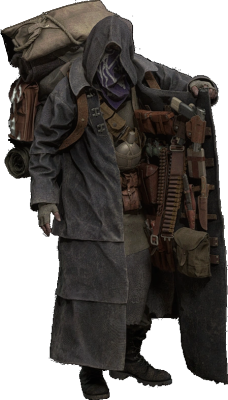
By mid-morning the street had become a living current of people. Customers drifted between the three carts, weighing aromas against prices, textures against memories. Others simply stood, momentarily suspended by the sudden abundance of choice. Arno observed in silence, noting that the Duke—for the rotund man could only be the Duke—laughed freely, served generously, and yet never once obstructed Arno's line of sight or interfered with the flow of his own customers.
At one point the Duke leaned closer, voice lowered in mock conspiracy.
"Don't think too hard, my friend. We're only here for today. No intention of claiming your corner permanently."
From the shack the Merchant's voice drifted out. "Temporary arrangement."
A brief pause.
"…Most likely."
Arno exhaled slowly and turned back to his counter.
"Then we should make the most of the morning," he said.
Arno let a small, excited smile appear on his face. "Competition?"
"Friendly rivalry," the Duke declared, slapping his knee.
"Survival of the competent," the Merchant muttered.
For one extraordinary morning, Lungmen bore witness to three sellers working side by side: three distinct philosophies of craft and commerce unfolding along a single stretch of pavement. The street would never again feel entirely ordinary.
By afternoon the grand cart had vanished. The shack disappeared without disturbing so much as a single brick. Only the lingering perfume of roasted meat and the memory of astonished, contented customers remained—along with an unspoken sense that Arno's modest operation had been quietly measured, and quietly endorsed.
When the street finally quieted that evening, Arno found himself seated in a borrowed back room—too orderly to be a mere storeroom, too cluttered to be an office. A single scarred table occupied the center. The Duke sat on one side, relaxed and expansive; the Merchant perched on a crate near the wall, absently adjusting a small metallic object between gloved fingers.
In the corner of the room, Niko was conspicuously silent.
She sat cross-legged on a stool far too small for her, holding a cinnamon bun that was nearly the size of her head. Sugar dusted her fingers. A handmade fish plushie—stitched carefully, lovingly—rested against her side. She took another bite, eyes wide, shoulders finally unknotted from the tension she'd carried all day.
Arno regarded the two visitors who had upended his routine without warning or explanation.
"So," he said, folding his hands on the table, "I will ask the obvious question. How are you here?"
The Duke's laugh rolled through the room, deep and unforced.
"That question has trailed us across more worlds than I care to count, my friend."
The Merchant spoke next, voice rough but not unkind.
"We go where trade exists. Where need exists. Where something worth preserving is being built."
Arno tilted his head. "That is deliberately vague."
"Intentionally so," the Duke replied, still smiling. "Call it following the wind. One day it carries us to a castle, the next to a half-ruined hamlet, the day after to a city still deciding what it wants to become."
"You've seen many places," Arno observed.
"Many," the Duke confirmed. "Some drowning in surplus, others scraping by on almost nothing. Markets paid in coin, in favors, in memories. One memorable world accepted only gemstones carved into skulls."
"Another outlawed merchants outright," the Merchant added.
"And yet?" Arno prompted.
"They found us anyway. And let me tell you, the things we've seen would go beyond your wildest dreams…" the Duke said ominously.
The conversation unfolded naturally thereafter. They spoke of strange patrons and stranger regulations, of markets that existed for a single night, of cities whose streets rearranged themselves when unobserved. In return, Arno offered glimpses of Lungmen—its intricate rules, its rival factions, the way opportunity and peril so often arrived together.
At length the Duke glanced toward the corner and smiled.
"Your assistant has excellent instincts. It took her less than ten minutes to decide we weren't going to devour anyone."
Niko froze mid-bite, then resumed eating without comment.
"She is observant," Arno said quietly.
Eventually the atmosphere shifted—subtle, but unmistakable. The Merchant rose first. From within his coat he produced a small, solid plaque, its surface engraved with careful precision. He placed it on the table and slid it toward Arno.
The Duke cleared his throat, adopting a tone of gentle formality.
"By custom, and by consensus, we recognize you as one of us."
Arno looked down.
SHOPKEEPER'S GUILD
INTERWORLD MERCHANTS' CONCORD
NOTICE OF RECOGNITION
By authority vested in the Guild and by consensus of its standing members,
the bearer of this notice is hereby acknowledged as a
MEMBER IN GOOD STANDING.
This recognition affirms lawful participation in Guild trade,
adherence to established customs of fair exchange,
and the right to operate without interference from fellow members
across all recognized markets and territories.
Issued without expiration.
Revocation subject only to Guild deliberation.
He did not immediately reach for it.
"This does not obligate me to begin appearing in haunted villages, I trust?"
The Duke laughed again. "Only if the mood strikes you."
"Membership does not bind," the Merchant said. "It just means you are one of us now."
Arno lifted the plaque. It was heavier than its size suggested.
"Thank you," he said, and meant it.
They did not prolong the farewell. The Duke stood, already stretching as though the road were calling. The Merchant adjusted his coat, casting a final glance toward Niko—who hugged her plush toy a fraction tighter.
"The wind is turning," the Duke said cheerfully. "Take good care of your corner of the world, Arno."
"And make sure to enjoy yourself too. You have no idea how much fun it has been for us for the past few centuries." the Merchant added.
Then they were gone.
Later that night, when the borrowed room stood empty once more, Arno placed the plaque carefully inside his cart. Niko peered over the counter.
"So… you're in a guild now?"
He nodded.
She smiled, a trace of powdered sugar still clinging to her cheek, and took another bite of the cinnamon bun.
The next day, business resumed its familiar rhythm. Mostly.
The line formed the way it always did—early, quiet at first, then steadily filling with the usual mix of tired faces and practiced patience. The cart stood where it always had. The street sounded the same. If anything had changed, it was subtle enough to be missed at a glance.
Still, every so often, a customer would slow their step. Someone would look down the block, then back again, brow furrowed.
"…Wasn't there another cart here yesterday?"
Another would swear they'd smelled something different in the air that morning—spices they couldn't name, something warm and rich that didn't belong to coffee at all. A third mentioned a shack that definitely hadn't been there last week, though they couldn't quite say where it had stood.
Arno answered none of it. He poured, took payment, nodded people along.
By midday, the questions stopped. The rhythm settled. The street accepted what it could see.
But a few customers left glancing over their shoulders, as if half-expecting something large and friendly to be there when they looked back—only to find the space empty, and no proof it had ever been otherwise.
AN: The reason why I made the Duke sell food and Merchant sell toys is because they obviously cannot sell guns, ammo, and explosives in Lungmen. Otherwise, they'd instantly be sought after by EVERYONE who'd want a piece of them.
Also, just to clear it out, Duke sells food that is made on the spot, like a taco or shawarma vendor. So his food is made to be eaten there, meanwhile Arno sells pre-packaged goods so those are much easier to take home. Just decided to point it out so as to show that there's no redundancy in these roles.
Also gotta let Arno see how the REAL masters move goods.
A Customer's Musings-2
Tenno
Making the rounds.
- Joined
- Oct 21, 2021
- Messages
- 27
- Likes received
- 188
A Customer's Musings - 2
You know, I thought Arno (Finally got the name of the shopkeep), finally adding coffee, the ambrosia of the hard-working man and woman on terra would be the highlight of the week. But no, rather it was the sudden appearance of 2 new sellers. Both are just as mysterious and so very different from Arno.
One is a man completely covered, carrying a massive backpack full of quality knick-knacks, toys, and some interesting odd and ends. The Merchant, as he calls himself, is quiet, mysterious, and incredibly generous with his prices. So much so that even I, a factory worker, could afford something on my budget. Like the amazing painting of a castle in a lake that I bought, really made me feel like a fancy noble!
The other, named Duke, is the largest man I have ever seen, as I couldn't even see his feet when he sat down. The man had folds on his folds, yet his size was surpassed by his jolly attitude, wit, and cooking. Good lord, his cooking, the smell alone made the visit worth the hour-long line just to buy one of his meals. Which I did, ordered a nice steak, and it was the greatest meal I've ever had the privilege of tasting. Almost on par with my own mother's cooking!
But what really surprised everyone was the teamwork. Arno, Merchant, and Duke coordinating together was a thing of beauty to watch. And a hefty increase to their wallets' weight with the number of customers theyve got. Honestly, it looked like a mini festival with all the food, toys, and other things people have been buying. Made the plaza feel a lot more lively, which is a nice change. Too bad it only lasted a day.
They just packed up and left, and by the time people woke up the next day. They were already gone, a shame really. I really wanted to taste the Duke's full menu.
Hopefully, that little event will help keep Arno above the red. Especially with those bastards making a mess of things by scaring his customers. Too bad they haven't done anything yet, would have loved to call the LGD. See how they like being intimidated and tailed. Also started saving for a security camera, want it pointed right out my window, and hopefully see if I can catch any of those thugs doing something illegal.
You know, I thought Arno (Finally got the name of the shopkeep), finally adding coffee, the ambrosia of the hard-working man and woman on terra would be the highlight of the week. But no, rather it was the sudden appearance of 2 new sellers. Both are just as mysterious and so very different from Arno.
One is a man completely covered, carrying a massive backpack full of quality knick-knacks, toys, and some interesting odd and ends. The Merchant, as he calls himself, is quiet, mysterious, and incredibly generous with his prices. So much so that even I, a factory worker, could afford something on my budget. Like the amazing painting of a castle in a lake that I bought, really made me feel like a fancy noble!
The other, named Duke, is the largest man I have ever seen, as I couldn't even see his feet when he sat down. The man had folds on his folds, yet his size was surpassed by his jolly attitude, wit, and cooking. Good lord, his cooking, the smell alone made the visit worth the hour-long line just to buy one of his meals. Which I did, ordered a nice steak, and it was the greatest meal I've ever had the privilege of tasting. Almost on par with my own mother's cooking!
But what really surprised everyone was the teamwork. Arno, Merchant, and Duke coordinating together was a thing of beauty to watch. And a hefty increase to their wallets' weight with the number of customers theyve got. Honestly, it looked like a mini festival with all the food, toys, and other things people have been buying. Made the plaza feel a lot more lively, which is a nice change. Too bad it only lasted a day.
They just packed up and left, and by the time people woke up the next day. They were already gone, a shame really. I really wanted to taste the Duke's full menu.
Hopefully, that little event will help keep Arno above the red. Especially with those bastards making a mess of things by scaring his customers. Too bad they haven't done anything yet, would have loved to call the LGD. See how they like being intimidated and tailed. Also started saving for a security camera, want it pointed right out my window, and hopefully see if I can catch any of those thugs doing something illegal.
Chapter 18
New
Paracsus
Know what you're doing yet?
- Joined
- Dec 20, 2023
- Messages
- 194
- Likes received
- 3,330
Mounting Pressure
The pressure began quietly at the start of the week.Two unfamiliar men started lingering near the cart during lunch hour. They positioned themselves close enough to the line that their comments carried, but not close enough to be accused of blocking customers. They talked about wait times and mentioned other stalls down the street that were "more established and well-known." Their tone was casual, but deliberate.
Most people ignored them. A few hesitated before stepping forward, though none left outright.
"At least the food Arno sells doesn't cost an arm and a kidney to keep you full." One college student joked.
Arno continued working without acknowledging the interference. He prepared each order at the same steady pace he always had. Niko handled payments and greeted customers with her usual warmth, though she kept an eye on the men's movements.
The following day, a different tactic was attempted. A woman from another stall approached people before they reached the cart and suggested they try alternatives. She implied that the cart's operations the cart sold shady items since no one could explain how it does these things. This also went ignored, mostly because nobody cared and nobody got hurt.
By evening, several people remained nearby after closing to see whether a supplier would arrive. No deliveries came. No crates were unloaded. Arno locked the cart and left on foot, as he always did. The next morning, the shelves were full again.
(Arno and Niko had to go and circle around after making sure the peeping toms are no longer around to come back to the cart. Mostly after the creeps have been scared off by the LGD patrols who've been receiving reports on "shady people loitering at night.")
Midweek brought more visible obstruction. A delivery van parked unusually close to the curb during peak hours, narrowing the pedestrian space and forcing customers to line up single file. Two men stood near the ordering side of the cart long enough to slow down the process. They never openly interfered, but their presence created friction.
Customers eventually pushed past them. One office worker asked them to step aside so she could place her order. The situation did not escalate, but it was noticeable. The delivery van also got slapped with a parking ticket and a stern talking to by the nearby Tea House owner because the obstruction from said van was annoying her customers as well.
By Thursday, some of the regulars had grown impatient—not with Arno, but with the persistent hovering. When someone repeated the rumor about licensing, a dockworker in line pointed out that the cart had been operating consistently for weeks without issue. Similar comments and remarks about how Arno having an official notice ended the discussion. People returned their attention to the counter.
On Friday, a university student openly recorded when one of the men tried steering customers away. The video circulated among local groups that evening. It did not attract citywide attention, but it was enough for regular customers to recognize that the interference was coordinated. Many students even threatening to call the police for harassment, which caused the harassers to back off.
The watchers reduced how close they stood after that.
Several streets away, the individuals organizing the pressure reviewed their observations in a rented warehouse. Sales during peak hours had barely dropped. Average daily revenue remained steady. Repeat customers had slightly increased. The attempt to apply to disturb Arno's operations from the source had failed entirely due to the mysterious lack of a resupply; there were no external distributors to contact, no suppliers to threaten, and no deliveries to interrupt to their knowledge. Surveillance had confirmed that the cart restocked without visible support.
Either that, or the cart owner made his things in house. They did not want to accept that possibility because that opened up a whole new can of worms.
That absence complicates matters.
Back at the cart, Arno did not address the rumors publicly. He did not confront anyone. He did not change his pricing or adjust his hours. When a customer quietly asked whether he was being harassed, he replied that operations were normal.
Niko became more alert as the week progressed. She stayed closer to the ordering side during rush hours and made sure customers could approach without obstruction. She did not challenge anyone directly, but her gentle coaxing and directing of the customers prevented crowding and disorderly behavior.
By the end of the week, it was clear that indirect pressure had produced little effect. The cart continued to operate. Customers continued to return. There was no supply chain to disrupt and no visible vulnerability to exploit.
With those options exhausted, attention shifted to the cart itself.
That decision led to the late-night meeting in the parking lot behind the closed warehouse.
They met in a rented storage warehouse several streets away from the district where the cart operated. The building had no signage, no business markings—just a numbered unit and a rusted rolling door. Inside, the space was mostly empty. Concrete floor. Corrugated walls. A single fluorescent light buzzing faintly overhead. The air carried the dull scent of dust and old oil.
A folding table stood in the middle of the open floor. Mismatched chairs surrounded it.
Spread across the table were printed sheets and handwritten logs: estimated daily foot traffic, time-stamped customer counts, rough revenue projections based on observed purchase volume, and comparative charts showing declining sales from nearby establishments.
The man at the head of the table kept one hand pressed flat against the top page.
"It isn't working," he said.
He tapped a column circled in red ink—steady numbers, unchanged over weeks.
"We've positioned people near the cart during peak hours. We've made it uncomfortable to stand in line. We've redirected traffic where we can. And yet the volume holds."
The broad-shouldered man to his right leaned forward. "We monitored supply activity for two weeks," he said. "There are no deliveries. No vendor drop-offs. No restocking runs. He closes at night and opens the next day fully stocked."
A quiet pause followed.
"No external distributors," the woman near the end of the table added. "We confirmed that twice. No crates brought in. No inventory transfers. Nothing."
"Which means we can't choke him upstream," someone muttered.
The man at the head of the table nodded once. "There's no supply chain to pressure. No credit accounts to freeze. No contracts to lean on."
"And he hasn't adjusted pricing," the woman continued. "No increases. No visible shortages. No promotional desperation. Same menu. Same hours. Same demeanor."
"That's the problem," the negotiator said. "People read stability as legitimacy."
Silence settled over the table.
"We expected him to react," one of the men said. "Raise prices. Argue publicly. Make it easier to frame him as unreasonable."
"He hasn't," the head of the table replied. "He stays neutral. The more we apply visible pressure, the more we look territorial."
A shorter man across from her, the one who tracked competitor pricing, nodded. "I walked past yesterday. There were eight people in line at 11 a.m.—normal lunch rush. Two of them were regulars we've seen at our own spots before. One even waved at me like nothing's changed."
Silence followed that observation.
"So the indirect approach failed," the first man said. "We assumed sustained inconvenience would push him out. It didn't. He's absorbing it."
The broad-shouldered man exhaled through his nose. "Because he's getting sympathy now. The more we lean, the more some customers dig in to try and help him. Principle over convenience. We didn't count on that."
The woman folded her arms. "And if we keep going the same way, it only gets worse. Word spreads. Other independents see he's holding out and think they can try the same."
"That's the real cost," the first man agreed. "Not just this month's numbers. He'setting a precedent t. If one small operator can ignore the pressure and keep trading, others will test the same boundaries. We lose control of the district."
A pause settled, longer this time.
The shorter man broke it. "So we escalate."
No one reacted with surprise. The statement landed like an expected next step in a budget meeting.
The woman looked directly at him. "You're suggesting we damage the cart itself."
"Yes. Make it inoperable. At least temporarily."
"That crosses from influence to destruction," she said carefully. "There's no walking that back. We'll be cooked alive if we get caught."
The first man interjected. "We're already past plausible deniability on the soft pressure. Following customers, quiet warnings to nearby shops—enough people suspect us. If we stop now, he wins by default. The lines keep forming. Our sales keep sliding."
The broad-shouldered man rubbed his jaw. "How exactly? We're not talking fire or anything permanent. Just enough to sideline him for weeks."
"Early morning," the shorter man answered. "Before first light, before any customers show up. Two people go in. Break the frame joints, crack the wheels, damage the counter supports so it can't be pushed or leveled easily. Tools are basic—crowbar, hammer. In and out in ten minutes. No noise beyond what a passing truck would cover."
"And evidence?" the woman asked.
The first man shrugged slightly. "We've never spoken to him directly. No messages, no calls, no witnesses who can place us there. He can report vandalism, but it's one more incident in a city full of them. Police have bigger priorities."
The shorter man added, "We wear gloves, dark clothing, nothing identifiable. Park a block away. Use the service alley behind the lot—he leaves the cart there overnight. It's exposed."
The broad-shouldered man frowned. "If he rebuilds quickly? New frame, new wheels—he could be back in a month."
"Then we deal with it then.," the first man said. "But the message lands either way. Endurance has limits when the equipment itself breaks."
The woman studied the table for a moment. "Once we do this, there's no pretending anymore. He'll know it's us, even without proof. And he won't forget."
"No," the first man said. "He won't. But forgetting wasn't the goal."
Another brief silence.
"When?" the shorter man asked.
"Tomorrow morning," the first man decided. "5:30 a.m. Weather forecast is clear, low traffic. We confirm the cart's location tonight—same spot as last week."
No one objected.
Chairs scraped lightly against the concrete as they stood. Reports were gathered, folded, and tucked into jackets. The single overhead bulb buzzed faintly as someone switched off the secondary work light near the door.
They had tried isolation through pressure.
It had failed.
Now they would remove the means of operation itself.
The decision required no further discussion.
Later that night, a plain gray van idled briefly in a dim parking lot behind a closed storage warehouse three blocks from the docks. The engine cut. The headlights went dark. The lot was mostly empty—stacked pallets near the loading bay, a chain-link fence along the perimeter, and a single streetlamp casting weak yellow light across cracked pavement.
The driver's door opened.
The man who had led the earlier meeting stepped out and shut it quietly. He carried a small black duffel bag. Three people waited near the rear of the van.
Two men stood with tools already in hand—one holding a crowbar, the other resting a short-handled sledgehammer against his shoulder. A woman stood a few steps apart from them, her posture relaxed but alert. There was no visible glow yet, but her right hand remained loose at her side, fingers flexing once as if rehearsing a motion.
He approached and set the duffel on the ground between them. The zipper rasped softly as he opened it.
"Service alley behind 14th," he said. "Same position as before. He parks close to the brick wall. Narrow access. You'll have a few minutes at most before anyone passes through."
The man with the crowbar glanced down into the bag. Inside were spare gloves, dark cloth tape, padding to wrap around metal contact points, and a compact flashlight fitted with a red lens.
"Hit structural points," the organizer continued. "Main frame rails first. If those don't give, move to the axle housings and support braces. Don't waste effort on panels. If you can't break it cleanly, make it look unstable."
The man with the sledge shifted his stance. "He didn't respond to pressure," he said. "Didn't raise prices. Didn't shorten hours. You think this changes that?"
"It doesn't need to change it immediately," the organizer replied. "It needs to introduce cost. Uncertainty. If he believes the cart isn't secure, he'll reconsider staying."
The woman finally spoke. "And if he's present?"
"Then you make it clear this is escalation," he said. "Threaten him. Make him understand that this is the consequence of ignoring a negotiated exit. Do not disengage the moment he resists. Hold the line long enough for the message to register."
Her expression did not change, but she gave a small nod.
"We offered compensation," the crowbar wielder muttered. "A clean withdrawal."
"He declined," the organizer said evenly. "That was his decision."
He closed the duffel and handed it to the man with the sledgehammer.
"Half has already been transferred. The remainder follows confirmation that the cart cannot operate tomorrow. No excess damage. No signatures. This is a correction, not a spectacle."
He stepped back toward the van.
"If it turns complicated, separate and return here. No calls. No discussion after."
He got back into the driver's seat. The engine turned over softly. The van rolled out of the lot, headlights only coming on once it reached the main road.
The three remained in silence for a moment after it disappeared.
The crowbar was wrapped in padding. Gloves were pulled on. The sledgehammer strap was adjusted across a shoulder.
The woman turned toward the street first.
They moved out together, measured and deliberate, heading toward 14th Street and the service alley where the cart would be secured in the hours before dawn.
Shots Fired
The street lay silent in the pre-dawn darkness, the pavement still holding residual warmth from the previous day. Streetlights offered dim, uneven coverage along the service alley where the cart stood secured overnight—shutters latched, compartments closed, tie-downs checked.Arno had stepped outside to bring out the cooler and exterior shelves. Meanwhile, Niko remained inside to freshen up in the morning before greeting customers.
Three figures entered the alley from the open end. Two carrying heavy tools while a third figure—the woman—trailed several paces behind, her right hand already faintly glowing with the violet shimmer of nascent Arts energy. She held a slender wand loosely at her side, ready to channel if resistance appeared.
The first man reached the cart and forced his crowbar beneath the main frame rail, prying with deliberate force. Metal groaned under strain.
Nothing shifted.
He adjusted his footing and leaned harder, jaw tightening as he put his weight into it. The crowbar flexed slightly at the hooked end. The cart did not.
"What the hell…?" He remarked. "The fuck is this thing made of?"
The second man stepped to the rear wheel assembly and delivered a heavy swing of the sledgehammer. The impact rang sharply through the alley.
The wheel remained aligned. The axle did not crack. No bolt sheared loose.
He frowned and struck again, harder. The sound carried, loud and jarring against the brick walls.
The cart stood exactly as it had before.
Arno turned at the repeated impacts and rushed to the sound. He turned the corner to see the three strangers banging at his home.
"Stop," he said clearly. "Step away from the cart. Now."
The two men with tools paused, unsettled more by the lack of visible damage than by his voice. The first man yanked his crowbar free and examined the contact point. There wasn't even a visible bend in the frame rail.
The woman raised her wand slightly; the violet glow intensified, unstable but gathering.
The first man straightened, breathing harder now—not from effort alone. "You should've taken the bosses' offer when they gave it to you, vendor! If you'd listened and moved on like they asked, none of this would be happening!"
"Yeah," his partner added, masking confusion with volume as he hefted the tool again. "They gave you the easy way out. Maybe a share in the profits and some extra hands.You coulda walked away clean. But you had to stay."
He swung again, aiming for the wheel mount with a full overhead arc.
The tool struck.
The sound echoed.
The mount did not splinter. The wheel did not buckle. The crowbar rebounded slightly in his grip, the shock traveling up his arms.
Arno's expression did not change.
"It is my property," he replied evenly. "Drop the tools and leave."
The man with the sledge shifted his stance and took another step forward, raising the hammer as if determined to press the point despite the lack of results.
Arno reached inside the opened service window to draw his weapon that sat close to the desk just out of sight. The Remington came free in a practiced draw—chambered, safety disengaged. He raised it two-handed, muzzle aligned on the advancing man's center mass. His grip was firm from range and self-defense training, though the front sight trembled faintly under the surge of adrenaline.
He kept his weapon trained on one of the men and walked a bit away from the cart, making sure to keep the three thugs' attention on him.
"Final warning," Arno stated. "Drop it. Back away."
The two men tensed at seeing the firearm while the woman lifted her wand higher, the violet glow brightening as she began to form the casting gesture, eyes fixed on him while, behind them all, the cart stood untouched.
"You really expect us to believe some cart owner can afford firearms? You're not even a Sankta!" She yelled. She wore a smirk on her face as the purple light at the tip of her wand grew brighter.
"But you know, you can still walk outta here if you tell us where you get your stuff. If not, we can always ask the kid.,,"
Arno's grip on his rifle tightened, but he did not falter as he kept aim at the man closes to the cart.
'Niko, please don't go outside…' He pleaded.
Inside the cart, Niko had moved to the service door at the first loud impact. Seeing the glowing wand aimed toward Arno, she acted without hesitation: she seized a heavy glass bottle from the counter that was filled with juice. She opened the door to see the thugs still focused on Arno's drawn weapon.
Then, with as much force as she could, threw the bottle at the mage whose back was facing her.
The bottle struck the woman squarely in the shoulder and shattered on impact. Glass and liquid sprayed across her arm and chest; the sudden pain and surprise broke her concentration. The violet energy flickered and collapsed; she staggered back a step with a sharp gasp, wand dipping.
The distraction gave Arno the fraction of a second he needed.
He shifted aim and fired.
The round was supposed to hit the woman's torso, but the aim shift and slight hesitation on Arno's end caused it to veer slightly off course, causing it to hit her hand instead. It struck cleanly, shattering bone and tearing delicate muscle. The wand flew from her mangled hand in a spray of blood and flesh; she screamed and dropped to her knees, clutching the ruined limb to her chest, fingers already useless and bleeding heavily.
The man with the sledge reacted to the shot by charging forward, hammer raised for a desperate swing.
Arno tracked the movement under pressure and fired again.
This round hit the rushing man in the right knee. The kneecap shattered on impact; bone fragments tore through cartilage and ligament. The leg collapsed beneath him mid-stride. He fell forward hard, striking the pavement face-first with a sickening thud, then curled around the ruined joint, howling in raw agony.
The first man, still holding his crowbar, froze. He looked at the woman kneeling and clutching her destroyed wrist, then at his companion writhing on the ground with a leg bent at an unnatural angle. He dropped the crowbar—it clanged against the concrete—and raised both hands.
"I'm done," he said quickly. "We're out."
He backed away, then turned and ran toward the alley mouth without looking back.
Arno kept the rifle trained until the fleeing man vanished around the corner. Only then did he lower it, sweeping the alley once. The two injured figures remained down: the woman rocking in pain, blood pooling beneath her cradled arm; the man with the shattered knee gasping and clutching his leg, unable to rise.
Niko stepped out fully, anxious and concerned. "A-Are you hurt?"
"No," Arno answered. He engaged the safety, placed the rifle on the cart's rear step with the action open, and assessed the immediate scene. "They were determined."
Niko glanced at the scattered tools and the blood on the pavement. "They mentioned an offer. Something about a 'gift' from their bosses."
"They were hired to send a message," Arno confirmed. "Not coordinated. Just capable enough to cause serious damage."
Several residents had appeared at upper windows, alerted by the gunshots and screams. One already had a phone recording.
Arno addressed the nearest bystander. "Please contact the LGD. Report attempted destruction of licensed vendor property in the early morning hours. Two defensive shots fired after verbal warnings were ignored and an Arts user began to cast. Two suspects seriously injured and remaining on scene; one fled."
The resident nodded and began speaking into the phone.
Sirens rose in the distance within minutes—patrol units responding swiftly in the pre-dawn quiet.
When the first LGD vehicle arrived, Arno complied precisely: rifle on the ground, hands raised when instructed, account delivered clearly and without embellishment. Niko provided her corroborating statement, including her action in throwing the bottle to disrupt the Arts casting. Some of the nearby civilians also chipped in to act as witnesses to the whole debacle.
The officers documented the scene—the discarded tools, the blood evidence, the shattered wand fragments. They noted the sequence: attempted vandalism, verbal warnings, continued aggression accompanied by shouted references to a prior offer, an interrupted Arts attack, and two precisely placed defensive shots resulting in severe but non-fatal injuries. The injured pair were stabilized on site before medical transport.
An incident report, photographs, witness statements, and insurance documentation would follow. A formal request for enhanced overnight patrols was likely to be submitted.
The attempt had failed.
The group's calculated act of sabotage—intended to quietly eliminate competition—had instead produced two severely injured operatives, one escapee, and a public demonstration that the target was both prepared and resolute in his defense. The precedent established was no longer one of submission, but of effective resistance.
The LGD station was a flurry of activity. Niko had observed that it resembled a busy government office during peak hours. Officers moved briskly back and forth, carrying folders and clipboards. At the front counter, a man argued heatedly about a parking citation, his voice rising over the constant murmur. Somewhere behind a partition wall, a phone rang persistently, unanswered for several cycles.
Niko clutched at Arno's hand the whole time, matching his steps as they approached the desk so as to not get swept up in the crowd and get lost.
The officer behind the counter glanced up, his eyes shifting between them before settling on Arno. "You're here about the 14th Street alley incident?"
"Yes," Arno confirmed evenly. "We were directly involved in the events."
The officer's gaze moved to Niko again, lingering for a moment. "And she was present at the scene?"
"Yes, she was," Arno replied.
Niko lifted her chin slightly, meeting the officer's eyes. "I was there. I saw everything."
The officer gave a short, professional nod. "All right. Please wait here for a moment." He gestured toward a row of chairs along the wall.
They were eventually escorted into a smaller interview room containing a plain metal table and three chairs. The space was not overtly intimidating, but the camera mounted high in the corner prompted Niko to sit straighter than usual, her posture rigid against the backrest.
A woman in a plain jacket entered shortly afterward, carrying a tablet. She closed the door behind her, sat across from them, and placed the device on the table. "Good evening. This is Investigator Reyes. This conversation is being recorded for official purposes. You are not under arrest at this time. We simply require a clear and detailed account of the incident. Do you both understand?"
Arno nodded promptly. "Understood."
Niko nodded as well, though her hands remained folded tightly in her lap, knuckles pale.
Investigator Reyes turned to Arno first. "Mr. Arno, please begin by explaining the sequence of events, starting from the moment you first noticed something was wrong."
Arno spoke clearly, recounting the details without embellishment. "We were operating our cart in the usual location when I heard the distinct sound of metal being struck repeatedly. I observed two men using tools to damage the cart's frame. A third individual stood nearby, preparing what appeared to be an Arts manifestation—purple energy gathering in their hands. I immediately issued verbal warnings to cease their actions and identify themselves. They did not comply. One of the individuals then referenced an 'offer' that had been refused, implying this was not a random act but a response to our refusal."
Reyes paused, her stylus hovering over the tablet. "They mentioned an 'offer' explicitly?"
"Yes," Arno confirmed. "The words were something to the effect of 'you should have taken the offer when you had the chance.' It suggested this was targeted retaliation."
She made a brief notation. "Please continue."
Arno described the escalation in precise terms: the bottle thrown to disrupt the Arts casting, the advancing attacker with the sledgehammer raised, and his decision to discharge his firearm to prevent imminent serious harm. Throughout, his tone remained level and factual, devoid of unnecessary emotion.
When he concluded, Reyes turned her attention to Niko. "Ms. Niko, you were the one who threw the bottle?"
Niko nodded once. "Y-yeah. That's right.."
"Can you explain your reasoning for doing so?"
She swallowed, then answered steadily. "I saw the purple light—the Arts—getting larger and more intense. The person casting it showed no sign of stopping, even after Arno warned them multiple times. I didn't want her to complete whatever she was preparing. She looked dangerous."
Reyes regarded her calmly. "You understood that intervening in that way might provoke them further or escalate the situation?"
"They were already angry," Niko replied quietly. "They were trying to break our store and the magic person was aiming her wand at Arno. I didn't want him to get hurt so I chucked the bottle to try and distract her."
"Did anyone instruct you to throw it, or suggest that you should do so?"
"No," Niko said quietly. "I just didn't want Arno to get hurt…"
Arno remained silent, allowing her to speak without interruption.
Reyes nodded slowly and returned to her tablet for a moment. "For your information, two of the suspects are currently in surgery but are reported as stable. The third fled the scene and has not yet been identified. Based on the preliminary evidence and your accounts, this incident is being classified as attempted destruction of property and aggravated assault, with potential additional charges pending further investigation."
Niko shifted in her seat. "Are they going to come back? For us, I mean."
Reyes met her gaze directly. "That is difficult to predict with certainty at this stage. However, we are treating the matter with appropriate seriousness and will pursue all leads."
"Are we going to be in trouble? They started it!" Niko exclaimed, her voice rising with anxiety.
Arno placed a hand on her shoulder to calm her. "We are not in trouble, Niko. We acted in self-defense. Remain calm."
She set the tablet aside. "There is an important point both of you should understand. Whenever a firearm is discharged within city limits, protocol requires an automatic review by Internal Affairs. This is standard procedure and does not imply wrongdoing on your part. It simply ensures thorough documentation and compliance with regulations."
Niko's shoulders tensed visibly, but Arno spoke up before she could respond. "I understand the necessity of such reviews. We complied with all protocols during the incident."
"I am not suggesting otherwise," Reyes replied evenly. "The review exists to protect everyone involved, including officers and civilians."
Arno nodded. "We appreciate the safeguards in place."
Reyes continued. "Additionally, civilian footage of the incident is already circulating. Portions were recorded from nearby buildings and windows. You should anticipate seeing clips appear online by this evening or tomorrow."
Arno nodded. He saw this coming from a mile away. "We understand. We won't give any comments regarding this."
"You might get some attention because of this," Reyes said, her tone matter-of-fact. "Some people will back you up. Others are going to second-guess what you did or straight-up criticize it."
Arno gave Niko a quick glance before answering. "People usually take sides before they know the whole story. We'll deal with anyone who comes asking."
Reyes's mouth curved just slightly. "Smart way to look at it."
Then her face settled back into its usual calm lines. "One more thing. If anybody reaches out—reporters, random people, other vendors, even someone pretending to be official—don't talk to them. Just tell them to call us here. Got it?"
"Got it," Arno said right away. "We'll do exactly that."
Niko gave a small nod, staying quiet.
Reyes paused for a second. "So… are you planning to keep the cart at 14th Street?"
Arno answered carefully. "We're thinking it over. Moving might be the safer choice right now."
Niko looked at him but didn't say anything.
Reyes nodded. "It could cut down on the chance of anyone coming back for round two."
"That's what we're worried about," Arno said. "Safety comes first."
Niko's fingers pressed together tighter in her lap, but she kept her mouth shut.
Arno went on, voice steady. "The spot's nice and we're used to it, but it's not worth the risk anymore."
Reyes tapped a few last notes into her tablet and switched it off. "You're free to go. We'll get in touch if we need anything else—especially once we figure out who the third person was."
They stood up. Arno grabbed Niko's hand and they left the room, very aware of the camera in the corner.
Back in the main part of the station, the place was still humming—officers shuffling papers, people waiting in line, phones ringing. Niko looked around at all of it.
Arno spoke low so only she could hear. "The statement stays on file forever. That's just how it works. But having it there also protects us."
She didn't answer right away. They walked toward the doors in silence for a few steps.
When they stepped outside. Arno spoke as they descended the steps. "We'll need to leave the spot for a while. Long enough for things to settle and for anyone still watching to lose interest."
She gave a brief nod, keeping pace.
"I wanna say goodbye to Miss Exia and Texas." She said. "I don't want them to get worried."
"We will. But for now, let's just make some preparations. The cart gives us food, but we don't have a place in mind just yet." Arno replied. "I wanna make sure that we don't end up sticking out like a sore thumb."
The cart sat in its usual place along 14th Street, tucked beside the brick wall as if nothing had happened that morning.
Arno took a moment before approaching. The street traffic had thinned, but he still scanned both ends of the alley out of habit. Satisfied, he keyed in the command on the side panel. The cloaking system engaged with a faint hum. The cart's exterior shifted subtly, its outline softening and blending into the surrounding shadows. It wouldn't make it invisible, but it would make it easy to overlook.
He unlocked the door and stepped inside. Niko slipped in after him, pulling it shut firmly behind her.
AN: First time doing a (sorta??) action scene. Please gimme feedback on this. I was struggling to make it not seem like utter nonsense, and this is how it turned out.
The end to Arc 1 is close by. I will be giving him something pretty special later on. Stay tuned, dear consumers.
Last edited: