• An addendum to Rule 3 regarding fan-translated works of things such as Web Novels has been made. Please see here for details.
  • We've issued a clarification on our policy on AI-generated work.
  • Our mod selection process has completed. Please welcome our new moderators.
  • Due to issues with external spam filters, QQ is currently unable to send any mail to Microsoft E-mail addresses. This includes any account at live.com, hotmail.com or msn.com. Signing up to the forum with one of these addresses will result in your verification E-mail never arriving. For best results, please use a different E-mail provider for your QQ address.
  • For prospective new members, a word of warning: don't use common names like Dennis, Simon, or Kenny if you decide to create an account. Spammers have used them all before you and gotten those names flagged in the anti-spam databases. Your account registration will be rejected because of it.
  • Since it has happened MULTIPLE times now, I want to be very clear about this. You do not get to abandon an account and create a new one. You do not get to pass an account to someone else and create a new one. If you do so anyway, you will be banned for creating sockpuppets.
  • Due to the actions of particularly persistent spammers and trolls, we will be banning disposable email addresses from today onward.
  • The rules regarding NSFW links have been updated. See here for details.

My brothers Keeper, an SI as the twin brother of Stalin (Reworked)

This made sense for the beginning of the fanfic but cmon bro, he's personally killed entire families, hundreds of soliders, been through warfare, charged first in battles, and he still quakes in his boots like a little bitch, it's simply ridiculous, Stalin ain't that scary he just isn't, your character is pathetic, this attitude should've ended within the first few chapters if not scenes

Yeah right now Mika is worst than Stalin in the eyes of a lot of peoples so is not Logic that is still afraid or dont have other plan for stalin
And I hope after this chapter is not going to still cry about his wife death and try to kill himself
If Mika really want to save peoples from stalin why doesn't he try and make a Better image for him and stalin, because the only thing he do is kill peoples left and right
 
This made sense for the beginning of the fanfic but cmon bro, he's personally killed entire families, hundreds of soliders, been through warfare, charged first in battles, and he still quakes in his boots like a little bitch, it's simply ridiculous, Stalin ain't that scary he just isn't, your character is pathetic, this attitude should've ended within the first few chapters if not scenes

The road to hell, good intentions. He's definitely built a 6 lane highway by now
 
I think Mika's been 'playing' a role and dissociating; that's why he could kill without mercy, and still be scared. His knowledge of the future gives him the ability to view the world as "false" to an extent.

Also, the whole Stalin is an unfeeling machine of unending ice as deep as Mother Russia is going a bit too far. Or is it just how Mika perceives him?
 
I think Mika's been 'playing' a role and dissociating; that's why he could kill without mercy, and still be scared. His knowledge of the future gives him the ability to view the world as "false" to an extent.

Also, the whole Stalin is an unfeeling machine of unending ice as deep as Mother Russia is going a bit too far. Or is it just how Mika perceives him?

After what he saw in the illusion ( Maria and his Victims ) in going to change some extent . He can't be the same person after all this
 
The brothers Jugashvili New
The New York Times
July 17, 1973
Somali Forces Take Dire Dawa

Somali troops, supported by Soviet and Cuban volunteers, captured the strategic Ethiopian city of Dire Dawa early today, dealing a significant blow to the government of Emperor Haile Selassie. Military sources said the assault was led by Lieutenant General Dmitry Yazov and involved coordinated infantry, chemical and artillery attacks.

The loss of Dire Dawa, a key transportation and commercial center in eastern Ethiopia, comes as the Selassie government faces mounting pressures from famine, unrest within the armed forces, and growing political opposition.

In Washington, the United States condemned the joint Somali-Soviet action and announced plans for expanded military and economic aid to Ethiopia. American officials declined to comment on reports that U.S. special forces advisers may already be operating alongside Ethiopian units.

The Soviet Union has not publicly acknowledged its role in the fighting, but Western diplomats said the operation underscored Moscow's expanding influence in the Horn of Africa.


March 30, 1921
On a train approaching Moscow
Moscow Oblast, Russian SFSR


Stalin stepped quietly out of the room, closing the door with care. Nadezhda lay curled on her side, Vasily tucked against her chest, both breathing in the deep, even rhythm of people who had not yet learned to ration sleep. He paused a moment, watching them, then turned away. That world—of rest, of softness—was not meant for him. It never had been. Revolution trained a man to live on fragments: fragments of sleep, fragments of warmth, fragments of mercy.

He crossed into the main room.

Mika was sitting at the table, a book propped open on a makeshift stand, the lamplight catching the uneven planes of his face. His hair was loose, falling to just above his shoulders, no longer tied back with military precision. The eyepatch, the half-empty sleeve pinned at the elbow, the ill-fitting tunic—he looked less like a commissar now and more like a brigand who had wandered in from the mountains and never quite left. It irritated him in a way he could not fully articulate.

Mika glanced up and smiled faintly. "Hey, Joe."

He acknowledged him with a nod and took the chair opposite. "What are you reading?"

"The Red Room," Mika said, tapping the page with his left index finger. "Swedish novel. Strindberg—August Strindberg. Elsa found a Russian edition for me. Thought it might keep me occupied before Moscow buries me alive with paperwork."

His mouth tightened at the name. Elsa. The foreign nurse. The humanitarian. The woman who had threaded herself into his brother's life at precisely the wrong moment. He understood grief. He understood desire born of loneliness; he was no stranger to that particular ache. But her? A foreigner. Connected to international relief networks, Western eyes, bourgeois sympathies. Too clean. Too visible.

"You sound like you're in love," He said flatly.

Mika did not deny it, just shrugged. That alone was unsettling.

"Unfortunately, you're not wrong," he replied. "And I hate myself for it. Every time I think of her, it feels like I'm betraying Maria." He exhaled slowly. "But it's lonely, Joe. Without Maria. And now without Elsa."

Stalin folded his hands. "Then find another woman in Moscow. Someone suitable. With your reputation, that won't be difficult."

Mika nodded, but his expression didn't change. "I know. But what would that give me? Someone pretty? Someone obedient? I don't need a servant or a sycophant or someone to warm my bed." He looked up, his remaining eye meeting Stalin's eyes. "I need someone who tells me to stop. Someone who calls me a monster when I deserve it."

Stalin felt a flicker of irritation. Softness. She was making him soft.

"You know what your new position entails," Stalin said. "You do not have the luxury of conscience."

Mika gave a short, humorless laugh. "Did you read the Kronstadt report?"

"I did."

"You saw that it worked."

Stalin remembered the words on the page. The crossing of the ice. The surrender. The casualties reduced by a margin that should not have existed. Foolish. Reckless. Brilliant, perhaps—but brilliance that relied on luck was still foolishness.

"That will not work again," Stalin said. "You will not always survive such gestures. Sooner or later, that kind of softness gets a man killed."

Mika studied him for a moment. "I don't really fear dying anymore," he said quietly. "And I trust you to take care of my children if it comes to that. I'll do what you tell me, Joe. I always have." A pause. Then, almost gently: "But I'll do it my way."

Stalin snorted. "You've never known any other way."

"What do you expect?" Mika shrugged, closing the book. "Someone has to be the soft one."

Stalin did not respond. He watched as Mika's gaze drifted down to the empty sleeve, the stump beneath the fabric. The lamplight made it look smaller than it was, diminished.

"Do you know anyone in Moscow who can make a prosthetic?" Mika asked. Casual. As if he were asking for a new pair of boots.

"I can arrange inquiries."

Mika nodded, thoughtful. Then he smiled.

Stalin felt it immediately. That smile—the same one Mika had worn as a boy before suggesting something outrageous, impractical, or dangerous. It never boded well.

"I have an idea," Mika said.

Stalin sighed. "Out with it."

"You think," Mika said, gesturing at the stump, "you could have the prosthetic maker attach a blade instead of a hand?"

For a moment, Stalin said nothing. He simply stared at his brother, seeing not the wounded man before him but the boy who had once proposed shooting bullets with a slingshot, who had once suggested setting the school bully's pants on fire "for balance."

"What the hell are you talking about?" Stalin said flatly. He leaned back in his chair, folding his arms across his chest, studying his brother the way one studies leftover ordinance. "Have you finally gone mad?"

Even now—mutilated, grieving, half-broken—Mikheil was still Mikheil. Creative. Reckless. Incorrigibly dangerous. Loss had taken his arm and his wife, but it had not dulled that sharp, irritating spark in him. If anything, it had honed it.

"No, Joe," Mikheil replied calmly, almost patiently. He shook his head once. "I'm peacocking."

Stalin narrowed his eyes. "Pea… what?"

"Peacocking." Mikheil shrugged with his remaining shoulder. "You know the bird?"

"Yes," Stalin said curtly. "A bird. Get to the point."

"You've heard of their feathers," Mikheil went on, undeterred. "Bright. Excessive. Impossible to ignore."

"I said get to the point."

Mikheil smiled faintly. Not amused—focused. "Think about it. A blade for a prosthetic. A proper one. Short sword, maybe. I keep my hair long. The eyepatch stays. I won't look like a Party functionary or a clerk. I'll look like a bandit king. A warlord. Someone clearly insane."

He tapped his chest lightly with two fingers. "They'll look at me and think, this man is a menace. This man is insane. We should not provoke him."

Then he pointed at him.

"And they'll look at you, my older brother, my boss, and think—this man is the only one who can rein him in. The only one he listens to. The only one he answers to." He leaned forward slightly. "Which means he must be even more terrifying than I am."

Stalin said nothing. He did not interrupt. He was interested, he let him continue.

Mikheil pressed on, warming to his argument. "You can be the Party man. The organizer. The straight man. I'll be the monster. The Hero of the Revolution who still bows his head to his brother." He exhaled through his nose. "Lenin won't live forever. When he's gone, who do you think they'll look to? You—the man who held Petrograd, the man I defer to? Or those losers in the Politburo? Trotsky? Kamenev? Zinoviev?" He scoffed. "They're already on track to lose the succession battle. They just don't know it yet."

For a long moment, Stalin remained silent.

Clever, he thought.

Clever—and reckless. The idea was dangerous. It invited myth, spectacle, rumor. He despised chaos. Yet he understood symbols. He understood fear. And he understood that a controlled monster was more useful than a hundred loyal stooges.

He studied Mikheil again: the scars, the eyepatch, the empty sleeve. People would whisper. They already did. This would give them something solid to fear.

Finally, He spoke.

"Have you told anyone else this?"

"No," Mikheil said immediately. "Just you. I wouldn't risk it otherwise."

"And if that Swedish woman returns?" He asked, his voice carefully neutral. "Would you speak of me to her?"

Mikheil hesitated, just a fraction of a second. "It depends," he said honestly. "If she comes back. If something develops. If she becomes my wife—then she'd be family. I would speak to her as I spoke to Maria."

His jaw tightened. "And what did you speak of with Maria?"

"Work," Mikheil replied without hesitation. "Executions. Politics. How much I despised Zinoviev. How you were my connection to Moscow. Maria was my wife. Kato's sister. I trusted her."

"You are far too trusting," Stalin said sharply.

Mikheil smiled again, tired but unrepentant. "I prefer to think I'm a good judge of character."

Stalin did not return the smile.

Instead, he leaned forward slightly, elbows on his knees, eyes fixed on his brother.

Loyal, he thought. I need to keep him on a leash.

Stalin studied his brother for a long moment, eyes narrowed, jaw set, weighing the idea not on its absurdity but on its usefulness.

"Fine," he said at last. "Keep your look. I'll get you a stupid little blade for your arm—hell, I'll get you a real short sword if that's what you want." A thin smirk crept across his face. "If you insist on looking like a bandit king, you might as well commit properly."

Mika's face lit up, the way it always did when he thought he'd won something. "I knew you'd come around to my mad plan," he said. "And I think you'll like what else I have planned."

"Oh God," Stalin muttered, rubbing the bridge of his nose. "What now."

Mika rose from his chair with deliberate energy. "Follow me."

Stalin sighed, already regretting the decision, and stood. He followed his brother out of the main room and down the narrow corridor, passing the closed doors behind which children slept—Mika's five, Yakov included—and their mother. Stalin glanced at the doors only briefly. Family was a vulnerability; he never forgot that. Mika, on the other hand, leaned into it.

They entered Mika's makeshift office. The room was cramped, utilitarian, far too tidy for someone who claimed to live on the edge of chaos. Without ceremony, Mika crossed to the far wall and knelt, dragging out a heavy wooden chest. Then another. Then a third. Each was roughly the size of a small child.

Stalin's brow furrowed.

Mika produced a key from his desk drawer and unlocked the first chest. The lid creaked open.

Gold coins gleamed dully in the low light. Foreign banknotes—American, French, Italian—were stacked in uneven bundles. Gems followed in the second chest, loose and unmounted, catching the light with quiet, obscene brilliance. The third held more of the same.

Stalin froze. "What is this," he asked slowly, his voice flat. "And how did you get it."

Mika closed the chests again with irritating calm and locked them. "I skimmed taxes. Carefully. Over time." He met Stalin's eyes without flinching. "Consider it starting capital for a little business I've been thinking about."

Stalin stared at him, mind racing. This was not petty corruption. This was scale. This was planning.

He pulled a chair closer and sat heavily. "Who knows about this?"

"Maria knew I was saving," Mika said quietly. "Aside from her, no one."

Good, Stalin thought. At least the Swedish woman wasn't involved.

"Go on," he said. "What idiotic idea justifies this."

Mika smiled, dragged another chair over, and sat across from him. "Do you know what Prohibition is?"

"Prohibition of what?" Stalin snapped. "Be specific."

"Alcohol," Mika said. "In the United States. It's illegal there now. John Reed told me about it. Demand is enormous. The Italian mafia—New York, Chicago, everywhere—they're killing each other over access to booze."

Stalin leaned back, arms folded. He said nothing.

Mika stood, retrieved a folded map, and spread it across the desk. His finger jabbed at the United States, then slid south.

"Here," he said. "Cuba. Ninety miles off the coast. Alcohol is legal there. I buy ships. I load them with liquor. I don't sell directly into the U.S.—too messy. I sell to intermediaries in Cuba. Mafia connections. They move it in. They pay us for supply."

His finger moved again. "Mexico is another option. Canada too—laws vary by province, some dry, some not."

Stalin watched him closely now, irritation giving way to reluctant interest. This wasn't drunken fantasy. This was logistics. Supply chains. Risk buffers. Plausible deniability.

"You want to turn Soviet money into criminal profit," Stalin said.

"I want to turn chaos into leverage," Mika replied calmly. "And money."

Stalin did not smile. But he did not interrupt.

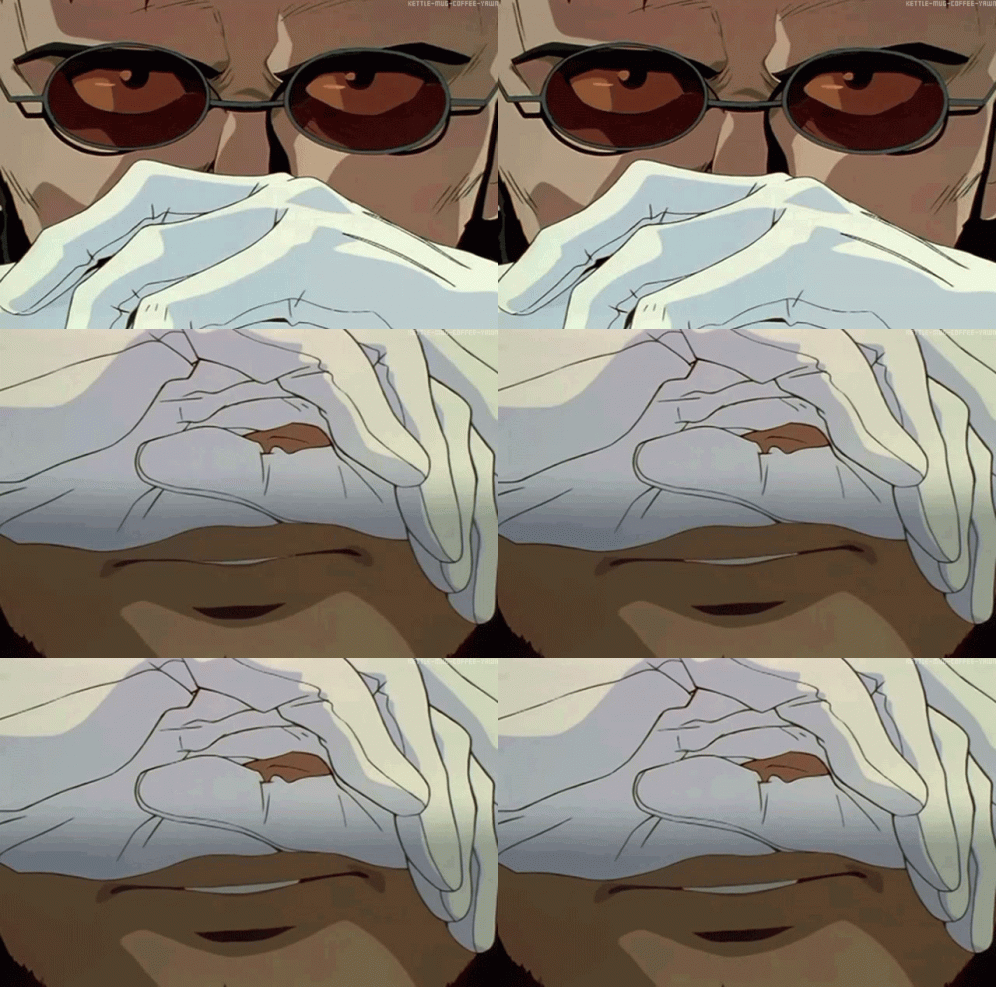
He leaned back slightly, fingers interlaced over his stomach, eyes fixed on his brother as if Mika were not a man but a problem to be solved.

"Go on," he said at last. "Who would run this operation? You will be buried in Cheka work. You won't have the time—or the discretion."

Mika barely hesitated. "You remember our brother-in-law, don't you? Aleksander. Kato's little brother. The one with that ridiculous mustache."

The name landed like a stone dropped into still water.

Stalin leaned back further, gaze drifting to the ceiling for a brief moment. Kato. Every time her name surfaced, something in him tightened—irritation, grief, guilt, all tangled together. Especially now, when Mika's daughter was growing older, her face becoming an uncomfortable echo of the woman he had buried.

"Yes," Stalin said quietly. "I remember him. I haven't seen him since I was sent to Siberia."

Mika nodded. "Do you think you can contact him?" Mika pressed. "He was a Bolshevik like you. I lost track of him after I moved to Petrograd. I don't even know where he is."

Stalin thought for a moment, rifling through memories and correspondence like a filing cabinet.

"When I last wrote to him," he said slowly, "he mentioned Moscow. Foreign Affairs. Minor post." His brow furrowed. "But after Sergo moved on Georgia, I believe Aleksander went south with him."

"Who's Sergo?" Mika asked.

"Sergo Ordzhonikidze," Stalin replied without hesitation. "A party man. A friend. I met him in prison." He paused, then added, as if filing the thought away, "Reliable. Ambitious. Brutal when necessary. I'll introduce you one day."

"Sounds charming," Mika said lightly. "So—what do you think, Joe? Feasible, right? We'd make a lot of money doing this."

Stalin's eyes sharpened.

"And the Party?" he asked. "And Lenin?" His voice hardened. "If this becomes known—if we are caught profiting from smuggling—we won't just lose our positions. We'll lose the succession entirely. Trotsky would flay us alive."

Mika shrugged, irritatingly calm.

"Oh, that's easy," he said. "We tell him."

Stalin stared at him.

"Are you insane?"

"Think about it," Mika said, leaning forward now, animated. "The civil war is ending. The country is ruined. We need capital—real capital—to rebuild. So you pitch it to Lenin like this: international trade operation, alcohol exports routed through third countries. State revenue. Reconstruction funds. Nothing about my little savings."

Stalin listened despite himself.

"We run it officially," Mika continued. "But Aleksander manages the operations and the books. We skim quietly. Build a private war chest. Lenin doesn't need to know about that part."

Stalin said nothing for several seconds.

Then, reluctantly, he nodded.

"That… could work," he admitted. "But who makes the contacts? Aleksander doesn't speak English. You do—but you're needed here."

Mika's smile widened just a little.

"I was thinking of bringing Reed in."

Stalin's jaw tightened.

"John Reed?" he snapped. "The American? Are you joking?"

"Come on," Mika said. "He trusts me. He likes me. More importantly, he's American. He knows the country, the people, the networks. He can teach Aleksander English, show him how things work, introduce him to the right criminals."

Stalin disliked this intensely. An American. A brother-in-law. Unsupervised. On the other side of the world.

Yet the numbers began to form in his mind. Hard currency. Influence. Independence from party budgets. Leverage—always leverage.

At last, he exhaled through his nose.

"Very well," he said. "I'll speak to Lenin."

He fixed his brother with a warning look.

"If this collapses," Stalin added quietly, "it collapses on you first."

Mika only smiled.

Stalin did not like that smile—but he had learned, long ago, that Mika's ideas had a tendency to work themselves out, much to his irritation.
 
Stalin did not like that smile—but he had learned, long ago, that Mika's ideas had a tendency to work themselves out, much to his irritation.
And the invisible historian wrote: "Yes, Comrade Stalin knew once again, that his brother was right. And that annoyed him very much."
Mika: "Without me, this whole place would fall apart."
 
"You think," Mika said, gesturing at the stump, "you could have the prosthetic maker attach a blade instead of a hand?"

A freaking madlad.

I actually laugh while readimg this at night

He tapped his chest lightly with two fingers. "They'll look at me and think, this man is a menace. This man is insane. We should not provoke him."

Then he pointed at him.

"And they'll look at you, my older brother, my boss, and think—this man is the only one who can rein him in. The only one he listens to. The only one he answers to." He leaned forward slightly. "Which means he must be even more terrifying than I am."

It'd be funny if in the future, every single spies and diplomats actually think like this. And somehow, Stalin would be officially recorded as the nicer guy.
 

Users who are viewing this thread

Back
Top