Chapter 60: Saltcliffe
New

aiwonder
Know what you're doing yet?
- Joined
- Oct 14, 2024
- Messages
- 116
- Likes received
- 471
Otho found Jon at his desk, dressed except for his boots, with the Saltcliffe drawings spread beside the trays of dragonshell. His breakfast had gone cold.
"The cart is ready," Otho said. "Borren was to find our guides."
"Ask Tommen. Take the rods and cords and begin where we agreed. I shall come when the questioning is done."
"They will ask about Borren."
"Tell them he is in my dungeon. They will hear the rest from me."
Jon covered the shells and pulled on his dry boots. At the door Arthur told him Ethan was waiting below. The boatmaster had been asking for wine.
"Water will serve him. I want to see the passengers first."
* * *
Someone had washed Laro's hair and put a clean shirt upon him. The collar was gone. Linen covered the place where it had rubbed, and he sat with his neck carefully straight, following Arthur's sword until the knight stopped beside the door. Without the dirt and salt he looked younger. Jon disliked how much that changed the sight of him.
Lorren said he had slept and eaten a little. Mallador was still forbidden to use his injured arm; Denner was enduring his complaints. Jon drew a stool to Laro's bedside, with the maester beside him to help where Jon's High Valyrian failed to reach the boy's Lysene speech.
When Jon glanced at the bread upon the coverlet, Laro put his hand over it.
"Keep it. There will be more."
His father made rope in Lys. An uncle had found him a place upon a merchantman, and he had sailed hoping to bring home money. He remembered his wages and the first hot meal he had bought ashore. Then he reached the galley which had come alongside asking help for a sick man, and his voice dwindled.
Grapnels had come over the rail. He hid beneath a coil of rope; they found him there. He could not say how many moons had passed since. There had been too much time below decks. The master taken last night had not been among the attackers. Laro had seen him later, bringing provisions and carrying away cargo.
Yesterday that man had argued over whether he was worth more mending rope or sold ashore. Afterwards they lowered him into the boat by his bound wrists.
Laro lifted his hands to explain. Lorren eased them down, but Jon had seen the swollen band beneath the sleeve. The boy had listened while men discussed his price. One of them was downstairs asking for wine.
He was to wait with the cargo in the house ashore until another vessel collected him. Five captives remained upon the galley: two women and three men. Her figurehead was a swan with its neck broken off, pale wood showing through the paint.
"Give that description to Denys," Jon told the maester.
Laro caught the name and began speaking quickly, drawing his feet beneath the blanket.
"He thinks you mean to send him back to find them."
"No." Jon leaned nearer. "You are free, Laro. You will stay here while you recover. No one has bought you."
Even after the maester repeated it, the boy kept watching him, trying to discover what had been left unsaid. Jon told Lorren to send for anything else he needed and began to rise.
"My father."
He sat down again. Laro hurried through his father's name and the way to the workshop, then stopped because he had forgotten a turning. A yard where the ropes were laid out. A blue door beside it. His eyes followed the maester's quill as though an error might lose his father altogether.
"I shall send a letter with a ship bound for Lys," Jon promised.
"He cannot read."
"Then the man carrying it will read it to him."
Laro pressed the heel of his hand against one eye. "Tell him I tried to come home."
For a moment Jon heard his own son calling from another room, in a house he would never enter again. He had to swallow before answering.
"I will."
In the passage he stopped to unclench his left hand. He had spent years studying Rome and the wealth it had wrung from its slaves. He knew the arguments used to excuse it. Hearing them here, with a boy afraid his father would think he had abandoned him, made him sick with anger.
Daenerys's punishment of the masters of Slaver's Bay would look like child's play beside what he intended once he had the strength to reach them. He would ruin the men who owned the markets as thoroughly as those who kept the captives. It would take ships and armies and wealth he did not yet possess. He meant to acquire them.
The woman in the next room had paid for passage from Hull to Blackburn, where her sister had written that the castle was hiring servants. Once clear of Hull, the master went to the galley instead. She could wait while he collected his cargo, he said, or swim. When Laro tried to speak to her, he struck him with a lantern.
Her daughter pressed against her skirts. The woman drew her onto her lap and covered one small ear while explaining what she had heard: workmen would soon be along that shore, and the house must be emptied.
Jon asked Wylla to send for the woman's sister. Outside, Arthur closed the door softly.
"Borren said they paid for passage," Jon said.
"Some did."
Enough truth to hide behind. Jon went down to hear the rest.
* * *
Hewyn had built up the fire above the dungeon stair, though its warmth scarcely reached the guards at the door. Damp darkened the wall beneath the high window, where the maester settled to catch the light.
Rollam's chain caught upon his stool. He pulled at it in sudden panic until Hewyn freed the link. He could be little older than Laro; Jon wished that made his part easier to judge.
His uncle had fetched him and three other carriers after the meeting to clear the western smokehouse. Rollam knew the goods avoided Blackburn's dues. Five nights he had worked there, for six coppers each, once eight for staying until morning. His work was outside, he insisted. Yet he had seen a man try to leave and a sailor bring him back. He had also seen Borren pay Orrick, the guard who came ahead of last night's boat to say the patrol remained farther east.
The other carriers were questioned separately. One had taken bread inside after Borren locked the door. Another said he fled with Orrick because the man wore the castle badge. Ethan asked how he had seen it beneath the guard's cloak; the answer came less readily.
Jon sent Tomas and Marros to search the smokehouse by daylight and guard Borren's house. They were to take men who knew boats. Stolen cargo was to be found; the villagers' fishing gear left alone.
Hessa came in without her cap, trying to hide the short chain against her stomach. Before she sat, she asked for her son.
"He is in his cell. I have spoken to him." Jon waited until she sat. "Yesterday you said people paid for passage. Laro did not. Was he the first you had reason to doubt?"
"Borren said—"
"Tell me what you saw."
Before the last new moon there had been a woman beneath a boat, her skirts drawn over her feet. When she moved, Hessa saw blood upon one ankle and skin rubbed away around both. The woman watched a sailor by the steps the whole time Hessa brought her bread.
"Did you tell your brother?"
"He said she had hurt herself in the crossing."
"And you believed him?"
"He is my brother." She looked up, frightened and angry together. "He fed us when my husband did not come home. Found work for Rollam. What was I to tell him? That I thought he had become the sort of man who—"
"You could have come here."
"And said a woman's ankles were sore?" She turned to Ethan. "You sent men. They found nothing."
"I did not know there was a woman, Hessa."
Her expression faltered. She wiped her face, dragging the chain across her dress.
"You saw blood and the skin rubbed away," Jon said. "Do not call that a sore foot again."
"I was afraid."
"So was she. What became of her?"
Borren had said she went on. Hessa had not asked where. She remembered boats waiting beyond the rocks for word from the upper path; the maester wrote while Jon drew out what she knew. When he finished, she begged to see Rollam. Her son had only followed his uncle.
"When I have finished with the sailors. Until then you remain apart."
Borren tried to smile at Ethan when he entered. His swollen lip spoiled the attempt. He began about Rollam's innocence and his own help during the fighting.
"Mallador told me you knocked the knife aside," Jon said. "He also told me you struck him before that. Who told you the landing was safe?"
"Boats have landed there for years." Borren appealed to Ethan with a glance. Jon knew that look: a grown man hoping someone would take the matter out of the boy's hands.
"I asked about last night."
"Orrick passed upon his round."
At first the payments were fish and wine. When Jon mentioned the silver Rollam had seen, they became two stags whenever a boat came. Since spring, Borren admitted. The buyers had been coming for two winters.
"You remember that winter." He spoke to Ethan again. "Boats ashore with no canvas fit to put them out. I found men willing to advance what we needed."
"Who?" Jon asked.
"Merchants from Hull." His foot moved until the chain scraped. "You will need them for all that building. Send me back with Ethan and a guard. I can put the trade right."
"You are not going back."
"My lord, you have been here little more than a week. Men owe me, and I owe others. If you take me away—"
"You sat at my table yesterday and heard me promise work for your people. Then you helped bring a slave ashore." Jon rose. "Do not tell me what Saltcliffe owes you."
"I did not know about the collar."
"Who locked the people in your house?"
"I have kept goods there for half the village. Ask—"
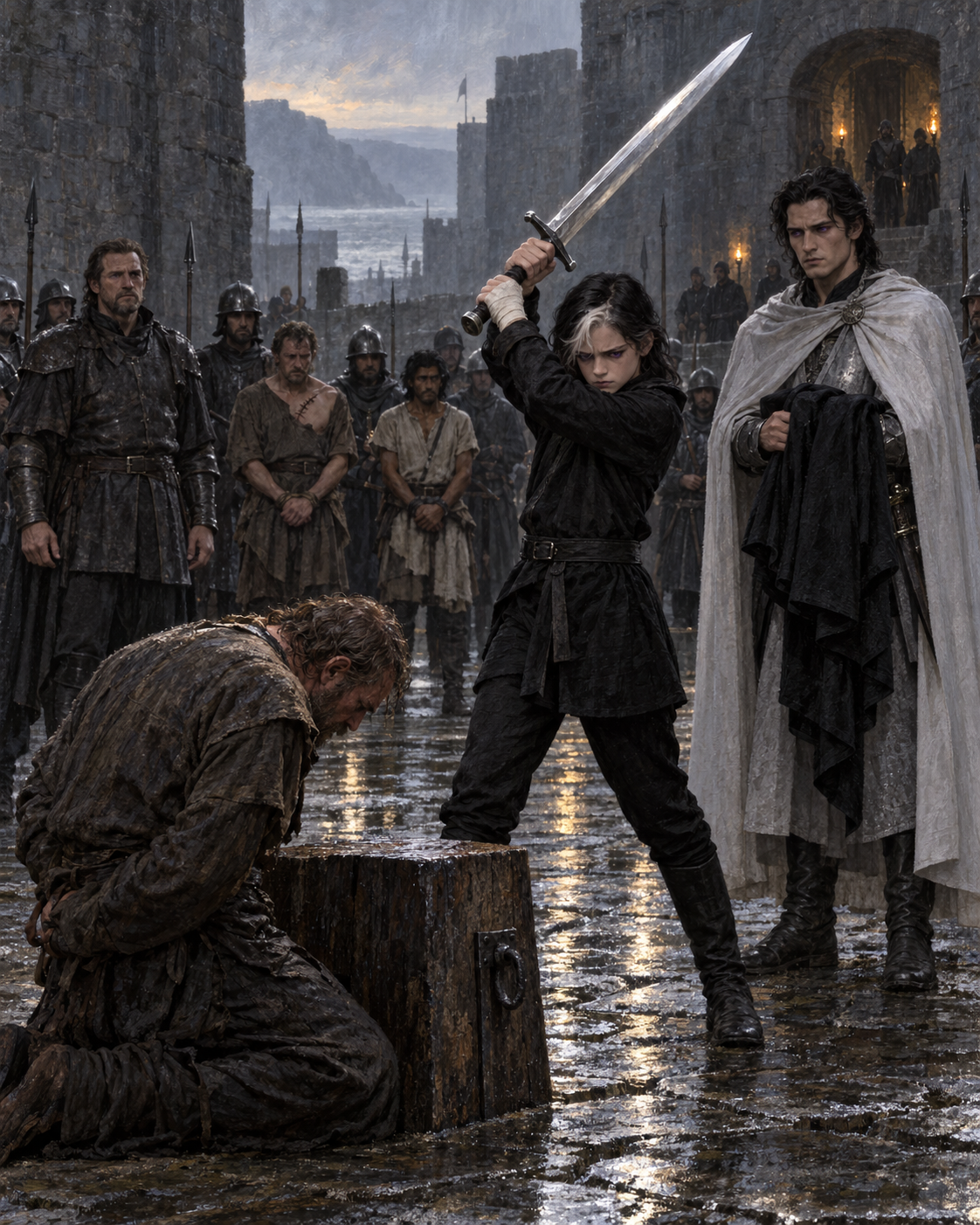
Jon turned to the guard beside Borren. "Strike him."
The fist caught him across the mouth. His stool scraped sideways; the guard caught his shoulder before he fell. Borren bent over his manacles, coughing blood onto his coat.
Jon waited for him to raise his head. "Who locked the door?"
"I did. When the master told me. They owed him money for passage."
"One tried to leave. A sailor brought him back."
Borren said nothing. His bravado had gone, but he had yet to name anyone who paid him. Jon came round the table and asked about the woman with the raw ankles.
"Hessa told you?"
"Answer."
Borren claimed the master had said she tried to jump overboard. They tied her to stop her doing it again. He could not understand her speech; how was he to know what she had agreed to?
"There is a maester in this castle. You could have brought him to her. Instead you took their coin and locked her in."
Jon could smell the old sweat in his coat. He wanted to seize him by the throat. Somewhere there were other houses like that smokehouse, and men expecting the next payment.
"Who settled the money?"
"If I name a man, he will hear of it. My sister still has to live there."
"You took her son with you last night," Ethan said. "Do not pretend you were thinking of them."
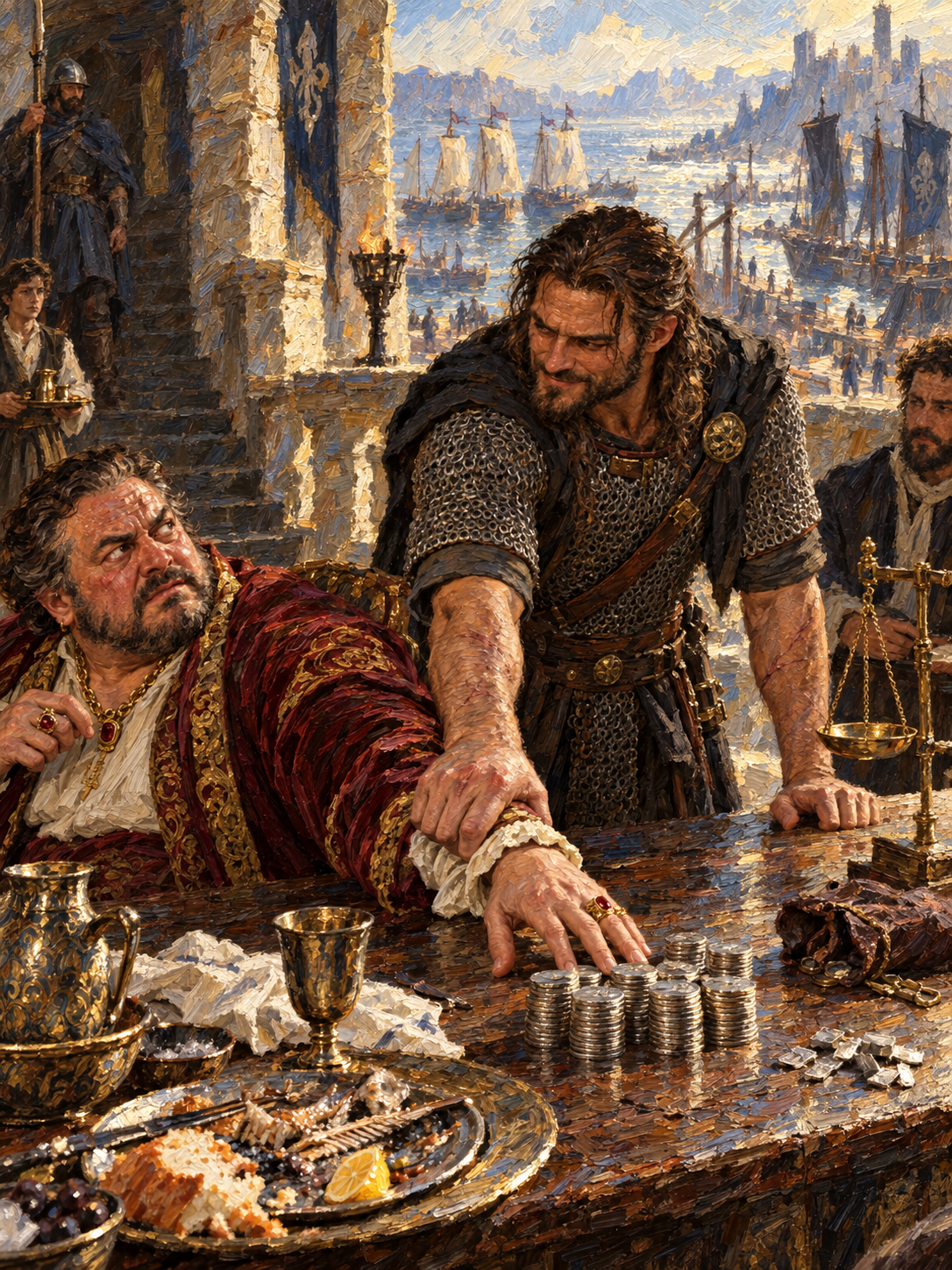
At last Borren named Neresso, a merchant in Hull. Ethan pressed him until he described rooms above a warehouse beside the boatyards, with a carpenter working beneath. Neresso had bought fish first, advancing money for casks and canvas. Later he paid for storing cargo and finding carriers. Some goods returned to Hull; others went inland from Blackburn in carts. The woman had gone back to the larger ship two nights later. Borren denied knowing where it took her.
"Why risk another landing with my men measuring Saltcliffe?"
"It was to be the last. I sent word about the works. The master said he would clear the house."
"He brought more cargo."
"Until another boat could take it away." He looked towards the door. "Tomorrow night. If the weather held."
A larger vessel, with two masts, would use the same cove. Jon sent Denys the description and expected night; he would hear the sailors before trusting either.
"Give Ethan the carters' names. You no longer speak for Saltcliffe. No orders, no money collected in my name, no word sent out of this castle."
"Rollam, my lord. If I help you—"
"You will answer for your own deeds. So will he."
* * *
Voss brought irons found beneath the boat's forward boards. One cuff could have closed about a child's wrist. Jon had them laid upon the table. Denys had accounted for his patrols: none had been the vessel sighted outside the point. She might yet have been an ordinary trader bound north.
Orrick admitted six payments. He had obtained that stretch of coast by asking Torven to exchange his duties with those of a man whose child was ill. The illness was real; Ethan had sent to the house. When Tobin complained about the landings, Orrick warned Borren and led the searchers away from the smokehouse.
"Eleven years you have served here," Ethan said. "And sold us for two stags."
The guard kept his eyes down. Torven confirmed the exchange of duties; the searchers described where Orrick had led them. Ethan would examine the earlier changes with Torven.
The sailors followed separately. Lorren had the injured oarsman's leg supported while he answered. He named Neresso without prompting and described the carpenter sharpening tools while they rolled casks past his door. The mate admitted that the galley took merchantmen and bought stolen cargo. Other captains shared her stores and anchorages. He had seen three ships together, but did not know how many belonged to them. He also confirmed the collecting vessel expected tomorrow night.
Their master came last, one eye nearly swollen shut, still protesting that his goods were bought.
Jon touched the wrist irons. "You held a knife at a bound boy's throat."
"The boy was not yours."
"He belongs to no one."
Arthur moved from the door. The master followed him with his good eye until Jon struck the table with his left palm. The irons jumped.
"Look at me. His name is Laro. His father makes rope in Lys and has had no word of him for months. Did you strike him with a lantern?"
"He would not be quiet."
Jon stared. The man actually seemed to believe he had explained it.
"Have you nothing else to say?"
"In Lys, a master has the right—"
"I will hear no claim that gives you the right to sell a boy." Jon leaned over the table. "You brought him onto my land in a collar and drew steel upon my men. You will stay in those chains until I decide how you die. Tell me where the others were taken."
Confronted with his mate's account, the master described the broken swan and an anchorage well south where the galley had last watered. By now she might be anywhere upon the Narrow Sea. Jon kept him until the noon bell, extracting the captains' names and the ships they commanded.
When he was taken down, Jon dictated a letter to Lord Velaryon. Neresso was to be seized, his warehouse searched and any captives freed. Denys would send Black Tern that afternoon with another captain and a rested crew. He would stay to cover the harbour and prepare tomorrow night's watch while Voss slept. Men would wait at the cove whether the collecting ship came or stayed away; any who yielded were to be taken alive.
"And I want those people found. Send the galley's description with the ships trading east."
Laro's letter would go with the first trustworthy master sailing to Lys, with orders to read it aloud to his father. All eleven suspects had now been questioned. Jon allowed Hessa her guarded visit to Rollam, then left with Ethan. They would hear for themselves how much Saltcliffe depended upon Borren.
Outside, practice swords rang across the yard. Jon unclenched his aching jaw. Aries was beneath the eaves, chasing a hanging sack with his wooden sword until it swung back at his face. He seized it with both hands.
"Let it swing," Jon said. "That is what it is there for."
"I thought you had gone." The boy looked towards the horses being saddled.
Jon took a practice sword. His right knuckle protested, so he changed hands. "Show me."
"With your left?"
"His feet work," Arthur said. "Watch those."
Aries attacked eagerly. Jon gave ground until the boy reached too far, then touched his chest.
"Again."
"Have I done something?" Aries's point drooped. "You're cross."
Jon had ordered Borren to answer in much the same voice. He lowered his sword.
"Not with you. I'm sorry. It has been a foul morning."
"Should I fetch my cloak?"
"There is time. Try once more."
Jon showed him a shorter step. Arthur corrected his stance, and they crossed the yard slowly, until Aries began watching Jon's weight instead of staring at his sword. When the groom approached, Jon held up a finger.
This time Aries let him move away. When Jon came within reach again, the boy struck, glancing off his blade and touching his sleeve.
"There," Arthur said.
Aries turned, delighted. Jon tapped his unguarded shoulder.
"That one does not count. He was speaking."
"You can ask him to keep quiet."
The boy considered the Sword of the Morning and decided against it. Arthur laughed.
"It was well struck," Jon told Aries. "You made me come to you."
As they put the swords away, Aries asked why he had been sent to Gawen last night. He could have carried blankets. Tomas had gone.
"Tomas has had years of training. There were men waiting with knives." Jon straightened the fastening at the boy's wrist. "You will have your turn. Until then, you stay where I send you."
Aries held still, his mouth stubborn. "Was Rollam frightened?"
"Yes."
"His mother was crying. I saw them before Wylla sent me upstairs."
Jon remembered his own children listening in doorways while the adults thought them safely out of earshot. Aries had been left to make sense of chains and a weeping mother.
"She is being questioned too. Helping us last night did not answer everything about what she knew."
"Will you tell me what happens?"
"What you need to know. Fetch your cloak. You come to Saltcliffe today."
Arthur examined Jon's knuckle while Aries hurried inside.
"Let your page do the buckles. That will please him."
"He ought to be worrying about missed blows," Jon said. "I don't want him lying awake wondering whether men will carry him off and sell him."
"Nor do I." Arthur glanced towards the infirmary.
"Laro was watching your sword."
"I saw. I'll leave it outside when I next see him."
Jon nodded and took the reins, waiting for Aries's feet in the passage.
* * *
The cloud had broken by the time they reached Saltcliffe. Sunlight lay upon the wet roofs, and smoke from the boiling shed drifted through the racks of split fish. A girl upon an overturned boat was swinging a rope at the gulls. She stopped to watch the riders. One bird dropped behind her and stole a piece before her belated shout could trouble it.
Jon looked towards the path that passed west behind the headland. The hidden cove was out of sight. Borren had walked home from locking people in that shed and eaten supper among neighbours who thought they knew him.
Arthur, Ethan and Aries dismounted beside him. Otho came down from the marked ground with Tommen and two boatmen who remembered the worst winter water. The first soldiers were unloading tools. Around them, islanders waited with baskets forgotten at their feet; one man moved nearer his wife when Ethan approached.
"I have questioned Borren," Jon told them. "He took payment for secret landings and paid a man of the garrison to warn him when the shore was to be searched. Last night we found a boy with an iron collar at his throat."
A woman touched her own neck. Tommen said, "I heard he was in debt, my lord."
"He was taken from a merchant ship. Borren accepted silver to keep people locked up until another boat came for them. I will not hear it called a debt."
"He has lived here all his life," a boatman protested. "We would have known."
"You did not." Jon waited for the man to meet his eyes. "Borren no longer speaks with my authority. Neither does the guard who helped him."
Faces turned towards Ethan. He endured their scrutiny without defending his garrison.
"What of Rollam?" a woman asked. "He is Hessa's only boy."
"And what of the one in the collar?" someone called from behind the racks.
"I have questioned Rollam," Jon said over the rising voices. "I will decide his punishment. Otho directs the work here, and Ethan will see to the village until I appoint a headman. Bring us anything you know of those landings. Anyone sending warning to Borren's accomplices will answer for it."
He asked what had stopped while they waited for him.
"The casks," Tommen said. "And the fish. We cannot sell it."
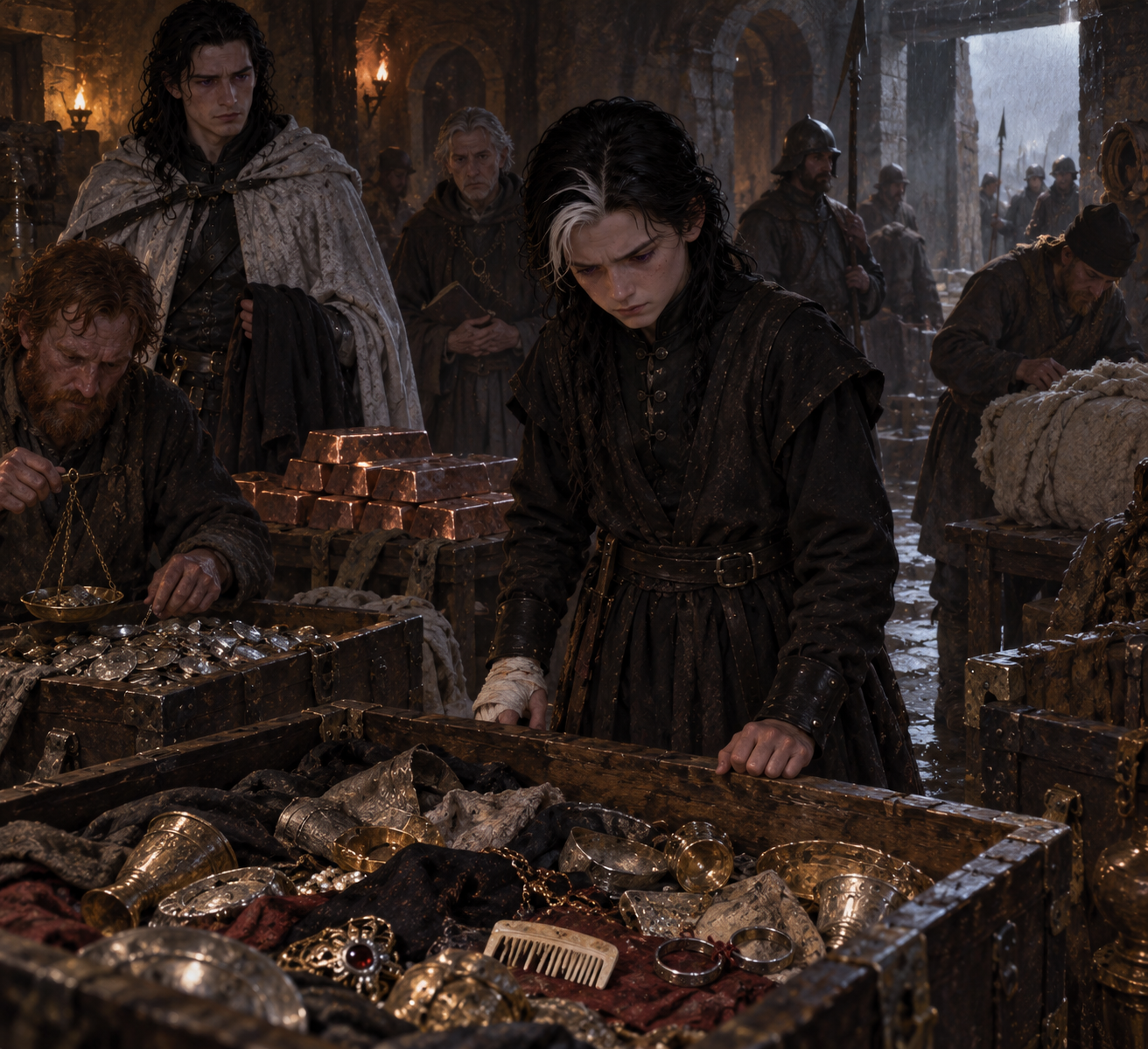
Borren's house stood above the ordinary landing, well east of the hidden cove. Guards waited outside its store, where casks, nets and a wrapped roll of sailcloth stood beneath the loft. The headman had supplied half the boats with something they could not do without, advancing money through winter and finding buyers for their catch. Now the fishermen crowded into his doorway, unable to agree upon what they owed.
"He said a good season would clear it," one admitted. "Said that last year too."
"Did he give you the reckoning?" Ethan asked.
"He told me." The man glanced towards the shore. "There was the fish to sell."
Jon could have sealed the store and left the maester to untangle ownership. Meanwhile a boat would lose days at sea because its net was behind a locked door. Borren's neighbours would remember who had turned the key.
Ethan had begun asking who dealt directly with the buyers. The answers came more readily than anything said about the western cove. These men knew the price of a cask and which merchant would wait for payment; confronted with Borren's prisoners, they had scarcely known where to look. Jon watched their hands moving over the goods as they spoke. The village could manage without its headman. First he had to give them somewhere to turn when the arrangements they had lived by fell apart.
A familiar Blackburn buyer was due that afternoon. Jon established that he supplied ships at anchor and kept a stall beside the market; this was ordinary trade, quite separate from the vessel expected at the western cove. He told Ethan to hear the price and see the men paid, keeping Borren's portion aside until the debts were examined.
"You will not pay the same debt twice," he told the man who had borrowed through winter. "Tell Ethan what you received and what you have given back."
Tommen could finish the sail already cut. If its cloth proved stolen, Jon would bear the loss; the uncut roll must await the maester's examination. Nets and ordinary boat gear could leave under Ethan's eye. Wine, oil and foreign cloth seized at the western smokehouse would remain with the other evidence.
Outside, a fisherman asked about his imprisoned brother's children. Ethan went down to him, promising food before dark. Across the yard, Gella stood with her arms folded beneath her apron.
"The pan is boiling, my lord. If you still want to see it."
"I do."
* * *
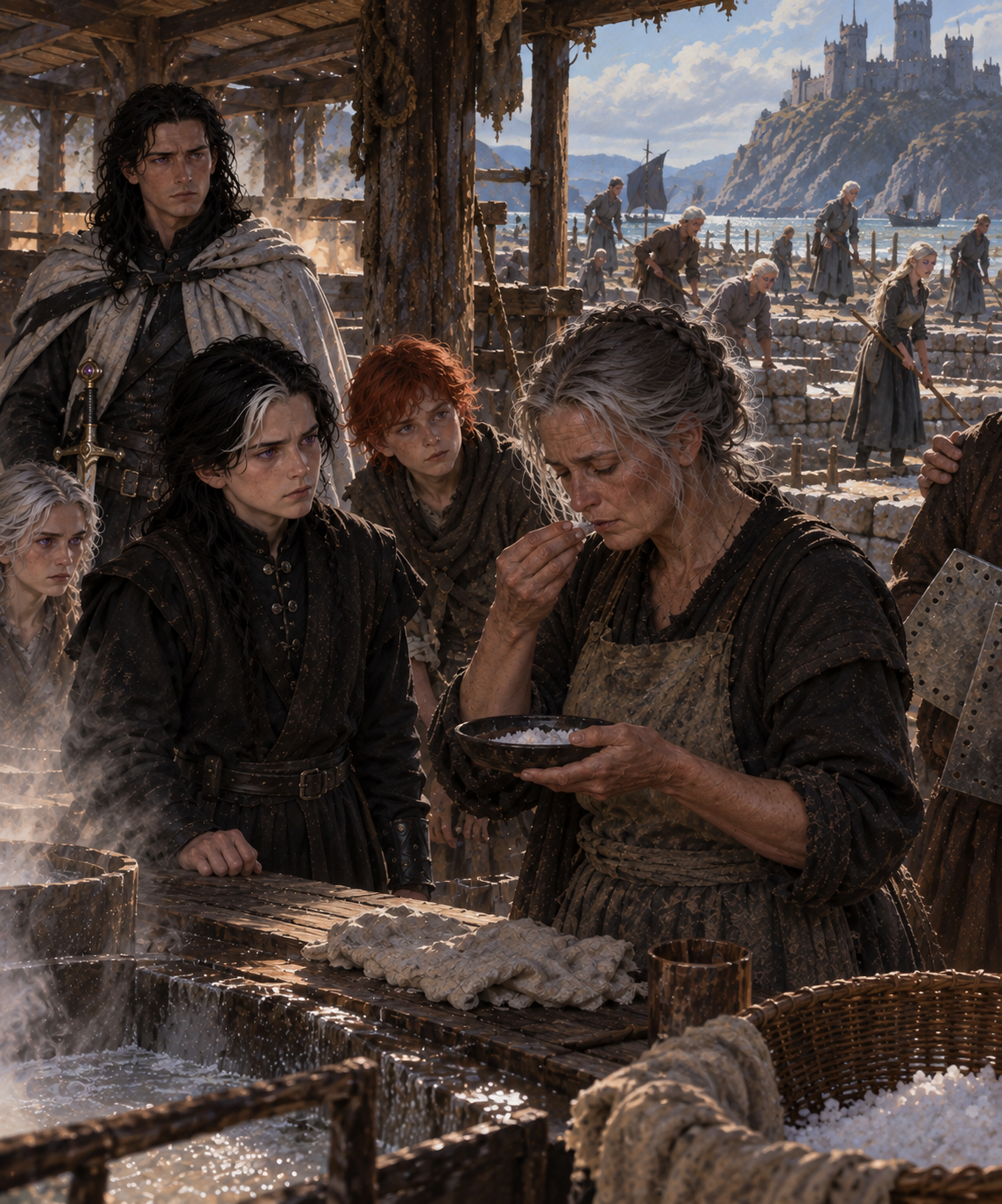
The pan simmered beneath rafters wet with steam. A drop fell upon Jon's hair as he bent to inspect an old repair beneath the rim. Smoke caught his eyes; the man tending the fire shifted a piece of fuel and the draught drew it away.
Gella had chosen her two learners: a woman who had worked pans across the bay and an older boatman whose knee would no longer straighten. Neither looked like someone awaiting a marvel. They had already lost working hours to a young lord's promises.
"They want to know how you mean to make it white," Gella said.
"You will see." Jon gave Arthur his cloak, and the knight hung it clear of the smoke. "Show me where you are with this batch."
She drained a rakeful into a basket and scraped the last grains from the wood. Jon tasted the salt. Bitterness lingered after the first sharpness had passed.
"That is a good batch," she said, watching his face. "The fuel is dry today."
He remembered tipping too much salt into a pot and swearing over it. Such a cheap, careless waste in his old life. Here every grain represented water carried and fuel gathered, and she had made certain none remained upon her rake.
He could change that. After the morning, the certainty was a relief.
"Ladle out a little of that saltwater. We can try it today."
"In what? Those boilers you drew are not built."
"A clean cooking pot. Keep your pan working."
She sent her boy to borrow a sound earthenware pot. The pan held strong brine, seawater boiled down until much of its water was gone. They strained a little through clean cloth, catching ash and grit, then left it to stand. The finer dirt would sink while they looked over the new works.
Outside, Otho's cords marked the ground for the first furnace and boiler, above the ordinary spray. Jon brought the learners out to see them. Aries stayed with Gella to help carry clean water for washing the pot and tools.
The older worker looked from the nearest peg to the soldier standing at the far end.
"All of that? For one boiler?"
"One. More will follow when we can supply them."
"My wife will have something to say if you mean me to feed that fire."
"You will have men to carry for you, and others to relieve you. Bring her when we settle your work and pay."
The woman wanted to know how they would get so much water uphill. Jon showed her the cleaner intake, away from the fish washing, and where a timber frame would stand. Men would turn a winch to haul up buckets and empty them into a trough leading to the settling tanks. From there, the water could run downhill to the boiling house. He remembered pumps he had inspected in another life, but those required fittings he could not yet provide. Otho's carpenters could build the frame.
Otho wanted the rock uncovered before fixing the frame's footings. Jon agreed. They would use the loose stone for the road.
He could see the finished works clearly enough to grow impatient with the pegs at his feet. Once these men had learned, they could teach the next hands themselves. Without that, every undertaking on the island would wait upon his coming.
A boatman stepped across the cord ahead of them. "I bring her up here when the sea rises, my lord. Put that edge across the slope and it'll split her bottom."
The hauling way met the proposed road upon steep ground. It had looked easier on the drawing. Jon walked it with him, then moved the crossing lower, taking space from the store yard. Otho held a board while he amended the plan: paving flush with the slope, the drain covered beneath the crossing. The boatman followed the shifting cord with his eyes.
His wife had been waiting beside him. "And my mother? You mean to take us higher. She cannot manage many steps."
Gella sent Aries after them as Jon followed the woman through a passage hung with washing. Her mother's room opened upon a small yard fenced with broken oars. It was damp, cramped and convenient. Jon had seen enough old people measure a home by the few journeys they could still make unaided.
He gave the family a ground-floor room in the lower row, with a door into the court and a level way to the working yard. The woman made Otho show her where it would stand.
"You stay here until it is ready," Jon told them.
She looked uphill. "And the nets?"
"There will be room. Show Otho what you need to keep."
He would not let the new streets bend around every familiar fence. But he had promised to oversee the building, and he would have to return when the walls rose to make certain her mother could reach the room he had given her. The woman would believe him when she saw it.
Aries caught his boot against a basket on the way down and apologised to its owner. A boy behind her asked whether he was one of Jon's soldiers.
"His page." Aries straightened his cloak. "I ride with him."
"Do you fight him?"
"We practise. I caught his sleeve today." He glanced at Jon.
"He did."
Aries was showing the boy where his sword had landed when Arthur called him down the path.
* * *
Noll had brought scrap plate and a hammer. He laid them upon a trestle with the air of a man expecting an unreasonable request.
"The breadth you drew, I cannot beat it out with the hands I have. Every man wants nails as it is."
"Then we buy plate for the first boiler. Show me the sizes you can join."
The smith overlapped two pieces. Rivets would hold them; keeping brine inside through repeated heatings was another matter. Jon crouched opposite him and drew the supporting brickwork in the dirt. The iron needed room to move as it heated, and they must be able to reach the joints for repairs. Noll examined the plates again.
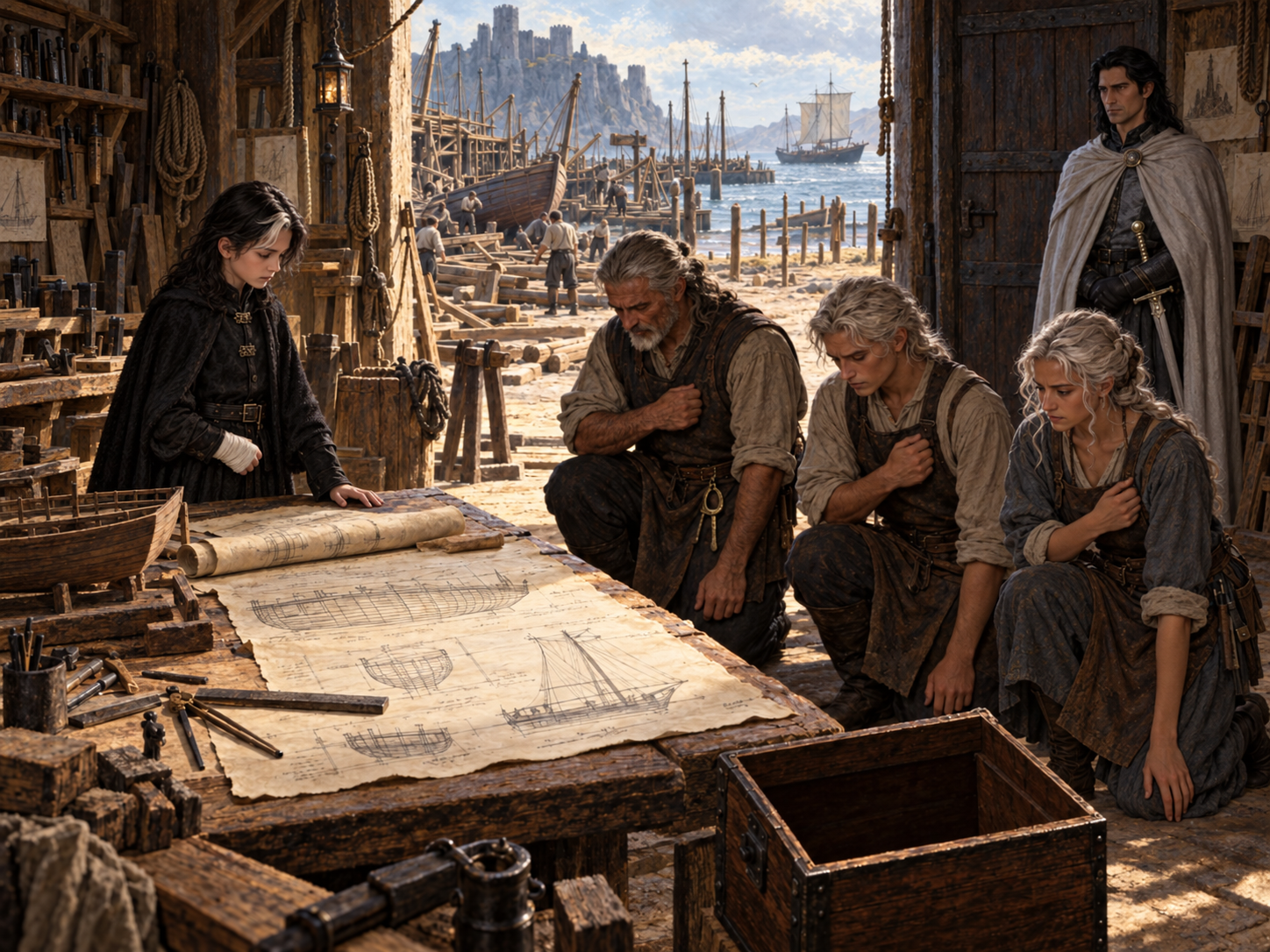
Otho unrolled the larger drawing. The long boiling house filled most of it, with room for the workers along the vessels and separate stores for fuel and finished salt. Jon traced the brine's course from the settling tanks. Men would bring water and fuel while others tended the fires and gathered the salt; the work would continue through changes of hands. Noll's finger stopped upon the furnace beneath the first great boiler.
"I have mended pans. I've never built anything like that."
"You will build the first with me."
"And the masons?"
"With me too. We shall test the joints with cold water, then watch them as it heats." Jon drew the sheet nearer. "Tell me where you doubt it."
Noll named a joint near the corner. Jon turned the plate and showed how it would sit upon the support. The smith listened without agreeing. When Otho began rolling the plan again, Noll stopped him; he wanted another look at the underside. Jon left it open. They could begin there.
For a while Jon's world narrowed to the metal between them. He had missed this during the questioning: a difficulty that yielded something when he looked closely enough.
The woman from the pan interrupted. "Where am I meant to stand?"
Otho showed her on the plan. She stepped back and swung her rake as she would beside the pan, showing how far its handle reached. A worker passing behind her would be struck. Jon shifted the vessel's outline to leave a wider passage.
The woman watched him as though she expected offence. Jon thanked her and had Otho measure the space she needed. She would have to spend her days working there.
Back at the shed, Gella showed Jon the dirt settled at the bottom of the pot. They carefully poured the clear brine into a bowl, leaving the dirt behind, then washed the pot and poured it back. She set it over a small fire, sheltered from the blowing ash. A gentle simmer would steam away the water and leave the salt behind. Jon left her to tend it and took Otho to the waiting men.
The foundations and road could begin now, with a modest roof to keep their fuel dry. The greater building would follow when the plates and timber arrived. Abel knew the cost was coming; hoped-for clock orders would not buy iron this afternoon. The interval would give Noll time to settle his requirements while brick and stone were prepared in the other villages.
Jon explained the first work plainly. The hired men must tell Otho which days their boats could spare them. Stone and earth were to be kept apart, and no one was to shift the house pegs without asking. When the road was cleared, Otho could carry on with the foundations without waiting for Jon's next visit. Anything beyond the agreed work must come to him.
The fisherman who had objected to the crossing offered his sons once they had finished with the nets.
"That will do," Jon said.
One of the sons was already among the men. He looked towards his father, received a nod and took up a mattock. Others began fetching their tools. Jon watched the first uncertainty pass into the familiar business of deciding who would carry and who would dig. They could doubt his white salt while opening a trench. He needed the work begun, and Otho now had enough hands to begin it.
He took Otho's spade in his left hand and put his boot upon the blade. The turf resisted. For an irritating moment everyone waited upon the strength of a twelve-year-old boy, and he remembered lifting far heavier things. Arthur moved closer. Jon pressed down and turned the sod himself.
"Keep that earth for the ground above the houses."
Otho passed the spade to a soldier, whose next cut came more easily. Jon's right knuckle stung; he had caught the shaft with that hand as the turf gave way. He flexed it once and left them to work.
* * *
They ate while the trial pot heated. Stools came from the houses, and someone added smoked fish to the food Wylla had packed. The older worker's wife brought bread. Finding him beside the salt shed, she asked whether he still meant to carry fuel upon that knee.
"I've done it all winter."
"And I have watched you trying to get out of bed every morning." She noticed Jon listening and fell quiet.
"He can tend the fire sitting," Jon said. "Others will carry the fuel."
"I'd be glad of that, my lord," her husband said. His wife took a stool beside him and broke the bread.
Tommen came down from the store. The buyer had offered less upon hearing Borren was gone. Ethan had threatened to send the catch to Blackburn to be sold beside the man's own stall, and a better price had emerged. Below them, casks rolled towards the water while Ethan listened to a woman holding up a fish by its tail.
The sailmaker took bread but ate little. His eyes kept returning to the guard outside Borren's house.
"Borren bought my mother's shroud," he said at last. "I could not pay him that moon. He never asked afterwards."
Jon lowered his cup. "I believe you."
"He came to see her too, when she could no longer get down to the shore." Tommen seemed offended by the easy answer. He had prepared for an argument.
"You want me to spare him."
"No. I don't—" He rubbed crumbs between his fingers. "I've known him since we were boys, my lord."
Jon remembered Laro clutching his blanket. All morning he had forced men to acknowledge what they had done, and now a kindness to someone else was supposed to weigh against it. The anger came readily. Recognising that Tommen had asked nothing of the sort took more effort. He was trying to save some portion of the man he had trusted.
"Borren had the key," Jon said. "Those people could not leave unless he opened the door."
"He told us they were waiting for passage."
"Some were. Others came in chains. He knew which was which."
A boatman called from the shore. Tommen lifted a hand without looking round. At length he admitted he had thought Jon mistaken, even after seeing the guards.
"I am not mistaken."
"No, my lord." Tommen rose, leaving the bread. "I had better finish that sail."
Jon let him go. He believed Borren had sat beside the old woman and paid for her burial without expecting anything back. It would not save him.
Gella's boy called from the pot. Much of the water had steamed away, and white salt crystals were gathering at the edge. Jon gave Gella a clean scoop. She lifted them into a cloth-lined basket and let the water drain through.
"More will come if we boil it down," she said.
"The water left in the pot holds much of the bitterness. Leave it."
"There is salt still there."
"Set it aside. We will see how much, and what use we can make of it."
She obeyed reluctantly. The new furnaces would use heat that her shed squandered, but she had today's fuel to reckon with. Until they had proved themselves, these white grains would have to earn their price.
They spread a little salt upon a dish beside the warmth to dry. Above them spades struck stone; casks were lowered into the buyer's boat. Jon passed the dish to Gella when the grains were dry.
She rubbed a pinch between finger and thumb. White lodged in the creases of her darkened skin. She held it nearer the light, tasted it, waited, then tasted again.
"Let me," the other woman said.
"Wipe your hands. You've been at the fuel."
Gella surrendered the dish reluctantly. Her companions tried it and looked towards the old pan where the batch had begun. At last she pointed uphill.
"The great boilers will make salt like this?"
"Yes. Once we have built them properly."
Noll picked up his plates and examined the holes again. Jon felt a pleasure out of all proportion to the few grains on the dish. He had imagined ships and machinery, streets full of work. For now, a woman who had spent her life boiling dirty salt was tasting what he could teach her to make, and a smith was looking afresh at the difficulty of containing it.
"Could I take some to Wylla?" Aries asked.
Most stayed with Gella. Jon wrapped a little for Aries, while Noll took darker salt to show beside it. The boy carried his packet as carefully as gold. Gella examined the water they had set aside. By the time Jon returned, he suspected she would have tried another pot herself. He hoped she did.
Before mounting, Jon returned to the hillside. The first foundation line lay open. Otho was showing the boatman's wife the lower row; her husband had brought their nets to show how much room they needed. Ethan would finish the payments and see the detained men's families fed. Choosing a new headman could wait until he knew who had helped with Borren's ordinary work without taking part in the landings.
Tommen walked beside the horses to the bend. "I'll have the sail finished when you come back, my lord."
"Good. I want to see it set."
He bowed and turned homewards. From the road, Jon could see Gella outside the shed with the dish still in her hands. Farther up the slope, the men were digging while soldiers carried the loosened stones aside.
* * *
The castle was taking supper when they returned. Aries had gone quiet on the last stretch of road, but the sight of Wylla restored him. He rescued the saddlebag from the groom and carried his packet of salt inside with both hands, explaining what it was before she had finished asking whether he had eaten.
Jon wanted water and a clean shirt. Denys was waiting, however, and he stopped in the passage to hear him. Black Tern had sailed for Driftmark that afternoon with Jon's letter and the captain Denys had chosen. Denys himself would remain to direct the watch. Fresh men were going to the western cove; they would look for the two-masted vessel tomorrow night, whether word of the raid had reached her or not.
"Five people still aboard that galley, if the boy is right," the captain said.
Jon stopped rubbing the soot from his cuff. Had they watched Laro being lowered over the side? Had any envied him?
"Unless she has put them ashore elsewhere. Have the incoming masters been asked about her?"
"My men have the description. So do the other captains."
"Send for me as soon as there is anything."
"At once, my lord." From the kitchen came Aries's voice, explaining the salt to Wylla. Denys glanced towards the door. "Did Saltcliffe give you what you wanted?"
"They are digging the foundations. We have white salt, though barely enough to cover your palm."
Denys went into the kitchen, and Jon climbed the stairs.
Arthur was outside Jon's chamber with Gawen, settling tomorrow's escort. Gawen shifted his sling and stepped aside.
"I need you for the crows," Jon told Arthur.
"After you eat."
He was hungry enough to agree. Washed and changed, he ate the stew brought to his desk. Beside his bowl stood the covered trays of dragonshell. Aries had asked again what he meant to do with the gold-coloured piece.
He lifted the cloth and turned the fragment beneath his fingertip. Candlelight moved across its raised pattern. He was glad he had brought it out of the mountain's bones and dust, though he still had no answer for Aries, or for Arthur's question in the cave.
He covered the shells and finished eating. If he waited for the island to give him a quiet evening, he would sail east no better prepared than he was now.
Arthur joined him in the room beside the western postern. Hugin waited upon the ledge. Munin came for the meat in Jon's hand, and he fed them both before settling upon the stool.
"Both tonight?" Arthur asked.
"I can move between them. I want to see how long I can stay with both, and how far they can go."
Arthur set water beside him. "For the expedition?"
Jon nodded. "I may need eyes ahead and behind us. Or help farther away than I can reach now."
He kept Valyria to himself. Flight would show him a coast, but there might be creatures in those ruins that could follow men where birds could not. Firewyrms came to mind, and the thought was enough to make him study the crows more soberly. They knew his touch. He had fed them, travelled with them, shared their hunger and delight in the wind. Whatever he encountered in Valyria would have no such reason to admit him.
He meant to strengthen himself while he had time to learn what he could bear. If his first struggle with an unfamiliar creature came when men were depending upon him, fatigue or a broken hold might kill them.
Munin opened her wings. Jon followed her over the wall, with the cliff passing beneath her left wing and the sea spreading to her right. Hugin came after them. At the first jut of rock Jon slipped into him; for an instant he saw Munin ahead, climbing above the spray.
The change was familiar. He returned to Munin, then tried to keep her sight while opening his attention to Hugin. That was harder. Sea tilted across the cliff. He let Hugin go, steadied Munin, and tried again with both birds gliding in the same direction.
For several wingbeats he could see through both. Munin flew low over the water. Hugin's shadow crossed the grass above the cliff, and Jon felt the wind differently against each pair of wings. Excitement nearly made him lose it. He eased back into Munin and let Hugin follow of his own accord.
At the southern headland he turned her in a wide circle, then went back to Hugin. Both answered readily. He sent them beyond the point.
They passed a sheltered inlet, then a pale rock standing alone in the sea. At each he changed birds, waiting until he could see clearly before asking more of them. Dragonstone dwindled behind him. Beyond the rock, drawing Hugin's sight into his own took an effort he had not felt nearer the castle. He tried once more, with Munin circling above a fishing boat, and felt a dull pressure gather behind eyes that were still closed in the postern room.
He fixed the pale rock in his memory. Tomorrow he would try that distance with one crow, then both, and find which effort had tired him.
He brought them home separately, taking Munin first while Hugin perched upon the headland. The wind opposed her now. When she gripped the window ledge, Jon left her and reached back for Hugin. Finding him again was easier than keeping both in flight. He brought the second crow along the cliff until Arthur's pale cloak showed within the window.
Jon opened his eyes. His shoulders ached from holding still.
"You had both?" Arthur asked.
"For a little while farther out." Jon took the water. "It became harder beyond the white rock south of the headland. I brought them back one at a time."
"You were gripping that stool."
"I felt it. I'll come before the yard each morning. I want to try that stretch while I'm rested."
"And stop there?"
"If I need to. Once I can hold them easily at that distance, I'll send them farther."
Arthur watched him rise, then moved aside. Jon fed the crows again before they left.
They found Aries at supper with Gawen. Wylla had spread the salt upon a dark plate. Aries pushed it towards Arthur.
"Try it."
"Let him sit down first," Wylla said, drawing the boy's supper back within reach.
Jon took the empty place. Eastcove would have him in the morning. Arthur tasted the salt, and Aries leaned forward to hear what he thought.
Last edited: