• A notice about Rule 3 regarding sites hosting pirated/unauthorized content has been made. Please see here for details.
  • Staff is working to deal with the problem of synonymous tags. See here for more information and to suggest tag mergers.
  • Due to issues with external spam filters, QQ is currently unable to send any mail to Microsoft E-mail addresses. This includes any account at live.com, hotmail.com or msn.com. Signing up to the forum with one of these addresses will result in your verification E-mail never arriving. For best results, please use a different E-mail provider for your QQ address.
  • For prospective new members, a word of warning: don't use common names like Dennis, Simon, or Kenny if you decide to create an account. Spammers have used them all before you and gotten those names flagged in the anti-spam databases. Your account registration will be rejected because of it.
  • Since it has happened MULTIPLE times now, I want to be very clear about this. You do not get to abandon an account and create a new one. You do not get to pass an account to someone else and create a new one. If you do so anyway, you will be banned for creating sockpuppets.
  • Due to the actions of particularly persistent spammers and trolls, we will be banning disposable email addresses from today onward.
Quite confused.

The father is calling Ashara his sister. Proven by the context.

It is not explained that Jon would be her presumed twin brother. But there is no other logical explanation for the take Ned gives.

With every paragraph my confusion got worse. Had to re-read it three times to even be sure of what it was MEANT to say. Let alone the confused mess that is what it actually says.


Thanks for the lookout!
 
Chapter 29: Second Harvest New
sh522h.png


The next morning, the new bell sounded as Willam Dustin's stallion picked a dry path through barley carts. The horse raised its head. Men paused with pavilion ropes in their fists; a cook leaned from an awning, flour to his elbows. By the ditch, a girl held coloured ribbons above the mud and counted the notes.

"That is not Winterfell's bell," Mark Ryswell said after the second.

Barbrey sat tall and straight beside him, a brown braid against her wine-dark hood. Rain had blackened the hem of her divided skirts. She turned towards Mark. "It comes from Jon's yard." Seven strokes crossed Winter Town.

"Is that what we have bought?" Willam asked.

"Something smaller, I hope." Barbrey listened until the last note faded.

Willam turned in the saddle to look at the children. Their daughter Marna rode a shaggy pony between two Dustin guards. She had Barbrey's dark eyes and brown hair, though the hair was braided with yellow ribbon and the eyes were busy searching the receiving stair. Her yellow cloak lay rolled behind the saddle because she had declared the morning too warm for it. Her brother Roderick ignored her from the back of the scarred bay he had praised in every letter north, with one white eye, one chewed ear and a mouth already wet around the bit.

"Nine," Marna said. "I heard nine."

"Seven," her father told her. "The sound comes back from the walls."

Marna looked towards the nearest tower, listening for another. The long summer had brought another harvest and another court, larger than the first. Fires smoked beside both ditches. Mountain riders led strings of hairy ponies between grain wagons. White Harbor merchants had rented every dry doorway. Pavilions crowded the outer wall in russet, green, brown, pale blue and wool dyed so cheaply purple that rain had turned it pink. Lesser sons argued over beds while kitchen women argued over firewood. A factor had hung painted clock faces above his stall. Their hands all showed different hours.

"That man says Lord Jon made them," Mark observed.

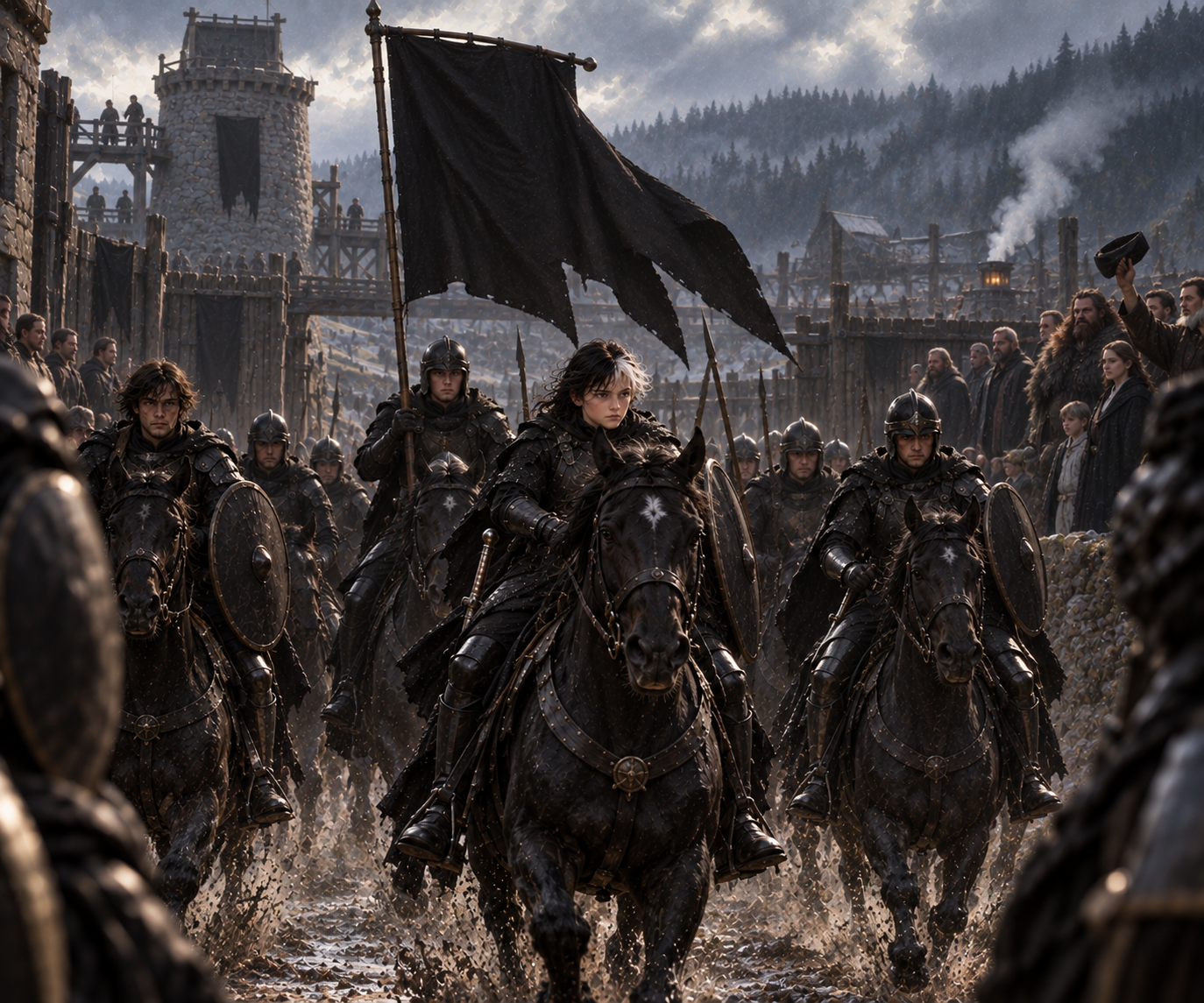
Barbrey glanced once. "I should ask him before paying for one." Behind the market stood the Black Yard's timber halls, two smoking kitchens, roofed work court, stable, barracks and Ewan's forge. Its plain black banner hung dark with rain. Twenty-five riders came through beneath Tomas's raised fist, four files halting clear of a brewer's broken cart. At the earlier harvest the captain had been narrow-shouldered in a patched cloak. Now the grey braid lay across a man's shoulder. Good bread had covered the other boys' sharp wrists too; they sat their rough northern horses without hanging upon the reins or turning to admire the watching lords. Jon followed on his black stallion, the silver clasp of his black cloak above cloth wetted by the mane. Arthur rode a dappled grey at his right, Dawn's pale hilt above his shoulder. Jon waited for Tomas to clear the gate before dismounting.

Willam dismounted with care, gave his reins to a groom and opened his arms. "At last, someone in Winterfell who has changed."

Jon embraced him. The boy had grown high enough to strike Willam's shoulder instead of his ribs. "Roderick has found a bigger horse, too."

Roderick stroked the white-eyed bay. "Neither of you has asked to see him move."

"He tried to bite the groom," Jon said.

"He requires a firm hand and a rider who does not fear a little spirit," Roderick insisted.

"He requires another owner," Barbrey replied. "Your hand has failed."

"Try him, then," Roderick said to Jon. "He threw one of our grooms yesterday."

Arthur looked at the horse, then at the churned road and hanging awnings. "In the yard. There are too many people here."

Marna opened both hands to show six pebbles. "Six stones on Jon."

"Whose stones have you wagered against my horse this time?" Roderick demanded, already knowing the answer.

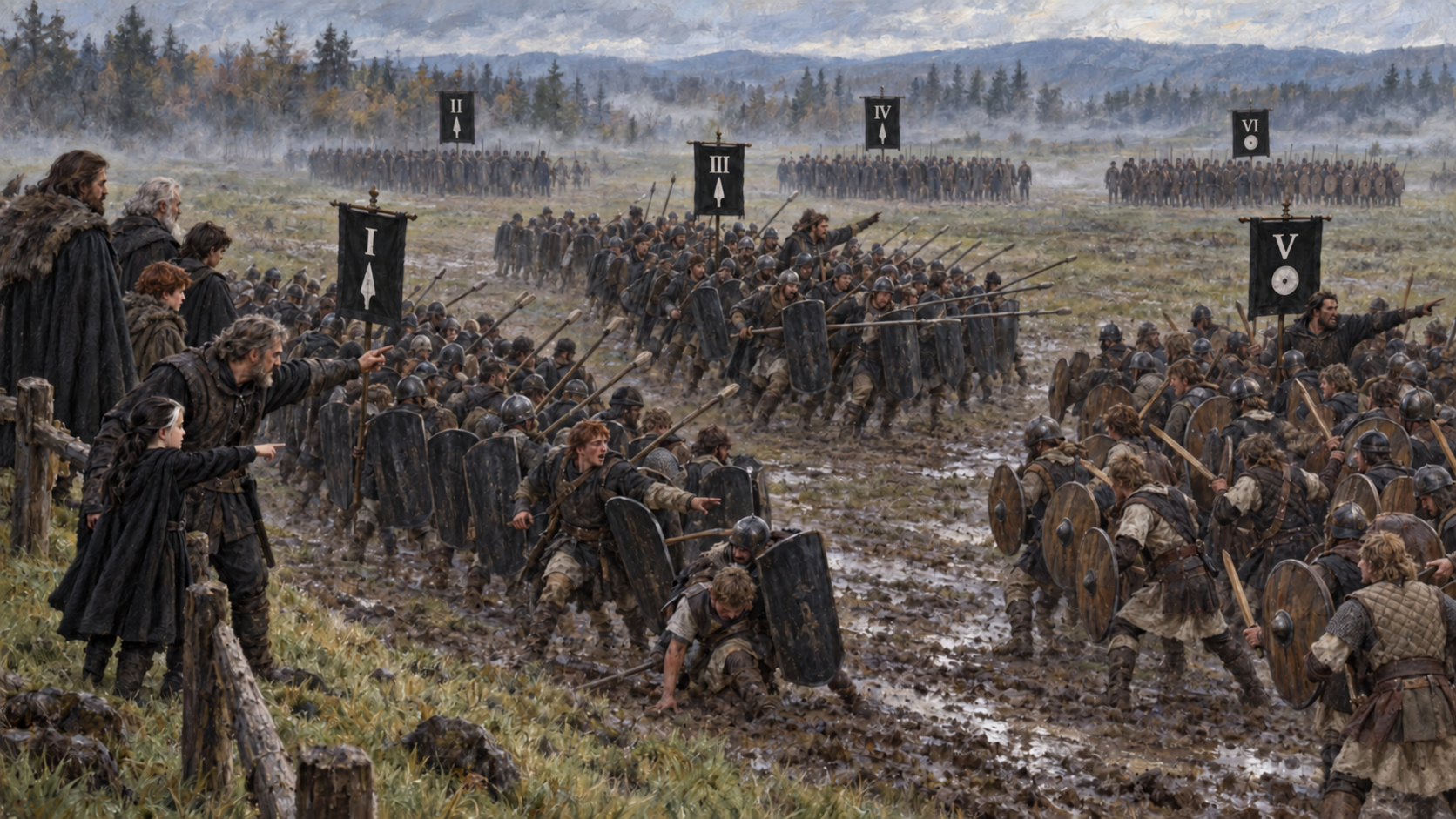
"Yours." In the field beside the Black Yard, Hewyn's first fifty drilled that morning in black coats behind broad shields. Their first rank cast weighted ash at wicker, withdrew, and reached for long spears while the second rank covered them. Three shafts struck early. One fell short. A shield rose late and knocked against the shaft of the man beside it. Laughter came from the rail.

Hewyn walked to the late shield and set its rim two handbreadths left. "Farther left. You nearly struck the man beside you." The man corrected his stance. A young decanus started to shout at the outer rank, stopped himself, and crossed to speak close instead. Hewyn passed behind without interfering.

"How long have those soldiers served beneath the black cloth?" Mark asked as the late shield returned to place.

A brewer beside the rail answered with the confidence of a man who had heard from someone else. "They came in with the last muster, my lord."

"They cast like new men," Mark said. "Half the shafts quarrelled before reaching the wicker."

"They recover better than many levies after five moons," Willam replied. On the next cast, the shafts struck in two ragged beats but none crossed another file. The second rank covered before the first reached the rack. The rail grew quieter.

Jon came beside them. "They are Hewyn's first company. The others train at the Old Watch."

"How many others?" Mark asked.

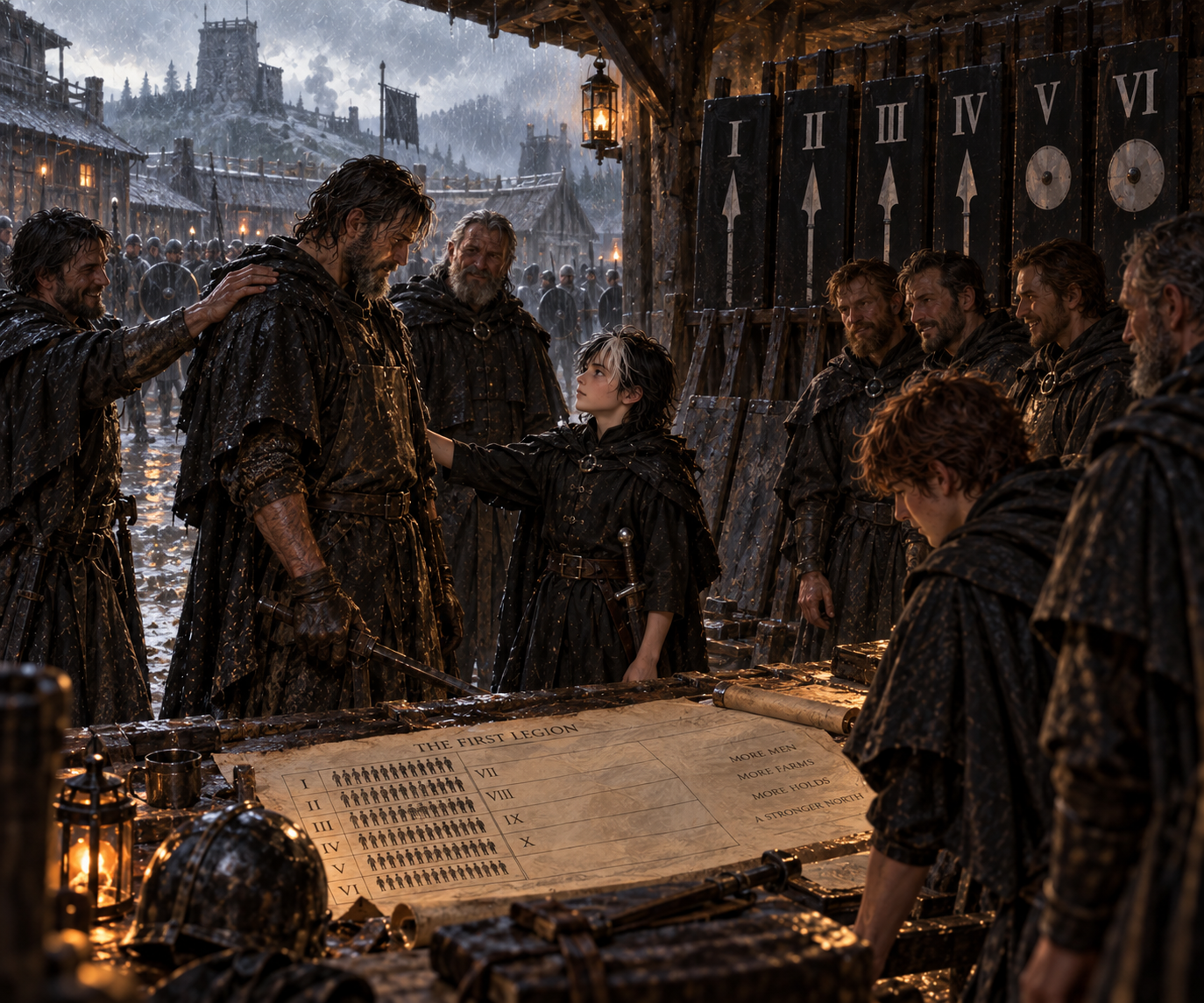
"Five companies. Three hundred men altogether."

Mark looked towards the road to the Old Watch. "I thought your father had lent you those guards to keep order among the workmen."

"He did. These men are mine."

"And you keep them after the harvest?" Barbrey asked.

"They are paid throughout the year."

She looked from the drilled fifty to the roofs beyond them. Willam knew that look; she had given it to their steward when he first named the price of the clock. Mark was still watching the field.

"Eight," he said to Willam, too quietly for Jon to hear over the hammer. "My father would not let me choose my own horse at eight."

Willam glanced towards the busy gate. He remembered helping Ned carry this boy out of a tower. "Nor mine," he said.

A hammer rang from the forge, followed by another. Barbrey turned towards the roof. "How do you hear yourself think?"

"I usually go uphill." Jon led them towards the work hall.

Willam looked towards the new roof. "Show us what we bought before my wife begins sending some of it back."

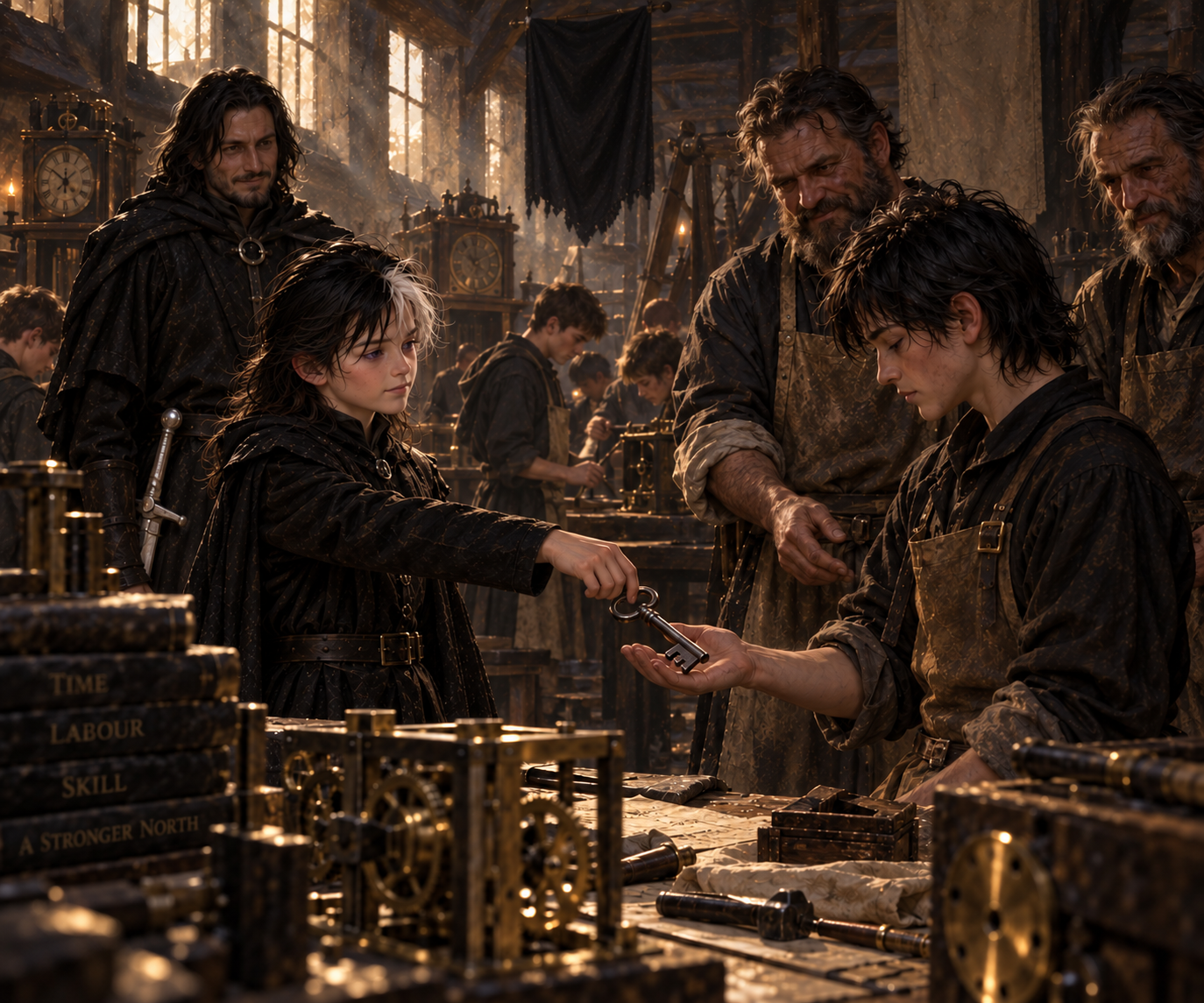
The Dustin clock waited beneath the work-hall roof, its movement enclosed in polished black oak. Twelve bronze studs marked the face. The case stood inside a travelling cradle lined with grey felt.

William smoothed the felt beneath the case and stood aside as Willam approached.

Willam looked at the apprentice. "Your name?"

"William, my lord."

Willam smiled. "My mother spared me the second i."

"So did Master Woods until I learnt my letters." The apprentice coloured, but Willam laughed and waved him back to his work.

Woods waited beyond the cradle while Barbrey walked around the case. She opened both lower doors, examined the joinery and listened when the bell struck.

"Adequate," she said.

Woods glanced at Jon, uncertain whether that was approval.

"She means she likes it," he told the carpenter. "You may send the bill."

Woods bowed. "The chamber wall must take felt and timber before you set the case, my lady. The bell carries through stone."

"Will we hear it from our chamber?" Barbrey asked.

"The lining will soften it, my lady. William will try it when he sets the clock," Woods said.

She closed the little door. "Send it when the road dries. I have waited long enough. I will not lose it to a careless carter."

"I shall go with it, my lady," William said. "We will have it striking before I leave Barrow Hall."

"Show my steward how to stop it at night."

"There is a lever inside the case. I can show you now."

"Later. Leave it striking while we are here."

Willam thanked the apprentice and turned to Jon.

On their way through the work hall, a woman stopped Jon to ask for a letter from her son in White Harbor. Perkin kept the letters; Jon would look after dinner. She touched his sleeve, then remembered his guests and curtsied. Jon introduced her as one of the women who had sewn the clock's travelling covers. Barbrey asked whether the felt kept out road dust, and Willam waited while they spoke. Before they left, Maege Mormont's mud-spattered outrider announced the Bear Island party less than a mile away. A page brought word of Theo Wull and nine mountain ponies on the west road.

"Tell Arya," Jon said. "She has been waiting for them since dawn."

Marna sent word to Sansa that she had arrived and asked after the Manderly girls. They were already with Sansa at Winterfell; Arya waited at the gate with Jory. Jon sent the page to Septa Mordane, then rode uphill with the Dustins to greet the newcomers. The horse trial waited while Maege rode into Winterfell at the head of twelve islanders, stout in patched ringmail with grey threading her braid.

Dacey dismounted behind her, lean and long-legged, taller than the groom she shyly thanked. She helped Jorelle from a smaller pony while a groom lifted Lyanna from the pillion. Arya ran to embrace her, and Lyra had to call them clear of the horses.

Three short-handled axes rode behind Lyra's saddle. When she dismounted, Arya brought Jory and Lyanna to see them. Lyra crouched and uncovered the polished hafts, keeping the leather over the edges.

"You said you would bring them."

"I did. You can watch me throw tomorrow."

"I want to try."

"We shall find you something you can lift first," Dacey said. She led the little girls towards the keep, Arya looking back at the bundle.

Eddard walked down at a lord's pace and clasped Maege's forearm. She had watched Hewyn's ragged spear ranks as she rode through Winter Town. Theo announced himself with laughter before the mountain ponies reached the yard. He caught Jon by both shoulders and scowled.

"Too tall by half and still too solemn," Theo said, looking him over.

"You should have come yesterday. Robb put me in the mud twice."

Theo cuffed him lightly. "An army and still no beard. The gods are cruel."

Jon grinned and caught Theo's wrist before he could cuff him again. "Robb would be pleased to put you in the mud as well."

"He will need help," Theo said. "He can have Mark."

"Leave me out of it," Mark said. "I have come to eat."

Eddard laughed as he came to greet them. The bay jerked against his lead. Ralf caught the bridle before the horse could swing into Willam's bad leg. He ran a hand beneath the saddlecloth, then began unbuckling the bit.

"He fights this," he said, showing Jon the heavy curb.

"Put the plain one on him." Jon handed his cloak to Arthur. "And shorten the leathers."

Roderick followed them into the yard. At the horse block Jon greeted Harl Wull, Brandon Norrey and Edrik Flint, their ponies already with Theo's. He pointed Edrik towards the games ground beyond the wall, then mounted. The three joined Robb at the rail. Gawen cleared two boys from the gate and guarded it himself; Arthur stayed near the block.

The bay sidled at once. Jon settled into the saddle with one hand in the mane and let him walk. Roderick had held the reins tight on the road; Jon's hands were lower, the leather slackening whenever the horse stopped tossing his head. They passed Willam once, then again. The bay was beginning to lengthen his stride when a shout rose from the market beyond the wall.

He reared. Willam gripped his stick, suddenly aware of how small Jon looked above the horse's shoulders. Arthur was already moving along the rail. Jon bent forward, his black hair falling across his face, and kept his hands clear of the bay's mouth. The forefeet struck the mud. Before Willam had drawn breath, the horse kicked up behind and lunged towards the gate.

Gawen stepped aside. Jon turned the bay along the fence, taking him past the closed gate and into the length of the yard. Mud flew from his heels. For a few strides Willam thought he would bolt through the men at the far end, but Jon brought him round before he reached them. The gallop shortened to a trot. At the next turn they were walking.

No one at the rail spoke. Jon kept the bay moving until his head lowered and the reins hung loose again. When he stopped beside Ralf, the horse stood while he dismounted.

Roderick let out a breath. "He threw Harrold with less than that."

"He tried hard enough," Jon said. He rubbed the bay's damp neck. "Leave him with us while you are here. Gawen can ride him tomorrow."

"I brought him for the race."

"You will ride the roan," Willam said.

Roderick glanced at his mother. She was watching Jon shake the mud from his sleeve. "You heard your father."

Jon turned to Gawen. "Use this bit. He went well enough before the noise."

"Aye, my lord." Gawen took the reins while Ralf loosened the girth. The bay followed him towards the stable, ears moving at the voices behind him.

Arthur handed Jon his cloak. "Hurt?"

"Only my knees." Jon bent one, then the other, and brushed the wet hair from his eyes. The pale lock at his left temple had come loose from its thong. "I shall feel it tomorrow."

Marna held out her hand to Roderick. "Six."

"Those were my stones you wagered."

She kept her hand out. Roderick dug into his purse and dropped six more pebbles into it. Willam looked away before his son could catch him smiling.


* * *

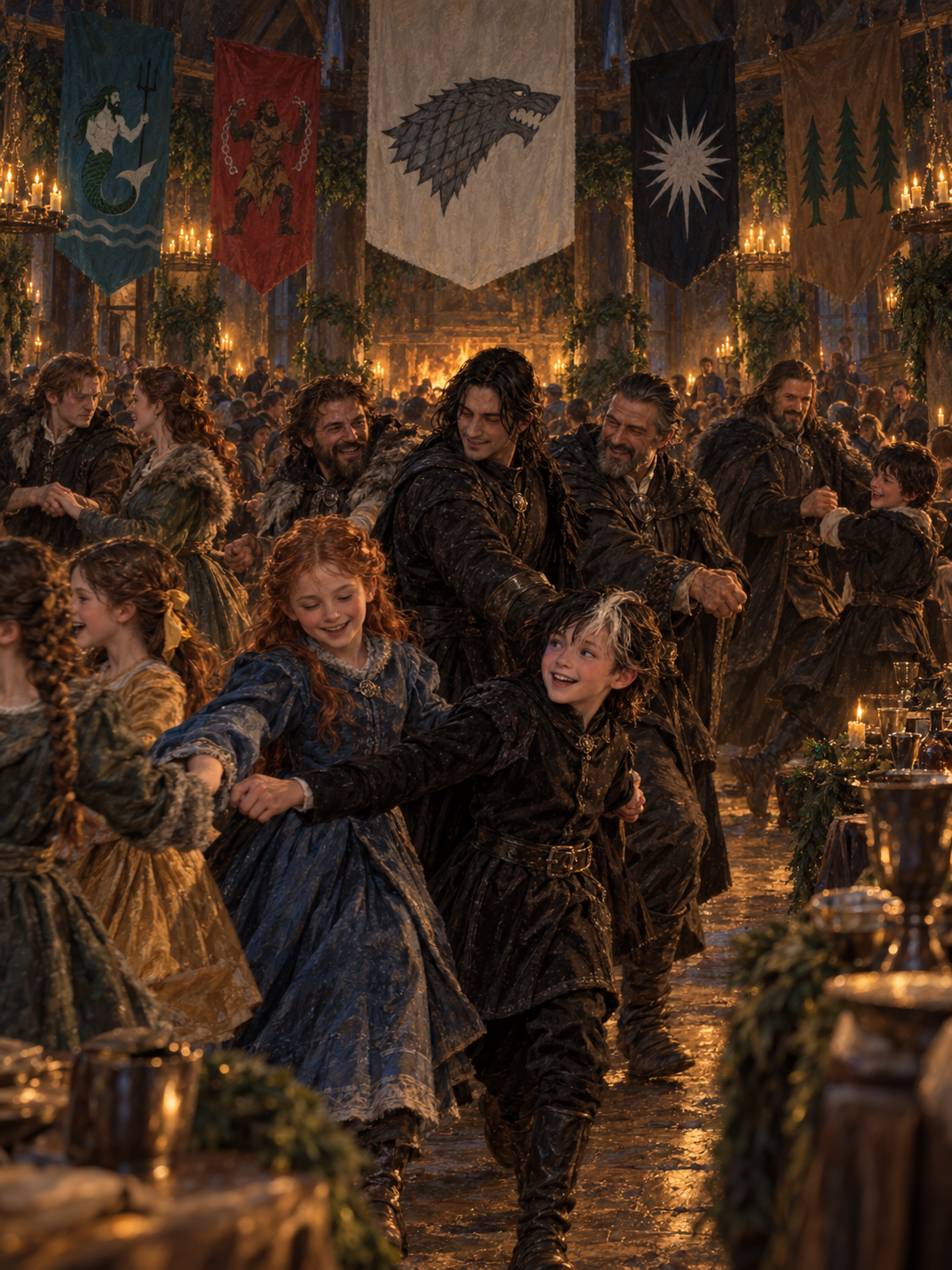
By the time Willam and Barbrey came down, the benches nearest the hearths were full. Wet riding cloaks had given way to best wool and silver clasps. Green boughs bound the pillars beneath the visiting banners; above the high seat, the grey direwolf spread across white cloth.

Outside, spits turned over the yard fires. Servants carried broken loaves and a steaming pot to the tables beneath the awnings and the people eating along the wall. Willam caught roast meat, damp stone and sweet applewood smoke. A piper among the wagons played fast enough to set the serving boys running to his tune.

Barbrey stopped him before he took his place.

"Your clasp."

He looked down. One end of the little gold chain had caught beneath his collar. She freed it with a practised finger, settled the black crown upon his breast and turned to greet her father.

Barbrey's father had saved her a seat below the dais. Mark sat opposite, talking horses with Medger Cerwyn. Halys Hornwood, still helping Lady Donella out of a cloak a servant mostly held, beckoned Willam to hear about a stag.

"Let him sit first," Barbrey said. "He has heard about nothing but horses since dawn. Give him time to swallow something before you begin upon deer."

Halys promised to save the best part. Willam eased his bad leg beneath the table and found a cushion at his back. Catelyn caught his eye from beside the Tallharts and nodded. Amid the crowded hall, she seemed to know exactly who had found a place and who still wanted a familiar face.

Theo Wull found Willam before the first dish did. His blue cloak was checked in grey and white about the edge, its clasp worked in the shape of one of his house's buckets. He laid it over a bench and brought a spare, bearded man forward by the elbow.

"You remember the Norrey."

"Brandon." Willam rose far enough to clasp the offered hand. "You have come a long road."

"And found three of my neighbours here before me." Norrey glanced towards the lower end of the table, where a Burley was already breaking bread. "I should have left when the oats were cut."

"You stayed to see them threshed as well," Theo said. He took the place beside Mark and stretched his legs. "His folk would sooner finish a field than begin a feast."

Norrey sat opposite him. "Some of us finish both."

They washed while the servants set out bread, salt and butter. On the dais Catelyn touched Robb's shoulder and he turned from Harrion to sit straight. Sansa needed no reminder; her silver clasp, no larger than Willam's thumbnail, shone against blue wool. Beside Arthur, Jon wore his usual black, but the fine cloth fitted close over narrow shoulders. His hair was drawn back, the white lock bright whenever he turned towards the candles.

Eddard rose before the dishes were uncovered. The fiddles fell quiet. Men near the doors passed the silence back through the hall until the sound of the yard piper could be heard quite plainly.

"My lords. My ladies. Friends." He rested one hand beside his cup. "We have brought in another good harvest. I have ridden through full fields this summer, and heard the same news from many of you. The gods have been generous to us."

Willam looked along the faces turned towards the high seat. Some of these men had eaten at Rickard Stark's table. Others had first come to Winterfell as boys in their fathers' company and now had children waiting beside them. Eddard knew most of them by name. He let his gaze travel the length of the hall before going on.

"You have brought your sons and daughters a long way to be here. My wife and I are glad to welcome them. There is food and ale in the yards for those who came with you, and the kitchens will keep serving while any guest remains hungry."

Greatjon struck the table once with the heel of his hand. Several men answered him. Eddard waited with the beginning of a smile.

"Tomorrow evening, I ask the lords and the clan chiefs to join me in my solar. There are matters we should speak of while we are gathered." His eyes went to Benjen, seated in black near the end of the dais. His brother gave a small nod. "The Night's Watch has sent us news, and I would have you hear it."

Willam saw Norrey lower his cup without drinking. The man exchanged a glance with Theo, then looked back towards Eddard. Benjen had come south for more than his brother's hospitality, that much was plain. The talk could wait until they were alone with him.

Eddard lifted his cup. "For now, I thank you for coming. May your households prosper, and may we share many more harvests. To the North."

"To the North!"

The answer filled the rafters. Willam drank with the rest. Beside him Barbrey raised her cup towards her sister's son at the Bolton table. Domeric saw her and returned the salute rather gravely before Smalljon leaned across to say something that made him smile.

The covers came off the dishes. Aurochs, blackened at the edges and red where the carvers cut into it, went past on a great wooden platter. There was venison in a thick sauce of onions and wine, turnips shining with butter, little pies that released the smell of pepper when a knife broke their crusts. Willam took a rib and a spoonful of the onions baked whole in their skins. Barbrey cut into a trout scattered with green herbs. Across from them Mark was already pressing the bread into the meat juices.

Wyman Manderly had sent jars of pickled cockles and smoked fish from White Harbor. He watched Norrey try one of the cockles, his pale eyes bright above the white beard he had tucked into his cloth.

"Well?"

Norrey chewed, swallowed, and looked into the jar. "A long road for something so small."

"The vinegar makes the journey with it," Wyman said. He offered the jar to Theo, who took three at once. "My cook swears they are best with ale. I have yet to persuade him that wine will serve."

"The cook is right," Theo said after trying them.

"Then you must come to White Harbor and tell him. He is a lonely man among so many drinkers of wine."

Wyman told them how his granddaughters' carriage had sunk to its hub on the river road, within sight of an inn. Norrey heard with satisfaction how a team had to be fetched through the rain. Mountain men, he said, knew better than to take a wheeled house uphill.

"My wife expects no such thing," Willam said.

"I expect a horse that stands still while I mount." Barbrey looked towards Roderick. Her father followed the glance and told the boy to bring the bay to him before they left.

"After Jon's riding master has ridden him," Willam said.

"A man can buy a horse without all his kin riding it." Roderick picked up his knife. Marna laughed, and Barbrey passed him the venison.

At the next table Galbart and Helman argued over the driest road from Torrhen's Square. Halys left his stag to trace a third route with a crust, until Medger reminded them that its bridge had been mended. The men leaned nearer to hear him. Willam ate through roads, a Rills marriage, hunting hounds and a cousin's quarrel that had sent him to the Watch. Halys eventually returned to his stag.

Theo had news of Ethan as well. A letter had reached him before he left home. He drew it from inside his coat, still folded in its worn cover, and passed it to Willam below the level of the dishes.

"The sea has not drowned him yet."

"He means to ruin my eyes instead." Willam held the page nearer a candle. Ethan had crowded the last lines up the margin. He wanted news of the families and asked whether Martyn's old shoulder still troubled him. Willam read that part aloud, and Martyn, who had come down from the high table with Jon and Arthur, reached over his shoulder for the letter.

"It never troubled me half as much as his complaining."

Arthur smiled as Martyn turned the page in search of the beginning. For a little while the talk stayed with Ethan and the letters that had crossed the length of the kingdom. Jon listened with his hand resting upon the back of Willam's chair, and asked to read the letter when the others had finished.

"You have had three from him since I had one," Theo told him.

"He sends me harbour accounts."

"This one is chiefly about your roofs." Willam gave it to him. "Apparently he means to have you dry when you arrive."

Jon read the cramped last lines. "I shall thank him. He has found room to complain about my writing too."

"There is little wrong with your writing," Arthur said. "You give him too much of it."

Jon's mouth bent. He folded the letter carefully and returned it to Theo before sitting in the place Martyn made for him. A servant brought a clean trencher. Willam cut a fresh piece from the aurochs and put it on it.

"Eat before Halys gets you started upon the stag."

"He has already told me," Jon said. "Twice."

"Then you can tell your men where to find its brother," Halys answered readily. "Come to the Hornwood when you have finished with all this building. Bring Robb. My son could do with company that doesn't agree with everything he says."

Daryn heard his father and said that his friends knew when he was right. Halys looked delighted to have proved his point. Lady Donella gave the boy a little smile and moved the salt within his reach.

As hunger eased, Catelyn and Donella went to the mountain women, while Eddard and Benjen joined Helman at the Glover table. Farther down, one black brother taught a boy a trick with a sliver of wood. Tomas sat at the head of the household table, Olyver laughing beside him; beyond them Hewyn's new spearmen glanced towards the high tables between watching for the next dish.

Wylla stood beside their serving table with a basket under one arm. She caught Jon looking and lifted it enough for him to see the little blackberry tarts inside. He picked up his trencher, excused himself and went down to her. Willam saw her inspect his trencher, say something close to his ear, and give him a tart. When he came back he had brought two. He put the second before Barbrey.

"Marna says you like these."

"Marna has been asking me for another since the first course." Barbrey broke it and offered Willam half. "She seems to have found a better table."

Their daughter was at Sansa's side, where a space had been made between the Manderly sisters. The girls had been watching the musicians for some time. Now servants were taking away two narrow trestles and carrying the empty benches to the wall. Sansa rose as soon as the floor was clear, only to sit again when Catelyn looked towards her. Marna caught her hand beneath the table.

The boys were no less watchful. Daryn Hornwood had abandoned a story about his father's hounds halfway through it. Cley Cerwyn was rubbing a spot from one boot with the heel of the other. Near the pillar, Theon adjusted the clasp at his throat and pushed his dark hair back. He caught Robb watching him and stopped.

"Your collar is straight," Robb said.

"I know." Theon glanced towards the girls again. "Look at your own."

Robb's grin broadened. Then Alys Karstark looked his way, and he found something to say to Jon.

The fiddler tried a few notes. Beside him a woman in a russet dress plucked her harp, bending close to listen before tightening a string. The yard pipes sounded faintly through the doors, quicker and rougher than the measure beginning in the hall.

Eddard offered Catelyn his hand. She rose, smoothing the folds of her dark blue gown. For the first few steps they had the floor to themselves. She lifted her face to his, candlelight catching her high cheekbones as he turned her. Willam remembered a younger Ned who would gladly have found some pressing duty in the yard when the music began.

"He still counts," Barbrey murmured.

Eddard's lips moved once. Catelyn said something to him, and he laughed. Wyman Manderly bowed to Lady Donella; she touched her husband's sleeve before accepting. Other couples followed them out, wool and velvet brushing as they passed between the benches.

Harrion brought Dacey down from Maege's side, then stepped aside when a young knight asked her to dance. She smiled shyly and took his hand at once. Maege had spent the greetings presenting her heir to men who remembered a child. In her green dress she looked tall and slender; with her hair loose, her long face seemed softer than it had above her mail that morning.

"You had only to ask," Smalljon told Harrion as he came back.

Harrion took his cup from the table. "I was speaking to her."

Smalljon looked towards the dancers. Harrion gave him a shove before he could say anything else.

When the musicians began a quicker tune, Sansa came straight to Jon.

"Will you dance with us?"

He set down his cup. "Gladly."

Marna followed her, but stopped beside Barbrey to smooth her skirts. Her mother freed a yellow ribbon caught beneath her sash. Across the table, Wynafryd Manderly had risen with her younger sister. Wylla was tugging at her hand to make her hurry.

"You will miss it," Barbrey told Marna.

"I know." Yet she stayed until Jon turned and offered his other hand. Then she went so quickly that her ribbon slipped loose.

The girls took Jon towards the floor. Sansa's auburn hair shone against her blue dress; beside her, his own lay black as ink over the high collar of his coat. Wylla Manderly reached up to touch the white lock at his temple, stopped short of it, and put her hand behind her back. Jon bent to hear what she asked. Whatever his answer, it brought her nearer, looking up at him with a smile. A serving woman stepped back to let the children pass. Willam watched Jon make room for each girl, the candlelight catching his fine straight nose and the clear colour of his eyes. "He will turn heads," the serving woman murmured to a man passing with bread. "He does that with a wooden sword," the man answered. Jon caught the woman's eye as he passed and thanked her for finding Sansa's ribbon earlier. She smiled, then curtsied.

Robb had crossed to Alys. He bowed as carefully as his father had, and she stood before he had finished asking. Both paused, uncertain what came next, until Robb offered his hand. Alys took it. Her narrow face was pink above the white sunbursts at her collar. She glanced back once towards Lord Rickard, then hurried to keep beside Robb as they joined the others.

Torrhen Karstark leaned over his brother Eddard to watch them. Harrion caught the back of Torrhen's collar and pulled him down before Alys could see.

Theon lingered beside Willam's table, pretending to listen to Roderick. A Flint girl stood nearby with her sister, turning a blue glass bead upon the cord at her neck. She had thick brown braids and a little gap between her front teeth. Each time Theon looked over, she looked away.

Roderick nudged him. Theon elbowed him back, but went to her.

"Lady Erena. Will you dance?"

She glanced at her sister, who immediately found reason to turn towards the hearth. Erena's fingers left the bead. "Yes, thank you."

Theon had his hand out before she finished. They set off on opposite sides of a bench, stopped, and came round the same end. Erena laughed a little. Theon's ears reddened beneath his hair, but his grin returned when she took his arm. Roderick watched them go with his mouth open, as if he had not expected his advice to work.

"And you?" Barbrey asked Roderick. "You have been waiting since the floor was cleared."

He looked towards a Norrey girl in red wool. "What is her name?"

"Anya," Willam supplied. "You shared a pie with her this afternoon."

"We did not talk much." He left before his mother could answer. Anya nodded to his invitation; one of her two cousins hid a smile as they passed.

The dancers formed two lines. Older sisters made room for little ones, and boys who had shouted over supper stood straight beneath embroidered collars. Sansa watched the opposite girl for the first turn and knew the second herself. Marna laughed when Jon brought her round to face her parents.

Cley listened while Wylla Manderly explained something—then waited, hand still offered, when she turned the wrong way. Farther down, Benfred Tallhart bent to hear the softly spoken Ryswell girl instead of filling the hall with his own voice. Lyra unwound Arya from her skirt without leaving the measure; Jorelle drew Lyanna round beside them. Dacey passed with the knight, light-footed and certain. Maege watched her daughters over her cup.

When the music ended, Willam made room for Sansa, Marna and Wynafryd. Barbrey moved the candle clear of their sleeves and called for watered wine.

"Did you see Cley? He waited for me," Wylla Manderly told her sister.

"We all saw." Wynafryd's eyes strayed towards Daryn at the edge of the floor. He was looking at her; she bent over her cup before he could smile.

Marna leaned close to Sansa. Her whisper carried across Willam's sleeve.

"Your brother has such pretty eyes."

Sansa looked at Robb, who was coming towards them with Alys.

"Jon," Marna whispered.

"They look purple near the candles," Sansa told her. "Come nearer next time."

"Sansa." Marna's whisper was urgent now. Jon was returning with Theon.

Barbrey lowered her cup. Willam kept his eyes upon the dancers still leaving the floor. He had no wish to make his daughter hide behind her mother for the rest of the evening.

"You are still counting the steps," Theon said as they approached.

"Erena had to steer you round a bench," Jon answered.

"She seemed pleased to have hold of me." Theon's grin widened.

Willam watched Jon join them, smiling, without a trace of his usual dust, charcoal or dried mud. Wylla stood beside the serving table, pleased with her work.

Marna put down her cup with both hands. "Could we dance again?"

"Of course." Jon offered his hand.

"I meant to ask—" Wynafryd began.

"The dance after?" Jon asked. She nodded, and Daryn finally came to claim this one. His shoulders eased when she smiled and took his arm. Sansa watched them with satisfaction until Domeric asked her. She rose at once and gave him her practised curtsey.

"I know this dance."

"So do I." His smile made her lift her chin as they found their places.

Harrion had reached Dacey before anyone else this time. He gave Smalljon a look as they passed; Smalljon raised both hands, grinning, then beat Benfred to Jorelle. He asked properly and took her hand with unexpected care. Theon returned to Erena by the correct end of the bench. Anya drew Roderick back from the doorway when the first notes sounded.

The slower measure carried them past Willam's table. Marna watched Jon's feet until they came level with her father, then looked up. "Your bell rang nine times this morning."

"Seven," Jon said.

"Father said that too. I counted nine."

"You heard it come back from the walls."

"Then I shall stand in your yard next time." Marna followed him through the next turn without looking down.

Robb and Alys followed, concentrating until she looked up and made him smile. Cley danced with a mountain girl; Lyra settled Arya beside Maege before accepting Benfred. Daryn said something that made Wynafryd glance towards Halys. Willam could see the stag story coming round again.

At the change of tune Wynafryd claimed her promised dance without prompting. Marna let Jon go reluctantly, then took Torrhen's hand with Barbrey's nod.

"She has remembered her manners," Barbrey said.

Willam watched Roderick fetch a cup for Anya. "So has he."

"For tonight."

When Domeric brought out his harp, Sansa drew Marna and Wynafryd onto the nearest bench. She inspected the silver waves on Wynafryd's cuff and secured a promise to learn the stitch after breakfast. Wylla showed them her own crooked attempt; their heads stayed together until Barbrey reminded them to listen. Theon stood beside Erena, while Daryn and Cley sat on the hearth edge. Roderick's heel tapped to the first notes before he remembered he was pretending not to care.

Willam could see Domeric's resemblance to his mother when he bent over the strings. Roose came to stand behind him and said nothing during the playing. When the tune ended he laid a hand briefly upon his son's shoulder. The boy looked up, then towards the girls clapping beside Barbrey. His smile lingered as he settled the harp again.

Barbrey asked for another, but Theo had already begun singing the final verse again. Greatjon joined him from three places away. By the last line half the table was singing, some keeping the tune and others trusting that enough ale would carry them through it.

Jon returned from speaking with Galbart about the roof beyond the smithy. Its rafters were on; boards would go down tomorrow to shelter the case finishers and Woods's new apprentices.

"Woods should have asked for twice the floor," Wyman said. "A merchant in my hall last moon forgot the ship he had come about when I showed him my clock. He had spoken of nothing but Leyton Hightower's."

"Did he remember his ship before paying for another?" Barbrey asked.

"He ordered one through Jon's factor next morning. Some men would sooner be seen without a horse than without what their neighbour has bought."

"They must wait with the lords," Jon said. "No poor movement will leave here inside a good case."

"Put mine after Lord Halys's, then," Galbart said. "Helman and I left our earnest this morning. Hornwood has chosen its case?"

"And sent its measures first," Jon said. "William will write when yours is ready."

"Some grow tired of waiting," Wyman said. He set down his cup. "Lord Walder's steward has asked me to carry an offer. He would give you a yard at the Twins, freedom for your carts at his crossing, and a portion of the price of every clock sold there."

"Who would teach them?" Jon asked.

"You would send two of your best hands, with the patterns. He wants the right to make and sell."

Galbart looked towards Jon. The conversations nearest them had begun to slow.

"My men have work here," Jon said. "If Lord Walder wishes to buy clocks for his towers, Osric will send the terms. His keepers will have the same instruction as yours."

"There is more. His steward suggests that a granddaughter's marriage portion could settle matters between your houses."

Jon put down his knife. "Did he name her?"

"He offered to send a list."

Barbrey looked across the hall at the girls gathered beside Sansa. "Does he send the same list with every bargain?"

"I did not ask," Wyman said. "What answer shall I carry?"

"The making remains with my house. And he may address any marriage proposal to my father, apart from the price of a workshop." Jon glanced towards Eddard, still speaking with Benjen and Helman, then took up his knife again. "I thank you for bringing it yourself, my lord."

Wyman turned to Galbart about a ship overdue from the west. Jon finished his tart while they compared sailing dates.

Greatjon had been looking towards the table where Jon's household sat. Tomas and several of the younger guards had stood to make room for a late dish, and their shoulders were level for a moment above the seated men.

"Those are the boys you mean to take south?" he asked.

"My household," Jon said.

"I saw them riding through the town. They sit their horses well." The praise came easily, but Greatjon's eyes had gone to his own son. "Have you set any of them against a lad who was born with a sword in his hand?"

Roose drew his chair nearer the table. "They are a credit to their coats. I had wondered how they would fare against someone they do not practise with."

"Then tomorrow will interest you," Jon said. "There is room after the other games."

"Put your best against Smalljon," Greatjon said. His son straightened at the sound of his name. "We shall see what your teaching has done."

Willam looked down the hall. Tomas had noticed that his lord was being watched, although the words could not have reached him through the noise. He waited at the end of his table. Around him the others continued eating and talking.

"Your son has had a master-at-arms since he could hold a wooden sword," Jon said. "So have Robb and most of the heirs here. One of my men against him would be a good bout. It would tell you little about the company I have trained."

"A company, then," Greatjon said. "You have boys enough."

"Let them fight the heirs together," Jon said. He looked towards Eddard, who had come back with Benjen and Helman. "Equal sides. Shields and ash swords. A banner at each end of the south meadow, and the first company to carry the other banner home wins."

"I will lead the heirs," Robb said. "Will you lead yours?"

"Yes." Jon watched him turn to Eddard. Smalljon was already whispering to Harrion, Cley leaning over the table, Theon smiling as though he had seen an opening.

"Ser Rodrik will prepare the field," Eddard said. "Arthur and Martyn judge, with Jory's men to help. You obey them."

"We will," Robb said.

"After the midday meal," Jon said. "Let them finish the other games first."

Mark asked whether the Dustins could make a third side; Barbrey told him to let the boys choose these two. Willam found himself looking forward to it.

Maege put down her cup. "Lyra will fight with the heirs."

Greatjon looked at the girl beside Arya, then back at her mother. "You mean to set your daughter in the middle of that?"

"I mean to let her use what she has been taught." Maege turned to Robb. "Will you have her?"

"She is already in," Robb said. Lyra grinned. Smalljon began to object to something Harrion had said about his shield, and Greatjon left the matter of daughters to demand what the two boys were arguing over.

Over the next cheese and bread, Robb gathered Domeric, Theon and Harrion to choose the rest: Daryn, Roderick, Lyra, Cley, Brandon Norrey, Edrik Flint and Harl Wull, with a Burley boy beckoned from his father's side. Medger had to tell Cley to let his captain finish before asking again about the banner.

Jon called Tomas over. "The full household in the south meadow after dinner tomorrow. Lord Robb and the heirs."

Tomas bowed, exchanged a nod with Theon's raised cup, and went to his file leaders.

Greatjon offered a cask of ale on the heirs. Theo wanted to know which ale before committing himself, and Norrey offered to drink it first and settle the question. The wagers spread as the serving women cut the cheese. Lord Ryswell called Mark back to hear the terms; Wyman asked whether he might back a side even if his granddaughters disapproved. Sansa announced that she would cheer for Jon, then saw Robb looking and added that she would cheer for him in the morning.

"You can cheer for both," Jon told her.

"Not when you fight each other."

"You managed it in the yard last week."

"That was different." She went to Marna before either brother could ask her why. The girls had decided to wear their ribbons to the games, and Wylla Manderly was trying to persuade her sister to lend her the blue one.

Jon went to hear what Robb's new company was boasting. Robb lowered his voice until he left them to it. While Greatjon drew the other men into his wager, Maege took the place beside Eddard. Arthur remained at his shoulder. Willam heard her ask when Jon would return from Dragonstone.

"He means to take up his seat," Eddard said. "Winterfell will still see him."

"And his wife, when he has one?"

Eddard turned towards her. Across the table Jorelle was trying to persuade Lyra to leave the boys to their battle plans.

"She has years before she must leave my hall," Maege said, following his glance. "I should like to know something of the hall she might go to."

"You are speaking of Jorelle."

"I am. I have no great chest of gold to put beside her, but she will not come friendless. Our people know ships and hard coasts. There are men on Bear Island with no holding for a second son, and your lad has work enough for them." Her voice stayed low beneath the quarrel over the ale. "I should like to see her keep a hall of her own, with her sisters welcome at its table. It would do both our islands good."

"The Mormonts are a loyal house," Eddard said. "There is good blood on both sides. It could be a good match."

Arthur looked at him sharply.

"I ask for a hearing, Ned. We need promise nothing over supper."

Jon returned to fetch his cup. Maege made room for him without breaking off. "Your father and I have been speaking of my daughter, Lord Jon."

Jorelle had heard her name. She came nearer, uncertain which of them to address. Jon drew out the vacant chair beside him.

"Will you join us for the next dance, my lady?"

"If Smalljon leaves my feet alone."

"He will be at the other end of the line. I shall put myself between you if he comes this way."

She laughed and sat. Maege watched him move the hot cheese dish clear of her sleeve before turning back to Eddard.

"We will speak," Eddard said.

Arthur's hand remained upon Eddard's chair while Maege thanked her host. Willam waited for the wine servant to pass before taking his cup. Theo rose when the fiddler lifted his bow.

"Give us something we can dance to up a hill."

"You have danced to that one for thirty years," Mark said.

"And I mean to finish learning it." Theo fetched a mountain woman who promptly took charge of his turns. Shoes struck the flagstones together; Greatjon sang above the fiddles, answered by men beside the low yard fires.

Dacey had accepted another dance from the young knight. Her skirts swept past Willam's knee as they joined the line. He watched them complete the turn, set his cup upon the table, and offered Barbrey his hand.

"Will your leg bear it?" Barbrey asked.

"For one dance."

She rose and took his hand. He had to keep his steps short, and she matched him without comment. Across the line, Sansa drew Jon beside Marna, Jorelle and Wylla Manderly. Arya caught Lyra's hand and hurried to keep up with her. Smalljon turned too soon and collided with Robb; both boys laughed and found their places again. Bran tried to follow beneath the linked arms until Catelyn lifted him clear.

Willam watched Jon miss a step, recover and smile at Sansa. The boy laughed more readily among them than he had on his arrival that morning. Near the hearth, Mordane spoke to the linen woman, who had paused to watch. The woman curtsied, took up her empty jug, then called encouragement to Sansa when the line came round again. Willam nearly missed his own turn and felt Barbrey's fingers tighten around his.

"Watch where you put your feet," she said softly. He obeyed. Across the floor, Eddard caught Theo by the wrist and drew him into the reel. Mark and Martyn seized Arthur. For one noisy circuit, the six men in the hall who had ridden from the tower moved beneath Winterfell's rafters, children weaving between them, alive where they had once expected graves. When the music ended, Willam stayed beside the floor to watch his friends try to persuade Arthur into another dance.

"You have looked at those men all day," she said.

"Theo is difficult to overlook while standing still and impossible once someone begins a song."

"Do not make a fool of me, Willam. You have watched the other four whenever the laughter eased."

He watched Jon crouch to hear Bran's solemn account of a stolen tart. "We nearly lost all this."

Barbrey knew the dead who had not been brought north, though not every truth. "Yet here they are. Loud enough to trouble the living." Greatjon roared with laughter at that moment. Willam lifted his cup to him.


* * *

When the last guests began leaving the hall, Eddard asked Jon to come upstairs. Arthur followed them into the solar and closed the door. The noise of the feast dwindled to a murmur beneath the floor.

"Lady Maege is not a woman to make an offer lightly," Eddard said. "Nor would I dismiss her daughter lightly."

"No one has dismissed her daughter," Arthur said. "There will be no betrothal."

"You might allow Jon to sit before settling his marriage."

Jon took the chair beside the hearth. "What did you tell her, Father?"

"That I would hear her. The Mormonts are loyal, and Jorelle is well brought up. A good match deserves consideration."

Arthur remained standing. "His fortunes have scarcely begun to change. You have seen the letters asking for his work. Give it a few years and the fathers of those houses will be asking the same question as Maege."

"And would a girl with a richer father make a better wife?"

"It might give Jon allies who could do more for him."

"Maege has never withheld her help when I needed it."

Jon looked from one to the other. "I would hear what she wants for her people. We can employ men without marrying their lord's daughter. I like Jorelle. I have never thought of marrying her."

"There would be time to know more," Eddard said.

"Then leave me that time. I have not yet set foot on my own island. I do not want to promise what sort of life a wife would find there."

Arthur drew the other chair out, but did not sit. "Tell Maege he is too young for an undertaking of this kind. Let her daughter enjoy the rest of her visit."

Eddard's eyes rested upon him before returning to Jon. "No promise will be made. I will speak to her myself."

"Thank you, Father."

"Go to bed. You will be wanted early." He waited until Jon rose, then drew him close enough to kiss his brow. "Lady Jorelle must hear no unkindness from this."

"She will hear none from me."

Jon went out. Arthur stayed beside the empty chair until the footsteps had faded along the gallery. Eddard went to the door and closed it.

"A good match," Arthur said. "For Lord Stark's bastard."

"Choose your words."

"I have chosen them all evening. You know whose son he is. He could marry into a house with the strength to put thousands behind him. You offer to hear a match that would bring him a few boats and men who already answer to you."

"Maege would be his kin. She would not betray him."

"To whom?" Arthur asked. "Robert?"

Eddard's mouth tightened. He lifted the wine jug, found it empty and set it down again.

"You fear what a greater marriage might give him," Arthur said. "Is that why this one pleased you?"

"I would have him live long enough to marry. I would have him know his children."

"And remain harmless enough for your king to permit both."

"I have promised him nothing." Eddard faced him. "Do not mistake what I promised my sister for a wish to see the realm bury another generation."

Arthur took his hand from the chair. "Nor mistake my agreement to hide him for consent to keep him beneath the men who should bow to him."

"You will not arrange a marriage behind my back."

"I will bring an offer to you. I will not consent merely because you approve it." Arthur opened the door and left.


* * *

Jon was waiting in his own room. Wylla had gone to settle the younger children; he had asked her to leave the lamp. Arthur closed the door and crossed to the hearth.

"He called it a good match twice," he said. "He knows what she can bring you. He knows how little it would change."

Jon poured water into the empty cup beside him. "Sit down."

Arthur took the cup, but remained standing. "You think I have made too much of it."

"I think he loves Robert. That has not changed because I am growing."

"It should change what he is willing to give away."

"He lost his father and his brother to Aerys. Then he lost my mother. Robert was his friend before any of it." Jon waited until Arthur looked at him. "Aerys called for Robert's head as well. What were they meant to do? Wait to be strangled or burnt?"

Arthur set the cup down. "The king gave them cause. I know that."

"So does Father. He can love me and still fear what you hope I will become."

"He would choose your life for you."

"And I have told him what I will not promise." Jon leaned back in the chair. "He wants this to end with everyone he loves alive. I understand that wish."

Arthur sat at last. For a little while they could hear someone laughing in the yard below. Then Jon raised his head. The softness had gone from his face; his purple eyes held Arthur's.

"Aegon was a babe. Rhaenys was a child. Whatever our father did, neither of them had done it."

"No."

"Clegane and Lorch murdered them. Tywin offered their bodies to Robert, and Robert accepted them. I might have been laid beside them if the wrong man had found us." His hand closed upon the chair arm. "Viserys and Daenerys are somewhere across the sea, and we cannot even tell them where it is safe to come. That is what they have left of our family."

Arthur bowed his head. "I ought to have been in King's Landing."

"You kept me alive," Jon said. "I will not forget that. Father may choose to forgive Robert. I cannot forgive the men who murdered children and called it service. My brother and sister must be avenged."

Arthur looked up. Jon had not raised his voice.

"Then keep the freedom to choose your allies."

"I mean to. Help me build something they can trust, and find out where my kin have gone."

He had no intention of letting Walder Frey marry into those works. Jon remembered the welcome given to Starks at the Twins; he would pay the toll and choose another place to sleep. Wyman could carry back a price for a finished clock and leave the rest unanswered.

Arthur drank the water. His shoulders eased as he set the cup down.

"Father will speak to Maege," Jon said. "Let him do it."

Arthur nodded. At the door he stopped.

"Willam had word of the boy at the mill. Ramsay. His mother says he is Roose's. Money comes from the Dreadfort for his keep."

Jon straightened in his chair. "Has Domeric been to see him?"

"Not that Willam's man has heard. Domeric returns to the Vale after the gathering."

"Let me know if that changes."

"I will." Arthur's hand remained upon the door. "You remembered the name plainly."

Jon said nothing. After a moment Arthur wished him good night and went out.

When he was alone, Jon opened the black book at the Bolton names. He entered Willam's report beneath the old account: a boy at the mill, money from the Dreadfort, no word yet of Roose visiting him. He wrote Domeric's intended return to the Vale separately. An intention could change; he had just asked Arthur to tell him if it did.

He left the remembered death where it stood. Beside it, in the firmer hand these years of writing had given him, he put the name of the man now making inquiries. At the earlier harvest he had scarcely been able to get his questions beyond his own room. This time someone would bring him an answer.


* * *

The games began the next morning in the damp field below Winterfell. Robb caught Harrion Karstark's sword on his shield and struck him across the ribs. Harrion seized the shield rim as Martyn called him out.

"He still has hold of me," Robb protested.

"Let go, Harrion." Martyn stepped between them. "Robb, back to your place." The boys separated. Theon won his bout against Daryn Hornwood with a quick thrust that caught the Hornwood beneath his raised arm.

"Again?" Theon asked, as Daryn lowered his sword.

"After the other bouts. I know what to watch for now."

Theon grinned and passed his weapon to the next boy. Daryn stayed beside the rope to watch. Arya called Jon's name when he entered against Roderick Dustin. Roderick was taller, heavier and plainly eager to recover some of the pride he had lost over the bay.

"You will not find this as easy as riding," Roderick said.

Jon raised his shield. Roderick came straight at him, driving hard enough to make him yield the centre. Jon let him take another step, turned outside the heavy rim and laid his ash blade across Roderick's back.

"Out," Jory called. Roderick looked towards his mother.

She shook her head. He lowered his sword and left the field. Smalljon called for Jon next, but Ser Rodrik put a Burley boy before him. Smalljon knocked the other shield high on their first exchange. While he watched it fall, the Burley struck him across the side.

"Smalljon Umber, dead," Martyn called. Greatjon laughed until he bent over the rail. The last boys' bout put Robb opposite Jon. They had fought with ash since both could close their hands around it. Robb had punished the small dip in Jon's shield often enough to know it. Jon had learned how Robb liked to make his fourth blow answer his first.

"You always wait for the fourth," Robb said.

"Then try something else."

At the signal, Robb gave him three familiar strokes, then drove in behind his shield. Jon was already lifting his sword for the expected fourth cut. His boot slipped in the wet grass as their shields met; his knee struck the ground and Robb's padded point touched his shoulder.

"Jon Black, out," Martyn called. Jon lowered his sword.

Robb offered his hand. Jon took it and rose with mud across one knee.

"You were still waiting for the sword," Robb said.

"I was."

"Try tomorrow."

Sansa came with a cloth. Jon took it, wiped his hands and passed it to Robb, who had mud down his cheek.

Theon asked whether either of them had left any mud in the field. Robb flicked the wet cloth at him and missed.

Arthur brushed a smear from the back of Jon's collar. "How are your knees?"

"Sore." Jon watched Martyn fetch another sword from the rack. "Is he finally going to ask you?"

Martyn heard him. "A duel is owed." He stepped inside the rope while Smalljon began shouting for the grown men.

"Ser Arthur?"

Arthur unbuckled Dawn. "I have been waiting."

Martyn rolled his shoulders as he watched Arthur take the pale sword to Eddard. Jon moved closer to the rope. He had seen both men teach for years and rarely seen them face one another.

Eddard received Dawn across his palms. Arthur chose an ash sword from the rack and tried its balance. Martyn saluted him with his own.

"First to two clean touches," Rodrik called. "No head or hand. I will not send either man to Luwin because children wanted a song." Martyn kept the centre. Arthur offered angles and empty ground, drawing him into each change of measure. On the first pass Martyn cut for the ribs and changed high. Arthur slipped outside and touched his sleeve.

"Dayne." The second pass began more slowly. Arthur left his blade late between them. Martyn refused the offered body. He struck the blade just above Arthur's hilt and crowded shoulder to shoulder. A turn of the hips sent Arthur's ash sword spinning. Martyn's point stopped at his ribs.

"Cassel." The field erupted. Smalljon climbed the fence. Greatjon dragged him down without ceasing to shout.

Arthur retrieved the fallen sword and smiled at Martyn.

"You have been practising that."

"On Jory." On the last pass Martyn tried to close again. Arthur let their blades bind, shifted his grip and stepped inside Martyn's defence. His point touched the centre of Martyn's chest.

"Dayne." Jon saw another field for a heartbeat: red stone, hard sun, Martyn dead in dust, Arthur's white cloak bloodied in the sand, Eddard riding north with names instead of men. The remembered deaths had once been more certain than the laughing men before him. Arthur crossed to Eddard. Their eyes met over Dawn. Eddard's right hand had closed so tightly around the grip that the knuckles showed white. He returned the sword without a word. Martyn embraced Arthur. Mark reached them first, followed by Theo and Willam, all three talking over one another. Eddard stood outside the laughter for one breath, then clasped Martyn's shoulder. Jon took up a spare sword and tried Martyn's bind against Tomas beside the rope. Tomas struck him beneath the ribs.

"Again," Jon said. Tomas reset his shield. This time Jon got the bind but could not turn the blade before Tomas recovered.

Robb sat on the rail to watch. "You will be here all morning."

"Only until I have it."

"You said that about the last one," Theon said, and went to fetch his bow. The bowmen had the far field before the sun climbed over the east wall. Rain still darkened the butts. Daryn Hornwood put his last shaft a thumb from the centre peg. Theon waited for the rag above the target to fall still, drew and split a pale shaving from the peg. He lowered the bow with his arm trembling and a grin he made no effort to hide.

Daryn brought the arrows back and handed Theon his.

"A good shot."

"Better than yours."

"Today." Daryn took his place for the next round. Theon was still smiling when he followed.

Lyra knelt beside Arya with the smallest bow from Farlen's rack. She steadied it while Arya drew, her little face lengthening with effort until Jon saw Father's look of concentration beneath the untidy dark hair. Three arrows reached the straw; one caught the edge of a painted ring. Arya turned at once to show Dacey, who had waited behind the line.

"I hit it."

"I saw." Dacey bent to free a loose strand of hair from the bowstring before Lyra took the bow away. Arya stayed close to them while the older girl chose her own.

Sansa watched from beside Marna, blue ribbon looped over her fingers. The two girls had wagered upon Theon and Daryn; Marna surrendered a yellow ribbon with a sigh, then held it against Sansa's sleeve to see how the colours went together. Wynafryd fastened the slipping end while Wylla Manderly called for Lyra to shoot. Lyra's two green-fletched shafts landed close enough that their feathers brushed. Arya clapped hardest.

At the rail, Sansa was trying to decide whose colours would look best on a horse. The Hornwood orange, she told Marna, would show wonderfully against a black coat; the grey of Winterfell was handsome close by but vanished in a crowd. Wynafryd disagreed about the grey and pointed to Robb, whose white wool caught the sunlight whenever he moved.

"You can know a rider before you see his face," Sansa said. "That is what I like. All the colours coming towards you, and everyone knowing his name."

Arya had returned with Lyra. "I like it when they fall off."

"You would." Sansa turned the yellow ribbon between her fingers. "A knight may break his neck."

"Not if he falls properly. Ser Gawen said so."

"He said he would teach you to fall," Lyra corrected. "Not that horses will always put you down gently."

Arya looked annoyed by the distinction. Sansa took the chance to draw Marna's attention to Daryn's embroidered collar. It was fine work; the leaves ran beneath the fastening without losing their shape.

"Perhaps you can marry the collar," Arya said.

"Perhaps you can go and roll in the mud until someone mistakes you for a pig."

Marna made a small, shocked sound. Arya's ears reddened. She snatched a loose rush from the ground and tickled the back of Sansa's neck with it. Sansa jerked, struck Wynafryd's hand and sent the ribbon fluttering beyond the rope.

"Give it back."

Arya had already ducked under the rail. She caught the cloth before a passing boot reached it, but Sansa took it from her without thanks.

"You are not sitting by me at supper."

"I did not want to." Arya went to Lyra's other side. She stayed there for the next round, cheering twice as loudly as anyone when Sansa's chosen bowman missed.

Theo Wull took a bow after Lyra and put his first arrow well outside hers. Greatjon jeered from the rail. Theo handed him the bow, and his own second shaft was forgotten when the larger man fared no better. The horse race followed the dry rise beyond Winter Town. Robb rode a rangy chestnut against Domeric's grey, a long-legged Dustin roan beneath Roderick, and six other northern horses. The white-eyed bay remained in the Black Yard's inner ring with Gawen's groom and no crowd at the rail. Jon stayed at the race rail beside Gawen, his knees still sore from the bay. Roderick led the first half but took the turn wide and lost three lengths. Domeric slipped inside. Robb waited until the last rising ground before letting the chestnut stretch, then won by a head. Domeric leaned from his grey to clasp Robb's forearm before either mount had blown itself quiet. Roderick came in behind Domeric. He dismounted without looking towards his sister while Ralf took the sweating roan.

"You went wide," Domeric told him as he dismounted.

"The bay turns faster."

"We will work the bay before you leave," Gawen said. "Today you had to judge the roan." By midday the wrestling ground had become brown paste. Smalljon carried a Burley three strides towards the rope while the boy clung around his middle; both went out together and landed hard enough to paint their backs in mud. Rodrik made them begin again. On the second grip Smalljon set his feet, turned his hip and dropped the Burley within the rope. Greatjon ran onto the field, lifted his son and nearly fell beneath their joined weight.

"Leave him breath for the next bout," Maege called.

"He has won it," Greatjon said, setting Smalljon down. His son shoved a muddy hand through his hair, grinning at the boys beyond the rope.

They ate at the meadow edge before the mock battle. Elspeth's beef-and-onion pies vanished before the second basket arrived. Boys compared bruises and pressed them to see which hurt most. Wylla put a pie, an apple and a cup of watered ale before Jon. He broke the crust while it was hot.

"Is that the first you have eaten since dawn?" she asked.

"No. Ralf brought bread to the yard."

She sat beside him while he ate. Pepper and sweet onion warmed his mouth. Across the trestle, Robb was trying to find space for Smalljon on a bench already full of his chosen band.

"Domeric has the banner?" Jon asked.

"He does," Robb said. "You will find out the rest soon enough."

Theon reached across for Jon's apple. Wylla caught his wrist.

"There are more in the basket."

He fetched one for himself and brought her another. She accepted it without giving him the praise he seemed to expect.

Robb was still making room on the bench when Jon noticed the swelling beneath his sleeve.

"Let Luwin see that before the field."

"It is only a bruise." Robb pulled the sleeve lower.

"Then he will tell you so."

Theon snorted into his apple. "Gods, let him eat. Lord Stark is sitting over there. He does not need another father at this table."

"I would rather he could hold his shield."

"So would I. He has put me on his left." Theon nudged Robb's elbow. "Show the maester. Then neither of them can keep asking."

Robb gave both of them a resentful look and went to where Luwin was washing his hands. Jon watched him lift the sleeve. The maester turned the arm, pressed the swelling and sent him back with no more than an instruction to come back if it stiffened.

"There," Robb said as he reclaimed his seat.

Theon leaned back to let him pass. "You may grow up now, Jon. Your son has survived."

Jon had been reaching to move the cup from Robb's returning elbow. He left it where it was and took another bite of pie. Theon saw the checked movement and grinned.

"Come closer," Robb told Theon. "I want to tell you where Smalljon is going."

"Straight at whoever looks biggest. I have watched him before."

"Not if he does as I ask. Listen." Robb caught his sleeve to draw him nearer. Theon shifted his cup clear of the younger boy's elbow and leaned across the table. Smalljon bent in from the other side. Whatever Robb said made Theon shake his head, but he stayed close, answering too quietly for Jon to hear. Jon finished his pie while the three argued.


* * *

After the midday meal, Ser Rodrik emptied the south meadow and measured the starting ropes himself. House Black's plain banner stood at the north. The grey direwolf marked the south. Twenty-five heirs, wards and Winterfell boys formed behind Robb. Jon's twenty-five household guards faced them across churned grass. The crowd stood three deep beyond the side ropes. Lords climbed benches; townsmen filled wagon beds. The fifty spearmen of First Century remained in their own field in five tens. Less than a moon under black cloth had not made them proven men, and Hewyn would not let cheers persuade them otherwise.

Rodrik walked the ground between both bands. "Bring the enemy banner across your own rope and you win. When a marshal ties white upon your arm, leave at once. When the horn sounds, stop." Arthur and Martyn carried white staffs on opposite sides. Jory and five guards waited to pull marked boys clear.

Tomas set Jorren's file on the left and Rylas's beside the reeds. Gage stayed with the banner; Olyver's six waited behind the centre. Jon walked the short distance between them, checking the gaps. The northern end was firmer underfoot. Robb would have to cross the wet middle to reach it.

"Let them come to us," Jon told the file leaders. "Give a little at the first clash, then hold. Gage, keep four with the banner whatever happens."

He turned to Tomas. "When they leave an opening, take Jorren and Rylas through it. Olyver will cover the gap behind you."

"And the reeds?" Rylas asked.

"Watch for Theon. If he comes through, pass him to Gage before you follow Tomas." Jon raised his sword so every file could see. "If I am put out, obey your captain."

The horn blew. Robb crossed the wet centre at once. Smalljon's wing pulled ahead of Harrion on the left, leaving a gap between them. Rylas held his place beside the reeds. Jon saw Robb glance towards Theon, who was hidden by the taller growth, then call his centre to slow.

Jorren yielded two paces. Olyver bent his outer pair without committing the rest. Rylas gave ground towards the runnel. Theon burst from the reeds with five shields, driving towards the road an eager file would have opened. Rylas met his first two; Gage turned another pair from the pole. Leather boomed. Theon slipped around the first rim and struck a household boy through the ribs. Jory tied white upon him before he finished swearing. Gage caught a Cerwyn youth upon the upper arm. Martyn marked the Cerwyn youth and waved him towards the rope.

"Their middle is open," Tomas called.

The grey banner stood behind Domeric, Lyra Mormont and four younger heirs. Harrion had followed Jorren too far west; Smalljon was still driving towards the runnel. Jon raised his sword. "Now, Tomas!"

Tomas struck Jorren's shield with his own and called Rylas from the reeds. Olyver moved before the gap fully opened, six reserve shields filling the middle in one turn. Rylas handed Theon to Gage's outer pair and went south. Padded ash hammered shields. Olyver struck Cley across the ribs and took Cley's blade beneath his arm before he recovered.

"Both dead," Martyn called. Cley lowered his weapon and looked ready to dispute which blow landed first. Lord Cerwyn pointed towards the rope. Cley left.

Two black files drove south with Tomas. Jon kept Olyver's remaining men between Robb and the pole while Gage held four close and two against Theon's raid. Robb saw the division and attacked before Tomas reached the middle.

"Smalljon, break their right!" Robb shouted. "Theon hold their left. Do not enter until their middle turns." Smalljon drove one shield into the boy behind it and pushed both through mud. Olyver's file bent without breaking. Its right pair gave one pace; the centre closed behind them as they had drilled. Theon darted around Rylas's marked man, but Gage's outer shields caught him short of the pole. Robb entered behind Smalljon with his shield high and sword low.

Jon met him at the inner join. Smalljon still seemed bound against the outer pair. Robb cut high. Jon caught the blow square, kept his feet out of the mud Robb had used that morning and watched the sword. Then Smalljon tore free and struck the rim beside him at the same instant Robb drove shoulder and shield through the opening. Jon's young weight could not hold both. He turned enough to keep his knee beneath him, but Robb's padded point slid under his raised arm.

Martyn's staff struck earth. "Jon Black, dead."

"Clean," Jon said. He handed his sword and shield to Jory and crossed the nearest rope. He stayed beside the rope without calling to the men still fighting. Robb and Smalljon drove against the remaining centre while Theon forced Gage's outer pair inward. Two of Olyver's surviving men saw the breach and ran towards the middle.

The four guards at the banner closed their shields. Smalljon took the left pair, driving them back against the pole. Robb beat down the shield before him and struck its owner across the ribs. The fourth guard turned to meet him, but an heir coming up behind Robb caught the boy's exposed side. The two guards received white bands and stepped clear. With the remaining pair held by Smalljon, Robb tore the black cloth from its pole.

At the southern end, Domeric shifted left exactly as Tomas approached. Tomas turned towards Jorren.

"Rylas, keep Lyra. Jorren, strike Domeric's shield. Finnan with me through the right." Domeric met Jorren square. Lyra pulled Rylas wide. Finnan slammed the exposed shield edge; Tomas passed the other shoulder. Harrion Karstark, falling back from the western side, lunged to cover the flag and was caught between two black blades. Arthur's staff marked him out. Tomas reached the grey direwolf. Robb was already running south with black cloth streaming from his hand. Tomas gathered the direwolf against his chest and chose the eastern rope, where reeds slowed pursuit but left a narrow strip of firm turf along the boundary.

At the wet middle, the two men from Olyver's file closed their shields across Robb's path. He checked his stride and called Smalljon. The larger boy came pounding down from the pole, struck one defender across the ribs and drove the other's shield aside. Robb burst through. While they had been stopped, Tomas had passed the middle along the eastern rope; he now had fewer strides left to run.

The field broke around the two banners. Boys broke off their bouts to pursue or block the runners. White staffs rose behind them. Domeric chased Tomas until Finnan met him shield-first. Both landed cleanly and Arthur tied white upon both arms. Theon cut down the last guard behind Tomas; Rylas struck his ribs and took Theon's answering blow. They left together, arguing which was first until Martyn pointed his staff.

Robb gained on the open ground, but Tomas reached the black rope with the direwolf against his breast. Robb brought House Black's banner over his own line two strides later. Arthur sounded the horn. Every blade stopped. For a breath neither side knew which cloth had passed first. Tomas bent over, hauling air, with the grey cloth bunched against his chest. Robb stood mud to both knees with the black banner in one hand.

Rodrik heard Arthur, then Martyn. He lifted his staff towards Tomas. "House Black." The black coats shouted. Robb's company groaned, then laughed. Greatjon demanded another battle loud enough for the Wall to hear. Roose Bolton did not join him. He watched Tomas call four battered files together after their lord had been removed. Domeric watched too, his white band looped around one arm. Domeric said something to his father. Roose listened, his eyes still on the black coats.

Robb returned the black banner before coming to Jon. "I had you."

"You did." Jon took his shield back from Jory.

"And Smalljon got us through." Robb looked towards Tomas, who was carrying the grey banner back across the field. "I should have left more men with Domeric."

"Tomas saw the gap."

"Next time I am putting someone on him." Robb called the captain over and took the banner from him. "You run too fast."

Tomas was still catching his breath. "So did you, my lord."

Robb clasped his shoulder. Roose approached while Greatjon and Rodrik were disputing the finish. Domeric followed one step behind his father.

Roose looked past Jon to the eastern boundary, his exceptionally pale grey eyes following the strip between reeds and rope. "That strip of turf brought your captain home."

"Domeric nearly closed it," Tomas said.

"Nearly," Domeric agreed. He was still breathing hard. "I should have called Harrion back sooner."

"I needed Theon back," Robb said. "Not that he would have come."

"You commanded him," Domeric said.

Theon joined them, a white band around his wrist. "You should have called. I could not see you through the reeds."

Domeric offered Tomas his forearm, pushing back a mud-stained cuff so they could clasp cleanly. Roose watched the clasp, then went to speak with Rodrik. By the barrels, the boys were comparing the white bands they had earned and accusing one another of having died too cheaply.

Greatjon claimed Robb's banner must count because he had crossed his own rope before the horn ended. Rodrik told him Tomas had crossed first. Maege observed that Smalljon had spent most of the field running in the wrong direction with admirable force. Their sons drank and listened while the fathers fought the battle anew with cups in hand.

Medger Cerwyn brought Cley through the noise with a pale-haired nephew held by the shoulder. "This one died when he was told," he said, nudging Cley forward. "The other has spoken of your silver since the bellman read the call. He is fifteen and free of every promise but mine. After his next nameday, Hewyn may look at him."

The nephew bowed to Jon. "My lord, I have been practising with my uncle's men."

"Keep at it," Jon said. "Hewyn will hear you when a place opens."

Two mountain men came next to ask about landless cousins, followed by a Glover steward asking whether sea service changed the pay. Hewyn took them aside beneath the awning and sent for his clerk.

Near the water barrels, Luwin washed blood from Fergus's brow. A shield rim had opened the skin above one eye during Theon's first rush, but the boy had hidden it beneath wet hair until the red line reached his cheek.

"Who struck you?" Luwin asked, holding up two fingers for him to follow.

"Theon Greyjoy."

"Look at my hand." The maester bound the cut in white linen. "You sleep beside my hearth tonight. I want to watch that swelling."

Fergus touched the bandage and looked towards his file. "May I ride tomorrow?"

Ralf passed behind him with two saddles over one arm. "If Maester Luwin says you may. Until then, no saddle. Your horse can spare you a day."

Benjen found Eddard while the household counted shields. "Let me take them into the wolfswood tomorrow. Three nights should be enough to see how they manage away from their own yard."

The rookery horn answered before Eddard could. A boy brought the message to Luwin at the barrels. The maester broke the black wax and called Benjen over. Two more steadings in the Gift had emptied. One ranger had returned without the three men who left with him, and Mormont wanted his First Ranger north before another moon was lost.

"I ride at dawn," Benjen said.

Robb looked towards the wet meadow. "And the wolfswood?"

"Arthur can take you. I must get north." Benjen turned to Jon. "We will ride together when I next come down."

"I shall hold you to it."

Jon watched Tomas gather the four file leaders beside the racks. "Fifty before I sail," he said to Arthur. "I want men who can fight beside me as well as those have today."

"You have a good captain to help choose them." Arthur took the cracked shield Jon held and turned it to examine the split.

After supper Jon and Robb took the window bench in Eddard's solar while Benjen laid out the raven's message. Arthur came with them. Servants had brought extra benches; Wyman took the broad chair and Willam a place where he could stretch his leg. Theo sat at Eddard's invitation. Through the open windows came the fiddler's tune. No one interrupted Luwin's reading; by the missing rangers, Greatjon had stopped turning his cup.

"Which steadings?" Norrey asked.

Benjen named them. Norrey leaned forward, elbows upon his knees.

"My men use the western one when they cross the hills. There was a family there when they passed in the spring."

"There was a family there a moon ago," Benjen said. "Mormont has sent men to look for them."

"Raiding?" Rickard Karstark asked.

"We have found burnt crofts elsewhere. At these, the animals were gone and the doors left open. I will know more when I get back." Benjen rubbed a thumb along the edge of the letter. "The Watch has too few men for the roads it must cover. Mormont asked me to bring home what help I could find."

Eddard drew Luwin's list towards him. "Winterfell's grain will leave with an escort. The horses Hullen has chosen are ready. My brother rides at dawn; the wagons will follow."

"I can send flour by sea to Eastwatch," Wyman said. "Fish as well. There is no reason to drag it all the way from White Harbor on an axle."

Benjen nodded. "Send word to Cotter Pyke before your captain sails. He can have men ready to unload."

Luwin wrote while the two discussed which captain was likely to make the voyage. Jon watched Wyman lean nearer to hear Benjen over a burst of singing from the yard. At supper the lord of White Harbor had spoken of the same ships with a cup in his hand and his granddaughters leaning upon his chair. Now he wanted a letter waiting at the harbour before he returned.

Greatjon would send cattle. The drive could join Winterfell's wagons where the roads met. Lord Ryswell asked what kind of horses the rangers needed, and Benjen answered readily: sure feet, sound wind, mounts that would live on what could be found for them. He had no use for a great destrier in the woods.

"You shall have garrons," Ryswell said. "I know the sort."

Maege waited until Luwin had finished the line. "Bear Island can spare smoked fish. Not many men."

"Mormont knows your coast needs watching," Benjen said. "The fish will be welcome."

She nodded and sat back. There was no need to remind anyone how recently the ironborn had come to that coast. Beside her, Galbart spoke quietly to Helman, arranging for their provisions to go together.

Eddard let the offers finish before asking about recruits. Some lords had prisoners who might choose the black. Others promised to have the call made at their next gathering. Norrey said he would send word through his villages when he returned; his people knew the Watch's roads and some had kin among the brothers.

"I shall have the call made in Winter Town again," Eddard said. "Men who wish to go will be given food for the road."

Jon waited until his father looked towards the window bench. "I can send woollen cloth with the wagons. It is ready in the Black Yard. Perkin can have it brought up in the morning."

"Good dark wool?" Benjen asked.

"Brown. You will have to dye it."

"We have managed that before." His uncle smiled for the first time since entering the room. "Thank you."

Luwin read the promises back. A few men corrected the routes or added the names of stewards who should receive the letters. Robb listened closely, his hands still upon his knees.

Galbart Glover waited until the maester laid down his quill. "I saw your new men below the town, Jon. Young men, most of them. They will scarcely know another service by the time you sail."

"That is why I chose them young."

Galbart rested his cup upon one knee. "And every oath is to you?"

"Yes, my lord."

"He raises them with my leave," Eddard said. "They will go to Dragonstone with him."

"I know, Ned." Galbart glanced towards Robb beside Jon. "But we are accustomed to calling men from their fields when we need them. Yours will spend four years learning to be soldiers."

"They will," Jon said. "Hewyn and Martyn have begun."

Galbart turned his cup once, then rose. He bade Jon good night with a grave inclination of his head and went to speak with Benjen at the table.

Robb rose with his father. Norrey and Theo stayed to describe the western track and the family seen there; Willam waited for Arthur. Downstairs, the music had stopped and benches were being put back.

Later the young guests crowded the gallery outside Jon's room to argue over the banner race and their winnings. Wylla made them wait until he had washed and changed for bed, then let them into his room and took the best chair herself. Robb wanted to go over the race with Tomas; the boys were already moving pebbles across the floor while Smalljon insisted all games should end in wrestling. Beneath the window Wynafryd taught Sansa the admired border, Marna's brown braid touching Sansa's auburn one as she watched beside the Manderly sisters. Arya sat against Lyra's knee and made her explain how she had defended the flag.

When Benjen came to say his farewells, he found a dozen children on the floor arguing over pebbles laid out as shields. He stepped across the battlefield to embrace Jon, promised Arya he would remember the axe she had asked for, and told Robb to write something in his next letter besides who had beaten whom.

"What else happens here?" Theon asked.

"I shall ask your maester." Benjen ducked a cushion on his way out.

Benjen left before sunrise upon Tallow, with his bedroll across the saddle and provisions for the road. Jon watched the black cloak vanish along the kingsroad. Behind him the Old Watch's cracked ploughshare sounded the work bell. Below, the Black Yard answered in bronze. Between the two, Winter Town opened its shutters to another crowded morning.
 
Last edited:
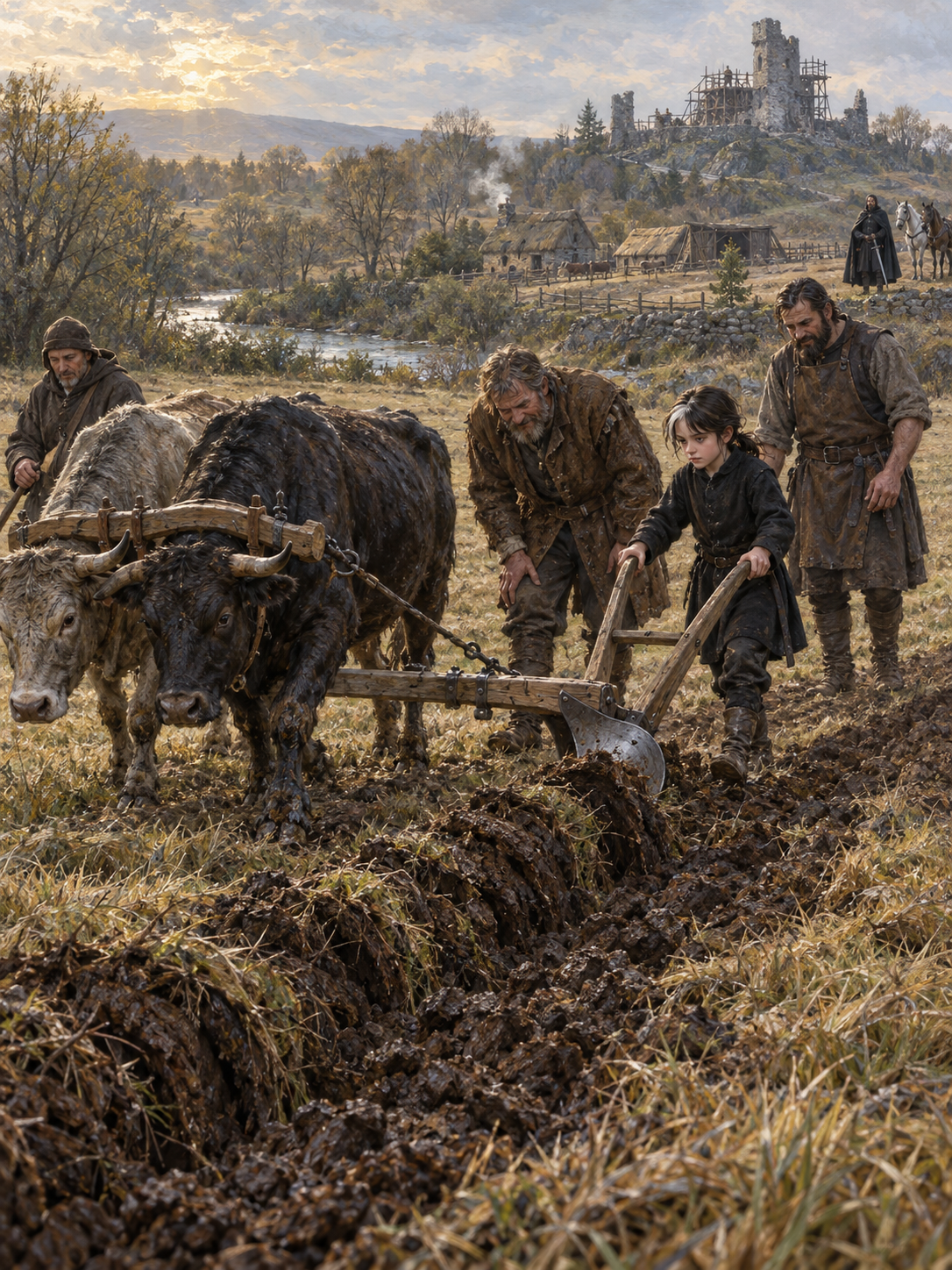
Chapter 30: Miller’s Run New
njro9w.png


The swallows still gathered beneath the Old Watch gate when Jon rode down to the river fields. Beyond the wall, men were pitching the last oat sheaves onto a cart. Arthur pulled his horse aside to let it pass. A loose stalk caught in his boot buckle and went with him down the slope.

Miller's Run entered the holding through a stand of alder, crossed below the tower and fell between the rocks where Jon meant to put his wheel. Farther down, it curved east and left the leased ground. On the western bank, old field walls disappeared beneath briar. Two empty crofts faced a byre whose thatch had sunk between the rafters.

Jon dismounted beside the nearer croft. Through its open door he could see nettles growing around the hearth. A row of empty nests clung beneath the lintel.

"Woods says the walls will bear another roof," he told Arthur. "The byre needs new timbers. I shall have them here before the next families come."

Arthur looked beyond him at the rushes. "You have men enough asking for the spear."

"I need ploughmen as well. Men who can tell me what this soil will grow." Jon put his reins over his arm and led Bucephalus down the bank. "I can try a new plough in these fields and still reach the clock benches before dinner. Dragonstone has different soil. It will need its own crops and its own drains. I would rather arrive with men who have already built something with me."

Bucephalus lowered his head towards a thistle. Jon drew him clear.

"These families will stay," he added. "Father has agreed that their holdings pass back to Winterfell with the tower. The rent stays as we agree it now."

Arthur took the stallion's reins while Jon went farther down on foot. The ground sucked at his heels. He hitched his plain black coat above the mud and tucked its skirts through his belt. By the water, he crouched and pulled a mat of grass from the mouth of an old ditch. Beneath it lay black mud and a broken stone lip.

He followed the old channel until it vanished beneath a tumble of field stone. Beyond it, the higher ground was dry enough to crumble between his fingers. Someone had worked this land before the cottages emptied. The ridges were still there under the grass, and along the far wall an apple tree held a few small, hard fruits.

Jon looked back towards the tower. From the high window he would be able to see these fields and the road to the works. He had spent years in another life driving out before dawn to find a pump, a fence or a gate that needed attention. Here he could ride the whole holding before breakfast.

He brought a lump of the upper soil back to Arthur. "Have Perkin send for the families as soon as their harvest is in. Woods can begin the roofs while we clear the water."

Arthur gave him the reins. The lump broke apart as Jon slipped his glove on, scattering crumbs over his black sleeve.


* * *

At the next market Jon had the bellman call for farmers. This time he stayed beside the well while the man read, with Perkin seated beneath the adjoining awning.

"Land at Miller's Run for families willing to settle it. Shelter on arrival, with cottages to be repaired for the settlers. Seed and the first provisions supplied. No rent before the first crop is brought in. Those accepted will keep the husbandry Lord Black sets upon the holding."

The crowd was smaller than the one which had heard the call for spears. Men listened beside wives with market baskets. A few had brought children. There was less laughter and more asking the bellman to repeat himself.

A grey-haired man asked what would happen when Jon went south. Told that the holding remained under Winterfell, he listened to Perkin's rent terms, then stepped aside to consult his wife. The next wanted to know whether he must bring his own oxen.

"Not to be considered," Jon said. "Tell Perkin what you have, and the work you know."

By noon they had names from several lordships. A woman with two boys received directions for her husband to meet Jon after finishing his present lord's harvest. One family withdrew at the amount of draining; another went with the woodward to see the croft before deciding.

A week later six households gathered below the Old Watch, where canvas shelters stood ready upon the dry ground beside the byre. They had brought tools and bedding in handcarts and upon pack ponies; one man carried a cradle with his spade tied across it. Jon rode down to meet them, passing the new barracks where Hewyn's men were putting their shields away. Beside the river a woman had spread a cloth upon the grass for her youngest children. The others waited with their caps in their hands while Perkin read the names.

Gerren, who had driven the first cart, bowed with his cap against his belly. He had worked his elder brother's land near Cerwyn until the brother's sons were old enough to do without him.

"Your lordship means to let us the fields beyond the byre?"

"The sound ground. The wet bottom stays meadow until we can drain what is worth draining." Jon stepped over a fallen doorpost. "Come and look."

Gerren followed him inside. His wife remained by the cart, watching Woods's men lift a new ridge beam onto trestles.

"There is no rent before your first crop," Jon said. "Perkin will supply seed and food until then. You will owe labour on the common drains and keep the ground in the crops I set. Your own garden lies behind the house."

Gerren rubbed mortar between his fingers. "And when you go south, my lord?"

"You remain. Lord Stark has agreed it."

The man glanced through the doorway towards his wife. She had begun untying the loom.

Spearmen tightened the canvas shelters by the byre. Once roofed, the crofts would take two households; until more dwellings were ready, the settlers shared a fire beside their carts. Jon showed them the future doors and garden fences. One man measured a doorway with his shoulders; another asked to bring the fruit tree from his former home.

"If it can be moved without killing it," Jon said. "Ask Gerren to help you choose the place."

When they came back towards the crofts, Gerren's wife was waiting beside the door. Her name was Merra. She asked for a window beside the hearth, wide enough to work by.

Woods joined them from the byre. Jon looked at the sun and moved round the corner to see the slope. "Put the loom against this wall. You will get light from the east. Woods, give her a shutter here."

She curtseyed and went back to the cart. When Jon passed again on his way to the ditch, she had taken the boy from between the turnip sacks and wrapped him in a blanket upon the ground. Her husband was holding up two pieces of the dismantled loom while she told him which belonged together. Farther along, a hen escaped its wicker crate and the children went after it, checked at once by a sharp word from their mother when their chase reached Jon's horse.

Jon took them down to the ditch that afternoon. Ten spearmen had come with spades after their morning drill; the settlers brought mattocks and baskets for spoil. At the lower end, Jon stepped onto the gravel and set his spade against the broken lip. He loosened the stone while Symon lifted it clear.

Water seeped into the space. Jon scraped the bed open until it ran, brown at first, then clear enough to show pebbles.

"Keep the bottom falling towards this," he told Gerren. "We work back from here. Leave the sides sloped or the first rain will bring them down."

He cut a length himself, lifting each sod onto the bank with both hands. Behind him, the digging spread uphill. Symon showed one of the new men how to lever a root instead of wearing himself out chopping it. By dusk, water from the lowest hollow was moving between the fresh sides. The farther ground was still too wet to bear a cart.

Jon returned each morning before riding to the Black Yard. He took a spade when he came, checked the channel after rain and worked beside the men where roots or stones slowed them. Upstream he found a reach high enough to feed the gardens. He carried his level between the run and the crofts, with Gerren's elder son holding the far end of the line. The channel would have to go round the shoulder of the hill. A straight cut would fall too quickly and leave the gardens above it.

Gerren stopped beside the first bend. "That brings us farther from the houses, my lord."

"For a little way." Jon took him along the hillside to where it flattened. "Here we turn back. Keep it at this height and the water will reach the upper garden. Cut down there and your wife will still be carrying buckets uphill."

The man looked back along the proposed course. He had cleared ditches since he could lift a spade; he had never laid one out to bring water round a hill. "Will it come so far with scarcely any fall?"

"Come tomorrow and see."

Woods fitted a wooden hatch at the mouth, well above the proposed wheel. When the first length was open, Jon lifted it and let Gerren's son watch the water enter. It crept over the dry bed, darkening the earth ahead of it. Merra followed beside it with her skirts gathered up. By the time it reached the croft, two more women had come from the shelters.

Jon knelt at the bend and scraped away a ridge left by a spade. The thin stream spread across his fingers, gathered again and ran on towards the garden.

"All the way from there," Merra said. She looked uphill, then at the buckets beside her door. "And we can let it in when we need it?"

"Once the sides are finished. Show her the hatch, Gerren." Jon stood, wiping his wet hand on his breeches. "You will both need to work it."

Gerren's elder son had run ahead to watch it arrive. His father called him back to help raise the low side. Merra stayed by the stream until Jon shut the hatch, watching the last of the water disappear into the thirsty ground.

"The bottom drain stays open," he told Gerren. "This one opens only when the plants need water. If the run falls low, close it."

The new roof timbers went up while they dug. Smoke returned to the crofts. More families came to look, and Woods began a second row on the dry rise. Jon found children collecting fallen twigs there one evening; they stood aside with their bundles and watched him pass.


* * *

William returned from Barrow Hall with mud on his boots and Lord Dustin's steward's receipt folded inside his coat. The clock had kept its hours through the trial. Lady Barbrey had made him show the steward twice how to silence the bell at night.

"She heard it from her chamber?" Jon asked.

"No, my lord. She said I was to make him do it with his eyes shut."

Woods laughed and went back to the case he was fitting. Perkin counted the balance William had brought, paid the last of the journey's charges and closed the Dustin account.

Osric's packet arrived that afternoon with an Oldtown merchant: Leyton's final six hundred dragons, acceptance of the Hightower clock and recommendations for nine prospective recruits. All four faces had agreed through the trial; the keeper had taken over the winding.

"Through Ronnel?" Arthur asked, reading the names.

"The first two," Jon said. "Osric spoke to the Seneschal while the clock was fitted and proved."

Henly, Otho, a healer, an armourer's son and four men who had kept accounts were among those recommended. Osric would bring them north when he had arranged the remaining passages.

Perkin counted eighteen hundred dragons paid for the Hightower; the two counting-house clocks were also settled. Iron, timber, bells and making had been entered before departure. He added the last fitting wages and carriage, keeping the recruits' passage separate at Jon's order.

"Close the clock accounts," Jon said. "Their passage belongs with the men I am hiring."

William opened Callum's report. A shaft had rubbed during the first fitting; Callum had corrected its seat before the trial began. Jon had William find it upon their copy of the drawing and explain the change.

"Would you have found it here?" Jon asked.

"Not on our frame. The wall would have held it differently." William put the two drawings together. "I would have to try it under its own weight after fitting."

"Remember that at the next hall."

Perkin put the Hightower account with the completed work. Highgarden and the Rock were next: the rose case ready, the lion still awaiting its movement. William had two plain clocks to finish before either left, and three more merchants had paid earnest.

"One at a time upon my bench," Jon said, giving him the lion drawing. "Fit the ordinary train. Leave the moving paws until we can do them together."

William pulled his stool nearer. Arthur took the recruits' recommendations beyond reach of the brass filings.


* * *

Ewan and Jon worked on the new plough between the clock orders.

Jon had carved the curve of the mouldboard in wood, paring away curls until the surface would lift and turn the earth without an abrupt bend. Ewan bent thin iron over it in sections. Jon held each cooled piece against the form while the smith worked the next. Twice he carried them back because the edges met in a ridge that would catch soil.

The cutting share was separate, so a worn blade could be changed without making the whole plough anew. Woods brought an ash beam and the handles; Jon helped him fit the ironwork, driving the smaller pins while Ewan seated the heavy ones.

Gerren came when they had it assembled. He took off his cap at the door and waited until Jon beckoned him to the bench. For a while he touched only the wood. Then he bent to examine the iron curve, following it from the share to its broad upper edge.

"There is a deal of iron in that, my lord."

"It must hold this shape. Bare wood would soon lose the curve I want." Jon took the wooden form from beneath the bench and set it beside the finished mouldboard.

Gerren turned the form over. "You cut this yourself?"

"Aye. The first had too sharp a turn. This lifts the soil more gently."

Ewan showed him where the separate share came free. At that Gerren set his cap down and crouched for a better look.

"Will your lordship have it drawn by horses?"

"Oxen. Garrick is buying trained pairs."

"The lower ground will take the pull from them."

"We shall begin above it." Jon showed him the fittings at the beam. "The pull can be shifted here. You know the teams. Work with me until we have it drawing straight."

Cold rain delayed them for weeks. A skin of ice formed overnight in the horse trough and broke beneath a bucket next morning. Jon kept the oxen on the firm road, where Symon walked the unfamiliar teams in their new yokes. The plough waited beneath the byre roof, its iron greased against rust.

When the weather softened and a handful of the upper soil crumbled instead of smearing across his palm, Jon brought it out. Ewan came to watch the ironwork under strain; Arthur waited with the horses at the headland.

He walked behind the handles with Gerren beside him. Symon led the oxen. Their shoulders moved under the yoke; the beam tightened, and the share entered the ground. Earth climbed the mouldboard and rolled over with its grass beneath it.

The first length took them along the old headland. Jon felt the pull through both arms and settled his weight behind the handles, guiding rather than forcing the share down. Small roots tore with a sound like cloth parting. Gerren kept pace beside him, watching the clean face of the furrow. At its end Jon stopped the team and had him help shift the hitch. On the return the sideways strain eased. The rhythm came back more readily than the strength. As a boy in his first life he had wanted farm work finished so he could get to his books; as an old man he had found reasons to walk the fields after supper. He understood that last habit best now.

"Keep it there," Jon said. "Let it turn the earth."

He gave Gerren the handles and walked beside him while they made the next length. The man had spent more of his life behind oxen than Jon had spent in this body. He soon found the feel of it, eased one handle and laid the next slice of earth beside the first. His sons followed with a basket for stones. At the far end he stopped, planted the handles and looked back down the furrow.

"That has buried the grass, my lord."

"Aye. We shall harrow it before sowing."

Gerren bent over the turned sod and broke its edge with his thumb. "I used to send the boys through after me with mattocks." He beckoned his elder son to look. The lad knelt, pulled at a tuft buried beneath the furrow, then looked along the whole length they had just turned.

"Fetch your mother," Gerren told him.

By the time they reached the far end again, Merra was waiting with her knitting caught beneath one arm. Gerren made her walk the furrow. He had begun explaining before he remembered Jon was beside him, and stopped with a muttered apology.

"Show her," Jon said. "You know what work it has saved."

Another farmer came from the byre and asked to try. Gerren walked beside him while Jon watched the join between the plates. The soil shed cleanly.

"I could use another team now," the farmer said when he halted. "If your lordship will have another of these made."

"When Ewan has finished this one. The hitch needs an easier fastening. Bring your eldest to the next trial."

The man lingered beside the mouldboard until Gerren called him to help move the team. Behind them Merra was asking how much more ground they could manage.

By noon dark furrows crossed the field and the stone basket had been filled twice. Merra brought bread; Wylla arrived with onions and barley. Arthur cut the loaf while Jon washed, then they sat together upon the cart bed. Merra broke her youngest boy's bread into his broth.

"The loom is yours?" Jon asked.

"My mother's before me." She glanced towards the byre. "I have been weaving through the wet days. If your women have need of plain cloth."

"Bring Mairi, my seamstress, a piece when you have one ready. There are shirts to make as well as coats."

Merra looked at Gerren, who was eating too quickly to answer at once. He swallowed and nodded. The older boy asked whether the soldiers' black cloth came from black sheep, and Wylla told him that the best of it did. She had spent enough mornings separating shades to have an opinion on the matter. Gerren reached for another piece of bread while they talked. Beyond the cart, one of the oxen lay down, folding its great forelegs beneath it with a sigh.

After the meal, Jon walked the fields with the ploughman. Beyond the newly turned earth lay another long strip, the rough ground beside the byre and a sheltered enclosure against the western wall.

"Four fields," Jon said. "Barley, clover, rye and turnips. When a field is ready for its next crop, we move it on. The clover stays for cutting and grazing before we turn it under for rye. It feeds the beasts and leaves the soil better for grain. The turnips help us keep them through the cold, and their dung comes back here."

"We keep a turnip patch, my lord. My wife tends it."

"Then I shall want her help. I mean to grow enough for the byre as well as the pot."

Gerren looked back at the oxen. "There is work in that much hoeing." He hesitated. "And which field rests, my lord?"

"The clover takes the place of bare fallow."

"But it is growing a crop."

"A different one. Grain after grain takes the goodness out; clover helps put it back." He had learned the cycle through cattle, fodder and dung in his first life, long before he learned what happened beneath a root.

Gerren rubbed his beard. "We let the cows onto the fallow. My father did the same. I have never heard of a man sowing it for them."

"You will see the difference in the byre before you see it in the next grain crop."

The ploughman looked across the four strips again. Beside the byre, his wife had begun gathering the bowls. "She wanted another cow. We had no hay to spare."

"Let us bring in the first cutting before you buy her one."

"Aye, my lord." Gerren's eyes moved to the clover ground. "Will your lordship have us keep the grass cut apart, then, so we know how much?"

"That is what I want."

"I will pay for the extra hands. We shall begin with these four strips and keep seed from what grows best." Jon knelt and broke a clod along the furrow. "The lower meadow stays in grass. We have enough to bring under the plough."

Merra joined them to reckon the seed and hands needed for the root strip. She would use the spacing from her garden, with paths left for the hoers. When Jon asked about storing the sound roots dry and covered, she showed him an old pit beyond the wall. It stood above the ditch, half filled with rubbish; he had it cleared and left open to dry.

They would cut the roots for the cattle and return the rotted bedding to the fields. Gerren repeated the next morning's work to his sons before Jon left. Their names meant nothing to Ethan yet. In four years Jon meant to have men on Dragonstone who could teach this work as plainly.

A little seed from every sack had first gone onto damp linen to test whether it still sprouted. Over the following days they sowed barley, rye upon the lighter ground and clover beyond it. Jon and Merra laid out the root drills. Behind the byre, the lads mixed spent bedding and dung with leaves and spoiled fodder, keeping fresh stable muck apart and clear of the stream.

When the seedlings were large enough to thin, Jon and Merra returned to the drills.

Gerren's youngest daughter found Jon at the root ground with the dinner Wylla had sent. He ate upon the boundary wall while the harrow crossed the brown earth. Across the run, Woods's men were lifting another beam beneath the broken tower.


* * *

Gawen had Jon's arming coat waiting when he came back from the fields. While Jon washed the soil from his hands, the knight made Aries lay out everything which went over it.

The boy found the mail collar, the belt and the gloves. He put the helm with its open side upwards, where loose grit could fall inside it. Gawen turned it over without scolding and had him feel the lining.

"Clean cloth beneath it. You would notice a stone after someone had fastened that on your head."

"I'd take it off."

"Lord Jon may have both hands occupied."

Aries spread the cloth. Jon came in with Arthur, still drying his hands, and stood while the page brought his coat. Gawen helped settle the heavier pieces, then showed the boy which fastenings could be reached without lifting anything beyond his strength.

Aries hauled the first strap tight enough to pucker the coat. Jon caught his hand.

"I shall want to breathe."

The boy let go at once. Gawen loosened the fastening and showed how much room to leave, then made Aries set it again. One strap twisted against the collar. He had to undo the buckle and begin from the other side.

"Now ask him to move," Gawen said.

"Move, my lord."

Jon raised his arms, turned and bent to take up his shield. The collar held without drawing across his throat. Aries ran a finger beneath the edge as he had been shown, pleased to find the same space still there.

"Better," Jon said. "Leave the sword belt for Gawen until you can manage it without dragging the scabbard on the floor."

The boy's pleased look vanished. "I can lift it."

"Lifting it is not the only part."

After the practice Gawen made him return each piece dry to its place. Aries discovered how much work remained after his lord had taken the armour off. He tried to leave a buckle beneath the cloth. Jon found it when he came for his gloves and called him back.

Wylla sat nearby mending the elbow of the little black coat. She watched Aries take the buckle without argument, and set it down again only after he had cleaned the dirt from beneath its tongue. When she called him to try the mended sleeve, he came with his hands held out to show they were clean.

While Gawen took the horses out, Jon cleared the little table and laid down a worn copy of the northern road map. Aries came back from Wylla with his mended sleeve rolled up to admire the stitching.

"Here," Jon said, setting a fingertip beside Winterfell. "Find where we are."

Aries bent over the ink. "Where's the pig pens?"

"Too small to show."

"They're bigger than that." He pointed to the little square which stood for the castle.

"The square tells you where Winterfell is. It does not show the size of the walls." Jon traced the kingsroad south with his finger. "This takes you out of the town. Follow it with me."

At the turning towards White Harbor, Aries tried to take the straighter road. Jon brought his finger back and let him choose again. Arthur drew up a stool while they followed the branch towards the sea.

"Our factor Osric went that way with the clocks," Jon said. "At White Harbor he took ship. When you carry a message, you ask which road. When you send a man as far as Oldtown, you must ask about ships as well."

"Why not ride all the way?"

"You could. It would take longer, and the clocks would have to bear every rut. Find the sea."

Aries touched the blank space east of the coast. He knew the word now, though he had never seen more water than the river in flood. "Dragonstone's in there?"

"Farther south than this sheet shows." Jon fetched the smaller coast chart from his letter case and set White Harbor beside White Harbor. "Here is Gulltown. Farther down, my island."

Arthur held the curled corner flat while Aries followed the coast between them. The boy had begun to recognise some of the letters; he picked out the first of his own name in White Harbor and lost interest in the others.

"If it's yours, why do you live here?"

"I am preparing the men and the work we shall take there. My castellan Ethan keeps it for me until I come."

"Is White Harbor yours too?"

"No. Lord Manderly holds it."

"But our clocks go there."

"And pay to use his harbour. Having goods in a wagon does not give me the road beneath its wheels." Jon tapped the square for Winterfell again. "Even here I have neighbours. Their cattle cross the lower lane. I cannot stop them because my wagons would rather use it."

Aries frowned at the sea chart. "What if you send soldiers?"

"Then I have sent armed men to break an agreement I made before Lord Stark. He would have something to say about it."

"So would the neighbours," Arthur said. "And the next man Lord Jon asked to make an agreement with him."

The boy looked from one sheet to the other. He put a finger on White Harbor, then drew it carefully through the blank sea towards Dragonstone.

"That way?"

"By ship," Jon said. "Yes."

Jon gave him a scrap and the charcoal to draw the journey. Aries made a boat with a horse almost as large as its hull. Jon put away the charts while the drawing acquired a second horse and a strip of dry land for them to reach.


* * *

The cyvasse set from White Harbor reached the Black Yard with a merchant's next parcel of brass. Its box had plain iron hinges and smelled faintly of the cinnamon packed beside it. Jon unwrapped the pieces, checked them against the book and took the whole thing up to Winterfell that afternoon.

Luwin cleared his little table beneath the rookery window. He named the pieces, showed Jon how to set his ground and raised the screen between them. Above their heads a raven knocked its beak against a cage bar. The maester went up to settle it while Jon arranged his army, then returned and lifted the screen.

Jon lost a horse before he had quite understood what Luwin was preparing. He asked to have the move shown again. Luwin smiled and leaned over the board to show him, then put the pieces back where they had been and allowed Jon to continue from his mistake.

Robb found them there with the game well advanced. He pulled a stool beside Jon and watched Luwin move an elephant.

"Has he taken one of yours?"

"My horse," Jon said as Luwin removed it.

Robb bent nearer. "You could take—"

"Let me finish this one."

Jon brought his dragon forward. Luwin considered it for a while before answering, and Jon began to think he had recovered enough to trouble him. Then he saw the approach he had left open beside his own king. Three moves later the maester took it.

"Again," Jon said.

"After Robb has had his turn." Luwin set the captured king upright and showed Jon where the trouble had begun. Robb was already drawing the box towards him.

Jon gave up the stool. He stayed to hear the maester explain the pieces again, watching Robb choose his ground far more cautiously than he had chosen his. When a servant came to fetch them for supper, Robb made her wait while Luwin showed him why a move he wanted would lose his horse.

Arthur waited outside the rookery. He nodded towards the game box. "Skorion massitas?"

"Qringōntan." Jon passed him the box.

"Against Luwin? You are in good company."

They carried the set down together. Robb wanted to borrow it the next evening. Jon agreed, provided he brought every piece back.

Jon had enjoyed himself, even in defeat. He wanted another game against Luwin now that he understood the pieces, but he also wanted to put Robb across a board whose rules he knew. He had played chess for most of his former life; the prospect of teaching his brother brought back his appetite for it. That night he drew an eight-by-eight board and set down the shapes of all thirty-two pieces.

Woods found a strip of dry birch among the offcuts. The men could be cut from it, he said, but no one was to expect fine horses' heads from a carpenter who had roofs to finish. Jon asked only that the pieces could be told apart. He inked the board himself while the glue dried beneath its frame.

Robb came upon him a few evenings later with the pale men arranged before an empty chair. He set down the mittens he had brought from Winterfell and examined a knight.

"Where are the elephants?"

"There are none. This is a different game." Jon moved the chair out with his foot. "Sit. You can have the pale side."

"What is it called?"

"Chess."

Robb settled opposite him. Jon showed him the towers first, then the septons and their slanting paths. The knight took longer. Robb lifted it over a pawn, put it down upon the wrong square and frowned when Jon moved it one farther across.

"It can jump over its own men?"

"And yours. But only to a square it can reach by that move."

"Show me again."

Jon did. He left castling until Robb could move the rest without asking and let him take back the first queen he offered. The second stayed beside Jon's cup. Robb stared at the gap in his line, then began making room for a tower.

Arthur stopped behind his chair. "Your king."

"I can see him." Robb bent lower. "Jon, wait."

Jon waited. Robb's frown over the board was giving him almost as much pleasure as the game. When the meal bell sounded, Robb asked whether they might eat there. Jon sent for bread and cheese, and Arthur took the spare stool.

Hewyn came in as they were finishing and returned the following evening to try it. Jon had a second board made for the officers' room. He wrote out the moves in a few plain lines and left the sheet with it, but for the first week men were forever coming to ask about a pawn at the far edge or a king that had nowhere to go. He went back with them when he could. Before long he was finding his chair occupied and two more men waiting to challenge the winner.

Robb borrowed the first set for an evening at Winterfell. When Jon arrived for supper, he found it in the family room, with Sansa in Robb's chair and Theon opposite her. Jeyne had drawn a stool close to Sansa. Robb stood behind them, trying to explain a move neither had asked him about.

"That tower cannot go through your own man," he said.

"I was moving him out of the way." Sansa set down the pawn she held. "You said I could move him two places at the beginning."

"You can," Jon said from the doorway. Sansa looked round at once, and Robb made room for him.

Theon turned one of the dark pieces upon its base. "Who taught you this? Luwin says it is not in his book."

"Jon made it," Robb said. "The board and all the moves." There was pride in the way he said it. Jon took the chair beside the hearth, close enough to see the game without standing over Sansa.

Theon put the piece back and looked up at Robb. "And you know them all?"

"Enough to beat you," Robb said.

"After me." Sansa waited until Theon looked at the board again before moving her pawn. Jeyne whispered something to her, then pressed her lips together when Robb leaned nearer.

Arya came to Jon with a captured knight in each hand. He made a place for her beside him and showed her the carved heads. She preferred the dark one; its nose had come out longer. Across the room Robb caught himself reaching over Sansa's shoulder and drew his hand back. A few moves later she took Theon's tower.
 
Chapter 31: The Sixth Roof New
5sofye.png


In the third moon of the lease, Jon stood inside the sixth of the first sleeping sheds and watched a swallow turn between the wall plates at its open end. It flew out over Woods's head with a wisp of straw in its beak.

"It has begun before us," Robb said.

"It need not house fifty," Jon answered.

Robb and Theon had arrived while the carpenters laid out the last truss. Their horses stood outside with Arthur's grey. Jon's coat hung upon a peg; lime dust whitened his black breeches, and a shaving had lodged in the pale lock beside his left eye.

Munin perched above the coat, turning a bent nail between her claws. When Woods reached for it she flew to the next post. Robb began to laugh, then covered his purse with one hand.

Beyond the doorway, rain had dulled the first barracks' shingles to old honey; the newest still shone yellow. Men were carrying bundles into the fifth. One had wrapped an astonishing number of possessions in his blanket. Another brought only boots and a wooden bowl. Clay stopped the gaps between rough planks upon low stone footings. Once this roof was covered, the last men could leave their tents. Proper stone barracks and passages would follow the tower work; Woods had framed the roofs so their sound timbers could be lifted and used again.

"Where did you find room for all this?" Robb asked. "There were nettles here."

"You helped cut them."

"There seemed rather more nettles than ground."

Jon smiled and took the measuring cord from Woods. The pegged triangular truss lay over the scratched lines used for its fellows, ready to fill the roof's last short bay. He checked its width and the two feet that would rest upon the wall plates.

"Hold there, Symon."

The spearman kept his end while Jon checked the second measure. Woods took the cord, coiled it, and waved the waiting men closer.

Robb picked up one of the short braces waiting beside the frame. "Where does this go?"

"Along the roof, between these and the next timbers." Jon showed him the angled ends. "The frame carries the weight across the room. The braces stop it leaning along the building when the wind presses against it."

Theon took the brace from Robb. "Even with those pegs?"

"The pegs hold the joints together. The whole frame can still lean. These braces tie it to the frames beside it."

"He will be asking all morning," Robb said.

"Then he can help Woods after dinner. There are plenty of braces still to fit." Jon went out with the carpenter to see the lifting ropes.

The last truss lay close to the end wall. Two stout poles rose above it, lashed together at their heads, with the tackle hanging between them. The lifting line ran to a windlass bolted upon a heavy timber bed. Woods had made its drum; Ewan had cut the teeth for the wheels Jon drew beside it. Within the open framing, the little wheel at the handle meshed with a much larger one on the drum.

"We have a windlass at Pyke," Theon said. He followed the rope with his eyes. "It takes more than those two to work it."

"Try the handle when they have taken the slack." Jon laid his hand upon the smaller wheel. "This turns several times before the drum turns once. You will have farther to wind, but less weight on each turn."

Theon looked up at the great beam, then at the two spearmen beside the handles. "That is a roof timber."

"I know what it weighs." Jon called Woods over to check the sling. "Leave the handles where I have set them. The men can change places without stopping the lift."

Jon crossed to the spearmen. Black coats lay along the wall beside water bottles and a loaf wrapped in a sleeve. Farther up the lane Hewyn's shouted commands punctuated the scrape of another company's feet.

Jon chose the men for the guide ropes and put Woods where he could see both ends of the beam. Arthur brought Robb and Theon beside the windlass.

"Take up."

Rope wound upon the drum and the truss rose, shedding wood chips. Once its whole weight hung clear, Theon glanced at Arthur. The knight stepped aside.

"Keep it moving," Jon told the nearer spearman. "Lord Theon, take his place."

Theon caught the handle as it came round. He braced for the weight; his first turn carried him farther than he intended. He found his footing, turned again, and looked up. The beam was still rising.

Robb left Arthur to see it from the other side. "You are doing it."

"I can see that." Theon was breathing harder now, but his grin had spread. He made another turn before letting the spearman take over. For once he left the questions to Robb.

Jon followed the nearer end towards the pencil line marking its seat. The guide ropes steadied the frame beyond the men's reach; Woods climbed the short ladder and put a shoulder behind his bar.

"Keep winding."

The beam came level with the wall. Jon moved outside, where he could see the far end.

"Towards me a little. That will do. Lower."

Wood settled against wood with a deep knock. Woods drove the first peg while his man secured the other end. Jon waited until they had fitted the braces, then had the men ease the windlass. Above him, the last frame stood against the pale sky.

A shingler put down his bundle and bent to examine the windlass. "Could I have a drawing of this?"

"Come back with Woods after dinner," Jon said. The man put on his cap and fetched his shingles.

The lifting crew drank at the well while Hewyn's company came to relieve them, each side making the usual remarks about easy mornings. A man with three water bottles stopped to give one to a friend. Beyond the last sleeping hall, Fourth packed turf along the western bank, now above a man's head. Each week Jon extended the work, taking different tens as drill allowed.

Ormund came from the tower with mortar upon his leather apron. The mason looked along the barrack plinth before approaching Jon.

"The hearth is ready, my lord. I have left the screen wall for after they move in. It will not hinder them."

Sun lay across the red hearth bricks and swept floor. Bed spaces lined a clear central passage; Woods's opposing windows let air move through the room.

"Finish the tower stair next," Jon said. "Wylla still has to go round by the yard whenever she wants the stores."

"We can begin after dinner."

Ormund went back to his men. Robb wandered to a window and leaned out, trying to see the kitchen fires. Theon looked at the rows of empty bed frames awaiting their straw mattresses.

"They will be pleased when it rains."

"They were pleased after the last rain," Arthur said. "They could see their roof timber coming up the road."

Jon took his coat from the peg. Across the run, men were extending the wheel pit's channel while a barrow brought foundation stone. The wheel remained a covered stack of timber beside the unfinished shelter for Ewan's work.

Wylla had set cold beef, mustard and baked onions beneath an awning. Theon washed; Jon found soot from the hearth bricks upon his own palms and joined him. Robb's bread split beneath a hot onion, and he reached for another piece.

"Your father asks whether you are coming tomorrow," Wylla told Jon.

"After the morning drill. Tell him I shall stay to supper."

"Sansa wants you to hear what she has learned upon the harp."

Robb swallowed. "She wants all of us. Septa Mordane made us sit through it yesterday."

"Was she good?" Jon asked.

"Better the second time."

"There were three times," Theon said.

Wylla set the mustard beside them. "Then she is practising."

A rider appeared at the gate with Perkin's boy, and Jon put down his onion. Osric's letter had come through White Harbor in a merchant's packet.

Osric was still near the Citadel, checking the nine candidates' references. Paid work in the North continued to draw enquiries; most ended when he mentioned the eventual move to Dragonstone.

His fuller report described a healer who had earned silver links, two men with iron links whose fathers worked metal, and a factor's son accustomed to accounts. A mason's son had brought drawings of a watercourse. Osric had kept him talking long after the first visit.

Jon read that part again.

"Good news?" Arthur asked.

"Useful men, if they are what they claim." Jon passed him the letter. "Osric has been to see their former masters. He is checking their work before he brings them."

Theon had gone to join Robb at the parapet, from which they could see the last rafters going up. Jon pulled the cloth over the remaining bread and stood.

Wylla's curtain still divided the guardroom. Riverbank flowers stood upon the chest beneath it. Jon moved his blanket and spread the papers on his own chest while Arthur brought the stool.

"He asks for something to put before them," Arthur said.

Jon found the drawing of the proposed wheelhouse. He set aside the page showing the drive and chose the simpler plan of the building and its channel. Beside it he laid Hewyn's notes about the javelins, then took a clean sheet to draw the ironwork that had given Ewan trouble.

"These can go. Have the mason's son draw his watercourse in section. I want to see how he joins the banks to his walls."

Arthur leaned nearer as Jon drew the shoulder below the point.

"And the smiths?"

"They can tell Osric how they would make this, and what iron they would choose. I shall learn more from that than from counting the links at their throats."

He wrote a short reply, asking Osric to bring the strongest candidates when his enquiries were finished. The healer was to describe the work he had actually done; the accountant could send a page in his own hand.

Arthur turned the building plan towards the light. "You mean to take them all south?"

"If I keep them. They will have time to learn beside me here." Jon rubbed a spot of dried mud from the corner. "Ethan can hire a mason. What I want is a man who knows why I put a drain where I do, and can lay the next one without sending across the sea to ask me."

"And when he disagrees with you?"

"He can show me his ground." Jon smiled faintly. "I still decide what we build."

By late afternoon the last stretch of shingles lay beneath the mallets. Robb was holding a ladder for Woods while Theon passed bundles up to him, his fine grey sleeves rolled and his expression suggesting that this had not been his intention when he left Winterfell.

Jon crossed to the tent ground with Martyn. Men shook old straw from their blankets; one crawled inside for a lost knife while another waited barefoot for a friend to find his shoes. Pale, flattened patches marked where they had slept.

Woods sent a boy back for a mallet left on the ridge, then called the men in. A broad young swordsman entered carrying two mattresses, reconsidered the window bed and dragged one farther inside. His companions followed so closely that Martyn had to clear the passage.

Jon stood in the smell of pine and fresh straw while the last tent poles went past. Voices filled the windows. Beneath a new bed, muddy boots stood carefully together.

Woods came beside him, looking up at the timbers. Beyond the far doorway Wylla was calling Robb and Theon to wash before they rode home. Robb shouted that they were coming. Theon was still brushing wood dust from his sleeves when they reached her.

The next day Jon rode up to Winterfell after drill. He left Arthur speaking to Jory in the lower yard and went through the Great Keep, following the broken phrases of a harp. Sansa sat by the family-room window with Jeyne Poole beside her. The tune was one Domeric had played at harvest; she managed the troublesome turn, saw Jon in the doorway and lost the next note.

"You remembered."

"I promised, didn't I?" Jon took the chair she had cleared for him. "Finish it. You had it right until you looked up."

She began again, this time keeping her eyes upon the strings. At the last note Jeyne shut the little book with satisfaction. Septa Mordane gave a nod from beside the hearth.

"Better. Put it away carefully." She turned to Jon. "She will want to practise the dance as well, Lord Black. She has been saving it for your visit."

"I promised her."

"Then move the spare chair before you begin." She returned to her sewing. Jon put it against the wall and sat down again. He could work with that much civility.

Sansa put away the harp, then came back with quite a different book. She opened it across Jon's knees at a coloured picture of a queen and her ladies. Their sleeves trailed almost to the floor; the queen wore a net of pearls over her hair.

"Wynafryd says they still dress like that at some of the southern courts. Not the crowns, of course."

Jon examined a blue sleeve. "You would trail that in every dish you reached for."

"You fold it over your wrist. Mother showed me." Sansa demonstrated with the narrower sleeve of her own gown. "You do not reach across a table anyway."

"Robb does," Jeyne said.

"Robb is not a queen."

"He would eat as much if he were," Jon said, and Sansa laughed before the septa looked up.

Thread marked pictures of riders before a pavilion and a feast with musicians in a gallery. Jon turned the book towards the window. Beneath the queen's chair sat a small dog; at the back, the painter had given two men little more than noses.

"Would King's Landing look like this?" Sansa asked.

"I have never seen its court."

"Uncle Arthur has. He tells me who rode in the lists, but never who danced afterwards, or what the ladies wore. He says he does not remember."

"He probably remembers which doors he had to guard."

"Then you must remember when you go south. Properly. Not merely whether your dinner was hot." She touched the painted pavilion. "I should like to see the entry of the knights. The banners and all the horses dressed together. Here half the men come to supper in whatever they wore in the yard."

"You would miss the ones who did."

"I would write to them. And they could visit."

The door opened. Arya entered with a pair of shoes dangling from her fingers and a look of innocence Jon did not trust. Robb followed her, carrying Bran because the little boy had refused to be left with his nurse.

"I found these outside," Arya said. She set Sansa's dancing shoes very neatly beside the chair.

"They were in my chamber."

"Then I found them there."

Sansa reached for the nearer shoe. Something rattled inside it. She tipped a little heap of dried peas into her hand while Jeyne covered her mouth. Robb put Bran down and turned towards the window, shoulders shaking.

Arya lifted her skirts in a curtsey so deep that her hair fell over her face. "For the princess. So everyone will hear her coming."

"Those are my new shoes." Sansa's voice had gone thin. "You have stretched the stitching."

"No, I haven't."

"They are Sansa's shoes, Arya," Jon said.

Arya's grey eyes narrowed as though he had joined the wrong army. Jon held out the other shoe. A pea rolled beneath his chair.

"Empty it."

"It was only a jest."

"Then you can finish it by picking them up."

Septa Mordane set down her sewing. Arya's face changed at once; she bent to the floor before the septa could begin. Sansa drew both shoes into her lap and inspected the soft seams.

"You are a baby," Arya muttered.

"And you are filthy. Look at your hands."

"They are clean enough."

"They are not coming near my things again."

Jeyne shifted closer to Sansa. Arya looked from one girl to the other. "Lyanna would have laughed." Neither answered. She gathered the peas in the hem of her gown, dropped one, and snatched it up before anyone could help her.

Robb made room at the window for Bran. Jon put the book on the table and bent to look at the shoes in Sansa's lap. The stitching had held. He told her so, but she still put them safely behind her chair.

"I wanted to practise," she said. "You promised."

"I did." Jon stood. "Which dance?"

"The one Wynafryd showed us. You go back too soon."

He let her place his hands. The first movement was slow enough that Jeyne could call it out from beside the table. Sansa watched Jon's feet, corrected his turn and began again. Soon she forgot to be angry long enough to smile when he managed it.

Arya stayed by the hearth. When Robb beckoned her to join him, she shook her head.

"I do not want to. You cannot even run in those shoes."

"Then do not," Sansa said. "No one is making you."

Bran wanted Robb to carry him through the turn. They nearly overturned the chair, and the septa sent them into the passage, where Jon found them after the dance.

Bran had taken one of the wooden swords from the nursery box. He thrust it towards Jon's belt.

"My sword," Bran said. He held it up for Jon to admire.

"A fine one. Will you let me pass?"

Bran lowered it and reached for Jon's belt instead. "Yours."

"Mine stays where it is." Jon caught the reaching hand. "Come down to the yard. We can find a shield for yours, and Arthur can show you how to hold it."

Behind them Sansa and Jeyne were arguing over the painted queen's sleeves. Arya went the other way with the peas, without saying goodbye to her sister.

Two mornings later Mairi spread one of the emptied tents across a bench. A rope had torn through its corner, and the cloth smelled of wet straw. Jon laid his drawing beside it. Woods held down the curling edge while Mairi followed the seams with a blunt finger.

"Room for a ten, my lord?"

"With their bedding. The cooking stays outside."

She measured the width again. "I would put another strip here. They will pull at that when the cloth is wet."

Jon added the strip to his drawing. They would use stout linen, with leather sewn beneath the rope holes and around the places where the poles pressed. He wanted a low ridge and sides that reached the ground, with an overlapping flap at each end. Mairi cut the first pieces while he and Woods worked upon the poles.

Jon had cursed enough equipment that packed well in a drawing and badly into a vehicle. He divided the ridge pole into sleeved, pinned sections and had Woods lay them beside Ralf's panniers. One stood too high; they shortened it before cutting the rest. Woods made shouldered hardwood pegs and a pattern for the other carpenters.

Ewan brought two spades and an axe. Jon chose the broader spade head as the pattern; its handle must be replaceable with timber cut on the road. He fitted a leather guard to the axe before letting it near the tent cloth. Elspeth's borrowed cooking pot stood beside it. She wanted it back before dinner.

"For the whole ten," Jon told Ewan. "They can share the fire and the pot. I want the other smiths' prices before we order the rest."

Woods brought over the carrying fork he had shaped from Jon's second drawing. A crosspiece held the rolled wool blanket above a hanging food bag. Malcolm and Symon came in from the yard to try the load. Jon tied on a cup, a small bundle of spare wool hose and a cover of oiled cloth, then had Malcolm take it upon his shoulder. Woods watched the crosspiece while Jon settled the ties closer to the shaft.

The blanket stayed behind Malcolm's neck and the bag rested against his back. His cup struck the wood with every step.

"We shall hear First coming," Symon said.

Malcolm stopped, tucked the cup beneath a strap and walked past him in silence.

Arthur lifted the second fork, cut shorter for Jon. "What do you call this one?"

"The bundle is a sarcina. The fork is a furca." Jon fitted the cover over his blanket.

"More old words?"

"Useful ones." He drew the lower tie tight and shouldered it. "Bring your shield, Malcolm. I want to see you put the load down."

They tried lowering the forks and bringing their shields forward at the gate. Malcolm's food bag dragged through the dust; Jon raised its fastening. Mairi's first tent needed a second line of stitching along one seam, and Woods secured a loose pole pin with a retaining thong.

Ralf balanced the folded tent against the pot and tools in the mule's panniers, with the short poles lashed above. He checked the padded saddle clear of the spine and led the beast through a tight turn. Jon tied the repair pouch where a man could reach it without unloading.

"One ten first," he told Woods. "They will carry it and mend what fails. Keep the patterns when we have put that right."

Perkin noted the linen and iron, and Jon had him seek pack beasts in small lots, working towards thirty for the cohort. Men would carry bedding and food; beasts and carts took the shared loads. The next tents, tools and blankets must be priced before another recruiting call.

Elspeth sent a boy for her pot before they had finished packing. Jon gave it back and told Perkin to add another to the order; they would need their own for the next trial.


* * *

A fortnight later Lew and Hennet carried the last lifting stone into the exercise room and set it upon its thick timber pad. Wet grass scented the air through the shutters; outside, Martyn's practice swords knocked together.

The room took two tens with space between them. Smaller stones stood beneath the windows; Mairi was reinforcing a sand sack's worn corner beside the clear central floor. At the far end, a smooth ash bar crossed two stout uprights, with a climbing rope beside it.

Jon left his coat on the bench and checked the joints with Woods. From a stool he reached the bar, drew his chin above it and lowered himself. The uprights held under his shifting weight. Arthur tried next; Woods watched the pegs, then told his apprentice to trim them.

Heward leaned upon the bar with both boots on the floor, moved a sack clear of the door and beckoned the men in.

"First's two leading tens. Leave the shields at the rack. Malcolm, take the window side; Symon, the other."

Hewyn sent the men in and went to bring the next company down from the field. Rain began tapping upon the shingles. Those nearest the windows closed the windward shutters while Jon laid a sack in the clear space between his boots.

Jon showed Malcolm and Symon the lift, holding the sack close as he rose and lowering it gently. Heward watched the two decani before allowing their men to take the stones.

Lew chose one of the larger pairs. His shoulder twisted as the second came up.

"Down," Heward said. "The pair by your left boot."

"I can lift those, Campidoctor."

"I saw. Now show me one you can put down as well."

Malcolm worked beside him with the smaller pair. Jon moved Hennet's stones closer to his feet, while Heward caught Symon lifting when he should have been watching his men.

Small groups changed between sacks, low-bar holds and the climbing rope. Heward kept the floor beneath it empty and brought down a lad kicking for a height his arms could not hold. Jon held a stool at the bar so weaker men could practise without swinging.

Mairi finished one sack and took another whose stitching had begun to pull. Heward named it to Tomas when the household arrived, then kept Malcolm and Symon at the door.

"Tomorrow you show the next two decani. I shall watch. Nobody takes a larger stone because the man beside him has one."

Jon took his coat from the bench. Tomas was already setting his file in pairs.


* * *

On the next dry afternoon, Jon and Woods raised a tally board beside the drill ground, where the men passed to the trough. Its six columns bore the century flags: white numerals above spearheads and shields, on black within purple borders.

Hewyn read the numerals. "What goes beneath them?"

"Wins. Shield games at the last drill of each sennight. One stroke for the century that wins its match. Change the men each sennight." Jon brushed a shaving from the board. "At the moon's end, the best century has a supper of its own choosing, if Elspeth can make it."

"Tell them that last part yourself," Hewyn said. "Or they will ask her to roast an aurochs."

Jon laughed. "She may refuse that."

The first contests began after the carrying gangs had put their tools away. Hewyn set straw bosses along the bank for javelins while Martyn brought out the practice shields. Men came from the washing trough still rubbing their hair, calling to friends in other centuries. Lew had tucked his shirt into his breeches crookedly. Hennet pulled it straight before he reached the throwing rope.

"You have made me miss," Lew said after his first shaft went wide.

"You have not hit anything yet."

The next went into the straw. Lew turned with his hands spread, and Hennet bowed to him so extravagantly that Malcolm told both to face the targets.

Hennet's last two shafts held in the straw, one beside the centre.

Coll won the final cast. Jon put a silver stag into his palm before the men, and Coll's grin widened when his friends began telling him what he owed them. Hennet received a copper for the change in his throwing. He kept turning it between his fingers until Lew told him it would buy no more for being polished.

At the shield square, four of First faced four of Third. They had to drive the opposing line beyond the cord while keeping their own men inside it. First rushed, opened in the middle and lost two men at once. The others tried to hold until Malcolm called them out. Third's waiting men shouted loud enough to bring Woods from the roof timbers.

Jon gave Norren the chalk. The centurion put the first white stroke beneath III while the victors crowded to see it. First's men stood farther back, already disputing their rush.

"Next sennight," Malcolm told them. "You may argue at supper."

The board filled slowly over the following weeks. Men stopped beneath it with wet hair or spades upon their shoulders; even those who had watched a match came to see its result written. When Third finished the moon ahead, Jon came to their hall as Elspeth's women carried in mutton pies. He sat with Norren for the first bowl. Outside, First's men were asking Malcolm whom he meant to put in their next four.


* * *

In the fifth moon, the First Cohort marched out to spend two nights beside the wolfswood. Poole had hired a rough pasture above a stream. There was no barrack waiting there, no cookhouse and no bank already cut. The men carried their bedding and food; the new tents went with the pack animals, together with older canvas which Mairi had patched for the journey.

The pages stayed with Wylla. Aries had put his bedroll beside Jon's until Gawen carried it upstairs again. He was still learning to ride within the yard. Jon left him three short lines for Perkin and promised to hear them upon returning.

Hennet had liked the carrying fork upon the short roads round the Old Watch. After half a day his right shoulder had grown sore. He shifted the shaft to his left, caught his cup against Lew's helm and received a curse for it. Ahead, men crowded at a narrow crossing. The rear ranks kept walking until Malcolm raised his voice.

Jon came back along the stopped column on foot, leading his horse. He watched Rennick's first ten clear the crossing before turning to Malcolm.

"Leave that distance when you move. If they stop again, you will have room to put your loads down."

Malcolm brought his men back a few paces. Jon waited beside the crossing until the next two tens had passed.

They reached the pasture with three hours of daylight left. A clump of ash trees stood beside the stream. Lew pointed towards their shade, already easing the fork from his shoulder. Malcolm stopped him before he could untie the blanket.

"We have not been given our ground."

First's flag went up beside a stake driven into the higher grass. Jon called the six centurions to him. Tomas had already taken the household beyond the field, leaving pairs upon the approaches.

Jon walked the ground with the officers before allowing the animals in. He took them first to the stream, where the mud showed the edge of its last rise. Grass lay flat beneath the ash roots. He scraped a shallow hole with the heel of his boot; water gleamed in it before they had finished speaking.

"No beds here," he said. "Drinking water from above that bend. Horses below the crossing. The privies go beyond the southern hedge, away from this stream."

Hewyn looked towards the higher slope. "First and Second there?"

Jon laid the first cord from the entrance across the field, with Arthur at its far end. The centurions set their flags in the barrack order: four spear centuries in their familiar places, swordsmen beside the two entrances. Fourth's rear tents would run down into wet ground; Jon moved them forward.

"Walk it with your decani," he told Rymond. "They must be able to find their own tents after dark."

Malcolm brought First through the entrance and found Sixth's canvas across the lane. Its bearers had put the bundles down where the pack animals stopped. Men behind Malcolm began spreading out to pass them.

"Keep your ten together," Jon called. He took one end of the nearest bundle while its owner caught the other. They carried it to Sixth's flag. "Unload at the tents. This road stays open."

Brus sent two men for the rest. A mule squeezed past, its pannier almost brushing Hennet's chest.

Hewyn divided the work. Some men remained armed while the digging parties took spades; others carried canvas and fetched water. Jon joined Malcolm's ten at the northern ditch, took off his coat and borrowed a spade. Hennet watched him begin cutting turf.

The ground was dry at the surface and heavy beneath. Jon lifted smaller pieces than the men beside him. He laid the first sods grass-down upon a cloth, then scraped the bottom until the cut was broad enough to work in. Malcolm knelt to judge its depth.

"Only this?"

"For two nights. The Old Watch has to hold through years of weather." Jon pointed to the stakes lying inside the cord. "We still need room for those on the bank. Keep the loose earth back from the lip."

Hennet cut until his shoulders ached worse than they had upon the road. When the relief came he surrendered the spade gladly. His hands were dark with soil, and there was still a tent to raise.

Lew forgot a retaining pin when they raised the ridge. The pole sleeve parted, dropping canvas over Hennet's head. Jon helped them lower it and fit the pin before trying again. He stayed until Lew had moved two pegs into firmer ground and Hennet had shifted his blanket clear of the cloth. The low clouds over the trees promised to test their work before morning.

By supper the ditch was continuous except at the entrances. One of Third's tents leaned; Gerralt had Fifth move a rope from the path to the water. The cooking fires stood clear of the canvas, but their pots were slower than Elspeth's kettles. Lew tried the barley and found it hard.

Jon ate with the centurions beside the northern entrance. Arthur sat upon a rolled cloak, his sword across his knees. Beyond them men lay back in the grass rather than return to the tents they had spent so long raising.

"Fifth have put their boots outside," Arthur said.

"They will fetch them when it rains." Jon scraped the last onion from his bowl. "Malcolm's men still have a drain to finish."

Hewyn looked towards First. "What has he left?"

"The channel above their tents stops short of the lane drain. Malcolm said it was finished. I want him to look again."

Hewyn called the decanus over. Malcolm went back with Jon, carrying a lantern. The shallow cut looked sound until they reached its lower end. There a ridge of untouched grass stood between it and the open drain. Malcolm set the lantern down and put his heel against the ridge.

"I meant to send them back."

"Then you should not have told me it was done. Fetch a spade."

They opened the end together. Jon poured half a bucket into the upper reach. Water crept down towards them, gathered in a hollow and stopped. He made Malcolm follow it back with the lantern, then scraped away the higher patch below the hollow. The next water ran through to the lane.

Malcolm reached for the spade. "I will bring them out to see it."

"Bring the two who cut it. The others have their own work." Jon wiped the handle before giving it back. "Tomorrow you take this tent down and choose another place for it. I want them to know what they are looking for."

Rain began while the lamps were being put out. Hennet heard it moving through the grass before it struck the canvas. He drew his feet farther into the blanket. Water whispered in the little channel outside; his bedding remained dry. Across the lane a man swore loudly enough to wake Sixth, and somebody called that he ought to have fetched his boots.

At the first change of watch, one of First's sentries came back alone. He had heard the relief being called and left his place before the next man reached it. Heward met him between the tents with his cloak over his nightshirt.

"Who has your post?"

The man pointed towards the tent from which the next watch was coming.

"That is not the post." Heward sent Tomas's nearest guard to stand there, then took the sentry to Hewyn. He had Malcolm fetched as well.

Jon came out with his cloak round his shoulders. Heward named the empty entrance and its temporary guard; he had checked that the other approach's relief was complete.

"I heard my replacement called," the sentry said.

"Called out of bed," Hewyn answered. "You left before he reached you."

Malcolm admitted that he had not walked the post with the new men. He had told them the length of the watch and where to stand.

Jon took them back to the entrance. He called the relief forward and stood between the two men while the first showed where the path disappeared beneath the trees.

"You leave when he has taken your place," he said. "Now tell him what you heard before you came in."

The man named a loose horse beyond the stream, then corrected himself. He had heard hoofs; he had seen nothing. Jon made the new sentry repeat it before dismissing the old one.

Hewyn kept him beside the entrance. "No leave for a sennight when we return. Malcolm will go with you at the next changes until you can be trusted to complete one." He turned to the decanus. "Show every man in your ten. Not just these two."

Heward brought the other duty decani to witness the next change. Jon and Tomas checked the remaining posts, hearing each sentry's report before he left.

Morning brought wet canvas, stiff fingers and no cookhouse to hide in. Jon had the tents opened to air. Malcolm moved his shelter, walking the ten along its new outfall before bedding went down. Lew tested the corner pegs; Hennet kept his blanket rolled until the pole pins were in.

Over breakfast Jon asked Hennet where he would put the tent in the next field. He pointed uphill, then stopped to look towards the stream.

"I should walk it first, my lord."

"Do that." Jon held out his bowl for the pot. The barley was softer this time.

When they struck camp, the men filled the pits and ditches and laid back the turf. Jon walked the pasture with the owner before they left. Two rails needed replacing. Hewyn paid the agreed damage from the journey purse and kept the reckoning for their return.

At the Old Watch, Hewyn asked when the whole cohort would go out again.

"In three moons. Different ground, two nights at least. Each time, change the men who dig, cook and keep the stores." Jon looked through the open barrack door, where Hennet was setting his cup upon its dry shelf. "Keep the shorter marches between. They have plenty left to learn."

Hewyn went to tell the centurions. When Malcolm brought the news, Lew fell backwards onto his bed and covered his face with a stocking. Hennet rubbed his sore shoulder and listened to the rain upon a roof somebody else would have to mend.
 
Chapter 32: Links Without Chains New
gz7982.png


Oldtown was falling astern when Osric took his eldest son's letter from inside his coat.

The Hightower still rose above the roofs, pale in the morning haze. Somewhere high upon it, the clock he had brought south was counting out another hour. Its keeper had signed the final report. The money had been sent north, the smaller clocks delivered, and nine men waited aboard on the strength of promises Osric had made in Jon's name. For the moment, there was nothing he could do about any of them.

He unfolded the letter against his knee.

Lachlan had written that they were all well. Finlay had torn his good breeches climbing onto the byre roof to fetch Ailsa's ball, and seemed to think retrieving it excused the tear. Their little sister wanted to know whether her father would be home for her nameday. Osric counted the days again. If the crossing went well, he should have time enough.

Farther down, Lachlan wondered whether Lord Jon would be taking more men. His last letter had asked whether the soldiers were paid while they learned. Osric had answered that question, then filled the rest of his reply with news of Oldtown. He had carried this letter for a fortnight without answering it at all.

He had meant to take Lachlan with him on the next wool buying journey. The boy had a good head for figures, and Osric had already spoken of him to a merchant in White Harbor. They would have to talk when he got home. He wanted to hear his son ask for himself, and know what had drawn him to soldiering beyond the black coat and a wage of his own.

Finlay had added a crooked line at the foot of the page, asking for something from the ships. That, at least, Osric could manage. A little painted cog lay in his chest, wrapped against the rubbing of his boots.

Under it lay soft blue wool for Ailsa, bought in an Oldtown market. She had wanted a blue gown when he left. He hoped she still did; he had spent long enough feeling cloth between his fingers while the draper brought out dearer bolts. Wrapped inside was a small silver necklace with a bead of blue glass. Ailsa liked to fasten his cloak clasp beneath her chin and parade about in it. Now she would have something of her own to show her brothers.

A few years ago, a good price for Winterfell's wool had meant bringing home honey cakes, if there was enough left after the journey. He had paid for the necklace without borrowing from his next cargo. There was money set aside for all three children now, and their winter clothes were bought. Lachlan had mentioned that Finlay's sleeves were already too short. Osric had thought the new coat would last him longer.

Osric had once waited outside counting rooms while richer men finished their business. Lord Leyton's steward now answered his letters. At the king's feast a knight who had scarcely acknowledged him had shifted along the bench to make room. Osric could still remember trying to eat his beef while three great houses asked him for things he had no authority to promise.

Jon had since offered him a regular wage, his road expenses and the hire of whatever men he needed. Osric had accepted before his lord could think better of it. He was buying for House Black as well as carrying its goods now. There would be work for him when Jon went to Dragonstone; more than enough to keep him away from home for half the year unless he made some arrangement for the children. He would need to see the island, and ask the children what they thought of living beside the sea.

He folded the letter along its worn creases. Near the hatch, Lucan was trying to persuade Cadan to eat. Mallin had secured a place out of the wind and was telling a sailor where to put his chest. Henly and Emrick were examining the fastening of the ship's boat.

Osric had gone south with clock cases. He was going home responsible for nine young men.

Finding men had taken longer than settling the clocks.

Jon had wanted tradesmen's sons, young men who might learn his ways of working without a family quarrel whenever they dirtied their hands. Crofters' sons would do. So would bastards with an education and nowhere to use it. Osric had kept the younger applicants longest at his table in the Scribe's Hearth. A knight's nephew had arrived with two letters and asked which servants would attend him. Osric had sent him away with both letters. Others withdrew when they heard of Dragonstone, or wanted a lord's wages while they finished a chain and prepared to leave him.

He had gone back to their masters, their employers and, in Henly's case, the forge where he had learned his first trade. Luwin's recommendation had opened doors at the Citadel. It had not told Osric whether a man would turn up when promised.

By their third morning at sea, the men had begun bringing their questions to him as soon as he appeared on deck.

"Master Osric?"

Otho had come to stand beside him at the rail. The mason's son was little more than twenty, with broad hands scarred by work done long before this voyage. A narrow yellow-gold link hung from the cord at his throat: mathematics, the study that had taken him from his father's building sites into geometry and the measurement of watercourses. His drawings travelled inside a worn leather roll. He had wedged it above his berth, away from the spray that sometimes reached the hatch.

"The clock in the Hightower. You said a weight drives it."

"It does."

"Then what prevents the weight from running down at once?"

Osric shifted to give him room. "Something checks the wheels. A tooth at a time. Callum could tell you more, if his lordship permits it."

"And that governs all four faces?"

"They show the same hour. I stood in the square and checked."

"I saw them. I wanted to know how." Otho glanced towards the hatch. "And the northern wheelhouse—does he devise its machinery too? The drawing you sent me showed the building and its channel. Nothing of the drive."

"Because that was what he wanted you to work upon."

Mallin joined them, his cloak falling clear of boots that had cost more than Osric's whole riding kit. The third son of a wealthy Oldtown wine merchant, he had earned yellow gold too. His former master praised his sums; his father's clerk confirmed that he had kept the warehouse books. Osric had brought him for those reasons, though he wished the young man would sometimes let another finish asking a question.

"Does Lord Jon truly devise these things himself?" Mallin asked. "My father sells wine under his own name. He does not tread the grapes."

"Have you been told otherwise?"

"I have been told he is eight."

"He is."

Mallin waited. A sailor came between them with a coil of rope, and Osric moved aside to let him pass.

"After the king's clock was delivered, I told him a packing wedge had shifted at sea. He drew me a different block while I was still explaining it. The next cases went out with that block fitted. Woods could tell you who drew the clocks. So could Ewan, who made the ironwork."

"His father is Lord Stark," Abel said from behind them. "How does that make him lord of an island?"

Abel's own gold link had slipped beneath the mended collar of his coat. A Duskendale wool factor's son, he had helped Osric untangle a charge for fodder. They had spent half an evening over the receipts; Abel had wanted to see the tally kept by the man who fed the horses.

"The king granted it to him after the war," Osric said. "Lord Stark has men holding it until he is ready to go."

"And these works belong to the boy?" Mallin asked.

"House Black pays me. You will hear the terms from its lord."

Otho was still looking towards the hatch, where Callum had stowed his tools. "Would he let us study the mechanism?"

"Ask him."

"You say that often."

"You keep asking what he will do."

Abel laughed. Otho smiled reluctantly and went to Henly, already describing the question about the falling weight.

Henly listened with his head bent. Smallest of the party, he had a burn across one thumb and split skin beside his nails. His dull iron link marked warcraft, learned at the Citadel through bridges and siege engines; the forge work had come from four years in his father's shop. Beside him Emrick wore the same metal openly against a robe too tight across his shoulders. The Gulltown armourer's son had a flattened ear and a habit of asking how anything was fastened. He had helped repair scorpions upon his city's walls. Henly knew the Oldtown engines. They had spent the previous evening comparing them.

Osric could not promise either man a place. That troubled him more now than it had across a tavern table.

Nyles waited until the others were occupied before approaching. He was the youngest, with a black iron link small enough to disappear when he closed his fingers round it.

"You said he might need someone for his ravens."

"He may."

"I have only the one." Nyles opened his hand. "Lorren has two. Half the others have gold."

The black iron meant ravenry. His keeper had spoken well of his care of the birds; Nyles himself seemed to think Osric had brought him by mistake.

"Gold would be little use if the bird flew to the wrong castle. Tell him what you have done."

Nyles looked out across the water. "Would there be a place in the North? When the others went south?"

"I told you at Oldtown. He means to take his household with him."

"I remember."

Osric would have to make certain he remembered when the time came to swear. He watched the young man go to sit beside Lorren upon a spare spar lashed to the deck. Lorren Flowers had two pale silver links for healing, earned through further study and work with patients. Osric had spoken to the physicians named in his letters. His knightly father had given him little beyond the bastard's name; his crofter mother had found the means to send him to Oldtown. When Cadan had rubbed his heel raw aboard ship, Lorren had dressed it and made him stop wearing the offending shoe.

Cadan was still limping. Lucan moved to let him sit beside them and rescued the bread he had been about to put down in a wet patch. Copper showed at Lucan's collar, reddish beside the gold of Cadan's single link. History for one, numbers for the other; both had kept themselves by copying the Citadel's accounts. Osric had seen the smallness of their bundles when they left their lodgings.

"Five places," Lucan said, watching Mallin return to his sheltered seat. "Nine of us."

"You knew the number."

"It seems a smaller number now we have sailed."

"There was no one offering you a place at home," Cadan said. "Nor me. We might as well be cold where someone is willing to look at our work."

Osric had promised their passage back, and a month's wage for coming. He reminded them of both. Lucan thanked him without much warmth. He wanted employment, not another journey.

They talked of the work throughout the voyage. Otho filled spare scraps with questions. Nyles was ill whenever the sea rose, and Mallin discovered that no payment would buy him a berth which did not move. At White Harbor, Garrick arranged wagons for the empty Hightower cradles and mounts for the men. Osric sent word ahead, then took the road he had travelled with wool for years.

Six days later his knee was aching and the traffic had begun to thicken. A cartload of hides held them at a narrow turning; beyond it he could hear the Black Yard's hammer. He sent Garrick on with the cradles. A guard at the fork told him that Lord Jon was at the Old Watch, and the nine followed him up the rise.

Emrick reined in first.

The timber fence enclosed a long rectangle with rounded corners. At its centre stood the old stone fort, its crooked walls at odds with the straight roads Jon had laid out around it. Osric could see through the open gate to the crossing beside the old curtain wall. Low barracks stood in rows along the approach, their fresh shingles yellow beside roofs already weathered by rain. Beyond them, cords marked the ground for more buildings. Masons were still at work upon the old tower.

"Is this an army camp?" Henly asked.

"His men live here," Osric said.

Henly looked along the bank. "There is room to form inside the fence. And get to the gate without passing between the sleeping quarters."

"The roads cross square," Otho said. "He has left the same space for the next buildings."

Emrick watched a file of men carry spades through the gateway. Their shields were stacked under a shelter beside the lane. "Are those his soldiers doing the digging?"

"They were when I left." Osric scarcely recognised the place himself. Jon was only in the sixth moon of his lease. The circuit had been a line upon the ground then. The upper walk still lacked boards, and carpenters were working upon one gate tower, but it could now be closed at night.

Mallin had stopped smoothing his cloak. A command carried across the enclosure; beyond the barracks, spearheads rose together and settled. Lucan stood in his stirrups to see.

"How many men?"

"Ask the man with the roll when we get inside. I have been in Oldtown."

They waited at the gate for a stone cart from Lord Cerwyn's quarry. Osric recognised the driver, who had carried his wool when there was little other work to be had. The man raised a hand to him and turned towards Ormund's heaps.

Jon came from the tower with Arthur beside him. His black coat was brushed, though lime marked his boots, and a white lock lay loose across his forehead. Osric had carried his handwriting half the length of the realm. Seen again beside Arthur, he was painfully small.

Osric dismounted carefully. Jon noticed the leg and sent a boy for a stool before asking for the recommendations.

"Nine worth bringing before you, my lord. Their letters are in the chest."

"And the bell chambers?"

"Measured. I checked them myself."

Jon greeted the men by name as Osric introduced them. Emrick's bow came a moment late. Mallin looked from the child to Arthur, who had taken the reins and was listening like any other man awaiting instructions.

When Otho came forward, Jon asked for the watercourse section.

"You brought the outfall farther down the run than I marked."

"The fall was better there, my lord." Otho fumbled with the wrapper. "I explained in the letter—"

"I read it. We will walk it tomorrow. Harlon knows how high the water comes."

Otho had freed the roll but did not open it. "You read the working as well?"

"I have questions about it. After you have eaten."

A crow landed upon the fence behind Jon and began picking at the wood. Three white feathers showed in its folded wing. Nyles watched it while Osric found Callum's report.

Jon gave them three days' work to begin with. Each would work beside the people whose duties he hoped to share; afterwards Jon would hear from both. There were rooms waiting at the Black Yard. Osric was to eat before they opened the clock accounts.

He had intended to insist upon that himself. He let the boy help him up from the stool.

At the late meal in the Black Yard, Osric sat by the window with Jon and Arthur. Henly's washed hair was wet round his ears. Abel waited for Jon to take bread, while Mallin examined the cloth laid beneath the serving dishes. Osric asked whether the cookshop by the Citadel gate had truly changed hands.

"The daughter has it now," Henly said.

"And waters the broth," Lucan added.

"You always went when she was scraping the pot," Lorren said. "I ate well enough."

That started an argument about what one could expect for a copper. They had lived in the same streets for years without knowing one another, and soon found half a dozen people in common. Osric ate while they talked. Later he gave Jon Ethan's letter: Qavo had reached Dragonstone with his family and apprentices. They were lodged near the shipyard, and the receipts for their release were enclosed with Pello's account.

Ewan's hammer sounded outside. Henly paused with bread halfway to his mouth, listening to the change in its beat.

"Would you rather see the forge?" Jon asked.

"If it pleases your lordship."

"Finish eating. I will take you round afterwards."

Before dusk Jon took them through the hall and packing yard. William was closing the cases; Jon asked him to show Emrick the hinges while Otho unrolled his drawings upon a clear bench. Osric left them there. His knee had stiffened again, and the stool beside the kitchen hearth was empty.


* * *

Otho spent his first morning with Jon at the wheelhouse's open foundations. Before showing him the drawing, Jon took him down the proposed lower race to its return into Miller's Run.

Harlon the miller came down with them. "That hollow fills when the run is high." He pointed to a silt line above the alder roots.

Otho took the height against Jon's cord, bracing a knee upon the slope to write. He examined the gravel beyond the bend and paced back along the proposed channel.

"Carry it out there," Jon said, pointing to the gravel. "We have more room to discharge. Keep the wheel where it is."

"More cutting," Otho said. He put the figure beside the first. "Less stonework."

Jon spread the drawing on a stump. "Show me the section."

Otho drew the bed and sides, making the deep part distinct from the ground above. Jon added the clearance beneath the wheel. They worked with their heads close to the paper while Harlon walked the length again. When the miller returned, he asked for steps on the near side, where a man could reach the channel to clear it without climbing past the shaft.

"Here," Jon said, leaving space on the plan. "And the bank must let him bring a barrow down."

By noon Otho had drawn the section and falls and counted the cutting. His sums held, and the steps left the channel's width intact. Harlon took the section to Woods; Jon kept the plan of the holding.

"Put the heights on this as well."

Otho entered his heights. Jon joined two equal ones with a charcoal curve, then took him back up the muddy bank to find more with the level. The curve passed through each. As Jon began another below it, Otho reached for his dividers, then stopped. He bent closer to the drawing.

"The ground falls sharply here," he said, indicating where the curves drew close. "But this shelf is nearly level."

"Aye. Keep the same fall between each line. We shall carry them across the holding."

Otho followed the wider-spaced curves down from the fort's bank towards the run. "I have spent days drawing sections across ground like this." He looked up at Jon. "And I had the heights all along."

"Harlon's hollow comes back almost to the bank." Otho laid two fingers beside the watercourse. "We could show where the flood reaches."

"If we measure the marks it left," Jon said. "Find Harlon tomorrow. He can show you what the run does in winter." Jon rubbed his cold fingers together. "When we survey Dragonstone, we shall make plans like this. The builders will need them when I am elsewhere."

Otho turned the paper to study the slope from the other side. "May I keep this one, my lord? I should like to try it on the ground beyond the bank."

"Of course. Finish it. Bring the places you are uncertain of, and we shall measure them together."

At Harlon's call, Jon left Otho with the rolled plan and went to show Woods where the steps would enter.


* * *

On the second morning Jon brought Henly and Emrick to the old drainage cut above Miller's Run. Hewyn had lent them men from the six centuries. Woods's short bridge frames lay upon sledges beside the bank.

The acolytes spread their drawings. Henly had carried his proposed abutments back beyond the scoured earth; Emrick's diagonals brought the weight into sound timber at the joints. Both had studied bridges at the Citadel. Jon went through their sums before showing them his own sheet.

"Keep your seats there," he told Henly. "We shall use the longer frames. Emrick, these crosspieces come out when we move it."

Emrick examined the iron shoes. "Each loose joint will work when a wagon crosses."

"Fit this one." Jon handed him a wedge. When it was seated, he had the men lift and turn the frame. The joint held. "Now take it apart."

Henly watched the pieces return to the sledge. "We would usually fit and mark each timber for its own place."

Jon took a crosspiece from the other heap. "Try this."

It fitted. Emrick tried another, then compared both with Woods's gauge. A broken crosspiece could be replaced without cutting its neighbours loose.

"Keep the gauges with you," Jon said. "I want another crew able to put this together after you have taught them."

They drew the assembled span across on rollers. When one corner led, Henly halted the pull and corrected the ropes. By afternoon both ends rested upon their prepared seats.

Emrick reached for the empty cart. Jon stopped him and had weighted sledges drawn onto the deck by rope. They watched the joints against a stretched cord, checking after each unloading how much movement remained.

One shoe had begun to fret against its timber. He made them unload the span and open it. Emrick found the poor bearing before Jon spoke and asked Woods for a broader seat. They tried it again next morning.

When the bridge had carried the proof loads, Jon crossed with Henly, who kept looking beneath the deck.

"Strip it after dinner. Hewyn's next party will build it from the same load. Watch where they need your help."


* * *

While Otho measured the race, Abel began on three clock accounts Perkin had left unreconciled amongst wages and stores. He wedged a stool's short leg with a scrap and spread the accompanying letters.

Near noon he brought two pages to Perkin. "The lion's earnest appears twice. This entry is the promised sum from the letter. This one is the coin you actually received."

Perkin looked at the dates, then reached for the receipt. "The copy should have been struck through."

"The felt may have been charged twice as well. I shall ask William what he packed."

By dusk the duplicate was cancelled and the felt traced to a second delivery. Abel had separated promised payments from coin received; Perkin was copying outstanding orders beside the costs still owed, with carriage letters tied to each.

Jon asked how long the copying would take and put two young scribes at Abel's disposal.

"My father could not abide a clerk who remembered a thing but could not find it," he said.

"He would get on with Poole." Jon explained who Winterfell's steward was, then put the household roll, grain account and barrack estimates beside the clocks. "Tell me what I can spend upon those roofs. The men must still be paid and fed."

Mallin brought his reckoning while Abel was out with the storekeeper. His columns were straight, his additions correct. He had put the unpaid balances against the cost of the next barrack range and allowed for timber Jon had not yet bought.

"You could begin both roofs, my lord. The merchants will give time against debts of that quality."

"How much time?"

"My father commonly settles at the end of a moon."

Jon drew the nearest clock order towards him. "This balance is due after delivery and seven days' running. It is still on William's bench. What will you promise the timber merchant if a wheel cracks during the trial?"

Mallin looked at the order. "A short extension."

"At what price?"

"That would have to be agreed."

"Then find the price before you tell me I can afford it. I will hear an offer of credit. I will not spend it while we are still guessing its terms."

Mallin glanced at Perkin, who had stopped copying. Jon waited until the acolyte looked back at him.

"Abel has gone to check the stores. Go with him tomorrow. Some of the sound timber is already promised to the bridge work."

"Surely the storekeeper can send his tally. My father employs men for that."

"So do I. You would be responsible for what you advise me to spend." Jon returned the reckoning. "Learn what is there."

Abel returned with the storekeeper's tally checked against the timber itself. He had set aside what Woods needed for repairs and separated the wages due from the coin available for building. They could buy the first roof timber now; the next range must wait for balances still owed upon clocks. Jon heard him through and approved the timber.

Mallin accepted the sheet with both hands. He asked Osric that evening whether there was another post, one concerned with buyers and correspondence. Jon had Osric for that work. By morning Mallin had decided to take the promised passage home. He made his farewells courteously, though he sought out Arthur to deliver them. Osric went with him to settle the travelling arrangements.

Lucan and Cadan kept their figures neatly, but neither had Abel's experience of buying and selling wool. Jon told them he had chosen Abel for the accounts. Lucan asked when a ship might take them south. Cadan began folding the spare sheets, smoothing each with the side of his hand.

Perkin's evening pupils arrived while they were there. Cadan sat beside Murch, breaking an unfamiliar word into sounds. Lucan caught a spearman reciting from memory and changed the order of the words. Jon brought fresh lines the next evening. This time both pupils could read without their teachers speaking first.

"Could you do this regularly?" Jon asked when the men had gone. "Perkin has begun the officers. I want the soldiers taught as well."

Lucan looked at the slate Murch had left. "I thought you meant a few men chosen for command. You want schoolmasters for the whole company, my lord?"

"For all six, as we can make room. Letters, and enough reckoning to read an order for grain without fetching Perkin."

Cadan put down the sheets he had folded. Lucan was still looking at Jon. "I have copied muster rolls for captains. They kept clerks for that. I have never heard of a lord teaching all his soldiers."

"I mean to promote the men who prove themselves," Jon said. "But they must be able to read and write before I give them command. I won't have a good man passed over because he was never given the chance to learn."

Cadan nudged Lucan's arm. "We might as well hear him."

"I am hearing him."

"What else have we? We crossed half the realm to get here. I've no work waiting in Oldtown."

Lucan rubbed the bridge of his nose. "Neither have I. But I had hoped—" He stopped, conscious of Jon watching them.

"For the accounts," Jon said. "Abel has them. Your passage home is still paid for if you want it."

Cadan turned the slate over. On its back Murch had written his own name, pressing hard enough to chip the chalk. "He asked whether he could write to his father when he'd learned enough." He put it down beside the folded sheets. "How many would we be teaching at once?"

"Tell me what you can manage."

"Ten beginners apiece," Lucan said. "To start with. More than that and I'll spend the whole lesson finding who has lost his place."

"Those who can read a little should sit together," Cadan added. "They need different work."

Jon agreed. He offered a year's wages, meals and quarters, with time outside the lessons for their own studies. They could renew the arrangement each year. If they remained when he left the North, their work would go with him to Dragonstone.

"And books?" Cadan asked.

"Show me what you need. Perkin has primers. I can lend you histories."

Lucan looked towards the door through which the soldiers had gone. "If they are sent out, are we paid while we wait for them?"

"You are paid for the year. There will be work to prepare, and boys in the household who need teaching."

"That is better than being paid by the sheet," Cadan said to Lucan. "And warmer than the room I left."

Lucan studied Murch's slate a moment longer. "A year, then." He faced Jon. "I will do it, my lord."

Cadan agreed before Jon could ask him. Perkin brought the wage book and sat with them over the duty groups. Lucan began separating the men who knew their letters from those who had only learned to write a name. Cadan went looking for the primers.

Hollan brought the household boys' work next day and stayed while William read. He showed Cadan where the boy now corrected himself, then let William finish without help. Perkin paid what Hollan was owed. He left the primers and returned to letter-writing in Winter Town; his pupils kept their midday lessons, apart from the soldiers' evening groups.


* * *

Branoc's chisel gave Lorren work before the trial was over.

The carpenter came into the infirmary with a rag twisted around his hand and blood running to his elbow. Lorren sat him down, his broad face composed as he loosened the rag and pressed a clean cloth over the wound. Wylla brought water and held the basin while he washed. He asked Branoc to move each finger, testing what the cut had damaged before reaching for his needle.

"Look at me," Wylla told Branoc when he began to sway. "Not at that." She kept him talking about his little girl while Lorren worked.

When the bleeding had stopped, Lorren dressed the hand and settled Branoc by the hearth. He stayed until the carpenter could drink without spilling.

When Jon entered, Branoc tried to rise. Jon kept a hand upon his unhurt shoulder.

"Show his lordship," Lorren said.

Branoc moved each finger. His mouth tightened with the effort. Jon waited for Lorren's examination before asking what work he could safely do.

"Nothing that pulls upon the hand, my lord. Let it rest first. I shall look again tomorrow."

Jon sent word to Woods. Branoc looked towards the door as the message went.

"Your wages continue," Jon told him. "Let Master Lorren tend it."

Wylla brought Branoc broth and showed Lorren the linen. He held a clean fold to the light and asked who washed it; she answered while separating the bloodied rags.

Nyles came to Jon on the third evening, turning his black iron link upon its cord. He asked again whether there might be a place for him in the North.

"I need a keeper who will go to Dragonstone," Jon said.

"Master Osric told me. I thought there might be birds to tend here as well."

"There will be. But I am choosing the men I shall take with me."

Nyles let the link fall against his robe. "Then I should not swear, my lord."

Jon agreed and sent him to Osric for his trial pay and the promised passage. At the door Nyles stopped to ask whether he could have a letter saying he had left freely. Jon wrote it himself.


* * *

The five chosen for the specialist posts stood in the repaired lower room of the Old Watch on the fourth morning. Their links remained upon leather. Lucan and Cadan had agreed their separate teaching terms with Perkin; they would draw household wages without entering the companies.

Lorren would tend the works and companies, consulting Luwin on difficult cases; Wylla kept charge of linen, meals and washing. Otho would lead the fabri in building the bridges, engines and works he designed with Jon; his own lessons would begin with watercourses and foundations. Henly and Emrick would command and train the engine crews in use, maintenance and field repair. Jon would choose able lads passed over at the next muster. Abel took House Black's wages, provisions, rents and building money into one account with the island's returns. Perkin retained the clock books and reported their earnings and costs to him.

Jon stood beside the table in a fresh black wool doublet, the little square badge sewn flat over his heart. He named the posts, wages, quarters, and limits before any man knelt.

"Seven years, unless I release you sooner," Jon said. "You will keep the guarded work of my house, account honestly for what I put in your hands, and teach the apprentices assigned to you. If you cannot settle a disagreement about the work, bring it to me."

Before they swore, Abel declared a small debt to an Oldtown bookseller. Osric had already recorded it; Jon had the sum advanced against Abel's wages so the claim could be settled. The others owed nothing.

He gave them time to read the terms, including the provision for injury in his service. Then he called Lorren forward.

Lorren swore by the Seven. Otho followed by the old gods, and Henly, Emrick and Abel took their oaths in turn. Jon heard each man, then bade them rise.

Osric paid their promised wages. Henly tucked his link away and followed Perkin to find Hewyn: the bridge frames needed moving for Otho's afternoon work. Emrick asked to send for tools left with his father in Gulltown.

"Give Osric the list," Jon said. "And a letter to go with it."

Lorren asked Wylla to show him the barrack beds. Jon called Abel back beside Perkin's old household book.

"This goes to Abel, with the two young scribes. Keep the clock book, Perkin. William needs someone who knows what each buyer ordered."

Perkin drew the thick book out from beneath a tied packet. A bent quill had been trapped between its leaves. "And who remembers when he changes his mind."

"You have the letters for that."

"Three from the same man this moon. He began with pine and now wants oak, for the price of pine." Perkin handed the book to Abel. "The tenants' rents are towards the back. Gerren brings his own tally. Ask for it before you set down what the miller says."

Abel opened to the place and kept a finger there. "When will you bring me the clock money?"

"At the week's end, with the receipts."

"And the wages and materials paid out," Jon added. "Make sure Abel has the earnings before I promise them elsewhere. Bring any new undertaking to me before you agree to it."

Abel offered to go through the unpaid bills that afternoon. Perkin handed him the sheaf, then snatched back a small square of paper.

"That one belongs with the clocks. Two keeper's keys and a new cord."

Abel shifted his stool for Perkin. Otho was sorting his measured sections from the sketches made beside the run.

"Bring your roof drawing after breakfast," Jon told Otho. "Keep the working beside it. We shall choose with Woods before he begins."

Arthur walked with Jon down to the run. Otho had stopped at Woods's timber pile; Emrick was looking back at the bridge frames. Below the bank, hammering covered their voices.

"Your father would have wanted to speak to Otho," Arthur said.

"About the bridge?"

"About what he had read, and why he had left it for this." Arthur stopped beside the alder. "He liked men who could answer his questions."

"Did he like their answers when they disagreed with him?"

Arthur looked at him. "He listened to Aemon. I thought he listened to me." He was quiet for a moment. "I cannot tell you how much of my counsel he took."

Jon looked north beyond the new roofs. Aemon's counsel had interested him even when he knew the man only from the books. Here he could ask his own questions. The thought of speaking with someone whose years exceeded his own held a private appeal too, though the maester could never be told why.

"I want to hear what Aemon says of him," Jon said. "I still mean to make that journey."

"Then write to Benjen when we have the time." Arthur looked towards the new men crossing the yard. "Tell Aemon something of what you are doing here. He will have questions of his own."

Ewan had hired two northmen while Osric travelled inland: Noll, an armour fitter from White Harbor, and Bennard, who brought his Cerwyn bloomery's furnace book wrapped against rain. Jon examined their work before accepting them. Noll took the armourers; Bennard worked under Ewan at the furnaces and heavy hammer.

A shout rose from below. The grinding wheel had begun to turn. Jon went down with Arthur while Bennard opened the sluice farther.

Inside the shelter Ewan held a rough blade against the wet stone. The changed sound drew Noll from his bench. Jon watched the bearing under pressure, then signalled Ewan to ease the blade away. The stone ran freely.

"Bring the tools from the wall men first," Jon told Bennard. "They will need them before morning."

Noll took Ewan's place with a chipped chisel. Sparks scattered over the wet boards. "My father would have put me at the handle. Half a day, when his tools had got ahead of him."

By the last chisel, Noll's sleeves were soaked and three carpenters waited outside. He asked about driving more stones. Jon uncovered the larger wheel's drawing for him; Ewan stood grinning beside the empty basket.

After supper Otho brought his roof drawing to Jon's workroom. Henly and Emrick followed with thin ash strips and two trestles. Jon moved one clear of Wylla's sewing and examined the longest beam upon the plan.

"Why this depth?"

"My father used it over a hall of that width. His carried slate; yours carries less."

"And if the merchant cannot give us that section?"

"We can deepen it and narrow the face. Within reason—a narrow beam needs keeping upright."

Jon chose a straight strip twice as broad as it was thick. Henly weighed equal amounts of sand into four small bags while Emrick set the trestles. With its broad face uppermost, the ash bent visibly under a bag hung from the middle. Otho measured from a taut thread. They took the bag off and watched the wood return, then turned the same strip upon its edge and hung the weight again. This time the bend was much smaller.

"How much for the same bend?" Jon asked.

Otho examined the end. "Twice, I should say. Perhaps a little more."

"Three," Emrick said.

Henly wanted to measure again. Jon waited, then had each man write his guess. He set his own beneath them and pushed the sheet to Otho.

"Four?" Otho asked.

"Four bags in all. Try it."

Emrick added the weights. At the fourth, the strip had bent almost as far as it had under one when laid flat. Otho held the rule while Henly checked the line of the thread. They unloaded it and tried once more. The difference was small enough to lose beneath the edge of Otho's thumbnail.

Emrick stared at the four written upon the paper. "You had that before we touched it."

"The measurements give it to us."

"I know a beam stands better upon its edge," Otho said. "I have never been taught how to reckon the difference. Is there a book?"

There had been books enough on the shelf beside his old desk. Jon could recall the diagrams readily; the name on the spine would not come. For a moment he wanted to put the volume into Otho's hands and let him argue with that.

"I can write the working for you."

Jon drew the two ends. "Use the same measure for both. Multiply the breadth by the depth, then by the depth again, then once more."

Otho set down the figures. With the strip on edge, its breadth was halved and its depth doubled. He went through the multiplication twice, then divided one result by the other.

"Four." He drew the figures closer to the lamp. "That is all?"

"For comparing these two, with the same wood and the same distance between the supports. Change the distance and we must account for that too." Teaching without the notation Jon had used for decades took care. He had to let them finish one calculation without filling the margin with three more.

Otho rested a hand upon the roof drawing. "My father keeps the sizes he has used for years. When a hall is wider, he goes to see one of that width. He would not believe this from a letter."

"He could test it for himself."

Henly gave a short laugh. "Mine would fetch his own timber and try to prove it wrong."

"Let him." Jon put a fresh sheet beside Otho. "Now keep the breadth. Double only the depth."

Emrick drew his stool closer. Otho worked more quickly, stopped at the answer and looked back at the first calculation.

"Eight times as much weight?"

"For the same small bend, using the same kind of sound timber. The length must stay the same, and the deeper beam must be kept upright."

"With twice the wood." Otho laid his palm beside the section upon his roof plan. "Could I bring you another drawing?"

"Bring three, with the timber each would take. Woods must be able to buy what we choose."

Henly had picked up a second strip, where a dark knot broke the grain. "This could break before it bent so far."

"It could. Keep that piece apart." Jon laid it beside the clear ash. "We have measured how far one strip bends under a weight. We have not found what will break it. Nor can it tell us every fault in a great beam."

Emrick turned the knotted piece over. "A wagonload will never be all of one quality."

"Then we allow for poorer timber than the best we tried. We choose it carefully, and we test what we build." Jon moved the roof drawing between them. "Begin with the least we will accept."

Henly asked about a longer span. They shifted the trestles along the same strip and marked the new distance, keeping the weight in the middle. Emrick had stopped guessing aloud; he wanted the working first. When Jon showed how doubling the clear span could give eight times the bend under the same weight, Otho took another sheet.

They were still measuring when the lamp began to gutter. Henly reached for the oil. Emrick had his coat off and a smudge of charcoal across one cheek; he had forgotten to call Jon "my lord" for the last three questions.

"After breakfast," Jon said when Otho asked about bringing the roof sections. "We will choose with Woods."

"May we keep the apparatus tonight?" Emrick asked.

Jon let them take it downstairs. Otho lingered to copy the last calculation, crossing out a sum when his haste led him wrong.

"Will you let me study the wheel's machinery as well?" he asked. "I have been trying to understand the drive from what Callum told me."

"You will be working upon it. Bring your questions when we have chosen the roof."

Otho gathered his sheets, then came back for the ruler he had left beneath the drawing. Emrick was calling from the stair. He went down to join him, still reading.


* * *

The next morning Jon brought Woods to the pegged ground beside the barracks, well inside the new bank and timber fence. He stretched a cord across the grass and waited while Woods counted the paces.

"A schoolroom," Jon said. "Large enough for sixty at the benches. Perkin needs his workroom back."

Woods looked towards the exercise hall. "I could divide one end."

"Leave that for the weights. This stands apart from it and the sleeping rooms." Jon moved the corner peg to clear the barrack path. "Windows along both sides. A hearth here, and room for benches with tables before them."

Woods shortened one side of the cord. Longer beams would mean another timber purchase; two rows of posts could carry the roof with what he had. Jon walked between the proposed rows, then brought Cadan and Lucan to judge the light. They asked for a cupboard that would keep the books dry and a lectern at each end. Jon had Abel pay for both, with slates, chalk and lamp oil.

Five weeks passed before the schoolroom was ready. Jon saw the posts raised between journeys to the Black Yard and helped hang a shutter. Woods widened benches too narrow for a man working at a slate. Rain delayed the roof; the teachers kept taking turns at Perkin's table.

The first pupils came after supper. Hewyn had arranged reliefs for two lessons a week per group, with two other groups due next evening. Officers sat among common soldiers according to what they could read. Murch and Hennet took the window bench; across the room Lucan lit a lamp for the men still learning their letters.

Cadan changed a grain order from the west gate to the well. Murch began with the remembered words, stopped and bent nearer the slate. Hennet waited for his turn. When the lesson ended, Murch asked to keep the slate; Cadan gave him fresh lines to practise. Jon went out to Hewyn while Lucan brought three latecomers to the other bench.

"Keep an evening for me as well," Jon told Hewyn. "Every fortnight. You and the other centurions, with Malcolm when you can spare him."

"Here, my lord?"

"After the last reading group. Henly and Emrick will come. We have spent long enough teaching men how to stand together. Their officers must learn where to take them."

Jon left Hewyn to arrange the reliefs. Heward asked to attend; he had taught these men their drill and wanted to hear what Jon expected of them as commanders.

Rennick arrived with the last of his supper wrapped in a cloth. Brus made room for him beside the hearth, where Arthur was drying one damp sleeve. Henly had cleared the long table. Upon it Jon set six pale counters, then four red ones.

"Each stands for a thousand men. You command the pale army."

Rennick stopped chewing. Hewyn looked at the counters again.

"Six thousand?"

"Someday you may have that many. Tonight they will fit upon the table."

Jon placed four pale counters abreast and two behind them. Opposite stood the red army, its centre pushed forward, its wings farther back. He had borrowed the shape from Cannae, leaving out the cavalry and much else. There was enough here for a first evening. In his former service he had sat through exercises ruined by an instructor determined to include every difficulty he could remember.

"You have met upon open ground. No woods, no river. Your men are pressing their centre, and it begins to give way." He drew the middle red counters back a little. "Their wings are still where you first saw them. Gerralt?"

"Go after them. Break them while they are wavering."

"With whom?"

"The men fighting them. Bring the others in from the sides." Gerralt leaned over to show him. "We have more. They cannot stand against all of us."

Rennick nodded. "Send the fresh men through as well. No use leaving them to watch."

Hewyn studied the narrowing space. "Keep them together. No man runs ahead for plunder. Once you are through, turn upon the rest."

He spoke with more care than the others, but Jon had heard the same answer. Hewyn was arranging a few dozen men in his mind, men he could reach with his voice. The others had spent their fighting lives watching the shoulders ahead of them. Choosing where an army fought had belonged to a lord upon a horse.

Jon moved the pale counters as they had asked. The outer bodies bent inward to join the advance; the two from the rear followed into the same space. He let the red centre yield farther. Then he turned its waiting wings against the exposed sides of the pale army.

Rennick put his supper down.

"I would turn those men outwards." Gerralt touched the crowded counters.

"Which men hear you?" Arthur asked.

"The ones upon the side."

"And the men behind them are still trying to get at the enemy in front." Arthur set his hand across the pale counters. "I have been pressed so close I could scarcely draw my sword arm back. A man behind you shoves because he cannot see what has stopped you. Tell that man to turn, and he may understand you well enough. He still needs somewhere to put his feet."

Hewyn drew the two rear counters away.

"You sent those in too," Jon reminded him.

"Aye." Hewyn left them where they had been. "I did."

"The men in their centre may truly be beaten," Jon said. "Their wings are not. You have brought your whole army after the part that was already giving ground."

He restored the lines. This time he left the outer pale counters facing the red wings. The middle pair advanced only far enough to remain level with them; two thousand stayed behind, with room to move towards either side.

"Here. The centre keeps its men together. These go against the wings instead of crowding in after it. If either wing turns inward, it gives these men its side." He moved one red counter to show them, then put it back. "Your fresh men can still reach whichever part needs them."

"They could get away," Gerralt said, looking at the red centre.

"They could. You might have to let them. You have an army to command while they are running."

Hewyn rubbed at his jaw. "Stopping our middle will be the hard part. They will think they have won."

"Give their captains a limit," Arthur said. "Keep abreast of the men beside them. They must know you mean it, even with an enemy's back in front of them."

"And leave someone able to see whether they obey," Jon said. "You cannot spend the whole battle fighting beside the foremost man."

He pushed the counters towards Hewyn. They went through it again. Gerralt still wanted to pursue, but this time asked where the enemy's wings stood. Rennick kept his two thousand back. When Brus suggested sending them against the left, Hewyn asked what was happening on the right and waited for an answer.

By then the fire had sunk below Arthur's boots. Henly reached for the counters, but Jon stopped him.

"Leave them."

He waited until the men looked up from the table.

"No noble's son is coming to take your place. When we have more men, I intend you to lead them. I chose you knowing what you had done. I also know how much you still have to learn."

His gaze went from Rennick to Gerralt, then rested upon Hewyn.

"There are no better men being kept somewhere to do this for you. You will have to become better at it. I will teach what I can, and Arthur will help me. Every fortnight, you will sit here and make mistakes where we can mend them." He touched the pale counters. "Out there, men will die for some of those mistakes. Men you have eaten with. Men who trust you enough to follow when you tell them to advance."

Rennick had folded the cloth over his uneaten bread. None of them was looking towards the door now.

"I expect you to study. Ask when you do not understand. If you think I am wrong, tell me why. What you are willing to learn here will matter to every man we put under your command. Will you do it?"

"Aye, my lord," Gerralt said.

The others answered with him. Hewyn remained looking at the table a moment longer, his mouth set. Then he bowed his head.

"We will not fail you, my lord."

"I will see you in a fortnight," Jon said. "Talk this over among yourselves. If you think of something we have missed, bring it to the next lesson."

"Yes, my lord."

Jon left them around the table. Arthur followed him into the passage, drawing the door closed behind them.

"You have laid a great deal upon those men," he said. "A lord's son has years with a master-at-arms, a maester, his father's captains. Most of these men were taught to do as they were told and keep out of the way."

Jon slowed beside the stair. "I know. And if I keep making every decision for them, that is all they will ever know."

"An oath will not give them those years."

"No. I shall have to give them time. Hewyn must have hours for study, as well as drill and duty. So must the others." Jon looked back at the closed door. "I mean to trust them with more than this. I owe them the chance to learn it."


* * *

At Winterfell two days later, Jon waited in Luwin's chamber with the Valyrian chronicle open upon his knees. The maester was finishing a letter for Eddard. When he had sealed it and set it aside, he looked towards the book.

"Pikīptā?" Luwin asked.

"Pikīptan. The harbour has two names. I have marked both."

"Leave the slips in. I will find you an older copy."

When the lesson was over, Jon asked about keeping ravens at the Old Watch. Woods had mended the loft shutters and moved the wool baskets out, leaving a room large enough for cages.

"I want birds for Winterfell and Dragonstone," Jon said. "And birds of our own that can bring their answers back."

"Who will tend them?"

"I mean to hire a keeper. Could you recommend someone?"

"Clem helps me with the birds here. He has been asking for paid work." Luwin drew the chronicle towards him. "He will need more teaching. That must be here, where I can show him as we work."

"I will pay him while he learns," Jon said. "If he is willing to go south when I leave, I would like to speak to him."

"I will tell him."

Clem arrived at the Old Watch with a patched leather glove tucked through his belt. He was a pigeon keeper's son, broad across the shoulders, and read the line Jon gave him slowly but without stumbling. He listened to the terms, asked whether his lodging came with the wages, and agreed to go south with the household when the time came.

In the weeks that followed Clem divided his days between Luwin's rookery and the Old Watch. Jon found him scraping a sill while young ravens complained. Winterfell's birds could already fly home; those raised here would take longer to trust with letters.

"Do not hurry it," Jon told him. "I want the letters to arrive."

Clem lifted his scraped hand. "So does the maester, my lord. He made me bring the first one up the stair myself when I tied it badly."

Jon examined the message tube. At Woods's call for a shutter hinge below, Jon returned the tube and went to help before the light failed.


* * *

Gawen slipped Bracken's leading rope free on a clear morning after the acolytes had settled into their work.

Aries did not notice for six strides. He was watching the space between the gelding's ears, with his heels quiet and the reins gathered as he had been shown. At the corner he turned, found the knight standing at the mounting block, and gripped too hard.

"Ease your hand," Gawen called. "He has not changed because I stopped walking."

Bracken tossed his head. Aries eased the rein and brought him round at a walk, Jon watching from the rail. He halted late, corrected with a touch instead of a pull, and grinned down at them.

"Again?"

"After you dismount," Gawen said.

The knight steadied the saddle while he came down. Aries landed upon the block and took Bracken's rein before reaching the ground. He ran a hand down the damp neck, talking too softly for Jon to hear.

"You may keep him," Jon said.

Aries turned. "Keep him where?"

"In my stable for now. Beside my horses when we travel."

The boy stared at the rein in his hand. "Mine?"

"Bracken and the saddle you have been using. Gawen says you can be trusted to look after him, with help where you need it."

"He is old," Aries said, as if someone ought to find the fault before the gift could be taken back.

"He is sound. You have ridden him often enough to know whether you like him."

"I do." The answer came loudly. Bracken turned his head at it and began searching the boy's sleeve.

"You have more to learn before you ride beyond the town," Gawen said. "Owning him will not spare you the lessons."

Aries nodded, stroking the same patch of neck. After a moment Jon had him walk Bracken before unsaddling.

Wylla appeared at the gate carrying his new cloak. Mairi had cut it to fit the black page's coat, with a plain fastening the child could manage himself. Wylla put it about his shoulders and reached beneath his hair to settle the collar.

"Stand still."

"He's mine."

"I heard."

"And the saddle."

"Then you had better eat before you spend the whole morning polishing it. Elspeth has your bowl."

Aries looked towards the horse. Gawen took the rein and promised to remain there. Only then would the boy go indoors.

At breakfast Aries asked whether Bracken would sail to Dragonstone too.

"Aye," Jon said. "What will he need?"

"Hay. Oats. His brushes." Aries considered the spoon in his hand. "Water."

"Enough for the crossing. No grazing when his hay runs out. The captain must leave room for all of it."

"And me."

Jon pushed the bread within his reach. "You already have a place."

"Beside him?"

"We shall see where the horses go first. You can help Gawen decide what must come."

Aries began with the saddlecloth. He wanted to know whether it must be kept over the saddle at sea, and whether Gawen had ever taken a horse aboard. Before Jon had answered, he was asking whether a gelding might grow too old in four years.

"Eat," Wylla said when his porridge began to set.

He swallowed three hurried spoonfuls and reached for his cloak. She took hold of its corner without looking up from her sewing. He sat down and finished the bowl.

That evening Wylla found him with the saddle on his knees and Bracken nosing his bright hair. Gawen had checked the girth and put the brushes away. Still the boy stayed.

"Bed, love."

Aries put a hand against the gelding's muzzle. "In a moment."

Wylla gave him one. When he followed her out, he took her free hand without seeming to notice that he had done it.
 
Chapter 33: The Infirmary New
a7h0op.png


The last readers were leaving the schoolroom when Jon came in from the rain. One of them held his book beneath his coat; another followed him towards the barracks, still disputing a word. Light showed beneath the infirmary door.

Inside, Lorren had drawn the bench close to the hearth. A quarryman sat with his boot off and his breeches cut above the calf, gripping the edge of the seat while Lorren held linen against his shin. His muddy stocking lay upon the floor. Beside the door his mate stood crushing both their caps, too broad to leave much room for anyone passing.

Jon left his sword against the wall and slipped past him. He had ridden from the Black Yard in the rain, and his wet coat clung coldly between his shoulders. Wylla took it from him and spread it over a chair well away from the clean linen. The room smelled of damp wool and the soap she had used upon the table. On the shelf above it, Lorren's jars still bore the little ties that had kept their stoppers in place all the way from Oldtown.

"Woods sent him straight here," Wylla said.

Lorren looked up. "It has slowed, my lord. I am waiting before I lift the cloth."

Jon crouched beside him. The quarryman tried to draw his foot back beneath the bench.

"Leave it where he has put it," Jon said. "What is your name?"

"Bors, my lord."

"Did the stone fall upon it?"

"No, my lord. The sledge shifted. I was getting clear."

"He had his leg out," his mate said. "Only the back of his stocking caught, and then—"

"I felt it," Bors interrupted.

His mate fell silent. Lorren asked Bors to move his toes again, then described what he had found beneath the torn stocking. He spoke to Jon without taking his eyes from the injured man.

"Is my wife coming?" Bors asked.

"I sent word to the wool hall," Wylla told him. "She knows where you are."

"She will think it worse than it is."

"Then she will be pleased when she sees you." Wylla put another stick upon the fire.

His naval training had taught him to keep a man alive until better help came. Lorren had spent years with patients, and had already found the position in which Bors could keep his leg still without trembling. Jon waited until he had finished his examination.

When Lorren eased the linen aside, the wound had ceased to bleed freely. Grit remained along its edge. He reached towards a jug upon the stool.

"What is in that?" Jon asked.

"Water, my lord. Wylla had it boiled."

Jon touched the outside of the jug. It had cooled while Lorren worked. At the basin he worked Wylla's soap around his nails and between his fingers. Beside Lorren's open book, thread and the knife used upon the breeches crowded the lamp.

"Wash again before you clean the wound," Jon said.

"I washed when he came in."

"Before you cut away his stocking?" Jon glanced at the mud beside the bench.

Lorren looked down at his fingers. He had wiped them upon a cloth; nothing remained upon the skin that Jon could see. Bors was watching them both.

"The stocking was filthy," Lorren said. He set the jug aside and came to the basin. "Keep your leg where it is, Bors. I shall only be a moment."

Jon took his place beside the bench. "How long have you been working with the stone gangs?"

"Since hay cutting, my lord. There is more earned at it."

"And you will need another stocking."

"My wife will tell me." Bors looked towards the door, then down at his ruined clothes. "The little one keeps stealing her shoe. He has only just found his feet, and now he wants to be shod."

Jon laughed. His own daughter had rejected an expensive toy for its box; he could still hear his wife laughing at the price. "Was it at least an old shoe?"

"Her good one. She keeps giving him the other, but he will not have it."

Lorren returned with his sleeves turned back. "This will sting, Bors. Keep looking at his lordship."

Wylla held a basin beneath the leg. Lorren poured clean water over the wound, taking his time with the dirt. Jon steadied the man's knee when he flinched. A fold of clean linen lay ready upon a separate stool. The muddy stocking went into a bucket beside the door.

The quarryman's mate reached for a cloth to wipe the bench.

"Use the one by your foot," Jon told him. "Those are for the wound."

The man dropped his hand. "Beg pardon, my lord."

Lorren glanced at the untouched linen, finished cleaning the cut and examined it by the lamp. Bors let his breath out as Lorren wound the bandage.

"Come back tomorrow," Lorren told him. "Earlier if the pain grows worse, or you feel feverish. You are to keep off the stone gang until I have seen you again."

"I could stand at the light end."

"You can scarcely stand here."

Bors looked at Jon.

"Master Lorren decides when that leg is fit for work," Jon said. "You will keep your wages while it mends."

For a moment Bors seemed more troubled by that than by the bandage. He looked at the mate still holding his cap.

"There is work I can do sitting, my lord. Woods has pegs waiting to be trimmed."

"Ask him in the morning, if Lorren lets you go. Tonight you are going home."

His mate helped him to the door. Outside, a man from Hewyn's century took his other arm. Their voices dwindled along the passage, with Bors insisting that he could manage the last stretch himself.

Lorren waited until they were out of hearing. He gathered the used cloths, leaving the clean folds upon their separate stool.

"I would have washed again if I had seen dirt upon my hands," he said. "You think wiping them was not enough?"

Jon pulled a stool to the table. "Sit down. I have been meaning to speak with you about this since Branoc cut his hand."

Wylla brought him a bowl of stew. He had forgotten supper. She placed it upon the far end of the table, away from the healer's tools, and remained to hear.

"Do you believe that so little dirt can corrupt a wound?" Lorren asked.

"Less than we can see." Jon broke a piece of bread into the stew. "Some sickness is carried by living things so small that our eyes cannot find them. They pass from a sick man in his waste, in what he coughs out, or upon hands that have touched him. There are others in dirt and spoiled matter. Some do us no harm. Some grow in a wound and make a man gravely ill."

Lorren's hand remained beside his book. He had been ready to open it; now he studied Jon instead.

"Living things. In a man who has no worms?"

"Far smaller than worms."

"Within the pus?"

"They help cause it. They need not wait for a wound to look foul before they are there."

The healer pushed the lamp nearer. In its light his two silver links shone against the throat of his robe. "A wound may fester beneath a clean dressing. I have seen that often. We take the dressing away and find it hot and swollen, though nothing foul could have touched it."

"It may have been carried in when the man was hurt. Or upon the hands that dressed it."

"Mine, then."

"Possibly." Jon let him consider that. "You can clean a wound and still lose the man. I cannot give you a way to save every one of them."

Lorren frowned at the basin. "We would look to his food, or the air of the room. If the dressing was clean, we would begin elsewhere."

"Attend to those too. But do not take clean cloth for proof that nothing harmful reached the wound."

Lorren thought about that while Jon ate. Beneath the window, rain tapped upon the sill. Somewhere outside a horse struck its stable door, followed by a groom's weary complaint.

"Can you see these creatures with a lens?" Lorren asked.

"With sufficiently good glass and enough enlargement, some of them. I do not have such an instrument here."

"Yet you are certain."

"I am."

"Did Maester Luwin teach you this?"

"No."

"Then where did you learn it?"

Jon put his spoon down. There had been a time when the answer would have needed no care at all. He could have named the place, described the room, complained about the man who had taught him. Some of those details had grown dim; the instruction remained. None of it would explain him to Lorren.

"I have had good teachers."

"Could I read what they wrote?"

"I have no book of theirs to give you. You will have to question me."

Lorren glanced at the little hand beside the bowl.

"At the Citadel I would be asked for more than my word," Lorren said.

"So would I. Keep your accounts of the patients. Write down what you do, and what follows. We will go through them together."

"You are asking me to change how I tend them before I have that answer."

"Would washing your hands again have harmed Bors?"

"No." Lorren looked towards the bucket by the door. "But if your explanation is right, that rag could carry his sickness to another man."

"It could. So could the hand that wrings it out. That is why I want clean cloth kept apart, and hands washed between patients."

"Boiling the water kills them?"

"Many of them. It does not excuse leaving blood or dirt upon a tool. Those must be cleaned off first. And a pot over a fire cannot make every instrument fit for every operation."

Lorren nodded slowly. "I have seen a man scrub a blade, heat it and wipe it upon his apron. He was particular about the blade. He would not have let me use it uncleaned."

Jon waited. The healer did not name the man who had taught him.

Wylla took away the empty bowl. "And I have watched a woman rinse a sick child's cloths beside the water she meant to cook with. She thought the water was clean because she could see through it."

"Boil what she means to drink," Jon said. "Keep the washing water away from it."

"The infirmary linen can be washed apart. But I cannot have the kitchen kettle missing whenever Lorren needs water."

"Ask Abel for another. And tell Woods I want a cupboard here, with doors that close."

Wylla looked at the shelf. "Those jars can go higher. I need the dry place for the linen."

Lorren moved his book to let her measure the space with her hands. When she had gone, he opened it at a page crowded with additions. The first question concerned bleeding a patient whose wound was swollen. Jon answered that one readily; the next brought him to a halt.

The healer had fetched a jar of dried northern root. He described how it was prepared, then waited for Jon to tell him whether he should continue using it.

"You must teach me that," Jon said. "I have never used it."

"But you know what causes the wound to fester."

"I know something of it. I do not know every remedy on your shelf." He turned the jar to read its label. "Tell me what it does, and what you have seen when you give it."

Lorren drew his stool nearer. For a while Jon listened. When he could not answer a question, he said so, and they put it aside to ask Luwin. The healer's book lay between them now, its lower corner weighted with the jar.

Later Lorren returned to his patients with flux. Jon wanted clean drinking water, waste kept clear of the well, and close watch on what the sick could swallow and retain. He had seen men withhold drink until the stools ceased. Patients must not dry out while the illness ran through them.

"How many can you watch at once?" Jon asked.

"I cannot watch them all." Lorren rubbed his eyes. "Bors's mate did not know what to do when he reached the door. If I had been in the barracks, he would have stood there waiting."

"Then we shall teach them something to do. Hewyn can send you steady men."

"I can show them. Keeping them useful when they are frightened is another matter."

Jon knew that too. He had heard instruction given calmly in a room like this and struggled to recall it when someone was bleeding in front of him. "We can practise that. I will bring Henly after dinner tomorrow."

Lorren marked his place but did not close the book. "There is more of this than one lesson, my lord."

"Then we shall have more than one."


* * *

By the following afternoon the rain had cleared. Through the infirmary's open window came the thud of practice shafts striking wicker. Lorren had moved the bench against the wall to clear the floor. He was putting away the broom when Jon arrived with Henly, two poles and a roll of strong canvas.

Two spearmen waited by the hearth. The broader had scarcely room to straighten beneath the beam and watched Henly lay out the canvas with growing interest.

"Are we carrying that, my lord?"

"One another, once we know it will bear you."

His companion looked him over. "I should have come before dinner."

Henly passed the poles through the sewn sides. Jon had asked Hewyn for steady men who listened when frightened. Every century would need them, and Lorren would have to teach them. Today they could make their mistakes without an injured friend at their feet.

He put one man on the floor and had the other kneel beside him. A folded cloth stood for the dressing. Jon described the wound they were to imagine, then watched the soldier press the cloth into place.

The man lifted it almost at once to look beneath.

"Keep it there," Jon said. He crouched beside him and put his own hand over the soldier's, showing the firmness he wanted. "Let Lorren judge when you can move it. You do not help by lifting it every moment."

They changed places. The broader man gave a theatrical groan until Lorren told him he would have breath enough to complain after the lesson. Jon moved back to the bench and let the healer take them through the next attempt.

Lorren began with an explanation of where to put the dressing. Halfway through, the kneeling soldier glanced towards Jon.

"Ask him," Jon said.

"Do I fetch you first, Master Lorren, or stay here?"

"If you are alone—" Lorren stopped and looked at the room as though seeing the man upon its floor afresh. "Call for help. Tell whoever comes to fetch me. You keep your hand there."

Jon tested the canvas seams while they practised again. Henly had left the poles long enough for a good grip at either end. Jon lay upon the carrier and folded his hands over his belt.

The men lifted one end ahead of the other. His heels slid towards the foot of the canvas.

"Down," he said.

They lowered him at once. The broader soldier had been watching Lorren; his companion had taken his word from Henly, who was pointing to a twist in the canvas.

"Choose who calls the lift," Jon told them. "The other waits for him. Look at one another."

The next attempt brought him up level. Jon had them set him down and let the broader spearman take his place. Lorren took one end while the other soldier carried the foot. Henly went ahead to hold the door and guide them through the narrow passage. A pole end scraped the post; the man upon the canvas seized its edges.

"Where does it hurt?" Lorren asked when they set him down.

"It does not. I thought you would tip me out."

Lorren looked back at the doorway. "You could not see where we were going."

"I could see the ceiling. That was enough."

They tried it again, with the healer telling him when they meant to turn. Henly marked the scraped handle so he could smooth it later. By the time they came back, Jon had laid out the padded wooden support beside the bench.

Lorren examined the poles afterwards. "We can keep these with the tents."

"And a set here," Jon said. "A cart will not reach every place a man falls."

Henly lay down for the last trial. Lorren showed the soldiers how to steady his uninjured leg upon the padded support without wrenching it. When they carried him, the healer walked beside them and asked what moved and what rubbed. After the soldiers had left, Henly knelt to examine the edge that had pressed beneath his heel. Jon sent him for Woods's plane.

"I shall need helpers of my own," Lorren said. "For the room as well as the field."

"Hewyn will send you men in turns, beginning tomorrow. Teach them what you need done here as well as in the field. When we next take boys for the household, you shall examine those who fail at weapons but show sense and steadiness."

"For carrying?" Lorren asked.

"The soldiers will do that. Your youngest lads can begin with the linen, water and dressings, under your eye."

"And their letters?"

"Alongside the work. I want them able to read what you leave for a patient, and tell you plainly what has changed."

Lorren drew the bench back beneath the window. "I have had grown men tell me a patient was better because he had stopped complaining. Sometimes he was too weak to speak."

"Then that is something you must teach them to notice." Jon stood and stretched his cramped knees. "Choose boys who will come and ask you when they are unsure."

Lorren straightened. "And you will continue the lessons?"

"Bring your questions after supper twice a week. If I am at Winterfell, have them ready when I return."

At the door Jon found Munin perched upon the stone ledge. The crow had worked a straw loose from the thatch of the shelter opposite and seemed unwilling to surrender it. Jon held out his wrist. Munin stepped onto the leather, straw and all, while Lorren watched from within.

"She will not be coming into this room," Jon said.

Lorren laughed and put the cover over his clean linen. He bowed as Jon went out.

Four days later Jon met Bors upon the path to the timber shelter. Woods had given him seated work, smoothing pegs. He carried his little boy upon one arm and his dinner in the other hand. The child held a shoe by its heel.

"I see he kept it," Jon said.

"His mother wants it home before supper, my lord." Bors shifted the boy higher. Small teeth had left marks upon the leather strap.

When Jon went to the infirmary that evening, Lorren had already examined the leg. The cut was closing without redness, though he meant to keep Bors off the quarry. His notes lay open beside the lamp.

"One man," he said. "I have had wounds mend cleanly before."

"Of course."

"I should like to follow the others as closely." Lorren turned the page to the next patient's name. "And I have questions about the men with flux."

Jon drew up his stool. From the yard came the changing guard's footsteps, and above them Munin called once from the roof. Wylla brought a second lamp before the room grew dark.
 
Chapter 34: Three Roads New
r51f17.png


By the second year of the lease, Mairi could tell where Lord Jon had been by looking at his boots.

Grey grit belonged to Winterfell's inner yard. Yellow chips and brass dust came from the Black Yard. Black peat, crushed fern, and bone-pale lime meant the Old Watch. On fitting days she sometimes found traces of all three. Ralf kept a fresh horse ready after dinner, though the hour Jon arrived varied.

One overcast morning he entered her cutting room with black mud on his heel and brass caught in his cuff. Beneath the hired wool hall's windows, four women cut bolts, three quilted linen over fleece and tow, and five wrestled with half-finished hemp tents. Iron shears clacked; beeswax rasped along linen thread.

None of the cloth was truly the same black.

The best cloth had grown dark upon the sheep. Alder bark deepened a brown bolt; oak galls and iron liquor made another midnight-dark. After three soakings that handsome cloth parted in Mairi's hands. The ruined practice cuff hung nailed above her table.

Jon looked from the failed cuff to the waiting coats. "I asked for one colour."

"The strongest bolts differ, my lord." Mairi brought him the torn cuff. "I can darken them all with this dye, but it weakens the cloth. These others have held through washing."

Cob the tailor snorted from the far table. His white beard rested upon the tape around his neck. "Soldiers should look as one."

"Not if the cloth tears, Master Cob." Mairi laid the ruined cuff beside his bolt.

Cob held his own bolt against the rejected strip. "This dye has not weakened it."

Jon tested the edge where Mairi indicated. It held. "Use it, then. The cut must match; the shade may vary. Put the strongest dark cloth aside for the household, where mail and saddle will wear it."

"We can cut the rest to the same patterns, my lord," Mairi said. At Jon's nod, Cob spread the sound bolt across the table.

Beside the soldiers' patterns lay smaller ones for the pages. Nibs needed his sleeves let down; Geth's shoulders had outgrown his coat. Wylla had marked changes for all seven. Jon wanted sound dark wool and a matching fit, with none of the officers' distinctions.

Cob bent over the coat before him. "The left shoulder wants another finger."

Mairi measured and found he was right. She shifted the pattern, and Cob cut the cloth.

Jon laid his sword belt beside the drawings weighted under Mairi's shears and river stone. His coat had a close waist and riding skirts, with a sleeveless outer garment in long panels and little shoulder caps. Cob had disliked those until he saw them in cloth.

"The collar sits better, my lord," Mairi said as Wylla helped Jon into it. She eased his hair from beneath the standing edge. Midnight-black strands caught upon a basting thread; the pale lock at his left temple fell free across his cheek.

He turned his head each way. "Lower it here." He touched the place beneath his jaw. "I need to look behind me without the whole coat coming round."

Mairi folded the edge and pinned it. The figured black wool upon the breast showed its leaf pattern only when he moved towards the window. Below it the skirts hung plain. He had chosen small square clasps of blackened iron, refusing Cob's silver ones after laying both against the cloth.

Jon settled astride the low bench, reached forward as though gathering reins, then twisted to take his sword belt from the table. One of the shoulder caps lifted from its stitching.

"There, my lord," Cob said. "That is where it pulls."

"Give it room under the arm. Keep the waist." Jon stood and lifted his arms while Wylla tried the sleeves. The right stopped above his wrist; the left covered two knuckles. He showed Mairi the pulling seam and held still for her pins.

"Hold your arm there a moment, my lord, if you please," Mairi said.

"How much longer?"

"Only this sleeve, my lord." She eased it away from his wrist.

Wylla drove a pin through the loose fold. Jon hissed when it found cloth close to skin.

"I shall have Noll make the next one," Jon said.

"Then he may wash it too." Wylla shifted the pin. Outside, a Cerwyn carter went east with rough stone, baskets of wall pinnings and Deepwood oak chained along his cart. White Harbor iron bound its hubs. Jon bought nothing south of the Neck that he could get nearer.

"More coats for Hewyn?" Mairi asked, chalking Jon's elbow.

A year of marches and ditch work had worn through the six centuries' first coats. Some men had patched one elbow twice.

"For Martyn's swordsmen next," he said. "Both centuries. Fit the men on the morning drill first, then those coming off the works. The spears can follow when their next bolts arrive."

"May the men come here to be measured, my lord? I would rather fit each one myself."

"Martyn will send them in tens." Jon kept his arm raised while Mairi finished. "How are the women finding the work?"

"They can keep their looms going, my lord. But the wool grows dear."

"How dear?" Jon asked.

Abel stood beside the door with a wax tablet crowded from edge to edge. "The lower market price rose another copper the ell. Torrhen's Square has three hundred ells of sheep-black cloth if we take the coarse weave. Barrowton offers two hundred finer, dearer by half. The White Harbor factor offers dyed black for less than either."

Mairi held up the torn cuff. "The White Harbor factor offered this."

"Leave that cloth. Ask the Torrhen's Square and Barrowton men for samples before you order. Mairi, put them through the same washing. We shall use whichever lasts."

"And the tents?" Abel asked.

Mairi pointed to the narrow canvas panels. "White Knife flax in the first four. Hornwood hemp in the rest. The hemp is heavier and swells tighter in rain. It also fights the needle like boiled hide."

"Have the men use both. Tell me how they carry and whether either leaks. We shall order the next lot from the better maker."

Wylla bit off her thread. "There. Equal sleeves."

Wylla brushed the brass shaving from his cuff and gave him a scrap from the ledge. Arya had drawn him riding three horses at once.

"She says you cannot be too busy to ride with her if you can manage this."

He looked again at the enormous spurs. "Tell her after lessons tomorrow."

"Tell her yourself. She waited for you last night." Wylla gave him the drawing. He folded it into the pocket of his new coat.

Next afternoon, fetching Winterfell linen, Mairi found Jon and Arthur in the stable court. Arya came through the arch calling that her lessons were finished. Her pony waited; Jon held the drawing.

"You have given me more legs than a horse," he told her.

"You need them for the spurs."

"I do not need those either." He folded the paper before she could take it back. When she was settled, he mounted and brought his horse alongside the pony. "The lower road first. We shall go past the apple trees."

Arya explained which gate would take them round the outer wall as well. Jon heard her out and agreed, Arthur following them through the arch. Downhill later, Mairi glimpsed them through the trees at the pony's pace. Arya pointed beyond the wall; Jon turned to look.


* * *

At the lower well, the bellman was reading Lord Black's call again.

The bellman named the trades wanted at the Black Yard, then the new places: forty spearmen and twenty swordsmen, aged sixteen or seventeen, for Hewyn to try at the Old Watch. Six further farming families could apply to Abel for holdings at Miller's Run, with seed and first provisions supplied.

Mairi waited by an onion barrel while a cart squeezed past. Jon's carters had carried the new calls out after sowing; wool merchants and hinge buyers spread them farther. Within a fortnight strangers came to the well with bedding as well as tools.

A carpenter had his saw wrapped in his spare shirt. Behind him a woman held a hen under one arm and a little boy by the other hand; an older girl carried their cooking pot. Two young men with spears were trying to see over the cart. A grey-haired woman asked Mairi whether the sewing work truly paid at the end of each week.

"Mine does," Mairi said. "What have you sewn?"

The woman opened a bundle and showed her a winter coat, much patched but neatly joined at the shoulder. Her daughter had quilted the lining. They had come from beyond the White Knife after a wool carter told them there was work through the cold months.

"Come with me when this cart has passed."

Jon stopped his horse beside Arthur's to hear the carpenter's account of Cerwyn roofs, then sent him to Woods at the western stair next morning. Mairi had cloth for another sewing table. He told her to fill it and give Abel the names before pay day.

A man beside the onion barrel lowered his cap when Jon turned towards him. His wife stood behind him with a bundle against her hip.

"The land, my lord. Is there still a place?"

"What have you farmed?"

"Rye, mostly. Hay on the lower ground. My wife keeps the cattle."

Jon asked how many beasts they had wintered and heard the woman's answer as well as her husband's. Mairi could see the woman weighing each word before speaking.

"Bring your family to the byre tomorrow," Jon told them. "I shall be there after the morning drill. You will see the fields before I choose."

"We heard your lordship means to sail south."

"You stay on the land. Lord Stark takes my place when I go." Jon waited while a carter backed clear of the narrow turn, then rode on towards the works.

The woman with the hen watched him go. "That was Lord Black?"

"Aye," Mairi said.

"My husband said he would be older."

Her husband was still holding his cap. He put it on and lifted the saw back onto his shoulder.

An alewife called for more bowls; men were eating on the wall beyond her full benches. Mairi found room for the women's bundles and led them to the wool hall. Next door, an owner was dragging hay from a loft he had left empty all summer.

Not every hand found Jon's coin. Two carpenters whom Woods refused drank beside the lower well and explained nightly that a boy lord preferred boys he could command. A tanner lost three apprentices to higher wages and raised the price of every harness strap. The washerwomen complained that black dye fouled their runnel. Within one moon three landlords had raised their rents.

William's aunt found Mairi outside the candle shop and held up four fingers. "Four coppers more for the same roof, and rain still enters above Beth's pallet."

"Mine rose six before I took the room behind Elspeth's stair."

"You receive a room with the wage. My landlord wants more coin and will not even mend the roof." Behind her, little Beth dipped scraps of wick into cooling tallow and counted each beneath her breath.

"William sends silver."

"And my landlord knows it."

A week later Jon walked Mairi's room in the finished coat, his sword belt threaded between its long panels. The shoulder pieces moved cleanly; the black skirts parted above his boots and fell together when he stopped. She had never made this cut before. Cob already wanted a tracing.

Perkin came to fetch him while Mairi pinned Mallador's coat. A year of bread and ditch work had broadened the man's shoulders beyond his old pattern. She asked leave to speak of William's aunt.

"Her landlord has raised the rent, my lord. There are others in the sewing room with the same trouble."

Mallador kept his arms up and looked at the wall.

Jon looked to Perkin. "Whose houses?"

Mairi named them. Perkin knew two without opening a book.

"Two stand upon Winterfell ground," he said. "One belongs to the brewer. The last is held from a Cerwyn steward."

"Poole hears the first two," Jon said. "For my workers, we shall take the six empty lofts beside the south store by the year. Fixed rent for each loft, not by the head put inside it. Woods adds a lodging row to the next timber count."

"There are more families than that, my lord. Could the new rooms be ready before the rain?"

"Have Woods price the lodging row for Abel," Jon said.

Mairi thanked him. Perkin took the women's names for Abel before Jon left for the works.

Mallador lowered his arms too soon and took a pin in the shoulder. He cursed.

"Hold still," Mairi told him. "Lord Jon managed it."

Mallador raised his arms again.


* * *

That afternoon Mairi wrapped the Karstark sunburst in grey felt while Jon rode into a yard crowded with deliveries. Highgarden's rose stood beside Casterly Rock's lion. The empty Hightower frames had already gone for timber.

Plainer clocks awaited an Oldtown cloth merchant, a Barrowton wool factor and two White Harbor brothers sharing one between their warehouses. Woods had chosen clean oak for their visible doors; one buyer paid extra for brass. The merchants expected work worth showing their customers.

Perkin told Mairi which cases must be wrapped first. The southern clocks would leave together; the Karstark one would take the eastern road with Lord Rickard's carrier.

The Glover and Tallhart clocks had gone with the last northern wagons; Hornwood's keeper had sent acceptance. Two cases awaited passage south and upriver. Bracken's steward had ordered after the royal gift, Blackwood's after Bracken—with a bell to carry at least as far. Perkin had charged for the difference. Neither wanted a plain case.

William showed the lion's little paw train before closing its case, then had an apprentice demonstrate where the keeper's hands must stay clear. At the ordinary benches he assigned work and sent faulty pieces back. He scarcely looked up when Jon finished his inspection and went to Ewan.

A merchant came with a wool bill for Abel. While a boy fetched him, the man's wife toured the clocks, keeping her two sons' hands clear of the carvings.

"That one," she said when they reached the smallest pine clock. "You could hear it from the kitchen."

Her husband looked up from the account he had brought. "We came to collect the wool money."

"I know why we came." She bent nearer the dial, examining the little hand. "Master Lewyn's wife says hers keeps the whole house to order."

"Two hundred and forty dragons for the pine case," Perkin told her husband when he came over. "Another twenty if you want oak, with your device above the dial."

The man rubbed his beard. "My device?"

"Send a drawing. Lord Jon must approve the work before I promise it."

His wife glanced at him. "You said the new hall looked bare."

"The roof cost enough." He examined the clock from the side, bent to look beneath it, then straightened when Jon came across from the next bench. "Might I have oak, my lord? A fleece above the face. No beasts moving about."

"Woods will draw it for you. The next place we can promise is three moons hence."

The merchant asked Perkin for the order sheet. Mairi heard his purse loosen as she folded felt around the sunburst. His younger son began counting clocks; the elder told him to count theirs too.

A White Harbor factor found Mairi behind the felt screens and offered half a silver stag if his master's case could leave with the next wagons. Karhold's clock was ready; his own still waited for its final run.

"The clerk can call it a packing fee," he said. "No need to trouble his lordship."

Mairi looked at the coin. It was more than the rise in William's aunt's rent.

"You had better ask him." She pulled back the screen. Jon stood at the next bench with Ewan, close enough to see the open purse.

The factor shut it. "My master would pay for haste, my lord."

"You have his place in writing. It has not changed."

"Other customers have had delays."

"And yours will be among them if the clock is not ready." Jon called Perkin. "Write to his master. Future business comes through another man."

The factor tried to explain his fee. Jon heard him out and had Tomas show him out. Later Perkin brought Mairi the delivery list: Karhold still headed it.


* * *

There was one finished clock which Perkin kept off the sales list.

William had made it in a plain oak case while the great commissions filled the benches. Jon checked the first fitting; William kept it running for the last seven days, recording windings and corrections.

"Castle Black," Jon said when Mairi asked how she should wrap it. "The one I promised Benjen."

William opened the case. There was room for a man's gloved hand at the winding, and the screens lifted clear for cleaning without taking the movement apart. Jon put on his thick riding gloves and tried the handle. Neither cuff caught.

"Callum?"

Callum had spare pins, cord and common bushes packed. Oldtown had left him with a firmer opinion of stairs. Now he and Garrick would take the clock north with Winterfell's grain wagons.

"Seven days under the keeper's hand before you leave," Jon told him. "Have him fit a spare bush as well as wind it. Bring back his questions." William passed over the winding roll.

Perkin brought the cost, with a copy for Abel: oak, movement, carriage and fitters' wages, entered as a gift from House Black.

"Enter it," Jon said. "And tell the grain carters not to put the ironwork beneath wet sacks."

Two mornings later the covered cases left between flour and lamp oil, a black brother riding beside the fitters. Garrick had separated the loads. Callum's mother waited at the gate until he found room for her food beside the tool chest.

Jon sent a letter of his own with the gift, addressed to Maester Aemon. He asked after the old man's health, wrote a little of the men he was teaching and said he still hoped to visit. Arthur read it at Jon's invitation and suggested no alteration.

"Give the letter to Maester Aemon himself," Jon told Callum.

Callum put the letter inside his coat. William handed up the last oil horn and stepped clear as the convoy moved.


* * *

A fortnight later Mairi rode the coat cart to the Old Watch near sunset. The mare knew the road better than she did and objected whenever the wheels left its crowned centre. Side ditches carried brown water towards Miller's Run. At the fork below the byre, two carts had drawn aside to let her pass.

The man from the onion barrel led a cow; his wife carried a churn beside their cart. Behind came the other families Jon had chosen over three mornings in the unlet fields, asking about their work and putting them beside Gerren. Six new families had places. The first six helped unload their tools and bedding.

Mairi checked her mare while a girl ran after a rolling wooden bowl. Above the gardens, the new cottages stood in a row along the dry rise. Their thatch was finished, though one door still lay across the carpenter's trestles. Merra led the woman with the churn towards the nearest hearth.

Jon sat his horse beside the field gate, his black coat dusty at the hem. He called the newcomers together and showed them the ground beyond the drainage ditch.

"Begin there with Gerren tomorrow. Keep the lower meadow for hay and grazing. The cattle need it as much as you need the grain."

One man kept a hand upon his son's shoulder until the boy remembered to bow. Jon sent them to their carts and rode uphill. Mairi followed the dry road round the hollow below the granary, hearing the cow behind her.

The Old Watch had gained straight streets and long roofs. Grass covered most of the enclosing bank. Ormund's masons raised permanent barrack walls beneath the saved roof frames, working there when rain kept them off the tower. As each range was finished, its plank walls went to stores and work sheds. Along the bank, joists projected from new posts, ready for the wallwalk.

Beside the nearest barrack, Ormund levered a newly delivered Cerwyn stone round to inspect its bed. The carter waited. "These will do. Take your tally to Abel," the mason told him. "And tell the quarryman I can use another load."

Below the fall, a timber race reached towards an unfinished wheelhouse. Jon had put the grinding stone on the first shaft while Woods prepared the heavier gear. Hand bellows still served the hearth. A broken paddle hung over the door after the first little wheel had shed it in flood.

Jon was still dismounting inside the gate when he asked Hewyn, "The western drain?"

"Running, my lord. That length of bank is nearly turfed." Hewyn pointed to the men pressing sods into the slope.

Jon glanced over. Two men were still grinning at a decanus whose knees had sunk deep into the bank. Beyond them, the newest recruits had begun arriving from the washing trough with their hair wet and their coats over their arms.

Mairi knew most of them by their measurements. Hewyn had spent four days trying the men who answered the bellman, and Jon had chosen sixty. She had fitted the last coat that morning. Now they stood in six small groups beneath the eaves while their new companions waited across the yard.

Jon took his cloak off and gave it to Mairi. "Bring them forward, Hewyn."

The recruits crossed the yard. One was still working his thumb into his sleeve when the man beside him pulled his hand down. Jon waited until they were still, then called the oath. Their answers came unevenly at first; by its end Mairi could hear the lads beneath the farthest eaves.

"Your centurions will give you your places," Jon told them. "You begin with their men at dawn."

Rennick led his ten beneath Second's sign. Forty spears and twenty swordsmen joined the six centuries, bringing each to sixty. The new bays smelled of pine; Woods had finished them during Hewyn's trials. A merchant's clock delivered the week before had paid the carpenter.

A tall lad stopped before a bed chest and looked back for the companion with whom he had travelled. Symon caught his eye and pointed to the empty place beside his own.

"Here. He is in Third."

The lad put his bundle down. Through the open door Mairi saw Symon show him the shelf for his bowl.

Heward named the men who had fallen behind. They would take Jon's short circuit and begin on lighter stones; Hewyn wanted them at the spear field after breakfast.

Mairi laid Jon's cloak over the nearest railing and went to loosen the first canvas bundle.

Six new tents waited in the inner yard. Mairi showed Mallador how the upper seam shed rain before Hewyn set the men to the ropes. Under the first roof she felt a corner patch pulling upon one row of stitches.

"I shall turn this before they take it out, my lord."

Jon tried it and asked for a broader patch clear of the eyelet. Rain came while the other five were being pitched. Mairi stayed beneath the first to watch for leaks; outside, Mallador pulled his hood over his ears and fetched the last bundle.

The cohort now camped out every third moon. Its newcomers would pitch beside men who remembered the wet pasture. Jon still walked the ground before the baggage came in, but each centurion now brought him a fault: Malcolm had moved a tent uphill; Gerralt kept his men at their posts until relieved. The new canvas gave them more room.

Darkness caught him at the Old Watch. He ate barley, onions, and mutton neck at Hewyn's long table and asked after the two men too ill to work. Then he went to the fresh grey waiting beneath the stable lean-to.

"Winterfell?" Mairi asked.

"The Black Yard first. William has a proof train losing one beat in four hundred. Father has the Cerwyn boundary hearing at dawn."

Arthur brought out Jon's gloves. "William sent word. He found the bent pin. You need not go back tonight."

Jon stopped with one hand in a glove. Beyond the gate, both roads lay dark. "He is certain?"

"He has it running again. He wants to watch it through the night."

"Then Winterfell." Jon mounted. Arthur brought his horse alongside, and they took the road up to the castle.

Their lamps climbed towards Winterfell. Mairi's assistants sewed broader patches over the tents' weak corners, teaching two men from each ten the stitches. The others took the dry bedding in.


* * *

Two mornings later Jon found applicants outside Woods's shed, bundles at their feet. They had failed Hewyn's infantry trial and stayed for the engines. Across the yard, the sixty chosen men carried turf to the bank.

"Have they been told?" Jon asked Henly.

"That there are twelve places, my lord. And that you will choose in three days."

Jon took off his coat. "You will serve under Henly and Emrick. There will be wages and an oath, as there are for the soldiers. The work will include hauling engines, setting them up and keeping them fit to use."

A broad-faced lad raised his hand a little, then lowered it.

"Speak."

"Would we have another trial for the swords afterwards, my lord?"

"You would be learning this trade. If you mean to leave it as soon as Hewyn has an empty place, go to him now."

The lad considered it, looking past Jon towards the bank. "I'd stay, my lord."

"Then put your bundle inside."

At Otho's windlass, the first pair drove their loaded sledge into an uneven plank. One pulled harder; the other looked beneath it. Jon packed the hollow and made them walk the route before trying again. Henly noted their names while Emrick changed the pairs.

One lad knelt to turn the sledge's leading rope clear of a splinter before it caught. Jon stopped him as he rose.

"Your name?"

"Kester, my lord."

"How old?"

"Seventeen."

Kester had dragged timber from wet ground where his father cut wood near Torrhen's Square. He could count a load, but not read. Jon sent him to coil rope with Emrick and called the broad-faced lad.

Merrit was eighteen. He had driven his uncle's cart for three years and been turned away from the swordsmen for his age. He looked at the windlass before answering Jon's questions.

"We back the cart away and lay fresh boards when a wheel sinks, my lord. My uncle has lost a horse trying to pull one out loaded."

"Show Emrick where you would lay them here."

Merrit hesitated over the drawing Otho offered. Jon turned it until the shed lay on the same side as the building beside them. The lad's brow cleared. He pointed to the soft ground at the end of the plank way.

On the second day Merrit found a bad crosspiece Henly had planted in the bridge frame and fetched a rasp. On the third, with partners changed and the model hidden, Kester recovered the arrangement by laying the pieces out. Others waited for instructions. Jon chose twelve, aged sixteen to nineteen; the rest received trial pay and a meal.

He heard their oaths in the tower yard. Abel entered them upon a separate roll and paid their first wages. There were still three hundred and sixty infantry. These twelve went with Henly and Emrick, six under each.

"Libritors," Jon told them when Merrit asked what Abel had written above their names.

Merrit repeated it carefully. Kester tried it under his breath while putting his silver away.

Their first lesson as sworn men began after dinner. Jon spread a drawing of a bolt-thrower upon the worktable. Beside it stood his unfinished model, its arms lying loose beside the frame. The lads leaned closer when he fitted them into place.

"Otho will lead the fabri who build these. You will learn to set them up, shoot them and keep them working. Henly and Emrick will teach you what you can mend yourselves. A broken frame goes back to the builders."

Kester looked from the small frame to the dimensions on the paper. "How big will it be, my lord?"

Jon had him hold one end of a cord and walked the other end along the bench. Merrit moved a stool out of his way. At the full length Kester looked back towards the door, measuring the passage with his eyes.

"We'll need the other doors open to get it through."

"Aye. Fetch the pieces. We shall begin with the carriage."

Letters with Cadan and axe practice would follow: Emrick must teach them to defend themselves and their engines. For now Jon knelt amongst all twelve, set the drawing within sight and put the first timber into Merrit's hands.

A sennight later Jon found Emrick teaching them with wooden axes behind the shed. The blades were stained blue at the edges. Kester had blue upon his sleeve, his neck and the end of his nose. Merrit had only a stripe across one knuckle and was pleased enough with himself to lose the next exchange while glancing at it.

After washing off the blue, they drew a worn windlass part with Otho and Jon, looking for its failure. Merrit glanced towards the sword centuries' shouting, then bent to his page as Henly laid a sound part beside the worn one.


* * *

Ten days later Jon climbed the southern gate tower with a mallet in his belt and pegs knocking against his knee. First and Third passed up floorboards. His left forearm ached from Arthur's sword lesson, after the new men's morning circuit.

Otho and Woods stood upon the first flooring. The paired towers faced east, joined above the gate leaves by a great beam. The gates had closed for moons; now each would have a fighting platform.

Jon and Otho took the planks Malcolm passed up. Woods bored the holes; Jon drove the pegs. Beneath them a shingle cart passed towards Second's hall, where men were stripping the temporary walls from beneath a propped roof.

Otho wanted those men for the wallwalk before the next rains.

"Hewyn can lend two tens," Jon told him. "Ask which. The others are marching with Martyn."

Otho had learned to ask; drill had emptied his work gangs too often.

At the wallwalk junction Jon held a brace while Otho fitted its foot. The stair rose clear between the inner posts.

"Show me how you set this out," Jon said.

Otho flattened his drawing beneath Jon's hand. Stair, supporting frame and their heights shared the sheet; he laid a rule along the bearer.

"The stair ends here, my lord. Two men can pass on the landing."

Jon looked down through the open framing. "Leave the inner rail loose until Woods has laid the last tread. We shall bring men up with shields before we finish it."

"Shall I bring the stair at the far corner into this drawing as well?"

"Make a sheet for each corner. Put the joining lengths of walk beside them, with the beams counted. Tomorrow you can go through the timber heap with Woods."

They pegged the brace and took Malcolm's next plank.

By dinner they could walk from the gate platform onto the first length of wallwalk. Its outer side still awaited the broad breastwork boards; Woods had a temporary rail across the open end. Jon went as far as it and looked back into the enclosure. The lanes met squarely below him. Water ran in a stone gutter beside the granary, beneath a little bridge made from three saved slabs. Beyond the roofs, the old tower rose taller than their work, its repaired corner pale against the weathered stone. Smoke from Ewan's hearth drifted above the alders outside the bank.

Malcolm brought bowls for Jon and Otho, then went for his own. Jon sat upon stacked boards and found bacon beneath the peas. Woods and Otho counted joists; below, the relieved men washed and fetched their shields. Drill began while he was still eating.

"Norren! Bring that last ten through together!"

Third's rear men had cut round stacked timber while the front went through the gate. Norren brought them back and slowed the turn. Heward waited for the last pair, then called the next ten. Jon returned to his broth. He liked hearing faults corrected without everyone looking up for his decision. A ship's captain could not settle every task on deck; his youngest officers needed that habit too.


* * *

When Mairi next brought liners, Robb's horse stood outside and his practice coat hung inside Jon's door, familiar from her last two visits. The brothers ate upon the bench, wet from washing. Jon's black hair clung to his neck, the silver lock damp against his cheek. His sleeve was torn; Robb had a red patch beneath his jaw.

Wylla came out of the guardroom carrying the old bed linen. She stopped beside Jon and took his wrist.

"Let me see."

He turned his arm for her. Beneath the tear, the skin was unbroken.

"Robb caught the seam."

"You caught my chin." Robb moved his jaw experimentally, then took another bite of bread.

Wylla let go. "There is a clean shirt on your bed. Put that one with the washing when you have finished."

Theon appeared from the horse line with a loaf under his arm. He had combed his black hair and fastened his cloak with a gold clasp; the dust on his boots had received less care. He unwrapped the loaf and set it between the brothers.

"There was cheese in the kitchen, too. I could not find anything to carry it in."

"Your mouth," Robb said.

"Some of it." Theon sat beside him and reached for Jon's knife.

Jon passed it hilt first. He shifted his bowl onto his knee to make room while Theon cut the loaf. Robb reached for the largest piece and found Theon's hand resting upon it.

"I carried it up the hill."

"You carried it from the kitchen," Robb said.

"And the kitchen is below us." Theon cut the piece in two and gave Robb the smaller half. Jon took the other before the dispute could grow.

Robb opened the cyvasse box he had brought back from Winterfell and began setting his ground behind the screen. Theon leaned over and had his hand pushed away.

"You play him afterwards," Robb said. Jon smiled and waited while they settled it.

Mairi left the liners beneath the eaves and joined Wylla at the beds. Fresh rushes lay beneath the turned mattresses; Arya's meadow flowers stood in the slit above Jon's chest. Outside, cyvasse pieces clicked and Robb told Theon to keep his advice to himself.

Mairi caught the clean sheet's far end as Robb asked to ride after tomorrow's lessons.

"Come here first," Jon said. "I must finish with Woods."

"I shall bring my bow."

"Bring mine," Theon said. "If Rodrik lets me go."

Wylla tucked the sheet beneath the mattress. "He eats better when they come," she said quietly.

Mairi looked through the doorway. Jon was reaching across Robb for another piece of bread.


* * *

A fortnight later Mairi was pinning a cover on the same bed when Jory brought Bran into the yard and passed him down to Jon. Sansa followed with a basket and a neat auburn braid. Arya was already off her pony, tugging a strap caught under the saddle flap, while a guard helped the nurse dismount.

"Lady Stark asks that they be home before supper," Jory said. "Bran has been telling me where to turn since the market."

"You went past it." Bran pointed towards the road.

"That was the cow lane."

"It came here."

Jon set him down. "You can show me from the stair. Come and see the room first."

"Which bed is yours?" Bran asked inside.

Jon lifted him onto it. Bran bounced once, making the straw crackle.

"Mine is softer."

"You may keep it." Jon pulled the folded blanket beneath his brother's legs so his boots would not touch Mairi's work.

Sansa opened her basket. Six small honey cakes lay beneath a cloth. One had lost a corner.

"Arya dropped it."

"Only that one." Arya took the damaged cake before anyone could assign it elsewhere.

"Did you bring them for Jon or for yourself?" Sansa asked.

Arya held it out to him. He took a bite and gave it back. Bran pushed another into his hand before he had swallowed.

Mairi gathered her pins; the children left little room to work. Wylla brought cups and sent her for the small jug. When Mairi returned, Sansa sat upon the clothes chest, feeling the wall.

"Does it get wet here?"

"It did before Woods mended the roof," Jon said.

"Where will people dance?" Sansa asked.

"In the hall, when the tables are cleared," Jon said. "You will have to tell me how much room you need." Sansa looked through the doorway again, judging it with considerably more interest.

Arya had gone to the doorway. "Where is the other room?"

"Up the stair."

"Show us."

"Finish the cake first." Jon caught Arya's loose crumbs. Mairi took her sewing outside; he followed with Bran and Arya, Sansa bringing the covered basket.

Beneath the eaves she stopped to look at the liner Mairi was sewing. "Is that for a coat?"

"A sleeping blanket, my lady. It goes inside the canvas."

Sansa touched the quilted edge with one finger, careful of the needle. Across the yard Arya had found the dressed timber figure used in the household's drill. She pulled at its black sleeve.

"Why has he got your cloak?"

"It is an old one." Jon came to stand beside her. "The men practise getting him onto a horse."

"He has no feet."

Jon drew the coat aside so she could see the padded wooden body beneath it.

Bran wanted to try lifting him. Jon took the weight from behind while the little boy clasped both arms round the padded middle. The figure rose clear of its resting blocks. Bran looked at Arya over its shoulder, red-faced with effort.

"Put him down gently," Jon said. They lowered it together, and Bran patted the wooden head as though he had rescued a living man.

From her sewing Mairi heard the children climbing with Jon and Jory. A carpenter passed with his mallet and wished the little ladies good day. Bran reached the rail and pointed to the lane.

"There. It does come here."

Jory looked where he meant. "Across the byre. You would have brought us through the cows."

Bran considered that route with evident satisfaction. Sansa had turned towards the window above the guardroom.

"Will you put glass there?"

"A shutter first," Jon answered. "That room is Wylla's."

"It had better be," Wylla called from below. "I have been looking at the same curtain for a year."

Sansa leaned against the rail. "May we see it when she moves in?"

"You may help her choose the curtain."

"I shall choose one she likes," Sansa said, with a glance at Arya, who had already begun suggesting colours.

By the time the light left Mairi's sewing, the horses were ready. Bran protested that he had missed the river; Jon promised to take him when the ground dried. Sansa gave him the last cake at the gate. Arya held his sleeve until he agreed to come to supper.


* * *

Back at the Old Watch after supper at Winterfell, Arthur found Jon beneath the tower window. A small fire burned in the hearth behind him. He had laid a history of Robert's war across the new rooms' account, a strip of black cloth marking his page.

"Who wrote this?" Jon asked.

Arthur read the heading. "A man who survived on the winning side."

"He gives the great lords a page apiece. Darry has three lines."

"Then he has missed a good deal." Arthur frowned at the page before pulling up the stool. Wylla was taking Aries up to bed; they waited until her voice had passed the stair before Arthur closed the door.

"Jonothor Darry was my sworn brother. He died at the Trident. Raymun lost three elder brothers in the war. Afterwards his house lost half its lands and most of what made it powerful."

"And Willem took Viserys and Daenerys away."

"He was master-at-arms in the Red Keep before the war. He could have bent the knee and asked to remain. He chose the children." Arthur smoothed the corner of the page.

Jon moved the cloth to Darry's three lines, his lips pressing together as he read their names again. "And Hoster Tully came out of it with the North and the Vale tied to Riverrun. He sold his daughters for a place beside the men who would rule."

"Catelyn had been promised to Brandon long before the war."

"And when Brandon died, Hoster made certain the new Lord of Winterfell took his place. Then he gave Lysa to a man old enough to be her grandfather. What did it matter what she wanted, so long as he could call the Lord of the Eyrie his son?"

Arthur glanced at him. "Ned needed the riverlords' swords."

"I know he did. Aerys had murdered his father and brother and was demanding his head. Hoster knew how badly he needed them too. That is what disgusts me." Jon pressed the cloth flat between the pages. "House Darry lost three sons keeping faith. Tully made sure his family gained from changing sides."

For a moment he looked towards the door. He had eaten at Catelyn's table that evening, with Hoster's grandchildren arguing over who would sit beside him.

He turned back to Arthur. "Who else stayed loyal?"

"Myles Mooton. He was Rhaegar's squire, a fine young knight. Robert killed him at Stoney Sept. His brother William holds Maidenpool now. Their house stood against its own liege for your father's house."

"Against Hoster Tully."

"Aye. As the Graftons stood against Jon Arryn at Gulltown. Lord Marq died there fighting Robert."

Jon found Gulltown in the book. He knew it through bills, hatch widths and carriage costs; the men who had fought in its streets had seldom entered those reckonings.

"Gerold rules there now."

"So Ethan's letters say. He has a city to hold, and Arryn is still his lord."

"Do you know whether he shares Marq's loyalties?"

"I do not know him well enough to say."

Jon left the book open. "Then I shall learn what happened before I decide who is useful."

Arthur named Velaryon ships, Celtigar wealth, Sharp Point and Sweetport Sound: sea houses long bound to Dragonstone, now under Robert's peace. Some he knew himself, others only through their fathers. He distinguished them carefully.

"They would have reason to prefer a Targaryen on Dragonstone," Jon said.

"They might. They have made their peace with Robert. You would be asking them to stake land, ships and sons upon Aemon Targaryen."

"I intend to give them more reason to do so than a dead prince's name."

Arthur glanced down at the account trapped beneath the history. "These rooms?"

"These rooms first. Then rooms enough on the island, ships that can carry what we make, and soldiers who are not sent home because some lord needs his harvest brought in." Jon freed the account and laid the two documents side by side. "A man who wants his lands back may serve me until I give them back. I need men who will still serve afterwards."

"The lord whose father died for yours may serve for more than land."

"I would rather find out while we are buying timber than while he holds my flank."

Arthur considered him. "That is fair. Do not forget to learn what he fears as well."

Jon turned to the Trident. The paragraph below Lewyn Martell's name gave the size of the Dornish contingent.

"Ten thousand." Jon's finger stopped beneath the number. He looked up at Arthur, a crease deepening between his brows. "Doran had more men than that."

"He did not empty Dorne."

"His sister was in King's Landing with her children. Aerys had them under guard. What was he saving the rest for?"

"Doran was angry with Rhaegar. He had cause."

"Then he could have cursed Rhaegar to his face after we won. Elia was still his sister." Jon pushed the book towards Arthur. "He sent enough men to claim he had done his duty and kept enough to survive losing. Tell me I am wrong."

Arthur left the book where it was. "I was not at his council. And Lewyn died at the Trident with men who had done all that was asked of them."

"I am speaking of Doran. He mourns her now. Where was that love when she needed every spear he could send?"

Arthur looked towards the shutter. Miller's Run sounded through the gap beneath it.

"I have asked myself that."

"And Mace Tyrell." Jon pulled the book back and turned the leaves until he found Storm's End. "Feasting beneath the walls while my father went to the Trident. How much of the Reach did he need to watch Stannis starve?"

"Reachmen fought at Ashford. Some joined Rhaegar."

"While Mace sat with the rest. Robert broke my father's chest with a warhammer, and that fat bastard was still at his table." Jon was leaning across the table now, colour high along his cheekbones. His voice had risen. He saw Arthur glance at the door and lowered it with an effort. "When Ned came, he knelt. All that strength, and he used it to keep himself comfortable until he knew whose boots to lick."

Arthur's mouth tightened. "Your father needed those men."

"Then say so. I am sick of hearing how much cause these men had to do so little."

"I just did."

Jon stopped. Arthur was looking directly at him now.

"You think I have made my peace with it because I can speak of it without shouting?"

"No." Jon glanced down. "No, Uncle."

He found the account of the sack. Tywin's arrival occupied most of the page; the children's deaths took a few lines near the bottom. His hand covered them.

"He waited too. Until he knew Rhaegar was dead. Then he found the courage to march."

Arthur read past Jon's fingers. "Aerys opened the gates to him."

"And he sent Clegane and Lorch to the children." Jon moved his hand. "You would not tell me all of it before."

Arthur's eyes left the page.

"Tell me now."

For a while Arthur said nothing. Then he drew the book away from Jon and shut it.

"Clegane killed Aegon in front of his mother. Smashed his head. Ned said there was scarcely anything left of his face." He swallowed. "Then he raped Elia and killed her. Lorch took Rhaenys. She had been stabbed over and over."

Jon knew. He had read it years before this life, and the worst of it had stayed with him when whole stretches of those books had faded. He had once been able to put the book down and go to bed. Now Arthur sat across from him, struggling to speak about a child he had held.

"How old was she?" Jon asked.

"Three."

Three. Jon had lived years beyond the age his sister would ever reach. He tried to imagine her standing beside Arthur's stool and found Arya there instead, demanding that he keep his promise to come to supper. He looked away, his jaw aching with the effort of keeping silent.

"Lorch kept stabbing her." The words came out thick. "A grown man with a blade, and he kept—"

"I heard you."

Arthur had risen. The stool scraped behind him, catching on a joint in the boards. He left it tilted against the table and went to the window.

Jon watched him grip the sill. He had wanted Arthur to share his anger. Now he wished he had stopped a sentence sooner.

"She used to pull at my cloak," Arthur said. "If I was speaking to someone and she wanted me. Never waited for me to finish."

He rubbed his face with one hand, hard enough to redden the skin beneath his eyes.

"Elia would tell her to leave me be. I told her I did not mind."

Jon could hear the water below them. He waited, but Arthur said no more.

"I am sorry."

Arthur shook his head. "You asked what happened. You ought to be able to ask me."

"Tywin had them wrapped in his own cloaks." Jon could hardly bear the thought of men arranging the bodies for presentation, folding cloth around what had been done. "He carried them into the throne room as if he had brought Robert a wedding gift. And Robert took them. He let those men live."

Arthur turned from the window. "He let them keep their spurs."

There was such loathing in his voice that Jon scarcely recognised it.

"And married Tywin's daughter," Jon said. "A king's marriage for that. Darry loses half his lands, and Tywin Lannister gets his blood upon the throne." He shoved the history away. It struck the account and sent a loose sheet sliding to the floor. "I will not have someone tell me years from now that I must forgive him because I need his gold. Or that Clegane and Lorch were overzealous servants. He chose them. He brought what was left of my brother and sister to Robert, and he took his reward."

Arthur came back to the table. He put the stool upright but remained standing beside it.

"They think House Targaryen is finished," Jon said. "That they can grow old with what they have done. We will give them their due, Uncle. I swear it."

"They should answer for it. And I want to stand beside you when they do." Arthur rested his hands upon the back of the stool. "But you will need allies to reach them. Men who can bring an army, or feed one. Some will have married their daughters into those houses. Others will have prospered under Robert. They may offer you the strength to take your throne and ask you to leave an old grievance buried."

"My brother's smashed head is an old grievance?"

"To them." Arthur held his gaze. "You know what it is to me. I am asking what you will do when punishing a man costs you the lord whose soldiers you need. You may have to compromise, however bitter it tastes."

"That is where you are wrong."

Jon rose. The loose sheet lay beside his boot. He picked it up, smoothed it upon the table and pushed it towards Arthur.

"You see this every day. You have watched me build it. Yet when we speak of a crown, you still look to the great lords for the armies and gold to win it."

"There is a great deal between this yard and a kingdom."

"I know how much work lies ahead. I intend to do it." Jon laid his hand upon the account. "The clocks paid for men I could never have raised from my lands. At Dragonstone I shall have a harbour to send my goods across the narrow sea. Every venture that succeeds will pay for the next. I have plans enough to keep us at work for years."

Arthur looked down at the figures.

"And an army large enough to face them?" he asked.

"Our centuries are a beginning. I will raise legions of my own. Men trained by my officers, paid from my purse, with homes on my lands. When I give an order, they will obey me. Mace Tyrell will have no harvest to call them away to, and no son to put over them."

Jon came around the table. He wanted Arthur to understand this as much as he had wanted him to share his anger.

"I will make alliances. Men who have kept faith with us will find that I can keep faith too. But I will build enough of my own strength to refuse a bargain. If a lord wants a murderer pardoned for the use of his swords, I mean to be able to send him home with them."

"Even if it costs you years?"

"Then it costs me years. They have made me live under another name. They will not decide what sort of king I become as well."

Arthur studied him. Jon could see that he was still troubled, but he no longer looked as though he were waiting for the anger to pass.

"I shall help you build it," he said.

"You already are." Jon's mouth curled into a slow, hard smile. Candlelight shone in his purple eyes beneath the fall of his white forelock. He kept his gaze fixed on Arthur. "But understand what we are building. The old way of Targaryen rule is done."

A log cracked in the hearth behind him.

"I will make the wealth that sustains my crown, and raise the legions that defend it. With my own hands, if I have to."

He drew the account back towards him.
 
a7h0op.png


The last readers were leaving the schoolroom when Jon came in from the rain. One of them held his book beneath his coat; another followed him towards the barracks, still disputing a word. Light showed beneath the infirmary door.

Inside, Lorren had drawn the bench close to the hearth. A quarryman sat with his boot off and his breeches cut above the calf, gripping the edge of the seat while Lorren held linen against his shin. His muddy stocking lay upon the floor. Beside the door his mate stood crushing both their caps, too broad to leave much room for anyone passing.

Jon left his sword against the wall and slipped past him. He had ridden from the Black Yard in the rain, and his wet coat clung coldly between his shoulders. Wylla took it from him and spread it over a chair well away from the clean linen. The room smelled of damp wool and the soap she had used upon the table. On the shelf above it, Lorren's jars still bore the little ties that had kept their stoppers in place all the way from Oldtown.

"Woods sent him straight here," Wylla said.

Lorren looked up. "It has slowed, my lord. I am waiting before I lift the cloth."

Jon crouched beside him. The quarryman tried to draw his foot back beneath the bench.

"Leave it where he has put it," Jon said. "What is your name?"

"Bors, my lord."

"Did the stone fall upon it?"

"No, my lord. The sledge shifted. I was getting clear."

"He had his leg out," his mate said. "Only the back of his stocking caught, and then—"

"I felt it," Bors interrupted.

His mate fell silent. Lorren asked Bors to move his toes again, then described what he had found beneath the torn stocking. He spoke to Jon without taking his eyes from the injured man.

"Is my wife coming?" Bors asked.

"I sent word to the wool hall," Wylla told him. "She knows where you are."

"She will think it worse than it is."

"Then she will be pleased when she sees you." Wylla put another stick upon the fire.

His naval training had taught him to keep a man alive until better help came. Lorren had spent years with patients, and had already found the position in which Bors could keep his leg still without trembling. Jon waited until he had finished his examination.

When Lorren eased the linen aside, the wound had ceased to bleed freely. Grit remained along its edge. He reached towards a jug upon the stool.

"What is in that?" Jon asked.

"Water, my lord. Wylla had it boiled."

Jon touched the outside of the jug. It had cooled while Lorren worked. At the basin he worked Wylla's soap around his nails and between his fingers. Beside Lorren's open book, thread and the knife used upon the breeches crowded the lamp.

"Wash again before you clean the wound," Jon said.

"I washed when he came in."

"Before you cut away his stocking?" Jon glanced at the mud beside the bench.

Lorren looked down at his fingers. He had wiped them upon a cloth; nothing remained upon the skin that Jon could see. Bors was watching them both.

"The stocking was filthy," Lorren said. He set the jug aside and came to the basin. "Keep your leg where it is, Bors. I shall only be a moment."

Jon took his place beside the bench. "How long have you been working with the stone gangs?"

"Since hay cutting, my lord. There is more earned at it."

"And you will need another stocking."

"My wife will tell me." Bors looked towards the door, then down at his ruined clothes. "The little one keeps stealing her shoe. He has only just found his feet, and now he wants to be shod."

Jon laughed. His own daughter had rejected an expensive toy for its box; he could still hear his wife laughing at the price. "Was it at least an old shoe?"

"Her good one. She keeps giving him the other, but he will not have it."

Lorren returned with his sleeves turned back. "This will sting, Bors. Keep looking at his lordship."

Wylla held a basin beneath the leg. Lorren poured clean water over the wound, taking his time with the dirt. Jon steadied the man's knee when he flinched. A fold of clean linen lay ready upon a separate stool. The muddy stocking went into a bucket beside the door.

The quarryman's mate reached for a cloth to wipe the bench.

"Use the one by your foot," Jon told him. "Those are for the wound."

The man dropped his hand. "Beg pardon, my lord."

Lorren glanced at the untouched linen, finished cleaning the cut and examined it by the lamp. Bors let his breath out as Lorren wound the bandage.

"Come back tomorrow," Lorren told him. "Earlier if the pain grows worse, or you feel feverish. You are to keep off the stone gang until I have seen you again."

"I could stand at the light end."

"You can scarcely stand here."

Bors looked at Jon.

"Master Lorren decides when that leg is fit for work," Jon said. "You will keep your wages while it mends."

For a moment Bors seemed more troubled by that than by the bandage. He looked at the mate still holding his cap.

"There is work I can do sitting, my lord. Woods has pegs waiting to be trimmed."

"Ask him in the morning, if Lorren lets you go. Tonight you are going home."

His mate helped him to the door. Outside, a man from Hewyn's century took his other arm. Their voices dwindled along the passage, with Bors insisting that he could manage the last stretch himself.

Lorren waited until they were out of hearing. He gathered the used cloths, leaving the clean folds upon their separate stool.

"I would have washed again if I had seen dirt upon my hands," he said. "You think wiping them was not enough?"

Jon pulled a stool to the table. "Sit down. I have been meaning to speak with you about this since Branoc cut his hand."

Wylla brought him a bowl of stew. He had forgotten supper. She placed it upon the far end of the table, away from the healer's tools, and remained to hear.

"Do you believe that so little dirt can corrupt a wound?" Lorren asked.

"Less than we can see." Jon broke a piece of bread into the stew. "Some sickness is carried by living things so small that our eyes cannot find them. They pass from a sick man in his waste, in what he coughs out, or upon hands that have touched him. There are others in dirt and spoiled matter. Some do us no harm. Some grow in a wound and make a man gravely ill."

Lorren's hand remained beside his book. He had been ready to open it; now he studied Jon instead.

"Living things. In a man who has no worms?"

"Far smaller than worms."

"Within the pus?"

"They help cause it. They need not wait for a wound to look foul before they are there."

The healer pushed the lamp nearer. In its light his two silver links shone against the throat of his robe. "A wound may fester beneath a clean dressing. I have seen that often. We take the dressing away and find it hot and swollen, though nothing foul could have touched it."

"It may have been carried in when the man was hurt. Or upon the hands that dressed it."

"Mine, then."

"Possibly." Jon let him consider that. "You can clean a wound and still lose the man. I cannot give you a way to save every one of them."

Lorren frowned at the basin. "We would look to his food, or the air of the room. If the dressing was clean, we would begin elsewhere."

"Attend to those too. But do not take clean cloth for proof that nothing harmful reached the wound."

Lorren thought about that while Jon ate. Beneath the window, rain tapped upon the sill. Somewhere outside a horse struck its stable door, followed by a groom's weary complaint.

"Can you see these creatures with a lens?" Lorren asked.

"With sufficiently good glass and enough enlargement, some of them. I do not have such an instrument here."

"Yet you are certain."

"I am."

"Did Maester Luwin teach you this?"

"No."

"Then where did you learn it?"

Jon put his spoon down. There had been a time when the answer would have needed no care at all. He could have named the place, described the room, complained about the man who had taught him. Some of those details had grown dim; the instruction remained. None of it would explain him to Lorren.

"I have had good teachers."

"Could I read what they wrote?"

"I have no book of theirs to give you. You will have to question me."

Lorren glanced at the little hand beside the bowl.

"At the Citadel I would be asked for more than my word," Lorren said.

"So would I. Keep your accounts of the patients. Write down what you do, and what follows. We will go through them together."

"You are asking me to change how I tend them before I have that answer."

"Would washing your hands again have harmed Bors?"

"No." Lorren looked towards the bucket by the door. "But if your explanation is right, that rag could carry his sickness to another man."

"It could. So could the hand that wrings it out. That is why I want clean cloth kept apart, and hands washed between patients."

"Boiling the water kills them?"

"Many of them. It does not excuse leaving blood or dirt upon a tool. Those must be cleaned off first. And a pot over a fire cannot make every instrument fit for every operation."

Lorren nodded slowly. "I have seen a man scrub a blade, heat it and wipe it upon his apron. He was particular about the blade. He would not have let me use it uncleaned."

Jon waited. The healer did not name the man who had taught him.

Wylla took away the empty bowl. "And I have watched a woman rinse a sick child's cloths beside the water she meant to cook with. She thought the water was clean because she could see through it."

"Boil what she means to drink," Jon said. "Keep the washing water away from it."

"The infirmary linen can be washed apart. But I cannot have the kitchen kettle missing whenever Lorren needs water."

"Ask Abel for another. And tell Woods I want a cupboard here, with doors that close."

Wylla looked at the shelf. "Those jars can go higher. I need the dry place for the linen."

Lorren moved his book to let her measure the space with her hands. When she had gone, he opened it at a page crowded with additions. The first question concerned bleeding a patient whose wound was swollen. Jon answered that one readily; the next brought him to a halt.

The healer had fetched a jar of dried northern root. He described how it was prepared, then waited for Jon to tell him whether he should continue using it.

"You must teach me that," Jon said. "I have never used it."

"But you know what causes the wound to fester."

"I know something of it. I do not know every remedy on your shelf." He turned the jar to read its label. "Tell me what it does, and what you have seen when you give it."

Lorren drew his stool nearer. For a while Jon listened. When he could not answer a question, he said so, and they put it aside to ask Luwin. The healer's book lay between them now, its lower corner weighted with the jar.

Later Lorren returned to his patients with flux. Jon wanted clean drinking water, waste kept clear of the well, and close watch on what the sick could swallow and retain. He had seen men withhold drink until the stools ceased. Patients must not dry out while the illness ran through them.

"How many can you watch at once?" Jon asked.

"I cannot watch them all." Lorren rubbed his eyes. "Bors's mate did not know what to do when he reached the door. If I had been in the barracks, he would have stood there waiting."

"Then we shall teach them something to do. Hewyn can send you steady men."

"I can show them. Keeping them useful when they are frightened is another matter."

Jon knew that too. He had heard instruction given calmly in a room like this and struggled to recall it when someone was bleeding in front of him. "We can practise that. I will bring Henly after dinner tomorrow."

Lorren marked his place but did not close the book. "There is more of this than one lesson, my lord."

"Then we shall have more than one."


* * *

By the following afternoon the rain had cleared. Through the infirmary's open window came the thud of practice shafts striking wicker. Lorren had moved the bench against the wall to clear the floor. He was putting away the broom when Jon arrived with Henly, two poles and a roll of strong canvas.

Two spearmen waited by the hearth. The broader had scarcely room to straighten beneath the beam and watched Henly lay out the canvas with growing interest.

"Are we carrying that, my lord?"

"One another, once we know it will bear you."

His companion looked him over. "I should have come before dinner."

Henly passed the poles through the sewn sides. Jon had asked Hewyn for steady men who listened when frightened. Every century would need them, and Lorren would have to teach them. Today they could make their mistakes without an injured friend at their feet.

He put one man on the floor and had the other kneel beside him. A folded cloth stood for the dressing. Jon described the wound they were to imagine, then watched the soldier press the cloth into place.

The man lifted it almost at once to look beneath.

"Keep it there," Jon said. He crouched beside him and put his own hand over the soldier's, showing the firmness he wanted. "Let Lorren judge when you can move it. You do not help by lifting it every moment."

They changed places. The broader man gave a theatrical groan until Lorren told him he would have breath enough to complain after the lesson. Jon moved back to the bench and let the healer take them through the next attempt.

Lorren began with an explanation of where to put the dressing. Halfway through, the kneeling soldier glanced towards Jon.

"Ask him," Jon said.

"Do I fetch you first, Master Lorren, or stay here?"

"If you are alone—" Lorren stopped and looked at the room as though seeing the man upon its floor afresh. "Call for help. Tell whoever comes to fetch me. You keep your hand there."

Jon tested the canvas seams while they practised again. Henly had left the poles long enough for a good grip at either end. Jon lay upon the carrier and folded his hands over his belt.

The men lifted one end ahead of the other. His heels slid towards the foot of the canvas.

"Down," he said.

They lowered him at once. The broader soldier had been watching Lorren; his companion had taken his word from Henly, who was pointing to a twist in the canvas.

"Choose who calls the lift," Jon told them. "The other waits for him. Look at one another."

The next attempt brought him up level. Jon had them set him down and let the broader spearman take his place. Lorren took one end while the other soldier carried the foot. Henly went ahead to hold the door and guide them through the narrow passage. A pole end scraped the post; the man upon the canvas seized its edges.

"Where does it hurt?" Lorren asked when they set him down.

"It does not. I thought you would tip me out."

Lorren looked back at the doorway. "You could not see where we were going."

"I could see the ceiling. That was enough."

They tried it again, with the healer telling him when they meant to turn. Henly marked the scraped handle so he could smooth it later. By the time they came back, Jon had laid out the padded wooden support beside the bench.

Lorren examined the poles afterwards. "We can keep these with the tents."

"And a set here," Jon said. "A cart will not reach every place a man falls."

Henly lay down for the last trial. Lorren showed the soldiers how to steady his uninjured leg upon the padded support without wrenching it. When they carried him, the healer walked beside them and asked what moved and what rubbed. After the soldiers had left, Henly knelt to examine the edge that had pressed beneath his heel. Jon sent him for Woods's plane.

"I shall need helpers of my own," Lorren said. "For the room as well as the field."

"Hewyn will send you men in turns, beginning tomorrow. Teach them what you need done here as well as in the field. When we next take boys for the household, you shall examine those who fail at weapons but show sense and steadiness."

"For carrying?" Lorren asked.

"The soldiers will do that. Your youngest lads can begin with the linen, water and dressings, under your eye."

"And their letters?"

"Alongside the work. I want them able to read what you leave for a patient, and tell you plainly what has changed."

Lorren drew the bench back beneath the window. "I have had grown men tell me a patient was better because he had stopped complaining. Sometimes he was too weak to speak."

"Then that is something you must teach them to notice." Jon stood and stretched his cramped knees. "Choose boys who will come and ask you when they are unsure."

Lorren straightened. "And you will continue the lessons?"

"Bring your questions after supper twice a week. If I am at Winterfell, have them ready when I return."

At the door Jon found Munin perched upon the stone ledge. The crow had worked a straw loose from the thatch of the shelter opposite and seemed unwilling to surrender it. Jon held out his wrist. Munin stepped onto the leather, straw and all, while Lorren watched from within.

"She will not be coming into this room," Jon said.

Lorren laughed and put the cover over his clean linen. He bowed as Jon went out.

Four days later Jon met Bors upon the path to the timber shelter. Woods had given him seated work, smoothing pegs. He carried his little boy upon one arm and his dinner in the other hand. The child held a shoe by its heel.

"I see he kept it," Jon said.

"His mother wants it home before supper, my lord." Bors shifted the boy higher. Small teeth had left marks upon the leather strap.

When Jon went to the infirmary that evening, Lorren had already examined the leg. The cut was closing without redness, though he meant to keep Bors off the quarry. His notes lay open beside the lamp.

"One man," he said. "I have had wounds mend cleanly before."

"Of course."

"I should like to follow the others as closely." Lorren turned the page to the next patient's name. "And I have questions about the men with flux."

Jon drew up his stool. From the yard came the changing guard's footsteps, and above them Munin called once from the roof. Wylla brought a second lamp before the room grew dark.
Missing threadmark
 
Chapter 35: The Pale Bows New
r3hwji.png


Once Woods had finished the upper chambers, they carried the beds out of the guardroom. Jon and Arthur had adjoining rooms, with Wylla's below them and a narrow sleeping place for Aries beside hers. The boy brought his blanket up himself. Wylla took the trailing end before it caught on a splinter, but left him to carry the rest.

Jon set his books beside the new window. From the guardroom he had looked out upon boots and the legs of passing horses. Here he could see over the nearest barrack to the enclosing bank, where carpenters were fitting planks to the wallwalk. Beyond it the fields sloped towards Miller's Run. Smoke rose from the cottages on the farther rise, thinning in the damp air.

He stood there while Arthur brought the last of his things upstairs. Below, a soldier had stopped carrying a pail of mortar to watch a pair of men struggling with a shutter. Ormund called him back to work. Jon leaned out far enough to see the mason take hold of the pail himself and carry it beneath the barrack roof.

"He has been waiting for that stone all sennight," Jon said.

"It came while you were at Winterfell." Arthur set the book chest down. "Woods wants the men for the walk as well."

"I gave him two tens. He will have to finish with them. Ormund has half Second sleeping round his props."

Arthur came to the window. For a while they watched the pails passing into the hall. Fresh stone showed beneath its weathered roof; farther along, planks still closed the walls. A man emerged from the doorway carrying his bedding, shook white dust from it and looked indignantly towards the mason. Ormund pointed him out of the way of the next pail.

"Have them move their beds to the finished end while he works," Jon said. "I will speak to Rennick."

The conversation with Arthur had left him thinking of armies large enough to break the power of the great houses. Now he watched a man find somewhere to put his blanket. Three hundred and sixty infantry, every one of them needing a dry bed, good bread and his pay. He knew what their mouths cost him each moon. Raising another cohort would mean finding the same money again, and officers he could trust with it.

The thought scarcely diminished his pleasure in the view. He had ordered the first cord stretched across a slope full of bracken. There were men living along that line now.

After dinner he left Aries at his letters and returned upstairs. He had promised Ewan the late afternoon and left his work coat ready upon the chest. Hugin stood upon the sill, turning his head between Jon and the bread in his hand.

Jon gave him the last piece and drew his chair towards the window.

"Will you stay?" he asked Arthur. "I want to take him over the holding."

"As far as the river?"

"And round the bank. I have been looking at the place a wall at a time for a year." Jon glanced towards the long roof cutting off his view of the lower yard. "I should like to see the whole of it."

Arthur shut the door and brought his own chair within reach. Jon settled his feet upon the floor and rested his hands upon his knees. Hugin swallowed, wiped his beak against the sill and stepped out towards the light.

For a moment Jon felt the wood beneath his claws and the chair beneath his thighs together. The room fell away. He sprang from the sill, spread black wings and dropped past the tower wall. Air caught beneath him. A few hard beats took him above the stable, then higher, until the nearest roof no longer hid the street beyond it.

He turned over the bank.

The Old Watch lay below him, its long enclosure bending round at the corners. The ditch showed dark outside the turf, broken at the ways in. Within stood the crooked remains of the older fort, hemmed by the straight roads he had laid out around it. Barracks faced one another across the main approach. The crossing beside the old curtain lay open, with the store doors turned towards it and the smaller paths leading away between the buildings.

Jon banked again, unwilling to pass over it so quickly.

He knew those proportions. He had studied plans of Roman forts long before he had ever held a sword, following their streets with a finger, imagining what it would have been to arrive with a marching column and find a familiar place waiting for each part of it. Here the slope had forced him to alter a corner. The old curtain robbed him of ground he would have preferred to leave clear, and the tower stood where no Roman surveyor would have chosen to put it. Yet the arrangement he had worked towards was there beneath his wings. He could follow a century's road from the entrance to its hall without losing it behind another building.

He had spent so long with a cord in his hand, arguing over the width of a passage or moving a doorway on a drawing, that seeing it joined together caught him unprepared. He made another circuit. The dark rectangle turned slowly beneath him, smoke trailing across one corner, a wagon creeping along the road towards its gate.

His fort.

He wanted Arthur to see it from here. Looking from the window would give the knight only another piece of it, and Jon knew how little a drawing conveyed of the pleasure of finding his own plans occupied by men.

A gust lifted his left wing. He corrected too sharply, dropped and recovered with the tower sliding sideways past him. Hugin's alarm drove the thought of Arthur out of his head. Jon steadied the wings and took a lower course along the bank, attending to the air against his feathers until the bird settled.

The western turf had rooted well. Grass covered the slope where he remembered carrying sods with his arms shaking from the digging. The fence rose above it, with stretches of new walk showing pale along its inner face. Beyond the carpenters, bare joists waited for their boards. Woods had laid a stout pole across the last finished stretch to keep men from stepping out onto the unfinished work.

Jon settled upon a fence post near the gate. From here he could see the pegs in the new flooring above the entrance. His palm had blistered driving some of them. One carpenter knelt with a board across his thighs while another held its far end; they shifted it, tested the fit and lifted it away again. Woods shaved a little from the edge. This time it settled into place, and he reached for the pegs a younger hand was carrying in his cap. The lad tipped the cap too far. Woods caught it against his chest, laughing as the boy scrambled after the pegs that had escaped.

Jon recognised the laugh. The carpenter had not sounded like that when they first opened the tower and saw the fallen floors.

Below the gate platform, the wagon came in loaded with stone. Its wheels sank a little where the road had been churned beside the entrance, then found the firm centre. The driver brought it almost to Second's hall before a mason waved him towards a new heap beside the street. Two soldiers began lifting stones from the back.

Jon watched the pile grow. The earlier load had been set against the hall; this one spread beyond it. A stack of the old wall planks stood opposite. There had been room for two carts to pass along that stretch when he and Woods measured it. Now the wagon took up most of what remained.

From the field outside came Hewyn's command.

First's flag moved towards the gate. The men behind it came at a steady walk, shields upon their arms and practice spears upright. Second followed, with Rennick walking along the flank. Jon hopped to the end of the post and watched the head of the column pass beneath him.

They had been ragged enough upon this road once. Men stopped to pull at a boot or turned when somebody called from a window; the ranks behind found the delay by walking into them. Now the First came through with room between the files, the men keeping their pace even where a carter's horse tossed its head towards the moving spears. A decanus checked one new lad with a hand against his elbow. The lad corrected his place without bringing his neighbours to a halt.

Hewyn saw the wagon. His arm went up. The halt passed back along the First, then Rennick stopped Second clear of the entrance. Men near the middle turned their heads to see what had delayed them. Their decani put them straight again.

"Leave it standing," Hewyn called to the driver, who had begun gathering his reins. "We will come round you."

He sent the First through by tens. Each turned past the wagon and formed again beyond it, where Malcolm waited. One file came out crooked; Malcolm shifted it while the next ten cleared the wheels. Rennick held his men until Hewyn beckoned.

Jon remained on the post, pleased to have nothing to do with any of it. Hewyn spoke to the carter, Rennick brought his men through, and the men who had been unloading kept their hands upon the stone until the last shields passed. When the road was clear, they went back to work.

The two centuries formed across the yard. Hewyn had them turn, then move off towards the lower field again. Jon watched Second cross the open space beside the curtain without a man wandering towards his own hall. Their newer coats were easy to pick out among the faded wool. He was pleased by how quickly those wearing them found their places.

He would have the timber stack moved. Ormund could keep stone beside the wall he was raising; the rest must wait in the stores yard. The broad road was doing the work Jon had intended for it, and he wanted its whole width back.

He took wing as the men passed out. Beyond them, the sword centuries were working under Martyn. Jon heard a burst of shouting and turned towards it, settling in a tree above the practice rail.

A man from Sixth had slipped. Two companions stood over him with their shields forward while Fifth pressed close, their wooden swords striking the rims. Brus called the halt. Martyn made the fallen man stay where he was. The lad was trying to pull his elbow clear of a boot.

"Mind his head." Martyn tapped the upper edge of the nearest shield with his practice blade. "Get that over him. You too. Now give him room to get up."

They tried it again. This time the fallen man came to his feet behind the shields, red-faced and grinning when somebody from Fifth called to ask whether he meant to spend the afternoon down there. Brus silenced them and brought the lines together once more.

Heward watched from his garron a little farther uphill. He shifted in the saddle to ease his bad knee, then rode along the flank as Martyn started the next exchange. His whistle cut through the shouting when the rear rank crowded too close. Men in the rear were pushing shields into their companions' backs. At the front they had scarcely room to draw back their swords.

He stayed through the correction. From the ground he would have been watching a shield, a pair of feet, the man immediately before him. Here the whole line narrowed and widened beneath his gaze. He saw how an eager man pushed his companion aside, and how the shove travelled until somebody on the far end lost his place. Heward stopped them, made them step back and began again more slowly. The next advance held together.

There would be much to talk over at the officers' next evening lesson. Jon wanted to hear what Heward and Martyn had seen from their places beside the ranks. He would come back to this perch after working beside them and see whether the same faults appeared.

The garron cropped the grass when Heward let his reins fall. Hugin saw something move beneath its hoof. Jon had to turn him away from it, and the bird complained in his throat before lifting from the branch.

Beyond the training ground, the holding opened towards the water. Jon followed the road downhill. Its ditches carried the morning's rain away from the fields; at the ford a woman waited with two baskets while a pair of cattle crossed. A small boy stood in the path to keep them from turning into a garden. The last beast stopped to nose the woman's basket. The boy came to help her, pushing its muzzle away with both hands.

That path had been there when Jon first rode the bounds with Eddard's woodward. Men from the neighbouring holdings still brought their beasts down it. Jon had marked its turns for Woods before the first building went up. The woman could still get her baskets through without carrying them into the cattle's hooves.

From above he could see the worked land reaching farther from the old crofts than it had the previous summer. Uneven strips of cleared earth remained along the edges, with roots heaped where the men had dragged them out. The new cottages stood on dry ground above their gardens. One woman shook bedding from an open door; near another, children were carrying stones to an older girl building a ring round the hearth outside.

He came lower over Gerren's fields. The clover moved beneath him, dark and thick after the rain. Near the byre a man was mending the end of a hurdle while another held it upright. Jon recognised Gerren only when he landed upon the gate and the farmer turned his face towards the sound. Gerren scarcely glanced at him before bending to the broken weave again.

For a little while Jon watched his hands. There had been a time when he could have put his own beside them and worked until supper. He still expected that strength when he took up a tool, then found the short reach and narrow wrists of this body waiting for him. The two men lifted the hurdle. Gerren tested the mended part with his knee, nodded, and carried his end towards the byre.

Jon had asked these people to bring their families here. Looking down from the tower, he thought first of the fields he meant to reclaim and the harvests he would need. At the gate he found himself watching a child trail after her father, carrying the strip of willow he had dropped. She offered it to him as soon as he put the hurdle down. Gerren tucked it into his belt and let her take his free hand.

When Jon sailed south, they would still be here. He had told the new tenants so himself. He wanted to leave Eddard good farms, with cattle enough and roofs that held; men applying for his next cohort ought to be able to come here and ask what service to Lord Black had brought their neighbours.

Hugin stirred. The bird had been patient through a great many things of no interest to him. Jon let him drop into the grass, peck twice, and swallow what he found there. The hunger eased a little. He rose again and followed the run towards the fall.

Water flashed between the alders. The timber race led towards the unfinished wheelhouse, where the little wheel turned the grinding stone while the heavier work waited. Two men stood beneath the open side of the roof. One bent over the stone; the other held a piece of iron towards the light. Jon knew better than to try to judge its edge from a moving bird, but he watched the wheel complete another turn before passing on.

He would be down there with Ewan later, close enough to hear where the shaft complained. For now he followed the bank uphill, passing the drain's clear outfall and the men coming in from the fields with tools over their shoulders. The tower rose ahead. Its new window stood open, Arthur's figure dark within it.

Jon meant to return to the sill. Hugin turned towards the stable instead.

There was a scrap caught near the gutter. The sight of it brought a sharp, familiar desire, and Jon let the bird have his way. He spread his wings, caught the ridge with both feet and settled, feeling the rough timber beneath his claws. Below lay dark thatch, a strip of wet paving and the white linen Wylla had hung upon a line. He worked the scrap free, swallowed it and shook rainwater from his beak.

The stable's half-door moved. Jon turned his head towards it.

Something moved in the shadow below. For a moment Jon thought it a folded stocking dragged by the wind. Then it raised a blunt little muzzle. A puppy, brown along the back, with a pale patch at the throat and paws too broad for its thin body, stood upon a rolled saddlecloth.

Aries came through the door with a bowl hidden beneath his coat.

Instead of finishing his lines, Aries knelt behind the half-door. The puppy scrambled over his knees; he caught its belly, lowered it to the hidden bowl and steadied the rim while it ate.

Hugin clicked his beak. The boy looked up sharply. He pointed at the crow, whispered a fierce warning and drew the edge of the saddlecloth farther round the little nest. The puppy licked his thumb.

Jon returned to the chamber with the scrape of claws still in his hearing. Arthur's hand rested against the chair back until his eyes had settled upon the window. He flexed his fingers, feeling them close against the wool upon his knees.

"The old planks opposite Second need moving," he said. "They are narrowing the road. I will speak to Woods when I go down. Ormund can have one load of stone beside the hall at a time."

"Did the wagon get through?"

"The wagon did. Hewyn had to bring two centuries round it by tens." Jon accepted the water Arthur offered. "They managed well. I watched the swords too."

Arthur waited while he drank. Below the window Hugin called once from the stable roof. Jon glanced towards it, and Arthur followed his gaze.

"Something wrong?"

"I have found another mouth in my stable."

"A cat?"

"A dog. Aries has hidden it behind the loose half-door."

Jon set the cup down and rose. On the way through the yard he stopped Woods and told him where to put the timber. Rennick was outside Second's hall; Jon spoke to him about moving the beds, then went towards the stable with Arthur.

Aries met them outside the stable with his hands behind his back. The bowl had disappeared. Milk shone on one black cuff.

"Where are the lines I gave you?" Jon asked.

"Upstairs."

"Finished?"

"Nearly."

Jon looked past him towards the half-door. "Bring it out."

The boy's face changed. He put himself between Jon and the opening.

"I haven't got nothing."

A squeak came from behind him. Arthur looked at Jon, who waited.

Aries crouched at last and lifted the puppy. He held it high against his chest, one small hand cupping its hindquarters. Mud had dried along his own sleeve where it had slept.

"Where did you find it?"

"Behind the dyer's. In the nettles."

"Does it belong to him?"

"No. There were two. The other was dead."

"How long has this one been here?"

Aries looked towards the beam. "Three nights."

The puppy thrust its nose beneath his chin. His arms loosened just enough to let it turn. Jon had seen him wrench away from men who meant to help him; here he waited patiently while sharp little claws found a place upon his coat.

"Where have you put it when you go to bed?"

"With me."

"Wylla's clean bedding?"

"It was cold."

Jon knelt and held out two fingers. The puppy sniffed them, then buried its face against Aries again. A fresh scratch marked its ear. Its ribs could be felt without pressing.

"Have Gawen look at the place you found it. We will ask the dyer and the nearest houses whether someone lost a pup."

"You'll give it away."

"If it belongs to someone, we must find that out. If it does not, you may keep it."

Aries had begun shaking his head before Jon finished. He stopped. "Here?"

"Here. Not under the clean linen, and not on stolen milk. Elspeth will tell you what scraps you may have. Farlen will look at the ear and show you how to feed it."

"I know how."

"Then listen when he tells you what else it needs."

Aries lowered the squirming puppy. It circled his boots and followed him to the half-door, where he fetched the bowl and a cloth stained red from the dyer's shed.

Wylla arrived while they were clearing the nest. She took in the dog, the milk and the corner of her missing blanket without asking which child had done it.

"That is why you would not let Mairi make your bed."

Aries's chin came up. "He is staying."

"Then he can stay clean. And so can you." She pointed towards the pump. "His cloths first. Afterwards you will help me change the pallet."

"He needs me."

"He will have you after the washing. Jon can hold him that long."

Aries looked at his lord before surrendering the puppy. It wriggled against Jon's hands, whining after the red head. Jon moved it to the crook of his elbow, where it quieted, though it kept its nose towards the pump.

Farlen came that afternoon. No one at the dyer's claimed the litter. He brought a little strap and spoke to Aries about warm shelter, clean water and keeping the pup clear of cart wheels. The boy listened to every word. When a larger yard dog thrust its head through the door, Aries put himself between it and the puppy, spoke once, and waited. The dog backed away without showing its teeth.

"He has always been good with the strays," Gawen said quietly. "They come nearer him than they do me."

Jon watched Aries fit the strap with Farlen's help. The boy had noticed it catching the scratched ear and turned the fastening before the kennelman reached to do the same. There was nothing in that which could not be learned by watching dogs closely. Jon kept watching nevertheless.

"What will you call him?" he asked.

"Patch." Aries put one finger beneath the pale mark at the puppy's throat. The small mouth caught it and began to suck. He let the dog have it a moment before gently working it free.

By evening Patch had a dry box outside the hot kitchen and a bed beside Aries's pallet. Wylla made the boy finish his lines. He spoiled the last letter when the puppy chewed his bootlace, then asked to try again. Jon heard the correction before going to Ewan, who had kept the piece for him. Rain was running from the forge roof when they finished.

Back at the tower, Hugin landed upon the sill with something dead in his beak and shook rain over Jon's supper.

Wylla looked from the crow to the bowl. "That one is yours now," she told Hugin.

She took the bowl. Hugin hopped after it, the three white feathers showing in his left wing. Wylla shut the inner shutter in his face.

From outside came a hoarse, aggrieved "Hold."

Arthur laughed.

Wylla brought fresh broth and barley bread. Outside, the works men splashed towards their halls; Elspeth was arguing about a missing pot. New timber, wet wool and onions scented the tower. Jon's roof had held through two storms. He had returned the basin to the kitchen moons ago.

"There were three waiting when you came home," Arthur said.

"The young cock from the river."

"He follows the others farther now."

Jon tore the bread. "He sat on my hand yesterday."

The young bird had arrived earlier that second year, thin and noisy, begging from Hugin until he was chased off. Munin tolerated him at a distance. With food left on the sill he slowly lost his fear of Jon. Anyone might see that. What happened with Arthur watching was harder to explain.

After supper Wylla took away the dishes and warned them against letting the fire die. Jon waited until her footsteps reached the room below. Arthur moved his chair beside the bed.

Outside, the young crow had taken shelter beneath a stone lip. Water dripped past his head. Jon could feel his irritation as faintly as a prickle beneath his own hair. He leaned back against the bolster and closed his eyes.

The cold came first. Then stone beneath his feet, rough enough for claws to grip; his belly settled over them, keeping them warm. The rain seemed louder here, each drop on the sill a sharp, separate sound. Hugin perched farther along beneath the eaves, his head tucked backwards into his feathers. At the lower window Munin worried something pale between her toes.

The young crow's head turned. Jon recognised a bucket carrier's coat below, but scarcely saw the face beneath his hood. Rain gleamed between the barracks and upon the gate's planked platform. Beyond the bank, three lanterns moved through the alders. He had left Ewan and Bennard there; from here he could not tell which lights were theirs.

A familiar voice spoke in the room behind him. Jon withdrew. The stone vanished from beneath his feet; his heels pressed into the mattress. He opened his eyes to Arthur watching him over the guttering candle.

"I heard you."

"I only said your name."

"That was enough." Jon rubbed his warm fingers. Months of practice let him keep some feeling in his own hands, even at the window. He still entered one bird at a time, returning before trying another.

Arthur pushed the cup into his hand. "Will you try the hen?"

"Tomorrow. She has found something worth keeping."

He drank, then went to the shutter. Munin flew up from the lower window with the pale end of a bone spoon. Jon held out his hand; she dodged it and flew towards the kitchen roof.

"Elspeth will blame me," he said.

"She will be right."

Jon shut the shutter and drew the curtain. Arthur went to his own chamber only after the fire had caught again. Jon lay listening to the rain until the sound became the hiss of arrows passing through leaves.

* * *

The archers wore grey.

White bows rose above the grass, facing straw butts dark at the centre. Cloaks lay folded behind the archers, spare strings wrapped against damp. One man inspected a feather; another rubbed knuckles thickened by years at the string. A boy gathered spent shafts and ran clear at the master's call.

Jon knew the pale wood. A crow moved along the bank, picking between the spent shafts. He followed it towards the elm.

Bloodraven waited beneath the elm. His white hair lay against the weirwood bow at his shoulder; his one red eye followed Jon. When Jon looked back at the bank, the crow was gone.

"Have you forgotten archery?" he asked.

Jon looked back at the butts. "I have been occupied."

"So you have told me." Bloodraven held the bow where Jon could see the string. "How often do you take one of these in your hands?"

"Less often than I should."

"My Raven's Teeth would have welcomed an enemy who made the same choice."

At an order the bows bent. Strings sounded together, then arrows struck. The captain walked behind the reloading men, touching an elbow, speaking quietly. Their next flight landed closer.

"I remember what your archers did at Redgrass," Jon said.

"You remember the killing. This occupied more of their lives."

Bloodraven held out the bow. Jon took it. The grip fitted a larger hand than his, and he could not draw it to his cheek. He stopped before the effort spoiled his stance.

"Too strong."

"At present."

Jon handed it back. "How long could they keep that pace?"

"Watch."

An archer lowered his bow and shook his shoulder. At his captain's word he went to the rear; another stepped into the gap with an arrow ready and loosed with the next flight.

"And you?" Bloodraven asked.

"I said I had neglected it. I will remedy that."

"Yet you count the turns of every wheel you make."

"Is that what you brought me here to tell me?"

The archers blurred. Sunlight narrowed to a strip between red walls, and the elm's shade became a gatehouse. Gold cloaks closed around a silver-haired man. He had a paper in his hand. One guard struck it aside; another caught him above the elbow. Jon heard him demand the Lord Hand. His accent was strange, but the name was plain.

Aenys Blackfyre.

Jon turned. Bloodraven stood beside him in a dark cloak, older now, his mouth a thin line. The captive's boots scraped the cobbles as the guards took him away.

"You gave him safe conduct."

"I did."

"He came to put his claim before the council. You had his head instead."

"Another Blackfyre king would have meant another war."

"You could have opposed him before the lords. You chose to promise his safety because that brought him within reach."

"And Aegon sent me to the Wall for it."

The gate vanished. Snow blew between black pines. Jon could smell horses, old leather and men sleeping too many nights in wet clothes. A column passed beneath the trees. Pale bows stood above rolled bedding; grey cloaks had been exchanged for black. Some of the archers were old enough to remember the practice field. They had followed their lord into banishment.

For a moment Jon saw his own men on that road: Tomas beside the packhorses, Hewyn counting those who passed.

"Do you regret it?" he asked.

Bloodraven watched the black-cloaked men. "There was no Blackfyre king."

"That is not what I asked."

The wind drove snow into Jon's face. He lifted an arm and found a branch there, white beneath his sleeve. Roots had begun to press through the frozen ground.

"You know these men too readily," Bloodraven said. "Whose histories have taught you to question mine?"

"You brought me here and showed me these men." Jon pulled his arm free of the white branch. "Shall we finish with your archers?"

Jon met his gaze. He knelt with Eddard before the heart tree for his father and his people. In another life he had settled quarrels without trusting gods; a sorcerer whose trees answered him would not command that trust.

"You learn to see through three birds," Bloodraven said. "You might learn more."

"Then teach me. Speak plainly for once."

The old man looked towards the men disappearing among the pines. "Attend to the one you enter. You bring the others with you in your thoughts." Above the road a young crow beat towards an alder. Jon knew the crooked perch beneath it; he had sought Munin's roof while looking through that bird before falling asleep. "That one knows its own roost."

Jon watched the bird settle. Its hunger and the feel of rain upon its back came with it, faint but familiar. Bloodraven had followed his gaze to the alder. Jon could not tell how much else the old man had seen.

"How often are you there?"

"When there is an eye to look through." Bloodraven turned from the alder. "I have need of you in the North. The dead are stirring. You would spend the realm upon another throne."

"The Others," Jon said. Snow filled the road behind the last black cloak. Something moved between the trees, too far away for a face.

"You know the name."

"Old Nan knows it. So does every northman who has sat through one of her winter tales."

"Her tales will not hold them. Nor will a crown."

"Men will. Men with food, weapons and somewhere to stand." Jon faced him. "I mean to rule, and to have those things ready."

"A war between Robert and Rhaegar's son would give the dead another army. Your claim can wait."

Bloodraven spoke as if Robert's peace would last without Jon. Varys had a claimant; Littlefinger prospered by turning lords against each other. Ned had trusted him, once, in the story Jon knew. Cersei had put Jaime's children into Robert's succession. Arthur lived, other events had changed, yet Robert's death would still expose it. Quietly keeping Dragonstone would leave the realm to men already preparing to tear it apart.

"The realm has fought two wars within my lifetime," he said. "I did not begin either. Leave Robert his throne and you still have lords who will take their chances when he dies."

"And you would take yours."

"Yes. I will not put my family back into his hands. Nor will I leave the Watch to beg at one lord's table after another. I mean to have a Crown strong enough to send what it needs."

"The lords will fight you for that strength."

"Some will. I shall need to win." Jon looked down the empty road. "You want me to fight the Others. I intend to. My family will have a future in the realm we save."

Bloodraven's face seemed to recede into the pale wood. "Will you set the crown aside if I ask it?"

"No."

The silence lasted until Jon could hear rain striking the shutter beside his bed. He waited, resisting the pull towards waking. At last the old man said, "We will speak of this again."

"I expect we shall." Jon felt his own fingers close upon the blanket. The pines faded, and he opened his eyes to the dark rafters of his chamber.

* * *

Arthur sat beside the window while Jon dressed. The door was shut; below them, Heward's whistle called the household from their beds. Jon spoke of the archers he had watched in the night.

"Bloodraven again?" Arthur asked.

"Aye. One of them lowered his bow and shook out his shoulder. The captain sent him to the rear and brought another through before the next flight. Their line never broke."

"What did you make of that?"

"I want officers who notice when their best men have had enough, and men trained to take their places."

"And what else were you shown?"

Jon shook his head. "I am still thinking about it." Arthur did not press him.

"And the bows?"

"I shall ask Harwin to look at my shooting." Jon drew his belt through the buckle. "And I shall need a body of archers of my own. Men who train together, with officers who know how to use them."

"You mean to raise them now?" Arthur asked.

"Not yet. The men already sworn to me come first."

Arthur lifted Jon's cloak from the chair and handed it to him.

Hugin followed them down by stair window, wall and roof. The young cock stayed at the tower. Munin came for breakfast and stole a strip of skin from Arthur's bacon.

After the run and sword lesson, Jon rode to Winterfell and sent for his bow. He had outgrown its draw. Harwin found a stronger one in the bow room and watched him try it before they went to the butts. Jon loosed six shafts while the castle's pages finished their riding turns. Five struck the straw. The sixth cut low into the turf.

"You are holding too long," Harwin said. "By the last, your arm had begun to shake."

Jon lowered the bow. "Show me."

Harwin took his place and drew in one smooth movement. The string touched his cheek; he loosed. Jon watched the hand afterwards as closely as he watched the shaft. When Harwin returned the bow, he drew again and let the arrow go before his shoulder tightened. It struck the lower painted ring.

Theon arrived with Robb as they were fetching the shafts. He looked at Jon's butt and chose the one farther away.

"How charitable of you," Robb said.

"He has had the nearer one all afternoon."

Theon's first arrow struck near the centre. His second came so close beside it that Jon heard wood scrape wood. Theon looked back with a grin.

Jon held out his last shaft. "Your bow, then."

Theon let him try it. The heavier draw brought him up short. He gave it back without loosing and took his own from Harwin.

"In time," he said.

Robb divided the gathered arrows, six each. They shot until the riders had left and the painted rings dimmed. Before going inside, Jon asked Harwin for another hour later in the sennight.

Hugin rode home on Bucephalus's saddle behind Jon, his claws hooked into the rolled cloak. The stallion turned an ear towards the scratching, then settled. Munin flew ahead from tree to tree. When they reached the tower she was already upon the sill, waiting for supper.
 
Chapter 36: The Clover Field New
0pkzoh.png


Gerren had begun mowing before Jon reached the field. His scythe made a soft, tearing sound through the clover, followed by the whisper of his feet. Purple flower heads fell into the swath. Beyond him the lower meadow shone silver with dew, and cattle stood against the alder shade with their tails moving.

Several weeks after the new families came, washing hung between their cottages and every chimney smoked. Beans grew beneath Merra's new window. Jon drew rein at the gate.

"Leave the horses here," Jon told Arthur. "I want to see how far they have cut."

Jon opened his coat as he walked. His shirt was damp from the recruits' short morning run; he had breakfasted on bread and ridden down while Hewyn took their drill. Commands reached the field on the changing wind.

At the end of his swath Gerren stopped to whet the blade. Dannel, one of the new tenants, stood beside him holding a rake. He was a narrow man with pale whiskers and enormous hands. His wife had brought the cow Mairi passed on the road.

"My lord." Both men took off their caps.

"Carry on, Gerren. Is the upper length ready?"

"Flowers opening all through it, my lord."

Jon parted the clover and bent a stem. Its lower leaves were green. Farther in, he checked beneath the growth before returning to the cut edge.

"Take this field today. Leave the meadow until we have these swaths spread."

Dannel looked towards the byre. "Gerren says your lordship means to keep it apart from the other hay."

"Until we know how much this ground has given us." Jon drew off his gloves. "Have you cut clover before?"

"Among the grass, my lord. Never a field sown with it." He hesitated before adding, "There is good barley land under this."

"There will be rye here after the clover has had its time. You saw the crop order when you took the holding."

"I did, my lord. I meant no complaint."

Jon watched Gerren begin another swath. "You brought a cow. How many did you leave behind?"

"Two. My brother kept one. The other we sold to the butcher."

"For want of fodder?"

"Aye."

"Then help me bring this in. We can keep beasts through the lean months if we have something to feed them."

Dannel bowed his head and returned to the cut swaths with his rake. Arthur set Jon's coat upon the gate, where it would stay clear of the cut grass.

Gerren's eldest brought Jon's scythe with its shortened handle, keeping its blade clear of his legs, then stayed to watch.

Jon's first sweep left a tuft. He shifted his foot and took the next cleanly, turning at the hips with the edge low. Hugin hunted insects along the cut, flashing three white feathers as he hopped clear. The smell brought back Jon's father's mower, grass packed under its raised deck. Here he heard Gerren's whetstone on the blade.

His shoulders began to tire well before Gerren's. Jon finished the length, stood the scythe against the cart and drank. He had the movement in his head; his body still made him pay for using it.

Arthur offered him the water again. "There is more field than there is of you."

"Gerren can have the rest." Jon pushed the white lock out of his eyes. "Send the men with forks across when they have finished carrying stone. I want this spread before dinner."

Six men from Third came with forks. Jon showed them how to loosen clover without beating off the leaves, then a practised mower took the next swath. By noon it lay pale in the sun. Wylla brought Jon broth while Merra and Hesta, Dannel's wife, served the men.

Gerren sat only after Jon beckoned him. He kept his cap upon his knee while he ate. His eldest had two strips of linen spread across a flat stone, with rye grains sprouting along them.

"Dannel's seed," Gerren explained. "He brought some from home."

Jon put his bowl down and looked. The grain from their own store had sent out stout white roots. Much of Dannel's remained swollen and still.

"Both cloths wetted together?"

"Same morning, my lord," the boy said. "Same place by our window."

Dannel crouched beside the stone. "It looked sound when we bagged it."

"Some seed dies in store," Jon said. "You could sow more of this and still leave gaps. Use ours for your first sowing. Keep these cloths another few days, lad. Show him what comes up."

"Aye, my lord."

Gerren's son folded the edges back over the grain, careful of the roots. Dannel watched him do it. When they went back into the field, the new tenant asked the boy how long Lord Jon had been having him try the seed that way.


* * *

They had four clear days for the hay. Jon rode down each morning before going to the works, stooped to twist a handful of stems and turned over the grass where it lay thickest. Gerren needed no lesson in judging dry hay. What caught him was how much longer the heavy clover stems held their moisture after the leaves felt ready.

"One more afternoon," Jon said. "Bring it in when the damp has gone from underneath."

Wagons came the following day. Hesta and Merra raked behind the loaders, their children gathering tufts from the tracks. Jon and Gerren's eldest watched the clover fill its separate dry bay in the barn, rising above the boy's head.

Gerren climbed the ladder to look along the top. He stayed there long enough for Merra to ask whether he meant to sleep in it.

"We have the meadow still," he said.

"Aye. I can see it from the door."

He came down slowly, smiling at Jon. "I should never have put seed upon that field for hay, my lord."

"Now you have seen it, show Dannel how you will feed it with the other fodder. I do not want hungry cattle turned straight into the standing clover."

Hesta nodded at that. Her father had lost a cow swollen upon rich grazing. She went with Gerren to look at the space left for meadow hay, asking how many beasts the byre could hold once Woods had finished its farther end.

The dry weather lasted. Dust rose behind the stone carts. At the Old Watch the masons covered fresh mortar against the sun; below it the run showed bare stones where brown water had passed a fortnight before.

Back from the hay, Norren's men rammed earth under the northern bank's cross-timbers. Jon helped, then joined Otho and Woods setting wallwalk bearers. Hay wagons reached the barn below. He left them for the gardens.

Dannel waited at the garden feeder with his hoe. Hesta wanted water for the wilting cabbages. Jon scraped beneath them: the older rows still held moisture, but the newly planted ground was dry beneath the surface.

He opened the hatch a little and watered only the new rows, keeping the bottom drain clear.

"All that digging to get the water out, and now we bring it back," Dannel said.

"After rain, the roots sat in it for days. Dig beside the plants before you open anything. Your hand will tell you more than the leaves at noon."

Dannel tried both patches, then followed the feeder with his eyes towards the river.

"Who showed your lordship how to bring it round there?"

"I laid it out with Gerren." Jon took his gloves from his belt. "Ask him where the fall lies. You will both be keeping it clear."

The man bowed. His eyes went once to Jon's face before returning to the water.

Hesta came with her youngest. Jon showed her which opening to close; she told Dannel, set the child well clear and fetched a hoe.

Jon sent the byre's rotted bedding to the sowing ground and left the fresh heap to rot. Beyond Hesta's garden, the lower meadow stayed unploughed for the oxen and the run's floods.


* * *

Two moons later, Arthur found Jon at the barley field with a sickle in his hand.

The tenants had begun at dawn. Sheaves stood in rows across the stubble, and the newly cut straw scratched through Jon's breeches whenever he knelt to bind one. Gerren's eldest worked beside him. His younger brother drove the cart along the headland, keeping the oxen at a pace that let the loaders follow.

"Ewan is looking for you," Arthur said.

"He has the drawing. I told him I would come after dinner." Jon twisted the straw band and tucked its end beneath itself. "Has something changed?"

"He wanted you to look at it again."

Across the river Fourth hauled squared timber to a carpenter on the wallwalk. The northern side had stood finished since haymaking; now its breastwork turned east towards the tower. Under the hammer shed's open roof, the frame waited for Ewan's gear.

"I shall see him after dinner. We shall finish this side while it is dry."

Arthur took off his cloak. He had helped with harvests as a boy in Dorne, though Gerren's eldest looked astonished when the knight asked for a sickle. Jon sent him to the next uncut strip and resumed his place.

By noon Jon's back ached, and he was glad of Merra's call. Children gleaned behind the cutters. Hesta caught her smallest pulling a bound sheaf apart for her basket.

They ate brown bread, cheese wrapped in dock leaves and boiled eggs in the cart's shade. Dannel cut his family's smoked pork and offered Jon a slice before taking his own. Jon accepted with thanks.

Merra had brought butter in a covered crock. She was taking another to Winter Town when the field work allowed it. The new alehouse bought from her, and two soldiers had asked for some to carry home on leave.

"You bought the cow, then," Jon said.

"Hesta found her for us, my lord. A good beast." Merra looked at her husband. "Gerren spent so long looking into her mouth that I thought he meant to eat her."

Gerren swallowed his bread. "I meant to keep her."

The women laughed. Dannel looked across the stubble.

"My brother wants to see your plough, my lord. I told him what ground we have opened. He thinks I am boasting."

"Bring him after the grain is in. You and Gerren can show him." Jon reached for the butter crock.

Drying and threshing still lay ahead. Seed and food for twelve families came before Jon's due; even then Abel would have to buy grain for the barracks. But the hay would keep more cattle alive, their dung feeding the fields in turn. His father would have asked about that before admiring the barley. Jon had heard the question often enough to ask it himself. Here winter might last years.

Jon washed at the bucket and mounted, straw clinging to his knee. As he and Arthur rode for the wheelhouse, Gerren called the workers back and the cart moved along the sheaves.


* * *

A few days later Perkin caught Jon before the afternoon's riding with three letters of receipt. Abel was beside him, his own folded account tucked beneath one arm.

"Karhold has paid. Highgarden's twelve dragons came with the steward's apology, and the Rock's keeper has sent his mark. All three clocks are accepted."

The steward had withheld twelve dragons for widening a socket the masons had cut short of the agreed measure. Osric had sent back the drawing, and the mason had withdrawn his claim against House Black.

"And the merchants?"

"The Oldtown cloth seller, the Barrowton wool factor and the White Harbor brothers have theirs. The next work is for Gulltown and Lannisport. William has the cases matched to the orders."

Jon took Perkin's account. Since the previous reckoning, eighteen hundred and sixty dragons had come in against completed deliveries. Six hundred and twenty had gone in making and carrying that work, including the fitters' wages. Abel opened his own sheet beneath it. Eight hundred more had been spent on the household and the new sleeping bays. He had added the four hundred and forty remaining to the older coin.

"Two thousand one hundred and forty in the chest," Abel said. "Apart from the earnest for clocks we still owe. Six hundred must stay for the next wages and the grain already ordered."

"Leave it there. Bring me the price for Woods's additional benches after William has told him how much room he needs."

Abel kept one folded letter in his hand. "And the two cogs Denys has found?"

The sellers were ending a partnership. Denys had examined both hulls out of water and sailed with their masters. He wanted room for grain, wool and clock cases that galley benches denied him.

"Buy them at the price he has agreed. Keep the masters and any crew willing to stay." Jon handed the letter back. "Tell him I want cargo earning their keep on the return passage as well."

Abel went to arrange payment. The cogs would belong to House Black, carrying island fish north and grain south, with clocks raised clear of the damp holds.

William had been at the ordinary movements all morning. Jon and Arthur found him showing an apprentice why a clock that ran freely upon the bench caught after its case was closed. The boy reached for a heavier weight. William stopped his hand and made him open the door again.

"Look at the back of the shaft."

The apprentice found the bright mark where it had touched the timber. William waited while he corrected the clearance, then had the movement put back upon the proof frame.

"You remembered the Oldtown report," Jon said when the boy had gone.

"And Barrow Hall. The wall is not always as straight as the man who measures it says." William wiped the shaft and set it aside. "The next two should be ready to pack tomorrow."

At first Jon had checked every count and fitting with William. Then he saw only the finished movements and working; now William brought him the departures from established patterns. New designs still needed teaching. Common clocks no longer waited for Jon.

"Call Ewan and Woods," he said.

William looked at the clock he had just examined, then went to fetch them.

Jon took the large work-hall key from his ring. When the masters were beside the bench, he put it into William's hand.

"From tomorrow you command the clock rooms. Choose the work, pass the clocks and teach the next hands, whether I am here or away. Perkin keeps the buyers' letters and accounts; his receipts and charges go to Abel each sennight."

William turned the key over. "The new orders as well, my lord?"

"The common work, at the prices and terms we have agreed. Take only what your benches can finish. Bring a new great commission to me before you bind the house to it."

"And if a promised clock is not fit to send?"

"Keep it and put it right. Tell Perkin who must wait. You need not find me to stop bad work leaving the yard."

William went to one knee. "I will keep your trust, my lord."

"Rise, Master William."

Ewan offered his hand first, pulling William up before the younger apprentices could crowd round him. Woods took the other. One of the boys called him master twice, enjoying the sound until William sent him back to cover the open movement.

Arthur leaned nearer Jon. "You will have to ask where he keeps your tools now."

"I already do."

"Only when his lordship leaves them inside the cases," William said.

He reddened when Ewan laughed, but did not take the words back. Jon smiled and handed him the tool he had been holding.

His aunt arrived before the hall closed. Eda had brought candles and expected to find him at the bench. Instead an apprentice called him master, and she stopped with the basket against her hip.

William showed her the key. Eda looked from it to his face. "Master William? Is that what I must call you now?"

"Not you."

"What about Beth?"

"Especially not Beth."

Eda laughed and kissed his cheek. William glanced at the apprentices, but none dared smile until Ewan did.

"Beth wants you at supper tomorrow," Eda said. "She has a dry corner in the loft now and means to show you."

"After we close." William set her basket clear of the tools and opened a finished clock. He answered Eda's questions until he forgot the other benches.


* * *

Lady Stark summoned Jon next morning. He left Arthur with the horses and found her by her sitting-room window, a letter upon her lap. Luwin waited at the table with a fresh sheet.

"My father wishes to purchase one of your clocks," she said after Jon had bowed.

"For Riverrun, my lady?"

"For his hall. Lord Bracken has entertained guests beneath his, and Lord Blackwood apparently thought it necessary to tell my brother how well his own keeps the hour." Her mouth tightened. "Visitors have begun asking when Riverrun will have one."

Jon sat. Perkin had received the two keepers' reports within days of each other. Jon had wondered which neighbour would write next; a summons was new.

"William can send drawings of the cases. We shall need the height of the room and the place for the bell."

"A trout, naturally. My father leaves the arrangement to your judgement." She glanced at the letter. "He felt it would be better to settle this through me."

Luwin dipped his quill. "Have his steward's measures come with the letter, my lady?"

"He will send them. There is also the price. My father would expect some consideration for a purchase within the family."

Within the family. Jon kept his eyes upon her. She had never offered him those words when there was nothing to be gained by them.

"What consideration does he ask?"

"The same size as Lord Bracken's, with a sixth allowed off the charge. The balance at the year's end, after his steward has seen how it serves. Riverrun would give your work a place before many important guests."

Luwin's quill paused above the paper. Jon could hear children in the courtyard below; someone was calling for a ball to be thrown back.

"The ordinary trial is seven days," Jon said. "If the keeper cannot manage it, our fitter stays until he can. Lord Bracken paid on those terms."

"My father is Lord Bracken's liege."

"Yes, my lady. I would be pleased to have my work in his hall." He let that stand before continuing. "But I cannot give him the same clock for less and leave the other man to learn it from his guests."

"You are being offered more than another customer."

Jon could have asked what else Hoster offered. He could imagine how little she would enjoy answering. A quarrel might cost the sale and hurt Robb.

"Then I ought to give him something suited to Riverrun," he said. "If he wishes to spend less, Woods can draw a shallower case with the trout carved upon it. The movement will keep the same hour. I can quote for both, and your father may choose."

Catelyn folded the letter along its crease. "He does not wish for a lesser clock."

"Then I will send the price for the larger one. Half upon agreement, the rest when his keeper accepts it. The fitter and his instruction included."

"And when would it be ready?"

"William must give the season. I will not put another house back after taking its earnest."

For a moment Catelyn looked as though she would dismiss him. Then she turned to Luwin. "Set down both designs. My father may prefer the plainer carving."

Luwin read the terms back. Jon answered about carriage and rose at Catelyn's small nod. She did not mention family again.

Arthur was walking the horses when Jon came down. He listened as they rode through the gate.

"A sixth off," he said. "And your coin left in Riverrun until the end of the year."

"He asked through his daughter. He hoped I would find it harder to refuse."

"Did you?"

Jon glanced back towards the keep. "I found it harder to refuse politely."

Arthur's expression eased. Jon meant to earn from the riverlords for years; Hoster could pay what they paid.


* * *

The answer from Castle Black arrived while William was showing a fitter how to open one of the new cases.

Perkin brought Mormont's thanks from Winterfell, written by a steward at Aemon's dictation and signed by the Lord Commander. Callum's report had come on the same raven: seven days under the keeper's hand were complete, and Garrick was packing the cradles for home.

Jon read the fitter's account first. They had placed the movement in a sheltered lower room rather than leave it beside an exposed stair. One cord had been shifted to keep it from rubbing upon a beam. Nothing in the train had needed remaking.

Castle Black was setting reliefs by the bell. Men coming off the Wall no longer quarrelled over whose glass had been turned late. Mormont thanked him for the grain too, making sure the new clock did not eclipse his hungry men.

Aemon added that he heard the bell from his chamber. Callum had described the movement and brought a small wheel for Aemon to examine by touch. He hoped Jon would tell him more in person when the northern roads brought him there.

"Read that part," Jon told William, giving him the sheet.

William took it by its clean edges. His lips moved over Aemon's account before he looked up.

"He liked it, my lord?"

"He asked Callum to show him the escape wheel twice. I think so."

William read it again. Behind him the fitter waited with the open case, unwilling to interrupt.

Arthur arrived from the yard while Jon was reading Mormont's closing lines aloud. The Lord Commander's raven had begun calling for corn whenever the new bell sounded. Mormont wondered whether it would ever learn that the clock did not summon men to every meal.

"Benjen will blame you for the bird as well," Arthur said.

"He should blame whoever keeps feeding it."

Jon handed him Aemon's note. The knight read it quietly, one thumb held clear of the old man's words. When he returned it, Jon put it with the other letters rather than the delivery accounts.

Perkin settled the fitters' road purse and sent Abel the gift account, with nothing charged to the Watch. William asked to copy the passage about the keeper, then returned to his waiting fitter with the letter.
 
Chapter 37: The Blackworks New
s9x0lc.png


The following afternoon, Jon stood between the unfinished hammer frame and its drive shaft, sleeves rolled above the elbow. A leather apron covered his coat; his hair was tied clear of the machinery. The sluice was shut. Ewan waited beside the disengaging lever while Bennard turned the shaft by hand and Woods watched the new bearing settle beneath its weight.

It moved a quarter-turn and tightened. Bennard stopped.

Jon worked the shaft backward, then sighted along the bearing seat. The far timber had settled. He levered it up while Bennard turned the shaft; Woods slipped oak packing underneath until it ran freely. They left room for later adjustment and moved the disengaging handle within reach of the hammerman's place, clear of the falling head.

By supper Jon had grease beneath both cuffs. He washed and joined Arthur over cold beef and mustard while Wylla examined his coat.

"Does it turn?" Arthur asked.

"Freely. We will couple the hammer after Woods finishes the braces."

Wylla held the coat to the light. "You have grown through this one as well."

"The sleeves were short before today."

"Aye, and you told me they were handier for working." She folded it across her knees. "Mairi shall have it tomorrow."

"I may be late for dinner. William wants a hand with the Waynwood clock before they close the case."

"Then send word before we carve the beef," Wylla said.

Jon leaned back while she told him of a kitchen maid's wedding. Arthur knew the groom's father and asked after his broken leg. For a little while no one wanted a drawing or a decision. Later Jon fell asleep listening to the run through his open casement, before Wylla put out the lamp.

A fortnight later, Jon brought the hammer under load.

The first blow flattened the orange end of the bar. The second jarred soot from the rafters. Jon felt the timber shift through the soles of his boots and saw the leather guide pull sideways.

"Disengage."

Ewan pulled the lever. The hammer fell once more, then lay still while the wheel turned on. Bennard drew the bar clear, and his mate shut the sluice. Across Miller's Run, men had stopped their mattocks to listen.

Jon waited for the wheel to still. "Woods, bring the lifting bars. No one under the helve until it is shored."

Jon knelt beside the anvil block. One corner stood clear of its bed, and a thin thread of water ran from the gap.

Otho crouched beside him and pushed a sliver of wood into the seam. It came out wet. They had drained the wheelhouse floor; seepage had found the softer clay beneath the block instead.

When they lifted the block, Jon and Otho dug down to firm ground. They carried a drain beneath the new bed to the lower channel, beginning at the outlet. Woods widened the bracing while Ewan and Bennard repaired the displaced guide and checked the disengaging lever.

Jon had Otho set a cord from sound stone beyond the excavation and measure down to each corner of the new bed. They loaded it with stone. Otho calculated the weight from the carters' weighed blocks and brought his figures to the pit, clay drying upon his sleeves. Jon put down his rammer and climbed out to read them.

"I would have made the bed broader," Otho said. "This tells us how far we need to go."

"It tells us how this ground bears it. Keep the weight there tonight. Take the heights again before the men move anything."

"And when the hammer falls? The same weight dropping will strike it much harder."

"We try that separately, with the head raised a little at first. Let me see your figures before we couple it." Jon wiped a smear of clay from the page with the side of his thumb. "You will watch the bed. I shall watch the drive. Woods keeps his men clear until we are satisfied."

Otho went back to the cord, and Jon held the rule for his last measurement. They returned before breakfast. Two corners had settled slightly; Otho entered both upon the drawing. After another day under the stones, neither moved.

Nine days passed before the repaired bed was ready for a loaded trial. Otho stood beside the fixed cord while Jon watched from the frame and Ewan turned the hot bar. The bed held firm through every blow. When the drive stopped, Otho checked each corner before bringing Jon the unchanged heights.

The men who had dug it out stood along the open wall. At first they watched the bracing, expecting the lurch that had stopped the earlier trial. Then the bar lengthened beneath Ewan's tongs. The hammer rose and fell, rose and fell, the blows so close together that a man had to shout to be heard. A striker standing beside Bennard slowly lowered the hand hammer he had brought.

Ewan drew the bar clear. Bennard had the next ready. Scale broke from it in dark flakes; beneath the dull crust the iron shone yellow. Jon sent Bennard to lower the sluice a little, then stood beside Ewan until he found the stroke he wanted. The smith worked the bar along the face of the anvil, turning it between blows. His first grin vanished as he concentrated.

Woods laid the rule against the drawn length, then looked at the iron waiting beside the hearth.

Ewan checked it and caught Bennard's sleeve. "Fetch the heavy stock. My lord, stay for that one."

Jon remained to help him find the stroke. When the hammer stopped, the striker asked Ewan for the tongs. Ewan showed him where to stand, then kept his hand on the disengaging lever as the man tried the next bar.

Bennard caught Jon at the door when they broke for food. He bowed before speaking, flushed and eager. "My lord, may I write to my father? Only to tell him what I have seen. He will scarcely credit it."

"Write about the work. The drawings stay here."

"Aye, my lord."

Jon wiped his face upon his sleeve and called Ewan to eat. The smith had put another bar into the hearth. He took it out reluctantly, still looking back at the hammer as he followed them.

By then carters were asking whether their charcoal went to the clock yard or the Blackworks. The name had begun at the alehouse: Lord Black's works beside the black water. Jon heard it at the gate and took it up himself.

The Blackworks occupied both banks below the Old Watch. Ore and old iron entered at the northern gate; charcoal came by the eastern lane to a raised dry store. Beyond the ore shed, roasting hearths stood downwind of the yards. The tall furnace had its own stone enclosure. Finery hearths, hammer house, armour room, file benches and proof court followed the water, with a ditch and bare strip separating every hot roof from the timber stores.

A carter's shovel exposed Walder's fraud. Rich red stone filled the upper sacks; underneath lay wet rubble and earth. Ewan emptied the rest beside the wagon and sent for Jon.

"There is always waste," Walder said.

Mikken, visiting from Winterfell, picked up a grey lump and broke it with a hammer. There was little in the fresh face that interested him. He set it beside the red stone without speaking.

Jon picked up one of the wet stones. "You sold me iron ore. You will not be paid for earth."

"The carters have crossed half the North."

"Their wages come from your bond. Return my earnest and take your load away."

Walder appealed to Eddard, who had stopped by the scale on his way to the armour room. Eddard looked into the emptied sacks and told Poole to inspect the trader's last delivery to Winterfell.

Before sunset Walder had agreed the repayment with Abel. Jon barred further purchases from him and went back to the furnace.

In the weeks that followed, the furnace men rejected another poor load and sent for better ore from the western hills. Empty stalls in the ore shed filled again before the first full casting.

Before the tall furnace was lit, Jon laid the intended stages out beside it: ore, brittle casting, refined iron, steel. Ewan had handled the little trial pieces often enough to know why the first metal would not go straight to the armour bench. What he doubted was how much sound material they could carry through all four stages.

Bennard was less certain. He picked up the brittle casting and set it beside the bar. "My father would never have paid for this, my lord. He would have sent the seller away."

"So would I, if he sold it as bar iron." Jon put the refined piece into his hand. "That came from the same trial. You worked it yesterday."

"Aye." Bennard turned it over. "But why make it brittle first?"

"To get more iron out of the ore than Ewan's hearth can give us. We can change it afterwards. You have seen that." Jon pointed past him to the finery hearths and the hammer house. "Each must keep up with the one before it. A heap of casting is no use to Noll."

Ewan looked up at the baskets waiting on the platform. "Nor will it be a little heap if this works."

Jon showed them the space he had left for another hearth. Bennard paced the passage to the hammer; the furnace foreman sent two charcoal men round by the farther door to clear it.

"Keep the trial pieces," Jon told Bennard. "Set pieces from the full charges beside them. I want you to know what changed when we made more."

Bennard laid each beside the entry for its heat in his furnace book.

Sweat shone on the faces of the two men waiting with baskets upon the charging platform. Below them, Jon followed the bellows rods through a slow turn of the wheel, then climbed to check the heaps. Roasted ore stained his fingers red; limestone dust lay white in the charge man's apron.

"Use these baskets together," he told him. "Do not add ore because there is room at the throat. Bennard will tell you when the next load is wanted."

The man repeated the amounts. Jon went down and ordered more blast. The paired bellows boards rose and fell without the slowing that came when tired men worked the levers. The hammer crew, watching from across the yard, drew back.

Through the opening hours Jon went between wheel, hearth and sinking charge. Sweat cut a clean path through the soot at Bennard's temple. When the relief arrived, Jon kept the first charge man to watch his replacement fill the baskets, then sent him to eat. Elspeth's boy had brought onions and bread; Jon took his share to the wheelhouse, where Bennard explained the blast he had settled upon.

Near midnight Ewan called him to the lower opening. Slag had run first. Now the metal followed, filling the branching sand channels with a light that painted the men's faces orange. One of the hammermen stepped forward before the heat stopped him. He had held iron in tongs all his working life; he watched it run past his boots and said nothing.

Jon stood beside Ewan until the last channel filled. The old burn at the smith's mouth showed pale against his blackened skin.

"Smith preserve us," Bennard whispered. His hands had come together against his chest.

Ewan wiped his mouth and leaned towards Jon. "We shall need the finery men working in turns when this has cooled. I can take the first."

Jon drew him back as the heat strengthened. His own heart was beating hard. He gripped the smith's shoulder, and Ewan looked from the casting to him and laughed.

Ewan took off his leather cap. He looked suddenly tired, and older without it. "I shall want more room by that hearth."

"You shall have it. Show Woods where before he lays out the next bench." Jon looked along the cooling branches. Kept working, this furnace could supply all Noll's benches. He wanted to stay until the glow had gone, but the night crew were ready. He checked them with Bennard and left.

In the morning Bennard broke one of the thin branches with a sledge. The pale fracture was coarse and brittle, just as the trials had been. The men carried the pieces to the finery hearths. There Ewan worked them under the blast, burning away much of the carbon they had taken up in the tall furnace, gathering the softened iron and drawing out the slag beneath the water hammer.

The refined bars went to a low masonry furnace behind the finery. Bennard packed them in its long fireclay chest between layers of crushed charcoal, and Jon checked the spacing before they sealed the lids with clay. The iron needed carbon restored in a controlled charge. Days of heat would carry it in; trial bars drawn through small openings would show how far it had reached. A second chest was still drying beside the furnace.

Ewan watched the last lid lowered. "And then we cool the whole thing before we see most of it."

"Which is why the next charge must be ready when this one comes out." Jon pointed to the empty drying rack. "We need the second chest fit before we need another hammer."

That first full charge came out blistered. Bennard cut a trial bar and found the outside harder than its heart. Left as it was, the steel would vary across every plate they drew from it. They cut the bars into lengths, stacked the lengths into bundles, welded them under the hammer, then cut and worked them again. The powered blows made possible in an afternoon what would have worn out their strikers.

Jon kept the grades apart. Plate did not want the hardness of a cutting edge. The smiths compared each trial with their retained pieces, until they could repeat the treatment and obtain the same result.

There were failures: a leaking chest, a weld that opened, bars softened by too much working in the fire. Bennard repaired the chest lining; Ewan shortened the later heats and opened the doubtful welds before they reached Noll. Five weeks after the first casting, Ewan laid three selected bars across the trestles in the armour room.

Noll cut pieces from each. Mikken chose the files and watched the hardening. The first piece bent far before it tore. The second took a harder edge without chipping under the blows they gave it. A strip drawn for plate came through its quench whole and sprang under pressure instead of staying bent.

Bennard had stopped writing. "My lord, what did you read to learn this? If you could give me the title, I might have a copy sent from Oldtown."

"I have no book to give you that will teach you these furnaces," Jon said. "I shall teach you myself."

Bennard glanced from the pinned drawings to his half-filled page. Jon put the strip back into his hand.

"Keep your notes. I want you able to teach the next man."

Bennard left room beneath his drawing for another trial.

Mikken chose his own bars for the following week's trial. Afterwards he counted the bundles Noll had passed for plate. "Good steel comes to Winterfell in a little chest. We put it aside for the work that deserves it." He turned the last trial piece over. "You mean to give this to every lad with a spear?"

"To every man I have sworn to arm," Jon said. "Noll is making their helms now."

Mikken looked towards the armour room and asked whether his eldest apprentice might spend a few days at the forge.

"He may learn at the armour bench," Jon said. "Noll can use another pair of hands."

Mikken bowed his head. "I will send him tomorrow, my lord."

Ewan tapped the stacked bars. "The water never asks for ale."

"It asks for bearings," Woods replied from the doorway. "And you ask for ale often enough for both."

Jon grinned with the others, but stayed by the bars. In the smaller furnace beyond the wall, their potter was still trying clays for the covered crucibles Jon wanted. Melting selected steel completely would give him finer, more uniform stock for delicate tools and springs. Two pots had slumped in the heat; a third had survived empty. That work would continue. The armourers already had enough sound steel to begin.

Jon allotted the output to the waiting benches. Sound soft iron went to nails, hinges, buckles, wagon tyres, tools, and shield rims. Tougher bars became spear sockets, bosses, helmet bowls, and the long narrow shanks of Jon's weighted javelins. The closest steel went beneath the armourers' hammers or into edge stock. The water hammer drew bars quickly, but shaping and tempering the finished blades still occupied the smiths for days.

The first hundred helmet bowls stood in five rows outside the armour room, dull grey beneath oil. Their edges, liners, nasal bars and cheek pieces were unfinished. Rodrik Cassel stopped his horse to count them, dismounted and leaned forward to count the rear row.

"All for your men?" he asked.

"For the next two spear centuries," Jon said.

Rodrik lifted one bowl. Noll had left it thicker over brow and crown, thinner behind the neck. "My father armed men with boiled leather when steel caps could not be found."

"Take one to Winterfell," Jon said. "Have Mikken fit it and tell me what your men make of it."

Rodrik turned the bowl in his hands. "They will want the other ninety-nine."

Rodrik tried the bowl over a quilted cap and asked which measures Noll needed for Winterfell's men, and how many a cart could carry without crushing the rims. Jon brought him to the armourer before he rode home.

The finished foot harness was plain by design. A thick quilted jack bore the sweat and kept iron from skin. Over it came a darkened breast and back plate, with short overlapping lames guarding belly and hip without shortening the stride. The helm had a broad brim or a simple nasal according to the man's work. Shield, spear, sword, belt, and weighted javelin followed. Mail collars and sleeves went first to the officers, front ranks, and men whose posts exposed the neck and arm. The armourers could raise plates faster than their ringmakers could finish mail shirts.

The household received better. Their mail shirts were repaired link by link, then fitted beneath shaped breast and back plates, shoulder cops, arm defences, and splinted protection for thigh and shin. Not every man wore the same pieces. The men tried each piece with sword and shield and in the saddle before Noll finished the straps. Dark wool, blackened fittings and the armourers' close work gave the household its common likeness.

Tomas tried the completed harness in the saddle and upon the stair, then dragged a weighted sack through the gate. The right shoulder caught when he cut overhead. Jon stopped the blow and showed Noll the meeting edges; the armourer marked the alteration in chalk, keeping the protective overlap below.

Tomas peeled off the breast and mail, leaving his linen wet enough to wring. "Will every spearman have a fitting like this, my lord?"

"Every household man receives a fitting," Jon said. "The foot receive three measured cuts adjusted at the straps." He turned to Noll. "Start with the men who fall between those sizes; you can alter the patterns before we cut the next lot."

Tomas put his arm back through the loosened harness so Noll could check the chalk line. Beyond the door, the first men for the foot fittings were coming up from the river.

Visitors who had come to hear the clocks began stopping at the armour racks. Lord Cerwyn arrived with his master-at-arms and found Jon sitting upon a low stool, holding a breastplate against a swordsman while Noll judged its lower edge. Jon finished before rising to greet him. The man remained at the bench in his quilted jack, uncertain whether he should bow with half his harness unfastened.

"Stand easy," Jon told him. "Lord Cerwyn has come to look at the iron."

"And its price," Medger said. He set his gloves beside a row of unfinished bowls. "Fifty helms, if you can have them ready before harvest."

Medger's master-at-arms asked Noll for a fitted cap. He examined its turned edge and liner holes while the swordsman moved his head beneath it. Medger glanced from the man to the waiting rows.

"I have seen armourers' shops with less iron in them than this bench," he said.

"There will be more benches," Jon replied. "Abel keeps my accounts. He can give you the terms. I will promise the helms when Noll has set aside the issue for my own men."

Medger sent for Abel before he left. His master-at-arms stayed through the next fitting, asking how the cheek straps could be replaced by a man upon the road.

Wyman Manderly's armourer came the following week. He spent a whole day watching plate emerge beneath the hammer and offered twice the stated price for the next hundred. A Bolton factor asked Woods what wage would tempt him east.

"Would I choose my own men?" Woods asked.

"The yard would be yours."

Woods heard him out, his rule idle between his hands. At last he said he was in Lord Black's service and took the man to Abel.

Jon sold nails, tools, hinges, bars, and a limited number of helms once his own men had theirs. He kept the furnace designs and trained smiths in his service. Requests for ironwork gathered on Abel's desk.

Abel brought him the Manderly offer before sealing the reply. "Enough to add another bench. Shall I name a later delivery?"

Jon read the figure twice. "Once three of our centuries are armed. Tell him I will set a date when Noll can give me one."

"His armourer also asks for a drawing of the hammer." Abel held out the second sheet.

"Not for sale."

Abel amended the reply and Jon signed.

By the first hard frost, forty-seven people drew regular wages from the Blackworks. Eleven were smiths or armourers. Six kept furnaces, charcoal, and ore. Woods divided carpenters between wheel, cases, shafts, and buildings. Women from Winter Town cut liners, quilted jacks, waxed thread, and set rivets at benches made to their height. Boys fetched charcoal, worked the files and learned to keep their hands clear of the hammer. At the armour benches, the masters turned their pieces towards the light before passing them on.

The alehouse complained of soot upon its washing and doubled its stew pot. Two crofters abandoned poor strips of land to earn winter silver and discovered the Old Watch still required them to return for harvest service owed to Winterfell. A widow named Bessa took three lodgers, bought a second goat, and threatened to skin the next armiger who wiped lampblack upon her wall. As charcoal grew dearer, Jon put his forester in charge of opening new coppices and protecting the young growth. On pay days the bread stalls stayed open later, and the alewives filled benches that had stood empty a year before.

Along the road to Winter Town, empty houses filled before new frames rose on plots where sheep had grazed among fallen stones. A smith from the Cerwyn lands was moving in with his wife and children. The smaller child followed their household chest through the doorway, carrying the iron pot in both arms.

A bootmaker had set a glazed window above his bench, with children's shoes upon the lower shelf. Farther on, a woman from Mairi's cutting room stopped Jon's horse to thank him for giving her eldest work. It had paid for her roof before the rains. Her youngest called from the new upper window; she looked up sharply, remembered to curtsey and hurried home.

Jon's horses knew the stops now. He spent the morning at the Black Yard on a striking train, ate at Winterfell with Bran arguing beside his chair, and reached the Blackworks in time for Noll's inspection of the next helms.

Two bowls showed seams after raising. Noll split them open for the smiths to see, then put the rest of that iron aside.

Hewyn arrived with the fitting list for the next spear century. "Does this hold up their issue?"

"Only these helms," Jon said. "Keep the old caps until Noll has sound steel. The men know their drill."

"And the field march?"

"On the day appointed."

Hewyn folded the list and went to the gate. The men waiting for their fittings were eating beneath the outer lean-to; their old caps hung from belts or lay beside the bowls.

Twelve days later the new helms were ready. Noll hung one over a clay form in the proof court. Hewyn's poleaxe dented the crown but did not split it. Two spearmen waiting by the rail leaned forward to see the inside.

One took off the old leather cap he had brought from home. He turned it over in his hands before putting it away.

That morning Mairi brought six women, a wrapped pole and a roll of wool broad enough to cover Jon's table. Beneath the armour-room lamps she shook out a plain black field.

"The borders are doubled, my lord. Tomas asked for a stronger hoist."

Jon tested the edge between his fingers. "Good. Bring the pole."

Tomas helped the women spread it clear of the floor while they fastened it. Mairi had brought new cloth for the six century flags as well. Their purple edges had faded through marches and wet drills; the white numerals and spear and shield badges would be sewn onto the replacements.

Mairi nodded to the women. They opened the second bundle: fifty narrow sable shoulder cloaks, each cut to clear a sword arm and backed at the clasp. Beside them, Noll's benches held the first six complete household harnesses—dark steel from helm to sabaton, mail filling throat, armpit, and groin, the plates shaped for saddle and foot rather than tournament display. Round shields rested against the wall, black-faced and uncharged.

Ewan came in with the proof pieces wrapped for Noll, but stopped at the harnesses. He lifted two breastplates in turn and examined their insides.

"Noll made me cut pieces from each charge," he told Jon. "I thought he was being wasteful." He unwrapped the bent strips and broken ends, marked to match Bennard's book. "They answered alike. Even the ones Mikken chose."

"They worked alike under my hammer," Noll said. "I could keep the same allowance when I raised them."

Ewan looked along all six suits, smiling. "I could have stood in a lord's armoury and wondered who had paid for these. We made the steel here."

Jon set two tested strips beside one another. "Different charges. This one needed more working before it matched. Show me where you changed the heat."

Ewan fetched the book. As Jon explained why he had altered one stage and left the next alone, the smith compared the strips' thickness. Noll pointed to the trial he wanted repeated for the thinner arm plates.

"Will you come before the next chest is filled, my lord?" Ewan asked. "I have been wondering about the thinner bars. If they take the change sooner, we could keep them apart. I want to try it while we still have these to compare."

"Lay out the two charges with Bennard. Keep everything else alike, and leave room for the trial bars."

Ewan closed the book upon his thumb. He called for Bennard, then turned back before the foreman arrived. "And the clay pots, when one holds. I want to be there for that as well."

When the new banner rose above the proof court, workers and their children filled the gate without a bell calling them. Candidates waiting for Hewyn joined two Winterfell guards at the racks; one guard called the other to see the shoulder joints. Jon came over. "Fit Tomas again," he told Noll. "At first bell tomorrow, the armour goes to the yard."


* * *

That night Wylla found Aries asleep outside her chamber with Patch across his feet.

He had brought his blanket and folded it too narrowly to cover his knees.

Wylla crouched beside him. He woke at her touch and came up with both arms over his head.

"It is me," she said.

He let the arms fall. For a moment he could not look at her.

"Bad dream?"

"No."

She waited. Patch stood, stretched and pressed his nose into the blanket.

"I heard you go," Aries said at last.

"To the linen room. Mairi needed help with the blankets."

"You were gone long."

Wylla sat beside him on the stair. He moved nearer without lifting his face. She put the blanket over his knees and tucked the cold foot beneath it.

"You could have come and found me."

"I wasn't looking."

"No?"

He shook his head. She let him have that. After a little while he leaned against her arm, and she gathered him close enough that his cheek rested upon her shoulder. The puppy lay down again.

Jon came to the landing carrying an unfinished letter. He stopped when he saw them. Aries made to straighten, but Wylla kept her hand at the back of his head.

"He will have his sleep before any more errands," she said softly.

"I came for the spare candle."

"On the shelf."

Jon took it and withdrew. He had lain against that same shoulder after waking frightened, and had no wish to make the boy explain himself before his lord. In the morning Aries arrived early with Jon's boots and said nothing of the stair. Before going out he set Wylla's little footstool beside her chair, where she could rest her feet while she sewed.
 
Chapter 38: The Sable Standard New
qius1x.png


Tomas hated the sabatons.

He crossed the Blackworks yard in forty-three pieces of darkened steel and complained only of the two upon his feet. Plates slid at his shoulders and mail whispered beneath his arms. His round black shield rode upon his back; the sallet's open visor stood above a mail curtain and fitted gorget.

"They catch when I turn," he said.

Noll knelt to feel the plate above his left toe. "Walk to the post and turn again."

Tomas obeyed, taking the corner more carefully. The steel caught once more.

Arthur circled him once. "Run."

Tomas ran.

The practice course took him over the low wall and through the narrow turns of the yard. A low rail required him to vault. Three close-set posts forced his shoulders sideways. He climbed the tower stair, ducked beneath a beam, mounted a horse from either side, dismounted into wet gravel, rolled, rose, and cut at six hanging billets. At the last post Gawen struck him from behind with a padded poleaxe. Tomas stumbled two paces, turned behind his shield, and put the blunted sword against Gawen's throat.

Tomas came back to the bench. Jon had seen the left toe catch.

"The stair and the roll once more. Slowly."

Jon watched the feet this time. The right sabaton cleared every turn. The left caught once upon the stair and again when Tomas rose from the roll. Noll had shortened both to the same measure because Tomas's bare feet differed by less than a finger. The difference became larger inside wool, hose, and leather.

"Cut the left lames back," Jon said. "Give the toe more rise."

Noll chalked the new edge. Tomas lifted the foot to let him reach beneath it, then sat gratefully on the bench. Sweat had darkened every strip of linen visible beneath the plates.

Jon looked to the men waiting behind him. "Strip it. Jorren next."

The close-fitting steel had been polished to expose cracks, then darkened with heat and oil to the colour of a rain-heavy sky. Breast and back plates turned blows from the ribs; faulds covered waist and belly, tassets the thighs without closing the saddle. Articulated plates protected the limbs, with mail at their openings. Out of combat a short black mantle lay over one shoulder, clear of the sword arm.

Each man received his harness as his fitting came. Jorren needed more steel at the chest and less at the waist; Rylas needed shorter tassets to crouch behind his shield. Olyver's right pauldron locked when he raised his arms, so Noll cut it to a different arc. Gage's sack-drag left a chalk crescent where the back plate bruised him.

"In most armouries, a common guard takes what fits least badly," Rodrik Cassel said.

He had come before breakfast and remained through the third fitting. His fingers kept returning to the sliding rivets of the shoulder piece Tomas had taken off.

"In most households, a common guard does not receive this much steel," Catelyn said.

She stood above the proof yard with Eddard, Robb, Luwin, Lady Dustin and Lords Manderly, Umber, Bolton and Cerwyn, who had come for the petitions after harvest. Theon sat on the gallery stair, his cup between his boots; Jory waited below. Catelyn's grey cloak was still clean from the road. Beside her, Robb had her auburn hair and blue eyes. Jon looked down at his muddy boots.

"They will be at my side in a breach," Jon said. "I want them properly armed."

Catelyn watched Noll ease Tomas back into the harness and loosen the shoulder straps. "Some of them had never owned a pair of boots when they came here."

"I remember."

Robb reached for a loose vambrace Noll had laid on the gallery ledge. Catelyn stopped him before he could fasten it. "You have your own armour. Leave the man his work."

She drew Robb a little nearer and asked whether his new cuffs had rubbed on the ride. Jon turned back to Noll. She had not asked after his. He knew better than to wait for it.

Jon pulled off his glove to help Noll with a fastening. The strap dragged across the red groove on his wrist. Mairi saw, took it from him and let it out a hole. "Wear it loose today, my lord. I shall move the strap when you have finished." He thanked her and bent to Noll's work.

At the rail the women disputed whose seam held best, loud enough for the watching lords to hear.

Eddard stepped down from the gallery to examine Tomas's harness. Catelyn stayed above with Robb until the covers came off the foot armour.

The retainers made a second audience along the rail. Wyman's man held his cloak; Smalljon had been left with Greatjon's. Catelyn and Barbrey leaned close to hear one another over the hammer.

Jon saw Eddard looking towards the tower above the works. Fresh mortar showed beneath the repaired battlements. A cart was climbing towards the granary, and on the cleared slope two plough teams moved in adjacent strips. His father had known the place when a man could shelter sheep in its hall. Jon waited until he looked back, then called Mairi to the covered racks.

The foot armour waited beneath sailcloth along the south wall. At Jon's signal, Mairi's women pulled the covers free.

Fifty sword-and-shield harnesses filled the first racks. Black quilted coats showed beneath dark breast and back plates, short overlapping lames protecting belly and hip. Mail covered neck and upper arm; plates guarded shoulder, elbow, forearm, knee and shin. The rounder, open helms let men hear commands in a crush. Each round shield had an iron rim, deep boss and three replaceable hand straps adjustable for gauntlet or bare hand.

The spear harnesses stood beside them. Their brimmed steel caps shed rain and downward cuts. Mail collars covered throat and shoulder. Breastplates and short steel skirts guarded the front; black quilted sleeves remained free enough to level a long spear or cast a pilum. Their shields were longer than a man's torso and curved enough to share blows with the shield beside them, black-faced, iron-rimmed, and bare of beasts. Spear, short sword, and two weighted pila completed the issue.

Mairi showed how the jack kept plate from chafing and where a man could fit spare straps upon the road.

Greatjon Umber lifted one of the long shields, his enormous hand closing over its upper rim. "Too tall for running hills."

Hewyn stepped from the weapon rack. "You carry it higher when you run, my lord. Here, above the knee." He showed Greatjon the straps.

Greatjon put his arm through the straps and discovered the shield had been fitted for a smaller man. He ignored that, planted it, and demanded a spear. Hewyn gave him an ash stave with a padded head.

"Come, Smalljon."

His son grinned and took a second stave. Smalljon had his father's breadth coming into his shoulders, though he still had to look up to meet the older Umber's eye. They struck until the yard rail shook. The shield swallowed the first thrust, turned the second, and caught the third upon the rim. Greatjon attempted to rush. He brought the shield across to shove his son back, but its curved rim jammed against his own shoulder. Smalljon skipped clear before he could get the shield forward again.

Greatjon lowered the shield and rolled his shoulder. "I would not carry that on a hunt. Bring me five of your men; I want to see them use these together."

Hewyn called five spearmen from the waiting First Century. They came at a run, took shields from one rack and spears from another, and formed upon the painted line. One man wore boiled leather because his coat plates were still at proof. The other four carried steel upon head, throat, breast, and hip.

Greatjon walked around them. His amusement faded at the rear, where shield edges still overlapped and spear butts remained clear of one another. "Now move."

At Hewyn's nod the decanus gave the command. Five men crossed the packed earth together, opened at the ditch plank, closed beyond it, and turned with their shields facing the rail.

Greatjon followed them to the far end of the rail, watching their feet. One man shortened his stride over a rut; the others kept beside him.

The Umber laughed and handed back the practice spear. "I like them. Your flag is still ugly."

Jon smiled. "You are welcome to pay for the next one."

"Plain black. Did the painter charge by the beast?" Greatjon went to look at the helmets, chuckling to himself.

Roose Bolton had said nothing. He stood beside his thin master-at-arms, touching neither armour nor weapon. His pale grey gaze moved from fifty racks to six completed household harnesses, then to the hammer sounding below and the ore carts entering the gate.

"How many of these can you finish in a week?" Roose asked Noll, touching the edge of a foot breastplate.

Noll glanced at Jon before answering. "Twelve harnesses in a good week, my lord. Seven if too many pieces fail."

"Twelve," Wyman repeated. He looked along the racks again.

"The common issue," Noll said. "Not fitted household suits. We draw the rough plate in batches, then several benches work on it at once."

Wyman's smile remained. He folded his great hands over a belly clothed in blue-green velvet, but his pale blue eyes were intent upon the hammer. "Even so. White Harbor could furnish ore, charcoal, hands, and a better road to the sea."

"Send the offer to my accountant, Abel," Jon said. "My men come first, but there will be bars and finished harness to sell once they are armed."

Roose asked whether his armourer might visit the lower furnace.

"He may inspect what we sell," Jon said. "The furnace work is closed."

Roose let his hand fall from the breastplate. He asked no more in front of the other lords.

Barbrey Dustin turned a brimmed cap to examine its lining. "The clocks bought this."

"The furnaces and the men to work them," Jon said.

"I shall have to tell Willam what else his clock bought." She set the cap down and went to join Eddard.

Lord Cerwyn's master-at-arms asked to see the plate proof. Mikken wanted it as well. Noll led them behind the stone wing of the proof court.

In the proof court, Noll hung two breastplates over layered wool and packed clay. One had passed the armourers' trials. The other had been rejected because its lower edge showed a faint seam after raising. Both looked equally sound beneath oil.

Mikken took the measuring jaws. He checked the crown of the breast, the ribs, and the thinner metal at the belly. Noll showed him the same measurements on the pattern hung beside the rack. The greater thickness lay where the direct blows were expected; the turned edges and curve stiffened the rest.

"Choose the bow," Jon told Rodrik.

Rodrik selected Winterfell's heaviest crossbow from three upon the bench. Greatjon cocked it with a goat's-foot lever and asked for a quarrel with a narrow hard head. Noll paced out the shooting distance. Everyone withdrew behind the stone wing.

The bolt struck the accepted plate with a flat iron crack. The breast jumped upon its straps. Clay burst from the open neck. When Noll lifted it down, the quarrel hung bent beneath a deep bright dent. It had not passed through.

Noll worked the quarrel loose and gave it to Greatjon. The Umber held the bent point towards the light; its shaft had split at the head.

Wyman beckoned his armourer to the bench. Mikken felt around the back of the dent and the small raised tear where the steel had come closest to failing. Behind the outer rail men pressed forward until a Stark guard held the plate up for them. Several began speaking at once.

Roose stepped closer once the crossbow had been laid down. "The seam in the other one?"

Noll showed it to him, then hung the rejected plate back on the frame. The next quarrel entered beside the seam and tore through. When he lifted it down, Wyman put the sound plate beside it himself.

"The first would still hurt a man," Rodrik said. "Break ribs, perhaps stop his breath."

"Better than the quarrel through his chest," Jon said. He pressed his fingers against the back of the dent.

Catelyn looked towards the waiting soldiers. "And every one of them receives the first plate?"

"Steel from a tested charge," Jon said. "Then Noll checks each plate as it is shaped. That seam would have kept the second one off a man's back."

Catelyn touched the back of Robb's sleeve. "I would have Mikken inspect yours again before you hunt in it."

Robb was looking at the waiting shield line. "He can look at it tomorrow."

Fifty of Gerralt's sixty swordsmen took the yard after the proof. Martyn had armed them in stages so no man learned new weight upon the day of display. Their dark breastplates showed less steel than the household harness, but more than most northern levies saw outside a lord's retainers. Round shields locked across the lane. At Martyn's command the leading pair struck, covered, and passed rearward while the pair behind filled the place. No man swung wide enough to open his neighbour.

Robb leaned over the rail. "They look slower than your first boys."

"The armour is new to them," Jon said.

"Those pieces below the knee too?"

"Aye. Watch how much the shield leaves uncovered when a man steps forward."

Martyn heard him. "Lord Robb, take an ash sword and find the knee."

Robb looked to Eddard, received a nod, and went down. Martyn gave him a practice helm and a shield. He fought one man, then two, then a closing four. Against one he touched the shoulder twice. Against two he reached a thigh and was struck across the helm. Against four, the line yielded, closed around his advance, and laid three padded blades upon him before he found a knee.

He returned red-faced and grinning. "I had the first one."

"And then the other three had you," Theon said from the stair. He moved his cup to let Robb sit beside him.

Martyn stayed by the rail until the four had returned to their places. "I am having to unteach them things I spent years putting into boys," he said quietly to Jon. "Reach farther. Take the opening. Fine advice until it leaves the next man uncovered."

"They need that reach when they fight alone. Keep giving them their bouts."

"I do." Martyn glanced towards the four. "Will you let them face your household again? I have a few things for them to try."

"Ask Gawen for a day," Jon said. Martyn beckoned the four forward again. This time he stood behind them, watching the men who waited to replace the leading pair.

Eddard watched the shields reset. "How many northern lords could put one hundred men in so much steel?"

Rodrik answered before Jon. "Few without stripping their knights, my lord. Fewer could replace it."

"The Manderlys," Wyman said pleasantly.

"And now he need not buy it from you," Barbrey said.

Jon looked beyond the rail. Only fifty shield harnesses stood ready. The other sword century was drilling at the Old Watch in its old leather and mail while Noll finished the plates. "I cannot arm both centuries in it yet."

Eddard turned to him. "But you will."

"Yes."

Roose looked from the ready harnesses to the empty racks. Catelyn kept her eyes upon Jon.

Medger drew Eddard a little aside while the men reset their shields. "I could call more men than this from my lands," he said. "Keeping them here through harvest, buying every coat and feeding them all winter—my steward would have something to say."

"So would mine," Greatjon said. "Loudly."

Medger watched a charcoal cart pass the gate. "The soldiers, these buildings, the horses. How much gold must those clocks bring him?"

"Enough to pay for what you see," Eddard said.

"And he is still taking orders," Wyman added.

"I saw the men waiting with purses," Barbrey said. "None looked likely to leave."

Roose stood beyond her, his hands hidden within his sleeves. "And when the rest of the armour is finished, the furnaces will remain."

Greatjon stopped testing the bent quarrel with his thumb and put it down.

Jon went to Noll for Tomas's measurements. Behind him Medger asked how soon he meant to fill the next barrack. His father turned and let Jon answer.

"With the next muster. The case makers have their benches; Woods can spare more men for the roof now."

Before the visitors left for the Old Watch, First Century's families gathered outside the armour room. Some had walked since dawn. A mother from the wolfswood rapped her son's steel cap with a knuckle. Two boys begged to lift a long shield and nearly fell beneath it together.

Mallador came from the armour room dressed as no one at his old holding had ever seen him. His jack was black wool over linen and tow. Steel covered crown, throat, breast, belly, and hip. The long shield rose from ankle to shoulder. A spear stood in one fist; two pila rested against the wall.

His elder brother stared longest at the boots. "They pay you to wear all that?"

"They pay me to carry it fifteen miles and dig before I take it off."

"You will drown in the first bog."

"Then you had better bring a rope." Mallador grinned and set the spear against the wall.

Their father did not laugh. He touched the breastplate, then removed his cap when he saw Jon beside the rack. "My lord, if he falls in your service…"

"His wages come to his family, and the death silver besides," Jon said. "We have the name he gave us in the wage book."

"Your name, Father," Mallador said. "I gave them yours."

The old man's fingers rested on the plate a moment longer before he let it go.

"Thank you, my lord." The man looked back at his son, still taking in the breadth of his shoulders. "He eats well here?"

"Ask him."

Mallador's brother pinched his upper arm. "He eats."

"Too much," their father decided, satisfied.

At the Old Watch, the banner rose at noon.

Finnan carried it from the tower gate. Once the narrowest of Tomas's boys, he had grown into his harness; only his face betrayed his youth. Blank black wool hung from the crossbar, its divided lower edge letting wind pass without wrapping it round the staff.

Tomas formed the household beneath it in four files, the first half of the intended fifty. Six wore fitted plate; the rest had their older mail beneath black mantles. Round uncharged shields covered their left sides, their swords riding high to clear the saddle. Lances stood behind. In a break of sun they looked closer to landed men-at-arms than the hungry children who had entered Jon's yard.

Arthur and Gawen mounted them. Tomas held command. Jon rode at the centre upon Bucephalus, in black wool and a lighter fitted breast because his body would outgrow expensive limbs within a season. The silver streak above his left temple showed beneath the edge of his open helm. He turned once to check the files behind him. The standard stood one horse behind his right shoulder.

They passed beneath the gate, wheeled upon the road, and returned at a canter. At the horn the outer files opened. Jon drove through the lane. They followed in two ranks, then closed behind him before the banner crossed the painted mark. A second horn broke the charge. Every horse returned to the starting line without a rider chasing applause.

A man beside the road took off his cap as they passed. His son rode in Gage's file, close enough for him to hear the stirrup leathers creak. He raised a hand; the young guard kept his shield up until Tomas called the halt.

Roose Bolton left before the second charge. His master-at-arms remained until the household dismounted and watched which men removed their own armour and how readily the younger men helped one another with the straps. Jon sent Gawen to escort him to the gate. Before dinner he told Abel to bring him any order from the Dreadfort before agreeing a price. He would sell Roose a clock readily enough. Steel was another matter; he knew whose men it might one day be used against.

Before the visitors rode back to Winterfell, servants brought bread and ale to the trestles beside the tower. Robb asked Jon for his chessboard and sent a boy inside to fetch it. Smalljon sat opposite him while Greatjon went on describing the breastplate proof to Rodrik.

"These all begin in the same places?" Smalljon asked.

"Every time." Robb put the last pawn in its rank and began showing him the moves. Smalljon reached for his queen as soon as he heard how far she could go; Robb made him look at the men standing in her way.

Wyman drew a chair nearer. He watched Robb move a knight over its own pawn, then asked to see it done again.

"Where did you find this game?"

"Jon devised it." Robb looked up at his brother and grinned. "He taught me."

Wyman turned the rough-cut knight between his fingers. "Will you have a set made for me? Wylis would enjoy this."

"Woods cut these," Jon said, sitting at the end of the trestle. "I shall ask for another set, with the rules."

"Let us finish the moves," Smalljon said. "Then Robb can try beating me." Robb grinned and turned the board to give him the pale men. Wyman stayed beside them, his cup clear of the pieces.

At Winterfell that evening, Jon stopped outside the family hall to unfasten his cloak. Catelyn was speaking beyond the partly open door.

"…you saw how those lords watched him, Ned. Only the gods know what some of them might be plotting…"

Her voice dropped. Jon slipped the clasp free and looked through the opening. She stood beside the hearth, facing Eddard, her brow drawn. He caught only a few more words.

"…but what if Robb…"

Robb and Theon came up behind him, still arguing over the afternoon's swordplay. Jon pushed the door open, but their voices covered Eddard's answer. His father shook his head once. He spoke briefly, with the same unyielding look Jon knew from a refused request. Catelyn's lips tightened. She said nothing more as Eddard turned to greet the boys.

Robb brushed past Jon, smiling as he called to their father. Jon followed him to the table.

Wylla made room for him beside Bran. The little boy had built a crooked rank of spoons across Jon's place and would not let anyone clear it until Jon had inspected the army.

"No horsemen?" Jon asked.

"Arya took the forks."

Across the table Arya hid her hands. Robb began to laugh. Catelyn called for the servants to bring the first dish, and the spoons went back to their places one by one. Bran surrendered the largest last, insisting that it was the captain. Jon put it beside his bowl.

Wylla set duck with onions and prunes before Jon, and he discovered how hungry he was. Eddard cut the pie while Robb leaned across Bran to describe Greatjon with the shield. It grew as he told it; by Smalljon's first thrust, Arya was standing to see over the table.

"Sit down," Catelyn said. "You may hear him from there."

"Did he fall?"

"No," Jon said, before Robb could improve upon it. "He asked to see the spearmen use it."

Theon held up a hand to show how much strap had remained beyond Greatjon's arm. "You should make one for him. Then no one else would steal it."

Sansa looked up from the pie. "Would it have his giant on it?"

"I expect so," Theon said.

"Your men ought to have something," she told Jon. "Even little silver stars would be pretty."

"They have cloaks for looking pretty." Robb reached for the mustard, still pleased with the men he had fought. "I want another turn against those four when we go back."

Eddard passed him the pot. "Then ask Martyn. He will be glad to keep you occupied."

Jon ate while the talk moved to the following day's hunt. Bran pushed the captain's spoon against his wrist and asked for more sauce. Across the candles, Catelyn cut the meat upon Arya's trencher. She had said little beyond calling for the dishes and correcting Arya. When Eddard turned to ask her something, she did not answer until he repeated her name. Then she set down the knife and looked up, her brow still drawn. Jon knew this table well enough to follow three conversations without joining any of them. He stayed until Bran grew heavy against his shoulder and Wylla came to take the little boy to bed. He had missed this sort of noise after his wife died. Then he had found the quiet tolerable, even useful, until a visit from the grandchildren reminded him what he had been tolerating. Bran's weight against his arm was welcome.

Wylla found him fetching his cloak and caught sight of the reddened skin above his glove. She brought out Lorren's salve. Jon sat while she worked it into the sore place at his wrist.

"Those lads' fathers could never have bought them what you showed us today," she said. "I saw how they looked at their sons outside the gate."

He smiled and gave her his other hand.

Wyman Manderly sent a new offer the following morning.

Greatjon sent six barrels of ale and a note demanding that the black shields learn to drink without breaking formation.

Jon returned to the Blackworks that morning to find Tomas waiting in the altered sabaton. The captain crossed the yard, turned sharply, climbed the stair and came down without catching either foot. At the bottom he drew his sword.

"That is better." He tried one last turn.

"Keep that cut with his pattern," Jon told Noll. "He will need another pair before we leave the North."

Outside, the plain black standard pulled once in the north wind and settled above the gate. Beneath it, First Century lifted its shields for the afternoon march.

Two mornings later Otho brought a wet rope and his notes to the schoolroom. Before the hammer crew began work, they had used its drive to raise a weighed load through a measured height. Emrick had timed each lift with a clock from the packing yard while Henly watched the sluice. Now all three followed Jon in to work through the figures.

Their wet coats filled the pegs ordinarily used by soldiers. Jon set the clock upon the lectern and opened a shutter, letting rain-scented air into the stale peat smoke. Otho spread his channel measures beside the morning's figures.

"You allowed for the speed changing beneath the surface?" Jon asked.

"Aye, my lord. I took the flow at three places. I would not swear to the last figure."

"Neither would I. Keep the range."

Jon drew a long rectangle upon the board. Beneath it he set down the estimated weight of water passing the wheel in the time of one lift, and the height through which it fell. Otho supplied the multiplication. Jon drew a shorter rectangle beside it for the work their hanging load had received. A motor's rating had once supplied a number he could read from a plate. Here they had to find what the wheel delivered under load. He kept the losses in the calculation; forgetting them had made too many elegant designs useless long before he came to Winterfell.

Emrick studied the space between them. "The wheel does not take everything the stream gives it."

"No. Where does the rest go?"

"Water spilling before it has descended," Otho said. "Water striking badly. The bearings."

"And the teeth," Henly added. "I can feel that pair bind when we turn the shaft by hand."

Jon gave him the chalk. "Show me which pair you would change."

Henly drew the drive as it stood, then moved one wheel. Emrick objected that the new shaft would cross the passage used to bring in long iron. Henly rubbed out its end with his sleeve and tried a shorter shaft. Jon waited while they settled the arrangement, then had Otho put the altered drawing beside the first.

"Now tell me how we find whether it is better."

"The same lift," Otho said. "With the water at the same height above the sluice."

"And the same opening," Henly said.

Jon added both beside the drawing. "Take several times. Keep the slow ones as well as the quick."

Emrick leaned upon the bench. "We could draw the load faster with another pair of wheels."

"A lighter load," Otho said. "Unless we find more from the stream." He turned to Jon. "But the bearings may waste more under a heavier pull. The easy lift will not tell us what the hammer leaves for another machine."

"That is what I want you to find next. Begin with the drive carrying its usual work. Change one thing at a time, and record which."

Jon sat beside Otho as he planned the trials, crossing out one that would change sluice and gearing together. Henly drew a way to disengage the shaft without stopping the wheel; Emrick asked to compare the grinding-wheel drive.

When Lucan arrived, Jon cleared him one end of the crowded board and moved his pupils to the window. Otho was calculating what they could still drive in dry weather. He proposed keeping the grinding stones working while the heavy hammer rested between heats.

"Ask Ewan how long those intervals are," Jon told him. "Stand through a charge. Then bring me the arrangement you would build."

"Tomorrow morning, my lord?"

"After the run."

Henly and Emrick went out discussing bearings. Otho stayed to copy the figures for the next trial; beneath his first arrangement he had added another and was counting the shafts it would spare.


* * *

In the last moon of the lease's second year, the carpenters took the lifting frame from the final barrack roof and brought it to the eastern gate. Fourth's men carried the ropes. They had dug that reach of ditch, rammed its bank and hauled the wall timbers up from the stacks; now they brought the beams for the roof between the two gate towers.

Jon came after drill and climbed with Otho. Below them Rymond set his men on the hauling ropes. At Woods's call the first beam rose slowly above the passage. Jon and Otho guided the nearer end onto its seat while Woods watched the farther joint. A mallet sounded from the other tower, and the beam settled.

After the next lifting, the haulers went to eat. Jon held a brace while Otho marked it from the fitted joint, then cut to the mark with the engineer supporting the offcut. Woods tried it and handed Otho the auger.

"Follow that face," Jon said, holding the square for him. Shavings curled over their boots. By afternoon the braces were pegged and Rymond brought a fresh ten up with shingles, passing the finished watch on the stair. Jon stood against the rail to let them by. A sentry was already walking to the corner tower along the completed timber way.

Three mornings later Jon was riding out with Otho when his father's banner appeared beyond the gate. Robb came up the road first, with Theon at his shoulder and Eddard beside Ser Rodrik behind them. Jory followed with the Stark guards. Jon had expected them after dinner. He turned Bucephalus beneath the new roof and waited for his father to come through.

The great black leaves stood open beneath the paired towers, their iron straps dark against the oak. A guard saluted Eddard, then waved a grain cart after the last of Jory's men.

"I could see the whole eastern side from the road," Eddard said. "Even the spaces between the buildings."

"Nothing to hide behind at the ditch," Rodrik said, rain clinging to his white whiskers.

Jon brought Bucephalus alongside his father's horse and led him down the main street. Water whispered through the gutters, but the crowned gravel was almost dry beneath their hooves. Six stone barrack ranges stood under rebuilt shingle roofs, purple edging the century boards above their black doors. Eddard looked through the nearest open shutters while a man brushed mud from the step.

At the crossing Jon held Bucephalus to one side while the grain cart passed a century returning from practice. Neither had to stop. Robb watched the last rank turn into its lane.

"That was why you left so much road. I thought you had wasted it when it was all string."

"And the kitchen is close," Theon said. "Robb should like that."

Beef and onions scented the air. Robb looked towards the cookhouse, then grinned when he found Theon watching him. The hammer sounded from down by the run. A lad carrying a basket of slates hurried into the schoolroom, where older soldiers waited beneath the eaves.

Eddard slowed beside the empty ground behind the barracks. "You have left a good deal here."

"For the next sleeping bays," Jon said. "Woods can begin when the timber comes." He pointed to the lane to the stores. "Keep that clear, Otho."

"Without moving the bank?" Eddard asked.

"There is room for the rest of the men inside it."

They left their horses with Jory and two of the guards beside the inner lane. Jon took the stair to the eastern corner tower, where a man from Rymond's hauling party now stood sentry. Robb rested a hand upon the breastwork and looked down farther than he had expected.

From here the ditch could be followed along both adjoining sides. It enclosed the fort in a broad rectangle with gently turning corners, the turf bank rising to a timber breastwork and a sheltered walk between the towers. Beyond lay the ground cut for hay, with the crofts and fenced gardens farther down.

Eddard said nothing for a while. His eyes followed the wallwalk to the gate roof they had ridden beneath, then returned to the old watchtower's crooked windows above the straight new roofs.

"Three hundred acres, a ruin and a road almost lost beneath the grass," he said. "I knew what you meant to build. It looks larger now that it stands."

Jon had spent two years going home with clay on his boots or shavings in his hair. The men who had hauled the timber now kept watch from it, with dry beds waiting below. He was looking towards the new gate roof when Eddard laid a hand upon his shoulder.

His father studied him in silence, then bent towards him and lowered his voice. "Where did you learn all this, Jon?"

Jon thought of the camp plans in the books he had owned, their gates and barrack rows marked in black. None of them stood on Luwin's shelves.

"Some of it from books," he said. "Hewyn told me where his old camps went wrong. I had room here to lay the roads out properly."

Eddard held his gaze a little longer. Then he took his hand away. "Show me the rest."

At the granary Eddard examined the open space beneath the raised floor, then joined Jon at the back. Water ran past the foundations towards a covered channel below the lane.

"You have taken the washing water down separately," Eddard said.

"It enters below the well and the gardens. The road drains join it farther along." Jon showed him the stone covers that could be lifted. "We can reach the whole length to clear it."

Eddard asked whether floodwater could come back through. Jon led him out through the second entrance to the outfall beyond the bank, where old flood stains marked the lower rocks. Rodrik came down beside them to examine the fall.

"Have you the plan here?" Eddard asked, brushing grit from his glove.

"Otho keeps a copy in the tower."

"Fetch it. I should like to see the ground beneath these roads."

Otho went ahead while they walked back through the barracks. Eddard asked where the men kept their spare gear; he knew how readily they could block a passage with it. Jon took him into one of the narrow yards behind, where shafts stood beneath the eaves and wet coats hung in covered recesses, clear of the lane.

Arthur met them at the old tower stair. Upstairs Otho had spread the drawing upon a trestle beneath the window. Eddard laid his gloves beside it and bent over the lines. Rodrik followed the crossing with one thick finger while Jon showed his father where the new work joined the old walls.

"Let me have a copy before you sail," Eddard said. "A new holding need not grow as Winterfell did. I should like to consider where else this arrangement would serve."

"Otho will make you one." Jon drew the edge of the sheet flat for him.

His father stayed over the drawing until Wylla leaned from her window and called that their dinner was getting cold. Robb was already on the stair. Theon followed, asking whether she had known they were coming. Eddard looked up at last, but left his gloves upon the plan. Jon fetched them for him on the way down.
 
Chapter 39: The Practice Field New
5hnfa1.png


After dinner, Robb followed Jon down to the armour room instead of fetching his horse.

"Father says we may stay until supper." He reached for the small breastplate hanging beside Jon's black jack. "Are you riding?"

"Swords first."

"Good."

Jon looked round. Robb had already begun unfastening his belt.

"You can use the spare jack. Ask Tomas for a sword."

Wylla met them with the bread Jon had left at dinner, folded round cold beef. He ate it on the way to the racks, breaking off a crust for Hugin.

The rain had passed. Along the eaves, water still fell into the gutters, but the practice ground had dried enough for swords. Twenty-five household men waited beside the racks, some in their new dark plate, others wearing the mail they had used through the building of the fort. Arthur paired them while Gawen took the youngest along the rail. Jon wiped his fingers and drew on his gloves.

Tomas bowed before raising his round shield.

The sleeves that had once hung loose now strained across Tomas's shoulders. His practice sword struck Jon's shield hard enough to make his elbow ache. Jon gave ground, caught the next blow upon the sloping face, and stepped outside the captain's sword arm. His own blade reached the ribs.

Tomas drew back at Arthur's call. They began again. This time he kept his shield nearer and crowded Jon before the younger boy could turn. Jon's heel slid in a damp patch. He recovered behind his shield, but Tomas's sword was already against his shoulder.

"Again," Arthur said. "You are watching his blade, Jon."

Jon settled his feet. Beyond Tomas he could see Eddard and Rodrik at the rail, with Theon lounging between them. Robb had found a partner beside Gage and was grinning as though getting hit had improved his afternoon.

Arthur came behind Jon and touched his elbow. "You were making room for the sword before there was an opening. Let him come."

Tomas came willingly. Jon took the first blow through his forearm, waited through the second, then turned his shield against the captain's wrist and got his short stroke in. Arthur had them repeat the exchange slowly before moving down the pairs. Jon shook the ache from his wrist and waited for Tomas, smiling.

"Four years," Eddard said, watching Tomas. "He was scarcely more than skin when he first came."

"He has eaten a good deal since," Rodrik replied. "And he makes Jon work."

"He is paid to." Jon lowered his shield. Sweat had loosened the tie in his hair; the white lock clung to his temple. He pushed it back with a gloved wrist.

At Arthur's call Jon offered Tomas his hand. The captain took it, still explaining where the turn had caught him. Arthur listened with a small smile.

When the bouts ended, Gawen had the quintain ready beyond the worn track. Jon checked Bucephalus's girth while Theon chose a lance.

"Those are for the older men," Gawen told him. "Take the lighter one beside it."

"I can carry this one."

"You must aim it as well. Take the lighter one."

Robb laughed and was given a lighter lance of his own. Jon mounted, settled the butt beneath his arm and brought Bucephalus down the track at a canter. The shield swelled before him. He struck it high, felt the lance kick against his ribs, and passed while the weighted arm swung behind. At the far end he eased the horse down and came back with his arm aching pleasantly.

Gawen pointed to a dark knot near the centre of the wooden shield. Jon brought his next pass lower and struck it. Tomas and Jorren followed with heavier shafts, their dark armour clattering at the turn.

Theon hit the outer edge and sent the quintain spinning. Robb missed altogether, swore, remembered his father, and looked towards the rail.

Eddard's expression did not change. "Try again."

Theon had seen the bow hanging beside Jon's saddle. "Have you been keeping at it?"

"Each morning."

"Then I shall bring mine next time." Theon grinned. Jon's last arrows had grouped more closely, but Theon could still outshoot him with ease.

By the time Robb struck squarely, the foot were leaving their barracks. Gawen took Jon's lance and kept the household at mounted work, Arthur watching the older pairs pass with shields raised and blunted lances lowered. Jon washed his face and went to Hewyn.

Across the lower field the six flags had risen. Their new purple borders were still bright. White I and II showed above spearhead badges at the front, III and IV beyond them. Upon the black cloth of the sword centuries' flags, white round-shield badges lay beneath V and VI. Even when the cloth hung still, the short crossbars held the badges open to the eye.

Theon came down from the horses with Robb. "Which one is fifth?"

Robb pointed before Jon could answer. "That one. The V."

"You have been learning his letters."

"The men know them," Robb said. "I thought I ought to."

Three hundred and sixty men stood beneath the six vexilla. Where the ground rose towards the fence, Jon could see all four spear centuries, sixty men in each, their long shields resting beside their boots. More breastplates had appeared since the proof at the Blackworks. The men waiting for theirs still wore bought mail or quilted jacks and old caps; the equipment differed, but every man carried the weapons he used upon the march. Most of Gerralt's swordsmen wore their new plate. Brus's century remained a mixture of iron and leather.

Eddard was following the breadth of the front. "You have made them deeper than they were at the armour yard."

"Four ranks today. Hewyn, bring Second beside you."

Rennick brought Second out in a narrow column, then spread it upon First's right. The nearest decanus set the pace while the farther men hurried into place. Spear shafts rattled as the last rank settled. Rodrik leaned upon the fence.

"Good enough on clear ground. Have them turn towards the ditch."

Jon looked to Hewyn and gave the direction. The two centuries changed front separately, each following its own vexillum, and dressed beside one another again. First finished sooner. Its optio walked along the rear while Second closed the last space.

"If they turn as one great body, the outside men have too far to go," Jon said. "I want the officers to move their own sixty."

"A captain would do the same with his men," Rodrik said.

"Mine must do it with any of the other five. Norren, bring Third forward."

Third fitted beside them without rearranging the line. Rodrik glanced towards the three centuries still waiting. "And you can keep those back."

"Until I need them," Jon said.

He sent First to the target rail while the others worked the turn. At Hewyn's command the front rank cast their practice javelins together. Shafts struck the old shields along the rail, some high, some low. Before the last had stopped bouncing, the men had their spears. Jon walked beside them as they advanced, watching the points come level above the long shields.

At the rail they halted. The men in front shortened their grips to work close. Malcolm thrust between the hanging shields; Coll turned his own shield against one and found the gap beneath it.

"They will not always have room for the spear," Rodrik said.

"No." Jon called three men clear of the rank. He had Malcolm press a hanging shield against the foremost man's shaft. The spearman held it for a moment, then let it go and drew the short sword at his belt, keeping his shield between them. "They practise that too. I will not have a man dragged out of line trying to save a piece of ash."

Robb went nearer the rail. "Could they all throw?"

"Before closing, if I have the time. I will not leave the front bare to get another cast away." Jon sent the men back for their javelins, then called Martyn over from the sword centuries.

Rodrik's gaze kept returning to the empty ground before the shields. Jon had heard the same doubt in his questions: who would stand still and let them do this?

"Give him opponents," Jon told Martyn. "Fifth against First and Second. Press either one when you see your chance. Third supports them."

Martyn smiled beneath his beard. "Gerralt."

The swordsmen exchanged their weapons for wood. Practice spears came down from the rack. Eddard moved with the boys to the bank, clear of the ground the centuries would use. Jon remained beside Hewyn until the last sharp head had been carried away.

Fifth began against First's outer end. Its men came on behind their round shields, forcing Hewyn to turn his end files towards them. Second advanced far enough to threaten their side. Martyn drew Gerralt back, changed his approach and drove between the two spear centuries before they could close.

"Hewyn, hold there," Jon called. "Rennick, turn upon him."

Second's nearest ranks came round. The sword century checked, its front crowded by spear points from two directions. Gerralt kept his men together and worked back out of the narrowing space. Nobody chased him. First's edge straightened at Malcolm's call.

The next attack came harder upon First. Shield rims knocked, men grunted and boots churned the wet earth. Jon waited until Martyn had committed Gerralt's rear files, then sent Third forward against their exposed side.

"First, retire. Behind Norren."

Hewyn drew his century back as Gerralt turned to meet the fresh spears. The men closest to Fifth gave ground last, their shields still raised. One caught his heel and stumbled; the man beside him held long enough for him to recover. First passed behind Third and formed again beneath its flag. Malcolm stood at the near end, his face red above his collar, calling the last files into place.

"I thought he had them caught," Theon said from the bank. He had stopped lounging against the fence and was following First as it formed behind the fresh spears.

Jon ended the bout before Martyn could renew it. The men lowered their practice weapons. He walked through the gap First had used, then called Hewyn and Norren to him.

"Norren came forward early enough. You waited too long to bring your last ten away," he told Hewyn. "They were nearly left there."

"I saw it, my lord. Malcolm had to fetch them."

"Let Malcolm give the word from that end."

On the next withdrawal, First's last ten moved as Third took the pressure. Jon watched from beside Eddard.

"Let us see Hewyn command them," Eddard said.

Jon called across the field. "Hewyn, take all six this time. I shall watch from here."

Hewyn gathered the centurions and gave the two sword centuries their work. As the officers returned to their flags, Robb climbed a root to see the widening front.

"You knew how you wanted this before you called for the men," Rodrik said quietly. "I remember arguing about how many lads could be kept at the Black Yard."

Jon watched Rymond place Fourth behind the threatened wing. "I have had time to improve it."

"Where did you begin?"

"With what I had read. And what you and Arthur taught me."

Rodrik looked at him. "You have not told me much."

"No," Jon said. "But I do want your judgement of the drill."

Rodrik turned towards the field. "He has both sword centuries now. I want to see where he puts them."

The horn sounded. Across the field, the black shields moved. Jon leaned upon the rail beside his father, following Hewyn's choice of ground.

Eddard stayed through two more exercises. When they ended he went down to speak to the officers himself, asking how the younger men had borne the longer marches and which centuries still lacked armour. Theon fetched the horses while Robb remained beside Jon.

"Would you show me where you would put the household?" he asked. "Against those spears."

Jon pointed towards the rise beyond the ditch. Robb studied it, then shook his head and named another approach. They were still arguing about which ground a horse could cross when Eddard called them in for supper. Arthur was already waiting at the tower door, carrying Jon's forgotten cloak.


* * *

At the next change of moon, Heward gave each of the six pages a different centurion to serve. Timm was to leave Rennick's Second Spear Century for Norren's Third Spear Century, but after breakfast he went back to Rennick's barrack.

Heward stopped him at the door. "You are with the Third Spears this moon."

"Master Rennick said I was useful."

"You were. Now you are to help Norren."

Timm glanced past him into the barrack. "I know where Master Rennick keeps everything."

"Then show the boy taking your place." Heward waited until Timm looked at him again. "You must learn the other centuries too. When you carry an order, you need to know which man is to receive it and where to find him. Norren will show you his work as Rennick showed you his."

"Do I come back here after?"

"When you have served the others."

Timm considered that, then went inside to show his replacement where Rennick's things belonged. The campidoctor waited for him to finish before sending him across to the Third Spears' barrack.

Aries remained Jon's own page, but joined the six for their reading and figures. Whatever work the centurions found for their boys, that hour belonged to their lessons. When one arrived saying he had been told to finish oiling a belt, Cadan put him on the bench with the others and went to speak to the officer himself. The boy finished the belt after his letters.

Geth could now read a short order without stopping to sound every word aloud. Nibs still lost his place when a line ran long, so twice a sennight Jon sat with him and Aries for extra practice. He wrote short notes about errands they had already done, giving them familiar names and places to read.

Nibs copied carefully, but a neat copy did not always mean he understood it.

"Read that back to me," Jon said, turning the boy's own work towards him.

Nibs followed the line with his finger. At the end, Jon asked whom he was meant to find and what he was meant to take. When the boy had to look again, Jon let him. Neither page carried a written message away until he could read it back correctly and explain the errand.

Their weapons lessons continued as well. Gawen worked on their balance and taught them the beginnings of riding. Heward drilled their steps and turns, while Fifth and Sixth, the two sword-and-shield centuries, took turns supplying a man for the short afternoon bouts.

One afternoon Jon found Colin of Fifth Century teaching them under Gerralt's eye. Colin was showing Nibs a feint, but the boy had brought the wrong foot forward while watching the sword. When he tried to copy the movement, his feet tangled.

Gerralt tapped the earth beside his shoe. "Show him how to stand first."

Colin lowered his practice blade. He stepped beside Nibs and set his own feet where the boy could see them.

"This one forward. A little less. There."

He had Nibs step towards him and back again, slowly enough to keep his balance. Only then did he ask him to lift the sword.

Aries watched from the rail with Jon's cloak over his arm. When Jon called, he shook the dust from the hem and brought it over. Behind him, Nibs looked down at his feet.

Colin waited while he put them right, then raised his wooden blade for another try.


* * *

Two evenings later, Jon and Arthur were crossing the yard on their way to supper.

"Brus wants more time against the household," Arthur said. "His Sixth Sword-and-Shield Century managed better today, but the younger men still follow an opponent when they should hold their place."

"Does he stop them?"

"He stopped the bout twice and made them repeat the turn."

"Then give him another afternoon. Gawen can spare a file."

Shouting came from the stables, followed by several hollow thumps and Patch's excited barking.

"Hold it, Geth! Hold it!"

"I am holding it!"

Something fell with a clatter. The boys burst out laughing.

Jon turned towards the open doors. "What are they doing?"

Arthur followed him beneath the eaves.

Baskets blocked most of the stable passage. The larger ones had been overturned and pushed together, with straw packed between them and a narrow gap left for a gate. Geth knelt in that opening, bracing a round shield while Timm tried to squeeze past its edge.

"Back!" Nibs shouted from behind him. "You're not through yet!"

His iron cap slipped over his eyes. He shoved it up with the heel of his hand, exposing a flushed little face beneath the broad rim. The quilted jack he had taken reached almost to his ankles; its sleeves had been rolled into thick bundles, one already coming loose over his sword hand.

Aries stood outside the baskets with Tob beside him and Patch bouncing at his heels.

"Timm, come back! We're meant to go together!"

He stepped forward to fetch him, caught his boot against the long scabbard hanging from his belt, and had to grab Tob's shoulder to keep from falling.

"You're pulling it off!" Tob protested.

The collar of his borrowed jack had slipped over one shoulder. He caught it beneath his chin while Aries freed his boot, then tried to hitch it back into place without dropping his wooden sword. The padded gloves he wore made this almost impossible; their empty fingertips folded whenever he tried to grasp the leather.

Aries let go of him and dragged the scabbard round to his other hip.

"Then stand still."

"I was standing still."

Inside the gate, Timm had become wedged between Geth's shield and a basket. His breastplate was strapped over a thick quilted coat, but even with the buckles drawn tight, the steel stood well away from his chest. Its lower edge caught against his thighs when he bent. He tried to straighten and pushed the basket backwards instead.

Nibs struck his shoulder with the flat of his wooden sword.

"You're dead."

"I'm stuck."

"You can be both."

Geth began laughing. He had to put the shield down to help Timm out, exposing Wrenn behind him in a faded leather jack whose armholes gaped around his narrow shoulders. Wrenn immediately crouched to cover the opening, stepped upon the hem of Nibs's coat and brought his little commander down onto a basket.

"Get off me!"

"I'm not on you."

"My coat!"

From behind the far tower, Hake laughed so hard that he had to hold his helm in place. Someone had packed its lining with straw. A few stalks protruded above one ear; the rest fell into his eyes whenever he shook.

Arthur leaned a hand against the doorpost. Jon glanced up at him and found the knight pressing his lips together.

Aries had managed to free his scabbard. He stood with his boots apart, the stiff shoulders of his leather jack jutting well beyond his own. The coat had once fitted one of the younger household men. Upon Aries, its skirt nearly reached his knees, and the doubled belt gathered the loose leather into great folds around his waist.

Timm backed away from the gate.

"They have four. We only have three."

"We have Patch."

The dog sprang against Aries's leg at the sound of his name. His forepaws struck the hanging leather, and his tail swept straw against Tob's shins.

"He won't do what you tell him," Tob said.

"He follows me."

"He follows everyone."

"Yield!" Aries shouted towards the baskets. "Lord Aries gives you one more chance!"

Nibs had regained his feet. He planted his wooden sword upon the wicker, with both hands upon its pommel.

"No."

"We'll knock your wall down."

"You'll have to put it back up."

Aries reached for the sword at his hip. The scabbard rose with the hilt until he clamped it between his knees and pulled harder.

Steel scraped free.

Jon straightened.

"Aries."

The boy turned, delighted at first.

"My lord! Look, we've—"

"Put that sword down."

Aries's smile faltered. He lowered the blade, but its weight carried the point farther than he intended, brushing Tob's padded sleeve before striking the floor.

"Carefully."

Arthur stepped past Jon and closed his hand over the blade near the hilt. He took it without resistance.

"All the weapons," he said. "On the bench."

The boys began obeying in an untidy clatter. Timm tried to bend for a fallen wooden sword and had to spread his knees to make room for the breastplate. Geth unstrapped his shield. Without the excitement of holding the gate, he could scarcely keep its weight upon his arm.

Nibs remained behind the baskets until Arthur beckoned him through.

Jon took the steel sword from his uncle. It was a broad, blunted practice blade, heavy enough that Aries had needed both hands merely to draw it.

"Who gave you this?"

Aries swallowed. "No one."

"Where did you find it?"

"In the practice shed."

"You know which swords you are allowed."

"It's blunt, my lord."

Jon looked from the blade to Tob, who was rubbing the place it had brushed.

"You nearly struck him while turning to speak to me. A blunt sword can still break his arm."

Aries's eyes followed his. Tob stopped rubbing.

Jon laid the weapon upon the bench, well beyond their reach. Beside it stood an empty helm with a broken chin strap, two wooden swords and the gloves Tob had finally managed to pull off.

"Did anyone give you leave to take the armour?"

No one answered.

Aries removed his cap. His red hair clung damply to his forehead, flattened beneath the worn lining. One ear was folded over; he rubbed it absently, watching Jon.

At the far entrance, a horse snorted.

Ralf stood outside with a groom and two geldings. The nearer horse stretched its neck towards the loose straw, but the groom held it back from the baskets.

"I sent the boys for bedding, my lord."

Jon looked along the stalls. Three stood empty, their floors swept but bare.

"How long ago?"

"Long enough to have those done. I told them where to spread it."

"We brought it," Aries said.

Ralf's gaze moved over the castle.

"Aye. I can see where you put it."

Aries's cheeks reddened. Behind him, Geth shifted his weight.

"I told him we had to finish first."

The red head turned sharply.

"Aries," Jon said.

The boy faced him again.

"What did you tell Geth?"

"That we could finish after."

"Did Ralf say the work could wait?"

"He was out with the horses."

"Did he?"

"No, my lord."

Jon waited until Aries looked at him.

"Then why did you tell the others to leave it?"

Aries held the cap against his stomach. His fingers tightened beneath its rim.

"I'm your page."

There was still some certainty in the answer. He glanced towards the six boys gathered beside the bench.

"They serve the centurions. I serve you. I thought that meant they had to do what I said."

The corners of Jon's mouth flattened.

"No."

Aries looked back at him.

"I have not put you in command of these boys."

"But when you send me—"

"When I send you with an order, they obey the order. You do not gain the right to make up another one."

Aries drew his shoulders in. The broad leather seams scarcely moved with them.

"Ralf has charge of these stables," Jon continued. "He gave them work to do. You had no leave to take them from it."

"I only wanted—"

"I know what you wanted. Geth reminded you of their work, and you told him he must obey you instead."

The boy's lips parted, but nothing came out.

Jon's voice had grown quieter. His eyes remained fixed upon Aries, cold enough that the boy stopped trying to meet them. He looked at the cap, then at the floor. The flush had spread down his neck.

Behind him, Hake held his helm by its loose straps. It knocked against his shin once before he caught it against his leg. Wrenn had begun picking straw from the front of his jack, dropping each piece beside his boot. Nibs stood close to Geth, one small hand gripping the older boy's sleeve.

"Did you tell them I would allow it?" Jon asked.

Aries nodded.

"Speak."

"Aye, my lord."

"You had not asked me."

"I thought you would."

"Next time, ask. You are not to give anyone leave in my name unless I have told you to do so."

"Yes, my lord."

Jon turned to the others.

"When a message is unclear, ask. Serving me does not forbid Aries from being questioned."

Geth nodded first. The younger boys followed.

"Take off the armour and leave it upon the bench. Finish the stalls Ralf gave you. When he is satisfied, you may wash and go to supper."

Timm glanced at the equipment already piled there.

"Do we put these back first?"

"No. Aries will see to them."

Aries raised his head.

"You will stay after the others have gone," Jon told him. "Ralf will show you the empty end stall. Clean it, then sweep this passage. Everything taken from the shed is to be cleaned and returned. Ser Gawen will count it."

The boy looked along the passage towards the feed room.

"All of it?"

"All of it. There will be no games for you tonight."

Aries glanced at Geth, then Nibs. Neither looked back.

"Only me?"

"Only you."

His mouth tightened. For a moment Jon thought he would argue. Instead he lowered the cap onto the bench, so carefully that it made no sound.

Arthur began helping the boys out of their borrowed armour. Timm could not reach the breastplate's side buckles beneath the folds of his coat. When the knight freed the last strap, the boy let out a long breath and rubbed both thighs.

Nibs had pulled his jack halfway over his head and become trapped inside it.

"Stop pulling," Arthur told him.

"I can't see."

"I know. Lower your arms."

Geth held the hem while Arthur worked the heavy quilting free. Nibs emerged red-faced, his hair standing up, and immediately looked towards Jon as though being caught in his coat might count as another offence.

Jon pointed him towards Ralf.

"The bedding."

The boy hurried away.

Aries was still struggling with his belt. He had knotted the spare length behind the buckle, and each tug made it tighter. The empty scabbard knocked against the bench. He caught it, tried again and bit his lip.

Arthur held out his hand.

"I can do it."

"Let me see the knot."

Aries hesitated before turning. Arthur loosened the leather and drew it free. Without the belt, the old jack hung open over the boy's fitted black coat. Its collar had rubbed a red patch beneath his chin.

Jon waited until it was off.

"Tell Ralf why his work was left."

Aries faced the groom.

"I called them away." He swallowed. "I told them they could leave it because I was Lord Jon's page."

Ralf listened, one hand resting upon the nearest stall door.

"And whose idea was taking the gear?"

"Mine."

"Then begin with those baskets. I need room to bring the horses through."

Aries bent to the largest. Patch came nosing beneath his arm, tail moving hopefully.

"Not now," he whispered.

He dragged the basket aside with the dog following at his heel.

Jon remained until the passage was open and the six other pages were carrying bedding into the stalls. Then he went out with Arthur. Aries kept his back towards them as their footsteps crossed the threshold.


* * *

By dusk, the horses were feeding quietly behind their half-doors. The last light lay in narrow strips beneath the high windows, catching dust whenever Aries shook his cloth.

He sat on a low stool beside the stable bench, with Geth's shield propped between his knees. Ralf had inspected the passage and the empty stall, but found straw lodged behind the shield's grip. Aries had spent several minutes trying to work it free with the corner of a rag.

Most of the gear had already gone back to the shed. One cap stood beside his rinse bucket, its lining turned out to dry. An old apron covered his coat; Ralf had knotted its neck loop short enough for him, but the hem still lay across his shoes.

Patch slept beneath the bench.

Wylla came in carrying a bowl beneath a folded cloth.

"Aries."

He pulled the rag through the grip again.

"I've nearly finished."

She set his supper down and came beside him. His hair was full of dust, and a dark smear ran from one cheek towards his ear. The skin beneath his chin was raw where the borrowed collar had chafed.

"Let me look at you."

"It doesn't hurt."

"I have not asked what hurts."

She tipped his face towards the window. His eyes were red. He tried to blink before she could see how wet they were.

Wylla's expression softened.

"Oh, love."

"I'm not crying."

She drew him against her waist. For a moment he held himself stiffly, the rag still stretched between his hands. Then his forehead pressed into her gown.

"He was angry."

"Aye."

"I've never seen him look at me like that."

Wylla put one hand upon the back of his head and stroked the tangled red hair.

"You frightened him with that sword. Ralf told me."

"I wasn't going to hit anyone hard."

"You could not know how hard it would land."

Aries said nothing. She felt him swallow against her.

"And you should not have taken the boys from their work."

"I know."

She let him lean against her a little longer, then crouched beside the stool.

"Show me what is left."

He pointed behind the shield's grip. She held it steady while he worked the rag through from the other side. A last twist brought the straw free.

Ralf came to inspect it. He ran a finger beneath the strap, looked at the cap beside the bucket and nodded.

"Take those back. Ser Gawen is still in the shed. You are finished here."

Aries rose with the shield held against his chest. Wylla took the cap as far as the doorway, then settled its strap over his wrist so he could manage both.

When he returned, she had uncovered his broth and broken the bread. He sat beside her on the bench without being told.

"Hands," she said.

He showed her.

She wiped the dirt from his knuckles with a damp cloth, then gave him the spoon. He took two mouthfuls while she untied the apron and drew it over his head.

"I thought he would like it," he said at last.

"The castle?"

He nodded.

"We made the gate narrow. So they couldn't all come through together."

Wylla smoothed his collar away from the rubbed place.

"Then you should have found somewhere you were allowed to build it."

"Ralf would have said to finish first."

"There was your answer."

Aries bent over the bowl.

For a while she let him eat. The broth held barley and onion, with a piece of mutton she had cut small enough for his spoon. He left the meat until she nudged his hand towards it.

"Your lord had plenty of people telling him to finish his work before he began something else," she said.

Aries looked at her.

"He still does. Usually me."

That almost drew a smile.

"He did not get those first boys merely by asking. Lord Stark wanted to know who would feed them, where they would sleep and who would teach them. Jon had to give him proper answers."

"He always knows the answers."

"Does he?" Wylla lifted an eyebrow. "I remember him sitting over an account with Master Poole because he had forgotten how quickly boys wear through their boots."

Aries glanced at his own.

"He learned. And he listened when someone knew more than he did." She put her arm about his shoulders. "You see him in the yard giving orders. You see less of the work that keeps those men fed and clothed."

"I was going to help Ralf afterwards."

"I believe you. But Ralf had horses waiting, and Geth had already told you that. Being eager does not make you right."

He scraped a little broth from the side of the bowl.

"Will he still want me with him tomorrow?"

Wylla turned him gently towards her.

"He has spent too many evenings teaching you to decide you are no use after one foolish afternoon."

His mouth trembled. She kissed his brow.

"He expects much of you, love. I have seen him put aside a letter because you wanted something explained. He wants you to understand his work. As you grow, there will be more he can trust you with, and—"

"Aries. Come here."

Jon stood inside the doorway.

The boy rose abruptly. His spoon struck the bowl, and Wylla steadied it while he wiped his palms against his coat. He crossed the passage with his head down.

Two paces from Jon, he stopped.

His hands folded together, separated, then folded again. He began rubbing one thumbnail over the other.

"Have you completed the work I set you?" Jon asked.

"Yes, my lord."

"Ralf has inspected it?"

"Aye. The passage and the stall." Aries swallowed. "Ser Gawen counted everything. I took the shield back last."

"Good."

The boy's fingers went on moving.

"Do you know why I punished only you?"

Aries glanced up.

"Because I began it."

"The others wanted to play too."

He looked down again. Behind Jon, the evening yard had grown quiet. A man crossed the gravel carrying a lantern, its light passing briefly over the door.

"Because I told them they had to listen."

"Yes."

Jon waited until the boy's eyes returned to him.

"They thought you had the right to let them leave their work. When Geth questioned you, you used your place beside me to silence him."

"I thought I could."

"I know. But you chose for all of them. I would not punish them for trusting an authority you claimed to have."

Aries pressed his lips together.

"You wanted them to follow your decision. When it proved wrong, you had to answer for it."

The boy nodded. His chin shook with the movement.

"I'm sorry, my lord."

Jon looked at the small, bent shoulders and the hands working restlessly beneath them. The defiance was gone. Aries had done the work without attempting to hide any of it, and now he seemed scarcely able to stand still beneath his lord's attention.

Jon put a hand upon his shoulder.

"Leave your fingers alone."

Aries let them fall.

"Look at me."

He raised his head slowly. His eyes were wet and red-rimmed, the lashes clinging together at the corners. He blinked hard. A tear slipped down the cheek Wylla had just cleaned.

Jon's voice gentled.

"I expect a great deal of you, Aries."

"I'll do better."

"I believe you will."

The boy drew an uneven breath.

"I am hard on you because I see the makings of a great man in you. You learn quickly. You have courage. And those boys trusted you long before you wore my coat."

Aries held his gaze now.

"I remember the night they came here. You slept beside them and left your new coat over Nibs."

"He was cold."

"Aye. You saw that without anyone telling you. I want you to show the same care when they look to you for a decision."

Jon's hand remained steady upon his shoulder.

"One day I mean to give you work I cannot stand beside you to watch. I want to know you will hear advice, judge carefully and tell me when something is beyond you."

"I will, my lord."

"You have years to learn. I intend to teach you as much as I can, and I expect you to make good use of it. Begin with your friends. Help them do their work properly. Let Geth speak when he thinks you are wrong."

Aries nodded.

Jon gave his shoulder a small squeeze.

"I know you can become a man I am proud to have beside me. Can you do that for me?"

Aries sniffled and rubbed his fist across his eyes. When he lowered it, he looked straight at Jon.

"Yes, my lord."

"Good. Finish your supper, then go to bed."

Jon released him. He exchanged a glance with Wylla and walked out into the yard.

Aries stood where he had left him until the footsteps faded.

Then Wylla came to him.

She gathered him against her before he could try to hide his face again, one arm around his shoulders and her other hand cupping the back of his head. His fingers caught in her gown. She bent to kiss his hair, holding him close while he pressed his wet cheek into the familiar wool.
 
Chapter 40: Six Centuries New
jcvz2i.png


The next spear century came to the Blackworks for its helms with straw still clinging to the old leather liners. One man had folded a rag beneath a cap that had belonged to his father. He took it out before Noll measured him. Another laid a split cheek strap upon the bench and asked whether the new one would last longer.

The third year of the lease had begun. Hewyn kept the men moving between the fittings and the practice lane. Most had sworn in the first year and worn those caps through two years of marches, building and drill. The sixty taken the following year were less weathered, though they no longer needed leading through every turn. Jon watched one file advance, halt and cast, then sent its men back to Noll wherever an edge caught the collar.

Cressen came to the bench with a stores order folded in his glove. Noll reached for the bundle he carried, but the guard held it back.

"Six collars to the proof yard," Cressen read. "Two to stay here for the new pattern. Which two, master?"

Noll pointed to the red-bound pair. Cressen left those and wrapped the other six. Jon remembered Olyver writing "bread" and "board" for him beneath the eaves. Before the second year ended, Cadan and Lucan had heard all twenty-five read unfamiliar orders and letters in several hands. Some were slow; none needed a clerk. Tomas now posted watch changes as well as calling them. On Jon's ships, reading an instruction had scarcely been remarkable. He watched Cressen close the bundle, pleased by how ordinary it was becoming here.

"Take the receipt back to Abel," Jon told Cressen.

"Aye, my lord." Cressen tucked the order away. "He says the last two went into the issue book before Noll had finished them."

"Then he can enter these when the proof is done." Noll put the red-bound pair beneath his bench and called the next man forward.

The third call brought more applicants than Hewyn expected. They waited below the practice field, some with spears, others with bundles of clothes, all watching the black steel. Behind the six barrack ranges, clock money had paid for new sleeping bays within the finished bank. Gangs levelled the outer field; Woods had lengthened the exercise room for another set of bars and Ewan's weights. Clock wagons left so often that carters complained when anyone blocked the loading space. One White Harbor load had carried Wyman's chess set, Jon's rules tucked inside.

Perkin and Abel met Jon beneath the armour-shed eaves with the completed year's accounts. He held his bread and cold chicken clear of the pages.

"Ten thousand two hundred dragons received for the year's completed clocks," Perkin said. "Two thousand eight hundred for the timber, metal, wages, fitting and carriage. Seven thousand four hundred clear from the trade."

Perkin had marked the larger commissions in the margin: Hornwood, Deepwood Motte, Torrhen's Square, Stone Hedge and Raventree Hall. Beneath them came Riverrun. Hoster Tully had chosen the larger case; his agreement and earnest came through Catelyn, his balance after the keeper's trial, without the longer credit he had sought. Jon lingered over that entry.

Abel showed where the earnings had gone. The men, works, stores and four new merchant hulls had taken more than half the profit. Two cogs joined Denys first; two broad roundships followed before the year ended. He now had four merchant hulls beside the ten warships, their White Harbor calls frequent enough for Garrick to know which masters would keep a clock chest dry. With the older money carried forward, four thousand six hundred dragons remained: three thousand reserved for wages, grain and the next intake's first issue, leaving sixteen hundred unpromised.

"What is William making now?"

"The second falcon, for the Gates of the Moon, and Lord Tywin's smaller clock. Merryweather's order is almost completed; Redwyne's case is still with Woods. The other benches are on merchant work. Two Gulltown buyers, the Lannisport cloth house, and another for the White Harbor brothers. They want this one inside their own hall."

"They have paid their earnest?"

"All of them," Perkin said. "Their earnest is kept apart from the completed sales. Abel has my return; none of that money is in the sixteen hundred."

Gawen came from the stable carrying a bridle. He had been to look at another horse dealer's string.

"Twenty-five geldings I would put the new boys upon, my lord. A hundred and eighty dragons for the lot. He will keep them until Ralf has tried the last four."

"Buy them if Ralf agrees. Have them sent in small groups." Jon returned the household account to Abel. "And have the hundred and twenty foot's wages and first issue ready for the oath."

Gawen went to find Ralf. Perkin drew two letters from the back of his book. "Osric sent these with the accounts. Neither man lives in Westeros."

A Pentoshi merchant who had seen a clock in an Oldtown wine house wanted one for his reception room. A Braavosi merchant's factor had seen the White Harbor clocks. His letter asked the price of two clocks, gave the measurements of both rooms and asked about fitters, shipping and repairs across the narrow sea. Jon read it twice.

"Have William price the making," Jon said. "Osric can find the cost of the passage. No promise of a delivery season yet."

"From White Harbor?"

"For the reckoning. Give me a second price from Dragonstone."

Perkin looked up.

"We mean to move the work there," Jon said. "Ethan needs William's requirements before he sets out the rooms. Send copies of these letters with them. He should know who is beginning to ask."

Arthur read the Braavosi's letter. "This one has thought about what happens after the clock arrives."

"That makes him worth answering." Jon wiped his fingers. "Perkin, let the eastern offers stay letters until we agree the work. Abel has what the men need without waiting for those answers."

He left Perkin to fold them with William's commissions and went to meet Martyn on the path.

Four crows picked through the earth beyond the waiting men. The grey-throated hen had joined the others that summer. She still flew off at a sudden movement, but in the evenings she came to Jon's sill. Twice he had sat with Arthur and looked down from her perch, returning to his own body before the candles burned low.

Jon went down to the practice lane with Martyn. A lad in a good leather jack had just knocked the practice sword from his partner's hand. He grinned towards the waiting men. When Martyn put them together again and told him to keep behind the shield, he lowered it to try the same stroke.

"Enough," Jon said. "Give Gerralt the sword."

Gerralt held out his hand from beside the rack. The grin vanished. The other lad was still rubbing his knuckles.

"You stay," Jon told the other lad. "Pick it up. Ser Martyn will show you where your hand went wrong."

For six days Jon came after the morning run, heard the officers' choices and tried the doubtful men himself. Good listeners often outlasted lads with finer weapons. By the last evening he had chosen a hundred and twenty who had seen enough of the work to know what they were swearing to.

After the oath each centurion received twenty men, bringing every century to eighty. Jon mixed them with seasoned soldiers; no decanus received a whole ten who had never held a shield in line.

The new men marched to the lower ford after drill, in plate or their old leather and mail as issue allowed. Jon went in his armour and had little breath left at the gate, where Arthur waited with his horse for Winterfell.

Over the following weeks Hewyn lengthened the road: first half a day, then from before sunrise, bedding and food on carrying forks and shared loads on pack beasts. An officer brought the newer tens home early. Jon walked the level stretches with the rest and rode the longer rises, falling back to watch the rear. They came home late, dust white on their coats, and were back in the shield lanes next morning.


* * *

For a fortnight Otho's fabri had been fitting a travelling catapult with Henly and Emrick. They brought it in pieces to the upper ground before the rain. Henly's six libritors took the engine while Emrick's six helped Otho bed it on firm ground above the ditch. Stones waited sorted by weight.

Jon knew Henly's mechanism. The changes were in the short frame lengths that fitted army wagons, gauge-matched iron shoes and bearing blocks removable without dismantling half the engine. The clockworks' fine boring tools had served those last.

Henly held up the spare bearing. "It fitted on the bench, my lord. I have not tried it in this frame."

"Then change it now."

They supported the arm and took out the first block. The spare went into its seat without a chisel touching it. Emrick turned the shaft while Henly tightened the fastening. When the arm moved freely, Jon called the crew forward.

The first stone struck the bare ground beyond the ditch. Hewyn watched from the rail with Martyn and Gerralt. Another followed, then a third. They fell close enough together for the men at the rail to begin laying wagers on the next.

Emrick looked to Jon. "Farther?"

"Keep the same setting. Bring the relief crew."

The relief crew knew the drill but had not assembled this frame. Jon let them take their time over the winding, then stepped beside the caller.

"Ask each man. Do not let the whole crew answer at once."

The replies came down the line. At Emrick's signal the stone struck beyond the first group, well inside the cleared ground. Henly noted the setting and the ground beneath the supports. When he asked to try a heavier stone, Jon agreed, but left the calling to the new crew.

By late afternoon they had a dozen shots recorded with charge and setting. Henly laid the sheet against his drawing; the next frame would begin with measured ranges, not his memory of the Citadel yard.

"Take it down," Jon told them. "Tomorrow the same men carry it round the hill and raise it again. Keep the pieces together upon their own wagon."

Emrick gave the order. Henly went to the carter to settle the load while Jon rode down to see how the youngest swordsmen had managed without Gerralt beside them.


* * *

The rolling frame was ready that same moon. Its Blackworks shed had stood unfinished through the end of the second year while Ewan and Woods built the machinery. Bennard cast the short, heavy iron rolls; Jon and Ewan's stout powered bench turned their faces and necks true. Hand-fitted bronze bearings held them in a forged-iron frame. Ewan had taken more pains over the two screws governing their gap than over any armour he had made.

Now he stood beside the finished machine with Noll. A broad billet of iron waited in the reheating hearth. Jon had drawn its intended length upon a board, and Ewan kept looking at the line.

"The hammer would do it," he said. "I know what the hammer asks of the iron. I cannot see those taking hold of so much at once."

"They will take a little with each passage." Jon set the screws while Ewan watched. "We keep the rolls apart enough to catch it, then bring them closer."

Otho came in from the new wheelhouse with his book. They had spent the previous afternoon measuring the water through its channel. He pointed to the marked opening on the sluice drawing.

"The hammer and grinding wheel must wait while this runs, my lord. The bellows can keep their water."

Jon followed the figures with his finger. "Leave their sluice as it stands. Ewan, have your men bring the next billets to heat while we work this one."

Jon tied back his hair, pulled on his apron and took the long tongs. Otho raised the sluice. As water struck the wheel, the rolls turned towards their gap, filling the shed with a low grinding unlike the hammer.

Ewan helped lift the iron onto the feeding support. Jon brought its end forward until the rolls caught, then opened the tongs and drew them clear. A longer flat emerged onto the receiving bed, shedding black scale.

Ewan leaned forward. "Gods."

Ewan fetched the second tongs. They reheated the flat when it cooled, matching the screw turns to keep the upper roll level. He set the next billet himself. By the time the waiting iron was worked, all three flats took the same gauge.

Noll had gone to fetch a billet of their plate steel. "My lord, will you try this while I am here?"

Jon took it to the hearth. "We can draw the blank for an arm defence. You will still raise it to shape and give it its final heat."

"I know what remains." Noll looked at the three flats. "I have men spending half their morning getting stock ready for it."

Ewan stayed at Jon's shoulder through the steel's passages, asking how much narrower they could set the rolls and whether wider ones would require another wheel. The blank came out long enough for Noll to lay his arm pattern along it. He held the pattern clear of the hot surface, smiling broadly.

Ewan pulled his apron round and sat upon a stool beside Jon's drawings. "Show me how you chose their breadth, my lord. Before we make another pair." He called Bennard back. "Bring the sizes the benches keep asking for. And the cartwright's list. We shall want those here."

Jon sat beside him and turned to a clean page. Noll remained standing with his pattern in his hand, waiting to have his own sizes entered first.


* * *

Later that moon rain drove Branoc and his six new barrack signs beneath the hall's eaves. White letters shone on black, four spearheads and two round shields; the weathered planks lay face down in the mud. The centurions sheltered beside their replacements while the sword centuries trotted home with shields over their heads.

Malcolm was still working First. Its rear rank had been slow on the turn; he made them repeat it, called the others back and tried the whole line. This time it held. He dismissed them and came under the eaves, water running from his beard.

"Hewyn has spoken for you," Jon said. "You will command First Century."

Malcolm glanced at the captain.

"You have been doing most of it already," Hewyn said. "The other five keep me busy enough."

"Centurion, my lord?"

"Aye. The pay goes with it. Bring me your choice of an optio after supper."

"I will, my lord." Malcolm straightened, then seemed to remember the rainwater dripping from his hair onto Jon's boots and stepped back. "Thank you."

Jon called Rennick and the other centurions over. They made room for Malcolm among them. Gerralt clapped his shoulder; Brus asked whether this meant First would arrive before Sixth at tomorrow's march.

"We have been waiting for you all week," Malcolm said.

Hewyn grinned and held out his hand for the First's sign. "You can quarrel about that when you are dry."

Abel joined them under the shelter and unrolled the larger establishment. Ten cohort spaces filled the page. Only the first had been entered.

"The First Legion," Jon said.

Robb had ridden down after lessons. He came closer to read the empty spaces, Jory waiting at the shelter's edge. "You mean to fill all that?"

"In time, if I have land and work for them. This is the beginning."

Jon held the sheet until Robb had read the names, then rolled it at Jory's reminder about supper.

The signs were hung when the rain eased. Men ducked beneath the familiar names without pausing, more concerned with dry stockings and supper. Malcolm stopped at the First's door to speak with Mallador, then followed his men inside.

Jon left Hewyn to the centuries and rode up to Winterfell with Robb. At the Great Keep stair they parted. Robb went to change his wet coat; Jon carried the list of unfilled places to his father's solar.

Eddard had the shutters open despite the rain. A mason had left a loose piece of facing stone upon his desk, with grit scattered over the corner of a letter. Jon moved his own paper clear of it and set down the list.

"First's new centurion has his command," he said. "I shall begin choosing for the household next."

Eddard read down the six centuries. "How many places remain before you reach the six hundred?"

"A hundred and twenty. Twenty in each century, to be taken next year. The household will have its fifty this summer."

"Then I shall want to see them together before you sail."

"You shall. I want the household call read in the town and at the nearer holds. Tomas can begin the trials as soon as they come."

"Send Luwin the words. The same terms as before: no sworn man without his lord's release." Eddard folded the list and set it beside the stone. "Will you stay to eat?"

Jon unfastened his damp cloak. "That was my intention."

His father set a clean sheet over the unfinished letter and rose. They went down together; Robb had changed his coat and kept the place beside him.

Next morning Jon ran with First and joined Malcolm at the lifting stones. Heward was watching a man favour one shoulder. Murch noticed, took away the heavier weight and sent him to Lorren; the man had admitted nothing before the work began. Heward left the decanus to conduct the next row. When they had stretched and loosened their shoulders, Jon fetched his shield for drill.

Robb joined him at the trough after drill, flushed from his ride and carrying his coat. Jon sluiced his neck and wrung out his loosened hair.

"You are nearly as tall as I am," Robb said.

"Stand straight, then."

Robb did, at once. Jon laughed and gave him room. His brother still had the broader chest, though Jon felt his own shoulders filling his shirt as he pulled it over his head.

They followed the first file to breakfast, Robb asking to try the heavier stones. Jon stopped him at the door to scrape his boots. Elspeth could see them from the hearth.

During the afternoon's weapons drill, Jon heard the weighted javelin given its old name again. Some men still preferred it.

"Heavy dart," someone muttered behind the second rank.

"Pilum," Jon corrected.

"Aye, my lord." The man picked up another shaft.

The pilum's long iron shank drove its hardened point through hide and wood. Old shields sagged beneath lodged shafts along the target rail. A man who survived the cast might still have to drop his shield, opening him to the spears. Jon had argued over pila in books and museum reconstructions for pleasure. Here he watched each strike; a mistake in his memory had to be found before a man trusted his life to it.

The new weapons flew differently from their padded practice shafts. Hewyn kept the men behind a rope while Jon watched where each batch fell. He altered the balance of the shafts that consistently landed short and sent a split socket back to the forge. By the end of the week the first ranks were putting their casts into the shields, and few men still needed reminding of the name.


* * *

Martyn had trained both sword-and-shield centuries since their first oaths beneath the ruined tower. While the armourers worked, he kept making the lanes less forgiving. The first of them took its new plates through the same turns it already knew in leather and mail.

The gate narrowed to four shields. The stair turned unevenly; an alley bent twice before opening onto a platform that shifted upon buried timbers. High sword strokes struck the ash rods Martyn fixed overhead. Wide cuts hit a neighbour's shield. Men learned to stab around rims, punch with the boss, and replace the front pair without showing their backs.

Their armour changed the drill. A shifting coat rubbed one man raw beneath the arm; others loosened their collars gratefully when Martyn called a rest. Lorren went along the bench with water while the men retied their points. Martyn showed them how to lift a senseless comrade out of his harness, and had each pair practise before returning to the lane.

"A naked man is faster," one swordsman said while Lorren dressed the raw skin under his arm.

"Try the march naked, then," Lorren said. "See what the midges leave of you."

The Blackworks altered the armholes and sent Mairi new measures. By the second month the century could run five miles in armour, fight ten minutes in the lane, withdraw and pitch shelter before taking it off. Men still cursed the weight, but knew where to find oil rag, spare thong, rivets and repair wire.

Fourth and the second shield century received their steel through the following months. Between fittings Jon rode to the clock rooms, where William's work might take him through three rooms.

One wet afternoon William was directing two men through the covered passage with a case. He had laid an old sail over its open movement while the joiners finished the door.

"The Rock's smaller one. I want it on the proof frame before the lamps are lit."

Jon held the workroom door for them. The second falcon stood wrapped to the neck, its wings upon a shelf. Three plain cases and trays of unfinished wheels filled the window benches. At the far end a fitter worked beside a White Harbor clock's chipped oak door.

"Have you room for that repair?" Jon asked.

"If I keep the new work off this bench. They put a nail through the back to hang a lamp." William showed him the bent piece the nail had caught. "I have sent the keeper a drawing of where to put it next time."

A laugh came from the doorway. Perkin was bringing in a cloth factor from Lannisport. The man had come north with a shipment of wool and meant to inspect his master's clock before returning to White Harbor. He shook the rain from his cap, bowed to Jon and went straight to the case Perkin showed him.

"He asked for darker oak."

William lifted the little sample which had travelled with the order. The factor held it against the door, then took both nearer the window. Beneath the wet grey light they matched. He rubbed the case with the side of his thumb, trying the smoothness of the finish.

"It looked darker by his hearth."

"So will this," William said, and sent an apprentice for a lamp.

By lamplight the oak warmed to brown. The factor asked to hear it strike; William showed him the winding first. Jon watched the cord settle evenly on the barrel. When the bell sounded, a man at the next bench kept filing through every stroke.

The factor paid the remaining hundred and thirty dragons from his travelling chest. Perkin wrote the receipt while William named the next morning for collection, once he had tried the spare parts in the movement.

Perkin sent that receipt and two other balances to Abel that evening. Jon found Abel checking a grain wagon at the tower. The rye was dry, the load complete and the quarter's wages still reserved. Jon authorised payment and went in to supper.

Fourth's issue was seven helms short. Those men kept their old caps and marched in their usual places until Noll could fit the last bowls after drill.

Men accustomed to the plates checked their comrades' straps. The others listened when they showed where their own had rubbed.

Hewyn wiped the old tallies from the board beside the drill ground. The six white numerals stood above clean spaces. Martyn watched Jon lay cords across the new practice lanes.

Two crooked lanes opened into a square barely broad enough for ten shields abreast. Jon walked one approach, moved a stake where the turn favoured the left-hand side, and tried the other.

"Ten against ten," Jon told the centurions. "A different ten each time; every century meets the other five. Whoever holds the square at the last horn earns the stroke. If neither holds it, neither earns one."

The winning century would have its chosen supper and an afternoon free, divided by Hewyn so the gates kept their guards.

Malcolm glanced towards Gerralt. Fifth's centurion had already begun choosing men.

Martyn sent them apart before either could study the other's order. First waited in the western lane, shields braced at the turn. Fifth's men came from the east, their wooden blades held low.

At the horn, First rushed the square. Its leading pair reached the middle while the men behind were still turning. Fifth came through together. A shield caught First's foremost man sideways; his neighbour stepped back to cover him, and the narrow opening filled with black shields.

"Bring them through!" Malcolm called.

The rear pair pushed forward, but there was no room left. Martyn blew the last horn with Fifth across the square and First crowded against its own corner.

Gerralt took the chalk. One white stroke appeared beside V.

Malcolm took his leading pair back to the corner, first without shields, then with them. Jon watched their second passage before going to Third's helms. Behind him Fifth's men discussed which pies Elspeth made best.

After Fifth's first victory, Gerralt kept two of his younger men at the rail while the others went to the water. Colin put their shields beside one another and showed where First's leading pair had separated at the turn. He had learned to make the lesson with his feet as well as his mouth. When one of the lads crowded him, he stopped and brought him through the corner again.

Gerralt watched without helping until Colin began explaining a third time.

"Let him try it."

Colin stepped back. The other lad made the turn badly, tried again and found the space.

Jon came from the armour bench with Arthur. Colin, who had once lunged at every opening, now waited while his partner learned to keep up.

"You have given him men to teach," Jon said.

"Two for now," Gerralt answered. "More when he stops telling them everything at once."

"Do you mean him for a ten?"

"I do, my lord. Not yet. He must learn to hear a complaint without taking it for an argument." Gerralt raised his voice. "Colin. Fresh pair."

Colin fetched his shield. Across the field Heward halted the household's next pairs; after Rylas finished, Arthur brought the serjeant to Gerralt's lane.

"Try him against someone he does not teach."

Gerralt sent Colin in. His grin had gone by the time Rylas settled his shield.

The household serjeant gave him no broad stroke to turn. Short thrusts pressed Colin towards the hurdle; Rylas caught his shield rim and touched above the knee. Colin backed clear before the return reached his chest. On the next passage he waited, freed his shield and caught Rylas's forearm as the serjeant changed his grip.

Rylas glanced at the place, then raised his sword again. Colin lost the last exchange. He came out breathing hard, with a red mark below one knee and no claim that the hurdle had hindered him.

"Again tomorrow?" he asked.

"After Gerralt has finished with you," Rylas said.

Gerralt took Colin's wooden sword and tried a nick with his thumb. "He has two lads to bring along before he goes hunting better opponents." He kept him to hear Rylas explain the final opening while Jon watched beside Arthur.

"He is quick enough for the household," he said.

"With a sword," Arthur answered. "Gawen would want to see more of him on a horse."

"Have him ride with the spare mounts twice a week. Gerralt can release him after the morning drill."

Gerralt came over when Jon beckoned. The centurion of the Fifth Sword-and-Shield Century listened to the order, then looked back at Colin.

"He has a place to earn here too, my lord."

Jon understood his reluctance. Gerralt had helped make Colin one of his best swordsmen and had begun trusting him to teach the younger lads. He meant to keep him in his own ranks, not lose him to the household just as that work was bearing fruit.

"I know," Jon said. "His century comes first while he serves in it. I want to know what else he can do."

Gerralt inclined his head. At the rail Colin was settling a borrowed shield on the younger man's arm, showing him where the strap had twisted. His centurion watched until it lay flat.

Matches continued between ordinary drills. Second beat Fourth and lost to Sixth. Third held Fifth to a draw, then lost the rematch. Men stopped before the board on their way to breakfast and counted with a fingertip.

During Second's bout against Third, a bearded recruit struck again after Martyn's halt. His opponent had lowered his shield and stepped outside the cord. The wooden blade caught him above the eye. Martyn seized the recruit's wrist; Hewyn pulled him clear before he could swing again.

Jon stopped the next pair at the lane. "Ten strokes for striking after the halt. At morning muster."

Lorren took the injured man inside while two veterans held the recruit and Jon dismissed the other tens. Before supper Jon found the cut stitched. The eye was unharmed, but the man's head ached; Lorren kept him overnight.

At morning muster Hewyn counted ten strokes at the oak block. Jon ordered the recruit released to Lorren and kept on light duties until his back healed.

The games resumed that afternoon. The injured spearman watched with his head bandaged; Lorren kept him from weapons for a sennight. He returned with the swelling gone and the cut closing cleanly.

When each century had met the other five, First and Fifth alone had four wins. Jon ordered a last bout between them. Malcolm sent a ten that had watched its comrades lose from the rail. This time the front pair waited at the bend. Their shields entered the square together; when Fifth drove against them, the men behind took the weight without crowding the turn.

The last horn found First holding the ground.

Malcolm handed the chalk to the decanus who had led the winning ten. The man added a fifth stroke beside the numeral I on the tally board, recording another victory for the First Spear Century. First now had five wins to Fifth's four. The waiting spearmen roared; they had won the moon's contests and the supper that went with them.

Gerralt, centurion of the Fifth Sword-and-Shield Century, studied the two tallies before turning to Hewyn.

"When do we wipe those clean and start counting again?"

Elspeth came out to hear what First wanted for supper. Eighty men began answering at once.

Roast pork came down their tables that night, with apples baked beneath it. Jon gave Malcolm the afternoons Hewyn had agreed for their leave, two tens at a time. Across the yard, Fifth's men called that they would see them hungry next moon. First answered by holding up the bones.
 
Author’s Note New
Hey everyone, I appreciate all the bookmarks and likes. I know some of you have been eager to get this story out of the North. Well, I've got news. We're only eight chapters away ( possibly even less as i plan to cut and/or merge chapters), and at my current posting pace, that's about three days.

Thanks to everyone who's stuck with me on this journey. I hope you've enjoyed the slow build, because it's been key to Jon's future plans. He won't be staying put on Dragonstone the way he has in the North. I gave him a naval background in his past life for a reason.

Jon will sail!

P.S. If you have any ideas for Dragonstone or Essos that could make this fic better, drop them below. I'm always eager to hear suggestions from anyone willing to help.
 
He's going to need a lot of people to develop his lands. Maybe he can swing down to king's landing to get a letter of marque from Robert to raid some slave ships.
 

Users who are viewing this thread

Back
Top