• A notice about Rule 3 regarding sites hosting pirated/unauthorized content has been made. Please see here for details.
  • Staff is working to deal with the problem of synonymous tags. See here for more information and to suggest tag mergers.
  • Due to issues with external spam filters, QQ is currently unable to send any mail to Microsoft E-mail addresses. This includes any account at live.com, hotmail.com or msn.com. Signing up to the forum with one of these addresses will result in your verification E-mail never arriving. For best results, please use a different E-mail provider for your QQ address.
  • For prospective new members, a word of warning: don't use common names like Dennis, Simon, or Kenny if you decide to create an account. Spammers have used them all before you and gotten those names flagged in the anti-spam databases. Your account registration will be rejected because of it.
  • Since it has happened MULTIPLE times now, I want to be very clear about this. You do not get to abandon an account and create a new one. You do not get to pass an account to someone else and create a new one. If you do so anyway, you will be banned for creating sockpuppets.
  • Due to the actions of particularly persistent spammers and trolls, we will be banning disposable email addresses from today onward.
Chapter 55: Beneath the Stags New
k27lgq.png


By the time Arthur opened his shutters, Jon had given up trying to sleep.

Below his window, a kitchen boy carried a basket almost as large as himself across the court, stopping to hitch it higher against his stomach. Jon watched him reach the opposite door, then pulled on his boots. He had been awake long enough to calculate how many days the men on Dragonstone had already waited for him.

Hugin stirred upon the sill. Jon broke a scrap from the cold meat beneath a cloth and held it out. Munin came down from the bedpost at once. The other three crows watched from their baskets.

Aries came in with his practice clothes over one arm and bread in his mouth. "Ser Arthur says we have time for the yard."

"Has he eaten?"

The boy swallowed. "He says he has."

Through the connecting doorway, Jon could see untouched bread beside Arthur's cup. His uncle had passed his sword belt through the wrong loop and stood looking at it, his fingers still upon the buckle.

"Uncle?"

Arthur looked up. The light showed the hollows beneath his eyes and the roughness along his jaw. His gaze settled upon Jon's eyes before he pulled the strap free.

"Did you sleep?" Jon asked.

"A little." His voice was rough. He cleared his throat, but added nothing.

A second cup stood upon the table. Jon sent Aries for the practice gloves and waited until he had gone.

"Who was here?"

"Jaime. Barristan came before dawn."

Wax had pooled beneath a candlestick; a sheet covered in Arthur's handwriting lay beside it. His uncle usually answered questions while finishing whatever task was in his hands. Now the belt hung loose again.

"Did you speak about Aerys?"

Arthur rested his hands upon the table. "Yes. He meant to burn the city. Jaime killed him to stop it."

Jon drew out a chair and sat. Now he remembered Jaime's confession in the books: the hidden wildfire, the alchemists, a king who meant to burn with his capital. He had put the jars among dangers to be dealt with when he came south. Looking towards the window, he felt the shame of how easily he had allowed people he could not see to keep living above them.

"The wildfire," Arthur said. "There may still be stores of it."

"Is that why you sent for Barristan?"

"Jaime brought him. I told Barristan I believed his account. He will lay the matter before the Hand this morning. Jaime is writing down what he remembers." Arthur glanced at the sheet. "They will oversee the opening of the stores as soon as the guild has men ready."

"And until then?"

"Find the places. Question the men who may know. Put a watch on any store they can identify. No one is to disturb the jars without the alchemists."

"Ask Barristan to write to us. I want to know what they find, and whether the people above it are safe."

Arthur nodded. His shoulders had eased while they spoke of something that could be done. Then his gaze returned to the empty chair.

"I ought to have heard him years ago."

Jon waited, but his uncle said no more. He knew Jaime's account from the books; he did not know what the two men had said to each other here.

"You need not tell me everything this morning." He moved the bread towards Arthur. "We have time to sit a little."

From the next room, Aries called that he had found the gloves. Arthur finished fastening the belt, then put his hand upon Jon's shoulder. His thumb moved once over the seam of his coat.

"I would like to give you your lesson." His voice had steadied.

"All right. Eat first."

Arthur looked at the plate. "Am I your ward now?"

"Until you finish your breakfast."

A reluctant smile eased his uncle's face. He picked up the bread. When Aries returned, Arthur listened to his complaint about a strap and held out a hand to examine it.

Jon went to speak to Tomas. Six of the household would accompany them; Gawen would remain with the others. Jon had no intention of leaving his protection entirely to men whose names he did not know. Two guards went ahead when they left, the others following Jon and Aries.

Arthur led them past servants hauling sacks and through a covered walk. They emerged above twisting steps, with sunlight upon the Great Hall's upper windows. One door stood open while a man carried out old rushes.

Jon stopped. "May we look inside?"

"The king will not be there yet."

"I know."

Arthur studied him, then went to the guards. One asked whether the boy was Lord Black; at Jon's answer he moved aside. Tomas left two men at the entrance and followed them in.

Far above the empty floor, the Iron Throne caught a thin bar of light.

Jon lifted his head. Swords rose in a crooked thicket behind the seat, bent and blackened, their weight climbing into the dimness. Narrow iron steps climbed its front, with blades waiting if a man stumbled. At its foot, Jon could make out a crossguard among the weapons melted together. These had once been carried by living men.

"Can the king see everyone from there?" Aries asked.

"Everyone who comes before him," Arthur said.

Jon remembered offices where power wore an ordinary suit and pretended the desk was only furniture. Aegon had dispensed with the pretence. A man approached that chair from a very long way below it.

He wanted to climb the steps. The desire surprised him by how little it had to do with curiosity. He could picture his hand upon the armrest—and Tomas drawing his sword when the guards tried to stop him. Jon stayed where he was.

Arthur had watched him throughout. "They kept the dragons' skulls along the walls."

Jon turned towards the hunting tapestries. "Where are they now?"

"Below. Robert had them taken down."

"I should like to see them."

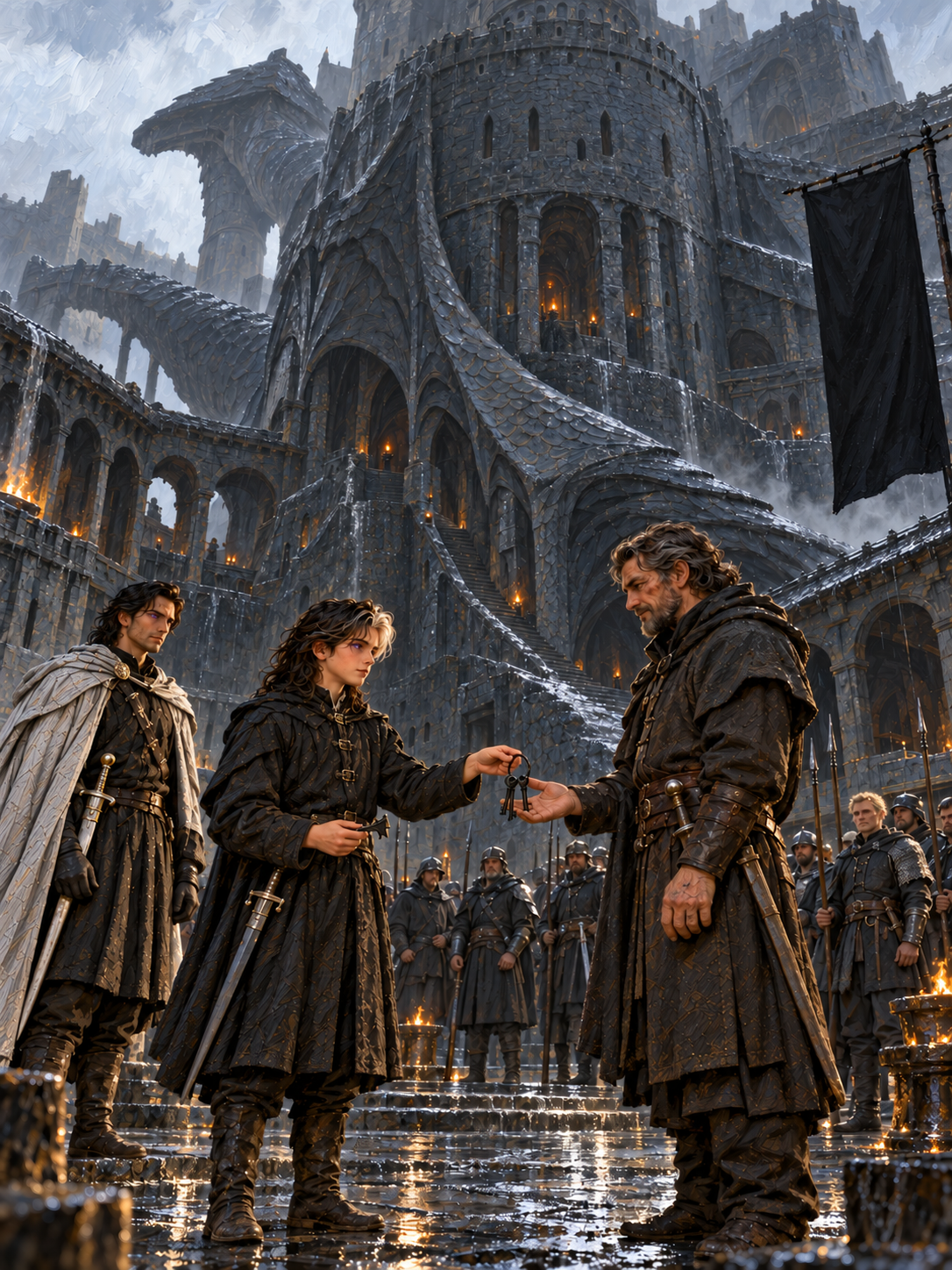
"I will ask who keeps the keys."

They moved away together. Behind the throne, a guarded door let the king leave without passing his petitioners. There were other ways through these walls. Maegor's passages. Jon remembered Varys in darkness, a child with a candle, voices travelling where their owners believed themselves alone. He could recall scarcely a useful turn of the routes. His engineer's eye could not tell him whether a thick wall contained a stair, a passage, or simply more stone.

He waited until Aries had gone ahead with Arthur, then spoke to Tomas.

"While we practise, look at the room behind mine. And find out what lies above it."

"Something wrong with the chamber?"

"I don't know yet. I would rather know who can reach it."

Tomas nodded. Jon would still keep his papers locked away and his voice low. Six swords outside a door were poor protection against a man already inside the wall.

At the entrance Arthur stopped to ask the guard about the skulls. A soft voice greeted them from the covered walk.

"Lord Black. I had hoped you might sleep longer after your voyage."

The bald man beside the clerk wore loose lavender silk, his cheeks pale with powder. A floral scent overcame the mustiness of the rushes.

"Lord Varys," Arthur said.

"Ser Arthur. How pleasant to see you here again." Varys dismissed the clerk with a paper for the steward. "Runestone seems to have kept you busy. Lord Yohn, your nephew, then Ser Lyn demanding sharp steel. Did no one let you sit down?"

"I found time."

"And still remembered to send men recruiting among the hedge knights."

"My household needs good riders," Jon said.

Varys glanced at the practice gloves beneath Aries's arm. "More swordplay? I ought to warn the kitchens that Ser Arthur may be late for his dinner."

Aries grinned. Jon kept his own smile small. The victories would be common talk; the recruiting had attracted less attention.

"My uncle has promised me a lesson."

"A promise many men would envy." Varys folded his hands. "I trust your household is comfortably lodged? Fifty men can try a steward's patience, however welcome their lord."

"They have enough room. Some remain aboard. We arranged it yesterday."

Tomas had moved level with Jon. Varys acknowledged him courteously. "Your other ships must have been more crowded, with the craftsmen's families aboard."

"They have reached Dragonstone."

"So I hear. Lord Arryn will be pleased. He has had enquiries about so many new households reaching your island."

The departures had been public. A man could learn much by listening on a quay. Jon was less certain why Varys wanted him to know how much had reached his ears.

"I shall see the Hand this morning."

"Of course. Should you require anything while you are here, pray send word."

Jon thanked him. Once they were beyond hearing, he glanced at Arthur. "Was he as helpful to Aerys?"

"He always had some fresh warning. His Grace rarely heard one without finding another man to distrust."

"Were the warnings true?"

"Some." Arthur lowered his voice as a servant passed. "I sometimes wished he had been as diligent in telling the king when his fears were groundless."

Tomas sent Rylas through the godswood door first. Among the trees, the clash of practice swords faded. Jon went to the oak at its heart and laid his hand against the bark. He had wanted quiet, but it made him think of Bloodraven, who had found him in dreams far from any heart tree.

"No face," Aries said. "Do the old gods hear you here?"

Jon looked up at a bird searching beneath the bark. He felt nothing from it. "I don't know."

Arthur stood beside him. Jon meant to keep his promise to tell his uncle what the dreams demanded. There was still much neither understood.

"Rhaegar walked here when he wanted quiet," Arthur said.

"Alone?"

"When he could persuade us to remain by the door."

Tomas waited within sight of it, watching the way they had come. Jon tried to imagine his father beneath this tree, with no harp, no armour, no need to speak until he was ready.

A shout reached them from the yard. Aries turned towards it.

"Come," Jon said. "We are keeping you from the swords."

The boy brightened, and Arthur led them out.

Blunted swords rang across the practice yard. Beside two guards bearing Highgarden's roses, a slender boy with brown curls drove his opponent backwards. A squire in plum wool called for the retreating boy to turn.

In the middle of the yard, a sandy-bearded knight in a spotted-leopard surcoat saw Arthur and stopped. "Ser Arthur."

The silence spread unevenly. Jon had entered yards where men stopped because their lord had arrived. These men looked over his head. The Tyrell squire turned so quickly that his opponent nearly struck him; at a guard's warning he jerked back, still staring at Dawn.

"Ser Aron," Arthur said. "Might we use a little of your ground?"

"As much as you wish." Santagar, the master-at-arms, turned to Jon. "And Lord Black. Welcome."

Arthur chose ground where the sun would fall across them. Tomas placed two guards by the entrance and set the others to take turns at the posts. Rylas remained beside Jon's discarded sword belt. Tomas left him in charge and went to find the steward.

"The rest of you have not finished," Santagar called. "Find your partners."

Arthur examined the practice sword Aries handed him. "The ground is firmer than at Runestone. Try your feet first."

Jon advanced and retreated, feeling where the earth had been scuffed loose, then raised his sword.

Arthur came at him. Jon caught the first cut, slipped the second and sent his point towards the exposed wrist. His uncle's blade returned across it. Steel struck close to Jon's knuckles; he twisted free before Arthur could trap his sword, but the point touched his ribs.

"You turned the point away," Arthur said. "You had not taken the rest of the blade out of my reach."

"I thought I could get to your wrist."

"You almost did. That is why I gave it to you."

They repeated the exchange slowly. Jon's speed might win the first opening, but reaching too soon put his hand within a stronger man's grip. Against Robb he might have pulled clear. Arthur scarcely had to change his stance.

"Make me turn before you come in."

Jon let the offered wrist go, cut high and moved as Arthur's blade rose. His second cut came round low. Arthur brought his elbow close to stop it, but Jon was clear before the reply.

"Again."

His uncle came faster. Jon gave ground, then broke sideways. He felt the pressure ease as their blades met and followed it, turning his wrist instead of driving through. His point caught the leather at Arthur's side.

"Better. You made me move."

The next exchange ended with Arthur's point against his chest. Jon swore, earned a raised eyebrow, and tried again. His uncle kept him at it until he could manage the movement with his breath coming hard.

Aries brought water when they stopped.

"He'll have you at that until supper. I was a year older when I discovered I could ask for a drink." The voice came from behind Jon's shoulder.

Arthur's mouth softened in recognition. Then he glanced at the watching men and drew a slow breath before lowering his sword.

Jaime Lannister came past the racks, helm under one arm, golden hair falling beside a face Jon would have recognised without the white cloak. Rylas moved nearer, saw Arthur lower his blade, and held his place.

"You found us." Arthur offered the water. "Good morning, Jaime."

Jaime looked at his old teacher before taking the cup. When he turned to Jon, his smile came more easily. "So this is the nephew."

"Jon Black, ser."

"So I am told. Jaime Lannister." He set down his helm and chose a practice blade. "Have you time for a few passes?"

Jon tested his grip. "If my uncle permits."

Arthur glanced at the light upon the wall and stepped back. "Keep the lesson in mind."

Jaime raised his sword almost lazily, leaving the same wrist exposed. Jon circled instead of taking it, feinted at his shoulder and cut for the other side. Jaime met him hard. The shock ran through Jon's wrist. He slid clear before the knight could bear his sword down, sending a cut back as he went.

"Better," Arthur said.

"I had hoped you meant me." Jaime attacked again.

Jon turned two blows and ducked the third. The next came as he straightened, leaving him to meet it badly or retreat into reach of the point. Jaime's weight drove his defending blade aside; the tip struck below his collarbone.

"Again," Jon said.

Jaime let him settle, then offered the same opening. Jon began the same retreat. When the knight lengthened his step to follow, Jon went towards him instead, slipping outside the sword's line. His point flashed towards the wrist.

Jaime's hand vanished behind a turn of steel. He stepped back to make room for the parry. Jon followed, struck again and saw his expression sharpen. The reply came before Jon could recover. Jaime crowded him, forcing him to turn. He escaped the first cut; the second stopped against his side.

Arthur called an end. Jon lowered his sword, breathing through his mouth.

Jaime rolled his wrist. "You did say twelve?"

"Twelve."

Santagar looked at the men watching. "You may watch when you can move as quickly. Back to it."

Jaime had beaten him twice, but Jon had made him abandon the second trap. Next time he needed to be clear before the knight could close.

"I was not that quick at his age," Jaime said, returning the sword.

"You were harder to persuade to stop."

Jaime laughed. Arthur's answering smile was brief, but Jon saw it. Near the racks, the boy in plum wool tried Jaime's last turn.

"You are stepping on your own foot, Andren," the Tyrell squire told him.

"I know which foot it is."

Jaime retrieved his helm and spoke quietly to Arthur. His uncle listened and nodded; then Jaime left for the hall.

A young knight with seven stars at his throat approached Jon. "Eustace Sunglass, my lord. Lord Guncer is my cousin."

Sweetport Sound. One of the houses whose oaths Ethan held on his behalf. Jon offered his hand. "I shall hope to see you when I reach Dragonstone."

"I should like that." Eustace glanced towards Arthur. "Would your uncle have time for a few passes?"

Arthur beckoned him over. Eustace's first attack was good, a thrust becoming a cut, but Arthur caught the next blow and touched his shoulder. He tried again, cautiously, and lost his opening.

"You knew what you wanted the first time," Arthur said. "Do not abandon it because I knew too."

The knight in the red-tree surcoat was already tightening his gloves. "Ser Lucan Marbrand," Santagar told Jon. "New to his spurs. Not to a sword."

Marbrand made Arthur turn twice. Then his uncle caught the blade, released it before Lucan could use the pressure, and brought his point beneath the guard. The knight looked down and laughed ruefully.

Beside Jon, someone said, "I have been trying to beat him all week."

The Tyrell boy had come over. Santagar named him: Loras Tyrell, Lord Mace's youngest son, squire to the king's brother.

"Andren Plumm says Marbrand leaves his left side open," Loras continued. "He neglects to say what happens when you try to reach it."

"You could ask my uncle."

"I mean to." Loras looked him over. "You beat Waymar Royce."

"Yes."

"He beat me last time we met." The boy lifted his sword. "Have you another bout in you?"

Arthur looked at Santagar, who pointed to the ground beside the posts. "One. The Hand does not wait upon my yard."

Loras came in while Jon was still judging his reach, blade flicking towards his face before dropping towards his thigh. Jon caught the lower cut and moved away from his free hand. Loras followed, making him turn before he could answer. Andren stopped smiling.

Jon let the next blow drive his sword down. Loras stepped after it. Instead of wrenching free, Jon turned with the pressure, shoulder sliding past shoulder, and brought his point against the padding beneath Loras's arm.

"Touch," Santagar called.

Loras looked at the mark. "I thought I had your sword."

"You did. You brought it round for me."

The boy tested the movement with his empty hand. "Again?"

"When Lord Arryn has finished with him," Santagar said.

Loras offered Jon his hand. "I shall remember that."

"So shall I." Jon could feel the jar of that first cut in his wrist. This was no finished Knight of Flowers, but there had been little wasted in those attacks. He wondered what another two years would make of him.

Jon felt the bruise below his collarbone as they left. He would wash, put on his court clothes and carry Ned's letter to the Hand. Beyond the godswood wall, the oak branches moved in the breeze. The quiet beneath them already seemed a long way from the watching men in the yard.


* * *
​

Tomas caught Jon outside his chamber. The room behind it held spare bedding; above it were two empty guest chambers. The steward had opened all three for him. A narrow stair reached the upper rooms from the passage beyond Arthur's door.

"I cannot tell you what is inside the walls, my lord."

"Then keep a man where he can see that stair as well as our door. Do not hinder the servants." Jon waited while Tomas placed the guard, then went in to wash.

The Hand's servant arrived while Jon was dressing. Lord Arryn would receive him before the audience. He had brought pears from the king's table as well; Jon told Aries to leave some for Gawen and stay with Tomas when they entered the hall.

Arthur stood beside the open chest. He lifted Dawn from where it lay wrapped in cloth, his hand closing round the pale hilt.

"Dawn," he said.

Jon glanced at the pale hilt. "They know you carry it."

"They know I once carried it in another king's service."

"Wear it," Jon said. "Robert pardoned you. Let him see the man he pardoned."

Arthur buckled on the sword. A little of the stiffness went out of his shoulders.

Robert would see Ned's son. Cersei had been his enemy since the king gave him Dragonstone as a babe; yielding to her would not change that. Arryn had kept Robert's kingdom together for years. Jon wanted to know what he expected of him on Dragonstone, and how much business the Hand would still insist on sending north.

He took his father's letter and went with Arthur to the Tower of the Hand.

A guardsman admitted them to a room already at work. A clerk stood before Arryn with two letters open.

"Bracken says the pasture is his, my lord. Blackwood says otherwise."

Arryn rubbed the bridge of his nose. "Send copies to Lord Hoster. Ask where the cattle were taken and whether either house has gathered men. Until he has ruled, neither is to cross the disputed ground under arms. Put that in both replies."

The clerk bowed and went out. Arryn rose, still broad through the shoulders, though age had hollowed his cheeks. There was nothing drowsy in the pale blue eyes he turned upon Arthur.

"Ser Barristan came to me early. The guild will be questioned privately. I have given him the men he asked for. We shall speak of it when there is news." He drew out a chair. "Sit, both of you."

Jon gave him Ned's letter. At the sight of the seal, the severity about Arryn's mouth eased.

"He might have come with you."

"He wanted to see the harvest brought in."

"There is always a harvest, or a bridge, or a bannerman whose sons require separating." Arryn broke the seal and read, moving the paper nearer the window where Ned's writing grew cramped.

"Lord Yohn wrote of Runestone," he said when he had finished. "Both of Ned's sons in the final. Your father will have been pleased to hear it."

"Robb will tell him every blow when he reaches home."

The clerk returned with bread and cold trout. Arryn thanked him and waited until they were alone again before offering the dish to his guests.

"Before I sail, my lord," Jon said, "I would know what you expect of me on Dragonstone. My father still has the keeping of it. Ethan has his orders. But I mean to govern when I arrive."

"I hear you have sent six hundred men ahead of you."

"Six hundred foot. Ethan already has five hundred in the garrison. My household travels with me."

"What service do you intend for them?"

"Defending my lands. Guarding my people and the goods we send by road or sea. Ethan has men enough to hold the castle, but I want a force that can meet trouble beyond its walls."

"Then you must give thought to your bannermen as well. Several of those houses served the Targaryens for generations. A new king's seal does not make a man forget whom his father served."

"Nor where his brothers died," Arthur said.

"No. Some will be pleased to receive you, Ser Arthur. They may be rather less pleased by the lord you serve."

Jon rested his cup upon his knee. "I do not expect my uncle's name to settle every disagreement."

"It may encourage them to conceal one. They can honour him at supper and refuse you the next morning."

"They need not like me to honour their oaths."

"But a reluctant bannerman can delay a ship, dispute a summons or send fewer men, all with a reason he considers sufficient." Arryn looked from Jon to Arthur. "Robert gave you Dragonstone to honour Ned. He also wanted those houses answering to someone raised in the North, taught loyalty by a man he trusted."

"Someone to keep the old king's men obedient."

"Yes. He expected Ned's influence to weigh more heavily upon you than theirs."

"And now I arrive with Ser Arthur Dayne beside me."

"Which will interest them considerably. Some may welcome him because they believe he remembers their loyalties fondly. Others may wonder why he serves the lord Robert chose to curb them."

"They may ask me," Arthur said quietly.

"They will be more careful than that."

Arryn's affection for Ned was genuine. It did not put them on the same side. He expected Ned's son to strengthen the settlement he had helped build; Jon meant to take Robert's throne and overturn it.

"And if one of them refuses you?" Arryn asked.

"He will tell me why. I shall hear him with Ethan beside me. If he has lost a ship or cannot spare the men, we can speak of what he can provide. I want the service he owes."

"You are twelve. His Grace has given you a lordship, and Ned holds it for you until your majority. A quarrel with one of those houses will reach him as well."

"I know the terms. Ethan remains castellan. I shall not pledge the island or bind my father to an agreement without his knowledge." Jon leaned forward. "But I will not have a bannerman refuse to speak to me because I am young, then send his excuses north where I cannot answer them."

"Then give Ned your account too. If a lord disputes what he owes you, let your father hear it before you send men to collect it. You may have every right to the service and still make a costly enemy in obtaining it."

"And he may hope to keep me waiting while my men eat through their stores."

"He may."

"I shall send my father an account of what I do. I will not suspend every order while a reluctant bannerman seeks a different answer from Winterfell." Jon kept his gaze upon the Hand. "My own ships and men will begin the work. The others will give the service they owe."

Arthur nodded. "Ethan knows which men have answered him readily. We shall hear from him before sending for the others."

"And if a dispute reaches the Crown," Arryn said, "I will expect your account as well as theirs."

"I shall give you the cause plainly enough." Jon drew his plate nearer. "I need those lords to trade with me. I have no intention of making enemies of the whole bay."

"Then give them reason to come to your harbour." Arryn pushed the bread within Jon's reach. "Robert has read Ned's account of the wildling attack. He will want yours. And when he asks after your father, answer him as a son. He hears enough of the Warden of the North from me. If he speaks too freely, remember that he is fond of Ned."

There was warning enough in the qualification. Jon finished the bread.

As they rose, Arryn put a hand on his shoulder. "It is a pleasure to meet the boy Ned named for me."

"He speaks of you often."

The answer pleased him. Jon would not pretend he had disliked that kindness. He would remember what Arryn expected in return.

By the time they reached the stair, the Hand was dictating again.

At its foot Jon stopped beside a window overlooking the lower court. Tomas took Aries on towards the hall, then waited at the turn. Jon watched a clerk pass before speaking.

"I have no intention of letting my father or the Crown govern Dragonstone through me," he said quietly. "I mean to rule my lands as I see fit, as the other lords do."

Arthur rested a hand upon the sill. "Have you told Ned that?"

"He knows why I am going there. I mean to enlarge the harbour and build ships. There is land to put under the plough and work waiting for the people I have brought south. I will not leave it all standing idle while a raven takes each decision to Winterfell and another brings back permission."

"And if Ned objects?"

"I will read what he says. He knows a great deal about governing. But I will decide what is done on Dragonstone. A bannerman who dislikes an order will not escape it by writing to my father."

"Arryn will expect you to remember this morning."

"He wants me to keep those houses obedient to Robert. He must let me govern them. I will give the Crown what I owe it, but I have no intention of letting men here hinder my work whenever it displeases them."

Arthur considered him, then nodded. "If Ned asks me to restrain you, I shall bring the matter to you. He will have your answer."

"That is what I ask."

Jon went to join the household. Arthur fell into step beside him, and Tomas led them towards the hall.


* * *
​

The Great Hall was full when they returned. Petitioners raised rolled parchments above the press while boys held their masters' cloaks and purses. Tomas drew Aries clear of an opening door. Jon followed him towards the carpet, Arthur at his shoulder. Somewhere a spur kept striking stone. It stopped when the king spoke.

Robert sat high among the jagged blades, a heavy gold crown upon his black hair. One hand lay open along an armrest which looked capable of cutting it.

Near the doors, a merchant woman clutched a petition soft at the creases. An usher kept her waiting while a party in blue and yellow passed with a warrant no one had yet examined.

"Lefford," Arthur said quietly. "Lord Leo, of the Golden Tooth. One of Lord Tywin's bannermen."

A tall squire of perhaps sixteen walked at Lefford's shoulder, a healed cut dividing one eyebrow. He inspected Jon, then Arthur. The usher greeted him as Gerren and asked after his uncle's rooms. Beside the merchant woman, a lady in russet waited with her steward and his leather case. The usher bowed to her, but kept his staff across the way.

"Lady Meredyth Wendwater," Arthur murmured. "A widow. She holds the lands until her son comes of age."

Arthur named Lady Tanda Stokeworth and her daughters, then Rykker of Duskendale, talking to Lord Ralph Buckler and his cousin, Ser Brus. Beside them, William Mooton started towards Arthur, then stopped when his wife touched his arm.

Myles Mooton, Rhaegar's squire, had been killed by Robert at Stoney Sept. His brother had come to do business beneath the victor's throne.

"Then mend the bloody road." Robert's impatient bark carried to the doors. A clerk beside the throne checked his quill above the parchment.

Someone behind Jon murmured that Ser Harys Harte had been arguing his cousin's cause since the doors opened.

"Your Grace, Lord Harte has repaired his portion," Ser Harys said. "The ditch lies upon Lord Rosby's land. Our carts have been standing there for three days."

Gyles Rosby lowered the cloth from his mouth. Those nearest leaned closer to hear him.

"The ditch carries water from their fields. They have blocked the culvert to spare themselves the cost of clearing it."

Ser Harys drew breath to protest. A white-bearded Stormlander called that Bronzegate's carts were in the same mire.

"Then send Buckler to pull them out, Hugh. He is broad enough."

Lord Hugh Grandison laughed. Ralph joined him, though Brus had begun counting something upon his fingers for Rykker. The Stormlanders were still grinning when Rosby tried again to be heard.

Near the dais, Renly turned at his brother's laughter, broad-shouldered in green velvet. Loras stood behind him with his gloves and nodded to Jon.

Petyr Baelish stood beside Renly in plum velvet and a silver mockingbird clasp. Jon's fingers closed around his cuff. He had thought often of that man with Ned's blood on his hands. Baelish was smiling.

Stannis listened beside a pillar, his hard jaw edged with a short beard. Behind him, a boy with an onion upon his breast held a leather case. A scarred knight wearing three death's-head moths upon his coat stood beside the boy.

Arthur returned Stannis's curt nod. "Ser Richard Horpe beside him."

Lysa Arryn drew her small son closer, ignoring the cup his nurse offered him. Her eyes lifted towards Petyr, then followed her husband to the throne.

Tyrion Lannister laughed up at a taller kinsman beyond Lefford's party. His nose was whole. He looked much younger than the weary man Jon remembered from his reading.

"Ser Tygett," Arthur said. "Lord Tywin's brother."

Tygett's grin faded at the sight of Arthur. They exchanged nods. A small golden-haired boy pressed close to his side.

"His wife, Lady Darlessa Marbrand." She took the folded cloak from her little boy before he could drop it.

Ser Ilyn Payne stood at the next pillar with a greatsword over his shoulder. It was not Ice. Jon's father was in Winterfell, alive. None of what he remembered had happened yet. He released his cuff.

"Jon," Robert called.

Both Jon and the Hand looked up.

The king laughed at that. "The little one. Though he has done his best to spoil the name. Come here, boy."

Ser Harys lowered his petition. Arryn drew him aside with a quiet word as faces turned along the carpet.

"Stark's son?" someone asked.

"The clockmaker," came the reply.

Lefford's young kinsman spoke to Lucan Marbrand, now changed out of his practice coat. The knight's answer made the squire's brows draw together.

The men nearest the carpet made room. Farther back, departing courtiers stopped with their cloaks over their arms.

"The clocks pay for the men," a woman said behind Jon. "That is what I should like to know about."

One man bowed to Arthur and let his greeting to Jon follow late. Rykker asked Buckler whether all fifty riders had come south. Jon stepped onto the carpet.

Rosby remained beside the dais, his mouth pinched. Baelish smiled at Renly without taking his eyes off Jon.

Cersei sat below the throne in green silk heavy with gold. Her face had Jaime's fine bones and an expression of composed interest. A lady waited beside her with a prayer book. "Jocelyn." The queen beckoned her closer and spoke too quietly for Jon to hear.

Ser Meryn Trant opened the way, a golden lion fastening the white cloak at his shoulder.

Joffrey sat straight-backed, one hand upon a richly mounted sword. A sandy-haired squire scarcely older than Jon held his cup. Jaime waited beyond the royal chairs; farther along, Pycelle leaned upon his staff.

Jaime gave his old teacher the smallest nod. Arthur bowed to the king. Beside him, Jon went down upon one knee.

"Your Grace."

"Up. Let me look at you."

Robert bent forward, blue eyes bright beneath thick brows. Gold thread strained across his belly, but his chest and shoulders were enormous. His beard was black and full, his cheeks flushed above it.

Jon rose into that welcome, knowing how quickly it would die if Robert knew whose son stood below him. He had known the danger for years. Hearing the man address him made it immediate.

"Gods, Ned kept you north long enough. I asked for a child, and he has sent me a soldier."

"I hope to be of more use than when you first asked."

"You will have to tell me how you left the Vale boys flat upon their backs. Ned writes as if he were afraid to boast."

"Robb would have supplied the parts he left out."

Robert's laugh brought others after it. Jon found himself smiling. It was a good laugh, full and heedless, and for an instant he understood why men had followed its owner into danger.

"Two sons in the final! Jon, did Ned ever win anything without making us drag the story out of him?"

"He generally preferred you to finish telling it," the Hand said.

"He was ungrateful. I always improved it." Robert studied Jon again. "Not much of Ned in the face. Dayne eyes, though. I remember those."

"My mother's family, Your Grace."

"And her brother's sword." Robert's smile faded as he looked at Arthur. "Ser Arthur."

"Your Grace."

"Ned tells me you have kept the boy well guarded."

"He is my sister's son, Your Grace."

"So you told me when you asked to go north." Robert's eyes dropped to Dawn. "Ned has had no cause to regret it, then."

"None that he has given me." Arthur remained standing with his hands at his sides.

Robert turned back to Jon. "Was Robb close to beating you?"

"He had the strength of me. I kept him turning."

Robert made him describe the finish, interrupting twice to ask where Robb's shield had been. "And the Greyjoy took your archery. What were the Vale boys doing?"

"Robar Royce won the melee," the Hand reminded him.

"You should have been there, Bryce," the king told the young lord with nightingales upon his breast. "Perhaps the south would have won something."

"Corbray took the joust, Your Grace."

"Another Valeman. You are making it worse."

Caron accepted the laughter with a bow. Lord Grandison slapped his arm. Near Lefford, the tall squire's mouth tightened; Ser Lucan said something which made him look away.

"You should have brought your brother," Robert said.

"His ship was bound for White Harbor. Our father expects him home."

"Your father expects everyone home. He ought to have married a woman who disliked children."

Cersei's fingers moved on the arm of her chair.

"Lord Stark is careful of his heir," she said. "That is hardly a fault."

Robert turned sharply. The flush above his beard deepened. "I said nothing of faults."

"Then Lord Black will understand that his brother's place is with his family."

The queen looked directly at Jon, her faint smile almost courteous. He was the son she meant to put outside the family.

"Robb understands his duty," Jon said. "We parted knowing we both had work to do."

"Indeed. You are going to take possession of Dragonstone."

"I am going to govern it, Your Grace."

She glanced towards Arryn. "Lord Stark still holds the castle in his keeping?"

"As His Grace's grant directs," the Hand said.

"Of course." Cersei turned back to Jon. "Who will receive your new soldiers?"

"My castellan and my officers."

"Your father's castellan."

"My castellan, under my father's charge," Jon said. "He has been informed of every ship we sent."

Robert shifted on the throne. A spur scraped iron.

"He is filling an empty castle, Cersei. You have spent twelve years telling me what a poor gift I made him."

"I have said that Dragonstone was the seat of the king's heir."

Rykker's conversation stopped. Caron stopped beckoning a servant; Lefford watched Robert without moving. Joffrey straightened in his chair.

"It was the seat of dragonspawn," Robert growled. His thick fingers curled over the iron armrest. "I put an end to their rule. Ned's son holds it now."

Mooton lowered his eyes. Arthur stood very still. Jon thought of two small bodies laid beneath a cloak, and the man above him finding the family name sufficient answer.

Cersei let the silence stand. "And your son is a prince of your house. Whatever its history, the castle guards the approach to your capital. Joffrey has an interest in its keeping."

"Then he may ask about it," Robert said.

Joffrey looked from his mother to the floor below the throne. "How many ships do you have?"

"Ten warships and six merchantmen, my prince."

"My father has the royal fleet."

"Yes."

"You would have to give him yours if he commanded it."

Jon met the boy's eyes. He could hear Osric describing a small prince who had wanted a bell to obey him, and a hearth boy left trembling beside it. The years had improved Joffrey's clothes.

"My obligations to the Crown are recorded," Jon said. "They will be honoured."

"A lord should know them without being reminded," Cersei said.

"I do, Your Grace."

"And a king should know the strength of the castle he has given into another's hands. Lord Arryn, I trust an account will be furnished when these men are settled."

"Lord Stark can furnish it," Arryn answered. "The account will come through him, as Dragonstone's affairs have done since the grant."

"The grant settled the matter," Stannis said.

He had not raised his voice. Cersei turned towards him nonetheless.

"I ask for an account, my lord. The captains, the warships fit to sail, and the men under arms. Surely the master of ships appreciates knowing who commands at the mouth of the bay."

A muscle shifted beside Stannis's jaw. "I know who commands there. So does Lord Stark." Each word was distinct; he kept his eyes upon the queen.

Robert gave a pleased grunt. Stannis held the queen's gaze. He had scarcely looked at Jon.

The queen turned from Stannis to Robert. "Then let the Hand have their names and their strength after Lord Black reaches his island."

"Have Ethan send it through Ned," Robert told Jon. He motioned to the clerk beside the throne, who bent over his parchment.

Jon kept his eyes upon the queen. "The Hand will have the account through my father, Your Grace. The choice of my captains and the command of my men remain mine."

Meredyth spoke to her steward, who checked the papers in his case. Near the throne, Jocelyn watched the queen.

Robert looked down at Jon. "I did not give you Dragonstone to have those Targaryen loyalists turn your head. I want them kept under control. Their ships come when I call, and no man raises a dragon banner in my bay."

His gaze moved to Arthur for a moment, then returned to Jon. "I trust Ned's sons to keep faith with me. See that your bannermen remember their oaths."

"They will answer to me, Your Grace. I shall see that they give the service they owe."

"Good. You have men enough for it. How old are those soldiers of yours?"

After Jon answered, Robert asked who drilled the spears and whether the household could ride in armour. Jon named Hewyn. The king's attention sharpened as Jon described keeping men in their places after the first rush.

"Most lads can be taught to run at an enemy," he said. "It is getting them to stop that ruins your voice. Have you taught yours that?"

"We punish men who leave the line for a kill."

"Even if they get it?"

"Especially then. The next fool thinks he can do the same."

Robert's hand struck his knee. "There speaks someone who has had to fetch them back."

Jon felt an unwelcome pleasure in the recognition. This man could be careless with a kingdom and still understand what a frightened young soldier might do when he saw an enemy running.

"You would have saved me three horses at Ashford," Lord Grandison said.

"You lost two," Robert called down.

"Two beneath me, Your Grace. The third was being ridden by the fool I went back for."

The Stormlanders laughed. Robert pointed at him, remembering, and for a moment the old lord's beard shook with something more than courtly amusement.

"And then you teach them their letters." Cersei spoke through the laughter. "How generous. Do they all expect to become gentlemen in your service?"

Lefford's squire grinned. His uncle did not, though he made no move to check the boy.

"They can read their orders and tell whether they have been paid correctly, Your Grace." Jon kept his voice level.

Robert turned to ask when Ned meant to visit, but Pycelle came forward before the Hand could answer.

Gold and silver chains lay across red velvet and ermine. After Luwin's plain wool, the Grand Maester looked dressed for a different profession.

"Maester Luwin writes highly of your industry," Pycelle said. "These teachers of yours were once acolytes, I understand?"

"Some of them."

"A pity their studies were left unfinished."

"They are continuing their studies in my service."

"Naturally. Should you require counsel upon suitable books, you need only ask."

Jon remembered who had urged Aerys to admit Tywin's army. He would not mistake the offer for disinterested kindness, but neither would he refuse a useful book merely to deny Pycelle a courtesy.

"I should value any accounts of Dragonstone's harbour and surrounding waters," he said. "Older works as well, if you have them."

"I shall have my attendants inquire," Pycelle said.

"My thanks."

"Find him one about battles, Pycelle. Then I might borrow it." Robert rose, setting the courtiers in motion. "We will hunt after we have eaten. Come with us, Jon. Dayne may attend you. Caron, Buckler—let us see which of you can stay upon a horse."

"Your Grace," Arthur said.

Barristan moved to meet the king as he descended the narrow iron stair. Robert waved him aside with the ease of long habit.

At the bottom he put a hand on Jon's shoulder, heavier than Arryn's had been.

"You have his look when you mean to argue. Ned's, I mean. Your mouth gives you away."

"I shall try to remember that."

"Don't. It would spoil it." He looked to his brother. "Renly, find the boy a decent place at supper. I want to hear what else Ned has been keeping from me."

Renly bowed with a smile that seemed to cost him nothing. "If you will let him reach the table, brother."

"Stannis?" Robert asked.

"The galley captains are waiting."

"They will still be waiting when we return."

"They have been waiting since yesterday." Stannis's mouth barely moved. Behind him the boy holding his papers looked down at the leather case.

Robert's smile thinned. "Then by all means preserve them from another afternoon."

Stannis bowed and left with Horpe and the boy holding his papers. Three Stormland knights hesitated between the brothers before following their lord. Caron stayed, calling for his riding cloak.

Robert made for the doors. Jalabhar Xho bowed in his feathered cape. "Your Grace, concerning the ships—"

"Next year, Xho." Robert clapped him upon the shoulder without stopping. Behind the prince, the merchant woman raised her petition, then lowered it as the king passed.

Lefford's squire approached Cersei with his uncle's folded warrant. Trant let him pass, then closed the way before Ser Harys. The queen handed the warrant to a steward. "Take this to Lord Baelish. I would have Lord Lefford paid today." He bowed and took Gerren with him. Harys was still waiting when Trant returned to the queen's chair.

Cersei beckoned Jocelyn closer. The lady looked towards Jon before inclining her head. He could not know whether the look concerned him or the door behind him.

Rykker caught Arryn's clerk before he could follow Robert. Brus joined them, and Rosby came coughing into his cloth.

Brus watched the queen's steward lead Gerren away. "Lefford has his answer, at least."

"The Crown owes him the money," Lucan Marbrand said as he passed.

"And our carriers want paying while their carts stand idle. Tell him to ask about the road as well." Brus turned back to Arryn's clerk.

Lysa intercepted the Hand, their small son pulling at the chain upon his coat. When Arryn beckoned Jon closer, her smile arrived late.

"How is Catelyn?" she asked, her eyes resting briefly on Arthur.

"Well, my lady. I left her with all the children about her."

"Robert, greet Lord Black." She smoothed her son's hair, though he tried to turn away.

The boy hid his face against her skirt. Arryn thanked Jon for Ned's letter before Lysa could insist. As Jon moved away, he heard her ask whether Petyr would join them at supper.

In the yard, Tommen ran to meet his mother by the bridge to Maegor's Holdfast. He caught a heel in his robe, and his attendant seized him before he fell. Cersei straightened his clothes, listening to something he urgently needed to tell her.

Myrcella waited with their septa, watching Jon. When he bowed, she looked down and smoothed a ribbon which was already straight.

"Did you truly win?" she asked.

"The squires' melee, Princess. Yes."

"Against your brother too?"

"He made me work for it."

She looked up then, studying his face with open interest. "Were you hurt?"

"A few bruises."

"Oh." Her brow creased. "I hope they are better."

"Much better. Thank you."

Her smile came all at once. Joffrey turned, and Myrcella drew herself up as though she had been discussing something of great importance.

"Myrcella," Cersei said.

The girl hurried to her mother, but glanced back before taking the septa's hand. Jon's answering smile sent her eyes to the stones again. He had seen the same solemn concern upon Sansa's face when a handsome knight came home with a bandaged hand.

Cersei's gaze lingered upon him. Then she took Tommen over the bridge, and the guards closed together after them.

Jon raised his eyes from the spikes below to the windows. Behind those walls Elia had tried to protect her children. Men had climbed them and found her. Watching Cersei with Tommen's hand in hers, he could think only of another mother trusting to the same walls.

Arthur touched Jon's elbow. "Come."

He had been looking at the same windows.


* * *
​

They ate bread and cold meat while Aries found Jon's riding gloves. Gawen protested at being left behind until Arthur asked how he meant to control a frightened horse if his injured arm failed. Aries would stay with him; Tomas and Rylas would ride with Jon.

At the stable door the sandy-haired squire from the dais was testing a wineskin's stopper. "Lancel," Tygett called. "The buckle first. You will have that under your feet."

The boy secured the strap. Beside Tygett, his younger son Tyrek held Robert's spare gloves. Kevan's son and Tygett's, serving their royal cousin's husband. Jon remembered stronger wine and a boar. Lancel was still only a boy fastening a strap.

"They give us cups," Tyrek complained. "Gerren is allowed a sword."

"He is seven years older," Tygett said. "Keep those gloves out of the mud before you ask me for a lance."

Lancel smothered a grin. A groom moved Jon's saddlebag to make room for the king's wine. The queen's kin served Robert at table and on horseback; her brother stood behind his chair. These were already the ordinary workings of his household.

Bucephalus stood beneath the arch, his coat brushed to a shine. Arthur was checking his horse's reins. Across the yard Barristan passed in his white cloak, already armoured for the hunt; the two knights exchanged a greeting.

"You needn't ride, if you would rather stay," Jon said.

"I have spent enough of this visit looking backwards." Arthur tightened the fastening beneath his horse's throat. "Show me what the king means to kill."

Robert meant to kill everything. He told them so while a squire searched for his dropped glove. In brown leather, without crown or robes, his shoulders seemed less an encumbrance. A grizzled hound lurched against his knee; he took its head between both hands and shook it affectionately.

"He can smell the meat in your pocket," Renly said.

"And you can smell a free supper halfway across the keep." Robert accepted the glove and mounted.

Caron and Balon Swann rode together. Lord Ralph Buckler brought his cousin Brus and two household knights; Lucan Marbrand and Andren Plumm joined Tygett. Loras waited upon Renly while Tyrell guards brought up the horses.

Lefford's squire drew level with Jon. His hair had been carefully combed above the divided eyebrow. "Gerren Lefford, my lord. Lord Leo's nephew. I hoped to meet you in the yard."

"You were not there this morning."

"My uncle had business. Marbrand says you are fast."

"He saw me beaten twice."

"By Ser Jaime." Gerren glanced towards Arthur. "Some men are given better opponents than others."

Jon looked at him. The squire's smile returned stiffly. "I would welcome a turn. My uncle hopes to find me a place in the prince's household. They will ask Ser Aron about my swordwork."

"I will give you a turn. Ask Ser Aron for ground."

Gerren nodded as the king called for Lancel. Thoros hurried down the steps with his belt loose, claiming prayer had delayed him. Robert bade him pray for a faster horse. The priest laughed, then grinned at Arthur as though the years between them had been an interrupted meal.

Joffrey emerged upon a chestnut palfrey, wearing new gloves. Sandor Clegane rode behind him, his burned face turned towards the company. When a groom approached the prince too closely, he moved his mount between them. Joffrey scarcely noticed. He had drawn level with Robert and was waiting for his father to look at him.

Robert was arguing with the master of hounds about the changed wind. "Deer have legs. So have we." He looked round. "Come, Black. Let us see whether your uncle has taught you anything useful."

Jon urged Bucephalus forward. Beyond the gates, carts drew aside for the procession.

They crossed the river with the horses stamping upon the ferry timbers. Across the water, the Red Keep stood clear above the roofs. From here its walls concealed the poorer streets below them. Jon could see houses pressed tightly along the slope and a strip of washing lifted by the wind. Tomorrow he meant to walk those streets, if the king would leave him the day.

Robert pointed upstream with his riding crop.

"Ned once fell into a river trying to keep his boots dry. Has he told you?"

"No, Your Grace."

"He wouldn't. Put one foot on a stone, decided it would hold him, and went in up to his neck. Jon Arryn laughed so hard he had to sit down."

"Did you cross safely?"

"I was already across. He had a face on him all evening."

Jon thought of his father's face when the younger children clambered upon him, solemnly determined to finish a letter with Bran hanging from one sleeve. That man had once stood dripping in a river while his friends laughed. He would have liked to see it.

"I shall ask him about it," Jon said.

"See that you do." Robert was still grinning. "And tell him I remember. He thinks going north made us forget every foolish thing he ever did."

Robert changed the weight of old boars whenever someone challenged him; Tygett supplied the number of men needed to lift them. Caron claimed the hunts had grown safer since Grandison ceased carrying a bow. Brus laughed so hard his horse shied.

Robert called to Lucan about his horse. The young knight urged it forward, but Caron kept the place beside the king.

"You are crowding the hounds, Marbrand."

"Then give me room to answer him."

"He did call for him, Caron," Tygett said. Caron drew back a length. Lucan thanked him with careful courtesy and passed.

Ser Balon Swann fell into place beside Jon where the track widened. The knight was broad through the chest and arms; an ivory-and-onyx swan clasp held his cloak clear of his bridle hand. He asked whether Jon's horse had been bred in the North, then about the men riding behind him. Unlike the queen, he waited to hear the answers.

They went deeper beneath the trees. The road dwindled to a track beneath oak boughs, and sunlight broke across the riders in shifting patches. Water left by the last rain shook from the hazel when a horse brushed it. Jon breathed damp leaves and warm leather; after the city, he could almost taste the difference in the air.

Bucephalus wanted to pass the gelding in front. Jon kept his hand low upon the reins, feeling the stallion gather himself whenever the path widened. Behind him, Tomas called Rylas closer. The horns and the hounds were drawing men forward, but his escort had work enough without chasing deer.

The first cast failed. A huntsman found a fresh slot in the mud, then lost it beneath hoofprints. Robert dismounted to look. "You've ridden straight over it."

"I followed you, Your Grace."

"Then you should have stopped me." The man held his tongue. Before Robert could say more, the grizzled hound pushed beneath his arm, sniffed the earth and pulled towards thicker cover.

"There. That one remembers his trade." Robert rubbed its neck. "Give him room."

They found the hart among bracken tall enough to hide its body. It stood with one foreleg raised, then fled through the trees. The chase scattered them.

Bucephalus plunged after the king's horse. Jon bent beneath a branch; to his left Balon found a cleaner line. Behind him the prince shouted at Clegane to move aside. The ground fell steeply, and Jon checked the stallion to keep him balanced. Rylas stayed abreast on the outside of the track; Tomas followed.

Robert took the slope without slowing. His gelding slid, recovered and carried him through a narrow gap, Barristan close behind. Brus came up on Jon's left, trying to take the same line.

"Low branch!" Tomas shouted.

Brus bent too late. The bough struck his shoulder and swept him backwards from the saddle. His right boot caught in the stirrup. The horse ran on, dragging him over roots with one arm flung across his face.

Jon hauled Bucephalus aside. "Rylas, the reins!"

Rylas caught the loose bridle near the bit and brought the gelding round against the bank. Brus swung beneath its belly. A hind hoof struck beside his head before Rylas forced the horse to stand.

Jon dismounted, leaving Bucephalus's reins with Tomas, and caught Brus beneath the arms. The knight tried to rise, but the trapped foot twisted him back with a cry. Jon drew his knife, pulled the stirrup leather clear of the leg and cut. Brus fell against him as it parted.

"Keep the horses back," Jon told Tomas.

Renly checked his mount above them, halting the following riders. Jon helped Brus clear of the hooves. Blood ran from his brow. He lay on his side, struggling for breath, until Arthur dismounted and Lord Ralph came calling his cousin's name.

Brus answered with a curse and pushed himself upright, holding his shoulder.

"Stay there," Arthur said. "Let me see your arm."

His fingers closed when Arthur asked; he moved the elbow before pain stopped him. Jon gave Ralph a folded cloth from his saddlebag for the cut. Rylas still held the trembling horse; the severed stirrup lay in the leaves.

"We have him," Arthur told Jon. "Go with Renly. Walk down the rest of that slope."

Jon wiped his knife on the leaves and remounted. Renly waited until Brus stood between Arthur and Ralph. Below them the hounds had begun to bay in one place.

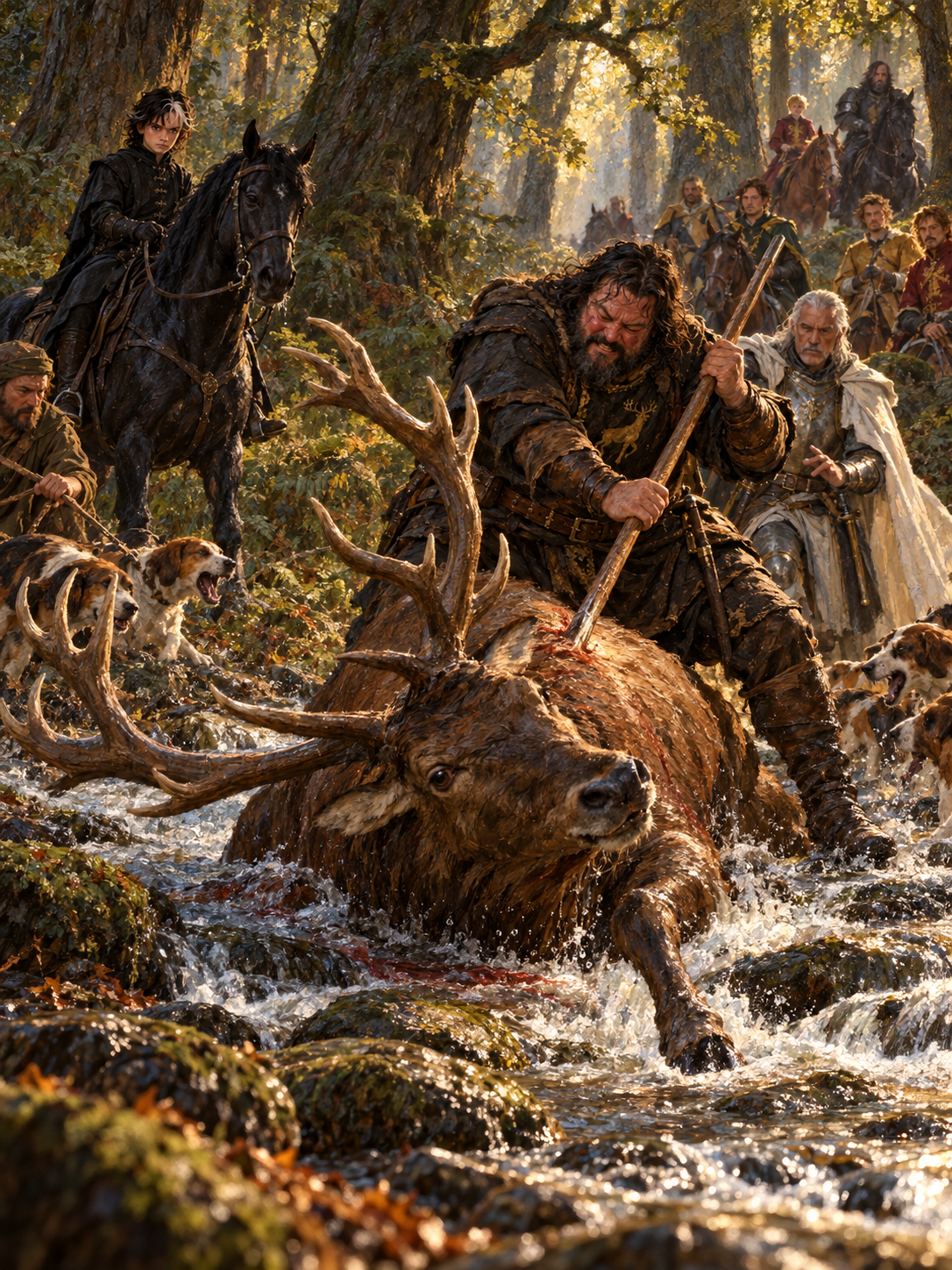
The hart had turned at a stream. Jon reached the bank as Robert dismounted and took a spear from his huntsman. Hounds closed about the animal in the shallow water. The attendants called them back as the king went forward.

Jon had shot deer from a steady rest in another life. Here the antlers could open a man from groin to throat. The hart tossed its head at a dog; Robert moved before the huntsman could pull the leash clear.

He stepped inside the sweep and drove the spear behind the shoulder. The animal struck against him. One boot slid upon the stones; he planted the other, bent his knees and bore down with both hands. The haft bowed. Jon saw the muscles stand out beneath the leather, the jaw clenched behind the beard. Then the hart's forelegs folded and Robert followed it down without letting go.

He waved the huntsmen back until it ceased struggling. When he straightened, one knee was soaked through and his chest heaved. His grin returned before his breath.

"Fine beast. Look at him, Black." He held out the spear. "Here. Feel that."

Jon took the heavy haft, slippery with blood. The Demon of the Trident. He had seen the belly first, the wine and the impatience. Now he imagined that strength behind a warhammer, with a younger man's lungs to sustain it. Rhaegar had faced that blow. Fat had slowed Robert; it had not made him harmless.

Across the stream Balon was telling Caron how close the antlers had come. Both looked towards Robert with a pleasure Jon understood.

"Your boot nearly went from under you," Jon said, returning the spear.

"Aye. Bloody stones." Robert rubbed his knee. "Your spearmen should practise on bad ground. Every lord gives you a level yard, then expects you to fight halfway up a hill." He glanced back. "Where's your uncle?"

"With Ser Brus. A branch took him out of the saddle. His boot caught in the stirrup."

"Is he badly hurt?"

"He was standing when we left. My uncle is seeing to his shoulder."

Robert beckoned a huntsman. "Take two men back. Bring him down carefully. If he cannot ride, send for a cart."

Joffrey arrived while the carcass was being opened. His cheeks were red, his cloak caught with burrs. He looked from the hart to Jon's bloody hands. "You let him kill it?"

"I killed it," Robert said.

"You said I could ride with you."

"Then you should have kept up."

Clegane dismounted. "The ground broke away. His horse couldn't take it."

"Get him a better horse."

"He has a horse he can sit."

Robert looked sharply at him. Sandor held the reins and waited.

"Next time," the king told Joffrey, turning away. "There will be other deer."

The prince kicked at a fern. His eyes passed over Jon and stopped upon the blood on his hands. Jon went to rinse them. Gerren arrived with the later riders and heard Joffrey demand water. He took a cup from Lancel and brought it himself, bowing over it.

Brus came down on a borrowed horse, his arm bound against his chest and a cloth tied above his eye. Ralph kept beside him. Robert heard Arthur's account and ordered a groom to lead the horse home. Brus began to object, then stopped when he tried to dismount.

They ate upon a dry rise while the carcass was made ready for the horses. Robert divided a loaf with his knife, sent a hunk to an elderly huntsman and found him cheese when the man admitted he could no longer manage the crust. Farther down the slope servants unpacked a second hamper for men whose own bread was going untouched in their saddlebags. The king's hunts fed a good many people.

Thoros disputed Robert's account of the last leap. Balon took the king's side, Renly the priest's, and Tygett said they had all chosen a wretched line through the trees. Loras listened with his chin lifted, then quietly told Andren how he would have taken it. The Plumm boy pointed to the leaves caught beneath Loras's collar. Their laughter was lost in the louder argument until the old huntsman shook his head over his cheese. Robert demanded his judgment. When the man said the deer had jumped better than any of them, the king roared and sent him another piece.

Jon smiled. Men who had stiffened at every movement of the queen's hand were talking with their mouths full. He waited for a gap. "Your Grace, I must ask leave to sail."

Robert looked up from his bread. "You have only just arrived."

"My people reached Dragonstone ahead of me. There are decisions waiting upon my arrival."

"You have a castellan. Let him earn his keep."

"He has earned it. I would like to see what I am asking him to do."

Robert wiped foam from his beard. "Stay tomorrow. You have scarcely seen the place." He handed his cup to a squire. "Ask me at supper tomorrow, and I may let you go the morning after."

Jon bowed his head. Fondness for Ned did not prevent Robert keeping Ned's son here for his pleasure.

The light was low upon the river when they returned. Aries had Mott's reply: the armourer could receive Jon in the morning. Jon told him to have the chest ready and sent Tomas to warn the men they would be walking as well as riding. They would have their day in the city after all.

He washed and changed for supper. Arthur went to speak with Barristan; they met again upon the stair, still fastening their cuffs.


* * *
​

Renly found Jon outside the supper hall, looking at the clock he had sent to the king.

The crowned stag above it had acquired gilded antlers. A page was trying to see the works through the pierced wooden side while his companion held him by the belt.

"The door opens," Jon told him.

The boys snatched their hands away, bowed and fled. Renly laughed. Loras stood beside him with his gloves.

"Do you still make them?" the squire asked.

"My foreman makes them. I help when he needs me."

"Then you have time to practise."

"Loras has been accounting for your victory," Renly said. "Your height, your sword, your uncle."

The boy's ears reddened. "I said he was quick."

"Repeatedly. You may ask him for another bout when I have fed him." Renly took his gloves and led them inside.

Heat from the hearths met Jon at the door, carrying the smell of venison and crushed herbs. Cersei stood beside her chair, listening to Lefford. Across the hall Brus Buckler sat with his arm in a sling and a clean dressing above his eye. His cousin cut his meat while Caron bent to hear about the fall.

Robert beckoned Jon with his cup. "Here. You have not met everyone."

Jon went with Renly to the dais, Arthur close behind, and bowed while the king forgot whom he had intended to name.

"Stannis," Robert said at last. "You will have plenty to say to him. Ships and accounts. You can bore each other tomorrow."

Stannis looked at the wine running over the side of Robert's cup, then at Jon. Up close, the hard set of his mouth made the resemblance between the brothers more difficult to see.

"Your captains have reported to the harbourmaster?"

"Yes, my lord."

"Good. I shall speak with you before you sail."

"You see?" Robert said. "He has begun already."

"You introduced us."

Renly turned a laugh into a cough. Stannis ignored him. "Your six hundred foot have gone ahead with the workmen. Have all the transports reached Dragonstone?"

"They have, my lord. Grafton's clerk gave me Ethan's raven at Gulltown. The heavy ironwork took another tide to unload, but no one was hurt."

Stannis nodded. "Good. Bring what your captains know of the harbour when we speak."

"He shall," Robert said, reaching for the bread. The Hand offered Jon a faint smile.

"You have survived the hunt."

"Better than Ser Brus. Has the maester seen him?"

"Bound his shoulder and forbidden him to ride for a few days," Renly said. "He was fortunate you and your man stopped."

"He can have one of my carriages when he goes home," Robert said. "Ralph will never persuade him to stay off a horse otherwise."

"Lord Black's supper is waiting." Cersei's voice was cool. She had finished with Lefford; the western lord bowed to Robert before withdrawing. "Lady Tanda has made him very welcome."

Robert looked towards the place she indicated, then back at Jon. "I asked him to sup with me. Set him here." He tapped the table at his left. "Lady Tanda may have him when I have finished."

The steward bowed and sent a servant for a chair. Renly moved his cup farther along the table. Jon remained beside Arthur. "A place for my uncle as well, Your Grace."

Robert looked at Arthur, then nodded to the steward. Cersei sat without answering. Jon waited until both places were ready before taking the chair beside the king. Across Robert, Joffrey watched the servants lay a fresh trencher before him.

Robert gave Jon a generous helping of hart. He ate while the king disputed the chase with Caron and Renly asked Arthur about Runestone. For a little while he could enjoy his supper.

Robert finished his argument by accusing Caron's horse of choosing a shorter hunt. He tore another piece of bread, wiped it through the juices upon his trencher and looked at Jon.

"Your father ought to be here."

"He remained at Winterfell, Your Grace."

"The North would survive a few weeks without him." Robert shook his head. "I should have liked to hunt with him again."

"Ned would have told me I was too old to go tearing down that slope." Robert glanced along the table. "Wouldn't he, Jon?"

"He would have advised you to take the path," Arryn said.

"And come after me when I didn't." Robert's smile faded. "Gods, I miss him. I hear more of him from ravens than from his own mouth."

Jon could picture Ned listening to the shouting, suffering the king's arm across his shoulders. He would have complained afterwards and remembered every word. "I will tell him you missed him, Your Grace."

"Tell him to come. Bring Robb, bring the girls. There are rooms enough." Robert looked towards his son. "You should know Ned's boys, Joffrey. I was younger than Jon when I went to the Eyrie. Ned and I were together every day."

Joffrey straightened. "Yes, Father."

"And you must come back when you have settled your island," Robert told Jon. "I would have you and Robb as close to my son as Ned has been to me. We did well enough together, whatever the Hand remembers."

"I remember being asked to forgive rather a great deal," Arryn said.

Jon smiled. "We shall have to ask Lord Arryn for the stories."

"You will hear them from me. He always leaves out the good parts." Robert held his cup out to Lancel, then caught sight of the pale line between Jon's thumb and forefinger. "That was from the wildling?"

Jon turned his hand upon the table. "Her sword went through my glove."

"Ned wrote that you killed their leader. He gave me less of the fight than of the wounded afterwards." The king settled back, his attention fixed upon Jon now. "Tell me how it happened. You were camped in a charcoal burner's clearing?"

"An old one, with the pits still there. We had twenty-five of my household. My father and Robb had gone to settle a quarrel between the Hornwoods and Cerwyns. The raiders saw them leave. They wanted our horses, mail and food."

"So you stayed."

"We knew the clearing. We could block the narrow ways in and keep men together. I would not lead the horses and the baggage into trees where we could scarcely see one another."

Robert nodded, chewing a mouthful of bread. "How did they come at you?"

Jon put his cup beside his trencher to show where the horses had stood, then pointed out the spring and western bank. Robert moved a dish aside. Along the table, Renly ceased speaking to Arthur.

"Their bowmen kept us behind the shields. Others came at the barriers. One reached the horses with a torch."

"That would have emptied your camp," Caron said.

"We killed him and put it out. Men were coming through at the spring. My uncle held the approaches with Gared and Desmond."

Robert looked past Jon. "Both ways, Dayne?"

"Yes, Your Grace. Both men with me were wounded. Beyond us were the boys tending Finnan."

"And this woman?"

"Sygga," Jon said. "She stayed where she could see us. Her second had a horn. Whenever we moved men to meet one attack, she sent another against the place they had left."

"She had fought before, then."

"Often, I think. She moved when men left the line to cover Finnan. Then Keir fell at the western end. He had shielded my page from an archer, and a man threw a spear into him." Jon looked towards Aries, standing with Tomas by the door. "I sent three men to close the gap. Sygga reached them before they had settled."

"She thrust for a man's throat. I caught her sword. Tomas was behind me, but the middle still needed him. I sent him back."

"And took her yourself."

"I was there, Your Grace."

The king gave a small nod. "Go on."

Jon had told Ned this while his hand was still bandaged. Here, with clean linen beneath his wrists, he remembered the wet ground more clearly than the pain.

"I tried to crowd her with my shield. She stepped away, caught under the rim and struck me in the mouth with her own. Then she worked me towards the pit."

"Did you see where she was putting you?" Robert asked.

"Yes. I could not get round her. Tomas tried to reach me, but an archer drove him down. She forced me over the edge. That was when she cut my hand."

"My shield caught against the bank. I had to let it go. She came down after me with her point at my face and told me to drop the sword."

Joffrey leaned forward. Robert put down his bread. "She meant to take you alive?"

"She thought I might be worth something."

"You would have been. How did you get past her point?"

"Hugin and Munin came at her."

The king frowned. "Which of your men?"

"My crows." Robert turned towards Arthur, who inclined his head.

"I heard one cry out. I could not see Jon below the edge."

"Munin caught in her hair," Jon said. "Sygga shook her off, but Hugin came at her again. She lifted her shield. I struck her sword aside and thrust beneath her coat. She was still trying to hit me, so I struck again."

"With that hand?"

"It still held the sword."

Robert took Jon's wrist and turned the scar towards the candles. "A little farther and you might not have held anything." He released him. "Did you teach the birds that?"

"They were frightened when she drove me down. They have been with me since they were young."

That much was true. He had given Ned the same account.

"I hope you fed them well," Caron said.

"They seldom let me forget."

Robert laughed, but he was still studying Jon. "And when she fell? Did the others stand?"

"For a little while. We pushed the western shields forward three paces. My uncle killed the men still pressing him. Five ran. We took two alive."

"You let the five go?" Joffrey asked.

Jon looked along the table. "I kept my men in the camp."

"I would have ridden them down."

"The horses were still tied, my prince. The men nearest me were on foot, and several were hurt. We had no way of knowing whether more raiders were waiting in the trees."

"They were running away."

"And could have turned on the first fool who followed them alone," Robert said. He pointed the piece of bread in his hand at his son. "You could learn a thing or two from Jon, Joffrey. He knew when to keep his men together."

The prince's face reddened. Lancel lowered his eyes to the flagon. At the foot of the dais, Gerren stood beside his uncle, listening. He glanced at Joffrey and quickly looked away.

"Ser Aron says I have improved," Joffrey said.

"Then listen when a man tells you something you have yet to learn." Robert turned back to Jon. "Did they try you again?"

"No, Your Grace."

Cersei laid a hand upon her son's arm. "Then you must watch him in the yard." She looked across at Jon. "I should like to see what you have learned, Lord Black. Ser Aron will find you an opponent."

"I have promised Gerren Lefford a few passes, if Ser Aron has ground for us."

Gerren looked at his uncle. Lefford gave a small nod.

"Then we need not keep you from your promise," Cersei said. "After supper, I think."

Jon had raised children in another life. He knew what an easy comparison could do. Joffrey had heard it before his mother, his squires and the men whose praise he wanted. He would remember who had been sitting beside his father.

Robert was already asking after the prisoners. Jon named Torwynd and Fenn, told how they had crossed by the Gorge, and answered what he could about word being sent to the Wall. The king waved the next dish away until he had finished.

"Your men did well," he said at last.

"They did."

"The three who died. What were their names?"

"Struan. Keir. Finnan." Jon could hear Finnan asking if he had done well. "They had been with me for years."

Robert lifted his cup. "To Struan, Keir and Finnan, then."

Arthur raised his cup. The others followed, and Jon drank. Robert called the servant back with the dish and asked after the wounded. Only when Jon had answered did Thoros begin a noisy argument with the musicians.

Lady Tanda came to the dais. "Your Grace, may we borrow your guests? Lord Mooton has scarcely spoken since Ser Arthur went past him."

Arthur looked towards the lower table.

"Go on, then," Robert said. He glanced at Jon. "Write to your father. Tell him I expect better of him next time."

"I will, Your Grace."

Jon rose with Arthur and thanked the king for supper. Robert caught his forearm before he could turn away.

"And come back yourself. Dragonstone is no distance."

"When I can leave it in good order."

"Ned's answer already." Robert let him go with a laugh and called Thoros up to him. Renly rose to accompany them down. Joffrey watched Jon pass the end of the royal table and turned away when Jon inclined his head.

Tanda had places made beside her. Her daughters sat within reach, with Rosby beyond the worst of the draught. Rykker moved his cup for the servants while William Mooton turned eagerly towards Arthur.

"Lord Caron tells me Corbray demanded sharp steel," Tanda said.

"He did."

"And regretted it," Rykker said, lifting his cup.

"He yielded honourably." Arthur's voice was quiet, but Rykker lowered the cup.

Mooton set his own down untouched. "He has always been very certain of himself."

"He had reason to be."

The river lord turned his cup by the stem. His voice dropped.

"Myles was very certain too."

Arthur turned fully towards him. "I remember."

"He wrote of you. When he was with the prince." Mooton glanced towards the dais. Robert was listening to Thoros, laughing with his head thrown back. "We still have the letters."

"I should be glad to read them, if you wished it."

Mooton's wife rested a hand upon his wrist. After a moment he nodded. "I could have copies made."

"Thank you."

Jon reached for the bread, giving Mooton time to turn towards his wife. The man who had killed Myles was paying for their supper.

Tanda introduced Lady Marissa, then Lady Alys Buckler beside her. Lord Buckler leaned across while Jon was making his bow. "Brus has told me what happened. Who was the man who caught his horse?"

"Rylas." Jon beckoned him from the door.

Buckler clasped the young man's forearm. "My thanks to you both. My cousin might have been dragged all the way down that slope." Rylas bowed, plainly at a loss for an answer, until Jon thanked the lord and let him return to his place.

Lady Alys asked her husband whether Brus had eaten. Buckler looked along the table to check. Jon put down his knife as someone asked for a cushion behind him.

"Two," Tyrion said. He had wandered over from a table nearer the hearth. "I should like to see what you are eating before the servants take it away."

"You could stand upon the bench," Tygett replied.

"I tried that once. My father mistook it for an attempt to address the hall."

Tygett laughed and moved a stool. Tyrion accepted the place beside Jon, pulling his cup within reach before thanking Lady Tanda. Darlessa came with her husband; little Tyrek followed until a call from the dais sent him hurrying away with Lancel.

"Lord Black." Tyrion settled upon the cushions. "At one table you were seven feet tall. At another your armour could turn an axe. I thought I had better come here before the third gave you wings."

"His crows would object," Arthur said.

Tyrion grinned, then looked towards the open doors, where the clock's carved stag showed above the passing servants.

"I have wanted to ask you about that. The keeper at the Rock winds up two weights every morning. One turns the hand, I suppose. Does the other lift the hammer?"

"Yes. The bell has its own wheels."

"So striking the hour does not slow the hand." Tyrion looked back at him. "That much I could follow. What keeps the first weight from running straight to the floor?"

"A wheel which is caught and released, one tooth at a time. There is a weighted bar above it that swings back and forth. Each turn of the bar lets the wheel move a little farther."

Tyrion held his cup still while he considered that. "The weight keeps trying to turn the wheels, and the bar keeps stopping them?"

"For a moment at each tooth. Without it, the wheels would race until the weight struck bottom."

"And if the bar swings too quickly, noon comes early." Tyrion put down his cup. "Our keeper compares the clock with the sundial. Is that how he knows?"

"Yes. Move the small weights farther along the bar to slow it, closer to the middle to make it faster. The clock needs tending. Dirt in the bearings or too much oil will affect it."

"Our keeper guards the works as if my father had put the Rock's gold behind them. I asked to try once. He offered to send for my brother."

"He could have shown you without letting you touch it. That is how William begins with the apprentices."

"Perhaps I should have asked him to take me as an apprentice." Tyrion's gaze returned to the doors. "And the bell knows whether to strike three times or four by another wheel?"

"One with notches spaced round it. A lever drops into the next notch and stops the striking. Getting those spaces right took us some work."

"I can imagine the household's gratitude while you were learning."

"My brother made it strike early once. Father sent him to carry the firewood the kitchens had wasted."

Tyrion laughed. Jon found himself laughing with him. He had not thought of Robb's blistered hands for years.

"You should come with us tomorrow," Jon said. "We are riding into the city after breakfast. I am taking my armour to Tobho Mott, then we mean to see something of King's Landing."

"I should like that. Jaime asked me to come from the Rock, but he has spent most of the time on duty." Tyrion glanced towards the white cloaks. "It has been a while since we had much time together."

Tygett heard him and rested a hand briefly upon his shoulder. Tyrion looked up at his uncle, then reached for his cup again.

"My father tried to have one of his men taught in your workshop," Tyrion said. "You refused him."

Rykker stopped attending to his plate.

"We sold him the clock he wanted."

"And kept the means of making more," Rykker said. "I wondered who had advised that."

"I did not need advice to keep my own work."

Rykker smiled slowly. "No. Perhaps you did not."

Tyrion was still smiling. Jon liked him, but he had no intention of letting that liking loosen his tongue about Dragonstone. Anything he told him might reach the rest of the family.

Tanda introduced Lord Harrold Hayford, a square-faced man in green. "Six hundred foot," he said. "Do you train them all yourself, Ser Arthur?"

"They have officers of their own. I teach Lord Black's household. Ser Gawen teaches their riding."

Hayford looked towards Tomas and Rylas in their plain black coats. "I had taken them for guards. Are any of knightly birth?"

"A few," Jon said. "Most came without a sword or horse."

"Then I should like to see them in the yard," Balon Swann said.

"Before breakfast," Arthur told him. "You may judge Gawen's work for yourself."

Meredyth Wendwater glanced towards her son at the squires' table. "I am still looking for a household that will teach my boy well. Ser Balon, would your father consider him?"

"How old?"

"Twelve."

"He will want to see him ride. I can introduce them. I cannot promise the place."

She thanked him. Lady Alys promised to write to her cousin at Stonehelm; she would at least discover whether the boy was eating. Meredyth's cautious smile widened as she turned to Arthur.

"He will accuse me of choosing the wrong household when he hears I sat beside you."

"Bring him to the lesson tomorrow," Arthur said, smiling. "If he will rise early."

"There," Rykker said. "And Dragonstone is rather nearer than Stonehelm."

Jon looked at him. The lord of Duskendale reached for his cup as if he had offered nothing more than a geographical observation.

"My household is already formed," Jon said to Meredyth. "Your son is welcome to the lesson, my lady. I have no place to offer him."

"We shall settle for the lesson, then," Tanda said. She turned to Meredyth. "You may yet hear from Stonehelm."

Lefford stopped beside Arthur on his way from the dais. Gerren waited behind him with Lucan and Andren. "Lady Meredyth, there are very good masters here. I shall put your son's name before Her Grace. Your father was known at the Tooth."

Meredyth thanked him. At her nod the steward drew a fresh sheet from his case. Jon remembered the usher barring her way while Lefford's party passed.

"A royal household offers opportunities which no island can," Lefford added.

Gerren straightened. Tygett glanced towards the dais. "Provided they find time to put a sword in his hand. Lancel has fetched enough wine to float a boat."

Darlessa caught Tyrek's sleeve as he returned. "This is the knight you have been asking about."

The boy bowed so deeply that his curls hid his face. "Ser Arthur."

"Tyrek. Your father says you are beginning with the sword."

"When Ser Aron lets me." He glanced at Jon. "Did you teach Lord Black when he was my age?"

"Before that."

"Will you teach here now?"

"I leave with him."

Tyrek's face fell. "Why aren't you one of the king's knights again?"

Lefford's cup stopped short of his mouth. At the table's end, a man in faded brown turned to listen.

"Because I have promised to serve Lord Black," Arthur said.

"But you could—"

"He has answered you," Tygett said quietly.

Darlessa drew her son nearer. Arthur asked which sword Santagar had given him, and the boy answered eagerly. Jon had heard his uncle's promise in private. Here, the men listening knew what a white cloak had once meant to him.

Lady Alayne Redwyne, who had been listening from Tanda's other side, set her cup before Lefford.

"Can you tell me who selected this?"

Leo looked at the pale wine. "I do not manage the royal cellars."

"My nephew did. Until last moon. I thought you might know his replacement."

"I know his family."

"A cousin of Lord Plumm, I hear." Silver showed in the lady's red hair. She glanced towards the dais before continuing in a lower voice. "Was there any fault in my nephew's work?"

"None that I have heard. Her Grace approved the new keeper. He came recommended."

"So did my nephew."

"He was offered another place, with better wages."

"In the west. My brother sent him to serve the king. He already has a cellar at home."

Buckler put down his knife. "We have boys who would serve Robert. Men whose fathers served his father. We are told there is no room."

"The new keeper has experience," Lefford said. "He was not taken from a nursery."

"Neither was Alayne's nephew. Yet Lord Plumm's cousin needed a place, and one was found."

Lefford's mouth tightened. "Her Grace was satisfied with what she heard of him."

"I should settle for being heard," Hayford said. "My steward has called three times about the fodder supplied to the king's stables. Have you been paid, my lord?"

"At last."

"This morning I was told the accounts must wait."

Jon remembered Gerren carrying Lefford's warrant past the petitioners. A payment hurried through, a place found for Plumm's cousin. Buckler was plainly tired of seeing the queen's connections preferred.

"Harrold, the purveyor's reckoning differs from yours," the Hand said. He had stopped behind Hayford with a clerk beside him, a small bundle of letters beneath the young man's arm. "Bring your steward to mine after breakfast, with his copy of the deliveries. If the sums agree, I shall have payment ordered before he leaves."

"He has taken the copy twice."

"Then he shall put it in my steward's hand." Arryn turned to his clerk. "You will be there. I do not mean to have him sent to another door."

"And my nephew, Lord Hand?" Alayne asked.

"Still in the city?"

"For the present."

"Keep him here. Until the steward brings me a cause for his dismissal, he is to resume his duties, with the wages owed him. The new keeper can assist him in the meantime." His clerk was already writing. "Have that done tomorrow. Bring me the steward's order and the letter recommending the new keeper."

"Her Grace approved that appointment," Lefford said.

"I heard you. I shall speak with her." Arryn rubbed the bridge of his nose. "For tonight, leave it there."

"Of course, my lord."

Hayford turned to the clerk; Alayne thanked the Hand. Neither seemed surprised. Arryn waited for the clerk to finish, his fingers pressed beside one eye. Jon suspected this interruption to his supper was familiar.

"Lady Jocelyn has the letter," Lefford told the clerk. "Tell her the Hand has asked for it."

The man in brown waited until Lefford had finished, then came round the table to Arthur. He had a ploughman stitched upon his breast. Arthur rose before he could speak.

"Ser Raymun."

"Ser Arthur." Darry took his hand and held it. "It has been a long time."

"It has."

Raymun's gaze dropped to Dawn, then returned to Arthur's face. Jon remembered the three Darry brothers who had died at the Trident. For a moment Raymun seemed unable to finish the greeting. Arthur waited until he released his hand.

"My sister Jeyne, and her husband, Ser Cleos Frey." Raymun introduced them to Jon. Cleos had already bowed to Tygett. Genna Lannister's son, Jon remembered.

Darlessa asked Jeyne after her boys. "My elder would have asked Ser Arthur the same question," Jeyne said, smiling at Tyrek.

Raymun let the women speak. When he addressed Arthur again, his voice scarcely carried beyond them. "We heard so little of you in the North."

"Winterfell has been good to us."

"I am glad." Darry seemed about to add something, but Cleos moved aside to let a servant pass and he waited. "And now Dragonstone."

"With Lord Black," Arthur said.

Raymun looked at Jon. "There are families upon the island who have served its lords longer than any of us have lived. Some have kin at Darry. You mean to keep them in service?"

"Ethan has kept men who served before the war. I shall need their knowledge of the place. Those who do their work well have nothing to fear from my arrival."

"Ethan knows the men he has kept," Arthur said. "Lord Stark trusted his judgment."

"That is good to hear." Raymun's attention returned to Arthur. "I wish you well there."

"Thank you, Raymun."

Darry drew a breath before stepping back to his sister. Tanda offered Jeyne a place, and he moved the chair for her, his expression composed again. When Darlessa resumed her question about the boys, Raymun listened with the rest.

Jon finished his meal, thanked Lady Tanda and rose to join Arthur. By the hall doors, Lady Jocelyn fastened Cersei's cloak. Joffrey waited beside her, Gerren holding the prince's practice harness.

A page stopped Arthur outside the doors. Ser Barristan hoped to see him in the yard after supper. Arthur sent word he would come. Jon waited beside him, scarcely three paces from the queen.

"Beat Lord Black tonight, Gerren, and you may attend my son at his practice each morning." Cersei glanced towards Jon, then returned her attention to the squire.

Gerren bowed. "Your Grace." The queen moved on with her son, and the squire watched them go before turning towards Jon.

He caught them before they reached the stair. "Ser Aron has made the west yard ready, my lord. I am to take him this." He shifted the harness beneath his arm. "My uncle has released me."

"Ser Aron judges," Jon said. "Blunted swords and practice rules."

"I shall tell him." Gerren went ahead, Andren Plumm hurrying out of the hall after him.

Jon sent Aries for his padded coat and gloves and told Tomas where they were going. Robert had praised him at Joffrey's expense. Now Cersei had offered Gerren the place he wanted if he could put Jon down before the prince. Jon meant to beat him cleanly, with Joffrey and the queen watching.


* * *
​

The west yard smelled of lamp oil and cooling earth. Lanterns beneath the covered walk lit the practice ground. Jon's men waited near the entrance, Tomas and Rylas closest to the racks. Aries brought the padded coat and gloves; Gawen followed with his injured arm in its sling.

Gerren was tightening his sword belt beside Andren Plumm. The prince's harness lay upon a bench. Loras had come with two Tyrell guards; Lucan was talking to Tygett. Caron and Swann appeared beneath the arch with their squires before Jon had fastened his coat.

Arthur examined Jon's gloves. "You have had a long day."

"So has he."

"Then do not spend the first exchange trying to prove that you have not." His fingers closed over Jon's wrist for a moment. "Watch him. Let him tell you how he means to fight."

Santagar ran his thumb along the rounded edge of Gerren's blade, then handed Jon another of the same length.

"Three clean touches. No blows to the face. You stop when I call." The master-at-arms looked at each of them in turn. "This is practice."

They had taken their places when Cersei entered with Joffrey and Lady Jocelyn. The queen stopped beneath the covered walk. Lord Lefford came behind her and joined Lucan; Caron and Swann moved beside Gawen. Gerren bowed towards the queen before he turned back to Jon.

"No black armour tonight?"

"Not for practice." Jon inclined his head to the queen, then settled his grip again.

"Give him a turn to remember, Black," Caron called. Across the ground, Lefford said something to Lucan without looking away from his nephew. Jon recognised the division from the supper table. He settled his feet and waited for Santagar to step clear.

The first cut struck hard enough to drive Jon's blade against his shoulder. He turned with it and gave ground. Gerren followed in measured steps, his sword recovering neatly after each blow. He was stronger, and he knew how to use the extra reach. Jon let him press until the heels of his boots reached the darker earth beside the walk, then slipped left as Gerren cut towards his ribs.

The squire checked the blow. His point came back at once. Jon had to knock it wide before he could move, and Gerren's boot scraped across the space he had meant to take.

Jon stopped retreating. He met the next cut early, before Gerren could put his shoulder behind it, and drove his own point high enough to make the taller boy lift his guard. Gerren's elbow rose. Jon struck beneath it and was clear before the answering blade swept past.

"One," Santagar said.

Aries let out his breath. "Well taken," Caron said, and Balon nodded. Lucan called to Gerren to keep his elbow in. The squire rubbed his side and raised his sword.

"Again."

He gave Jon no easy opening. Boots scraped; blades rang. The bruise Jaime had left that morning pulled beneath Jon's coat. Gerren caught the hesitation, driving his next two blows to that side. The squire was learning him.

Jon showed him the opening a third time.

Gerren came in behind his sword, hard and certain. Jon stepped towards him instead of away. Their guards struck together. For an instant he was close enough to see the sweat caught in Gerren's divided eyebrow; then he turned his wrist, slid his blade free and tapped the squire's breast before his opponent could bring his point back between them.

"Two. Separate."

Gerren pushed away. Jon let him go. The squire looked towards the covered walk, but Cersei answered Joffrey without glancing towards him.

"You have had a great deal of teaching," Gerren said.

"I have."

"Most of us must earn a knight's time."

Arthur had gone very still beside the racks. Jon let the complaint pass. He kept his eyes upon Gerren's sword.

"Do you want the next pass?" Jon asked.

Colour rose beneath Gerren's sunburn. "I am ready."

He tried to make Jon attack. His blade stayed low, his stance inviting a blow at the head. Jon moved right, then back, making him follow. Gerren resisted the first feint. At the second, his point twitched. Jon touched the opposing blade, withdrew before it could trap him and went low as the squire's guard came up. The blow stopped against Gerren's thigh.

"Three. Enough."

Gerren's sword was already moving. He checked it at Santagar's voice, late enough for Jon to feel the air of its passing, and stood breathing hard with the point beyond Jon's shoulder.

Tomas had taken a step from the racks. Jon lifted his empty hand, keeping his gaze on Gerren. After a moment the squire lowered the blade.

"Well fought," Jon said.

He offered his hand. Gerren looked at it before taking it, his grip stiff through the glove. "My lord."

"You nearly had me against the walk."

"Nearly." Gerren released him. He bowed to Arthur and returned the sword to Santagar with more care than he had shown Jon's hand.

Gerren turned towards the covered walk. Cersei drew her cloak closer about her shoulders. "Ser Aron will find the prince another partner for the mornings. Your uncle may keep you for the present, Gerren."

"Your Grace." Gerren bowed, but she had turned away. Joffrey went with her without looking at Jon. Lady Jocelyn followed.

Caron opened his mouth as Gerren came back past Lucan. Before he could speak, Tygett asked Santagar for a sword. "A good bout. Both of them." He weighed the blade in his hand.

Loras caught Jon by the sleeve as Aries hurried up with water. "That second turn. Show me."

Jon handed the cup back and took Loras's wrist. "Here. I could not pull straight back. He had closed that way." Andren came closer as Jon repeated the turn slowly for both boys.

Tygett called to Arthur. "Will you give me a turn, Dayne? I should like to try you while I can still lift a sword."

Arthur looked at Jon, who had already turned to watch, then went to the rack.

Tygett drove him back with a cut which became a thrust halfway through. Arthur had to turn sharply to clear it. They crossed half the yard before his uncle caught the next blow and touched Tygett beneath the arm. The older Lannister looked down at the point and laughed, breathing hard.

They clasped forearms. Whatever Tygett said made Arthur smile. They returned the swords together while the squires crowded nearer.

Lucan asked about the last exchange. Balon stepped nearer, and Caron held out a hand for a sword so Arthur could show him. Santagar told the squires to leave them room. Gerren made to follow, but Lefford called him away. He took his uncle's cloak from a page and went after him.

Barristan arrived while Arthur was correcting Caron's grip. The white cloak brought a change in his uncle's attention which Jon recognised. Arthur returned the practice sword and asked Gawen to take Jon back to their chambers.

On the way, the household captain asked when they could sail.

"The morning after tomorrow. I shall settle our leave with the king tomorrow."

"Then I shall have Voss ready." Gawen glanced back towards the yard. "Best not give them another day to find you amusement."

Jon had taken off the padded coat when Arthur returned with Barristan and Jaime. Gawen went to the outer door. Arthur waited until it had closed, then set a folded paper upon the table.

"The king has agreed to the search," he said.

Barristan drew out a chair. "The Hand's warrant lets us open the old stores, whoever holds the buildings now. His men will go with us. No landlord can turn them away." He opened the paper to show the seal.

Jaime stood beside the window. "Some of those buildings have been pulled down. Others have people living in them. We may find someone's bed where Rossart put his jars."

Jon thought of the kitchen boy struggling with his basket that morning. "Where will those people sleep if you have to move them?"

"I shall have the Hand's steward find lodgings."

"Before the houses are emptied," Jon said. "And someone to guard what they leave. A man may be slow to go if he thinks he will come back to an empty shop."

Barristan rested his hand beside the seal. "There will be guards at the stores. I can have them watch the goods as well. I shall speak to the steward tonight."

"And if you find danger before we sail?"

"We clear the house at once. Your departure will not delay us." Barristan looked towards Arthur. "The guild is finding men to open the stores safely. I have the men to keep others away. We can begin without you."

Arthur read the paper in silence. Jon could still see him over the unfinished belt that morning, unable to keep his hands upon the work.

"Send me word when you have opened the first," Arthur said at last. "Even if there is nothing in it."

"I will write," Jaime said.

Arthur looked up at him, then folded the paper and held it out. Jaime took it. Neither man had smiled, but when Arthur rose he put a hand briefly upon Jaime's shoulder.

Barristan pushed back his chair. "I had better find the steward while he is still awake." He looked towards Jon. "Stay out of the old cellars."

"Gladly," Jon said.

They left together. Arthur went with them as far as the yard. Jon stayed at the table for a while, listening to their steps recede. The danger was still there, beneath streets full of people who would wake tomorrow knowing nothing of it. At least men who believed Jaime were looking for it now.

Jon brought his writing things to the table. He wrote of Arryn's warning about the Narrow Sea houses and the account Cersei had persuaded Robert to demand: captains, warships fit to sail, men under arms. Ethan would supply the garrison's strength; Jon, the figures for the men and ships he had brought south. Ned would receive both for the Hand. He added Robert's command to keep the old Targaryen bannermen obedient, and the trust placed in Ned's sons. He set out the harbour work he meant to begin on reaching the island, and the men he would put to it.

Then Jon turned the sheet.

He wrote that Arryn looked tired and Robert missed Ned. The king had invited Robb and the girls south; he wanted their sons to know one another as they had at the Eyrie. Jon paused over Joffrey, then added that Robert had praised him at the prince's expense, and Joffrey had taken it badly.

There had been affection in this day. He had liked Robert handing cheese to an old man, Tyrion laughing over Robb's mischief with the clock, Arryn hearing news of the boy he had raised. None of it had made the throne less dangerous.

Caron and Swann had cheered him; Tygett had spared Gerren further humiliation. Jon would remember both. Settling his people on Dragonstone need not make the Stormlanders' quarrel his own.

He wanted the throne. He had wanted it before coming here; seeing the man upon it had given the desire weight. He meant to build the strength to take it, and the realm he would need when the cold came. It would require more than being cleverer than Robert or finding fault with his rule. Today Jon had seen men love him. He had watched the king hold a struggling beast upon his spear and laugh before he had caught his breath. If Jon came for that crown, he might have to fight the man who had killed Rhaegar, and men who remembered why they had followed him.

The clock rang outside the hall. Its sound reached the chamber softened by walls and distance. Jon looked down at the letter. He had written nothing of that ambition. He finished with the hunt, the king's good wishes, and the date he meant to sail.

He sanded the letter. Outside, practice swords rang in a short exchange. One of the men laughed, and this time Jon recognised Arthur. He went to the window and left it open.
 
Last edited:
Chapter 56: The King’s Pleasure New
k7p7o3.png


Tyrion Lannister was sitting upon Jon's armour chest when Jon came down to the stables. Aries stood beside him with the key, plainly uncertain whether he ought to ask a queen's brother to move.

"I did promise to come," Tyrion said. "I thought I would begin by getting in your way." He slid down from the chest. "Aries tells me you intend to ask Mott about the black finish."

"And have him look at a buckle." Jon drew on his gloves while Aries opened the lid. "We shall leave the horses there and walk afterwards."

"Then I shall come as far as the armourer. You may have the hills to yourselves."

Arthur took his reins from a groom. "Did you see Jaime before you came down?"

"Briefly. He is on duty until evening."

"I shall find him then."

Tyrion went to see about his pony. Aries held up the separately wrapped shoulder defence, showing Jon where the buckle's tongue caught against the leather.

Tomas had given Jon's letter to a master sailing north; it would go on to Winterfell from White Harbor. Jon asked the ship's name. Ned would have his account of the welcome, and the demands that had come with it.

The groom helping Aries load the packhorse was named Hal, a thick-shouldered man with a healing split at his mouth. Arthur described their route: Mott's, the Sept, then the lanes below the flour sellers and the Dragonpit.

Hal glanced at Jon's boots. "There's easier walking than those lanes, my lord."

"Do you know them?"

"I was raised there. My aunt still has a place below the Street of Flour."

"Then stay with us," Arthur said. "It has been years since I walked them."

Hal looked at the boots again. "You'll want to keep clear of the water in the middle, whatever the men with carts say."

Aries looked down at the leather he had cleaned that morning.

"These will do," Jon said. "They have been wet before."

Arthur led them from the keep, Jon beside him. Tyrion brought two men in Lannister colours, and Tomas followed with six of the household. Aries rode close enough to ask Arthur about the towers. Hal led the packhorse behind them.

The street narrowed beneath projecting balconies. A woman drawing in her washing lifted a wet sheet just in time to save Tyrion from wearing it. He thanked her so gravely that she laughed and nearly dropped it again.

Near Fishmonger's Square the air smelled of crushed scales and sour water. Aries pulled his collar over his nose. "Gods, that's foul," one of Tomas's men muttered. A boy scrubbing a table stopped to stare at Dawn. His master pushed another board towards him without looking up from his knife. Flies gathered upon the first.

Arthur waited for a cart before turning uphill into the Street of Steel. Hammering came through open doors. At one forge a boy worked a treadle while a smith held a knife against the turning stone, sparks falling between his boots.

Farther up, painted shutters replaced bare boards. A boar's head stood over one doorway; behind another hung a breastplate with gilded claws worked into its shoulders.

Above the roofs, the Great Sept's towers caught the sun. Baelor had put his gods where half the city must look up to them. Jon's own forebears had paid for it.

Jon pictured Ned upon those steps, confessing to treason while the headsman waited. His fingers tightened on the reins. Ned was still at Winterfell. Jon made himself look back to the street.

Two stone sentries stood at Mott's door in ornate red-steel armour, one fashioned as a griffin, the other as a unicorn. Aries stared until Tomas told him to dismount. Hal brought the packhorse aside, and two guards lifted down the chest.

The master wore black velvet embroidered with silver hammers and a sapphire large enough to ransom an indifferent knight. He welcomed Jon, recognised Arthur with undisguised pleasure and offered Tyrion wine before leading them into the working yard.

Aries showed him where the shoulder buckle caught. Once Jon wore the harness, Mott had him raise his arm and reach across his chest. The edge pinched through the padding.

"You have grown."

"I sent fresh measures."

"You did. At the time, you were that size." Mott loosened the fastening while Arthur held Jon's wrist. "A longer strap will serve now. When this catches again, send for another piece. I will not leave room for a blade beneath it."

While the leatherworker cut the strap, Jon examined the correction Mott had made to his drawing. He had allowed for a raised arm and a resting one, but too little for the turn between them. Then he asked about the black finish.

"Was it the dragonglass that changed it?"

"In part. The drawings were yours, my lord. The finish was developed here."

"Name a price for teaching it."

"I am not offering to teach it." Nor would Mott send a craftsman to Dragonstone. His men were needed in the city; he would accept orders for finished work.

Jon wanted that skill upon the island, but supplying the glass gave him no claim upon everything the armourer had learned. He agreed to send Noll's drawing and a steel sample for Gyles Grafton's harness. Mott would examine them before quoting a price, and answer what other questions he could by letter.

They tried the new strap with sword and shield. Nothing caught. An apprentice recorded fresh measures while Mott gave Jon a failed strip of the blackened steel to compare with any clouding upon his armour. The fitting cost nothing: Jon had paid for harness he could wear.

At the next bench, Tyrion took off a belt with a bent clasp and asked for a replacement. He wanted a broader tongue, easier to fasten without looking down. Mott went to fetch examples, leaving Arthur examining an unfinished gauntlet and Aries packing the chest.

"You were almost as displeased as my father's man was when you refused his request," Tyrion said.

"He bought a clock. I bought armour."

"Father preferred the clock to your answer." Tyrion drew his feet aside as water from a bucket ran towards a drain. "We had a channel like that at the Rock. The masons built a stair over it and flooded half a passage."

They had narrowed the channel to make room for the foundations. Tyrion described how he had opened the neighbouring wall instead. Jon asked about the fall, and Tyrion put down his cup to draw the turn in spilled water upon the bench. He remembered the measurements and corrected Jon when he placed the stair too near the outlet.

"You had charge of the work?" Jon asked.

"All the drains and cisterns. My father put his youngest son amongst the shit, where he belonged." Tyrion picked up his cup again. "I rather spoiled it by stopping the floods. He had to complain about the stonework instead."

Mott returned with the clasps. Tyrion selected one and left the belt to have it fitted, then settled back upon the bench.

"How are you finding King's Landing?"

"I could spend a moon in these shops," Jon said. "I have had enough of the Red Keep for a while."

"Already? Robert has been almost indecently fond of you."

"He has." Jon watched Mott disappear into the shop. The king's welcome had been warm enough, but he remembered how the pleasure had drained from the faces farther down the table. Men who had fought for Robert were being made to ask why their sons could find no place beside him. The westermen had seemed very comfortable listening. "I had not expected so many of his old friends to seem unwelcome there."

Tyrion gave a little snort. "They helped put him on the throne and have been reminding him of it ever since. You should hear them when a man from the Reach gets something they wanted. My sister is allowed friends of her own. I doubt you left Winterfell without a few."

"Her friends seem to need other men's places."

"And yours would never ask?"

Jon glanced towards the door, where one of his guards stood talking to a Lannister man. "They might. I would expect a better reason for dismissing someone than that his replacement knew me."

Tyrion turned his cup between his palms, watching him over its rim. "You are rather severe on royal favour for a man who received Dragonstone in his cradle. What service had you performed for His Grace?"

Jon had expected the island to enter it. "None. My father had. The king rewarded him, and I have spent years preparing to govern what he gave me."

"And the men you pity would say as much for their sons. My sister is doing what they wish they could." Tyrion drank. "You need not like her. But if you want an easier welcome when you return, give her something to be pleased with. A place for a man she recommends would cost you very little."

Jon remembered the Hand rubbing the bridge of his nose. He wondered how often Arryn had accepted just such a bargain, hoping to be left to his work.

"I shall appoint men I need," he said. "She can send a name if she likes. I make no promise to employ him."

Tyrion smiled. "I wonder how often you have told your father no."

Jon left that alone. He had enjoyed talking with Tyrion about the Rock, but he would keep his plans for Dragonstone to himself. The man might resent his father and quarrel with his sister; Jon knew better than to expect him to side against the Lannisters. He had scarcely suggested that Cersei was overreaching before Tyrion began finding excuses for her.

"Robert gave me the island," Jon said. "He did not give your sister the choice of who commands there."

For a while there was only the hammering. Tyrion finished his wine and reached for the jug, lowering his voice as he leaned towards Jon.

"No. He gave it to Ned Stark's bastard. You had best hope he remains as fond of Ned Stark."

Aries's hands stopped upon the lid of the chest. Jon motioned him to finish. Tyrion had watched for a flinch; now he watched the boy close the lock.

"You need not whisper it," Jon said. "I have heard it before."

"So have I, often enough." Tyrion's mouth twisted. "All dwarfs are bastards in their father's eyes."

Jon remembered the words. Hearing them offered as a claim upon his sympathy was less pleasant than reading them had been.

"Then why help him make you one?"

Tyrion lowered his cup. "Explain."

"You understood what was wrong with that drain. You put it right. Then you made a jape of yourself for doing it."

"Forgive me. I had not realised I was in the presence of another septon."

"You spoke of it with pleasure until you mentioned him." Jon rested his hand upon the chest. "They call me bastard. They call you dwarf. Wear it like armour, if you must, but stop doing their work for them. You make yourself the jape before anyone else can speak."

"A dwarf who cannot laugh at himself is a tedious creature. I have been assured of that often."

"You can laugh. You can also let a man hear what you know without telling him why your father thinks less of it."

For a moment Tyrion's face was still. Then he smiled, with none of the warmth he had shown over the drain.

"Lord Stark's bastard has discovered the cure for being Tywin Lannister's son. Shall we ask what Lady Stark thinks of your wisdom?"

Jon felt the deliberate reach for a sore place. "She will have her opinion. I shall still govern Dragonstone."

Arthur set down the gauntlet. The small sound carried through a pause in the hammering. Tyrion glanced towards him, then back to Jon.

"And I remain a Lannister, however poorly I amuse my father."

"I have never doubted it."

Tyrion searched his face. Jon let him.

Mott returned to say the belt would be ready by afternoon. Tyrion put down his cup and counted the coins into the armourer's hand.

"Send the fitted belt to the Red Keep. I shall be there." He turned to Jon. "Enjoy your walk, Lord Black. Take care you do not inherit the city's drains as well."

He called his guards, mounted the pony they brought round and rode downhill. Jon watched the red cloaks disappear between the smiths' signs before turning to Aries and the locked chest.

They left the horses and armour chest in Mott's yard. Rylas found a stool beneath the climbing vine while Aries checked the lock and surrendered the key. Jon tucked his gloves through his belt. After the forge, even the dusty air outside felt pleasant.

The hammering followed them uphill. It weakened as the workshops gave way to shops selling candles, ribbons and little figures of the Seven. A woman had hung lengths of blue silk beneath her awning; the wind lifted them against Jon's shoulder, cool and almost weightless. Across the street, a boy was painting a wooden sun above a door. Yellow drops speckled his hair. His master shouted that he was putting more paint upon himself than upon the sign.

Aries kept looking towards the white towers. Tomas caught his coat before he stepped into a basket of rushes. The woman carrying it lowered one end with a grunt. Aries apologised and helped her lift it again; Arthur waited beside Jon, smiling.

At the top of the street, the buildings drew back and the Great Sept stood clear.

The square was bright enough to make Jon narrow his eyes. Sunlight lay upon the marble steps and flashed from the crystal atop the seven towers. The vast dome rose behind them, pale against the summer sky. Along the foot of the steps, people had made a second, less orderly town of baskets, bundles and folded blankets. A father was combing road dust from his daughter's hair. Two women shared a crust beside a pair of worn shoes set carefully heel to heel. Beyond them, a merchant's servants shook out a carpet so their mistress need not kneel upon the stone.

Jon had seen grander buildings in his first life. Yet the Sept filled his sight, its bells settling in his chest. Men without engines had hauled those stones uphill and raised that dome. He wanted to see how.

Tomas came beside him. "My lord, may I go in?"

"Of course. We shall be here a while."

The lieutenant spoke to one of the guards, leaving him in charge, then went up the steps. Aries watched him.

"May I?"

"Come with me."

Arthur glanced at Jon, but said nothing. Jon had no prayer to offer the Seven. That would not prevent him from entering their house respectfully.

They passed Baelor's statue. Flowers lay at its base in damp cloth, their purple petals curling in the heat.

"The king who walked to Dorne," Aries said.

"Aye," Arthur answered. "To make peace, and to bring his cousin home."

"Did he build all this when he came back?"

"He began it. He did not live to see it finished."

Aries looked from the statue to the dome. "How long did it take?"

"I do not know how many years," Jon said. "Think of bringing all that stone through the streets we have just walked." He pointed above the entrance. "They needed timber beneath each arch to hold it until the last stones were fitted."

The Hall of Lamps lay beyond the outer doors, coloured glass globes hanging above their heads. Through the inner doors the seven broad aisles opened towards the space beneath the dome.

There were candles everywhere, small flames wavering before the altars and gathering into a gold haze. Incense lay sweet and thick upon the air. Sunlight from the high windows caught the hanging crystals and scattered colour over the shoulders of a kneeling woman; when she rose, the blue and red passed down her dress and came to rest upon the floor. Above her, the high spaces held the murmur of prayers and the slow tread of people who had lowered their voices without being told.

Aries stopped speaking. He took another step, then looked up so sharply that Jon laid a hand between his shoulders to steady him.

Tomas had gone to one of the altars. Jon could see his dark head among the bowed heads of strangers. He turned away and let him have his prayer.

A septa was guiding a tired old man towards a bench. Arthur moved aside to give them room. The old man's daughter followed with his shoes in her hands; the heel of one stocking was dark with blood. Near the next pillar a well-fed man in a green velvet cap knelt with the same anxious concentration. Jon could not hear what either had come to ask.

Jon's wife had liked old churches. She had read the names cut into worn memorial stones while he examined the roof, and afterwards asked him whether he had noticed anything built lower than his own nose. For a moment he could hear her voice with painful clarity. He looked down at Aries, who was trying to see everything at once, and left the stonework alone.

Arthur leaned close enough to be heard without disturbing the people beside them.

"Rhaegar was married here."

Jon followed his gaze towards the far end of the hall.

"I stood near those doors," Arthur said. "White flowers all the way to the altar. Servants were still carrying them in when the guests arrived."

Jon knew better than to ask about the bride or prince in front of Aries. The questions he wanted answered belonged elsewhere.

They waited near the entrance until Tomas rejoined them. The lieutenant's eyes were a little red. He thanked Jon, then bent to straighten a strap that had worked loose upon his boot. Aries watched him for a moment and quietly moved out of his way.

Outside, the square seemed louder and hotter. Jon looked back. His family had built this place and buried its royal dead here; the people upon the steps had made it part of lives no Targaryen king had known.

Arthur brought them down from the Sept by a street of moneychangers and cloth sellers. The houses here stood upon stone lower storeys, their upper floors plastered cream or pale yellow. A blue door had polished brass upon it. Beside it, a servant was watering a pot of red flowers while watching the people below. The water splashed a man's cap, and his complaint brought a hurried apology from the window.

"We used to buy bread here," Arthur said at the next turn.

He stopped beneath a hanging bunch of wooden grapes.

"They may disappoint you," Jon said.

"The baker was behind the shop." Arthur peered through the passage beside it. "Or he was."

The smell reached them before the baker's wife emerged, wiping her hands upon a floury cloth.

"Is bread still sold here?"

"It is if my husband leaves any for the customers."

A man's voice protested from beside the oven. She ignored it and brought them two round loaves. Arthur paid, and she wrapped them in a scrap of clean cloth before handing them to Hal. The groom broke one while they walked, passing pieces along to the guards. Aries burned his fingers upon the first piece and transferred it from hand to hand until Tomas told him to stop performing and eat it.

They turned east through the city, the Sept's towers disappearing behind roofs. Arthur pointed towards Rhaenys's Hill, but Hal chose the turns towards his aunt's quarter, knowing where carts could pass and a stair could shorten the walk.

Here the stalls held purple onions, cabbages misted from a jug, and plums polished against a seller's apron. Beneath a striped awning, a man weighed pepper, removing grains until his customer objected. A boy passed with hot pies; the browned pastry made Jon hungry again.

Aries had been keeping beside him as ordered. Then a small wooden horse rolled across the boards of a stall and caught his attention.

The toymaker lifted it by its cord. "Runs as well as a courser. Eats rather less."

It was painted red, with a black mane and two pairs of wooden wheels. One wheel wobbled. Aries bent to examine it, his bread forgotten in his hand.

"The hole is too wide."

"It still runs."

"It runs into the other horses."

The man set it upon the board again. It veered towards a row of little knights, knocking one over. Aries looked at him. After a moment the toymaker grinned.

"A copper penny. You may correct its manners yourself."

Aries looked up at Jon, who nodded towards the purse at the boy's belt. "It is your coin."

Aries considered the horse with the solemnity he had given Mott's armour, then bought it. The man wrapped it in cloth. Aries tucked it beneath his coat and finished his bread as they walked.

"A splinter beside the peg would hold it straight," he told Jon.

"Perhaps. Let me see it when we are back."

Dirty water spread across the paving ahead, carrying straw and grease. Three men had lifted a drain cover. One reached into the opening while another held his belt.

The baker whose threshold lay in the water argued with a man at the next house's window, who refused to come down.

Jon stopped short of the slippery stones. "Where does the channel empty?"

The kneeling man withdrew a fistful of rags and pointed farther down the slope.

"Past the next turn, my lord. If they've not built over that too."

"They have not," the baker said. "I went myself."

"Then we'll find what's stopped it." The man threw the rags into a bucket and reached down again.

The channel was good work, deep and stone-lined. Someone had paid to build it.

Jon would want the existing channels opened and their outlets found before buying houses here. The covers should lift easily, and there must be room to reach in and clear the silt.

"Can they mend it?" Aries asked.

"They can clear this much," Jon said. "We cannot see the rest."

The man drew out another sodden lump. Water began to move beneath his arm. The baker stopped arguing long enough to fetch a second bucket, and Jon led his party round the dry side of the lane.

Two streets farther on, they found a fountain. Water fell from a spout into a stone basin, clear enough for Jon to see the worn bottom beneath the ripples. The air beside it felt cooler. Women waited with jars, and a water carrier was fastening full buckets to his yoke. Hal filled the cup hanging at his belt and passed it to Aries.

"Alysanne's fountain," Arthur said.

"The queen?" Aries wiped his mouth.

"The Good Queen. She would not have the poor drinking from the same river into which the city emptied its filth. Barth helped bring clean water into the city."

Jon rested his palm upon the cool rim. Alysanne and Barth's answer still worked. A cracked pot caught a leak, saving the trickle for herbs at the wall's foot.

"Where does it come from?" Aries asked, looking into the basin.

Jon pointed uphill. "From higher ground through conduits. The water falls this way because the source is above us."

"So you would have to lift it to put one upon the hill?"

"Unless you found a source higher still. Or caught rain in cisterns."

Beside the basin, a little girl had helped fill a jar almost as broad as her body and now insisted upon moving it. With both arms round its neck she dragged it an inch across the paving, stopped, and tugged again. Her mother waited with another jar upon her hip, trying to persuade her to let go.

Jon moved aside so they could pass. The child looked at his boots, then at the armed men waiting behind him, and abandoned her struggle long enough to hide against her mother's skirt. Hal offered to carry the jar to the turn. The woman hesitated, then accepted after seeing him speak to a water seller she knew.

Aries followed them with his eyes. "Would she be there every day?"

"More than once, if the household is large," Jon said.

Water near the doors, washing kept clear of the drinking supply: the mother would have time for other work, and children might have time for lessons. Jon began counting the doorways along the lane until Arthur touched his elbow to let a woman pass.

Hal returned, wiping water from his forearms. They continued towards Rhaenys's Hill.

By the Street of Flour the fine shutters had gone. The sacks upon the carts wore the white dust of their contents; flour lay in the seams of the paving and upon the shoulders of men who bent to lift them. A child at an upper window was drawing with one finger in the powder upon the sill. Below him a mule refused the turn, forcing everyone behind it to wait while its driver explained its ancestry.

Hal led them round the obstruction and down into Flea Bottom.

The houses leaned over the lane until the strip of sky narrowed between their roofs. Their lower timbers were black with damp, but people had found colour where they could: a green shutter repaired with unpainted wood, scarlet thread drying upon a rail, a broken blue bowl filled with yellow flowers. Washing hung from poles above the gutter. A woman with a needle between her lips drew her knees out of their way without stopping her work.

Cookfire smoke caught beneath the upper floors. Jon smelled the sour reek of hides before seeing a boy carrying them. Then onions frying in fat reached him, and his stomach answered despite everything else.

"That's worse than the drain," Aries said, pulling his collar over his nose. "What is it?"

"Tanner's yard, beyond that wall," Hal told him.

One of the household coughed and spat into the gutter. "I'd sooner muck every stall at Winterfell."

"Then don't apprentice to a tanner," Tomas said. "Keep moving."

Beyond the wall, hides stretched upon frames and a man scraped one with a curved blade. Jon would need that trade upon the island. He would choose ground with water and cart access before houses grew round it.

The lane narrowed. Tomas sent two men ahead and kept another at the rear. Nobody shouted for room, but swords at their hips were explanation enough. A man lifted his basket clear.

They went down a passage where broken boards bridged the gutter. Through one open door Jon saw bedding rolled against every wall and a woman stirring a pot between two sleeping children. A man worked a cobbler's awl beside her, close enough to the hearth to use its light. There was scarcely room to set down a foot between them.

Farther on, a chest and mattress blocked the passage. A man arguing through a barred door broke off at the sight of the guards and seized a handle. "Leave it," Jon told him. Hal found them room to pass beside the wall. The man's wife sat picking lice from a little girl's hair; a boy held their cooking pot. Behind Jon, the father began asking again for seven days to find the rent.

A younger girl was picking spilled grain from the straw beside a cart. Aries watched her put it into her mouth, then looked at the bread beneath Hal's arm. The groom broke off a piece and gave it to him. Aries carried it over. The girl snatched it and backed against the wheel before eating.

Jon had noticed a barefoot boy watching from a doorway. He wore a brown shirt with one sleeve cut short. When the party moved on, the boy slipped ahead through a gap between two houses. Jon saw him again at the next turning, speaking close to a girl carrying an empty basket. She glanced at Jon, then hurried uphill.

Varys's little birds? A lord with armed men would draw eyes anywhere, but these children kept pace without begging or offering anything for sale. Perhaps word of their walk was already on its way to the keep.

He kept the thought to himself. At the next crossing the brown sleeve showed beside a doorway, then disappeared.

As they climbed towards the edge of the quarter, Jon asked Hal, "Is this where you grew up?"

"A lane back, my lord. We had the room over a harness maker's." Hal ducked beneath a drying sheet.

Just outside Flea Bottom, a narrow woman balanced a basket upon her hip, directing two men with a handcart. She called Hal's name with relief.

"Now you come. Take this."

"I'm working, Aunt."

"So am I."

He caught the basket. Then she noticed Jon, Arthur and the black coats. Her hand rose to the cloth covering her hair.

"My lord. I didn't see."

"Your nephew is showing us the quarter."

"Then he can begin by showing you how he earns his dinner."

Anxiety crossed her face. Hal set down the damp washing and went to help with the great copper vessel upon the cart. Its handles were too broad for her doorway.

"My aunt Rilla, my lord," Hal said as he passed Jon. "She feeds half this lane."

Jon and Aries stepped into a shallow recess to give them room. The men tried the copper sideways. Its rim scraped the frame.

"Lift your end," Hal said.

"I am lifting it."

Hal set his end down and examined the door.

"Off the hinges. There's room if we take it off."

Aries caught a loose cloth before it fell from the latch, then held the basket back while the men lifted the door free. The copper scraped through.

"You'll put it back," she told them.

"Yes, Aunt."

"There's stew, if you've a mind to it. I can bring it out."

"We have been smelling it since the turn," Jon said. "We should like to eat."

The room was scarcely wide enough for a table and the bench along its wall. A shutter had been propped open with a spoon, allowing a shaft of light to fall across a table scrubbed pale from years of use. Behind it hung bunches of dried herbs and a strip of cloth with several needles stuck through it. Jon could see the copper through a rear doorway, beside a hearth whose smoke drew badly. Rilla sold meals here and took in washing when the meals failed to pay.

The men upon the bench stood as Jon entered. One swallowed a mouthful of bread in a hurry and took his bowl against his chest.

"Stay," Jon said. "We can sit at the end."

They looked at Arthur. He moved aside, and Hal sat first, putting the basket beneath the bench. The men made room. One kept his cap in his hands until Rilla warned that he would drop it in the stew.

Tomas arranged the guards along the approaches to the shop. Jon asked Rilla to feed them as well. She looked towards the pot, counted mouths under her breath, then sent Hal for another loaf.

"There is enough?" Jon asked.

"There's enough stew. It's the bowls I'm short of."

"They can eat in turns."

Rilla nodded. The man who had mended the copper still waited for his money. She counted coins into his palm, argued over two of them, and secured a few more days for the balance. Jon let them finish.

Hal came back with the bread and set it on the table. Rilla was rinsing grit from the copper. He steadied it while she poured, and water trickled over his fingers from a hole beside the mended seam.

"It leaks."

"Not where he mended it."

"Then he'll have work next week."

"If you've come to complain about my housekeeping, you can put the door back."

Hal grinned and went to replace the door. Aries left his wrapped horse beneath the table and helped carry the pegs.

The stew was thick with barley and onion, its mutton harder to find. Aries coughed over the pepper. Rilla pushed him a cup and told him to take smaller mouthfuls, forgetting for a moment to be frightened of his company.

At the bench's other end, a carter resumed an argument about a broken axle. His companion claimed he had warned him. The answer made Hal laugh from the doorway.

Aries looked up at the ceiling.

"Will that fall?"

A brown stain spread along a beam into the outer wall. Plaster had swollen beneath it. Someone had driven a wedge beside the timber; a pan waited on the shelf below.

Rilla followed his gaze. "It's been there a while."

That was no answer. Jon set down his spoon.

"Does it move when people walk above?"

"The floor creaks. It's always creaked."

He could see no fresh break, but the timber's end lay hidden in a wet wall. Repairing it meant finding the water and supporting the floor above. The wedge was no assurance.

"Who owns the room above?"

"My landlord. That one and the next two. The back belongs to another man." Rilla lifted the lid from her pot. "They each say it's the other's roof."

"Does someone live there?"

"A woman and her sons. She moved her bed when the wall got wet. Now the water comes down behind it in the other place."

Hal's face had lost its amusement. "Has he still not sent a man?"

"He sends one for the rent."

"Have a carpenter look at that end of the beam," Jon told Hal quietly. "He must see the room above as well. I will pay for the visit."

Rilla had heard. "My lord, I wasn't asking—"

"Your nephew is one of the men looking after our horses. I can pay to have someone look at his aunt's ceiling."

"I know one in the next street," Hal said. "He worked with my uncle."

"Bring me his account, or send it if we have sailed."

Rilla thanked him with an awkward little movement of her hands. Then the pot boiled over and gave her something else to attend to.

Aries waited until she had turned away. "Could you buy it?"

"The house?"

He nodded.

"Yes, if the owner is willing to sell," Jon said. "I'd want to know what the repairs will cost before making an offer."

"Would you live here?"

"I was thinking of making it fit for the people who do."

Aries looked towards Rilla's bed, half hidden by a curtain beside the hearth.

"Where would she cook while you built it?"

Jon smiled at him. "That is a better question than where I should sleep."

Jon could readily picture sound floors, a proper flue, a covered washing yard. Rilla would need a temporary kitchen near her customers. Moving her across the city during repairs could cost her the trade that paid her rent.

Jon would begin with an empty place, if he could find one sound enough. People could move there while the next house was repaired. Shops below, rooms above, privies away from the water. The rents would have to meet the upkeep.

And they would know whose houses they lived in. A dry room, steady work, a keeper answerable for repairs: Jon wished to improve the place and possess it. He saw no reason to pretend otherwise.

Dragonstone must take most of his money first. If Hal's carpenter proved good, Jon could ask whether he knew men willing to bring their families across. Carters and leatherworkers had their uses too; sound houses and steady wages might persuade them.

He would have to choose. The capital could fill every passage he bought before Ethan had roofs or grain for them all. It must not supply the whole island merely because it was nearest.

In the streets Jon imagined, neighbours spoke the old language and children answered their mothers in it. That required families, far more than learned men at his table. Those families lay across the Narrow Sea. Northmen and people from these lanes had a place, but could not be the whole.

Rilla brought bread. Jon asked about the rent collector and remembered the names she gave. She knew which rooms stood empty and which families had left after payments rose. Before any bargain, he would have someone trace the ownership.

"If you ask him about buying," she said, "don't tell him I told you the room at the far end is empty. He'll say it's waiting for someone."

"Is it?"

"Only when the rain stops."

This time she did not look frightened when Jon laughed.

Rilla gathered the uneaten bread into a cloth. "If you've finished, my lord, I keep what's left for the little ones."

"Yours?" Aries asked.

"No children of mine. There are boys who come round when they've had nothing." She folded a corner over the bread. "One used to sweep the hearth for me. Came back last week with his hand swollen so badly he couldn't hold a bowl."

"Who did that to him?" Jon asked.

Rilla glanced towards the men at the other end of the bench. Her voice dropped. "Another boy. There are fighting pits in cellars in Flea Bottom. Men put the little ones against each other and take wagers."

Aries stopped reaching for his cup. "They pay to watch children fight?"

"Aye."

"Where are their mothers?"

"Dead, mostly. Fathers too. Or gone where nobody here can find them. The men give them food and a place to sleep, then tell them what they owe for it."

Aries pushed his bowl away. "They can't make them do that."

Rilla looked at him, and he flushed. "Someone ought to stop them."

Jon's fingers had closed upon the edge of the table. He could see a small hand too swollen to lift a bowl, and men leaning over it with money in their fists. For an instant he wanted one of those men within reach.

"Where is the boy now?"

"With my neighbour. She's kept him these three nights. He thinks they'll come for him."

"Do you know where he fought?"

"He showed me the stair. I went once to fetch him. They said he wasn't there." Her hands had stopped upon the cloth. "My lord, I can't have them hearing who told you."

"I shall take the account to Lord Arryn myself. Your name need not be cried through the streets." Jon looked at Arthur. "We will speak to his men when we return."

Arthur had set down his spoon. "Tell me which stair."

She described an alley back down in Flea Bottom and the cellar entrance behind a shuttered winesink. Hal knew the turning. Jon listened until Arthur could repeat the way without her help.

"Have you told the watch?" Jon asked.

"I told a goldcloak when the boy first came back. He said boys fight in every lane."

"That isn't the same," Aries said fiercely.

"No," Jon said. "It is not." He took two silver stags from his purse and put them beside the folded cloth. "Feed him. Have that hand tended. Hal will leave you word of what the Hand's men are doing."

Rilla covered the coins with her palm. "And the others?"

"I will ask him to find them too." Jon rose. His food lay unfinished. "Keep that bread for them."

At the door Jon drew Tomas aside and sent one of his men ahead to the Hand's chambers. He was to give the account to Arryn's steward and ask for men to come quietly to the cookshop. Jon would bring the full account himself. Hal made certain the messenger could describe the way back.

The remaining guards finished their meals. Aries took his wrapped horse from beneath the table and tucked it into his coat. Hal would call upon the carpenter after returning the horses to the keep. Jon paid for the meals and left him the inspection money. Rilla stood in her doorway watching them go.

Aries waited at the turn, his mouth set. Jon looked back once at Rilla's doorway, then followed him.

They climbed a narrower lane where an old woman beat a mattress in a patch of sun. Dust rose with each blow; a caged green bird shrieked above her. Aries passed without looking up. Hal guided him round a broken edge where the paving had fallen into an old cellar.

Jon saw the black opening beneath the occupied houses and stopped.

Arthur noticed at once. "My lord?"

Wildfire. He pictured green flame breaking through the floorboards, the rooms above already full of smoke. The Hand's men were searching, but this was an occupied street. Had anyone checked beneath these houses?

"Do boys get into the Dragonpit from these streets?" he asked Hal.

"They find ways through the walls, my lord. My aunt says one will break his neck, if he hasn't already."

"Then we shall keep to the outside." Jon looked at Aries. "That includes you."

The boy nodded. Arthur waited until Hal had led them onto a broader stair, then fell into step beside Jon.

"What did you see?"

"A cellar under someone's hearth." Jon kept his voice low. "We will speak when we are back."

As they climbed, the Dragonpit rose above the roofs. Jon had mistaken the surviving curve for the dome; now sky showed through the gap behind it. A sapling grew high in the masonry.

Aries finally looked up. "How did the dragons get through?"

Arthur pointed ahead. "Wait until you see the doors."

The last turn brought them out onto open ground. The wind reached Jon's damp collar and cooled his neck. Grass grew between cracked paving stones, and the low weeds beside the walls were dusty with grit. A man leading a donkey had halted beside a heap of broken stone. The animal's panniers were loaded with pieces small enough to carry away. When he saw the armed party, the man pulled at the rope and hurried down the farther slope.

Jon could hardly blame him for using stone kings had left here for generations. Every cartload made the ruin a little less.

The huge doors were shut. Their weathered bronze held dull green in the hollows and a warmer brown upon the places people could reach. Aries went a few steps towards them, then remembered Jon's order and stopped.

"May I touch them?"

Jon checked above the threshold for loose stone. "At the middle. Stay clear of the wall."

Aries touched the bronze and withdrew his palm from its heat. Arthur stood close enough to catch his coat.

"Thirty riders abreast, they say," the knight said.

"Maegor began this," Jon said. "Jaehaerys finished it. Balerion lived here."

The name made Aries stare again. "The Black Dread?"

"Aye."

"Is his skull the one the guards were talking about? The largest?"

"It is."

"How big?" Aries spread his arms.

"Bigger than that." Arthur smiled. "You should see it when there is a chance."

Beyond the doors lay vaults and passages Jon could not inspect. His forefathers had built for creatures that could destroy a town, then kept them chained while the city crowded round their hill.

"Were they all killed here?" Aries asked.

"Several," Arthur said. "During the war between Rhaenyra and her brother."

"By other dragons?"

"By people," Jon said. "Many people. Some dragons were small, some chained. The people were frightened, and angry enough to come up here together."

"Did they get out again?"

"Some did."

The boy looked towards the fallen roof. The people beneath those stones belonged in the tale too.

Drogon, Rhaegal, Viserion. He could almost see them as hatchlings, clinging to Daenerys amid the ashes of the pyre. Would that night still come? They would be so small at first. Behind these doors, chained and surrounded by a hostile city, they would have nowhere to flee.

His jaw tightened. He would never allow dragons to be threatened like this again. He would see them guarded by men he trusted, with room to move and a way out no crowd could close. Whatever else he restored upon this hill, he would remember what had happened beneath its roof.

Arthur drew Aries back from the doors. "Come. You can see the river from here."

The view opened as they walked towards the edge of the hill. The Blackwater spread beyond a jumble of roofs, bright where the sun reached it and dark beneath the crowded masts. Little boats moved between the larger ships. Jon could follow a sail for a few moments before a nearer roof hid it. To his left the Red Keep rose upon its own height, its red walls clear above the haze. Westward stood the pale dome and seven towers of the Sept. They had crossed much of the city between the two hills, and he could now place several of the turns which had bewildered him below.

Aries pointed at the keep. "Was the city always here?"

"There were villages near the river," Jon said. "Fishing boats, farms, crossings. When Aegon landed, he built a fort of earth and wood upon that hill."

"Where the castle is?"

"Yes. The stone castle came later. People needed to sell his men food, mend their gear, build houses for those who followed them. More came when he made this his capital."

"All this because he landed here?"

"Because he stayed." Jon rested his forearms upon a sound stretch of low wall. "A camp can move. A king's court brings people who mean to remain."

Arthur pointed towards the Sept. "Visenya's Hill. This one is Rhaenys's. His sisters' names, and his own upon the hill of the keep."

Once these hills had been names on a printed map. Now Jon stood upon Rhaenys's hill, with his ancestors' city spread below him. He could tell Aries its history, but not what it meant to him.

Arthur showed Aries the walls and the kingsroad beyond the Gate of the Gods. Houses hid other gates. Jon could see the crowded approaches and the carts forced together by steep ground; he could not name every opening.

"And that way takes us back towards the Sept," Arthur said, indicating the Street of the Sisters. "We can collect the horses without going through the lower lanes again."

"What is that house?" Aries asked.

"The Alchemists' Guild is along there." Arthur's glance touched Jon and moved on. "Their work is dangerous. You will not go looking for it."

Aries nodded, looking tired. Jon gave him a piece of the remaining bread.

The boy sat upon a low stone to eat, with Hal beside him. Jon turned back towards the Dragonpit.

Jon meant to rebuild the Dragonpit. He followed the broken curve with his eyes, imagining the fallen walls raised and a roof spanning the space again. His forefathers had commanded that work once. He wanted to restore the great building they had left in ruins, and make it a place the city used.

The land around it would give him room to begin: workshops and yards for the builders, then markets, baths and a hall for players. Below the hill, Flea Bottom needed rebuilding street by street. Water and drains, sound houses over shops, room for a cart to pass. He would start with empty plots so tenants could move into new rooms while their old houses came down. Rilla would still need customers during the work.

The guild must search the pit and make certain it was safe before masons entered. Then he would need a survey of what still stood and the hands to shore it. Looking at the broken height, he could already imagine the timber, lifting gear and years of wages. He wanted the work all the same.

Aries came to stand beside him. He had scarcely touched his bread.

"My lord?"

Jon turned.

"Those boys Rilla told us about. What can we do?"

"Have them found and taken somewhere safe. Make the men who kept them answer for it. The Hand will have word by now. I'll speak to him myself today."

"But there'll be others." Aries looked down towards the lanes. "If they've nowhere else to go."

"Then we give them somewhere." Jon stood beside him at the wall. "A house where they can eat and sleep. People to look after them, and masters who will teach them a trade when they are old enough."

"Here?"

"Here. I mean to rebuild the Dragonpit and the ground around it, and Flea Bottom below us. There will be a place for those children in it."

Aries looked from the ruin to the crowded roofs. "All that?"

"It will take years. I shall have to buy land, find the men and keep paying them. But I will change this, Aries. I promise you."

The boy studied his face. "I believe you, my lord."

Jon laid a hand upon his shoulder. Aries stayed beside him a little longer, watching the streets below. When Hal called, he went to join him with the bread still in his hand.

Arthur waited while the others moved towards the path. Jon turned back to the ruin. He would need the hill and the streets below it held under terms no court favourite could overturn. Robert's liking for Ned's son would not be enough.

"I mean to find out who holds this ground," Jon said quietly. "And what the Crown receives from it."

"You may find the king values the hill more when someone offers to buy it."

"Then I shall learn that before I offer. I want the facts first."

They descended towards the Street of the Sisters. Houses cut off the wind. Two children raced past with a hoop; Aries watched them vanish, then caught up with Jon.

The sound of workshops returned as the afternoon lengthened. Jon's feet ached; dust and the city's smells clung to his coat. He carried away the route to a cellar, the names of men who collected rents, and work enough to occupy him for years.

* * *

They collected the horses at Mott's and returned to the keep. Jon sent Aries ahead with Hal and went with Arthur to the Hand's chambers. Their messenger was waiting outside. He rose as they approached, and Arryn's steward admitted them at once.

"Your man told me about the boy," Arryn said. "I have sent two of my household without their colours. They are to get him somewhere safe before they go near that cellar."

"Rilla fears the men who keep it," Jon said. "A goldcloak dismissed her when she tried to tell him. Have your own men hear her."

"They have those orders." Arryn drew them to his table. Arthur described the cellar stair while the steward wrote. Jon offered to pay for food, care and lodgings for any children they found. Arryn heard him out, then asked his steward which Watch captain had charge of those streets. Jon left his offer in writing.

When Jon returned to their rooms, Aries was asleep on a bench while Hal worked the stains from his boots. The groom nudged him awake and helped him pull them off. Jon sent him to lie down until he was wanted.

Jon remained by the window. Shadows filled the lanes below, but the river still held the light. He watched a vessel easing between two ships at the quays.

Arthur set a folded message beside the washbasin. "Barristan sent this while we were out."

Tomas waited beyond the outer door. Arthur looked in on Aries, then shut the connecting door. Jon drew the shutter partly closed.

"Have they found anything?"

"Nothing confirmed. The Hand's men are checking the places Jaime remembers. The guild is helping them find the men who knew the stores."

"The Dragonpit needs searching. Beneath it too."

"It is among the places they intend to examine."

"The guild goes in first. No masons, no lads climbing through gaps in the walls."

"I will tell Barristan." Arthur poured water into two cups. "You were frightened of that opening in the lane."

"A cellar beneath people's homes. There could have been a hearth on the other side." Jon took his cup. A passage he had read about jars beneath the Dragonpit gave him a place to search. It gave him no route into the vaults, and no witness Arthur could question. "If the search needs men or coin, tell me."

"I shall."

"Will you speak to Jaime before we leave?"

"If his duties allow it."

Jon nodded. Below the window someone called a name, and a more distant voice answered. "We left them a poor inheritance."

"Your family?"

"That fountain still serves people because Alysanne wanted it built. We could have done more than leave each king to decide whether a street interested him."

Arthur's hand tightened around his cup. "Rhaegar meant to change the court."

"I wish he had."

"So do I."

Arthur had stood in the Sept for Rhaegar's wedding. He had known Elia and her children.

"He left you at the tower," Jon said. "His wife and children were here. Whatever else he intended, that happened."

"Yes." Arthur set his cup down. "I have thought about it every day since."

"I am angry with him."

"You may be. You need not persuade me that there is cause."

Jon reached for Arthur's cup and filled it again. "I forget what you have had to live with."

"You have your own thoughts of him. I would rather hear them than have you spare me everything."

They heard the bed creak through the closed door. Jon opened the shutter a little farther. The last light lay upon the river.

"I want a house here. Room for the men and horses, somewhere to receive people without an usher deciding whether they may see me."

"And a workshop."

"If the house will take one." Jon smiled. "William's men should have somewhere better than an inn to unpack a clock."

"The queen may offer you rooms."

"She may keep them. I would rather buy." Jon looked towards the roofs. "And I mean more than a house for myself. I want to rebuild Flea Bottom. The pit and its grounds will be the larger work upon the hill, but the streets below it matter just as much."

"Hal knows the streets."

"I shall ask him who can make the inquiries."

"How much would you put into it?"

"Dragonstone's houses and work are already promised. I will keep those promises. But I shall set money aside for this as the island begins to earn. We can start with one street and keep building."

"And the pit?"

"I want it rebuilt, Arthur. The building itself. I will find out what the Crown requires for the grant, and what the masons need to raise it again."

"The king may give it and expect gratitude for the rest of your life."

"I would offer a price and have the grant written plainly." Jon turned from the window. "I mean to rule in my own name. I need property, ships and men who answer to me before I attempt it. I will not take that throne only to find every useful order waiting upon a lord who wants a marriage or another acre."

Arthur was quiet. He had heard the intention before.

"Tonight I ask Robert for leave. Tomorrow we sail."

"I shall have Tomas see to the baggage."

After Arthur left, Jon opened his private book. In English he noted the land he would need for the pit and its surrounding grounds, then turned a page for Flea Bottom. He put the children's house at the top, above his questions about water and temporary homes. Then he closed the book and called Aries.

The boy appeared with his hair flattened upon one side and the wooden horse in his hand.

"Let us see him, then."

Aries had saved a thin shaving from the kindling basket. Jon eased the loose peg out, fitted the shaving beside it and pressed it home again. The wheel still turned. He set the horse upon the table and drew it towards Aries by the cord. This time it kept straight.

"I said it would work."

"You did. Find somewhere safe for him while we dress."

Aries tucked it into his bundle, then fetched Jon's clean shirt. He kept looking towards the armour chest.

"What is it?"

"If a strap tears, can Noll put another rivet through without cracking the black finish?"

Jon paused with one arm in the sleeve. "I will ask Mott in my letter. We should know before anyone tries it."

* * *

A steward sent Jon towards the queen's chamber; an usher intercepted him to say Robert wanted him beside the garden. Beyond the door, servants were moving a table because the king had decided the smaller room was less draughty. Rosby sat coughing into his linen while Tanda Stokeworth explained that she had said precisely that an hour ago.

"You must say it to me next time," said a small man at Jon's elbow. "I shall arrange the tables before His Grace arrives."

"And take the credit, Lord Baelish?" Tanda asked.

"Only if he approves."

Tanda shook her head and beckoned her daughter out of a servant's path. Baelish moved with her, making room for the hot broth, then offered Jon the place beside the window. Grey showed in his beard; the rest of him seemed younger than Jon expected, narrow and neat beneath his silver mockingbird clasp.

"Lord Black. Did you enjoy the city?"

"We saw Mott's shop, the Sept and the Dragonpit."

"Then you have earned your supper. His Grace is considering a tourney after the harvest, for Prince Tommen's nameday."

Jon glanced towards Robert, who had stopped in the doorway to speak with Renly. "Has he set a date?"

"Not yet. His Grace is still deciding how large an affair he wants."

Baelish offered him a cup from a passing tray. Jon took it. There was no cause to make theatre of refusing wine he did not intend to drink much of.

"I knew your father's lady when we were children," Petyr said. "She would have disapproved of this room. Too many people waiting for one man to decide where to sit."

The mention of Catelyn brought the betrayal sharply to mind: Ned helpless, with Baelish's knife beneath his chin. Jon had read that scene long before hearing this man's voice. Baelish stood within one pace. Jon's hand settled on his sword belt before he checked it. He had no letter, no witness—nothing to give Arryn but an accusation of crimes that had not happened. He let his hand fall.

"She would have placed the table herself."

"And dared him to move it." His smile softened, convincingly enough that Jon wondered how much of it was real. "Is she well?"

"Yes, my lord."

"Give her my regards when you write."

"I shall."

Rosby began coughing harder. Baelish set down his cup, fetched a chair and helped him move out of the draught. He remained until the fit eased, then told the usher that Lord Rosby would dine where he sat. Jon could see why a man might prefer dealing with him to arguing with three stewards.

They were seated at last. Cersei entered in dark red silk, an emerald net about her hair. Joffrey paused beside the chair nearest Robert until an usher indicated another place. Sandor remained by the door.

Jon sat beside Baelish and opposite Balon Swann, with Arthur farther down near Barristan. His place gave him a clear view of the king and little shelter from the queen. A servant offered broth scented with onion and green herbs. The day had left an ache beneath his shoulders, and the warmth of the bowl was welcome. Baelish broke bread while asking Balon about his father's journey home. For a little while nobody wanted anything from Jon.

Then Tanda leaned across Rosby's chair to ask about a clock for a poorly lit chamber. Every one she had seen was cased in dark wood.

"Pale oak would do," Jon said. "Or we can paint the case. Where would it stand?"

She showed him with her hands: the door, the bed, the narrow space between. When she mentioned the door opening against the same wall, he asked which way it swung. They found a place farther along, with room for the weights to descend. She preferred the oak, provided she could read the face from her chair.

A knight wearing a blue cockerel said Lord Tywin's clock could be heard throughout his solar.

"Father has a large solar," Tyrion said, "and a small tolerance for anyone who talks while it strikes."

The knight managed a smile and asked Jon about six smaller clocks for his lord's friends.

"Write to William upon Dragonstone. He has the order book and will tell you what can be undertaken."

"I should prefer to write to you."

"You may. I will put the letter in William's hands."

"Then I shall trouble William." The knight returned to his meat.

"You place a great deal in your servants' hands, Lord Black," Cersei said.

"They know the work, Your Grace."

"Their masters still decide whom they serve."

"I have told him to complete the orders I accepted. If I promise work he cannot manage, I make liars of us both."

"You could keep a craftsman here. The court should not have to send to an island whenever something requires mending."

"A keeper can manage ordinary care. For a damaged part I can send a man."

"I said keep one here."

Robert was occupied with Renly, though Jon could see Arryn listening beyond him.

"I have too few trained men to spare one for occasional repairs. When the orders support a man in the city, I shall consider it."

"Perhaps His Grace's convenience should carry some weight."

"His clock has a keeper, spare parts and a man who knows how to fit them."

"Quite right," Robert said. "Though the damned thing still insists upon striking when I am speaking."

"I was considering Joffrey's household." Cersei watched Jon. "A clock suited to the heir to the throne should deserve your personal attention."

Joffrey straightened. He had been cutting his bread into increasingly small pieces. Cersei had opposed Jon's possession of Dragonstone since he was a babe, and the old grant had survived her renewed objections. Now she offered him the place of a craftsman furnishing the prince who, in her judgement, ought to possess his island.

"I would be pleased to have one made."

"Then you will put his work before those other orders."

"The orders already paid for will be finished first. William will give you a date for the prince's."

Her knife stopped against her plate. "You are very particular about what you owe."

"I gave my word when I took their coin."

"Then keep it to him as carefully. You may remain long enough to take the measurements."

"I can take them tomorrow. The work must be done upon Dragonstone."

"Then return with it," Joffrey said. "I want to see the inside."

"The keeper can open the case for you, my prince."

"I want you to show me."

"You shall see the works," Robert said. "Gods, let the boy finish his supper. Black, see that it is a good one. No need to gild every wheel."

He turned back to Renly. Jon still had neither a description nor an agreed price. He would soon be told what he had promised if he left it there.

Jon turned to Cersei. "Should the case match the furnishings, Your Grace?"

"Of course."

"I shall take a colour sample when I measure. William will send drawings, a price and a likely date. We shall begin when the work and price are agreed."

"The prince should not concern himself with the price."

"He won't," Robert said. "Baelish will. That is why we keep him."

Petyr bowed. "I shall endeavour to survive it, Your Grace."

Jon met his glance across the dishes. He could hardly exclude the master of coin from a royal payment. William would hear the terms from Jon first.

Servants brought river fish with sharp green sauce. Rosby's untouched meat disappeared, replaced by a bowl of the broth he had preferred. Pycelle had been eating slowly beside the Hand. He put down his spoon.

"Lord Buckler tells me you were quick to his cousin's aid yesterday. Luwin has written of the men he teaches for your household."

"My uncle saw to Ser Brus's shoulder. I cut the stirrup."

"Knowing which task to undertake is part of the teaching. Men are less willing to admit what they cannot do when their lord is watching."

Jon looked past the old man's chain. Pycelle might have intended praise for Luwin or a warning about his former acolytes. Either way, the difficulty was familiar.

"Then they must tell me when a task is beyond them," Jon said. "Hiding it to please me could cost a man his life."

"See that they know it. Luwin cannot be at every bedside."

"No. He cannot." Jon had spent enough time beside wounded men to know what the absence cost.

Balon asked about the soldiers' lessons. A page had told him even men who had never served in a castle learned their letters.

"Any who will learn," Jon said. "Those who wish to rise must."

"Not every man can command."

"No. I mean to find the ones who can."

"A costly way to discover it," Baelish said.

"Cheaper than giving a command to a man who cannot manage it."

"You could put a knight over him," Balon said.

"And pass over a man who has spent four years learning the work? The knight must offer something better."

"A knight may have spent longer learning."

"Then let him show it."

Balon's face closed. He had asked about a strange practice; Jon had answered as though he demanded Hewyn's place.

"Gawen had fought and led men before he came to me. I wanted that experience. I would hear another man who could offer it, but I will not turn out a good officer merely to give a knight his place."

"No man wants to serve a lord who would turn him out lightly."

"The appointments are mine. If a man cannot do the work, I shall remove him. I would rather find what he can do while there is time to teach him."

"Your father allows you a free hand."

"He expects an account of how I use it."

Baelish asked about Lord Swann's stable. Renly joined them, and Balon's expression eased. Jon ate his cold fish. He need not have made the knight defend the years spent learning his own work.

* * *

When the sweet course was cleared, Jon asked Robert for leave to sail. The king wanted another day's hunting, then turned to the singer by the door and began the first line before the man had finished tuning.

"Your Grace," Jon said when he stopped, "my ships are ready. Ethan has the men waiting for me."

"There will still be men and rocks tomorrow."

"And another day's work to catch up," Arryn said. "You sent for him on his way to his seat. He has attended you."

Robert sighed. "Ned always had someone ready to speak for him too. Very well. Go and inspect your rocks."

Jon bowed.

"Write to your father. Tell him I asked for him."

"I did, last night."

Robert squeezed his shoulder. "Good. Perhaps I shall come myself. Find me something worth killing."

"I will ask Ethan what game there is."

The king released him and called for the song.

Baelish caught Jon in the passage with a folded leaf bearing the western knight's name and directions to Tanda's steward.

"For your foreman. The steward can supply the chamber's size and see that a drawing reaches her."

"Thank you." The names were legible, the directions precise.

"Send the prince's estimate to me as well as the queen. Someone must find the money."

"The drawings and estimate will go together."

"You have managed your money carefully, I hear. A harbour, workmen, six hundred men under arms—they must eat whether a clock is delivered or not. Speak to me if you need an advance against a royal order."

A useful offer from the wrong man. Money could be across the sea when wages fell due, however rich its owner. Jon put the leaf away.

"My present orders are paid for. I will undertake the prince's when we have agreed the work."

"Then we shall agree it." Baelish moved aside for Stannis. "Enjoy your new seat. I spent years wanting to leave mine."

"Do you ever go back?"

"Less often than my steward would like."

Someone called for his opinion on a wager. Jon watched him return to the room. He had seen how easily Baelish smoothed Rosby's way and found Tanda's steward. A man could grow used to such help, until he no longer knew how to get anything done without him.

Stannis waited until he had gone. "What have you promised him?"

"A price for the prince's clock. In writing, before we begin."

"Keep your own copy." Stannis drew him into a window recess, away from the servants carrying dishes. "You will keep Dragonstone's harbour in good repair. The royal fleet patrols those waters. Its captains must be able to put in for water, provisions and repairs."

"Ethan says the inner quay is sound. The outer one needs work. I will inspect it when I arrive."

"Use the sound quay until the other is ready. But keep my captains informed. I will not have a ship damaged for want of a warning."

"They shall know which berths are safe."

"And if you put ships on patrol, have your captains speak with mine. They must be ready to sail together when there is need."

"I'll have them meet when your ships next call."

Stannis nodded. "Good. Better they know one another before they have to chase the same pirates."

Jon watched him turn towards a waiting servant. He had expected a much stiffer man. But Stannis was Lord of Storm's End, with the Stormlands sworn to him; he had never been passed over for Renly and left to brood upon Dragonstone. Dragonstone had gone to Jon. His very presence had changed both brothers' lives before he could speak. Perhaps receiving his father's seat had spared Stannis years of resentment.

Through the doorway, Renly stood laughing with Balon Swann. Jon studied him for a moment. Renly had no Stormlands to bring to an alliance now, none of its rents or levies. If he still turned towards the Tyrells, he would have greater need of their gold and swords. Highgarden would expect something in return. Without Storm's End behind him, would Renly find himself caught all the more firmly in their thorns?

Varys found him looking for Arthur. The eunuch lifted a fallen spoon onto a servant's tray and waited for the man to pass.

"Ser Arthur is with the Lord Commander. Did the city repay your walk?"

"I saw things I wished to see."

"And some you might rather have missed." Varys moved with him to let two men carry a bench through the passage. "I hear your men would rather clean the stables at Winterfell than walk our lower streets."

Jon thought of the boy in the brown shirt and the girl with the basket. His armed company could hardly pass unseen, but Varys had chosen to mention what the guards said as well as where they went.

"They had not been here before."

"Nor have many of those you sent to Dragonstone. Six hundred is a great many to find work and lodgings for."

"They are soldiers, with officers and wages. The craftsmen have work waiting, and houses were promised to those bringing families."

"Were the houses ready when they sailed?"

"Ethan had the money. I shall know what is finished when I arrive."

"Lord Stark chose a dependable man. A comfort, when old servants remain faithful through a change of masters."

Arthur had been such a servant. So had Jaime, in another fashion. Jon kept his answer upon the man named.

"Ethan has served me for years. I expect his accounts to be in order."

"I still remember him as Lord Stark's man. One grows accustomed to a name."

"Is there something in those accounts the Hand requires?"

"You have discussed that with Lord Arryn."

"Then what would you have me tell you of the island?"

"That it prospers, my lord. We should all be pleased to hear it."

"I hope to send good news."

Arthur appeared with Barristan. Varys asked after an old injury to the Lord Commander's shoulder. While Barristan answered, Jon joined his uncle. He had no intention of giving the eunuch another question to evade.

They crossed the yard beneath a row of lit windows. A servant closed shutters above them, one leaf at a time; the music grew fainter, then stopped when the last met its frame. Jon could still smell the feast upon his clothes.

"You were sharp with Swann," Arthur said.

"I heard a request for an officer's place before he made one. I should have asked whom his father puts over the men when Balon is here. I might have learned something."

"Ask him when you next meet."

"I will. I am not changing the appointments."

"I did not ask you to."

"I would like a day in which I can give an order without explaining it to half a court."

"You will have a ship tomorrow."

"Voss will explain the wind to me."

Arthur smiled. "Listen to him."

Aries slept beside the armour chest with Patch's head upon his boot. Gawen sat at the table trying to cut cheese one-handed. Jon took the knife and cut enough for them both.

"We sail after breakfast. There is a clock to measure first."

"Did you sell it to the king?"

"Joffrey wants one. We haven't settled the price."

Arthur took the offered cheese and sat. Gawen glanced at him. "Then I shall have the men ready before they find another chamber for you to furnish."

Jon pulled up the remaining chair. The three ate for a while, keeping their voices low so Aries could sleep.

* * *

The Dragonpit's dome stood whole against the night.

Jon knew the doors. Aries had touched their bronze that afternoon. Now torches crowded the slope below them, hundreds of flames bending in the wind. Bells rang across the city. Men hammered at a side entrance while others hauled one another through a broken window.

"Kill them!" somebody screamed. The cry passed down the hill.

A dragonkeeper braced his spear across the doorway. The crowd drove him backwards until his legs went out beneath him. Jon tried to reach him, but men passed through his outstretched arms. He stumbled into the pit with their bodies all around him and none against his skin.

Heat struck his face. Chains dragged across stone.

A small dragon snapped at a man carrying an axe. Others pressed behind him with spears, thrusting whenever the creature turned its head. Fire washed over them. Burning men fell against those still climbing through the windows. The screaming changed, but the crowd kept coming.

Jon ran towards the nearest chain. His hands closed upon nothing.

"You cannot loose it."

Brynden Rivers stood beside him, untouched by the crush.

Above the smaller beasts, pale-blue wings opened. Silver flashed through smoke. Dreamfyre pulled against her remaining chains until an iron link parted. Men scattered beneath her first wingbeat. She rose through the vaulted dark, searching for a sky the dome had shut away.

Each time she came down, they swarmed her. A crossbow snapped. The bolt caught her in one eye.

Her scream drove Jon to his knees. Dreamfyre hurled herself upwards. For a moment he thought the dome would open for her.

Stone burst inward. A wing disappeared beneath falling masonry; the other beat once through dust. Jon covered his head as half the dome fell upon dragon and men together.

The bells stopped.

He lowered his arms. A crushed hand protruded from the rubble beside a length of blue hide. Far beneath the stones, something still burned.

"Our princes fought over who should rule," Bloodraven said. "They spent the strength of our house killing one another. And when the people came for what remained, a queen believed fear of dragonfire would send them running."

Jon got to his feet. Dust rasped in his throat.

"Pride made her deaf to warning. Do not let it do the same to you."

"I saw the chains." Jon's voice shook with anger. "And the roof. I will remember both."

"Will you remember when remembering stands between you and a crown?"

Laughter rolled through the ruined vault.

Jon turned. Robert Baratheon sat upon the Iron Throne, a cup raised in his great hand. His crowned shadow climbed the wall behind him. He laughed until wine spilled down his wrist, and the court laughed with him.

The rubble was gone. Jon stood upon the throne room's long floor. Cersei drew Joffrey close beside the steps. Farther back, Baelish bent to hear a lord who kept glancing towards the queen. Varys watched them while a servant whispered in his ear. Robert saw none of it.

"You want his place," Bloodraven said.

"Yes."

"Then look at everyone between you and it. Each has something to keep, something to gain. They need not agree to ruin you. One can cost you ships, another years, another the men you meant to send north. How much will you spend answering them?"

Robert's cup struck the floor. Jon looked towards it, and the room changed.

He was seated above them. Cold iron pressed against his palms. A crown weighed upon his head, and men in black knelt below the steps.

"Or you win," Bloodraven said.

Snow blew through the open doors. Beyond them lay burned fields, then the white face of the Wall. Its gates stood open. Nothing moved upon its summit. Shapes came through the snow beneath it, more than Jon could count.

The nearest kneeling man raised his face. Frost filled his beard. His eyes were blue.

Jon stood so sharply that a blade caught his palm. The crown fell, ringing down the steps. Outside, the dead passed through streets where no living voice answered them.

"You can win every quarrel south of the Neck and leave the world defenceless," Bloodraven said. "Spend its last strength taking that seat, and this is what you may rule."

Jon faced him. "May."

The red eye held his.

"You showed me what happened in the pit. This has not happened."

"It can."

"Then help me prevent it." Jon stepped down among the kneeling dead. "Do you think my pride lies in refusing to learn? I take pride in the choices I make for our blood. Its return. Its survival. Ours, Brynden. You sometimes speak as though you have forgotten that."

Bloodraven's mouth tightened. "I have not forgotten our dead."

"Then think of those who may yet live. I mean to restore our house and leave it a world worth ruling. I can do both."

"And when your plans will no longer serve both?"

"I change them." Jon held up his bleeding hand. "I will not spend lives proving that my first choice was right. If I must delay a war or abandon an alliance, I will. I have plans, Bloodraven. You see the past. The future is not beholden to you."

Wind drove snow between them. Bloodraven's hair lifted from his scarred cheek.

"Nor to you."

"I know. That is why I prepare." Jon looked towards the open doors. "Ethan and I will begin the stores when I reach Dragonstone. The Watch will have supplies before I have a crown. Show me what threatens that work. Tell me where I have misjudged it. But the choices remain mine."

He passed the fallen crown and went towards the doors. Bloodraven neither followed nor called him back. Snow rose around Jon's knees. He pushed on until he could no longer feel his feet, then caught the doorpost to pull himself through.

His hand closed upon a blanket.

He woke gasping, his palm unmarked. Men were calling for the baggage. Arthur appeared with a candle, came inside and shut the connecting door.

"Bloodraven," Jon said, before his uncle could ask.

"What did he show you?"

"The dragons dying in the pit." Jon sat up. "Then a throne I had won, with nothing left alive to rule."

Arthur sat beside him, the candle still in his hand. "He says this will happen?"

"That it could. I mean to prevent it." Jon took the candle and set it on the table. "I will tell you all of it."

He began with the torches climbing the hill.

* * *

Voss found Jon and Arthur finishing breakfast. Rain had passed over the city overnight, but the wind was steady and both ships could make the passage. His men were ready for the last baggage.

"If we load this morning, we can be clear of the river by noon."

"Have Tomas send the chests down. I have one thing to finish here."

From the adjoining room came Denner's voice, asking who had put a saddle upon his rolled bedding.

While the household carried its baggage down, Jon measured Joffrey's chamber with the royal keeper and a servant of the queen watching. The prince was at his lessons. His handsome room was untidy; someone else would restore whatever he displaced. Jon moved a chair for the keeper's rod, uncovering a painted knight with a broken wooden lance.

Cersei had left instructions for gilding the case. Jon noted them without comment. William would have the measurements, her requested details and the terms stated at supper. He was to finish the paid orders as agreed and promise nothing further for the prince until Jon approved the price and date. Jon also wrote to thank Mott for the fitting, asking how to rivet a replacement strap without cracking the finish. He would read the answer with Aries.

He kept William's notes with his papers and a reminder to have Noll send Mott the drawing and steel for Gyles Grafton's harness. Mott's letter went to a messenger; Jon went down to the horses.

Barristan met them beside the mounting block and gave Arthur a folded paper. Jon checked that the household was ready while they spoke, then quietly asked his uncle about the stores.

"The search continues," Arthur said. "Barristan will write as soon as they know more."

"Lord Arryn will send you word of the children," Barristan said as Jon reached for his stirrup. "His men know the boy must be safe before they question anyone at the cellar."

"Have word sent to me of where the children are taken," Jon said. "The offer to pay for their care stands."

"I shall tell him."

Jaime was absent on duty. Arthur looked towards the inner yard before mounting. Jon waited until he had settled the reins, then led them beneath the gate, over stones still dark with rain.

Downhill, a man swept water from his doorstep. A bread seller shouted over an argument at the next stall. Tomas bought loaves while they waited for a cart to turn. Jon's came with cheese tucked inside, its edges softening in the warm bread.

At the river, Broad Oak was taking the last horses aboard. Gawen waited beside her gangplank while Alasdair counted the files. Denner touched each sack of oats as the sailors carried it past. Aries kept Bracken clear of the baggage, Patch beneath one arm.

The boy looked up as Jon dismounted. "Will we come back, my lord?"

"Yes." Jon passed his reins to the waiting man. "And we shall see those skulls when we do."

Aries moved aside for a chest, still watching the streets beyond the quays. There would be questions upon the crossing. Jon was glad of it. His own list lay in his coat: houses, water, the ruined pit, men who could tell him what each would cost. First came the island and the people waiting there.

Arthur joined him as a sailor carried a coil of rope up the gangplank.

"Ready?"

Jon took another bite of his bread and turned towards the ship.

"Ethan has waited long enough."
 
Chapter 57: Dragonstone New
v2tcn2.png


Black Tern carried Jon downriver that afternoon, with the broad-bellied roundship Broad Oak following her into Blackwater Bay. By evening the city was gone. Tern climbed a dark swell, hung for a moment with her bow raised and dropped. Jon braced his feet and caught a rope. His stomach rebelled. He vomited over the side while Arthur held his sword belt.

Captain Voss found them at the change of watch. Jon had watched the helmsman haul at the steering oar, correcting too late and then too far.

"He waits until she has turned," Jon said. Voss watched, then took the oar himself, easing it as the stern began to fall away.

"Aye, my lord." Voss glanced at him with fresh interest. "Have you handled a tiller before?"

"I have been watching the man at this one."

Voss looked from Jon to the wake. "Watching alone does not usually teach a man to judge her like that."

"Then credit me with a good eye." Jon rinsed his mouth and handed Arthur the cup. "Show him what you changed."

Voss called the helmsman back and made him feel the first pull beneath both palms.

Rain hid the shore and stars. In his old navy there would have been a compass by the helm. Jon wondered where on Dragonstone he might find lodestone.

Morning found Broad Oak within easy hail. Gage leaned over her rail with a face the colour of candle fat. Beside him, Gawen's injured arm was still bound.

Most horses travelled aboard the roundship; Bucephalus, Bracken and a few household mounts were below Tern's deck. When Bucephalus began striking the stall wall, Jon stayed beside him until the groom adjusted the breast rope and the sweating horse quieted beneath his hand.

By noon Tern had reduced sail to keep the laden Broad Oak close. Cloud darkened the southeast. Voss spread his chart.

"We could reach this cove before it strikes," Hobb, the ship's carpenter, said. "Tern could. Broad Oak might not."

Jon traced the northern shore. "If the wind comes from those clouds, it will drive us towards the rocks. The slower ship may not get clear."

Voss studied the cloud. "We stay out. Reef now, while the men can still see their hands."

The crews hauled in and secured part of each sail, leaving less canvas for the wind to catch. They lost ground, but kept open water around them as the storm struck.

Rain hid Broad Oak; only her bell reached them. Water washed across Tern's deck and drained through openings along the sides. Hobb checked the repaired seam below and returned with dry hands. The horses began hammering wood.

Jon and Arthur found Aries beside Bracken, gripping the rail and speaking close to the gelding's ear. The lamp was hooded and secured beyond the stalls.

"He keeps trying to turn."

"Stand here, out of reach of his forefeet." Jon moved him towards the end post. "Let him hear you. The groom will see to the sling."

Aries began again. Jon found Bucephalus's wet muzzle and spoke until a line cracked overhead. For an instant he was beneath the pines again, dropping his shoulder against a blow. Arthur steadied him. He kept one hand on the horse until he could hear the sea.

By dusk the storm had passed north. A stall pin had broken; Voss had a rope burn, Jon a split knuckle. Both ships and everyone aboard survived. Jon ate fried salt cod and onions against a rolled sail while the household sang the road song Heward hated. Wind stole every third line.

Arthur sat beside him as Olyver added an obscene verse from Broad Oak. Tomas called across to mind his tongue. The men sang it louder.

"Wylla would hear that from Dragonstone," Arthur said.

"She would know which one sang it," Jon said. Broad Oak's lamp rose and fell beyond the rail.

Aries sat beneath the awning with Patch's nose near his bowl. When Jon joined him, the boy looked back towards King's Landing.

"Will Lord Arryn know where to send word? About the boy Rilla told us about?"

"He knows where we are going." Jon sat beside him. "I shall write when we arrive."

Later Jon found him asleep with his fingers caught in Patch's lead. He eased them free and secured the leather clear of the ladder. Beneath the same awning the five crows slept in covered cages.

* * *

The water casks knocked against their lashings through the night. In sleep the sound deepened into bronze bells.

Jon stood on a quay beneath towers joined by bridges so high that people crossing them appeared no larger than insects. Evening burned in their windows. A mountain rose beyond them against a red sky.

A girl waited beside a gangway, a sheet of writing crushed in her fist. When she spoke to the older man counting water jars, he sent a porter back for more. Brightly dressed people watched from a terrace. One raised his cup towards the ships; his companions laughed.

Five dragons passed overhead.

Jon felt the beat of their wings in his chest. A horse reared against its harness, and someone dropped a basket of fruit. The girl looked up. Silver shone in her hair.

Daenys, he thought.

He tried to reach her, but a mother with two children crossed his path. Sailors were arguing over her cedar chest. There was room for the family; the chest would have to stay. The smaller child reached for it until one sandal slipped from her foot. Her mother caught her up and carried her aboard, leaving the little shoe beside the discarded chest.

The ships drew away. Jon remained upon the quay, watching the last sail diminish.

Then the light changed.

Other hulls occupied the berths. A warehouse stood where the cedar chest had been. Twelve years, if the history he remembered was right. Twelve years of mornings in which these people had looked at the mountains and gone about their business.

The bells began again, too many of them, badly out of time.

Beneath his boots, stone moved.

A crack ran across the quay. Water leapt through it. Jon saw a woman seize a sailor by the sleeve while a child clung to her skirt. Boats were pulling away behind them, their gunwales almost level with the water.

"How many places?" the woman asked.

The sailor looked past her towards the mountain.

Light opened in its side. For a moment Jon could see the towers through their own walls, every bridge and chamber stark against the brightness. He reached for the child.

He woke holding Arthur's sleeve.

Arthur held his wrist. Tern creaked in darkness, the sea slapping the hull. Jon tasted blood. The knight passed him a cloth and waited while he pressed it beneath his nose.

"The Doom," Jon whispered, when the timbers groaned loudly enough to cover him. "I think I saw Daenys leaving. Then the people who stayed."

Arthur's gaze went to the closed cabin door.

"Was he there?"

"I saw no sign of him." Jon loosened his grip on the cloth. "I don't know where it came from."

Arthur stayed until the bleeding stopped. Beyond the bulkhead a groom murmured to one of the horses. Jon listened until he could lie down again.

* * *

Dawn of their third day found the ships crossing long blue-grey swells. On Broad Oak, a sailor hung wet shirts from the rigging.

Jon joined Voss at the stern. He had washed the blood from his face; the child's reaching hand had followed him out of sleep.

Hobb hauled in the sounding line. Mud clung to the tallow beneath its lead weight, a sample of the bottom. Jon rubbed it between finger and thumb, then looked at Voss's chart.

"Mud. You expected shell."

"The outgoing tide carries silt off that bank. We are closer in than I would like."

Voss ordered a turn towards deeper water and had the course signalled to Broad Oak. Hobb went forward to lower the weighted line again. Then the lookout shouted.

"Land!"

Jon saw only cloud at first. The horizon had darkened in one place, an uneven stain beneath the brighter eastern sky. Then Tern climbed a swell, and the stain held its shape while the clouds moved above it.

Dragonmont.

The mountain rose broadly from the water, one scarred shoulder descending towards the shore, the other lost in vapour. A pale plume rose from the half-hidden cone and bent across the sky.

Jon gripped the rail. All those years of letters, measurements copied beside a guttering lamp, salt-stained accounts. He had drawn the shipyard again and again in Winterfell, argued over a basin he could not see. Now the island filled the horizon.

Black cliffs emerged along its foot. Surf burst against them, filled the fissures with white, and drained away in shining threads. Higher ground carried a rough green covering, broken by stone wherever the slope steepened. A line of trees crouched in a fold sheltered from the sea. Farther up, the green failed and the mountain showed its ribs.

For several breaths Jon could find no castle at all.

Then a patch of cloud brightened behind a ridge, and a wing appeared against it.

The wing belonged to a tower. Its outer edge curved down into the wall, immense fingers of stone spread beneath a membrane thick enough to house rooms. Below it, a narrow head thrust towards the sea. What Jon had mistaken for broken rock was a jaw; what he had taken for a ledge was a foreleg folded against the tower's breast.

Farther inland a neck arched towards the mountain. Between the towers rose the great round bulk of the Stone Drum, with walls crossing the slope beneath it. Some towers stood upright; others seemed to coil back into the masonry.

The castle stood beneath Dragonmont's vast shoulder. Its makers had followed the rock, found purchase upon it, and made the fortress seem rooted there. The highest tower remained far below the smoking summit. Even so, the wings, jaws and horns cut into the morning sky with a boldness that made the ordinary battlements Jon knew look almost timid.

He had expected black stone. He had not expected so many kinds of black. Wet walls reflected the pale sky in streaks of silver. Recesses beneath the wings held a darkness the morning could not reach. Along a sunlit curve, the stone shone with the deep, glassy lustre of a bottle held against a flame; farther round it dulled to charcoal. Water ran from a dragon's chin in a white line that broke apart before it reached the ground.

Aries arrived at the rail with Patch gathered under one arm. The dog's ears had flattened in the wind.

"Is that smoke?" the boy asked.

"From Dragonmont." Jon watched the plume rise from its fixed place while cloud crossed the mountain.

Aries looked down at the shore, then back at the smoke. "And people live under it?"

"They have for a very long time."

The answer did not settle him. Jon could still see the impossible brightness of the dream. Yet a fishing sail moved beneath the quiet plume, and Aries put Patch down without releasing his lead.

Tomas joined them, hollow-cheeked from the crossing. He looked from the smoking summit to the castle, then called to the men below. Boots hurried up the ladder. Someone came without his coat; another had only one sleeve on and forgot the other while he stared.

"That wall," Jorren said, pointing.

The youngest guard beside him began to answer, saw the greater wall above it, and closed his mouth.

The ship creaked beneath them, her crew hauling and easing lines while the northerners stood crowded at the rail.

Arthur came last, salt dried along his cloak. He rested his hand beside Jon's.

"Which is the Sea Dragon?" Jon asked.

Arthur pointed to the tower whose long head faced the water. "There. The Windwyrm is behind it. You will see more of the neck when we turn."

His voice had changed. Arthur was following a wall above the harbour, finding something there that the rest of them could not see.

"You remember it well."

"Well enough to know the drawings never put the towers close enough together." Arthur's thumb moved along a split in the rail. "Wait until you stand beneath them."

A mineral smell caught beneath the salt and tar, sharp enough to sting Jon's throat.

Aries wrinkled his nose. "The mountain?"

"Aye," Arthur said.

One of the men behind them muttered that the king's city had followed them out to sea. Tomas told him the city had never looked half so well. That drew a few tired smiles, and the men began to talk again.

The smell strengthened as they drew nearer, then vanished when the breeze shifted. In its place came woodsmoke. Jon could distinguish houses now, crowded upon the lower slope beneath the curtain walls. This was Blackburn, the village gathered about the main harbour. Its slate roofs shone after the rain; turf roofs made dark green patches between them. Smoke rose from narrow chimneys and was pulled sideways almost at once. Nets hung from poles. A strip of red cloth fluttered above a door, startlingly bright against all that wet stone.

Two men hauled a net into a fishing boat. Beyond them a woman in a patched blue headcloth shouted towards the quay; her words reached Tern after her mouth moved.

Barrels stood among heaps of cordage. A cart waited with one wheel propped on a stone while men argued over its load. Through a gap between roofs Jon saw a garden no wider than a sailcloth, beans tied against the wind.

From farther out, the castle had seemed capable of swallowing every human thing below it. Here was a man carrying a fish basket directly beneath a dragon's outstretched claws, stopping to shift the weight on his shoulder. A child ran past him with an empty pot. Neither looked up.

Jon had come to live here. The thought struck him with a pleasure so sudden that he loosened his grip on the rail and flexed his aching fingers. He wanted to climb every stair he could see, look through the narrow windows beneath the stone wings, feel the ground of the island under his boots. For once he let the accounts and measurements wait.

A galley, Stone Drum, was leaving the harbour beneath black sails, her oars dipping together. Salt Wraith lay farther out beside another galley. Voss named them as a cheer crossed the water. Tomas raised his hand; Hobb shooed three guards away from a rope the crew needed.

The mole curved out from shore to shelter the harbour, its broken outer stones awash. Inside it, men hauled a barge clear of the only sound unloading berth.

Broad Oak waited outside while Tern approached under reduced sail. A narrow boat brought a harbour pilot, who climbed aboard and bowed without taking his eyes from the water.

"Your leave, my lord. The outer beacon has shifted."

Voss looked towards a red-painted post among the rocks. "It stood true on our last visit."

"The storm moved the stone beneath it. Steer wide of the broken end." The pilot pointed past the mole. "That jagged rock marks the shallows. Keep clear of it."

Tern crept inward under his quiet directions. Brown water covered submerged stone beyond the rail. A cormorant stood upon a ruined block, wings spread, close enough for Jon to see the pale hook of its beak.

Under the harbour wall the wind failed. Voss ordered out the sweeps, and sailors bent to the long oars to bring Tern alongside. Men upon the barge shouted that the tide would not wait for northern lords.

"Then pull harder!" someone called from the quay.

Black-coated soldiers took their places to catch the mooring ropes and kept a path clear through the carts. Faces watched from the harbour tower; higher still, spears showed against the castle wall.

Hobb cast a mooring rope towards a new iron ring in the quay.

"The post!" a man shouted. "That mortar hasn't set!"

The waiting men looped the rope around the timber post instead. It tightened, drawing Tern against the bundles of rope hung over her side to cushion the hull.

After two nights of movement, Jon's knees prepared for a roll that never came.

Voss touched Jon's elbow. "Tobin, your harbour master. He has been keeping the landing clear."

Arthur nodded towards a man waiting beyond the rope handlers, his cloak fastened with a small mailed fist. "Ethan Glover."

Sailors laid and secured the gangplank. Jon crossed first, Arthur following.

Grey threaded the castellan's hair; wind had deepened the lines about his eyes. Two fingers lay crooked against his palm where Aerys's gaolers had broken them. Jon had read his letters for years. Until now, he had never seen the hand that wrote them.

Ethan went down on one knee upon the quay. The waiting guards followed, then Tobin and the craftsmen gathered behind him. Only the men holding the ship's ropes remained at their work.

"Lord Jon. Dragonstone welcomes its lord." Ethan bowed his head. "I am glad to see you safely here."

For a moment Jon heard only the creak of ropes and water beneath the hull. He let them see him before he spoke.

"Rise. You have my thanks for keeping it." He offered Ethan his hand. "I have waited a long time to come."

Ethan rose and clasped his forearm. His eyes travelled over Jon's white forelock and split knuckle before he turned to Arthur.

"Ser Arthur. You have brought him farther than Eddard wished."

"The sea brought him the last part, and complained throughout."

Ethan gripped Arthur's forearm with his sound hand and held it a moment.

"And congratulations on Runestone, my lord," Ethan said to Jon. "A captain brought word of your victory. Your father must be proud, with both his sons in the final."

"Thank you. Robb made me work for it."

"I would expect nothing less of him." Ethan smiled.

Ethan led Jon clear of the gangplank. The quay seemed to tilt beneath Jon; he stopped to let his body discover its mistake.

From here the castle seemed to stand almost over him. The Sea Dragon's head projected beyond its tower, its lower jaw dark against a pale reach of sky. He could make out the ridges above its eyes. Rainwater still dripped from one tooth. The cliff beneath it was seamed with narrow plants whose roots had found holds where Jon could see none.

"Mind your foot, my lord," Tobin said.

Jon stepped over a loop of rope as the barge's crew hauled it taut. A woman with a basket of gutted fish shook her head at the lord looking at towers in the middle of her quay.

A guard captain stepped forward from beside the harbour tower. Pale gold hair lay cropped close to his head; his surcoat had faded almost brown, and his mail was patched. When he raised his head, Jon saw pale violet eyes.

"Marros, my lord," Ethan said. "Captain of the island guards. Born here in Blackburn. His father kept the sea gate."

These were the men who had kept the castle before the northern coats appeared. Some would remember a queen upon the island. Others had grown up under the consequences of her death and her children's flight. They watched the son of Eddard Stark come ashore with a household at his back, and Jon could see them measuring how much their lives were about to change.

Robert's voice returned to him, blunt with wine and old hatred. He had wanted the dragonspawn's former vassals held firmly in hand. Ned's sons could be trusted to do it.

Jon looked at their worn harness. He would judge their service himself.

"The wall watch?" he asked Marros.

"At their posts, my lord. I brought twelve for your escort. Six more hold the harbour tower."

"Good. Ser Gawen commands my household; he is aboard Broad Oak. Tomas is his lieutenant. Show him the carts and where you want the landing kept clear."

Marros took Tomas to see the storehouses, making room for a cart that had finally found its driver.

Hewyn came from the berth with mud to his knees. Jon's field commander knelt, then rose at his word.

"How are the men?" Jon asked.

"Wet, my lord. Two shelters flooded; we moved them before dawn. The rest held." Hewyn glanced at the soldiers handling ropes. "They would all have come to meet you. I brought enough to help unload."

"See they are relieved when they need it. I shall come out tomorrow."

Hewyn's face eased. "They will be glad of that, my lord."

Tobin covered the new mooring ring with a plank. Jon crouched beside it. Fresh mortar filled a shallow socket in crumbling stone. "Have it cut into sound stone. Keep using the post until it will hold." Tobin beckoned a mason.

"There is Harbert," Ethan said, indicating an old sailor teaching a boy to use a sounding line. A crutch hung upon his chair. The sailor tried to stand as they approached.

"Stay seated," Jon said.

The man settled, his stiff left leg turned at an angle that made Jon's own knee ache.

"I had word of your wounds," Jon said. "Are you teaching the harbour boys?"

"Aye, my lord. I have them on their marks. Some can count well enough with both feet dry. Put them in a boat and they lose half their numbers."

A boy beside him looked indignantly at the coil in his hands.

The mast had fallen across Harbert during the fighting against the ironborn. Jon had ordered his wages continued. Now he watched the man lift his bad leg with both hands to make room for someone passing.

"And your wife? Is Mira managing?"

"There is a man from the harbour to help her with me. They take turns, as your letter said." Harbert smoothed the line across his knees. "I can get myself to the door now. She says that gives her half the house back."

"Then I shall try not to fill the other half with pupils. Keep teaching them. We will need men who know these waters."

Harbert's hand closed around a knotted length of cord. "Bring yours here," he told the boy. "Let my lord hear whether you have remembered."

The boy gave the marks in a rush, faltered, and began again while Harbert waited without helping him. Jon listened before following Ethan along the mole.

Storms had taken the outer berth a little at a time. A former royal castellan had used its stone to shore up a failing tower; Ethan had kept the inner berth working. He showed Jon where the repaired basin met older work. That section had held, as his letter promised. Farther out, a wave burst through a gap and sprayed their boots.

Stannis's warning about the royal fleet had been sensible. Patrol ships would need depths, turning room, stores and sound berths. Voss had only one place to unload the horses.

"Tern will anchor outside when she is empty," Ethan said. "Then Broad Oak takes the berth. Ralf has bedding laid in the lower sheds for the horses."

They returned to the berth as a boat brought Gawen across from Broad Oak. He climbed ashore with his arm secured beneath his cloak. Ethan glanced at the sling.

"Runestone?"

"Robar Royce." Gawen looked up at the castle. "He sends his regards."

"I hope you left him something to remember you by."

"Ask Jon."

Bucephalus struck the wide unloading ramp laid from Tern's deck before Jon could answer. He came down with wide nostrils and planted all four feet on the quay. Ralf, Jon's horse master, waited until he lowered his head, blew at the stone and moved.

Jon had taken a step towards him when Wylla reached him.

She put both hands on his face. Her thumbs rested briefly beneath his eyes, and he could feel her taking account of the crossing, the fading bruises and everything his last letter had failed to tell her. Then she drew him into her arms.

Boiled mint, woodsmoke, rosemary soap. After the king and a storm at sea, that familiar smell brought Winterfell back more sharply than any thought of its walls.

Jon held her tightly.

"You have salt in your hair," she said against his temple.

"Most of the bay tried to come aboard."

Aries came down the plank behind them with Patch pulling at his lead. At sight of Wylla, the boy stopped. The dog recognised her skirt and scrambled towards it, claws slipping on the wet stone.

"Come here, love."

Aries passed the lead to Gawen's waiting man and went straight into her arms. He held her so tightly that she had to steady herself against the mooring post. She kissed the side of his head, felt beneath his collar and drew back just far enough to see his face.

"I had your letter."

"Did it read right?"

"Every word. I kept it." She drew the folded paper and his little bone comb from her pocket. "Gawen can tell me the rest himself."

"He said you would blame him."

"I mean to."

Gawen waited a pace behind Aries, a travel pack hanging from his sound shoulder. Wylla's gaze dropped to the sling.

"Aries said you could still complain."

"He was kind about it."

"Kinder than I shall be if you try lifting that."

He started to take off the pack. She lifted its strap clear before it could catch his injured arm; a corner of faded blue wool came with it. Her fingers rested upon the mended lining.

"You kept it."

"Did you think I would throw it away?"

"You have a better one now."

"You mended this one."

She looked up at him. Gawen's hand was still upon the strap, beside hers, though she had taken the weight. For once he seemed to have nothing more to say.

"I have missed you," she said.

"And I you."

Wylla tucked the blue fold beneath the flap. Over Aries's head she caught Jon's eye. He smiled and went to help Ralf move the horses clear.

Bracken came ashore more quietly. Two men followed with the covered bird cages, a furious croak rising beneath the cloth. All five crows had survived with more appetite than their master. Jon lifted one corner. Munin turned a bright eye towards the light and seized the bar with her beak. Her opinion of the voyage was plain.

"Soon," Jon told her, and lowered the cloth before the noise unsettled the horses.

An old woman waited beyond the carts, holding an earthen jug against her stomach. When Hewyn kept her clear of Bucephalus, she raised it towards Jon.

"Will my lord taste Blackburn's water?"

Brown liquid rocked beneath the rim. Black grit had settled against the clay.

Jon passed the stallion's reins to Ralf and went to her. "Where did you draw it?"

"The lower row. Same place as always." Her fingers tightened upon the handle. "It was running clear before."

"Mella's grandson has the flux," Wylla said. "Lorren has been seeing him and five others. Two are young enough to be carried."

Ethan looked at the jug. "The lower channel was clear yesterday. Stewart opened an old outlet above the village this morning."

"Maester Stewart," Ethan said as a man in a mud-streaked robe approached through the water carts. The maester bowed over his chain, then looked ruefully at Mella's jug.

"The silt bed collapsed, my lord. I was trying to draw the backed water off. The old plan shows a drain beneath the smokehouses, but we have not found its mouth."

Above them, a gutter carried fish scales and straw down between the houses. Years of repairs had diverted water beyond anything that old drawing could show.

"Stop the digging," Jon said. "We will find where the water goes before anyone opens another part."

"Could we have castle water for the little ones?" she asked.

"Yes. Hewyn, send the full drinking-water casks from Tern to the lower row. Mella will show your men which houses. Have the water boiled."

He sent Marros for clean vessels and Aries to find Lorren, guided by a castle page named Geth. Wylla would separate cups and bedding. Lorren must report that evening, sooner if a child could no longer keep water down. They could use the castle well until the village supply was safe.

"Ship water for the horses too," Jon told Ralf. Mella lowered the jug. "I can show your men the back way. The cart won't fit, but two men can carry a cask."

"Go with them." Jon turned to Tobin. "Has this backed up before?"

Tobin and Mella disputed which smokehouse had flooded first. Ethan fetched the plan; Jon marked the places he would inspect with Stewart at first light.

Marros posted a guard at the digging. Hewyn's men rolled the first cask off the quay while Jon ate bread Elspeth had sent down from the castle.

When the water party had gone, Ethan brought forward a broad man in a leather apron. "Qavo Ryndoon, your master shipwright. His son Moro works with him."

Qavo bowed; Moro held a wooden square against his apron. Jon returned the greeting, studying the faces behind years of hull sketches and timber requests.

A young woman stepped beside them, a book under her arm. "I am Naella, his daughter. I keep my father's accounts and write his letters. May I speak for him, my lord?"

"I am glad to meet you at last, Master Qavo," Jon said in High Valyrian.

Qavo's eyebrows rose. "And I you, my lord," he answered in the same tongue. "Master Ethan told me of the ships you mentioned in your letters. He says you have something rather different in mind. Have you brought drawings?"

"I have. Once I have seen the island, we shall look through them together. I have great plans for the two of us."

Qavo glanced towards the unloading ship, then inclined his head. "I am ready to be of service, my lord."

Ethan introduced Anara, Qavo's wife, as she caught a little girl before she could run between two carts. "Tala," Anara warned. The child submitted to having her hand held and continued staring at Jon's horse.

Ethan folded the channel plan. "Shall I show you your castle?"

Sunlight shone along the Sea Dragon's teeth.

"Yes."

They went up on foot, leaving Ralf with the horses. Bucephalus would have forced everyone against the walls.

The road climbed between houses built wherever the slope allowed a foothold. Some leaned against older stone; others had been extended over narrow passages so that people walked beneath rooms to reach their doors. Most were dark with weather, but a few carried patches of limewash, pale as milk where the rain had not worn it away. A yellow shutter stood open above a woman scaling fish. From another window came the smell of onions frying in fat.

Men stepped aside. Women looked up from nets and washing, some dipping curtsies with their hands still full. Ethan named them as they passed. Jon lost half the names, but remembered a man with one white eyebrow and an old woman sorting hooks while she inspected him from boots to forelock.

Silver-gold hair shone among the darker heads. A girl carrying a basket of fish had tucked her pale braid through her belt to keep it clear; two boys arguing over a net float both had violet eyes. Jon found himself looking from one face to the next.

"He is little," someone said behind a shutter.

"You were expecting his father?" another voice answered.

A woman caught sight of his face and fell quiet. Her eyes were a darker violet than Marros's. She looked at Jon's white forelock, then at the black cloth above his escort, and lowered her head before he could read more of her expression.

Valyrian blood ran strong here. He had crossed the sea to the castle of his forefathers and found their people in the street beneath it. In Winterfell his eyes had always marked him out. Here a fish seller's daughter could look back at him with the same colour in hers. Some of the families he meant to bring across the Narrow Sea might find distant kin among these islanders. He wanted them to have a reason to stay long after their ships had sailed.

The man with the white eyebrow called a welcome. Two neighbours joined him; a third watched Ethan. Children followed, whispering about the huge black horse left below and the sword on Arthur's back. Jon heard his name passing ahead, sometimes with lord before it, sometimes with Stark's boy after. He returned their greetings without hurrying.

At a doorway, two boys stared at Arthur's sword until their mother pulled them behind her.

The knight touched two fingers to his brow. One boy peered around her skirt and returned the gesture.

Above the fish racks the road narrowed. Rainwater ran down a gutter cut into the rock, carrying a leaf through tiny waterfalls. The smells changed with each door: salt fish, smoke, damp wool, a sour breath from refuse awaiting a cart. Higher up came the mountain's sharper tang.

A cooper's mallet sounded behind one door. Across the lane, an old sailmaker held each seam close to his eyes before passing the needle through. Two women spun beside him, their baskets pushed beneath the sailcloth.

"Who helps you with the sails?" Jon asked.

"My son, when the boats cannot go out." The man lowered his needle. "He earns more aboard them, my lord. I cannot blame him."

Ethan said he was Blackburn's only sailmaker. Jon watched the man bend over the seam again. New hulls would need more than timber; even keeping the fishing boats afloat depended upon these tired eyes.

Behind some houses were cramped yards, water butts beneath the eaves and stairs steep enough to make a child climb with both hands. A woman lowered a basket from an upper room. Beneath it, a laden handcart had jammed between a buttress and a fish rack. Its driver swore while two neighbours lifted one wheel clear.

Jon stopped to watch. His harbour would need broad approaches, storeyards and a road to the arsenal. The city he meant to raise could not grow around every crooked wall already standing. Whole rows would have to come down. He began to mark a route in his mind, from the quay to higher ground, cutting through the crowded sheds.

Families would lose houses they had known all their lives. Shops would lose their trade while streets were opened; neighbours would be separated. He knew what that would cost them. He would not let it stop him. They could hate him while the work went on. In time they would have clean water, sound homes and work beyond what this cramped fishing village could offer.

He needed the harbour and arsenal working when the realm began to break apart. The legion could cut roads and move stone as well as drill; he had engineers, surveyors and tools brought south for that purpose. He would put them to work as soon as the ground was measured.

At the next turn the roofs fell away from the road, and the harbour opened below them.

Black Tern looked suddenly small, her men passing chests down the gangplank. Broad Oak waited beyond the mole. The broken stones which had troubled them at water level lay in a lace of foam. Farther out, sunlight travelled across the bay, turning the sea to beaten silver.

Jon stopped.

Wind pressed Jon's damp coat against his legs. The mainland was an uncertainty beneath the haze. King's Landing had vanished: its crowded halls, Cersei's watchful eyes, the demands concealed in Robert's good humour.

Here, his orders would reach the men carrying those chests before a raven could have found Winterfell.

Tomorrow he could walk down and see whether the water had reached the houses that needed it. He could learn a man's name without waiting weeks for a letter.

Ethan had gone ahead to speak to Marros at the bend. Arthur remained beside Jon.

"Rhaegar spent hours at the Painted Table," Arthur said quietly. His eyes had gone to the Stone Drum. "I would sometimes find him there with a single lamp burning, staring at the kingdoms. He scarcely looked up when I entered."

"Thinking of the realm?"

"Of his forefathers, often. He wondered what Aegon had thought as he stood there, or what Jaehaerys might have wished to do differently." Arthur rested his hands upon the parapet. "He knew the histories. He wanted to ask the men themselves why they had chosen as they did."

Jon looked towards the tower. "There are things I would have asked him."

Arthur was silent for a moment. "I wish you could have."

Ethan glanced back from the bend. Jon rested his hand briefly upon the worn parapet, then followed.

The first curtain wall rose beyond the last houses. What he had taken from the ship for an irregular fringe of battlements resolved into stone creatures standing above the parapet. A hound with a long, lean body crouched beside something winged and eyeless. Farther along, a dragon's tail curled around a tower so closely that the stair slit opened between its coils. Water had darkened the grooves of its scales.

Here the two dragons he had seen from below met breast to breast, their wings spreading over the entrance. Distance had made the arch seem finely drawn. Under it, Jon had to tilt his head back to follow the nearest wing to its outer edge. Each rib was thick as a great timber. Between them the black stone curved smoothly into a surface dimly gleaming with moisture.

Jon stepped towards the nearer flank. The scales were larger than his hand. They changed size around the joint of the foreleg, fitting the curve so naturally that he found himself expecting a fold to give beneath his palm.

The stone was cold.

He ran his thumb between two scales. There was no chisel chatter, no roughness left by dressing the surface. Along the shoulder, the form flowed into the arch without a seam he could find.

In his old life he had admired the ingenuity of builders. Here was a method he could not explain. He wanted lamps, ladders, time to discover where the makers had begun.

"Has anyone had to repair this arch?" he asked.

Ethan looked at the flank beneath his hand. "Not in my time. We replace steps, lintels in the later buildings, ordinary stone. Marros has never known anyone mend this."

Jon thought of the Dragonpit's broken dome. Here the stone dragons remained whole, their eyes fixed upon the road their living kin had once darkened. The contrast tightened something beneath his ribs. He let his hand rest against the scales for another moment, then took it away.

Marros's guards stood within the gatehouse. Beyond them, Ethan's Northmen had gathered beneath a stores arch. Plain black cloth hung above both groups. A ten of Hewyn's spears was coming out with drinking water; Jon stepped aside.

The island men wore patched mail and battered steel caps. The Blackworks harness moved closely with the northerners' bodies as they lifted the casks. A gate guard touched a spearman's vambrace and asked what it weighed. The man raised his arm to let him feel, smiling, until someone called for help at the cart.

Marros watched the exchange. Jon saw his shoulders ease a little when the spearman answered without mockery.

Within the court the harbour wind diminished. Jon heard a bucket set down, a shutter scraping overhead, a horse calling from an unseen yard. The castle's heights enclosed the sky in an unfamiliar shape.

Arthur had been right about the drawings. From within, the towers overlapped. A wing cut across the Stone Drum's round face; a long neck rose behind a roof and vanished before Jon could trace it to its body. Stairs climbed the inside of a wall, turned beneath an arch and emerged where he would never have expected them. There were doors beneath claws, windows set between ribs, covered walks whose supports seemed to brace the bellies of sleeping beasts.

The castle had been his in law for most of his life. Now he could smell its kitchens, feel its paving beneath his boots. He had wanted to come for so long that he had grown used to wanting it. He took another look before speaking.

Ethan waited.

Before the Stone Drum, Ethan drew out a ring of keys: one long and rusted, two smaller and plain, the fourth spreading into a black wing above its shaft. He held them out to Jon.

The conversations around the yard faded.

"I have held Dragonstone under your seal since King Robert granted it," Ethan said. "The castle and the whole island are yours, my lord."

Jon looked at the crooked fingers holding the ring. For years those hands and a few loyal men had been almost all he could reach across the water with. He took the keys.

"You remain my castellan."

Ethan inclined his head. Jon separated the wing-shaped key from the ring and returned the others.

"Keep these."

"That one opens the lord's chambers," Ethan said softly. "And the chamber of the Painted Table."

One edge had worn smooth with use. Jon closed his fingers around it and slipped it inside his coat.

Ethan turned towards the yard. "Lord Jon of House Black has taken possession of his seat."

Marros's men struck their spear butts upon the paving; the northerners answered. Jon stood where both groups could see him. A kitchen girl stopped in a doorway with flour upon her sleeve. Above her, someone opened a shutter wider.

"I thank you for the service you have given Ethan," Jon said. "He has kept this castle for me through lean years. Those who hold their places under him hold them under me."

An older guard near the gate touched his neighbour's elbow. Both looked towards Marros, who had straightened as Jon spoke.

"I shall hear every village in its turn. Extra bread and fish will go to the barracks and camp tonight. Men at their posts will be relieved so that they can eat."

The spear butts sounded again. Men called his name; Jon let them finish. Some faces looked pleased, some relieved; others waited to see whether his words would survive a difficult week.

Aries came down beside the stores arch. Lorren had gone to the lower row, he reported. Geth had shown him a stair through the wall, but he had found his own way back by the stone beast with the broken horn.

"That one?" Jon asked, pointing above the arch.

"No. A different one." Aries looked up and frowned. "There are two."

"There are considerably more than two," Ethan said.

Wylla found the boy before he could count them. She touched Jon's wet sleeve and sent Aries for a dry cloak.

The great hall lay within a dragon of its own.

Jon had seen parts of it from the court without understanding the shape. As he approached, the long roof became a back, the stone at either side gathered into folded limbs, and the entrance opened between the jaws of a resting head. Red doors stood within its mouth. The colour had darkened with age but still glowed where lamplight reached it, rich against the black stone.

Warm air came through the jaws, carrying woodsmoke, bread and fish broth. Jon paused beneath the upper teeth, then passed between the red doors.

They ate bread while servants laid the supper tables. Ethan would have taken him straight to his chamber.

"The rest will keep until you have slept. I have had the bed aired." He was already turning towards the inner door. "Aries, bring his cloak."

"The cloak, yes," Jon said. "Then the walls. I have spent enough of today looking up at them."

Ethan glanced at Arthur. The knight took bread for the walk. After a moment Ethan smiled, opened the other door and led them out.

Beyond the hall, a covered passage followed a great stone tail. Strips of sunshine fell between its coils. A man with a sack of onions flattened himself against the wall, staring at the boy beside Ethan. His sack began slipping down his shoulder.

Ethan called his name and told him to mind his back.

He knew where every passage led. At a fork beneath a dragon's outstretched wing he took the darker stair without hesitation, touched a latch hidden in the curve of its neck and brought them out above the outer court. Wind swept Jon's hair across his eyes. Below them, the gate through which they had entered looked almost modest. From here he could see how the wings over it joined the curtain wall, carrying their weight back into the greater mass of the castle.

Aries leaned carefully over the parapet. "Was Aegon the one who built it?"

"The Conqueror found a castle here," Ethan said. "So did his forefathers. The Valyrians held this island before the Targaryens made it their home. An outpost at the edge of their world." He looked along the black wall towards the smoking mountain. "A considerable outpost."

"Why did they come here, then?"

"Aenar Targaryen brought his household from Valyria. His daughter had dreamed of its destruction." Ethan rested his crooked hand upon the parapet. "A man with more lands than he could count sold them because he believed his daughter. Men called him a coward for leaving."

Jon remembered the abandoned cedar chest and the silver-haired girl beside the gangway. Twelve years before the Doom.

"And he was right," Aries said.

"To listen to her," Jon answered. "Yes."

Arthur watched him. Jon looked towards the sea. His forefathers had come seeking refuge, long before they sailed from here to conquer.

Ethan pointed out the harbour watch's signals and a covered way to the lower gate. Marros showed Jon a hollow in the paving, hidden when rain filled it. Jon marked it in the black book from his travelling satchel.

He kept the book open at the castle plans, away from the pages about kings and children not yet born. Ethan's eyes followed the unfamiliar English. Jon held the leaves against the wind while comparing his sketch with the wall.

The passage he had drawn through this section would have cut through the dragon's foreleg.

He crossed it out.

"Your drawing was wrong?" Aries asked.

"My idea of what the drawing showed was wrong." Jon turned the book so the boy could see the two lines without offering it to him. "I put these yards beside one another. One is above the other."

Ethan bent to look at the shape. "There is a stair through here, though. Marros can show you."

The captain took them down the stair into a vaulted room where spear shafts stood beneath the ribs of the ceiling. A pale-haired knight held a mail shirt flat while a black-haired boy worked at its sleeve. The boy saw Arthur and rose, nearly dragging the shirt off the trestle.

The knight caught it. "The pliers, Aleyx."

The boy put them down, flushing. His eyes were dark purple.

The knight set down the mail and knelt. "Ser Vaelor Scales, my lord. This is my squire, Aleyx Waters." The boy dropped to one knee beside him.

Scales was lean, with thickened knuckles and a coat neatly patched where embroidered scales had once covered the breast. "He commands the lower watch for me," Marros said.

"Rise, both of you. Are these all for repair?" Jon asked.

"Two shirts. This one caught beneath a shield rim." Scales lifted the sleeve. "My squire has nearly finished it."

Arthur bent to examine the join. Aleyx held the mail towards the light without being asked.

"How old are you?" Arthur asked him.

"Sixteen, ser."

"Nearly ready for his spurs," Scales said. "He has been asking whether he might watch you in the yard."

"He may." Arthur released the sleeve. Aleyx looked to his knight, who nodded.

"Scales," Jon said. "An old house, is it not?"

"Old Valyrian blood, my lord. Ser Elyas Scales was master-at-arms here and helped train the young King Jaehaerys."

House Scales had served his blood for generations. Jon would honour that loyalty through Vaelor, and give him a chance to restore his family's standing.

"Do you still ride with a lance, Ser Vaelor?" Jon asked.

"I do, my lord." Scales straightened. "My horse is sound."

"Then bring him to Hewyn's camp tomorrow. I am building heavy horse for the legion. I intend to bring in other knights, and I want island men among them. You and Aleyx will join the field force."

Scales glanced at his squire. "The boy remains with me?"

"Until you judge him ready for his spurs. Arthur will see you both ride. Marros, arrange the lower watch's relief before they leave."

"I have a man for it," the captain said.

"I shall report in the morning." Scales bowed again, his hand resting upon Aleyx's shoulder. The boy was trying hard to stand as still as his knight.

Marros showed Jon the salt damp upon the outer rack. Every fresh load must come uphill from the harbour; Jon noted that beside his sketch.

At the door, he asked Ethan quietly about the squire's family.

"An acknowledged bastard of the island Qoherys line. Quenton left a natural son here when he took Harrenhal; Aleyx's father descended from him."

Outside, Marros paused beside Ethan. "The families have been asking about the rooms over the lower gate."

"The new men will have to sleep somewhere," Ethan said.

"They think the household will want them."

Jon shut the book over his finger. "Are families living there now?"

"Four. Two widows among them." Marros met his eyes this time. "Their men served here."

"Then we shall find somewhere else for ours. Show Gawen the empty rooms first."

The captain bowed, answering Jon without first looking at Ethan.

They passed women plucking fowl, then the greater kitchen, cold and shut. Ethan raised his lamp to black rafters and pale droppings. Something moved above the light. Jon closed the door before Aries could investigate.

Through a barred opening Jon saw skins and books beneath linen. Ethan told him that Perkin had put the most fragile in inner cupboards. Jon asked for building accounts and water records. The castellan warned that old kings had kept better lists of guests than of men who mended their drains.

"Then we begin with what they left us." Jon marked the library in his book.

Ethan led them up to the clock rooms above the store court. The plaster was dry, the benches fixed beneath the windows. William, the clockmaker Jon had sent ahead, put down the files he was unwrapping and came to greet him.

"We got the long bench through," he said. "Had to take its legs off at the turn."

Jon tested the bench. It did not shift. Shallow drawers waited for small parts; daylight reached the whole worktop.

Below, carts crowded the store court. Every delivery must cross that yard and climb the narrow stair; there was no room to expand. These rooms would serve William and his apprentices well enough. A full manufactory would need its own ground, where workshops could grow without swallowing the castle's stores.

The shadows of the castle's horns stretched across the court when they reached the Stone Drum. Jon could now find the hall and lower stores.

Ethan stopped outside a door worked with scales. "The upper stair brings us to the Painted Table. Your rooms are below it, but the hangings still need a beating. Wylla has made you comfortable elsewhere."

Jon took out the wing-shaped key.

"The table first."

The Chamber of the Painted Table was wider than the tower ought to contain. Four windows faced four winds. Old wax sweetened the cold air; dust greyed the window seats. Carved legs crowded beneath a wooden Westeros shaped to every bay and headland. Jon walked slowly beside it. Faded mountains rose above blue rivers, towns and ports pricked the land in dim gold. No painted line divided the kingdoms. These were the coasts he had studied on flat sheets by candlelight.

Dragonstone stood apart on a small black pedestal. "Aegon looked at this before he crossed," Ethan said. "So the tale goes."

"He could not have seen every stream."

"No. Nor could the man who carved them." Arthur moved south, following the red rise of Dorne. He found the Torrentine without searching for its name. His thumb came to rest beside a gold star worked into the wood.

Jon walked north. Winterfell was a grey mark among painted trees. Roads, rain, Runestone and two sea crossings fitted beneath one arm. He touched the little wolf, thinking of his brothers and sisters behind those walls.

He had spread maps across his own dining table and watched a granddaughter colour the sea on the spare sheet beside him. This table would have delighted her. He touched the carved Wolfswood, remembering her insistence that the rivers needed fish. Arthur watched him from Starfall. "Jon?"

"I was thinking how much this leaves out." Jon drew his hand back from Winterfell. "Show me Dragonstone."

Ethan brought an island chart and spread it beside the carved coast. Blackburn and four smaller villages lay about the mountain. Here Jon could put names beside the places he intended to see.

Jon opened his black book at the island sketch. The harbour and city drawings lay farther back, beneath pages he kept closed.

"What occupies the ground beyond Blackburn?" Jon asked.

Ethan traced the road with a crooked finger. "Gardens first. Then grazing and the tenants' strips. These were Scales lands, before Stannis took them for the Crown."

"The tenants pay the castle now?"

"All of them. Every estate and farm on the island went into the king's grant to you. Scales kept his name and his spurs." Ethan's finger rested upon a faded boundary. "We still use the old names. People know the ground by them."

Jon followed the line across the hills. The division survived upon parchment, but the ground on either side was his. He could join fields, alter the drainage and put his roads where they needed to go. He wanted the extent of each tenancy in writing before work began.

"Bring me the letting rolls with the chart."

Hewyn arrived with Gawen and Tomas while Ethan was finding Eastcove. Marros brought stools. The field commander sat with his boots well clear of the carved coastline.

"Where have you put the six hundred?" Jon asked.

Hewyn leaned forward to point. "Here. Two miles out from Blackburn. Water close by, and room to get the centuries clear of one another. Heward has them drilling there."

Jon found the camp upon the chart. His future streets reached beyond it; the legion would have to move. He studied the higher ground to the south-west. He would inspect it before bringing his design before the officers.

For now he sketched the camp's position beside the shore and wrote his observations in English.

"Have them go about their work when I come tomorrow."

"We can go after the channel," Ethan said. "Then take the coast road to Eastcove. Cinderwell is another ride."

Jon nodded. "Come with us, Hewyn."

"I will meet you at the camp."

Ethan rolled the chart as the watch bell rang. Below the tower, men were going towards the hall.

When they returned to the hall for supper, the lamps had been lit. Broad Oak had taken Tern's berth, and the last of the household were coming up from the quay.

Wet wool and fish broth scented the hall. Warmth rose from the stone beneath Jon's feet. Dragons climbed the pillars towards a roof darkened by generations of smoke; at its far end stood a throne carved into heads and folded wings. Jon sat beneath them, rested his hands upon his own table and let himself enjoy the sight.

Ethan had kept supper to Jon's household guard and captains, Arthur, Wylla and the acolytes. He introduced Torven, captain of the northern garrison, and seated him beside Marros. Hewyn and his centurions filled the other end. Otho had Henly and Emrick beside him. Abel made room when Lorren came in from Blackburn.

"How are the children?" Jon asked.

"All six have kept something down. Mella's grandson asked for bread." Lorren accepted a bowl of stew. "I shall go back after supper."

"Eat first," Wylla said, passing him the loaf.

Jon waited until Otho had filled his bowl. "What do you think of William's new rooms?"

"Good light. Sound benches. He made me admire every drawer." Otho smiled, then glanced towards the store court. "But anything larger than a clock will be a misery to carry up that stair."

"I thought the same. They will serve him for now." Jon drew his chair closer. "Ride with me tomorrow. I want your eye on the ground."

"Where are we starting?"

"The fouled channel below Blackburn, then the camp and Eastcove. The other villages after that. Bring men who can take levels and make a drawing I can trust."

Otho put down his spoon. "Are we measuring for repairs, or for the work in your book?"

"Both." Jon rested a hand upon the black book. "We'll alter the drawings as needed. You will oversee the building and choose the foremen."

"Then I need to know which work comes first. We will soon run short of good masons if every village has a roof to mend."

"We'll settle which work comes first when we have seen the villages. For now, use the legion. They have been trained for this. Put them to work under the builders and masons already here and those we brought from the North. I shall send for more craftsmen for the larger works."

Hewyn set down his cup. "I'll arrange the work parties. Tell me how many men you need, Otho. I'll change them over so the centuries keep up their drill."

"The northern craftsmen and their families are still in our camp," Hewyn added.

"Once I have seen the island, I'll place them where their trades are needed," Jon said. "They'll have homes of their own soon enough."

Abel leaned past the jug. "And send me the reckoning, Otho. Timber, wages, cartage. I cannot tell my lord what he can afford if half the building is missing from my books."

"You will have it," Otho said. "Hewyn, which of your men worked stone before they took the spear?"

Hewyn looked along the table. Gerralt named a mason in Fifth; Norren knew two men who had laid field walls.

"Give Otho their names," Jon said. "He can judge their work. Henly, Emrick, go through the tools with him and tell me what the smiths must supply."

Emrick swallowed his bread. "We shall need apprentices too, my lord."

"Find willing lads. Otho can try them at the work."

Wylla had taken the seat beside Gawen. He moved his cup to give her room and bent to hear her question about Runestone. She laughed at his answer; he was still smiling at her when Tomas drew him into a discussion of the walls.

Jon ate while his officers talked. He would have liked Robb beside him, interrupting with questions, and Arya slipping down the bench to pester Arthur. He reached for more bread. Across the table, Otho was already asking Gerralt about his mason.

* * *

After supper, Ethan led him to a narrow chamber warmed by the wall behind it. Letters filled the second chair. Jon recognised his own seals among the broken wax upon the desk.

"You keep them all?"

"Some need reading more than once. Especially the drawings." Ethan cleared the chair and poured ale, turning his crooked hand until he could grip the jug. "I was thinking what to put in my next letter while you spoke to Mella. Then I remembered you had heard her yourself."

"You may give your hand a rest."

"For tonight, perhaps." Ethan set down the jug. "You remembered Harbert's wife."

"Both their names were in my book. I had not understood how badly his leg had healed." Jon took the cup. "There are others I ought to see."

"I will take you to them."

"I want supplies put aside for the Night's Watch."

"Has Benjen sent word?"

"Not since I left the North. I will ask for a fresh account. Count our stores and commitments. Keep what the island and our men need, then see what we can buy. Food first; woollen cloth and leather when the merchants come. Bring quantities and prices before ordering."

Ethan considered. "There may be fish to spare. Grain will be harder. How large a shipment?"

"That depends on the cost. Find a dry place for it now, even if we must begin with a modest cargo."

Ethan drew a sheet towards him. Jon took the spare quill and wrote the instructions.

"Come when I open the stores," Ethan said. "You will see more than a reckoning can tell you."

"Once we have dealt with the channel."

Ethan placed the sheet beside his keys.

"And I should like to hear more about your years here," Jon said. "When we have time to talk."

"I would like that." Ethan drained his ale, then took up the lamp to lead him upstairs.

* * *

Wylla had chosen a dry guest chamber; the lord's rooms could wait for a proper inspection. Jon's chests stood beside bedding that smelled of lavender. Arthur tested the outer door of the adjoining room and left the inner one ajar.

Jon laid the wing-shaped key beside the lamp and went to the window. Beyond a stone dragon's neck, Blackburn's lights shone down the hillside. A lantern vanished beneath a roof and emerged farther on, moving towards the harbour. Out upon the black water, Tern's riding light swayed.

Sooner or later, the great lords and the men about the king would begin making their moves. Some would want a share of what he was building; others would want it checked. He knew enough of their ambitions to expect both. The more of his plans he completed before then, the stronger his position would be.

He opened the black book. Beside the shipyard plan he noted that the inner berth must stay open during the mole's repair. He left the depths blank until Voss could take soundings and recorded his instructions about the Watch.

Dark cloth marked the older pages concerning the Wall. Some details returned as he read; others remained unfamiliar, though he had once known them well enough to write them without hesitation. Beside Waymar's name he added the invitation and Yohn's warning.

On a clean page he recorded the dream: five dragons, the girl by the gangway, the cedar chest abandoned upon the quay. He kept what he had seen apart from what he thought it meant. Arthur appeared in the doorway as he finished. Jon let the ink dry, locked the book away and washed his hands.

Perkin brought a packet from Winterfell, addressed to Dragonstone to await Jon's arrival. His account of the Runestone tourney had reached them. Aries laid out the writing things while he broke the seal.

Sansa wanted to know whether the stitching on her direwolf favour had survived the mud. He had told her who won, she complained, but scarcely anything about the ladies' gowns. Arya was delighted that he had beaten Robb and wished she could have seen it. She wanted him to describe the last fight properly. Beneath her uneven lines she had asked whether he was at Dragonstone yet, and when he would write again.

Bran had dictated questions about Waymar's rescue and the real sword Alester had been given at thirteen. Could Jon draw Dragonstone as he had drawn Runestone's gate? Eddard had added his own request for word of their safe arrival.

Jon began his reply with that. They had reached the island that morning; everyone was safe, though he had been thoroughly sick upon the way. He told Arya that Robb had made him earn the victory, then described the gallery for Sansa. Aries helped him remember the colours.

"May I tell Bran about the castle?"

Jon gave him the quill. The boy wrote carefully, stopping once to ask how to spell gargoyle. On another leaf Jon drew the dragon outside the window, with its long neck and the water streaming from its jaws. Bran would want to come the moment he saw it. Jon wished he could.

He wrote to Waymar about the baffling stairs, the water casks and the drain he would seek tomorrow. He asked after his friend's lip and admitted that his own ribs still objected when he laughed.

He wrote last to Lord Arryn about the boy at Rilla's neighbour's house and the cellar children: whether they had been rescued, where they were being cared for, and where to send the promised money.

"Will he have an answer?" Aries asked.

"He may. We will make certain he remembers we are waiting for one."

Aries handed Perkin the sealed letter himself. Outside, the six pages were waiting to show him their quarters. Geth promised a shorter route to the lower yard; Nibs claimed a much better dragon above their window.

Patch stopped at Wylla's chair beyond Jon's door. Aries found him asleep upon her hem and stayed to tell her about his letter to Bran. Jon heard her laugh while he undressed, then closed the shutter and went to bed.

* * *

Ethan was waiting in the court before sunrise, with Stewart. Otho arrived carrying a level, two of his men behind him with rods and measuring cord. Ethan had brought bread wrapped in linen. Jon had brought the black book.

"You will want both hands," Ethan said, seeing it.

"Aries has a satchel." Jon gave the boy the book while he fastened his cloak. "Keep it wrapped until I ask for it."

Arthur joined them at the gate. Ethan led them past Blackburn's upper water supply to the lower channel. A girl scrubbed scales from a board; two dogs nosed at a bucket until its owner chased them away. Someone recognised Jon's white forelock, and heads began to turn.

"That early?" a man said from a doorway.

Ethan greeted him by name. His wife came to look, drying her hands on her apron.

Mella waited beside the channel with her skirt tucked above her ankles and a crooked hazel stick in hand. Stewart unwrapped the old plan for Otho; Tobin's men brought baskets and two worn shovels.

"Show me where it reached," Jon said.

She put the stick against a smokehouse wall. A brown stain ran through the mortar above the threshold. "There. My daughter was lifting fish while her boy was still emptying himself."

Jon followed the water downhill with Ethan, Arthur and Otho. At the shore, Tobin's men had exposed the buried outlet. Roots and broken reeds packed the channel; water trembled behind them.

Otho crouched beside the mouth. "That cover is split, my lord. We must prop it before anyone reaches beneath." Jon bent to examine it, then nodded. Otho sent one of his men for timber.

The outlet lay west of its position on Stewart's plan. Ethan held a rod while Otho took the levels; the maester wrote down the readings. They worked uphill between the smokehouses, Jon comparing the measurements with his drainage scheme. Behind a low bank of newer earth, water stood against the foundations.

From the shore the fall had looked sufficient. Uphill, Jon's boots sank and the water scarcely moved. Otho checked again and showed him the reading. The smokehouse stood lower than the earth thrown up to protect it.

"Who put this here?"

"Before my time at the quay," Tobin said. "After a winter tide."

"My husband helped," Mella said. "The sea came through our door. He was not the only one."

Jon marked the bank in his book. The winter water marks would guide its replacement. For now he and Otho marked a shallow channel from the old outlet across bare gravel beyond the houses. Otho checked the slope, then set Tobin's men to digging and showed them where to line the bend with stone.

A woman came out carrying damp kindling. "Will they have to lift our floor, my lord?"

"Bring it to me this afternoon," Ethan said. "Lord Jon has had enough of this water for one morning. I will settle what work you need."

She began to turn.

"Has water come through the boards?" Jon asked.

"Through? No, my lord. It comes under the door."

"Then show Stewart the sill. We may not need to touch the floor." While she took the maester to it, Jon drew Ethan beyond the baskets. Arthur joined them, out of the workers' hearing.

"Do not decide when I have finished."

Ethan glanced towards the doorway. "I have dealt with her husband before. He will ask us to replace the whole floor."

"Then tell me that. I want your advice." Jon rested his muddy hands on the low wall. "Yesterday you decided I was going to bed. Today you decided I had finished here. You have been leading a long time. I understand the habit."

Colour rose beneath Ethan's weathered cheeks. "You had scarcely slept aboard the ship."

"I slept last night. I did not come all this way to be shown my castle and kept out of its business. I mean to rule it, Ethan. If something is unwise, tell me why. Do not decide that I need looking after instead."

Ethan's hand closed upon the bread cloth. Jon thought he might speak of Eddard. He waited; he would not leave this unspoken.

Arthur leaned beside the wall. "You have seen the decisions he sent from Winterfell. Now you can give him your advice to his face."

"I have never doubted his judgement in the work."

"Then give him room to use it."

Ethan looked back at Jon. "I have had years to grow used to a letter coming. I shall have to grow used to you being here."

"Begin with Eastcove. Show it to me when we have opened this outlet."

"I would take you to the camp first and come back by the coast."

"That will suit."

By late morning Otho had the split cover propped and the new channel ready. He walked Jon along it to the shore, showing him the fall. Jon told Tobin to clear the old outlet.

Tobin pulled reeds out in a black clump, followed by rotten timber that lodged across the drain's mouth. Jon passed down a hooked pole; the men rolled it clear. Brown water surged from the old drain into the new channel, struck the stones at the bend and raced across the shingle into the surf.

Mella ran to the smokehouse and returned more slowly, wiping her hands on her skirt. "It is out."

"Keep someone here through the returning tide," Jon told Tobin. "Send to the castle if it backs up. We can mend the damaged upper course once this has drained." Mella's family would keep using the drinking casks until the channel was cleaned and flushed.

"My daughter's boy kept his broth this morning," she said.

"I am glad of it." Jon looked towards the child standing in the doorway with a cup in both hands.

They ate on a dry stone as the last reeds swept towards the surf. Ethan shared his bread with a fisherman. Otho checked the corrected plan with Jon while Stewart entered their final measurements.

* * *

Ralf met them with the horses above the quay. Ethan took the road inland, past gardens and little walled fields. Two miles from Blackburn, they came upon Hewyn's camp. Brown canvas spread across the slope in straight rows; smoke rose from the kitchens, flattening whenever the wind caught it.

Men had draped wet blankets over racks between the tents. A cook glared into his kettle while someone split kindling behind him. Boiled grain, damp leather and woodsmoke filled the air. Beyond the horse lines, a century turned at Heward's call, shields flashing as the men faced the sun.

Scales stood by the horse lines with two saddled mounts. Aleyx was tightening a girth while Heward spoke to his knight. They had reported as ordered. Arthur stayed to watch them ride.

Hewyn came to meet them. Jon dismounted beside a cart whose wheel had sunk into the turf.

"Show me the shelters you had to move," Jon said.

Hewyn led him down the slope. "Two seams gave. We have patched them, but the lower ditch needs carrying farther." He pointed towards men lifting sods onto a barrow. "Water came through Third's cookfire."

The ditch ended against an old bank. Heward held a rod while Otho measured the hollow and stretched a cord to the bank. Jon asked where the water went beyond it.

"Through the pasture," Ethan said. "Then the shore. No houses below this part."

Hewyn sent a man to follow it before they opened the bank. Jon entered the measurements in his book.

Jon asked about water, carts and grain. Hewyn showed him the stores, where a decanus made two men lift a sack clear of the earth. Outside, Heward showed him where stones caught the rear rank during a turn. Arthur joined them there. Scales rode well, he reported; Aleyx needed more work.

"Where does the grazing end?" Jon asked Ethan when they returned to the horses.

"I can show you."

Hewyn went back to the ditch. Ethan led Jon towards the higher south-west ground, with Arthur, Otho and Aries following. The tents dropped behind a fold of land. Dark rock broke through broad reaches of grass; an old bank curved above a shallow gully. Wind tugged at Jon's coat, then fell away as he stepped behind it.

"Castle grazing to that wall," Ethan said. "Crofts beyond."

Jon stood upon the bank. There was room for formations here, and more ground beyond them as the legion grew. He pictured barracks on the rise, workshops apart from sleeping quarters, horse lines clear of the wells. He opened the black book and drew the slope. Above it he wrote a name in English: the Black Fields.

At the gully, a thread of water moved beneath the weeds.

"Does it run all summer?"

"Some years the herders take their beasts farther up," Ethan said.

Jon marked that beside the line. Six hundred men could not live upon a wet-season trickle. Wells, stored rainwater, a channel from higher ground: each needed proving before he brought them here.

Otho held the cord while Jon measured the approach around a bank of gorse. A loaded wagon would need more room. Behind the gorse they found an older track, stony and broad enough. They followed it downhill, Otho noting where the surface would need levelling.

A woman came from the croft beyond the wall, her daughter trotting after her.

"That bounds our grazing."

Ethan greeted her. "Bessa. No one has crossed it."

"Men start with a cord." She noticed Jon and curtsied. "My lord. We graze this side by leave. Since my father's time."

"Where do you bring them in winter?"

She showed him the sheltered corner, pointing out hoofprints beneath the bank. Her croft paid rent to the castle; the grazing was his to reassign. He would find another place for her stock when the work began. Bessa's goats would not decide where his army lived.

"Who remembers the extent of the leave?"

"My uncle. Old Wat as well, though he'll tell you different."

"Make a note of both," Jon told Ethan.

Jon put the book away. Water and the cart approach needed work. He would give the legion its home here, beyond the city's growth.

They returned to the horses. Ethan led them towards Eastcove, with Arthur behind Jon and the household men following.

* * *

The coast road wound between walls so low that the barley seemed to spill over them. Someone had coaxed onions and beans into pockets of deeper soil. A boy on a wall scrambled down when he recognised Ethan, then stared at Jon while one of his sheep put its head into the beans.

The sea appeared and disappeared as they rode. At one turn it filled the world, dark blue beneath a white seam of cloud; at the next there was only gorse, warm stone and grass scraping Jon's boot. Ethan pointed out the inland road to Cinderwell. They kept to the nearer route until hearth smoke rose above a hollow and roofs showed below it.

Eastcove's fishing boats lay above the tide on worn timbers. Nets hung between poles. A woman with a silver-blond braid worked a net needle so quickly that Jon first mistook it for a spindle. She stopped when they passed. Her little daughter looked up from the float in her lap, pale hair tied back with a strip of red wool.

They left the horses with a guard. A man came from beside a stack of tile, rubbing clay from his palms. "Ormond, our headman," Ethan told Jon. Ormond knelt, then rose at Jon's word, looking towards Ethan.

"We had word he was coming. I thought tomorrow."

"My lord wanted to see Eastcove today."

"Then you are welcome, my lord. I would have had the men gathered."

"I can see where they are." Jon looked towards two men who had stopped caulking to watch. "Will you show me what they are doing?"

Word went ahead of them. An old man came out with a knife and half-peeled turnip still in his hands. A child asked whether this was the lord who had won the tourney at Runestone. His mother gripped his shoulder, but Jon had heard.

"Where did you hear that?"

The boy looked at his mother. She looked at Ormond.

"A boat came from the city," the headman said. "There have been three versions of it."

"Only three?" Arthur asked.

The mother laughed before she could stop herself. Jon told the child he had won the squires' melee, then asked whether the boat beside his door belonged to his family. The boy led him over to show him his father's patch, then remembered whom he was leading and retreated behind his mother again.

Jon knelt to look at the repair. When he rose, the caulkers were still watching, their tools idle in their hands. One returned his nod and bent to his work. The other looked at the mud drying on Jon's boots before doing the same.

Ormond showed them his tiles. Jon turned one over, rubbing a thumb across its rough underside. "Where is the clay dug?"

The headman took them behind the ridge. An old stream curved through the workings towards the eastern inlet; cart wheels had streaked the track red and grey. A potter was scraping clay from his spade with a broken sherd.

"Does it all fire alike?" Jon asked.

"No, my lord. I fire a piece before I take a cartload." The potter pointed with the sherd. "My father dug there. His father before him. We still find bad pockets."

Otho asked the potter for fired samples from the different workings. Farther off, smoke escaped from a crude pit where shells were being burned for lime. Jon looked back along the clay-smeared track. Here was material for his drains and walls, but carts would need a better road and the clay would need testing before he counted it in thousands of bricks. He marked both in his book.

They returned by Ormond's kiln shed, whose beams had begun to fail. Otho inspected the timbers with him, took the roof's measurements and noted what needed replacing.

Ormond looked up the lane. "If you are bringing workmen here, my lord, there are houses I would have them see. I have been asking for their roofs to be mended these three years."

"Show Otho the worst of them," Jon said. "I want to know what they need." Otho added the houses to his notes.

Farther down, Ethan stopped at a house with a blue scrap tied above its door. A widow brought out a bench for Jon, though there was scarcely room between the wall and a drying net. He thanked her and remained standing. Two neighbouring children watched Aries's sword belt with envy; a baby slept in a basket behind her feet.

"How many people live here?" Jon asked Ormond.

The headman checked his rent roll. It named the widow. Her married daughter and the baby lived with her too, she explained, while her son-in-law was at sea.

"They need feeding as well," Jon said.

"The daughter pays no rent, my lord. She has no house of her own."

"Then we need a separate count of the people. Everyone, including the children."

Ethan nodded. "We have last winter's count. Some headmen have sent corrections."

"Bring me the latest figures tomorrow. Then we count again, house by house. I want everyone's name, age and skills. Children too, and anyone away at sea."

Jon turned to Otho. "Bram and Torr can help Stewart's two clerks write the lists. Each headman will take them through his village and the farms around it."

"I'll send the lads to the maester," Otho said.

The widow looked between them. "Is this for a new tax, my lord?"

"No. I need to know how much food the island needs and how many people can work." Jon turned to Ethan. "Have the names read back to each family. They can tell us if someone has been missed."

Ethan agreed. Ormond offered to start with the houses nearest the kiln, then take the men out to the farms.

The count would take weeks. There were farms and scattered cottages beyond the villages, as well as Jon's new arrivals. He opened his book and copied a short example for Ormond. The widow gave him the baby's name, and he added it beneath her daughter's.

* * *

They reached Blackburn as the light warmed the western faces of the houses. Tobin met them above the quay. The outlet had held through the returning tide; two men would watch it that night. Mella's daughter was hanging wet cloths above the smokehouse door. Jon dismounted to look, then asked Tobin to have every measurement and alteration copied onto one plan.

Before supper, Jon spread the day's measurements beside the island chart. The village road, temporary camp and Black Fields now had shapes he could trust. Farther inland, too much of his drawing still depended upon letters and guesses.

Ethan brought the letting rolls. Old Wat remembered Bessa's grazing leave differently; her uncle was away with sheep. Jon marked both accounts, then asked about the roads to Cinderwell, Wyrm's Rest and Saltcliffe. He meant to walk their working places and hear what each could supply before he gathered everyone to announce the work.

"Tomorrow we settle the urgent requests," he said. "At the week's end I want the village heads here again, with the garrison captains and my field officers. Tell them to allow the morning."

Ethan glanced at the closed book beside Jon's elbow. "I shall have them warned."

At dinner, Aries fell asleep before the fish was brought, his chin sinking towards the bread in his hand. Wylla took it and let his head rest against her arm.

"He will sleep through the bells," Ethan said, watching Aries. He looked tired himself. "Ormond will raise the houses again tomorrow."

"He asked me about them today."

"It has been his chief complaint for three years. If men and timber are coming to Eastcove, he will want them used on his people's homes."

"I will hear him. Otho can tell us whether repairs are worth making." Jon broke his bread.

Arthur set down his cup. "Your lords will have things to ask as well."

Jon knew the ships those houses held; Ethan's reports had followed their sailings for years. Driftmark's fleet would be essential to what he intended. Robert wanted the old Targaryen vassals kept in hand, but Jon would not make the king's resentment his policy, or wait months for those houses to decide how much notice they owed him.

"They will come here. In two weeks."

Ethan nodded slowly. "Velaryon can cross readily enough. The others will have time to arrange their households."

"I want them at dinner. Before we sit, they renew their oaths."

Ethan glanced towards the empty end of the high table, measuring places almost despite himself. "They swore when the grant was made."

"To an infant they had never met. They will meet me now." Jon put down his knife. "I will hear their concerns and confirm what is owed on both sides. But they come as my vassals. The letter should leave no doubt about that."

After they had eaten, Jon sent for Maester Stewart to write the summons to Velaryon, Celtigar, Sunglass and Bar Emmon.

Servants cleared the bowls while Stewart laid out parchment. Arthur drew his chair nearer the hearth. The maester dipped his quill and waited for Jon to begin.

Jon dictated. Having come to Dragonstone to govern in person, he required each lord's attendance on the fourteenth day from the date of the letter, to renew the homage and fealty due to House Black. Afterwards, he would receive them at his table and hear matters concerning their lands and service. They were to send acceptance and the number accompanying them, so quarters could be prepared.

Stewart read the first letter aloud, then passed it to Jon to sign. By the fourth his split knuckle ached, but the name was steady. Stewart warmed the wax; Jon pressed his seal into each dark pool.

"Tonight?" Ethan asked.

There was still light above the sea.

"Now."

Jon went with the letters to the rookery. Stewart checked the birds by their home roosts. Below the window, men were bringing the last carts through the gate. Beyond the roofs, the bay stretched towards shores Jon had only seen upon maps.

The first raven beat its wings against Stewart's hand. Jon watched him fasten the summons. Four messages, four seals, a fortnight for the men across the water to prepare their answers.

At his word, Stewart opened his hands and the first raven flew. The others followed, carrying Jon's summons out across the bay.
 
Chapter 58: The Castle Below New
5wrzjc.png


On his third morning on Dragonstone, Jon woke to water striking stone.

For a moment he was aboard Tern again. Then he saw red light upon the coverlet and a gull passing the window.

Wylla sat in the embrasure with a torn cuff upon her lap. She put it aside and brought his breakfast nearer.

"Did you sleep?"

"Until the sea woke me."

"The sea has been there all night."

"It waited until I was comfortable."

She smiled and gave him the broth. Across the harbour, men were raising a sail. He wondered whether Robb had reached Winterfell, and how much Theon would let him tell of Runestone without interrupting.

"I miss them," Jon said.

Wylla looked back from the chest. "So do I."

She sat beside him until he had finished eating. When Aries arrived with his boots, she took one look at the mud upon them and sent him out again.

Wylla took his clean shirt from the chest and caught a loose button before it fell.

"That can wait," Jon said. "Are there women still here who served in the castle before? Or daughters of the old servants who want work?"

"Some of both. One of the laundresses has been here longer than Ethan. Her daughter helps when there is enough washing to pay her." Wylla laid the shirt across her knees. "There are women in Blackburn who would come back for steady wages."

"Will you speak to them? We shall be opening rooms that have been shut for years. I want people who know the castle, and others you can teach."

She looked up. "How many?"

"Enough to do the work. Take on those already here who are willing, and hire more if you need them." He drew his chair nearer. "I want you as my housekeeper. The chambermaids and laundresses will answer to you. Rooms, bedding, linen—you know what is needed better than I do."

Wylla turned the button in her fingers. "And when a captain borrows six blankets and brings back four?"

"He answers to you as well."

"I should like to hear you say that before them."

"You shall. Ethan will give you the keys and find quarters for the new servants. Settle their wages with Abel. Your own will increase with the office."

"Then I had better begin asking." She rose, taking the button with her. "After I have mended this. You will lose it otherwise."

Ethan was waiting in the passage. The castellan had the village returns beneath his arm, with a folded slip protruding from almost every leaf.

"The maester has the old count and the names of everyone brought ashore," Ethan said.

"Then let us see who has been missed."

The five headmen were eating by the hall fire. Tobin, headman of Blackburn, had pulled his stool close enough to dry his boots. Ormond of Eastcove kept a wrapped roof tile beside his bowl. Merren, Cinderwell's headman, sat with Dake of Wyrm's Rest, while Qarl of Saltcliffe watched a servant carry away the last of the fish.

Jon took the chair at the end of their table rather than climbing to the high seat. Arthur stood behind him until Wylla told a servant to bring another stool.

"We will settle what cannot wait," Jon said. "Then I want Merren and Dake to show me their villages. I have seen Blackburn and Eastcove. Saltcliffe comes tomorrow."

Ormond touched the tile. "And the houses, my lord?"

"Any family beneath a roof Otho judges unsafe goes into other lodgings today. Abel will pay for them."

The headman's mouth tightened. "We have been waiting three years."

"I saw the lanes yesterday. Patching roofs will not give carts room or keep foul water from the doors. You will have new homes. First I must settle where they stand."

Otho unwrapped the piece. "The kiln roof is the first repair. Your carpenter and mine can set the beams. Keep everyone out until they have."

Ormond agreed to that. He left the tile upon the table.

Maester Stewart spread the old count and the landing return. Jon checked that each soldier, officer, craftsman and family appeared only once.

"Still the old count underneath," Jon said.

"Corrected as far as the headmen know. My clerks will begin visiting the houses today, with Bram and Torr."

"Names, ages and the work they know. I want it finished before the council in seven days."

"Four writers cannot cover the farms as well," the maester said.

"Tomas, choose eight of the household who write a clear hand. They report here after breakfast."

Tomas glanced towards Gawen, whose bound arm rested against his chest. The knight nodded.

"Leave me enough for the escorts," Gawen said.

"You will have them. Maester, divide the writers between the villages. The headmen supply guides for the lanes and outlying cottages. Check castle and camp against their rolls."

"And men at sea?" Qarl asked.

"With their households, and marked away. Read every entry back."

Tobin rubbed his beard. "Some will think you mean another levy."

"There is no new tax. They have my word."

The maester moved his returns aside for the castle books. Abel laid his own accounts beside them; Perkin, the legion's quaestor, brought Hewyn's pay roll.

"The boat levies are in the iron chest," the maester told Abel, setting down its key.

Jon drew their books together. "Abel, my income and expenditure; Maester, Dragonstone's books. Work out what comes in, what we expect to receive and what must go out. I want the figures before the meeting."

"We shall have them," Abel said.

Perkin had marked two names upon the roll. Hewyn bent over his shoulder.

"Back with their centuries yesterday," the commander said.

"Then they draw with them." Perkin amended the entry and gave Abel the sum for the next issue. Jon checked it before leaving them to settle the transfer.

Dake had been waiting to speak. Eight northern soldiers had bought grain at Wyrm's Rest and paid fairly. Two households had sold them sacks set aside for sowing.

"The green straw round the mouths tells us which," he said.

"It tells your people," Hewyn answered. "It told mine nothing."

"The sellers knew," Jon said. "How much has been eaten?"

"Two sacks opened. Most remains."

"Return the sound grain and recover its price. Ethan will replace what was eaten with seed. The sellers keep their remaining sacks for sowing. Hewyn, camp purchases go through your quartermaster."

Dake nodded, satisfied enough to stop picking at the straw upon his sleeve.

Merren's complaint was water. Cinderwell's lower basin ran thin when the castle drew heavily. Jon asked how the castle well could affect it.

"Because it is fed from our spring, my lord." Merren glanced at the maester. "I put dye in the upper basin last summer. It reached the castle buckets before evening."

Jon set down his cup.

Ethan's letters had said well; Jon had pictured a separate shaft. Otho drew the water plan nearer.

"Show us when we reach Cinderwell," Jon said. "For today, the castle's washing waits until the village has filled its jars. Keep the ships' drinking casks for the sick."

Qarl's three missing boats came last: Sweet Moll, Three Brothers and Grey Petrel, taken for Stannis's fleet. Their charge remained against Saltcliffe though none had returned.

"Find the levy," Jon told Ethan. "They will not keep paying for boats the Crown took away."

Qarl thanked him. Jon told him to have the salt boilers and boat owners ready tomorrow. Outside, the maester was dividing the twelve writers between the villages while Gawen settled the escorts.

* * *

Tobin caught them at the harbour before they mounted.

Grain and empty casks filled two carts jammed nose to nose above the quay. Shipmen waited with sacks upon their shoulders while the carters argued.

"Every morning," Tobin said.

Jon walked between the wheels. The grain cart could not back far without striking the corner of a smokehouse. Beyond the casks, a flight of steps took half the width of the lane.

"Who uses those rooms?" he asked.

"A netmaker below. His daughter and her husband above."

Jon had the empty casks lifted off and the lightened cart turned against the wall. Then he marked the stair and smokehouse upon his sketch. More berths would be wasted if cargo could not leave them.

Salt had split the facing beside the sound berth. Farther out, waves rocked a fishing boat through a gap in the harbour arm.

Otho put his rod against a loose stone. "We can mend this piece without closing the landing."

"Make it safe," Jon said. "And have the pilots measure the water along the broken arm. I want the fallen stone marked, not merely the depth above it."

South of the quay, sheds crowded a long slope. While Otho measured, Jon drew a wider harbour road, room for stores beside it and new house rows above the cart traffic.

Tobin followed his gaze. "There are boats pulled up behind those sheds."

"I will see them before anything is moved."

He joined the harbour road to his street sketch. Blackburn's houses would be rebuilt around the routes and working ground the port required.

Before mounting, he gave Hobb a drawing of the chessmen Aries had been asking for. The carpenter turned it over, judged the little figures and promised to find suitable offcuts.

They left Tobin settling his carters and rode inland with Merren. Dake had gone ahead to Wyrm's Rest to see to the returned grain.

Cinderwell's heaps of cut stone gave way to green gardens around a fold in the mountain. Bean poles leaned over low walls. Women worked linen in troughs below the village, and water ran beside the road in a cut lined with fitted stone.

Merren took them past the houses to the spring.

Jon dismounted before Bucephalus could push among the waiting jars. A girl lifted two away from his hooves and stared at the white lock above Jon's brow. Her mother pulled her aside, but he asked her to leave the jars where she had been filling them.

"I want to see which runs first."

The upper basin overflowed through two lips. One fed the village. The other entered a covered course bending towards the castle. A third channel lay choked with pale deposits and earth.

"That is where we lose it," Merren said, pointing beyond the covered course.

Above it, a retaining wall bowed beneath wet turf. Otho worked his rod into the hollow at its foot and brought it out muddy.

"The footing is washing away."

"Can you open the old channel?" Jon asked.

"After the wall is held. Open it now and we may bring that end down."

Merren's daughter showed them where water rose through a crack after rain. She had been told to keep the goats away because one had broken a leg there. Otho followed her downhill and altered the line he had begun drawing.

Jon traced the branches upon his sketch. He had drawn the castle and village supplies apart in Winterfell; now he joined them. Any new demand would reach back to this basin. Its losses mattered as much as the water flowing from the spring.

"Send for props and a mason," he told Otho. "Carry the seep clear before anyone disturbs the wall."

Below the spring he marked new housing ground, the clean-water course and a workshop approach clear of both. Merren showed him which gardens flooded and where carts could turn.

At a shed, the headman brought out three pieces of rusty stone.

"From the northern cut. It never yielded much; we sold a few loads to the castle smith before the workings slipped."

Jon felt the weight with pleasure. Water moving through volcanic rock could leave rich deposits; the old cut deserved more than Merren's few cartloads. He wanted samples from the seam itself.

"Who worked it?"

"Two still live here. One cannot climb now."

"Then I shall hear him here. The other can take us to the cut later in the week. Keep these apart from anything gathered elsewhere."

Merren fetched a sack. Jon sent it to Noll with a household man; Otho stayed to explain the shoring to the village mason.

Wyrm's Rest lay in a sheltered hollow beyond the ridge. The barley stood thickest there, with beans nearer the houses and cattle grazing below a belt of wind-bent trees. Dake met them at a field edge where his sons were arguing over the returned seed sacks.

One wanted to repay the soldiers at once; the other insisted that some of the grain was missing.

"Weigh it first," Jon said. "Then you will know what to repay."

Dake sent one for the balance. The other went to find the man who had sold the grain, muttering that everyone had known where the sacks belonged yesterday.

Jon knelt between two barley strips and worked the earth in his fingers. Damp held beneath the dry surface. It smelled familiar enough to bring his first father's boots to mind, clods falling from them onto a kitchen floor and his mother ordering them outside.

He rubbed the soil from his palm more slowly than he needed to.

Dake took him to the lower field. Rain stood there after the upper ground had dried, but a drain along its foot would discharge into another family's grazing.

"Where does the water leave that hollow?" Jon asked.

"Through the stones beyond the cattle. Unless they clog."

"Show Otho when he comes. We start at those stones."

Jon followed the hollow with his eyes. Draining one field would gain him nothing if the water drowned the next. The outfall had to be clear before he brought men here to dig.

They walked the strips, talking of seed, winter fodder and the plough teams shared between households. Dake reckoned close to six hundred acres went under the plough, with perhaps half as much again in meadow and grazing. When Jon asked whether that included the farms beyond the ridge, the headman stopped to count them upon his fingers.

"Some of them. I would have to ask about the far side."

Jon put a mark beside the figure. On the rising ground he could see barley growing thin over stone; below, the deeper soil carried a crop almost to his waist. Acreage alone would tell him little unless he knew which sort he had. He drew the ridge and the watercourse, then asked Dake to walk the boundary with him.

Otho caught them there, leading his horse. He had left the mason setting props beneath Cinderwell's wall. Jon showed him the two hollows and waited while he measured the fall between them.

Above the fields stood the queen's barn, three walls and a rowan growing where grain had once lain. Its beams had long since gone into village roofs. Otho tested the surviving floor piers and found one settling towards the damp ground.

Dake pointed to the trees above the spring. "There is timber."

"And roots holding that slope," Otho said. "I would leave those standing."

Jon drew a cart court by the barn, with room for threshing and stores. New house rows would stand on drier ground above it. He asked Dake for paid hands after harvest.

"After," the headman repeated.

"After. I have soldiers who can dig. I did not come to take the sickles out of your fields."

They ate at Dake's house beneath a beam polished dark by generations of smoke. His youngest daughter brought Jon a bowl and remained close enough to hear what he thought of the cheese. He asked for another piece. She carried that news to her mother at once.

Before mounting, Jon added the deeper soil, the stony strips and the wet ground beneath the barn to his sketch. In his first life a farm had been worked with the whole holding in view. Here the same plough teams served households whose strips lay scattered across the hollow. He had watched a team cross one man's ground to reach another's while a third waited. He could do better with land he owned outright. He began joining the fields upon the page, leaving their boundaries visible beneath his new lines.

* * *

That evening Ethan took him into the rooms behind the Stone Drum's inner door.

The wing-shaped key resisted at first. Jon lifted it slightly, felt the wards settle, and turned it with his sound fingers. A servant pushed the shutters open. The bed hangings stirred in the draught, shedding dust upon a chest carved with dragon scales.

"Prince Rhaegar's rooms," Ethan said. "When he was here."

Arthur went straight to the window without waiting for Ethan to show him the room. His hand settled upon the sill.

A broad bed, a desk darkened along one leg, a stool with its covering split at the seam. Jon had expected something that would make the man easier to imagine. A pale rectangle showed where a writing box had stood upon the desk. He looked at it longer than he needed to.

"Did he work here?" Jon asked.

"Sometimes." Arthur touched a shallow nick in the window frame. "He would have this open in weather that sent the servants to fetch heavier cloaks."

Ethan took the servant into the adjoining room to lift the old covers. Jon remained by the desk.

"What are you looking for?" Arthur asked quietly.

Jon considered the question. "Something he left."

The knight's gaze moved over the bare shelves. "Most was carried away."

Jon ran a thumb along the desk's edge, feeling an old repair beneath the lip. Arthur waited beside him. After a while Jon took his hand away and followed Ethan into the next room.

The bath beyond the bedchamber had survived better. It was sunk into black stone, with tarnished copper showing beneath its rim. The floor felt warm through Jon's soles, though the room had no fire.

Otho joined them with a lamp and crouched beside a bronze cover. Ethan told him a blocked pipe lay behind it; a smith had found soot when he opened it years before.

"Then that may carry heat rather than water," Otho said.

Jon held his hand beneath the second opening. Nothing came from it.

"We will trace both," he said. "After Cinderwell has its supply."

Mors met them in the gallery with the instrument store's new key and Callum at his heels. Inside, cedar boxes stood clear of the damp upon stone feet. Otho lifted out a measuring chain; Callum reached for a copper tube.

"Let Mors loosen that cap," Jon told him. "There may be drawings inside."

They carried the sound tubes upstairs. The first skin showed the old harbour, its soundings and the road joining the villages.

Jon marked one watercourse for Otho to measure; its line differed from what they had seen.

The next drawing showed a narrow landing beneath the western cliffs. Steps descended through an opening concealed by a hooked spur of rock.

Ethan bent over it. "I have no stair there upon my chart."

"Is the landing still used?"

"By fishers, perhaps. That shore is easier seen from a boat."

Tobin was still helping the maester with Blackburn's lanes. They called him over; he recognised the landing.

"The queen's steps. Old people said a queen could come ashore there while her enemies watched the harbour."

"Which queen?" Aries asked.

Tobin scratched his beard. "Depends which old person you asked."

Tobin tapped the road above the landing. "I have complained to Ethan about that path. Casks and cloth come through. Travellers too, with no baggage, and men with cudgels beside them. None passed my quay."

Jon leaned over the chart. "Recently?"

"This summer. Before that as well." Tobin looked towards Ethan. "I never caught a boat."

"I sent men along the cliff," Ethan said. "They found an empty path. No one would give them a carrier's name."

"Qarl knows that coast," Jon said. "I will ask him tomorrow. Have Halren copy the landing for Voss."

* * *

On the fourth morning Jon rode to the camp with Arthur and Otho before taking the coast road to Saltcliffe.

At the camp, First Century was opening passages through its ranks. Malcolm's spearmen held their long shields close while Gerralt's swordsmen came through the gaps with round shields and blunted steel. On the uneven ground, the left passage narrowed. Two men struck shoulders, checked, and let the next pair past before following.

Heward called the halt from his garron. His bad leg lay clear of the stirrup.

"Who moved the rear file?"

Malcolm pointed to one of his decani. The man came forward reluctantly.

"Why?" Heward asked.

"The hollow was deeper than I thought. I wanted their feet clear of it."

"And left Gerralt half a passage. Walk it together."

He waited while the two officers did so, then sent them back to their men. The next attempt went more smoothly. Jon stayed through a third, watching the newer soldiers measure themselves against men who had been drilling since the Old Watch.

Hewyn joined him by the ditch.

"I am making you primus pilus," Jon told Hewyn. "Senior centurion of the First Cohort. Malcolm and the others keep their centuries."

Hewyn took a moment before answering. "I'll need to know how far you mean to take it."

Jon looked along the tents housing his six hundred men.

"Five thousand five hundred in the First Legion when it is complete."

Hewyn turned towards him; Arthur and Heward drew nearer.

"All foot?" the campidoctor asked.

"No. Two thousand shield infantry. Thirteen hundred heavy swordsmen. Seven hundred and fifty archers and crossbowmen between them."

"And the rest?"

"Horse and the men who keep the army moving. Seven hundred and fifty riders, most of them heavy. Two hundred engineers and engine crews. The last five hundred for healers, armourers, wagons and the rest. They belong in the count as well."

Hewyn looked back at the men drinking beside the nearest standard.

"There are scarcely that many people upon the island."

"There will be more. I will recruit beyond it."

Heward shifted in his saddle. "I have men here who can scarcely keep ten recruits in order. Where am I to find officers for that many?"

"Put your steadiest men over the newer recruits. I want to see which can teach a ten before we give them a hundred."

Arthur rested a hand upon his saddle bow. "For the horse you will need more than recruits. The riders must know their work before you can teach them to work together."

"Knights, men-at-arms, men who have served upon the road," Jon said. "Some from the North. Others from wherever we can find them."

"And horses bred to carry them," Arthur replied. "Ralf must have a say before you promise seven hundred and fifty saddles."

"Ralf shall choose the horses. And we keep these six hundred drilling while we train recruits. They must give me officers for later legions too—four thousand five hundred men in each."

Heward watched Malcolm reset his ranks. "I know where I'll start."

Henly and Emrick's twelve engine men were cleaning fittings. Jon examined a rusted pin set aside for Noll, then left the crews to their engines.

Otho caught up beside Perkin's pay table. He needed labour for the spring, the unsafe quay and the kiln roof.

"Two centuries' worth at any one time," Jon told Hewyn. "Change the parties. One whole century stays ready; the rest keep their drill and camp duties. Otho names the skilled men he needs to retain longer."

"My masons cannot begin afresh every morning," Otho said.

"Give Hewyn those names today."

At the horse lines, Ser Vaelor Scales was watching Aleyx ride a turn Arthur had set for him. The boy came round too fast, corrected, and tried again without being told. Scales opened his mouth to call him back.

"He knows what went wrong," Arthur said. "Let him mend it."

The two garrison commanders were waiting beyond the horses. Torven carried the northern return; Marros had his island men upon a separate sheet. Ethan stood between them.

"Put the watches together," Jon said. "Marros commands the garrison. Torven is his lieutenant. Men from both rolls at each post, until they know the whole castle."

Ethan looked briefly at Jon, then drew the two sheets nearer.

"My men know the upper stairs," Torven said. "Some have never stood the sea gate."

"Then I will go round it with you," Marros answered. "And send a serjeant who knows the landings."

"Bring Ethan one watch roll," Jon said. "Abel receives one return for the pay. Scales and his squire are with the field force now. Do not leave them upon both."

Torven marked their names. Gawen's household remained apart; Tomas would keep its drill while the knight healed. Marros began explaining the sea gate to Torven as Jon mounted. Ethan joined the riders at the coast road with the missing-boat levy.

* * *

Saltcliffe announced itself by smell before they saw the roofs.

Fish hung in rows above the shore, their split bellies silver-grey in the light. Smoke crawled low beneath the cliff. Children stood beside an overturned boat to watch the riders, but one girl lost interest when a gull made for the fish she had been told to guard. She drove it off with a length of rope.

Qarl met Jon at the bend. The headman had changed his sealskin cap for one with a sounder seam.

"Your salt boilers first," Jon said.

The woman beside the nearest pan did not stop raking when they entered. She told a boy to close the lower draught, waited until he did it properly, and then wiped her hands upon her apron.

Qarl began to explain the salt rent.

"I have the accounts," Jon said. "I want to see her work."

The woman glanced at Arthur, then back at the young face beneath the white lock. Arthur leaned against the doorpost and waited.

"Then mind that step, my lord," she said. "It shifts."

He stepped over it.

The pan had been patched so often that one edge sat higher than the other. She showed him where crystals caught, where the fire ran too hot, and the basket through which she strained the brine. Cleaner salt fetched more at the castle, but another boiling ate fuel and time.

"Could you sell more of the clean sort?" Jon asked.

"If I made it for the price they offer, I would be burning my bed before winter."

Otho crouched at the fire mouth. She came round to show him the channel beneath the pan, talking more freely now that someone was looking where she pointed.

Jon asked the boy to bring a day's dry fuel. He laid the bundles beside the shed, then the salt they expected from them. The comparison went into Jon's book. So did the wet wood stacked against an open wall and the distance from the landing to the pan.

The woman corrected his drawing of the fire beneath the pan. Outside, Jon sketched the salt sheds, curing yards and a cart road behind the shore. He placed replacement house rows above the works, linked by lanes that left the boats' approach clear.

He took two samples in folded cloth and had Otho measure the pan.

"I want you at the meeting," Jon told the salt boiler. "Bring those figures."

Qarl glanced at the pan. "Who will tend this?"

The woman looked at her boy. "He can mind it until I return."

"Then we shall hear you," Jon said.

Outside, Tommen the sailmaker had spread a torn sail between stones. Three boat owners had claims upon the next roll of cloth. He showed Jon the lengths he needed before Qarl could move them on.

"Ethan found the levy," Jon told the headman as they walked. "The charge upon the missing boats will end. The maester will send the households copies."

Qarl stopped. For the first time that afternoon, his thanks seemed to come without calculation.

Jon let him finish before producing Halren's copy of the western coast.

"Show me the queen's steps."

The headman's hand paused above the skin.

"Round that point, my lord. You cannot see them from here."

He led them west along the shore. Beyond the last drying racks, the path rose beneath a shelf of dark rock. Gulls crowded the ledges above it, quarrelling over places scarcely wide enough for their feet. Their cries echoed beneath the overhang.

Jon stopped.

Outside the shelter, white streaks ran down the rock towards the water. Under it, where the cliff bent inward, the droppings had gathered in a broad, uneven bank. It stretched beneath the overhang for a good twenty paces. Feathers stood in the crust. A broken nest lay half buried at its edge. The smell caught in his nose before he stepped nearer.

"Mind your boots," Qarl said. "It is foul under there."

Jon picked up a length of driftwood and pressed its broken end into the bank. The fresh surface gave way to older brown-grey layers. He scraped a little clear. There was more beneath.

Guano.

He remembered ships carrying Peruvian bird dung across oceans to feed tired fields. Rain would have washed much of the goodness from an exposed deposit. Here the rock roof reached beyond the bank, and the shelf stood above the weed and wreckage left by the sea.

He thought of the fields he had walked with Dake, and how much manure the island's cattle could provide. This would need trying in a small patch first. Strong manure could spoil a crop as readily as poor ground could starve one.

"Have the birds always nested here?"

"As long as I remember."

"Other places like it?"

Qarl looked along the cliff. "Two farther east. The lower one gets the sea in winter."

Jon handed the wood to Otho.

"See how deep it lies against the back. Measure the shelf as well."

Otho tested the footing before stepping beneath the overhang. Arthur remained beside Jon, watching the birds lift and settle as the man disturbed their shelter.

Jon marked the place and told Qarl to send a small sack from the dry bank to Dake. The first trial would need very little. He returned to Halren's drawing.

"The steps are beyond there?" Jon asked.

"Aye, my lord."

The headman's voice had tightened. Jon closed the book.

"But boats can land?"

"At the right tide."

"And put cargo upon the western road without passing Blackburn?"

Qarl looked back along the path towards the village. "A cask sometimes. Oil. Wine."

"Tobin saw cloth. Men too."

"Travellers miss their ships."

"Then why did the men walking beside them carry cudgels?"

The headman did not answer at once. Above them, a gull dropped from its ledge and sailed round the point.

"I did not see them, my lord."

"Give Ethan the names of the carriers you know."

"I would not accuse a man—"

"I asked who carries the casks." Jon folded the drawing. "He can answer for what is in them."

Qarl named two local men and a Lysene who came by sea. Ethan took the names. Jon went as far as the lower turn, where a fall of stone had narrowed the path to a crumbling ledge. Arthur tested it with his boot, then shook his head.

They would need to approach by water. From where Jon stood he could see only rock beyond the western point. A boat might have been lying there without showing a foot of sail to the village.

* * *

On returning to the castle, Jon sent Voss round the point with a local pilot. Marros put a man on Qarl's road, and Hewyn chose four grown spearmen for a concealed shore watch. Jon went through the first census sheets with the maester.

The house visits had found people the rent books missed, and a child entered twice. Tobin settled which house she belonged to while Jon examined the additions.

Voss returned before supper with wet boots and a scrap of fine cloth caught beneath a landing ring.

"The steps have been cleared this summer," he said. "Fresh cuts in the brush. A place to drag a boat above the water. No one there when we looked."

"Room for a ship?"

"A boat. Perhaps two. Anything larger stays outside, which is what interests me." He laid the cloth down. "My pilot knows the Lysene Qarl named. He has seen him take cargo off a larger vessel beyond Driftmark. Says the Lysene answered to another man aboard her."

"Did he know the ship?"

"No. I have his description."

Ethan brought the names Qarl had given them. One carrier had already gone west after speaking with the headman. Marros's watcher had followed him as far as the fork above the smokehouses.

"Let him keep following," Jon said. "Quietly."

Mallador and Pease came in with the other two spearmen. Voss showed them the upper path and the places from which they could see the cove without standing against the sky. Hewyn settled the signals: two nightjar calls for a boat; one thin whistle for chains or blood.

"See what they carry," Jon told them. "Do not fight for a cask of wine. If someone is about to be killed, help him. Otherwise call the others before closing the path."

When they had gone, Voss tapped the landing upon the drawing.

"The boatmaster could be buying from raiders, or landing their cargo for a share. I have seen both in the Stepstones."

"And the men ashore?" Ethan asked.

"They need never set foot aboard the ship that took it."

Jon looked again at the scrap of cloth. Two island carriers and a boatmaster might be all they could catch here. The men buying the cargo, and those taking it at sea, could be long gone before anyone on Dragonstone knew their names.

"Then we need the boatmaster alive if we can take him," he said. "And whatever he keeps his reckoning on. I want to know whose cargo comes next."

* * *

On the fifth morning Ormond waited beside Eastcove's clay pits while a carpenter braced the kiln roof. The potter and his daughter had laid out clay and fired pieces beneath an awning.

She broke a grey lump across its pale seam. "Too much of that and the tile splits."

"The red shrinks," her father said. "It needs mixing."

Jon compared the sound tiles with the failures. He rubbed the palest chip and asked where its clay came from. The daughter pointed beyond the working face.

"Keep a basket apart. I want it washed and tried by itself."

He pocketed the chip and sketched a small firing chamber with thicker walls.

Otho marked the old pit's edge beneath the brambles. Jon followed a clay barrow into the village; its wheel caught a drying rack, sending the potter's daughter hurrying to steady the tiles. Another barrow blocked the well path.

Jon opened his book upon a wall. He drew the pit, watercourse and receiving yard, placing clay sorting and washing above settling basins. Covered mixing sheds led to forming benches, potters' wheels and drying houses.

"Your second shed crosses the old workings," Otho said.

Jon moved it uphill, extending the covered way. The daughter showed him tiles drying beneath three separate roofs; he widened the sheds. Beyond them he drew three large kilns opening onto their own lane, with loading courts, access to the flues and room for another kiln. He gave the fuel yard a separate entrance and placed sorting and packing stores beyond the cooling ground.

The lime burner called them over to a spoiled batch. Jon took samples, then watched dust blow across the yard and moved the shell-burning ground clear of the pottery sheds on his drawing.

Ormond followed him to the lane. "And the houses nearest the kiln?"

"All replaced." Jon looked along the roofs. "The rest as well."

"My brother's house is sound." Ormond pointed along the row. "He laid half those stones himself."

"Then he stays in it until his new one is ready. The roads and workyards must have room, Ormond."

The headman's mouth tightened. He looked from his brother's doorway to the black-coated men waiting behind Jon. One called to Otho in a broad northern voice, asking where to put the rod. Ormond watched him cross the lane before looking back at Jon.

"Even the sound houses."

"Yes."

Ormond lowered his hand. He stood aside when Otho came through, but his stare followed the rod until its end touched his brother's wall.

From the bank, Jon traced the Blackburn road and the path to the boats. He drew an outgoing cart road from the packing stores, joining the main road beyond the houses, clear of incoming clay and fuel. Beside the works he sketched new house rows and rear yards, a street wide enough for laden carts to pass, shorter lanes, a market and access to the water. The drains ran downhill away from the well.

Otho brought the chain. Ormond followed, studying the ground rather than the page.

"The smoke comes this way in winter." He pointed across the lower slope. "You would put them beneath it."

Jon moved the houses uphill. "Measure from that wall."

Ormond took the chain when Otho offered it. He held it where he was told, his face still set, and looked back towards the houses whenever the men moved the line.

The resentment was plain whenever Ormond looked at the northerners. Jon did not think he would leave the matter there. The man knew Eastcove well, but there were others who knew it too. If he began hindering the rebuilding, Jon would replace him.

The old cottages remained faintly drawn beneath the new streets. Every one would go, but not before Jon had somewhere to put its household. He worked until the bank's shadow crossed his boots.

Before mounting, he returned to the pale clay the potter's daughter had set aside. He compared it with his chip, then added a second small room beside the trial kiln. The red clay would make walls and roofs. He turned the finer piece once more before putting it away.

They reached Blackburn with clay drying upon their boots. Otho sent his assistant back to the castle with the measuring rods, but followed Jon into the shipwright's shed. Qavo had laid two short battens across a trestle. Moro held one end while his father bent the other, judging the curve. Naella moved the pieces aside for Jon's drawings.

Jon laid out the ship drawings in order, hull sections beside the plan of the decks.

Qavo followed the deck beams across the first section, then bent closer to examine the fighting deck above.

"Where are the rowing benches?" he asked in High Valyrian.

"There are none."

He looked up. Jon waited. Qavo examined the drawing again, then flattened it upon the trestle with his palm.

"You said fighting ships."

"I did."

"A merchant can wait for a wind. An enemy will not." He pushed the drawing towards Jon. "Put a galley here. She can cross your bow, turn under your stern, choose where to grapple. What does your captain do? Pray?"

Naella translated. Otho bent closer. "Both without oars? Then all this weight above the water—decks, men, armour—and those masts. We brace a wall against less than the wind will put upon this."

Qavo waited for the translation, then tapped the upper deck. "That is what troubles me."

Jon drew it back.

"Show me where you would put your rowers."

Qavo marked a line with his nail. "Here. Bring this deck down and give them ports along the side."

"And use the room I need for stores and soldiers. You would give me a broader galley." Jon set a finger upon the lower deck. "I have galleys. These ships must carry men farther, with enough food to keep them fit when they arrive."

"I have brought men home in galleys."

"Then tell me where this hull will fail. We will mend the design. We are not putting oars back into it."

Jon laid the rigging sheet beside the hull. He had studied fighting carracks in his first life, their square sails forward and lateen aft. He could picture one heeling under a press of canvas far more readily than Qavo could read it from charcoal. He turned the sheet so the shipwright could follow the masts down into the sections.

"The forward sails drive her. The after sail helps us balance the rig. We place the masts to suit the hull, and carry less canvas when the wind strengthens." He traced the fuller section beneath the waterline. "Her weight goes down here. Stores and ballast low. No great wooden towers piled at either end."

"The mast steps must carry down into sound framing," he added in Common. "And the deck beams must hold the sides together. Otho, I want you and Qavo to examine those joints."

"You still have no answer for a calm," Qavo said.

"Boats to tow her. Anchors to warp her where the bottom allows. Neither will make her dance round a galley. In a calm we defend her sides, and her captain avoids being caught there when he can. Under sail, with room to work, we fight on different terms."

Qavo shook his head. "You ask a great deal of your captains."

"Yes. We will train them." Jon flattened the curling sheet. "I want two ships. Before we cut their frames, you and I will settle every section. Mark the joints you distrust and the timber you need. We begin with those."

Naella gave Otho the terms.

"And if she lies badly in the water?" Otho asked.

"Then we alter her before soldiers go aboard. We trial the first hull under sail, with ballast standing for her load, before the second is too far along to change."

Naella repeated that. Qavo remained silent, then reached for the charcoal.

"This stern," he said. "Begin here. That rudder needs more than the timber you have given it."

Jon turned the sheet. "Show me."

They worked until Naella brought food. By then Qavo had marked two joints he would not trust and changed the position of a mast. He had sound covered timber, but not enough long pieces for two keels. Nor could he build large hulls among the fishing boats. Jon took him down the southern slope to see the ground he had sketched two days before.

Qavo paced the shore, then called Moro to stand where the shingle fell away. He sighted along the slope and asked for measured depths beyond it.

"I have sent the pilots," Jon said.

"Bring me their figures before you clear this." Qavo pointed inland. "And I want to see how you mean to bring the timber down."

Jon added the question beside Otho's measurements. Qavo took the ship sheets back to his shed. He was still shaking his head when he called for another batten.

William was less willing to be interrupted.

Lady Merryweather's clock stood open upon William's bench, the commission she had requested at the feast. He stopped its weighted bar after several beats.

"The bearing tightens when the room cools," he said. "I want another night before I change it."

Perrin had taken Perkin's place beside the order book. A Braavosi captain waited with a letter offering fifteen hundred dragons for two trained men and drawings enough to begin making clocks in his employer's city. There would be twenty dragons more upon each clock sold under Jon's name.

Jon read the offer while William went back to the bearing. Fifteen hundred would buy a great deal of what lay upon his table downstairs. Two trained men gone would leave empty benches here, and he knew how long it had taken to fill them.

"He may buy clocks to sell," Jon said. "The men and the drawings remain here. Perrin, answer him courteously."

The captain began arguing the value of the offer. William moved the open case away from his elbow and covered the exposed wheels.

"Perrin has the prices," he said. "And the dates I can finish them."

Jon drew Perrin aside. "The enquiries from Essos—the ones that reached us in the North. Have you kept them together?"

"Pentos, Myr and Tyrosh. Two merchants asked more than once."

"I made them wait until we were settled here. They have waited long enough. Answer them now. Take William's prices and the dates he can promise, and see which will place orders." Jon glanced back at the open clock. "We shall need the money more than ever."

"And if they offer what the Braavosi offered?"

"The same answer. They may buy the clocks."

* * *

Hobb brought the chessmen that evening.

He had used timber left from Tern's repairs. A knot had given one horse a broad, crooked head. Aries held it beside the lamp.

"Bucephalus."

"He will be offended," Jon said.

"Not if we let him win."

Hobb laughed and took the stool Jon offered. Hewyn joined them after seeing the shore men relieved, and stayed long enough to lose a bishop while explaining why he had not lost it.

When Arthur asked Jon to come to Ethan's solar, Aries was teaching Hobb how a knight moved. He had fetched beans to mark the path. The sailor was pretending to understand less than he did, making the boy show him again.

Ethan closed the solar door. A short list of shipmasters lay beneath the lamp.

"Arthur says I may speak plainly," he began.

"You may," Jon said. "I know who my parents were. Father and I spoke before I left Winterfell. He knows Arthur and I have discussed it."

Ethan looked towards the knight, then slowly back to Jon.

"All these years," he said.

He stopped there. His crooked hand lay open upon the table. Jon put his own beside it.

"You kept the island for me."

Ethan turned his hand beneath Jon's and gripped it carefully. "Then you know why I came."

"I do."

Arthur drew a chair near. Qavo had once shared a roof in Myr with Viserys and Daenerys, but that was years ago. Later reports came through passing ships; none placed them with certainty now.

"Then we need someone who can find them," Jon said.

"Denys knows two of these masters," Ethan replied. "Both trade with Myr. One knew the quay where Qavo lived."

Arthur offered to go if they found no trustworthy man. Jon shook his head.

"Your face is known. Have Denys choose the captain. He asks quietly while he trades. If they need food or lodgings, he can pay for them. Enough for passage as well, should they need to leave."

"For here?" Ethan asked.

"Not until we know where they are and who is watching them."

He thought of Robert's ships in the Gullet and the men who still remembered silver-haired children in these rooms. Finding them would be difficult enough without promising a refuge he could not yet conceal.

Arthur took a clean sheet. They needed a question that would persuade Viserys the message came from someone who had known him before the flight. He began writing, crossed out the first attempt, and sat a while with the quill above the page.

Then he smiled.

"He refused his letters one morning," he said. "His nurse asked whether he wanted to write to Rhaegar."

"What did he say?" Jon asked.

"That he wanted Rhaegar to know he had been good."

"Had he?" Ethan asked.

"Not that morning." Arthur bent to the page. "But he wrote it himself before he was done."

Jon watched him finish the question. He had thought so often of the man Viserys would become that it took an effort to hold another picture beside it: a boy at a desk, labouring over a letter to his brother.

* * *

On the sixth day the pilots' soundings took them back to Blackburn. Qavo and Otho checked the shore while Tobin found a net shed's owner. He cleared their measuring line, then showed Jon where boats came ashore. Jon moved a proposed storeyard, keeping that access open.

At Eastcove, Ormond had cleared the lane for Otho's chain. He gave the master short answers. When a northerner laughed at something his companion said, Ormond turned sharply towards them. Jon looked up from his drawing and caught the headman's expression before Ormond faced the cottage doors again. Jon widened the packing-store turn while an assistant measured the housing ground.

That evening the five village drawings covered Jon's table. Every village house would be replaced, each new settlement laid out around its roads, lanes and workyards. He numbered the first building grounds; families would move before their old rows came down. Eastcove's kilns would make much of what the rebuilding needed. Otho's latest measure narrowed its outgoing road against the watercourse. Jon shifted the packing store and tested the turn again with his straightedge.

Wylla came in with the laundress's daughter carrying dry linen. Her mother was showing two other women the rooms above the lower yard. The work had begun without Jon having to leave his table.

Gawen followed them to the doorway. "My men need six more blankets."

"Then ask Wylla, and tell her where the last six went."

The knight turned to her. "They are at the lower post."

"Now I know," she said, and Jon caught her smile.

After they left, he turned the drawing towards Otho. "We can measure that corner before going to the farms."

Otho checked the line, then nodded. Jon poured him the last of the wine. Beyond the shutters a man called the night watch.

They measured that turn early on the seventh day, then joined Dake at the outlying farms. While Otho worked the chain, a farmer led Jon to a sunken boundary stone. Jon cleared the grass and asked how long the adjoining strip had lain untilled.

That evening he brought the drawings to Abel. Some works would compete for the same carts and skilled hands; others could begin together. Blank spaces remained where timber and tool prices should have been.

"Find what can be bought here and what must come from the mainland," Jon said. "Send the enquiries while Otho finishes measuring."

"The answers will not all come by tomorrow."

"I know. But they can be on their way. I want men at work as soon as the council rises."

On the eighth morning, Merren's miner took them into the northern ravine.

Merren's miner led Jon, Arthur, Otho and Bennard up the ravine on foot, correcting his older companion's hearth-ash plan twice.

A dark band ran through rusty stone. It broadened beyond a fall of scree, then vanished where the old working had collapsed.

"Best loads came from there," the miner said.

Bennard stayed clear of the overhang. "Before that fell?"

"Aye."

Jon gathered samples for Noll. He marked a route towards the intended loading ground, keeping spoil and carts clear of Cinderwell's water.

Otho traced the ground with his rod. The easiest cart road went towards the spring.

"Then find another," Jon said.

They went on to the flooded quarry. Green-black water covered the lower workings. Above it, dark glass showed through the rock in shining bands. The miner brought Jon a loose piece from the old spoil and waited while he examined it.

"Children gather the smaller pieces."

Jon wrapped the sharp edge before putting it away. The Wall returned to him with the feel of the glass: boxes under cover, trained hands shaping points, captains who understood why ordinary iron would not be enough. He wrote a separate note and closed the book before the miner turned back.

No one went into the lower workings. A trickle ran down the far face though no rain had fallen since the previous afternoon. Otho wanted to know what fed it before promising men they could empty the quarry.

At the burned mill farther east, they found nettles in the race and a wheel pit full of leaves. Bennard climbed down to examine the old sockets while Jon waited for the neighbouring farmers.

One said the stream ran all summer. Another said it had failed when his eldest was born. His eldest, a broad-shouldered young woman, said the miller had dammed it that year to mend the race.

They argued until the father remembered the repair.

Jon followed the race uphill while Otho measured the fall. At Miller's Run, running water already worked his bellows and hammer. Here it ran unused past blackened walls. He would need thousands of swords and suits of armour as the legion grew; the castle smithy could not supply them.

"Another Blackworks," he said to Bennard. "A new wheel for the hammerhouse. Smelting furnaces, forges and armourers' shops here on the island."

Bennard climbed out of the pit. "The furnace bellows will need their own drive. You cannot stop them whenever the hammer needs mending."

"Then leave room for it, and the grinding stones. Measure the water and the fall before we settle the wheels." Jon pointed beyond the burned wall. "How much sound ground is there?"

Otho took his rod along the bank. Jon followed, tracing an approach wide enough for ore and charcoal carts. The drinking supply at Cinderwell was another matter; this stream offered power. Slag and forge washings would need somewhere other than its bed.

"Bring Noll here tomorrow," Jon told Bennard. "I want his furnace needs beside your hammerhouse measurements, and his findings on the ore. We can buy iron for the forges while the mine is opened."

Bennard nodded and called Otho back to examine the lower bank. Jon drew the race and the first wheel in his book, leaving ground beside them for the works to grow. Above the sketch he wrote Blackworks.

The ride home took them past Wyrm's Rest again. Dake's sons waved from their own barn, where they were lifting the seed sacks onto dry boards. At Cinderwell, props held the damaged wall and the seep ran clear of its foot. A woman filling jars pointed out where the lower lip had kept flowing that afternoon.

Jon dismounted. The basin rose even as the woman filled her jar. He sent a rider ahead to the maester: tomorrow, the castle's draw must be measured at the same hour as the village's. He wanted the figures together, not two separate assurances that the water ran well.

* * *

On the ninth morning, the maester brought the completed returns to the Painted Table.

The headmen had answered for every house their guides could find. The last disputed entry concerned a fisherman who slept at his sister's when his boat was ashore. The maester had checked it himself.

Castle and camp were checked against their rolls. Sailors remained marked away; passing crews were counted apart.

"Four thousand six hundred and eighty-four of the old inhabitants," the maester said. "Seven hundred and forty-six newly come. Five thousand four hundred and thirty in all."

Jon checked the corrections. A mother's trade had been added; a child now had a name beside the widow's entry.

Abel arrived while Jon was checking the last names. He laid his accounts beside the maester's volumes and opened their finished reckoning between them. Castle lands and houses, market rents, dues on small cargoes and anchorage, payments from the vassal houses: Jon followed each source into the total. Abel's figures carried the clocks through materials, wages and delivery to the money received and the payments still expected.

They had used the last full year's receipts and the orders now in hand to judge the coming year. Dragonstone's ordinary revenues stood at eighteen thousand dragons; the clocks brought the expected income to thirty thousand two hundred and forty. Against that they had set seventeen thousand four hundred and forty for the castle, garrison, cohort, household, ships and workshops at their present strength.

Jon checked the sum beneath them. "Twelve thousand eight hundred left over the year."

"If trade holds and the payments come when they should," Abel said. "Some of that money will not reach us until after harvest."

The maester showed him the dates. Jon followed them back to the drawings at his elbow, the new Blackworks among them, considering which purchases would fall due first. By the time Abel left, he had changed the order of two sheets and written the sum upon the one he would take into the meeting. Tomorrow the headmen, masters and officers would see what the week's work had produced.

He spent the rest of the morning copying his selected drawings into the Common Tongue. Otho came up twice, once with a corrected distance and once to make Jon move a mark the width of a fingernail. They checked the last of the figures against the completed count. When the ink was dry, Jon set the drawings beneath a pair of flat stones and pushed his chair back.

Wylla found him there and persuaded him to walk with her before the noon meal.

Aegon's Garden lay sheltered behind the castle's mass. Wild roses had pushed through a thorn hedge, and the shade beneath the dark trees smelled of pine. Wylla stopped to ask the herb cutter about a plant growing beside the wall. Jon waited with Arthur while Aries tried to persuade Munin to surrender a piece of bread.

Beyond the garden, the sept doors stood open. Jon went in as the keeper was cleaning wax from a stand. The carved gods wore layers of old paint. A chip beneath one figure's robe showed dark wood.

"Ship timber," the keeper told him when he bent to look. "From the masts that brought the Targaryens out of Valyria."

Aries forgot the crow. "These came from there?"

"The wood did. So the old accounts say."

Jon looked at the painted faces again. He had passed the door twice without knowing what stood within it. Wood carried across a sea that no longer had the same shores, cut into new shapes and painted by hands born long after the men who had sailed with it.

He touched the unpainted edge with one finger, then stepped back to let the keeper finish.

Outside, Dragonmont rose above the roofs. Vapour drifted from its flank and broke apart in the wind. Jon had ridden round it all week, searching its slopes for water, stone and good ground. He had yet to enter a single place where its dragons had lived.

"How far to the old lairs?" he asked Arthur.

The knight followed his gaze. "The lower ones? We could be there well before the light goes."

"Then let us go after we have eaten."

Arthur looked at him. "Have you finished with Otho?"

"Until tomorrow. If I put another drawing before him now, he may throw me out."

Aries had stopped beside them. "Inside the mountain?"

"As far as we can see our way," Arthur said. "I will ask Marros which paths the herders still use."

Jon sent Aries to tell Tomas to choose ten men and bring lights and rope. The boy was halfway across the garden before Wylla called him back to collect the bread Munin had abandoned.

She watched him go again, then turned to Jon. "You will eat first."

"I said we would."

"I heard you. I am making sure you heard yourself."

He offered her his arm for the walk back. She took it, though she kept him long enough beside the herb cutter to ask her second question.

* * *

Tomas brought ten of the household to the mountain road after the noon meal. They wore black cloaks over their working coats. Two carried lanterns and spare candles; another had a coil of rope. Arthur waited beside Jon, his grey-white cloak lifting in the wind, while Aries arrived with the food Wylla had packed.

They went on foot. The hammering at the castle faded beyond the first shoulder of rock. Pines bent towards the sea, their roots exposed where rain had washed earth from the path. Above them, vapour streamed from a fissure and blew apart. Its sour smell reached Jon in gusts; between them he could smell the warm pine needles underfoot.

The old approach was wide enough for a wagon. On its seaward side, broken paving lay halfway down the slope. Jon followed the sounder edge, looking at the ruts worn into the stone. Meat had come up here once. Sheep, cattle, horses perhaps, enough to feed creatures that could carry a knight in armour above the clouds.

He tried to picture the men leading those animals towards the caves. The cattle would have smelled what waited for them.

Arthur had spoken to Marros about the lower lairs. Herders still used the approach, though few went beyond the daylight. At a fork they took the path beneath an overhanging wall, and the entrance appeared so abruptly that Aries stopped in front of him.

The opening rose through the cliff in a ragged arch. One side bulged inward; the other had split away, exposing black stone beneath a crust of grey. A pine grew out of the fallen rock. Jon could have put a house beneath the arch and still left room above its roof.

Warm air touched his face.

Tomas sent two men ahead with a lantern. Jon followed across a sloping shelf where rain had carried grit towards the mouth. Something pale rolled beneath his boot. He stopped.

A sheep's jaw lay at his feet, the back teeth still fitted in their sockets.

There were more bones against the wall: ribs, a hornless skull, the split shaft of a larger leg bone. One rib was scorched along its curve; another ended in a splintered break. Pale fragments showed where rain had scoured away the dust. Farther under cover they lay dark among feathers and the dry pellets of newer inhabitants. Jon stepped round a heap of them and found another beyond it.

"They ate here," Aries said.

Jon looked up into the chamber. "For a very long time."

His voice came back from somewhere beyond the light. He waited for the echo to die.

The roof rose beyond the lantern's reach. A broken seam of dragonglass caught the light along one wall; beneath it, rough stone gave way to a smooth, dark sweep longer than a horse. Deep grooves ran beside it. Jon spread his hand across one and found he could not span its width.

He looked back. The men at the entrance stood small beneath the arch, with room for many more beside them. He had spent the week judging what a cart or a company could pass through. A creature had needed all this room for its own body.

"Vermithor laired in this mountain," he said.

Arthur came to stand beside him. "After the Old King died."

"And Silverwing. The king and queen gone, their dragons still here."

The histories had taken him from Jaehaerys's reign straight into the quarrels that followed. Here he imagined the years between: keepers still bringing food, an immense creature turning at footsteps, and the rider who never came up the path again.

One of the men passed the forward lantern to Aries. He lifted it towards the grooves. "Was this his?"

"I cannot tell," Jon said. He took his hand away. "There were six dragons living wild or without riders here when the Dance began. And others before them."

They passed under a low fold in the chamber wall. Beyond it, daylight fell through a split high overhead, lighting a bank of old rubble. A narrow passage descended to their right; straight ahead the floor broadened into another hollow. Water had drawn white lines down the stone. Somewhere underneath them it dripped steadily, each drop much louder than it ought to have been.

One of the guards called Tomas over.

A black curve projected from the rubble. Jon first took it for a root, until the lantern showed a row of smaller bones behind it. He knelt beside them. The curve ended in a broken joint; farther back, among pale animal ribs, lay a narrow jaw with two dark teeth still set in it.

"A dragon?" Tomas asked.

Arthur took the other lantern and crouched opposite Jon, holding it low to show the jaw.

"Dragonbone," he said.

Jon brushed grit from the broken joint with his glove. The dark colour ran through it; it was not soot upon a pale bone. A slender piece curved back beneath the rubble, and beside it lay the short, knotted links of a spine. He found no skull. Several bones disappeared beneath stone too heavy to shift by hand.

The Cannibal had eaten young dragons and eggs. These might be remnants of a meal, or of a hatchling that had never left the mountain. Jon could give them neither a name nor a cause of death.

He had been imagining wings large enough to shade the castle. This creature might once have fitted in his arms. He eased his boot away from the scattered pieces before standing.

"Mind where you step," he said as he rose.

Beyond the rubble, cut footholds climbed to a shelf. A bronze ring remained beside the lowest, green around its setting. Arthur tested the ascent. Jon followed sideways, keeping his weight upon his legs when a reach pulled at his ribs. Above, a shallow chamber opened along one side into the larger cavern. Warmth came through his soles. Low basins hollowed the floor, their bottoms filled with earth and broken stone.

"The hatcheries were beneath the mountain," Arthur said. "They were still finding eggs here in King Aerys's time."

The room was high enough for men but too low for a grown dragon. Jon could picture keepers bending over the hollows. He looked for some surviving fitting or inscription that might tell him whether they had.

Something beneath the lip of the nearest basin caught the lantern light.

Jon bent down and settled upon one knee. A curved piece lay half buried in the grit. He drew off a glove, brushed grit away and worked his fingers beneath it. Carefully, he lifted it into his palm.

Its inner face was smooth. Along the jagged edge he could see the thickness of the shell; the dark-red outside bore rows of tiny overlapping scales. Dust lay in the grooves between them.

"Arthur."

The knight lowered himself beside him. Jon rubbed away the dust with his thumb. A coppery gleam travelled along the scales as he tilted the fragment towards the lantern.

Aries leaned over his shoulder. "Is it an egg?"

"Part of one." Jon's voice had gone quiet.

He laid the red fragment upon his folded glove and searched the hollow. Another red piece came free, then a smaller chip. Beneath a flat stone lay half the curved side of a second egg, smoke-grey with green along its scales. A crack ran from rim to rim. When he lifted it, the two pieces separated in his hands.

For a moment he could only look at them.

Perhaps someone had come here each morning to see whether the shell had split, and one day found a wet snout and a furious little mouth. Or the eggs had broken with nothing alive inside.

Jon wanted to put the pieces together and know which had happened.

Tomas shifted behind him. "Shall I fetch the bag?"

"Your cloaks," Jon said, looking up. "Take them off and spread them here. All of you. Find every piece of dragonshell you can. Under the ledges, in the cracks, wherever we go. Even the little pieces. We are taking them back."

Clasps clicked. The household men unfastened their cloaks and laid them with the clean sides uppermost. Tomas left two men watching the approach and brought the others onto the shelf in pairs. Jon put the grey pieces upon the first cloak and showed them the scales.

"That is what you are looking for. Keep the pieces from each hollow together."

Jon picked up his glove and closed his left hand around the first red fragment. That piece he would carry himself.

Aries set down his lantern and knelt beside him. With a twig he drew a chip from a crevice. Gold showed beneath the dust.

Soon the men were calling to one another across the shelf. One found fragments under a spill of earth at the back of the chamber. Another lifted a broken shell caught between two stones, its blue surface dulled almost to black. Tomas stopped a man from tipping his finds onto the rest and folded a corner of his cloak between them.

Aries picked up his lantern when they moved into the next chamber. A split overhead admitted a thread of daylight. More animal bones lay against the far wall; a large skull had lost its lower jaw. Behind it, grit held red and cream-coloured chips. Jon crouched to gather them, passing each to Aries. A guard lay flat to reach beneath the ledge and came out with dust in his hair and three pieces cupped in his hand.

They searched until the light had moved the width of Jon's boot. Dust greyed their knees; another glint beneath a pebble brought them back each time they thought they had finished.

Beyond that chamber, steps continued downward. Hotter air rose from below, carrying a bitter smell. Arthur held his lantern over the first turn. Jon looked past him into the dark, then back at the bundles they had already gathered.

"Another day," he said.

On the way out Jon stopped beside the little dragon's bones. Arthur held the lantern while he sketched their position beneath the shelf. He wrote a few words in English beside the drawing, then closed the book. The bones remained where they had found them.

Outside, the wind cooled the sweat beneath his collar. The household laid their bundles upon level ground while Tomas passed around the food. Arthur stood with Jon at the edge of the path. Far below, the castle's carved dragons crouched above the harbour. Beyond them stretched the sea, bright enough to hide the distant shore.

Jon thought of the timber in the sept, carried out of Valyria before the Doom. Those ships had brought living dragons too. He looked from the cave mouth to the sea, wondering what the ruined cities still held that men had failed to carry away.

Arthur would object the moment he heard the name. Jon kept it to himself.

"I want the maester to find the old sailing accounts," he said. "Charts as well, if there are any worth keeping."

Arthur glanced at him. "For Qavo?"

"For an expedition. In time."

The knight looked down at the crowded harbour. "You will need ships first."

"And men who know their work." Jon turned the fragment within his palm. He meant to have both before he named the destination. For now, there were old accounts to find and ships to build.

Behind them, Tomas called for the men to lift the cloaks. They gathered the corners into loose bundles, keeping the larger pieces from knocking together. Aries had tied his own small collection in the linen that had held their bread.

Arthur glanced at the burdens, then at the fragment Jon still held.

"What will you do with it all?"

Jon rubbed his fingers over the piece he had found first. Dust came away from the little scales. In the afternoon sun, red deepened beneath his touch and copper shone along the edges.

"I don't know yet."
 
Chapter 59: The Fisher’s Stair New
9zwetv.png


On the tenth morning, Ormond caught Merren above Blackburn before the castle bell rang.

The Cinderwell headman had his daughter's account of the water folded beneath his cap. Dake followed upon a shaggy mare, barley caught in his saddlecloth. Both had expected to go straight to the castle.

"Come with me first," Ormond said. "We should speak before he puts those drawings before us."

Dake eased his mare to a walk. "We have been speaking to him all week."

"And what has he told you?"

"That he means to mend my barn."

"Did he leave your houses where they stood?"

Dake looked towards Merren. Ormond saw the answer before either spoke.

He took them to Tobin's counting room. Blackburn's harbour master made them wait while a carter showed him the split ends of a timber load. Borren, Saltcliffe's headman, arrived with the salt boiler; she went to find breakfast. Ormond closed the door behind her.

Tobin moved a basket of floats so Dake could sit. There was scarcely room for five men.

"He is taking down Eastcove," Ormond said. "Every house. Not just the bad roofs. Every one."

Tobin leaned against his desk. "He has said the same of Blackburn."

"He told you he would build new ones first?" Merren asked.

"He told me." Ormond gripped his cap, remembering the measuring rod against his brother's wall. "There are hundreds of his people in that camp. Who gets the keys when those doors are hung? The men he brought with him, or my brother?"

Outside, someone dropped a timber and swore.

"He has not said that," Tobin replied.

"Look who holds the chain and writes our names. He means to clear our villages and fill them with northerners."

Merren's thumb pressed against the paper beneath his cap. "My daughter showed him where the water breaks through. He listened."

"And now he knows where to put his own people."

Dake shifted in the chair. "He sent my seed back."

"Two sacks against a village? We shall be told to move while his men settle in. Then the timber will be needed for a ship, the coin for his soldiers. We have all heard reasons before."

Borren stood beside the door, rubbing at a damp patch on his sleeve.

"He has work for our men," he said.

Ormond turned on him. "Does that buy the ground beneath your house?"

"No." Borren's hand stopped. "But I would hear him before I called him a thief."

Ormond looked from one to the other. They would still be afraid to say it when the first walls came down.

"Then let us ask Ethan. He knows what those houses are to us. He has heard us for years."

"Ethan is a northerner," Dake said.

"He has lived here." Ormond put his cap back on. "And he knows which promises the island can afford."

"I will ask who gets the houses and when," Tobin said. "I will not tell Ethan that Lord Jon has ordered something none of us heard." He opened the shutter to call a boy to watch the timber.

Ormond led them up the hill. He had got them to come.

Ethan listened outside the stores, his crooked hand resting upon a cracked grain bin. At the mention of northern families taking the new homes, he looked to Tobin.

"Was that said?"

"No," Tobin answered. "But people will ask it. They see the camp. They see the drawings. We need to know whose homes are being built."

"And what becomes of our leave to draw water and work beside our doors," Merren added. "A room is not everything."

Ethan had the storekeeper carry the bin away. "No. It is not."

"Then speak to him," Ormond said. "You kept this island before he could write his name. He may hear you where he will not hear us."

"He has heard you."

"He has measured us."

Ethan's face hardened. "I will bring your concern to him. I will not promise to stop work he has ordered."

"Even if it costs us our villages?"

"He means to rebuild them. There is a difference."

"There is to the man with the drawing."

"At the meeting," Ethan said, "you will ask about your homes, your work and the order in which people move. Ask what you need answered. Do not tell the other villages they are being driven out to make room for strangers unless that is what my lord has ordered."

Merren unfolded his daughter's paper. Already, Ormond thought, they were turning it into a matter of measurements.

"Come to the hall," Ethan told them. "I will speak to him before he joins us."

Ormond followed the others through the stores arch. Two northern boys were helping an island guard carry a bench. He stepped aside for them without returning the younger one's greeting.

* * *

Jon was at his desk, trying to fit two red shell fragments together, when Ethan knocked.

They met along one jagged edge, then parted at the next. He laid them upon the cloth. The other finds filled shallow trays, each gathering kept apart as Tomas had brought it from the caves. Beside the lamp, Aries had left a gold-coloured piece with a question beneath it: was this from the same egg as the red?

Jon had no answer yet. He put the paper beneath the tray and admitted Ethan.

The castellan shut the door. He gave Ormond's words without softening them, then distinguished what Tobin and the others had actually asked.

"Did you promise them anything?" Jon asked.

"To put it before you. Nothing more."

"Good." Jon laid the linen over the shells. "Today they will see where their new houses will stand."

"They need to hear who will live in them as well."

"They shall."

Ethan looked towards the bundled drawings. "Ormond has been asking for repairs for three years. He finds a whole new village harder to believe than another refusal."

"That gives him reason to question me. Not to decide what I intend and carry it about the island."

"I told him so."

Jon took up the drawings. His right knuckle still objected when he tightened the cord; he loosened it and used his left hand.

"You have lived with these people longer than I have," he said. "Tell me what they are afraid to ask. But I will not leave the villages as they stand."

"I know." Ethan opened the door for him. "Tobin will ask about the netmakers."

"Then we begin with the road that serves them."

The hall had been cleared of all but two long tables. At one, the village heads sat with the people who knew their work: the salt boiler, Eastcove's potter and his daughter, two farmers Dake had brought, and the netmaker whose stairs narrowed Blackburn's harbour lane. The masters and officers occupied the other. Qavo had drawn Naella's stool close enough that she could hear without interrupting every speaker. William kept a hand over his order book whenever a cup came near it.

Ethan sat beside Jon, Arthur at his other hand. Captain Denys had brought the warship captains. Voss and Marrec sat nearest the harbour drawings, Broad Oak's captain holding his gloves between his knees. Perkin set the cohort's pay roll beside Abel's accounts and went to speak with Hewyn.

Jon remained standing while Otho spread the island drawing. Roads joined the villages to Blackburn; kilns and workshops clustered where land and water would serve them. The sight still pleased him.

There were years of building upon that sheet. He could not wait for each undertaking to finish before beginning another. The thought of facing war with half his strength still upon paper had kept him working long after the castle slept.

"I mean to rebuild all five villages and make Blackburn a city," he said. "The kilns will supply the building yards. Our forges will make their tools and fittings, and the harbour will bring in what we lack and carry out what we sell. You have each shown me your own ground. Today you will see how it joins the rest."

"A city?" Merren looked towards Ethan. "Is that what you advised?"

Jon kept his hand upon the drawing. Ethan had opened his mouth, but closed it when Jon spoke.

"The plans are mine. Ask me."

Merren shifted upon the bench. "Then begging your pardon, my lord, who has built such a place for you before?"

"No one. I have rebuilt a ruined holding, brought its fields into cultivation and put water to work in its forges. Bennard built the wheels with me. Noll has worked beneath the hammers."

"In the North," Ormond said.

"At Miller's Run."

"We have heard of it. None of us has seen it."

Men murmured agreement. Dake had sons older than the lord who proposed to alter his fields. A tourney and a fight in the woods proved little about rebuilding villages. Jon's own men had watched his work grow over years; these men had known him for a week.

"You shall see the work here," Jon said. "You will have the drawings today, and the men to begin setting out the ground. Otho has measured what we need. When we reach your village, tell me where you think the plan fails."

"We begin with the roads." Jon drew over the harbour sheet and traced the lane to where it pinched between the smokehouse and the netmaker's stair.

"You cannot widen that without taking our stair," the man said.

"No. Your house is among the first to be replaced. Your new workroom opens here, towards the boats. Living rooms above it, a yard behind."

"My daughter lives with us."

"She is in the count," the maester said, finding the entry. "Her husband too."

The netmaker bent over the house drawing until his beard touched its edge.

"Where do I spread a sail?"

"Along this side," Otho said, showing the yard beside the workroom.

"For your nets and the fishing boats' sails," Jon said. "The larger ships will need sail lofts at the arsenal. I have allowed ground for those as well."

The netmaker looked towards the southern shore upon the larger drawing. "Who will work them?"

"We shall come to that."

Ormond's chair scraped. "And he gets that house before the stair comes down?"

"Yes. Throughout the island, houses will be replaced as the new streets and works advance. Sound houses remain until their households have somewhere ready. Ethan is moving those beneath dangerous roofs into temporary lodging."

"And the northern families?" Ormond asked.

"They need homes too. We shall build them beside the work they have come to do."

"In the first rows?"

"Some. Their craftsmen will help build those rows. But no house assigned to an island household will be taken for them." Jon touched the maester's return. "We counted everyone so we could provide for everyone."

"Five thousand four hundred and thirty people," the maester said, opening the return. "Seven hundred and forty-six newly come. The others were already here."

"Every household must have its place before Ethan moves it," Jon said.

The netmaker ran his finger along the proposed yard once more. Ormond kept his hands beneath the table.

"Nothing is built yet," he said.

"No," Jon answered. "That is what we are here to begin."

Jon turned Blackburn's sheet towards its harbour master, Tobin. "Here we shall gather the island's goods, and bring other captains to buy, repair and take on cargo."

Fishing boats kept the northern landing and the ground for spreading nets. Cargo quays occupied the middle reach, with weighing sheds before long warehouses. Hoist beams projected over loading courts; the floors stood above Otho's storm line. Grain had stores apart from the oil and pitch.

Jon traced the passage goods would take through weighing sheds into store, clear of the market. Carts entered by a broad road behind the warehouses. Tobin's rooms overlooked the berths and weighing ground.

The gated arsenal occupied the southern slope: seasoning grounds, saw pits and a frame loft above three slipways. Two were for Qavo's oarless ships; the third was reserved ground.

Long sail lofts stood beside the fitting-out shore, with canvas stores below and clear floors above. Ropewalks lined the yard; riggers' shops stood near the slips.

"These will supply the fleet, the ships we build and the merchants coming here for repairs," Jon told the netmaker. "Cutters, sailmakers, sewing hands and apprentices working together. There will be room for several crews."

The man leaned over the lofts. "I mend what they bring me. I have never cut sails for a ship such as his." He nodded towards Qavo.

"Then we need masters who have fitted large ships. You know the island's boats and their work. There is a place for that skill here."

"And all the cloth?" Tobin asked.

"Bought at first. The weaving shops will supply it as we build them and train the hands. I want sailcloth made here as well as sails."

"You expect ships to stay here for work," Tobin said.

"And to return for it." Jon looked towards Denys. "First, the ships we have. How many can you put to sea?"

"All ten warships, my lord. Stone Drum made her last twelve days with ordinary work at the pumps. Salt Wraith has carried her new mast through a squall. The others have held their rounds."

Stone Drum's captain leaned forward. "I want a second suit of sails aboard. We can patch what we have, but the sailmakers need time."

"Tell Tobin how much canvas and cordage you need," Jon said. "And your crews?"

"We have the men for the ships," Denys answered. "I would have the captains exercise together more often. A crew can handle her own galley well enough and still foul another when both turn upon a signal."

"When Greyjoy rose, you held the centre off Fair Isle after King's Tooth lost her mast," Jon said. "You sent boats for Black Gull's survivors and returned to your station. That is the service I want from the man commanding my fleet. Captain Denys, you will serve as acting admiral until further notice."

Denys rose. The captain beside him straightened in his chair.

"I will serve, my lord."

"The captains answer to you for the fleet's service. Set their watches, see to their readiness and bring their needs to me. Arrange the exercises around the escorts and patrols."

Jon turned to Voss as Denys sat.

"Black Tern?"

"Sound. Hobb went over the repaired seam himself. He came back dry." Voss glanced towards Qavo's drawing. "Give him a place to work upon boats, and he will be happier still."

"He shall have it. Marrec, how soon can the merchantmen carry building supplies?"

"The four roundships and both cogs have room again. Broad Oak can take a load now. Long beams will take more handling than sacks, and I need the landing clear when we bring them in."

"Tobin will give you the berth and men to clear it. Keep Broad Oak ready for the first timber. Denys will arrange the escort; the remaining holds can carry grain and the goods Abel has ordered."

Qavo nodded over the turn Otho had widened for his keel timbers.

"Keep the sound landing open while we rebuild the damaged berth," Jon told Tobin. "Leave the beach beside the slips for repairs. Otho, begin the harbour arm from its sound root and keep the channel marked."

"The outer length will take time," Otho said.

"Qavo must have a safe launch. Finish what he needs first."

Tobin marked the working berths upon his copy.

The second sheet showed Blackburn from the water. Rows of tiled roofs climbed towards Dragonstone's towers, broken by courts and wider streets. Limewashed brick rose above black stone footings; shops faced the roads, family rooms above their shutters. Jon had left the farther wards in charcoal.

Tobin held it towards the window, comparing it with the harbour below.

"You have left the market above the warehouses."

"And given it room to become a great bazaar." Jon placed the ground plan beside the view. "The present market will occupy the first court. Goods going into store use this road behind the warehouses. Those going to the stalls turn here."

He remembered reading of Qarth's bazaar, its bright birds and planted terraces. He wanted that wealth of goods within Blackburn: island wares beside foreign cloth and spices, buyers finding more than one ship could carry.

"Qarth draws trade through the Jade Gates. We stand before King's Landing, at the entrance to Blackwater Bay. Let merchants sell part of a cargo here, buy another and leave goods safely with a factor, and we can earn from more than what this island produces."

Covered stalls and cart yards would come first. Further courts could grow around them without closing the market, joined by a covered walk. Jon showed where inns and cookshops would face the approaches, their stores reached from behind.

"And the women who sell a basket of fish?" Tobin asked. "They cannot take a merchant's shop."

"They keep stalls by the fish landing, and there will be places for small sellers here as well. Charge them for the space they use. A woman bringing eggs should not pay the same rent as a man keeping three rooms full of silk."

Beyond the market lay the first houses. Their shared courts held cisterns and washing ground, with bakehouses opening onto them. Second stairs gave the upper rooms another way out. Gardens lay behind the outer rows; other households would have plots beyond the town. Each ward had a well and a small square for food sellers.

"The court stays open," Jon said. "No one is to roof it over for another shop."

The main streets followed gentler slopes, broad enough for laden carts to pass. Smaller lanes ran between the houses. No upper chamber could bridge a principal road and close the view towards castle or harbour.

Otho's cutaway showed drains beneath the paving, accessible for cleaning and falling away from the drinking supply and inner harbour. The privies had separate approaches for removing waste.

"These cuts go in while the ground is open," Jon said. "And the streets follow the lines Otho marks. No man is to narrow a road with his shop or build across a drain. If he does, he will pull it down." He looked around the table. "I will not have my plans for this city ruined because men build wherever they please. Dragonstone will not become a cesspit."

Larger plots beyond the first wards were to remain clear of cottages and sheds. Jon had marked them himself; their buildings belonged to the fuller drawings in his chamber.

Tobin pointed out the smokehouses again. "Those must keep working until the new sheds can take the fish."

"Then we build the new sheds with the first homes. The quay earns nothing while fish spoils beside it."

Otho marked the smokehouses beside the first house row. Ormond followed the movement of his quill, then looked towards the accounts waiting beside Abel.

Hewyn had found the camp upon the broader drawing. "Your streets have reached our tents."

"They will." Jon laid the plan of the higher ground beside it. "The new fort goes here. I shall call this ground the Black Fields."

Barracks, stores and armouries stood within the defences; drill fields spread beyond. Workshops and horse lines stood apart from the sleeping quarters.

"Like the fort we built in the North, but much larger. A permanent home for the legion, with room for its full strength: five thousand five hundred men."

Merren stared at him. "More soldiers than there are people on the island?"

"When the First Legion is complete. We begin with quarters for the six hundred here, and build the rest as we recruit." Jon looked to Hewyn. "The present camp stays until the new quarters have water, a road and covered stores. You and Otho inspect them before the men move."

Hewyn bent over the barracks. Scales pointed out a bank that narrowed the riding ground; Otho marked it for cutting back.

"Eastcove supplies much of the material for that building." Jon drew its sheet into the cleared space. "You have the clay beds, men who know how they fire, and shell for lime. I mean to enlarge the yards until they can supply brick, roof tile and drainpipe to the whole island. Common pots will still have their place; later we shall send what the yards can spare to buyers across the bay."

Ormond sat forward at once.

The works stood between the clay pits and the road, clear of the filled workings Otho had found beneath the site Jon had first chosen for a shed. Jon had moved the houses uphill after Ormond's warning about winter smoke. A separate shore lane served netyard and cooperage; the well had its own approach.

"You keep access to the boats," Jon told Ormond. "The carts carrying clay do not cross the lane outside your brother's workroom. Nor do finished loads back through the firing yard."

The potter's daughter set a bowl beside the drawing and pointed out where they lost fine clay when emptying the washing pit. Jon marked a second settling basin for Otho, clear of the well's supply.

Covered mixing places and forming benches led to the drying houses. Beyond them stood three long buildings, each within its own firing court. The potter searched the drawing for the kilns until Jon laid a finger upon the first.

"That whole building?"

Jon unfolded the drawing that showed its interior. Chambers lay beside one another, joined by passages beneath the brickwork. The potter bent closer. His daughter stood to see over his shoulder.

"You have divided the kiln."

"The chambers work in turn. While one is firing, its heat passes into the next and warms the brick waiting there. We can empty a cooled chamber without stopping the rest."

"And get a sound firing all the way through?" The potter looked from the chambers to the passages beneath them. "Make mine twice as wide and I would scorch the pots beside the fire while the middle stayed underburnt. This is larger than my house."

"The passages and shutters let us govern where the heat goes. I will show you at the first firing."

Otho turned the sheet towards himself. He had copied these passages twice under Jon's direction; now he followed them again with his finger.

"I can set out the walls. You must show the masons how these join before they close them over. None of them has built such a thing. Nor have I."

"I shall be there to lay it out and inspect it," Jon said. "The first firing will be under my hand."

The potter studied Jon. "I would keep my own kiln burning until I have seen what comes out of yours."

"Keep it. Its brick helps us build the first; the first supplies the next. Compare your lining clay with Noll's. We shall need the best of it."

Jon pointed past the fuel stores to a smaller kiln. Ormond stared at it.

"And that? You had not enough fire already?"

"That one is for different work."

Jon set the pale fired chip beside the potter's bowl.

"Porcelain."

Qavo looked up before Naella translated. The potter's daughter glanced at her father, who had not moved.

"The thin white ware that comes from the east," Jon said. "Hard through the body, not red clay hidden beneath a white glaze. Fine enough for light to show through its edge."

"I saw a cup like that in Myr," Naella said. "The merchant would not let anyone lift it."

"Then I would like his customers to have more choice."

Abel's quill stopped. William bent to see the chip, though Jon kept a finger upon it.

"This is not porcelain," Jon said. "It tells me where to begin looking. The pale clay must be tried with the proper stone, finely ground, and a hotter firing than we use for ordinary pots. I have drawn a smaller kiln so we can change the body and the heat without spoiling a yard's worth of building material."

"You know how to make it?" the potter asked.

Clay filled the cracks of the potter's fingers. His gaze left the chip and settled on Jon's face.

"I was working clay before I was your age, my lord. I have never known a potter who could make a cup like that."

"I know how it is made. We must find which of your clays will serve, and what must be brought from elsewhere. I shall teach you the process myself."

The potter rubbed his jaw. "At that heat I have had bowls slump together. You open the kiln and find one lump where twenty stood."

"That is why we begin with small firings. I shall give you the mixtures to try. We change one thing at a time and keep the failures where we can compare them."

His daughter picked up the chip. "I can make the little trial pieces. They need to be alike if we are comparing them."

"Yes."

She looked at her father, then back to Jon. "And I would like to be there when they are fired."

"You shall. What is your name?"

"Ellyn, my lord."

"Ellyn will work at the trial kiln with us," Jon told the potter.

"She makes most of our bowls. I still have customers for those."

"Then we shall arrange the firings so you can keep them supplied. I want her to learn the mixtures as well as shape the pieces."

Ellyn laid the chip beside her bowl. Ormond had watched without touching the drawing.

"Painted cups," the headman said. "We need houses."

"The three large kilns make the brick, tile and pipes for them. The little one begins work that may pay for more than houses." Jon moved the chip clear. "I will not promise buyers a ware we have not made. Nor will I wait until every road is paved before we learn to make it."

He told Marrec which materials to seek. Ellyn turned her bowl towards the window. Daylight shone upon its glaze; none passed through it. She held it a moment longer before putting it away.

Jon brought Saltcliffe's sheet forward.

"Your salt supplies the island, with a little left to sell. I intend to make it a trade worth sending ships here for."

Borren drew the sheet towards him. Curing sheds, cask stores and a cooper's shop stood behind the fishing landing. Beyond them, the saltworks occupied more ground than all the rest together.

The salt boiler put her hand upon that part of the drawing.

"How many pans do you mean to put there?"

"We begin with one boiling house." Jon showed her the boilers above their brick fire passages, with vessels and channels between them.

She traced a channel, lost it where the drawing cut through a vessel, and withdrew her finger.

"I know a salt pan, my lord. I do not know what that is."

"The vessels do separate work. Heat leaving one warms the brine for the next, instead of going straight out of the shed."

Noll leaned over the metalwork. "We can make the plates. Fitting them to this will take work."

"You and Otho will build the first with me."

There was no saltworks he could send them to study. They could shape iron and lay brick; Jon would have to teach them how those crafts could build the machinery he remembered.

"And the salt will be white," he said. "Without the grit or bitter taste."

"White?" The woman stared at him. "From the same sea?"

"Yes. We separate what is mixed with it."

Marrec laid his papers down. "I have carried salt out of half a dozen ports. I have never seen it white."

"You will carry it out of this one."

"I skim my pan," the woman said. "I keep the ash out. There is still grey in every grain."

"We clean the brine before the salt forms and lift the grains out before the bitter liquor boils down with them. I shall show you the process when the first boiler is ready. You can taste the result beside what you make now."

"And the grains?"

"Washed in strong brine, then drained."

"You mean to wash salt?"

"In brine too full of salt to dissolve much more."

She looked towards Noll again. He was still following a join beneath the vessel. Neither had an answer for the other.

Her eyes returned to Jon's young face. "And if it comes out grey?"

"Then I find where the impurities entered and correct it. The boilers will be built as I have drawn them." He held the sheet flat. "Keep your pan working until we can replace its supply. Choose two experienced people to learn with you."

Marrec wanted a sample for buyers. Jon promised one when they had made it. Fine salt would find its way to wealthy tables first; with fuel and trained hands, he meant to supply cargoes for curers and provisioners too. The sea lay at his door. This trade could grow far larger than the clocks.

The woman pointed out where fish barrels were washed, too close to the proposed brine intake. Jon had Otho move the washing place beyond the landing. Borren offered to keep the accounts as the works grew. Jon let the offer stand. Nothing yet proved that the darker rumours belonged upon a council table.

He pointed to the bank beneath the nesting ledges.

"Keep the dry bird dung clear of the beach sand. Dake has the first sack to try. If the crop answers, we shall arrange its gathering and storage."

Dake drew the sheet closer and followed the road towards his fields.

"Cinderwell has water, stone and the old mineral workings," Jon continued. "The drinking supply comes first."

Merren produced his daughter's measurements. Both branches had held during yesterday's draw. Jon ordered the damaged wall secured, with the clean-water course kept above the washing places and clear of ore carts. New homes stood below the protected spring ground; stone-cutting sheds faced the quarry road.

Until Otho understood the water in the lower workings, men would take only sound stone they could reach safely above it.

"Keep the dragonglass they find," Jon added. "Whole pieces, wrapped against breaking. Smaller sound pieces can be worked into knives."

He had not forgotten the Wall. These men had enough to consider without hearing why he wanted glass points kept against an enemy they believed belonged in tales.

Noll laid out his ore samples. One had given a little iron; another yielded too much waste to promise useful work.

"The miner will take you to the better seam," Jon said. "Find its extent. Otho settles the drainage before men clear the workings. Keep the spoil beyond the water running towards Cinderwell."

"We shall need iron before that."

"We shall buy it." Jon opened the mill sheet. "For this."

Bennard reached for it. Yesterday he and Noll had gone over the burned mill together; their charcoal corrections lay across the wheel pit and the old bank. He smoothed the folded sheet with both hands, checking what Otho had drawn from their measurements.

"Another Blackworks," Jon said. "Smelting ground, forges, a hammerhouse and armourers' shops."

Merren followed the water line. "That is not our spring."

"No. The mill stream gives us power. Your spring gives you drinking water."

Noll unfolded the furnace drawing. Merren put a hand beside the little figure at its foot.

"Is that meant to be a man?"

"To show its height."

"You cannot work that like a smith's hearth."

"It is fed from above. The blast enters below."

"Have you built one?"

"Not of this size. It must be built and lined as I direct. We begin the forges with bought iron while we raise it."

Bennard studied the race. "The bellows need their own wheel. We may have enough fall to use the water again for the hammer."

"Measure it. Give each wheel a bypass so one can work while the other is mended. Build for the hammer first."

Then Bennard found wheel timbers allotted to kiln roofs. Qavo objected too; Naella explained that some lengths had been chosen for ship frames.

"Qavo keeps his frame pieces," Jon said. "Bennard takes what the wheel needs. Otho, cover the first kiln with what remains. Raise the other walls while Marrec brings more."

Otho corrected the allocations. Noll kept his finger upon the finishing shops.

"The furnace iron needs working before it is a sword."

"The refining hearths supply sound bars and plate. We need picks, nails and wagon fittings as well as weapons. These forges will have work before the legion takes all they can make."

"I can teach two at my hearth. Give me twelve, and I spend the day keeping them out of one another's way."

"Two, then. Island men as well as those we brought." Jon asked the maester to write offers for furnace keepers, hammermen and armourers: wages, passage and homes for their families. Denys would send them with the departing captains.

William's clock rooms had ground nearer Blackburn, clear of the case makers' sawdust. Perrin had answered the eastern enquiries, but existing orders came first; Lady Merryweather's clock retained its place.

Around those rooms Jon showed courts for weavers and cloth finishers. Beyond the inhabited streets he had reserved ground for glass, soap and dyes, with fuel roads and drainage clear of the cleaner trades.

Tobin studied the workshops. "We have no men who can build your kilns or boilers without you. How many more trades must you teach?"

"The new methods are mine to teach. But open your eyes to what we are building. The weavers supply the sail lofts. The lofts and ropewalks fit the ships. The forges supply their ironwork, and Saltcliffe their provisions. Each trade gives work to the others."

The netmaker looked from the lofts to the ships. "I would need men beside me."

"And some will need you to teach them. Think of what a fleet requires, year after year. We shall have whole industries here."

Dake had waited with his hands folded. When Otho mentioned men for another foundation, he reached for the island drawing.

"Some of those men will be bringing in the harvest. I need them."

"You keep them." Jon drew the farm sheets forward. "Now, Wyrm's Rest."

Dake had reckoned close to six hundred acres under the plough around the village, with perhaps three hundred more in meadow and grazing. Otho's lines distinguished those holdings from the farther farms they had walked. Jon had marked the deeper soil separately from the stony strips and the wet hollow below the ruined barn.

"You have good barley ground, beans, meadow and cattle. I mean to bring the farms under one management, use the teams properly and keep more fodder."

Dake bent over the larger fields and found a boundary missing.

"That wall separates three holdings."

"It comes out after harvest. The teams will plough across that ground as one field."

"Three families sow there."

"They will work it together. I shall choose crops for the estate as a whole, with men overseeing the grain, stock and teams."

"You choose what I sow?"

"Yes."

Dake sat back. One farmer began to speak, then stopped when he raised a hand.

"I thought you meant to mend the barn and lend us better ploughs. My father worked that holding. I work it. We pay what is owed. Who decides when my oxen go into my field?"

"The man overseeing the teams, following the order I set."

"Then it will no longer be my holding."

"The land belongs to me, Dake. After this harvest I am taking its farming into my own hands. I shall provide the seed, tools and stock we need. Those who work it will be paid through the year."

Dake spread his hand over the drawing. He had come prepared to argue about roads and labour. Now he understood that decisions his family had made for generations would belong to a boy at the castle.

"The whole crop is yours, then. And I buy back the barley my sons and I have grown?"

"You may take part of your wages in grain. Your garden and poultry remain yours. The estate's harvest goes into its stores."

"You would make hired men of us."

"We cannot drain a hollow properly while each man stops at his boundary. Nor will I keep teams idle on one holding while the next waits for a plough. I want your knowledge of this ground used. The decisions will be mine."

"I have fed my family without a man at the castle telling me when to turn an ox."

"And I must feed the families coming to the works and the legion I mean to raise. Even worked together under my direction, with better tools and methods, these farms will not feed everyone I intend to settle here. We shall still buy grain by sea. I will have this land yield as much as it can."

Even the men from Miller's Run had never seen farming organised on this scale. Dake kept looking where his boundary should have been.

"I own my oxen," said his neighbour.

"They remain yours. If you put them to the estate's work, you are paid for their use as well as your labour."

"My brother owes days of work instead of some of his barley," Dake said.

"Those dues end when paid work begins. The standing crop is gathered under the terms on which you sowed it." Jon turned to the maester. "Bring the rents and services when we meet the households. I will settle wages and grain allowances before the change."

"You had best tell them yourself. I will not say I offered you their holdings."

"You have offered nothing. This is my decision, and I shall tell them so. Ethan, arrange for me to meet them after the day's harvest work. The maester comes with us."

Dake lowered his hand. Jon showed him the rebuilt barn, its threshing court and dry grain stores, with fodder sheds and a dairy beyond. Homes stood on higher ground, their yards clear of the cattle route. Jon explained the rotation briefly, leaving meadow and unsuitable ground to the uses their soil allowed. Dake followed his hand without speaking. He had spent a lifetime judging a season by what his own holding would yield. Now Jon was showing him the store from which his family would be paid.

His neighbour pointed to the wet hollow. "That will not take a plough when the rest are ready."

"The outlet is cleared first. Work outside the standing crop now; cross it after harvest."

When Jon asked which ground dried first, Dake answered after a pause, his voice flat.

"And Borren's dung?" he asked at last.

"A small trial beside the same crop without it. I want to see what it does here before we scatter it across good seed."

His neighbour grunted agreement. Dake folded his drawing and kept it beneath his hand.

Around him, the others were comparing their sheets. The potter asked Noll about fire clay; Tobin kept his city view propped against a cup, glancing towards the harbour. Otho answered a question about cart roads, then gathered the kiln drawings.

"And the soldiers for the works?" he asked.

"Two hundred at any one time, shared across them all," Jon said. "Hewyn, rotate the details so their drill continues. Otho directs them while they are building."

"And who sees our houses finished while your men build all this?" Ormond asked.

"I do. Eastcove's first kiln and houses are among the works we begin now."

"Men have begun there before. We are still waiting for them to finish."

"Your people keep their roofs until the new ones are ready."

"That is what you say." Ormond looked towards Ethan. "He is twelve. He has put more building before us in one morning than we have seen in twenty years."

The room quieted. Even Qavo looked up from Naella's translation.

Jon put down his quill. "You will address me, Ormond."

"I meant no offence."

"You meant Ethan to overrule me." Jon waited until the man met his eyes. "I asked you here because you know Eastcove. Your warning about the smoke was useful. If you find a fault, I expect to hear it. But my age does not give you leave to set aside my orders."

Ormond's face reddened. No one spoke for him.

"I am your lord. The rebuilding will go forward. You feared your people would be turned out for mine. I have answered that before everyone whose hands will build these houses. The maester will write it with my orders. Ethan will answer for moving the households. You will know where each is to go before its walls come down."

Ethan inclined his head, accepting the duty.

"My brother built his own house," Ormond said. "He does not wish to trade it for a promise."

"He will trade it for a completed house. But he will move." Jon's voice remained level. "The rebuilding is not awaiting his consent, or yours. Give Otho the help I ordered. If you mean to prevent the work, say so now, and I will appoint a headman who will carry it out."

Ormond's jaw worked. At length he lowered his eyes.

"As my lord commands."

There was no trust in it. Jon had not expected any.

Food came while the clerks copied the plans. The headmen drew together, comparing what Jon had proposed for their villages. Tobin answered questions with the netmaker listening at his shoulder. Dake spread his farm drawing again, speaking quietly to his neighbours. Ormond leaned across to look, but kept his own copies close. Tobin had pushed his bowl aside to keep broth off the harbour road.

Jon ate little. He would need everything useful he could recall: the engineering he had practised, the navy's lessons in keeping men supplied, work upon the family farm. Tools and methods scarcely thought about for years must be remembered, adapted and taught. These drawings were only a beginning.

He had roughly two years if events followed the course he remembered. He would still be training men when war consumed the strength the realm needed against the Others. Working harder would not be enough. He would have to delay the disaster itself.

It began with Jon Arryn's death. Keeping the old Hand alive might buy time; he would have to find a way soon.

Otho brought the last copies. Jon set aside his cup and rose. The conversations died away.

"I mean to make Dragonstone prosperous. Its ships will carry goods made here. Its craftsmen will have work enough to teach their sons and daughters. Families will put food aside for winter, and men find paid work without leaving the island."

He rested his hand upon the plans.

"That will change the life you know. Some of you will leave houses your fathers built. You will learn unfamiliar work. Dake's farmers will work their fields together. I understand why you are troubled. But I have seen what this island can become, and I will not leave it as I found it."

He looked along the table.

"You will not be left to find stone, hire builders and somehow make these works run yourselves. I shall provide materials and pay the men. I will lead the construction, teach the methods and see the first kilns and boilers working properly. Otho and the masters direct the work under me. Bring us the difficulties. We shall deal with them."

"There will be discomfort. You have my word that sound homes remain until their replacements are ready, and work done for me will be paid. In return, I expect you to carry out your part. Any man who deliberately hinders the work will answer to me."

Jon took his hand from the plans.

"Tomorrow we begin the preparations. I shall come to each village in turn and direct the work myself. Headmen, tell your people what has been decided. Have men who know the ground ready to meet me."

Ormond gathered his copies. Dake rose more slowly. Neither offered thanks, though both bowed before leaving. The netmaker waited for Tobin, asking about the sail lofts.

Jon dismissed the masters and officers, keeping Ethan, Arthur, Abel and the maester behind. The last clerk gathered his copies and closed the door. Abel opened the household accounts; the maester set Dragonstone's books beside them.

"Now give me the full reckoning," Jon said.

"Eighteen thousand dragons over the year from rents, market and harbour dues, anchorage, and the payments owed by your vassals," the maester said.

"With the clocks, the expected income is thirty thousand two hundred and forty," Abel continued. "Seventeen thousand four hundred and forty goes to ordinary expenses at our present strength. That leaves twelve thousand eight hundred, provided trade holds and the money is paid."

Ethan drew his chair nearer. "How much of it is in hand?"

"Three thousand eight hundred dragons free, after the moving bills and the sums already promised. Wages, provisions and existing orders are set apart. My lord has allowed twenty-eight hundred for the first works. A thousand remains in reserve."

Abel set out the approved purchases: the first kiln, mill wheel, harbour stores and approaches, the water supply and first row of houses, and Qavo's first timber and fittings.

"Those sums let us begin," he said. "The other kilns, the new salt boilers and the later streets will need further payments."

"And these are the rents under the present arrangements," the maester added. "When you take the farms into your own management, their rents cease and their wages begin."

"Set the old rents against the wages, seed and tools we shall pay for, and the crop we shall keep," Jon said. "I want that reckoning settled before the change."

The maester marked the farm account. Ethan kept his hand upon the island drawing.

"You are taking on too much. Begin with Blackburn and the first kiln. Let the others see something finished."

"The kiln needs a road. The houses need brick. The mill needs fittings we are buying because we have no forge large enough to supply them. Waiting upon each in turn would cost us years."

"And opening them together costs more before any earns its keep. I have seen works abandoned after men spent a summer digging them."

Abel drew his stool nearer.

"I have no quarrel with the work, my lord. I paid for what you built in the North and saw what it returned. But Ethan is right about the money. Today's orders are covered; after that, the receipts must keep pace. Eastcove's brick will go into your walls. That saves purchases, but brings no coin to pay the wagoner. The clocks must carry us until the other trades earn."

"Perrin has answered the eastern enquiries."

"The orders we hold are in this reckoning. Until enough of those merchants send fresh orders and money, we cannot build at the pace you want."

In the North, each new order had bought another bench, another pair of hands, steel for boys who drilled in leather. Here Jon could see the whole island's possibilities, and the money still came a clock at a time.

"I could spend ten years at this table and keep finding uses for the next payment," he said. "I want the works large enough to support themselves while we build the rest."

"Even with the eastern orders, there will be years of work," Abel said.

Arthur looked towards the ships upon the harbour sheet. "The expedition you spoke of on the mountain. Is that part of this?"

Ethan looked up.

"It is. I mean to go east when we have ships fit for it. We need more buyers, and masters who can teach the trades I want here. There is wealth beyond what this island can give us."

"A trading voyage?" Abel asked.

"In part. I shall put it before you when I have the accounts and charts."

Arthur watched him a little longer. "You have scarcely arrived."

"And I am not leaving tomorrow. But I mean to prepare."

Arthur would demand a destination. Jon had no proved route, and Qavo's new ships were still drawings. But the gold left in Valyria could keep yards building for years and pay skilled men while they trained others. Afterwards, the workshops and ships must earn their own keep. He wanted the treasure for the beginning.

Arthur would call it madness. Jon kept the name behind his teeth.

Abel touched the smaller reckoning. "An expedition will need fitting out too."

"It will. Nothing you are paying for today depends upon its return." Jon turned the mill plan towards Ethan. "These works begin. Bring me changed prices while I can still alter the orders. I will hear what must wait, but I will not put the whole island aside until I can afford to finish it."

"Then I will see the ground made ready," Ethan said.

"And I shall speak with William about the next deliveries," Abel said.

He gathered the household accounts while the maester took up Dragonstone's books. Ethan went with them to arrange the preparations with Otho. Jon sent for Denys and the captains; Arthur remained at his side. Marros and Hewyn joined them at the harbour drawing.

"Voss has had word of cargo changing boats beyond Driftmark," Jon said. "There are landings here that have escaped Tobin's dues. It may come to nothing, but keep a watch all the same. I want to know what puts into these coves and what waits offshore to meet it."

Denys looked to the masters of Stone Drum and Salt Wraith. "Take a consort each. Stone Drum keeps the northern round; Salt Wraith the southern. Learn the boats working those shores. If something strange comes in, mark her course and send word."

"Keep the usual rounds," Jon said. "Voss will tell you what his pilot saw. We are still finding out what passes through that landing. The men ashore are watching it quietly."

Hewyn showed Denys where his concealed men lay, and Marros pointed out the open patrol above them. Denys kept Black Tern near the harbour and put Voss in charge of the small boats needed along the cliffs.

"Report what you see," he told the captains. "Keep ordinary traffic moving. If we have cause to take a ship, you will have the order."

Jon dismissed the captains as the afternoon bell sounded. Below, the first carts were being called into the store court.

* * *

That afternoon Hessa crossed the lower yard with an empty creel. A door in the castle's western wall led to the cliff path and the fisher's stair. Her crab pots lay below it; she needed to empty them before the tide covered the lower steps.

She had passed her brother after the lord's meeting. Borren was taking Rollam to clear the western smokehouse for a boat due after dark. Her son had gone ahead with a coil of rope. She had called after him to mind the wet steps.

Today a northern spearman barred the doorway.

"You must turn back."

"My pots are below." Hessa shifted the creel upon her shoulder. "I need to reach them while I can."

"The way is closed. We have men watching the cove."

The cove lay beyond the western headland, hidden from the castle. Her pots were on the nearer rocks, at the foot of the stair.

"You can watch it without stopping me."

"This stair leads to the landing."

"Across the black shelf, when the tide is out. I have no need to cross it." She pointed past him. "Come down and I'll show you."

He glanced at his companion. Neither knew the shore; she could see it in their faces.

"I cannot let you through without Hewyn's leave."

"Then let us find someone who can. The water is coming in."

"Pease, keep the door." He went with her into the yard, where Marros met them beside the store court.

"What is it, Mallador?"

Hessa told him. Marros heard the spearman's account too, then looked towards the armoury.

"Lord Black ordered the watch. We will ask him what ground he meant it to cover."

He led them across the yard.

Lord Black sat beside Noll's bench, drawing a bearing with the worn part beside his paper. He pushed the white lock from his eyes with the back of his hand. He looked younger here than upon a horse.

"Noll, take that one to Bennard," he said. "Show him where it wore. I want the new shaft supported properly before you load it."

Marros spoke, and the boy put down his quill.

Hessa made a stiff curtsy. "My lord, your man has shut the way to my crab pots."

Jon looked at Mallador.

"The stair joins the cove path," the spearman said. "I did not know how far she could go beyond it."

"He sent me back without looking," Hessa added.

The young man flushed.

"I will look now. Marros, send Hewyn word that we are going to the fisher's stair."

Hessa followed him out, surprised enough to forget the curtsy. Ser Arthur joined them at the door. Mallador took her basket, then had to stand still while she freed a baited hook from his cloak.

At the western wall, Pease stood aside while Marros lifted the sagging door. Beyond it, a rope ran down steps hollowed by generations of wet feet. The newest length was pale; the oldest shed brown fibres when Hessa pulled it.

"Who mends this?" Jon asked.

"We do. When someone brings rope."

Arthur went first, testing the steps. Jon followed with his hand upon the sound length. Below the bend, the sea washed over the lowest shelves. Hessa showed them where the rope ended.

"The lower twelve drown twice a day." Hessa pointed to her pots on the nearer rocks, then farther west, where a low shelf joined them to the next headland. "That is the crossing to the cove. Once the tide covers it, no one can reach the landing from here."

Mallador looked from her pots to the crossing. Jon let him look.

"Send for a sound rope," he called up to Marros. "Once it is fixed, the fishers use this way when the tide permits. Put someone who knows it beside the watch."

"Myself or Old Jyck," Hessa said.

"Jyck drinks," Marros answered from above.

"He also knows when the sea comes in."

"He can do one at a time," Jon said. "Settle it with him."

Mallador helped Hessa empty the pots. Four crabs and an eel went into her creel. As she fastened the lid, Jon looked along the exposed shelf towards the headland.

"Can we reach the cove from here?"

"While the shelf is bare. We would have to come back by the upper path."

"Show me."

Arthur led them over the slippery shelf around the headland, until the castle disappeared. A narrow cove lay beyond, with a split rock at its mouth. Steps rose from the landing to a smokehouse, and a steep track climbed from there to the upper cliff path.

Hessa stopped beside an outcrop, in sight of the smokehouse door. She had meant to show them her pots.

"There it is, my lord. We had best go up before the water reaches us."

A shutter scraped open. Hessa turned so sharply that she stumbled against Mallador. When she looked back, Jon was watching her.

"Whose house?"

"An old smokehouse."

"Who owns it?"

She took the creel from Mallador and bent over its lid until Jon asked again.

"My brother's. Borren."

"Saltcliffe's headman?"

She nodded. The shutter closed. Hessa kept her eyes upon the knot beneath her thumb.

"Does he still cure fish here?"

"When there are fish to cure."

"And when there are boats to unload?"

"It is a sheltered landing. Men have used it all my life." She made herself look up. "He is our headman. You had him at your table this morning."

"I did. I asked him about the travellers brought ashore with armed men beside them."

"People pay for passage."

"Is that what they told you?"

"Borren told me."

Jon glanced at Arthur, then sent Mallador a little way back to watch the shelf. Hessa wished he had sent the knight too. Arthur's sword hung between her and the path.

"What comes into that house, Hessa?"

"Ask my brother."

"I have. Now I am asking you."

She pulled at the wet knot. All that foolish quarrelling at the door, and now she had brought the lord himself to Borren's landing.

"Wine," she said. "Oil. Casks brought up by men I have known since they were boys. Borren pays them to carry it. There is little enough work when the boats cannot fish."

"And the people?"

A woman beneath an overturned boat. Skirts pulled over raw ankles. Hessa had left bread and water beside her and gone home.

"I never saw Borren force anyone ashore."

Jon said nothing. She could hear Mallador's boots scrape upon the rock behind them.

"He is my brother," she said. "I came for my pots. I did not come to give you Borren."

"You need not accuse him of anything you have not seen. But I will find out what is happening here." Jon looked towards the house. "The watch will stay. When the next boat comes, my men will see what it brings."

"Tonight?"

The word had escaped before she could stop it. Jon turned back.

"Is a boat expected tonight?"

Hessa shook her head, then stopped. She had already answered him. Inside, her brother and Rollam would be moving the racks. Her son's rope had been for the landing.

"He took Rollam with him after your meeting."

"Who is Rollam?"

"My son. Seventeen." She had to swallow before she could go on. "Borren said a boat was due after dark. They came to clear the house."

Arthur shifted his weight. Hessa caught the movement and stepped towards Jon.

"His father died fighting the ironborn. Borren taught him the boats. He does whatever his uncle asks." She looked at Arthur's sword. "If your men go down there, my son will be among them."

"Then he must yield. Any man who does will be taken alive. I will give that order myself."

"Your men will hear it?"

"They will."

She searched his face. "And afterwards?"

"I will question him. And his uncle."

The shutter remained closed. Borren had told her those people paid for passage. If that was true, they could tell the lord themselves.

They returned by the upper path, past an old lime pit. The twenty-minute walk brought them to the castle's western door, with the cove long hidden behind the headland.

Jon sent Mallador to Hewyn with the orders for the watch, then turned to Hessa.

"I need someone with the watch who knows when a boat can cross those rocks. Will you go?"

"And point out my brother for them?"

"They know Borren. I need your knowledge of the water."

She thought of Mallador. He had carried her catch without complaint and flushed before the lord. Tonight he would be waiting with a spear where Rollam worked.

"You will come too?"

"When they send word."

"Then I will be there." She drew the creel against her. "You gave me your word about my son."

"I remember. Marros will pay for your time. Tell him when the watch must leave."

Hessa took her creel to Marros and asked where she should wait. Borren would tell her there was nothing to fear and send her away. This time she would be there when the boat came. Rollam would listen if she called.

* * *

Aries was writing beside Wylla when Jon returned late that afternoon. Patch lay across his boots, twitching at a dream. The boy had heard there would be men watching the cove after dark and asked whether he might carry a lamp.

"Gawen needs you here," Jon said. "You can help with the harness he cannot lift."

"He says I sort the straps wrong."

"Have him show you. He will want it ready when that arm is sound."

Aries bent reluctantly to his letter. He had written more about the mountain than the whole voyage south. Jon sat beside him and read the line about carrying dragonshell in their cloaks.

"Have you told Robb?" Aries asked.

"Not yet."

"He would have liked the caves."

Jon imagined Robb questioning Arthur about every great bone they passed. It had been strange to see so much without him.

"I shall ask him to come," he said. "When he can. I would like to show him the island."

"And Arya?"

Wylla looked up from her sewing. "Write to her too, or she will hear of the caves from someone else and think you forgot her."

"I have not forgotten her." Jon drew a clean sheet towards him. "Or Sansa."

Aries pushed his page closer, unsure how to describe the little skull beneath the shelf. They argued over its size until Wylla made them move their hands out of the lamplight so she could thread her needle.

"I wish we had seen one alive," Aries said.

Jon's pen stopped. For a moment he saw the great chamber filled, the sleeping creature's flank rising where their lanterns had found only bone.

"So do I."

Aries put that in his letter.

Later, Jon saw Wylla and Gawen through the open linen-room door. Her hand rested against the knight's sling.

"It is healing," Gawen said.

"I know." She smoothed the cloth without looking up. "I had thought I was done being frightened when someone went away."

"Your husband?"

"The war took him. My little boy was gone too, before they brought Jon."

Gawen's good hand moved towards hers, then stopped. Wylla took it herself.

Jon went quietly on. The fragments still lay across his desk. He moved the ink farther from the cloth and finished Robb's letter with the invitation. Afterwards he took up the red piece from the mountain. Its raised scales caught the lamplight beneath his thumb. He studied the broken edge, then reached for another piece.

* * *

Before dusk, Hessa showed Hewyn how high the water must rise for a laden boat to pass the split rock. He placed Mallador and Pease near the landing, his other men along the descending track, then joined her in the gorse above the smokehouse. Farther along the coast, the ordinary patrol kept its usual fire.

From Blackburn, Denys had sent Voss with two skiffs to wait beyond the cove's mouth for a signal from the cliff. The larger ships kept their ordinary rounds offshore.

Jon waited with Arthur in a room beside the castle's western postern. Tomas had the household ready in the lower yard.

"Ormond brought Ethan the guides' names himself," Arthur said.

"He wants the housing order read to his people when I come."

"He could have sent someone to ask. I think he means to watch the work himself."

"Then Otho will know where to find him."

Arthur smiled a little. "He will count every beam you send to Eastcove."

"Good. He can tell us if a carter delivers short."

Rain began after dark. A spearman came running through the postern, breathing hard and spattered to the knees.

"A boat off the western cove, my lord. Hewyn sent me."

Jon rose. "Has it come in?"

"Still outside the rocks. They have lowered the sail. Hessa says they are waiting for enough water to pass. Her brother is waiting at the smokehouse with his carriers."

"How many aboard?"

"I could not see. There is a lantern, but they keep it low."

"Tell Tomas to be ready to leave. Send for Lorren and his assistants, with blankets. Then come back here."

The man left. Arthur closed the door and stood guard while Jon crossed to the window. Hugin and Munin sheltered beneath its stone overhang. Jon took Munin upon his wrist and lifted her into the rain.

He sat upon the window seat and closed his eyes.

The cold struck first. Wind caught beneath Munin's wings and carried him beyond the wall. He followed the cliffs around the headland until the cove opened below, black between pale lines of surf.

He found the boat by its lantern. Two men held it off the rocks with their oars. A third stood aft. The fourth raised the light and pulled a corner of sailcloth from the cargo.

There were people beneath it. A woman sat with a child against her breast. Farther forward, a young man in a dark cloak tried to stand. The lantern bearer caught his arm and forced him down.

Jon circled, counting again. Four crew; three passengers. The woman and child were wedged between a bale and the gunwale, with nowhere to go if armed men climbed aboard.

He brought Munin lower, but the youth's hands remained hidden. The lantern swung towards her as the boat rolled. Jon caught her balance and turned her towards the cliff.

Arthur's hand was upon his shoulder when he opened his eyes.

"Four crew. Two at the oars, one aft, one carrying the lantern," Jon said. "Three others: a woman, a child and a youth. The lantern man would not let the youth stand. I could not see his hands."

Arthur took his cloak from the chair. "Voss can take her as she comes in."

"Not with them trapped among the cargo. We take her at the landing, once they are off." Jon stood, steadying himself against the window jamb. "And we put men close enough to reach that youth. I do not like the way he was being held."

The runner was waiting outside when Arthur opened the door.

"Go ahead of us," Jon told him. "Tell Hewyn to let the people aboard come ashore before he moves. Mallador is to watch whoever brings the passengers up. Pease is to have men ready to get them clear. I want them out of reach of a knife."

"And the boat, my lord?"

"Keep Voss's signal ready. Once we move, he must close the mouth at once. Two men with oars will not wait for us to finish."

The spearman repeated the orders, then hurried through the postern. Jon joined Tomas in the yard. Lorren arrived with Denner and two men carrying his supplies. Jon ordered dry rooms prepared for anyone they brought back, then led the household out.

They followed the upper path west through rain, slowing where runoff crossed the track. After twenty minutes they passed the old lime pit. A sentry brought them down to Hewyn above the cove.

Below lay the smokehouse and the water beyond. Hessa crouched beside a rock, her shawl over her hair. She looked first at Jon, then at his men's swords.

"Have your men been told about Rollam?"

"They have been told to take anyone who yields." Jon turned to Hewyn. "Make certain every man hears it."

Hewyn nodded. "Your runner reached us. Pease has two men with him. Mallador is watching the steps from the landing. Borren has four carriers by the house."

"The boat?"

"Coming in."

Hessa touched Jon's sleeve. A sliver of light showed at the smokehouse window.

"That calls them in," she whispered. "He opens it twice when the boat is beneath the house."

Jon looked at her. She let go of his sleeve and drew her shawl tighter.

"He told me it saved someone walking down to see."

Hewyn showed Tomas the track leading up from the smokehouse. Hessa pointed to a narrower path branching towards the lime pit.

"That joins the upper path too. If my son runs, he might try it."

"Tomas, hold it," Jon said. "Take six. Call on them to yield before you close."

Tomas left with his men. Hewyn went down to join the party on the main track, while Lorren and his assistants waited with Jon's reserve. Arthur crouched beside Jon behind the rock.

Below them, the shutter opened twice.

The landing lay hidden beneath the cliff lip. Men appeared on the upper steps with bundles, entering the smokehouse and returning empty-handed. Hessa watched without speaking.

At last the woman came up with the child clinging to her neck. Jon leaned forward. The youth followed, his cloak drawn high, the lantern bearer gripping him above the elbow. A second sailor came behind them.

"There," Jon murmured to Arthur. "The man holding him."

A thin whistle sounded beside the house and was repeated up the track. The lantern jerked round. Before Hewyn's men reached the yard, its bearer had dragged the youth against him.

Jon turned to the guard beside their signal lamp. "Now."

The man uncovered it towards the cove mouth. Voss's answering light showed beyond the split rock, then moved as the skiffs closed in.

Pease came out from beside the smokehouse. He drew the woman and child behind the wall while his two men put themselves between her and the sailors. Mallador was already running towards the youth.

"Drop it!" he shouted.

Hessa rose. Down by the door, Borren swung at Mallador. The spearman staggered against a cask.

"He's collared! Look at his neck!"

The lantern fell. Jon saw Borren turn, then Hewyn's men crowded into the yard and hid them from view. A man cried out. Hessa started down the track, and Jon caught her sleeve.

"Stay here."

"My son is down there."

"And men with spears who will not know you in the dark. Wait until the path is held."

She pulled once, then stopped. Someone shouted for a light below. Jon kept his reserve above; Hewyn had men enough in the cramped yard, and the upper path must stay guarded.

Tomas returned first, water running from his shield.

"Two taken on the goat path. One has an island guard's badge beneath his cloak. My men hold them at the lime pit."

"Borren?"

"No."

They waited until Pease came up from the landing.

"Hewyn has the house, my lord. Three strangers inside, alive. Mallador is hurt."

Jon sent two household men to help guard Tomas's prisoners at the lime pit. The rest descended with him, Arthur at his side. Hessa followed under escort, and Lorren carried his bag ahead.

Shale shifted beneath Jon's boots. Below, lanternlight fell upon men kneeling beside the smokehouse. Lorren and Denner went straight to Mallador.

Blood darkened the sailcloth round Mallador's upper arm. Pease knelt beside him while Lorren checked the wound. When Mallador tried to rise, Jon held out a hand.

"Report from there."

"The master was the one holding the boy," Mallador said. "I saw the iron at his neck when they came up. Hands tied too. I waited until all three were clear of the steps, as you ordered. Then I whistled."

"He heard you."

"Aye. Drew his knife before I could reach him. Borren struck me as I came in. I shouted about the collar, and he looked back at the boy." Mallador glanced towards the prisoners. "Then he knocked the knife aside. Gave me room to take the master, though he cut me doing it."

"The woman and child are unhurt," Pease said. "We kept them behind the wall until it was over."

Lorren pulled the cloth firm. Mallador stopped speaking until he could breathe easily again.

"The two oarsmen?" Jon asked Hewyn.

"Master and mate here. Two men stayed with the boat. Voss is after them. Borren and three carriers by the wall; the fourth is the man Tomas caught with the guard."

Borren knelt beside an overturned cask. Blood ran from his lip. His cap lay in the mud between his knees.

"He told me three travellers," he said. "He brought a slave."

The Lysene master answered with abuse. Arthur moved him away from the door. Lorren left an assistant with Mallador; he and Denner followed Jon inside.

Oil from a broken jar shone upon the floor. Lorren had an assistant hold a lantern clear of the spill, then wrapped a blanket around the woman and child. Faded blue streaked her greying hair. The youth sat apart, wrists bound in his lap. Denner knelt to cut the cord.

The iron at his neck was too tight for comfort. Jon saw the raw skin above its edge when the boy turned towards Arthur's pale sword and shrank back.

"We will have the collar opened at the castle," Jon told Lorren.

The youth spoke rapidly. Jon caught enough of the Lysene words to understand that he was asking what would happen to him, not enough to answer safely in the same speech. He tried High Valyrian instead, slowly, and asked his name.

"Laro."

Jon repeated it. Freed of the cord, Laro drew his hands against his chest and began to shake.

The woman spoke next, pointing to the purse sewn beneath her dress. Hessa understood part of it.

"They paid for passage," she said. "She says they paid him."

"They keep the purse," Jon told Lorren. "Take all three back with an escort when you can move them. The maester can hear their accounts at the castle."

Outside, Hessa stopped beside Borren. A spearman let her through at Jon's nod, but kept the headman's bound hands in sight.

"You came with him?" Borren asked her.

"Where is Rollam?"

"Mother."

One of the three carriers kneeling by the far wall lifted his head, hair plastered to his forehead. Hessa went to him so quickly that the spearman reached for her shoulder.

"Let me see him."

Jon motioned the man aside. She knelt in the mud and took her son's face between her hands. Rollam tried to turn away, but she held him until she had looked at both cheeks. Then her hands went to the rope.

"Leave his bonds," Jon said.

She looked up. "Forgive him, my lord. He was only following his uncle. Borren told him to help."

"He helped unload this boat. He comes with the others."

"His father died in the Greyjoy war. Borren has looked after him since he was little. When he tells him to do something—"

"I will question your son myself." Jon held her gaze. "You will not untie him."

Hessa's fingers loosened. Rollam bent his head until it rested against her shoulder. She held him there while the guard waited beside them.

Voss's horn sounded from the landing.

The oarsmen had pushed off at the first shout, leaving master and mate ashore. At the split rock, Voss blocked them with one skiff while the other drew alongside. One sailor jumped for the rocks and broke his ankle. The other surrendered when Voss's men caught the gunwale.

Jon went as far as the last safe step. Voss came to the near side of the boat and lowered his voice.

"There was another vessel outside the point. Hobb saw her light as we closed upon this one. Between squalls we caught a little of her sail turning north. Then the light went dark."

"Could it have been one of ours?"

"Too far off to name her. I kept the skiffs here. By the time these two yielded, the rain had hidden her."

Jon looked beyond the split rock. Nothing showed upon the water now.

"Report to Denys when you reach Blackburn. He will compare it with the ships upon that round. Give him the time and what Hobb saw."

Voss nodded. If the vessel had been waiting for this boat, someone might already be carrying news of the raid away from Dragonstone.

Jon turned to Voss. "Put our men aboard. The boat and her cargo are seized. Bring her into Blackburn and set a guard over her."

Voss indicated the two bound sailors beside the skiff. One sat with his injured leg stretched before him. "And these two?"

"Send them to the castle with the rest. Lorren will see to that ankle."

Jon climbed back to the smokehouse. Hessa was still beside Rollam. When Hewyn ordered the prisoners up, she rose with her son and tried to take his arm.

"Walk behind the guards," Jon told her. "You come to the castle too."

Hewyn kept the sailors apart from Borren and his carriers for the climb. Lorren supported Mallador's arm; his assistants brought Laro wrapped in a blanket, the woman and child following. The boy kept one hand beneath the collar, trying to lift its weight from his throat.

They returned by the upper path. At the lime pit they joined the escort guarding the two men Tomas had caught. Jon recognised the island badge beneath the guard's wet cloak. The man lowered his face when Jon stopped before him.

"Take that off him."

A man of the island garrison tore the badge free. Hewyn put two northerners on either side of the prisoner and sent him ahead.

Lanterns moved through the rain. Hessa kept close behind Rollam's guards.

* * *

Wylla met them inside the western postern with servants and dry blankets. Lorren took the three strangers to the fire in the adjoining hall while Jon followed the prisoners towards the cells.

At the stair, Hewyn had irons waiting. Manacles replaced the wet ropes. Rollam flinched when the clasp shut; Hessa pushed forward, but a guard barred her way.

"Keep them apart," Jon said. "I want no word passing between them before I question them. Your own men on the doors, Hewyn."

"Aye, my lord."

The wounded sailor was carried down with his ankle splinted and wrists chained. Borren watched each man taken below. His shaking hands rattled the chain.

"Rollam," Hessa called.

Her son looked back as the guards turned him towards the stair. She tried to follow.

Jon caught Hewyn's eye. "Hessa as well. A separate cell."

She stopped. "My lord?"

"You will be questioned with them."

"I showed you the landing. I went with your men."

"You knew what your brother used that house for. You kept silent until I pressed you." Jon stepped out of the guards' way. "I mean to find out how much you knew."

"I only wanted my boy safe."

"He is here. And you will remain here until I have your answers."

She drew her wrists against her breast, then let the guard fasten the irons. The sound brought Rollam round on the steps.

"Mother?"

"Go with them," she said, though her voice scarcely carried.

Hewyn led her down after him. Jon waited until Borren and the last of the carriers had followed. Ten men and Hessa, all in irons. The guards shut the stair door.

Arthur stood beside him, rainwater dripping from the hem of his grey-white cloak.

"You think the ship offshore was waiting for them?" he asked.

"It may have been. Voss could not name her." Jon looked towards the closed door. "But his pilot had already seen this Lysene taking cargo from a larger ship. Borren had men ready to unload him tonight, even after I questioned him about that landing. And one of our guards was there."

"Someone may have told him it was safe."

"I mean to find out who."

Arthur followed him into the small room beside the stair. A brazier glowed beneath the window. Jon unfastened his cloak and laid it across the back of a bench. His fingers were stiff with cold.

"You think there are more landings?" Arthur asked.

"I think we have caught the men who unload one boat. I want to know who fills it, who buys the cargo, and where they meant to take that boy."

Boots sounded in the passage. Ethan came through the doorway with Marros behind him.

"My lord—"

"You knew nothing of this?"

Ethan stopped. His gaze moved from Jon to Arthur.

"I knew men had used the landing to avoid the harbour dues. I told you that. I sent men to look when the complaints first came."

"And?"

"An empty path. No boat, no cargo, and no one willing to give them a name. We only got those names from Borren this week." His voice had sharpened. "I cannot put a watch upon every rock along the coast. I have kept this island for you for years, Jon. I did not sit idle."

Arthur straightened. His hand settled upon his sword belt, and Ethan saw it.

Jon walked round the bench towards his castellan.

"A smuggling ring a short walk from my castle. Saltcliffe's headman involved. One of your guards caught running with them." Jon stopped close enough that Ethan had to look down at him. "And slavers, Ethan."

"Slavers?"

"A boy brought ashore with his hands bound and an iron collar round his neck. Their master drew a knife on him when our men moved in."

Ethan's mouth tightened. "If you think I would knowingly allow—"

"I am asking how they managed it under your watch. Borren sat at my table this morning. I was trusting him to prepare Saltcliffe for the work. How many others have we trusted?"

Marros held out the badge. "Orrick was the guard. Tomas caught him on the goat path with one of the carriers."

Ethan stared at him. "He has served here eleven years."

"Then you can tell me who put him on that watch."

The castellan turned back to Jon. For several breaths neither moved. Ethan's jaw worked, but he made no further defence. He was the first to lower his eyes.

"I will not let it happen again, my lord."

Jon sighed. He was cold through, and the first men would gather for the works in a few hours.

"We will deal with this tomorrow. Let them stew in the dungeons tonight." He turned as Hewyn returned from the stair. "Keep them apart, with our men guarding them. Ethan, be here when I question them in the morning."

"As you command."

Arthur's hand left his belt. Jon took up his cloak and went back to the postern hall.

Wylla had the little girl wrapped in a dry blanket beside her mother. Lorren knelt before Laro, examining the skin beneath the collar. At Jon's approach the boy drew the blanket closer about his shoulders.

"Wylla, find them warm rooms and something to eat. Dry clothes as well. They are to be looked after." Jon turned to Lorren. "Have that iron off him tonight. See to his neck and check the others."

"I have sent for a smith," Lorren said.

"Stay with him while it is done. No one is to press them for their story tonight. I will speak with them tomorrow."

Wylla led the woman and child inside. Jon waited until Lorren had settled Laro beside the fire, then left them to their work.

By morning the headmen would be preparing their people, Otho would need him at the works, and Saltcliffe's headman would still be in a cell. Already this business was taking time he had meant to spend building. If Borren and the boatmaster served others, those men could reach into the very villages he was depending upon.

He would find out how far it went and root it out before it held up everything he had begun. Two years had seemed little enough that morning. Time was already running out.
 
Last edited:
I am surprised you did not have him get a direwolf given the huge amount of time he spent with the starks.

Spreading clocks does not have as big a impact as spreading better metals he should be a lot more careful with that.

Another big thing would be if he can make penicillin and keep its making secret he can have a great medical system for his people and sell it to other in a processed non replicable from for big bucks. Potentially more than enough to make him the richest house around.

He can also make all the ship navigational instruments that he knows about, it would make his fleets unparalleled and able to take impossible routes.

His hand seems to have suffered like 3 or 4 injuries since his childhood very weird. Did some of those not heal properly why does he still have a painful scar? Seems like a big future issue, in the medvial world full use of your hands for war is critical.

What are his plans with marriage will he go for Danny? She is after all the key to hatching the dragons.

All in all he should be a lot more secretive with his products production now that he has his own place. There are many years where all sorts of ripple effects could happened not in his favor if the techs spread too quickly outside his control.
 
Chapter 60: Saltcliffe New
hguxs0.png


Otho found Jon at his desk, dressed except for his boots, with the Saltcliffe drawings spread beside the trays of dragonshell. His breakfast had gone cold.

"The cart is ready," Otho said. "Borren was to find our guides."

"Ask Tommen. Take the rods and cords and begin where we agreed. I shall come when the questioning is done."

"They will ask about Borren."

"Tell them he is in my dungeon. They will hear the rest from me."

Jon covered the shells and pulled on his dry boots. At the door Arthur told him Ethan was waiting below. The boatmaster had been asking for wine.

"Water will serve him. I want to see the passengers first."

* * *

Someone had washed Laro's hair and put a clean shirt upon him. The collar was gone. Linen covered the place where it had rubbed, and he sat with his neck carefully straight, following Arthur's sword until the knight stopped beside the door. Without the dirt and salt he looked younger. Jon disliked how much that changed the sight of him.

Lorren said he had slept and eaten a little. Mallador was still forbidden to use his injured arm; Denner was enduring his complaints. Jon drew a stool to Laro's bedside, with the maester beside him to help where Jon's High Valyrian failed to reach the boy's Lysene speech.

When Jon glanced at the bread upon the coverlet, Laro put his hand over it.

"Keep it. There will be more."

His father made rope in Lys. An uncle had found him a place upon a merchantman, and he had sailed hoping to bring home money. He remembered his wages and the first hot meal he had bought ashore. Then he reached the galley which had come alongside asking help for a sick man, and his voice dwindled.

Grapnels had come over the rail. He hid beneath a coil of rope; they found him there. He could not say how many moons had passed since. There had been too much time below decks. The master taken last night had not been among the attackers. Laro had seen him later, bringing provisions and carrying away cargo.

Yesterday that man had argued over whether he was worth more mending rope or sold ashore. Afterwards they lowered him into the boat by his bound wrists.

Laro lifted his hands to explain. Lorren eased them down, but Jon had seen the swollen band beneath the sleeve. The boy had listened while men discussed his price. One of them was downstairs asking for wine.

He was to wait with the cargo in the house ashore until another vessel collected him. Five captives remained upon the galley: two women and three men. Her figurehead was a swan with its neck broken off, pale wood showing through the paint.

"Give that description to Denys," Jon told the maester.

Laro caught the name and began speaking quickly, drawing his feet beneath the blanket.

"He thinks you mean to send him back to find them."

"No." Jon leaned nearer. "You are free, Laro. You will stay here while you recover. No one has bought you."

Even after the maester repeated it, the boy kept watching him, trying to discover what had been left unsaid. Jon told Lorren to send for anything else he needed and began to rise.

"My father."

He sat down again. Laro hurried through his father's name and the way to the workshop, then stopped because he had forgotten a turning. A yard where the ropes were laid out. A blue door beside it. His eyes followed the maester's quill as though an error might lose his father altogether.

"I shall send a letter with a ship bound for Lys," Jon promised.

"He cannot read."

"Then the man carrying it will read it to him."

Laro pressed the heel of his hand against one eye. "Tell him I tried to come home."

For a moment Jon heard his own son calling from another room, in a house he would never enter again. He had to swallow before answering.

"I will."

In the passage he stopped to unclench his left hand. He had spent years studying Rome and the wealth it had wrung from its slaves. He knew the arguments used to excuse it. Hearing them here, with a boy afraid his father would think he had abandoned him, made him sick with anger.

Daenerys's punishment of the masters of Slaver's Bay would look like child's play beside what he intended once he had the strength to reach them. He would ruin the men who owned the markets as thoroughly as those who kept the captives. It would take ships and armies and wealth he did not yet possess. He meant to acquire them.

The woman in the next room had paid for passage from Hull to Blackburn, where her sister had written that the castle was hiring servants. Once clear of Hull, the master went to the galley instead. She could wait while he collected his cargo, he said, or swim. When Laro tried to speak to her, he struck him with a lantern.

Her daughter pressed against her skirts. The woman drew her onto her lap and covered one small ear while explaining what she had heard: workmen would soon be along that shore, and the house must be emptied.

Jon asked Wylla to send for the woman's sister. Outside, Arthur closed the door softly.

"Borren said they paid for passage," Jon said.

"Some did."

Enough truth to hide behind. Jon went down to hear the rest.

* * *

Hewyn had built up the fire above the dungeon stair, though its warmth scarcely reached the guards at the door. Damp darkened the wall beneath the high window, where the maester settled to catch the light.

Rollam's chain caught upon his stool. He pulled at it in sudden panic until Hewyn freed the link. He could be little older than Laro; Jon wished that made his part easier to judge.

His uncle had fetched him and three other carriers after the meeting to clear the western smokehouse. Rollam knew the goods avoided Blackburn's dues. Five nights he had worked there, for six coppers each, once eight for staying until morning. His work was outside, he insisted. Yet he had seen a man try to leave and a sailor bring him back. He had also seen Borren pay Orrick, the guard who came ahead of last night's boat to say the patrol remained farther east.

The other carriers were questioned separately. One had taken bread inside after Borren locked the door. Another said he fled with Orrick because the man wore the castle badge. Ethan asked how he had seen it beneath the guard's cloak; the answer came less readily.

Jon sent Tomas and Marros to search the smokehouse by daylight and guard Borren's house. They were to take men who knew boats. Stolen cargo was to be found; the villagers' fishing gear left alone.

Hessa came in without her cap, trying to hide the short chain against her stomach. Before she sat, she asked for her son.

"He is in his cell. I have spoken to him." Jon waited until she sat. "Yesterday you said people paid for passage. Laro did not. Was he the first you had reason to doubt?"

"Borren said—"

"Tell me what you saw."

Before the last new moon there had been a woman beneath a boat, her skirts drawn over her feet. When she moved, Hessa saw blood upon one ankle and skin rubbed away around both. The woman watched a sailor by the steps the whole time Hessa brought her bread.

"Did you tell your brother?"

"He said she had hurt herself in the crossing."

"And you believed him?"

"He is my brother." She looked up, frightened and angry together. "He fed us when my husband did not come home. Found work for Rollam. What was I to tell him? That I thought he had become the sort of man who—"

"You could have come here."

"And said a woman's ankles were sore?" She turned to Ethan. "You sent men. They found nothing."

"I did not know there was a woman, Hessa."

Her expression faltered. She wiped her face, dragging the chain across her dress.

"You saw blood and the skin rubbed away," Jon said. "Do not call that a sore foot again."

"I was afraid."

"So was she. What became of her?"

Borren had said she went on. Hessa had not asked where. She remembered boats waiting beyond the rocks for word from the upper path; the maester wrote while Jon drew out what she knew. When he finished, she begged to see Rollam. Her son had only followed his uncle.

"When I have finished with the sailors. Until then you remain apart."

Borren tried to smile at Ethan when he entered. His swollen lip spoiled the attempt. He began about Rollam's innocence and his own help during the fighting.

"Mallador told me you knocked the knife aside," Jon said. "He also told me you struck him before that. Who told you the landing was safe?"

"Boats have landed there for years." Borren appealed to Ethan with a glance. Jon knew that look: a grown man hoping someone would take the matter out of the boy's hands.

"I asked about last night."

"Orrick passed upon his round."

At first the payments were fish and wine. When Jon mentioned the silver Rollam had seen, they became two stags whenever a boat came. Since spring, Borren admitted. The buyers had been coming for two winters.

"You remember that winter." He spoke to Ethan again. "Boats ashore with no canvas fit to put them out. I found men willing to advance what we needed."

"Who?" Jon asked.

"Merchants from Hull." His foot moved until the chain scraped. "You will need them for all that building. Send me back with Ethan and a guard. I can put the trade right."

"You are not going back."

"My lord, you have been here little more than a week. Men owe me, and I owe others. If you take me away—"

"You sat at my table yesterday and heard me promise work for your people. Then you helped bring a slave ashore." Jon rose. "Do not tell me what Saltcliffe owes you."

"I did not know about the collar."

"Who locked the people in your house?"

"I have kept goods there for half the village. Ask—"

Jon turned to the guard beside Borren. "Strike him."

The fist caught him across the mouth. His stool scraped sideways; the guard caught his shoulder before he fell. Borren bent over his manacles, coughing blood onto his coat.

Jon waited for him to raise his head. "Who locked the door?"

"I did. When the master told me. They owed him money for passage."

"One tried to leave. A sailor brought him back."

Borren said nothing. His bravado had gone, but he had yet to name anyone who paid him. Jon came round the table and asked about the woman with the raw ankles.

"Hessa told you?"

"Answer."

Borren claimed the master had said she tried to jump overboard. They tied her to stop her doing it again. He could not understand her speech; how was he to know what she had agreed to?

"There is a maester in this castle. You could have brought him to her. Instead you took their coin and locked her in."

Jon could smell the old sweat in his coat. He wanted to seize him by the throat. Somewhere there were other houses like that smokehouse, and men expecting the next payment.

"Who settled the money?"

"If I name a man, he will hear of it. My sister still has to live there."

"You took her son with you last night," Ethan said. "Do not pretend you were thinking of them."

At last Borren named Neresso, a merchant in Hull. Ethan pressed him until he described rooms above a warehouse beside the boatyards, with a carpenter working beneath. Neresso had bought fish first, advancing money for casks and canvas. Later he paid for storing cargo and finding carriers. Some goods returned to Hull; others went inland from Blackburn in carts. The woman had gone back to the larger ship two nights later. Borren denied knowing where it took her.

"Why risk another landing with my men measuring Saltcliffe?"

"It was to be the last. I sent word about the works. The master said he would clear the house."

"He brought more cargo."

"Until another boat could take it away." He looked towards the door. "Tomorrow night. If the weather held."

A larger vessel, with two masts, would use the same cove. Jon sent Denys the description and expected night; he would hear the sailors before trusting either.

"Give Ethan the carters' names. You no longer speak for Saltcliffe. No orders, no money collected in my name, no word sent out of this castle."

"Rollam, my lord. If I help you—"

"You will answer for your own deeds. So will he."

* * *

Voss brought irons found beneath the boat's forward boards. One cuff could have closed about a child's wrist. Jon had them laid upon the table. Denys had accounted for his patrols: none had been the vessel sighted outside the point. She might yet have been an ordinary trader bound north.

Orrick admitted six payments. He had obtained that stretch of coast by asking Torven to exchange his duties with those of a man whose child was ill. The illness was real; Ethan had sent to the house. When Tobin complained about the landings, Orrick warned Borren and led the searchers away from the smokehouse.

"Eleven years you have served here," Ethan said. "And sold us for two stags."

The guard kept his eyes down. Torven confirmed the exchange of duties; the searchers described where Orrick had led them. Ethan would examine the earlier changes with Torven.

The sailors followed separately. Lorren had the injured oarsman's leg supported while he answered. He named Neresso without prompting and described the carpenter sharpening tools while they rolled casks past his door. The mate admitted that the galley took merchantmen and bought stolen cargo. Other captains shared her stores and anchorages. He had seen three ships together, but did not know how many belonged to them. He also confirmed the collecting vessel expected tomorrow night.

Their master came last, one eye nearly swollen shut, still protesting that his goods were bought.

Jon touched the wrist irons. "You held a knife at a bound boy's throat."

"The boy was not yours."

"He belongs to no one."

Arthur moved from the door. The master followed him with his good eye until Jon struck the table with his left palm. The irons jumped.

"Look at me. His name is Laro. His father makes rope in Lys and has had no word of him for months. Did you strike him with a lantern?"

"He would not be quiet."

Jon stared. The man actually seemed to believe he had explained it.

"Have you nothing else to say?"

"In Lys, a master has the right—"

"I will hear no claim that gives you the right to sell a boy." Jon leaned over the table. "You brought him onto my land in a collar and drew steel upon my men. You will stay in those chains until I decide how you die. Tell me where the others were taken."

Confronted with his mate's account, the master described the broken swan and an anchorage well south where the galley had last watered. By now she might be anywhere upon the Narrow Sea. Jon kept him until the noon bell, extracting the captains' names and the ships they commanded.

When he was taken down, Jon dictated a letter to Lord Velaryon. Neresso was to be seized, his warehouse searched and any captives freed. Denys would send Black Tern that afternoon with another captain and a rested crew. He would stay to cover the harbour and prepare tomorrow night's watch while Voss slept. Men would wait at the cove whether the collecting ship came or stayed away; any who yielded were to be taken alive.

"And I want those people found. Send the galley's description with the ships trading east."

Laro's letter would go with the first trustworthy master sailing to Lys, with orders to read it aloud to his father. All eleven suspects had now been questioned. Jon allowed Hessa her guarded visit to Rollam, then left with Ethan. They would hear for themselves how much Saltcliffe depended upon Borren.

Outside, practice swords rang across the yard. Jon unclenched his aching jaw. Aries was beneath the eaves, chasing a hanging sack with his wooden sword until it swung back at his face. He seized it with both hands.

"Let it swing," Jon said. "That is what it is there for."

"I thought you had gone." The boy looked towards the horses being saddled.

Jon took a practice sword. His right knuckle protested, so he changed hands. "Show me."

"With your left?"

"His feet work," Arthur said. "Watch those."

Aries attacked eagerly. Jon gave ground until the boy reached too far, then touched his chest.

"Again."

"Have I done something?" Aries's point drooped. "You're cross."

Jon had ordered Borren to answer in much the same voice. He lowered his sword.

"Not with you. I'm sorry. It has been a foul morning."

"Should I fetch my cloak?"

"There is time. Try once more."

Jon showed him a shorter step. Arthur corrected his stance, and they crossed the yard slowly, until Aries began watching Jon's weight instead of staring at his sword. When the groom approached, Jon held up a finger.

This time Aries let him move away. When Jon came within reach again, the boy struck, glancing off his blade and touching his sleeve.

"There," Arthur said.

Aries turned, delighted. Jon tapped his unguarded shoulder.

"That one does not count. He was speaking."

"You can ask him to keep quiet."

The boy considered the Sword of the Morning and decided against it. Arthur laughed.

"It was well struck," Jon told Aries. "You made me come to you."

As they put the swords away, Aries asked why he had been sent to Gawen last night. He could have carried blankets. Tomas had gone.

"Tomas has had years of training. There were men waiting with knives." Jon straightened the fastening at the boy's wrist. "You will have your turn. Until then, you stay where I send you."

Aries held still, his mouth stubborn. "Was Rollam frightened?"

"Yes."

"His mother was crying. I saw them before Wylla sent me upstairs."

Jon remembered his own children listening in doorways while the adults thought them safely out of earshot. Aries had been left to make sense of chains and a weeping mother.

"She is being questioned too. Helping us last night did not answer everything about what she knew."

"Will you tell me what happens?"

"What you need to know. Fetch your cloak. You come to Saltcliffe today."

Arthur examined Jon's knuckle while Aries hurried inside.

"Let your page do the buckles. That will please him."

"He ought to be worrying about missed blows," Jon said. "I don't want him lying awake wondering whether men will carry him off and sell him."

"Nor do I." Arthur glanced towards the infirmary.

"Laro was watching your sword."

"I saw. I'll leave it outside when I next see him."

Jon nodded and took the reins, waiting for Aries's feet in the passage.

* * *

The cloud had broken by the time they reached Saltcliffe. Sunlight lay upon the wet roofs, and smoke from the boiling shed drifted through the racks of split fish. A girl upon an overturned boat was swinging a rope at the gulls. She stopped to watch the riders. One bird dropped behind her and stole a piece before her belated shout could trouble it.

Jon looked towards the path that passed west behind the headland. The hidden cove was out of sight. Borren had walked home from locking people in that shed and eaten supper among neighbours who thought they knew him.

Arthur, Ethan and Aries dismounted beside him. Otho came down from the marked ground with Tommen and two boatmen who remembered the worst winter water. The first soldiers were unloading tools. Around them, islanders waited with baskets forgotten at their feet; one man moved nearer his wife when Ethan approached.

"I have questioned Borren," Jon told them. "He took payment for secret landings and paid a man of the garrison to warn him when the shore was to be searched. Last night we found a boy with an iron collar at his throat."

A woman touched her own neck. Tommen said, "I heard he was in debt, my lord."

"He was taken from a merchant ship. Borren accepted silver to keep people locked up until another boat came for them. I will not hear it called a debt."

"He has lived here all his life," a boatman protested. "We would have known."

"You did not." Jon waited for the man to meet his eyes. "Borren no longer speaks with my authority. Neither does the guard who helped him."

Faces turned towards Ethan. He endured their scrutiny without defending his garrison.

"What of Rollam?" a woman asked. "He is Hessa's only boy."

"And what of the one in the collar?" someone called from behind the racks.

"I have questioned Rollam," Jon said over the rising voices. "I will decide his punishment. Otho directs the work here, and Ethan will see to the village until I appoint a headman. Bring us anything you know of those landings. Anyone sending warning to Borren's accomplices will answer for it."

He asked what had stopped while they waited for him.

"The casks," Tommen said. "And the fish. We cannot sell it."

Borren's house stood above the ordinary landing, well east of the hidden cove. Guards waited outside its store, where casks, nets and a wrapped roll of sailcloth stood beneath the loft. The headman had supplied half the boats with something they could not do without, advancing money through winter and finding buyers for their catch. Now the fishermen crowded into his doorway, unable to agree upon what they owed.

"He said a good season would clear it," one admitted. "Said that last year too."

"Did he give you the reckoning?" Ethan asked.

"He told me." The man glanced towards the shore. "There was the fish to sell."

Jon could have sealed the store and left the maester to untangle ownership. Meanwhile a boat would lose days at sea because its net was behind a locked door. Borren's neighbours would remember who had turned the key.

Ethan had begun asking who dealt directly with the buyers. The answers came more readily than anything said about the western cove. These men knew the price of a cask and which merchant would wait for payment; confronted with Borren's prisoners, they had scarcely known where to look. Jon watched their hands moving over the goods as they spoke. The village could manage without its headman. First he had to give them somewhere to turn when the arrangements they had lived by fell apart.

A familiar Blackburn buyer was due that afternoon. Jon established that he supplied ships at anchor and kept a stall beside the market; this was ordinary trade, quite separate from the vessel expected at the western cove. He told Ethan to hear the price and see the men paid, keeping Borren's portion aside until the debts were examined.

"You will not pay the same debt twice," he told the man who had borrowed through winter. "Tell Ethan what you received and what you have given back."

Tommen could finish the sail already cut. If its cloth proved stolen, Jon would bear the loss; the uncut roll must await the maester's examination. Nets and ordinary boat gear could leave under Ethan's eye. Wine, oil and foreign cloth seized at the western smokehouse would remain with the other evidence.

Outside, a fisherman asked about his imprisoned brother's children. Ethan went down to him, promising food before dark. Across the yard, Gella stood with her arms folded beneath her apron.

"The pan is boiling, my lord. If you still want to see it."

"I do."

* * *

The pan simmered beneath rafters wet with steam. A drop fell upon Jon's hair as he bent to inspect an old repair beneath the rim. Smoke caught his eyes; the man tending the fire shifted a piece of fuel and the draught drew it away.

Gella had chosen her two learners: a woman who had worked pans across the bay and an older boatman whose knee would no longer straighten. Neither looked like someone awaiting a marvel. They had already lost working hours to a young lord's promises.

"They want to know how you mean to make it white," Gella said.

"You will see." Jon gave Arthur his cloak, and the knight hung it clear of the smoke. "Show me where you are with this batch."

She drained a rakeful into a basket and scraped the last grains from the wood. Jon tasted the salt. Bitterness lingered after the first sharpness had passed.

"That is a good batch," she said, watching his face. "The fuel is dry today."

He remembered tipping too much salt into a pot and swearing over it. Such a cheap, careless waste in his old life. Here every grain represented water carried and fuel gathered, and she had made certain none remained upon her rake.

He could change that. After the morning, the certainty was a relief.

"Ladle out a little of that saltwater. We can try it today."

"In what? Those boilers you drew are not built."

"A clean cooking pot. Keep your pan working."

She sent her boy to borrow a sound earthenware pot. The pan held strong brine, seawater boiled down until much of its water was gone. They strained a little through clean cloth, catching ash and grit, then left it to stand. The finer dirt would sink while they looked over the new works.

Outside, Otho's cords marked the ground for the first furnace and boiler, above the ordinary spray. Jon brought the learners out to see them. Aries stayed with Gella to help carry clean water for washing the pot and tools.

The older worker looked from the nearest peg to the soldier standing at the far end.

"All of that? For one boiler?"

"One. More will follow when we can supply them."

"My wife will have something to say if you mean me to feed that fire."

"You will have men to carry for you, and others to relieve you. Bring her when we settle your work and pay."

The woman wanted to know how they would get so much water uphill. Jon showed her the cleaner intake, away from the fish washing, and where a timber frame would stand. Men would turn a winch to haul up buckets and empty them into a trough leading to the settling tanks. From there, the water could run downhill to the boiling house. He remembered pumps he had inspected in another life, but those required fittings he could not yet provide. Otho's carpenters could build the frame.

Otho wanted the rock uncovered before fixing the frame's footings. Jon agreed. They would use the loose stone for the road.

He could see the finished works clearly enough to grow impatient with the pegs at his feet. Once these men had learned, they could teach the next hands themselves. Without that, every undertaking on the island would wait upon his coming.

A boatman stepped across the cord ahead of them. "I bring her up here when the sea rises, my lord. Put that edge across the slope and it'll split her bottom."

The hauling way met the proposed road upon steep ground. It had looked easier on the drawing. Jon walked it with him, then moved the crossing lower, taking space from the store yard. Otho held a board while he amended the plan: paving flush with the slope, the drain covered beneath the crossing. The boatman followed the shifting cord with his eyes.

His wife had been waiting beside him. "And my mother? You mean to take us higher. She cannot manage many steps."

Gella sent Aries after them as Jon followed the woman through a passage hung with washing. Her mother's room opened upon a small yard fenced with broken oars. It was damp, cramped and convenient. Jon had seen enough old people measure a home by the few journeys they could still make unaided.

He gave the family a ground-floor room in the lower row, with a door into the court and a level way to the working yard. The woman made Otho show her where it would stand.

"You stay here until it is ready," Jon told them.

She looked uphill. "And the nets?"

"There will be room. Show Otho what you need to keep."

He would not let the new streets bend around every familiar fence. But he had promised to oversee the building, and he would have to return when the walls rose to make certain her mother could reach the room he had given her. The woman would believe him when she saw it.

Aries caught his boot against a basket on the way down and apologised to its owner. A boy behind her asked whether he was one of Jon's soldiers.

"His page." Aries straightened his cloak. "I ride with him."

"Do you fight him?"

"We practise. I caught his sleeve today." He glanced at Jon.

"He did."

Aries was showing the boy where his sword had landed when Arthur called him down the path.

* * *

Noll had brought scrap plate and a hammer. He laid them upon a trestle with the air of a man expecting an unreasonable request.

"The breadth you drew, I cannot beat it out with the hands I have. Every man wants nails as it is."

"Then we buy plate for the first boiler. Show me the sizes you can join."

The smith overlapped two pieces. Rivets would hold them; keeping brine inside through repeated heatings was another matter. Jon crouched opposite him and drew the supporting brickwork in the dirt. The iron needed room to move as it heated, and they must be able to reach the joints for repairs. Noll examined the plates again.

Otho unrolled the larger drawing. The long boiling house filled most of it, with room for the workers along the vessels and separate stores for fuel and finished salt. Jon traced the brine's course from the settling tanks. Men would bring water and fuel while others tended the fires and gathered the salt; the work would continue through changes of hands. Noll's finger stopped upon the furnace beneath the first great boiler.

"I have mended pans. I've never built anything like that."

"You will build the first with me."

"And the masons?"

"With me too. We shall test the joints with cold water, then watch them as it heats." Jon drew the sheet nearer. "Tell me where you doubt it."

Noll named a joint near the corner. Jon turned the plate and showed how it would sit upon the support. The smith listened without agreeing. When Otho began rolling the plan again, Noll stopped him; he wanted another look at the underside. Jon left it open. They could begin there.

For a while Jon's world narrowed to the metal between them. He had missed this during the questioning: a difficulty that yielded something when he looked closely enough.

The woman from the pan interrupted. "Where am I meant to stand?"

Otho showed her on the plan. She stepped back and swung her rake as she would beside the pan, showing how far its handle reached. A worker passing behind her would be struck. Jon shifted the vessel's outline to leave a wider passage.

The woman watched him as though she expected offence. Jon thanked her and had Otho measure the space she needed. She would have to spend her days working there.

Back at the shed, Gella showed Jon the dirt settled at the bottom of the pot. They carefully poured the clear brine into a bowl, leaving the dirt behind, then washed the pot and poured it back. She set it over a small fire, sheltered from the blowing ash. A gentle simmer would steam away the water and leave the salt behind. Jon left her to tend it and took Otho to the waiting men.

The foundations and road could begin now, with a modest roof to keep their fuel dry. The greater building would follow when the plates and timber arrived. Abel knew the cost was coming; hoped-for clock orders would not buy iron this afternoon. The interval would give Noll time to settle his requirements while brick and stone were prepared in the other villages.

Jon explained the first work plainly. The hired men must tell Otho which days their boats could spare them. Stone and earth were to be kept apart, and no one was to shift the house pegs without asking. When the road was cleared, Otho could carry on with the foundations without waiting for Jon's next visit. Anything beyond the agreed work must come to him.

The fisherman who had objected to the crossing offered his sons once they had finished with the nets.

"That will do," Jon said.

One of the sons was already among the men. He looked towards his father, received a nod and took up a mattock. Others began fetching their tools. Jon watched the first uncertainty pass into the familiar business of deciding who would carry and who would dig. They could doubt his white salt while opening a trench. He needed the work begun, and Otho now had enough hands to begin it.

He took Otho's spade in his left hand and put his boot upon the blade. The turf resisted. For an irritating moment everyone waited upon the strength of a twelve-year-old boy, and he remembered lifting far heavier things. Arthur moved closer. Jon pressed down and turned the sod himself.

"Keep that earth for the ground above the houses."

Otho passed the spade to a soldier, whose next cut came more easily. Jon's right knuckle stung; he had caught the shaft with that hand as the turf gave way. He flexed it once and left them to work.

* * *

They ate while the trial pot heated. Stools came from the houses, and someone added smoked fish to the food Wylla had packed. The older worker's wife brought bread. Finding him beside the salt shed, she asked whether he still meant to carry fuel upon that knee.

"I've done it all winter."

"And I have watched you trying to get out of bed every morning." She noticed Jon listening and fell quiet.

"He can tend the fire sitting," Jon said. "Others will carry the fuel."

"I'd be glad of that, my lord," her husband said. His wife took a stool beside him and broke the bread.

Tommen came down from the store. The buyer had offered less upon hearing Borren was gone. Ethan had threatened to send the catch to Blackburn to be sold beside the man's own stall, and a better price had emerged. Below them, casks rolled towards the water while Ethan listened to a woman holding up a fish by its tail.

The sailmaker took bread but ate little. His eyes kept returning to the guard outside Borren's house.

"Borren bought my mother's shroud," he said at last. "I could not pay him that moon. He never asked afterwards."

Jon lowered his cup. "I believe you."

"He came to see her too, when she could no longer get down to the shore." Tommen seemed offended by the easy answer. He had prepared for an argument.

"You want me to spare him."

"No. I don't—" He rubbed crumbs between his fingers. "I've known him since we were boys, my lord."

Jon remembered Laro clutching his blanket. All morning he had forced men to acknowledge what they had done, and now a kindness to someone else was supposed to weigh against it. The anger came readily. Recognising that Tommen had asked nothing of the sort took more effort. He was trying to save some portion of the man he had trusted.

"Borren had the key," Jon said. "Those people could not leave unless he opened the door."

"He told us they were waiting for passage."

"Some were. Others came in chains. He knew which was which."

A boatman called from the shore. Tommen lifted a hand without looking round. At length he admitted he had thought Jon mistaken, even after seeing the guards.

"I am not mistaken."

"No, my lord." Tommen rose, leaving the bread. "I had better finish that sail."

Jon let him go. He believed Borren had sat beside the old woman and paid for her burial without expecting anything back. It would not save him.

Gella's boy called from the pot. Much of the water had steamed away, and white salt crystals were gathering at the edge. Jon gave Gella a clean scoop. She lifted them into a cloth-lined basket and let the water drain through.

"More will come if we boil it down," she said.

"The water left in the pot holds much of the bitterness. Leave it."

"There is salt still there."

"Set it aside. We will see how much, and what use we can make of it."

She obeyed reluctantly. The new furnaces would use heat that her shed squandered, but she had today's fuel to reckon with. Until they had proved themselves, these white grains would have to earn their price.

They spread a little salt upon a dish beside the warmth to dry. Above them spades struck stone; casks were lowered into the buyer's boat. Jon passed the dish to Gella when the grains were dry.

She rubbed a pinch between finger and thumb. White lodged in the creases of her darkened skin. She held it nearer the light, tasted it, waited, then tasted again.

"Let me," the other woman said.

"Wipe your hands. You've been at the fuel."

Gella surrendered the dish reluctantly. Her companions tried it and looked towards the old pan where the batch had begun. At last she pointed uphill.

"The great boilers will make salt like this?"

"Yes. Once we have built them properly."

Noll picked up his plates and examined the holes again. Jon felt a pleasure out of all proportion to the few grains on the dish. He had imagined ships and machinery, streets full of work. For now, a woman who had spent her life boiling dirty salt was tasting what he could teach her to make, and a smith was looking afresh at the difficulty of containing it.

"Could I take some to Wylla?" Aries asked.

Most stayed with Gella. Jon wrapped a little for Aries, while Noll took darker salt to show beside it. The boy carried his packet as carefully as gold. Gella examined the water they had set aside. By the time Jon returned, he suspected she would have tried another pot herself. He hoped she did.

Before mounting, Jon returned to the hillside. The first foundation line lay open. Otho was showing the boatman's wife the lower row; her husband had brought their nets to show how much room they needed. Ethan would finish the payments and see the detained men's families fed. Choosing a new headman could wait until he knew who had helped with Borren's ordinary work without taking part in the landings.

Tommen walked beside the horses to the bend. "I'll have the sail finished when you come back, my lord."

"Good. I want to see it set."

He bowed and turned homewards. From the road, Jon could see Gella outside the shed with the dish still in her hands. Farther up the slope, the men were digging while soldiers carried the loosened stones aside.

* * *

The castle was taking supper when they returned. Aries had gone quiet on the last stretch of road, but the sight of Wylla restored him. He rescued the saddlebag from the groom and carried his packet of salt inside with both hands, explaining what it was before she had finished asking whether he had eaten.

Jon wanted water and a clean shirt. Denys was waiting, however, and he stopped in the passage to hear him. Black Tern had sailed for Driftmark that afternoon with Jon's letter and the captain Denys had chosen. Denys himself would remain to direct the watch. Fresh men were going to the western cove; they would look for the two-masted vessel tomorrow night, whether word of the raid had reached her or not.

"Five people still aboard that galley, if the boy is right," the captain said.

Jon stopped rubbing the soot from his cuff. Had they watched Laro being lowered over the side? Had any envied him?

"Unless she has put them ashore elsewhere. Have the incoming masters been asked about her?"

"My men have the description. So do the other captains."

"Send for me as soon as there is anything."

"At once, my lord." From the kitchen came Aries's voice, explaining the salt to Wylla. Denys glanced towards the door. "Did Saltcliffe give you what you wanted?"

"They are digging the foundations. We have white salt, though barely enough to cover your palm."

Denys went into the kitchen, and Jon climbed the stairs.

Arthur was outside Jon's chamber with Gawen, settling tomorrow's escort. Gawen shifted his sling and stepped aside.

"I need you for the crows," Jon told Arthur.

"After you eat."

He was hungry enough to agree. Washed and changed, he ate the stew brought to his desk. Beside his bowl stood the covered trays of dragonshell. Aries had asked again what he meant to do with the gold-coloured piece.

He lifted the cloth and turned the fragment beneath his fingertip. Candlelight moved across its raised pattern. He was glad he had brought it out of the mountain's bones and dust, though he still had no answer for Aries, or for Arthur's question in the cave.

He covered the shells and finished eating. If he waited for the island to give him a quiet evening, he would sail east no better prepared than he was now.

Arthur joined him in the room beside the western postern. Hugin waited upon the ledge. Munin came for the meat in Jon's hand, and he fed them both before settling upon the stool.

"Both tonight?" Arthur asked.

"I can move between them. I want to see how long I can stay with both, and how far they can go."

Arthur set water beside him. "For the expedition?"

Jon nodded. "I may need eyes ahead and behind us. Or help farther away than I can reach now."

He kept Valyria to himself. Flight would show him a coast, but there might be creatures in those ruins that could follow men where birds could not. Firewyrms came to mind, and the thought was enough to make him study the crows more soberly. They knew his touch. He had fed them, travelled with them, shared their hunger and delight in the wind. Whatever he encountered in Valyria would have no such reason to admit him.

He meant to strengthen himself while he had time to learn what he could bear. If his first struggle with an unfamiliar creature came when men were depending upon him, fatigue or a broken hold might kill them.

Munin opened her wings. Jon followed her over the wall, with the cliff passing beneath her left wing and the sea spreading to her right. Hugin came after them. At the first jut of rock Jon slipped into him; for an instant he saw Munin ahead, climbing above the spray.

The change was familiar. He returned to Munin, then tried to keep her sight while opening his attention to Hugin. That was harder. Sea tilted across the cliff. He let Hugin go, steadied Munin, and tried again with both birds gliding in the same direction.

For several wingbeats he could see through both. Munin flew low over the water. Hugin's shadow crossed the grass above the cliff, and Jon felt the wind differently against each pair of wings. Excitement nearly made him lose it. He eased back into Munin and let Hugin follow of his own accord.

At the southern headland he turned her in a wide circle, then went back to Hugin. Both answered readily. He sent them beyond the point.

They passed a sheltered inlet, then a pale rock standing alone in the sea. At each he changed birds, waiting until he could see clearly before asking more of them. Dragonstone dwindled behind him. Beyond the rock, drawing Hugin's sight into his own took an effort he had not felt nearer the castle. He tried once more, with Munin circling above a fishing boat, and felt a dull pressure gather behind eyes that were still closed in the postern room.

He fixed the pale rock in his memory. Tomorrow he would try that distance with one crow, then both, and find which effort had tired him.

He brought them home separately, taking Munin first while Hugin perched upon the headland. The wind opposed her now. When she gripped the window ledge, Jon left her and reached back for Hugin. Finding him again was easier than keeping both in flight. He brought the second crow along the cliff until Arthur's pale cloak showed within the window.

Jon opened his eyes. His shoulders ached from holding still.

"You had both?" Arthur asked.

"For a little while farther out." Jon took the water. "It became harder beyond the white rock south of the headland. I brought them back one at a time."

"You were gripping that stool."

"I felt it. I'll come before the yard each morning. I want to try that stretch while I'm rested."

"And stop there?"

"If I need to. Once I can hold them easily at that distance, I'll send them farther."

Arthur watched him rise, then moved aside. Jon fed the crows again before they left.

They found Aries at supper with Gawen. Wylla had spread the salt upon a dark plate. Aries pushed it towards Arthur.

"Try it."

"Let him sit down first," Wylla said, drawing the boy's supper back within reach.

Jon took the empty place. Eastcove would have him in the morning. Arthur tasted the salt, and Aries leaned forward to hear what he thought.
 
Last edited:
I am surprised you did not have him get a direwolf given the huge amount of time he spent with the starks.

Spreading clocks does not have as big a impact as spreading better metals he should be a lot more careful with that.

Another big thing would be if he can make penicillin and keep its making secret he can have a great medical system for his people and sell it to other in a processed non replicable from for big bucks. Potentially more than enough to make him the richest house around.

He can also make all the ship navigational instruments that he knows about, it would make his fleets unparalleled and able to take impossible routes.

His hand seems to have suffered like 3 or 4 injuries since his childhood very weird. Did some of those not heal properly why does he still have a painful scar? Seems like a big future issue, in the medvial world full use of your hands for war is critical.

What are his plans with marriage will he go for Danny? She is after all the key to hatching the dragons.

All in all he should be a lot more secretive with his products production now that he has his own place. There are many years where all sorts of ripple effects could happened not in his favor if the techs spread too quickly outside his control.

Thanks for taking the time to write all this. I get your point about the metals and keeping production secret. Selling something and showing everyone how to make it are two different things, and Jon won't want all his advantages spreading beyond his control. Having his own place on Dragonstone gives him more room to be careful about that.

Penicillin isn't in the plans, but navigation definitely is. I gave him a naval background for a reason, and there's plenty I want to do with his ships and voyages. Always happy to hear ideas for that side of things.

I'll go back over the references to his hand too and check that the injuries and recovery are consistent. Thanks for pointing that out. As for the direwolf and marriage questions, I'll keep quiet for now. Can't give everything away ;)
 
Chapter 61: Eastcove New
261ll7.png


Jon sat beside the open window, his eyes closed and Arthur waiting by his stool. Through Munin's eyes he watched the white rock draw nearer. This time he reached it without the strain of last night's flight.

He let her settle upon it. Water broke below her claws, and a fishing boat moved slowly across the mouth of the inlet. He could distinguish the man at the stern from the one bending over the net. For a little while he watched them work, then brought her home.

The second flight was harder. Hugin flew above the cliff while Munin kept nearer the water. Jon held both for longer this time, until the two moving shores began to slide across one another. He released Hugin, waited for Munin's sight to steady, and reached for him again. By the white rock his neck was stiff and Arthur had spoken his name twice.

He returned the birds separately. There was no virtue in making himself useless before breakfast.

"The distance is easier with one," he said, opening his eyes. "With both, I tire sooner."

Arthur passed him the cup. "You were gripping the stool again."

Jon flexed his fingers. He had scarcely noticed them tightening; all his attention had been upon the birds.

"The same distance tomorrow," he said. "Until I can hold them without losing the shore."

Arthur nodded. Jon drank the rest of the water. In Valyria he might need to find a landing or a path well beyond the reach of his own eyes. He might also encounter creatures far harder to hold than birds that already came to his hand. For now, even these two could exhaust him.

In the yard, Aries waited with the wooden swords and his six friends. The centurions had released their pages to ride with Jon for the day. Geth and Timm were trying the balance of swords too long for them; Patch lay across Aries's feet, his pale throat turned to the sun.

Jon took a shorter sword in his left hand. His right knuckle still hurt when he closed his hand.

Aries glanced at the other boys and attacked too quickly. Jon turned the blow aside. Arthur corrected the boy's grip and made him try again. On the third exchange Aries caught Jon's sleeve.

"I got you!"

"You did. Keep your guard up."

Aries raised it, grinning. Nibs wanted the next turn, but the maester arrived with letters while Arthur was pairing the others. Patch lifted his head at the sound of the breakfast bowls.

"The last reply, my lord. From Sharp Point."

Jon handed his practice sword to Aries. They went beneath the covered walk, where breakfast had been set upon a narrow table. Wylla moved a bowl clear of the papers and put it before him.

Velaryon, Celtigar, Sunglass and Bar Emmon would come. The maester had kept the earlier answers together while they waited for the fourth. Each promised attendance and named the company that would need lodging. Jon read the assurances for himself, eating between letters.

Monford Velaryon would cross from Driftmark with his household. His acceptance was courteous and brief. Ardrian Celtigar required rooms suitable for his years and asked that his servants be allowed to prepare them. Guncer Sunglass wished to hear the septon's service during his stay. The answer from Sharp Point confirmed that House Bar Emmon would attend with its household and sworn men.

"They expect to be here within four days, my lord. The day before the gathering."

"Give Wylla the numbers. Tobin must know which ships to expect." Jon drew Monford's letter nearer. "This was written before Black Tern sailed?"

"Yes, my lord. There is no answer yet to yesterday's letter."

The invitation and the order concerning Neresso were separate matters. Monford had agreed to meet his young overlord; he had not yet told Jon what his men had found above the boatyards of Hull.

Arthur took the place beside him. "You will have more than building to discuss with them now."

"I meant to discuss their ships."

"And their service. Monford will want to know how often you mean to call upon it."

Jon looked towards the yard. Noll was arguing with a carter about a chest placed beneath the ironwork. Ewan had opened it himself and was lifting out the tools he wanted kept within reach.

"Then I shall tell him what I require." Jon turned back from the yard. "I need them ready to act when I call upon them."

"They have not seen what you built in the north," Arthur said. "Expect questions."

"They will get answers."

Jon left the replies with the maester. "The day before the gathering, you and Ethan go through the census with Otho and the masters. I want the craftsmen placed where their trades are needed, and the other willing hands sent where the work can use them. Keep the harvest requirements beside you. I will not have two foremen promising the same men different wages."

"And the men already upon the works?"

"They stay at work. We are preparing the larger parties."

Wylla had been studying the household numbers. "Some will come early. They always do."

"Have their rooms ready."

"I shall, if you leave me the women I have just hired. Tell Ethan I need them here."

"Then here they stay."

She pushed his bowl nearer. He finished it while Arthur went to the horses.

* * *

Ormond had gathered Eastcove beside the well.

Jon saw the folded housing order in his hand before he dismounted. Behind the headman stood men in clay-stained coats, women with baskets, and a cooper still wearing his leather apron. Children occupied the wall until their elders made them get down. The morning firing had begun; smoke spread above the low roofs and thinned as it reached the rising ground.

Otho waited with two assistants and a bundle of pegs. He had left a foreman at Saltcliffe to continue the agreed foundations. Here the cords lay coiled at his feet.

"They wished to hear it from you, my lord," Ormond said.

"Then read it."

The headman looked briefly at Ethan. Jon waited. At last Ormond unfolded the sheet and read the undertaking that no occupied house would be pulled down until its household had been shown a finished dwelling fit to receive it. Ethan would oversee the moves. The new houses were for the islanders as well as the people Jon had brought, according to the places assigned to them.

Ormond read the first part twice. No one hurried him.

"Those are my orders," Jon said when he had finished. "Keep that copy where your people may ask to hear it."

A man beside the cooper pointed uphill. "Are we all to go there?"

"The first rows will stand above the smoke. Come and see where."

Jon gave Bucephalus to the groom and took the lane through the houses. Arthur followed with the pages; Ewan and Noll came behind the cart. Hake held Patch by a short lead to keep him from the chickens beneath it. People left the well to walk with them, speaking quietly as they passed their own doors.

He had spent much of the survey looking past those doors. Now a woman stood upon one threshold with a sick child against her shoulder. A patched sail covered another roof. Ormond's brother had set a new lintel above his workroom and rubbed oil into the wood until it shone. The headman stopped there.

"He put that in last autumn."

His brother stood within the doorway, broad across the shoulders, pale hair tied back with a strip of cord. He looked at Jon without bowing until Ormond touched his arm.

"You will be able to use it again," Jon said.

"It fits this door."

"Show Otho its measure. He can allow for it in the new one."

The man glanced at the acolyte but did not answer. Jon went on. Saving a lintel would not make him welcome the loss of the house around it. He had seen men fight a road widening over a few yards of garden, and those men had lived long enough to watch governments come and go. These people expected their lord's decision to outlast them.

Beyond the last cottages, Otho opened the drawing upon a plank laid across two baskets. The survey marks remained where they had left them. An assistant pulled brambles clear of one while Jon followed the slope with his eyes.

"Begin with the road," he said.

Otho's men carried the cord uphill. One held its end at the old wall while the other walked away with the coil turning in his hands. The first pale line stretched across the rough grass. A second followed beside it, far enough away for laden carts to pass.

The villagers spread out along the cords. From the castle table it had been a narrow strip between buildings. Here a woman could stand in the middle and see how much ground Jon meant to keep open.

"That is a street?" the cooper asked.

"The main one. The shorter lanes leave it here and here." Jon walked to the first crossing. Otho gave him a peg, and he set its point against the ground. "Houses along the upper side. Their doors face the street. Courts behind them, with room for washing and the work that belongs at home."

"And my staves?"

"Your yard remains nearer the shore. You will not carry wet timber through the house rows."

The cooper called to his apprentice, who had stayed with the cart. They stood together examining the space between the proposed lane and the slope below.

Jon led the others down the side of the new street. A shallow gutter would receive the runoff from the roofs; the larger drain would take it away below the houses, clear of the well. He showed them where a person could lift a cover to clear a blockage. Otho set pegs at the changes of direction while the island mason checked the fall with him.

A girl carrying a water jar stepped across the cord and continued along the familiar track. Her mother called her back, embarrassed.

"She can cross it," Jon said. "The cord shows the edge of the road. It is not a wall."

The girl went on more slowly, looking over her shoulder. Aries moved out of her way. He had been keeping carefully inside the lines himself.

At the lower end, the new road met the lane to the boats. Ormond came forward before Otho drove the next peg.

"That is where the boats come up in winter."

"They keep the shore lane," Jon said.

"They do. But not that little turn." Ormond pointed at the bend. "You watched them carry nets through it. An empty boat is another matter."

Jon looked from the drawing to the ground. The lane was wide enough along its length. Its turn into the hauling ground had been drawn around a drying shelter, and a boat longer than a cart would cut across the corner.

"Which boat?"

Ormond called down towards the shore. Three men came from beside an upturned hull. They gave its length while Otho stretched the chain along the bend. Jon asked them to show where the bow went when they hauled it higher. One took the loose end of a cord and walked the curve, another followed at the distance of the stern, and the line swept through the proposed shelter.

"Move the shelter back," Jon said.

Otho measured from its rear peg. "There is room if we narrow the yard."

"Do it. Keep this turning ground clear."

Ormond watched the new peg go in, then looked back towards his brother's house. It still stood in the path of the future road.

"If you moved the road as well—"

"The road stays. You have my word about the houses, and I expect your help building them."

Ormond's mouth tightened. "Yes, my lord."

Jon called the mason to the first house row. Behind them, Ormond sent two men for spades.

* * *

Below the house rows, men had begun stripping turf from the ground reserved for the first large kiln. The other two sites were still grass. Otho had left room between them for fuel carts, and a broad stretch beside the road for drying sheds. Jon stopped there with Ewan and Noll while the potter caught up, his daughter carrying a basket at his heels.

The man looked along the cords. "All that for one firing?"

"For bricks and roof tiles," Jon said. "Saltcliffe needs them. So will Blackburn, and every house we build here. Your old kiln cannot supply all of them."

"It supplies the people who pay me."

"And it will go on doing so. I am paying for this one."

The potter gave him a doubtful look, then bent over the drawing Otho had spread upon a board. He had spent his life judging heat through a kiln mouth. Jon was asking him to trust passages buried beneath a chamber several times the size of his own, with shutters to direct the draught through them. He followed one passage until it vanished beneath the drawn floor.

"What stops the fire taking the nearest way out?"

Jon crouched beside a pile of old bricks and laid two short rows, bridging them with another brick. The potter came down beside him. With the drawing close at hand, Jon showed him where the heat would enter, where it would rise through the floor, and which openings they would close to make it reach the farther end.

"That closure will need to fit," the man said. "Leave a gap there and your far end will be cold."

"Yes. And we must be able to reach it when it needs mending."

Noll wanted to test the iron guides before trusting them in such heat; Ewan found too little room to remove the frame for repairs. Jon altered the drawing. Beside him, the potter lifted the top brick to examine their little channel.

"You have fired one of these before, my lord?"

"We built furnaces in the north. I shall direct the building and the first firing here."

The man's eyes rose to Jon's face. Jon knew what he was trying to reckon: years of learning, years of work, all somehow fitted into twelve years of life. Beside him, Ewan was already discussing the frame with Noll. The potter looked between the two northmen and back at the drawing.

"Then I had best be here for it."

"I want you here." Jon rose and brushed dirt from his knees. "Otho, send for me when they begin the heat passages. Nothing is to be covered until I have inspected it."

The potter led them back to his sheds, still asking about the firing. Beneath the first roof he had to turn sideways between racks of unfired pots. One board sagged under its load; he lifted it with both hands and told Ellyn to move the jar beneath it.

"You can give me a kiln as big as the castle. I shall still lose the ware if it has nowhere to dry."

Ewan took the village carpenter to the timber cart. There was enough to roof the first two bays of the drying shed; Jon had them begin there, so bricks could be shaped and dried while the foundations were dug.

Ellyn lifted her basket towards a bench. Her father caught her wrist before she set it upon a row of small clay horses.

"Mind those."

"I saw them." She moved the basket farther along. Aries had stopped beside the horses. There were birds too, some no larger than his thumb, waiting to go into a firing with the cups.

Ellyn showed Jon the notches distinguishing her clay samples. Her father warned that the lower seam grew gritty. Noll took two pieces to test in the smithy furnace before they used either clay to line the new kilns.

"Could I make one?" Aries asked Ellyn, touching a clay horse's tail.

"Leave those alone," her father said.

The boy withdrew his hand. Ellyn broke a little clay from a lump beneath a damp cloth and gave it to him.

"Use that. Over there, where you won't knock anything."

Jon left him with the other pages and took father and daughter to the old stone storehouse beyond the sheds. Its roof needed patching, but the walls were sound. Otho could put a lock upon the door and shutters at the windows. The small porcelain kiln would stand behind it, out of sight of the road.

Ellyn went through the doorway first. Daylight fell through a gap in the roof onto the empty floor.

"I could set a bench along here."

Her father remained beside Jon. "She will have to do more than set a bench."

"So will you. I am teaching both of you." Jon kept his voice low. "The mixtures and the firing are to remain here. You will swear to that before we begin. No visitors in the workshop, and no one taught without my leave."

"They'll come asking once they see the cups."

"Perrin will sell the cups. Send them to him."

For a moment the potter looked pleased by the thought of people seeking his work. Then Ellyn turned from the wall.

"Tomorrow, my lord?"

"Tomorrow afternoon. Otho will have the roof made sound. Begin with more samples of each clay, all the same thickness. We can test those while Marrec finds the stone for the mixtures."

"Tomorrow?" Her father stepped inside. "I have bowls waiting to be turned. You heard me promise the jars for Blackburn."

"I can do the bowls in the morning."

"And the next morning? And the day after? There are orders besides those."

She looked at Jon, then back at her father. "I tried to speak to you yesterday."

"You chose a fine moment. We had a firing to unload."

"I tried afterwards too." Her voice rose. "You said there was no use talking until his lordship came."

The potter glanced towards the men working outside.

"Everything you know, I taught you. Have you found so little worth keeping?"

"That isn't what I said." Ellyn's face had flushed. "I want to learn this as well."

Her father had agreed in the hall, but plainly he still expected to decide when she could be spared.

"Ellyn begins tomorrow," Jon said. "You will have her in the mornings for now, and Otho will send someone to help with the hauling. I promised to keep your customers supplied. I shall keep that promise."

The potter rubbed the dust from his palm. "You will need her longer when you fire."

"I will need you both. Arrange your orders with that in mind."

He showed them where the little trial chamber would stand. A larger kiln devoted to porcelain would come when they could produce good ware reliably. Until then the great works below belonged to brick and tile. He could afford spoiled cups in a small firing; he could not let them consume the fuel and labour needed to roof the island.

Ellyn would receive the wage of a potter's assistant from tomorrow, and a master's wage once she could oversee the work. Her father stayed to discuss the kiln's arch while she fetched her samples.

By the time they returned to the sheds, the pages had unpacked the food Wylla had sent. Geth was cutting bread upon a clean board; Timm and Hake had found benches for the men coming off the digging. From the houses came a jug of ale and a pot of fish broth. Jon realised how hungry he was when he smelt it.

Aries had used his clay to make a bird with a long beak. Tob and Wrenn were trying to persuade him it was a goose.

"It's Hugin," he said.

"Hugin has a neck," Wrenn answered.

Aries pinched the clay beneath the head. The beak drooped against the board. Ellyn sat beside him with her bowl and, after watching his attempt to lift it, gave him a small stick to prop it up while it dried.

"You can take that away later. Stop pulling at it."

He obeyed, reluctantly. Nibs had made a dog and put a pale scrap of clay upon its throat for Patch's marking. He kept looking down at the real dog beneath the bench, then adding more clay to the legs. Geth moved the board before a heavy paw could land upon it.

Jon sat with Arthur at the end of the bench. The children had spent the morning following them through measurements and arguments; now they were quarrelling over whether the crow could stand up. He watched Aries cup his hands around it as Wrenn reached across. There was a smudge of clay on the boy's nose.

Across from them, the potter cut bread for Ellyn and put it beside her bowl. She thanked him quietly. When Ewan asked about the clay bank, her father began describing the lower seam. Ellyn listened for a while, then reminded him where they had taken the last good load. He accepted the correction without looking at her. She bent over her broth.

Ormond had brought his brother to the meal. They sat near Otho, who shifted his drawing to keep an ale jug off it. The brother asked which of the marked plots would be his. Otho showed him, and he leaned across the sheet with his bread still in his hand.

"Will they begin those houses today?" Ormond asked.

"The first foundations," Jon said.

"Most of your men are down by the kiln."

"It needs more hands. There will be men on the houses as well."

The headman looked towards the slope. The digging there had stopped for food, leaving a short dark cut across the grass.

"We have waited through three winters for repairs. Now you ask us to wait while you build half the island."

Jon set down his cup. "I have brought the men and the timber. You have heard me order the work, and you have my word that no family leaves its home until the new one is ready. I will hear a fault in the plans. I will not spend every visit persuading you to let me begin."

Ormond's brother lowered his bread. The talk nearest them had ceased.

"The men will do as you command, my lord," the headman said stiffly.

"So will you."

Ormond bowed his head. Jon reached for his cup again, leaving him to his meal. He would not wring gratitude from the man, and had no time to try.

When the mason rose to return to the house ground, Ormond's brother went with him. The headman caught his sleeve.

"There is work waiting at home."

"It will wait until evening." He pulled his sleeve free. "If I'm to live in that house, I want to be there when they start it."

He took a spare mattock from beside the cart. Ormond watched him climb the slope and remained seated long after the men around him had gone back to work.

Otho spoke with Eastcove's foreman while Jon finished eating. Ewan would stay with the carpenter; Noll had Saltcliffe's fittings waiting at his forge. The old kiln could supply the first bricks. They would send for Jon when the new kiln's heat passages were ready to begin.

Their two hundred construction men were spread across the island. The census would give Ethan and the maester more labour to place before the gathering, after Jon's remaining village visits. He looked at the first trench and wished for the machinery he had once hired with a telephone call.

Ethan followed him towards the horses. Once they were clear of the sheds, Jon spoke about the workers for the private workshops.

"Gella has the salt refining. I shall teach the potter and his daughter the porcelain. When we have the means to bring freed men and women here, I want willing hands offered places with them."

"The people we took from Borren?"

"They have homes to return to. I mean others who want to settle here. Wages, a roof and a trade worth learning. We shall need more than the island can spare."

Perrin would arrange the search when the coin could bear it. Gella already had her guarded screen. Ethan would post a guard here when Ellyn began tomorrow. Deliveries stayed outside; Jon alone approved helpers for the private work.

Aries came running when the groom brought Bucephalus round. His hands were washed, though he had missed the clay upon his nose.

"Ellyn says we must leave them to dry. Can we come back for them?"

"When they are fired."

Nibs was less willing to leave his dog. Geth promised to come back with him, and Ellyn put both figures high upon a rack beyond Patch's reach. Her father called her to the wheel as the horses were led out. She answered at once. The bowls were still waiting.

Ormond stood beside the road to see Jon off. Above his shoulder, his brother was digging where the first house wall would stand. Jon returned the headman's bow and rode for the castle.

* * *

The boys argued about their clay animals for most of the ride. Aries wanted to paint his crow black; Nibs asked whether he could sleep with his dog once it had been fired. Arthur told him to ask Wylla. By the time they passed beneath the castle gate, Patch was trotting beside the horses with his tongue hanging out and the boys were looking for water.

Denys waited by the stable yard. He let the grooms take the horses before coming to Jon.

"The mate from the boat we took still says one ship. He and his master agree upon the lantern signal. The collector sends a boat in first, to see what is ready."

Jon's thoughts returned to the western cove. "Has anyone been near the smokehouse?"

"No one. Hewyn has the upper path, and Voss will take the boat as soon as its men land."

"Then we take their ship while they wait for it to return."

Denys unfolded his drawing against the stable wall. Salt Wraith would wait behind the southern headland, hidden from the approach. A second galley would lie farther offshore to close the route north. The collector had to anchor outside the cove's rocks; once her boat was inside, Voss would send a skiff round the headland to warn them.

"If she has heard about the raid, she may keep away," Arthur said.

"If she comes, I want her master alive." Jon looked at Denys. "You command the ships. I shall take the household aboard her."

The captain hesitated. Arthur did not.

"You can leave that to Tomas."

"I have led them in battle before."

"On ground that did not move beneath you."

Jon remembered wet decks and the sudden weight of a vessel meeting a swell. He had years of service Arthur knew nothing of, but none of it had put a sword in his hand at a defended rail. He looked again at the drawing.

"Then we choose where we board, and Denys gives us cover. I will not send them across alone."

Arthur's expression hardened. For a moment Jon thought he would argue before the captain. Instead he stepped nearer the drawing.

"I go beside you. Tomas takes the other side. You keep together once you are over."

Jon nodded. Denys had watched the exchange without speaking. Now he put a finger upon Salt Wraith's waiting place.

"Fifty legionaries, twenty-five in each galley, besides the crews and your household. We have enough to search her and take her if she fights." He folded the drawing. "We sail while there is still light."

Jon went upstairs to change. The day's drawings lay beside the covered trays of dragonshell. He began unfastening his clay-stained coat as Wylla came in with the water.

"Aries stays here," he said.

"They all do. Gawen has them." She looked at the mail waiting upon the bed. "Denys could have brought you this ship without taking you out in the dark."

"Perhaps."

She set the basin down more sharply than she needed to. Jon washed while she laid out his shirt. His right knuckle had split at the edge; she cleaned it and replaced the binding with a thinner one that would fit beneath his glove.

"Laro ate outside today," she said. "Arthur went to him without his sword, as he promised. They talked a little. And the woman's sister came from Blackburn to fetch her and the girl."

"How was she?"

"Crying before she'd crossed the yard. Both of them were." Wylla eased the glove over his hand. "They have gone home."

He sat a moment longer. He had ordered food and beds and letters yesterday, with the anger of the questioning still upon him. The woman had her sister now. Laro could sit in the sun. He wanted to bring the other five back with news as ordinary as that.

Wylla helped settle the mail beneath his black coat. Arthur came for him while he was buckling his sword belt, and she handed Jon the food she had wrapped for the boat.

"Eat before you get there."

"I will."

At the lower door, Tomas waited with the household. He checked Jon's shield strap while Arthur spoke with Denys's messenger. Jon flexed his bandaged hand beneath the leather. It would bear a shield. His sword would stay in his left.

"Ready?" he asked.

Tomas nodded. Above the doorway Hugin stirred, and Munin answered from the wall. They followed Jon down to the harbour.

The legionaries were embarking when they arrived. Hennet went up Salt Wraith's gangplank with Murch's men, carrying his spear low beneath the rigging. Across the quay, Mallador was arguing with the optio assigned to the other galley. His injured arm was bound against his body.

Jon stopped beside them. "What did Lorren tell you?"

Mallador's mouth tightened. "Not to use it, my lord. I can still give an order."

"He wants his ten," the optio said. "I told him he cannot board like that."

"Then he stays aboard your galley." Jon looked at Mallador. "Help keep the rowers covered. When we have prisoners, you can watch them from the rail. No climbing across, and that binding stays on."

Mallador glanced at the waiting men. One had his shield ready to hand him. He shook his head, and the man took it aboard with his own.

"Yes, my lord."

* * *

Salt Wraith carried them round the island beneath the last of the daylight. Jon stood near the stern with Arthur, Tomas and four of the household. Along the benches the rowers bent to their work, watched by the ship's master. Denys went forward to speak to the bowmen. The galley's replacement mast stood steady above them, its ropes creaking as she met the swell.

Behind the southern headland they shipped their oars and waited. Their consort lay farther offshore. The legionaries crouched beneath the rails, shields beside them. Neither galley showed a light towards the cove.

Jon ate the bread Wylla had given him. Tomas took the rest and shared it with the household, who were checking straps and shifting their feet upon the unfamiliar deck. The pages had been left in Gawen's care, still arguing over their clay figures. These boys were older and had trained for years, but Jon knew the face beneath every helm. He watched Tomas tighten his shield strap.

"Keep room to move your hand," Arthur told him.

Tomas tried the grip again and loosened it a little.

The headland grew black against the fading sky. Jon had begun wondering whether the collector had been warned when a skiff came round the point, its oars scarcely stirring the water. One of Voss's men caught the rope lowered from Salt Wraith.

"She is at anchor. Two masts. Four men have gone in with the boat."

Denys questioned him, then sent the skiff towards the consort. Jon put away the food and caught Arthur's eye. Hugin and Munin waited upon the stern rail.

"Stand close," he murmured.

He sat against the stern boards, sheltered by Arthur's cloak, and reached for Hugin. The crow rose above the cliff. Through his eyes Jon found the collector, then a second ship waiting beyond the outer point, her oars held still. From the galley, the headland hid her completely.

Munin took him farther out. A dark sail showed against the last grey light upon the water, well beyond the collector. Men were crowded along its rail. For a few heartbeats he held both birds, two waiting ships fixed against the coastline. The effort tightened behind his eyes. He released Hugin and brought Munin round towards the galley before opening his own eyes.

"There are three," he told Arthur.

Jon rose and called Denys over. He gave him both positions. The captain looked towards the empty water, then sent a man up the rigging.

"A sail beyond her!" the lookout called down.

"Another under the outer point," Jon said. "She has oars. It is an ambush. They mean to close behind us."

Arthur looked towards the headland. "Someone must have warned them."

"I will find out." Jon turned to Denys. "Warn the other galley."

Denys sent a shuttered signal to the consort, then strode along the benches. "Keep low until they come within bowshot. Shields ready at the stern." The legionaries moved into place. Arthur watched Jon until he had steadied his breathing.

"Can you fight?"

Jon drew his sword. "Yes."

They rounded the headland at a steady pull. The collector lay outside the cove, her stern lantern making a wavering line upon the sea. Beyond her, the smokehouse lantern opened and closed. Voss would let the boat reach the landing; Hewyn's men waited above it. Jon could do nothing for them from here. He watched the figures gathering along the ship's rail.

"They've seen us," Tomas said.

Three lights appeared at the collector's stern, one above another. They burned for a few breaths, then vanished. Denys went still beside the master.

A man in a pale coat climbed onto the raised stern and shouted towards the bow. Sailors ran to the windlass. Another began hauling on a line beneath the mainmast, and a sail rose slowly into the night.

Denys called across the water. "In Lord Black's name, keep your anchor down and lay aside your arms!"

"We are waiting for the tide!" the man upon the stern answered.

"Then you can wait while we come aboard."

The man turned away. Jon saw a crossbow rise beside him.

"Down!"

The bow snapped.

* * *

Hennet heard the bolt strike before he saw the man fall.

The rower pitched against the next bench, one hand clamped over his upper arm. His oar swung across another, and the long wooden shafts slammed together. The rower behind him screamed as the shafts trapped his wrist. Salt Wraith lurched beneath Hennet's boots; he caught the rail with his shield and nearly lost his spear over it.

"Lift them! Lift the bloody oars!" the master roared.

Two sailors dragged the wounded man clear. Blood ran from between his fingers onto the bare back of the man beneath him. Hennet could smell it through the tar and seaweed. He had been watching the merchant's lantern, waiting for someone to tell him when they would go aboard. Now men were shouting from every part of the galley, and he could not see the ship that was coming to kill them.

"Aft! Shields aft!"

The optio caught his shoulder and thrust him towards the stern. Hennet went with the others, stepping over a fallen oar. Beyond the rail a low, dark bow was growing larger. Its men had hooks ready. One wore a yellow scarf about his head; another stood with his mouth open, shouting something Hennet could not understand.

Their lord was already there. Hennet knew the black shield and the small figure braced beside Ser Arthur.

"Over the rowers!" Jon shouted. "Keep those shields up!"

Hennet set his shield beside the next man's. An arrow struck it so hard that the rim jarred his teeth. He ducked, then forced himself to look over it. The rowers had nowhere to go. They crouched between their benches while the master tried to bring the stern round, and Hennet could feel one man's shoulder pressing against the backs of his legs.

"Make room," he said. "I need to stand."

The rower crawled farther under the bench. Hennet widened his feet as he had been taught. He wished violently that the deck would hold still.

"Wait!" Denys called.

The pirate with the yellow scarf swung his hook. Hennet watched the iron turn above his head and thought of it catching his throat. It fell short, struck the water and vanished. The man hauled at his line, shouting at the rowers behind him to bring them closer.

"Loose!"

The bowstrings cracked above Hennet's shoulder. The man in the yellow scarf fell backwards. Another pirate dropped to his knees with both hands against his face. A hook struck Salt Wraith's rail and scraped along it; a sailor brought an axe down on the rope before it could tighten.

The pirate ship kept coming. Hennet thrust at a hand reaching for the rail. His point struck the wood instead. The hand disappeared. Someone beside him shouted in his ear to draw back, and he wrenched the spear free as a second volley went over them.

At last the enemy's bow swung away. Oars struck the water out of time; one snapped against Salt Wraith's side with a noise like a breaking branch. The low ship slid across the collector's bows, men falling against one another as its master tried to get clear.

Hennet wanted to shout after them. He wanted to thrust again and make certain they stayed away.

"Hold your places!" the optio shouted.

He held. He had ignored a halt once in an alehouse and paid for it upon the whipping block. Here there was a man beneath his shield who would die if he went chasing glory along the rail.

"Alongside the collector!" Denys called. "Bowmen, keep her stern clear!"

The galley turned. Lanternlight spread across a hull that seemed far too high. Above it stood men with stones, axes and crossbows. Hennet saw a red sleeve as a bowman leaned out; then a stone struck the man beside him, and the world narrowed to the thump of shields and the need to keep his head covered.

The inboard oars came in. Grapnels flew. One rope was cut and fell back among them, but another held. The sailors hauled until the two hulls struck together. Hennet felt the blow through the soles of his boots.

A ladder went up. The first soldier climbed with his shield above his head. He reached the rail, thrust once, then vanished as two hooked poles shoved the ladder sideways.

His cry came from below.

Hennet looked between the hulls. A face broke the black water and went under again. The ships drew apart upon a swell, then began to close.

"Rope!" he shouted. "Get him a rope!"

A sailor threw a coil. Hennet dropped his spear and caught the running end, bracing his foot against a bench. The man in the water seized it. For one dreadful moment his shield lodged against the hull and held him down.

"Let it go! Leave the shield!"

The man obeyed. Hennet and the sailor hauled together, dragging him clear as the ships ground against one another. A third man caught his belt and pulled him over the rail. He lay coughing water onto Hennet's boots.

"Breathe, you fool," the sailor said, his voice shaking. "You're out."

Hennet snatched up his spear. Lord Black had moved along the rail with Ser Arthur and Tomas. Above them, the collector's captain was drawing men towards the stern to meet Denys's boarders. For a moment the stretch beside the mast lay thinly held.

"The stern!" Jon called to the bowmen. "Keep those crossbows down!"

A fresh ladder rose. Hennet put his shoulder beneath one side while a sailor held the other. Jon climbed first. An arrow struck the planking beside the spearman waiting above him; the man flinched, and Jon drove his shield against the spear shaft and went over.

Arthur followed, then Tomas. A hooked pole reached for Tomas's helm. He twisted away, and the helm came loose with a strip of leather trailing behind it. It struck the galley's rail and vanished between the hulls. Hennet could hear fighting on the higher deck, close enough to distinguish the grunts between the blows.

"Across!" Jon shouted. "Come on!"

The optio pushed Hennet towards the ladder. He passed his spear up to the man above, took hold of the rungs and climbed. He did not look down this time.

* * *

Mallador could hear the shouting from Salt Wraith, but the sail bearing down upon his own galley hid her from him. He stood beside the stern boards, his good hand upon the rail. Without Denys's warning they would have had their backs to this ship, their bows pointed towards the collector.

"Here she comes," the master told the optio.

The optio turned. "Keep your heads down. Mallador, hold your ten here. Nothing gets through to the benches."

Mallador passed the order along. One man made the sign of the Seven. Another spat between his boots and rubbed his palms upon his coat. Twenty-five legionaries aboard, and he could not raise a shield. He could feel the binding drag at his upper arm whenever the galley rolled. It held the arm firmly against his body. He was beginning to be grateful for that.

The pirate swung alongside. Beneath her dark sail, a row of heads appeared above the rail.

"Oars in on that side!" the master shouted. "In, damn you!"

Wood rattled through the oarlocks. An arrow struck a bench where a rower's back had been. The man flung himself down, dragging his neighbour with him, and someone began shouting that they were too close.

"Shields!"

The front rank rose. Shafts knocked against wood; one struck the mast and hung there trembling. Mallador pressed himself behind the stern boards. He could see very little now except the backs of his own men and the sail looming over them.

Hooks struck their rail. A rope slashed across the deck and tightened, dragging a loose shield towards the side. Then the hulls met with a blow that drove Mallador's teeth together.

"Hold!" the optio roared.

A plank came down across the rails. The first pirate ran upon it crouching behind his shield. A legionary thrust at him, but the point glanced away and the man jumped, striking the deck upon both feet. Two more followed before the spearmen could close.

"They're over! They're over!"

Mallador caught the shouting soldier by his collar with his good hand.

"I can see them. Face them!"

He pushed him towards the passage between the benches. Four of his ten moved with him. The pirate who had crossed first swung an axe at the nearest shield, hooked its edge and dragged it down. His next blow struck the shield of the man beside it. A sword went into his thigh. He fell screaming; a second thrust silenced him, and the men behind him stumbled over his legs.

"Close up!" Mallador shouted. "Don't follow them out!"

One of his men had already stepped forward. A spear from the higher deck struck his helm and sent him reeling. Mallador ordered two men into the gap. His wounded arm throbbed with every shout. He wanted a shield himself. Every time he leaned out to see his men, he expected a point between his ribs.

The surviving boarders fell back to the rail. Their shipmates hauled them up while the legionaries thrust after them.

At the rail, a sailor swung an axe into a grappling rope. Before he could strike again, a pirate leaned over with a long spear and drove him back.

Mallador pointed. "Bowmen! Above the man with the axe!"

The nearest archer turned. His first arrow went high. The second struck beneath the pirate's chin, and the spear fell between the ships.

"Cut it!"

The sailor struck twice. The rope parted. Farther forward another snapped, and a cheer broke from the men holding the rail. The plank shifted beneath a pirate's feet. He dropped flat, clawing at its edges while his fellows seized his coat and hauled him back.

"Last rope!" the master bellowed.

It had caught beneath the broken end of an oar. Mallador sent two men to cover the sailor hacking at it. The pirate ship was pulling away already; the rope creaked, and the hooked iron tore a long splinter from the rail before the axe cut through.

Water opened between the hulls. The bowmen loosed into the retreating ship while the master called the rowers back to their benches.

Mallador counted his ten. The man struck upon the helm was sitting down, both hands over his face. Alive. He ordered him dragged clear of the oars.

"After them?" someone called.

"No." The master pointed inshore.

Salt Wraith lay against the collector beneath the headland. The smaller oared pirate was turning towards the collector's other side, men crowding her rail with hooks. Above them, steel flashed on the higher deck. Mallador could not tell whose.

"Bring us in beside that little bastard," the master said. "Outside her. She isn't getting away."

The optio called men forward. Mallador gathered those of his ten still upon their feet and moved them clear of the working benches. His arm burned beneath the binding. He kept it there as the rowers bent, the bow swung inshore, and the smaller pirate's stern came steadily nearer.

* * *

Jon could see the collector's mainmast over the shoulders of the men trying to drive him back into the sea. He had gained scarcely six feet from the rail.

A sailor came at him with an axe. He caught the blow upon his shield, felt the edge bite into the wood and drove his sword beneath the man's raised arm. The sailor fell against a cask. Jon pulled free and nearly went down with him as the collector rolled against Salt Wraith.

"Make room for the men!" he shouted. "Forward!"

Tomas fought beside him, bareheaded, driving a man with a hooked pole away from the ladder. The household held the opening behind them. Hennet thrust a spear past Jon at a pirate trying to reach their ropes.

More black coats followed. Casks and fallen cordage broke their line as soon as they reached the deck. Jon pushed them into the space they had, two shields abreast beside the mast, another pair towards the hatch. Arthur caught a legionary by the sleeve before he blundered across their points.

"Together!" the knight shouted. "Give each other room to strike!"

A lantern smashed somewhere above them. Burning oil spread across a folded scrap of sail, throwing yellow light up the mast. Smoke blew into Jon's face. A sailor beat at the flames with his coat while another dragged a bucket up from the side. Water hissed across the planks. Through the smoke Jon glimpsed a man still burning at the sleeve, battering his arm against the rail.

Near the stern, Denys's boarders had gained the rail. Jon heard him through the uproar, driving them towards the helm. For a moment it seemed they had the collector between them.

Then something struck her other side.

The deck heaved. Men staggered against the mast, and a fresh shower of hooks rattled over the far rail. Beyond it lay the smaller oared pirate, her bow coming level with the mainmast. The men aboard her were shouting to those upon the deck, waving them back from the ropes they meant to use.

They had come to reinforce their friends.

"Other side!" Jon called. "Hennet, keep that hatch clear!"

Hennet and two men moved across it. A pirate threw a plank between the ships; another caught it and dragged it into place. More men were gathering behind him. The plank sloped up from their lower deck to the collector's rail. Salt Wraith, the collector and the low pirate now rose and fell together, lashed into a tangle of grinding timber and taut ropes. Jon's retreat lay over the rail behind him. Ahead, the captain in the pale coat was forcing his way through his men.

"Take the boy!" he shouted in the Common Tongue. "Alive, if you can!"

Jon met him beside the mainmast.

The first blow jarred his shield against his chest. He struck back, but the man caught the sword upon his own and crowded him towards the mast. He was stronger, and he knew it. Jon gave ground enough to turn the next cut aside, then drove his point towards the man's belly. The captain knocked it away. Jon's edge caught his coat and opened the pale wool without reaching the flesh beneath.

To Jon's right, Arthur was fighting two men who had come down from the stern. One had a long knife and the other a bill whose hook kept reaching for the knight's neck. Tomas held the gap behind Jon. Beyond him Hennet's spear rose and fell above the hatch.

The captain came again. Jon struck low, trying to make him give ground, but the man stamped back and smashed the rim of his shield into Jon's. Pain flared through the bound hand. Jon's heel struck the mast footing. He stumbled, his shield dragged wide as the captain bore down upon him.

The sword rose above the pale coat.

Tomas stepped bodily between them. His own sword came up too late to stop the whole blow. Steel rang. The deflected blade cut across his forehead and down towards his left brow, and blood poured over his eye.

He drove into the captain before the man could draw back, shoulder first, forcing the sword arm wide.

Jon thrust beneath it.

His blade entered below the man's ribs. He pushed until the captain's breath broke against his ear, then tore it free. The man seized at Jon's coat. Jon struck him again and shoved him away. He fell beside the mast, the pale wool darkening beneath him.

Tomas staggered. Jon dropped his sword and caught him as his knees gave way. He slipped his other arm free of the shield, letting it fall beside the blade.

"Arthur!"

Arthur turned. The knife-man was down; the other fled towards the stern, dragging his bill behind him. The knight reached Jon in two strides. His face changed when he saw the blood.

"Hold them back!" he told the nearest household men. "Give him room!"

Jon lowered Tomas against the mast and pressed his cloak to the wound. Blood ran through his fingers. Tomas tried to push himself upright.

"Stay down." Jon's voice came out harsher than he meant. "Stay with me."

The boy's mouth moved. Jon bent nearer, but a roar from the far rail drowned the words.

The smaller ship's men were coming across their plank.

Hennet's first thrust knocked one back. Another clambered over the rail beside the fallen man, axe raised, and met the household's shields. They struck him down, but the plank shook beneath more feet. Upon the lower deck beyond it stood a broad man in a green coat, his beard threaded through a copper ring. A man in a rust-red jerkin repeated his orders and struck at the backs of sailors who hesitated.

"Captain says across!" the lieutenant screamed. "Move, you dogs!"

Arthur looked towards them, then back at Tomas.

"Press here." He placed Jon's hand more firmly over the folded cloak. "Do not lift it."

Jon could feel Tomas trembling against his arm. "Take their captain."

Arthur rose. "With me!"

* * *

Hennet moved aside as Ser Arthur came towards the plank. He had seen Tomas go down. Between the men crowding the deck he could still glimpse Lord Black kneeling beside him, one hand pressed to his head. He wanted to know how badly the boy was hurt, but Arthur was already at the rail.

Two of the household followed the knight. Hennet went with them, calling the legionaries nearest the hatch. Arthur struck the next boarder's sword aside and drove him back upon the plank. The man tried to retreat. The pirate behind him would not move, and for an instant the two blocked each other.

Arthur's sword took the nearer man beneath the jaw. He fell across the plank. The man behind him stumbled over his legs and caught desperately at the rope beside it. Arthur shoved the body clear with his boot.

"Back! Get back!" someone shouted from the lower ship.

Arthur crossed before they could pull the plank away, driving the stumbling pirate back before him. At the lower end the man fell among his own crew.

The grey-white cloak swung as Arthur ducked beneath the lieutenant's short pike. The point passed over his shoulder. He trapped the shaft beneath his arm, stepped off the plank onto the lower deck and cut across the man's face.

The lieutenant reeled against the rail. Arthur drove his sword beneath the red jerkin and left him dead against the timbers.

"Close behind him!" Lord Black shouted from the collector.

Hennet was already crossing. He planted his spear against the lower rail to steady himself, then jumped down beside the household. A pirate charged him as he landed. One of Tomas's men met the charge with his shield. Hennet caught his balance, drove his spear into the pirate's chest and had to wrench it free before the falling man dragged him down.

"Here!" the household man shouted. "Stay beside me!"

Hennet brought his shield up. The space between the rail and the first bench was scarcely wide enough for them both. Beyond it, Arthur was fighting his way towards the helm.

The captain in the green coat came down the narrow passage between the rowing benches with a curved sword in one hand and a dagger in the other. He had seen the lieutenant die. He did not rush. He waited for Arthur to step between two benches, where the knight could not give ground easily, then slashed at his head.

Arthur caught the cut and stepped onto the nearest bench.

The captain's dagger stabbed at empty air. Arthur's boot drove against his shoulder, sending him sideways into a rower who had not got clear. The captain tore himself free, roaring, and came back with the curved blade held low.

He cut for Arthur's legs. Arthur dropped from the bench on the other side and turned with him, using the timber between them. The curved sword struck wood. Before the captain could lift it, Arthur's blade flashed across his sword arm.

The dagger came up. Arthur knocked it wide with his hilt and drove his point beneath the man's chin.

For a heartbeat the captain remained standing, his open mouth red above the copper ring. Then his knees folded beneath him.

Arthur pulled his sword free.

"Down!" he roared at the men beyond the body. "Throw them down!"

The first axe fell. A sailor near the bow still had a spear raised; he looked past Arthur towards the sea and found the second Dragonstone galley coming alongside. Its bowmen stood above him with arrows drawn. There would be no escape that way.

"On your knees!" Mallador shouted from her rail. "Hands where we can see them!"

The spear went overboard. Along the benches, men let their weapons fall and raised empty palms. Arthur kept his sword towards them while the legionaries spread through the ship.

Hennet stopped beside the fallen captain. His own breath rasped inside his helm. He could hear the oars of Mallador's galley, the slap of water between the hulls, a man sobbing beneath a bench. Someone beside him began to cheer. Hennet looked back towards the collector, trying to find Tomas.

* * *

Jon heard the cheering from the smaller ship. The collector's own resistance had broken with her captain. Denys's men held the helm; the last men upon the raised stern were laying swords at their feet. For a while the only cries came from the wounded and from sailors warning one another about the ropes between the ships.

Jon looked down. Tomas was staring at him through his uncovered eye.

"Can you hear me?"

The boy nodded, then winced. "My eye."

"Don't touch it."

Arthur returned across the plank with a folded cloth stripped from a sailor's pack. Blood covered the front of his coat. He knelt and replaced Jon's sodden cloak with the cloth, working quickly while Jon held Tomas's shoulder. The boy made a low sound when the pressure changed.

"It was coming down on you," Tomas whispered.

"I know." Jon swallowed. "I saw."

The blade had been meant to split his skull. Tomas had known that when he stepped in. Jon looked at the blood upon the boy's cheek and could find nothing else to say.

Denys crouched beside them. "Both ships are ours. The other sail has broken away."

"Lorren."

"A skiff is already going." Denys turned at a call from the rail. "Here. Bring that plank here!"

Hennet came back from the smaller pirate and dropped to his knees beside Tomas, ready to lift when the sailors called. They eased Tomas onto the plank, bound him to it and passed him down to Salt Wraith. Jon watched from the rail. The wounded rower lay beneath a spare sail. Near him sat the man hauled from the water, coughing and shaking; another boarder held a cloth against his scalp.

Beyond the smaller pirate, Mallador stood at the consort's rail, shouting at a captive who tried to rise before the searching was done. His injured arm was still bound against him.

The third ship's sail was dwindling into the dark. Denys would not scatter his force in pursuit with wounded men and two prizes to secure. He ordered the prisoners stripped of their knives and the grappling ropes kept fast until each captured ship had a crew aboard.

The dead captain lay beside the mast. Two sailors held the collector's first mate upright, his wrists bound behind him. He strained against their grip as Jon approached.

"Who sent you?" Jon demanded. "Who told you we were coming?"

The mate gave a harsh, angry laugh and spat on the deck at Jon's feet.

"Ask him." He jerked his chin towards the corpse. "You cut him open."

Jon glanced at the sailor beside him. "Strike him."

The blow split the mate's lip. He sagged between his guards, then raised his head, breathing hard through his nose.

"Who warned your captain?" Jon asked.

The man stared at him and said nothing.

"Chain him apart from the others. I will question him myself tomorrow."

A sailor called from the stern hatch. In the compartment below, they had found an iron bar fixed near the floor and chains wrapped in sacking to silence them. No captives. Jon stood upon the ladder long enough to see the low roof and the space where people would have been made to crouch.

"Use those irons on the crew," he said, and climbed back into the night.

Voss's skiff had reached them. All four men sent to the cove were taken; Hewyn had caught the one who tried the upper path. Denys counted nineteen survivors in custody aboard the two prizes. Twenty-three prisoners altogether, besides those already in the castle.

"Keep them chained and apart from the prisoners in the castle," Jon said. "We question them tomorrow."

He still needed to find the galley with the broken swan. Its five captives were missing.

Denys divided prize crews between the captured vessels. Jon crossed back to Salt Wraith and knelt beside Tomas for the journey home.

* * *

Lorren met them at Blackburn with men carrying a litter. Jon walked beside it all the way to the castle. Tomas had stopped speaking, though his uncovered eye followed Jon whenever the torchlight reached him.

In Lorren's room, Wylla cleared a table and brought water while he cut away the makeshift binding. Arthur caught Jon by the sleeve before he could crowd closer.

"Let him work."

Jon stood back. The cut ran across Tomas's forehead towards the brow, its edges gaping beneath the blood. Lorren bent over it, and Jon made himself turn away until the stitching was done.

Ethan waited with Denys by the door. Jon gave him the news in a low voice: the ambush, the two dead captains and the captured ships. The maester must send the word to Velaryon before Monford sailed for the gathering. The prisoners were to be kept apart. After that he scarcely heard Ethan leave.

Tomas lay pale beneath the clean bandage when Lorren called him over. He would keep the eye. The wound would leave a scar.

Jon pulled a stool beside him. For years he had watched this boy train, eat, quarrel with the others and learn to command them. He had been proud of what they had become. Tonight he had felt Tomas's blood warming his hand.

"You saved my life," he said.

Tomas looked towards Arthur, then back at him. "I couldn't let him—"

"I know." Jon took his hand. "Thank you."

Arthur drew a chair to the other side. "I saw what you did."

Tomas tried to straighten. "Ser."

"Lie still. You have done enough standing in front of swords tonight." Arthur looked at Jon. Jon nodded.

"You have earned your spurs," Arthur said.

For a moment Tomas only stared. Then he tried to sit again, more urgently this time. Arthur laid a hand upon his shoulder and stopped him.

"You need not kneel," he said. "Stay as you are." He looked towards the door. "Bring his comrades in."

The household came in their stained coats, followed by legionaries who had fought beside them. Gawen entered with his arm in its sling. Aries slipped in behind him and stopped when he saw the bandage; Wylla kept a hand upon his shoulder.

Arthur drew his sword.

"Will you keep your sworn word, defend those who cannot defend themselves, and bear yourself with courage and honour?"

Tomas's answer was too faint for the men by the door. He swallowed and tried again.

"I swear it."

The blade touched his shoulders in turn.

"Then I name you Ser Tomas."

Tomas blinked hard, but the tears came. Jon stood and rested a hand upon his shoulder.

"Every day I live from this night is one you gave me, Ser Tomas. I will not forget it."

Hennet raised his fist by the door. "Ser Tomas!" The cry spread through the crowded room and into the passage, the men roaring his name.
 
Chapter 62: Wyrm's Rest New
2u47n7.png


Lorren called him ser as he tied the bandage.

Tomas had heard it half a dozen times since morning. It still made him want to look past the healer and see which knight had entered the room.

"Tell me if the light troubles you, ser."

"It doesn't."

"And if that changes, send for me. No getting up to see whether you can manage."

Tomas promised. Lorren gathered the soiled linen, set the water where he could reach it and went to the wounded legionary in the other bed. The man was breathing more easily now. He drank what Lorren gave him, lay back and was soon asleep.

When the healer left, Tomas listened to his footsteps until they faded into the castle passage.

The room had a ceiling higher than any at home. A stone beast crouched above the window, its open jaws black against the last of the evening light. Below it his sword stood within reach of the bed. Someone had cleaned the blood from the scabbard and rubbed the leather dry. Lord Jon had done it, Lorren said.

Tomas reached out and touched the pommel.

He remembered a pale sword above him, Arthur's voice, the pressure of a hand upon his shoulder. Some of the faces behind Jon had blurred together. He could recall Hennet shouting, though, and men taking up his name so loudly that Wylla had turned towards the door to hush them and then begun smiling herself.

Ser Tomas.

He whispered it again. He was a knight. Even now, he could scarcely believe it.

His mother had mended his cuff before he swore his first oath. He could still see her biting the thread, holding his wrist while she checked that the patch lay flat. When the choosing was over she had sewn the black badge onto his coat. At his new bed she had folded his cloak and touched his cheek, though the other boys were watching and he had wished she would stop.

He would have given a great deal to feel that hand now.

What would she say? Would she believe the first letter, or carry it to someone else to have it read again? He could write it himself. Once he would have needed another man to tell her even that he was safe.

He had not come to Jon expecting knighthood. A place, regular meals, wages to take home, work that might carry him farther than the same few roads. That had been enough to make him run until his chest hurt on the day Jon chose them. Olyver had lost a shoe; Tomas had taken his sack as well as his own, and by the end both burdens had seemed filled with stones.

Jon had remembered that.

Years later, when Gawen was given command, Tomas had wondered whether Jon remembered anything else. He was ashamed of the thought now. He had stood before the boy he served and asked whether he had given cause for doubt, unable to keep the hurt out of his voice.

Jon had said he had not.

Last night Jon had sat with Tomas's hand in his own, blood dried upon his sleeve, and thanked him. There had been nothing distant or lordly in his face then. Tomas remembered that part very clearly.

The door opened without a knock.

Olyver put his head around it, followed by Alasdair, Gage and Cressen. All four had washed. None had managed to make his boots quiet upon the stone.

"Lorren said a little while," Alasdair told the others.

"You have said that twice," Olyver answered. He stopped at the foot of the bed and bowed with such care that Tomas knew trouble was coming. "Ser."

"Don't."

"Was that too little? I've never had to bow to you before."

"You still don't."

"Good." Olyver sat down on the chest beneath the window. "I wasn't going to keep it up."

Gage grinned. Cressen stood nearest the door until Alasdair drew a stool forward with his foot and made room for him. Tomas wanted to ask about the fight, about who had been hurt and what he had missed after they carried him down from the collector. For once nobody was waiting for his questions or his orders. They had simply come to see him.

"You look dreadful," Gage said.

"Thank you."

"Better than last night," Cressen added quickly.

Olyver leaned forward, elbows on his knees. "He means you looked worse when you were covered in blood. Very cheering company we've brought you."

"I've had worse."

"When?"

"Whenever you complain about your boots."

Alasdair laughed. Olyver pointed at him. "You took those boots off at Runestone. You saw what they'd done to my heels."

"We all saw. You showed everyone."

Tomas was smiling before he could help it. The wound pulled as his face moved, and for a moment he shut his eyes. When he opened them, all four were watching him.

"It only hurts when I laugh."

Olyver nodded solemnly. "Then Alasdair can tell the next jest."

That made it worse. Tomas pressed a hand against his cheek, laughing through his teeth while Gage tried to quiet the others. The legionary beneath the shelves stirred, muttered something and went back to sleep.

After a while Alasdair asked whether Tomas remembered Arthur drawing Dawn.

"That, yes."

"Geth says you tried to get up."

"I thought I had to kneel."

"You'd have fallen on your face," Gage said. "Then Lorren would have had to start again."

Tomas glanced at the sword beside his bed. He had seen great lords stand to receive Arthur Dayne. At Runestone, men had pressed against one another for a glimpse of him fighting. That same man had laid Dawn against Tomas's shoulder and called him worthy.

He tried to explain it. "I thought, when he said it... I thought he meant when I was well. Some other day."

"He wasn't going to wait," Alasdair said.

Tomas nodded, though he still had not quite caught up with it.

Olyver looked around the room. "You'll want your own chamber now. Can't have a knight listening to Gage snore."

"He snores louder than I do," Gage said.

"A better chamber for both of you, then. At the far end of the castle."

Cressen smiled. "Finnan would have wanted the bed nearest the door."

The smile went before he finished saying it.

No one answered. Olyver lowered his eyes. Gage's hand, which had been resting on the bedpost, tightened around it.

"I wish they could have seen it," Cressen said. "Finnan. Keir and Struan too."

Tomas looked down at the coverlet.

He remembered Finnan scraping the burnt crust from the porridge pot, Keir's cup always in the wrong place, Struan drumming his spoon until somebody threatened to take it away. Memories from a hundred suppers came more readily than their faces upon the day they died. He was grateful for that, then ashamed to be grateful.

Cressen rubbed his palms over his knees. "I didn't mean—"

"I know," Tomas said.

He knew exactly what Cressen meant. There should have been three more men trying to squeeze through the door. Struan would have wanted to hear every word Arthur said. Finnan would have found something to mock before anyone grew too solemn.

Tomas had helped mend Struan's whistle. He could still feel the thin linen binding beneath his thumb. It hung beneath a name in the northern barracks now, far from this sea and this castle, and for a moment the distance hurt as much as the memory.

"They would have been proud of you," Alasdair said.

His voice was quiet. He had not been beside them in the wood. Tomas remembered how he had looked when the wounded came home, and how hard he had worked to find something useful to do for every man who returned.

"Finnan would have said you took long enough," Gage murmured.

Cressen let out a breath that almost became a laugh. "He would."

Tomas blinked until he could see them clearly again.

"I wish they were here."

"Aye," Alasdair said.

They let him say it. No one hurried to make the room cheerful again.

A little later there was a knock. Gawen came in with his left arm in its sling and a folded cloak over the other. The men began to rise, but he waved them down.

"Stay where you are. I've come to congratulate him, not inspect his visitors."

Gage brought him the chair. Gawen set the cloak across its back and studied Tomas's bandage before sitting.

"Ser Tomas."

It sounded different from him. Tomas felt his throat tighten.

"Ser."

"Arthur told me what you did. So did Hennet. Hennet's telling was rather longer."

"Was I taller in his?"

"By the end of it I thought you must have carried the captain under one arm and Lord Jon under the other."

Olyver made a pleased noise. "That's how I shall tell it."

"You will tell it properly," Gawen said, though he was smiling. Then he looked back at Tomas. "You did well."

Tomas had heard him say those words after a difficult turn upon a horse, or a passage at arms that had taken weeks to master. He had always wanted to hear them again.

"Thank you, ser."

Gawen glanced down at his sling. The smile faded a little.

"I wish I had been beside you on that ship. I would have liked to knight you myself."

"I wish you had been there too." Tomas hesitated, then looked up. "Though having Ser Arthur do it wasn't so bad."

Gawen laughed, and Tomas laughed with him, more carefully this time. Around them the others began smiling again.

"No," Gawen said. "I suppose the Sword of the Morning will serve."

Tomas remembered the bay he had ridden when Arthur first put him under Gawen's teaching. He had been so determined to do well with the lance that his whole body had stiffened. Gawen had taken it away and made him turn the horse without hauling at its mouth. Tomas had thought he was being sent back to a child's lesson. By the fourth circuit he had understood why.

"You taught me," he said.

"Some of it. Arthur might object if I claimed the rest."

"You know what I mean."

Gawen's good hand closed briefly around his forearm. "I do."

For a moment neither spoke. Then Gawen settled back in the chair.

"Lord Jon means to make you a landed knight," Gawen said. "You are to choose a name for your house, and arms to bear upon your shield."

Olyver opened his mouth. Alasdair put a hand on his knee without looking at him.

"A landed knight?"

"Aye. A holding of your own, in return for your service. He will settle the grant in time."

Tomas stared at him. Knighthood had been enough to leave him bewildered. Now there was to be land as well, and a name his children would carry.

"Here?"

"Elsewhere. He has not named the place." Gawen glanced at the others, then back at Tomas. "For now, think about what you would call your house. There is no need to choose tonight."

The room was very still. Olyver had forgotten whatever jest Alasdair had stopped him making.

Tomas tried to sit higher and stopped when the room tilted. Gawen steadied him until it passed. All at once he was glad to be lying down.

"He said that?"

"He did."

Land. There would be a place he could take his mother and say that she need not ask another man's leave to stay. He could scarcely imagine what such a place would look like.

"All I wanted," he began, and had to clear his throat. "When I went to him, I only wanted something more than the life I could see waiting at home. I thought if he kept me, if I learnt enough..."

Gawen waited. The others did too.

"He gave me all of it. A horse. Good steel. Men who listened when I spoke. I can write to my mother myself." Tomas looked at his companions. "I have you lot. And now this."

Olyver's face had lost its jesting look.

"I don't know what I could ever give him that would be enough."

"He is alive tonight," Gawen said. "Do not make what you did a small thing."

Tomas shook his head carefully. "I wasn't thinking of being rewarded."

"I know you weren't." Gawen leaned forward. "Jon knows it too. He has watched you serve him for years. Last night did not make him notice you for the first time."

The fear Tomas had carried from that conversation about the captaincy returned, smaller now and a little shameful. He had mistaken a change in his duties for the end of Jon's trust. Yet Jon was giving him a future he had never known how to ask for.

"I will not fail him."

Gawen nodded. He did not make Tomas swear it again.

"Then begin by letting that head mend. He will have work for you soon enough."

When Lorren returned, he found five visitors where he had allowed a little quiet company. Gawen accepted the blame and rose. The others followed, each finding something brief and awkward to say at the bed. Cressen gripped Tomas's hand rather than speaking. Tomas held it until Cressen was ready to let go.

At the door Olyver looked back.

"A boot," he said.

"What?"

"For your shield. Since carrying mine won you your first command."

"I carried your sack. Oren carried your boot."

"Then put two sacks on it."

Alasdair pushed him through the doorway before Tomas could answer. Their voices receded along the passage, arguing over whose account of the trial was worse.

Tomas lay looking at the empty chair. Tomorrow he would ask for ink. He would begin with the thing his mother needed to hear first: that he was alive, and being well cared for.

After that, he would tell her what Arthur Dayne had called him.

* * *

Below the hall, Drennan, the sail-mender from Saltcliffe, waited upon a stool in the guardroom, his hands chained. The captured first mate of the collector had named him as the man who warned the pirates of Borren's arrest.

He rose when Jon entered the guardroom. His wrists were raw where he had twisted them against the irons, but his clothes were clean. Pale hair hung about a narrow, weathered face. There was a small red puncture beside his thumbnail, the sort a man acquired working a needle through stiff canvas.

He looked like half the men Jon had passed on the road to Saltcliffe.

"My lord, there has been a mistake."

"Then explain it."

Drennan glanced at Ethan. Arthur closed the door behind them, and a garrison man took his place beside the prisoner.

"I went to see my cousin. I told your men."

"At Hull?" Jon asked.

"Aye."

"You told another man he lived down the coast."

"His boat was there. I meant to find his boat."

Jon stood across the table from him. "What is his name?"

Drennan answered. Ethan already had it. The maester had sent a man to ask after the cousin's household, but Jon did not intend to sit through another account of how a visit to a relative had brought Drennan alongside the collector before dawn.

He nodded to the guard.

The man brought in one of the prisoners caught at the cove. Drennan stared at him, and the other prisoner immediately began speaking.

"That's him. Little boat, brown sail, pale patch beside the mast. Came out with news of the shore."

"He has been told to say that."

"I saw you," the prisoner said angrily. "You asked where our captain was. Said Borren was in the castle and we were fools if we came ashore as before."

Drennan's eyes went from the prisoner to the door.

Jon waited until the guard had taken the witness out again.

"You warned them."

"I wanted them gone." The answer burst out of him. "They were to take their things and leave. Borren had brought them here. I wanted no part in what followed."

"So you rowed past my men to tell armed pirates where those men were waiting."

"I did not know they would fight."

Ethan made a disgusted sound. Drennan turned towards him, seizing upon the older man's attention.

"You know me. I've worked here all my life. I patched the sail on your stores boat last winter. Ask any man at the harbour what I—"

"Look at your lord when he questions you," Ethan said.

Drennan faced Jon again. For a moment the helplessness slipped, and something resentful showed beneath it. Jon knew what the man saw. A boy, hardly broad enough to fill the black coat, with a bandage on his hand and older men standing behind him.

"Why warn them at all?" Jon asked. "Why not bring what you knew here?"

"They owed me money."

There was the beginning of an honest answer.

"For sails?"

"Sails. Rope. Work upon the shore."

"What work?"

He would not answer that. Jon sent for Borren.

The former headman came between two guards, still wearing the coat in which he had been taken. One side of his mouth was swollen. He stopped when he saw Drennan.

"You told them?"

"You should have kept my name out of it."

"I never gave your name."

"They went straight to my shed!"

Jon let them look at one another. Then he asked Borren who had helped make the shore store ready for people.

"We stored cargo."

"You locked people in it. You have already admitted that. Who helped you?"

Borren looked at Drennan again. The sail-mender began shaking his head.

"Don't."

"Who?" Jon repeated.

"He brought the rope. Helped cover the openings so they couldn't be seen from the path."

"You told me it was for wine!"

"The first time." Borren's voice rose. "Tell him what you did when the woman started crying. Tell him why you went round to her door."

Drennan lunged at Borren. The guard caught his shoulder and forced him to his knees. The chain snapped tight.

Jon came around the table.

"What did you do?"

"Nothing."

"You heard her. You went to the door. What did you do?"

Drennan knelt with his hands against the seat of the stool. His mouth worked. Behind him, Borren watched with the ugly relief of a man whose accomplice had finally been caught.

"She wouldn't keep quiet," Drennan said. "I told her she had to. The boats were close. People could hear."

"Did she ask you for help?"

"I couldn't understand her."

"Did she try to get out?"

Silence.

Jon bent until the man could not avoid his eyes.

"Did she?"

"Aye."

"And you shut her in."

Drennan began to cry. Jon felt no satisfaction in it. The tears had come when the danger reached him. There had been none for the woman behind the covered openings.

He remembered Laro trying not to flinch when a hand came near his face. He remembered the narrow space beneath the collector's deck and Tomas lying against the mast with blood running between Jon's fingers. Drennan had seen the prisoners on shore. He had known what those ships served, and when soldiers came to stop them he had rowed out to give warning.

"No one mistook what was happening," Jon said. "You heard a woman begging to leave. You kept her quiet. Then you helped the men who had chained her."

"I have told you."

"Because you were caught."

Jon looked at Borren. "Did Orrick see them brought in?"

"He held the lantern at the door. He could see the ropes as well as I could."

Ethan nodded grimly. "He admitted seeing the woman. Claimed he thought she was a prisoner taken by a lord's ship."

"Then he should have brought word to you," Jon said. "Instead he took his money and turned the search away."

He straightened. Borren began speaking at once.

"My lord, I can still help you. Neresso has other men. I know the carters, where they—"

"You gave Ethan those names."

"There may be others."

"Then you should have remembered them while you could still bargain."

Arthur stood beyond the table, watching Jon rather than the prisoners. Jon made himself unclench his good hand.

He had wanted to seize Drennan and drag him through the castle to see the people left in Lorren's care. That would have made them a spectacle for their tormentor. They had endured enough without being summoned to prove their pain to him.

"The galley," he said. "The broken swan. What work did you do aboard her?"

Drennan raised his head. "Her sail."

"Describe it."

"Pale canvas. The upper corner tore. I had no length wide enough, so I joined two blue pieces across it." He swallowed. "They were to replace it at Hull."

"When did you mend it?"

He placed the visit between two landings Borren had already described. Ethan questioned him until the sequence was clear. Drennan had carried the sail back aboard himself. There had been armed men at the hatch and a woman sitting below the ladder with her wrists tied.

Jon made him continue. The galley put into ports as Fair Wind, a name Ethan took down for the searching captains. Her crew covered the broken swan with a hood of sailcloth when they did not want it recognised. Drennan had sewn that too.

"They need not show us the bird," Arthur said quietly.

"No." Jon turned to Ethan. "Send the false name and sail description to Denys and Driftmark. Tell them when he last saw that canvas; she may no longer carry it. Whoever takes the message is to explain the covered bow as well."

Drennan looked up with desperate hope. "I can show them. Take me on a boat. I'll point her out."

"You will stay here."

Jon went back to his place at the table. Ethan had the earlier accounts before him: Borren's payments, Orrick's altered patrols, the master's treatment of Laro. Each had been questioned separately; their own words had supplied what the others tried to hide. Drennan had filled another gap. There was enough to judge the local men without pretending he had found every hand in the trade.

"At dawn, I will take your head, Borren. Orrick and the master who held Laro will follow."

Borren stared at him. Orrick and the Lysene boat master taken with Laro on the first night still waited in the cells below.

Jon turned to Drennan.

"You remain apart until we have checked what you told us. If your answers prove useful, you live. You will work in irons. Lie to me again, and you join them."

Borren's face emptied.

"My sister—"

"Will answer for what she did. Your sentence is yours."

One of the guards took his arm. Borren planted his feet. He looked at Ethan, then Arthur, searching for someone who might tell the boy to reconsider. Arthur opened the door for the guards.

"Ask him what he took!" Borren shouted as they pulled him past Drennan. "Ask how much they paid him!"

"We shall," Jon said.

They took Drennan down by another passage. For a little while Jon could hear Borren calling from the stair. Then a door closed, and he heard only the wind at the high window.

Ethan remained beside the table. "And the collector's first mate, my lord?"

Jon looked at the purse lying among the prisoner's things. That morning the mate had thought silver might save him. He had spoken of the people beneath the galley's deck as if Jon were asking about a cargo of hides.

"Let him go hungry. No visitors, and no word to the other prisoners. He can sit with what he knows until Neresso is brought here."

"We have no answer from Lord Velaryon yet."

"Send another raven. When he comes, he is to bring Neresso under guard. I will question them both that day." Jon pushed the purse away. "We shall see how much defiance the mate has left by then."

The castellan nodded. He drew the account of the battle prisoners nearer: nineteen fit enough for the work already begun at Cinderwell, three wounded still under Lorren's care, and the first mate held separately. All twenty-three were accounted for.

"Feed the nineteen properly," Jon said. "I need them strong enough for the work still to be done."

Ethan's hand stopped above the page. "Work? You mean to keep them here?"

"In chains, as they intended for the people they carried. Two years upon the works. After that, they go to the Wall."

"Some will run if they can."

"Then their guards had better attend to their duty. Keep them together when they are moved. Otho is to have the labour he can use, with men watching them."

Jon had seen what those ships made of people. He had no intention of feeding their crews through idle months in a dungeon while honest men broke their backs hauling stone. They would help build the island they had chosen to prey upon. The thought left him coldly satisfied.

The other three would remain under guard while Lorren treated them. Hessa and her son were still held with the earlier prisoners; their questioning was unfinished. Jon would not let Borren's death become an answer to every question about his household.

Ethan put the accounts together. "Who takes Saltcliffe now?"

"Send for Hewyn. I want half a century posted there. Fifty men under a steady optio."

"To support the next headman?"

"There will be no next headman."

Ethan went still. Jon could feel his own anger rising again, as sharp as when Drennan had admitted shutting the woman inside.

"A headman, one of the garrison, a sail-mender with a boat. How many more took coin and looked away? Until I know, Saltcliffe answers to the optio. He answers to me."

"And the village's ordinary business?"

"Goes to him. The fishing continues. Gella's work continues. But his men will watch the landings and the coast, and only the helpers she has chosen are to go behind the screen where she refines the white salt. Put guards upon the salt stores and the carts when they go down to the boats."

The white salt could pay for more than the village understood. Jon would not teach Gella a process, build the means to enlarge it and then leave it among men who had already sold far worse secrets for silver. The optio need not know how she made it. He needed to know who was allowed through her door.

"Choose men who were not fighting last night," Jon added. "Hewyn will settle their duties. They are posted there, not available for Otho to borrow by the day."

"I will have him sent up." Ethan gathered Borren's earlier account. "Denys left orders for Qavo to examine both prizes. The captain he put over the watch will take the shipwright aboard in the morning."

"Have Qavo send me what each needs. Hull, rigging, oars, all of it. Begin the repairs he can make with what we have."

The collector and the smaller oared ship would give him two more vessels once they were sound. They needed crews as well as repairs. Jon told Ethan to have Denys's captain keep the prisoners clear of both hulls and put reliable men over the remaining cargo. The report would go to the acting admiral as soon as a boat could find him; the work need not wait for his return.

Arthur had listened without interrupting. Now his gaze fell to Jon's bandaged hand.

"You mean to do it yourself in the morning."

"I passed the sentence."

"I heard you." Arthur held out his hand, and Jon reluctantly let him examine the swollen knuckle. "You must be able to finish what you begin."

Jon closed his fingers. It hurt. He kept them closed.

"I can."

Arthur studied him, then released the hand. "I will have a suitable sword brought down."

Jon looked towards Ethan. "Make certain Saltcliffe hears the charges. I will not have Borren's friends tell them he died for hiding a cask of wine."

The castellan bowed his head. "They will hear them."

* * *

The yard was still in shadow when the prisoners came out.

Rain during the night had left dark patches between the stones. Jon stood bareheaded beside the block, his cloak folded over Arthur's arm. The sword from the armoury had a long hilt and a broad, freshly honed blade. He had tried its weight in private, with his left hand taking the stronger grip and his right bracing below it. Lorren had bound the knuckle again. Even so, a dull ache ran into his wrist whenever he tightened his fingers.

The island garrison brought the condemned men across the yard. Orrick searched the ranks for familiar faces. Some men looked back; others kept their eyes upon the block. His coat still showed the stitches where the badge had been torn away.

Ethan read the charges. The words carried clearly in the quiet: coin taken, patrols diverted, captives concealed, men warned against their lord. The slaver master listened without expression. Borren kept shaking his head.

Jon watched him. He remembered the women and children who had waited outside Saltcliffe's houses when the first arrests were made, unable to learn whether their fathers would come home. This man had been trusted to speak for them. He had used that trust to open a door to slavers.

When Ethan finished, Borren began talking at once.

"My lord, there are things I have not remembered. Give me another day. You need to know who—"

"You had the night."

"I can still name men."

"Then name them."

Borren's mouth remained open. At the edge of the yard, someone shifted upon the wet stone. He tried to give Jon a name already taken down in the cells. Ethan said so. Borren turned towards him with a look of desperate hatred.

The guards brought him to the block. He resisted until one caught his shoulder and made him kneel. Jon waited while they settled him. He could hear the man's breathing.

Eddard's voice returned to him with a clarity that made the cold yard seem briefly familiar.

The man who passes the sentence should swing the sword.

Jon had heard those words as a child. He had watched Eddard stand where he stood now, grave and certain, while other men looked on. He had understood the duty long before this morning. Understanding it did nothing to lessen the weight of the sword in his hands.

Borren looked up once.

"My sister's boy. He did what I told him."

"He will answer for his own deeds," Jon said. "I have told you that."

Borren lowered his head. Jon set his feet, lifted the sword and struck.

The shock of it drove pain through his right hand. He held the blade steady while the guards moved forward. Arthur remained beside him, near enough to take the sword if he asked. Jon did not ask.

Orrick came next. Without the badge, he looked like any frightened island man. He glanced at the soldiers who had once stood beside him and began to say that he had never laid hands upon a captive.

"You were paid to keep them safe," Jon told him. "You took more to leave them to those men."

Orrick looked down. He had nothing else to say.

The guards brought him to his knees. Jon waited until they stood clear, then raised the sword and took his head.

The master who had held Laro cursed when his turn came. Jon caught the boy's name among the words and felt his grip tighten despite the pain. The man had cut Mallador while trying to escape the first night's raid. Now he spoke as if losing his freedom were an injustice greater than anything he had done.

Jon let him finish. Then he carried out the third sentence.

When it was over, he stood with the point lowered towards the stones. His breathing sounded too loud. Blood had run along the blade towards his hand; a guard brought water, and Arthur took the sword only after Jon had loosened his fingers from it.

Ethan asked about the bodies. Jon gave the order for burial and remained while the garrison lifted them. There were men watching from the castle doors who had never seen their young lord kill. He was conscious of them, but had no wish to look at their faces.

The first mate waited somewhere beneath their feet. Neresso was across the water. Others still thought themselves beyond his reach.

Jon washed until the water in the basin had to be changed. His knuckle had begun bleeding beneath the wrapping. Arthur helped him bind it, saying little, then left him to change for the ride.

Wylla met him at the stable door with bread and cheese wrapped in linen. She took one look at his face and put the food into his sound hand.

"Eat before you ride."

"I will."

"Here."

He stayed beside the door and ate. She waited until the first piece was gone, then folded the remaining bread into the cloth for him. Beyond her, Alasdair was settling the escort. He had Tomas's duties for the day, with Gawen remaining at the castle.

"How is he?" Jon asked.

"Tired of being told to lie still," Wylla said. "Lorren is pleased with him."

Jon nodded. He could still remember how little pressure it had taken to make blood well through the cloth over Tomas's brow. The captain who had done that was dead. The men who had helped bring him to their shore had begged for their lives that morning.

He had slept badly and his hand hurt. When a groom fumbled a buckle he nearly snapped at him, then saw that the lad was trying not to touch the bandage. Jon finished it with his left hand and thanked him.

Hamish waited by the gate with Otho, mounted upon a sturdy bay. Gerren's elder son had brought his sea chest south to help lay out Jon's fields; during the island survey he had spent more time beside the measuring lines than at the castle. Now dust marked the knees of his breeches and a short measuring rod was tied behind his saddle. He looked young among the weathered men who had come to Dragonstone with their trades, though he had followed a plough long before he had ever seen a ship.

"Have you everything?" Jon asked him.

"Otho has the drawing, my lord. The longer cords went ahead with his men." Hamish hesitated. "Am I to stay there tonight?"

"Yes. I shall introduce you to Dake, then we will walk the ground together."

Hamish settled his foot more firmly in the stirrup. He had wanted this work. Being given charge of it had made him quieter.

Ethan met them as the gates opened. He and the maester would follow later, after the farms' work was done, for the household gathering Jon had promised. Hewyn was choosing the fifty men for Saltcliffe. They would march before noon.

Jon mounted. Beyond the last houses the road rose into open wind, and he was glad of the cold against his face.

* * *

Dake was cutting barley when they found him.

He worked beside his elder son, gathering stalks against the sickle. Behind them two women bound the cut grain. A child collected fallen heads into a basket until his mother called him out of the horses' way.

Dake straightened as Jon dismounted. His eyes went to the fresh wrapping on Jon's hand, then to Arthur. Someone from the village must already have brought news of the executions. He gave his greeting carefully.

"My lord."

"Finish the row. We can speak while you work."

His son pointed out shade for the horses. Jon sent the escort there and walked along the cut edge with Hamish. Otho continued towards the queen's barn, where his labour party waited.

Heat was gathering in the hollow. Chaff clung to Dake's neck, and his hands were dark where the sickle rested. He looked Hamish over, taking in the light beard, the plain coat and the measuring rod.

"Another man to measure us?"

"This is Hamish, Gerren's son. He worked with me at Miller's Run." Jon waited until the headman faced him. "He will oversee the farms here."

Dake lowered the handful of barley he had been about to cut.

"Oversee them."

"Under my direction. You and your neighbours will give him what he needs to learn the ground."

Hamish inclined his head. "I shall need to see where the river leaves its banks, and which fields dry first. Otho showed me the wet hollow."

"Did he?" Dake's glance returned to the young man's face. "And how many harvests have you brought in without your father telling you where to begin?"

Hamish reddened. "I worked beside him. We both followed Lord Jon's plan."

"Then I hope you remember it."

Jon felt the first stir of irritation. Dake's son had stopped cutting to listen; one of the women bent very deliberately over her sheaf.

"He remembers it," Jon said. "He helped put it into practice. That is why I brought him."

Dake looked at him, then resumed work. The sickle moved too quickly through the next handful, leaving stalks that his son cut when he passed.

"Your men have put a cord across the cattle way."

"To mark the new lane," Hamish said. "They lift it when the herd comes through."

"I asked my lord."

Jon's jaw tightened. "And Hamish answered you. The cattle way remains open."

The headman muttered that he was glad to hear it. Jon kept walking. If he answered every sour remark as sharply as he wished, they would spend the morning quarrelling beside an uncut field.

From here he could see the narrow strips spread across the hollow, some ready to reap, others still pale green upon the higher ground. The divisions had given each family a share of good and poor soil. They also sent teams back and forth across the same ground while men waited for their neighbours to finish. He meant to change that as thoroughly as he meant to change the streets of Blackburn.

At the end of the row Dake tucked his sickle through his belt and came with them. His son followed a few paces, until Dake told him to keep working.

"I was going to ask about the teams."

"Ask after the row."

The son went back, visibly displeased. Dake watched him bend to the barley, then turned towards the ruined barn.

"We have teams already."

"Which will still be needed," Jon said. "Your privately owned beasts remain yours. We settled that."

"We settled a good many things at the castle."

Jon stopped. Dake took another step before noticing and turning.

"If you have a question, ask it. I have no patience for being made to drag one out of every answer."

The headman's face darkened, but he bowed his head. "No, my lord."

They went on to the queen's barn.

Three walls still stood, streaked with lichen. A rowan grew where carts had once crossed the threshing floor, and one of the old piers had settled towards the wet ground below. Otho's men were clearing fallen stone from the approach. They had kept clear of the standing crop.

The larger drawing lay upon a board set across two trestles. Jon held it down while Otho fetched stones for the corners. Hamish stood beside the headman, leaving Dake room to see.

"Six hundred and forty acres," Otho said. "The ground we have marked for the first estate."

Dake bent over it. "I reckoned near six hundred."

"We took the farther edges and the fields beyond the rise," Otho answered. "That is the measured ground within this line."

Jon followed it with a finger. "The best arable land around the village. There are other fields beyond it, and meadow and grazing besides. This is where we begin."

The river curved along the lower side of the valley, with the deeper soil upon its gentler slopes. Beyond the selected ground, broken hills divided the farther farms. Jon had no intention of pretending they were useless because they did not fit conveniently upon this sheet. Their time would come. These acres were close enough to work together and good enough to reward what he put into them.

Inside Otho's measured boundary, the old narrow strips remained faint beneath Jon's darker lines. Larger fields followed the slope. A cartway reached the barn without cutting through the houses; the new house ground stood higher, with gardens behind it and a separate way for cattle.

Dake found the wall that divided his father's old ground from a neighbour's.

"That comes down."

"After the harvest."

"And this one."

"Where we have marked it. The new boundaries follow the fields we intend to work, not the shares your grandfathers divided."

Hamish bent closer. "This turn stays wide enough for the oxen. If we leave the wall across it, every team will have to stop and go round."

"We have managed to turn an ox before," Dake said.

"I can see that. I am asking what happens when we work the whole length."

There was nothing insolent in Hamish's tone. Jon heard the effort it cost him to keep it that way. Dake's eyes narrowed at being answered, then shifted to Jon as if expecting him to put the young man in his place.

"The wall comes down where I have marked it," Jon said. "Hamish will see that the turn is kept clear."

He put more force into the name than he had intended. Arthur looked at him from the other end of the trestles. Jon drew a breath and moved his hand to the river.

"Now show him what the water does here."

They left the drawing weighted beneath the stones and walked upstream to the shoulder where Jon meant to take water into the new channels. The river ran clear over pebbles there. Farther down, alder roots gripped the bank and a narrow shelf overlooked the bend.

Dake pointed out a scar upon the opposite bank. Winter floods had cut it. He knew where the water spread and where it stayed swift enough to take a man's footing. Jon listened. This was knowledge he needed, and he would not throw it away because the man giving it had become disagreeable.

Hamish asked whether the highest stain had been left by the last great rain or an earlier flood. Dake answered, then looked annoyed with himself for doing so.

Otho took the height against the marked rod. Jon walked the proposed course with him, keeping it above the fields that would need water. They would bring a channel around the rise, with smaller cuts leading into the flatter ground and gates to close them when enough had passed. The drains would carry away what the soil could not take.

Hamish crouched at a shallow dip, looking back towards the river.

"This bank will need raising."

"Yes," Jon said.

"Or the water will leave us here."

He said it almost to himself. Jon remembered him as a younger boy running ahead of their first channel at Miller's Run, eager to see whether the water could truly reach his mother's garden. The first trickle had found a low place there too. Hamish had helped mend the bank until it held.

"Have it marked," Jon told him. "And bring the men who will tend the gates when we set them. They are to see why each one stands where it does."

Dake rubbed his chin. "And when the river is low?"

"We take less. Otho will keep measuring it. I mean to use this water properly, not promise you a second river."

They followed the bank down to the shelf above the bend. Here Jon showed them the mill site. Water brought along a separate race would turn the wheel, then return below it. Carts could approach from the barn ground without trying to climb the steepest part of the bank.

"Grain brought down from the stores," Hamish said, studying the slope. "Flour back up by that way."

"Once the road is made." Jon turned to Otho. "Set the working height before the foundations. The wheel and the water leaving it must both have room."

Otho had already marked two possible lines. He and Jon compared them while Dake watched the river. It was no broad northern water, and its strength would vary. The gates and channels had to serve both mill and fields. Jon would not have Hamish opening every irrigation cut while the miller wondered why his stones had stopped.

"My father would have liked a mill here," Dake said at last.

For the first time that morning his voice held something besides resentment. Jon looked at him.

"Did he ask for one?"

"He asked a good many things. Men came, looked and went back to the castle."

"Then watch what my men build."

Dake gave no answer. Hamish was looking at the water, perhaps wise enough to leave the moment alone.

They returned by the grazing below the wet hollow. The man who held it stood watching soldiers lift stones from the choked outlet. He met Jon with a question about how much of the upper ground would be drained through his meadow.

"None until this end is clear," Jon told him.

Hamish followed Otho to where the water could leave beyond the obstruction. He came back with mud upon his boots and asked the man to walk it with him. Dake remained beside Jon. His mouth tightened as his neighbour went with the younger man and began pointing out the winter pools.

"He will need you," Jon said quietly. "You know this valley."

"So you have said."

"And he knows the work I intend. You will learn one another's part."

Dake looked after Hamish. "If he can spare the time from telling us ours."

Jon turned fully towards him.

"Enough."

The word brought Dake's eyes back at once. Jon kept his voice low, though he wanted to raise it.

"You have had a remark for every answer he has given you. If he is wrong, show him where. I have heard enough about his age."

Dake's cheeks darkened. "As you say, my lord."

It was obedience of the narrowest sort. Jon let it stand and called Otho back to the barn.

By noon they had marked the mill ground and the first lengths of channel. At the queen's barn, men had cleared a passage wide enough for a cart. The old walls would be tested before anyone built upon them. Beside them lay room for a new covered threshing floor, with stores where clean grain could be kept dry and fodder sheds far enough away to leave carts clear access. The dairy would stand nearer the houses, reached without taking the dung carts through its yard.

Jon left room in the drawing around the threshing floor. Much of what he wanted there depended upon the Blackworks. Bennard was still laying foundations; Noll's men could not turn out every fitting he needed because he was impatient for it. For now, the farmers would see a larger, better arranged place to do their work. In time the work itself would change.

Dake came back from his house carrying the guano sack sent from Saltcliffe. His wife and younger son followed with food. She set bread, cheese and a bowl of beans beneath the surviving wall while the men found places to sit.

Dake loosened the sack several paces from the food. Even there, Arthur grimaced when the smell reached him. Dake almost smiled, then glanced at Hamish and fastened the mouth again.

"We were told to keep this dry."

"Do," Jon said. "At the next sowing, put the same seed in two small plots beside one another. Spread this on one and leave the other without it. I want to see the difference."

Hamish asked where the ordinary manure was kept. Dake pointed with a piece of bread.

"Behind the byre. I suppose that must move too."

"If the new drains would wash through it," Hamish said. "I'd rather see it first."

Dake's wife told him where the path was. He thanked her and sat. The elder son arrived last, hands washed but chaff still caught in his hair. He took a place beside his brother and listened as Jon spread the smaller field drawing upon a flat stone.

"The new divisions will let us keep each course together," Jon told Hamish. "Wheat, then turnips, barley and clover. Different fields in different courses, so we still bring in grain while the others carry fodder."

Hamish nodded. "Some of the upper ground will want longer under clover."

"We will judge it as we go. The deeper ground can begin sooner. Keep the present crops until they are gathered, then we set the next sowing."

Dake leaned over the drawing despite himself.

"You would put all that good ground to turnips?"

"When its turn comes. The beasts must eat as well. More fodder lets us keep more useful stock through the lean months, and the clover helps the ground recover."

"We eat barley."

"And we shall grow it. You can see it there." Jon held his irritation in check. "But scraping grain off the same tired ground every time is not the whole of farming. Hamish has seen what comes back when the crops are changed properly."

"I was there when Lord Stark's steward compared our returns," Hamish said. "He could find no northern barley reckoning better by the acre."

Dake stared at him. "No better?"

"That is what he said. We still bought grain. Less of it."

Dake looked at Jon, who nodded once.

"We shall buy grain here too," Jon said. "These are six hundred and forty good acres, not an island large enough to feed every man I intend to settle upon it. Better yields and proper stores will make us less dependent. They will not make ships unnecessary."

Dake's elder son shifted closer to the plan.

"And the new tools?"

"Will come as the Blackworks is ready to make them."

"Will we have enough teams for all this?"

"That is part of what they will change. Fewer hands will be needed to work more ground. As men can be spared, there is work waiting at the harbour and the forges. I shall need recruits for the legion as well."

Jon glanced towards the field where the uncut barley still stood. His father in his first life had worked more ground with a handful of people than Dake could have managed with every household in this hollow. He could not give them that farm. He could remember enough to begin changing this one, if he could find the iron, the timber and the time.

"The harvest keeps its hands until we know we can spare them," he added. "Hamish will not send men away because a tool looks promising upon my table."

The elder son nodded, then asked Hamish about driving an estate team. Dake interrupted before the young overseer could answer.

"He has driven ours since he was old enough. There is no need to make a trial of him."

"There will be different work to learn," Hamish said. "I should like men who know the beasts."

"Then there are plenty here."

"Good."

The younger son looked down into his bowl to hide a smile. Dake saw it. Jon watched the headman's face close, and set the drawing aside before the meal became another quarrel.

They spoke of the stock instead. Dake's wife knew which cows gave the most milk and which calved without trouble; her sons disagreed about the soundest young bull. Jon listened, asked to see the animals when the day's work allowed, and told Hamish to preserve the good breeding stock when they settled the estate's herd. Better feeding would show sooner. Better breeding would take patience, and he had no intention of selling their best animals while waiting for it.

When the family returned to the fields, Hamish went with Otho to mark the approach to the stores. Dake lingered beneath the wall.

"My son would have had my holding after me."

There was hurt beneath the resentment. Jon heard it and was tired of having to hear it through an insult to someone else.

"Your sons will have work and the chance to rise in it. You have heard what I intend to pay, and this evening we will settle the terms with every household."

"Under him."

"Under the man I appoint."

Dake looked out towards Hamish. The younger man had taken one end of the cord while Otho set the other. Two local carters stood watching; Hamish beckoned them over to ask about the turn at the barn. They went readily enough.

Jon saw Dake's grip tighten upon the sickle handle.

"You would rather they waited for you to answer every question," he said.

"I have lived here all my life."

"Then give him the benefit of it."

The headman bowed stiffly and went down towards the barley. Jon remained beneath the wall until his temper had cooled enough to return to the drawing.

Arthur came to stand beside him.

"He thought you would choose him."

"I know."

"His sons heard the appointment."

Jon looked up sharply. "I shall not ask his leave to make it."

"I did not suggest you should." Arthur's gaze dropped to the hand Jon had braced against the stone. "You are bleeding through."

Jon looked down. A small red stain had spread upon the fresh linen. He took his weight off it, annoyed with the wound and with himself. Arthur fetched Lorren's spare dressing from the saddlebag. While he loosened the old binding, Jon watched Hamish guide a cart through the proposed turn.

The young man stopped the driver, shifted the cord a pace and tried again. He had found a mistake without calling for Jon to settle it. That was what Jon needed from the men he brought south: enough knowledge to act, and the sense to ask when they reached its end.

He would not let Dake drive him out of the work through a day of sneers.

* * *

The households gathered when the last harvest carts had been brought in.

Some came still carrying tools. Children sat beside bundles of cut grain while the maester opened the old rent and service accounts upon a borrowed table. Ethan had the household names from the completed census. Hamish stood beside Otho's plan, his measuring rod laid beneath it.

Before they began, the maester handed Jon a letter from Driftmark.

Monford Velaryon's men had seized Neresso in his rooms above the warehouse by the boatyards at Hull. The rooms were being searched, the merchant held apart from his servants while their stories were examined. Monford would bring the prisoner with him when he came to Dragonstone. His captains also had the description of the broken-swan galley and were watching for her.

Jon read the letter twice. The man who had bought fish, advanced coin and then begun paying for human cargo was alive in a guarded room. He could name men the sailors had never met.

"Tell Lord Velaryon the collector's mate is being kept apart for the same questioning," Jon told the maester. "And send the new sail description and the name Fair Wind, if the earlier message has not reached him."

The maester nodded. Jon put the letter inside his coat and faced the waiting farmers.

Dake stood among them with both sons. His wife had found a place beside the other women. He had brought his neighbours as promised, though he had left Hamish to answer their first questions about the ground.

Jon began with what would happen to the crop they had already grown. It would be gathered under the terms on which they had sown it. The dividing walls marked for removal would remain until that harvest was in. When paid estate work began, the old labour dues and barley rents would end. Gardens, poultry and privately owned beasts remained theirs.

A man near the back interrupted.

"Whose barn does the next crop go into?"

"The estate's."

"And what do we eat?"

"Grain from the stores, as part of your pay, with coin beside it. The grain is settled in measures. A dearer market will not make your portion smaller."

The maester gave the rates prepared from the earlier returns. Jon had him explain them slowly enough for the men at the back to follow, including the additional hire for privately owned oxen. The estate would feed those beasts while it used them. A farmer asked twice whether the old rent truly ended when the whole crop went to Jon, and Jon answered him twice.

Hamish showed them the selected six hundred and forty acres. He pointed out the present cattle way, the barn and the river before explaining the unfamiliar lines. Jon could see men finding their own ground and drawing their neighbours closer. The mill made them look down towards the water. The new boundaries brought them back to the drawing.

"You will have word before a wall comes down," Hamish said. "The marks must be checked against what you have sown. I shall walk them with each household."

"With the headman's leave?" Dake asked.

Hamish looked at him. "Lord Jon has given the order."

"I heard Lord Jon. I asked who will settle it when your cord runs where it shouldn't."

"I will hear you and look at the ground."

"You will hear me." Dake let out a short, unpleasant laugh. "I've sons near your age. Now I am to stand waiting while you decide whether I know my own field."

The talk around the table died away. Jon felt anger rise so quickly that he had to take his hand off the drawing before he crumpled it.

"Dake."

The headman turned. There was still a challenge in his face, strengthened by the neighbours standing at his shoulders.

"My lord, these are men who have worked here all their lives. Set a man over them who has weathered more than his father's displeasure."

Hamish went red to the ears. Jon saw him draw breath and stopped him with a raised hand.

"You have spent the day trying to make him ashamed of an appointment I gave him," Jon said. "You have questioned his age, his experience and every answer that did not come from my mouth. Now you do it before the men he is to lead."

"I am asking who you expect us to trust."

"I expect you to obey him."

Dake glanced towards his sons. The elder was watching Jon; the younger had lowered his eyes. The headman's mouth tightened.

"I will take my orders from you, my lord. I will not have that lad—"

"You will obey."

Jon's voice cracked across the yard. He came around the table, and Dake took half a step back before setting his feet. Arthur straightened beside the maester. Alasdair's hand settled upon his sword belt.

Jon had told him plainly at the castle what would change. He had answered him again beside the fields, at the river and over their food. Still Dake thought he could choose which orders to obey. Jon's hand throbbed, and the memory of the morning's blood lay close beneath every word.

"Hamish speaks with my authority. When you refuse him, you refuse me."

"I have served this village—"

"Then continue to serve it. Help him learn the ground. Bring him what he needs. Stop trying to turn every man here against him because I did not choose you."

Dake's face flushed darkly. Someone behind him drew a breath, but no one spoke.

Jon stepped closer.

"I have already put one headman in chains and found him a traitor. I took his head this morning. Do not imagine I will suffer another man to use the same office to defy me."

"I have sold no one."

"Then obey the order I have given you." Jon held his gaze. "Obstruct Hamish, set men against him, and I will remove you. If it takes irons to make you obey, you will wear them. Have I made myself clear?"

Dake swallowed. His eyes flicked once towards Ethan, but the castellan did not intervene. Jon waited, breathing hard through his nose. He would have liked the man to answer quickly. He forced himself to give him the silence in which to do it.

"Yes, my lord."

"Who oversees these farms?"

The headman's jaw moved before any sound came.

"Hamish. Under you."

"Remember it."

Jon turned away before he said more. He went back to the table and made himself lay the drawing flat. The farmers watched him now with a caution that had not been there at the beginning. Dake remained where he stood, humiliated and angry, but silent.

Hamish's hands were still upon the edge of the board. Jon looked at him.

"Show them the first work."

The young man swallowed, then pointed towards the outlet below the barn. His first words came unevenly. He steadied as he explained where his men would begin and which ground they would leave untouched until the crop was in. He knew this part. Jon let him finish it without taking over.

When Hamish had done, a farmer asked whether the new cartway would block his gate. Hamish asked him to show where it stood. The man leaned over the drawing, and the ordinary questions began again, more cautiously than before.

Jon stayed while the maester compared each household's present obligations with the proposed pay. Dake brought his sons to the table when called. He gave the size of his family and the beasts he owned, listened to the reckoning and took his place again. He did not speak to Hamish.

By the time they finished, the barn's shadow lay well across the yard. There were boundaries still to settle upon the ground and particular services to untangle. Ethan and the maester kept those cases. The first men who wanted work upon the stores were told where to come when their own grain was secure.

Jon called Hamish aside while the table was being carried away.

"You remain here. Otho's foreman knows what can begin now. Keep the men upon the outlet, the barn ground and the approaches. The fields wait until the harvest is in."

"Yes, my lord."

"If there is trouble, send word. Do not let a man delay you for days because he thinks you will be too proud to ask for help."

Hamish looked towards Dake, who was gathering his sons to leave.

"I will need what he knows."

"Then ask for it. He has heard me."

The young man nodded. Jon could see the question he did not quite dare put, and answered it.

"I chose you because you have done this work with me. You know when to act and when to send for me. I shall return for the first ploughing, and we will settle the next sowing together."

Hamish's shoulders eased a little. "My father will want to hear."

"Write to him. And your mother. I promised she would hear from you."

That brought a brief smile. It was gone when he turned back towards the farmers, but he went to them without looking for Jon's leave a second time.

At the horses Arthur waited until they were out of easy hearing.

"He will remember the threat."

Jon looked back. Dake was walking home with his sons, his sickle hanging at his side. The elder tried to speak to him. Dake answered without turning his head, and the boy fell silent.

"He had warnings enough."

"He did."

Jon pulled his glove over the new dressing and stopped when it caught. Arthur held the reins while he worked it free.

Jon could not leave Hamish here with every man believing that appointment lasted only while its lord stood beside him.

"They will see the work continue," he said. "That is what I owe them now."

Arthur handed back the reins.

Beyond the barley, the last stones were being carried clear of the outlet. Hamish had joined Otho's foreman beside the barn, with two farmers following them to look at the proposed cartway. There was little upon the ground yet to show what Jon intended. Tomorrow there would be more.

Jon mounted. Blackburn would need him in the morning. Before the week was done, Monford would bring Neresso through his gates, and the man waiting hungry beneath the castle would have someone else to blame.

He meant to be there to hear it.
 
Chapter 63: Cinderwell New
soep9g.png


Jon woke with his right hand caught beneath him.

Pain went through the knuckle as he pulled it free. For a moment he lay still, listening to the sea beyond the window, and waited for the ache to settle. Yesterday's ride had left mud upon the boots beneath his chair. The clean clothes Wylla had laid out smelled faintly of the herbs she kept with the linen.

There was no blood upon them. He looked away from the folded shirt.

Lorren came while he was eating. The healer unwrapped his hand without asking whether it hurt, examined the split skin and made an irritated sound.

"You have opened it twice."

"I know."

"Then stop leaning upon it."

Jon put down his bread. "How is Tomas?"

"Better at obeying me than you are." Lorren wound fresh linen between his fingers. "He sat by the window yesterday. Not for long. If he tells you that means he is fit to ride, you did not hear it from me."

"And the man who went into the sea?"

"His breathing is easier. I shall keep him here."

Lorren reached for the last of his linen, then stopped. "One of the men from our lessons is going with the quarry party. I've given him dressings. If someone is hurt, he can do something while they send for me."

"Can you spare him?"

"Denner is staying. And it is no use teaching the others if we never let them out of this room." He tucked the linen away. "I have told him what he must leave to me."

Jon nodded. He remembered Hennet hauling at a wet sleeve between the grinding hulls. There had been moments upon that deck he could scarcely separate from one another, yet he could remember the pressure of Tomas's blood beneath his fingers with a precision he did not want.

Lorren tied the bandage and caught him testing his grip.

"Leave it."

Jon left it. He finished his bread with the other hand.

In the lower yard the nineteen prisoners stood ready for the road. The garrison serjeant was checking their irons while another man counted them. One pirate watched Jon cross the stones, then looked towards the place where the block had stood.

Jon saw where he was looking. He walked past without speaking.

Ethan waited at the gate with Otho's directions for the escort. He had slept little; the skin beneath his eyes looked bruised.

"The guards have their orders. Cinderwell and back before the gates are shut."

"No straying into the village."

"The serjeant understands."

Alasdair brought Bucephalus forward and held him while Jon mounted. He had taken Tomas's place among the escort. Twice he glanced back to count the men, as though Tomas might appear to ask him whether he had remembered.

"Voss is going along the western shore," Ethan said. "The mate gave him enough to find the inlet."

Jon turned in the saddle. "The one beyond the smokehouse cove?"

"Aye. There is meant to be a store above the tide. He will search it with men who know the coast."

The collector's first mate had offered more than Drennan's name when he thought he could buy his life. Until Voss found the store, Jon had only the prisoner's word that it existed.

"Have whatever they find brought here," Jon said. "The maester and Abel are to see it together."

"And the mate?"

"He stays where he is."

Ethan nodded. Neresso was already in Monford's hands. Soon the merchant would be here to answer the same questions, without knowing which lies his sailors had told first.

Arthur rode up on Jon's left. Beyond the gate, the road to Cinderwell lay pale between walls of dark stone. There was still much of the morning ahead of them.

Jon looked once towards the prisoners. "Send word if Voss finds people, or anyone guarding that store. Do not wait for me to return."


* * *
​

At Cinderwell the women washing linen heard the horses first.

They straightened over the troughs as Jon rode past, sleeves rolled above reddened elbows. Wet cloth snapped against stone. A little farther up, bean vines straggled across the lane and caught at Bucephalus's bridle until Jon pushed them aside. Smoke rose from the houses into a pale morning sky. Jon drew Bucephalus to a walk. He had spent so much of the previous day among barley and river mud that the sound of hammers upon stone seemed a change of country.

Merren met him beside a stack of dressed stone. He had put on the coat he wore to the castle, though dust already whitened its cuffs.

"My lord." Merren's eyes went to the fresh linen about Jon's hand. "My son was at the castle yesterday."

"Then he will have told you why those men died."

"He did."

The headman kept looking at the bandage. Jon could feel Arthur beside him, waiting. He had no wish to carry yesterday's executions from house to house like a threat.

"I have come for the spring and the quarry," he said. "Is the mason ready?"

"Aye, my lord. He has been waiting for you."

Beyond him Otho's assistant was setting a measuring rod against the upper end of the stone stack. Otho had come ahead with Bennard and Master Woods. A cart stood near the spring with dressed blocks for the permanent repair; the props beneath the damaged wall were still in place.

Jon dismounted. "Show me what the mason has done."

They climbed past the gardens. Two women waited at the basin with jars, talking over the sound of water. The village branch ran steadily. Beside it, the second outlet fed the covered channel carrying water towards the castle.

Otho knelt near the wall, scraping loose earth from a stone with the point of his trowel. He looked up when Jon approached.

"The wall can be rebuilt a little at a time. We will keep it propped while the mason works."

"And keep both outlets running?"

"With a wooden trough past the work. The mason has the boards."

The mason showed him the boards ready beside the wall. The trough would carry water around the repair and back into the basin. Jon checked where it would stand.

Merren's daughter stood there holding a narrow board. Cuts along its edge showed how high the water usually rose. She fitted it between two stones and waited for the water to settle.

"It hasn't fallen below that one," she said, showing Jon the lowest mark.

"Even when they draw at the castle?"

"Not since the leak was turned aside."

Her father looked pleased. "She checks before she takes the goats out. Again when she comes home."

Jon crouched beside her. A strand of weed caught upon the board and trembled in the current.

"Keep checking while the wall is rebuilt. If it falls, tell the mason at once. He is to stop and find out why."

"Will he listen?"

The mason gave an offended grunt. Merren opened his mouth, but Jon answered first.

"He has heard me tell him."

She glanced at the mason. He nodded towards the board, and she put it back against the stone.

Jon took the plan Otho held out and laid it across the cart. Cords marked the new house rows below the spring. The road from the quarry would lead straight to the stone-cutting sheds, leaving the women filling their jars clear of the carts.

Merren followed Jon's finger until it reached the wider space below the houses.

"That is more road than we have houses for."

"You will have more houses. And carts meeting upon it."

The headman looked down the slope. "Men will build their sheds against it."

"They will build where Otho marks. I will not clear a street only to have it choked with lean-tos in a year."

"If someone wants more ground, he comes to you," Jon said. "You bring the request to Otho. No one takes land simply because it stands empty."

Merren nodded, less readily this time.

A murmur rose from the lane below. The prisoner party had arrived from the castle.

The men walked in pairs between garrison guards, their ankle chains striking against the stones. One had wrapped cloth around the iron at his shin. Another stared at the spring until a guard told him to keep moving. The escort led them down the quarry approach, away from the waiting jars.

Merren watched them pass.

"Those are the men from the ships?"

"The nineteen fit for work."

"You mean to keep them here?"

"They work here under guard, and go back to the castle at dusk."

The headman waited until his daughter had gone back to the basin.

"Our men have been asking after the wages. I told them you needed hands."

"I do."

"These won't cost you any."

Jon folded the edge of the plan flat. "They must be fed and guarded. And none of them knows your quarry as your own men do."

"A man needn't know much to carry stone."

"The hands Otho has hired keep their places," Jon said. "I am setting the prisoners to clearing the old iron mine. They will shift the fallen rock and the waste choking its approach. Your people keep their paid work."

"And the men who only have their backs?"

"Will still be needed. The new works will need men to haul fuel and ore every day, besides those building them."

Two men beside the stone stack had stopped to listen. Jon spoke loudly enough for them to hear.

"I mean to take far more stone and iron from Cinderwell than you have ever sent out before. In time I shall have to bring workers here because your village cannot supply enough." He looked back at Merren. "We must build the works first, and the harvest still needs hands. Do not promise everyone a wage tomorrow. But nineteen prisoners will not leave your people idle."

Merren's shoulders eased. "Then the men I called for should still come?"

"Every man Otho has hired. At the wages agreed."

He handed the plan back to Otho and went down towards the quarry road. Merren followed, calling to one of the men at the stone stack to pass the word.

The guards had halted the prisoners beside an old loading platform. One of the pirates lifted his head as Jon approached and spoke with undisguised contempt.

"Slave work, then?"

Jon stopped in front of him.

"You boarded my ships with steel in your hands. You served men who kept chains ready for people they could sell."

"I never sold—"

"Two years upon the works, then the Wall. I gave you your sentence yesterday." Jon stepped closer. "Take a shovel."

The man glanced at the guards and lowered his eyes. The accusation stayed with Jon as he turned away. He had sentenced these men for their crimes, and he meant to make them work. He would also have to see that their guards did not use the sentence as leave to do whatever they pleased.

He called the escort's serjeant aside.

"Water and food while they work. If one is ill, Lorren sees him. If one refuses an order, bring the matter to me. If one tries to run, stop him. You are here to guard them, not find sport."

"Aye, my lord."

"And keep them on the ground Otho has allowed. No one goes down to the flooded quarry floor or into the mine until he says it is safe."

Beyond the platform, a man sat in the shade of a cart, with two wooden sticks he used as crutches propped beside him. His left boot had been slit open around his swollen foot. A younger miner waited at his shoulder, the same man who had guided Jon into the ravine during the survey.

"You asked to hear Caddoc," Merren said.

The seated man began to rise. Jon put out a hand.

"Stay there. Which part did you work?"

Caddoc pointed uphill with one of his crutches. "The stone quarry first. The iron mine in the northern face after. Near twenty years between them."

Jon sat on a squared block beside the cart. "Show me."

Caddoc had brought a piece of roofing slate. He drew upon it with a pale chip of stone, turning it towards Jon each time he added a line.

From the cart Jon could see both workings. The stone quarry was an open pit, its lower floor hidden beneath a dark pool. Farther north, above the water, a narrow path led to the iron mine's entrance. A short stretch of tunnel remained visible before fallen rock blocked it. Splintered roof props jutted from the rubble.

Caddoc marked the tunnel upon his slate. "The roof fell just inside. Buried the way through to the iron. We got everyone out, but no one would pay for new props and men to clear it."

"That is the prisoners' work," Jon told Merren. "Once Otho and your miners have secured the roof, the prisoners can carry out the fallen rock. Until then, they clear the path to it."

The old man drew a second line, lower down. "The quarry flooded because its drain was buried. Used to carry the rainwater out beneath the loading place."

The younger miner shook his head. "There's nothing there."

"Under the heap," Caddoc said. "I crawled in to clear it often enough. You were still carrying wedges for your father."

Jon looked towards the nettles growing over the dumped stone. They could search for the drain without entering the flooded pit.

"Show Otho where to look."

Caddoc glanced at his crutches. "Can't get over that heap."

"Stay here and direct him."

Otho took the younger miner down to the heap. Caddoc called directions until they reached the brambles beneath the platform. Jon gave them two prisoners to dig there. The other seventeen began clearing the mine path under guard, carrying the loose stone away in baskets.

A broad-backed villager beside the loading platform watched them take up their baskets. He had his coat under one arm and had not joined the other loaders.

"Did you hear what Lord Jon said?" Merren asked him.

"I thought you'd brought them for our work."

"They're clearing the mine. You're loading building stone, as we agreed. Put your coat down. The cart is waiting."

The man looked towards Jon, who nodded. He laid his coat aside and joined the village loading crew. Merren helped them draw a rope beneath the next block. Beyond the platform, the prisoners carried baskets between the mine path and the waste heap.

At the drain, one of the two prisoners began hacking at a buried slab. Caddoc struck the side of the cart with his crutch.

"Easy with that! You'll bring the drain's roof down."

Otho heard him and stopped the man. They cleared with their hands instead, drawing out roots and damp leaves until a gap beneath a flat stone appeared.

Jon went down to look. It was too narrow for a man to stand in, a drain built from flat stones and roofed with slabs. Water seeped between the rubbish blocking its mouth. Behind it, darkness extended farther than he could see.

"No one crawls in," he said.

Otho nodded. "If the quarry water is behind that rubbish, it may come out all at once."

"Then have everyone clear of it before you open it."

Jon stayed while Otho checked where the water would run. It would pass below the cart road, well away from the village spring. Only then did he let the digging resume.

On the way back he passed one of the prisoners who had been clearing the drain. A sharp piece of stone had cut his palm. Lorren's pupil knelt beside him, his sword pushed back out of the way, and took a clean dressing from its wrapping. A guard stood over them. The prisoner watched the man's hands without speaking.

Jon remembered two spearmen practising bandaging each other in the northern infirmary, one groaning until Lorren told him to save his breath. Here the pupil was speaking quietly to the prisoner while he worked. Jon watched for a moment, then went on.

When he returned to the cart, Caddoc was pretending not to watch him.

"You were right about the drain," Jon said.

"Aye."

"Why wasn't it kept clear?"

The old man rubbed dust from the slate with his thumb. "The lower stone cost more to lift. Fewer men came for it. Then the mine roof fell, and there wasn't coin to put either right."

"You told them about the drain?"

"I told Merren's father. He knew it as well as I did." Caddoc looked towards the prisoners. "He couldn't pay a gang to dig it out."

Jon glanced at Merren. The headman had heard. He was watching a block being levered onto the cart, his hands clasped behind his back.

"Can you come here while they clear the approach?" Jon asked Caddoc. "You need not climb. Otho will need what you remember."

"I can come if there's a cart."

"There will be. You will be paid for the day."

For a moment the old man said nothing. Then he turned his slate over.

"There's another place you'll want to look. Above the mine entrance. They threw ore in with the waste when they cleared the deeper seam. Might be some worth taking yet."

Jon shifted nearer on the block.

Caddoc marked the heap upon his slate. When Otho returned with the younger miner, Jon had them mark the places they could reach safely for samples. Reaching the deeper workings would take longer.

A shout from the loading place made them look round. The carter wanted the next block turned before they loaded it onto the cart. Four local loaders eased it back upon its wooden runners while the stone worker shifted a plank. They knew their work; no one hurried until he had taken his bar clear. Even so, by the time the stone lay where the carter wanted it, the men were breathing hard.

Jon watched them return for another.

"We will need lifting frames here, Otho. A crane at the loading place first."

"Like the one we used for the barrack roofs?"

"Woods can build from that pattern. It will need firm ground and room for the carts."

He remembered Theon working the handle in the North, astonished by the weight it raised. These loaders could use the same help. Caddoc pointed out a level place above an old wall, and Otho went to examine it. Jon sketched the crane beside the road while they waited.

When Otho returned, he approved the ground but asked for a wider approach. Jon assigned that work to the village building crew.

"Will it take the larger blocks?" Merren asked.

"That is what Woods will build it for. We will test it before your men use it."

Merren looked back at the loaders. One had sat down to pull a stone chip from his shoe; the others were waiting for him.

"And someone who knows how to work it," he said.

"I have men who can teach them."

Jon turned from Caddoc's drawing to Merren. "Find the miners who used to work here. Otho will need their help making the tunnel safe. They will be paid."

"They'll ask if there is more than a few days in it."

"Tell them what we intend to build at the mill. If that seam is worth working, I shall need their sons taught as well."

Merren asked the younger miner how many of the old hands were still in the village.

"Four who've worked the northern cut," the man said. "Perhaps six, if the brothers come back from Hull. There are some of the old miners from the lime pit, too."

Jon turned towards him. "Lime pit? Where?"

"West of the castle, my lord. Above the cove. The upper path goes past it."

Jon remembered the hollow beside the path, seen through rain on the night they took Borren. He had been hurrying towards the smokehouse then.

"They quarried stone there?"

"Limestone," Caddoc said. "For burning. Some of our men worked both places. My father did."

"Is there still stone to take?"

"Aye. They stopped paying for it long before they ran out. The face is under gorse now."

Jon looked at Otho. "Have someone who worked there show your assistant the pit. I want samples brought to the castle."

Merren frowned. "Eastcove already burns shells."

"They should keep doing so. We will need both." Jon turned back to Caddoc. "Who remembers the burning?"

The old man gave Merren two names. One had sons still living in Cinderwell; the other, he thought, had gone to Hull with his daughter. Merren knew which house to ask at.

In his first life, Jon had walked beneath Roman vaults built with lime and volcanic ash. Dragonmont might supply the ash he needed; now there was limestone close to the castle. He had to test both, but the discovery made him look again at the heaps of broken stone.

"I mean to use it for a stronger mortar," he told Otho. "One that will harden even in wet ground. Mixed with broken stone, it could give us foundations much faster than dressing every block."

Otho looked towards the village's marked house rows. "And Eastcove will supply the bricks above them."

"Yes. If we can make enough of both, we can build far faster. Have the lime burner try the stone. We will test small batches of the mixture before trusting a wall to it."

Merren had been listening closely. "You mean to use stone we throw away?"

"Some of it. Your masons will still be needed."

The headman glanced back at the quarry. "I'll find those men."

The first laden cart went towards the village as they took the path east. Its blocks were for the spring wall. Behind them the prisoners' shovels struck earth, and Caddoc called another warning from his place beside the cart.


* * *
​

Nettles grew thick against the burned mill's walls.

The fire had left black marks above the doorway. The old roof had fallen inward, and young ash trees had rooted among its charred timbers. Bennard's men had cleared the lower end since Jon's survey. A new trench ran beside the surviving wall; lengths of timber lay ready above it. Below them a separate stream, well away from Cinderwell's drinking spring, hurried through the abandoned mill channel and spilled into the wheel pit.

Master Woods stood beyond the doorway with two carpenters, measuring a span the new roof would have to cross. He lowered his end of the cord when he saw Jon, then gave it to his man and came over. The master carpenter had built Jon's first workshop in the North. Here the fire had left him little he was willing to trust.

Bennard stood in the pit up to his calves, arguing with a carpenter on the bank. Ewan's furnace man had worked the northern hammer long enough to know what its shaking could do to a poor foundation.

"The stones where the wheel will stand are loose. This end has to come down."

"There's good wall above it. We could shore it up."

"We'd still be building on loose stone."

Jon crouched on the bank above Bennard. The furnaceman pulled a loose stone out with one hand. Behind it, water had washed the mortar into a gritty hollow.

"Take this end down to sound stone," Jon said. "Save the good blocks for rebuilding."

The carpenter looked from the stone Bennard held to the wall above it.

"It is more work, my lord."

"And we would have to do it all again if that wall gave way."

Jon stood and took the drawing. Bennard had altered the waterwheel's design to make better use of the stream. Until the wall beneath it was rebuilt, the water would be diverted past the work.

"The hammer first," Jon said. "We need tools while the rest is being built."

Bennard nodded. "I've told them."

The timber cart arrived while they were measuring the hammerhouse. Ewan rode beside it with Noll, who had brought the smaller iron fittings from the castle forge. Henly and Emrick followed on foot, their coats over their arms. Jon had sent for both that morning; the acolytes had left their engine men cleaning and checking the legion's equipment.

Ewan dismounted and went straight to the load. He pushed one timber aside to examine the length beneath it.

"You have the best of them, Bennard."

"I asked for the best."

"So did the carpenter at Eastcove."

Bennard grinned. Ewan shook his head, but helped him slide the timber down beside the others.

"Can Eastcove spare you?" Jon asked.

"For today. Their carpenter has the mould and the first bench to work from. He made the last joints himself, and I've left him one of our men. He'll send if he needs me." Ewan looked through the mill's broken doorway. "I wanted to see this before anyone set a hearth."

Noll unfastened his leather roll upon a timber and spread out the iron fittings. His men were still making Saltcliffe's pieces at the castle forge. Here, Ewan set him to checking what the carpenters would need first.

Henly and Emrick joined them. Both acolytes knew forge work as well as the legion's war engines; Jon had brought them to help turn his drawings into working machinery. Woods called Emrick over to settle a fastening, while Henly fetched Bennard's drawing.

"The iron we ordered in the North should be here," Jon told Ewan. "Ask Marrec what has arrived. I want the forges working while the mine is cleared."

Ewan glanced at the road they had come by. "Is there better ore than the last lot?"

"Caddoc thinks so. He has shown us where to take fresh samples."

The old samples had given them poor results. Bennard would test the new ones before Jon committed men and money to the great furnace. Until then, purchased iron would keep them working.

Merren came closer as the carpenters unloaded. They laid two great timbers beside the marks for the hammer frame. The headman looked from them to the mill doorway.

"It won't fit."

"The hammerhouse is larger than the old mill," Jon said.

"I understood that. I did not think you meant the hammer itself would need all this."

Ewan squatted beside the frame marks. "A head that heavy needs sound timber to hold it, and sound ground beneath the anvil."

"How many men to lift it?"

"The waterwheel lifts it and lets it fall," Jon said. "The smith turns the hot iron beneath the blows."

Merren bent over the drawing. Beside him, a young man with a mason's mallet tucked through his belt frowned.

"It would beat the iron flat before he could move it."

"He learns when to turn it and when to draw it back," Ewan said. "No man works the hammer until he has been taught."

"Can he stop it himself?" the young man asked.

"From where he stands," Jon said. "That is part of the design. Ewan will choose and train the men who use it."

The young man did not look reassured. Jon knew enough injured workmen from his first life to take the question seriously. He told Henly to keep a barrier between the moving machinery and anyone walking through the shop. He would be there for its first trial.

The young man looked at Ewan. "You've seen one work?"

"I helped build one in the North."

The men beside the cart set down their wedges to listen. Ewan told them about the northern hammer: the heavy beating it spared his smiths, and the work that still needed a skilled hand. When one of the loaders asked whether he could learn, Ewan told him to come and watch the first trial. Merren moved closer to hear, and Jon left the questions to the smith.

Merren looked across the marked ground again.

"All this for your soldiers."

"Picks for the quarry," Jon said. "Fittings for Gella's works. Tools for the men making bricks at Eastcove. Nails, hinges, wagon tyres. We need those before I can arm another century."

"And then?"

"Then armour. Weapons. Work for the ships. And iron to sell when our own needs allow it."

Woods came over when Jon opened the quarry sketch. He recognised the lifting frame they had used in the North.

"You will build the cranes, Master Woods," Jon said. "Begin with the quarry. We will need another here for the heavy pieces, and more at the building sites. Blackburn's harbour will need them most of all; I want ships unloaded quickly."

"I'll need more carpenters for that."

"Begin with your own men. When Ethan, the maester and I go through the census, we will assign you more. Your deputy can keep the clockwork going with William."

Woods glanced at Ewan. "I'll need your ironwork."

"Send me what you need tonight," Ewan said. "Noll and I can go through it at the forge."

Henly and Emrick knew windlasses from their work on the legion's war engines. Jon set them to helping Woods with the cranes and teaching the first crews. Woods beckoned them over and spread the quarry sketch upon a timber. Jon left the three of them there and took Merren farther into the yard.

Beyond the planned forges, a cord enclosed the ground reserved for the furnace. Merren walked its length, then stopped.

"That whole square?"

"For the furnace, and room for the men working it."

Merren looked up the slope as though he might see the height of the thing in the air.

"The smoke will come into the village."

"The ridge will shelter you from most of it. That is why we chose this ground." Jon pointed out the fuel road, which would keep the carts away from the spring. Waste from the furnace would be kept clear of the stream as well.

"I've never seen a works built with so much empty ground about it."

"It will not remain empty."

Jon could almost hear the hammer pounding over the rush of the wheel. He looked back at the roofless mill, impatient to have it working.

In his first life a builder could buy the tools he needed. Here, Jon had to establish the workshops that would make them. Eastcove could not turn out bricks fast enough without better equipment; Saltcliffe needed its boilers; every new roof would need nails.

Behind him, the carpenter who had wanted to keep the old footing went back to the wheel pit with a crowbar.

They ate in the shade of the ruined wall. Merren had brought bread, cheese and onions; Noll cut his onion with a knife too broad for the task and offered half to Bennard. Arthur took the place from which he could see both approaches. Jon noticed it now in a way he had not before the fight aboard the collector.

Over the meal Bennard warned him that the island's charcoal would not supply the works he intended. Jon told him to give Marrec the quantities he needed. They would have to buy regular cargoes, and build somewhere dry to keep them.

Merren tore a piece from his bread. He watched a carpenter sight along one of the wheel timbers.

"Will you keep coming?"

"Yes."

"Lords say that."

Arthur looked at him. Merren swallowed the last of his mouthful.

"My lord. My father took men up to that drain twice. Once he had to turn them away without their pay. They remembered it every time he asked for anything afterwards." He brushed crumbs from his coat. "Caddoc makes it sound as though we all stood watching the water rise."

"He said your father knew what needed doing."

"He did. He couldn't make the coin come."

Jon looked down at the men still eating in the shade. Some would have worked for Merren's father. They would remember being sent home without their pay.

"I will be here when Bennard raises the frame, and again when the furnace is lined. If the spring falls while Otho is away, send to the castle." Jon leaned forward. "But I will not be here for every cart and every quarrel. You are the headman. I expect you to see that your people come when they are wanted. If there is trouble, I expect to hear of it."

Merren nodded slowly, then looked towards the carpenters still at their meal.

After the meal Otho found a better place for the hammer, where its weight would rest on firm ground and the smiths would have room to work. Jon altered the drawing with Bennard and Ewan beside him, while Woods measured for the new roof. By the time they agreed upon it, Jon's bandaged hand was aching again.

By late afternoon the burned timbers had been dragged out of the first bay. Fresh pale wood lay across the grass where the carpenter was setting out his joints. Upstream, men were opening the temporary channel that would carry the water past the wheel pit while its footing was rebuilt.

Jon left Bennard in charge at the mill. Woods and Otho went back to the quarry with the acolytes, while Ewan and Noll took the revised drawings to the castle forge. There was still work waiting for Saltcliffe. On the way through Cinderwell, Jon stopped once more at the spring.

The mason had diverted the flow into the wooden trough. It ran around the propped section with a hollow, rushing sound and fell back into the basin. Merren's daughter held her marked board at the village outlet. As Jon watched, she moved it a little, checked again, and nodded to the mason.

The women were still filling their jars below.


* * *
​

Voss was waiting when they reached the castle.

Salt had dried white upon his boots. One sleeve was torn at the elbow, and black grit had lodged in the seams of his hands. Behind him two garrison men were carrying a chest through the lower door.

"We found it, my lord."

Jon dismounted carefully. "Anyone there?"

"No one. Nor any sign that people were kept in that chamber."

"Show me what you brought back."

Voss led them towards the lower hall. The store lay beyond the smokehouse landing, he explained, behind a shoulder of rock that hid the inlet from the path. At low water they had been able to reach it along a ledge. Loose stones concealed the entrance, with a gap just wide enough for a man to squeeze through.

"The mate said it was dry," Voss continued. "That much was true. There are shelves cut into the back. Planks above the floor for the bales."

"Enough room for what came off one ship?"

"More than one, my lord. Some of the racks were empty. We found spare oars and cordage as well as the goods."

Arthur looked at Jon. Spare gear, empty racks, room for more cargo: the gang had expected to keep using this inlet.

"Did you leave a watch?" Jon asked.

"Four men on the path above. Out of sight from the water. The rest are bringing the last of it up."

"Keep them there. No fires after dark."

The recovered goods filled a room off the hall. It smelled of damp wood and old sailcloth. Abel stood beside the maester, weighing silver from an open chest. A second chest held plate and jewellery wrapped in cloth. Copper ingots lay near the door, and a guard was helping unfold a woollen bale to check it for rot.

Jon stopped beside the open chest.

They had been doing this on his own shore. Long enough to cut shelves in the rock, to learn which ledge stayed dry, to trust that someone would carry their goods away before an honest patrol came near.

"How much can we use?" he asked.

"The coin is still being weighed," Abel said. "Some is clipped. Some I must have valued before I give you a sum."

"And the copper?"

"Sound enough, by the look of it. Noll should see it."

Jon nodded. Noll could judge what they ought to keep and what to sell. Useful as the copper might be, it would not supply the hammer with iron.

Ethan came in behind them. "We should ask Drennan whether he knew about this store."

"Ask him. Separately from what he did at the smokehouse."

"He has asked whether the galley has been found."

"Give him no answer."

The castellan stopped beside the second chest. Jon followed his gaze to a woman's comb caught in the wrapping. Teeth were broken at one end. Beside it lay a pair of small bracelets tied together with thread.

He thought of the woman Drennan had shut behind a door because her crying could be heard from the path.

"Keep those apart."

The maester looked up from the scales.

"The personal things," Jon said. "Let Wylla show them privately to the people we brought out. No one is to drag them in here to pick through a heap before the guards."

The maester set the comb upon a clean cloth. Ethan moved a cup to make room.

"Some may have come from other ships," Abel said.

"Then we keep them until we know. Count what can be spent without that."

He had felt relief when he saw the chest. He still felt it, and hated that the money should make any part of this easier to bear.

Jon looked again at the bracelets tied with thread. Someone had kept them together through all this. He hoped Wylla would find their owner among the people they had rescued.

Abel waited until he looked back.

"This will help with the first purchases. I cannot yet tell you how many."

"Set aside the wages already promised. Then what Noll needs for the hammer, after he and Marrec have checked the iron we have."

"The furnace?"

"Not from money you have not counted."

Abel inclined his head.

At Cinderwell, Jon had stood upon empty ground and seen the buildings that belonged there. He could still see them. He could also see the fittings Noll had brought in a small leather roll, every one taking a man's time at the forge. The larger works would consume this silver long before the island earned it back.

The expedition remained necessary. Nothing upon this table changed that.

He took Voss aside before leaving.

"The people who used that inlet may not all have heard what happened. If a boat comes to the store, I want to know where she came from and who meets her."

"Take them, my lord?"

"If you can do it without losing the men. If she has a fighting crew aboard, send word and keep her watched. Do not let four men try what needed two galleys."

Voss glanced at the bandage on Jon's hand. "No, my lord."


* * *
​

The door to Lorren's room was half open. Jon heard Olyver before he reached it.

"Does your mother need to know what you had for breakfast?"

"I haven't written that."

"There's still room at the bottom."

Tomas sat propped against the pillows with a board across his knees. A sheet of parchment lay upon it, covered nearly to the bottom. Olyver had taken the stool nearest the window. His own hand rested around an inkpot so Tomas could reach it without turning.

Aries stood at the foot of the bed with Geth and Nibs. Patch had claimed the space beneath Olyver's boots and was refusing to move when the man shifted.

"Lorren allowed all of you?" Jon asked.

"He allowed them," Tomas said. "Olyver came to help."

"And has he?"

"He has opinions."

Olyver lifted the inkpot. "He would have spilt this without me."

Jon came nearer. Tomas tried to put the pen down and left a short black mark beside the last word. His face tightened with annoyance.

"You can copy it tomorrow," Jon said.

"I would rather finish. I've started it twice already."

Jon looked at the sheet, then away before he read anything Tomas had not offered him.

"Have you told her about the wound?"

"I've told her."

"How much?"

Tomas was quiet. Olyver stopped moving the inkpot.

"Enough that she won't hear the worst of it from someone else," Tomas said at last. "I told her Lorren says I'm mending. And that I can see properly."

"Good."

"I've told her about Ser Arthur. About what you mean to give me." He looked down at the parchment. "That took longer."

Aries had been peering around Geth to see the letter. At the change in Tomas's voice he became still.

"I keep writing it as if I have to persuade her," Tomas admitted.

"You needn't."

"I know. I only..." He lifted his eyes. "She'll think I've misunderstood."

"Finish it. I will put my seal upon it when you're done."

Tomas stared at him.

"Then she can blame me for the unlikely parts."

The smile came slowly. He looked down before Jon could see much of it, but his fingers had relaxed around the pen.

"Thank you, my lord."

Olyver cleared his throat and asked whether that meant Jon would take responsibility for whatever arms Tomas chose. The question drew the others in at once.

"A sword," Geth suggested.

"Every knight has a sword," Nibs said.

"Not upon his shield."

"They might. You haven't seen every knight."

"What would you choose, then?" Tomas asked Nibs.

Nibs considered. "A horse."

"Every knight has a horse," Geth said promptly. Tomas laughed, then winced and put a hand to his side.

"Neither of you is painting anything yet," he said. "Let me finish my letter." Olyver moved the inkpot within reach again. Aries stayed at the foot of the bed while Geth and Nibs began discussing colours.

When Lorren appeared in the passage, Jon sent the pages out ahead of him. Olyver stayed long enough to take the board off Tomas's knees.

Outside, Aries waited while Geth and Nibs went towards the stairs with Patch following.

"What is it?" Jon asked.

The boy glanced back at the sickroom.

"Will he have to leave us when he gets his land?"

"No holding has been chosen."

"But when it is."

Jon had thought of what he would give Tomas. He had spent less time thinking of what the promise sounded like to the boys who wanted him at the next meal.

"In time he may have duties elsewhere. He will still be one of us."

Aries rubbed a thumb along the seam of his cuff.

"For now, Lorren will scarcely let him reach the window," Jon said.

That brought a small smile. The boy asked whether he could bring him another sheet tomorrow. Jon told him to ask Wylla for it, but Aries lingered.

"Has Lord Arryn written?"

"Not about the children."

Aries looked down the passage. The others had gone around the turning.

"I thought we would know by now."

Jon had written again when they reached Dragonstone, asking after the wounded boy at Rilla's neighbour's house and the children made to fight beneath the city. Aries had carried that letter to Perkin himself. Each day since had brought some new demand upon Jon; the boy had been waiting through all of them.

"Come with me," he said.

They found the maester in his chamber. Jon asked him to send another letter to Lord Arryn that night. He wanted to know whether the children had been found, where they were being cared for, and to whom he should send the money he had promised.

"Have Abel set aside a purse for their food and lodging," Jon added. "When the answer comes, I want it ready to send."

The maester drew a fresh sheet towards him. Aries stood beside the table.

"Rilla, too," the boy said. "Ask if she's all right. She was afraid they would find out she'd told us."

"I will ask," the maester said.

Jon stayed until the letter was written. Aries watched the maester fold it, but had no more questions.

At the stair Patch came back for them, nails clicking upon the stone. Aries crouched to meet him and let the dog push his nose beneath his hand. Geth called from below. This time Aries went to join him.


* * *
​

Arthur found him in the little room beside the western postern after supper.

Hugin and Munin were upon the wall beyond the window. One had a scrap of meat; the other kept hopping nearer in the hope of stealing it. Jon waited until the quarrel was settled before sitting upon the stool.

Arthur put water within reach. "Where are you taking them?"

"Munin along the shore. Hugin over the ridge."

"Both out of sight of one another?"

"That is what I need to practise."

The birds had given him warning of the ambush. Without it, Denys would have had less time to ready his men, and the first boarders might have found them with their shields still stacked. Jon had thought often enough about what his gift could become. Now he had seen what a few moments' warning were worth.

He closed his eyes.

Cold air caught beneath Munin's wings. Through Hugin, he felt his claws leave the stone and the sea wind lift him. For an instant the two movements confused him. He held Munin level while Hugin climbed, then let the higher bird turn inland.

The castle fell behind them.

He had learnt to move from one bird's sight to the other without losing either altogether. Holding them upon different courses was harder. Munin followed the broken edge of the coast; Hugin crossed grass and the dark line of a wall. When Jon attended too closely to the wall, the shore vanished from his awareness.

He let Hugin circle while he searched for Munin's view again. Bloodraven had warned him about confusing one bird's senses with another's. He had to feel where each of them was.

He returned his attention to Munin: the wind rising from the water, the pull along the coast, the dark shapes caught among the rocks below. The shore came back. He held to that sense of her place while Hugin climbed farther inland.

Beyond the ridge, a cart was crawling along the Cinderwell road. Two men walked beside it. The bird's eyes found the pale load, the shadow beneath the axle, a hand raised to point up at him.

Stone for the castle. Men he might have passed a few hours ago.

He wanted to follow the road farther. Instead he turned Hugin home while Munin continued around the headland. As she flew farther from the castle, keeping hold of her grew harder. He nearly lost Hugin's view again.

Munin saw a narrow beach and a tangle of weed left by the falling tide.

Enough.

He turned Munin home and guided both birds back towards the castle. Only when he was sure of their course did he withdraw.

His left hand was gripping his knee. He loosened it.

Arthur waited while he drank.

"Well?"

"I lost the coast for a moment when Hugin crossed the ridge."

"But you brought them both back."

"Yes."

"Then remember that part as well."

Outside, one crow landed with a scrape of claws. The second took longer. Jon watched the empty stretch of wall until Hugin settled beside his companion.

The expedition would take him beyond familiar coasts. He would need to work at greater distances, to follow one creature without abandoning another, to return to his own body with strength left to act. Birds were a beginning. They were not the most dangerous things that might live in the country he meant to enter.

He had no certainty that a firewyrm's mind would yield to him at all.

He did not mention that to Arthur.

"Again tomorrow," he said.

"After sleep."

Jon was tired enough not to argue.

In his chamber the covered trays had been moved to make room for Otho's drawings. Wylla had kept the cloth over every fragment. Jon lifted a corner and turned the gold-coloured piece of dragonshell into the candlelight.

The broken edge pressed against his thumb. He loosened his grip before it cut him.

He still had no use for it. Yet he could not bring himself to put the shells away in a chest. They had lain among bones beneath the mountain while kings fought over the island above them. Now they lay beside his plans for the island.

Jon set the fragment down and drew the Cinderwell plan closer.

He added the old lime pit beside the western path, leaving room for Otho's measurements when they came. Beneath it he wrote the names of the men Merren was to find. He wanted the samples soon. If the stone and ash proved suitable, the builders could start using the new mortar while the mine was still being cleared.

Blackburn waited for him in the morning. Beyond that were the labour allocations, the lords coming to hear him, and Neresso.

He moved the candle nearer and finished the alterations while he could still remember exactly how Bennard had placed the hammer frame.
 
Last edited:
Chapter 64: Blackburn New
ge4xl8.png


Aries swung at Jon's head. Jon stepped inside the blow, touched the boy's ribs with his wooden sword and drew back.

"Again."

Aries looked towards Arthur, who motioned him forward. By the bench, Geth was explaining the mistake to Nibs. Nibs had been caught the same way and did not much care to hear about it. Patch slept beneath them, out of reach of the swords.

Jon held his bound right hand against his belt. The knuckle still ached, and Lorren had forbidden him a shield. Even closing his fist hurt. He waited while Aries shifted his grip.

"I might catch your hand," the boy said.

"Keep your eyes up. I'll mind my hand."

Aries struck. Jon turned the blade aside with his left and stepped forward, stopping his point beneath the boy's chin.

"You watched my sword all the way," he said. "What were my feet doing?"

Aries looked down. Arthur took Jon's place and repeated the step slowly, bringing his foot beside the boy's.

"He was here before you began to move. Try it on me."

Jon sat upon the bench while they practised. The first time, Arthur caught Aries on the shoulder. On the second, the boy made him give ground before he was struck.

Jon knew the mistake well enough. His heel had caught beside the collector's mast, and the captain had been upon him before he could pull free. He remembered the sword coming down. Years at sea in his old life had made him too sure of his footing; none of those years had been spent fighting in this body.

Arthur beckoned him back into the yard.

They used no shields. The knight struck lightly but gave him little rest between blows, pressing him whenever he tried to settle behind a parry. Jon yielded a step, then another. The bench caught the backs of his legs.

Arthur lowered his sword. "You knew it was there."

Jon glanced behind him, annoyed with himself. "I thought I had more room."

"You had room to turn. You kept going back."

They returned to the middle of the yard. By the time Arthur called a halt, Jon was breathing hard and Aries had forgotten his own failures in watching them.

"Next time, begin with me against the bench," Jon said.

"Tomorrow. Give me the sword."

Jon surrendered it. His hand needed rest, and Tobin would be waiting below.

Wylla had left bread and eggs in the hall. Geth came in rubbing his knee. "Nibs tripped me."

"You ran into me," Nibs said.

"You stuck your leg out."

"Sit down, Geth." Wylla drew a stool away from the table. "You can tell him from there."

Jon let them argue. Aries joined in with his mouth full, taking Nibs's side, and earned a rebuke from Wylla. After the boy's silence since the battle, Jon was glad to hear him making a nuisance of himself again.

Gawen sat at the end of the table with his left arm in its sling. Alasdair, who was taking Tomas's place beside Jon, brought him the names of the morning's escort. Gawen sent two back to their beds.

"They asked to come," Alasdair said.

"They were on watch half the night. Choose someone who has slept. And tell the grooms which horses you take. I had a man hunting through the stables yesterday for two already saddled below."

Alasdair went to change the escort. Gawen looked at the bread on Jon's plate.

"Is that all you're having? You'll get little chance to eat once Tobin has you."

Wylla put another egg beside the bread. When Gawen reached for the loaf, his face tightened; she passed it to his sound hand.

Lorren saw him wince from the doorway. "Still waking you?"

"Only when I turn onto it. I slept better."

The healer came round the table and loosened the sling. Gawen supported his forearm while Lorren felt about the shoulder, answering his questions between clenched teeth. There was less swelling, though one touch made him flinch sharply.

Jon put down his bread. He could still see Robar's broken lance and Gawen falling backwards from the saddle. At least the knight had some colour now. At Runestone, while the maester cut away his mail, he had looked close to death.

"Can he do more?" Jon asked.

"Walk. See to his men. Nothing that puts a strain on this arm." Lorren settled it in the sling again. "No shield, Gawen, and no lifting."

"Can I at least teach the boys?"

"With your voice. Arthur can show them the blows."

Aries grinned into his bowl.

"I'll have you after supper," Gawen told him. "We can go over what you learnt this morning."

"Arthur said I did better."

"Then you should have no trouble showing me."

Aries bent over his breakfast. Lorren went to claim the bread Wylla had saved for him, and she began gathering the empty dishes.

Gawen caught her eye. "Will you be sorting linen again tonight?"

"There is still a basket to finish."

"May I come down? I'm tired of sitting up here."

She paused beside his chair. "You needn't spend your evening watching me fold sheets."

"I'd like the company."

Wylla glanced along the table. Jon was cutting his egg, giving it more attention than it needed.

"Come after supper," she said. "I'll be there."

Gawen watched her carry the dishes away. When he turned back, he found Jon smiling at him. The knight raised an eyebrow, and Jon reached for his cup.

Alasdair returned as they finished eating.

"Ser Tomas asks to see you before you ride, my lord. Alone, if you have time."

Jon pushed back his stool. "Is he worse?"

"No, my lord. He told me to say so."

"Tell Arthur where I've gone."

Lorren followed him out. Tomas had persuaded the healer to let him walk into the little room adjoining the sickroom. There were no stairs, and Olyver would stay beside him.

"Let him try for himself," Lorren said. "He knows Olyver is there."

Jon cleared a stool from the way and waited. Tomas appeared in the doorway, one hand upon the frame, his shirt loose over his breeches. The bandage still covered part of his forehead. Olyver followed within reach, though Tomas waved away the offered arm.

"You could have stayed in bed," Jon said.

"I've had enough of that bed."

Tomas reached the chair and lowered himself carefully, gripping the table until he was seated. Lorren looked in to ask whether his sight was clear. Satisfied with the answer, he took Olyver away and left the door ajar.

Tomas laid a folded sheet upon the table.

"I've been trying to choose a name. Gawen says I ought to have arms of my own as well."

"Let me see."

Tomas opened the sheet. It held several names, two heavily crossed out, and a clumsy drawing of a shield. He covered the writing with his palm.

"Olyver helped. I copied some of them, but…" He glanced at the door. "I'd rather you chose, my lord."

Jon drew his chair closer. "The name as well as the arms?"

"Both."

"Your children will bear them. You needn't give me the choice because I've promised you land."

"It isn't that." Tomas took his hand from the page. "My mother mended my cuff for the choosing. She thought you'd turn me away if I looked too ragged." He smiled at the memory. "Then she sewed your badge onto my coat. I wore it home to show her, though she'd put every stitch in herself."

Jon remembered the boys trying to stand straight as he walked among them, and Tomas, already taller than the young lord offering him a wage.

"I've worn your colours ever since," Tomas said. "Now I'm to put something else on my shield, and I don't know what. I keep writing down names that sound like knights from a song." He pushed the sheet towards Jon. "You knew me before any of this. I'd be proud to have my name from you."

Jon looked at the crossed-out words.

"Are you certain?"

"Yes, my lord." Tomas's voice caught. He swallowed and tried again. "I want you to do it."

Jon reached across with his good hand and clasped his wrist.

"Then I will. Give me until tonight."

Tomas bowed his head. For a moment he seemed unable to speak, and Jon sat with him until he looked up again.

"I thought you'd tell me I had to choose for myself."

"You asked me, Tomas. That is enough." Jon drew the paper towards him. "May I keep this until tonight?"

Tomas nodded, wiping his cheek with his sleeve. Jon folded the sheet into his coat and called for Olyver. On the walk back Tomas accepted a hand at his elbow. The small effort had tired him more than he cared to admit.

His letter lay ready beside the bed. Jon had promised to seal it, and Wylla brought wax when Olyver sent for her. She held the parchment steady while he pressed his seal into it with his left hand.

"Ask Marrec for a captain bound for White Harbor," Jon told Alasdair once the wax had cooled. "Someone he trusts. Keep this until we know who will carry it."

Alasdair wrapped the letter in oiled cloth. Tomas watched from his pillows, and Jon promised to return after supper.

Jon left Tomas resting and went down to the horses.


* * *
​

Blackburn lay along the harbour below the castle, its houses and workshops crowded close to the water. Jon kept Bucephalus at a walk as they came down among them. Beyond the roofs he could see masts swaying, and farther along the shore, the two ships they had captured.

Porters crossed the road ahead with sacks upon their shoulders. A woman sitting outside her door gutted fish into a bucket while a boy rinsed the baskets beside her. She looked up as Jon passed and nudged the boy, who scrambled to his feet. Jon nodded to them and drew Bucephalus aside to let another laden man through. Arthur and the household rode behind him.

Closer to the quays, he could hear sailors calling across the water and the knock of a loose rope against a mast. Fresh tar caught in his throat. He watched a crew hauling on a line, their backs bending together, and for a moment remembered standing aboard a very different ship, waiting for her to come alongside. He had missed being among ships more than he had expected.

From the saddle he looked along Blackburn's waterfront to the empty shore beyond. He could picture vessels crowded there, their crews coming ashore to spend their wages, merchants seeking him out because there was good trade to be had. Ships passed Dragonstone every day on their way to King's Landing. He meant to give their captains reason to stop here. The little fishing settlement could become a city; he wanted to live long enough to ride through it and scarcely recognise the place.

Tobin joined them by the merchant quay, walking beside Jon's horse. He pointed out Lord Grafton's first grain ship waiting beyond the harbour entrance. The collector still occupied the berth she needed.

Jon turned towards the repair beach. Qavo was waiting there, his men at work on the smaller captured ship. Jon dismounted and gave Alasdair the reins.

The smaller prize lay in the shallows beside the repair beach, steadied by ropes to the shore. Her damaged rail had been removed. Moro, Qavo's son, pointed out where the hulls had struck during the fight and showed Jon the broken oar. At her side, Hobb was picking old caulking from a leaking seam.

"A new rail, an oar and the ropes they cut," Qavo said. "A few days, if the wood comes and the weather holds. I still have to look at the steering."

Hobb straightened. "I'll need help fitting these planks."

"Tobin will find you men," Jon said.

Denys's harbour-watch captain joined them from the larger prize, where sailors were unloading stores under guard. Jon told him to begin gathering a crew for the smaller ship. Denys would choose her master; once Qavo was satisfied with the repairs, they could try her close inshore.

"Find out whether she can keep up with the patrol before you send her out with it."

They went aboard the collector. Jon climbed the plank with his left hand on the rope rail and Arthur close behind. The burned sail had been cleared away, though soot streaked the side. Beside the mast lay a heap of fresh shavings. Jon slowed as he passed it. They had scrubbed away the blood.

Qavo lifted a loose deck plank and drove his knife into the curved brace beneath the beam. It sank with little resistance.

"Rot. This was here before the fight."

"Have we anything to replace it?"

The shipwright reached under the beam and followed the curve of its wooden brace. "One piece. The timber we chose for your first hull."

Jon crouched to look. The straight lengths would be little use here; too much wood would have to be cut away to make the bend. He had ordered two new warships, but this one could be at sea long before either was ready.

"Use it. Give Marrec the measurements for another."

Qavo called over a carpenter and showed him where to begin. Jon told him to open any other place he distrusted, then followed the captain below.

The hold still stank despite the washing. An iron bar ran beneath the low beams where the captives had been confined. Pale scratches marked the wood above it.

"Ethan has seen this?" Jon asked.

"Yesterday, my lord. He had the bars and fittings examined."

"Take them out and keep them for him. We can use the space for stores."

The captain glanced along the low hold. "Some of the crew will have to sleep above, then."

"Find them room."

Jon had studied the slave trade in his first life, following its routes across maps. Even in a child's body he had to stoop to reach the hatch. Somewhere beyond the bay there were people still shut in such a place, waiting while Denys searched for them.

He reminded the captain to keep the cargo guarded and send Denys word of the repairs. Arthur was waiting beside the mast when they came up.

"I saw you stop here," the knight said quietly.

Jon looked down at the scrubbed deck. "I remember losing my footing here."

"I could see him coming at you." Arthur's hand closed upon the rail. "There were men between us. I couldn't get past them."

"I know." Jon stood beside him. "Tomas reached me."

Arthur nodded without looking away from the mast. They stayed there until the carpenter asked them to move.

Tobin met them at the foot of the plank. The grain master's boat was coming in again.

"He wants to know how much longer."

Qavo came down behind them and inspected the berth Tobin meant to clear. "Fasten the planking first. You can tow her once that's done; we'll finish the brace over by the repair beach."

"Beside the smaller prize?" Tobin asked.

The captain agreed. His men could finish unloading while the carpenters worked, then help the towboats move her. Jon sent word to the grain master that he had the next berth.

"Settle tomorrow's berths between you tonight," he told Tobin and the captain. "If you cannot agree, take it to Ethan."


* * *
​

Marrec had spread his timber offers across a table in Qavo's shed. Broad Oak had sailed for the first cargo. House Massey offered standing trees; House Wylde claimed its timber was cut and seasoned.

"Has anyone seen it?" Jon asked.

"No. Only the letter from Rain House."

Qavo came in while they were reading, having left his carpenters securing the collector for towing. His daughter Naella translated his questions for Marrec, then followed as her father led them to the covered racks.

Two planks were missing.

"For a shed door," Qavo said, pointing to the empty place.

Otho, newly arrived with the harbour drawings, swore and sent an assistant to recover the wood.

"Find who took it too," Jon said. "No foreman takes timber from these racks without Qavo's leave."

Marrec folded the offers. "Who will inspect the timber? Qavo has both prizes to see to."

"One of his men, then. Someone who knows what he will accept."

Qavo objected to losing a carpenter while both prizes needed repair, but eventually gave Marrec a name. The buyer would inspect the wood before paying. Ordinary building timber must be bought separately; Jon would not pay a shipwright's price for every roof beam.

"Abel will want to know where the money is coming from," Marrec said.

"Bring him both prices. We will go over them tonight."

The recovered silver already had more claims upon it than Jon liked. Clock orders brought money in, but it would take far greater earnings to pay for the expedition he had yet to mention to Arthur.

Marrec went to speak to the captain of a timber boat, taking Otho with him. Inside the shed, Jon waited while Naella shut the door. Moro laid out the drawings for the two ships Jon meant to build without oars. His father had strengthened the rudder's support. Jon marked out more room for the helmsman, then followed Qavo's finger to the side of the deck.

"You have reckoned the soldiers' weight across the whole deck. When another ship comes alongside, they will all run here."

Jon remembered the lurch of a deck beneath men rushing to one rail. Qavo was right; the trial would need to allow for it.

"We will try her with weights in sheltered water. Shift them across and see how she bears it."

He would attend the trial himself. Both building places could be prepared, but the second hull must allow for whatever they learned from sailing the first. Until then, Denys would have the prizes.

Jon looked again at the drawings. He had spent so long working out how to have these ships built that it was easy to forget what another lord would pay for them. If Qavo could make them sail as he intended, they would change far more than his little fleet. Merchants would want them; lords would want ships that could catch them. He meant to be the only man who could supply either.

"These designs stay here," he said in High Valyrian. "No copies for another yard, and no ships built from them without my leave."

Qavo rested his hands on the table. "The men who build them will know."

"Then choose men who will keep an oath. I will pay them well enough to stay." Jon looked from the shipwright to his children. "From you three I must ask more. Your service for life, and your word that you will never give what I teach you to another master."

Qavo drew Naella closer to the table. "My children are making their lives here. What will they have from you?"

"A house, wages of their own, and my protection. You will have charge of my yards for as long as you can do the work. When you cannot, you will still be provided for."

"And if one of us breaks this oath?" Naella asked.

"Whoever betrays it forfeits what I have given them. Sell the drawings, or teach another lord how to build these ships behind my back, and the punishment is death."

She glanced at Moro. Her brother was looking down at the plans. Jon waited; he wanted the words understood before anyone spoke them.

Qavo came round the table and knelt. In his own tongue he swore to serve Jon for the rest of his life and keep the work entrusted to him secret. Moro followed him. Naella took a little longer, then knelt beside her brother and made the same promise. Arthur stood witness by the door.

Jon bade them rise and promised that he would keep his part. Afterwards Moro fetched a chest for the drawings. Qavo locked it himself and put the key inside his tunic. The models and the full-sized patterns would need just as much care once the work began.

When Otho returned, Jon drew the harbour sheet towards him. "You will oversee the villages and the building of the new works. I will give you the plans and go through the work with you. Bring me anything you cannot settle; I will come out when you need me. When the works are ready, I will test them with the masters. Blackburn and the harbour I will take myself."

Otho left one of his assistants with him to take measurements and carry instructions to the foremen. Jon added Qavo's dimensions to the plan, allowing room beside the hulls for lifting frames and timber carts. A great shed would cover the first two slips, with boarded walls and doors opening towards the water. No keel would be laid until it was enclosed. The shore watch would guard the entrance, and Qavo would say who could pass. Once Jon had drawn in the shed, there was too little room left for Moro to shape the frames.

"Come outside," Jon said.

They passed the repair beach and the three marked slipways. The harbour-watch captain followed with his list of stores from the collector. Aries followed close behind Jon. Geth had taken Patch back to the castle.

Jon walked beyond the last stake towards the rough shore. Otho started to remind him where the yard ended.

"I know. Qavo, show me how much ground you will need."

The shipwright considered the shore, then took Moro down to the water. Jon followed them with his eyes. Where two ships would rise this year, he wanted rows of hulls, sheltered working places and timber enough to keep the men employed.

Jon marked where he wanted the depths taken, including the rocks Tobin pointed out near the headland. Each sounding must come with the state of the tide, so he could work out how much water would remain beneath a loaded ship at its lowest ebb. He would use those figures to place the quays and reckon their height above the seabed. Denys and the pilots must go over the approach with him.

Behind Jon, the captain was telling Tobin that the collector's stores were ashore. Her opened joints were still being secured. Tobin went to keep the towboats ready.

Aries watched Moro carry the cord farther along the beach. "How many ships are you going to build?"

"Two to begin with."

Moro called for someone to hold the far end. Aries scrambled down to him.

The captain showed Jon a sound shed above the shore. A messenger had spent half the morning looking for the captain between the prizes.

"Use it for your shore watch," Jon said. "Have every message brought there, and leave word where you can be found."

Jon reserved the adjoining ground for Denys's headquarters and crews' quarters, with a muster court between them. The chart room and captains' chambers could wait; for now the shore watch needed men on duty day and night and a signal mast where it could be seen from the water.

Tobin returned as they were considering the approach. Harbert already had boys coming for lessons with the sounding line; there would be more new hands to teach when the yards opened.

Jon looked at the steep path, imagining Harbert trying it with his crutch.

"Give him a level way in and somewhere under cover to sit. Ask him what else he needs."

"I'll bring Mira down to see it," Tobin said.

These were quarters for the fleet. Marros kept the castle garrison, and the legion remained at Black Fields. The merchant road would pass outside the naval gate, where Tobin's carters could reach the public quays freely.

Behind the gate, towers and a barrier across the entrance would protect the fleet's water. Jon's arsenal plan reached inland from the slips: sail lofts, rope walks, anchor smiths, armourers, bowyers and fletchers, with ground for assembling and testing fighting engines. Timber and ready stores needed shelter above the storms' reach, arms secure under lock. He kept pitch and oil behind a wall, away from grain and sailcloth.

Qavo returned with wet boots and a far larger boundary than the first stakes had enclosed. Aries came after him with mud on one knee. Beside the fitting-out berth, the shipwright marked space for the mast crane and a clear way to bring in the masts.

"No houses along here," he said.

"Reserve it," Jon told the assistant.

Marrec had caught up with them. He studied the empty ground. "The men I bring will ask where their own houses are. Their wives will ask before they leave."

"Tell them when we can have houses ready. Until then, we pay for lodging and their passage here. I want masters who will stay to build the next ships and teach other men."

The wages and terms must come to Jon before promises were made. Abel would reserve money for the first recruits after tonight's count.

Qavo began naming men he trusted. Each would have to swear to keep the work secret before he was admitted to the building shed. Naella wrote the names down, pausing when her father remembered that one still had a merchant's hull to finish.

"Find out when he is free," Jon said. "We need not ask him to abandon it."

"Come to the castle tomorrow," Jon told Marrec. "We need ships sent out to find more men. Engineers, and acolytes willing to leave the Citadel, as well as craftsmen."

Dragonstone's craftsmen and the trained men he could bring from the North would not be enough for the yards and the growing town. Otho would be occupied with the villages; Jon needed men in Blackburn who could take a survey and follow his calculations without his standing beside them. He would have to look across the narrow sea as well. Skilled slaves could be bought in the Free Cities; he meant to raise that with Marrec tomorrow, when they could speak privately.

Jon sent for the clearing foreman and showed him where to begin on the three slips. Planks stacked on the third went back to the racks; that slip would remain outside the shed, free for repairs or a later hull. The assistant stayed to set the shed's corner stakes while the remaining men went to the merchant road.


* * *
​

The man Otho had sent for the planks brought them back, still uncut. Behind the weighing shed, Tobin was directing handcarts towards the stores while a carter hauled his load of pitch up to the ground set aside for it.

Broken barrels and old nets choked the passage behind the stores. Cleared, it could take handcarts; a working smokehouse blocked larger wagons.

"The smokehouse stays until its replacement is ready," Jon said. "Have the rest cleared this afternoon."

Jon traced the handcart route on his drawing and gave it to the foreman. Tobin stayed to show him where the cargo had to pass while Jon went uphill with Arthur.

Sailors were eating fish beside a brazier. Jon bought two skewers, and Aries took his too eagerly, shifting the hot wood between his fingers. Geth returned from the castle without Patch; Arthur bought him one before he could ask.

Cords marked the first court of the covered market Jon intended to build. An onion seller wanted to know whether buyers would still enter from the landing. Her husband brought their basket over and set it beside the cord, showing Jon where they hoped to have their stall.

By the time Tobin and Otho caught up, several sellers had joined them. With baskets beside the proposed entrance, there was scarcely room for two laden people to pass. Jon widened it on his drawing and had the cord moved. Once they were satisfied, he continued uphill. They could go on trading at their old stalls until the market was built.

Above the market, a netmaker and his daughter waited beside the cords marking their new house. Their old home stood in the path of a planned street. Her child slept against her shoulder. The old man stood where his workroom door would be, looking down towards the boats.

"Will they know where to find me?"

Tobin promised to show his customers. Nets could be brought up without crossing the cargo road, and the workroom would be wider than the old one. The netmaker paced it out while his daughter stood at the far cord.

The assistant caught up with them. Jon left him marking out room for the old man's bench and nets.

Farther uphill, a foreman was arguing with a man who had driven two posts across the line of a future street. Rafters and thatch lay ready beside his house.

"It is on my own doorstep," the man said as Jon approached. "My daughter's coming from Eastcove. Her husband has work here. Where are they to sleep?"

"You cannot build into the street."

"It's one room, my lord."

"And when your neighbour wants another? The posts come out. My man will show you where you can build."

The man looked from the stakes to the little heap of roof timber. Jon told the foreman to take the matter to Ethan if the plot had no room. The family must have lodging until the new row was ready; they could keep every piece of wood. He waited until the man laid down his mallet and began loosening the first post.

"Mark the next ward as well," Jon told the assistant when he rejoined them. "They need to see where the streets will be."

Jon had him take the fall along the proposed cart road with a builder's level and a measured cord. He divided the fall by the distance, checked it again, then lengthened the turn across the hillside. Loaded wagons would have an easier climb that way. The calculations were familiar from his work as a civil engineer in his first life; he wrote the figures slowly with his left hand while the assistant watched. On the drawing, broad streets crossed the slope, with narrower ways leading downhill. Courts behind the houses would give families space for washing and children somewhere to play. Aries asked whether they could have fruit trees there. Jon pointed out the ground he had left for planting.

The sewers took longer. Jon counted the house plots that would feed each line and worked through the quantities of water they would need. He allowed for the next wards, then checked the fall along the first street against the depth at which the drain would have to run. A hollow midway down would leave filth standing beneath the houses. He raised that stretch on his drawing and marked places where men could open the drain to clean it. Rainwater would run separately. When he traced the waste line down to the shore, Tobin stopped his finger beside a beach where people gathered shellfish.

"The tide brings it back across the landing," Tobin said, following the line with his finger.

Jon drew another possible course around the rise and marked the heights he needed measured. If it gave him enough fall, it would spare a long cutting through rock. He would walk it with the surveyors and Tobin, checking the outlet against the high tide. Until those figures were in his hands, he would not send masons away from repairing the harbour arm.

The first houses would have lined privy pits. Carts could empty them from the back lanes and carry the waste away from homes and wells. Jon had the men who would do the work examine those approaches before the assistant marked the nearby foundations. Market and harbour dues would pay for the public privies and their keepers.

Higher springs would feed covered water tanks. Jon added the households' daily needs, allowed for the workshops and animals, and wrote the total beside them. He sent two men to time how quickly the springs filled a vessel of known size; he needed to know whether they could supply what he had reckoned. Rain gathered from roofs could serve washing and fire buckets. He kept the drinking-water pipes apart from the waste drains and gave the assistant the measurements for the first row.

The netmaker's daughter had come back with another question. Her father wanted timber walls because he could mend them himself.

"Brick on stone," Jon told her. "We have too few trees for wooden houses. He will still have wood for his floors, roof and doors."

"We have little enough brick either," Otho said. "The potter's next loads are for the kilns."

Only the first new kiln had foundations begun. The other two sites were grass, and the drying bays remained unfinished. Marrec brought out an offer for bricks already fired. Once the potter's customers and kiln builders had their share, they would have to buy what else the houses needed.

Jon took the brick sizes from the offer and worked out what the first row would consume, allowing for doors and windows, then adding a margin for breakage. He showed Marrec the total. The offered cargo would not cover it. Otho had stone for the footings, but reminded them that the roof timber must arrive while the walls were going up. Marrec amended his purchases beside Jon's figures.

"Fuel too," he said. "Bennard and every kiln burner on the island want the next shipload."

"Bring me their needs and the prices," Jon said. "Allow for the village work Otho has already begun. Abel must know what each will cost."

He would not have materials scattered among unfinished rows. They must complete this one, and Marrec must continue seeking brickmakers capable of running the new kilns.

The woman had waited beside them, rocking the child when he stirred.

"Ethan will tell you when the house is ready," Jon said. "You can stay in your old home until then. After that, the street goes through."

"Can we take the door? He made it."

Otho glanced at the workroom plan. "We can fit it."

She went to tell her father. Jon sent the list of other households in the streets' path to Ethan. They needed somewhere to move, help with their belongings and a place to keep working. Refusals were to come to Jon after Ethan had heard the difficulties.

"I will hear what has been missed," he told the assistant. "But the houses must move."

Tobin asked for guards of his own. Sending to the castle was little use when a quarrel could begin and end while the messenger climbed the road.

"Blackburn will have the Black Cloaks," Jon said. "Their captain will answer to Ethan."

Jon reserved ground above the market road for barracks and a drill court, enough for two hundred men as the city grew. For now, Ethan could rent rooms and begin choosing recruits. Marros would lend instructors, but the Black Cloaks would have their own captain. Posts at the quays and ward gates would follow the growing streets.

The Black Cloaks would keep order in the public harbour and streets. Sailors outside the naval gate and lords' retainers must answer to them, Jon's men included. They would wear black wool with plain iron clasps and carry ash-grey staffs. Jon wanted men paid by him, taking no gifts from merchants. Tobin was to send Ethan names and trades that evening.

There were more demands for builders everywhere Jon looked. Hamish could not lose his harvest hands. Two hundred legionaries were already divided among the island's works, with another fifty at Saltcliffe, and none was excused his training. They needed more men from outside the island.

They went back down to the harbour arm, where a mason was levering a loose stone out of the damaged wall. He rejected it for a crack and chose another from the recovered pile while his apprentice measured the gap. The next quarry blocks should arrive roughly fitted, the mason said; he could not waste the low tide cutting stone they had paid to bring downhill.

Those sizes would go to the active upper quarry. The spring wall still had its promised load; Blackburn would take what the crews could cut and cart next. Nothing would come yet from the flooded lower quarry or its unfinished crane.

Under the mason's shelter lay limestone from above Borren's cove and ash from Dragonmont. Merren was seeking burners to make lime from the stone. Until they were found and a kiln ready, the limestone could remain in its sack. The masons already had lime made from burned shells.

Jon had the mason measure the shell-lime while a labourer sifted the ash. He chose two proportions to try and wrote them beside equal-sized moulds. He remembered the volcanic ash in Roman mortar, but this was ash from Dragonmont. They would compare both mixes with a third sample of their ordinary mortar, made and kept beside them.

"We keep some damp and some in water," Jon said. "Give them time to harden. Then we can see what we have."

He wanted mortar that would hold beneath the harbour water and cheaper foundations than cut stone. They would have to prove they could make it reliably first.

"None of this goes into the arm."

The labourer carried the samples under cover. Outside, the mason called for a bar. The recovered block settled into place, and Jon left the men racing the returning tide.


* * *
​

The collector was moving when Jon returned to the landing. Men hauled from the shore while boats kept her bow clear. Tobin kept the quay clear while they worked.

She settled beside the repair beach, and a boat went out to guide in Grafton's grain ship. Her master came down with the letter as soon as she was fast. Grain dust clung to his coat. He gave Jon a brief bow and watched the berth behind him while Jon read.

This was the first of four deliveries agreed after Runestone.

"Half the usual harbour dues on the grain," Jon told Tobin. "For the year, as agreed."

"There's lamp oil below it," the master said.

"Ordinary dues on that. Marrec may want to buy it for the workshops."

Tobin would check the account before Abel paid the balance. Jon wanted sailing dates for the remaining cargoes.

A handcart carried six sacks through the cleared passage to the grain store. The fish sellers continued working beside the landing. Tobin sent two idle men to help with the next load.

Inside, the keeper opened a sack. Grain dust and dry boards took Jon back to his family's barns. He rubbed a few kernels between his fingers while the man dug down to check the grain beneath. When the sack had been tied again, Jon told him to make room for the later cargoes. Even a good harvest from Hamish's farms would not feed all the men he intended to bring here.

Woods met him outside with Henly and their quarry-crane drawing. Henly and Emrick had helped build the legion's war engines. Emrick remained at Cinderwell; both would assist the master carpenter and teach the men to use the lifting gear.

Tobin took them beside the scales and pointed out where he wanted the harbour crane. Woods watched a sling of sacks turn above the grain ship, then looked along the cart lane.

"Every cart would pass under the load." Woods pointed to a stack of barrels. "Move those and put it there. We can bring a cart alongside."

Henly held the drawing against the shed while Woods marked the larger crane. It could lift heavy casks and bundles ashore without tying up so many men with each load.

"The quarry comes first," Jon said. "Ewan needs the ironwork list tonight. Henly, see Marrec about rope."

Jon marked where the ground must be opened to examine it once the cargo was ashore. Then he took Woods south to see the other ground he had reserved. Qavo and Moro were stretching a cord far beyond the old yard boundary.

The carpenter stopped. "All of this?"

"Eventually. The first three slips stay where they are."

Qavo showed him where lifting frames would stand beside the rising hulls, tall wooden legs supporting the rope that would haul a beam up and lower it across the ship. The frames could be moved along the slips as the work advanced. Woods raised the planned roof of the building shed to leave room above them, then kept a clear way for the timber carts.

The mast crane would stand outside, where the ships could be brought after launching. Crouching over the drawing, Woods sketched wheels large enough for men to walk inside, winding the rope to raise a mast above a waiting ship. Jon could almost see it hanging there, the crew below guiding its foot into place.

Jon and Woods went to inspect the shore before choosing where it would stand.

"Farther back," Woods said. "This edge will not bear it."

Jon sat on a timber and began reckoning from the weight of the heaviest mast and how far the crane must reach over the water. The farther out it carried the load, the harder it would pull against the base. He sketched a broader footing and marked where trial pits must be dug to find firm ground. Woods bent over his shoulder, settling how the timber frame would be braced and how the winding gear would hold when the men stopped turning it. He would build the crane; Jon would finish the calculations once they had examined the ground. They reserved space to test it with stone, barely lifted at first, and gave Marrec the sizes of timber required.

They returned to the merchant shore, where Otho joined them. Jon spread his plan across a stack of boards and checked the quay lengths against the ships Tobin expected to bring in. On the drawing, warehouses, customs and weighing rooms lined the broad cargo road behind the deep-water berths. He left separate stairs for passengers and small boats, then marked where later cranes could stand without blocking the carts.

Tobin pointed beyond the damaged arm. "A bad easterly will empty those berths, deep or not."

Jon's drawing showed two longer walls sheltering the enlarged merchant harbour. He shifted the proposed entrance while Tobin described how the easterlies drove the sea into the present one. The fleet kept its guarded southern basin, the fishing boats their northern landing.

"Finish repairing this arm first," Jon said. "Then take your soundings. Denys and the pilots must see the entrance before any stone goes into it."

Jon began a rough reckoning of stone for the shallower stretch, leaving the deeper lengths until the soundings were taken. Much of the wall would lie beneath the water; the quarry would have to supply far more than its visible height suggested. Once they knew what ground lay beneath it, he could calculate how broad its foundations must be. The first wall would also change where sand settled. They must watch that before he fixed the second one's course. Otho took down the likely demand on the quarry so he could plan the village deliveries around it.

"The Gulltown captains will like it," Tobin said. "Lord Monford may like it less."

Marrec had the same concern. Some of the masters they needed worked in Monford's yards. He might willingly sell timber, but men taking their families to a rival harbour were another matter.

"His ships will have a market here. So will his timber," Jon said. "Put that business before him tomorrow. I mean to build this harbour."

Tobin returned to the unloading. Near the weighing shed Perrin brought Jon the Braavosi captain's clock account. The captain had accepted William's price for a finished clock for his employer, and Abel held the advance.

"The man who wanted our workmen?" Jon asked.

"And still wants the clock sooner than William promised."

"Lady Merryweather's goes first."

Perrin had already told the captain so. There was also an enquiry aboard Green Gull, brought by Aron of Lemonwood in Princess Arianne's name. Arthur looked round at that, but did not know the merchant.

They found Aron beside the weighing shed, separating broken roof tiles from a damaged bundle. He wiped his hands and bowed to Jon, then to Arthur.

"An enquiry from Sunspear, my lord."

Jon opened the letter inside the shed. Arianne wanted a clock with a face visible from a lower court and a bell that could be heard in the hall. Aron watched Arthur while Perrin cleared a place to sit, then noticed Jon's bound hand.

"They say you took those ships yourself."

"My men and I. Have you seen the court where the princess wants her clock?"

Aron had. He drew the archway on a sheet held flat by a broken tile, glancing towards Arthur as he worked.

"You may remember it better, ser."

"It has been years. Tell us what is there now."

Perrin noted the measurements and particulars Aron could not supply. Those questions would return with William's offer. When the merchant asked whether he might promise the clock by year's end, Jon refused to give a date before William had considered it.

"He has other orders. Speak to him before you sail. Perrin will arrange it."

Outside, Otho was examining the surviving tiles. Aron left the drawing to answer him, briskly counting intact bundles and offering his cargo for the new houses. Jon left Otho to judge the tiles and Marrec to settle the price.

Aron bowed again to Arthur as they left.

"They will be glad to hear you are well, ser."

"You may tell them so."

The clock enquiry and cargo were real enough. Jon wondered how much else Aron would describe in Sunspear: the captured ships, the growing harbour, Arthur standing beside him.

Tobin caught them at the horses. The grain master hoped to sail tomorrow, and other Gulltown captains would follow if there were berths for them. Jon told him to keep the cargo quay clear and repairs in their own water.

Alasdair brought Bucephalus round. He still had Tomas's letter inside his coat. Marrec had found no trusted White Harbor captain yet, and the grain ship was going back to Gulltown.

"Keep it until he does," Jon said. "Tobin, we need prices for the Watch's supplies as well. Have Marrec ask what fish and cloth we can spare, and give Abel the cost of the rest. This grain stays here."

Carriage on to Eastwatch must be settled before they paid. If the same captain could take Tomas's letter, Alasdair must bring him to Jon before handing it over.

"Tell Tomas we are arranging it. We have no ship yet."

At the upper turn Jon looked towards the southern shore. He could imagine a hull rising on the first slip, ribs taller than the men fitting them, and felt the old longing to be aboard. Then Bucephalus began the steeper climb. His hand ached, and Tomas was waiting for the answer he had promised. He settled the reins in his left hand and rode home.


* * *
​

Abel was still weighing the recovered coin when Jon returned. Light from the open shutters fell across two trays: sorted coins in one, a heap of clipped silver in the other. The maester sat beside him with a sheet of figures.

"Marrec has sent the accounts for his purchases," Abel said.

Jon lowered himself onto a stool. "There will be more. How far have you got?"

Abel showed him. The foreign coins had to be reckoned against one another, the clipped ones weighed. There were chests still awaiting a final check, and the plate and copper needed valuing. Across the room, the personal belongings had been wrapped and set apart. Jon left them untouched.

"Bring in the remaining clerks," he said. "Finish the coin tonight, and make a list of everything else. Leave the maester to check the weights. Keep those bundles for Wylla's enquiries."

Abel called one of the clerks over. Jon waited while he divided the work, then had him set aside the wages already promised. Noll's hammer iron came next, after Noll and Marrec had checked what could be taken from the stores. The clock advance was already in hand, but part of it would go towards the grain balance and the purchases agreed with Marrec.

The maester laid the settlement returns beside the plan. Blackburn held fourteen hundred and thirty-eight people, the largest of the five villages. Eastcove had five hundred and seventy-seven; Cinderwell four hundred and ninety-eight; Saltcliffe four hundred and nine; and Wyrm's Rest three hundred and forty-four.

Another seven hundred and thirty-one were entered under the castle, garrison and harbour quarters. Six hundred and eighty-seven lived outside those settlements, scattered among farms, quarries, kilns and small coves around the island. With the seven hundred and forty-six newcomers entered on their own roll, the total came to five thousand four hundred and thirty. Jon went over the figures with Abel. Even bringing every spare hand to Blackburn would leave them short of the men he needed.

Jon listed the work that could begin at Blackburn: hiring skilled masters, clearing and drainage, stone and timber, and the enclosed shed Qavo needed before he could begin the new hulls. The first masters would need wages and lodging while their workshops were built.

"Reserve enough to begin," he said. "Show me what each will cost. I will decide how much more we can undertake when I've seen the whole account."

"Bennard will ask about the larger furnace."

"He has leave for the first repairs. The enlargement waits for its own reckoning."

Abel made a note, then returned to the harbour plan. "We could let some of these plots while the larger works wait. That would bring in rent this year."

"And put houses where the streets and yards must go?" Jon drew the plan back towards him. "In two or three years, the houses, workshops and harbour I am building here will bring in many times that paltry rent. I will not spoil the layout of a whole city for a few more coins now. The ground stays clear."

Outside, servants were carrying supper towards the hall. A clerk glanced up from his tray, and Jon called for food and lamps to be brought in.

"Bring me the count before the builders arrive tomorrow."

He left Abel dividing the last chests among the clerks. Arthur was waiting by the western postern, where there was still light upon the sea. Hugin stood on the sill of the little room beside the door; Munin perched on the wall outside.

Jon sat and fed them. The birds quarrelled over a scrap until Arthur separated them, and then Jon sent both out above the harbour.

Munin followed the road behind the stores. Through his eyes Jon found a cart waiting while two men shut warehouse doors. Hugin banked over the repair beach, tilting the shore beneath him. For a moment Jon lost the cart. He steadied Hugin and found it again through Munin, beside the bend he had ridden past on his way home.

Knowing the ground helped. He held both views for a little longer, then brought Hugin round from the headland and called them home. Watching through both birds at once had left him exhausted yesterday, and he stopped while he still felt well.

Arthur held out a cup when Jon opened his eyes. As he drank, claws scraped upon the sill. Both birds had returned.


* * *
​

After supper, Jon went to his chamber to wash the dust from Blackburn off his hands. Arianne's letter lay on the table. Seeing the sun and spear upon it brought back the question he had nearly put to Aron: was the princess betrothed?

A harmless enough enquiry, except that he knew what the answer ought to be.

In the books, Willem Darry had promised Viserys to Arianne. Oberyn had signed for Dorne, with the Sealord of Braavos as witness. Jon remembered the agreement clearly enough, but not the year. It might already have been made.

Or it might never be made here. Arthur was alive; Jon held Dragonstone by Robert's gift. He had learned too much of this world's differences to trust every remembered event. Qavo had known the royal children in Myr, yet the men being sent after them had only old reports and a quay to begin from. Jon could not even say where his aunt and uncle were sleeping tonight.

That troubled him more than the marriage. If Doran had already secured Viserys for his daughter, why had the children been left so poor? A little coin sent quietly would scarcely have brought Robert's armies down upon Dorne. Jon dried his fingers, anger rising with the old questions. He would find out what help had actually reached them.

Doran had held men back while Elia and her children were in the Red Keep. Jon had argued with Arthur about it before. Lewyn and the men who died at the Trident had done their duty; he had never blamed them for the spears their prince kept at home. Doran had preserved his own strength, and Jon's father had gone to the river without it.

Mace Tyrell had kept his strength too, feasting outside Storm's End until the war was lost. The Tullys owed their rule of the riverlands to his family, yet Hoster had joined those tearing it down. Robert had killed Rhaegar and accepted the bodies of his children, then married the daughter of the man who had sent their killers. Jon could sit at his table and take the lands he offered; he had not forgotten how Robert had won the crown.

It was Tywin he hated most. His brother and sister had been small enough to carry. Men had murdered them and laid them before a new king, and the men responsible still held lands and honours. No useful marriage or offer of soldiers would make Jon forgive that.

Doran might still have uses for Dragonstone even if he believed Jon to be no more than Arthur's nephew. Ships could carry Dornish soldiers past the mountain passes; a rich port at the mouth of Blackwater Bay could supply them. Jon glanced out at a cart struggling up the lower road. He would be doing the building and paying for it. Doran could afford to wait and see what came of the work.

When he took the throne, the Martells would answer to him. Doran's support would give him no right to dictate who Jon married or how he ruled.

For now he had a letter about a clock. It was signed by Arianne, and he would answer her. He remembered her anger at being kept ignorant of her father's plans; she might not be that woman yet, but there was no reason to begin by treating her as though her own enquiries required Doran's answer. The thought of Quentyn troubled him too. The boy was still alive, years from the journey Jon remembered. He hoped he would have no cause to make it.

A knock interrupted him. Arthur entered with the cloak Jon had left at the horses and hung it beside the door.

"Tomas is awake."

"In a moment." Jon sat on the edge of the bed. "How well did you know Doran?"

Arthur looked at the letter. "He never took me into his confidence, if that's what you mean. I knew Lewyn and Elia far better."

"Aron watched you more closely than he watched me."

"He knows my name." Arthur drew the stool near. "And there are people at Sunspear who will be glad to hear that I'm well."

Jon had spent the ride back from the quay wondering what the merchant would report. It had not occurred to him to ask whether Arthur wanted news in return.

"Would you be welcome there?"

"By some."

"And the others?"

Arthur looked towards the window. "I was in Dorne when Elia died. Her children were in King's Landing. They have a right to ask where I was."

Jon laid the towel aside. For a while he could hear the cart outside, its wheels grinding over the stones.

"What would they say if they knew about me?"

The knight turned back.

"They cannot have loved Rhaegar for what he did to Elia," Jon said. "Even if I were useful to them, that would remain."

"You were an infant."

"Would Doran care?"

"I don't know." Arthur leaned forward. "But if he asks you to answer for Rhaegar, I will be there."

"Doran has cause to hate the Lannisters too," Arthur said.

"He had cause to send more men before they reached Elia."

"And I have not asked you to forget it. Dorne has stood apart since the war. He may need an ally badly enough to offer terms worth hearing."

"My ships and my gold. I can see what he would gain."

"And you might gain a safe harbour, if Dragonstone ever fell. Somewhere to gather your men." Arthur leaned back. "Dorne's passes and dry country would make it hard for an army to follow you inland. I would hear what Doran offered."

"He would ask a great deal for that."

"Then we find out how much. He gains nothing by letting your ships and wealth fall into Lannister hands."

"The days when kings bargained with their own vassals are done," Jon said. "Doran will bend the knee or fall. So will the rest."

"You know you're making this harder for yourself," Arthur said. "Why? Kings have won wars by bringing the great houses to their side. Keeping those houses in balance is how they have held the realm together."

"When my ancestor came with his sisters and their dragons, he did what no king had done," Jon said. "He brought six kingdoms beneath one house. My house. He made vassals of kings and established a new order."

"He had dragons, Jon."

"Aye. He had the strength to enforce it." Jon met his eyes. "That is why I am building my own strength. We assume that because a thing has always been done one way, there can be no other. If no man has done it, we say it cannot be done. I intend to change that. I will establish a new order through my own might, Arthur. There is no other path for me."

Jon reached for Arianne's letter and folded it.

"Aron can have William's price and drawing. Nothing else. Let him sell his cargo. If the voyage pays, he'll come again."

He would bring news as well as tiles, and there were other ways to hear what happened in Dornish ports. Ships being hired and stores bought in quantity would be harder to hide than a letter at Sunspear.

"Have Ethan tell Marrec to ask his captains for news of unusual purchases. Ships, provisions, large companies seeking passage. I want to know who is paying."

As the knight rose, Jon remembered the captain Denys had been choosing for Myr.

"Ask Ethan whether our man has sailed. If he hasn't, tell him to listen for anyone else seeking the children. He needn't approach them."

"You think Doran is looking?"

"He may be. I would be, in his place."

Others might be searching as well. Jon remembered Illyrio's hospitality and Varys's shifting service, and somewhere beyond them a boy being taught to bear Aegon's name. He had never been certain whose son that boy was, even in the books. He had no report of him here. Viserys and Daenerys were missing people whom Qavo had known; they must come first.

"Our captain is not to delay his search following someone else's servant," he added. "Finding the children is his task."

"When Denys returns, he stays here until we have divided the work and settled the money," Jon said. "I want him with Ethan, Abel and Marrec when we decide which men and ships we can spare."

Afterwards Jon meant to send him east. While following reports of Viserys and Daenerys, Denys could seek out engineers and craftsmen willing to come to Dragonstone. He would need coin and clear terms to offer them. Tomorrow's reckoning would tell Jon what he could spare for the voyage; Denys would have his instructions before he sailed again.

Arthur agreed. Jon got to his feet.

"And bring me the reports on Oswell and Gerold tomorrow. We said we would take this up once we were settled. Ask Ethan for the old ones too; a name he passed over may mean something to you."

"There are men they could have gone to," Arthur said. "I can give Ethan names. Places where they might have found help."

"Only men you trust. Denys can tell us which ports his captains know."

Neither knight had been pardoned. Jon wanted no open letter with their names upon it travelling from port to port.

"If they are with the children, they will stay with them," Arthur said.

"I would not ask them to leave." Jon hesitated. "But they may know more about what was sent to my uncle Ned. What my mother thought he had received."

"I want to ask them that myself," Arthur said.

Arthur had already told him all he could remember.

"Tomorrow, then. We shall read what Ethan has together."

They parted in the passage, Arthur going to find Ethan while Jon continued to the sickroom.


* * *
​

Olyver met him at the door and went to wait along the passage. Tomas had a writing board across his knees.

"Did you get any rest?" Jon asked.

"Lorren saw to that." Tomas watched him take out the folded page. "Have you decided?"

Jon sat beside the bed. "I have."

Jon drew the lamp closer and unfolded the sheet upon Tomas's board. Beneath the crossed-out names he had drawn a shield. A silver gauntlet held a black heart, its edge picked out in silver against the black field. The fingers were clumsily drawn; he had managed them as best he could with his left hand.

"Sableheart," Jon said. "You told me you did not want to put my colours aside. Sable is black."

Tomas studied the shield. His thumb passed over the gauntlet, following the fingers where they closed about the heart.

"I cannot adopt you into House Black," Jon said. "But I would gladly have you for a brother. I wanted you to keep something of my name when you took your own."

Tomas looked up. Jon's gaze caught upon the bandage. He remembered his shield dragged wide, the sword above him, and Tomas stepping into its path. He had been certain the blow would kill him.

"I owe you my life, Tomas. I would be proud to have your house beside mine."

For a while Tomas said nothing. Then he looked down at the words Jon had written beneath the shield.

"Our Hearts Hold Fast." He read them softly, then nodded. "Aye. I like those."

"Ser Tomas Sableheart." He tried the name once more, smiling now. Then he reached for Jon's left hand.

"Thank you, my lord."

Jon returned the grip. Tomas held on for a moment before releasing him.

"We'll have a painter draw the arms properly," Jon said. "You can send a copy to your mother."

"I'll have to write again." Tomas smiled down at the sheet. "She'll want to know all of it."

"Alasdair can put another page with your letter. Marrec hasn't found a captain yet."

Aries knocked and came in carrying a bowl of broth from Wylla. He set it on the chest, then noticed the drawing.

"Are those your arms?"

Tomas turned the board for him. "Lord Jon chose them."

Jon gave the boy his chair. Aries leaned over the sheet, studying it, then asked if he might try drawing the shield.

"Geth showed me how to make the sides match."

"Fetch some paper," Tomas said. "Don't try on this one."

The boy hurried away. Tomas watched him go, still holding Jon's drawing. Laughter rose from the hall below, followed by the scrape of a bench.

He began asking about Blackburn: which prize would sail first, and whether Qavo was still willing to build without oars. Jon told him about the repairs and Grafton's grain ship at last taking the collector's berth.

"I'd like to see her in daylight," Tomas said.

"The collector?"

"When Lorren lets me. I don't want to remember her only as the place they carried me off."

"We'll go together."

They were still talking when Aries returned with paper and an inkpot clutched against his chest. His first shield came out too broad. Tomas turned the sheet, set a finger where the point should fall and helped him begin another.

Jon watched until Tomas laid down the quill and eased back against his pillows. His hand had been steadier today. At the door, Jon turned when he called.

"You'll tell me if they find the other prisoners?"

"As soon as I hear."

Lorren was coming along the passage. Jon asked him to give Aries time to finish the outline, then went downstairs.

In the linen room Gawen sat beside Wylla, a basket at her feet. She had stopped folding. They were talking too quietly for Jon to hear, her hand resting in his sound one.

Wylla looked up. For once she did not rise to ask whether he needed anything. Jon smiled and went on.


* * *
​

Back in his chamber, Jon sat over the harbour plan with a piece of dragon eggshell in his left hand. The other fragments lay beside the lamp. He turned it idly between his fingers as he checked the figures he had brought back from Blackburn.

A knock brought his head up.

"Come in."

Alasdair opened the door. "A boat from Captain Denys, my lord. The messenger's in the hall."

Jon laid the fragment beside the others and went down with him. The sailor stood beside the hearth with salt dried white along his coat. He held the back of a chair as he handed Jon a message in a leather wrapping. Arthur joined them while Jon broke the seal, and called for food and drink.

Denys's scout had found a galley near the creek beneath the split cliff. She had arrived earlier than the mate had said. The covered bow and joined blue patch at the top of her sail matched the mate's description. The scout had seen a boat take water out to her. Two people on her deck had their hands bound, though he had not got near enough to count everyone aboard.

Denys had gone to join him. He meant to catch her as she left, before she could turn back into the creek. The men and boats for the next relief were to be kept ready at Blackburn. If pursuit drew him farther south, he would send word through the agreed coastal boats.

"When did he send you?" Jon asked.

"Before dawn, my lord. The wind was against us round the point."

"Had he seen her himself?"

"Not then. The scout's boat had just come in."

Jon handed Arthur the message and sent Alasdair for Ethan.

"Eat," he told the sailor. "Afterwards, tell the maester where Denys last lay and which boats are carrying his messages. There'll be a bed for you."

Aries came down from Tomas's room as a servant brought the bread. He stopped on the stair, looking from Jon to the door.

"Are you going out again?"

"No. Denys is there. I'm staying here."

The boy let go of the stair rail. Jon drew a chair towards the hearth for him.

"You can stay and listen."

Aries sat, watching him. When Ethan and the maester arrived, Jon had the message read out and ordered the harbour captain told to hold Denys's relief ready. They were to carry provisions for a longer search. The other patrols would keep to their stations.

"Lord Monford is still expected tomorrow," the maester reminded him.

"We shall be ready for him."

Jon looked at the sailor, who was eating too fast to pay them much heed. His news was many hours old. Denys might already have taken the galley and be bringing people out of her hold. Five of Laro's companions were still missing; the scout's sighting could tell him nothing of them.

"Tell Lorren," Jon said. "If Denys brings back wounded people, I want warm rooms and men ready to carry them."

He turned to Aries. "Go and tell Tomas they've found a galley that may have the missing people aboard. We're waiting for Denys to send word."

Aries ran upstairs. Ethan sent the orders down to the harbour, and Jon stayed with the sailor. The man had no more news of the prisoners. When he reached for the empty jug, Jon filled it and let him finish his meal.
 
Chapter 65: Hands to Build New
yj69rv.png


Sarro's rings had sunk into his fingers. Flesh bulged on either side of the gold, pale where the bands pressed it, and one of the rubies was smeared with oil from Vhalar's fish. A bead of juice clung beneath his lower lip. He caught it with his tongue and reached for another piece.

The fat slug had helped himself before the servant had finished pouring.

Vhalar watched him eat from across the table. Below the terrace of his fort lay Bloodstone's eastern anchorage, loud with hammers and the calls of men hauling a galley ashore. He had come up from the morning muster without taking off his mail. Sweat was drying beneath it, and a split in his knuckle stung whenever he bent his hand. His forearms rested bare upon the table, dark with old scars below the sleeves. Sarro had needed to stop twice upon the steps. Now he sat in the shade, a gold chain disappearing into his collar, making a meal of another man's breakfast.

"Try the wine," he said. "It cost me enough."

Vhalar drank. Arbor gold. Good, too, damn him.

Through the openings in the parapet he could see Sarro's four ships. All four had clean hulls and well-kept rigging; their crews had furled the sails quickly yesterday, without half the shouting he heard from worse captains. They lay clear of his own vessels, where they could get under way without waiting for anyone to move.

Sarro had chosen those berths himself.

"Moreo sent a boat to you."

"He did." Sarro sucked oil from his thumb. "He wanted to know why I had come."

"What did you tell him?"

"That you had asked me. Should I have lied?"

Vhalar set his cup down.

"I want your four ships off the western landing while I take Moreo's camp. If his men put out to sea, catch them."

"I'll show myself there," Sarro said. "Crews armed, all four banners up. If anyone runs for the open sea, I'll turn towards him."

"And if he keeps coming?"

Sarro picked a fishbone from his lip and laid it beside his plate. "I let him pass. I am not losing a ship to win you a camp."

"His sons may return."

"Then I'll make the same show for them. If they want a fight, you'll have to give it to them."

Vhalar looked past him at the four ships. Moreo would have to judge their intentions from the beach, with Vhalar's men coming at him. The sight of them might keep him ashore long enough.

"Your first mates will hear the plan at sunset," he said. "See that they are here."

Sarro nodded and reached for the wine. He had never pretended to be a fighting man. He hired those, paid them well and stayed where his captains told him to stay. Last autumn he had carried cargo into Tyrosh beneath the very nose of a captain whose merchantmen he had robbed. Vhalar had heard about it from a man who had helped him sell the goods. The fat slug knew what he was.

Moreo would have known it once. Twenty years ago the old Lysene had taken ships out in weather that sent younger men crawling for shelter. He and Vhalar's father had divided prizes upon this terrace, quarrelled over the division, and tried to rob each other of them the following season. Moreo had always come back smiling. Age had caught up with him at last. At their last meeting he had needed two men to help him into his boat. Vhalar's father was dead; Moreo's time was passing too.

His sons had left him what they did not want and sailed east to raid near Slaver's Bay. A pair of vain little shits. The younger was a whoremonger, a drunkard and a coward, dining and drinking on his father's gold. His brother had lost two ships taking a third. They would quarrel over their father's chair while better men took the ships from under them.

Vhalar meant to be there first.

His father had left him eight galleys and ten longboats, besides the vessels that worked the northern stores. He had men enough to take Moreo's camp. Keeping ships off the western landing would cost him galleys he needed elsewhere.

Rolo. That young whoreson still held the south beach.

Vhalar remembered the boats coming back overloaded, wounded men lying between the feet of the rowers. His father had been dying upstairs while captains decided which son of a bitch was likeliest to pay them. Two of Vhalar's best had died getting the others away. Drazen had gone back for the wounded and the pay chest while men who had eaten at this table changed their colours.

He would have Rolo in time. The Myrishman had good crews and the appetite to use them; of the three men upon Bloodstone, he was the one who would fight hardest to keep what he held. Moreo's harbour and ships would give Vhalar the strength to finish it. With Sarro's four showing themselves off the western landing, he could leave galleys watching the south beach while he took his men against Moreo.

"Moreo's lieutenant has offered to let my men through," he said.

Sarro stopped with the cup halfway to his mouth.

There. That interested him more than all the ships in the harbour.

"The man who keeps his boats?"

"Yes."

"He has served Moreo half his life."

"Then he knows what will be left of it under those sons."

Sarro lowered his cup. "What have you promised him?"

"His command."

"You must be very sure of him."

Vhalar ran his tongue along the broken tooth at the side of his mouth. He was sure the lieutenant wanted to live. The man still lowered his voice when he spoke of Moreo, though they had met with miles of water between them and the old pirate. Fear did not disappear because a man's knees had begun to fail him. But he had asked twice whether Vhalar meant to give his ships to someone else. That worried him more than betraying the captain he had followed for twenty years.

"He has sent me the watch," Vhalar said. "His own men will be beside the boats. When I land, they stay out of my way."

"Unless Moreo has made him a better offer."

"Moreo cannot give him better sons."

Sarro's mouth twitched. "Let my first mate speak to him."

Of course. Put the two of them together, and Sarro would have a way into the western landing whether Vhalar took it or not. The man never reached for one thing when he could close his fist upon two.

"Tonight. One man, and he goes with mine."

"He asks his own questions."

"He may ask them."

"And if he comes back unconvinced, my ships stay where they are."

Vhalar let him wait for the answer. Somewhere below, a man called for more rope. Sarro's eyes remained upon him. He had offered the four ships if the lieutenant's word proved good. They were worth letting him ask his questions. Vhalar could settle what else he learned by choosing the men who went with him.

"Agreed."

"Good." Sarro broke another piece of bread and pressed it into the juices upon the dish. "Now, the money you already owe me."

He put the bread into his mouth before Vhalar could answer. Oil ran to his chin. A little glisten of it remained there when he wiped his mouth, and Vhalar found himself watching that instead of the man's eyes. Sarro was buying himself time to consider what he had just been told. Let him chew. He would still have to name a price.

"Drazen is bringing it."

"Your clerk tells me there is money coming from Tyrosh as well."

"Five weeks. Six, if the factor is slow buying grain."

"I will be in Tyrosh myself before then. My brother has freight waiting."

"Drazen will be here first."

"You expect him first."

Vhalar raised his eyes. In the doorway his clerk had stopped writing. The guard beside the stair shifted his weight and then stood still.

He could drive the knife beneath Sarro's jaw before the chair went over. The thought came readily, accompanied by the remembered feel of a man struggling against his arm. Sarro had lifted his chin to contradict him. There was room enough beneath it.

The fat slug watched his hand. He had another morsel poised between finger and thumb, but for once it did not reach his mouth.

Vhalar put the knife beside his plate.

"You will be paid when he comes. Until then, tell me what it costs to keep you here."

Sarro set the morsel down and wiped his fingers upon the cloth. "I have four crews drawing wages whether we sail or sit here. Grain will pay them as readily as a prize. I can go back to carrying it whenever I please."

"Then you lose nothing by giving me a price."

Sarro inclined his head. "For how many days?"

He looked past Sarro at the water. No dark sail beyond the headland. Drazen had been ordered to gather the treasure from the cove upon Dragonstone and the other hiding places along the Westerosi coast. Pello and the collectors were to account to him and put what they held aboard his ship. Vhalar's cousin Neresso had been told to settle every balance he could through Hull and the other ports. Coin, this time. He had no use for another hold full of goods while captains stood before him asking for their shares.

Drazen would bring it. He had brought the wounded off the south beach when there had been little profit in that.

"When Drazen returns, you receive what I owe you and the hire for all four ships begins," Vhalar said. "We sail within ten days of that. Name the price."

Sarro named his hire, then broke another piece from the bread. "And a quarter of the treasure. Coin and goods."

Vhalar shoved his chair back and stood. His hand struck the table hard enough to make the cups jump.

"For nothing?" He leaned across it. "You risk none of your men, none of your ships, yet you ask a quarter from me?"

"I ask for no ships." Sarro pressed the bread into the fish juices. "Isn't that what you really need, Vhalar?"

The fat slug put it in his mouth. Vhalar stood over him while he chewed, his palm flat upon the table. Sarro seemed in no hurry to move his plate out of reach.

"I hear things," he said when he had swallowed. "Rolo has more men and ships each season. Fifteen galleys now, they tell me, and ten fast ships. Against your eight galleys and ten longboats."

Vhalar's fingers curled against the wood. Fifteen galleys. He would have that count checked.

"The men call him Redaxe Rolo." Sarro smiled up at him, a glisten of oil upon his lower lip. "I'm doing you a favour, Vhalar. Some coin for me, and you keep Moreo's ships. His men, too. Enough to deal with that young upstart, yes?"

He reached for another piece of fish.

The fat slug had chosen his moment well. Vhalar needed those crews as much as their galleys. With Moreo's men under his command, he could strike at Rolo and still leave enough strength to hold the fort. Sarro knew it, and sat there eating as though they had been discussing the price of grain.

Vhalar took his hand from the table and drew his chair forward.

"A quarter of the coin and goods," he said as he sat. "Every ship comes to me."

"Agreed." Sarro lifted the fish to his mouth. "But you must pay for the waiting."

Vhalar rose. Sarro's servant straightened at the stair.

"Stay there."

He went inside. The clerk bent over his writing so quickly that his sleeve dragged through the wet ink. Vhalar passed him without speaking and took the chest key from his belt.

His father had worn it about his neck, beneath his clothes, as though his own son would steal from him. At the end the cord had lain against a chest wasted to bone. Vhalar could still see the rise of it beneath the filthy linen, and the patch of dried piss at the old man's hip. The servants had tried to change the bedding. He had struck one and sent the rest away.

The old bastard had been dying for days. He had shouted for captains who were long dead, cursed the Archon, cursed his son when Vhalar came to his bed. An admiral of Tyrosh, a veteran of Maelys Blackfyre's war, and he could no longer lift himself clear of his own piss.

Vhalar had reached for the key. The hand that caught his wrist had seemed too thin to hurt him.

It hurt. Even then, it hurt.

His father dragged him down until he could smell the stale wine in his beard.

"Power is not a means, it is an end."

Vhalar had bent close, waiting for more. Some last demand, perhaps. Another voyage against Tyrosh, another promise that he would drag the men who had voted against his father out of their houses.

The old man's mouth worked. Nothing came. Vhalar watched him struggle for breath. It would have taken so little to press the linen over his face. No one in the fort would have dared ask why.

He had not needed to. Before sunset the old bastard was dead. Vhalar had taken the key and ordered the bed burned.

He turned the key in the chest now. The lock grated.

His tongue found the broken tooth again. His father had given him that for asking, before the servants, why a captain who had deserted them was dining at their table. Vhalar remembered the taste of blood, and trying to hold it in his mouth while the admiral ordered him to answer.

"Look at me when I speak to you."

He had looked. The next blow had sent him against the wall.

A moon later the captain was dead, his mate bought and his crew paid from the admiral's chest. Vhalar had understood the delay then. He had used the same method himself, more than once. That much the old bastard had taught him well.

Silver shifted beneath his hand. There was enough to buy Sarro's patience for a week. The rest had to wait for Drazen. He took a bag and locked the chest again.

Above him, a guard crossed the wall walk. The stones beneath the man's feet had been laid for Daemon Targaryen's garrison, paid for with Corlys Velaryon's gold. His father had found broken walls and roofless barracks here after Tyrosh took his command and seized the family warehouses. Backing the wrong man for Archon had cost him the city; he had made men throughout these waters pay for it ever since. He had restored the fort, gathered the ships and established the trade that Neresso now kept upon the western shore.

All that work, and still he had called Tyrosh home. Still he had spent good plunder upon schemes to get back among men who had spat him out.

They could keep the fucking warehouses.

Vhalar had a fort, ships and men who obeyed him. With Bloodstone his, there would be other islands to take and harbours where he could put his own captains. Let the merchants of Tyrosh come to him when they wanted passage. He would enjoy hearing what they offered.

Outside, Sarro had finished the fish. Vhalar dropped the bag beside his plate.

"Seven days, beginning today. Your men take water and provisions from my stores. If Drazen has not come by then, you may sail."

Sarro loosened the cord. "Have your clerk weigh it."

Vhalar called the man out with his scales. Sarro watched each little pile, picking out a clipped coin and pushing it back. Then another.

"We take those here," the clerk began.

"He gets the full weight," Vhalar said. "Replace them."

The clerk found sound coins in the bag and laid them in the pan, keeping his eyes upon his work.

Sarro reached for the silver. Vhalar caught his arm, his fingers closing hard above the wrist. Sarro flinched and tried to pull away.

"Look at me."

Sarro raised his eyes. Vhalar bent towards him without loosening his grip.

"Take my coin and break your word, and I will hunt you down. Tyrosh, Lys, wherever you run. If it takes the rest of my life, I will find you and cut your throat myself."

Sarro swallowed. His eyes went to the stair. "My mate must be satisfied," he said, more quietly. "I have promised you no battle. And if Drazen has not come in seven days, I sail."

The pulse beneath Vhalar's thumb was racing. He smiled. So the fat slug could be frightened.

"I know what we agreed." Vhalar tightened his grip. "Keep your word."

For a moment Sarro was silent. He managed a tight smile. "And you keep yours. My captains remain mine, and the hire begins when Drazen returns, even if we are still in harbour."

Still bargaining. With Vhalar's hand upon him, the fat slug was still bargaining.

"You will have what I promised."

Vhalar released him and sat. Sarro flexed his fingers, then drew the silver towards him and began putting it into the bag.

The fat slug expected to sail away with his hire and a quarter of the plunder. He had houses to go back to, merchants who would welcome him, that brother finding freight. Vhalar could not cut his throat and expect four ships to fall into his lap. He would need Drazen to find out which of those captains belonged to Sarro through gratitude, which through debt, and which would take another man's gold.

There would be time while they prepared against Moreo.

Once the western landing was his, Sarro would have a place under him if he swore for it. A good place. Vhalar had work for a man who could deal in cities where his own name closed doors. And if he refused, there were quiet ways to kill a man, once his captains had ceased to need him.

"Your first mates at sunset," he said. "All four."

"They will come."

The servant brought Sarro's cloak and helped him rise. Vhalar watched the gold chain lift clear of his collar, then settle into the flesh again. His father had worn a chain like that in Tyrosh. He had kept it long after the office it signified was gone.

Sarro went down the steps with one hand upon the wall. Halfway to the landing he stopped, turned back and raised a hand. Vhalar returned the gesture.

Then he called his clerk to bring the ship accounts outside. He would choose the vessels for the western attack before the first mates came, and settle which galleys stayed to watch Rolo. Drazen would find them ready when he came home.


* * *
​

Alasdair had to knock twice. When Jon called him in, the boy looked at his face and reached for the washing cloth.

Jon had fallen asleep over the last drawing, his head resting on his good hand. The lamp had burned out. He rubbed at his cheek and found ink on his fingers.

"Abel is downstairs, my lord."

"How long?"

"Long enough for Wylla to feed him."

Jon straightened, his neck stiff. The drawing beneath his sleeve was stained, but the measurements were clear.

Alasdair set a basin on the chest. Beside it lay six sheets for Otho, tied separately from the harbour drawings. Jon had worked through the weight the hammerhouse supports must bear and marked the order of the work. Otho could begin the foundations while Noll made the fittings, but Jon would inspect the channel and wheel before they put either to use.

"Take these to Otho at Cinderwell. Give them into his hands." Jon separated one sheet from the others. "This is the alteration to the spring wall. He must read it with Emrick before they lay another course there."

"Shall I bring Otho back with me?"

"No, let him stay with the work. Tell him to send for me if anything is unclear. And bring back the measurements from the lower end of the channel. I want those before Woods cuts the axle supports."

Alasdair rolled the sheets while Jon put on his coat. In his first life, other engineers would have checked his figures. Here he had spent half the night going over them himself, trying to find what he had missed before Otho built it in stone.

The harbour plans stayed on his table. He laid a weight across them and put the wrapped eggshells into the chest.

"Gawen has chosen the men to ride with you," Alasdair said.

"Good. Tell them we are going to Black Fields."

Alasdair nodded. At the door, Jon remembered something else.

"Tomas's letter?"

"Still with me."

"Leave it with Gawen before you go. He has another page to put with it."


* * *
​

Abel had brought no chest of gold. He had brought three books, a little set of scales and a foreign silver coin so badly clipped that scarcely half its king remained.

"Six hundred and forty dragons," he said. "That is what the recovered coin comes to at the weights the maester and I have allowed."

Jon turned the silver piece over with his thumb. It was warm from Abel's hand.

"After the losses?"

"After clipping, bad silver and the cost of changing what we cannot spend here. Marrec has agreed the rates. I would not put the plate into that sum yet."

"Nor the things Wylla is keeping."

"Those are entered separately." Abel opened the first book. "The ships are entered separately as well."

Jon put the clipped coin back beside the scales. Repairs would consume money before either prize added to the fleet.

They had taken the small hall, where the morning light was better. Ethan sat beside the maester with the village returns. Perkin, the legion's quaestor, had brought his pay book and was checking the work rolls at the other end. Arthur stood by an open window. Otho had gone to Cinderwell before sunrise; his requests filled most of the sheet Hewyn was holding.

Jon sat and drew his bread nearer. Wylla had put it where he would have to move the plate to reach the papers.

"Begin with what is already promised."

Abel did. The money for the household, provisions and the men already in Jon's service had been put aside before the earlier allowance for the works. Of the three thousand eight hundred dragons then free, Jon had committed twenty-eight hundred and kept a thousand against need. There were purchases still to arrive against that allowance. A ship being late did not make its payment available for something else.

"The first kiln, the millwheel, the water works and the first houses remain within it," Abel said. "So do the timber and fittings already ordered for Qavo."

There were two hundred dragons from the Braavosi clock buyer. Eighty could go against the balance on Grafton's first cargo, with the rest held for the clock's materials, wages and carriage. Jon had wanted some of that remainder for another cargo of brick. William would still need to finish what the merchant had bought.

"Leave it with his order," Jon said.

Abel drew a line beneath it. "That leaves the six hundred and forty."

It seemed a smaller sum now that it lay beside so many things needing to be paid for. Jon had been turning the island over in his head all night, adding furnaces and quays to empty ground. He could spend this money before he finished his bread.

"The men who took the prizes will have sixty," he said. "Denys and Perkin can bring me the division. Include the wounded."

Perkin wrote the sum. "From the coin, my lord? The two ships remain yours?"

"They remain in the fleet."

The collector would cost him more before she earned anything. Jon wanted her all the same. Qavo could have her ready long before either of the new hulls, even with the brace they had found rotten beneath her deck.

His eyes went to the harbour drawing Ethan had brought down. Beneath the planned shed, two narrow outlines marked ships that did not yet exist.

He had meant to have them before Valyria.

He had drawn faster ships, better fitted to his purpose. Now the cost of finishing them lay among the houses, furnaces and wages. The island's revenue would not arrive merely because he needed it; some was still growing in Hamish's fields.

He might have to make the voyage in the ships he already owned.

He would have the soundest hulls opened and examined, and fill them with stores and spare rigging. His years at sea had taught him what to look for. Beyond the Smoking Sea, that might still count for very little.

"My lord?"

Abel had his quill poised above the next line. Jon put the drawing aside.

"Hold a hundred and forty for hiring," Jon said. "Wages and lodging. When it is promised, no one takes on another man without coming to me."

Abel entered it. Noll's return lay beside his book: a further hundred and eighty for the hammer's heavy fittings, timber and carriage. Some iron could come from stores, but the parts that had to be ordered were dearer than Jon had hoped.

"And Bennard's furnace?" Abel asked.

"Waits."

Marrec had brought fuel prices. The charcoal could come from the mainland, burned and bagged. Coal was offered through the trading ports, though none of the sellers had sent a sample.

"A small lot of coal to try," Jon told him. "Charcoal for the smiths until we know what they can use. The kiln burners can take dry brushwood and the offcuts from our yards."

"There is brushwood going with Grafton's next cargo."

"Ask the freight. Cheap fuel does us little good if it costs twice as much to bring here." Jon pushed the furnace drawing back beneath Noll's return. "And leave the building timber for Qavo and Woods."

They allowed a hundred and twenty for fuel and carriage. Abel checked the sums, then looked up.

"A hundred and forty remains."

"Keep it for Marrec's search."

Hewyn leaned back. "You will pay passage for more smiths before we have room for the ones here?"

"If we wait until their houses are finished to start looking, we may have empty houses for a year." Jon reached for Otho's list. "What does he want from you?"

"More men than I have offered him."

Hewyn passed it across. Cinderwell wanted stone hauled for the hammerhouse; Eastcove needed its drying shelter finished. Every village had asked for men, and Blackburn's list ran onto the back of the sheet.

"Two hundred," Hewyn said. "That was the number. Your foremen have begun asking my officers for more."

"They are to ask Otho. He brings it to me."

Jon worked through the parties with him. Sixty would go to Blackburn, fifty to Cinderwell, forty-five to Eastcove, twenty to Saltcliffe and twenty-five to Wyrm's Rest. Their officers would rotate whole groups, keeping enough of each century at Black Fields to train.

Ethan struck one cartwright's name from two village requests. He already had damaged wagons waiting in his yard. Hamish could spare nobody from the harvest yet, and Jon left the fishing crews alone. There were five thousand four hundred and thirty people on the island; seeing their names divided between households and trades made it plain how few could be moved without leaving another job undone.

"The fifty guarding Saltcliffe stay where they are," Jon said. "Write it where every foreman can see it. They are not part of the twenty."

Hewyn bent over Perkin's shoulder until the distinction had been entered.

The nineteen fit prisoners remained another matter. Their guards and food still cost money; their labour did not give Otho nineteen trained masons. They would continue on the quarry approach and mine path, clear of the flooded ground. The village workmen kept their paid places.

"And no more men are to be taken into the legion for now," Jon said.

"I have twelve already," Hewyn said. "They have given their names. Some have been waiting since we landed."

Jon glanced down at the work parties. Twelve he could spare.

"Take them, then. But that is all for now. I need hands for the works, Hewyn. The rest of the legion will have to wait."

Hewyn nodded. Perkin entered the twelve in his book and passed it to Abel so he could allow for their pay and keep.

"Does that include the Black Cloaks?" Perkin asked.

"No new levy for them either. Ethan and Marros will choose from the men already serving here. Bring me the names before moving them."

Arthur had come away from the window. He looked over the work parties, then at Jon.

"You ought to see what those men are being asked to do at the camp before you take any more of their time."

"I will. This morning."

Hewyn folded Otho's requests and took the written division with him.

They left in ones and twos. Ethan took the new assignments to have copies made. The maester went to finish the notices for the villages. Abel stayed while Marrec shut the door.

"The hundred and forty will begin the search," Marrec said. "It will not bring you all the men Qavo names."

He took a letter from his purse. It had come with his Lysene correspondence, from a merchant who had found sailcloth for him before. There was a millwright for sale, a man said to have built mills as well as tended them.

"He has a wife and two children. He also wants his widowed sister brought with him, and a nephew he has been teaching. The merchant spoke to him. He will not leave either behind."

Jon passed the letter to Abel. Beside the names were the asking prices, with passage reckoned underneath. Abel checked them against the allowance.

"We could bring them all, if these prices hold. There would still be something for enquiries. But we would have to leave the smith in Myr."

That offer lay farther down the letter. Qavo needed another smith; Ewan's men were already struggling with the repairs. Jon read it before returning to the millwright. The nephew was sixteen and had worked beside his uncle for four years.

"Find out whether he can do what they claim. Have a millwright question him, and see his work if there is any to see. If he is worth bringing, and the whole party can be brought within our allowance, choose him."

"The smith may be sold before we can return to him."

"I know." Jon left the letter with Abel. "We need someone who can teach. Make certain the millwright understands that before you agree to anything."

Marrec drew a second sheet towards him to write the reply. Jon waited until he had finished the conditions.

"They are to be freed, Marrec. Paid work, lodging until we have houses ready, and no debt for their purchase or passage. His family must hear the offer too. If they leave us afterwards, we lose the coin."

Abel looked up, then added that beneath the terms. Those admitted to the secret works would swear the masters' oaths; Marrec was to explain those before seeking an answer.

Marrec would also send enquiries north and ask his correspondents in Oldtown about acolytes willing to leave. Neither place could supply everyone Jon needed, but letters could travel with ships already bound there.

Denys would choose the vessels and men after his return. Jon meant to keep him here for tomorrow's meeting with Abel, Ethan and Marrec. Until they had heard him, no ship was to be taken from a patrol or promised for the eastern voyage.

When the merchant left, the hall seemed unexpectedly quiet. Jon finished the cold bread and went to find Ethan.


* * *
​

Hessa had been waiting in the little chamber off the hall. Rollam was brought from another room when Jon sent for him. The guard placed the boy beside his mother and remained at the door.

Seventeen, Jon remembered. Old enough to know why a man would try to run from a boat. Young enough that his mother's hand went straight to his sleeve.

Ethan set their accounts before him. Jon had read them again in the night. Rollam had carried Borren's goods on five nights, taking six coppers for most of them, eight for one. He had known they were avoiding the harbour dues. He had seen a sailor stop a man who wanted to leave. Hessa had fed a woman whose ankles were raw and bloody, and accepted her brother's explanation because accepting it let her stay beneath his roof.

"Is there anything in this you say is false?" Jon asked them.

Rollam shook his head. Hessa stared at the table.

"Hessa."

"No, my lord." Her fingers worked at the cloth of her son's sleeve. "But I never sold anyone. I told you that."

"I have not said you did."

She looked at him then, with hope so sudden that he almost wished she had kept her eyes down.

"You knew enough to ask what was happening," Jon said. "You saw what had been done to that woman. You helped Borren keep it hidden."

"I was frightened of him."

"And she had reason to be frightened of you."

Hessa's hand stilled. Beside her, Rollam had begun to breathe through his mouth.

Jon let the silence stand. Fear and dependence explained much. Neither put the woman with the bleeding ankles back where she belonged. He would not hang Hessa for her brother's trade, but he would not let her walk from the castle with nothing lost because Borren had given the orders.

"For ten years you will work where Ethan assigns you, without wages. You will be fed, clothed and housed. At the end of those ten years, your service is done."

Her face had gone slack. "Ten?"

"Ten."

Ethan wrote the term and the day it began. Jon waited until Hessa was looking at him again.

"You will work in the castle washhouse to begin with. You will not be set over anyone, and you will not be sent among the people brought out of Borren's hands."

Rollam swallowed. "May I stay with her?"

"You will go to the legion."

The boy's eyes moved to Arthur. There was no help in the knight's face.

"For ten years too?"

"For life." Jon spoke before Hessa could begin. "For the first ten years, you will receive food, clothing and shelter, but no wages. After that you draw a soldier's pay. Your service does not end with it. When you are old or hurt, there will still be work you can do."

Hessa made a small sound. Rollam had let go of her hand.

"You said you would take us alive."

"I did. You are alive."

"He is my only son." Hessa caught Jon's eye. "His father died fighting the ironborn. Borren was all we had."

"His father did not make these choices for him."

Jon rose. Hessa began to speak again, but he turned to Ethan.

"They may speak together before he goes," he told Ethan. "Have someone remain with them."

Outside, Arthur waited until the door was closed.

"You have given him a long service for five nights' work."

"Five nights he admits. I judged him on those."

"I heard you."

Jon looked back towards the door. He could hear Hessa crying now, with Rollam saying something too low to make out.

"He took their money. He saw a man being held and said nothing. I am not asking you to like the sentence."

Arthur studied him for a moment. "Hewyn will need to know what he is receiving."

"I will tell him myself."

Ethan caught up with them at the foot of the stair.

"The collector's mate has asked twice whether you mean to hear him today."

"When Lord Monford brings Neresso."

"He says he has more to tell."

"Then he can keep it in his head until they are both here." Jon turned to him. "I want their accounts separately, before either learns what the other has said. Let him wonder how much Neresso will give us."

Ethan's mouth twitched. "He has had time to wonder."

"A little more will do him no harm. Feed him. Keep him apart. And do not tell him which answers I mean to compare."


* * *
​

Tomas was trying to write his new name when Jon came in. He had filled half a sheet with it. The first attempts were cramped; the last had grown so large that there was scarcely room for Sableheart before the edge.

"My mother will think someone else wrote it," he said.

"She'll recognise that hand." Jon pointed to the letters crowded against the edge.

Tomas looked at the end of the name and laughed. Jon took the chair beside him. He had asked Gawen to join them, but the older knight was still in the passage speaking to Wylla.

"Any word from Denys?" Tomas asked.

"Not yet."

The pleasure went from Tomas's face. He laid down the quill.

"He'll send as soon as he can," Tomas said.

"I know." Jon moved the inkpot away from the blanket. "There is something else I wanted to speak to you about. You will need a page."

Tomas glanced towards the door, where Olyver usually waited.

"Olyver has duties of his own," Jon said. "I mean a boy for you to teach, as well as someone to carry your messages and help with your gear."

"I'm scarcely able to look after my own gear."

"Then you can begin by telling him how."

Gawen entered with Wylla and two boys. The taller had pale hair cut roughly above his ears, the shorter a dark head and grey-violet eyes. Both wore clean clothes that had plainly belonged to other children. The smaller boy was holding his cuffs clear of his hands.

Ethan had found them work in the household after their parents died. Daemion, the taller, was ten and carried fodder in the stables. Haerys was nine. He had been helping in the kitchens and had tried more than once to follow the pages into their lessons. Their families were of the island's old Valyrian stock, Wylla had told Jon when he asked her that morning. Neither had kin able to keep him.

Jon had seen Daemion often without knowing his name. He was usually disappearing beneath a bundle of hay.

"You know Ser Gawen," Jon said. "And this is Ser Tomas Sableheart."

The boys bowed. Haerys nearly struck the table with his forehead and came up scarlet. Tomas pretended not to notice.

"Wylla tells me you would like to serve as pages."

"Yes, my lord," Daemion said at once.

Haerys nodded, then remembered to answer aloud. His eyes kept returning to the bandage on Tomas's brow.

Jon explained what would be expected of them. They would serve their knights, care for what was entrusted to them, and attend lessons with the other boys. They would learn to read and reckon as well as ride and use a practice sword. They would earn their squires' places when their knights thought them ready.

Daemion listened solemnly until Jon reached the riding. Then he asked whether he would be allowed on a horse before he was a squire.

"When the groom says you are ready," Gawen told him. "Have you ridden?"

"Only when they were taking the horses down to water."

"With leave?"

Daemion's ears reddened. Wylla looked away, and Jon suspected she already knew the answer.

"You will ask next time," Gawen said. "You can begin by coming with me after this. There is a saddle I want looked over, and I cannot work the buckles with this arm."

The boy stared. "Am I to be yours, ser?"

"If you can learn to ask before borrowing a horse."

"I can."

Haerys looked at Tomas. The young knight had gone quiet, watching Gawen as though there were a trick to this that he hoped to learn by seeing it done.

"And Haerys will serve you," Jon said to him.

Tomas sat a little straighter. "I'd be glad of him."

The boy came nearer when Wylla touched his shoulder. He noticed the shield drawn on Tomas's board and bent to see it.

"Is that your hand?"

"A gauntlet," Tomas said. "It will look better when a painter does it."

"Aries drew that one," Jon said.

"Better than mine, then."

Haerys traced the shape in the air, careful not to touch the page. He asked what the words beneath it said. Tomas read them to him.

"Our Hearts Hold Fast."

The boy whispered them once to himself. Tomas offered him the sheet, then stopped when Haerys reached for it with the hand he had been chewing.

"Wash that first. There is a basin there."

Haerys hurried to it. Water splashed over the rim. Tomas smiled, then looked at Jon with an uncertainty the boy could not see.

"What if I teach him badly?"

"Ask Gawen. Or Arthur. You had to learn too."

Jon could remember Tomas waiting among the boys in the North, trying to stand as though he already belonged beside a lord. Now someone smaller was waiting for a word from him. He wanted more of that: children from the island growing into men whose place did not depend upon a great house finding them useful for a season.

Gawen took Daemion away to the stables. Before he went, he gave Jon a sword wrapped in cloth.

"Hewyn has found someone for it. Ask him when you reach the camp."

Jon knew it as soon as he felt the plain pommel through the wrapping.

"The boy's family?"

"His mother can barely keep him in boots."

Jon nodded and took the sword. Haerys had returned to Tomas with dripping hands held out for inspection. Tomas gave him a cloth and asked him to fetch the writing board once they were dry.

"I'll come back before supper," Jon said.

"Bring news."

"If I have it."

Tomas nodded. He watched Jon go, but by the time the door closed he was showing Haerys how to keep the board level without gripping the wet edge of the page.


* * *
​

The road to Black Fields was full of men coming the other way.

Jon drew Bucephalus to the verge as Murch came round the bend at the head of his ten. They carried picks and shovels, with their food tied at their belts. Hennet grinned up at Aries before lengthening his stride to catch the others. Jon had known those faces in the North, when Malcolm's First Century was still learning to keep its line. Murch was keeping them together now, calling the rear men forward as the road narrowed towards Blackburn.

Beyond the rising ground, tents stood in rough rows beside stacks of timber. Norren, centurion of the Third Spears, was counting grain into the covered store. He sent a man farther inside with his sack, away from the damp boards by the door. Most of the camp still lived under canvas.

Hewyn met them at the horse lines, finishing an answer to a runner before coming to Jon. His appointment as primus pilus had made him senior centurion of the cohort without relieving him of much of his old work. Arthur held Bucephalus while Jon dismounted. Aries took the reins; Colin and the other household men led their horses after him.

Farther along the lines, Ser Vaelor Scales was examining a saddle with Aleyx Waters, his squire. Marros had spared the knight from the garrison to help train Jon's mounted men. For now, Vaelor had more to say about the mounts than the riders. He greeted Arthur, then called Aleyx back to show him something beneath the girth.

"The twelve are here," Hewyn said.

The volunteers waited near the entrance, their bundles at their feet. One had brought a spear with its head wrapped in sailcloth. Several had the fair hair common upon the island; a dark-haired lad at the end had eyes nearly the same violet as Jon's. He wanted more men of that blood in his ranks. If he could buy families free in Essos, there would be room here for those willing to serve.

"Have Perkin take their names and swear them," he said. "These twelve. No others until I give leave."

Hewyn sent his runner for the quaestor. As they moved towards the practice ground, Rennick brought the Second Spears past them for their march, halting briefly while a man bound a split sandal.

Malcolm's First Spears were forming against Gerralt's Fifth Sword-and-Shield Century. Men were missing from Malcolm's line. The others closed the gaps at his order, shields knocking together.

"Some of your work parties," Hewyn said.

"They will rotate. Otho has two hundred, not as many as his foremen can find work for."

"I shall want the First together again before the week is out."

"Set the parties accordingly. Ethan is sending him your copy."

Heward rode along the front, his bad leg stiff in the stirrup. As campidoctor he could stop the drill, and Malcolm watched for his signal. Jon watched the men. He could see which were following the order and which were waiting to be pulled along by a neighbour.

The first advance broke at the left. A young spearman moved too soon; when the man beside him tried to catch up, a swordsman put his shield into the opening. Two more pressed after him. Malcolm called a halt before the struggling men brought down the file.

Heward had the section put aside its weapons and walk the movement. The young man kept looking sideways until the instructor stopped him again. Gerralt's men waited, sweating beneath their shields. One sat and began binding a finger while his companion held the end of the cloth.

"We can give them another go after dinner," Hewyn said. "They'll be watching the gap now."

"Let them," Jon said. "Then change where the attack comes."

Arthur glanced at him. Upon the collector's deck there had been little warning of where the next man would come from. Jon stayed while the section tried again. It held together longer, though Heward was still correcting them when Brus brought the Sixth Sword-and-Shield Century up to relieve Gerralt's men.

Gerralt came over with a shield whose binding hung loose. Its owner followed, turning a blistered hand palm upwards.

"Cinderwell?" Jon asked him.

"Hauling stone, my lord. I meant to mend it last night."

"He came back after supper," Gerralt said. "Ate what was left and slept in his boots."

Jon took the shield by its sound rim. He had seen tired men overlook worse faults than this. The work would continue, but there had to be time between putting down a pick and taking up a weapon.

"Have the returning parties look over their equipment before they eat," he told Hewyn. "Give them time to mend it. If they come in too late, do it before drill."

Gerralt took the shield back. Seeing Colin behind Jon, he caught his former pupil's eye. Jon remembered the centurion's reluctance to lose him to the household in the North. He had wanted to give Colin ten men, once the lad learnt some patience in teaching them.

"Still keeping your own shield up?"

"You can ask Ser Arthur."

"I was asking you." Gerralt looked towards the twelve, now gathering round Perkin's book. "We have some who have never held one."

Arthur gave Colin leave to help while they remained at the camp. Hewyn put four of the recruits with him and sent the others to two waiting veterans. There was no swordwork yet. They fetched practice shields and stood awkwardly with them while Colin showed his four how to hold their arms.

Jon followed Hewyn to the forge shelter with the damaged shield. Three of Ewan's experienced apprentices had charge there. Their master and Noll were at Cinderwell, working on the hammer and the new works; these men had the camp repairs under Ewan's directions.

The eldest took the shield and put it beside two pieces of harness. A pick head was heating in the hearth. Beyond it lay fittings from the works, each with a request that its owner needed them first.

At the far bench a younger boy was sorting nails against a wooden measure. He pushed the short ones into a separate pot, then brought the smith a handful of the right length.

The apprentice lifted a fitting from the bench. "That came from the crane," he said. "I've no pattern for it. The man said Lord Jon wanted it."

"Send it to Ewan with the measurements. He gives you your work here. Hewyn may put a weapon or harness ahead of it for a man going on duty."

The apprentice found the chalked board that had come with the iron and tied them together. Rymond, centurion of the Fourth Spears, arrived while he was doing it. His men were carrying stores by hand because their wagon had been taken to the works. Hewyn sent for it and kept Rymond beside him until they had agreed which days it could be spared.

On their way back Jon passed Colin's recruits. One was holding his shield almost flat against his chest.

"Out," Colin told him. "Like I showed you."

The boy pushed his arm straight. Colin caught the rim before it struck his neighbour.

"Not that far. Here—"

Arthur stopped beside them. "Let him see your arm."

Colin took a spare shield and stood beside the boy. He moved slowly this time. The recruit copied him, lost the position when he adjusted his feet, and looked unhappily at Colin. Jon saw the young guardsman begin to speak, then reset his own shield instead.

"Watch the elbow. We'll do it again."

Rollam arrived as the men were going to eat.

The guard brought him to Hewyn with Ethan's order. His clothes were bundled beneath one arm and his wrists were still tied. Jon took the officer aside and told him what the boy had admitted, then waited while he read the sentence.

"Ten years without wages," Hewyn said quietly.

"Food, clothing and shelter throughout. After that he draws ordinary pay. He serves for life."

"Has he been taught anything?"

Jon called Rollam closer. Hewyn asked about weapons, running and swimming. The boy knew nothing of a spear. He could swim, and seemed anxious to make certain the officer understood that much.

"Then you can begin with the rest," Hewyn said. "You sleep where your decanus puts you, eat with your ten and answer at the count. If you are missing, we look for you."

Rollam glanced towards Jon.

"If you try to leave the island, you come back before me," Jon said.

The boy nodded. Hewyn called for a decanus, but Rollam stayed where he was.

"My lord. When can I see my mother?"

"You may go to the castle when Hewyn can spare a guard. Your duties come first. You return with the man who takes you."

"Will she know where I am?"

"Ethan will tell her." Jon turned to Hewyn. "Arrange it with him. And have Rollam taught. He is to serve as a soldier, not spend the rest of his life carrying things because no one will train him."

Hewyn folded the order. The decanus cut the cord from Rollam's wrists and told him to pick up his bundle. Rollam rubbed one wrist, looking from the officer to Jon as though there might be something more. Then he followed the man between the tents.

Jon sat to eat. Aries brought the wrapped sword from the saddlebag and laid it beside his bowl. He had been quiet since Rollam's arrival.

Hewyn sent for Darys, one of the young trainees already attached to the camp. He came from the cooking fire still chewing and swallowed when he saw who was waiting. His boots were much mended. He had no sword belt.

"Ser Gawen and I spoke of him," Hewyn told Jon.

Jon unwrapped the blade. Beside him, Aries stopped breaking his bread.

"This belonged to Keir," Jon said. "He served in my household. His mother asked that it go to a boy whose family could not buy him one."

Darys looked at the plain pommel, then at Hewyn.

"Go on," the officer said.

"I could pay something. When I have it."

"She gave it," Jon said, and held out the scabbard.

Darys took it in both hands. He eased the blade free far enough to see the steel, then pushed it carefully home. Jon remembered Keir's mother keeping the belt. She had made herself leave the sword upon his table, though her hand had gone back to it before she left.

"Keep it clean," he told Darys.

"I will, my lord."

Hewyn sent him to the storekeeper for a belt. Aries watched until the tents hid him.

"Will he use it?" he asked.

"When he has been taught."

The boy pushed a crumb across the table with his thumb. "Keir was very quick."

"He was."

Jon waited, but Aries said nothing more. At the northern camp Keir had pulled him beneath his shield. The spear had taken Keir high in the chest. Jon remembered Aries reaching for him before Rylas dragged the boy clear. He put his bread down.

Darys returned with a belt stiff from long disuse. He tried it standing beside Hewyn, who was listening to a report from the stores. The scabbard hung badly; when he shortened the strap, the buckle caught against its mouth. He glanced towards Jon and tried the other hole.

Aries slid off the bench.

"You have it twisted."

Darys looked down. Aries took the scabbard's weight while he unfastened the strap, then passed the end back through the loop. His fingers stayed clear of the hilt.

"There. Try it now."

Darys drew the sword a hand's breadth and sheathed it again. "That's better."

He thanked Aries and went to show a companion waiting near the tents. Aries returned to his place beside Jon. He did not watch them draw the blade.

Colin rejoined the household men at the horses. His four recruits were going with the others to see where they would sleep. One tried to give back the practice shield he was still carrying; Colin pointed him towards the rack, then waited while he put it away.

Aries had Bucephalus ready. He held the reins while Jon mounted, then climbed onto his own horse. Beyond them, the decanus led Rollam out of a tent and towards the cooking fires.


* * *
​

They came back through Blackburn in the afternoon. The grain ship had finished unloading, and men were carrying the last empty sacks away from the quay. Farther south, a few of Qavo's men worked upon the smaller prize. Jon could see the pale wood where part of her rail had been replaced.

Tobin was at the harbour arm with the masons. He came to meet them when Jon dismounted, wiping stone dust from his hands.

"Your sixty will be welcome."

"Keep the skilled men where they are. Let the soldiers clear and carry."

"The mason has already told me." Tobin pointed to the damaged stretch. "He wants the loose stone out before he lays more. Some of it has gone deeper than he thought."

Jon went with him along the sound part of the arm. Water stirred between the fallen blocks. He could picture the shape below it from yesterday's measurements, but the exposed face was worse than the drawing suggested. A layer that looked firm from above had opened along a joint.

He crouched and followed it with his eyes, then asked for the mason's cord. Arthur took his elbow as he stood again.

"You need not climb down there to see it."

"I wasn't going to."

Arthur kept hold of him until he had stepped away from the edge.

Jon measured the damaged length from safe ground and worked through the additional stone with the mason. The width at the base mattered more than the neat face people would see above the water. They marked the portion that must be opened at the next low tide. Tobin would have the loose blocks carried clear so the men laying the repair could reach sound ground.

The longer harbour walls remained lines on Jon's paper. He wanted them badly enough to find himself looking past the broken arm towards the ships beyond it. He made himself return to the measured cord. Those ships would have to use this entrance for a long while yet.

Harbert and one of his learners were waiting at the shore-watch shed. The old man began to rise when Jon came in, bracing a hand upon the table, but Jon pulled up a stool before he could get to his feet.

He remembered Harbert's name upon Denys's list from Fair Isle: a broken hip and leg, a wife and two daughters waiting at home. Jon had ordered his pay continued whether he worked again or not. Catelyn had made him add someone to help his wife lift him. Now Harbert had a boy's work spread before him, and little patience with the figures.

"You let her drift here." He put a finger upon the drawing. "Which side of the mark were you?"

The boy hesitated. "Farther out."

"Then we still need the depth here."

Jon sat with them and brought the measurements back to the same tide mark. The boy had been practising inside the old harbour. A ship following his drawing would pass nearer the shallows than his boat had gone. He marked the stretch to measure again.

The survey for the new entrance would wait until the arm was repaired. Jon left Harbert the crossings he wanted measured when the men could be spared.

Alasdair found them as they were returning to the horses. He had dust up the backs of his boots and Otho's answer tucked inside his coat.

"He has the plans. Ewan and Noll were with him when I left."

"The spring wall?"

"Emrick went straight out to it. Otho wants you to see the hammerhouse channel when it is cleared. He has marked the place."

Jon opened the sheet. Otho had put a cross where the new course met harder ground, with a note asking whether the turn could be eased. Jon would need to see the cut. He told Alasdair to send word that the men could continue above it, leaving that reach until he came.

Merren reported that small carts could now pass along the quarry path; the heavier loads must wait upon the crane. Saltcliffe's optio had asked after Gella's fittings. Jon sent the question on to Noll, then returned Otho's sheet to Alasdair.

"Make sure every foreman has his copy of the assignments tonight."

They left the harbour and rode uphill. William heard them outside his workroom and opened the door before Jon could knock.

"If you want a date for the Dornishman, I haven't got one."

"I wanted to see the clocks."

"Then you may come in."

Lady Merryweather's stood upon the bench, its case still open. The weighted bar moved steadily above the wheels. William let Jon watch it for a while before showing him the new bearing.

"Three nights with this one. It no longer grips when the room cools."

"How much does it lose?"

William showed him his notes. The rate still changed, but it no longer lurched after the coldest hours. He wanted another comparison before closing the case for its final trial. Jon had handled instruments in his old life that would have made this look like a child's toy. Here, watching the teeth advance beneath the bar, he felt an affection for it out of all proportion to its accuracy.

"Good," he said. "Send for me before you pack it."

Perrin had cleared a corner for the order book. The Braavosi advance was entered at the top; the enquiries from Pentos, Myr and Tyrosh followed beneath it. Only the first had brought them money.

"The Pentoshi wants a month named," he said. "Myr has yet to send the size. But this one may answer quickly."

He laid the Tyroshi letter before Jon. The buyer would have the carved case made at home. He also wanted to send a man with the ship that collected the clock, to learn how to tend it.

"He offers more for the teaching," Perrin said. "An advance with his acceptance."

William left the bench to read the letter.

"Ask what the man knows already. If he knows his trade, I can show him how to tend this one. Someone there ought to. If they send it back for every fault, it will spend half its life at sea."

"He needn't stand at that bench to learn it." Jon indicated the unfinished parts beside the other workman. "Show him on the clock he is buying. No drawings go with him."

William read the offer again. "He asks to be taught to replace a wheel."

"Fit one we send him, yes. Make one, no."

Perrin drew his ink closer. "He may not pay the extra for that."

"Put those terms in the letter."

The extra money would have helped with the brick he had refused himself that morning. He left it out of his reckoning. William had taken years to train, and Jon meant to keep the manufacture here.

William returned the letter to Perrin. "Write out what I will show him. I don't want him arriving with a chest of tools and another promise."

"Let me see it when you have both agreed," Jon said. "And the Pentoshi?"

William could give him a range of dates if his two workmen were left at their benches. Men downstairs kept asking to borrow one for an afternoon. Jon confirmed that they were to stay, then asked about learners for the new rooms in Blackburn.

"Two," William said after considering it. "If Ethan can find two who can count and use their hands. More would only keep the others from working."

Their wages would come from the hiring allowance. William would choose them himself; a larger workshop would be of little use until he had people to put in it.

Aron's rough drawing lay beneath the book. Jon left the Dornish enquiry with William to price once the missing dimensions arrived. He would promise no date yet.

Perrin began their answer. William returned to Merryweather's clock, and Jon left him to his work.


* * *
​

The harbour signal came while Jon was washing the dust from his face.

Alasdair met him outside the chamber. "Denys, my lord. His ship is coming in."

"The galley?"

"Not with him. A boat came ahead with word. He has people aboard."

Jon was already moving. He sent Aries to Tomas and went down with Arthur, leaving the horses this time. By the time they reached the quay, Lorren's men were waiting with a litter. Wylla stood beside them with a bundle of cloaks.

Denys came over the side before the passengers. His coat was torn at one shoulder. He looked tired enough to sleep standing, but he smiled when he saw Jon.

"We have her."

Jon caught his arm with his left hand. "All five?"

"Five. Two women and three men. They gave me names for Laro." Denys took a folded sheet from inside his coat. "The galley is following under a prize crew. I brought these back in my own ship. She was fit to make the passage sooner."

Arthur took the account. Jon released Denys's arm and looked towards the rail. A woman was standing there with a sailor beside her, staring at the quay. She would not take his hand. After a moment he stepped back, and she began the descent herself.

Laro had come down with Wylla. He had kept behind the bearers until he saw her face. Then he called a name and pushed past them.

The woman stopped halfway. One hand tightened upon the rope. Laro said it again, laughing now, though the sound broke in his throat. She hurried the last few steps and caught him so hard that he stumbled.

Jon stood aside. Behind her came a man with one foot wrapped in linen, leaning upon a sailor. Two others followed. The last woman had to be brought down with help; Lorren went to her at once, speaking gently while he examined her.

All five. Jon counted them twice before he could stop himself.

Denys had caught the galley outside the creek before dawn. The scout had stayed with her when she began to move, and the warning had given him time to come across her course. There had been fighting, men hurt on both ships. His account named those of his own crew who needed tending. The galley's master and surviving fighting men were under guard aboard their prize.

"I left a man who knows that coast with them," he said. "They are taking her slowly. She will come in when she comes."

"And you are staying."

Denys looked at him in surprise.

"For now," Jon said. "Eat, sleep and let Lorren look at that shoulder. Tomorrow I need you with Ethan, Abel and Marrec. We have set money aside for the eastern search, but I will not choose ships without hearing you."

"I thought you might want me out again by nightfall."

"You have men still coming home. See to them first."

Denys nodded, and Jon went to Laro.

The young man was trying to speak to everyone at once. He brought one of the rescued men forward, then stopped when he saw Lorren's litter being lifted. His friend said something sharply in Lysene. Jon caught enough to understand that Laro was being told to let the healer work.

"There is a room ready," Jon said in High Valyrian. "You can go with them."

Laro answered too quickly. Jon asked him to slow down, and the second time understood his thanks.

"Tell Tomas they are all here," Jon said to Alasdair. "Tell him you saw them."

He waited until the last had left the quay, then went back to the castle behind them.

Lorren kept him out until he had finished. Jon used the time to read Denys's account with Arthur. The rescued people had come from the same galley the mate had named. Whatever Neresso said when he arrived, they would now have living witnesses to set beside the ships and the goods.

"The mate will hear the ship came in," Arthur said. "Men talk."

"Let him hear that much. No names, and none of what Denys has written." Jon folded the account. "He can imagine the rest."

When Lorren let him enter, Laro was sitting upon a stool between two of the beds. Someone had brought broth. The woman who had embraced him at the quay held hers in both hands, breathing in the steam.

Jon stayed near the door until she looked up. Without the crowd and the ship behind her, she seemed smaller. The borrowed cloak had slipped from one shoulder. Wylla put it back without interrupting what Laro was saying.

He made the introductions slowly enough for Jon to follow. There were trades among them: a woman who had woven cloth, a man who had worked with rope. Others had only the work they had done in their homes and aboard the ships that took them. Jon did not ask them to make an account of it for him now.

"If you have families to send to, the maester will write for you," he said. "Laro has already given us word for his father in Lys. Yours can go with it, if that is where it must be sent."

The man with the bound foot asked who would pay the captain.

"I will."

He looked at Laro, who nodded hard.

The weaver set down her bowl. She had no husband to send to. Her sister had gone to Tyrosh years before; she did not know whether the woman still lived there. Jon listened while she tried to explain where the sister had worked. One of the men remembered the name she could not find.

"Tell the maester when you have rested," Jon said. "We have letters going east. He can put the enquiry with them."

"If she is there, can I go to her?"

"When you are well enough to travel."

The woman looked at Laro until he repeated it in Lysene. Then she drew the bowl back onto her lap. Jon sat when Wylla brought him a stool.

"There is work here too, if you want it. We need people who can weave, make rope, build and teach. You may stay on Dragonstone."

The man beside Laro looked towards the door. "For how long?"

"As long as you choose."

"And what would we owe?"

Jon heard the care with which he asked it. He had been explaining wages all morning to men who expected wages. He began again, more slowly.

"You will be paid for your work. While you are ill, you stay here and are fed. No debt is being kept against you for it. If you wish to go home when you are well, we will find passage."

The man looked at Laro again. This time the young Lysene answered at length. Jon understood most of it: the opened door, the letter to his father, the meals he had been given without being told what they cost.

He let Laro speak. When he had finished, the weaver asked whether there were other women working at the looms here.

Jon repeated the question to Wylla.

"There are," she said. "I can take her to them when Lorren says she may go."

He gave the woman her answer.

"I could show them what I know," she said. "While I wait for word."

Jon had been hoping she might stay. Instead he told Wylla exactly what she had offered. Wylla nodded and asked which cloth she had worked with. For the first time the woman answered without looking to Laro, using her hands when she could not find a word Jon knew.

No one agreed to settle that evening. One wanted his mother found; another asked how far it was to Lys. Jon answered what he could. He had expected relief to leave them easier in the room, but every offer still had to be examined for what lay behind it.

He stayed until Lorren returned. At the door, Laro caught his sleeve.

"My father will think I am dead."

"We will send the letter."

"Soon?"

Jon put his good hand over Laro's. "I will ask Marrec tonight."

Laro nodded reluctantly and went back to his friends.


* * *
​

Ethan had the guest list spread beside the harbour chart when Jon found him. Through the open door, servants were carrying bedding towards the chambers set aside for the visiting households. Gawen stood in the passage with Daemion, showing him which men were to be sent to Marros and which messages belonged with the household guard.

The boy repeated a name wrongly. Gawen made him say it again before letting him go.

Jon watched him run off, then went inside.

"Monford?"

"The lookout has a sail coming from Driftmark. If it is his, he will be here before dark." Ethan drew a chair away from the table. "The other households have sent their numbers. There is room, though Lord Celtigar's men will have to share more closely than they asked."

"They may complain to you after they have slept in the beds."

"They generally do."

Jon sat. His hand had begun to throb again, and he rested it against his leg beneath the table. Ethan noticed but did not comment.

He had laid four older packets beside the acceptances. Velaryon, Celtigar, Sunglass, Bar Emmon. Jon recognised the seals. These were the letters Ethan had kept while Jon was still in the North, with notes of ships arriving and men sent to speak on their lords' behalf.

"You have watched them longer than I have," Jon said. "What were they doing before I came?"

Ethan drew the Velaryon packet nearer.

"With Lord Monford, much what he is doing now. Watching the water, watching Hull, and making certain no one forgot how much of both he understood."

"Did he object to the grant?"

"He swore when he was required to swear. They all did. But an oath to a lord in the North left him little to alter here." Ethan found a letter and flattened its curled edge. "His captains came to us about patrols. Sometimes they asked what we meant to do. Sometimes they told us what had been done."

Jon read the passage Ethan indicated. It concerned a merchant stopped and searched in waters both islands' ships used. The captain had sent his account after bringing the vessel into Hull.

"Was he wrong to stop her?"

"No. That is why I sent thanks instead of a quarrel. But I kept the letter."

Jon looked up at him. Ethan's crooked hand rested beside the seal.

"He will not like Blackburn growing at Hull's expense."

"He will like ships buying from him," Ethan said. "He will like good patrols. He may like your harbour well enough until one of his masters brings his family to live beside it. Then he will want to know whose servant that man is."

"A free craftsman may take work where he is offered it."

"Tell him that before Marrec hires someone who owes his yard another year's work. It will spare you an argument worth hearing."

"Have the agreements checked. The work here goes on."

Ethan turned to the next packet. Celtigar's steward had asked who would receive the island accounts under the new grant and which older obligations Jon meant to recognise. He had been courteous, persistent, and much more interested in the sums than in the absent boy whose seal would stand above them.

"He will have heard about the clocks," Jon said.

"And the prizes. Men who heard that you took two ships will have made four of them by now."

Jon thought of Abel's six hundred and forty dragons, each portion already spoken for. "He can hear the true number from me."

"Let him hear what you intend as well. He will try to work out what you can afford whether you tell him or not."

The Sunglass letters were more formal. There were questions about the oath, the witnesses and the arrangements for worship while the household visited. Ethan had answered them carefully. With Bar Emmon, most of the correspondence had passed through captains: shelter in bad weather, reports from the coast, a request that a fishing boat detained for unpaid dues be allowed to sail.

Jon read that one twice. The request had come before the payment.

"Did you release her?"

"After he paid."

"Did his lord write again?"

"No." Ethan gathered the loose pages. "They were learning what they could ask of me. Now they will learn what they can ask of you."

Outside, someone opened the door to a guest chamber. Light moved across the passage as a servant carried a lamp inside. Jon could hear Gawen answering a question, his voice patient until the same question came again.

"They will ask what they asked of you," Jon said. "I would rather hear it from them than have their captains settling it among themselves."

"And the first time one tells you his father was promised otherwise?" Ethan asked.

"He brings the promise. We read it. I will honour what I owe, and he will do the same." Jon put the letters down. "I will hear their counsel. I will not haggle over whether my commands bind them."

Ethan gave a slow nod. He did not offer another caution. Instead he showed Jon where the households would sit, which chambers were ready, and where Marros would receive their armed retainers. The renewed oaths would come before the dinner, as the summons required. Guests would be welcomed at the public landing. The new naval ground was to remain under its own watch.

Arthur joined them before they had finished. He brought the old reports Jon had asked for, folded inside a plain cover. Ethan shut the door before putting the guest list aside.

There was little certain about Oswell or Gerold. Arthur set aside one account after reading the description, then kept another to compare with a name Ethan remembered.

"This man knew Gerold before the war," he said. "If he is still where the letter says, I would trust an answer from him."

Jon drew the account nearer. Most of it concerned a ship's movements. There was nothing upon the page to tell him where his uncle and aunt slept, or who stood at their door.

"If your man finds either knight, can he reach the children?"

"We must ask." Arthur rested his hand upon the table. "Gerold and Oswell went to Dragonstone when I took you north. We divided the duty. I stayed with you; they went to the queen and Viserys. I hope they are still with him."

"And Daenerys."

"And Daenerys. But finding them will be the beginning. A merchant may hear where they have been. We need someone who can remain with them until there is a ship to bring them away."

Jon thought of Laro asking how soon his letter would leave. He had been able to put his hand over the boy's and promise to speak to Marrec. His own kin were somewhere beyond that same water, with no one here able to promise him even an address.

"Denys is to bring them here, if he can find them."

"You also need him to choose the men for the ships, see to the prizes and find workmen in Myr. He cannot leave a child in an inn while he goes looking for a glassmaker."

"Then he does not." Jon looked up from the report. "Marrec has merchants for the workmen. If Denys finds my family, everything else on that voyage waits."

Arthur held his gaze, then nodded. "He will need to hear that from you."

"He shall, when we meet with Abel and Ethan. We have not settled his sailing." Jon pushed the account back to Arthur. "Prepare what he needs to ask your man. Keep the children's names off the page. We can give Denys those instructions ourselves."

Ethan drew the private papers apart from Marrec's list. Arthur took a clean sheet, but sat for a moment before beginning. Jon left him to it. He still wanted to know why no word had reached Ned. That could wait until his uncle and aunt were found.

Arthur helped Ethan sort what Denys could carry openly from what must be given to him by word. Jon sent for Marrec and asked that Laro's letter take the first trustworthy passage towards Lys, without waiting for Denys's own voyage. The Watch's fish and cloth could also be bought within the provision allowance once carriage north was agreed. Tomas's letter would go with that cargo if its captain could be trusted; until then, Gawen would keep it.

Marrec went to the harbour before the light failed. Jon stayed with Ethan, going over the households once more. He wanted the men at the landing to know whom they were receiving. No one was to turn a visiting lord's request into an order for the workmen, or take a boat from Denys because a retainer claimed his master needed it.

Alasdair knocked while Ethan was sealing the last instruction.

"Ships off the headland, my lord. The watch has made out Lord Monford's banner."

Jon got to his feet. The ache in his hand had become a steady pulse.

"Have men waiting at the landing," he told Ethan. "Neresso comes up separately under guard. When I send for the mate, bring him to the room beside the hall. Keep the doors shut between them."

Ethan took the prisoner's accounts from beneath the guest list and went to give the orders. Arthur stayed while Jon straightened his coat.

In the passage, Daemion stood beside Gawen with a lamp held carefully in both hands. Tomas's new page had joined him. Haerys saw Jon and came forward, remembering his bow this time.

"Ser Tomas asks whether you are coming back."

"Tell him I will come when Lord Monford's business is done." Jon paused beside the boys. "Did he have the news?"

Haerys nodded. "Alasdair told him. He made him tell it twice."

Jon smiled and sent Haerys back to him. Arthur was waiting at the window overlooking the bay. Jon joined him there.

Beyond the harbour arm, the leading sail came clear of the headland. Others followed. Down at the landing, the watch was making room for Lord Monford's boats.
 
Chapter 66: The Lord's Peace New
1e2a447a5a3a8c4c53ba7c836a017623.png


Monford Velaryon came ashore before the last light had left the water.

He rose in the stern as his boat touched the steps, brushed aside the sailor's offered hand and climbed to the landing. His sea-green cloak hung open over his sword. For a moment he stood looking at the vessels drawn up beyond the harbour, while his men came ashore behind him.

"Lord Monford."

The Lord of the Tides turned. He had his house's pale hair, tied at the neck, and a narrow face reddened by the passage. He bowed to Jon, then inclined his head to Arthur.

"My lord. Ser Arthur. I had hoped to find you both in better repair."

"The hand will mend. Welcome to Dragonstone." Jon looked towards the second boat. "You have brought Neresso?"

"With my captain. He conducted the search." Two sailors were lifting a small chest clear of the wet steps. Monford beckoned them forward. "His books and letters. Some money. The goods remain under guard at Hull."

"Give the chest to Ethan."

Monford glanced past Jon. The castellan had brought men of his own to receive the prisoner; at Jon's nod, two stepped forward to take the burden.

"I would hear the charges myself."

"You shall hear him answer them."

The lord allowed the chest to pass. Beyond the landing, a porter shouted for room to bring a laden cart through. Men who had stopped to watch the arrivals drew aside, craning for another look as they returned to work.

"You have kept them busy," Monford said. "There was little enough doing when I last came here."

"There will be more when the new yard is ready."

"And four prizes to put in it, I hear."

"Two from the fight. Denys brought word of a third today. The fourth escaped."

Monford looked towards the repair beach again. "My steward's man had a richer tale. Gold enough to build another castle."

"I have one castle to put in order. It will take its share."

The second boat came alongside. Neresso sat between two guards, hands folded beneath the loose sleeves of a brown robe. His beard was trimmed and his hair carefully oiled, but he had lost a slipper coming down from the ship. He put his bare foot upon the step and winced.

"My lord." He was looking at Monford. "I have done all your captain asked. My rooms have been opened, my servants—"

"You will answer Lord Jon."

Neresso looked past him. His eyes went from Jon's face to the bandaged hand, then to Arthur. Jon let him look.

"Ethan will have water brought to you," he said. "We shall speak when your papers are ready."

"There has been a mistake about the men I employed."

"You may explain it then."

Ethan took the guards uphill with the chest. Neresso tried to catch Monford's eye once more before they led him away.

Jon followed at an easier pace, Arthur beside him and Monford on his other hand. Their households came behind. At the turn in the road, the lord stopped to examine the ships below.

"Which is the collector?"

Jon pointed with his left hand. "The two-master."

"A useful hull. Has anyone examined her lower timbers?"

"Qavo thinks she can be saved."

"Qavo is here?" Monford turned from the beach.

"He is building for me."

The wind caught Monford's cloak. He drew it back over his shoulder. "He would not settle in Hull."

A younger man had come up beside the visiting captain. His hair was almost as pale as Monford's, though strands had escaped its tie and were blowing across his mouth. He pushed them aside to look down at the collector.

"My brother, Aurane Waters," Monford said.

Aurane bowed. "My lord. I heard you had to tow her home. How much of her steering is left?"

"Enough to reach the beach. She will need work."

"I should like to see her when she comes off it."

Jon took another look at him. Aurane Waters. He remembered what the man had done in the books: persuaded Cersei to pay for ten new dromonds, picked the captains himself, then sailed off with the whole fleet when the Faith arrested her. One of the ships had even been called Sweet Cersei. The magnificent bastard had robbed her and taken her name along for the voyage.

Jon had laughed when he read it. He could feel the same amusement returning as Aurane studied his captured ship with such innocent interest. He would enjoy having this one about. He would also remember to count his ships.

"You may have the chance," he said.

Monford resumed the climb. His younger half-brother fell back beside the captain.

"Your merchant has been asking after men in my yards," the lord said.

"Marrec has my orders to find shipwrights."

"Some of those men learned their trade at my expense. I fed their families through winters when there was scarcely work for half of them. They owe more than a few days' labour."

"If they are bound to you, tell Marrec for how long. He will make no offer until he knows."

"And afterwards?"

"Afterwards I shall employ any who wish to come."

Monford looked at Arthur. Arthur walked on without answering.

"You will have every yard upon these coasts bidding against the others."

"I need men to build my ships, Lord Monford. I shall pay them to do it." Jon stepped aside for a servant coming down with an empty basket, then continued uphill. Monford followed without pursuing the matter.

At the castle, Marros received the visiting guards and showed them where they would eat and sleep. Monford's captain went to join Ethan. Servants took the sea-green cloak and brought water for the lord to wash before leading him to supper.

Jon had ordered fish, bread and onions cooked in butter. He had eaten little since morning, and the smell made him hungry enough to reach for the bread while Monford was still drying his hands. Arthur cut a piece for him without comment.

"The others come tomorrow?" Monford asked.

"Their chambers are ready."

"Celtigar has been asking what all this work costs. He takes an interest in your harbour."

Jon drew his plate nearer. "Have some fish before it goes cold."

They ate. Monford asked after the passage from the North and the tournament at Runestone, and Arthur answered him while Jon finished his first helping. When the lord enquired after Gawen, Jon told him the knight was up and about, though his arm still troubled him.

"Tomas must keep to his bed a while longer."

"The lad who stood between you and the captain?"

"Ser Tomas now. I knighted him."

"My pardon. The news had not reached me." Monford lowered his cup. "A brave deed. I hope he mends."

"So do I."

Arthur passed the onions. Monford took some and began speaking of a mast one of his captains had lost in rough weather off Massey's Hook. He gave the course and the wind, moving a fish bone across the table to show where the vessel had turned. Aurane, seated farther down, corrected the captain's name. Monford accepted it and went on.

"How heavily laden?" Jon asked.

Monford supplied the cargo, then the amount. Jon considered the turn he had shown.

"He should have shortened sail."

"He should. I have a mast for him at Hull. He will pay for it." The lord set down the bone. "There are lengths there which might serve Qavo. Sound timber, well seasoned. You could lose a year waiting for some of it."

Jon wiped his fingers. "Send Marrec the list and your price."

"I would have my own man speak with Qavo first. He knows what is in the yards. Let them look over the drawings together."

"Qavo can tell him what timber he needs."

"There is more I could offer. Men to work it, fittings already made. I should want the first vessel you can spare when your own are finished."

Aurane reached for the wine and filled his brother's cup. Jon watched the dark stream settle. Seasoned wood and trained men would bring his ships forward by months. Monford had chosen his offer well.

"Qavo's drawings remain here," he said. "Your man will have no need of them."

Monford set his cup down untasted. "A shipwright must know what he is supplying."

"Lengths and sound timber. He shall have the measurements for those."

"My own ships have claims upon the best of it. I might set some aside if I knew there would be a vessel for Driftmark at the end."

Jon thought of the bare ground below the castle and the drawings upstairs. Qavo had sworn lifelong service for the charge of those ships; his family had given their own promises. Jon meant to enclose the yard before the work began. He would not then open it to Monford's men to save a season. Once they had worked beside Qavo with those drawings before them, he would have given away years of his own knowledge.

"Finish your ships," he said. "Marrec may bid for what you can spare. I make no promise of a vessel."

"You will pay dearly for timber elsewhere."

"I shall decide what I can afford when I have the prices."

Monford studied him across the remains of supper. Jon reached for his bread. The lord could keep his timber until it rotted if those were his terms; Jon had not come to Dragonstone to build Velaryon's fleet for him.

Ethan entered as Monford took up his cup.

"The chest is open, my lord. The captain is ready."

Jon put down the bread and rose.

"Before we hear him," Monford said. "Neresso lived under my protection. His warehouse pays dues at Hull. My merchants will want to know why I delivered him here."

"Then hear the evidence with me. You will be able to tell them."

"An accusation from men you have taken prisoner?"

"Two men, questioned apart. Your captain searched his rooms."

"That does not make him guilty."

"No. It is why he will be heard."

Ethan closed the door. Monford remained seated, his cloth beside his plate.

"If I yield a merchant whenever another lord accuses him, there will soon be no end of accusations."

Jon rested his good hand upon the back of his chair. "You brought him to your liege to answer for crimes upon Dragonstone. He will answer here. If he is innocent, he leaves with you."

Monford glanced towards Ethan. The castellan stood waiting by the door.

"And if I have something to say in his defence?"

"Say it. Bring anything that bears upon the charge." Jon waited until Monford looked back at him. "Your protection will not buy him free of it."

The lord folded his cloth and left it upon the table. When he rose, Arthur opened the door.

"Let us hear him," Monford said.


* * *
​

The papers smelt faintly of damp wool.

Ethan had spread Neresso's books and letters upon the table. Monford's captain had found the books in the merchant's room and the letters in a locked box beneath his bed. Neresso had made no attempt to destroy them.

He came in wearing the robe in which he had been arrested, now dry. He had combed his beard with wet fingers. Jon received the deeper bow; Monford received the longer look.

"May I sit, my lord?"

Jon indicated the chair. Arthur stayed by the door while the merchant settled himself.

Neresso readily admitted supplying Pello, the collector's dead captain. He paid Borren for the use of the store and sent canvas, rope and oil from Hull. When Pello lacked coin, he paid in goods. Neresso opened his book and showed them the entries.

"I have dealt with him for nearly four years. Other captains use the store as well."

"Give Ethan their names."

He gave three. Then he explained the wool, the copper and the silver, naming buyers and prices with the ease of a man in his own counting room. He had been trading before Jon was born and seemed determined to remind him of it.

Jon stopped him at an entry for passage across the narrow sea.

"Who were these people?"

"Men seeking work. I found them berths when they could not pay for themselves."

"And who paid you?"

"The men who took them into service."

Jon left his finger upon the page. "A woman was brought ashore here with her ankles raw from irons. Hessa fed her. Two nights later she was put aboard another ship."

"I was not on Dragonstone."

"Was she seeking work?"

"I never saw her. I cannot tell you what happened to her."

"We found chains aboard Pello's ship," Arthur said.

"Ships from the east carry slaves. Selling a man rope does not make me answerable for everything he does with it."

"And arranging their passage?" Jon asked.

Neresso looked towards Monford. "I can answer for my own dealings. I cannot answer for every story told against a captain who is dead."

"Then answer for these." Jon tapped the book.

"I have."

For the first time he sounded irritated. His hands remained flat upon his knees.

Jon asked who stood behind Pello's voyages. Neresso named two merchants in Tyrosh and gave Ethan directions to their counting rooms. On the passage payments he would say no more. Jon sent him back under guard.

At the door Neresso turned to Monford. "There is other men's property in my warehouse. Goods held against debts. They will need my books."

"We shall have copies made," Monford said.

He waited until the merchant had gone. "He will say he trusted his captains."

"Do you believe him?"

"No. But some men in Hull will say you killed him for his warehouse. Others owe him money and will be glad to believe the charges."

"Then they can hear the evidence. Bring the mate."


* * *
​

The mate had been fed and shaved. A raw nick showed beneath his jaw. He looked over the papers before sitting, but Jon had closed Neresso's books.

"You gave us Drennan and the store," Jon said. "Where was Pello taking you afterwards?"

"South. He chose the ports."

"You were his mate. You knew where you were bound."

The man rubbed his wrist. Arthur pulled out the chair beside Jon, and he glanced round at the scrape of its legs.

"Bloodstone. The eastern anchorage, below the old fort."

"Who holds it?"

"Vhalar."

Monford leaned forward. "I heard Rolo of Myr had driven him off."

"Rolo took the south beach while Vhalar's father lay dying. Vhalar never lost the fort."

Ships were easier to speak of. At Jon's questioning the mate named eight galleys and ten longboats, all Vhalar's, inherited from his father. The two northern collectors Jon had captured were additional vessels, as was the third ship that had stood farther out during the fight.

"When did you last see those eighteen?" Jon asked.

"Before we sailed north."

He could give no reliable number for the garrison. Jon stopped him when he began counting sailors twice and asked what he had seen ashore. The mate described barracks, a repaired wall and guarded steps above the water. A spring supplied the houses below the fort. Monford questioned him about the shallows and made him trace the headland in a patch of spilt water.

Jon knew Bloodstone from histories of Daemon's wars. None told him where a boat could land now. He asked about the path behind the houses, but the mate had never followed it. Ethan left that part of his sketch unfinished.

"What did you carry back from the northern stores?" Jon asked.

"Coin. Supplies. Whatever Pello was sent for."

"Where is the coin?"

"Drazen took it."

He was Vhalar's lieutenant, the man sent to collect from the northern captains. The mate had helped carry chests onto his sailing ship at their last meeting before Dragonstone. He had seen bags of gold and silver opened for the reckoning, and other chests already below. He did not know their worth. Borren's store had not yet been emptied when Jon's men came ashore.

"Drazen was aboard the ship that waited farthest out?" Arthur asked.

"Yes." The mate looked between them. "Did she get clear?"

"She did."

He drew his hands off the table.

"Then he'll be going back."

"To Bloodstone?" Jon asked.

The mate stared at the closed books. Ethan waited with his pen above the page.

"My woman is there."

"Does Drazen know you lived?"

"He'll find out. And if your ships turn up asking after the fort, Vhalar will know someone talked." He looked at the guard. "I'm saying nothing more while she's there."

Jon sent the guard into the passage and waited for the door to close.

"Tell me her name."

"Let me fetch her."

"You are staying here."

"Then bring her away first."

"How do you expect us to find her?"

The mate had offered silver readily enough after his capture. He had spoken of the people in the hold as cargo. Now he sat with his jaw clenched, unable to trust them with one woman's name.

Jon let the silence last. He studied the sketch, weighing what it would take to land men at Bloodstone and seize the anchorage.

"I will try to save her," Jon said. "That is all I can promise."

"How?"

"That is for me to decide."

The mate stared at him. His eyes went to the door, then back to Jon. At last he leaned forward.

"Merra. Her brother is Tero, a caulker. Two fingers missing from his left hand. The pitch sellers below the fort know him."

Ethan took the names and directions on a separate sheet, then folded the sheet and set it apart from the account. Jon poured water with his left hand. The mate drank before he would look at him again.

"What did Vhalar want the money for?"

"Moreo. I heard him say Moreo had held the western landing long enough. I was at the fort with Pello."

"Has he attacked?"

"I don't know. The captains were talking of it when we left. Pello said Vhalar meant to move once the collections came south."

Money was short then. Some crews were still waiting to be paid. Besides Drazen's collections, Vhalar expected a Tyroshi factor with the proceeds of copper and silver sold in the east. The factor was buying grain as well. Pello had received word at Hull and meant to be back before him.

"Did he give a day?"

"No, my lord."

Jon told Ethan to have the other prisoners questioned separately about Drazen's cargo. Then he drew Neresso's book towards him.

"What did this man do for Pello?"

"Sold what we brought. Took his share. He's Vhalar's cousin."

Monford's hand stopped beside the sketch.

"Who told you that?"

"Pello. They quarrelled over eight bales of wet wool last autumn. Neresso wanted his money. Pello said being Vhalar's cousin didn't spare him his share of a loss."

He remembered Neresso sending his clerk Harro to inspect the bales. Monford's captain confirmed that Harro was under guard at Hull. Ethan found the eight bales in the book, with part of the loss charged to Neresso. Jon left the page open.

"Did he see the captives?"

"Once. In a lighter at Hull. He said two were too old for the price."

The captain looked up from the book.

"Where did Pello get his captives?" Arthur asked.

"Men ashore brought some. We took others from fishing boats. Pello chose who went south."

"And you?" Jon asked.

"I did what I was told."

"Did you guard them?"

The mate looked at Ethan's folded sheet.

"Yes."

Jon thought of Laro running to meet the woman from Denys's ship. Five brought home. There were families still watching for boats that would never bring anyone back.

"How many does Vhalar hold at Bloodstone?"

"Two hundred. Three, perhaps. I never counted them."

That was when he had last sailed. They were kept in two long sheds behind the storehouses, below the fort. Buyers came from Lys and Tyrosh. Vhalar kept shipwrights and smiths for his own use; others hauled timber in chains. There were women and children among them, and some spoke the Common Tongue.

Jon had him mark the sheds and the guards upon Ethan's sketch. Then they went through the northern landings and the approach to Dragonstone. Drennan had warned Pello in time for him to try to empty the store. They had expected watchmen or a searching galley. The attack in the dark had caught them unready.

"Had Vhalar ordered you to take me?"

"We didn't know you were aboard."

"Pello called for me to be taken alive."

"He saw your sword. The knights trying to reach you. He thought you'd fetch a ransom."

"Did he say that?"

"No. I heard him call for you alive. The rest is what I thought."

Jon sat back. He had wondered whether a man at court lay behind the attack. Nothing the mate had told him supported it. For now, he had a captain clearing stolen goods from a store and seizing his chance at a valuable prisoner.

When Ethan finished writing, the mate asked whether Jon would spare him.

"I have promised you nothing for yourself."

"But Merra—"

"I will try to save them both." Jon called the guard. "You will repeat your evidence before my lords tomorrow."

The mate watched Ethan put the folded sheet away before allowing himself to be led out.

Monford rose and stretched his legs.

"Moreo Vaharis holds the western landing. He raided with Vhalar's father. With Rolo in the south, that is three pirate fleets on one island."

"What does Vhalar prey on?"

"Merchantmen, mostly. They strip the holds and take the crews. Ransom for those who can pay. The slave markets for the rest." He looked at the sketch. "We need to know where those eighteen ships are now."

Jon nodded. "Bring Neresso back. And send for Abel."


* * *
​

Neresso drew the book towards himself as soon as he sat down.

"Eight bales of wool," Jon said. "You shared Pello's loss when they took water. What share did you take when a cargo sold well?"

"Whatever we had agreed. I put money into his voyages. That is hardly a crime."

"Did you know the ships were Vhalar's?"

"Of course."

"Your cousin."

Neresso looked at Monford. "His father was my uncle."

"You might have told me," the lord said.

"And would you have heard another word?"

His uncle had commanded ships for Maelys, he said, then lost his warehouses years later by backing the wrong man for Archon. He had fled Tyrosh with his ships and taken to plundering his enemies' trade. Vhalar had inherited the fleet and fort when the old man died.

"I sent provisions to my own blood. I have never hidden that I trade with his captains."

"You called it trade when they brought you stolen goods," Jon said.

"Then bring the owners here. I will answer for what I bought." He turned to Monford. "Your men watched the ships unload. You took your dues."

"Did I give you leave to sell men?"

"I found them passage."

Abel came in with his gown over his nightshirt. Jon gave him the books, showed him the six passages from Hull and told him what the mate had said. Ethan brought another candle while Neresso explained his expenses. Food, freight, the hire of the lighter. Abel listened and turned back through the accounts.

"The mate saw you inspect those people," Jon said. "You complained that two were too old for the price."

"A prisoner who hopes to save himself. What have you promised him?"

"An attempt to help two people at Bloodstone. Nothing for himself."

"He will still tell you what you want to hear."

"Harro and your boatmen will be questioned as well."

Neresso's thumb stopped upon the edge of the book. "They knew only what they were paid to do."

"Then you can tell us the rest."

"They were Pello's debtors. He had a claim upon their service."

"Did you see a judgement against them?"

"No. I had his word."

"Did any of them ask you to find them work?"

"Pello made the arrangements."

Jon waited until Neresso met his eyes.

"I asked you whether they asked for work."

"No."

Abel set the second book beside the first.

"Your expenses were repaid here," he said. "Food and passage, in full. This later payment was your profit."

"My fee."

"A share of what the buyer paid for six people. It is entered beside Pello's."

Neresso read it for himself. He turned back a page, then forward again.

"I advanced the money. I stood to lose it."

"You knew they were being sold," Jon said.

"They were sold in Tyrosh."

"And you arranged it from Hull."

For a moment only Abel's pages could be heard. Neresso looked to Monford, who left the book between them untouched.

"Lord Monford knows how long I have traded in his harbour. I have paid every due asked of me."

"You will answer Lord Jon."

The merchant straightened in his chair.

"Yes. I found the ship knowing they would be sold. I received a share. But I did not take them from their homes, and I never ordered Pello to take them. Write that too."

"Where did he get them?"

"He said a coaster. I do not know which."

"You said they were debtors."

"That was what he told me."

Ethan wrote down the answer. Jon made Neresso name the ship that had carried the six east and the buyer who had received them. Neresso supplied both, insisting that he knew nothing of what happened after the sale. When Ethan read his account back, he corrected the vessel's name and made him repeat the words concerning Pello.

Jon went on to the northern buyers of the stolen goods. Neresso supplied names and directions for men at Duskendale and Maidenpool, slowly at first, then more readily when he saw Ethan recording his help.

"Some bought without knowing where the cargo came from," he said. "You will ruin honest men if you seize everyone who traded with us."

"They will be questioned."

Monford knew one of the Tyroshi houses Neresso had named; he had bought pitch through them himself. Jon would have to separate the stolen cargo from the lawful trade.

They finished with the money sent south. Neresso produced a receipt for his payment to Drazen. He could not tell them what the lieutenant had collected elsewhere. For the Tyroshi factor there was a letter: copper and silver had been sold, grain was to be bought, and the balance brought to Bloodstone. Abel found the consignment in the book.

"When does Vhalar expect him?" Jon asked.

"Five weeks. Perhaps six, from now. It depends upon the grain and the wind."

"The copper was stolen?"

"Taken from a ship. I was not there."

Jon left Abel to check the remaining entries. They had no certain sum aboard Drazen's ship and no firm day for the factor's arrival.

Neresso watched the books pass out of his reach.

"You will need men in the eastern ports. I can write to merchants who would shut their doors to your captains. Have them watch for Drazen and the factor."

"And what do you ask?"

"Let me return to Hull, under Lord Monford's eye. Keep my goods until I have done what I promise."

"No."

"I am offering you a means to find them."

"Give Ethan the names. Any letter you send will be read." Jon stood. "Tomorrow you will answer the charge in my hall. If you wish to call a witness, name him tonight."

Neresso remained seated until the guard came beside him. Then he rose and straightened his robe.

"Lord Monford, I ask that you be there."

"I will."

He went without help, asking at the door for water to wash and a clean garment for the hearing. Jon nodded to the guard.

Abel needed more time with the books. Jon told him to have copies made so that the records of lawful business could return to Hull.

"My harbourmaster will answer for this," Monford said.

"Find out what he did. If he took money, bring him here. We still need to know which ships passed through."

The lord looked sharply at him. Jon held his gaze. He would not let the enquiry end with the punishment of a careless harbourmaster.

"Ethan will send a man with your captain," he said.

Monford inclined his head. "You shall have an account."

The passage was cold after the close room. A servant had fallen asleep upon a bench. He woke at Arthur's touch and hurried away for a candle while Jon drew on his cloak.

Monford lingered by the door.

"My father said he knew every master who came into Hull." He watched the servant disappear into the darkness. "I used to believe him."

Monford wished them good night and followed the servant towards his chambers. Jon waited until they had turned the corner, then took the sketch of the anchorage from Ethan and left with Arthur.


* * *
​

Arthur waited until the chamber door was shut.

"You need not go to Bloodstone."

Jon laid the sketch upon the table. "You have decided where I am going?"

"You asked about the fort long after you had enough to judge the men who served it." Arthur took off his cloak but did not sit. "We can clear your coast without taking a war into the Stepstones."

"And wait for Vhalar to send more men?"

"Make it costly enough and he may turn elsewhere."

"To a merchantman with fewer guards. Or a village farther south." Jon pulled out a chair. His right hand caught against the back; he stopped until the pain subsided. Arthur watched him sit.

"You have been through my plans," Jon said. "You sat with Abel this morning. You know what the works will cost."

"I know we left money against need."

"We did. It will not pay for every work I have begun."

"The eastern orders will bring more."

"They will. But in Essos it is still the smaller men placing orders. It will take time for the richer merchants and magisters to see the clocks and want their own. Then William has to make them. The money will come, but I cannot put men to work on the strength of orders we have yet to receive."

Arthur draped his cloak over the other chair.

"Then let the harbour wait."

"For how long? We need more workshops and trained hands before we can fill those orders. If I wait for the rich men to come to us before I build, I will have to make them wait in turn. You have seen how much needs doing here."

"And Bloodstone will pay for all this?" Arthur sat. "We have a prisoner's account of the place and a drawing that ends at the wall. Drazen may already have warned Vhalar. You could spend more fitting out than you bring home."

"If Drazen brings the money, Vhalar can move against Moreo. I mean to strike before he does."

"Drazen left before we knew his name. He may already be there."

"Then we have less time."

"Send a ship ahead. Find out whether Moreo still holds the western landing, and what stands between you and that fort."

"No. I will not wait for a man to go there and come back. If Vhalar takes Moreo's ships while we wait, we shall have those to fight as well."

"You do not even know how many men defend the wall."

"I know."

Arthur stared at him. "How soon?"

"The day after tomorrow. With the ships already fit to sail."

"You would put men ashore upon that account?" He pointed to the sketch.

"Yes. The longer I give him, the stronger he may be."

"Or we may arrive to find he has done it already. You are risking the men on a hope that he is slower than you."

Jon had considered that. Drazen had the better start, and no wounded men or household to settle behind him. Jon could lose the race before his ships left the harbour.

"We go now."

Arthur looked at the bandage resting in Jon's lap.

"You have another expedition planned. What became of finding your wealth in the east?"

"The expedition will have to wait."

"You spoke of finding buyers and bringing craftsmen here. I would sooner see you finish preparing that voyage than take on a pirate fleet because tonight we learnt where its master keeps his gold."

"And sail in what? The ships Qavo has not built?" Jon drew the candle away from the edge of the sketch. "I considered taking the vessels we have. They will serve in the Stepstones. For the voyage I intend, I want the new hulls."

"Then give Qavo time."

"He needs a yard fit to build them in. Workshops, materials, men who can do the work. He cannot make all of that from my drawings. The harbour need not be finished, but enough of the works must be. Until then the expedition waits."

"And while you wait, you would fight a war to pay for it."

"I would punish the man who sent slavers into my waters. Neresso did not act alone. Vhalar has people shut in sheds waiting to be sold, and ships crewed by the men who put them there. There is justice to be done there."

"There are slavers all across the eastern sea."

"This one has made himself my concern." Jon met his eyes. "And yes, I want his money. I want his ships. You need not make me confess it. They would help us here, and leave him unable to send another Pello north."

Arthur leaned back.

"Tomorrow I will ask the lords for ships," Jon said. "I expect excuses. Let Ethan take them down. I would sooner sail with our own men under Denys, but they shall answer me before one another."

"You have settled a great deal since supper."

"We learnt a great deal."

"And every answer has given you something else that cannot wait."

Jon looked up from the sketch. Arthur had left it untouched throughout the argument.

"What are you hurrying to get ahead of?" his uncle asked.

"You know there is more to prepare for than Vhalar."

"I remember the throne with nothing alive left to rule. You told me that dream. You did not tell me we were running out of days."

Jon could not have given him a day or a year he trusted. Too much had changed already. That uncertainty made the unfinished works harder to bear, not easier; he knew how long it took to turn money into something men could use.

"We have work enough for years," he said. "I will not let every chance pass because it comes before I am ready for it."

"A chance to gain something, or a chance to lose you?"

"Both. I know that."

Arthur's jaw tightened. He glanced again at Jon's hand, then made himself look away from it.

"When the time comes, I will explain," Jon said. "For now I need to get these things done. Every season we spend waiting is one we cannot use again."

"Is this something Bloodraven has told you? Or have you had another dragon dream?"

Jon folded the sketch along its old crease. He had told Arthur what he had seen. Explaining how much else he knew was another matter.

"I will tell you when I can."

Arthur remained seated. Jon let him weigh the answer without adding to it. At last his uncle reached for his cloak.

"I'll hold you to that."


* * *
​

By noon the yard was full of other men's colours.

A groom led away a horse beneath the red crabs of Celtigar. Beyond him, Lady Mylenda Bar Emmon brushed a speck from her son's shoulder. Duram endured it with his chin raised. His sword hung too high; as soon as she finished, he put his hand upon the hilt.

Jon waited at the foot of the steps with Arthur. Lorren had forbidden him to hold a sword, write with his right hand, or unwrap the dressing to see whether the wound looked better. Beneath the linen, it itched.

Lord Ardrian bowed over the hand Jon offered. He was broad through the middle, his beard neatly trimmed beneath pale brows.

"My lord. Two cases of wine from Claw Isle. Your steward has the tally."

Jon thanked him and sent Olyver to see the bearers in. Ardrian beckoned a square-built knight forward.

"My sister's son, Ser Corwyn."

Corwyn made his greeting, though his eyes had already gone to Arthur.

"Ser Arthur. Might I join you in the yard tomorrow?"

"If we have time."

"Thank you, ser."

He followed his uncle up the steps, looking pleased with the visit already.

Guncer Sunglass brought a septon and several of his household. Jon recognised the knight at his shoulder a moment before he bowed.

"Ser Eustace. You came."

"You asked me to, my lord. When my cousin said he was sailing, I begged a place."

"Have you recovered from your turn with Ser Arthur?"

"I have been trying to finish my attacks." Eustace glanced at Arthur. "He said I broke them off too soon."

"We shall see."

Guncer waited to present his septon, then his nephew, Ser Elyas. The younger Sunglass handed a bow case to a servant but kept a small leather satchel close against his side. Jon returned his greeting and asked after the book protruding from it. A table of the stars, Elyas said; some of the leaves had been spoiled during the crossing. He hoped Jon's maester might have a copy. Guncer brought the introduction to an end before his nephew could show them the damage.

Mylenda let her son speak first.

"Lord Jon. Thank you for receiving us."

The words had been practised. Duram got through them without looking at her.

"Lord Duram. Lady Mylenda. A good passage?"

"Very good," the boy said.

"He was on deck before dawn. He meant to have the first sight of Dragonstone."

"I saw the smoke."

"Your chambers look towards the mountain," Jon told him. "You may watch it from there."

Mylenda thanked him and called forward Ser Garon Bar Emmon. He carried a packet wrapped against the sea air.

"Our shipping accounts. Ser Garon has seen the work upon the galley himself. He can answer for the repairs."

Ethan received the packet.

"The master's estimate is folded inside," Garon said.

The castellan led them in. Jon waited for Duram to finish looking up at the towers, then went beside him into the hall.

The chair upon the dais had been made for a larger man. Jon had refused a cushion; two would scarcely have helped, and he had no wish to conduct the day's business perched upon a heap of wool. His feet reached the step. That would do.

Below him, the households found their places. The captured ships had been visible from the sea. Word of Neresso had travelled ahead of the guests from the yard, and several turned to look when guards took up their stations at the side door.

Arthur called Monford forward.

The Lord of the Tides knelt and gave his hands. He placed them carefully beneath Jon's bandaged right, without a glance at the wound. His oath carried through the hall. Men at the back who had been whispering fell quiet.

Jon promised him the protection and justice due from his lord, and raised him. Last night Monford had disputed the loss of a handful of workmen. Today he swore to put his strength at Jon's service. Before the afternoon was over, they would have to settle how much that meant.

Ardrian followed him, then Guncer. The septon watched Sunglass kneel before a lord who kept the old gods. Guncer spoke without hesitation; Jon received him with the same words he had given the others.

Duram came last, his mother a pace behind.

The hem of his cloak caught beneath his foot. Jon reached out and steadied him before he fell.

"Take your time."

The boy's ears reddened. He found the beginning of the oath and kept his eyes upon Jon until he had finished. Mylenda then gave her undertaking as regent, to govern Sharp Point in accordance with her son's sworn duty. She had made him speak for his house; when she spoke in her turn, there was no doubt who would have to find the men and money.

The hall stirred as they rose. Arthur stayed beside the chair, and the servants with the wine remained at the far doors.

"There is a judgement to be heard," Jon said. "Bring in Neresso."

The merchant wore a clean robe sent up from Monford's baggage. He had fastened it high at the throat and smoothed his beard. He bowed to Jon, then turned sufficiently to be seen by the other lords.

Ethan read the charges. Neresso had supplied Vhalar's ships, found buyers for stolen cargo, and knowingly arranged the transport of captives to be sold across the narrow sea. He gave the dates the books supplied. Where a witness remembered only a season, he said so.

Ardrian's steward began to write.

Neresso looked from Ethan to Jon.

"I have not denied my dealings with my cousin. I have given you the names of men who can speak to them. But I never sent Pello to take those people. I did not know where he had found them."

"You knew they were being sent for sale," Jon said.

"I arranged the passage. Pello had them brought to Hull. They were his."

"And you received part of what they fetched."

"For the passage, the food, the trouble of finding a ship. I explained the account last night."

Jon looked to Abel. The treasurer opened the book upon the table below the dais, but Ethan still had the dealings at the Dragonstone store to read. Neresso heard Borren's name and raised his voice.

"Borren paid the watchman. I did not. I knew nothing of that payment."

"We have no proof that you ordered it," Jon said. "Ethan, make that plain."

The castellan amended the account. Monford watched him write.

The mate was brought forward to describe the lighter at Hull. He kept his hands clasped before him as he told of Neresso looking over the captives and objecting to the value put upon two of them.

"This man was aboard the ship that fought you," Neresso said. "He would have carried you south himself if Pello had won. Now he hopes you will spare him for giving you a richer man."

"He has been promised nothing for himself." Jon turned to Abel. "Read the entry."

Abel gave the cost of six passages and the food advanced. Those expenses had been repaid. Then he read the sum left to Neresso from the sale, showing where it was entered apart from them.

"The better the price, the greater his return," he said.

"Without my money they would not have sailed," Neresso answered. "I stood to lose it."

"And expected to profit," Jon said.

"As any man would who advanced it. I did not take them from their homes."

He spoke towards Monford now. He meant to leave Pello with the blame for taking the captives and to answer only for the money. Jon had seen how carefully he counted even a small loss. He would have counted his share of these six people just as carefully.

Sunglass stepped forward when Jon invited questions.

"Were these admissions freely given?"

"I have been held under guard since yesterday," Neresso said. "And I had heard how the other prisoners were questioned."

"Were you beaten?"

"No."

"Threatened with torment?"

"No one needed to tell me what might follow if I displeased him."

Sunglass looked up at Jon.

"The mate was struck after we took his ship," Jon said. "I ordered it. Last night he was fed and questioned apart from Neresso. No one struck either man."

"I was there," Monford said. "Neresso disputed the account Ethan read back to him and corrected the vessel's name. He admitted arranging the voyage for a sale and receiving his part of the money. He also said that he had not known where the people were taken."

"That is what I have said here." Neresso faced Jon again. "I have helped you find the men you want. I have answered what I could."

Sunglass withdrew. Neresso watched him return to his place, then addressed the dais before another question could be put.

"If a fine is required, I can meet it. There are goods at Hull, debts owed to me. Men who will advance money upon my word."

"Some of those goods have owners," Mylenda said. "Their claims must be heard."

"Of course, my lady. I am speaking of what is mine." His courtesy remained exact. "Lord Monford knows how long I have traded in his harbour. I can pay."

Monford did not answer. Neresso had brought his appeal round to him again, in front of the other houses, but this time the Lord of the Tides kept his eyes upon Jon.

Jon rose, leaving his injured hand against his body.

"Neresso of Hull. You arranged for six people to be carried from Hull for sale, knowing why they were being sent. You received a share of the price. Your book records it, and you have admitted it before these lords."

"I have admitted no part in their taking."

"I have heard you." Jon waited until the merchant stopped trying to speak. "You will be beheaded at dawn."

Neresso stared up at him. Behind the lords, someone drew a sharp breath.

"Your property will remain under guard while claims are heard. Goods belonging to others will be returned where ownership is proved. What remains yours is forfeit. You may speak with the septon before morning, if you wish."

"Lord Monford."

The merchant's voice had changed. Monford met his eyes, but offered nothing. When the guards took Neresso's arms, his knees gave, and for several paces they bore most of his weight. Near the door, a woman drew a child out of their way.

Jon waited until they had gone. Abel's account remained upon the table below him. Six people had been entered there and a sum paid against them. Whether they still lived would take longer to discover. He would have Marrec begin today.

"My lords. We will speak in the council chamber."


* * *
​

Ardrian waited until the servants had set down the bread.

"You will have claims from every port between here and White Harbour. A man hears of a warehouse seized, and remembers a cargo he lost ten years ago."

"He will have to prove it," Jon said.

"That can be expensive work."

"Sharp Point can spare you some of it," Mylenda said. "We have Neresso's receipt."

Ardrian turned to her.

"Oak for our galley, ash for the oars. Paid for. He said the timber was at Hull, but when our master went to see it, the lighter had been delayed."

"Give the receipt to Abel," Jon told her.

"If he has sold it twice, my lord, I should like to know whose claim comes first."

Abel opened the smaller of the merchant's books. There were other advances, he said, and cargoes held against debts. Some of the goods at Hull had never been paid for. The coin in the chest would not cover the sums already claimed against it.

Ardrian listened with his bread untouched. Jon had seen him look at the chest when they entered; now he looked at Abel's list.

"Nothing is to be spent from it until the claims have been examined," Jon said. "Lady Mylenda's with the rest."

She accepted that. Beside her, Duram picked at a crack in the crust of his bread. He had said nothing since Neresso was taken away.

Denys brought the chart to the table. His coat was fastened loosely over the torn shoulder. Monford moved a cup so that he could unfold it without reaching across, then remained standing beside him.

"The people he sold," Sunglass said. "Will you seek them?"

Jon turned from the chart.

"We have the vessel's name and the buyer's. Marrec will make enquiries."

"And if the buyer will not give them up?"

"First we must find him."

Guncer did not look satisfied. He could offer a man or a ship if he wished to hasten the work. Jon turned back to Denys.

Denys laid a report beside the chart. The captured galley had been sighted from the headland; she should make the harbour that afternoon.

"Is that the galley your admiral took?" Ardrian asked.

"Yes," Jon said. "He brought our five missing people home on his own ship. The galley is following. Drazen escaped."

"With a warning for his master," Monford said. "If he has any sense."

"And the collections," Denys added. "We must expect Vhalar to have both by now."

Jon asked him to give the account. Vhalar commanded eight galleys and ten longboats, apart from the northern collectors and Drazen's vessel. The mate had known the captains when he sailed; he could not say where they were today. He placed Vhalar at the eastern anchorage beneath the old fort, Rolo upon the southern beach, and Moreo Vaharis at the western landing. According to Pello, Vhalar meant to move against Moreo once the collections came south.

Neresso's payment to Drazen was entered in his books. The mate had helped carry other chests aboard. Neither knew the value of the whole cargo, and it might already be spent. The separate Tyroshi consignment would bring proceeds from copper and silver, with grain bought for the fort. Neresso expected it in five or six weeks. They did not yet have the factor's sailing date.

Denys laid Ethan's sketch beside the chart. He went through what the mate had said of the sheds: two or three hundred captives at his last visit, some kept to work, others awaiting buyers from Lys and Tyrosh.

"From our coasts?" Sunglass asked.

"He heard the Common Tongue among them," Jon said. "He could not tell me more."

Sunglass bent over the sketch.

The houses had ships enough between them. Jon knew the numbers from Ethan's reports. Their captains would look to Driftmark or Claw Isle when Denys gave an unwelcome order. He preferred his own command. He would ask all the same, and remember their answers when they next came seeking a favour.

"You mean to take it," Ardrian said.

"I mean to take the anchorage."

Duram broke his crust. In the pause, the sound was surprisingly loud. Mylenda put a hand beside his plate and he laid the pieces down.

Monford looked from the fort to Jon.

"Daemon chose that place for a base. Stone above, galleys below. You will not take it by climbing over a rail."

Monford's eyes went once to the bandage. Jon left his hand where it was.

"I mean to strike before he takes Moreo's fleet as well."

"Has he not taken it already?"

"We do not know."

"Then send men to find out."

"They would need time to reach Bloodstone and return. I intend to sail tomorrow."

Monford set down his cup. "Without anyone having seen the defences?"

"Without waiting for scouts. I will take the ships we can make ready."

"You have not seen the place, you do not know its strength, and you will be putting men ashore before you can judge either."

"I may find more than I expect. I may also find him before he has swallowed Moreo's camp. That is the chance I mean to take."

Sunglass looked towards Arthur. Jon's uncle did not speak in his support.

Ardrian addressed Ethan across the table. "With the yard being built? The houses? Can you spare the men for this?"

Ethan looked to Jon.

"What ships can Claw Isle have ready?" Jon asked.

"My armed ships guard trade. Several are promised to voyages already paid for. Calling them home would break those agreements."

"When are they due back?"

"The first should return before the month is out, if the winds hold. But she is promised to a second convoy."

"And another?"

"My lord, merchants pay for safe passage. I cannot take their silver and leave them to the very men you wish to punish."

"Then name the first you can spare."

"Before we name ships," Monford said, "we should know what they are being asked to do. Burn a pirate's boats? Take his fort? Hold Bloodstone?"

"His anchorage," Jon said. "We take his fleet and free the people he holds there."

"And when you have them?"

"Leave. With the captives, the ships and what we can carry. I have no intention of playing conqueror."

Not yet. Jon looked down at Bloodstone. He wanted that anchorage, and disliked the thought of leaving it for another pirate to claim. But Dragonstone was already consuming his money and every trained hand he could find. He could not afford to keep a garrison supplied so far from home, or spare the ships to defend it. In five or six years, perhaps, with a larger fleet and the income to maintain it, taking the Stepstones need not be beyond him. He would plan for that properly.

Monford drew out his chair and sat.

"Then send to the Hand. The Free Cities will hear that a Westerosi lord is attacking Bloodstone. Tyrosh has merchants who sell to these pirates and buy their plunder."

"Some may have bought my people."

"They will not put that in their letters."

Sunglass leaned forward. "Your cause against Vhalar is plain. The men who lend him money may care more about what they stand to lose."

"And ask their archon to recover it," Monford said. "Sailing home will not necessarily end the quarrel. Lord Arryn should know what you intend before Tyrosh sends him its own account."

Denys spoke before Jon could answer. "If Drazen has brought the pay, Vhalar need not wait for the Tyroshi cargo. Moreo's ships could be his before that factor leaves port."

"Waiting may give you a sound ship in place of a hurried repair," Monford said. "You have a prize coming in today. Have you examined her keel?"

"No."

"Then we do not yet know whether she adds to your strength or your shipwright's work."

"Qavo examines her when she comes in," Jon said. "Denys will reckon only the ships fit to sail."

Monford continued before Ardrian could take up the objection.

"Make your ships ready while your men find out what is there. You need not sail before Lord Arryn has answered."

That was the restraint they wanted him to accept: a raven to King's Landing, an answer, perhaps another letter explaining why the first answer would not serve. Meanwhile Drazen could be paying crews upon Bloodstone, and another ship could be loading captives for Lys. Jon had waited upon distant decisions in his first life. The men who made them seldom had to mend what happened while they considered.

"I will send him an account today. I mean to leave on the first tide after dawn, once Neresso's sentence has been carried out. The ships that can sail will go with me."

"Then you ask us to commit our crews tonight," Mylenda said, "to an attack for which you cannot tell us the enemy's strength."

"I have told you what we know. I am asking whether you will send them."

Sunglass folded his hands upon the table.

"My oath requires me to defend these coasts. My ships will answer for that. I cannot leave Sweetport Sound bare while we discover how many enemies this raid will bring us."

"Nor can I leave our merchants without their escorts," Ardrian said.

"And Sharp Point has one galley under repair," Mylenda said. "You have heard what became of the timber for her."

"Our cog has carried men," Duram said.

His mother turned towards him. For a moment Jon thought she would silence the boy outright.

"Between our own ports," she said. "Where her master knows the water, and can put in if the weather turns." She faced Jon again. "She may serve here. I cannot pledge her to Bloodstone."

Duram kept his eyes upon his plate. Jon turned to Monford.

"Driftmark?" Jon asked.

"When the Crown has settled what is to be done," Monford said. "I will not lead my men into a quarrel with Tyrosh upon the strength of a prisoner's account."

"Enter their answers, Ethan."

Jon took his hand off the chart while the castellan wrote.

"Then I shall take my own ships and men. I will command them."

Ardrian began to speak, but Jon was already turning the chart towards the Gullet.

"Your coasts will require a guard. You have all agreed upon that."

He waited until Ardrian's attention followed his hand.

"Two armed vessels from Driftmark. One each from Claw Isle, Sweetport Sound and Sharp Point, with fit crews and provisions for forty days. Send the orders today. Ships already in your harbours are to come here at once."

"The same ships cannot—" Ardrian began.

"You have told me your merchants cannot be left to these men. I agree. One armed ship will join the patrol. Your officers will help search the landings."

"Claw Isle as well?"

"All four coasts. Lord Sunglass has acknowledged the duty. I require the same service from you."

Guncer looked at Ardrian. He did not withdraw the offer.

"One vessel," Celtigar said at last. "You will have her name."

Mylenda asked whether her armed cog would serve until the galley was fit. Jon agreed. Garon was to go through the repair account with Ethan, so that they would know when to expect her replacement.

Monford let them finish.

"Who commands these patrols?"

"Denys will draw their orders. He is my acting admiral. Before we sail, he will choose a captain to command in his absence, subject to my approval. One of my armed ships will remain until your patrol is assembled."

"Driftmark supplies two of the five ships. My masters know these waters and have served beneath my house for generations."

"Then give Denys the names of the men you trust with the duty."

Monford looked down the table at the admiral. "You would choose between them?"

"I would want to speak with them first," Denys said. "A captain who knows one approach well may know little of another. Their orders must cover all four coasts."

Jon waited. Monford could offer a good man and give him the chance of command, or keep him at home to make a point.

"My captains will report here," he said.

The assent was curt.

Ethan began to set out the searches ashore. Harbour officers would supply the names of masters who had traded with Neresso, including those whose dealings appeared lawful. Local men would lead the examination of the smaller landings, with Jon's officers beside them.

"Hull has already been searched," Monford said.

"Neresso's rooms," Ethan replied. "We need the men who brought his goods through the harbour."

"My harbourmaster can find them."

"He can begin today," Jon said. "Your captain takes the names back with him. My officer will hear what they say."

"Is my harbourmaster accused as well?"

"He has questions to answer. So did one of my guards."

"Hull trades with half the narrow sea. Men who have bought a coil of rope from Neresso should not have their doors broken because your officer does not know them."

"Then let yours show him which door to knock at," Sunglass said. "Mine will have to do the same."

Monford turned sharply towards him. Guncer went on.

"I would sooner have my own man present than learn afterwards what was asked in my harbour."

"There will be no seizure for having dealt with him," Jon said. "No ship detained merely because a name is in his books. Ethan will put that in the order. Where there is evidence, I expect it brought here, with the man who can answer it."

"And until then the harbour remains under my officers."

"They continue their duties. My men go with them."

Monford considered the words. "Copies of the statements to me."

Jon agreed. The originals would come to Dragonstone. Ethan recorded both provisions, and Monford watched him do it.

Ardrian asked about masters who had changed their ships' names. Denys wanted descriptions of the hulls, old ports and known associates, not merely lists to be compared by a clerk. For a while they spoke of particular anchorages. Mylenda named a creek that could take a laden lighter at high water. Monford corrected its depth. She named the master who used it, and he asked that the man be sent to Denys.

They knew their waters. Jon listened and let Ethan fill the page.

Ardrian asked about prizes.

"If my captain takes a raider, Claw Isle will expect a return. His crew cannot spend forty days earning nothing while another crew takes their place upon a paid voyage."

"The prize terms will be settled before they sail. Identifiable goods go back to their owners upon proof. The taking crew receives its reward, with provision for the wounded. Captured hulls come here for judgement."

"And a share of what is taken at Bloodstone?"

"No."

"Our ships will be guarding your waters while yours go south. That frees men for your expedition. The service has a value."

Jon heard Mylenda shift beside him. It was a better claim than he had expected Ardrian to make.

"It does. Your people will have the same protection as mine, and your crews the same terms upon patrol. If you want a share of what is taken at Bloodstone, send a ship to take it."

Ardrian looked towards Monford. The Lord of the Tides was reading the search order.

"We shall need the patrol terms in writing," Celtigar said.

"You shall have them."

Jon had Ethan include the conduct expected of the captains. A merchant who stopped for examination did not become a prize because his cargo was valuable. There would be no reward for accusing an innocent master. Ardrian asked who would hear disputed seizures; Jon answered that they would be heard here, with the captains and claimants present.

"There is one further matter," Jon said. "I will have a man from each of your households with me. Aurane Waters. Ser Corwyn Celtigar. Ser Garon Bar Emmon. Ser Elyas Sunglass."

Mylenda looked up from the repair account. Monford's face had lost the guarded satisfaction it wore when the patrol orders were settled.

"Aurane has duties upon Driftmark."

"He will have duties aboard my ships. So will the others."

"You have heard why we cannot furnish an expedition," Sunglass said.

"I have heard why you cannot spare ships. I am requiring four men. Their passage and provisions will be at my charge."

"Ser Garon is needed for the galley," Mylenda said.

"The master is to answer for the work. Garon will give Ethan the accounts before he leaves."

She put down the paper. "He has served this house well."

"Then you have sent me a useful man."

Ardrian looked towards the door. His nephew was somewhere in the castle, hoping for a place in Arthur's practice yard.

"Corwyn is a knight of my household."

"He remains one. He will answer to my officers while he serves with me."

Jon would give them no second command aboard his ships, nor any promise of a share for the houses that sent them. Four men could be taught his way of doing things without four fleets demanding to preserve their own. And they would see Bloodstone for themselves. When their kin spoke of what Jon had risked and what he had won, there would be someone at each table who had been there.

Monford leaned back. "You ask us to trust our blood where we will not send our ships."

"I am going with them," Jon said. "They will serve under the same orders as my own men."

"Elyas is young," Guncer said.

"Denys will give him duties fit for his experience. He will learn the rest."

Sunglass glanced at Arthur. "Will they be under your eye?"

"When they are with me," Arthur said. "They will obey the captain when aboard."

Sunglass considered him, then nodded. "Elyas will report to your admiral."

Monford waited until the others had finished. "I will speak with my brother."

"Tell him to report to Denys before supper. All four are to come."

Ethan entered the four names beneath the patrol orders.

By the time the papers were gathered, the servants had twice come to the door and been sent away. Ardrian drew his chair back.

"We should send a joint account to Lord Arryn," he said to Monford. "The judgement, and our concern about extending the fighting. There may be arrangements with Tyrosh we have not heard."

Sunglass agreed. Mylenda offered her steward to make a fair copy.

Jon let them settle which clerk would write it. Forbidding the letter would only give Arryn another reason to mistrust what he was doing.

"Ethan. Send for Stewart."

Ardrian stopped speaking.

"My account goes today. The evidence, Neresso's sentence, the patrols, and the force I am preparing. Each lord's answer to my request for ships. Lord Monford's presence at the questioning is to be included."

"I witnessed the evidence against Neresso," Monford said. "I have pledged no ships to your expedition."

"The letter will distinguish them."

He would read it himself. Arryn should have the evidence before he was asked to restrain a child carried away by his first victory. Jon could imagine Stannis asking for the ships' names, Robert asking whether the slaver was dead yet. Let them have the names, the crimes, and the four refusals with the reasons given for each.

Ethan opened the door for the servants. The fish had waited through the whole council. Jon lifted the cover from his plate; the butter had begun to set along the edge.


* * *
​

The council broke apart slowly.

Sunglass went to find his septon. Mylenda sent for Garon and the repair account. Monford remained with Ardrian near the door until the Celtigar steward arrived with fresh parchment. Neither lord had forgotten the letter.

Ardrian paused beside Jon on his way out.

"Your father was said to know the value of patience."

Ned Stark had endured a great deal in silence. Jon had seen the effort it cost him. Ardrian made it sound a pleasant habit.

"He also expected his orders carried out."

"Of course, my lord."

Ardrian bowed. Jon waited until he had gone, then turned to Denys.

"Show me what we can sail."

The admiral spread his roll beside the chart. These were the ships Jon had intended to use. He read down the names with Denys, marking those whose readiness still had to be settled.

"Qavo must examine the galley before I can give you a proper reckoning," Denys said. "Even if she is sound, she needs a crew. I cannot put the same oarsmen into her and the ships we have."

"Send for Hewyn. I want all six centuries ready to embark, with their centurions. The fifty at Saltcliffe stay with their optio. No one is to draw upon them."

"And the works?" Ethan asked.

"Recall the two hundred. Send riders now. That includes the twenty working at Saltcliffe, not the fifty guarding it."

Ethan had yesterday's assignments beneath his hand. "Otho will lose his haulers. Some of the stonework will stop."

"Leave him the craftsmen and the labourers who are not soldiers. Have him secure anything he cannot finish. I will take the centuries together."

"And the men Lorren is treating?"

"Stay. Hewyn is to bring me the fit roll, not six hundred names. Your garrison remains yours."

Abel had not closed his book.

"Keep the money already committed to the works," Jon told him. "Use the reserve for fitting out and hire. No promises against Neresso's goods."

"Hire?"

"Transports. Denys, see what merchant hulls are here and can sail with us. Enough for the men and their stores, with room to bring the captives back. We cannot reckon upon ships we have yet to take."

Denys looked down his roll again. "Their masters will want to know how near the fighting you mean to bring them."

"They are hired to carry us. No boarding, no place in the battle line. Our armed ships protect them. Settle their service with them before Abel pays."

"They will charge for the danger all the same."

"Bring me the price."

Denys put a finger beside two names on his roll.

"Not these by tomorrow. One needs work below the waterline. The other has too few hands."

"Leave them. And leave one armed ship for the coast until the lords' patrol arrives. Choose her captain today."

"That gives you fewer ships to take south."

"I know. The garrison and the coast must still be held."

Denys crossed out the names. "Fair Wind may have to stay as well. I will not know until Qavo has seen her."

"Then do not count her yet. Load the sound ships today. Food and water first; the men can bring their gear aboard while the stores are carried down."

Denys looked at the mate's sketch. "He may have every galley there. If we arrive without knowing, there will be little room to choose a fight."

Jon had no answer that would give them more room. The mate had left the inland ground almost blank, and could not put a number to the men within the wall. Sailing tomorrow would settle neither question. He had decided to go despite them.

"Give the captains the account we have," he said. "They are to know its limits. I will speak with them before we sail."

Arthur moved away from the table. He had argued the matter the night before; Jon could not mistake his silence for assent.

"Aron may know a pilot already here," he said. "Someone who has made that passage."

"Ask him today. We will not wait for anyone to be fetched from Dorne."

"And provisions on the southern coast?"

"We take what we need from here. If Aron knows reliable merchants along the southern coast, get their names in case we need to buy more on the passage. I will not have to beg Doran for provisions."

"I can ask without telling Aron our strength."

"Do that. It will not hold the ships."

Denys began marking the vessels to be loaded.

Jon watched his pen. He wanted the ships, the stores, and whatever remained of the money Drazen had carried south. Some of it might already be spent. The rest could leave aboard a fast vessel while Jon fought his way through the gate.

His injured hand had begun to throb. He shifted it beneath the table. Tomas had fallen across him on a deck scarcely wider than this room; he remembered trying to lift his sword with blood running over his fingers. He could feel Arthur watching him.

"Reckon food and water for three hundred more," Jon said. "And room to carry them. Some will be too weak to climb aboard without help."

Ethan brought him the papers for Hull. Harro and the boatmen would remain under guard while their statements were taken; the goods would stay sealed while Abel heard the claims. Jon approved both and asked after the collector's mate.

"Waiting," Ethan said.

"Five years' labour in irons, then the Wall. Have the sentence read to him."

Ethan set it down. "The others were given two years."

"He was their mate. He gave orders as well as taking them. His help has saved his neck."

"Shall I have him moved?"

"Keep him apart until we have finished checking his account. Drennan's bargain stands. Labour in irons while the rest of his story is tested."

"And the woman?" Arthur asked.

"I gave my word. Keep their names for me, Ethan."

Ethan kept the folded sheet with Merra's and Tero's names among Jon's papers. It did not go among those being copied for the lords.

Denys waited until Abel had gone to fetch Marrec.

"If I go south with you, I cannot make the other voyage first."

Jon had been reaching for the next paper. He left it where it lay.

Myr. Viserys and Daenerys. He had meant to send a man he trusted to find them, and now he was filling that man's days with another voyage. The children would have no way to know that anyone was looking.

"Speak to Arthur about his contacts tonight. Have the enquiries begun. If word comes while we are south, Ethan is to get it to me at the first opportunity."

Arthur nodded to Denys. Questions could go east while they sailed south. Bringing the children away would still require a ship and someone Jon trusted aboard her; that voyage would now have to wait. Jon disliked setting it aside, but he had given the orders.

"The craftsmen can be sought through Marrec's merchants," he said. "Keep to the allowance we gave him. Bring me any message that needs a ship of our own."

They would meet with Ethan, Abel and Marrec before supper, while the visiting lords were occupied with their letters. Jon asked Denys to have the first costs ready then.

A call from below drew him to the window. Fair Wind was entering the harbour beneath her prize crew. A boat had put off from the steps to meet her. She came sluggishly into the turn; Jon watched the men move upon her deck and the bow begin to answer, until the prize master had brought her safely past the shallows.

Yesterday he had considered taking a ship like her to Valyria. He had put that aside. Fair Wind might serve against the pirates if Qavo found her sound in time; the longer voyage would wait for the new hulls and the works needed to build them.

In his first life, he had known what a seaworthy ship could endure. He could remember the feel of one beneath his boots in weather that would drive these galleys to shelter. Those memories made Fair Wind's slow turn harder to watch. They gave him no vessel better fitted for the journey.

Below the castle the carpenters were still working. Jon could see one man steadying a timber while another drove the peg. He stood at the window a little longer, listening to the blows carry across the water.


* * *
​

Jon found Arthur in the passage with Corwyn Celtigar and Eustace Sunglass. Corwyn was asking about the fighting aboard the collector.

"Your practice will have to wait," Arthur told Corwyn. "There is too much to do before we sail."

Eustace nodded. Jon waited until they had finished before asking him where Elyas had gone.

"To trouble your maester. I warned him Stewart might be occupied."

"What does he want?"

"A star table. Sea water got into his satchel. He has been trying to make out the damaged leaves since breakfast."

Corwyn came with them as far as the turn of the passage, where Elyas had his satchel open. Garon Bar Emmon stood beside him examining a page. At Jon's approach Elyas closed the book over one finger and bowed.

"The maester has been sent for, my lord. I was told I might wait. I hoped to have a copy before we sail."

"He is writing for me. Ask him after supper."

Elyas accepted that without protest. Garon returned the page and showed Jon the folded account beneath his arm.

"Lady Mylenda has given me leave to take this to your admiral. I have sent for our galley master. He can explain the repairs, and answer to your castellan while I am south."

"Make certain Ethan knows where to find him."

"I will, my lord."

Aurane was coming up from the yard as they reached the stair. Salt water had dried along the edge of one boot.

"You went down to the galley," Jon said.

"I watched her come in."

"And?"

"Denys has men aboard her already. There are merchant masters waiting to speak with him on the steps. One wanted to know whether the galley was to be sold."

"She is not. He will have other business for that man."

"My brother wants to know which ship I will be aboard."

"When Denys has settled it, you can tell him." Jon looked from Aurane to the three knights. "Go to him now. We need transports. You know men who trade through your harbours. Find which have ships here, ready to sail, and bring their masters to him. Promise neither a price nor a share of anything we take."

"Our own houses' ships?" Garon asked.

"Merchant ships for hire. Your lady has given her answer about hers. Abel will pay from my purse."

"For how many men?" Elyas asked.

"Hewyn will give Denys the roll. He will tell you what he needs. You four will have places aboard my ships."

Corwyn inclined his head. Garon began to ask about a chest still aboard his lady's vessel, then stopped and said he would speak to the admiral. Elyas closed the fastening of his satchel.

Aurane looked down into the yard. Monford stood at the foot of the stair, waiting for him.

"He will want to speak with Denys himself."

"He knows where to find him."

Aurane bowed and went down. Corwyn and Eustace followed as far as the courtyard. Elyas handed his satchel to a servant and went after them; Jon sent Garon through the council-room door with the repair account before he joined the others.

Monford drew Aurane aside before the others reached them. His hand rested upon his half-brother's arm. Jon could not hear their words. Aurane pointed towards the harbour, then back at the stair. Monford shook his head and began to speak again.

Ethan found Jon there with Stewart's first draft.

"The evidence is copied. There is room for your seal when you are satisfied."

Jon took it in his left hand. From the lower hall came Ardrian's voice, asking a servant whether Lord Monford had finished with his clerk.

"Come with me."

In his chamber he read the draft with Ethan beside him. Stewart joined them with his pen and ink. The maester had set out the crimes and evidence plainly. Jon went carefully through the lords' answers to his request for ships. Each refusal was to stand with the reason given for it. If they later claimed he had denied them a part in the venture, Arryn would have their own words before him.

Stewart added the mate's estimate of the captives at Bloodstone and Jon's intention to free them. The five patrol ships would remain in home waters. The four men would sail upon Jon's ships, without vessels or crews from their houses. Jon read the passage concerning Bloodstone once more. Nothing in it pledged him to wait for an answer.

He pressed his seal into the wax with his left hand.

"For King's Landing," he told Stewart. "Send it now."


* * *
​

The first men recalled from the works reached the camp while Jon was there.

They came up the track in a dusty file, one carrying his boots by the laces. Hewyn sent them to eat before they fetched their arms. Behind the tents, someone was beating the dinner pot with a spoon; the cook had scraped it nearly clean and was shouting for more bread.

Jon had ridden the two miles from Blackburn with Arthur. Along the road they had passed carts going the other way, loaded with casks, sacks and bundles of firewood. Perkin had stopped one at the camp gate and was making the driver take off a broken barrel. Its wet trail ended in the dust beneath the axle.

"Empty it into the sound ones," the quaestor said. "We are not sending them short because you don't want to lift it twice."

The six centurions waited outside Hewyn's tent. Malcolm and Rennick stood together, watching their returning men. Norren had a roll open across his palm; Rymond was counting names against it. Beyond them, Gerralt and Brus had set two shields upon a chest and were comparing the space they would take in a boat.

Hewyn called them in. There was scarcely room for all of them beneath the canvas, so Jon had the table brought outside.

"The work parties will come in through the evening," Hewyn told him. "I have men waiting to put each back with his century. The Saltcliffe guards have been struck from the sailing roll."

"They remain under their optio. Ethan is to see that no foreman borrows them."

"And the thirteen at drill?"

"Stay with Heward. They are not ready."

Hewyn nodded. He had set Lorren's list apart from the rest. Jon saw familiar names upon it and left it where it lay.

"Denys is hiring transports," he said to the centurions. "Each of you goes with his own men. Hewyn will settle the divisions with him. Keep the tens together wherever the ships allow it. I want to know where to find a man when we put ashore."

"Are we to take the camp down?" Malcolm asked.

"Leave the tents standing. Ethan will have them watched. Arms, cloaks, blankets and what Perkin issues for the voyage. The spare kit goes by boat; no man is to arrive at the steps carrying a tent pole."

Brus looked towards the track. "Some of mine are still at Wyrm Rest."

"A rider has gone. Muster those you have. Send the others down when they have eaten and armed themselves. Do not keep a whole century here for ten men."

"The boats may part us," Rymond said.

"They will," Hewyn answered. "Put an optio ashore and another man you trust aboard. Count them at both ends. A boatload is not a new command."

Jon let him finish the arrangements. They had men to collect, equipment to issue and a road that would carry only so many carts abreast.

Rennick wanted to know whether the hired crews had been told where they were going.

"They will be told before they take my coin," Jon said. "They carry us and bring us back. We do the fighting."

"Then we shall need our boat order before the light goes."

"Denys will have it. Send a man to him now."

The centurions dispersed. Norren caught one of the returning workmen by the shoulder and turned him towards the bread. The man had begun to protest that he had already kept his comrades waiting. Norren put a loaf into his hands.

Jon stopped beside Heward on the way to his horse. The campidoctor was mounted, his bad leg hanging stiffly against the saddle. Rollam and the twelve volunteers stood before him with their practice shields. Several had turned to watch men putting on armour beside the tents.

"Eyes here," Heward said.

They turned back, reluctantly.

"You will answer to Ethan while I am gone," Jon told him. "Keep at it. I want them further along when I return."

"They will be." Heward waited until Jon had passed, then raised his voice. "Again. From the beginning."

By the time Jon reached Blackburn, soldiers were waiting above the harbour steps and a merchant was loudly refusing to put to sea.

He was a small man with a beard divided into two plaits. Corwyn stood beside him. Aurane had one foot upon a mooring post and was watching Denys examine the man's offer.

"I was told soldiers," the merchant said. "I have carried soldiers. I was not told Bloodstone."

"You have been told now," Denys answered.

"My owners did not give me leave to lose their ship."

Jon came down the last steps. The merchant bowed when Corwyn named him, then began again about his owners.

"You have not agreed to the voyage?" Jon asked.

"No, my lord."

"Then take your ship where they sent you."

The man looked at Denys, as though he expected some payment to be demanded for having wasted the admiral's time. Denys gave him back his paper.

Corwyn watched him go. "He carried men for my uncle last year."

"To Claw Isle," Aurane said.

"He said he had room."

"Tell the next man where we are going before you bring him here," Jon said.

Denys had four masters willing to hear the terms. Marrec knew two; Garon had found another discharging cargo, and Aurane had brought the fourth from a ship at anchor. Their offers lay beneath a stone on the admiral's sea chest. He had boarded each vessel himself and rejected the numbers one master claimed he could carry.

"He counted the space his men need to work the ship," Denys said quietly. "I did not."

"Will the four suffice?"

"With the places aboard our own ships. If their cargo comes ashore, and we stow for the people we may bring back as well as those we take."

The largest merchantman lay at the quay. Garon had found a dry place for her remaining bales, but its keeper would not open the doors without Marrec's word. Elyas stood beside the scales with the mate, reading back a tally as each load came over the side. He had tied his cloak out of the way. A smear of something dark ran from his wrist to the elbow.

Abel arrived with Ethan and Marrec before the first master had finished disputing the hire. Jon kept the meeting there. The men he needed were on the quay, and supper could wait.

The four masters heard the destination, then the service required of them. They were to carry the troops and stores, remain with the escort Denys assigned, and come in to a landing when he ordered it safe to do so. Their boats would help put men and provisions ashore there and bring them away again. None was hired to close with an enemy ship or carry soldiers into a defended landing.

"If there is no safe landing?" asked the oldest master. His cap had left a pale band across his forehead.

"You stay with your escort," Denys said. "I command the approach. My ships will have to clear the way."

"And if you cannot?"

"Then you will not be ordered in."

The master rubbed at the mark left by his cap. "I want that in the agreement."

"Put it in," Jon told Abel.

He had left a warship to guard the home coast. Now another would have merchantmen to protect while he sought a place to land. Asking the lords for their ships had cost him nothing; replacing the help they had refused was already costing money and strength.

The masters bargained over the advance, their daily hire and how long they were bound to remain. Abel made each say what provisions were included. Marrec settled the cost of storing the unloaded cargo, then brought out the other business Jon had asked for. The enquiries for craftsmen could leave with his ordinary letters. Denys and Arthur would speak that night about the children; Ethan would receive any reply while they were away.

When Abel showed him what remained after the first payments, Jon read the figures twice. The thousand dragons he had held back against need would no longer be a thousand. There would be more to pay when the ships came home.

"The works' allowance is untouched?"

"Untouched, my lord. Their advances come from the reserve."

Jon approved them. Abel took the masters aside, and Marrec sent a boy running to have the store opened.

The first century came down from the camp while the last bales were still passing ashore. Malcolm halted his men well short of the quay. Those behind him closed up until Hewyn waved them back, leaving a way through for the carts. Long shields turned edgewise to let a team pass; a driver swore at a man who stepped too close to his wheel.

The waiting soldiers had gone quiet. Jon could hear the clink of their equipment beneath the noise from the ships. Some watched the boats below them. Others looked out at the merchant hulls and tried to judge the distance.

At the steps, a sailor took the first man's spear before allowing him down. The next tried to follow with his shield upon his arm.

"Hand it here. Both hands for the ladder."

The soldier glanced at his optio, who nodded. He passed the shield down and descended. In the boat he sat where the coxswain pointed, holding his bundle between his knees. The next man took the place opposite him.

Brus brought a party down with round shields piled upon a handcart. His men wanted to load them together. The coxswain would take only half: the rest would leave him no room to work the oar. Brus looked at the boat, took hold of the uppermost shield and passed it back.

"Half, then. And no one goes without knowing which boat has his."

One boat pushed off; another came in. The movement made the first look suddenly small. Jon watched a man grip the gunwale until his comrade said something that made the others laugh. He loosened his hand without quite letting go.

Arthur stood beside Jon. His eyes followed the boat until it reached the ship.

"They will have time to learn the motion on the passage," Jon said.

"I hope they have time to keep a meal down."

Jon looked at him. Arthur had not meant it as a jest.

"Have Lorren speak with the officers before they board."

"I have."

Across the quay, Mylenda and Monford had stopped beside the empty handcarts, with Duram between them. Ardrian followed, complaining that someone had sent his boat to the wrong steps. Guncer joined them from the road.

Jon was near enough to hear Mylenda ask, "How many of those men were at the works this morning?"

"Two hundred have been recalled," Ardrian said. "My steward heard the orders going out."

A workman in a soldier's belt had come down the road at a trot. There was white dust in his hair. He stopped to ask where his century had gone, then hurried back towards the waiting ranks.

"He has spent the day hauling stone," Ardrian said. "Now he will spend the night finding his ship."

"Better that than finding his place in a line he has never stood in," Guncer answered. "They know their officers."

"Their officers know the shore," Monford said. He watched Brus pass another shield into the boat. "Denys will have his work with them."

"And with those masters," Mylenda said. "I heard one refuse the voyage."

"A sensible man," Ardrian said.

"A man whose owners had given him other business," Monford answered. "The others have agreed. Their ships are sound enough for the passage."

Ardrian looked at him. "You would go in one?"

"To be carried across the sea? Yes." Monford let a porter pass between them before continuing. "I would want to know where I could put my boats when I arrived."

Mylenda watched another file of soldiers turn off the road. "He will have emptied half his camp before the evening is out."

"He means to take the place," Guncer said. "I would be more troubled if he sent a handful."

"I would be less troubled if Garon were not among them."

Monford turned towards the merchantman at the quay. Aurane was aboard, bent over the rail while a mate showed him where to lead a line. For a while none of the lords spoke.

Jon left them to watch and went to see why the next cart had stopped.

Perkin and the oldest of the hired masters stood beside a stack of water casks. The master had set his heel against one and would not let the porters roll it towards the gangway.

"Below," he was saying. "You fill the deck with these and where do your people lie?"

"They need the water."

"They need somewhere to put their feet as well."

Jon looked from the casks to the open hatch. "Can they go below?"

"When those last bales are out. Your man wants to load over them."

Perkin had a soldier waiting at his elbow with another tally. "The boats are waiting for stores."

"Load the other ships while he clears his hold," Jon said. "We have paid for the space. Use it properly."

The master took his foot from the cask.

"And those you bring back," he said. "Three hundred, your admiral said. I won't fit them by throwing their water overboard."

"Nor will I ask you to. Set their room aside now. We keep it even if I find nothing worth bringing home but people."

Perkin nodded and sent the waiting soldier to stop the next cart above the steps.

The tide had fallen far enough to lengthen the ladders by the time Denys returned from Fair Wind. Qavo had found no reason she could not make the passage; the difficulty was still men. The prize crew could bring her into harbour. They could not fight her, and making up the numbers would weaken the galleys Denys already had.

"She stays," Jon said.

He disliked saying it. He had watched her come in and begun assigning her work before her ropes were fast. Denys crossed her from the sailing roll and passed it to Hewyn.

As the light went, lanterns were hung above the steps. The last work parties came down the road in separate groups, collected by men their centurions had left waiting. Jon saw Rymond turn a half-dozen towards a cart where bread and cold meat had been laid out. Further along, Rennick was counting men into a boat with a roll held close to a lantern.

Hewyn brought word from Saltcliffe. Its twenty workmen had returned; its fifty guards were at their posts. The optio had acknowledged the order to remain.

The lords went back to the castle before the loading was finished. Monford waited longest. Only after Aurane came ashore to speak with him did he turn towards the horses.

Arthur sent for horses. Jon had meant to stay until the last century was aboard, but Hewyn still had men to count and Denys had not finished with the masters. His presence was beginning to bring work to a halt whenever an officer turned to make a report.

"Bring the final rolls to me," he told them. "I will see the captains before we sail."

On the road up, he looked back. Boats were moving between the scattered ship lights and the crowded steps. Somewhere in the dark below, an officer called a name and waited for the answer.


* * *
​

At dawn, the septon finished his prayer beside the block.

Neresso's lips were still moving when the guards helped him kneel. Monford stood with the other lords beneath the steps. When the merchant looked towards him, he did not look away.

Jon waited until the septon had stepped clear. His injured hand lay against his chest. Arthur stood beside the block with a sword drawn.

Jon gave the nod.

The blow took Neresso's head cleanly. For a moment the yard was silent, then Duram made a small, choked sound and his mother drew him against her. A guard spread a cloth over the body.

Jon stayed until it had been carried away. Then he turned to Ethan.

"The island is in your keeping."

"Until you return, my lord."

Ethan walked with him to the horses. Behind them, the septon began another prayer.

The harbour boats were waiting when Jon came down. There were no companies on the road now, no carts blocking the steps. A porter was gathering the loose ends of rope from the quay. Out beyond him, men crowded the rails of the transports to watch Jon's party descend.

Jon and Denys had heard the final rolls and spoken with the captains before dawn. The admiral met him at the foot of the steps.

"The men are aboard. We can go."

Jon handed his reins to Ethan's groom. Arthur followed him into the boat, holding it steady while he found his seat. The four men from the visiting households came after them. Aurane glanced back once; Monford had ridden down behind them and was watching from above the steps.

The boat pulled away. Jon could feel the swell beneath it before they were halfway to the ship.

He climbed aboard with his left hand upon the rope. Hewyn waited by the rail, and beyond him the deck was crowded with men Jon had watched at drill in the North. They made room for him. Some grinned; others stood quietly with their shields against their legs. He recognised one of the men who had come back from the works last night, asleep beside his pack until a comrade nudged him awake.

Jon took his place beside Denys. Arthur remained close, his cloak stirring in the wind. Across the water, the first hired master was calling his men to the sheets.

"Take us out," Jon said.

The oars struck the water. Along the rail, men turned to watch the quay recede. Ethan stood at its edge with the grooms behind him; farther up, Jon could still pick out Monford's pale head among the departing lords.

One by one the ships followed them through the harbour mouth. The roll beneath Jon's feet grew longer as they reached open water. He waited until the last transport cleared the headland, then turned from Dragonstone and went forward.
 
Chapter 67: The Gamble New
3c0266638d92aa74a2ad2971a15c9b9b.png


Tero had promised to have the galley back in the water by noon. It was past noon, and she had not moved from the shingle.

Vhalar found the caulker beneath her stern, scraping pitch from the hull. Two fingers were missing from his left hand. Beyond him, chained men were dragging a heavy timber out of the galley's path to the water, urged on by an overseer with a whip.

"How much longer?"

Tero tapped a plank with his iron. A split ran through the wood.

"This needs replacing."

"You said noon."

"I found it after." He scraped away another strip of pitch, exposing the crack. "Launch her like this and she'll take water all the way across."

"Then replace it."

"I've been waiting for your carpenter to send the timber."

Vhalar looked towards the carpenter's shelter. The man beneath it hastily bent to the stack beside him.

"You. Bring it here."

The carpenter lifted a length of timber and hurried over. Vhalar made him stay while Tero marked where it needed cutting.

"By dark?" Vhalar asked.

"If he gets this fitted."

"He will."

While the carpenter carried the timber back, Vhalar looked across the anchorage towards the open sea.

Where in the seven hells was Drazen? His second knew they could not sail without the collections. The crews wanted their shares, and Sarro would charge him for every day his ships sat waiting.

A cry brought his head round.

The timber had shifted across the stones, trapping a slave's foot beneath one end. The others had stopped pulling. The overseer struck the man across the shoulders as he tried to wrench himself free.

Vhalar caught the overseer's raised wrist before he could strike again.

"He stopped pulling," the man said.

"Get the timber off him and put someone else on the rope."

Vhalar shoved him towards the sheds.

"Fetch more men. I want that path clear when the ship is ready."

The overseer hurried away. Two slaves lifted the end of the timber while a guard dragged the injured man clear. Then they took up the rope again.

From the shore, the two slave sheds looked much as any stores might: long roofs, small openings beneath the eaves, doors broad enough for a handcart. The bar across the nearer door was as thick as Vhalar's forearm. Someone inside had been coughing since he came down from the fort. He had told the keeper to separate the sick before the Lysene buyers came. If fever got among the rest, they would offer him half what the lot was worth and congratulate themselves upon their charity.

Goro was waiting beside the boats, his thumbs hooked into his belt. The captain had a new earring, a gold ring heavy enough to pull at the torn lobe. Vhalar had seen it upon a merchant taken off Cape Wrath.

"Your men ready?"

"They were ready yesterday."

"Then keep them ready."

"They want their shares."

"Have they sent you to ask?"

Goro took his thumbs from his belt. "I'm asking."

Vhalar looked at him until the captain glanced away.

It was the last day of Sarro's paid wait. Every man along the shore knew it. The four hired ships had taken their water that morning, and Sarro's boatmaster had asked whether the last of his provisions would be sent aboard before sunset. He had asked loudly, within hearing of Vhalar's captains.

"Drazen brings the coin, you get your shares," Vhalar said. "Until then, keep them sober enough to sail."

"They've been sober three days. They've nothing left to drink on."

"Sell that ring in your ear. I don't remember seeing it when we divided the last taking."

Goro's hand rose towards the ring, then stopped. Vhalar went past him to the end of the landing.

Four of his galleys were to go west, with six longboats carrying the men who would land first. Two more galleys would watch the southern approaches. Their captains had orders to send warning if Rolo moved and fall back beneath the fort, not give the Myrishman another pair of prizes. The remaining two would hold the eastern anchorage. Of the four longboats left there, two were to carry messages; the others would serve the fort and the ships.

He had gone over it until he could see every hull in its place. He still disliked the gap between the southern watch and the west. Moreo had chosen his harbour well. Reaching it by water meant taking the ships round the northern coast, leaving Rolo behind him with most of the island between their fleets.

A shout came from the wall above.

Vhalar turned. The lookout was pointing beyond the eastern headland. Below him, men upon the shore had stopped work and were looking out to sea.

A dark sail showed between two pale strips of water.

Goro came beside him.

"Is it—"

"Get your men off the landing."

The captain went to clear them. Vhalar stayed where he was.

The sail grew. He knew the patch near its foot, darker than the old cloth around it. Drazen had refused a new one before going north. There was good use left in it, he had said, and he could think of better things to bring home than a sailmaker's bill.

Now the yard hung crooked. As the ship came round, Vhalar saw fresh timber along a stretch of rail. A little water spilled from her side and flashed in the sun.

No collector followed her.

He waited until the ship had anchored. A boat went over the side. Drazen came down into it slowly, keeping one hand upon the rope while the other hung close to his body.

Drazen stepped ashore. His beard was full of grey salt, and there was a strip of dirty linen tied beneath his coat at the ribs. He looked past Vhalar towards the waiting men.

"The chests are aboard."

"How many did you leave behind?"

"None that we loaded."

"Pello?"

Drazen wiped his mouth with the back of his hand.

"Not here."

Vhalar let him stand there a moment. Men were pretending to busy themselves with ropes and water jars. Goro had stayed close enough to hear.

"Get the chests off her," Vhalar told him. "Put my men aboard. No one opens a lid until the clerk gets there."

Goro nodded. Vhalar sent a man to tell Sarro that his money would be ready in the morning, then began the climb with Drazen beside him.


* * *
​

Vhalar kicked the door shut.

"Two ships missing, and you come limping back with half your rail gone. What the fuck happened?"

Drazen unfastened his coat. The linen beneath it had stuck to his side. He pulled it loose, grimaced, and left it alone.

"Pello had word there were men searching the shore. He waited for them to come for the store. Two galleys came off the cove, and he went out to take them. We went with him."

"Two?"

"Two."

Vhalar stared at him. Three ships against two. Pello had spent years taking merchants in those waters, cutting off the shoreward escape while another ship came at them from the sea. He had brought home men worth ransoming and holds that paid for whole seasons of drinking. Now Drazen was standing in front of him with blood dried into his coat.

"Did they catch you drunk?"

"They caught us expecting men who'd throw their swords down."

Drazen reached for the wine jug. Vhalar caught it first and set it out of reach.

"You boarded them?"

"I did. Put men over the rail and went after them. There were shields waiting between the benches. We couldn't get round them, and their bowmen had the men behind us ducking before they could cross. When we tried again, they cut the grapnels. I lost men getting back aboard."

"And Pello watched?"

"Pello had the other galley fast. Our third ship came in to help him. By the time I got clear, the galley I'd been fighting was coming round on her. They'd have had our third ship between them."

Vhalar waited.

"I cut away."

"You left them."

"There were men pouring onto Pello's deck. The other ship couldn't turn without fouling him."

"And yours could."

Drazen's mouth tightened. "Yes."

Vhalar went close enough to smell the sour sweat in his beard.

"So you watched them take my ships and ran."

"I had your chests under my feet." Drazen kept his voice low. "You sent me to bring the money home. It's down there. Would you rather it was in their hold?"

"Careful."

Drazen's eyes went to the knife at Vhalar's belt. He had enough sense to keep his own hands still.

Outside, a man shouted for the haulers to lift together. Vhalar could hear Goro bawling over him. The first of the chests had reached the steps.

"Pello dead?"

"I couldn't see him."

"Don't tell me you couldn't see a fucking thing."

"I saw men going over his rail. I saw the other galley closing. I didn't see Pello die." Drazen swallowed. "I had men of my own to get off that deck. Nine of them are dead. Seven there, two on the way back. There's another below who won't last the night."

Vhalar looked towards the window. Nine from the carrier, besides whatever the other two had lost. Men who knew how to come alongside without smashing their own oars, who would climb into a ship while her crew were still fighting. He could buy another hull. Filling it with men worth feeding took longer.

"Whose galleys?"

"Dragonstone's. They came out from the island."

Vhalar turned back.

"Stark's bastard?"

"Unless someone else has taken his harbour."

"Neresso said he was a boy."

"Then someone has found him fighting men."

Neresso's letter had been full of new dues, new harbour officers, what this little bastard might ask to see when he began poking through other men's business. Vhalar had told him to pay what he must and send the rest. He had expected the boy to be another mouth wanting silver.

"Was he aboard?"

"I never saw him."

"The money ashore?"

"Not loaded. Pello had sent four men in for it. They hadn't come back when we went out."

Vhalar picked up the cup and hurled it into the hearth.

"Fuck Pello."

It broke against the stone. Drazen did not look round.

"The coast was crawling with men looking for that store, and he sat there waiting for a prize?"

"He thought he could take them."

"He was there to bring in my coin. Not give the bastard two ships to carry it off in."

He could hear it already. In the drinking sheds, aboard Sarro's ships, in whatever stinking hole Rolo had chosen to eat in that night. Vhalar had sent three ships north, and a boy had sent one home. Every merchant who had paid to be left alone would wonder whether he needed to pay again. Every captain with a grievance would have something to say over his cup.

"I'll have him chained to an oar." Vhalar turned upon Drazen. "The boy and every bastard who was aboard those galleys. They can row my ships until their hands rot."

Drazen said nothing. He was looking at the broken cup.

"What?"

"If they've taken our men alive, they won't have to row far to find us."

Vhalar's hand closed upon his knife.

"You think I don't know that?"

"Pello knew about Moreo."

For a moment neither moved. Then Vhalar took his hand from the knife and went to the window.

The chests were coming up the steps. His men had crowded the landing below, watching each one as it passed. They would hear about the ships soon enough. A few already knew; Drazen's rowers had mouths, and there had been men waiting to take their ropes.

The last time Drazen had come back short of ships, Rolo had been behind him. He had saved the pay then, too. Vhalar had seen what happened to captains who could no longer give their crews a taking. They drank alone while their mates found other ships.

He was damned if he would sit here losing men to that Myrish cunt while Moreo's sons pissed away a fleet in the east.

"We take the western landing."

Drazen looked up. "After this?"

"Especially after this. Orros gives us the landing. We go up the hill, gut the old man and take the rest."

"And if a galley comes nosing round here while we're doing it?"

"Two stay under the fort. Two watch Rolo. Your ship stays here until she's fit to sail." Vhalar pointed towards the window. "There are men on those walls. What would you have me do? Sit behind them waiting to see who comes?"

"Get your money out of the chests and into their hands. My men are talking already."

Vhalar looked down at the landing again. Goro had stopped a sailor beside the nearest boat and was questioning him. The sailor was waving an arm out towards the sea.

"They'll get it tonight."

"And Sarro?"

"He'll get his. He's sat here eating my stores all week. Now he can earn his fucking hire."

Drazen eased his coat away from his side. The cloth came free with a small tearing sound.

"Moreo's crews won't like seeing you kill him."

"They'll like being sold in Lys less. They put their swords down, they sail for me. Any who'd sooner die with him can do it."

"You'll still have to pay them."

"With the old man's gold. What do you think I'm going there for?"

Vhalar pushed the wine jug across the table. Drazen found another cup and poured, keeping his eyes upon it.

"You take two of the galleys," Vhalar said. "Keep his ships off my boats while I land. If Sarro does his part, they won't know where to run."

"I can do that."

"See that you do. I'm short of ships enough."

Drazen drank. He had something more to say; Vhalar could see him considering whether to risk it.

"Out with it."

"Goro will want to call us cowards. Let him try getting his own men across a rail like that."

"Goro will take his share and get aboard when I tell him."

Vhalar opened the door.

"Go and see to your ship. And keep your men clear of Sarro until I've spoken to him. I'm not paying that fat fuck twice because one of yours sold him a story."

Drazen put down the cup. He left without another word.


* * *
​

Sarro came ashore the next morning.

Vhalar watched him climb the steps with his first mate at his shoulder and two armed men behind. He had taken his time leaving the boat. First he had looked over Drazen's ship, then along the anchorage, and finally out past the headland as though another sail might yet appear there.

The payment waited inside the fort. Vhalar had kept his own captains up until well past midnight, dividing the returned money and hearing their complaints. The men staying east would have shares in the western plunder too. He had settled that before any captain could carry the grievance down to his crew.

Sarro stopped in the doorway.

"Your messenger said you had my money."

"I have."

"Good." His eyes moved to Drazen, who stood beside the window in a clean coat. "A rough passage?"

"You've seen the ship."

Sarro waited. Drazen gave him nothing more.

"Where are Pello and the other ship?"

Vhalar pulled out a chair. "Sit down."

"I saw only the one coming in."

"I know what came in."

"Then you can tell me where the others are."

"It does not matter to the work you are being paid for."

Sarro remained standing. His first mate had stopped just behind him, close enough to hear every word.

"It matters to me. I like to know the odds before I put my ships among them."

"Your ships will lie outside Moreo's harbour and frighten men who do not know how little you mean to do."

"And if the odds have changed?"

Vhalar gripped the back of the chair.

Sarro saw it. He drew his sleeve over the fading marks upon his wrist but did not look away.

"Your man has brought back a damaged ship without the two that were to come with him. You have guards round his sailors. I can ask you here, or hear six different accounts upon the shore."

"The collectors were taken," Vhalar said.

"By whom?"

"Dragonstone's new lord."

"The Stark boy?"

"His men." Drazen spoke from the window. "Two galleys. We boarded one and were thrown back. The other took Pello alongside. When we got clear, both our other ships had enemies over their rails."

Sarro looked at him for a long moment.

"Did anyone follow you?"

"None that I saw. Once we left the coast, I lost sight of them."

The merchant rubbed a finger beneath one of his rings. Vhalar had seen him do it while counting a doubtful price.

"If prisoners were taken, they can tell the boy where you keep your ships. Where you mean to take them."

"Pello knew I intended to move against Moreo. He did not know when."

"And now—"

"Now I have the money and the ships are ready." Vhalar shoved the chair aside. It struck the wall. "I have waited for the collections. I have paid you to sit in my harbour. Your mate has spoken to Orros, my men have watched the landing, and Moreo's sons are still away. How much longer would you have me wait?"

Sarro spread his hands. "Long enough to know whether—"

"Until those two shits come home with another fleet? Until Orros decides he has waited long enough and tells the old man what we offered him?"

"He would be hanging from Moreo's wall before sunset."

"Then he had better open the landing when I come."

Vhalar turned towards the door.

"Bring it."

His guards carried in the chests and set them upon the table. The clerk opened them. Sarro's eyes went to the money despite himself.

"The old balance," Vhalar said. "Your hire since Drazen returned. The advance for all four ships. Count it."

Sarro did not move at once. The clerk laid his reckonings beside the scales.

"This is my part of the bargain," Vhalar said. "Unless you mean to go back upon yours."

One of the guards set his hand upon his sword. The other did the same. Sarro's first mate shifted, and Drazen moved away from the window until he stood between the man and the door.

For a moment no one spoke.

Sarro looked at the guards, then at Vhalar. His mouth tightened. The smile he had brought ashore was gone.

"One fourth," he said. "Of the coin and goods. And I will remember this."

"As long as you do your part, I will do mine."

"My captains remain mine."

"I have not asked for them."

"And if Moreo's ships stand and fight—"

"Drazen will fight them. You show your four where they can be seen." Vhalar leaned across the table. "Will your mate stand by what he told me?"

The lean man glanced at Sarro before answering.

"Orros will give you the lower landing. His watch, his boat crews. He promised no more than that. The men at the fort answer to Moreo."

Sarro pulled the discarded chair back to the table. He sat carefully, straightened the reckonings, and called his own man to the scales.

Vhalar let the counting take as long as it needed.


* * *
​

By afternoon the crews were carrying their gear aboard.

A man came down with a stolen bedcover wrapped round his shield. Another had three knives in his belt and no shoes. Goro stood at the gangplank and made each man show his weapons before he passed. Those who had spent their shares too quickly were borrowing from shipmates at prices they would curse when the next division came.

The repaired galley had floated level through the night. Tero came out of her hold with his lamp and told Vhalar where the new plank should be checked again after the passage. Vhalar sent him back to the yard. He would have more ships to mend soon.

Drazen had gone aboard one of the fighting galleys. His own vessel would remain beneath the fort while her rail and rigging were repaired. He would take two of the four westward galleys when they entered Moreo's bay, keeping the way clear for the landing boats. The other two would put Vhalar's fighting men ashore while their rowers remained at the benches.

The six longboats loaded last. Men sat upon shields and water casks, their spears projecting over the gunwales. Three carried ladders lashed above the thwarts, with axes and spare bowstrings wrapped in oiled cloth beneath them. Vhalar made one boatmaster put four men back upon the landing before he swamped himself. They went to the next boat, grumbling until its men made room.

He had promised them Moreo's stores, his gold, and a share in the taking. They had begun to argue over it before the first oar touched the water.

At the foot of the fort, the slave keeper asked for more guards.

"For what?"

"The men in the second shed have heard you are going."

"They have eyes. What have they done?"

"Nothing yet."

Vhalar made him open the door.

The smell came out first. Men sat shoulder to shoulder along the wall, their chains passing beneath an iron bar. A woman with a shorn head drew a child against her knees. Farther in, someone turned his face away from the light.

"Keep the yard clear," Vhalar said. "Bar both doors. If anyone tries to break out, call the fort."

He waited while the keeper counted the keys back onto his ring. The two galleys staying east were ready to move, and the ships watching Rolo had taken their stations beyond the southern point. He had left men on the wall who would hang for sleeping there.

When he reached his boat, Sarro's four ships were drawing clear of their berths.

The merchant stood upon the stern of the nearest, one hand upon the rail. Vhalar raised his sword to him. Sarro inclined his head and turned to his captain.


* * *
​

The western shore emerged from the dark in pieces: a pale line of surf, the low rock at the mouth of the bay, then masts rising behind it.

Vhalar stood beneath his galley's mast with his shield upon his arm. They had rounded the island's northern coast during the night, keeping the longboats close. Now the rowers held their oars just clear of the water while the masters judged the entrance.

Above the landing stood Moreo's fort. It was a squat place of weathered stone built around an older house, with a low outer wall enclosing the stores and a higher yard behind the gate. Vhalar remembered whitewash upon the house and a chained ape that had sat upon the wall while his father quarrelled with Moreo over a prize. The whitewash had washed away. A watch fire burned where the ape's chain had been fixed.

Nine galleys lay below it, six afloat and three upon the beach. One of those ashore had been stripped almost to her ribs. Smaller boats filled the landing beneath the stores. Men were beginning to stir among them, dark figures against the pale sand.

A covered lamp opened twice at the lower steps.

Orros.

Vhalar looked to starboard. Drazen stood upon the raised stern of his galley, waiting. Beyond him the fourth fighting ship kept station, her bowmen crouched along the rail.

Vhalar lifted his sword.

The oars dipped.

They were through the entrance before the horn sounded from the fort.

A man ran along the wall shouting towards the water. Another seized the rope of the bell beside the gate and began to haul upon it. Its harsh note carried over the bay. Doors opened beneath the stores. Men came out carrying swords, some bare to the waist, others fumbling with coats as they ran.

The watch at the lower steps stood aside.

Farther out, three of Moreo's galleys were already drawing away from their moorings. One had her oars out on only a single side and turned drunkenly until men ran to the empty benches. The largest was moving towards the boats coming in with Vhalar's men.

Vhalar pointed his sword at her.

"Drazen! Keep them off the landing!"

The lieutenant raised his arm in answer. His two galleys swung across the water. Vhalar climbed down into the longboat waiting alongside, and its men thrust clear with their oars. The other boats were already pressing towards the steps.

Vhalar could hear Moreo's bell above the oars. He drew his shield higher and called to the men waiting behind him.

"There's your silver. Follow me and take it!"

The first arrow struck the water a yard short of the bow.

Vhalar watched the next flight rise from the wall. He brought his shield over his head. Wood cracked above him; something struck the man behind and knocked the breath out of him. The rowers kept pulling. Beneath their feet, water washed over the stones they carried for ballast.

To their left, Moreo's largest galley bore down upon the outermost longboat. Her bowmen crowded forward, trying to shoot past their own sail. The boatmaster shouted to his men to pull, pull, and the longboat slipped across her bow with scarcely an oar's length to spare.

Drazen caught the galley as she tried to turn after it.

His ship came alongside hard enough to break the nearest oars. Vhalar heard the crash, then the shouts of the men whose handles had been driven back against them. Hooks flew across the narrowing water. Drazen's second galley held farther out, denying the next attacker room to come round him. Moreo's third galley was still turning behind the other two.

Vhalar's own boat struck the shingle.

He went over the side into water above his knees. For a moment the stones rolled beneath his boots and the weight of shield and mail dragged him backwards. A man caught his elbow. Vhalar shook him off once he had his footing and waded clear, his sword held above the spray.

"Up! Get up the beach!"

Another arrow hit his shield. It came from the upper gate, well above the stores. The bowman who had loosed it was already reaching for another.

Vhalar ran for the lower steps.

Orros waited beside them with a handful of armed men. He was broad through the belly, with a grey beard plaited beneath his chin and a spear held in both hands. Two bodies lay near him. One had fallen across a coil of rope; the other wore the same strip of blue cloth about his arm as Orros's men.

"The landing is yours."

"The gate?"

"Shut when the bell rang."

"How many above?"

"They are still coming out of the houses."

A bolt struck the step between them and broke against the stone. Orros flinched. Vhalar pushed past him, keeping close to the wall of the nearest storehouse. His men followed in knots, splashing ashore, stumbling with their shields, shouting to those still in the boats. One stopped to haul a fallen man clear of the water. Another took the dead man's belt before running on.

Goro reached him with blood upon his cheek.

"Some of them are making for the ships."

"Let Orros have them." Vhalar caught the captain by the shoulder and pointed up the lane. "You stay with me."

The gate stood at the head of a short climb between the stores. Two square towers flanked it, their upper chambers open towards the yard. Men stood along the wall between them. There were more appearing with every breath: one pulling a shirt of mail over his head, another carrying a sheaf of spears, a boy with a bucket who vanished behind the parapet as soon as he saw the beach.

Moreo had not been idle while his sons were away. The gate timbers were newer than the wall. Iron strips crossed them at a man's shoulder and near the ground. Vhalar could see the pale heads of the nails.

"Ladders!"

They came up from the boats on men's shoulders, knocking against the corners of the stores. A shaft caught one of the bearers in the thigh. He dropped, bringing his end down with him. The men behind cursed him and tried to lift it before another flight came.

"Shields over them!" Vhalar roared. "Over them, you fools!"

Goro dragged two men into place. Others followed, lifting their shields while the wounded bearer crawled aside. The ladder rose again.

The first reached the wall to the right of the gate.

A man in a red cap went up it so quickly that Vhalar thought he might gain the top before the defenders could shift. Then a spear came over the parapet and struck his shield. He caught the next thrust upon its rim, hauled himself another rung higher, and took a stone in the face.

He fell without a sound. The man below him screamed as both came down.

The ladder hung against the wall for an instant. A hooked pole caught beneath its upper rung and thrust it out. Men scattered as it fell across the lane.

Vhalar stepped over the red cap. It had rolled almost to his feet.

"Put it up again."

No one moved.

He looked at the nearest man. A broken tooth showed beneath a lip he had drawn back from his teeth. His eyes kept going to the wall.

"Lift it."

The man bent. Someone helped him. They dragged the ladder back against the storehouse, leaving two bodies beneath the gate.

Vhalar glanced up the lane. Sending another man into those spears would buy nothing. Moreo's bowmen could shoot down into the approach while his spearmen watched the ladders, and the new gate would hold against anything they could carry in their hands.

A shutter banged above him.

He looked up. The storehouse had a loft beneath its roof, with a broad opening where bales were hauled in from the lane. It faced the left-hand tower.

"Bowmen. In there."

The door was locked. Goro put an axe into the hasp. A second stroke broke it, and the men shouldered their way inside.

"Leave the fucking goods!" Vhalar shouted after them. "Upstairs!"

He sent another party to bring the heavy timber he had seen beside the landing, a spar laid out for repair. While they fetched it, his men gathered beneath the walls of the stores, breathing through open mouths. Those who had landed from the two galleys were joining them now. The lane grew crowded. A man at the rear called that they should try the other side of the fort.

Vhalar turned upon the voice.

"And give them time to bar that too? We go through here."

A bowstring sounded overhead.

The man in the left-hand tower jerked backwards. Another ducked behind the stone. Vhalar looked up at the loft. Two archers had found room at the opening; a third knelt at a narrower window. They could not reach the whole wall, but they could reach the men looking down beside the gate.

"Keep their heads down."

The spar came up the lane, six men to a side. Others held shields over them as they ran it against the doors. The first blow boomed through the gateway. Men upon the wall shouted and rushed towards it. A basket tipped above them. Stones rattled off the lifted shields; one struck the timber and glanced into a bearer's face.

"Again!"

The spar struck. The doors shuddered and held.

Vhalar seized the nearer ladder.

"Goro. The other one. Now."

They ran them up together, one on either side of the gate. A spear struck the ground near Vhalar's foot. An arrow passed his face so closely that he felt the fletching. The ladder hit stone, slid, caught beneath the coping.

He began to climb.

The shield dragged at his left arm. He could not hold it high and use the hand properly, so he hooked his fingers over each rung and pushed with his legs. The ladder shook beneath the men coming after him. Halfway up, he heard Goro bawling at someone to climb or be thrown up.

A face appeared above the wall. A young man with a pale beard and both hands upon a spear.

Vhalar stopped one rung short of its reach.

The young man thrust down. Vhalar raised his shield, took the point near its centre and felt it bite deep. The man tried to wrench it free. Vhalar dragged the shield down and to one side.

The young man lurched against the parapet.

Vhalar let the shield go.

He climbed the last rungs with his sword hand braced against the stone. The young man still had the spear, with the shield hanging from it. Vhalar struck him across the wrist and drove his shoulder into his chest before he could drop it and draw his knife. They fell together upon the narrow walk.

A boot struck Vhalar in the ribs.

He rolled into the wall. A second man stood over him with an axe. Vhalar caught the descending haft near the head; the edge hit stone beside his ear. The man hauled back, pulling him half upright. Vhalar went with it and thrust beneath his arm.

He did not wait to see him fall. The spearman had found his knife.

Vhalar kicked him in the face and rose.

The first of his men came over the coping. Then a second. Farther along, Goro had one leg across the wall and a defender beating at his helmet with a short club. One of the loft archers put an arrow into the defender's back. Goro dragged himself over, got both feet beneath him, and struck until the man stopped trying to rise.

"The stairs!" Vhalar shouted.

Three defenders barred the descent into the yard. Behind them, others were turning from the gate. Vhalar went for the nearest before they could gather. The man gave ground along the walk, keeping his buckler close. He was good enough to turn the first cut and quick enough to answer it.

Vhalar felt the point drag across the mail beneath his arm.

He crowded in. There was no room for the buckler to swing, no room for a proper stroke. He drove the pommel into the man's mouth, hit him again, then shoved him into the defender behind. Both went down the steps.

The third ran.

Below, the yard had filled with men. Some were coming towards him; others were trying to drag a laden cart across the gate passage. Vhalar could see the bar laid in its brackets behind the doors, thick as a man's thigh.

"Down with me!"

He took the steps two at a time. His side hurt where the boot had struck him. At the bottom a man lunged from behind the stair with a boathook. Vhalar turned the shaft with his sword, caught it under his free arm and drove forward until the man struck the wall. Someone behind Vhalar finished him.

The others came down in a rush.

They hit the men at the cart before it could be turned. A mule screamed and began to kick. Its driver dropped the reins and fled towards the house. Vhalar caught a swordsman turning to follow him and cut across the back of his knee. The man fell in front of the cart, and his companion stumbled over him.

"The bar! Get that bar up!"

Goro brought men from the other stair. They crowded beneath it, straining, while Vhalar and the others held the passage. Beyond the doors, the spar struck again.

"Stop, you bastards!" Goro shouted. "Stop hitting it!"

Someone outside heard him. The next blow did not come.

The bar rose out of its brackets and fell with a crash. Men hauled upon the doors. One opened barely a foot before the cart wheel caught it.

Vhalar put his shoulder to the cart. Goro joined him. A defender came at them with a spear and was dragged down by the men squeezing through the gap. The mule kicked again, broke its trace, and lurched clear. The cart moved.

The doors swung inward.

Vhalar's men poured through, shouting his name, the names of their ships, promises of what they would do to anyone still holding a blade. The defenders gave back towards the house. A few threw down their weapons. Others tried to reach the door beneath the right-hand tower and found it already crowded with their own men.

Vhalar caught his breath against the wall.

He had lost his shield. Blood ran from a cut across his knuckles, and his left side hurt when he breathed deeply. He opened and closed the hand until he was sure it would serve.

Across the yard, a shutter burst outward. One of his men had climbed through a window. Another was trying to follow, despite Goro's shouts.

"Leave the rooms!"

The captain caught the second man by his belt and dragged him down. The first had already vanished inside.

The house door opened.

Moreo came out with his sword drawn.

For an instant Vhalar saw him as he had been when his father was alive: broad across the shoulders, fair hair bound behind his head, laughing over a captured cog while the merchant's master begged them to leave him something to take home. He had cut the man's purse from his belt and tossed it back with a single copper inside.

Now the hair was white. His mail hung loose beneath a faded blue surcoat, and a man beside him had one hand beneath his elbow.

Moreo shook it off.

"With me!"

His men came down the steps together.

There were scarcely twenty, but they knew one another. They had stood beside him through years of boarding decks and breaking holds, and they came with their shields touching. The first of Vhalar's men met them alone and went down. The second tried to turn away and was thrust through from behind.

The men who had been shouting a moment before fell back into those still coming through the gate.

"Stand!" Goro bellowed.

Moreo's men drove into them. A short spear caught Goro high upon his shield and forced him backwards. Beside him, a man dropped his axe to clutch at his throat. Vhalar saw the opening widen.

He snatched a shield from the ground and ran into it.

The first blow drove the shield against his chest. He planted his feet, struck over its rim and felt his sword glance from a helm. The man before him came on again.

"Here!" Vhalar roared. "Close on me!"

Goro struck the spearman from the side. Another of Vhalar's men pushed in against his shoulder. The retreat stopped. Behind them, more men were coming through the gate than Moreo could kill.

The old pirate saw Vhalar.

"You."

He said it so clearly that Vhalar heard him through the shouting.

"Your father knew better than to come here."

Around him his men were giving ground, but Moreo stood where he was, with his sword held low.

"He should have come years ago." Vhalar forced the spearman's haft aside. "Your time is done, old man. Mine begins here."

Moreo stepped through the gap his men made for him.

He did not hurry. Vhalar had expected a shout, some curse upon his father or the faithless men who had opened the landing. Moreo only settled his shield and came within reach.

His sword moved.

Vhalar caught the cut upon his shield. The point slid over its rim and came for his face. He jerked his head aside, felt it scrape his cheek, and struck back too late. Moreo had withdrawn behind his own shield.

Vhalar tasted blood.

Moreo had seen him snatch up the shield. He struck at its outer edge again, drawing Vhalar's arm across his body, and thrust beneath it.

This time Vhalar was ready. He turned his hip and took the point along his mail, then brought his sword down hard upon Moreo's. Steel rang. Moreo gave half a step and recovered.

Behind him, one of his men fell. Another closed the space. They were trying to give their captain room to kill Vhalar.

Vhalar went forward.

He struck high, then at the knee, then high again. Moreo met the cuts without wasting strength. His breathing grew louder. Sweat ran through his white beard. He retreated a pace towards the house, and Vhalar followed.

The retreat was an invitation.

Moreo planted his rear foot and thrust as Vhalar stepped after him. The point slipped beneath the shield and scraped across the mail at his belly. Vhalar twisted away, forcing the blade down with the shield's lower edge.

Moreo drew back for another thrust.

Vhalar struck before it came. The old man caught the blow upon his sword, but Vhalar bore down upon it and drove his shield against Moreo's, forcing it back against his chest. Moreo tried to give ground. His shoulder struck the man fighting behind him.

Vhalar shoved harder. The old pirate's knee buckled, and his blade dipped as he struggled to keep his feet.

Vhalar drew back his blade and thrust beneath his chin.

Moreo sagged against him, his sword hand trapped between their bodies.

He pushed him away.

Moreo fell upon the stones at the foot of his own steps.

One of his men cried out and came at Vhalar. Goro caught him from the side. The others hesitated just long enough for Vhalar's men to force their way between them.

"Down!" Vhalar shouted. "Weapons down, and live!"

A sword rang upon the stones. Then another.

Two men tried to reach the house. One made it through the door. The other fell upon the steps, and the men pursuing him climbed over his body.

Vhalar dropped the battered shield and stood over the old man until his own breathing steadied.

The bell had stopped.

From the harbour came a different sound: men cheering, answered by shouts from the landing. Goro went to the gate and looked down. When he returned, he was smiling through the blood upon his face.

"Drazen has two of them fast. The third came back under the beach. Orros's men have her ropes."

Vhalar looked at the house.

"Get men through every room. Roofs, cellars, the stores below. I want the ones still hiding brought out before they find a bow."

"And those who put their swords down?"

"Keep them together. I'll speak to them when we're finished."

He would need them. Nine hulls, even if one was barely a hull at all. Moreo's crews knew the channels, the coves where traders sheltered, the prices paid for cargoes that had lost their papers. They would grieve for him until their next share was counted.

Vhalar wiped his sword upon the dead man's surcoat.

Outside the gate, someone had broken a wine jar. The red stream ran between the paving stones, and men knelt with their cups in it while others fought over the jars still whole. Goro struck one with the flat of his sword and sent him after the men searching the stores.

Vhalar let the rest drink.

They had climbed the wall. He could hardly tell them now that everything behind it belonged to him alone.

A woman ran out of the house carrying a bundle against her breast. Two men caught her at the steps. The bundle fell and broke open, spilling shirts and a little wooden box. She reached for it, and one of them pulled her arms behind her while the other kicked the lid apart.

Silver scattered over the stone.

"Shared taking," Vhalar said.

The man who had bent for it looked up. Slowly, he took his hand out of his belt pouch.

"All of it."

He set three coins beside the others.

Vhalar pointed towards the gate. "Take her down with the rest."

More people were being brought out: servants from the house, a cook with flour still upon his sleeve, two girls clinging to the same older woman. Below the stores, a door had been forced open upon the captives Moreo had not yet sold. They came into the morning blinking, their ankle irons scraping the steps. Vhalar's men drove them towards the landing beside the newly taken.

One of the cooks tried to explain that she was free. The man tying her wrists told her to explain it to the buyer.

Orros came up through the gate. He saw Moreo at the foot of the steps and stopped.

"Your men have the ships?" Vhalar asked.

"Those still at their moorings. We are bringing the crews ashore."

Orros kept looking at the body.

"He came out," Vhalar said.

"He would."

"Then you knew how this would end."

The grey-bearded man lifted his eyes.

"I knew what his sons would do to the place when he was gone."

"He is gone. Keep your men together. Goro will send someone down to count the prisoners with you."

Orros understood. Vhalar saw it in the slight tightening of his mouth. He had brought him the landing, and he would keep the command he had bargained for. He would not be left alone with the ships.

"Where did he keep the books?"

Orros pointed into the house. "Above the hall. Room to the left of the stair."

Vhalar sent for his clerk.

The old man would have gold. He had seen enough being carried out already to know that. The books would tell him where the rest of it lay: which merchants held balances, which warehouses received his cargoes, what his sons had taken away and when they meant to bring it back.

Sarro would have his quarter. He could count it beneath Vhalar's eyes.

Inside, the hall smelled of spilled lamp oil and the breakfast no one had eaten. A loaf lay upon the table with a knife still in it. Someone had pulled the cushions from a bench and slashed them open. Feathers clung to the blood upon Vhalar's boot.

He crossed to the stair.

"Captain!"

The shout came through the open door. Vhalar turned, annoyed, and saw a man stumbling across the hall towards him.

"Sails!"

"How many?"

The man bent, sucking at the air.

"Speak."

"Coming round the northern point. Sarro's gone—his ships are running."

Vhalar looked past him towards the bright doorway. His men were carrying Moreo's cups into the yard.

"Rolo?" He caught the man by his coat. "What do they fly? Did you see the axes?"

The man's eyes widened.

"Black sails."


* * *
​

While the fighting still crowded Moreo's gate, Sarro had watched from the shade beneath his stern awning.

His first mate stood at the rail with a Myrish glass. He lowered it when Sarro held out his hand.

"They're getting another ladder up."

Sarro put the glass to his eye. For a moment he saw only stone. He adjusted it until the gate came into view, with men packed into the lane beneath it and a heavy timber swinging between them.

"Which one is Vhalar?"

"The left-hand ladder. Near the top."

Sarro found him. A man in mail was climbing with a shield above his head. It was difficult to tell one dirty killer from another at that distance, but the men below seemed unusually anxious to follow him.

"He does like to be first."

"And you still get your quarter."

Sarro lowered the glass. His mate was smiling at the men struggling beneath the wall.

"When it is paid."

Sarro settled the glass against the rail. Farther inshore, Drazen's two galleys lay entangled with two of Moreo's, their oars overlapping across the water. Men were fighting upon the decks. The third defender had turned back towards the beach after Sarro brought his four ships across the mouth of the bay.

That had cost him nothing. He had ordered the turn while the galley was still far enough away to believe he meant to fight. Once she ran inshore, he had restored his course and kept his distance.

"Will she come out again?" he asked.

"Not through us."

"She might, if someone tells her captain what I promised Vhalar."

"Then let us hope he keeps his bargains to himself."

Sarro smiled.

On the wall, the man they thought was Vhalar disappeared over the parapet. Others followed. The glass would have shown more, but Sarro left it where it was. He disliked the way it made a battle seem close enough to touch.

He reached for his cup. The edge of his sleeve drew back above his wrist, and he stopped with his fingers just short of the stem.

Vhalar had looked at him across the breakfast table: attentive, almost pleased, his hand closing harder while Sarro tried to pull free. He remembered the cords standing in the pirate's neck and the small, ugly satisfaction of the smile.

He had known Sarro was afraid.

Sarro picked up the cup.

"Your boat was back before we sailed?"

The mate nodded. "Both men. They spoke to the captain you named."

"And no one else?"

"No one who knew why they had gone. They took the empty water casks with them."

Sarro drank. The wine had grown warm beneath the awning.

Rolo now knew where Vhalar meant to be, which ships he was taking, and when the attack would begin. Sarro had sent no plea for assistance. He had described an opportunity to a man who made his living from them. If the Myrishman could not work out what to do with it, the tales of Redaxe Rolo had grown in the telling.

There had been no reply. That still troubled him.

Fifteen galleys and ten fast ships, if the latest count was right. Rolo had taken the southern beach while the admiral lay dying, before Vhalar could put his father's captains in order. He had known whom to pay, where to land, which men might fight and which would wait to see who won. Sarro knew captains twice his age who still called it luck.

Those were the ones who worried him least.

"He won't pass up a taking like this," the mate said. "You've left him very little to do."

"He's left us without an answer."

"Perhaps he means to answer in person."

Sarro looked at him until the smile faded.

Rolo had once spent eleven days hunting a Pentoshi captain who had fired upon his boat while they were under a flag of parley. The grievance had been real; no pirate would have let it pass. Yet Rolo had abandoned a rich, slow convoy to pursue one damaged ship, followed her into shoal water at dusk and lost a galley on the rocks. He had gone on in the boats.

One of Rolo's men had told Sarro the rest when he brought the captured cargo to market. Rolo had taken the Pentoshi captain alive. The ship was sound enough to tow, her hold still half full. He had burned her with the captain bound to the mast and sat in a boat to watch.

Sarro had asked what became of the men from the wrecked galley.

The man had not known. He had been more concerned about the price of the cargo than the crew Rolo had lost. That, too, made the account easier to believe.

If Rolo had only been a madman, someone would have killed him before he gathered so many ships. But he could wait, buy a man's servant, learn where a captain drank and when a harbour chain was lowered. Sarro could follow such calculations. He could not know when the Myrishman would decide that watching a man burn was worth more than the ship beneath him.

He wanted Vhalar between them when they met.

"Keep a man looking south," he said. "And another on the northern point. I want to hear of a fishing boat if one leaves the rocks."

"Already done."

"Good."

The mate glanced towards the fort. A shout had risen from the shore, too distant to distinguish. Men were running through the gate.

"You judged the old man's strength well."

"We haven't seen him yet."

"His gate is open."

"And men are still coming out of the house. Keep watching."

Sarro took another drink and handed the cup away.

The mate was watching the house obediently.

Vhalar would have to leave men here. He could not take Moreo's ships, empty his stores, find his money, settle the crews and march back across the island before Rolo had heard the first rumour. Every prize would hold him a little longer. Every man he sent aboard a captured galley would be one fewer standing beside him when the Myrishman came.

And if Rolo took the eastern anchorage instead, Vhalar would have to fight to get home.

He wanted them fighting here, where Vhalar's men were already bloodied and scattered among the stores. Rolo might win, but he would lose men doing it. Better still if neither captain came out alive. Taking the eastern anchorage cheaply would only give the Myrishman another fort and more gold to hire with.

"If one of the captains asks us for passage," the mate said, "what shall I tell him?"

"That I am a merchant."

The mate smiled.

"At the usual rate?"

"You may begin there."

He liked that answer. Sarro could tell. By evening, if matters went well, his mate would be repeating it to the other captains as proof that Sarro had understood the whole affair before a sword was drawn.

Let him.

There were men on this island who would drink his wine and call him a peddler to his face. They brought him waterlogged silk, spoiled spices, frightened people whose names they had never troubled to learn, and demanded the prices they had heard paid in Lys. When he told them what the goods would fetch, they reached for their knives. Then their crews wanted paying, and they came back.

Vhalar had inherited ships. Rolo had taken them. Both still needed someone who could turn a stolen cargo into silver without losing half its value at the first quay.

They might remember that when there were fewer of them.

Movement showed upon the steps of the house. The mate raised the glass, then offered it to Sarro.

"The old man."

Sarro watched Moreo's last men drive into the yard. For a little while the attackers gave ground. He could not see individual blows clearly, only the knot of shields pressing forward and the crowd thickening about it.

Then it broke apart.

"Down," the mate said beside him. "I think he's down."

Sarro held the glass steady. Men were running towards the house. Others knelt upon the stones with empty hands raised above their heads.

It had been quicker than he hoped.

"A quarter of all that," the mate said. "And our men haven't lost a finger."

"Have the signal flags ready."

"To go in?"

"To clear the bay."

The mate turned his head towards him, then nodded as though it had been the answer he expected.

"Of course."

Sarro could send for his share later. He had already collected his hire, the old balance and the advance. Those chests were below his feet, guarded by men whose wages came from his purse. The money in Moreo's house belonged to him only so long as Vhalar cared to remember it.

He had not forgotten the fingers upon his arm.

Nor had he forgotten what Vhalar had said about finding him, no matter where he went. A man who made such a promise might decide, after winning a fort, that he need no longer pay for what he could take.

Let him try that with Rolo.

The mate moved away to speak to the helmsman. Sarro rested both hands upon the rail and looked over the harbour.

Moreo's storehouses had good roofs. The landing lay well under the headland, sheltered from the worst of the weather. Ships could be watered there; cargoes could be held until prices rose. With enough coin, he could buy the services of men who had followed a dead captain. He knew which of Moreo's creditors would welcome a sensible settlement and which of his sons would sell an inheritance before trying to defend it.

Sarro had always paid other men for a safe place to put his goods.

He looked again at the house above the yard.

"Sails!"

The call came from aloft.

Sarro smiled.

"Now it begins."

The mate returned to the rail and lifted the glass towards the northern point. Sarro watched the nearest galley in the harbour. Her men were hauling a body clear of the oars. They had not heard.

"Sarro."

Something in the mate's voice made him turn.

The glass remained against the man's eye.

"Those aren't red axes."

Sarro held out his hand. The mate did not seem to see it.

"They're black."

"Black?"

He snatched the glass and swung towards the headland.

A dark sail stood clear of the rock. Another followed. Below them, oars rose and fell together, carrying the leading ships beyond the shelter of the point. There were more hulls behind, larger and slower, with pale canvas drawing in the wind.

He lowered the glass.

"Signal the others. Out. Now."

"What about Rolo?" his mate asked.

"Let them kill each other!" Sarro screamed.

Perhaps there would still be something worth taking when the fighting was done.

Sarro looked once towards Moreo's fort. Men crowded the yard, carrying what they had taken. Somewhere among them Vhalar was counting his victory.

There was no time to send a boat.


* * *
​

Jon saw smoke above the western hills before the fort came into view.

At first it lay low against the roofs. Then the wind lifted it, exposing the pale wall and the ships gathered beneath it. Through the glass he could see men upon the landing, boats moving close inshore, two galleys locked together farther out. He could not tell whose men stood upon their decks.

Their course would carry them round the northern headland to Vhalar's anchorage on the eastern shore.

Four ships were turning away from the bay.

Denys had seen them too.

"They're making for open water."

Jon lowered the glass with his left hand. His right lay against his belt, the bandage hidden beneath the cuff. It had ached through the last two nights. He had stopped expecting it to be better by morning.

"Let them go."

Denys waited.

"Keep the transports with their escort. We take the eastern anchorage."

The captain went to give the order. Beyond the rail, the four hired vessels held their distance behind the fighting ships. He had kept room aboard them for the captives they meant to bring away.

He looked towards the hills. If that was Vhalar's doing, the attack had begun before they could stop it. Whoever had won, Jon would have to learn what remained in the eastern anchorage when the coast opened before them.

Arthur stood beside the mast, one hand resting upon his sword. He followed Jon's gaze, then looked back at the ships behind them. He offered no further objection. They had spent those words on Dragonstone.

Hewyn came forward with his helmet beneath his arm. Men rose from the benches and took up shields. Aurane had gone to the rail to help pass the last quiver forward; Corwyn stood clear of the sailors, tightening a strap that was already tight. Officers moved among the legionaries, checking that every man was ready.

Jon set down the glass.

"Prepare the men," he told Hewyn. "It's time for war."

Hewyn put on his helmet.

"Black!"

The legionaries answered him, their voices striking the deck beneath Jon's feet.

"Black!"

The next ship answered, and the next. Men lifted shields above the rails. Farther back, the legionaries aboard the transports took up the cry.

"Black! Black!"
 
Last edited:
Chapter 68: Blood in the Water New


The bell began before the fort came into view.

Jon heard it through the creak of the oars: a hurried, uneven clanging somewhere beyond the headland. Hugin lifted from the mast. The crow flew towards the sound, then turned back when the cliff hid the ship.

"Keep the boats aboard," Jon told Hewyn.

The centurion looked past him. Along the rail, men were waiting to lower the first boat. Malcolm had a foot upon its bench.

"Hold," Hewyn called.

Jon beckoned Arthur towards the shelter behind the mast. A coil of heavy rope lay against the boards there, out of the rowers' way. He sat upon it, keeping his right hand clear of his knee.

"Stay beside me."

Arthur looked up at the crow and moved between Jon and the men forward.

Jon closed his eyes and found Hugin upon the wind.

For a moment the height caught him. The ship lay below, her oars combing green water, and beyond her the hired transports were still coming round the point. He turned the crow towards shore.

The eastern anchorage opened beneath his wings.

Two galleys lay off the landing. Men were running along their decks; on the nearer one, an anchor cable rose dripping from the sea. A third vessel sat higher out of the water, with bare patches along her rail and men scrambling down from the rigging. Four longboats lay close to shore. Someone was pushing one clear with a pole.

The stone steps were where the prisoner had said. They rose from the water between a low wall and a long storehouse, then joined a lane which climbed towards the fort. From the ship they would look like the quickest way ashore.

Hugin passed above the storehouse roof.

Men were gathering inside its upper floor. Through a broken patch of tiles Jon saw a bow drawn from a bundle, a man's shoulder, the pale shaft of an arrow. Along the wall overlooking the steps, shutters remained closed. The men at the foot of the landing were few and badly spread. A man in a striped cap waved them back, leaving the lower steps empty.

Jon took Hugin higher.

North of the landing, the shore curved into a yard where timbers and unfinished boats lay above a strip of shingle. A low ridge of rock ran out into the water between the yard and the steps. The loft could command the landing. It could not command all that beach.

Beyond the yard stood the two long sheds.

One door was open. Chained men were being driven out in short files. The line faltered where the path turned towards the fort. A guard struck someone with the shaft of his spear, and the whole file staggered against the men in front. Jon could see no more beneath the shed's overhanging roof.

He sent Hugin towards the hillside. The fort had a broad gate looking down the lane and a squat tower at the far corner. A stone stair climbed beside a hall to the tower and the adjoining wallwalk. There were men upon it, looking out to sea. Houses crowded below its western wall. Among them a pale path wound away from the spring and vanished behind trees. He followed it as far as the first turn.

Nothing moved there that he could see.

He had already spent too long.

The rope beneath him pressed against his thigh. He opened his eyes to Arthur's cloak and the smell of wet wood. The bell was louder now. Their ship had cleared the point.

"Bowmen in the storehouse beside the steps," he said. "Behind the shutters. They are leaving the landing open for us."

Arthur turned towards the shore.

Jon rose and called Denys. He pointed with his left hand, tracing the low rock ridge as it came into view.

"The boats go north of that. Into the timber yard."

Denys studied the narrow beach. "It shelves unevenly. They may have to wade."

"Better than climbing those steps under the loft. Can you keep its men down?"

"For a little while. Those galleys will have something to say about it."

One was already moving. Her oars struck the water in a ragged beginning, steadied, and drew her away from the shore. The second followed with men still running to their places.

"Then take them," Jon said. "The transports wait until we have the landing."

Denys pointed out a patch of water to the ship's master and went forward, calling for the signal. Hewyn brought Malcolm to Jon.

"The sheds are beyond the yard," Jon told them. "They have begun taking people towards the fort. First Spears secure the beach. Brus comes behind you. Do not run up the lane after anyone who gives ground. I want room to put the rest ashore."

Malcolm looked once towards the sheds, fixing them against the fort above.

"What if they start killing them?"

"Stop them if you can reach them. Keep your men together."

The centurion nodded and went back to his boat. Hewyn followed him, raising his voice to reach the next group waiting by the rail.

Jon caught Elyas's eye.

"Stay with the ship's bowmen. Shoot where their captain tells you."

The young knight had the bow out of its case already. "Yes, my lord."

"Garon, you go with Hewyn. Carry his orders until we are ashore. Corwyn, with me."

Aurane came forward before Jon could call him. A sailor had thrust a rope into his hands; he was keeping its loose coils out from under the men bringing a boat aft.

"And me?"

"Help get them away. Then stay with Denys until he sends you."

Aurane glanced at the men getting into the boats, then down at the rope in his hands. He shifted it to his other hand and went back to the sailors.

The nearer pirate galley turned across their course.

A shout rose from her bow. Jon saw shields above the rail, a hooked pole, a bare arm pointing towards their ship. Denys gave an order to the master. Their own oars checked on one side, and the deck slanted beneath Jon's feet as the bow came round.

"Down there!"

Arthur's hand closed upon his shoulder. Jon crouched behind the rail as an arrow struck the deck where he had been standing. Another passed overhead. The legionary beside him lifted his shield, and a third arrow lodged in its rim.

The bowmen answered.

From below the rail Jon could see little of it: the bend of a bow, a sailor's bare feet, the dark shaft quivering inches from his face. Denys remained where he could see both ships. He shouted to the men at the forward oars, then to the bowmen. The master repeated him. The ship heaved through her turn.

Malcolm's boat dropped into the water.

The men went over quickly, passing shields down before them. Another boat struck the sea aft. The cliff had sheltered them from the swell, but the wake of the turning galley caught it broadside and drove it against the hull. Wood cracked. One man fell between the thwarts; his companions dragged him up by his belt.

"Hold her off!" Hewyn roared.

A boat hook caught the rail. The men shoved, the boat cleared, and the first oars dipped.

Through the gap beneath a raised shield, Jon saw the enemy draw closer.

Denys had kept their bow towards her. Now the pirate captain altered course, seeking their flank. A second of Jon's fighting ships came out from behind them, her bowmen standing above a line of shields. The pirate checked. Men aboard her began shouting in different directions.

The sea between the ships filled with arrows.

One of Jon's sailors dropped beside an oar. The rower behind him tried to catch him and lost his stroke; the next oar struck his. A mate shoved between the benches, hauled the wounded sailor clear and thrust another man into his place. The oars found their work again.

Malcolm's boats were beyond the galley's bow now. The low ridge of rock lay between them and the steps.

Jon stood.

"Get down," Arthur snapped.

"I need to see the beach."

Arthur brought a shield up beside him. Jon looked past its edge.

The storehouse shutters opened.

Men leaned out with bows. They had waited for boats at the steps and found them making for the yard instead. Some tried to follow them with their arrows; others turned upon the ships. Denys pointed, and the forward bowmen shifted their aim. Elyas loosed among them, fumbled his next shaft, then steadied himself and drew again.

The first boats grounded short of the beach.

Malcolm went over into water above his knees. His men followed, stumbling over stones they could not see. A shield floated free. A man reached after it until Malcolm caught his collar and shoved him towards shore.

Pirates were running out among the timbers.

There were more than Hugin had seen. They came from a shed open at both ends, carrying axes, spears, a ship's boarding hook. One flung a stone which struck a legionary on the helm. The man dropped to one knee in the water. His companion hauled him upright and they went on together.

The beach was too narrow for a full front. First Spears had to come in between a hauled-out boat and a stack of rough timber, with the next boat's men still wading behind them. A pirate darted between the hull and the rocks. Jon saw him strike at a soldier's leg, saw the soldier fall, and lost both beneath the shields which closed over them.

"Close up! Shields together!" Malcolm's voice carried across the water.

The leading rank stopped trying to advance. Shields pressed together above the wash. More men came in behind, and spearpoints appeared between the shoulders of those in front. The pirates rushed them before the line was complete.

Jon watched a long hook catch a shield and wrench it sideways. A sword followed, striking the breastplate behind it. The soldier reeled into his comrades. They held him up, and a spear came over his shoulder and drove the attacker against the hauled-out boat. The legionary got his shield back in front of him before the next man came. Another pirate climbed onto its keel, trying to reach over the line. A legionary struck at his feet. He jumped down on the shoreward side and disappeared.

The second boat reached the beach. Then the third.

Malcolm's optio stood behind the line, catching each arriving file and sending it to a place. One man started towards the fighting at the boat's keel. The optio seized his shoulder, turned him and pointed him into a gap. He went there. The next men followed him.

Brus came through the shallows with his round shield raised, beating men forward with the flat of his sword. He took his first soldiers to the northern end of the yard, where pirates were already trying to get round the spear line behind the hauled-out boat.

The fighting vanished behind the hull. Jon saw Brus's helmet once, a lifted axe, the underside of a shield. Then a pirate came backwards into sight and fell among the stones. Brus followed far enough to clear the end of the boat and stopped his men there.

Malcolm moved forward.

The spear line took three short paces out of the water. Men still arriving filled the ranks behind it. Another three paces brought the shields onto dry shingle. Malcolm called again, and the front advanced together.

The pirates gave ground among the timbers. One tried to rally them beside a stack of planks, but Brus had already brought his men round its far end. The pirate saw the shields turning towards him and ran for the houses. Others followed, leaving their wounded where they had fallen.

Malcolm halted at the mouth of the lane. Behind him the next boats grounded upon a beach his men now held.

Hewyn was ashore. He climbed onto a stack of planks and raised his arm towards the ship.

Jon breathed out.

"Have my boat brought alongside."

Denys heard him from the forward rail. "Not yet."

The pirate galley struck the ship that had come up beside them.

The sound carried across the water, a deep wooden crash followed by screaming. Oars lifted and broke between the hulls. Grapnels flew. Their consort slewed round beneath the blow, and for a moment Jon saw men upon both decks thrown off their feet.

Denys was already shouting to the master.

Their own ship gathered way.

Jon caught the rail with his left hand and stepped clear as sailors ran past him with axes and coils of rope.

Beyond them, Hewyn lowered his arm and began widening the foothold.

* * *

Vhalar had sent three men to the headland before anyone could tell him where the black ships were going.

He stood at the western landing with blood drying beneath his mail and watched a boat pull in from Drazen's galley. Behind him the fort bell had stopped. His men had found the rope and cut it.

They were still coming down from the houses with their arms full.

A man hurried past carrying a copper basin packed with cloth. Vhalar caught him by the back of the neck and drove him against the storehouse wall. The basin rang upon the stones.

"Whose boat?"

The man stared at him.

"Whose fucking boat are you in?"

"Goro's."

"Then find him." Vhalar released him. "Leave that here."

The man looked at the spilled cloth.

Vhalar drew his knife halfway from its sheath.

He went.

"Stack it inside," Vhalar told the men behind him. "Put two at the door. Anything stolen before it's divided comes out of the thief's hide."

That carried farther than an order to muster. Men looked round from the bundles in their hands. One began protesting that he had found his silver before the gate fell; his own boatmate struck him in the mouth and told him to shut it.

Drazen came up the steps holding his side.

He had washed the blood from his face. There was more on his sleeve, though Vhalar could not tell whose. He stopped where the landing met the lane and glanced at the goods accumulating outside the storehouse.

"Sarro?"

"Gone."

"All four?"

Vhalar nodded.

Drazen spat into the water. "He saw them before we did."

"What did you see?"

"Black canvas. Men along the rails. They kept going."

"Dragonstone?"

Drazen looked towards the empty northern water. "Could be. Too far off to swear to it."

Vhalar felt the cut in his cheek pull as he worked his jaw.

The boy had taken his ships. That much he knew. He did not yet know whether these were the same men or another captain come to feed upon Moreo. A black sail could be bought in any port. It was the way they had passed the western harbour that troubled him.

They had seen the ships crowded beneath the fort. Seen the boats hauling spoils. They had kept going.

Towards his money. His anchorage. The men he had left to hold it.

"How soon can you sail?"

"My two can go now. Of Moreo's pair, one has half her oars broken. The other has a dead master and a crew who keep asking whether Moreo is alive."

"Show them."

Drazen looked back up the lane.

"Have his head brought down," Vhalar ordered. "Let them see who pays them now."

A runner came off the road, bent double and gasping. Vhalar caught his shoulder and kept him upright.

"Which way?"

"Round the north. All of them."

"How many?"

The man tried to answer, stopped, swallowed. "I couldn't tell. Big ships behind the galleys. Some with pale sails."

"Did any turn?"

"No."

Vhalar let him go.

Drazen said nothing. He did not need to. The two galleys left in the east could keep a few raiders off the steps. They could not fight a fleet alone.

"Get your men back aboard," Vhalar told him. "Send a longboat ahead. I want to know what's in my harbour before I put a bow into it."

"And these?" Drazen nodded towards Moreo's ships.

"Leave guards aboard. Break the steering on the ones we can't use. I won't have one rowing after us with Moreo's sons' colours up."

Drazen gave a short nod. He had begun to turn when Vhalar caught his arm.

"If that is the boy's fleet, you'll get another look at them."

Drazen looked down at the hand, then back at him.

"I'll know them close."

"See that you do." He released him.

* * *

The pirate galley was still locked against Jon's second ship. Denys had brought his own across the enemy's stern.

His bowmen could shoot along the pirate deck now. Men who had been trying to force their way over the consort's rail turned and raised shields against this new danger. Others kept fighting, unaware of what was happening behind them.

A grapnel caught the pirate galley's stern rail. A sailor braced his feet and hauled the rope tight; Jon stepped over it as three men ran to help.

"Boats!" Denys called aft. "Get the last men away!"

Arthur went down first. Jon followed, lowering himself with his left hand while a sailor steadied his belt. The boat dropped beneath his foot, rose again, and he landed hard across a bench. His bandaged right hand struck the side. Pain ran from wrist to elbow; he held the arm against his chest until it eased.

Corwyn came over after him with his shield upon his back. A sailor caught the shield's rim before it struck Jon in the face.

"Sit," Arthur told him.

He sat.

Above them a man screamed. Something heavy struck the water on the far side of the galley. Jon looked up once and saw Denys leaning over the rail, pointing their boat towards the yard.

They pulled away through broken wood and floating arrows.

From this low in the water the fort seemed much higher. The walls which Hugin had crossed in a breath stood above two steep lengths of lane. Smoke was gathering beneath the storehouse eaves. Jon could hear fighting inside, though the shutters facing the steps were empty now.

They passed a dead man whose shirt had filled with air and held his shoulders above the water. Corwyn looked at him until the boat carried them beyond.

"Watch the shore," Jon said.

The young knight turned.

At the timber yard, legionaries stood waist-deep to steady the incoming boats. A man offered Jon his shoulder. He took it with his left hand and stepped into cold water, then climbed the loose stones to Hewyn.

The centurion had blood upon his chin. It was coming from a split lip.

"Malcolm has the lane," he said. "Brus took the back of the storehouse. They kept looking out to sea until he was at the door."

"Losses?"

"Five dead that I've seen. Wounded coming back now. There's still fighting above us."

A shout came from the loft. Two men appeared at a window. One held a bow sideways above his head; the other waved empty hands.

"Down the stair!" Brus called from within. "One at a time!"

Jon looked up the lane.

Malcolm's line stood below a bend, shields towards the fort. The men had dragged a handcart across a gap between two houses. Behind them, soldiers carried their wounded downhill upon spare shields. One man walked with them, holding a broken arrow against his cheek so that the shaft would not move. Blood and saliva ran from the corner of his mouth. He kept spitting red onto the stones.

"Clear the steps and signal Denys," Jon told Hewyn. "Tell him we have the landing and need the rest of the men. Gerralt's men stay below until we know what is coming out of that fort."

Hewyn pointed towards the sheds. "They've shut themselves in there with the prisoners."

Jon turned.

The nearer door was barred from within. Men were battering it with a length of timber, stopping between blows to listen to someone shouting on the other side. At the second shed, a guard lay facedown beneath the wall. Another had dropped his spear and was kneeling, hands clasped behind his head.

"Bring him here."

A soldier caught the kneeling man by the collar and hauled him over.

Jon held out his left hand.

"Keys."

"I haven't got them."

"Who has?"

"Dallo. Inside."

"How many with him?"

"I don't—"

The soldier tightened his grip.

"Six! Maybe seven. I came out before they shut it."

Jon looked at the barred door. A woman's voice rose behind it, high and desperate. Someone inside struck the wood with a weapon.

"Stop the ram."

The men lowered their timber.

Jon moved close enough to be heard without shouting. Arthur stayed beside him, shield turned towards the gap around the door.

"Who commands in there?"

A pause.

"Who wants to know?"

"Lord Black of Dragonstone. Open the door, put down your weapons and come out."

"We have people in here."

"I know."

"We'll cut them."

Jon looked at the black gap beneath the door. A pair of feet stood just inside it. Bare feet, toes pressed hard against the dirt.

"Then you will have nothing left to bargain with."

Someone spoke rapidly inside. Another voice cursed him quiet.

"What are you offering?"

"Your lives if you yield now."

Arthur glanced at him, but Jon kept his eyes upon the door.

"You'll take us off in chains."

"Yes."

Silence followed.

Up the lane a horn sounded. Jon heard Malcolm calling his men back a pace. He could not see the bend from here. Hewyn looked towards it, then at Jon.

"Go."

The centurion ran.

Something scraped against the inside of the door.

"Lift the bar. Weapons out first."

The bar thudded onto the floor inside. The door came outwards an inch. Jon stepped back and let Arthur take his place.

A spear slid through the gap and fell onto the dirt.

The first man came out crouching, his hands above his head. Arthur pushed him to a waiting soldier. Another followed. Then three together, crowding the doorway until Arthur drove them apart with the edge of his shield.

The last man wore a ring of keys at his belt.

Jon caught the ring with his left hand as he passed and pulled him to a stop.

"Which opens the leg irons?"

The man pointed with a shaking finger.

A voice inside began to sob.

There were six guards. Jon had them taken to the storehouse with the other prisoners, away from the people they had kept. Then he went inside.

The smell stopped him at the threshold.

It was hot beneath the roof. Bodies packed the shadow beyond the doorway, some standing, others sitting against the wall with their knees drawn up. A rusted chain ran through rings set low in the posts. At the far end a woman was trying to pull a boy behind her while the man beside her stared at Jon's sword belt.

He had no sword in it.

She pulled the boy back anyway.

Jon called into the shed. "You're being taken out of here. The keys are coming. Stay clear of the door."

A man spoke from the dark in a language Jon did not know. Three others answered him. The woman kept watching his empty belt.

Corwyn came in behind Arthur and stopped so suddenly that the soldier following nearly struck him.

Jon handed him the ring and showed him the key the guard had pointed out.

"Find someone who can make them understand. Start nearest the door. Take their names as they come out, if they'll give them. Keep families together."

Corwyn knelt beside the first man and fitted the key. The lock was stiff. He worked it back and forth while the man held his ankle steady with both hands.

Jon stepped outside. Boats were moving towards the stone steps.

The second enemy galley lay farther offshore, beyond the two still locked together. She had tried to come round towards the boats and found the transport escort between her and the landing. Now she was backing water, her forward oars fouled, while men upon the escort's bow shot down at her. Jon could not tell whether she meant to fight or flee.

A black pennon rose above the nearer captured deck.

The first galley had fallen.

Jon watched the signal long enough to be certain, then turned back to the camp.

At the open shed, a young woman was trying to carry an older man through the doorway. He could not put his feet beneath him. His heel dragged, caught in a rut, and both went down. A legionary bent to help. The old man struck at him with a hand so thin that the tendons showed.

"Give them room," Jon said.

The soldier drew back.

Jon crouched where the man could see him and pointed towards the water.

"Ships. We have ships."

The old man stared. The young woman answered in broken Common, "He thinks you sell."

"No." Jon shook his head. "No selling. Can you tell him that?"

She spoke into the man's ear. He kept his eyes upon Jon.

"Tell him again."

She did.

This time he let the soldier take his arm.

Jon rose. Two men were carrying someone out of a lean-to beside the sheds. A strip of filthy cloth hung from the injured man's foot. Beneath it the flesh had swollen around a broad dark bruise.

"Can't walk," one of them said. "There are others behind him."

"Lay them in the shade by the yard. Water first. Find doors we can carry them on."

A thin man with pitch upon his sleeves pushed through the people gathering at the doorway.

"There are some they took up," he said. "Before your boats reached us. Seventeen. The ones they thought worth keeping."

Jon looked at his hands.

Two fingers were missing from the left.

"Tero?"

The man stopped.

"Who told you that?"

"Where is Merra?"

Tero tightened his grip upon the short iron in his right hand. A caulker's tool. He had held it so low that Jon had not noticed it.

"What do you want with her?"

"Her man spoke to me on Dragonstone. He asked me to try to get you both away."

The iron did not lower.

"Is he alive?"

"Yes."

"Where?"

"Still on Dragonstone."

Tero looked past him at Arthur, the soldiers, the boats coming to the steps. Behind him a woman had emerged from between two houses. She had a bundle gripped against her stomach.

"Merra," he called.

She came no closer.

"You'll see him if you come with us," Jon told her. "Ask me about him aboard. I need the road behind these houses. Where does it go?"

Tero followed his pointing hand.

"The spring. Then inland. There's a track round the back of the fort."

"Can men come down it to this yard?"

"If they know the turning."

The horn sounded again above them.

Jon looked towards the lane. Men were backing round the bend, shields up. A stone bounced down between their feet. Malcolm came last, walking backwards until he reached the straight below.

Hewyn came down the lane to Jon.

"The wall commands that bend. I've pulled Malcolm clear of it."

"Are they still shooting?" Jon asked.

"Stopped just before I came."

He looked at the tower. A man had been standing there with a bow when Jon reached shore. No one stood there now.

Denys had signalled the transports forward. They drew in behind their escort, and the first began lowering a boat. Reinforcements were coming, but the men in the fort could see the same water Jon could. If they meant to strike before the landing filled, they would strike soon.

"Hewyn, hold the lane. Get Gerralt together as his boats arrive."

He turned to Arthur. "Come with me."

They went behind the caulker's shelter, where stacked planks screened them from the yard. Jon sat upon a block of timber. Arthur took his shield and stood at the opening.

Munin answered more slowly than Hugin had. She was upon the ship's rail, worrying at a loose bright nail while men hauled a wounded sailor past her. Jon drew her away from it and up into the wind.

The shore swung beneath her. For an instant his stomach turned with the change, though his body sat still upon the block. He steadied her above the sheds and climbed towards the fort.

Men crowded the inner yard.

He could not count them. Part of the yard lay beneath a roof, and others stood so close to the wall that he saw only spearheads and the tops of helms. Those nearest the gate carried shields. A man in a red cap moved among them, striking the shields with the flat of his sword.

The gate remained shut.

Munin crossed the wall and turned towards the houses.

Below her, another group was coming down beside the spring. They moved in single file until the path widened, then gathered behind a low wall. The foremost man crouched and looked towards the rear of the sheds. One of the others carried an axe across his shoulder. Jon counted eight before branches hid the rest.

He could not see whether they meant the landing or the sheds. Either would put armed men behind Malcolm while the gate opened in front of him.

He let Munin settle upon the corner of a roof and returned.

His good hand was clenched upon his knee. He opened it.

"Men coming by the spring," he told Arthur. "More waiting inside the gate. They're coming out."

Arthur moved from the shelter before Jon had finished rising.

"Hewyn!"

The centurion turned.

"Gerralt goes behind the sheds. Take Tero to show him the turning," Jon ordered. "Put Rennick across the lane below Malcolm. When they come out, Malcolm gives ground to him. Slowly. I want them clear of their wall before we stop them."

"Then First Spears comes round the sides," Hewyn said.

"Where the houses leave room. Don't send men through doors we haven't searched. Rennick takes them in front."

Hewyn looked once towards the hidden path, then began shouting for Garon.

A horn sounded inside the fort.

* * *

Vhalar was still at the western steps when Goro brought the first count. Drazen's boat was pulling away. Goro had lost his helmet and bound a strip of sailcloth about his forehead. A dark patch was spreading through it above his ear.

"Twenty-seven of ours dead," he said. "Three hundred and thirty we put ashore. I've got the names from the boats."

Vhalar looked at the men gathering beside the storehouse.

Three hundred and three left. Some sat on the stones while others tied up their wounds. One held his arm across his chest and watched blood drip from the end of his sleeve. Another lay upon a door with his leg crooked beneath a blanket. He would not be climbing over a rail again today.

"How many can walk?"

"Most. Not all can fight."

"Put the worst aboard first. Those who can hold a spear can hold a deck."

"And the men who surrendered?"

Vhalar turned towards the yard.

They had been penned against the lower wall, with their weapons piled beyond reach and six of his men watching them. Some still wore mail. Others had stripped it off in the heat and sat bare-chested among men they had fought beside that morning. One had a torn piece of shirt pressed to his mouth.

"Sixty-five," Goro said. "From the gate, the houses, the landing. We've stopped finding them now."

"Moreo had more than that."

"A hundred and fifty here, they say. His sons took the rest. Some are dead. Some got out over the wall. Orros says there are holes enough in these hills to hide a hundred men."

"Orros says a great deal."

The lieutenant stood near the prisoners. He had kept his sword. Vhalar's men had kept close to him.

Vhalar crossed the yard, pulling his helmet off as he went. Sweat ran into the cut upon his cheek. He wiped it away with the heel of his hand and looked over the surrendered men.

"Moreo's dead."

No one answered.

"His sons aren't coming to feed you. They're drinking somewhere with a cargo they haven't sold yet, and when they hear this they'll start asking which of you opened the gate."

A few faces turned towards Orros.

Vhalar let them look.

"You want to wait here and tell them?"

A man in a dented iron cap rose from the stones. He had grey in his beard and a raw graze along one side of his neck.

"You said we'd live if we put the swords down."

"You're breathing."

"And now you want us to fight your next battle."

"Now I'm offering you a place aboard."

"Chained to what?"

Vhalar came close enough to smell the man's sour breath. The other prisoners drew away from them.

"A share. The same as my own men. Moreo's silver is in that house. His ships are at those moorings. There'll be more before the day's done."

"Your men have taken our things."

"Then earn enough to buy better."

The man spat blood at his feet.

Goro moved, but Vhalar held him back.

He wanted the rest watching. They had seen him come over their wall. Some had seen Moreo die. Fear had got their swords onto the ground; it would not make them pull hard towards another man's fight.

He took a small silver cup from the heap beside the storehouse. It had been hammered thin, with Moreo's mark scratched clumsily into its foot.

"This came out of his house." He held it up. "How long were you waiting for him to pay you?"

Someone at the back laughed once.

"Ask Orros." Vhalar turned towards the lieutenant. "Did your old captain divide it fairly?"

Orros met his eyes. "His sons were paid before the crews."

"There you are."

Vhalar threw the cup to the grey-bearded man. He caught it awkwardly against his chest.

"Bring it when we divide the take. Say I gave it you against your share."

The man looked down at the silver.

"You can sit here until someone puts you at an oar," Vhalar shouted to the others, "or you can pick up those swords and come with me. I'll give you a share of what we take. Coin. Cargo. A berth in a ship that sails. Who's coming?"

No one moved at first.

Vhalar kicked a sword out of the heap. It skidded over the stones towards their feet.

"Up! You've pulled for Moreo's brats long enough. Take something for yourselves!"

The man with the cup bent and took the sword.

Others followed. Not all. A wounded youth shook his head when his companion caught his wrist; the companion let go and went without him. Two men kept their backs against the wall. One stared at the place where Moreo's blood had dried upon Vhalar's boot.

Goro began sending those who rose into groups among his own men.

"Six of theirs to a boat at most," Vhalar told him quietly. "One man you trust behind them. Orros stays where I can see him."

The lieutenant heard. He did not protest.

When no more would stand, forty-three of Moreo's men had chosen a share. The remaining twenty-two stayed beneath the wall, guarded, while Vhalar's wounded were carried towards the ships.

Up the lane, someone cheered as Moreo's head came into view.

Vhalar scarcely looked at it. He was watching the longboat leaving for the northern point, its rowers bent low. Soon he would know who had dared pass him and what they thought they could steal.

"Get them moving," he told Goro.

The silver cup had disappeared inside its new owner's shirt.

* * *

Jon watched Tero lead Gerralt through the gap beside the caulker's shelter. The centurion saw the low wall, looked towards the spring and brought his first files across the turning. His optio led the next men behind the shelter, out of sight of the path.

An axe showed above the wall. Then a man's head.

He had been looking towards the open shed door. He turned, saw Gerralt and shouted. The men behind him were already climbing over. One landed upon his knees; another shoved past with a spear and came straight at the black shields.

Gerralt caught the thrust and struck low. His men closed beside him. The raiders had room for only a few men abreast, and those coming behind could see little until they were already upon the waiting line.

Jon watched Gerralt's optio emerge beyond the shelter. He had kept his men together. At the centurion's shout they turned towards the raiders' exposed side.

A shout came down the lane. "The gate! They're coming out!"

"Arthur. The lane."

The knight looked from him to Gerralt's fight.

"Go. I'll stay here."

Arthur caught two legionaries standing beside the shelter. "With him." Then he went uphill at a run, shield upon his arm.

Jon remained where he could see both the landing and the rear of the sheds. Garon came back from Hewyn, breathing through his mouth.

"Rennick is moving up."

"Tell Hewyn to keep drawing them down. Rennick holds where he is until the horn."

Garon turned at once.

At the corner of the shed a pirate hooked his axe over a shield and hauled it down. His next blow struck the dark breastplate behind it, throwing the soldier to one knee. The quilted jack beneath the steel had not spared him the weight of it. His mouth opened, struggling for breath. His neighbour thrust over him, catching the attacker beneath the arm, and the optio's men struck the raiders from the side. Gerralt took his line forward while two men drew the kneeling soldier back. The man behind stepped into his place.

From inside the shed came shouting. The people nearest its rear wall had heard the fighting. They were pressing towards the door before all their chains were open.

"Keep that doorway clear!" Jon called.

Corwyn appeared with the key ring still in his hand. He looked at the fight, then back at the people behind him.

"They're pushing—"

"Take them out towards the beach. Keep them below the timber stacks."

"Most of them don't understand me."

"Find the woman who speaks Common. Make her understand. Go."

Corwyn disappeared inside.

Above them, the sound in the lane grew louder.

"Back! Keep the shields closed!" Malcolm brought First Spears down the lane a few paces at a time. His optio repeated each order from behind the line, keeping the rear files from crowding those before them. The pirates followed close, striking at shields and trying to thrust between them. "Halt! Set!" The front rank planted its feet and held until Malcolm called them back again. Arthur took his place at the outer edge, where the houses left room for a man to slip past.

Jon watched the interval between them and Rennick shorten. They had drilled this with blunted spears on level ground, stopped and begun again whenever the files tangled. Here the lane sloped, the stones were bloody, and men were dying. Still the officers' calls passed down the ranks. Malcolm halted them once more.

Rennick waited below them. His rear files had cleared a way for the men who would come back through. Hewyn stood beside the handcart, watching the bend.

The red-capped captain came into view, sword raised. "After them! Get to the fucking boats!" Those behind him pressed forward to share in the pursuit.

The lane above Malcolm filled with men pushing downhill.

Hewyn glanced down the lane. Jon raised his left arm. The horn sounded.

Malcolm's outer files turned towards the houses. His centre held while Rennick brought fresh spearmen through the space opening beside them. Then Malcolm drew his remaining men back through the gaps. One caught his foot beneath a broken shield; two companions hauled him clear, and Rennick's line closed behind them.

The pirates struck waiting shields and fresh men.

Their captain tried to pull them up. A man behind him shoved him forward, unable to see why they had halted. Spearpoints reached over the front shields. Jon saw a pirate lift his sword to strike and fall before the blow came down.

Hewyn sounded the horn again.

Rennick advanced. On his left, Malcolm's men came forward along the house fronts, catching those trying to get round the spears. The pirates at the rear began edging back towards the bend. Their captain struck one across the shoulders, but another ran past him. Then half a dozen went together.

At the sheds, Gerralt's men were driving the raiders back against the low wall. The optio's files had closed their way into the yard. The man with the axe shouted something in a harsh, unfamiliar tongue. Two of his fellows understood and scrambled back over the low wall. Another tried to follow. A legionary caught his ankle and dragged him down.

"Let the runners go," Jon called. "Hold the path."

Gerralt halted his men at the wall. Three pirates knelt before them with their hands raised; others were fleeing back towards the spring. A legionary tried to follow until his optio seized his belt and pulled him into line.

Behind the shields, two men lifted a wounded comrade clear. Corwyn's first group came out of the shed and passed towards the beach under guard.

Jon looked uphill.

The pirates in the lane were retreating towards the gate. Their captain had lost his red cap. He stood at the bend trying to stop them, one hand raised above his head, until Arthur came through the crush and struck the hand aside with his shield.

The man's sword met Arthur's.

Jon saw the first blow turned, the second caught close. Arthur stepped inside the third and drove him against the corner of the house. They vanished behind men running uphill. When Arthur reappeared, the captain did not. Four of the men he had tried to rally threw their weapons down as Rennick came upon them.

Hewyn called Rennick forward.

Jon started up the lane behind the moving ranks. His two guards came with him. He passed a man sitting against a wall with his helm in his lap and another crawling towards an open doorway. Neither looked up.

A broken chest lay in that doorway. Red silk spilled from it, a silver clasp bright among the folds. Men stepped past it to follow their century. Jon saw one look, then turn his face back towards his officer. The chest remained where it had fallen.

At the bend, he could see the gate.

One leaf was swinging shut. The other had caught upon men trying to get through. Those inside were pulling; those outside were pushing, shouting that their own were still coming. A wounded pirate lay across the threshold, both hands pressed over the loops of gut spilling from his belly. He tried to drag himself clear on his elbows.

Arthur reached them before the opening narrowed.

He drove his shield into the closing leaf. For a moment it stopped. Malcolm struck the wood beside him with his shoulder, and three more legionaries came after. The men pulling from inside gave ground.

A spear came through the gap and struck Arthur's shield. He let its point slide past him, trapped the shaft against the door with his shoulder and shoved again.

The gate opened far enough for a man.

Rennick went through first.

The soldiers behind him followed so quickly that Jon could no longer see the courtyard. Steel rang beyond the wall. Someone screamed for the gate to be shut. A body fell into the opening and was dragged aside by its belt.

Jon stopped below the threshold.

His right hand had begun to throb again. He kept it against his stomach and looked back down the lane. Boats still came to the landing; men still climbed the steps. The people freed from the sheds were gathering below the timber stacks, guarded from the path. Corwyn stood among them with his head bent close to the woman who could translate.

A runner came up from the water.

"Norren's ashore, my lord. Rymond's coming behind."

"Norren takes the spring path. Gerralt holds the timber yard once Norren relieves him. Rymond keeps the landing and the prisoners. Tell him to start sending the injured aboard. Brus holds his men below until I call for them."

The runner repeated the orders and went.

A bowman appeared upon the wall above the gate. He drew upon Jon.

One of the guards thrust his shield up. The arrow struck it with a dry crack. Jon stepped close beneath the stonework while the other guard shouted a warning. A moment later the bowman disappeared from sight, driven back by someone inside.

Jon waited until a soldier came to the gate and waved him through.

The yard smelled of dust and opened bowels.

Rennick had brought his front rank as far as the well. Beyond it the pirates were falling back towards the stone stair, dragging their wounded with them. One stumbled over a broken spear. The man beside him caught his collar and pulled him upright without lowering his shield.

"Keep them moving!" Hewyn shouted.

Arthur reached the foot of the stair with six men close behind him. He caught a descending sword upon his shield, thrust beneath it and drove the man back into those above. The pirates yielded three steps. Then a spear came down over their shoulders and struck the legionary at Arthur's side beneath the jaw.

Arthur caught him as he fell.

An arrow struck the stones beside Jon. His guard pushed him beneath the gate arch. From there he could see the bowman at an upper window, already reaching for another shaft.

The tower and the hall adjoining it occupied the far end of the yard. The stair climbed along the hall's face to an upper door. From the landing, a short passage led onto the wall beside the tower. Those who had escaped Rennick crowded the upper landing. A man in a leather jerkin shoved them towards the parapet, trying to clear the doorway. They could hold a narrow stair. There was no room for them to form another line across the yard.

Rennick's men advanced past the well under raised shields. They had more room now. Their ranks spread across the yard, pushing the last scattered pirates towards the stair and the kitchen door beneath it. A man flung down his axe and knelt. Two others ran past him and were hauled into the kitchen by their fellows.

The door slammed.

"Rennick, support Arthur," Jon called. "Malcolm holds the gate. Leave a way through for the wounded."

Hewyn repeated the orders. Malcolm's men drew against the near wall, panting. Some had been fighting since their feet touched the shingle. Sweat dripped beneath their helms; the quilted jacks were dark at the sleeves. One man bent forward, the short plates over his belly sliding against one another, and let his spear butt fall onto the stones. His optio touched his shoulder, pointed out his place by the gate and waited until he had taken it.

Arthur brought the wounded man back behind the shields. Blood welled between the fingers pressed to his throat. He tried to draw breath, and red froth broke over his knuckles.

"They can reach over us from above," Arthur warned. "They've packed the landing."

Jon took the glass from Arthur's belt and passed it to the guard beside him. "Keep that ready."

The man in the leather jerkin sent two bowmen towards the windows. Behind him, others were pulling a heavy table through the upper doorway. They turned it upon its side and began wedging it across the entrance.

A woman cried out behind one of the shutters.

Jon looked towards the sound. Fingers gripped the narrow gap between the boards. Then they disappeared.

He pointed to the pirate who had yielded beside the well.

"The people brought up from the sheds. Where are they?"

The man's eyes went to the hall.

"Above the kitchen."

"Which room?"

"End one. By the tower. They locked them in."

Jon turned to Garon. "Bring Brus up. Have him send men for the ladders in the timber yard. Tell Rymond the freed people and our wounded are to keep going aboard."

Garon glanced at the stair, where Arthur's men were hauling their fallen comrade clear.

"Now."

He ran.

Across the yard, Rennick pressed the pirates farther up the stair. One lost his footing and went down beneath the shields. The others closed above him.

"Hold there," Jon called. "Shields up. Let them wait for us."

Arthur looked round, then raised his sword to stop the men behind him. Those in front settled upon the steps they had taken. Jon pointed out the bowmen's windows to Hewyn. Legionaries with javelins moved beneath the opposite wall, ready for the next man who showed himself.

The pirates shouted down at them. No one came off the stair.

Brus came through the gate as a pirate leaned over the stair wall to thrust down at Arthur. Two javelins flew across the yard. One struck the stone beside his head; the other caught his upper arm. His spear fell among the shields below.

Brus's men had room to enter behind Malcolm, though they had to turn sideways to let two soldiers carry a wounded man out. Brus saw the blood upon Arthur's shield and started towards him.

Jon caught his sleeve with his left hand.

"Here."

He drew him against the wall. An arrow passed through the gateway and struck the lane outside.

Jon pointed. "The roof beside the kitchen. It reaches almost to the wallwalk. Get your men up there."

A timber lean-to stood against the wall, its low roof piled with bundles of firewood. Above it, three pirates watched the yard over the stone parapet. They had a clear throw at anyone crossing the open ground below. The hall hid them from the men fighting upon the stair.

Brus studied it. "We'll need shields over the ladder."

"Take the broad ones from Malcolm's rear rank. Hewyn will press the stair when you climb. If they turn on you, Arthur goes up. If they stay with him, you take the wall."

Brus nodded. "Who comes after me?"

"Your own men. Rennick stays in the yard until there is room above. Leave the gate clear."

The centurion went to choose his first men. Jon beckoned Hewyn beneath the arch and gave him the same order.

"No torches," he added. "There are people locked above that kitchen."

"I heard them." Hewyn wiped his mouth with the back of his hand. "We can hit the pirates from both sides once Brus is up."

"Then keep Arthur's men fresh. He's been at the front since the bend."

Hewyn went across the yard behind Rennick's shields. A stone struck the well curb beside him and broke into pale chips. From the far wall, a legionary raised his javelin. The pirate who had thrown the stone drew back out of sight.

Jon's right hand was wet inside its bandage.

He pressed it against his stomach while one of his guards found a strip of linen. The man tied it over the dressing. Jon watched the stair throughout. Arthur still held the steps he had taken. Fresh legionaries were passing spare shields forward, and the men behind began taking the worst-damaged ones out of the line.

Beyond the gate, the first ladder was coming up the lane.

Garon ran ahead of it. "Aurane's coming ashore with word from Denys, my lord."

"Tell him I'll meet him at the steps."

Jon waited until Hewyn looked round.

"Send to me when Brus is upon the wall. No one goes through those upper doors alone."

"They'll go together," Hewyn said.

Jon went down with his two guards. Behind him came the scrape of the ladder being raised and Arthur shouting for the front rank to close.

* * *

Vhalar's galley had nearly reached the northern point when the longboat came back.

He knew something was wrong before its master shouted. The man stood in the bow waving both arms. Drazen's galley was farther out, keeping clear of the crowded longboats following the galleys.

Vhalar ordered the pace slackened. The messenger came alongside, caught a hanging rope and stayed in his boat.

"They're ashore."

"How far?"

"Through the gate. Black shields in the yard."

"The tower?"

"Ours still held it when we turned back. They were fighting on the stair. Black shields all the way down the lane, more by the boats. They've got both galleys."

A murmur passed along the deck.

Vhalar turned his head and it stopped.

"The carrier?"

"Still afloat. They're going aboard her."

"How many still fighting?"

"I couldn't count them. Some got out inland. We passed one of the message boats. They'd left before the fighting reached the steps."

Vhalar looked beyond the point.

He had left two fighting galleys and a fort with men enough to keep raiders off the steps. The galleys were lost, and the bastards were through his gate. But his men were still fighting. His cheek had begun bleeding again. He wiped it with two fingers, looked at the blood and rubbed it upon the rail.

"Bring Drazen alongside."

The master gave the signal.

His four western galleys and six longboats had gathered into a loose line. Moreo's prizes remained guarded beneath the western fort. Goro had left men there to hold the landing and guard the twenty-two of Moreo's men who had refused his offer; that was strength Vhalar could not bring to the east. Those aboard were tired. Some were wounded. Forty-three had been trying to kill him before breakfast.

The man with the silver cup stood near the mast, watching him.

Vhalar held his gaze until he looked away.

Drazen's galley drew close enough to speak across the water.

"They've got the landing," Vhalar called. "Our men still hold the tower."

"I heard."

"Could your boy do that?"

Drazen glanced towards the point. "The men who took our ships could."

Vhalar leaned upon the rail.

He wanted to drive straight into the anchorage and put his sword through whoever was wearing his silver. He wanted Sarro caught and stripped and dragged behind a boat until he stopped making bargains. He wanted the men at the oars to pull hard enough to break them.

He looked at the longboats.

Crowded. Low in the water. Easy to shoot into.

"No boats ahead of the galleys," he said. "Keep them behind us until I give the word."

Drazen nodded.

"When we clear the point, spread out. I want their ships looking at us. Give the men in the fort something to fight for."

"When do the boats go in?"

"When we have their galleys caught." Vhalar pointed towards the sheltered water beyond the headland. "Then we put our men into the yard."

"They've men waiting there."

"I heard. Keep those longboats clear until we can cover them." He looked towards the tower above the point. "The men up there only need to hold until we get in."

The cut in his cheek stung in the wind. He took a shield from the man beside him and tried its grip.

Vhalar raised his voice to reach the men at the mast. "If that little bastard is there, he'll live long enough to watch every ship he brought go down."

The grey-bearded recruit raised his sword. Others answered him, some eagerly, some because the men beside them had begun to shout.

Vhalar lifted the shield.

"Pull!"

The oars bit again.

* * *

Jon found a freed man sitting upon the steps, refusing to get into the waiting boat.

He held both arms around his knees. The sailor waiting below held out a hand. The man shook his head and began speaking so quickly that the woman translating could not interrupt him.

"His daughter," she told Jon at last. "She's still up there."

"Name?"

She asked. The man answered once, then again, louder.

"Some are still in the fort," Jon told her. "Ask him if she was taken up."

She spoke to the man. He nodded so violently that she caught his shoulder.

Jon gave the name to a soldier going up the lane. "Tell Hewyn. The people above the kitchen."

Behind them the next file had stopped. One of the men waiting could barely stand. A legionary put an arm beneath his shoulder while the sailor looked up from the boat, impatient to move.

"Use the other side," Jon told him. "Take those who are ready."

The sailor shifted the boat. The queue began moving again.

A little farther along the beach, men were loading the injured across two planks laid between a boat and a flat rock. The broken-footed worker lay upon a door. Tero held one end, his maimed left hand hooked beneath the edge. A sailor took the other.

Merra stood beside their bundle. When Jon came past, she caught his eye.

"What do we owe for the passage?"

"Nothing."

Her gaze shifted to the sailor helping her brother. "They know that?"

"They do." Jon beckoned the legionary at the planks. "See these two aboard together."

Merra loosened her hold on the bundle. Once the injured man was aboard, Tero took it from her and went ahead, then turned to offer his good hand. She glanced once towards the houses before she took it.

Corwyn came down with the count scratched upon the smooth side of a broken board.

"Two hundred and twenty-one from the sheds and the shore. Those are the ones we've counted. The seventeen taken up to the fort are still there."

"Anyone still missing?"

"Some are asking after people who were sold before today. Some don't know whether theirs were sold or moved. We're taking the names." He turned the board. "Twenty-six chained men in the galleys. The sailors counted those. The rest of the rowers say they were paid."

"Keep the paid crews apart until Denys has questioned them."

Corwyn nodded.

Two hundred and forty-seven freed, counting the rowers. Another seventeen above them, behind the men still fighting upon the stair. There was room aboard for them all, with Tero, Merra and the others asking passage, if he could get them out.

Jon looked at the boats instead of the board.

"How many aboard?"

"One hundred and sixty-one. More leaving now."

"Tell Rymond to keep the next file ready beside the steps. No pushing. Let the boatmen place them."

Corwyn went back up the landing, calling for the woman who had been translating. His sword had never left its scabbard. There was blood upon his knees from where he had knelt beside the chains.

Three women waited by the timbers in shifts torn almost to rags. One had grey in her hair. Beside her, a woman of perhaps thirty held hers shut with both hands. One eye was swollen shut, her cheek dark with bruises.

"The men you took." She spoke in Common, watching him with her one open eye. "They raped us."

A legionary looked towards the storehouse. "Fucking scum."

Jon's left hand closed until his nails hurt.

"Bring cloaks." Jon had to raise his voice to make the staring men move. "Ask who needs carrying."

The third woman still wore an ankle iron; its lock had seized. A soldier knelt to work it loose. As he lifted it away, she caught the knife at his belt and pulled it free.

He reached for her wrist. She screamed and stumbled backwards. Another man dropped his spear and went after her.

"Put it down," he pleaded. "We won't—"

She turned the blade upon herself before he reached her.

The first soldier caught her as she fell. He tore off his cloak and pressed it against the wound while the other took the knife away.

"Cloth," Jon ordered. "Fetch the men tending our wounded."

A woman in the waiting line began sobbing. The grey-haired one caught her arm and led her away. The bruised woman stayed, gripping her ruined shift, watching the soldiers try to save her companion.

Jon stood back to let help through. The legionary would not lift his hands until another man knelt beside him.

She died before they could carry her to a boat.

They covered her where she lay. The soldier sat back upon his heels, still holding the stained cloak. Her ankle iron lay open beside his knee.

Jon stared at it. He had counted her among the rescued. There was room aboard for her. He had brought ships, soldiers, everything he had thought they would need, and she had died at his feet.

His eyes went to the storehouse. The bastards inside would be listening for Vhalar, hoping to be rescued in their turn.

I'll kill them all. Every last one.

He took a step towards them. Corwyn moved with him, then stopped when Jon did. Uphill, steel rang against steel. There were still people locked above the kitchen.

"Get her aboard." His voice was harsh. Corwyn glanced at the wounded waiting by the steps. "After them. But she comes with us."

Beside the timbers, the bruised woman accepted a cloak and wrapped it round the one who was crying. Jon could not look at the storehouse again without wanting its door opened and the prisoners dragged out.

Aurane came ashore in the next returning boat.

He carried Denys's report, a waterskin and a bandage tied badly around his forearm. Jon looked at the bandage.

"Arrow?"

"Splinter. A grapnel tore the rail beside me."

"Can you use the hand?"

Aurane opened and closed it.

"Yes."

"The report," Jon snapped. Aurane straightened.

"One captured galley can row once we have men aboard her we trust. The other needs replacement oars and her steering mended. Denys says he can bring her off, but she'll need help if the wind comes against her."

"Our ship that took the blow?"

"Still making water. They have it under control, but Denys is keeping men at the pumps. She can fight. He says she ought not to take another like it."

"And the carrier?"

"Sound below the water. The rail is broken and her rigging is being repaired. He can put a crew aboard. He wants to know whether to bring her cargo out first."

"No. Put aboard enough to work her. If she has to be left, we take the portable goods then."

Aurane glanced towards the ship. Sailors were carrying a coil up her side while others cut loose the unfinished repair hanging above the deck.

"The longboats?" Jon asked.

"Two taken. Two got away before we had the steps. Denys has the captured ones carrying people now."

"Tell him to put a lookout high in every ship. We are through the gate, but they still hold the tower and the upper rooms. Vhalar knows we are here."

Aurane handed him the waterskin. Jon drank, then passed it to the nearest wounded soldier. The man took a mouthful and gave it to his comrade without being asked.

Garon came down while Aurane was returning to his boat. A wounded soldier had an arm across his shoulders. He helped the man to the shelter beside the steps before coming to Jon.

"Hewyn sent the count. Seventeen dead that they know of. Thirty-one wounded enough to need carrying or help. More coming down."

Jon looked up the lane. The first five had been lying upon the beach when he landed. Now men were being carried through the gate above him, and he did not know which would live to reach the ships.

"How far is Brus?"

"Brus has men on the wall, driving the pirates towards the tower. Ser Arthur's pushing up the stair."

Jon looked towards the storehouse. Rymond stood outside it, watching a file of prisoners being brought down from the loft.

"Stay with the lookout," Jon told Garon. "Send to me the moment he sees a ship."

He crossed to Rymond and gave him the order to bring their dead down when men could be spared to carry them. The wounded were to go first. The captured guards and bowmen were to be bound and sent under guard to the sounder captured galley, apart from the people they had kept in chains.

"Gerralt holds the yard beside you," Jon said. "If boats try to land, he stops them at the water. You keep this lane open and the people moving."

Rymond pointed towards the storehouse. "I've put shields across the passage behind it. Anyone coming from those houses meets us there."

"Good. Send to the gate if you need more men."

Beyond him, Gerralt's files were taking their places among the timbers. Norren had relieved them at the spring. The path, the sheds and the water steps each had men watching them now. Jon could bring fresh troops into the fort without leaving the boats exposed.

* * *

Vhalar saw the boats first as his galley cleared the northern point.

They were coming away from his landing, heavy with people. One turned awkwardly beneath its load. A woman sat in the stern with a child held between her knees; behind her, a sailor pulled at an oar tangled with the next man's. The pale-sailed ships waited farther out to take them aboard.

His master offered him the glass.

Vhalar raised it towards the timber yard.

Black shields stood among the hauled-out hulls. More men were coming down the lane, carrying something between them. A body. They brought it to the steps and waited while a boat was steadied below.

He moved the glass back to the yard. A soldier bent to help another man over a timber, and light caught the edge of a dark breastplate. The man beside him wore one too. So did the men standing behind their shields. Vhalar had paid a great deal for his own harness. These bastards had put steel upon the common spearmen.

At the yard's edge a man turned towards the sea and raised his arm. Heads followed. An officer came out between two hulls, pointed, and the nearest files moved down towards the shingle. Men farther back stayed where they were. At the steps, the next wounded man was being lowered into a boat.

Vhalar lowered the glass.

He knew how to catch a crew after a sack. Men carrying too much to fight, men with both hands upon a chest, captains shouting for oarsmen who had gone back for one last load. He had counted upon finding some of that here. His storehouses stood open. Yet the men who had taken them were waiting behind shields while others worked the boats.

His master pointed at the laden boats. "We could cut those off."

Vhalar looked beyond them. A black galley was turning out from the anchorage, keeping between the boats and his bow. Another followed her. The first had bowmen forward and shields along the rail.

"And take that one across our side?" Vhalar asked.

"If we pull hard—"

"She turns inside us. Look at her oars."

The master looked, then spat over the side.

Vhalar handed back the glass. "Take us farther out. Bow towards her. I want room to turn without putting a longboat under us."

The steering oars shifted. His men looked from the shore to the enemy ship. Near the mast, the grey-bearded recruit had stopped fingering the cup beneath his shirt.

"Shields forward!" Vhalar called. "Axes to the fucking rail! When we catch one, cut her oars before you climb."

Men began pushing through to their places. One stumbled over a wounded oarsman; Vhalar hauled him upright by the back of his belt and thrust him towards the bow.

He pointed to Drazen's ship and gave the signal to close the gap. No black galley would get between them and rake the longboats if he could help it. Once the fighting ships were caught together, the boats might have a way in. Until then their men would have to wait, however loudly the fort called for them.

A horn sounded ashore.

Vhalar looked up at his tower. A man upon it had seen him and was waving a sword. He could not hear the shout across the water.

"You'd better still be there," he muttered.

He took his place behind the forward shields. The black galley's bow came round to meet him.

* * *

The horn reached Jon at the bend below the fort.

He turned. At the timber yard, a lookout stood upon a stack of beams, pointing north.

The leading galley stood off the headland, her bow towards Denys's ships. Longboats followed behind her; more galleys were clearing the point.

Vhalar had come sooner than Jon had hoped.

"Tell the signalmen to warn Denys," he said to one of his guards. "Keep the transports covered. The boats go on loading."

The man ran back towards the water. A flag rose at the landing; Denys's ship answered.

Jon climbed the last stretch of lane.

Inside the fort, one ladder led onto the lean-to roof. A second stood upon it, propped against the wall, with two soldiers holding its feet. Brus was already upon the wallwalk. His men followed in pairs, turned behind their shields and went towards the tower.

The pirates between Brus and Arthur had nowhere left to stand.

One tried to scramble over the stair wall into the yard. He dropped his sword when Rennick's men levelled their spears at him. Another caught Arthur's blade upon his shield, backed a step and stumbled over the table wedged across the upper doorway. Hands reached out to drag him through.

Brus reached the head of the stair. Arthur stepped onto the landing beside him.

"Give me room!" someone shouted from within.

The table scraped backwards. Men crowded through after it, leaving two bodies upon the landing. Brus drove the last standing pirate into the doorway, then ducked behind his shield as a spear thrust from the darkness.

Arthur caught his shoulder before he followed too far. They formed their men into line across the opening.

Rennick began sending the surrendered men down to Malcolm. The yard was clear. Along the wall, Brus's soldiers occupied the places from which the pirates had thrown stones at them. Those still fighting were shut inside the hall and tower, with black shields outside their doors.

Jon crossed to the well under his guard's raised shield. Above, Arthur called for an axe. Jon could still see the open iron beside the dead woman's foot. The men behind that table had been driving captives up this very stair.

"Hewyn!" he shouted. "Get men through the kitchen below them. Search it first. Find the stair to those locked rooms."

The centurion called to Rennick. Men went to the lower door carrying a short beam from beside the lean-to.

From the tower roof came a shout. A pirate pointed out to sea, waving his sword. Others looked from the windows. A name passed from one opening to the next.

"Vhalar!"

The man in the leather jerkin appeared behind the overturned table. He was shouting for the others to follow him. Three came over it together, one scrambling onto the landing with his shield still caught upon its edge.

Arthur struck him back. Brus caught the next man's sword and thrust beneath it. The third tried to stop, but the men behind were still pushing. For a moment Jon saw the leather jerkin in the crush. Then a black shield drove against the doorway, and the pirates fell back inside.

"Close the gap! Keep them in the doorway!" Hewyn shouted.

The legionaries closed again. They had not given up a step.

Hewyn came back to Jon. "The lower door will go. I'll send the next men up that way."

"There may be someone waiting behind it. Keep the shields in front." Jon pointed towards the gate. "Vhalar's off the northern point. Malcolm stays here, ready if the shore calls. Finish this with the men you have."

Hewyn looked up at the crowded doorway, then towards the beam swinging against the kitchen door.

"Aye."

Jon returned to the arch. The path below was clear as far as the landing. Soldiers carried wounded men down it; boats waited at the steps. Through the open gate he could see Vhalar's foremost galley facing the black ships. The pirate would have to get past Denys, then force a landing against men already waiting for him.

Above Jon, an axe bit into the table. A spear came through the splintered wood in answer.

Garon appeared in the gateway, bent double from the climb.

"Two galleys south, my lord." He swallowed. "The lookout sent me. They're coming in fast."

Jon took the glass from his remaining guard. For an instant he thought Vhalar had sent them round to close behind him.

The southern ships were pulling hard. Men aboard the nearer one stood looking towards the landing. As Jon watched, her oars faltered. The second checked behind her, so close that her bow seemed almost to touch the other's stern.

Jon's ships lay between them and the landing. Above him, the defenders were still shouting Vhalar's name.

He lowered the glass.

Munin sat upon the roof below the gate, where he had left her after the second flight. He clicked his tongue and reached for her, urging her closer. She lifted from the tiles and settled upon the gatepost beside him. Hugin was circling over Denys's ship.

Jon turned towards Garon. "Get a signal to Denys. Two more from the south. I want—"

Garon was looking past him, out to sea. "More behind them."

Jon raised the glass again.

Beyond the two galleys, sails were opening round the southern point.

Behind him, Arthur called for another push.

* * *

Rolo had let the two galleys run.

All morning their oars had beaten white water along Vhalar's southern coast. One of his captains had called for leave to chase. Rolo had waved him back into line. Let the bastards exhaust themselves. He would catch them at their moorings, with the shore behind them and no room to turn.

Now they had stopped short of the anchorage.

His master leaned over the sun-split rail. "What are they waiting for?"

Rolo held out his hand for the glass. Salt grated beneath his thumb on the brass.

There were too many ships beneath the eastern fort. Black sails among them, and boats moving between the larger hulls and the landing. He followed a file of men up the lane. Black shields again. They passed through the gate without meeting a blow.

On the wall above them, more black shields faced inward.

Someone had got here before him.

Men pressed an upper doorway beneath their shields. A spear stabbed out and vanished. They gave it a little ground, then closed up again.

"Fetch the captain Sarro's men spoke to."

The man came aft in a faded blue coat, sweat dark beneath the arms. He had bought and sold prizes with Sarro for years, and had brought the two boatmen to Rolo before they returned west. He stopped at the head of the stern ladder.

"What did they say was left here?"

"Two galleys. Four longboats. Drazen's carrier."

"And those?" Rolo pointed the glass at the black sails.

"They said nothing of them."

"Did you ask?"

"I questioned them separately. Both gave me the same count. They went back before we began loading." He glanced at the ships. "These must have come after. Sarro would have told me."

"Would he?"

"We've dealt together for years. He knows what this could cost me."

Rolo laid the glass down and took his axe from beside the ladder.

The captain lifted his hands. "I've told you everything."

Rolo caught his coat, dragged him close and struck him in the neck. Blood sprayed across his cheek and mouth. He pulled the axe free as the man's knees gave way, then let him fall.

The master had stepped back. Along the rail, men stood watching the axe drip upon the deck.

"Get him out of the way."

Two sailors hurried to obey. The dead man's heels knocked against the ladder. Rolo picked up the glass. Blood ran beside his nose; he left it there.

The man might have been telling the truth. The southern watch had been where Sarro said it would be, and Vhalar was away in the west. Sarro had wanted Rolo to fall upon him there, after Moreo had done some of the killing. Rolo had chosen the weakened east instead. These strangers must have come while Vhalar was gone.

At the foot of the ladder, a sailor held a strip of dried fish between finger and thumb. His jaw had stopped moving. Rolo looked at him. The man swallowed and lowered his hand.

His master looked towards the landing. "Shall we put in?"

"Against those ranks? Fuck that. Keep the bowmen ready. No fire arrows. I want the ships whole."

The master called down to the bowmen. Along the rail, men plucked arrows from leather quivers and squinted down the shafts.

Below the fort, a boat drew away from the steps, green water slapping a hand's breadth below her gunwale. No shields along its sides. People huddled together while the oarsmen worked. At the stern of a transport, two men were hauling someone aboard in a sling.

Slaves. The strangers were taking Vhalar's slaves.

They were carrying the lame ones too, using good boat space on men who would scarcely fetch the price of their feeding. Another load came down the steps. Whoever commanded here meant to have them all. His fighting ships were coming out to cover the loading.

"Keep us beyond bowshot," he told his master. "Fast ships to seaward. Send two farther north. I want them across the merchants' way before they think to run."

The master followed his pointing hand, then looked back at the boats and nodded.

"Make the black sails come out after us."

"If they leave the merchants." Rolo lowered the glass. "And if they don't, we choose where to hit."

The master called the order to the signalman. He had stopped looking at the blood.

Rolo had brought six hundred fighting men in nine galleys and six fast ships. There was enough here to take Bloodstone, if he struck while its strongest crews were fighting one another.

Blue water showed between the ships, churned pale where the oars bit. Pitch and the sour stink of bilge came up from below. Rolo could already picture the captured hulls beneath the fort, his red axes flying from their mastheads.

They had laughed when he first came among these islands. The young Myrish bastard, too proud to wait his turn. Greybeards had patted his shoulder and told him to be patient. Then Vhalar's father had begun to die, and while his son sat waiting for the ships, Rolo had paid the right men and taken the southern beach.

Some of them still called that luck.

Vhalar had inherited ships, coin and crews who had made his father's name feared. The fool had mistaken it all for something he had earned. Moreo was an old man clinging to what his sons had not yet taken from him. Between them they had spent years fighting over pieces of Bloodstone. Now their fighting had given Rolo his chance to take the whole fucking island.

By nightfall he meant to have both forts, both harbours, every ship still fit to float. Sarro could come asking payment for his help. Rolo would decide what it had been worth.

Beyond Bloodstone, the nearest islands were held by Tregar Ninefingers, Qarro the Eel and Belaro the Gilded. Each on his own rock, each in the way. They would face him next. He wanted the whole Stepstones. Let them make their little agreements and swear to stand together; he knew what such oaths cost when a man's own harbour was burning.

Belaro had called him boy at their last meeting. Rolo would make him say it again.

"More galleys north!"

Rolo swung the glass towards the headland.

Four galleys, with longboats crowded behind them. He knew the broad stern of the nearer ship. Vhalar had come home.

Rolo laughed before he could help himself.

His master looked from him to the ships. "He could turn on us."

"He could. Put two galleys at the northern end of our line. Keep them close." Rolo watched Vhalar's bow. It pointed at the black ships. "But look where he wants to go."

Back to his fort, his silver, the men who ought to be holding his walls. Rolo could almost hear him demanding that someone give it all back.

The master pointed north. "Let him try them first. Wear each other down."

"While those boats finish loading?"

"We don't know the black ships."

"No. We know what they're staying for." He passed the glass to the master.

The master glanced at the transports, then at the bloody axe in Rolo's hand.

"We could lose ships."

Rolo turned his head.

The master had been there in the shoals, eleven days into the chase after the Pentoshi who had fired upon Rolo's boat under a parley flag. He had heard their galley break on the rocks and obeyed when Rolo ordered the boats lowered.

They had caught the Pentoshi alive. His ship could still be towed; half her cargo remained below. Bound to his own mast, he had offered the lot of it, and more besides. Rolo had sat in a boat watching the flames climb towards the bound man. Even then the fool had kept naming sums, as though they were haggling.

He remembered the moment the begging stopped.

"Keep your distance from the shoals, then."

The master swallowed. His throat worked above the salt-stiff collar.

Rolo rested a hand on his shoulder. Felt him stiffen beneath it.

"You saw the boats. You saw what holds them here. Keep the line together and we'll take them. Can you do that?"

"A-aye." His eyes flicked seaward. He drew breath and barked at the signalman. "Bring the outer galley closer. She's opening a gap."

Rolo took his hand away.

Good. He had no use for a man who could only tremble.

Ahead, one of Vhalar's southern watchers turned towards open water, saw the fast ships spreading to meet her and checked. Rolo's bowmen shouted at the sight. He went down from the stern with the axe hanging at his side. The crew made room along the deck.

At the bow he stopped beside the boatswain and pointed towards the ships beneath the fort. Men turned to listen. A few stared at the blood on his face until he looked their way.

"Take them whole. Crews that yield go in chains." Rolo lifted his voice above the oars. "Every chest comes aboard before a lid is lifted. You'll have your shares."

"And Vhalar?" someone called.

Rolo looked north. The man's galley was still bearing towards the black sails.

"Take him alive. I want him for myself." He grinned, blood wet between his teeth. "My last dog died. This one ought to know how to beg."

His grip tightened on the axe haft. Vhalar on his knees, trying to look proud with someone holding his hair. Rolo wanted to be close enough to see the bastard's mouth tremble.

A few of these men had served Vhalar's father. He could have more soon. Sound ships needed crews; captains who knew these waters were worth keeping, once they understood whose water it was.

He would take the ships and the slaves, the treasure in the forts and the goods in the sheds. By the time Moreo's sons came home, they would find his men upon their walls. Bloodstone would be his. The other islands would follow.

All of it. The wind cooled the blood on his face. He could hardly stand still.

He raised the axe.

"Close the way out!"

The boatswain struck his sword against the rail.

"RED AXE!"

The bowmen took it up. Men at the waist turned towards Rolo, blades lifted, and bellowed the answer. Across the water the nearest galley answered them. Another joined as the signals rose, her red axe shaking out above the deck.

Rolo climbed onto the bow platform so they could see him.

"RED AXE! RED AXE! RED AXE!"

Rolo smiled at the black sails and licked the dead man's blood from his lip.
 

Users who are viewing this thread

Back
Top