
• The regular administrative staff are taking a vacation, and in the meantime, Biigoh is taking over. See here for more information.
  • A notice about Rule 3 regarding sites hosting pirated/unauthorized content has been made. Please see here for details.
  • Staff is working to deal with the problem of synonymous tags. See here for more information and to suggest tag mergers.
  • Due to issues with external spam filters, QQ is currently unable to send any mail to Microsoft E-mail addresses. This includes any account at live.com, hotmail.com or msn.com. Signing up to the forum with one of these addresses will result in your verification E-mail never arriving. For best results, please use a different E-mail provider for your QQ address.
  • For prospective new members, a word of warning: don't use common names like Dennis, Simon, or Kenny if you decide to create an account. Spammers have used them all before you and gotten those names flagged in the anti-spam databases. Your account registration will be rejected because of it.
  • Since it has happened MULTIPLE times now, I want to be very clear about this. You do not get to abandon an account and create a new one. You do not get to pass an account to someone else and create a new one. If you do so anyway, you will be banned for creating sockpuppets.
  • Due to the actions of particularly persistent spammers and trolls, we will be banning disposable email addresses from today onward.
Margin of Error
Created
Status
Incomplete
Watchers
331
Recent readers
479

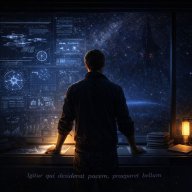
Marcus Sinclair carries memories of a future no one else can see: humanity's first contact, its wars, its extinction. Reborn in 2130, he has decades to prepare Earth for threats lurking beyond the Mass Relays. Scientist, strategist, prophet unheeded. He builds from the shadows, knowing the price of failure is annihilation.
Igitur qui desiderat pacem, praeparet bellum.
Last edited:
0000: Prologue New

USSExplorer

Doing what's necessary, even if it causes chaos
Joined
Mar 4, 2019
Messages
616
Likes received
36,307
0000: Prologue
In my first life, my real life, though I was learning not to call it that, Edinburgh had been different: greyer, grimier, and louder. This Edinburgh gleamed. The trams ran silently on magnetic rails, and the castle had lights installed that adjusted to the weather. Even the rain smelled different: clean, scrubbed of the coal and petrol I remembered but had never breathed in this body.

I sat on my bed, a datapad resting on my knees, its screen casting pale light across my face. Eight years old, or so they told me. Eight years since I had opened my eyes in a crib I did not recognise, in a home that was not mine, wearing a body that responded in ways no infant's should.

Eight years of learning to be someone new while accepting that my former life was gone.

My name is Marcus Cormac Sinclair. It wasn't always.

Before, in the life I remembered as clearly now as the day I'd woken in the body of a babe, I'd been someone else entirely. A man grown, also, interestingly, from Scotland. I shared that link with this new life, but little else. Back then, I had gone to sleep one night, as I always did. The next morning, I woke up as Marcus. One moment there, the next… here.

Unable to speak, I couldn't scream or shout. I couldn't ask about what was happening, where I was, what had become of my former family. By the time I was able to make this form talk, I had realised that this life was mine now. I still didn't accept it truly; the images of what I had once been remained. The grief at who I had left behind, no idea of their fate, lingered.

Those nights I'd cried over what had been, my new parents had attributed it to bad dreams. What else could they think it was? I was a child, one not able to walk or talk, and I cried. No one would expect a child to weep for a former life no one else knew about.

By the time I could walk, by the time I was able to hold something approaching a conversation with my parents, I had made peace with the altered hand that was dealt. Yet I knew this world was different from what I knew. I was in Edinburgh; the city was the same, and yet it wasn't.

On the surface, it was close enough to ignore. Yet the moment one looked at it, it became clear it was different. Technology was more advanced, the air cleaner, and the mood was less constricting than what my former life had felt like.

By the time I could read, I was cataloguing the differences.

And with each passing day, those differences only ever increased.

I'd read the history of this world as best I could, as much as my parents allowed a child to do so. This world had diverged a century before. The beginning of the twenty-first century had been the pivot. Events either didn't occur or happened differently. No 9/11, no COVID, no rise of the fracturing of politics. At least not to the degree that I remembered from that former life.

In their place, the Oil Wars. The shadow conflicts over resources. And then, a revolution in nuclear power, and it was as if someone had flicked a switch: stability, peace, balance.

In my first life, I recalled hearing the same story told to a different beat. Reassurances from politicians at podiums, headlines in print and online that said everything was under control, and how what people were saying wasn't the truth. Right up until it became the truth that couldn't be denied because the evidence was staring you right in the face.

This world gleamed brighter than my former one; it spoke of peace and balance as though they had simply been chosen. Given my history, that didn't reassure me, it just made me look harder for the cracks in the picture.

For a time, looking through all those differences and alterations for those slight misalignments, the fact that it was a century later than my former life had been the most jarring. And there had been days, weeks even, where every new change and shift in direction of this timeline frightened me.

None of that frightened me anymore. What frightened me was what I carried inside.

I looked down at my hands. Small. A child's hands. Exactly as they should be, and yet they didn't feel like they were. I knew I wasn't normal in ways that went beyond the obvious.

I'd noticed it first in how fast I'd picked up things. Then, I'd simply assumed it was memories of my former life carrying into this one. Preschool was easy, too, yet it was more than that. Then, at five, I'd discovered the first hint that something was… off.

I'd caught a cup before consciously registering it was falling. Those around me hadn't reacted to the cup. Not until I put it back on the table. From there, everything was questioned and then tested.

A random scroll I had read in preschool once was remembered clearly. A training piece of music was learned and reproduced after seeing the teacher play it once. The fact that I was faster, stronger, and quicker than those around me.

This body, this mind… they were wrong. Or perhaps it was fairer to say that they were too right, too perfect. Either way, it was dangerous. To me, and to my family.

Downstairs, I could hear my father explaining something to Callum. My younger brother was five and, from everything I'd seen, ordinary. Or at least, not like I was. My mother was in the kitchen; I could hear her movements, could smell the herbs she was using even though I shouldn't. Keira, my older sister, had music playing in her room. It was proven to mute noise from travelling in or out, yet I could track the strings, hear the angst in the track. I could feel the faint, impossible vibrations in the old floor.

This was my family. My family, and yet it wasn't.

Not the one I remembered. They were gone, if they ever existed at all. This family, the Sinclairs, were my new family, Marcus' family. My parents had raised me, my sister had teased and embarrassed me, and my brother looked up to me. They loved me, and I loved them, though it had taken me years to truly accept that the affection wasn't a betrayal of what had come before.

My eyes trailed over the screen of my datapad. The one that contained my secrets.

A gift when I turned eight a few months ago. One I had hardened in ways no eight-year-old should know how to. No network connection, no cloud backup, no outside connection, a pass-string that couldn't be broken without dedicated software.

The entirety of my understanding of a possible truth.

Inside were my observations, catalogued with the precision that came too easily: timeline divergences, technological anachronisms, political movements that shouldn't exist. The file marked 'ANOMALIES' grew faster than the others. Yesterday, I'd added a note about the Mars exploration initiative: The funding suggested that they expected to find something beyond just rocks and dead volcanoes. What that was, I didn't know, though I had theories. None of those was comforting.

A second childhood stretched before me, years of growth and education ahead, and I refused to waste them. I refused to live a meek, simple life. This body, my memories, were given to me for a purpose. The feeling that something existed at the edge of my thoughts, understanding or knowledge that would help explain this new life grew stronger with each passing day.

I didn't know why I was here, what purpose this existence served, if there even was any. Perhaps there was none. Perhaps I'd simply been carried from one life into the next, for no reason at all.

My fingers tightened around the pad's edges. I didn't believe that. I couldn't.

The flickers of something in my head were proof. Knowledge that I shouldn't have, ideas that didn't quite align with how things in this world worked. Hints that, while everything was how it should be, that wasn't the case. As if there was a puzzle of galactic proportions in my head, yet I had no idea what it was meant to be.

Each time I learnt something new, each time I pushed for knowledge of this world, another piece was revealed. Another clue, however inconsequential, was gained. I had to know more; I would know more. I would learn the science of this world, use it to unlock what was trapped beyond my conscious thought.

It was the only path I had that offered any hope of answers.

The rain continued its patient assault on the window. I watched it fall, this child who was not a child, and made myself a promise.

Whatever had brought me here, whatever waited in the years ahead — I would be ready. I would build carefully, hide what needed hiding, and when the moment came that demanded I act...

I would not waste my second chance.

--- ***---
The letter sat on the kitchen table between us, cream-coloured paper bearing the crest of Caledonian Academy. My mother's tea had gone cold. My father hadn't touched his. I found amusement in their reactions and the fact that the Academy had sent a letter. Anachronistic, unpopular with many, and yet a sign of their standing and brand.

"They don't usually offer places to children your age," my father said, his engineer's mind working through the implications. "The standard intake is twelve, sometimes eleven for exceptional cases. You're not even ten."

I knew this. I had researched Caledonian extensively over the past year, alongside other such academies and institutes. I'd mapped their alumni networks, their academic reputations, their connections to key universities and industries: paths that would help define my path forward once I left their halls. Caledonian wasn't the most elite, the most widely known, nor the richest. It was, however, the most efficient for me.

Close to home, less rigorous physical checks and expectations, and access to several cutting-edge STEM programs. The best overall package, and one that, if I applied for, my parents could afford without damaging their lives or limiting the development of my siblings.

"Marcus." My mother's voice drew my focus, her tone carrying a hint of suspicion. "Did you apply for this?"

I shook my head. "No." The truth, though, only because I hadn't taken the final step. Draft letters had been written, stored on my air-gapped, secure datapad. None had been sent. Drawing attention to myself when there were so many unanswered questions about this world was a step too far. "My teachers must have submitted something. Mrs Patterson mentioned a programme for advanced students last term."

A half-truth. What I failed to mention was that I had guided those conversations, asking questions that reinforced that my displays in class weren't by chance. That I had the capability to go further, faster than those around me. My interactions and words showed enough to intrigue my teachers, but never enough to alarm.

It was exhausting, this constant need to calibrate myself. Every test was answered with small, deliberate errors scattered among the correct responses. Every class discussion was balanced between insight and age-appropriate ignorance. Two years of walking a line so fine it sometimes felt like it would cut me in half. Caledonian, and others like it, offered a chance to remove the limits I placed on myself, at least in part.

My parents exchanged a look; one I had learned to read. They were concerned yet proud. Uncertainty over whether they should nurture my gifts and push me, or protect them by allowing me to develop without impetus. They had noticed I was different, special. How could they not? But they attributed it to intelligence, to an old soul, to the luck of the genetic lottery brought forth by laws offering boosts for newborns. They didn't know the half of it.

They couldn't.

"It's a significant opportunity," my father said slowly. "The resources, the instruction, the connections you'd make. But you'd be years younger than your classmates. That comes with challenges."

Mum's hand was warm. Warm in the way that hands always feel when you're cold. I wanted to pull away and lean in at the same time. That's what made it so hard; this love felt real. It was real. Yet, letting it flow around me felt like a betrayal. Eight years ago, different hands had held mine. I couldn't remember the faces anymore, not clearly, but I remembered being loved before.

"I want to go," I said, genuine emotion colouring my voice; the eagerness of youth was displayed on this rare occasion.

It wasn't entirely a performance. The Academy meant access to laboratories, to libraries, to minds that might help me unlock the fragments of knowledge lodged behind my conscious thoughts. Every equation I learned seemed to shake something loose, to illuminate another corner of whatever vast understanding had been placed inside me. The chance to push a little faster and further, to learn more of what was locked in my mind, was one I couldn't afford to miss.

I needed that knowledge. With each passing month, the feeling grew that I was preparing for something, building toward a purpose I couldn't yet name. A reason why I was here.

There had to be a reason.

My mother reached across the table and took my hand. Her skin was warm, her grip gentle. "You're sure? Once you're there, you can't simply come home if it gets difficult."

I nodded. "I'm sure." I met her eyes, and for just a moment, let my guard slip. Not in full, never that, but something honest and earnest. "I need to learn, Mum. Everything I can. I don't know why yet, but I need to learn more to push myself."

She studied my face, and I saw something flicker in her expression. Recognition, perhaps, of the weight behind my words. Fiona Sinclair had spent her career navigating the gap between policy and implementation, reading the subtext beneath official statements. She knew when someone was holding back.

But she also knew when to trust.

"Alright." She squeezed my hand once before releasing it. "We'll visit next week. See the facilities, meet the staff. If it still feels right after that..."

"It will," I finished, certain now that the path was before me.

I pulled the letter to me, enjoying the feel of the paper between my fingertips. One tip traced the Academy's crest. A lion rampant, navy blue with claws extended, ready to strike. Fitting, I thought with amusement, for the path I was choosing.

In my room, the datapad waited with its encrypted files. Tomorrow, I would update my plans and adjust my timelines. The Academy accelerated everything by two years, opening doors I hadn't expected to reach so soon. That brought danger: the chance to draw unwanted attention I couldn't yet counter. However, the chance to learn more about this world, to see how it worked, and to understand the systems others failed to realise existed in society. Those were things I couldn't fail to grasp once they were presented to me.

I would have to be careful. Older students would watch me; teachers would scrutinise me. The child genius, some would call me. A spoilt brat, others would say. Both descriptions were right, and yet neither was. The truth was far more than anyone would realise, and because of that, I had to be cautious.

I could stand out, yes, but never too much. Never go too far too fast. Doing so led to more questions, the kind that often came with examinations and tests; the type of moments that led to discoveries I could not afford.

Yet the opportunity merited the risk. It had to be.

I knew there was a reason I was here, that I was given this second life. The knowledge in my head, the hints of paths that didn't seem right when compared to what I knew of this world, had to serve a purpose.

I wasn't arrogant enough to think I could change the world, that I could save it from some unseen disaster. Yet, if such an event lay in the future, I would meet it prepared.

The Academy was simply the next step.

I was still nine years old, but I had a future to build.

---***---
The gates of Caledonian Academy loomed before me, wrought iron crowned with that same rampant lion I'd seen on the letter. Beyond those gates, stone buildings sprawled across manicured grounds, their architecture a deliberate link to tradition, altered by the various displays of modernity. Old enough to impress, new enough to function.

Around me, other students streamed through the entrance, everyone older and taller than me. I saw many looking around in wonder, talking animatedly with others. First-years, lingering, taking in the sights, carrying their bags. A handful seemed nervous, likely due to the uncertainty of leaving home for the first time.

I was lucky. Caledonian was close enough to my home that I could head back each weekend. I would, my mother insisted. Many others, it seemed, were not as fortunate, no doubt having already seen their bags taken to the dorms at the northern end of the campus.

As I moved towards the gates, I felt the eyes of the other students, new and returning, on me. The looks came in waves, all carrying the same three emotions, or variants of them: curiosity, confusion, and amusement. I was a child among adolescents, barely reaching their chests, with my uniform crisp and new and slightly too large despite the tailoring. My parents had insisted on room to grow. They weren't wrong, though I suspected the growth would come faster than they anticipated.

Entering the grounds, I caught fragments of conversations.

"Why's a kid here?" someone asked, not quite quietly enough that I couldn't hear them.

"Fresh meat," another muttered, hints of amusement and possibly something darker in their tone.

"Whose little brother is that?"

I ignored them all, the comments washing over me. They weren't wrong to stare. In their place, I would have done the same, though with better grace. A nine-year-old entering secondary school was unusual enough to warrant attention. I needed to manage that attention, cultivate it to suit my purpose. Too much, and questions followed. Too little, and I became invisible, unable to build the connections that would matter in the years ahead.

Six years was how long I was meant to be here. Six years of classes, laboratories, and libraries. Six years to learn, grow, and unlock more of whatever knowledge lay dormant inside my mind. The fragments had seemed easier to discover during the last few months of preparing to enter Caledonian. Not enough to reveal secrets of use, but enough to show they were there just out of reach. Teasing challenges to unravel and use, at least if I could do so safely.

I had these six years to find those worth my time, to build connections with them as I built my foundation. Academic credentials were a given, but the right relationships could be worth more. Yearmates who would become colleagues, teachers who might open the doors to mentors, potentially even rivals who would sharpen me against their edges. The social architecture of a life took time to construct, and I intended to use every moment.

A group of older boys passed, their uniforms bearing the pins of third-years. One glanced down at me with the casual dismissal of someone who had already categorised and discarded what he saw. An irrelevant child beneath their notice.

Good.

Let them underestimate me. Let them see only the small frame and young face. By the time they realised their error, I would be too established to dismiss and too ingrained for them to ignore. That was the game I had chosen to play: the patience of youth that hid ambition behind earnestness.

I adjusted my bag on my shoulder and walked through the gates.

The Academy awaited. My future awaited. And somewhere, in the locked corners of my mind, answers awaited, too.

I intended to find them all.


---***---

A/N: Welcome to my newest story. Like the others, this will be a slow burn with world-building involved over a long ride.
 
Last edited:
0001: The Academy New
0001: The Academy

"Monsieur Sinclair, perhaps you'd like to attempt the passage?"

Madame Fournier's voice was in that tone that teachers used whenever they suspected that a student wasn't paying attention. Yet, while my mind had been elsewhere, I had been paying attention; it was just that the mysteries in my head were more appealing than the lesson.

I looked at the text on my datapad. A simple paragraph about a family visiting Paris, the kind of introductory material meant to ease students into verb conjugations and basic vocabulary. We'd covered it over the last twenty minutes, the teacher taking time to have us all enunciate the verbs, practice how to roll our tongues and shift our lips.

I'd needed to hear her say it just once. From there, I could repeat it. The grammar rules we'd touched on in the last class were already ingrained in my mind with crystal clarity.

I read the paragraph aloud. Slowly and deliberately, stumbling over a word I knew perfectly but that most would likely struggle with. A calculated performance with an error placed where a bright but young and ordinary student might falter. The sort I'd used in this class and others already in my first few weeks at Caledonian Academy.

Madame Fournier studied me with an expression I was learning to recognise. I was seeing it more and more from my teachers. The slight narrowing of the eyes and the tilt of the head. The realisation that something was just a little bit off about me. The sort of difference that was unusual, but, in the eyes of a teacher, in a good way.

"Your accent is remarkably good for a beginner," she said. "Have you studied French before?"

"My grandmother speaks it sometimes," I lied, speaking with the confidence of a child who shouldn't know any better. "I must have picked up more than I realised."

My grandmother had tried to teach me a foreign tongue when I was a bairn, but that had been Spanish. Just as in this class but back then I'd feigned ignorance and played at failure. My grandmother had simply smiled and said I'd get there eventually.

I watched as Madame Fournier held my gaze for a moment before she looked away. I hoped she accepted my answer.

Around me, I felt the weight of my classmates' attention. Boys and girls who were two years older than me. No doubt their minds already noted me as different. Not in the way the teachers did, but in that way that children did. A curiosity, a nuisance, or something weird. The sort of weird that was often avoided, investigated with child-like drive, or bullied.

That wasn't what I wanted. I had to hide more, pull back where I didn't need the attention, and where my focus wasn't placed.

Next time I was asked, I'd speak slower and make more mistakes. Changes I would enact to appear merely as a child who was advanced for their age, and not a genius. Though that line grew thinner each day with each passing class.

---***---
I sat quietly as Mr Hartley handed back the tests. He moved with the efficiency of a man who'd done that thousands of times. Papers slid across desks; some were met with relief, and others with resignation. Outwardly, I was calm, displaying just a hint of pleasure. Internally, I was disappointed. Not at my performance, but in myself.

Ninety-four per cent. Based on the unnamed table on the board, I was top of the class by three marks.

I had aimed for eighty-seven per cent. That would've been respectable, if not for my younger age compared to my classmates, and nothing overly remarkable. Safely in the upper third without challenging for the top. Instead, I was clear out in front.

I had chosen my errors carefully: a sign mistake in one place, a skipped step in another. The kind of small slips that any student might make when placed under a time constraint. My flaw had come in the final question.

That had been a multi-part problem involving quadratic functions, worth fifteen marks. I had intended to lose five of them, perhaps six. Instead, I had solved it completely, my hand moving through the working before my mind caught up to stop it; I'd only realised it after the data had been inputted.

I'd acted on muscle memory, except that wasn't muscle. It was something deeper, something in me that recognised patterns and actions faster than conscious thought could process and then intervene. The knowledge in my head didn't wait for permission. It was as if it wanted me to know it was there and hated being constrained.

"Well done, Sinclair," Mr Hartley said as he paused at my desk.

Nothing more was said as he moved to the next desk, yet I'd already seen the look he'd shared with his teaching assistant. Once more, I'd outperformed students two years my senior.

Around me, my classmates shifted in their seats. I didn't need to glance at them to feel their attention or to understand their thoughts as they reassessed me again. I was the child genius, the weird kid. The threat to their standing in a system that ranked and sorted us by our performances in class on digitised lists in a place where each of us was expected to excel. The brat who'd defeated them again without looking as if I was struggling.

For some, that would fuel resentment. For others, it would discourage them. So be it. That was their failing, not mine. Others would look at my performances and take on the challenge; they would see me as an obstacle they had to overcome. They would push themselves to do better, to surpass me.

They'd fail, of course. None of them was capable of matching me. None of them, nor my teachers, understood what shifted in my mind, or how everything came with an ease that went beyond simply recalling such studies from a previous life. In time, years from now, they might understand a fraction of it. Perhaps, I pondered, the whole world might if what drifted at the edges of my thoughts revealed itself.

I folded the test paper and slipped it into my bag, already calculating how to adjust not to stand out too much beyond this moment. The next assessment would need to be different. More errors in all aspects of the paper. Less perfection where it mattered.

I was getting better at failing; I simply wasn't good enough at it yet. Though the thought was growing that perhaps I should stop trying to hide in failure.

---***---
It was halfway through my second year at the Academy, yet I was now studying the third-year curriculum. My results over the first year had been enough to encourage all my teachers to push for my rapid advancement. A challenge I had, after some consideration, accepted.

I had grown impatient, at least to some degree, with hiding my abilities, holding myself back until I was almost bored to death. My life, beyond the early attempts to not stand out, had drifted. When the chance had come to push myself, to display just a hint of what I could do, I'd taken it, and now found myself among classmates three years my elders.

My teacher, Dr Morrison, had stopped asking if I understood the material months ago. Now she simply handed me the advanced problem sets and let me work while she guided the rest of the class through concepts I had mastered in the first month of the semester.

I knew how that made the others feel, but I no longer cared all that much. Either they accepted the challenge I represented, or they didn't. My intentions were far beyond them and above theirs. They could either try to soar with me or fall to the ground and live through whatever became of their existence.

As I'd done since my first week at the Academy, I was seated at the back of the classroom. I did so partly for the benefit of being able to work without being disturbed, and also because, as much as it shouldn't, it amused me to watch my classmates struggle with Newtonian mechanics while I pondered at the edges of something far more interesting than our classwork.

Most were fifteen, a handful sixteen. They had three years on me in age, and I had left them behind so thoroughly that Dr Morrison no longer bothered pretending otherwise. Outside of the Physical Education department, no teacher tried to make me seem normal.

The names other students called me had grown louder and stronger. Child genius had become Prodigy. Weird Kid had become Freak. Both were accurate, though neither captured the full truth.

I was better than them in every conceivable way. Not just in maths or physics, not just academically, but in ways they couldn't see and I couldn't show.

When Cameron Ross had shoved me in the corridor last month, testing the small boy who kept embarrassing his peers, I had let myself stumble. I had let him think he had power over me, that at least here, in a primitive display of size and strength, he was above me. The fact was, he wasn't, and he failed to realise that even as he and his friends had laughed.

I'd seen his hands coming long before they had. I'd heard the whispers with his friends, the trap, if one could call it that, they had laid. I could've avoided it, but that would only make the next step more dangerous for everyone.

When it came, I had watched, fighting my instincts. I tracked his movements and considered redirecting his momentum to put him down, or shatter his wrist, or a dozen other ways to prove his inferiority.

I knew how to do all that. I'd read the books the Academy had on self-defence, and I'd trained what they taught in private, in the dark of night, in my room until they became second nature. I didn't need them now, but I knew one day I would. A day would come when I would be forced to fight to protect myself, to defend what I knew, and what I created. When that came, even though I didn't know when, I would be ready.

The restraint I'd shown there, and elsewhere, was perhaps my greatest achievement at Caledonian, though no one would ever know it.

"Marcus." Dr Morrison's voice cut through my thoughts. "Would you walk the class through the third problem? I think they'd benefit from seeing your approach."

At the start of the year, I would've hesitated. Not to avoid standing out, but because I wasn't sure how advanced to make my answer. Now I simply rose and walked to the board, marker in hand, aware of the eyes tracking me. Some were resentful, some were curious, and a few were genuinely interested. Like Dr Morrison, all of them expected me to explain the problem as well as she could.

Even as I wrote out the solution and explained it, my mind wandered further down the pathways this class led to. Wondering how far my mind would reach as it grasped for understanding that I didn't yet realise. The knowledge that lived behind my thoughts stirred as I worked, whispering of connections between force and field and something deeper that this world's physics hadn't yet discovered.

"Excellent," Dr Morrison said when I finished, barely paying attention to anything yet never appearing to be inattentive. "Clear and precise, as always."

I returned to my seat, accepting the praise with a nod that was just shy of dismissive. The arrogance I had warned myself about when entering Caledonian was growing stronger, and the warnings weaker. The mild contempt I held for most of those around me had settled to the point it felt second nature.

I was twelve years old, surrounded by teenagers I could outthink and outfight, and cultivated by teachers who saw genius where the truth was far stranger.

It was difficult not to feel superior. Each day, I wondered how much longer I would have to restrain myself so heavily. How long would it be until the day came when I could remove my shackles and begin to truly push myself?

---***---
The Great Hall of Caledonian Academy had stood for two centuries. Its vaulted ceiling bore the names of distinguished alumni in gilded lettering. Judges, politicians, scientists, captains of industry, and other figures of note. The weight of expectation and history pressed down from those rafters, with silent authority on the students who now sat in the Great Hall.

Well, they pressed down on everyone else.

I sat in the front row, as tradition demanded of the Dux Scholae. The First Scholar. That was the highest honour the Academy could bestow upon a graduating student. The formal ceremonial robes used each year had been heavily altered to fit my frame. Around me, my classmates who were graduating alongside me sat. Their robes were just as ceremonial, but lacking the status of being the best.

I was fourteen, and had taken five years to reach a point it had taken all of them six. To many of the others, this might be one of the pinnacles of their lives. To others, it would mark the beginning of some grand adventure. To me, it was a point where I could move on and stop holding myself back as much as I had been.

I could have finished the Academy in four years easily, perhaps three, if I had truly unleashed myself. The coursework had never challenged me, not genuinely. Mathematics was so simple that I barely had to focus on it. The sciences flowed like water under my command. Languages, history, literature, and the other subjects hadn't troubled me, even if they never held my interest.

Yet speed of completion had never been my goal. Not after I'd realised how I could use my time here. I had stayed the extra year deliberately, spreading my focus across disciplines I might never use. The friendships I'd developed, if one could call them that, were unlikely to be of worth in the coming decades.

Still, I'd noted names, courses chosen, and cultivated links with those that might amount to something useful in the future. They would either be further cultivated, or more likely, disposed of from the mental spreadsheet I'd crafted them onto.

My main reason to take the time was to expand and broaden my knowledge, though not in the courses available at the Academy. The puzzle in my head, the one that remained elusive even as each piece was revealed, went beyond what I'd realised. It didn't just cover maths and physics, but spanned every science, hard and soft, offering fragments of a far wider and more complex picture than potentially should exist.

I'd long since determined the variances in the history of this world compared to the Earth I'd known from an earlier point in its timeline. I saw the lies and deceptions that had been placed in knowledge such that even adults seemed unaware of them, or simply chose not to challenge them, and I'd caught glimpses of what might lie underneath.

Things were presented too cleanly. Yes, there were conflicts, disagreements, and even wars throughout the last few hundred years. Yet, each time the solutions explained by the reports, by the textbooks and history felt… lacking. As if something was being hidden. It felt as if someone, likely many people in fact, all across the world, were keeping details from the masses.

One of the most glaring examples happened fifty years ago. In the waning days of the last century, the USA, Canada, and Mexico had merged, forming the United North American States. Then, striking first in New York, insurgents had fought against this new continent-sized nation.

The Statue of Liberty had been destroyed in what history books and recordings labelled as domestic terrorism. There was truth in that, but something was missing. That Second American Civil War had lasted three years, and when it had ended, the UNAS was victorious, but no longer the global power it had once been. From its secure position as the dominant superpower, it had become one of several major players. The same was true of the Chinese People's Federation, though its shift had happened earlier than with the UNAS.

The UK was still linked to both the UNAS and the European Federation. In my old life, the UK had broken those bonds with Europe, yet here they remained, though not to the same depths they once had in that other timeline. On the surface, all was well, but when one dove a little deeper and read between the lines, then things became less clear. The world was nowhere near as rosy and peaceful as every source painted it.

Such knowledge and understanding would be useful in the future. With the time I had, learning about the cracks in the truth of society now was more important than surging ahead and not realising the truth until it was too late. Still, it was now time to push forward again and to pick the path that offered the best balance of risk, challenge, and reward.

The offers had come flooding in during my final year, even before my final evaluations and tests were completed. Edinburgh, Cambridge, Imperial, ETH Zürich, and others had reached out to me instead of me applying to them. My grades were such that not only the locations but the choice of subject was vast, and it appeared to everyone else that I could pursue whatever path I wanted.

Yet, for all that my path seemed to open up before me, it wasn't, and perhaps it never truly had been.

The knowledge in my head, that vast reservoir of understanding that unlocked piece by piece with every equation mastered, every principle absorbed, pulled me in a clear direction. Physics, Mathematics, and Engineering. The sciences that would carry humanity beyond this single world, out into the void where our future waited.

I didn't know why I was so certain of that path into the void, but the feeling that was where I needed to head was undeniable. Almost as if there was a compass in my mind pointing upwards towards true north.

Whatever purpose had placed me here, whatever reason lay behind my resurrection into this strange and altered world, it pointed toward the stars.

"Marcus Cormac Sinclair."

I pushed thoughts of the future aside as Headmaster Buchanan's voice echoed through the hall. I rose, smoothing my robes with the precision that implied normalcy when I was anything but. The façade was perfect now, and only when I wished did I let hints of just how far beyond everyone here I was appear.

"In recognition of exceptional achievement across all disciplines, for scholarship that honours the finest traditions of this institution, and for conduct befitting the ideals we hold dear, the Academy names you Dux Scholae of the Class of 2145."

Applause filled the hall as the Headmaster spoke, and I walked towards him. I accepted my medal as Dux Scholae with a handshake and then turned to face the students, parents, and faculty. My own family sat in the fourth row. My parents were proud and smiling, Keira was rolling her eyes theatrically, and Callum was waving enthusiastically.

They saw their son and brother, their wee professor, had grown into something remarkable. They didn't see anything more than I wanted them to, or the knowledge that whispered of technologies this world had yet to imagine were possible.

I looked at the other faces. Classmates who had gone through resentment, then respect, before simply accepting that I wasn't someone who moved in the same air as them. Teachers who thought they'd nurtured a genius who already understood everything beyond what they had to offer.

Five years of careful cultivation of calculated excellence, and of laying foundations for whatever came next.

The Academy had been the first step. University would be the second. And beyond that, the path stretched toward something I could feel but not yet name: a purpose written in the stars, waiting for me to grow strong enough to claim it.

I was fourteen years old, Dux Scholae of Caledonian Academy, and I hadn't even begun.

---***---
A/N: Yeah, another chapter. My plan is for a chapter a day until the end of the month, taking the story to 0015.
After that, it will drop to 3 a month.
 
Last edited:
0002: Foundations New
0002: Foundations
I walked to the lectern slowly, shifting as I did so to suggest unease. That was a charade, like every calculated action I'd taken over the previous five years. As I reached the lectern, the applause faded, and my eyes swept out over the Great Hall, taking in the expectant faces of those present. All of them were waiting to hear what the fourteen-year-old prodigy, what the Academy's genius, had to say.

Like with the walk, I'd prepared for this. Not so much the speech, as that had been written weeks ago and then refined and rehearsed until every pause felt natural. No, I had prepared for the performance I was about to give. The careful balance between brilliance and humility, and between vision and youth.

"Headmaster Buchanan, distinguished faculty, parents, and fellow graduates." I let my gaze sweep the room, making brief eye contact with faces that I'd catalogued over the last five years. "Thank you for this honour. Standing here, I'm reminded that none of us achieves anything alone."

The audience relaxed slightly, as intended, at the expected sentiment for me to express.

"First, I want to thank my teachers, who saw potential where others might have seen only a child too young for his surroundings. Dr Morrison, Mr Hartley, Madame Fournier, and so many others. You challenged me to reach further, think deeper, and question everything." A pause, timed precisely for the best reaction. "Even when those questions made you uncomfortable."

Scattered laughter echoed around the halls, the greatest concentration coming from the staff, the men and women who had taught me all they could, often going beyond the syllabus. Dr Morrison's expression suggested she remembered several of those uncomfortable questions I'd asked that had been beyond what she'd ever expected to answer.

"Next, I want to thank my family." My eyes found the fourth row. My father sat straight-backed, pride evident in every line of his posture. My mother's gaze held that knowing quality I had never quite escaped. Keira was fighting and failing not to look bored, while Callum waved, earning a gentle hand on his arm from Mum even as she smiled softly at her youngest. "You gave me roots strong enough to let me grow. Everything I am, everything I might become, is because of you."

For once, I spoke the full truth, making it easily the most honest thing I would say today.

"And to my classmates." I turned slightly, addressing the graduates behind me. "We've spent years together in these halls. Some of you resented me. Some of you competed with me. A few of you became friends, though I still don't understand how or why." Another burst of gentle amusement. "All of you made me better. Thank you."

My eyes swept over the faces before me. The families of my fellow graduates, the remaining students, and members of the faculty. Even figures from elsewhere, universities for the most part. Their faces, like the institutions they represented, were all known to me because they'd spoken with my family and me about why I should study with them and what made them more appealing than the others.

In my former life, I had applied for university courses like everyone else and then waited for their responses. In this new existence, they'd come to me. They understood the potential I had, or they thought they did. Like all others until now, they remained blinded to a truth that even I sometimes still found hard to accept.

"The Academy's motto is Per Scientiam Ad Astra. Through knowledge, to the stars. For two centuries, those words have inspired students to reach beyond their grasp, to push the boundaries of what is known, and to seek understanding of the universe around us."

I gripped the lectern's edges firmly, implying physical belief in my words, and let earnestness colour my voice.

"I believe our generation stands at a threshold. The Mars initiatives, the deep space observation, research, and mining programmes. The questions we're finally developing the tools to answer. We're not just studying the stars any more; we're preparing to meet them. To see what mysteries they hold, and in time, I hope, unlock them for the benefit of all mankind."

Another round of polite applause came with a gentle shift in focus. The first sparks of interest instead of polite attention. Exactly what I was hoping to draw out.

"I don't know what we'll find out there." I chuckled, disarmingly. "None of us do. But I'm certain we'll find something. Something that will change everything we think we know about our place in the universe. And when that day comes, it will be our generation, the ones sitting in this hall, who must be ready to face it."

As I spoke, my eyes studied the faces before me. Some nodded along, likely hearing only youthful idealism. Others seemed to look at my more carefully; as if my words triggered a reaction of some kind. I didn't think the reaction would stick. I was too young and, for all my intellect, unimportant to sway people with mere words.

Though perhaps, in the years that came, if whatever it was that made me so certain that the future presented danger, they would look back and hear my words in a new light. Hopefully they would think that meant I was worth listening to, without questioning too deeply how it's been that I seemed to know what had come years before it had.

Though for what reason they would be required to think that, I didn't yet know myself.

"So, as we leave Caledonian, I ask you, my fellow students, and those here today to congratulate us, to remember: Knowledge isn't just power. It's responsibility. It's the foundation we build when we don't yet know what we're building for. Learn everything you can. Question everything you're told. And never stop preparing. The future awaits us, with challenges we must be prepared for."

I stepped back from the lectern. The eyes of most were truly on me now, my words having the intended effect.

"Per Scientiam Ad Astra. Through knowledge, to the stars. I intend to get there. I hope that some, if not most, of you will join me."

The applause that followed was louder than before. My words, as I had designed them, stirred something in the minds of many. That desire to know and learn more, to see what was over that next hill, and to seek out new worlds and, if they existed, new civilisations. To boldly go where no man had gone before.

I chuckled, the memory of that particular piece of media coming forth unasked. My reaction, unplanned, seemed to please several of those watching.

My eyes caught my family. They were happy, yet there was something in my mother's expression. Something shifted behind her pride. Worry over what path I was walking.

She always did worry about me.

---***---
The transport hummed along the coastal road, its electric drive nearly silent as the Irish countryside rolled past. Laden with the day's shopping, we made our way back to our summer stay. My father had insisted on the extended-range model when we hired it in Dublin. Mum had teased him about being paranoid over being stranded, though I noted there was more to it than just that.

The charging infrastructure outside the major cities was thinner than advertisements suggested. The sort of minor flaw in how the world was presented that most might miss. As if those beyond the great centres of civilisation were from another world, or deemed unworthy of advancement because they chose not to live in metal and concrete jungles. Perhaps it was even a ploy to encourage more to move to towns and cities, where they could be more connected to the world.

Or where, for anyone who'd noticed the cracks beneath how perfect the world was meant to look, a gathered population was simply easier to keep track of.

We'd be staying in Ireland for half a month, though already a few days had passed. My parents had insisted on this trip, wanting a family holiday before university consumed me. Before the next phase of my life pulled me further from their orbit. I had agreed, recognising the wisdom even as part of me chafed at the delay in pushing to discover what secrets my mind was hiding.

The cottage they'd rented sat on the Wild Atlantic Way, overlooking cliffs that dropped into churning grey water. It was remote enough for genuine isolation, though connected enough that Keira's datapad still chirped with messages from friends she couldn't bear to be out of contact with for a fortnight. A datapad she was still glued to when my father and I returned, shopping bags in our arms.

"It's boring," she announced while sprawled across a sofa with the dramatic laziness only a teenager who wanted to be thought of as an adult could manage.

"It's peaceful," Mum corrected from the kitchen. "There's a difference."

"The difference is whether you're old enough to appreciate it," Dad added, as we moved to the kitchen, ready for Mum to place the shopping in its assigned locations. She was meticulous like that, a habit she was pleased to see I had adopted, though she remained unaware of why I had.

I caught the odd looks from her now and then. Ever since my speech at my graduation. She hadn't asked me about my words or the intention behind them. However, it was clear she had thoughts that refused to leave her alone.

I hoped by the end of this holiday that I could give her peace of mind. She deserved that much at least.

***
I sat by the window, watching the Atlantic throw itself against the rocks below as the night slowly crept up on us. Callum had claimed the seat beside me, his nine-year-old energy temporarily exhausted by a day exploring tide pools.

"Marcus?" His voice was quieter than usual. "Do you think there's life on other planets?"

I glanced at him. His eyes held that particular intensity children got when asking questions that mattered to them. Not idle curiosity, but something deeper.

"Yes," I said. "I'm certain of it."

"How do you know?"

I considered the question. With adults, I would have hedged my answer. Probability arguments, the Drake equation, the sheer vastness of the universe making isolation statistically improbable; those were the logical routes through which to craft an answer. Maybe mixed in with some general vagueness that they would expect from a teenager.

But Callum wasn't asking for statistics.

"Because the universe is too big for us to be alone," I replied. "And too old. Life has had billions of years to emerge, grow, and spread outwards. We're not special, Cal. We're just early. Or possibly late."

He considered my words with the odd intensity that only a child seemed to possess. "Will we meet them? The aliens?" His eyes lit up with fresh energy and excitement.

"Someday. Maybe sooner than anyone expects."

"Cool." He returned his attention to the window, apparently satisfied. I envied him that simplicity. The ability to accept wonder without immediately calculating implications.

***
On our last evening in Ireland, I found myself walking the cliff path with my mother. The sun was setting, painting the clouds in shades of amber and rose, and she had simply appeared at my side as I'd left the cottage.

We walked in silence for several minutes. She had always been comfortable with silence, never feeling the need to fill it with noise. That was one of many things I appreciated about her, and another small feature I had adopted myself.

"Your speech was beautiful," she eventually said as we reached a viewpoint where one wasn't sure if they were part of the sea or the Emerald Isle. "The faculty were impressed. Your father nearly burst with pride. The recruiters were intrigued."

"But?" I prodded, pleased to finally have the chance to ease her concerns and soothe her worries.

She smiled slightly. "No 'but', just an 'and'. It was beautiful, and it worried me."

I waited, knowing that she had more to say; she had been waiting since my speech, and throughout this holiday, to discuss it. Now, at last, we would.

"I've always known that something's been driving you. You're bound for greatness, Marcus, and I'll always be proud of you." She stopped walking and turned to face me. The wind caught her hair, and in the fading light, I could see the concerns she usually kept hidden. "Marcus, love, what is it that keeps pushing you to move forward so quickly? To give up on being a child… my child."

I didn't have an answer, at least not an easy one that I could give her. The knowledge in my head whispered of dangers I couldn't name, of purposes I couldn't define, and of a future that felt heavy with significance I couldn't yet see.

Yet I knew there was a purpose to it. That some sort of threat lingered just beyond my reach, past an event that none realised was coming but would, I suspected, change the world entirely.

"I don't know," I answered honestly, one of the few times I'd been fully honest with her in recent years. "I just feel that it's important that I see where my mind is leading me."

She studied my face for a long moment, reading me, as she always had. Then she reached out and took my hand.

"Just don't forget who you are, love. Not who you're becoming. Who you are."

I squeezed her hand and smiled. "I'll try."

We stayed like that for a few moments, her smile of motherly, unconditional love warming my heart as it always did. Eventually, she let go of my hand, and we walked back to the cottage in silence. The stars were emerging overhead, cold and distant and full of secrets I was only beginning to glimpse.

Somewhere up there, answers waited, though I didn't yet understand the questions they were asking. Though somewhere in the locked corners of my mind, just beyond my reach, I felt I knew some of them.

---***---
The room was already half-occupied when I arrived.

St Leonard's Hall was old by Edinburgh standards, yet it had been updated with the times. Victorian stone was dressed up with modern infrastructure. Secure doors that responded to my student ID opened when it was clear I sought entry, and then closed behind me once I was inside.

The lights adjusted as I entered, the climate system, one of those hidden pieces of technology, noting a new occupant. But beneath the technological overlay, the bones of the building remained: high ceilings, tall windows, and that particular, and oddly familiar, smell of ancient stone and generations of students.

I moved through the corridors, climbing to the third floor, and found the room assigned to me for my first year quickly. Other students glanced my way as I passed, which was something I'd long since grown used to. The presence of a child confused them, with some offering comments. Most were as crass as one would expect from university freshers.

The door to my room opened cleanly, only a faint hiss signalling the action. One desk was cluttered with datapads, scattered notes in actual handwriting, and a well-worn copy of something by Dawkins. A poster hung above the bed: a stylised double helix with the caption "Know Thyself" beneath it. The other half of the room was bare, waiting for its occupant.

I set my bag on the empty bed and began to unpack. I didn't have much, never having found a need for keepsakes. What was the point when most of what I needed could be found easily enough online, or was too juvenile for me?

A faint chime reached my ears, pausing me as I worked to unpack.

"Ah, the prodigy arrives."

I turned, taking in the young man in the doorway. He was perhaps nineteen, sandy-haired, with the kind of open face that suggested ease in social situations. Dutch, I guessed from the slight accent, or possibly Belgian. I had yet to learn either language, but I could differentiate them from nearby tongues. Perhaps I would have the opportunity this year to learn whatever it was he spoke.

"Marcus Sinclair," I said, standing fully, though I was still far short of his height.

"Lars Brenner." He set his mug down, tea, I realised as the scent reached me, and extended a hand. His grip was firm, confident. "Human evolutionary biology. The university warned me I'd be sharing with someone 'exceptional.' Their word, not mine."

I smirked, wondering who had called me that. "They have a gift for understatement."

Lars laughed, a genuine sound without mockery. "And for modesty, apparently." He settled into his desk chair, swivelling to face me, then reached for the tea. "Physics, yes? Theoretical track, from what I heard."

"With a mathematics and engineering focus," I continued, turning back to finish unpacking. "Evolutionary biology seems an interesting choice. Not medicine?"

"Medicine is about fixing what's broken." He gestured at the book by Dawkins. "I'm more interested in understanding how we got here. What made us us. The genetic bottlenecks, the selective pressures, and those random mutations that accumulate into consciousness." A grin. "Also, medical students have no social life. I have priorities."

I almost smiled at that. Directness, I could appreciate that.

His studies might also present an opportunity to determine something about what made me different. A chance to reach beyond what was just beyond my knowledge and seemingly extended into my genes. I was my parents' son, but I was so much more than that. Based on simple research and events that had occurred so far in my life, I was already above the norm, and there were years of maturity still to come.

"Fair warning," he continued, "I keep strange hours. Reading at 2 AM, and occasionally talking to myself while I work through problems. If it bothers you, we can establish quiet hours."

"I don't need much sleep," I replied, turning away from him to finish unpacking.

"Genetic enhancement suite?" The question was casual. Lars wasn't looking at me directly, but there was attention in the not-looking.

"Born in 2130. Standard protocol." A truthful answer, but one that missed much of what made me who I was.

"Mm." He took a sip of tea. "My younger sister got that. Still needs seven hours, or she's useless. Everyone responds differently, though."

That was a test, gentle but undeniable. Lars had established that he noticed things and asked about them. How I responded would shape his understanding of who I was. It was a refreshing change after being around children for so many years.

"Four hours for me," I said. "Sometimes less. The downside is I get bored easily."

"And the upside?"

I turned and smirked, a hint of challenge in my expression. "I have time to be bored easily."

Lars laughed at that. "We're going to get along, Marcus Sinclair. I can already tell."

I nodded, accepting the comment without challenge. He was what most students wanted to be: observant, social, and comfortable with himself. The sort of person who could be the centre of attention without trying, and noticed gaps in what others said and did. I wasn't here to directly make connections outside my studies, but Lars might offer a chance to do that, though it wasn't without risk.

My datapad chimed.

Settled in?
Remember, you can come home whenever you need to.
Love you.
-Mum


I looked around the room. Lars had already turned back to his work, muttering something in Dutch or Belgian as he scrolled through a research paper. Outside the window, Edinburgh stretched towards the Firth of Forth, old stone and new light mixing beneath that familiar perpetual grey sky.

I sent a message back.

Settled.
Roommate seems decent.
Talk soon.


Four hours of sleep per day. Twenty hours to work with.

Time to begin.

---***---
 
Last edited:
0003: First Semester New
0003: First Semester
The notice arrived on a grey Tuesday morning, less than a month into the semester. Mandatory health screening for all first-year students. A standard package of blood work, genetic baseline, and biometric registration, which all had to be done by Friday.

I sat at my desk in my room, having read the notice three times. My heart rate was carefully controlled, and my expression revealed nothing, giving no outward hint of my concerns. I'd known this was coming, but I hadn't expected it this soon.

"You look like someone just cancelled Christmas." Lars glanced up from his breakfast, a protein bar and coffee. From what I'd seen, that constituted his regular breakfast. "It's just a medical check. Takes twenty minutes."

"I don't like doctors." I kept my eyes on the message on my university-issued datapad.

My mind raced to consider the plans I'd developed for how to handle this. None offered anonymity, not to the levels I desired. I had known this would have to be faced. All universities, no matter the country or bloc, carried out such checks. I'd just expected to have more time to find a solution.

They said it was about mandatory health protection. After everything I'd learned about the history of this world, I wondered what else it might quietly be for.

"Who does?" He shrugged. "But it's mandatory. Some insurance requirement, I think. The university can't have students dropping dead from undiagnosed conditions."

I put the datapad down, my mind already running simulations.

I knew what they'd be asking for. A genetic sample, blood work, and the like. The standard panels that would determine if anyone was prone to a genetic disease. Corrections were offered if someone was prone and the disease was curable, which most now were. It was why I had been glad my parents decided against extra genetic boosters that were becoming commonplace when I was young.

Until now, I'd avoided detailed examinations. None were needed, and my parents never pushed me to get one, as I never got sick. Still, I didn't know exactly what was different about my biology; I only knew that something was. Something in my blood, in my DNA, made me faster, smarter, stronger, and more resilient than anyone around me.

If these tests found those changes as I expected, if they flagged it for further investigation...

Everything would be lost if I were. I didn't know why I'd been granted this second chance at life, and at an advanced point in the timeline. All I knew was that I didn't want to waste it because people would be greedy for the advantages I seemed to possess.

"Marcus?" Lars was watching me with that expression he got when he noticed something interesting. "You've gone very still."

"Thinking," I replied, staying calm as I spoke. The fear that was swelling inside had to remain there, and the casual annoyance I projected needed to be maintained. "I had a bad experience with a blood test as a child. A scary nurse with bad manners."

Lars chuckled. My explanation was weak, and I knew that. Yet what else could I say? Needles weren't used anymore; they hadn't been for over a century. It was dermal extractors now. Clean, painless, efficient, and something even children weren't concerned about, given how fast they were.

"I doubt the nurses here will be bad."

The way he said it, accompanied by the twitching of his lips, made his thoughts clear. The hot nurse was still a common male fantasy. I'd discovered that when I'd found access on the global network and easily bypassed most of the base security measures in place. Porn still existed; it always would. Like other such vices, it was accepted but never approved of.

Yet its presence on a deeper network, though one not far from the surface, suggested someone, some group, wanted to contain it. Or failing that, monitor those who gave in to such temptations, though for what purpose I tried not to speculate.

For the better, I was sure they would claim.

I stood, gathering my things. I had a lecture to get to. "I'll deal with it."

***
Over the next few days, I spent my free time researching, or more accurately, deep diving into the university's health protocols: specifically, what it was they'd be looking for. Standard genetic screening procedures. What they flagged, and what triggered referral to specialists.

I quickly found that the system had gaps and that, even without them, it wasn't focused on what I'd feared they'd be looking for. It was designed to catch common conditions, not to identify someone whose biology operated outside normal human parameters. I just had to give the bare minimum to meet requirements; that was all.

Which was why, late on Friday, near the end of the time the centre was open, I stood outside the Health Services building. Unlike many of the other buildings around it, it was modern and efficient, designed to process hundreds of students with minimal friction. My time of arrival was chosen specifically such that by the end of the week, the staff would be tired, bored, or eager to finish quickly.

I moved through the doors, my mind replaying the process I'd rehearsed dozens of times in my head. My ID card was swiped over the scanner at the desk, drawing the nurse's attention.

"Marcus Sinclair," the nurse said, checking her screen. "First-year physics. You're the last one for today."

"Sorry, seminars ran late." My words carried the right hint of apology.

She waved it off, already reaching for the dermal extractor. "Roll up your sleeve. This won't take long."

I complied, watching as she positioned the device against my forearm. The extractor hummed, drawing a small sample through the skin. I focused on maintaining steady vital signs and on projecting the mild discomfort of someone who disliked such procedures, as safe and painless as they were, rather than the careful control of someone managing every biological response.

"All done." She sealed the sample vial. "Results will be in your student health portal within a week. Any concerns, you'll get a follow-up notice."

I nodded, already recalculating the timeline as I rolled down my sleeve.

A week for results. If something were flagged, there would be a delay as they reviewed the data. I'd need to monitor my portal semi-obsessively and prepare contingencies if the results weren't on time or if the doctors requested additional testing.

I already had some plans in place. I knew my way around the campuses and surrounding areas perfectly. Days studying them before I'd arrived meant that all external paths were mapped. The buildings I could enter had all been explored as far as my ID allowed, with possible hidden routes for staff and senior students already considered.

I hoped those wouldn't be needed. Abandoning my family and leaving them in the lurch, or facing down government questions, scared me more than I expected. They didn't deserve that, but if the choice was between them enduring the pain and me living my life free of constant testing over my physical abilities, then I would run and keep running for as long as I could.

Everything I had done for just shy of fifteen years could, potentially, come crashing down because of one simple blood screening and test for genetic dangers.

As I walked back to my dorm, my mind raced. Beyond developing plans to disappear if needed, I also began considering how to fool such tests, and more invasive ones, in the future. I would leave Earth one day; I was sure of that. The tests then would be more invasive: I needed a plan to hide the truth from those tests and the people behind them until I was either too far from their reach or too powerful for them to target easily.

Medical exemptions existed, as did bureaucratic shields and religious objections, though the last was uncommon and I didn't expect it would be of use to me. Still, I needed one of those or something else to avoid the deeper and more dangerous examinations.

I couldn't fake a report now; the sample was in the system, meaning there was history, even if the university's records weren't meant to be shared with others without a court order. Potentially, if I studied the required fields, such as those Lars and others were learning, I could craft samples to use that wouldn't raise dangerous flags. They would match the records the university would soon have, but hide the full extent of who and what I was.

I was certain I was Human, but I was so different from everyone else that the chance that I wasn't lingered. That thought filled me with dread, the sort I hadn't felt since I'd first been born into this life and realised I was different.

The sort of dread that no rational thought, no amount of knowledge could ever counter.

---***---
A glance at the clock confirmed it was close to two in the morning. Apart from my partner and me, there were only a handful of people still present in the lab, working away at their projects. Those that I could see had that familiar glazed expression, the one of someone who'd spent too long staring at a screen.

I would honestly think the same was true of my partner, except his fingers flew across the keyboard as he worked. He was inputting rows of code at a speed only someone either devoted to the art or inspired by an idea that wouldn't let him quit could manage. The sort of speed that most people would struggle to read.

I could follow everything perfectly. Something that David Chen, days after we had started working together, was glad was possible.

We'd been paired by the professor in a shared mathematics elective for a cryptographic systems project. The professor, I assumed, thought it was amusing to assign the physics prodigy, who had already finished a semester's worth of credits in two months, and the computer science scholarship student together.

The project we'd been given was a joke. Three hours were all it took to plan it out, refine it, and then input the code. With us having two weeks to kill before the assignment was due, we'd begun experimenting, crafting something vastly more interesting.

"The distributed verification layer is solid," David said, not looking up from his screen nor slowing down his typing. "But I'm still not happy with the key exchange protocol. There's a vulnerability window during the handshake that bothers me."

Even as his fingers continued to fly over the keys, I looked at another screen, scrolling through the code there. It was already in my mind, but displaying that level of understanding was a step too far, particularly for someone who wasn't majoring in the field.

I quickly saw what he was referencing, pulling the section up on my screen and tapping at the lines in question. A microsecond exposure, practically unexploitable with current technology but theoretically vulnerable. The kind of flaw I felt I couldn't afford and would only matter if someone with significant resources specifically targeted the system.

The kind of flaw I felt that I couldn't afford.

"What if we stagger the verification across multiple nodes?" I suggested. "Distribute the handshake so no single point holds the complete key at any moment."

I already knew the answer; David's fingers stopping made it clear that he knew it too. He turned to me, an assessing expression I had learned to recognise spreading over his face. "That would require rearchitecting the entire trust model."

"Yes."

I could almost see the neurons in his mind sparking as they considered my idea. As if he saw the truth of what my suggestion would bring about.

"It would also make the system virtually uncrackable. Even with quantum computing."

"That's the idea."

His fingers lifted from the keys. Something he rarely ever did when we worked. A sign he was questioning my goals for this project, or at least why I needed something like it.

"You know, most fifteen-year-olds are worried about hiding their browser history from their parents. You're designing something that could protect state secrets." The tone was calm, the words measured, but I caught the questions underneath: the obvious one, and the ones he seemed unwilling to ask.

I pondered my response for a moment, considering whether I should go with some sort of explanation and risk further, deeper questions, or keep things simple and see how he reacted.

"I like to be thorough."

"Thorough." He turned back to his screen, but I caught the slight smile that slid onto his lips. A hint that he understood some of what exactly I meant by that word. "Whatever you say."

Silence fell over us as we got to work, the comfortable kind of silence that comes from those at ease working alongside each other. Cooling systems, distant keystrokes, and the occasional shuffling of someone running on empty were the only noises beyond David's fingers as they worked. There were questions I knew he held, ones that had only grown with my suggestion and reasoning.

"Can I ask you something?"

That question came ten minutes later, once the first stage of rearchitecting the entire trust model was completed and was being compiled by the VI for errors neither of us would have made.

I smirked. "You can ask."

"Why do you need something this secure? I mean, really need it. Not just as an intellectual exercise."

It was an expected question, and one that was similar to others I'd been asked. My performance, my drive, drew them naturally. I was going beyond what was required and doing so faster than needed. That sort of behaviour was almost begging to be questioned, particularly when around those with inquisitive minds.

For a moment, I pondered a falsehood, a half-truth to distract him, only to decide against it. I didn't know David that well, but I already felt I understood him enough to take a chance. He was sharper than most; he noticed things, drew conclusions, and built theories. Lying to him directly would damage the trust we were building, but the full truth was impossible.

"Because someday," I replied, measuring my words, "I'm going to have information that matters. Research, theories, or things that could change how we understand the universe. And when that day comes, I want to control who has access to it."

An answer that layered truth and falsehoods in it, though I wasn't sure how much of each was there. It was the sort of answer that I'd given often over the last ten or so years, the style and context evolving as I grew and those asking became more inquisitive. With David, I was revealing a touch more than with others before, to test and challenge him, and see if his worth could move beyond this project.

David was silent for a time, perhaps a minute, before nodding. "Fair enough." He turned back to the screen, fully committing to the project and seemingly content with my answer. "Let's build you something unbreakable, then."

I watched him work with a small smile. He was a brilliant young man who asked questions but accepted incomplete answers when it was clear he wasn't going to get full ones. Someone who noticed the gaps in what I said and chose not to push, accepting I wasn't ready to reveal everything. That was something potentially valuable and rare.

He had potential use as an asset and, perhaps, as a friend.

I wasn't sure I could afford friends, but I was learning that I might need them anyway.

---***---
The graduate seminar met in a cramped room on the fourth floor of the James Clerk Maxwell Building. Twelve students arranged around a battered conference table, most of them doctoral candidates, the youngest likely twenty-two, if not older. All bright minds who might go on to do amazing things in the future, but they weren't why I was here today.

In truth, I shouldn't be here anyway. I was a first-year undergraduate; thus, I shouldn't have been attending graduate seminars. Certainly not in my first semester. However, I'd already done three semesters' worth of coursework, though I still had the final exams to come. Those would come in a few weeks, near the end of the semester. Until then, I was free, and my advisor, unsure what to do with me, had pointed me towards the graduate programmes.

He likely expected me to get lost; he certainly wanted me out of his hair. What he'd done was place me around those I wanted to meet early. Which was why I was seated back from the table, almost in the corner of the room, a silent observer who didn't belong. The sort of anomaly that even now, after several sessions, the graduate students didn't know how to handle, and thus simply ignored.

That was fine. I was here for their teacher, not them.

Dr Aisling Okonkwo: Nigerian-born and British-raised, in her mid-forties, with close-cropped grey hair and papers that made clear she'd spent decades wrestling with problems at the edge of human understanding.

She had published extensively on propulsion systems, consulted for ESA, and had a reputation for identifying talent early. Talent that I hoped, even expected, she'd see in me before the semester was over.

I had researched her thoroughly before requesting admission to her seminar. She was exactly the kind of mentor I needed: brilliant, well-connected, and pragmatic enough to value results over process. She hadn't been concerned about my age from the first time we spoke.

"The fundamental constraint," she was saying, "remains the trade-off between specific impulse and thrust. We can achieve extraordinary efficiency at low thrust levels, but scaling presents diminishing returns that current models struggle to address."

As she spoke, she finished an equation on the board. It was standard formulation, the kind I had seen a hundred times. The kind that was wrong, not because it was incorrect, but because it was incomplete. It was missing a term that would change everything. A term that, from what I'd seen of the class so far, her students didn't realise was missing.

I didn't speak; I knew better than that. I was barely fifteen, and a first-year undergrad surrounded by adults who had spent years reaching the graduate programmes. Just being here drew attention, however. Normally, that would be dangerous, but to form the connection I desired, it was a risk worth taking.

"Can anyone identify the primary limitation in this approach?"

Silence greeted her question. The doctoral candidates shifted uncomfortably, some reviewing their notes, others simply waiting for someone else to answer. My eyes locked on the board, unwavering.

"Mr Sinclair." I was surprised she called me directly as she'd never spoken to me before. "You've been very quiet as usual. Any thoughts?"

For a moment, I considered not taking the bait and playing it safe. I didn't need to draw her attention directly now, not in front of her graduate students. Either remaining silent or offering a non-answer was the most prudent option. Yet, as her eyes locked on mine, searching for something in them, I realised it wasn't the smart one.

A partial answer was an option: one that lacked full understanding of the issue, as would be expected of an undergrad, even one as bright as many felt I was. That wasn't what I decided upon. No, it was worth taking the chance to bait a hook and see how Dr Okonkwo responded.

"The model assumes field uniformity across the acceleration chamber," I replied slowly. "But at the power densities required for meaningful thrust, you get asymmetric gradient formation. The ions aren't experiencing a consistent field. They're being pushed through a landscape that's shifting under them."

The graduate students blinked; shock, confusion, and astonishment blanketed their faces.

I stood, moving towards the whiteboard before I could stop myself, if I ever wanted to. "May I?"

Dr Okonkwo handed me the marker without comment, her expression unreadable.

I wrote quickly, extending her equation. A correction factor for field asymmetry, derived from principles I couldn't fully explain because I shouldn't have known them. "If you account for gradient instability and introduce a compensating oscillation in the field geometry, you can maintain coherence at higher power levels. The efficiency loss drops significantly."

As I stepped back, thirteen pairs of eyes stared at me, and no one spoke. The students looked at me in various states of disbelief. One, as if he'd been struck, was furiously scribbling notes, and others stared at me, their mouths agape.

Dr Okonkwo looked at the board, studying my work. Her expression remained neutral, but there was something in her eyes. Recognition, perhaps, or a calculation.

"That's… not in any literature I'm familiar with," she said, and there was more wonder in it than suspicion. "You'll have to walk me through how you got there."

I'd been expecting that question and was already preparing for it even as I corrected the equation. The answer came from somewhere deep in my mind, at the edge of the knowledge that remained as elusive as ever, but continued to offer breadcrumbs to keep tempting me closer.

"I've been thinking about it," I answered. "The standard models always felt incomplete, so I worked through some variations during the October break."

A half-truth. I had worked through variations; I simply hadn't invented the underlying insight that made them possible.

Dr Okonkwo held my gaze for a long moment. I couldn't tell if she believed me, but that perhaps didn't matter.

"Come to my office during my hours tomorrow," she said finally. "I think we should discuss your... autumn thinking... in more detail."

I nodded, handed back the marker, and then returned to my seat at the back of the room. I felt her attention on me even before I turned. She was assessing me, categorising and building a theory on the fifteen-year-old who had just rewritten her understanding of ion propulsion.

No matter how things went from here, she would be watching me, as would others.

That was fine. I wanted her attention; I had cultivated things for this moment and positioned myself for a chance like this. She was a mentor worth having, one who was now aware of the potential I represented.

I'd taken the chance; now I had simply to hope it didn't reveal too much.

---***---
 
Last edited:
0004: Mentor Found New
0004: Mentor Found
Dr Okonkwo's office was smaller than I had expected. Bookshelves lined three walls; physical volumes, some of which looked old, mixed with data-storage units whose indicator lights pulsed soft blue. Her desk was rustic, carved from wood, with a slab of smart-glass on the surface. As I entered, it was displaying a holographic schematic that collapsed to transparency, though not before I noted with amusement that it was linked to the correction I'd provided her during her seminar late last week.

Behind her, the window was open, allowing a sliver of cool sea air into the room. Through it, I could just make out the courtyard below, though not the figures as they moved around. The air carried a familiar hint of dampness that promised rain later.

Dr Okonkwo offered a small, tense smile and gestured for me to take a chair on the other side of her desk. I sat, aware of the assessment happening behind her eyes. It was the same look she'd worn at the last seminar. I suspected she'd worn that look whenever the correction I'd suggested, and I, were on her mind, though now that we were alone, it seemed sharpened.

"I've been reviewing your work from the seminar last week," she said without preamble or hint of annoyance that I'd waited until now to come. "The correction factor you proposed: I had the department's simulation VI run it through three separate models, then verified it manually."

I stayed silent as there was no point in my speaking until I knew what she'd found and what it meant.

"It works." She leaned back in her chair, fingers steepled as she continued to stare at me, eyes measuring me with that spark of intelligence that only the gifted ever truly possessed. "Not just works. It's elegant. Simple. The kind of insight that seems obvious in retrospect but that no one has ever published." Her eyes narrowed slightly. "I've checked extensively. I had the research VI correlate against every major journal, conference proceedings, and pre-digital archive in the field. Your approach isn't anywhere. It's not even hinted at."

Of course it wasn't. It came from me drawing on knowledge that was in my head, from knowledge I had that didn't align with what this world knew. Yet that knowledge, as it did in this case, either complemented and advanced what was known or offered new avenues of thought that none had considered so far. Why I had could draw that reservoir of information, and what greater picture it all led to, was another matter, but one that always cropped up whenever I considered something that pushed the boundaries of what I knew.

"As I said last week, Dr Okonkwo, it was something I'd been thinking about."

The skin around her eyes tightened, and her fingers pressed more firmly against each other. "For how long?"

"A few months." The lie came smoothly. I had been living with lies for fifteen years, so one more changed nothing.

"A few months." She repeated the words slowly, as if testing them for the truth, before she exhaled sharply. "A fifteen-year-old, in a few months, independently derived a correction to ion propulsion theory that has eluded those in the field for decades. That our best analytical systems, here and elsewhere around the world, never even considered extrapolating towards."

It sounded ridiculous, and I knew that. Yet it was the truth, or as much of it as she and anyone else were ever going to get.

"VIs correlate; they don't create." I shrugged as I responded, keeping my tone light. "Pattern recognition has its limits. What they're missing, what they will always lack, is intuition."

"That's not an explanation, Mr Sinclair."

I met her gaze directly, keeping my face calm. I wanted to smile or smirk, to show my approval of her intelligence, but I couldn't. She'd see it as a sign I was cracking, or lying in some way, or worse, contradicting some fallacy she expected me to provide.

Still, this was the moment that would determine our relationship going forward. The reason I had sought out her seminar once I knew it existed and had access to it. Why I'd rushed through the equivalent of a year and a half of my coursework to stand out and find the person who could offer me the support and connections I knew I'd need in the coming years, and open the door to the path I wanted to walk.

"Dr Okonkwo," I said carefully, leaning forward a touch, "I don't know how to explain where my ideas come from. I look at problems, and sometimes I see solutions. The mechanism isn't something I can articulate." I paused, letting honesty colour my voice. "I understand if that's unsatisfying. It's unsatisfying to me, too."

She studied me for a long moment. I couldn't see it, but I knew what her mind was doing. Weighing options and calculating risks and rewards. I was a puzzle, one she couldn't solve, and she had to assess how to use me to advance her research.

She wasn't the first to do that with me, nor would she be the last. Each time, I had a few moments of doubt, the fear that someone would realise the insanity that existed in my mind, and the knowledge it seemingly had access to.

"I'm not going to push," she said finally. "Not because I'm satisfied with your answer, but because I've learned that some questions don't have answers worth pursuing. What matters is that your work is valid, your insights are valuable, and you're clearly capable of contributing at levels far beyond your nominal standing."

Relief washed through me, though I kept it contained inside. Outwardly, I merely offered a soft smile. "Thank you."

"Don't thank me yet." A hint of amusement danced across her face. "I'm offering you a position as a research assistant on my current project. Ion drive efficiency for long-duration missions. ESA funding, access to Tier Two simulation environments, and, eventually, co-authorship on publications. It will be demanding, and I don't tolerate mediocrity."

I fought to keep my smile from growing. That, in some form, was what I'd been after. I'd intended to gain her attention, and the revelation I'd provided in her last seminar had gained that. Now she wanted to bring me under her wing, to determine if I was genuine or not. She'd be cautious with me, and likely keep me back from the most sensitive research until she was certain of my genius. Once she did, my foot would be fully in the door that I needed to open.

"I accept."

"I haven't finished." She held up a hand, her smile growing wider still. "You'll be working alongside my doctoral students. Some of them will resent you. James Okafor, in particular, has been my primary researcher for two years. He's capable and dedicated, and your presence will complicate his position."

I nodded, filing the name away. James wouldn't be the only one who'd find my presence unsettling, or see my insight and Dr Okonkwo's interest in me as a potential threat. Either way, I knew the first member of her team, the first figure that might become a rival, or at least someone who would be watching me.

"I understand."

"Do you?" she asked, an eyebrow rising. "You're fifteen. You've likely never had to navigate professional jealousy, academic politics, or the particular resentment that comes when someone younger and newer outperforms those who've paid their dues."

I responded outwardly with nothing more than a nod. Internally, I laughed. If only she knew. I had lived an entire life before this one, navigated office politics and professional rivalries and all the petty competitions people inflicted on each other. I was not the child she thought I was, but I couldn't tell her that.

"I'll manage," I said simply. Her eyes suggested she wasn't sure I would, but that was to be expected.

A chime from her desk, followed by a holographic notification blooming above the surface, drew her attention. She glanced at it, and something shifted in her expression.

"I need to take this. ESA liaison." She stood, extending her hand. "Welcome to the team, Mr Sinclair. We'll discuss specifics next week."

I stood, shook her hand, and then left. That ESA connection was the reason why I'd selected her, or one of the more important reasons. Access to a space program, to the galaxy beyond Earth, was what I needed. I knew that intimately, yet I still didn't know why.

Regardless, as I walked down the corridor leading from her office, I smiled. I had secured my mentor, or potentially the first of them. I had access to real research, and with that would come resources and, in time, credibility. Tier Two simulation environments meant VI systems sophisticated enough to model complex field interactions, tools that would help me validate the knowledge locked in my head without revealing its source.

Of course, it brought problems. Those like James Okafor who would be watching me, looking for cracks in my performance, seeking to strike down the child intruding on their work. Others would no doubt seek to exploit me for their benefit.

I'd have to be careful, more so than I'd been until this point. These were graduate students, adults that I'd be working alongside, but I could handle it. They were still young and inexperienced in so many ways. Ways they didn't realise I wasn't.

---***---
As the new semester rolled around, I found myself in another graduate seminar. Dr Okonkwo's recommendation had opened doors that should've remained closed for years. Her words were backed up by my acing three semesters' worth of tests in a few weeks. I'd completed half of a bachelor's course with full credits in six months.

It was the sort of performance that had the entirety of the physics, mathematics, and engineering departments buzzing. If not, the entire university. Already, less than two months into this semester, the university's adaptive testing system flagged my progression for manual review, opening the files and coursework for the third year of the bachelor's course when those around me were only just moving beyond what they'd learned in school.

The topic of the day's seminar was field coherence dynamics. An area where I was almost ready to publish my preliminary findings under Dr Okonkwo's guidance. Most of the attendees were doctoral candidates, alongside a few advanced Master's students: the youngest was twenty. Before I'd arrived, they been considered potential geniuses in their fields. Now they were judged against a new metric, one they couldn't hope to meet.

I was presenting my findings to them, seeking their oversight and thoughts. Behind me, the wall-mounted display cycled through equations I'd prepared. In front of me, they stared up at the work, some of them trying to hide that they were lost, or close to it, while others tried to understand what they were seeing, and how they'd missed such insights.

"That assumes linear degradation of coherence over distance."

The voice which interrupted my explanation came from the far side of the table and was clear and accented. Spanish, I thought. A name for the face came a moment later. Elena Vasquez, twenty-one. Working on a Master's in astrophysics. Beautiful, I could admit, even if such thoughts were basically irrelevant at my current age.

"But your own data suggests the relationship is non-linear past threshold densities. You're contradicting yourself."

I looked at her, taking in her features. Dark hair was pulled back severely, revealing strong yet feminine features and eyes that held challenge rather than deference. She was dressed casually, as was common for the graduate students, and tapped a stylus against the edge of her datapad. Yet, there was nothing casual about her attention, nor the fire of challenge in her eyes.

"The linear approximation holds within operational parameters," I replied, unfazed by her interruption or her focus upon me. "The non-linearity only emerges at densities we can't currently achieve."

"Can't currently achieve," she repeated, before leaning forward. "But you're building a theoretical framework. Shouldn't that framework account for capabilities we might develop? Or are you only interested in describing what already exists?"

Around the table, other students shifted uncomfortably, while a few seemed amused. That was something I was used to. I was the outsider, the one who made all their efforts to reach this point in their studies seem pedantic.

I ignored them, my focus on Elena, and I found myself smiling.

"That's a fair criticism," I admitted. "The framework is incomplete. I'm still working through the high-density implications."

"Then perhaps you shouldn't present it as though it were finished."

"I didn't." My response was as quick as hers, not giving an inch. "I presented it as preliminary work in progress. You're the one who assumed I was claiming more than I was."

Something flickered in her expression. Surprise, perhaps, that I had pushed back. Or respect that I hadn't crumbled under her criticism. I couldn't tell which. Oddly, I found myself half-hoping it was both, and more.

She fell silent there, and I resumed my presentation. When the seminar finished, I gathered my datapad, slipping it under my arm, and exited the room. Outside, I saw her waiting, an amused, almost teasing smirk dancing on her lips.

"Elena Vasquez," she said, offering her hand, the other holding her bag against her shoulder. "Astrophysics, though I'm considering a shift toward propulsion applications."

"Marcus Sinclair," I replied, shaking her hand, feeling the warmth of her palm against mine, even as I filed away the new information about her.

"I know who you are," she countered, a dry hint of amusement in her voice. "Everyone knows who you are. The child genius who makes doctoral candidates feel inadequate."

I chuckled as we lowered our hands. "I don't try to make anyone feel inadequate."

"No." She studied me with an almost uncomfortable intensity. "You just exist, and inadequacy follows naturally. It's rather impressive, actually."

I wasn't sure if that was a compliment or an accusation. Perhaps it was both. I found that I didn't mind as it meant she was thinking about me.

"Your critique was good," I said. "Wrong in its conclusion, but the underlying reasoning was sound. You identified a genuine weakness in my framework."

"Wrong in its conclusion?" Her eyebrow arched. "Confident, aren't you?"

"When I'm right, yes."

She laughed; the sound and seemingly genuine rather than mocking. "We should argue more often, Marcus Sinclair. I think I might enjoy it."

I watched her walk away, something stirring in my chest that I hadn't expected. She was brilliant, that much was something I'd known for a while. Not at my level, though I doubted anyone was. Still, she was genuinely exceptional. Sharp-tongued, unwilling to defer to reputation, and confident enough to challenge me in front of an audience.

Attractive, too, I noted again, though I pushed that thought aside. I was fifteen. She was twenty-one. Whatever I might feel was irrelevant and inappropriate.

But I found myself looking forward to our next argument. It was refreshing to be seen as an equal, not an anomaly.

---***---
The laboratory was quiet at this hour, with most researchers having long since left for the evening. Dr Okonkwo and I were still present. We stood before a curved bank of haptic displays with simulation data cascading across the surfaces in patterns the department's analytical VI had organised for easier comprehension. The blue glow cast sharp shadows across the room as she walked me through the parameters of her latest ion drive test while I stood still, examining the model, searching for visible issues, and waiting for her to explain the bottleneck she currently had.

"The experimental design is solid," she was saying, gesturing to expand a schematic. "We've accounted for thermal variance, magnetic interference, and power fluctuation. The VI's predictive models show performance within acceptable ranges."

I studied the schematics, my mind already at work. It mapped the relationships between components, traced energy flows, and identified potential failure points. The VI had done competent work, correlating against known parameters and historical data. But, just as I'd commented during my first proper meeting with her, VIs couldn't extrapolate. They couldn't see what wasn't already in their training sets.

I could feel there was an issue. Something nagged at my thoughts, trying to alert me to an issue I couldn't quite articulate. It was oddly refreshing to feel that, instead of simply understanding everything instantly.

Then I found it.

"The electrode geometry," I commented slowly. "You've positioned them for maximum uniformity, but that creates resonance patterns at high power. The ions will bunch at certain frequencies, degrading thrust consistency."

Dr Okonkwo frowned, pulling up the relevant specifications with a sweep of her hand. "The geometry was optimised by three different teams. Two human, one VI-assisted. They all agreed on this configuration," she said, even as her eyes scanned the specifications, seeking a deeper understanding of what I was suggesting.

"They optimised for uniformity, not for harmonic stability. The VI wouldn't flag it because resonance at these frequencies isn't in its reference architecture." I reached for the interface, and then hesitated. "May I?"

She nodded and then stepped back. I could feel her eyes watching as I modified the code, shifting the lines and symbols to correct the issue.

As I traced the adjustment on the screen, watching the simulation update in real time, I said, "If you offset the electrodes by seven degrees and introduce a slight asymmetry here, you break the resonance pattern. The ions distribute more evenly across the acceleration cycle. Thrust becomes more consistent, and you reduce wear on the chamber walls."

Silence.

I turned to face her, catching the unreadable expression she wore. Her eyes were locked on the modified design. The VI had already begun recalculating, with new projections expanding across adjacent displays. I could see her mind working through the implications, checking my logic against her own understanding, and then, as her eyes widened a touch, realising that I was right once more.

"That's..." She paused and then started again after taking a moment. "That's not an obvious insight," she said, and admiration edged out the disbelief. "Half my team wouldn't have found it in a month. What put you onto it?"

That question again. The one I could never truly answer, not without revealing information I wasn't certain of.

"I've been thinking about harmonic effects in confined plasma systems," I replied. "The pattern recognition transferred."

That wasn't a lie, but it wasn't quite the truth. It came from that same grey area that most answers came from: the space between what I should know and what my mind kept hinting at.

Her gaze shifted, landing on me. That assessing look I'd come to know well in the few months of working together was present once more. She was weighing what I said against what she suspected, and I wondered if she would push further this time or simply let the matter rest for today.

"I'll have the team run full simulations on your modification," she said finally. "Physical tests if the numbers hold. If this works, you've just saved us months of iteration." A pause. "You understand what this means, Marcus? You're not just assisting anymore. You're contributing at a level that would be remarkable for a doctoral candidate, let alone a first-year undergraduate."

I nodded, accepting the acknowledgement without adding unneeded words. Technically, I was a third year, though I hadn't finished the coursework or taken the final exams. Those, along with the last few from the second-year coursework, would come at the end of the semester, before the summer recess.

Assuming all went as expected, and it would, I'd have cleared more than two-thirds of a bachelor's degree in a single year. That was the sort of performance that would draw attention, serious attention. The kind that came from figures and powerhouses beyond academic circles. Political, economic, and commercial circles that sought to control and understand the technologies of the future.

I knew that attention was coming, and yet I was still holding back. The knowledge in my mind, lurking in a cosmic puzzle whose outer edges I hadn't yet pieced together, offered even more than what I already knew.

That frightened me at times. If others knew what thoughts surged through my mind, they'd label me a monster. Or at least something not Human. I was; I'd run the basic tests to confirm it. Yet at the same time, I wasn't. That much was beyond doubt.

"I know," I replied to Dr Okonkwo, pushing my concerns about what I truly was, and what I might one day know, down again. Such thoughts were dangerous to linger on, not least as I couldn't find answers currently.

Something shifted in her expression. Perhaps it was more understanding that my genius wasn't fully tapped, or perhaps it was recognition that I was aware of my capabilities. It was the sort of understanding that many might find unsettling.


"You're going to be remarkable," she commented quietly. "I just hope I can keep up."

I didn't tell her that keeping up wasn't the concern. The concern was hiding how far ahead I already was, while building a foundation strong enough to support whatever purpose had placed me here.

And that part, at least, stayed mine alone.

---***---
 
Last edited:
0005: Foundations Tested New
0005: Foundations Tested
Like many of the buildings of the university, the gymnasium I was currently in was a mix of old and new. It balanced history with the shine of something modern. Behind its Victorian brick façade, it hid modern climate control and lighting, with rooms that could be adapted for almost every sporting function.

I didn't come here often. At sixteen, I was seen as too small, too skinny and seemingly unready to play with the other students. Yet I'd come today because Lars had insisted I needed a social life beyond what he called my insane, accelerated study schedule and my habit of spending time only with graduate students and a doctor focused on publishing papers.

When I did come, I was normally alone, to avoid others seeing me move and exercise in case I went a touch too far beyond what my body appeared capable of doing. Other times, often at Lars' insistence, I'd watch as he and others played. Yet today, I'd allowed myself to be convinced by them to join in.

There was an element of danger in doing so, but it was also a good test environment. A controlled, isolated location to compare and calibrate myself against Lars and the others who were older than me.

They were a mixture of undergraduates from various fields, and as we played, I allowed myself to be better than most my age would be, though not to levels that would draw even more attention my way. I was fast enough to be useful and skilled enough to contribute, but never so much that anyone would look twice. A comfortable middle of the pack for those eighteen to twenty, but impressive for someone who was sixteen.

As we played, the ball came at me. A long pass from a chemistry student named Gregor. As I had done hundreds of times now, I tracked it easily, already calculating everything I needed. The ideal interception point and angle needed, along with the positions of the closest opposition as Gregor moved in from the left.

What I didn't calculate was the wet patch on the floor.

The defender, a burly geology senior named Hamish, slipped. His full weight, easily ninety kilograms and most of it muscle, came careening towards me at an angle that would have been painful for an adult, never mind a slightly lanky sixteen-year-old.

I saw all of it happen in slow motion. My eyes tracked the sudden shift in his trajectory and the slowly building panic in his eyes. I calculated how he would slam into me and the way his elbow would drive into my ribcage. This had happened before, though never so accidentally, and perhaps that was why I didn't react and adapt the way I otherwise would have.

Instead, without thought or decision, I moved. Purely by reflex, my body acted before my mind could calculate the perfect response to avoid damage without revealing the depth of my abilities, and before I could impose my carefully crafted limits to avoid revealing more than I wanted to.

My mind, for the first time perhaps ever, ran behind my body. I pivoted, caught Hamish's arm as he fell, shifted my weight to redirect his momentum, and then deposited him on the mat beside me. The move, never planned for, let him roll through the correction I'd enacted, so he was winded nearby instead of me being injured.

Around us, the game stopped. The other students were looking at me in stunned silence.

"Bloody hell," Gregor muttered, giving voice to the thought I was sure all of them were having.

I turned, moving to Hamish, seeking some time to process my actions.

He looked up at me, blinking as his mind no doubt replayed what had happened and then failed to understand how it had occurred. "What," he began, confusion dominating his face. "How did you…"

"Reflexes." The word slipped from me quickly, my mind firing rapidly, more than it usually did, to craft an answer. "My dad had me learn judo when I was young." I shrugged, seeking to deflect questions with a hint of embarrassment. "Muscle memory, I suppose."

I'd never taken judo. My dad had suggested it once, along with other such things, for exercise. I'd not accepted, already aware of the danger a slip in control could cause. That didn't mean I didn't know the martial art. I'd studied it and others from recordings and files. I could easily compete at an Olympic level if I wished, but I had no need or desire to do so.

It was merely a small tool in my arsenal if I were ever forced to defend myself.

Lars appeared at my side, helping Hamish to his feet while shooting me a look I couldn't quite read. "Nice catch," he said. "Didn't know you had that in you."

"Neither did I." That, at least, was partially true.

***
The game resumed not long after my mistake. I kept playing, though I allowed small mistakes to creep into my performance. A missed pass here, a stumble over my feet there, and the wrong choice at another moment. Just enough to both strengthen the idea that I wasn't some super athlete and to suggest, I hoped, that I was unnerved by what had happened.

In the locker room afterwards, Lars spoke to me about the incident. A firm hand on my shoulder, accompanied by a gentle word of support, told me that I'd done nothing wrong. He made sure I was okay after almost getting hurt and, he believed, hurting Hamish in turn. I thanked him for his words and slipped into the shower, letting the water soothe my skin as my mind raced.

Alone at last, my hands started shaking. Not from exertion, but from fear of almost losing control and being exposed.

It was similar to the fear I'd felt at the thought of the health check in the first semester. That had faded away when nothing untoward was revealed, but it returned now, rising from the depths as thoughts of what might happen if I was discovered to be more than what I should be took hold. That old fear was sharper now, and I felt that one slip would turn me from a person into something to be studied.

In that one moment, without even realising it was happening until it was over, I'd revealed more about my abilities than I'd ever wanted to. One moment of lost control, of reacting purely reflexively, and in front of several dozen witnesses who likely still didn't understand how I'd done what I'd done, could've been my undoing. If someone had pushed about how I'd avoided getting injured, or had recorded it…

My nails dug into my palms. I couldn't afford close calls. I couldn't afford any slips.

As the water continued to cascade over my frame, I made myself a promise. No more casual sports, no more chosen situations where my body might act faster than my judgment. I would find other ways to socialise, other outlets for my physical energy that sometimes built up to uncomfortable levels.

Until I understood what I was and what I could do, I could never let go. Not for a single moment. Perhaps I couldn't even after I learnt my limits. The world, for all its appearance of peace and contentment, might never accept the difference between me and everyone else. History gave me little reason to believe otherwise.

---***---
The incident in the gymnasium haunted me for weeks.

Four hours of sleep was all I needed, yet almost every night after the incident, four uninterrupted hours wasn't possible. My mind wouldn't let me. Tonight, like so many others, I stared at the ceiling. The sound of Lars' gentle breathing was all that filled the room, and my mind was awash with thoughts. The same ones that had plagued me each night since the incident. It was the same question I had carried since I was a child, one I'd seemingly set aside as unimportant, or at least less important than the path I wanted to take through life.

What was I?

I was different. Enhanced, somehow, in ways I didn't truly understand. That was beyond doubt. I knew the comparisons, how at sixteen I could compete at Olympic levels if I tried, possibly even shatter records if I pushed. That had been enough to know, as my focus had been elsewhere. But now…

Now I had to know more. The why and how could wait, but I needed to understand myself. I needed to be aware of what I could truly do, of what was different about myself. So that, if the worst happened, I understood my limits and could exploit them safely.

Which meant I needed to start learning biology. Seriously learning it.

The irony wasn't lost on me. Lars, my roommate, was studying exactly the field I needed. Human evolutionary biology, genetic architecture, and the mechanisms by which traits were expressed and inherited. His textbooks lined the shelves above his desk, alongside data-storage units containing thousands of papers he'd accumulated during his undergraduate years.

I could ask to read one of those textbooks or saved files, claiming curiosity. But two, ten, a hundred? That would only invite questions. The same questions I had sought to avoid being asked since I had first started school. The sort that, once someone started asking, tended not to stop.

***
I had waited. Lars kept regular hours. Days were spent in lectures; evenings he was either in the laboratories, the libraries, or out with friends. My schedule was different, having shifted with how far ahead of everyone else I'd moved. Beyond the seminars, the meetings with Dr Okonkwo and her team, or the odd evenings meeting up with Elena and others to debate random topics, my schedule was what I chose it to be.

I was close to finishing another year's worth of work. Everyone around me seemed to expect me to complete my Bachelor's before the year was over. Yet, since the gymnasium, ever since deciding I had to know more about myself, I had slowed down. Not enough to draw concern, but enough that I could devote time to learning a new discipline with the attention it deserved.

I'd started with Lars' introductory texts, working through them in days instead of the months they should have taken. The knowledge went in smoothly, integrating with frameworks I hadn't known I possessed. It filled in gaps in the puzzle that I had barely realised existed. My focus had always been on maths, physics, and engineering, but it seemed the knowledge was far broader than that.

That, too, was troubling.

By the second month after deciding to learn what I was, I was nearly finished with the coursework for a Master's in human biology. I was even touching on some graduate work, borrowing Lars' ID to gain access to the biology libraries that my ID wouldn't let me enter. Gene expression, epigenetic modification, and the complex dance of proteins and enzymes that turn the genetic code into physical reality. As close to the cutting edge as students were allowed to push.

I made sure to read everything there was about the genetic optimisation suites that had been available since the 2120s. The same ones that I'd been given as a child. I compared the expected results to what I knew about myself.

Standard enhancements could improve baseline human capability by perhaps fifteen to twenty per cent across various metrics. Things like strength, endurance, cognitive processing, and disease resistance. Meaningful improvements, but only incremental advancements. The enhanced were still recognisably human and still operated within the normal range of human potential.

I was not within the normal range. I wasn't even close to it.

Based on what I could measure without proper equipment, my physical capabilities exceeded the human baseline by factors of three to four. My cognitive processing was harder to quantify, but the speed at which I absorbed Lars' textbooks, and the ease with which I could locate and correct issues in work done alongside Dr Okonkwo and her team, suggested an enhancement of a similar magnitude. My healing rate, something I had tested reluctantly with various self-inflicted injuries that wouldn't draw too much attention, seemed to be five to ten times faster than normal.

No known enhancement therapy could produce these results. Nothing in the scientific literature even suggested such capabilities were possible, not even in the more theoretical works that some rumoured the rich and powerful had access to.

That meant I was something new. Something that shouldn't exist.

The only comparisons my mind could draw were from the media in this life and the former one. Super soldiers, Spartans, Augments, and even synthetic humans. I wasn't synthetic; even so, the media they came from offered comparable metrics I could measure myself against.

Regardless of exactly what I was, or how I'd come to be it, as I lay there in bed turning over everything I'd learnt about myself, the implications continued to make my stomach shift. The fear had always been there, low enough to live with. Tonight it pressed harder against my mind than it ever had.

If discovered, I'd be worth far more as a subject than as a person, and there'd be no shortage of people willing to prove it. I would rewrite what it meant to be human, all while losing everything that made me who I was, and being denied the freedom to unlock what I knew on my own terms.

I disliked the fear that swarmed my thoughts, but it was clarifying. It sharpened my focus and drove decisions I had been putting off.

My plans, crafted in the first week of the first semester for what to do if discovered, had been refined. The escape routes weren't merely for getting out of the city but for escaping from the country. There were still some places on Earth that were isolated enough that I could hide from most of the world if needed.

I'd be crafting dead drops and storage points throughout the city in the coming weeks to stash resources. False identities to escape the island and continent if the worst happened. They wouldn't last forever, but the few weeks, at best, of anonymity would be critical. David's security project suddenly took on new urgency as well. I needed systems that couldn't be cracked and data storage that couldn't be accessed.

Even though I'd now finished my research about myself, or as far as I was willing to push within the confines of the university, I'd keep my pace of study slowed. I needed the extra time to prepare for the worst, which was more important than gaining my degree as soon as possible.

I was sure that Dr Okonkwo had noticed the change in my output. She'd likely comment on it in the coming weeks to ensure I wasn't suffering from burnout or struggling with my chosen accelerated workload. I'd have excuses ready to ease her concerns and those of my parents if they were made aware.

There were two months left in the year. Now understanding more about myself, I had a hidden purpose. Preparations for the worst would be in place before the semester ended, before I returned home to see my family. I didn't want to abandon them or toss away my efforts so far. However, I would be a fool not to prepare for the possibility. One that would only grow as my name became more widely known.

---***---
The submission portal glowed softly on Dr Okonkwo's smart-glass desk, the final confirmation prompt waiting for her authorisation. Around us, the late afternoon light filtered through windows that had automatically tinted against the June sun.

"Asymmetric Field Gradients in Ion Acceleration: Theoretical Foundations for Enhanced Thrust-to-Power Ratios," she read aloud. "Okonkwo, A., Sinclair, M." She paused, looking at me carefully, her finger hovering over the prompt. "You understand this will raise eyebrows. A first-year undergraduate as co-author on a submission to the Journal of Propulsion and Power."

"Technically, I'm a third-year." I kept my tone light, a smile dancing on my lips. "Or will be, once the examination board processes my results."

She gave me that look, the one that said she was not amused by my deflection. "You know what I mean. The reviewers will scrutinise this more carefully because of your involvement. They'll look for errors, for overreach, for any sign that a student's contribution was exaggerated."

I allowed myself to scoff. The arrogance was warranted here. "Then they won't find any."

The paper was solid; I'd made certain of that. The central insight, the recognition that asymmetric field gradients could improve thrust efficiency without proportional power increases, was mine. The derivation, the mathematical framework, and the preliminary simulation results. All of it was mine, though she had refined the process to hide much of that truth.

But I had been careful about how much to reveal.

The knowledge in my head went further than what appeared in this paper. I could see extensions and applications that would take years for others to discover. I saw implications reaching well beyond this paper, touching on propulsion systems this world hadn't yet imagined. If I published everything I knew, if I laid out the complete framework that existed in fragments behind my conscious thought, I would change the field overnight.

I would also become the subject of intense scrutiny. Where did this knowledge come from? How could a teenager in his first year of university develop insights that eluded researchers who had spent decades in the field?

The answers to those questions would lead to other questions. And eventually, inevitably, to examinations I could not afford to undergo. The sort of investigations that had dominated my thoughts ever since the gymnasium. Even now, with the first stages of plans in place to escape to some remote country, the fear hadn't eased significantly.

So I'd recalibrated. I revealed enough to be significant, to establish credibility, and to only just open doors I needed opened for the future. Not so much that anyone would suspect the depth of what I was hiding, but enough that I'd have their attention in the coming years.

The electrode modification from months ago, the correction factor I'd provided in Dr Okonkwo's seminar, was in the paper. Concrete improvements to existing technology, alongside demonstrable results that could be tested and verified. But there was nothing that pointed towards knowledge I shouldn't possess.

The truly radical ideas, I kept to myself. Those could come out once I was no longer a student, and once my name could stand on its own. When my reputation was able to shield me from the most obvious dangers that might befall someone of interest to governments and corporations.

"Are you ready?" Dr Okonkwo asked, her hand never wavering as she waited for my response. One we both knew would come.

After I nodded, she pressed the prompt. The portal's light shifted from amber to green, signalling that the paper had been submitted. She'd explained that the normal process was six to eight weeks before we knew if they would publish it. As my name was attached, and they would scrutinise it further, we expected eight weeks to be the minimum time it would take.

"Whatever happens," she said, turning to face me, "you've earned this. The work is genuinely excellent, Marcus. I've reviewed papers from seasoned researchers that weren't this elegant."

"Thank you." It was one of the few times I let true appreciation show.

If not for her seeing my potential, for accepting me when I'd stepped before her, I wouldn't be here today. That first paper, the key to getting my name into the circles that would matter in shaping the future direction of technology, and, I hoped, the world, was now close to being published.

"But I need you to understand something." Her words and her expression hardened. "Publication brings attention. ESA will see this, as will other agencies, universities, and people of power in industry and government. There will be offers. People wanting to know more about the young mind behind the mathematics. Are you prepared for that?"

Of course, I was prepared and had considered that. It was, in fact, part of the strategy. Visibility created opportunities, connections, and resources, but it also created risk. The challenge was balancing the pair carefully, more carefully than I'd initially expected it to be. I was concerned about what I was, but I wasn't going to abandon the path because of what might go wrong.

"I'll manage."

Those were the same words I'd offered to James Okafor when he'd told me of the rigours of working on Dr Okonkwo's research team. His attempt to scare me off was one that had failed spectacularly. In the years working with her, his name had yet to appear on a paper of Dr Okoonkwo's. Inside of five months, mine was about to.

"I believe you will," she responded, a flicker of a smile emerging. "I just hope you understand what you're getting into."

I smirked, letting a hint of genuine emotion show. "I rarely understand what I'm getting into, Dr Okonkwo. I've found it doesn't stop me."

She laughed at that, the tension breaking. "No. I don't suppose it does."

---***---
 
Last edited:
0006: Summer and Success New
0006: Summer and Success
The hiking trail wound through pine forests that smelled of resin and morning dew, with the Danish coastline visible in glimpses between the trees while a cool breeze blew over us. My family walked ahead of me in loose formation: Dad leading, Mum beside him, Keira and Callum somewhere in between. I brought up the rear, as I often did these days, watching them more than participating.

I knew that distance was forming between us. That the path that I was walking would likely take me away from them, but I wasn't ready to let go of them just yet. They were my anchors in this life: the reasons I'd found for why I was willing to push to know what was in my head, and for why I felt I had to prepare the Earth for the danger I sensed was coming.

I glanced upwards, towards where I felt certain that danger lingered. It had no name yet, but I knew it would, one day. I offered another silent prayer that it wouldn't reveal itself today or any day before I and the world were ready.

Somewhere behind us, back at the car park where we'd left it, the transport that had brought us here was charging. It had carried us from Edinburgh all the way here as we journeyed through the European Federation's seamless border network. Dad had insisted on a newer model, one with adaptive suspension that handled the varied road conditions between cities and towns. Mum had allowed that, though on the condition that we stopped in various cities as we travelled.

We'd gone down to Hull, boarded a ferry, something fast and clean, to get to the continent. Then, after a few weeks, we had reached Denmark as our final destination. Once our time here was finished, another ferry would take us back to the UK.

Another of those small details about the world I'd noticed was that charging stations grew less prevalent and more expensive the further from major cities and roads one travelled. Just as had been the case in Ireland last year, which lent more weight to the idea that the world wasn't as perfect as the media and history suggested.

My brother slowed in his walk, and my focus shifted to him. He looked tired and subdued from the morning's walk as I moved alongside him.

"Marcus?"

I looked down at my eleven-year-old brother and smiled. "Hmm?"

"Do you think there's really life on other planets? Like, actual aliens?"

He'd asked me that before, first after my speech at Caledonian Academy and then every time I returned home. It wasn't unusual. Like many his age, Callum was fascinated by space, though I sensed it had grown stronger since that speech last year.

"Yes," I replied. "I'm certain of it."

I blinked, caught off guard by the confidence in my tone. It wasn't the careful, qualified response I gave others. No, I spoke with certainty without proof.

For years, ever since I'd come to accept that there was knowledge in my mind that remained elusively out of reach, I'd been certain there was life out there. Something lurked in the shadows, waiting and watching, and would one day threaten everyone. I had no proof of this, yet I could feel it in my bones with more certainty than I'd felt across two lifetimes.

"How do you know?"

My gaze shifted upwards again, the path we were walking already mapped out to avoid tripping. "We've been over this before Callum," I said with a smile. "THe odds on us being the first sentient race in the universe are slim. Though perhaps when we get there, we'll be late to the party."

When I looked down, his brow was creased. His young mind was hard at work processing my words, turning them over with the gravity only a child could bring to such matters. "Will we meet them? The aliens?"

"Someday. Maybe sooner than anyone expects."

"Cool." He grinned and bounded ahead, apparently satisfied.

I watched him go, unsettled by my own certainty. Where had that come from? The same place as the knowledge that lurked behind my thoughts, waiting to be unlocked, perhaps? The same source that I still didn't understand.

That was unsettling.

***
Keira found me later, just after lunch, at a scenic overlook. She was eighteen now, preparing for her own university journey in the autumn. She was full of plans and excitement that seemed impossibly foreign to me.

"You're doing it again," she said, settling onto the rock beside me.

I looked at her uncertainly. "Doing what?"

"Being here but not being here." She gestured at the view and at our parents, who were unpacking the memory-polymer containers that kept our food fresh at the perfect temperature. "This is supposed to be a family holiday. You're supposed to be present."

"I am present."

She smiled, though there was no warmth in her eyes. "No, you're not. You're watching us like we're specimens, which you're taking notes on." She turned to face me fully, and I saw something I hadn't expected in her expression. Pain. "You've always been the weird genius brother, Marcus. I accepted that years ago. But lately… it's like you're not even trying to connect anymore."

I didn't have an answer for her. She was right, of course. There had been distance between us, between all of my family and me, for years. It had grown greater after the medical check at the start of my first year. Then, after the gymnasium incident, after getting clearer hints of what I was and what I was capable of, it had grown to a point one might call a chasm.

Every conversation now felt like a performance, every interaction a careful calibration of how much to reveal and how much to hide, and I hated it. I hated that I was willingly distancing myself from my family. But it was to protect them. I had to keep them safe, which meant staying away from them.

"I'm sorry," I said, and I meant it. "I have a lot on my mind."

"You always do." She sighed, but some of the tension left her shoulders. "Just… try, okay? For Mum and Dad. They worry about you more than they let on."

"Okay."

***
That evening, we gathered around the fire pit at our rented cabin. I watched the sun set, noting the colour shifts in the sky while my datapad sat silent in my pocket, its notifications from the university temporarily ignored. In the background, the cabin's display showed a news segment, the volume low:

"…increased funding for Mars surface exploration missions, with the European Space Agency announcing a new partnership…"

"The paper you're publishing," Mum said, breaking the silence of the cabin as her eyes found mine across the flames. "It's important, isn't it? Not just academically."

Dad looked up from the fire he'd been tending. "Fiona…"

"It's a fair question, Ewan." She didn't look away from me. "I've read the abstract. I don't understand most of it, but I understand enough to know it's not ordinary work. The ESA doesn't reach out to ordinary undergraduates."

No, they most certainly didn't. They barely reached out to post-graduates, and even then, few of those had come close to co-authoring a paper that pushed the envelope of what was known as much as mine did.

"It's good work," I answered carefully. "It might help improve spacecraft propulsion. Make missions more efficient."

"And what comes after that?" Dad asked. His mind, geared towards engineering, was shifting. "Where does this path lead, Marcus? You're sixteen, and you seem already to be operating at levels most researchers don't reach in their entire careers. What's the endgame?"

I didn't have an answer I could give them. The truth was too strange and frightening. How could I tell them that I was preparing for something that I couldn't name? That I was building toward a purpose I couldn't yet see. That I understood things that no one else had even considered. Or that part of me dreaded what the wrong people would do if they ever grasped what I really was.

"I don't know yet," I replied softly, keeping all my thoughts and doubts out of my voice. "I'm figuring it out as I go."

My parents exchanged a look, the kind that said they knew I wasn't telling them everything. The kind that asked Are you okay? Without ever speaking the words.

I didn't like having to hide from them, from my brother and sister. Out of everyone I moved around with, using carefully crafted personas and half-truths, it was their reactions and their doubts that hurt the most. I wanted to tell them; I did, but they couldn't handle the truth.

No one could.

***
Later, as the fire burned low, Dad took Callum into the cabin. Keira had already retreated, a call over her datapad capturing her attention. I was left alone with Mum, who shifted closer to me, her hand finding my shoulder.

"You're going to do great things, Marcus. I know you will. Just remember," she said quietly, "brilliance isn't worth losing yourself over."

"I'll remember."

But even as I spoke the words, I knew they were a lie. Some part of me had slipped away the day I woke in this body with memories of another life, and I'd never quite found it again. I was me, and yet I wasn't.

The only question, of the untold number that never seemed to leave my thoughts, was whether I could find a way to make what I knew matter. Whether I could prepare the Earth and everyone on it for whatever it was that lurked in the depths of space before the cost became too high.

Callum still saw me as the invincible big brother. Keira saw through the performance but didn't know what lay beneath. My parents saw their brilliant son slipping away and didn't know how to hold on.

And I saw the cost of my secrets mounting, quietly, a little more with each day that passed.

---***---
September brought Edinburgh's familiar grey skies and the start of my second official year at the university. It also brought the notification I'd been waiting for.

Dr Okonkwo's office hadn't changed since June, though the view through the window showed leaves beginning to turn on the trees below. She gestured me to the chair across from her desk, her expression carefully neutral in a way that suggested she knew something she wasn't yet ready to reveal.

"Journal of Propulsion and Power," she said, activating a holographic display above her smart-glass desk. The acceptance letter floated there, official and undeniable. "Accepted with minor revisions. The reviewers called it 'groundbreaking' and 'paradigm-shifting.' One said it was the most significant theoretical advancement in ion propulsion in two decades."

I smiled, matching hers and showing some true pleasure at the formal confirmation of my ideas. "The experimental data helped."

"The experimental data confirmed what you clearly expected it to," she said, her tone more knowing than sharp. "That's the part that catches people's eye, Marcus. Most of us stumble towards an answer and show our workings on the way. You arrive already certain, and you don't think to hide it. If you want fewer questions, you'd do well to learn how to look a little less sure of yourself."

There was nothing I could say to counter that, because it was true. So I stayed silent and took her point for what it was: not an accusation, but a lesson. If I wanted to stop drawing eyes I couldn't afford, I'd have to build in the hesitation others expected, the false starts and the dead ends I kept skipping past.

She let the silence stretch for a moment, then dismissed the display with a wave of her hand. She then leaned forward and, for the first time that I could remember, looked older than she was.

"ESA has already contacted me," she began slowly, hints of worry in her tone. "They want to meet you to discuss potential collaborations on their advanced propulsion programme. Two private companies, Cord-Hislop and Eldfell-Ashland, have also inquired about consulting arrangements." She paused. "And Cambridge has asked about your post-graduate plans."

My mind shifted, focusing on the two companies. I knew them in ways that went beyond simply having heard of them since I was a child. They prickled at memories linked to my former life, yet how or why remained elusive. They were important, in some way, probably minor, but I didn't know how.

"I'm not interested in leaving Edinburgh," I said honestly, even as one stray thought wondered how others might react to hearing such news as they began their second official year at university. "Not yet. And any move to the private sector would bring constraints that would limit what I could publish and when."

"Sensible answers," she replied with a nod of approval. "But the ESA connection could be valuable. They have resources we don't, experimental facilities that could validate your theoretical work."

"I'd be open to discussing collaboration."

The ESA was exactly where I needed connections. Space was the future; I was certain of that, even if I still didn't know why. I had to be at the forefront of that research and those projects. Otherwise… it would all be for nothing.

As for the corporations and conglomerates, they could wait. They worked on business models, with a focus on potential future earnings and market control. I had shown promise with a paper at sixteen. If I showed more, they'd be back, and their offers would be better than before.

Dr Okonkwo studied my face, and I knew she was cataloguing details. My posture. My breathing. The micro-expressions I couldn't quite suppress. She was still building a model of me, trying to understand the person who produced these impossibilities as if I were an equation to be solved.

"You're sixteen," she said finally. "You've just put your name on something that will be cited for the next fifty years. People will want to meet you, understand how you came to these conclusions, and study alongside you. Are you prepared for that level of scrutiny?"

The word study landed differently now than it would have a year ago. Before the gymnasium, before I gained some understanding of what I was and what I was hiding.

"I'll be careful," I said.

"That's not what I asked."

"I know." I met her gaze directly.

Something flickered in her expression. Not disappointment, exactly. Recognition, perhaps, that I was deflecting, and acceptance that she couldn't force more.

"This changes things, Marcus. You know that."

"I know."

"Good. Because there's no going back now."

---***---
The Sheep Heid Inn claimed to be the oldest pub in Scotland, its stone walls dating back centuries. Whether the claim was true, I couldn't say, but the atmosphere was genuine and authentic in ways most modern places couldn't match: worn wooden tables, a fire crackling in the hearth, and the particular smell of old beer and older history.

There was technology here, but it was hidden and shaped to remain unobtrusive. The owners had long ago decided that ruining the aesthetic wasn't worth the price of open and obvious modern comfort. That was a sentiment I agreed with, as it made the place oddly archaic without ever feeling old and unimportant.

Once news of my paper being published echoed around the university, it caused many who had dismissed or ignored me to sit up and take notice. A sixteen-year-old undergraduate co-authoring a paper that was published in a prestigious journal was unheard of.

For those who didn't know me, it brought the expected reactions. Fear, consternation, jealousy, and, in a few unwanted cases, interest of a further sort I didn't wish to attract. For others, those I might consider colleagues and acquaintances, it created a reason to be proud, and for Lars, it was a reason to celebrate.

He had arranged this evening in the Sheep Heid Inn with the same enthusiasm he brought to everything, forgetting, or perhaps not caring, that at sixteen I couldn't drink. Everyone I knew was here, even if some of them I barely interacted with, or in the case of James Okafor and others, disliked me.

David had arrived with a datapad full of citation analysis. Predictive models that showed how the paper would propagate through the academic networks and beyond. The project we had started last year was beginning to show true potential, though we had taken it off the university's servers. What it would be used for meant that public records of its existence were unwise.

The arrival of Gregor, Hamish, and the others they ran with had caused me to freeze up. The memories of that day flashed back into my conscious thought. Yet it was Elena, arriving thirty minutes after the celebration started and already slightly drunk, that was causing me the most disquiet.

Almost as soon as she arrived, several girl friends in tow, she'd pulled me aside and settled us into a booth from which I couldn't escape, heedless of how others reacted or how close she sat.

"So," she said, after taking a sip of her vodka and orange, "how does it feel to be the youngest person to fundamentally rewrite propulsion physics in… what, a century?"

"I didn't rewrite it. I extended it," I replied, toying with the straw of my juice.

It shouldn't have bothered me that I couldn't drink; after all, there was little to be gained from getting drunk. Yet being unable to indulge, while surrounded by my colleagues, fellow students, and even those I'd rather not socialise with, was irritating.

Yet I knew it was for the best. I didn't know how my body would react to alcohol or what mistake I might make if it influenced my system. There was no telling the danger that could be unleashed if my body reacted before my impaired mind could even begin to process what was happening.

"Bullshit." She set her glass down with more force than necessary. "You broke something everyone thought was settled and rebuilt it better. That's not an extension; that's revolution." She leaned closer, her voice dropping to an almost conspiratorial level. "And you're not even excited about it."

"I'm pleased with the work." The answer was again bland and clearly not what she wanted.

"Pleased." She laughed, but there was an edge to it. "David," she called out to one of the few people around me she knew from outside the seminars, "back me up here. He's not pleased. He's… what's the word?"

David looked up from his datapad, his expression thoughtful. "Unsurprised," he said quietly. "Because it's not a surprise to him. Is it, Marcus?"

The words seemed to slice through the atmosphere. Silence fell over the area around me, eyes turning my way, most confused at the young man's statement.

Elena, I noted while trying not to, given how close she was, leaned forward predatorily.

"I worked on it for months," I said, keeping my voice steady, hoping to ease the tension that had befallen the festivities. "Of course, I knew it'd work."

"That's not what I meant," David said.

"No," Elena agreed. "It's not."

The moment stretched, dangerous and sharp. I could see Hamish, Gregor, and others trying to understand what was happening, why the mood had shifted. David watched me with the same quiet, easy interest he always had, curious but content to let it lie. James watched me closely, seeking the hint of a flaw in my façade, hoping to find cause to have Dr Okonkwo remove me from her research team.

Then Lars raised his glass, oblivious to the undercurrent or choosing to ignore it and move past it. "To Marcus! First of many, yeah?"

***
Later, as the night crept through the city, I found myself in the pub's courtyard. Even after the mood had returned to one of celebration, I had felt Elena's attention on me. It had lingered for the entire evening, as had David's occasional glances. Probably nothing more than curiosity, though my nerves kept reading it as something sharper. That weight and the scrutiny were why I'd come outside, seeking relief in the cool seclusion that the night offered.

Footsteps, no more than five minutes after I'd entered the courtyard, meant I wasn't going to get the isolation I sought. Not when I knew who it was.

"I'm not going to ask what you're hiding," Elena began, leaning against the old stone wall to stop her body swaying from her drinks. "I don't think I want to know."

"There's nothi–"

"Don't," she cut in, holding up a hand. "I'm drunk, not stupid. You're brilliant, you're strange, and you're scared. I don't know of what, but I see it. It's in the way you watch everyone, the way you're always calculating." She paused, her eyes narrowing as she stared at me.

I said nothing. There was nothing safe to say.

"Just… don't hurt anyone with whatever it is you're carrying." Her voice softened. "These people in there? Lars, David, even me. We actually like you; God help us. We're not just networking or trying to ride your coattails. We're your friends."

The word landed strangely. I had colleagues and contacts, people I found useful or interesting. But friends implied something more, something that I wasn't sure that I could afford.

"I won't hurt anyone," I said finally. "That's the last thing I want."

"Good." She pushed off from the wall. "Then come back inside and pretend to be happy for once. It's your celebration. Act like it," she said, offering her hand in a way that made it clear saying no wasn't an option.

I let her guide me back inside, her warm touch more pleasing than it should've been as the air and sounds of the pub washed over us. I looked around, taking in everyone still present, seeing the few I might call friends laughing and drinking. They were good people, all of them, and they cared about me in their own ways.

I couldn't reciprocate fully. There was always something held back, some part of me none of them would ever be allowed to see.

Dr Okonkwo had been right. There was no going back. The publication would open the doors I needed it to open, and it would create the visibility I required for my path forward.

But every opened door let something move in as I stepped out, and the light it brought might reveal things that were better left in the shadows.

I raised my glass with the others, smiled at the appropriate moments, and said the expected things.

I only wished I could still tell where the performance ended and I began.

---***---
 
Last edited:
0007: Whispers of Mars New
0007: Whispers of Mars
October brought shorter days and a chill that I had grown accustomed to while growing up in the city. It had been less than two months since my co-authored paper had been published, and the ripples it caused continued to spread. One of those ripples was why, close to lunchtime, I was sitting in the living room of my private flat with Dr Okonkwo beside me.

Through her efforts and the publication of the paper, the University had arranged to cover the cost of a private flat for me, saving me from staying in one of the University's Halls of Residence once again. I'd already checked the flat for any hidden trackers, though, as expected, I'd not found any. The flat offered me solitude and privacy, which I was happy for. But the news that I had it had drawn focus from other students, adding to the sense that I was getting special treatment, which I was.

The reason that Dr Okonkwo was in my living room was that today I would be having a video conference with several people she worked with on projects for ESA. As her protégé, a term she enjoyed teasing me with, I would need any arrangement with ESA to flow through her and the University. A sign that the politics of academia still existed when discussing the future of spacecraft propulsion.

Lars had come over the day before and helped me configure the room for the three-way conference that was about to start. I could've done the work by myself, but I understood there were benefits in keeping in contact with him. Plus, it meant I didn't need to accept such offers from others, particularly Elena.

Ever since the celebration, I'd been hesitant around her. I wasn't sure whether that was because she was starting to see past my attempts to hide much of who I truly was, because of how my body responded to her presence, or because of another, as-yet-unseen factor. Regardless, I was doing what I could to avoid her without making it obvious, or so I hoped.

As the call began, two figures floated above my desk, the projectors installed in my room not allowing them to be displayed at full scale.

Each shimmered in blue light I'd been used to almost my entire life here, yet which still nagged at my memories. Another small hint, like with the names of several companies, that I knew more about this world than I should, or that those names held some importance to the future that was slowly, constantly approaching. I just wished I knew why I felt so certain of that.

Dr Klaus Vetter was from ESTEC in the Netherlands and was grey-haired and professorial. Dr Ingrid Larsson worked for ESA's mission planning division, was Swedish, and was perhaps in her mid-thirties.

When Dr Okonkwo had told me of the meeting and mentioned them, I easily recalled their names. They were figures that had come up during my evaluation of the Doctor before I started sitting in on her seminars last year. I'd done deeper dives once the meeting was confirmed and knew these two could be invaluable to me in gaining access to cutting-edge science with off-world applications and without being confined to corporations that would seek to control and limit my work.

"Your paper has generated considerable interest," Vetter said, his English carrying only a slight hint of accent. "The theoretical framework for asymmetric field gradients addresses problems we've been wrestling with for years. We'd like to fund experimental validation at scale."

"I'd be interested in discussing that," I replied carefully, managing my emotions so I appeared both mature for my age and excited at the prospect of working with ESA.

"We're talking full-size test articles," Larsson said, taking over, "not laboratory models, and eventually, actual propulsion units we could integrate into mission architecture." She leaned forward slightly, her holographic image flickering with the movement. "With expanded operations planned for Mars and beyond, efficient propulsion is becoming even more critical."

Mars. The word landed differently now than it had even six months ago. The news feeds had been full of it lately. Reports of increased funding, new mission proposals, and a growing sense that something was shifting in humanity's approach to the red planet. As with the colour of the holograms and various company names, the planet tickled my memories as if it carried importance for the future that I should already know.

"You've seen the reports from Promethei Planum, I assume?" Vetter asked, his tone carefully casual.

"The anomalous readings?"

"Anomalous is... diplomatic." Larsson's slight smile held something I couldn't quite read. As if she knew more than she was willing to reveal for the moment. "Ten orbital platforms have experienced sensor failures over that region in the past eighteen months. Mass concentrations that appear and disappear between measurements. Magnetic field variations that don't match any geological model we have."

"Sounds like equipment malfunction," Okonkwo offered, though her tone made clear that she didn't believe her words.

"That's the official explanation." Larsson's smile widened fractionally. "Unofficially, we're increasing mission priority for that region significantly. Surface exploration, subsurface scanning, and a whole new generation of survey equipment. And we'll need better propulsion to get Earth probes and vessels there efficiently."

The more Mars was discussed, the more that tickle at the edge of my mind grew stronger. I knew, on some instinctual level, that Mars was important. More so than the companies and blue-light holograms. Why, however, remained hidden: locked away in my mind by someone, or more likely and worryingly, something.

"What exactly are you proposing?" I asked, forcing my voice to remain steady. I made sure my annoyance at the hidden truth and knowledge that were just out of reach didn't mix with my interest in what was on offer.

I listened quietly as Dr Vetter outlined the arrangement. Consulting work, through the University rather than direct employment. Access to ESA's data networks and simulation environments, along with funding for experimental validation at Edinburgh, and all with Okonkwo maintaining academic oversight. All that, along with regular briefings on the mission requirements and technical challenges, where my work could be applied.

It was everything I could have hoped for, more so given how soon it was coming. Space agency connections without institutional control, and resources without obligations. A foot in the door of one of the places that I was increasingly certain I needed to be.

"I accept," I said before Okonkwo could interject to negotiate on my behalf. The terms as laid out were fine as they were.

She shot me a look, but I could see the approval beneath the exasperation. It was as if she had hoped to get more out of Dr Vetter and Dr Larsson than what they had offered. I understood that, but by being compliant now, they would think I was easier to deal with. Later, when the knowledge I felt was just beyond my reach came into my hands, the balance would shift in my favour, and I'd be able to draw out far better terms.

If they wouldn't support my work, others would. I was sure of that.

From there, the meeting shifted. Times for technical discussions were worked around our various schedules. Formal agreements would be transmitted through the University's administration since I was still an undergraduate. I took it all in, letting Dr Okonkwo take the lead for most of it while still paying attention so that, when the time came in the future for me to speak for myself in such moments, I'd know how to approach it.

Eventually, the meeting concluded, and the two Doctors vanished as they ended the call. As the light returned to normal, my mind played over everything that had been mentioned about Mars. Anomalies, mass concentrations, and things that didn't match any expected model.

Dr Okonkwo turned to face me. "You're thinking about it," she said. "The Mars readings."

"Aren't you?" I responded with a smirk.

"I'm thinking that ESA doesn't reorganise mission priorities for equipment malfunctions." She gathered her materials, but her focus remained on me. "And I'm thinking you already see something in this that the rest of us are still reaching for." She paused at the door. "When you want to talk it through, properly, I'll be here."

"It's probably nothing," I replied, hiding behind the uncertainty of youth to avoid her asking anything too inquisitive about why I'd reacted how I had.

"Probably." She didn't sound convinced. "Keep me informed, Marcus. Whatever this turns into, I'll be there to help when you need it."

I nodded, already having realised she would be. Even in half a decade, when I should be able to move without her help, I would keep her part of my work. Beyond being my mentor, she was intelligent enough to deserve to be there with me. And perhaps she might be able to help when I needed it.

Something was happening on Mars. Something important. I just wished I knew what.

---***---
About a week later, I was in a common room of one of the Halls, enjoying lunch with Lars and some of his friends. The chance to keep my connections with him and them was worth having to trek here for the meal.

"...Mars Orbital Survey reports unexplained phenomena in the southern polar region..."

My head turned at the BBC report. The volume was low enough to ignore, but not so low that I failed to catch another passing mention of the red planet.

A student beside me, one of Lars's biology cohort, gestured at the screen. "They're calling it the Martian Bermuda Triangle. Satellites keep glitching over Promethei Planum."

"Probably just solar radiation," another offered. "Or magnetic interference from something geological."

"For two years? ESA's throwing serious money at it. That's not how you respond to equipment failure."

I stayed silent. The agreement with ESA meant I couldn't reveal I knew more than the general public. Lars looked my way, almost as if he sensed I was holding back, though he didn't push. I was thankful for that, though I wasn't sure what I could or would tell him if he did, at least beyond that Mars was important.

---***---
One evening, about three weeks after the ESA meeting, I walked into Dr Okonkwo's laboratory. Her head was down, focusing on something on her datapad, as she muttered to herself in a way I'd learned meant she was genuinely puzzled.

"Prometheus Planum magnetic signatures... this doesn't match impact crater formation at all."

"You're reading about Mars geology?" I asked, drawing her attention.

"ESA sent it," she answered with a troubled expression. "They think the anomalies might affect orbital mechanics for their propulsion planning, and they wanted my input on trajectory calculations. Do you believe in coincidences, Marcus?"

"No."

"Neither do I." She tapped the screen. "And this feels like the universe pointing at something."

As I examined what she was looking at, I couldn't help but agree.

---***---
In mid-October, I frowned at seeing a call from home. That was unexpected, as they never called outside the agreed-upon times.

I accepted the call, unsure of what it would bring, only to be greeted by Callum's face filling my datapad screen with childish enthusiasm.

"Marcus! Did you see the news about Mars? They found something weird!"

"They're just sensor glitches, Cal."

"That's what they said about the Oort Relay before they figured out it was alien!"

"What?" I asked even as my mind played those two words over. Oort Relay sounded important; as if it was familiar. But that didn't make sense.

"You know, in that old sci-fi show? The one where humanity discovers the relay network and meets all the aliens? Mum, let me watch the first season."

"Sounds like a good show," I replied, offering him a warm smile as my mind drifted.

I remembered that show from my childhood. It wasn't anything special, but there had been something about it that felt familiar. A feeling that was now settled on Mars.

"It is! Maybe Mars will be the key to making that real. Maybe we'll find aliens!"

"Maybe," I said. "Anyway, how's school going?" I asked, changing the topic.

---***---
One night in late October, I was sitting with David at a private workstation, our regular meeting to continue the security project we'd begun last year, which was still in development. It had evolved into something more comprehensive, even more so than when I had suggested the change to make it all but uncrackable. As we often did now, we worked in comfortable silence, each focused on our own problems.

"Look at this pattern." I turned from my screen, seeing him going over something that had nothing to do with cryptography. "Satellite malfunctions. Sensor anomalies. Communication delays. Even some orbital drift that ground control can't explain. All centred on Promethei Planum."

I fought down the urge to roll my eyes. Mars was everywhere, and it was growing tiresome. More so because each mention brought that feeling that I should know more than I did, but I couldn't tell what or remember why.

"What are you suggesting?" I asked, curious to hear his thoughts. It wasn't in his field, but he understood patterns, and he might have seen something that others, even I, might've missed.

His expression was half-joking. "Something's buried there. Something that doesn't want to be found."

"That's ridiculous," I said after laughing uncomfortably. The idea of something buried there only increased those feelings that I should know what was happening, or about to happen.

"Probably." He shrugged, returning to his code. "But someone's taking it seriously. ESA just approved another four new Mars missions, as have NASA and others, all targeting that region. That's billions of Credits' worth of 'probably nothing.'"

---***---
Alone in my room, late in the night, I was researching Promethei Planum. The data that ESA had provided to Dr Okonkwo and me was confusing and contradictory. Multiple agencies and missions were reporting different readings, and official explanations ranged from solar activity to instrument calibration to geological phenomena no one quite understood.

Something was going on there, and whatever it was, it was affecting our technology in ways that shouldn't be possible.

The answers were in my mind; I was certain of that, but the door there remained locked. Whatever was causing the problems on Mars was critical to understanding the threat I knew was lurking somewhere in the darkness of the galaxy, though I still didn't know why I was certain there was a threat. Only that it had fed years of caution brought forth by how different I was compared to everyone else.

---***---
November brought signs of an early winter, and as had been the case since the start of the month, I was in a laboratory, working on extending my field coherence framework to higher power densities. The mathematics kept breaking down at certain thresholds, collapsing into instabilities that made no logical sense.

I stared at the equations floating in the holographic display, frustration building in me. I knew this should work. No, I knew it did work. I was certain it did, by I knew that continued to elude me and I was finding it near-impossible to let the matter drop until I understood why I knew what I did.

The standard approaches weren't working. I'd tried every conventional technique I could think of and computational shortcuts the analytical VIs could suggest, but nothing held. The field equations kept diverging at precisely the point where they should've been most stable.

I needed something new. Something that accounted for...

I froze mid-thought as it hit me.

The revelation didn't come gradually as I'd expected. No, it arrived fully formed in my mind, as if the door had opened just enough for the knowledge to root itself in my thoughts before I could take a single breath.

Field recursion and nested geometries. The field doesn't just propagate; it folds back on itself, creating standing wave patterns that reinforce rather than destabilise.

My hands flew across the haptic interface. Corrections and new equations flowed from me faster than I could track as I transcribed them into the interface. I was remembering the solution and not working towards it.

I recognised many of the lines of equations that appeared on the screen, just not in the way they were currently used. Others… they were entirely new, and yet I knew they were correct even before I had finished inputting the formulae.

The framework took shape in minutes. Recursive field geometry for sustained acceleration. A complete theoretical model for multi-stage propulsion that exceeded anything I'd published, anything I'd even hinted at. It was beautifully elegant and completely unprecedented.

I sat back, breathing hard as the VI worked to confirm everything I'd just inputted was accurate. In mere moments, I had crafted an entirely new framework of physics. One that, while still unfinished, would change how ion engines were used.

"Marcus?"

I spun in my chair, so lost in the work that I'd failed to realise someone had entered. I tensed before I saw the speaker.

Dr Okonkwo moved closer, concern on her face, and a cup of coffee in her hand. "It's five in the morning. I was hoping I wouldn't fin–" Her voice caught as her eyes saw my screen. "What is that?" she asked slowly, her eyes widening as she read the first few lines of equations.

"An extension of the coherence model. Recursive field geometry for sustained acceleration." My reply was blunter than normal, a sign that I needed sleep more than I'd realised.

I rolled my chair to one side, letting her see the fullness of what I'd crafted. She was silent as her eyes moved over the equations, and my eyes glanced at her cup; the aroma tempted me seductively.

She turned to face me after a few minutes. "This is..." She paused and started again. "Marcus, if this works…"

"It works." There was no hint of doubt in my tone.

"You can't know that. You'd need months of simulation, experimental validation–"

"It works," I repeated. The words slipped out before I could wrap them in the doubt I usually performed, exhaustion loosening the guard I normally kept. "I know it does."

The silence stretched between us. She was looking at me the way she always did when I said or knew something I shouldn't. Concern mixed with intellectual interest marred her features, along with an almost parental sense of worry.

"Where does it come from?" she asked quietly. Not an accusation; something gentler, and more worried. "Really. Not 'I've been thinking about it.' Just... where?"

"I don't know," I said, unable and unwilling to deflect as I usually did. "Sometimes I just see patterns, connections others don't. It's like... like reading a language I don't remember learning."

"That's not normal."

A dry chuckle slipped from my lips. "I know."

She studied me for a long moment, her expression unreadable. "Marcus, have you considered that there might be something... special about how your mind works?"

"I don't need people prodding me to see what makes me tick," I said, keeping my voice level, pushing down my fears. "I need to do the work."

The last thing I wanted or needed was her, of all people, wanting to study me. Others I could avoid, even cut out of my life if needed, but not her. I needed her connections and her mind for the path forward I was crafting.

"And if the work requires understanding where your insight comes from?"

"Then I'll understand it myself. On my own terms."

She held my gaze for what felt like a long time. Then, slowly, she nodded.

"Alright. But if you ever change your mind, if you ever want help–"

"I won't."

She held my gaze for another minute and then nodded.

"Okay."

She didn't say anything more, but I sensed she was upset that I was keeping her out. One day, perhaps, I could let her or others in, once I was sure of what it was I knew, and what my body and mind were capable of.

Perhaps I was overreacting: if I hid the extent of what my body was capable of, or at least what I knew it could do, and only allowed my mind to be showcased, I might be fine. Yet the wariness that formed once I was certain I had been reborn, and then hardened once I saw signs that this world wasn't as rosy and safe as everything suggested, wouldn't release its grasp over my thoughts.

I returned my focus to Mars and the anomalies over Promethei Planum. Whatever I was, whatever it was that was trapped in my mind, that place was the key to understanding most of it, hopefully all. I just had to be prepared for what was found, though I wasn't sure what it would be or if I would be ready.

Or if the world would be.

---***---
 
Last edited:
0008: Complications New
0008: Complications
It was late December in 2146, a few days before New Year's, and Edinburgh was experiencing some of the coldest weather it had seen in years. I'd returned early to my flat, leaving my family behind, not long after Christmas Day, to focus further on the breakthrough I'd uncovered in November.

The campus, both the science campus and the others, was deserted. Almost everyone had returned home, wherever that might be, for the holidays. That was ideal for me as it meant I had almost uninterrupted access to the laboratory where I worked. One that only Dr Okonkwo and I had direct access to, but others could tell that I was in if they were around.

I wasn't at the lab currently, instead still in my flat, having just enjoyed a warm meal. I'd be heading to the lab later to push further, hoping that another breakthrough would force the door in my mind, the one that hid the knowledge I seemed to possess, to open once more. Before I could depart, however, there was a knock at the door.

"Elena?" I said as I opened the door to see the now twenty-two-year-old woman standing there.

She had a bottle of wine in one hand, and it was clear from her breath that she'd had a few glasses before coming. Her coat had a light covering of snow, indicating that the clouds had opened again, while her expression was conflicted.

"I spent Christmas with my family in Barcelona," she said without preamble, pushing past me in the process. "Normal, boring, wonderful Christmas. And the whole time, I kept thinking about you," she added as she slid her coat off, letting it fall to the floor.

She was dressed normally, yet she moved in a way that drew my attention.

"Elena," I began, closing the door behind her, only for her to blurt out something that was a scoff and a chuckle all at once.

"Not like that. Or not just like that." She moved closer, her dark eyes sharp despite the alcohol. "I kept thinking: Who is Marcus Sinclair? Not the prodigy or the published physicist. But the person underneath all of that."

"I'm not sure what you mean."

"Yes, you do," she said, sauntering closer to me. I noticed the slight difference in height between us; a recent spurt making me fractionally taller than her. "I've been reading your work, Marcus. At least what I have access to. Not just skimming it for interesting results. Reading it.

"And?" I asked, aware she had shifted her postgrad focus to propulsion applications as she had hinted at during our first true interaction.

"And there's a pattern," she began, still inching closer. "Each proposal you make, each alteration of established knowledge. You put things down like they're already settled, before anyone's had the chance to check. Most people hedge. You never do, and you don't even seem to notice that you don't. I get that you're a genius, and maybe that's part of it but… it's like you..."

She trailed off and she was close enough now that the scent of her perfume, a scent from Daniel Josier, filled my senses. Close enough that I could see the mix of curiosity and frustration in her eyes, and feel the warmth radiating from her body.

"You're sixteen years old, and at times you remind me of my dad, not the boy I like."

I tried to keep my expression neutral, but something must've shown because her eyes widened slightly.

"I'm not accusing you of anything," she said, softer now. "I'm not trying to expose you or catch you in a lie. I'm just... I want to understand. I want to know who you really are." Her face was inches from mine.

"Kiss me."

I didn't move. "You're drunk."

She laughed gently, which sent warm flutters through my chest. "I'm tipsy. There's a difference." Her free hand found my chest, resting over my heart. "Kiss me, Marcus. And don't hold back."

I knew I should hold back; that kissing her was dangerous. Letting anyone get too close, or becoming intimate, carried risk. Yet, the chance to let my guard down, if only for a few hours, and with someone I was attracted to, physically and mentally, was hard to resist.

My lips found hers. She tasted of wine and something more. Something that was uniquely her.

Something I wanted more of.
***
Hours later, as the first light of the next morning crept through the edges of the curtains, I found myself lying in my bed.

Elena rested beside me, a pleased, worn-out smile on her sleeping face. That smile, along with the sounds she'd made throughout the night and how my bed swam with her scent, swelled my masculine pride. And yet, that wasn't why I was awake now, my eyes tracking the faint lines of the ceiling as she slumbered beside me.

I had enjoyed everything that had happened since I'd kissed. More so than I had expected, in truth. Yet, I hadn't been able to fully commit; I couldn't let go.

Every touch and move I made was controlled; I made sure to never use too much strength or lose myself too deeply in the moment, so I didn't hurt her. Nor could I reveal that I already knew what to do and how to move and act.

So, I held back and played out the role expected of me: a young man experiencing their first night of passion. Now, hours later, I felt uncomfortable about deceiving her even as we'd shared the night.

Not long after, Elena shifted, and I looked down, smiling at her. I made sure as much true emotion as I could allow showed in my face and eyes. "Morning."

"Morning," she replied groggily.

I laughed softly, enjoying seeing her like this. It was rare to see her so disarmed and unfocused. So entirely Human. A thought that brought back the questions over what exactly I was.

"How are you up so early?" She asked even as I brushed a lock of hair from her face. "You should be worn out."

"I was. I'm not now," I responded, leaning down to kiss her again.

What this meant, or where I would lead, I couldn't say. For now, at least, I simply wanted to enjoy it.

***
"You're always holding back, aren't you? Even now, and last night, with me."

The question came as I made us breakfast, though it was past midday.

"I don't know what you mean." As I answered, I flipped the pan, perfectly catching the pancakes in it. The process was child's play for my mind and body.

"Yes, you do," she countered, leaning on the kitchen table, head resting in her hands. I didn't need to look to know she was watching me as I cooked. "But it's okay. Whatever the reason, Marcus, I just hope you don't come to regret this… distance you've crafted when you're older."

I smiled, pretending I didn't know what she meant. I did, and it was a choice I'd made ever since my rebirth. One that left me concerned about someone discovering that truth, and that there might be a reason for me knowing this was a second life. The worries about my body and the seemingly too-perfect world had come later, and only added to my tension. A tension that had been on full display last night, when I should've been enjoying the moment.

More than once, I'd feared hurting her if I lost control, and it remained in my mind even now, hours later, after we'd both risen from the bed. It would be there, regardless of where this led.

I had to keep myself contained, whatever it cost me.

---***---
Early in the new year, I found myself walking down a quiet department hallway. People were still filtering back after the holidays and settling back into the routine of university, regardless of their role. Undergraduates, postgrads, lecturers, researchers, and those rare few, like me, who didn't fit easily into such labels.

Well, there was no one like me. No other second-year student was a mere semester away from graduating with their Master's. I could've gained those credits last semester, but I'd kept my slower pace from after the gymnasium incident in place.

By the summer, I'd graduate, and the path I needed to walk was slowly revealing itself. My first paper had begun the process, and the work since then for ESA and ESTEC on related matters had widened it further. If there were another student, another teenager like me, anywhere in the world, I'd yet to hear of them. If there were anyone younger who showed such promise, they'd possibly be compared to me already.

"Sinclair."

I knew that voice well and stopped and turned to face the speaker.

James Okafor was a senior research assistant and a doctoral student. He had been her primary assistant before I'd burst onto the scene. At ten years older, and having filled his frame, he often sought to impose his presence over me.

"Okafor."

My tone matched his, along with a hint of annoyance at having to speak with him outside laboratories and seminars, which I was sure he caught. I wanted him to leave me alone, but it seemed he wasn't willing to do that just yet.

"Congratulations on the JPP publication." His tone made the words sound like anything but congratulations. "Quite an achievement for a..." He paused deliberately. "...second-year undergraduate."

"Third, as you well know," I corrected, even knowing it wouldn't change anything. Technically, I was in my fourth year because of my work, but I'd started the university year in third. My age and rapid advancement were something that continued to annoy him. "But, thank you. Your own work on thermal management has been progressing well, from what I've seen."

"My work builds on established foundations." He stepped closer, his height and frame advantages suddenly more pronounced. "Yours seems to jump to the top of the mountain before anyone's strengthened the base. It's always fully formed and perfect." He paused again. "Where's the experimental foundation, Sinclair? Where are the failed iterations?"

"The simulations provide the validation, and the mathematics is sound."

They were, and he couldn't refute that. Still, he was close to the truth in saying they emerged fully formed as I was drawing them out from deep in my mind. I no longer questioned that what was there was superior to anything on Earth, but I still wondered about how and why I had such knowledge.

"The mathematics is extraordinary." He stressed the last word as if it were an accusation. "Though it's a little too clean, isn't it? No wrong turns, no dead ends. Real work leaves a mess behind it. Yours never seems to."

I didn't bother directly responding. He'd used this attack pattern before, though never to this degree, and, in truth, there was no way for me to fully defend myself. None of the usual steps, such as pointing to the peer review process or citing the experimental confirmations that were already beginning to accumulate, would work.

He was determined to find a fault in my process even if he had no idea where to look.

"If you have concerns about methodology," I replied calmly, "submit them for peer review. Otherwise, this conversation is wasting both our time."

I turned, intent on leaving him be.

"You're sixteen years old," he called as if it were another accusation. "You shouldn't be capable of this work. So either you're cheating somehow, or you're..." He paused even as I began to walk away. "...getting the answers from someone else."

He was tossing around an insult, but he'd also come close to the truth. I was getting the answers from somewhere. Yes, it was coming from me, but the source was buried so deep that I wasn't sure if it was truly a part of me, or something my thoughts were connected to. sometimes I wasn't sure which answer I wanted to that riddle, or if I even wanted to know the truth.

I was different, in ways he failed to realise, and that I only barely understood. My private investigations had confirmed enough that I didn't doubt that.

"Have a good semester, Okafor," I said without looking back.

Even if he tried to continue this conversation, I wouldn't respond. I could feel my hands, luckily inside my pockets, clench. The only comfort was the faint grunt of frustration that came from him as I walked away, leaving him behind me once more.

---***---
By the middle of the month, I had completed the outline of the paper built on my breakthrough last November. The initial data had been sent to the ESA and had been refined; their help shaved months off the time needed to gather data that such a revolutionary paper required.

That help came at a cost, however, which was the addition of Dr Vetter's name to it, along with the right of first refusal on proper development and testing of the theories. I didn't consider either of those costs expensive, as each brought more influence and recognition with the ESA and beyond.

Dr Okonkwo was seated at her desk, the paper – Recursive Field Geometries for Multi-Stage Acceleration Systems – displayed on her datapad after she'd read through it.

When I'd presented it to her, she'd suspected I had written the paper quickly: months to craft a paper for submission seemed incredible. She'd probably die of shock if I told her the majority of it was completed in less than a week. I could've done it faster, though, without ESA's help, but I was no longer pushing myself to what I thought were my limits. I'd slowed enough that my progress was incredible and exceptional, not impossible. Plus, I'd wanted to continue enjoying my social life, though that had gone slightly pear-shaped since the New Year.

Elena had made no mention of our night together since, and our conversations remained friendly. Yet those around us sensed something was different, and the truth of what had changed added a restrictive air to our interactions. Something I understood and accepted, but also disliked.

"You can't just assert these things, Marcus." Dr Okonkwo stated while marking up my draft on her datapad, and I could already see the red annotations blooming across the holographic display. Most of the corrections were for adding the sort of cautionary language that academic publishing demanded. "You need to build arguments, address counterarguments, acknowledge limitations."

"But I know it works."

"Then prove it. Scientifically through experimentation and evidence, not through personal certainty."

I nodded, accepting her words. I knew it worked; the knowledge in my head had never been wrong. Sadly, the world required a demonstration before it would accept the truth.

***
By the end of January, after rewriting the paper as she wanted, I stood before the internal review board with Dr Okonkwo. For the last paper, I'd avoided being questioned as the board had focused more on questioning Dr Okonkwo about adding my name to the paper than if I understood the science. I had, and a few questions had proven that to their satisfaction. Today, I was facing their full presence.

My name on the last paper had brought attention to the university, which was more than happy to receive it. The hint that they were raising a genius who would shape the future, and through whom they could convince other minds to attend their halls, or sponsors willing to donate to future research.

My name at the top of a second paper, ahead of two eminent doctors in the field, would bring more attention, but if it were proven that I didn't understand what I was submitting, or that I wasn't the lead on it, it could greatly damage Edinburgh's international reputation in ways that could take decades to recover from.

I stood there, silent, as Dr Henderson, the committee chair, read through the final section with an expression I couldn't interpret. It wasn't a surprise as physics wasn't his field of expertise, but it also wasn't dismissal.

"This is either brilliant or nonsense. I genuinely can't tell which." His words were blunt, which made me smirk a little.

"I can," Dr Okonkwo said. "I've run the simulations, and the framework holds. If anything, his predictions are conservative."

"You're staking your reputation on this, Aisling," he said slowly. "The university's reputation."

"I'm aware."

The smirk became a smile at her tone. There wasn't a hint of doubt in it, and even if some of the concepts I had written confounded her, she trusted my findings and equations. She trusted me.

***
As February began, I was back in Dr Okonkwo's office. The committee had approved the paper after we had carried out a few revisions, and now all that had to be done was for her to send it to the publication. Instead of the Journal of Propulsion and Power, we would be trying for the Physical Review Letters, a more preeminent journal for physics.

"If they accept this," Dr Okonkwo said, watching the confirmation appear on her display as it blinked for attention, "you're not just published. You'll be established, Marcus. At sixteen."

"And if they reject it?" I asked, though I knew they wouldn't. The moment they read through the paper, they'd know it worked, and they'd be eager to bask in the attention the paper would bring them.

"Then we try somewhere else." A smile touched her lips, making it clear she knew the same. "But they won't. This is too good to reject."

It would be months before we knew the answer. The PRL took longer to review simply because it dealt with far more papers seeking publication than the JPP. In the time I would take to learn if they'd accepted my paper, I'd work to finish my coursework to complete a Master's inside two years. I'd also find time to work on other important projects, such as the security framework that was moving along quickly with David.

I knew the attention this would bring, and wanted to be able to move freely by the summer. My next step would take place after that, though I currently didn't know what it would be. Edinburgh had already prepared its offer: a postgraduate position, fully funded and covered, as I worked on a doctoral thesis.

Other offers would come in, likely bettering anything Edinburgh could offer. Still, the university would be given respect regardless of how its offer compared to others. Without their support, particularly from Dr Okonkwo, I'd not be in the position I was. The position that I knew I had to be, even though I didn't know why.

Whichever path I took, I'd remain a consultant for ESA. Mars was critical to learning what was out there. I knew that in my bones. Every other space agency, along with major corporations and conglomerates, seemed to be preparing or launching missions to Promethei Planum. There wasn't a day that went by that it wasn't mentioned on the news or in discussion. The anomalies were too common now, too visible to be written off as glitches.

Everyone was excited to learn what was there. I was the same; there was this sense that what we'd learn would reveal more than I was ready for. More than anyone was ready for.

---***---
One morning in early April, a new message arrived in my inbox. My brow rose as I saw who it had come from. I didn't expect a reply from Physical Review Letters until the end of the month at the earliest. One this soon only spelt disaster, but I knew that couldn't be the case.

Opening the email, I skimmed it, my excitement rising rapidly, though none of those around me could tell as I remained outwardly impassive.

Subject: PRL Submission #427392 - Decision
Dear Dr Okonkwo and Mr Sinclair,
We are pleased to inform you that your paper "Recursive Field Geometries for Multi-Stage Acceleration Systems" has been accepted for publication...


I read the whole message twice over. As if I couldn't quite accept the news. Or more likely, the speed at which it had come.

My datapad buzzed, and seeing the caller, I activated the small subdermal implant in my ear.

"You've seen it?" Dr Okonkwo asked, her voice barely containing her excitement. I might be the lead on the paper, but she'd get as much attention from it as I would. That would mean more funding for her research, which in turn would benefit me.

"The message from Physical Review Letters?"

I could almost see her rolling her eyes. "Yes. Who else?" There was a pause, likely as she took time to process the implications. "Marcus, do you understand what this means?"

"It means the work is validated."

She sighed, not holding back her annoyance with me, avoiding the answer she wanted to discuss. "It means you're sixteen and you've just published in one of the most prestigious physics journals in existence. It means every major research institution in the world just learned your name. It means–"

"It means I'm visible," I finished quietly. "Very visible."

"Yes," she said after allowing that to sink in. "That too."

"I'm aware, and I'm ready for it."

"I know you will be. Still, come to my office. We should talk about what's going to happen."

I agreed and then ended the call.

I continued walking, sending a short message to David saying I wasn't going to be able to make our discussion today. Even as I waited for his reply, my mind was abuzz.

The visibility this brought was a double-edged sword. It opened the doors I needed open, but also brought attention that could expose my vulnerabilities. The paper would launch my career and establish my credibility as it positioned me exactly where I needed to be. But it would also make me a target; I just had to hope it was only professionally, and not anything else.

I'd already accepted that. Success was impossible without risk, and the higher you soared, the further you had to fall, or the more others had to drag you down. Others might fear that risk, but I was going to embrace it. The knowledge in my head demanded it.

---***---
 
Last edited:
0009: Recognition and Confusion New
A/N: So, I've reworked the chapters before this one. The paranoia is softened to not be so in-your-face, with a reason for the foundation of it given in 0000. The melancholy had been dialled back, and any hint that other characters know what's different about Marcus has been removed. In some cases, altering scenes enough to need decent rewrites. Don't think this warrants a full reread, but that's up to you, the readers, to decide.
That'll be the limit of the reworking I'm prepared to do, as otherwise it'll take time away from writing my other stories.


0009: Recognition and Confusion
It took less than a week after my paper was published for my world to go crazy. The day after the publication was confirmed, I celebrated again with friends. Then, by the end of the third day, my inbox was full of offers from education centres, companies large and small, wide-ranging and highly focused, system-wide conglomerates, think tanks, research institutions, and all manner of scientific foundations. The offers came from around the world, and even included governments in the European Federation, UNAS, and beyond.

All of them wanted to meet to discuss terms and commitments, though by the end of that week, I'd whittled the list of those worth meeting down to thirty. There were another fifty or so that merited at least a comprehensive response, and more than two hundred more that deserved at least something in reply.

Everyone was chasing the tail of the comet that my paper had created, and while I'd expected the increase in visibility and attention, this had gone beyond my expectations.

The offers from universities and colleges around the world were remarkably similar to the one Edinburgh had given before the paper had been approved. A fully funded doctoral study position with private research allocation and freedom to pursue what I wanted and how. Those offers, coming from as far afield as MIT, IIT, and Tsinghua, would make me the youngest doctoral student worldwide; in some cases, the youngest they'd ever accepted.

Some of those offers had been polite, such as from Dr Richard Caldwell, Head of Theoretical Physics at Cambridge, and worded to appeal to my character. Others, such as from Stanford and ICL, amounted to little more than "Name your terms. We want you here."

The offers from the private sector mirrored those terms, and outside of a few rare cases, such as Cord-Hislop Aerospace, were ones I didn't even have an indirect connection to. Those who did have some connection were because of Edinburgh or ESA.

Dr Thomas Ashford, the Chief Technology Officer of Cord-Hislop, knew Dr Larsson at ESA, which he confirmed by copying her in on his offer to me. Their offer wasn't merely to consult but to become the Chief Theoretical Advisor for propulsion. It came with full laboratory access and manufacturing resources. And that was before the compensation, which would have made me financially independent within a year.

It, and other offers like it, were hard to reject completely. Beyond the finances, I'd need the connections in the coming years and decades. The ideas that remained locked away in my mind, beyond my reach, would require testing in ways I felt weren't currently even considered possible, to say nothing of being practical.

The various organisations exploring space came for me as well. NASA, CNSA, PASA, and ESA all reached out, but currently, only ESA's offer made sense. It came through Dr Vetter, his offer more measured than others but just as insistent.

The Mars situation was evolving faster than even I, with my current access, had realised. ESA was establishing a dedicated propulsion research division at ESTEC, and my recursive field framework was directly applicable to mission planning. Dr Vetter, understanding that I'd likely not take an outright offer to join ESA, brought a secondary offer of expanded consulting, with the potential for it to evolve into a formal position in the coming years. Other agencies were also advancing my work in preparation for joint and solo missions to Mars.

ESA's consultancy offer was appealing and had helped shape my responses to various companies, conglomerates, and other space agencies. If I could get in the door at several of them, I'd be able to plot my course forward with more clarity.

Other offers came that didn't fall neatly into the boxes I'd expected. One of those, and the closest to home, came from the Hague Institute for Advanced Study. Their offer, like that of other such places, promised intellectual freedom. A two-year research fellowship that came with minimal obligations and maximum autonomy.

There would be no teaching or assisting positions, which was a good thing, as I was uncertain if most students would like to be lectured by someone younger than them. The Hague's offer also came with no administrative burden. All they, and offers like theirs, wanted was to let me work and see where it led.

Every one of the top eighty offers brought something worthy to the table. Prestige and academic legitimacy from universities. Potentially unlimited resources and rapid application came from the companies and conglomerates. The agencies and governments brought access to data on Mars and beyond, and a truly solar scope. Those like the Hague offered freedom with maximum flexibility, and in several cases, no exclusivity.

After a week of going through the offers and having several respond to my counterproposals, I felt the choice was becoming obvious. Still, I wouldn't rush into anything; I had to consider everything.

I had barely stood from sending off the latest round of responses, as several of those places were willing to negotiate away from their initial offers, when there was a knock at my door.

"How many?" Dr Okonkwo asked as I let her in, referring to the current round of offers and proposals that had come in after I'd replied to almost every offer in some form.

"Fourteen formal and thirty inquiries."

"What are you thinking?"

I was silent for a long moment, as I considered how much to reveal. "I'm thinking that every offer wants to own a piece of me. Some want exclusive rights while others want commitment, but all of them want control."

"And you want to keep control for yourself."

It was an accurate insight, which I'd expect from her after how long we'd spent working together and how she'd taken to wanting to protect me at every step of the journey I was just beginning. At least this time she wasn't asking about the risks of visibility.

"The Hague offers the most freedom," I said. "At least while maintaining connections with ESA and allowing me to keep options into the private sector."

"It also offers the least structure," she added, making clear she knew what the Hague Institute offered.

"I can still work with ESA as a consultant if I'm at the Hague," I replied, a wry smirk forming on my lips, "and form a connection to Cord-Hislop in an advisory role. It'll also allow me to keep my links to Edinburgh and you." It would also let me build a portfolio of influence that wasn't tied to a single institution or location, something that felt wise given what I believed I knew about the knowledge in my head and the dangers that lingered far beyond the Earth.

Her smile grew. "You've already decided."

"I decided the moment I saw what they all wanted. I've just been making sure that my choice was the right one."

"Whatever you choose, I'll support you." She took a step closer, placing a hand on my shoulder. "You're destined for something great, Marcus. Just don't lose sight of the world while grasping the stars."

I nodded and smiled in thanks.

***

By the end of the next week, I'd sent all the final acceptances and rejections. Cambridge's response arrived within the hour: they were disappointed, but the door remained open for me if I wished. Most were like that. Dr Ashford from Cord-Hislop was different, choosing to appear before me via holographic call.

"You're making a strategic choice," he said, his voice suggesting he understood the manoeuvring I was making and might well know about my choice before it became official. "Maintaining your flexibility, which I understand. But know this: when you're ready for resources at scale, we'll still be here."

"I appreciate that."

"You're sixteen years old, yet you seem more aware of what you want than many twice your age."

"Thanks, I think."

He laughed at that, and I caught a hint that he was disappointed that I wasn't coming to work with him currently. However, he seemed to understand that the path I was taking was the one I wanted, and since I planned to do some work with Cord-Hislop as a consultant, mainly through the ESA, he likely planned to make other attempts to entice me into the company at some point in the future.

It was the smart play for him to make. Keep me on the line, then slowly reel me in with better, more tempting bait. The problem for him was that he wasn't trying to catch salmon or even tuna. No, I was something far larger, more intelligent, and in many ways, more dangerous.

---***---

By the end of April, my path was set. The Hague awaited me in the autumn. Until then, I had to complete my Master's, finish the security project with David, and assist Dr Okonkwo with another paper she was preparing. Today, my focus was on the security project.

The lab we were using was a private one, where no one else could work. David had arranged it for us, gaining exclusive access because my name was attached to the project. The university no doubt hoped that what I was working on would grant it more prestige when it was completed.

Sadly for them, this wasn't something I was prepared to share with the world. Not for a long time, if ever.

The system we'd designed was beautiful. Distributed architecture, along with quantum-resistant encryption, that carried no single point of failure. It was air-gapped by design and networkable by choice, bringing the kind of security that would make intelligence agencies the world over nervous if they knew it existed. If all went well, they never would.

"Run the penetration suite one more time," David said, his fingers hovering over the haptic interface. "If it holds against the VI attack patterns, we're done."

I did as he requested, and we sat back, watching. Assault after assault from three dedicated VIs came at the system. It didn't matter how they attacked: brute force, quantum decryption, and everything else, including several methods David had devised after the program was designed. They all failed. Nothing broke through the security we'd crafted; the architecture held, elegant and unbreakable.

"It's perfect," David commented quietly, something like awe in his voice. "I mean genuinely perfect. This shouldn't exist outside classified military systems."

I smirked, understanding the sentiment and knowing some of the ideas I'd had him implement weren't known to anyone outside this room. They might never have existed if the knowledge in my mind hadn't revealed just enough to let me see. "It likely doesn't exist there either. I think we've built something new."

He leaned back in his chair, studying me with that expression I had come to know well. The one that said he was about to ask something he'd been holding back, and with the project all but completed, I sensed today he would finally stop restraining himself.

"Can I ask you something? And will you give me an honest answer?"

"You can ask," I replied with a teasing smirk. He grunted out his amusement.

"Why do you need this? I mean, really need it. A sixteen-year-old physicist doesn't build unhackable systems for fun."

I took a moment to consider my response. I could give him the same half-truths I'd used before and with others, but I felt David deserved more than that. No, I knew he did. Not only had he built this with me, asking a few questions along the way about why I wanted it made, but he'd trusted my intentions.

More than that, he was, as Elena had said before Christmas, a friend. One I felt I wanted to keep in my life, in some way, even after I left Edinburgh and he continued with his studies. Studies that, based on the front project we had crafted to hide the creation of this unbreakable system, should see him gain enough extra credits that he could finish his Master's sometime in the next two years.

Currently, I wasn't sure if I would bring him fully on board with my plans, mainly as even now they remained uncertain. However, when the time came to craft a team around me, he would be one of the first I would ask. I just hoped he would accept.

"I need to be able to work without anyone accessing what I'm doing," I answered after the moment of contemplation was over, hinting at my intentions for the future. "To communicate with others without those who can't or shouldn't know realising I'm doing so, and to store data that can't be seized or examined."

His eyes narrowed. "That sounds less like an answer and more like someone who plans to do something nefarious."

"It's the answer I have and the truth."

He studied me for a while, the glow of the displays as the VIs kept trying and failing to break into our creation casting shadows over his face. I could almost see the thoughts dancing in his mind and felt I could predict the patterns of ideas that were forming there.

"I've known for a while that you're always braced for something," he said quietly. "I don't mean the prodigy thing. That's obvious. I mean the way you carry yourself. You move through the world like someone who's expecting it to turn hostile."

I stayed silent, letting him continue. He was right that I stayed guarded, always watching for the exit; I just hadn't realised he'd been reading it off me all this time.

"I'm not asking you to tell me what it is. I'm just saying I see it. I've seen it since we first started working together, though it took time for me to realise it, and this," he gestured at the screens around us, "is about keeping yourself safe, isn't it?"

"Yes," I admitted after a long pause. There was no point in denying what he had already deduced.

"Okay."

I blinked, faking confusion at his acceptance without challenge. "That's it? Just 'okay'?"

"What do you want me to say? That I understand? I don't. That I'm not curious? I am." He shrugged, a small smile touching his lips. "But you're my friend, Marcus, and friends don't force answers that aren't freely given."

I smiled, pleased he saw me as the friend that I felt he was.

"Besides," David continued, reaching into his bag, "if you ever do need to disappear, this gives you a tool to hopefully do so." He pulled out a small device, no larger than his thumb, and set it on the desk between us. "A custom encrypted comm unit that'll use the program we've just created. Unhackable and untraceable. And right now, only two units exist. This one, and the one I'm keeping."

I picked it up, turning it over in my hands. It was elegantly crafted and a lifeline if I ever needed one.

"Thank you," I said, allowing myself to be fully genuine for once.

"Don't thank me. Just don't disappear without saying goodbye, yeah?"

"I won't."

We spent the next hour finalising everything for the project. The VIs failed to break into it, and after installing the software on the devices David had built, we wiped the workstation and the VI systems several times to remove any trace of the project. The core data would be held by David on a secure datapad, well away from any server that might be accessible by others, and when I departed Edinburgh, this project would be remembered only as a theoretical exercise that never developed beyond that.

"What are you planning after you finish your degree?" I asked as we packed up. "Another two years, right?"

"Yeah. Then, probably a PhD here at Edinburgh. AI safety research." He smiled slightly. "Someone needs to make sure we don't build something we can't control."

I had plans regarding AI, though I couldn't tell anyone about them, not even David. The laws and controls around AI, true AI, not mere VIs pushed to their current limits, meant the creation of one was outright prohibited. Warnings from various media over the centuries, along with instances where advanced VI had caused chaos during their initial wide-scale implementation a century ago, had made the world rightfully cautious.

"Ironically, I think we already did," I countered. "Just not with artificial intelligence."

He paused, looking at me with an expression I couldn't quite read.

"Look, whatever happens, stay in touch, alright?" he said, gesturing at the comm unit in my hand. "Even if you can't tell me anything, even if you don't want me to help, just let me know you're alive."

"I will," I replied, closing my fist gently around the device. "I will."

---***---

The first days of May, as I was preparing for my final exams as a student at Edinburgh, brought a surprise.

Dr Annelise Bergmann, a Senior Research Fellow from ESA, had arrived in Edinburgh. She'd come to contact Dr Okonkwo and me, passing along information too sensitive to be transmitted over secure communications.

Promethei Planum was generating gravitational distortions that made no sense, along with readings that fluctuated in ways that simply didn't fit any current understanding. It was the sort of illogical behaviour that drove scientists insane, or granted them the spark their genius needed.

Which was part of why I was allowed to see the data.

Dr Bergmann, as cover for her arrival, was giving a guest lecture, and while she did that, I sat at the back of the lecture hall, going over the data. The other students were interested in her work, more so than most guest lectures, because it was known she was involved in ESA's work on Mars.

"The Promethei Planum region has become our primary focus," Dr Bergmann said, gesturing at the orbital imagery that filled the wall behind her. "The mass concentrations detected three years ago haven't dissipated. If anything, they're becoming more pronounced. Recent orbital surveys suggest subsurface structures of considerable scale."

A student near the front raised her hand. "Could it be volcanic activity?"

"The magnetic signatures don't match any known volcanic process, and the structures appear symmetrical." She paused, letting the implication settle. "Too symmetrical for natural formation."

I was only half-listening to the lecture, making sure that I didn't miss anything that might be of note. My mind was focused on the data Dr Bergmann had brought. Beyond the admittedly insane ways Mars was behaving, I felt there was something more to it: something linked to my memories that meant I knew Mars was even more important than the world realised.

A faint, floating memory, one I didn't fully recall ever having, suggested there was something buried in Promethei Planum. Something ancient and important. I was certain of that, even if I didn't have the faintest clue as to what it was.

***

The day after Dr Bergmann had departed, I was with Dr Okonkwo, going over the data brought for us to examine. In truth, neither of us had any connection to the research. However, to further their connection with me, Dr Vetter and Dr Larsson had convinced the Director General of ESA, Dr Henrik Lindqvist, to allow me to access the data, and I'd made it clear that Dr Okonkwo should see it as well.

"Look at this." She rotated the image, revealing geometric patterns beneath the Martian surface. "These aren't random formations. This is architecture."

"How deep?" I asked, leaning closer. I already knew the answer; she probably knew I knew. Still, we went over it like this to ensure nothing was missed.

"Fifty metres minimum, and likely deeper. The imaging can't penetrate further without dedicated surface equipment."

"What are they planning?"

"A manned mission." Her voice was quiet, as if weighed down by the significance of the moment. "ESA, NASA, and China are cooperating on this. They're targeting a landing late 2148 or early 2149, and they want your propulsion work for the transit systems."

"They're expecting to find something," I said softly, ignoring how my work was to become part of the project.

"Yes. And they want to be ready when they do."

***

By Friday, with recordings of her lecture spreading across the university's networks, Dr Bergmann's talk and what Mars represented were, once again, all anyone was talking about.

"My supervisor is talking about preparing xenobiology protocols," Lars said, shaking his head in disbelief as I sat with him and others in a pub in Edinburgh. "Xenobiology! Like we're actually expecting to find life. Not just primordial creatures, but aliens!"

"Dead aliens, you mean," another student offered. "If there was something there, it's been buried for millennia."

"Still counts. First evidence of true extraterrestrial life, even extinct? That changes everything."

"What if it's not extinct?" I'd been listening absently and didn't realise I'd spoken until the words slipped out.

Everyone present turned to look at me. They didn't know I'd met Dr Bergmann, but they knew she'd spoken with Dr Okonkwo; thus, they assumed that I knew more than they did.

"The anomalies are active," I continued, committed now. "Mass concentrations are appearing and disappearing, and the magnetic fields are shifting. That's not something dead technology would do."

Everyone stayed silent. My words had been taken in, and the implications shifted.

Lars raised an eyebrow. "You think something's still running? The area's been dead for thousands of years."

"I think we don't know enough to rule anything out."

***

On Sunday, I was in my flat. Before me were multiple screens displaying the Mars data. Everything that was publicly available, along with everything that ESA and others had gathered over the last few months, was all cross-referenced in the hope that it would bring answers to what I should already know.

There was something artificial beneath Promethei Planum. I could feel the knowledge in my mind shifting, and words that held no obvious meaning came forth.

Prothean. Beacon. Cache. Fifty thousand years.

"Prothean," I muttered aloud. The word meant nothing to me; it was just a sound my mind produced without reference. Yet, I felt as if I should know what it meant, as if I already did but couldn't grasp the memory I needed.

The riddle of how I seemed to know more than I should was more confounding than the data before me. It was like I was remembering something I shouldn't have forgotten.

---***---

 
Last edited:
0010: Resolutions New
0010: Resolutions
As May rolled along, the days grew warmer, and the end of my time at Edinburgh University grew closer. I'd come home, so I could consider the options put forth by the Hague Institute regarding my accommodation.

The Institute was already taking care of my clearance to live and work within the European Federation, not that the process was difficult due to the strong historical and political ties between the Federation and the United Kingdom. All I had left to do was choose which of the offered apartments I wanted, and then let them know when I'd be arriving.

A knock at my door drew me from those thoughts, and I walked over to it. As it opened, my eyes widened for a moment; genuine surprise appeared on my face.

"We need to talk about what happened," Elena said as she moved past me, once more letting herself into my flat.

"I know," I replied, closing the door and then turning.

I watched as she looked around, taking in the various boxes that constituted my belongings. It would be a few months before I moved out, but I was already starting the process. There was little that was keeping me tied to the university. Just my final exams, Dr Okonkwo, and my friends. And Elena and our unresolved issues.

"Not just the sex," she continued, turning to face me, a smile slipping almost unwanted onto her lips. "I mean, it was good. Better than good, if I'm being honest." I didn't bother to hide my pride at her words.

She glared at me for that, but there was no heat in it, suggesting her mind was on other matters. "It is just… during that. You were there, but you weren't. Like your mind was thinking about numbers while your body was… enjoying itself."

I stayed silent, as she was right. For all I'd enjoyed that night and morning, I'd been holding back.

"I thought it was emotional distance at first," she continued, settling down onto my sofa. "I mean, for all your brains, you're still young. I thought you feared intimacy and commitment. The sort of things all guys worry about."

"Maybe I do."

The words, as intended, made her laugh, though it faded almost as soon as it had come.

"Maybe you do," she repeated. "But I think it's more than just that." She looked up at me, her eyes gesturing for me to sit, though not next to her. "Your issue wasn't emotional; it's physical. You don't want to let me in, as if doing so would somehow hurt me."

"Elena–"

"Let me finish," she cut in, her tone sharpening but not to the point of anger. I pushed aside thoughts about how her mind worked and how it was that, as much as her looks, that had drawn me to her. "I've been thinking about this for weeks… months. It feels like you're hiding something, or you're just not ready for anything serious when I am. Either way, it makes it impossible for me to get close to you like I want to. No, like I wanted to."

I didn't respond because there really wasn't anything I could say that would ease her concerns, not without them being another lie to add to the piles I'd already told via omission. I was keeping my distance, because I felt I had to, not because I wanted to.

She stared at me for a long moment, and then her shoulders dropped slightly. In defeat that I wouldn't answer, or weary acceptance of the same.

"I'm not angry," she said quietly. "I'm not even hurt, not really. I just need to know if I'm going mad. If I'm seeing things that aren't there."

I stayed still, letting her continue.

"So what is it? Why won't you let me in?"

I pondered my response for a few moments. "I'm not ready for… what you want." It hurt to say that, but it was better than feeding any idea that I was hiding something. She was grasping at straws, looking for a reason, so I'd give her the obvious one, and let her forget about the more insane, but accurate, answer.

Her shoulders slumped at my words. "I expected that," she said quietly, looking away for a moment. "I mean, why would you be hiding anything?" I chuckled, deflecting further.

"What would I have to hide?"

"Better skills in bed than are fair?" she shot back with a lopsided smile. That fell a moment later. "But that doesn't mean we can't stay friends, right?"

"Is that what we are? Friends?" I found myself hoping she said yes. Like David had.

"I think we're people who saw each other clearly for a moment. That's rarer than romance." Her lips shifted, a smile I thought was genuine coming to them. "I'll take it if I can't have more."

All I could do was nod, and I was sure that relief was clear in my eyes. I held back, as I always did, but enough genuine emotion was showing as I found another person I could trust with at least some of the truth of who and what I was.

"I'm leaving Edinburgh."

The sudden shift in topic caught me by surprise. She laughed gently at my reaction. "I'm transferring to Spain to work on my PhD. You know that my plans changed because of you?" I nodded. "That's why I can't stay here. The university and the city, they remind me of you."

"They'll be lucky to have you," I commented honestly.

She wasn't as smart as David and those like him, but she wasn't dumb. Her mind was sharp, and she was able to see things quicker and clearer than others; something proven by how she understood I was different without, until today, realising why. She was brilliant without being exceptional, and part of me was jealous of her because of that.

"So, your graduation, it's goodbye," she continued slowly, not responding to my comment. "At least for a while."

"I know."

She leaned closer, reaching over the table between us to take my hands. I enjoyed the moment, memorising the feel of her skin against mine as if I knew it would be the last time she held me like this.

"Stay in touch, Marcus. Even if it's just occasional messages about physics. I'd like to know you're okay."

"I will."

She nodded and then stood, letting my hands slip from her grasp.

I followed, escorting her to the door. Once it was open, she turned back, looking up at me. "One more thing. Whatever the reason you have for keeping everyone at arm's length, I hope it's worth it. And, god help me, if you're right, then whenever the reason for you doing so happens, I hope you'll win."

"I will."

She smiled, then, after leaning close, placed a last parting kiss against my cheek. I watched her walk away, standing in the doorway of my flat. I wasn't heartbroken as we'd never been in love. But I was aware that, even while gaining a real friend, I'd potentially lost one of the few people who had seen me clearly and chosen to stay anyway.
---***---
As May ended, it brought with it my final examinations. The culmination of more than a year's worth of work towards my Master's. As I walked out of the last exam, one centred around advanced Quantum Mechanics, I allowed myself a rueful chuckle. Even if I failed all the exams, I'd still graduate. The two papers I'd published, along with other projects that I'd continue to consult on while elsewhere, were more than enough for me to gain my Master's and the University wouldn't let me go without having the degree that linked me to them. All these exams did was allow me to graduate with top marks in the Physics department, if not across the university.

As I emerged from the examination hall, I watched as other undergraduates walked past. All girls, who, based on the way they whispered and pointed at me, knew who I was. That wasn't unexpected given my rapidly growing fame, nor were the little smiles, movements of hair, and other slight signs of interest they displayed as they passed.

I offered them a warm smile back, though my mind was comparing them all unfavourably to Elena. All of them were physically appealing, yet I had no time nor interest in pursuing them. Even a simple one-night moment didn't hold the appeal it might've had a few months ago. My mind was already elsewhere, on my new life in The Hague after the summer.

Behind me, the rest of the students, all in their early twenties, taking the exam, remained. There were still ninety minutes of the one-eighty allotted for the exam to go, but I'd not needed half that time. In truth, I'd barely needed an hour, while the last thirty had been spent on confirming I'd not made any mistakes, even when I knew I hadn't. That wasn't to say the paper was easy, far from it, it was just that what it challenged me on was far beneath the levels my mind and the knowledge within worked on.

That sounded arrogant, but it was the truth, as did saying that Edinburgh University had served its purpose. It had brought me the credentials and connections I'd wanted, and now it was almost time for me to depart for my next adventure.
***
A week after the final exam, I found myself standing before a board primarily composed of senior members of the faculty of Physics and Engineering. Four members of the faculty, three from the Physics department, one from Engineering, sat before me along with an outside member, Professor Malcolm Reeves from Imperial College. Dr Okonkwo, as my advisor, was at my side, yet she was unneeded.

I was here today to defend my thesis, "Unified Framework for Field-Based Propulsion: Recursive Geometries and Acceleration Dynamics", but everyone knew this was a mere formality. The work had already been published, so there was little the board before me could do to reject it. However, the process had to be observed, otherwise there would be questions of favouritism. Or more of them, at any rate.

"The fundamental insight underlying this work," I explained in a clear and concise voice that, I hoped, didn't carry any hints of arrogance, "is that propulsion isn't about thrust. It's about field manipulation. This framework unifies approaches previously treated as separate disciplines. More significantly, it provides theoretical foundations for technologies we haven't yet developed, but which the physics allows."

Professor Reeves leaned forward. "Your recursive field geometry framework predicts propulsion capabilities we can't currently achieve. Why include theoretical work that can't be experimentally validated?"

"Because the mathematics is consistent, and the physics allows it. Whether we can achieve it practically depends on real-world issues, not on whether the theory is sound."

Dr Keating, from the Engineering department, followed up with a more pointed question. "Some reviewers have questioned how a student your age could develop these insights independently. How do you respond?"

I chuckled, amused that they were using reviews of my paper to challenge the thesis.

"Mathematics doesn't care about the age of the mathematician. The framework is sound, and the experimental validation supports it. My age is irrelevant to whether the physics is correct."
***
Ten minutes later, I was called back inside. I'd only left the room five minutes ago after being asked to do so to allow the board to deliberate. That it took them five minutes was shorter than I'd expected, but not by much.

"Mr Sinclair," Dr Henderson, the Head of School for Physics, began once I was standing before them again with Dr Okonkwo at my shoulder, "this is among the strongest theses this department has seen in decades. The work is original, the validation rigorous, and everyone here is already aware of how significant the implications of it are." He paused. "The only concern is over the pace of your work, and, as is to be expected, your age. To produce this level of insight is something everyone seated here is jealous of. However, those concerns aren't relevant to your thesis. That is why it is our recommendation that not only are you to graduate, but to recommend you for the Robertson Medal."

I smiled and nodded. The Robertson Medal was the top recognition given each year to a student from one of the traditional three sciences. That I was up for the award wasn't unexpected; Dr Okonkwo had mentioned it to me before. Still, hearing I was to receive it was nice; another feather in my cap to help defer questions that were only going to increase about my age and insight.

Dr Okonkwo walked at my side as I left the room, likely proud that I'd earned the Medal. It added to her reputation as well, and she would no doubt use it and my name to help gain funding in the coming years. If she needed more help, be that a personal appearance or a letter of support, I'd offer that freely. If it wasn't for her accepting me over a year ago, I'd not be where I was today.
***
Later that day, I was enjoying a coffee in one of the numerous shops around the campus, where one could get a drink and relax. My eyes scanned everyone moving around, taking it all in for one of the last times.

"May I?"

Looking up, I saw Professor Reeves. The man was in his sixties, at a guess, yet carried himself with vigour that belied his age.

"Of course, Professor."

He smiled and then sat, waving away the barista before she came over. Such work could be done by mobile VI systems, but the universities preferred if it was done by students. A chance for those who chose to work to gain experience, though with clear limits in place as to how long they could work so their studies weren't affected. I'd never chosen to do so, because of my age and the full scholarship I'd gained, but I understood why others did.

"I know genius when I see it," the Professor began without any foreplay. "I've supervised Nobel laureates, and, frankly, you're different from them. They were brilliant but comprehensible. You… I think you might be a genius for our age." His eyes were sharp, assessing. "I don't know why that is, but I want to see what you accomplish in life; and what wonders you unlock for mankind."

"But know this: You've caught attention beyond Edinburgh. The sort of attention that sees your genius and that you're special, and wants to harness you for its, or their, goals instead for the benefit of all." He held my gaze. "Be careful, Mr Sinclair. The world doesn't let people like you remain anonymous. You can't hide genius, and genius that appears too early and impresses as you have draws predators."

"I appreciate the warning."

"It's not a warning. It's a fact."
---***---
A week before my graduation, when I was expected to give a speech upon receiving the Robertson Medal, I was with my family. Mum, once she heard about the medal, had insisted on dinners with the other members of the family.

Currently, we were with Uncle Robert and his wife, Sandra, their kids, and my grandmother from my mother's side, Margaret. Robert was a lecturer and medical researcher at the University of Glasgow and my Dad's older brother, while my grandmother was retired and in her eighties, content, as always, to take on the role of the wider family's elder matriarch.

"The Hague Institute," Uncle Robert said over the main course after I'd told him and the others about my plans for after the summer. "That's quite prestigious."

"It offers what I need. Freedom to research without institutional constraints."

"Or connections," Mum countered. "Or support structures. Marcus, you'll be in a foreign country, alone, at sixteen."

"It's only a short flight from here, and I'm ready for it," I replied, seeking to assuage her concerns.

"Are you?" Her voice sharpened. "Because from where I'm sitting, you've been ready for everything except being a person."

The table froze there, with only Callum and my younger cousins failing to understand the issue.

"Fiona–" Dad started.

"No. Someone needs to say it." Mum's eyes didn't leave mine. "Marcus, you've achieved extraordinary things, and we're all incredibly proud. But you're also sixteen years old, and you're about to move to another country to work with people twice your age. When do you get to just... be?"

"I don't know how to 'just be,' Mum." The words slipped from me without restraint. "I never have."

My words, more truthful than I had intended, created a response. Pain and concern flashed in her eyes, and I sensed that she felt she'd failed in some way as my mother.

"We're not trying to hold you back, son," Dad said gently, easing the topic onwards. "We just want to make sure you're okay, and that you're not losing yourself in the work."

Callum, entirely unaware of the reason for the tension, and easily distracted by talk of my work, cut in. "Will you really work on spacecraft? Like, actual ships that go to Mars?"

I smiled, grateful for the shift in the conversation, and his simple, youthful acceptance of what I was doing without questions, like those from my parents, that I couldn't answer properly. "Theoretically, yes. The propulsion systems I'm developing could make missions faster and more efficient."

"That's brilliant! Can I visit you at The Hague?"

"Absolutely. Anytime you want." I looked at Mum, smiling. "All of you can," I added, hoping to further ease her worries about me, where I was heading, and what I would do.

I didn't know if it would work, but I wanted them to be happy. I was moving on with my life, even if my Mum wanted to hold on to me for a while longer. That didn't mean I would cut them out of my life. It was just that my path was taking me away from them.

I could only hope that it wasn't forever.
***
After dinner, I walked back to my flat by myself. My Mum had wanted to come with, likely to continue the conversation she'd begun over dinner, but Dad and Uncle Robert had stopped her. My grandmother had then put her foot down, saying, "Let him be his own man."

Mum had agreed, but I knew she wouldn't let the matter rest. Her fears about me growing up too soon, and leaving for another country, moving out of her reach, would remain for some time. Yet she had relented, at least for now.

Dad had made clear before I departed that Mum only worried because she loved me, and I assured him that I knew that. I promised that I'd stay in contact and come home as often as I could. It was just that I was moving forward in my life, something I knew I had to do, even if I didn't yet understand what drove me to keep moving so quickly.

Once I understood why the drive was there and why the knowledge was hidden in my mind, I'd try to repair anything that was damaged.
---***---
 
0011: Graduation New
0011: Graduation
I shifted, finding the academic robes that had been adjusted for my thinner frame uncomfortable as I sat in the front row on the right-hand side. Those seated alongside me had all earned their degrees as a Master of Science in one discipline or another, though they had taken four to six years to complete their degree: I'd taken two.

The rows behind held those who had earned a Bachelor's degree, each having taken longer than I had with my Master's. The staff who had overseen their education, including Dr Okonkwo, sat in rows to my right, while to the far left, framing the other side of the gathered graduates, were other members of the School of Science and the University as a whole.

The hall was packed to the point I wasn't sure there was an empty seat, though the noise that permeated the rafters died as the University's Chancellor, Sir Ewan Calvin, KBE, stepped forward to the lectern. As he moved, each step taken with practised precision, the technology hidden in the ancient hall kicked in, dulling further the noise from the audience and enhancing that from the stage.

"Today we gather to celebrate the graduates of Edinburgh's School of Science of 2147," Sir Ewan began. "Each and every graduate has earned their certification through hard work, dedication, and perseverance. Along with the other members of the University's board, and the faculty within the School of Science, I offer my congratulations to you all, and look forward to seeing what wonderful and amazing things you do in the coming decades."

Clapping, a mixture of polite and excited clapping, along with cheering, filled the hall for a few moments. Most of it came from where the families of those graduating today were seated, and I could see my family among them; their presence was far easier for me to spot than it would have been for anyone else.

"Before we officially announce the class of 2147, it is my honour to present this year's Robertson Medal to the most outstanding student among our new Masters of Science."

None of those seated near me turned, but I knew their eyes were on me, as were the eyes of many others present today. The same was true of the audience, in which, in some of the highest seats, furthest from the stage, sat people who were here to see me.

"The Robertson Medal for Outstanding Achievement in Physical Sciences is awarded each year to the graduate whose work demonstrates both excellence and original contribution to the field. This year's recipient has achieved something unprecedented."

Sir Ewan paused, letting anticipation build.

"Marcus Cormac Sinclair graduated from secondary school at fourteen, before completing his Master's in two years. At sixteen, he is the youngest in the University's four-hundred-and-forty-year history to complete a full Master's course and truly earn his title. Already, he has published two papers, one as the lead, and his work in the field of stellar propulsion has garnered international recognition from space agencies and industry leaders alike."

He kept his gaze on the crowd, but I could see his smile: the pride that I was graduating from his University and would bring more honour to it in the future. A future, it seemed from his smile, that he expected to be filled with amazing things.

"But more than his youth or his pace, what distinguishes Mr Sinclair is the quality of his thinking. His thesis committee described his work as 'paradigm-shifting'. The frameworks he has developed will influence propulsion physics for decades to come."

I caught the cue and stood, moving towards the stage. As I climbed the stairs, the hall filled with applause once more, and from far behind, I caught the excited yelling of my brother. The applause reached its crescendo as Sir Ewan placed the Robertson Medal around my neck. I shook his hand, noting how he seemed amused about something, and then moved to the lectern.

Because of the Medal, I was expected to give a speech: something I had pondered ever since it'd been confirmed I was getting the Medal. As the microphone was adjusted a fraction, I reviewed my speech one final time. I'd compared it to others who'd earned the Medal, and others who'd gained similar awards around the world, seeking to learn the best tone. I could only hope that what I'd decided upon would be remembered as I wanted it to be.

"Chancellor, faculty, graduates, families. Thank you for this honour." My voice carried clearly, the hall's acoustics working in my favour. "Standing here with the Robertson Medal, I'm acutely aware that I don't fit the expected mould. I'm younger than my peers, and I finished faster. And I know that creates questions."

I paused, letting the moment settle.

"Some people attribute my achievements to genius. Others to enhanced genetics. A few even suspect fraud." A slight smile touched my lips. "I've heard all the theories."

"In truth, I can't say for certain where my insights come from, but I know that they aren't the result of any single factor, but of everything that has gone into shaping the young man I am today. That brings with it a clear sense of responsibility."

I looked around the hall, taking in the faces of most of those present. I wanted this speech to be one that was remembered. In a sense, it would be a marker, so that when people looked back at my career, they could see this as the moment I'd made clear I had predicted what was to happen. Even if, currently, I didn't know what that was.

I saw things others didn't, and would do what was needed.

"We're living through a pivotal moment in human history. Mars has taken our attention over the last year in a way it hasn't in centuries. Impossible things are happening there: events that deny all that we know and understand. In the coming years, we will uncover what mysteries lie within Promethei Planum, and I know that whatever is found, it will change how we understand our place in the universe."

"That's not speculation. That's inevitability."

I looked out across the audience again, finding faces in the crowd. Dr Okonkwo wore her pride visibly as she listened. Professor Reeves, who had returned for today, wore an unreadable expression. Further back, my brother waved enthusiastically, recording everything with his pad, while my sister pretended to look bored instead of impressed, or possibly intimidated.

"So, what do we do with that knowledge? How do we prepare for a future we can't predict? We learn, we question, and we build. Not because we know what's coming, but because we know something is."

"The work I've done, field-based propulsion and recursive geometries, isn't about clever mathematics. It's about giving humanity options so that when we encounter technologies we don't understand, we will hopefully have the frameworks to comprehend them. When we face challenges we haven't imagined, we might already understand the tools we'll need."

"That's what education is for. Not memorising facts or passing exams. It's about building the capacity to handle and understand the unknown. To push into brave new frontiers with certainty and awareness."

I took another moment, letting my words settle once more before I continued.

"To my fellow graduates: you've spent years becoming experts. Now forget that expertise. The next decade will present problems your textbooks never covered, and your job isn't to know the answers. It's to figure them out as they come."

"To the faculty: thank you for teaching us how to think rather than what to think. That's the real gift. Not knowledge, but the methodology we'll need to walk into the future."

"To our families: thank you for supporting people who chose such difficult paths. Science doesn't pay like finance, and research doesn't offer stability like law. But it matters, and your support has made it possible."

"Lastly, to those watching who are younger, the students considering university, or the children dreaming of what they might become: don't let anyone tell you you're too young, too inexperienced, or too different. If you see something others don't, trust that vision. Build toward it. The world needs people who see what isn't there yet."

I took my final pause, and the hall was silent, waiting to hear what else I had to say.

"We graduate today into uncertainty. Into a future where Mars holds secrets we're only just beginning to glimpse. Into a moment where humanity prepares to learn whether we're truly alone."

"I don't know what comes next; none of us does. But I know it's going to be extraordinary."

"Thank you."

I stepped back from the lectern, letting the applause rise. I still didn't know what would be found on Mars, but I knew in my bones that it would be monumental. Perhaps, in the years that came, people would look back on this speech and realise I'd understood that. Such a choice carried risk, but the rewards it might well offer outweighed those.

I'd made the choice today to position myself as someone seemingly aware of the future. How that would play out in the coming years was something only time would tell.
***
After the ceremony, there was a reception, and I was moving through it seeking out my family. I greeted and spoke briefly with my fellow graduates as I passed them, my words potentially affecting them all, though how that would change things none of us knew.

"You essentially told them to prepare for a paradigm shift." I paused at the familiar voice and turned, smiling as the speaker continued. "A bold claim for a sixteen-year-old; your age is something that will make them want to dismiss you."

"It's bold, but accurate, Professor," I replied to Professor Reeves.

He knew I wasn't heading to Imperial College for a doctorate, but his interest in me remained. That was either potentially useful or possibly dangerous, though I didn't yet know which.

"We'll see, won't we? Sooner rather than later, by your implications."

"Mr Sinclair," the call for my attention came from an unknown voice, preventing me from directly responding to Professor Reeves. Turning, I saw that it was a reporter as they had their credentials clasped onto their shirt, though the microphone in one hand, along with a floating camera that moved above and behind their head, would've confirmed that without the credentials. "Mr Sinclair, can I ask about your Mars comments?"

I offered him a curt smile and then turned away, not eager to speak to the media currently. So far, I'd managed to avoid them, whether by chance or design I couldn't tell, but it seemed that from today, that restraint was gone. Still, this wasn't the place to begin my interactions with them.

Behind me, the camera shifted; its buzzing prickled my ears as it sought a better angle to shoot from while I ignored the reporter. I disliked all such drones as the sound they made was loud enough that it echoed in my head, disrupting my clarity. Something that others didn't seem to experience.

"Media requests go through the University's press office."

The statement came from Dr Okonkwo as she appeared at my side. She offered a sideways glance to apologise for the reporter's presence, to which I responded with a shrug, absolving her of any blame. The reporter backed off, clearly not eager to engage with a member of the faculty, and one with close ties to me.

"That speech might well be quoted," Dr Okonkwo began quietly once the drone had withdrawn as well. "Was that on purpose?"

At her side, Professor Reeves raised an eyebrow, indicating he wished to hear my answer as well.

"Partially. Mars will reveal something profound. When it does, people will be curious about those who claimed to know what would happen, and those with credentials and understanding that matters."

"Clever, and terrifying." She studied my face before chuckling ruefully. "You're sixteen, Marcus. You're not supposed to be playing this level of strategy."

I met her gaze, then looked at Professor Reeves and smiled. "I have to start sometime."
---***---
I stood at the door of my flat, ready to leave for the last time. Everything was packed away, with most either sent to The Hague or back home. Only a few boxes and a single bag remained now to mark my time here.

One thing that wasn't packed but was important was the encrypted comm unit David had given me; another was a datapad that ran on the secure system we'd crafted. Those never left my side now, because they represented technology that no one else knew existed, and in the case of the pad, because it held my thoughts on the future and the knowledge that was locked away in my head.

All of my data, published and not, was on the pad as well, along with ideas of how to advance further down those roads if and when the time was right. Some likely wouldn't be achievable for years, and others ventured into fields and concepts that pushed the boundaries in many ways, but all of them were stored there, where only I could ever access them.

My eyes scanned the living room a final time. A habit from my former life that had carried over into this one.

My academic credentials, at least the physical variants, were all packed. My Master of Science with distinction, along with the Robertson Medal. The records of my now three published papers were stored on a standard datapad along with the secure one. What records I had of my physical and biological makeup were on that secure pad as well.

I had the contact details of various figures of note. Those at ESA, at The Hague Institute, Cord-Hislop and elsewhere. Dr Okonkwo's details were there as well, and I'd still be working alongside her as the University had made me an honorary research associate to ensure my connection to them remained.

The friends I'd made over the last two years, specifically Lars, David, and Elena, would be kept active, though for Elena's, I wasn't sure how or where that friendship would lead. Others would be watched to see if they might be of use to me; if not, my interactions with them would likely fall away as I moved on with my life.

After ensuring everything was packed, cleaned, or otherwise restored to the condition it had been in when I'd moved in a year ago, I turned. I pushed the grav-sledge out through the door, the few remaining boxes and bags on it, and then closed the door, hearing it lock behind me.

My time at Edinburgh was now, officially, over. It had given me everything I'd hoped for, and more, but now it was time to move on to the next adventure.

The Hague would be different. More freedom to do as I wished, but more isolated than at the University. Still, it would place me closer to ESA headquarters and other facilities. Closer to one of the core locations handling data from Mars, and whatever that brought with it. The truth of what lay beneath Promethei Planum.

A truth that I hoped would unlock more answers than it raised questions. Both about the world around me and what lay dormant in my mind.
---***---
A few hours later, I was at home, with the smell of Mum's cooking reaching me even before I'd opened the front door. She was making lasagne, my favourite since childhood, in this life and the one before. I knew what her making it meant without her saying anything; she wanted me to stay, but knew I wouldn't.

I was delaying my move to The Hague for a few weeks to spend time with my family. When I finally did go, they'd be coming with me: a move designed to ease some of Mum's fears. I already had the address of my new flat and the codes needed to enter and control the internal systems.

Callum was excited to see where I'd be living and working, while Keira, who pretended to be uninterested, was excited for other reasons. I'd overheard her, unintentionally, talking with her friends about Belgium, and as she was old enough, about the best bars and clubs to head to while there.

That stirred unexpected concern in me: my brotherly desire to protect her from anyone who might seek to exploit or use her, be that because of me or simply because she was attractive. The latter was easier to consider and plan for; the former was far more concerning. ESA, the European Federation and others wouldn't move against me, but their opponents might seek to target my family to get at me.

"There you are," Dad said as I entered the living room, moving closer and then hugging me after I finished moving the boxes and bags from the grav-sledge that I'd left outside. "Your stuff?"

"In the garage," I replied as we broke the hug.

His hand moved to my shoulder, squeezing it firmly. He didn't say it, but I knew that he was proud of me, of what I had done, and what I would do. And yet, like Mum, he worried about me. They'd known I was different from a young age, and while they had accepted that, they still worried for me as any parent would. Just as I'd done in my former life.

"Go see your mother," he said, turning, his hand shifting to my back to gently push me away. "She's in the kitchen." I nodded and did as he asked.

In the kitchen, I found Keira helping Mum prepare dinner. "I'm home," I called out, drawing their attention.

"Marcus."

My mother came over, hugging me tightly, even with oven mitts on her hands, as she'd been about to pull the lasagne from the oven. The oven, like most appliances, was capable of transporting the food to and from itself, but she preferred to do it herself, claiming it tasted better with a human touch. I couldn't taste the difference, but I knew she was right.

Mum moved off, back to the oven, and then Keira came over. "You were right, you know," she said quietly. "I realised it when I left for uni myself," she explained with a teasing smile. "I thought I'd come home often, but I never did."

"Why not?"

"Because once you leave, you realise you never really fit here anymore. You've changed, but home hasn't, and I think the gap only grows with time."

"Is that supposed to make me feel better?" I asked, teasing her gently.

"I'm saying it's normal," she answered with a smile. "You're allowed to leave and not look back. Mum and Dad will survive." She paused. "Just don't forget us entirely, yeah? We're still your family, even after you become famous because of that mind of yours."
***
Dinner brought normality, though it was only surface-deep. We talked about normal things: football, and Callum and Keira's studies, with Keira about to start her second year at Robert Gordon. Dad spoke about his work and Mum about meetings, though it was clear her heart wasn't in it.

My impending move to the Continent was avoided until I was washing the dishes with Dad afterwards.

"I've transferred funds to your account," he said. "Enough for emergencies. I know that the fellowship provides a stipend, but…"

I smiled, catching what remained unspoken. "Thank you. I'll be careful."

I shouldn't need the money. Almost everything I'd ever need would be paid for by the Institute. They were doing so to make clear their intent on not just having me, but keeping me.

Still, money beyond their control was something worth having, something I would need to acquire more of in the coming years. Or at least more than I was already earning from the few contracts I'd signed regarding my papers and the developments they suggested.

"I know you will, son." He paused and grasped my shoulder. "You've always been mature for your age. Just don't lose yourself in that rush to be an adult. Enjoy the next few years and live a little."

"I'll try."

He smiled. "Maybe find a girl as well. The idea that you went through uni without having fun." He paused and shook his head. "I've failed as a father."

I laughed gently, enjoying the teasing. He didn't know about Elena; neither did Mum. I didn't want that pressure added to the situation, and now that we were just friends, there was little need to tell them.

"That's not true. You and Mum helped me grow into who I am today."

He smiled. "There you go. Acting mature for your age again." He leaned down, his voice dropping to a whisper. "Just once, for me, do something without thinking. Have some fun that doesn't involve science."

"I'll try, but you do know that everyone I'll be working with is closer to your age than mine?"

He pulled back, stumbling as if wounded. "The pain!" I laughed at his exaggerated reaction. "I know your new colleagues are going to be older, but they're not the only people in the city. There's universities in The Hague. See if you can't find some friends there, ones who aren't simply interested in your work, but in you."

"I'll try."

He nodded, pleased with his little speech. I knew Mum would worry about me later, likely repeating her fears, and I'd let her. I was leaving home, but I'd do what I could to ensure I came home often, as the work allowed.
---***---


A/N: And thus marks the end of Marcus' education arc.
 
Back
Top