
• A notice about Rule 3 regarding sites hosting pirated/unauthorized content has been made. Please see here for details.
  • Staff is working to deal with the problem of synonymous tags. See here for more information and to suggest tag mergers.
  • Due to issues with external spam filters, QQ is currently unable to send any mail to Microsoft E-mail addresses. This includes any account at live.com, hotmail.com or msn.com. Signing up to the forum with one of these addresses will result in your verification E-mail never arriving. For best results, please use a different E-mail provider for your QQ address.
  • For prospective new members, a word of warning: don't use common names like Dennis, Simon, or Kenny if you decide to create an account. Spammers have used them all before you and gotten those names flagged in the anti-spam databases. Your account registration will be rejected because of it.
  • Since it has happened MULTIPLE times now, I want to be very clear about this. You do not get to abandon an account and create a new one. You do not get to pass an account to someone else and create a new one. If you do so anyway, you will be banned for creating sockpuppets.
  • Due to the actions of particularly persistent spammers and trolls, we will be banning disposable email addresses from today onward.
Margin of Error
Created
Status
Incomplete
Watchers
539
Recent readers
424

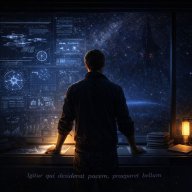
Marcus Sinclair carries memories of a future no one else can see: humanity's first contact, its wars, its extinction. Reborn in 2130, he has decades to prepare Earth for threats lurking beyond the Mass Relays. Scientist, strategist, prophet unheeded. He builds from the shadows, knowing the price of failure is annihilation.
Igitur qui desiderat pacem, praeparet bellum.
Last edited:
0000: Prologue

USSExplorer

Doing what's necessary, even if it causes chaos
Joined
Mar 4, 2019
Messages
664
Likes received
38,425
0000: Prologue
…​
The Edinburgh of my last life, a century before this one, had been far different. It had only grown greyer and grimier as the years passed. The Edinburgh of this new, second life gleamed. The trams ran silently on magnetic rails, and the castle had lights installed that adjusted depending on the weather. Even the air smelled cleaner, as if someone or something had scrubbed it, so that it felt as if I might've been standing in the middle of a field instead of a major city.

As I had that thought, I was sitting on my bed, a datapad before me, with its screen casting a pale light on my face. I was eight now and had accepted that this really was a new life, and not some trick of my mind. How I ended up here remained a mystery, as I'd gone to bed one night in my former life and awoken in this as a baby in a crib.

My name in this life was Marcus Cormac Sinclair, one that bore no resemblance to that in my former life.

My early years, before I was able to speak, had been spent in the silent terror of my mind, trying to understand, adapt, and then accept that this was my life now. I could recall most of my former life, from my childhood to being a father and grandfather, but now, after eight years, it felt more like a bad dream, and the emotions I'd endured in it, and in becoming Marcus, had faded.

I'd learnt to walk and talk ahead of schedule, impressing my parents, Fiona and Ewan, though it seemed they attributed this to a genetics suite that all children received now, one introduced in the 2120s. In the years since, I'd continued to impress them, though as I grew older year by year, I began to sense that there was more to my accelerated learning and development than a standard gene alteration.

That gene suite was one of several technological markers that made clear that this world wasn't merely a continuation of that reality, quite apart from it being well over a hundred years forward in time from my last life. The technology was, by and large, more advanced, but it went beyond that, and the pad before me contained my records detailing such differences.

The major ones were the easiest to spot, starting with no 9/11 in 2001, and then no COVID outbreak in the early twenty-first century. Politics seemingly hadn't fractured after those events either, at least not to the extent I remembered from my former life. There had, however, been events with no counterpart in that former life.

There had been a period around the middle of the last century called the Oil Wars. Conflicts, small and large, public and in the shadows, had been fought over dwindling natural resources. Then, after a revolution in energy generation, it was as if someone had flicked a switch and the world entered an era of peace and stability that has existed to the present day.

The issues of my former life, and the scepticism that had evolved there, had carried over into this life, and it made me question everything far more than any child should, perhaps more than most adults did. Enough that I found myself seeking clues to some shadow conspiracy taking place around the world, at least as far as my limited network access allowed, as children were restricted in what they could discover online, and I wasn't yet willing to test how far I could push the systems.

Yet, for all that the apparent distorted truth of this world unsettled me, what worried me more was myself, or more accurately, what I was capable of. For all that I appeared normal, fitting the expectations of someone who'd undergone the genetic enhancement suite, I was convinced I was beyond it.

At first, when I picked up things faster than expected, I'd put it down to simply remembering details and facts from my last life, or reasoning more maturely than a child should. Yet, as I began primary school, I had the first hint that it was more than that.

A cup had slipped from a table, though I only realised that once I was holding it. I'd placed it back on the table quickly, avoiding anyone seeing what had happened, but that reaction, which seemed to move faster than my conscious mind could process, had caused me several restless nights. Even now, three years later, it continued to torment me.

My body seemed, from limited testing I was willing to risk as a child, to be beyond what it should be: not just the baseline, but the gene suite as well. How far beyond, I didn't know, but it extended to my mind as well.

Even years later, I could clearly recall any random page I had read once in preschool. I could copy a musical piece after hearing a teacher play it once, at least as far as my young body would allow, and I understood things that I shouldn't, that I had no memory of ever learning in my former life.

Everything about me was dangerous, perhaps to everyone around me. I'd come to suspect that this had something to do with my rebirth, but beyond that, it was a mystery that would take decades to understand, perhaps even a lifetime.

Sounds from downstairs reached me when they shouldn't: my hearing, like my other senses, was enhanced far beyond what it had been in my last life.

Callum, my younger brother, was running around causing havoc as most three-year-olds did, while my dad, Ewan, moved after him. Mum was in the kitchen; I could smell her preparing dinner. Keira, my older sister, was in her room, her music as clear to me through two closed doors as it would be if I were there with her. Hell, when I placed my feet on the floor, I could sometimes catch faint vibrations from the music and other sounds that no one else seemed aware of.

They were my family, the Sinclairs, and I loved them as they loved me. Yet I recalled another family, one that included my grandchildren, making it hard to fully accept my place here. It had taken me years to move beyond faking affection for them; not until Callum's birth, when I first saw him after he came home from the hospital with my mother, did I feel a tug at my heart the way I'd felt for my children and grandchildren in that former existence.

My focus returned to my datapad. I'd been given it as a gift last Christmas, and it was beyond what a child my age would normally need, but my parents had been willing to give it to me as I was smarter than my age suggested, even accounting for everything else. I'd altered it to deny outside access, restricted access to cloud storage, and installed a pass-string that would be extremely difficult for any current system to crack, or so I hoped.

I was being paranoid about the security, but as the pad held everything I knew of this world and of the one I'd come from, and everything about this one that was different or felt off. They were the sort of records no eight-year-old should have, yet I wanted it all set down in one place, just in case something happened to me.

Even if I did nothing, I'd have to be careful in this life. My body and mind were further beyond the baseline than they should be; that alone would need managing if I was to enjoy this life. Though I did wonder if that would ever happen. Ever since I'd become certain I was different, I'd had a sense of unease about the future, as if something was lingering there, just out of sight and reach, deep among the stars.

Where this new life led, I couldn't say, but I wanted to enjoy it as best I could. This was a new Earth, and I had to live in it. Whoever or whatever had given me this second chance didn't matter; what did matter was what I did with the chance I now had.

---***---​
Roughly a year later, I was at the kitchen table with my parents, looking at a cream-coloured paper bearing the crest of Caledonian Academy. That they had sent a physical letter instead of merely reaching out electronically gave some sense of their standards and values, along with a slightly anachronistic feel that indicated the age of the Academy.

Both my parents were surprised by the letter when it arrived that morning, and as they continued to look over what it said, I noted with amusement that their breakfast had gone cold.

"They don't usually offer places to children your age," my father said. I was certain he was already working through the implications of them reaching out, his mind geared towards engineering as always. "It's normally twelve for such places, maybe eleven. You're not even ten, and they're reaching out. And how did they know to do that anyway?"

How they had known wasn't something I could answer, but I suspected that Caledonian, along with other such academies, had access to the education system. Such access was meant to be illegal, but perhaps the same methods that had existed in my former life were present here, though the Pound, along with other currencies, had been replaced by the World Credit in most places.

I'd already researched Caledonian and other places like it extensively, as I'd planned to apply for entry next year. That they had made their move now wasn't unworkable. They weren't the most famous, nor the richest, but their academic reputation and connections to key universities and industries in the UK and the European Federation would be of use.

I'd felt a draw towards the sciences over the last year, and if that was the direction I wanted to take, then Caledonian was one of the better choices: critically, it was in Edinburgh, so it'd be easy to study from home.

"Marcus." My mother's voice drew my focus, her tone carrying a hint of suspicion. "Did you apply for this?"

"No," I replied honestly with a shake of my head. "My teachers must have submitted something. I think Mrs Patterson mentioned a programme for advanced students last term," I added, offering a reason that should ease some of their concerns.

My parents exchanged a look, one I'd long since learnt to read, having once been a parent. Concern mixed with pride, that uncertainty of how hard to push their child, since I was clearly capable of more. I'd hidden most of what made me different, but I'd let enough show that I stood out without being lauded as some sort of prepubescent genius.

"It's definitely a good opportunity," my father commented slowly. "You'd get better teaching and resources, but you'll be years younger than anyone else there. That could be a problem."

Mum reached out, taking my hand in hers. She didn't say anything; her feelings, ones that echoed my dad's, were written over her face.

"I want to go," I said firmly, letting some emotion enter my voice. "School now is boring."

I didn't need to lie or manipulate them; what I'd said was true and accurate. The local primary couldn't compete with Caledonian in any way that mattered, nor could any of the other local private schools. The chance to have the Academy's name on my CV, and use it to open doors to university once I was finished, was worth taking, even if it meant I'd be surrounded by boys and girls two years older than me.

Friends hadn't been easy to make at preschool and primary. I found it hard to mix with the other children when my mind carried adult memories and worked at levels theirs simply weren't currently capable of. The same would be true, though to a lesser degree, at Caledonian, though friendships made now rarely carried into adulthood in any case.

"You're sure?" Mum asked. "Once you accept, you can't go back to your old school."

I nodded. "I'm sure." I met her eyes, letting her see my appreciation for her concern. They might not be my first family, but they were family, even if I was keeping that at a slight distance because I was different. "I need to learn, Mum, and I'm bored now. I want to see if this place will be better for me."

My mother had spent years throughout her career learning to read subtext in what was said and what people meant. Something I'd learnt after discovering her work involved advising government officials and others on policies. She'd know I was holding back, but she'd never come close to guessing what it was.

"Alright." She squeezed my hand once before releasing it. "We'll visit next week. See the facilities, meet the staff. If it still feels right after that..."

"It will," I finished, certain that the path was before me.

I reached out, running my fingers over the paper. It was an oddly soothing sensation, since paper was rarely used in this era. My eyes examined the Academy's logo, the same lion rampant as one of the flags of Scotland, though navy blue instead of red.

There would be challenges at Caledonian, from older students, teachers, and others, but I was prepared for them. Judging how much to reveal about myself and what I was capable of would take time to assess, but even as I held back, I understood the time there was a mere stepping stone to what came after.

That feeling of danger from the stars was always present, as was the pull towards science, engineering, and mathematics. I'd enjoyed those subjects in my first life, but the tug in this was more than simply carried-over memories: those fields, in some way, were going to matter in the future. I could only hope that, when I finally discovered why, it wasn't too late to deal with whatever threats lingered in this reality.

---***---​
I looked up at the iron gates of Caledonian Academy, noting the same lion rampant on them, painted the blue of the Academy so it stood out to any that passed by. Beyond the gates, which slowly opened for me, I saw buildings that dated back centuries sprawled across a campus befitting a private educational institution that held more wealth and influence than most people realised.

As I walked along the gravelled path, my shoes clipping against the loose stones, I noted the other students who were moving around, getting settled in as they returned or prepared to start the new term. All of them, like myself, wore the school's blazer, with trousers, shorts, or skirts depending on gender. The new students, be they first-years or transfers, were the easiest to spot, being the nervous ones by and large.

Many were moving to and from the large buildings at the edge of the campus, the boarding halls. As Caledonian was close to my home, I didn't need to stay in them, one of the reasons I'd chosen this academy over others, as it eased some of Mum's concern.

Once nearer the main building, many looked my way. At only nine, though I'd be ten in October, I was younger than my new classmates by two or three years. That I was wearing the Academy blazer meant I was a student, and I easily caught the snippets of conversation my presence generated.

"Why's a kid here?"
"Shouldn't he be in primary?"
"Whose brother is that?"
"Why's he wearing our school jacket?"

Their words carried a range of emotions, from confusion through concern to, in a few cases, outright dismissal and irritation. I ignored them all as there was no point in trying to deal with them now. They'd learn at the first assembly that I was a new student, and then, once classes began, that I was more than worthy of my place. After that, it was up to them how they reacted to my being a fellow student.

I'd be here six years at most, though I suspected it might be less. I could probably pass the university exams now, but I was maintaining the position of being smart for my age, not some super genius. I was far too young to want or need that sort of attention, and the longer I had to prepare myself for my adult life, the better I'd do.

No, Caledonian was just the first step in a career that I had already partially mapped out. Where it would fully lead wasn't clear yet, but I had years to determine that, and the course I wanted to follow after the Academy.

As I moved through the corridors, towards the main assembly hall, I saw several senior students, wearing badges that marked them as prefects, look my way dismissively. As if I was a child who didn't deserve to be here.

Once it became clear that I was publicly better than most of them, they'd react like kids always did: either by ostracising me or seeking to exploit me. The same tricks that adults used, though with far less skill and experience.

Part of me was looking forward to the challenge, not because I felt it would be worthwhile, but because it would at least offer some way to pass the time while I was here.

My future was beyond this place, as were, I hoped, the answers to why I'd been granted this second, initially unwanted chance at life.

---***---​
A/N: Welcome to my newest story. Like the others, this will be a slow burn with world-building involved over a long ride.
 
Last edited:
0001: The Academy
0001: The Academy
…​

"Monsieur Sinclair, perhaps you'd like to attempt the passage?"

The tone of my teacher, Madame Fournier, suggested she thought I wasn't paying attention. Yes, my mind had been elsewhere, but I knew what she was covering. Still, to give the impression I wasn't certain, I glanced down at the datapad and the passage she was referring to.

It was a simple one about a family visit to Paris, the sort of introductory text that was meant for new students, which was what I was. The issue was that I already knew how to say it; Madame Fournier had repeated it ad nauseam over the last twenty minutes, but I'd only needed to hear it once to be able to reproduce it perfectly. That I understood the grammar rules to advanced levels only made the class even more uninteresting.

I read the paragraph aloud, getting it correct bar a single moment. That was an intentional flaw introduced to hide how easy I was finding things, a tactic I'd been using in all my classes during this first semester at Caledonian.

Madame Fournier studied me as I spoke, her eyes narrowing as she did so. Perhaps she was annoyed that I had done such a good job with the passage, or perhaps she felt I wasn't pushing myself. The latter was true, and intentionally so.

I could easily have rushed through the curriculum; nothing about this class or the dozen others was in any way challenging. However, I'd already determined that graduating before I was old enough to be taken seriously, and not viewed as some child genius to be considered a freak, was the best path for me. That it would help limit attention on me, and the differences between me and any other gifted student at Caledonian or elsewhere, was another major factor in the decision.

"Your accent is remarkably good for a beginner," she said. "Have you studied French before?"

"My grandmother speaks it sometimes," I lied, speaking with the confidence of a child who shouldn't know any better. "I must have picked up more than I realised."

My grandmother had tried to teach me a foreign language when I was still a baby, but that had been Spanish. Just as with Madame Fournier, I'd pretended not to understand it perfectly, though I was already confident I could speak the language well enough to hold a decent conversation. The same was also true of French, though no one knew either of those facts.

Madame Fournier held my gaze for a moment before she looked away, seemingly accepting my answer.

The other students, all two or three years older than me, didn't know what to do about me. I was younger than them but, as with every other class, I was already sitting near the top in French. Again, I could easily be top, but I chose to sit just below that level to avoid too much attention; the effort to maintain such a low level was more taxing than anything else that had occurred in my first months at the Academy.

The others still regarded me as something of an enigma. Most ignored me, unable to deal with a child better than themselves, though a few tried to interact with me. I maintained a cool stance with everyone, not yet seeing anyone who might be worth staying in contact with once we graduated. I hoped that would change; otherwise, the boredom of the first few months was going to grow heavy as the years ticked away.

---***---​
I sat quietly as Mr Hartley handed back the mathematics test. He moved through the rows, passing out the papers with the presence of someone who'd been doing this for decades yet still retained a love for teaching.

I watched and listened to the other students as they looked at their papers, their reactions ranging from delight to disappointment and all of them easy to read. I knew the pitch, tone, and accent of every other student in this class, and in every other class I took, by heart. Something I'd wasted time on simply to alleviate some of my boredom while maintaining my current level.

As my paper landed on the desk, I looked at the score blazoned on it with fake delight. Ninety-five per cent, based on the scores listed without names on the class display, meant I was top by three marks. Impressive, but I'd been aiming for eighty-seven per cent to maintain the appearance of being good, but not the best. It seemed I'd underestimated the ability of my classmates this time.

Mr Hartley returned to the front of the classroom once he'd handed out all the papers, and the names were then displayed against the scores. "Well done, Sinclair."

I felt the weight of the other students' gazes as they looked at me. This was the first time everyone had lost to a child, and I could already tell how many of them would react to the embarrassment.

Most would simply be angry with themselves, and with me, for the result; some would whisper more loudly behind my back when they didn't think I could hear. A few, perhaps, might even attempt to respond. Those who did so in the class, seeking to regain their places, were at least worthy of respect. Those who chose a more aggressive, external reaction would be a problem, one that so far I'd managed to avoid at Caledonian.

I took a photo of the test, sure Mum would want a record of my performance. Otherwise, I was already putting the moment away, though I was adjusting my plans for the next test. I'd likely return to my sub-ninety position, though already, barely halfway through the first semester, I was beginning to wonder if I'd be able to keep up the charade for another five and a half years.

---***---​
My second year at Caledonian had seen me advance into Third Year academically, making me another year younger than my new classmates. In the end, I'd done well enough in the final tests for First Year that the teachers and administrators had suggested I advance an extra year to see if it challenged me. It didn't; the work was as simple and uninteresting as ever, but the fact I'd stood out even while trying not to was unexpected.

Holding myself back was more troublesome than I'd realised, and even though I was still doing so now, at least the standards of what we were learning made it easier to manage where and how to make mistakes to hide the truth of my intelligence. Of course, that tactic had already failed in science, the class I was currently in.

Dr Morrison, having realised that I was both interested in the subject and finding the coursework easy, had shifted my desk to the back of the classroom. In an attempt to stimulate my mind, she made sure the work waiting on the desk when I entered was more advanced than what she was teaching the rest of the class. It failed because the work was still at a level that didn't require me to push myself, but the attempt was appreciated, as was her not constantly trying to encourage me to advance another year or hold me up as an example to the rest of the class.

The rest of the class were all fifteen or sixteen, and being compared to a boy a month shy of his eleventh birthday wouldn't have done them any good. Something a few of my other teachers had yet to learn, though they also didn't have me doing advanced work for the year.

The only class where I clearly struggled was Physical Education, though again that was because I was hiding the truth of my abilities. I played the part of a boy better than normal for his age, but still slower and weaker than classmates who were years older than me. It was the only place where they didn't look at me with anything approaching contempt, though several did try to use it as a place to lord over me simply because they were bigger and older.

I didn't rise to the bait, a restraint that would, I expected, soon see most of them pull back from trying to anger me. There was no point in letting them get to me, and learning how to manage my reactions and abilities was, I'd come to realise, the greatest benefit of being at Caledonian, at least when one ignored that the Academy's name would make entry into elite universities easier to arrange.

"Marcus." Dr Morrison's voice cut through my thoughts. "Would you walk the class through the third problem? I think they'd benefit from seeing your approach."

I stood and moved forward. This had become a regular trick Dr Morrison used to ensure I remained a participant in her class. The others watched me move, their faces doing a better job than those of my former classmates at hiding their feelings at having a younger student guide them through a problem, though not enough that I couldn't read every emotion present.

Even as I guided them through the work, my mind was wandering, travelling down the pathways that the equations opened. As had happened a few times before, I felt as if I could see new directions to head, ones that didn't align with any of the work I'd learnt, in class or privately. It was almost as if something was whispering into my mind, offering hints as to what the future held and why I had this second life.

"Excellent," Dr Morrison said when I finished. I had barely been paying attention to my own words, yet had never appeared inattentive. "Clear and precise, as always."

I returned to my seat, accepting the praise with a nod. I could feel my emotions shifting under the surface, the desire to dismiss the praise as unworthy of my time. The arrogance that I'd warned myself to be careful of when entering the Academy was growing stronger in my second year here, as was the disappointment that I'd still not found any other student who might be worthy of keeping in contact with once I graduated and moved on to university.

Given I was smarter, stronger, and better in every way compared to my classmates, it was hard not to look down on them, but I had to contain those feelings. Standing out too much now risked attention I felt certain I didn't want or need.

Child geniuses were, to the general public, a curiosity, but to those with power and influence, they were likely tools to be controlled and leashed. That was something I wasn't going to let happen to me, which meant the charade needed to be maintained. Yet I wondered what it would feel like to finally remove the self-imposed shackles and see what this body and mind were truly capable of.

---***---​
I sat in the front row of the Great Hall of Caledonian Academy, waiting patiently for the ceremony to begin. I'd first entered this hall when I'd been nine; now, at fourteen, this would be the last time I stood here as a student.

My eyes, as they had done before, moved around, taking in the plaques on the walls where former students were remembered, both those who had stood out while here, and those who had gone on to do great things afterwards. Names of judges, politicians from across the spectrum, scientists, figures of industry and others worthy of note were remembered on those plaques.

The newest plaque, one that was currently covered, though I knew whose name was on it, kept drawing my attention. Pride swelled in me at what was currently hidden, though in truth, that plaque was, like my time here, merely a stepping stone to a far greater future. Still, being the Dux Scholae, First Scholar of this graduating class, marked the first clear moment where my name would be remembered.

I shifted in my seat, the ceremonial robes uncomfortable on my shoulders. Not because of the weight of history, but because they weren't meant for a fourteen-year-old to wear. I could've reached this point in half the time, but I'd held myself to a pace that wouldn't draw attention. I'd be entering university young, but not so young that I could be ignored or dismissed as some sort of freak of a prodigy that others didn't know how to deal with.

The whispered excitement of the other graduating students had me looking down the row at them. Most were still unworthy of my time, but a handful had shown promise, either because of their grades or the families they came from. I'd done what I could to form connections with them on the chance that any might be useful contacts for the future, but I suspected I'd be moving on to greater, headier things than any of them would be able to comprehend. I just wished I had some idea of what it was that gave me this drive, and that kept hinting that something dangerous lurked far above us, among the stars.

I'd used the time here to fully examine the history of this world compared to that of the one I had come from. The divergences started, as I'd already determined, in the late twentieth and early twenty-first centuries, but they had only grown wider as the decades passed.

The most glaring of these focused on North America and East Asia. In both places, the dominant nations, the USA and China, had undergone massive changes over the last century. The US had entered a second civil war, one that dragged in Canada, Mexico, and many of the smaller Central American nations. In the end, the area had unified into the United North American States, though only after the Statue of Liberty had been destroyed in the war.

In China, the CCP had fallen, sending the country spiralling for a few decades until the new government and nation, now called the Chinese People's Federation, had regained control. That meant the two great powers of my former life had been weakened greatly, and while they remained imposing, the chaos each had endured had allowed other blocs to rise, such as the European Federation, which had evolved from the EU, crafting a truly multipolar political world.

All the textbooks and reports suggested that, now that the chaos was over, these changes had left the world safer and more peaceful, but I had my doubts. There were too many little moments where it made sense that some group, or groups, had guided events to suit themselves, enough that, with my sceptical nature, I was more certain than ever that the world was being controlled by various groups working from the shadows. Groups that would, I was certain, take an interest in everything about me if I ever stood out more than I currently did.

I'd stand out more once I began university, and likely more still by the time I graduated, but by then I'd be an adult, or close enough to one that I'd have some control over where my future was heading, and be able to better prepare for any attempts to control and manipulate me.

"Marcus Cormac Sinclair."

I refocused my thoughts as Headmaster Buchanan's voice echoed through the hall, stating my name. Standing slowly, I patted down my robes and then waited as he continued speaking.

"In recognition of your exceptional achievement across all disciplines, for scholarship that honours the finest traditions of this institution, and for conduct befitting the ideals we hold dear, the Academy is proud to name you the Dux Scholae of the Class of 2145."

Applause filled the hall as the Headmaster finished, and I walked towards him. I accepted my medal as Dux Scholae with a handshake and then turned to face the students, parents, and faculty. I easily picked out my family as they sat in the fourth row, behind the faculty and returning figures of note. Both my parents were smiling proudly; Callum was waving excitedly, while Keira rolled her eyes, trying to imply she was bored when I knew she was just as proud of me as our parents.

My gaze shifted, taking in everyone else present. My classmates all seemed content with my position, their resentment having lessened over the years, often morphing into respect as I helped them when they needed it without being condescending. Our teachers looked on proudly at the young minds they'd helped to mould, while the returning graduates and other figures of note watched with curiosity as a child far younger than they had expected was named Dux Scholae.

Their interest in me would only grow as I moved forward, of that I was sure. They might think I was predictable, a young genius worth watching, but they, along with everyone else, failed to realise that I hadn't even begun to rise.

---***---​
 
Last edited:
0002: Foundations
0002: Foundations
…​

I stepped towards the lectern slowly, adding just a hint of uncertainty to my movements as everyone would expect from a child of fourteen about to address a room of several hundred people. As with most of my actions at Caledonian, it was a façade to hide the truth about who I was and what I was capable of.

I waited for the applause to fade, letting my eyes sweep over the Great Hall once more as if taking in the moment. Like with everything, I'd prepared for this speech, having been informed of my selection as Dux Scholae a few weeks prior.

"Headmaster Buchanan, distinguished faculty, parents, and fellow graduates," I began, my gaze moving over the assembled rows. "It is an honour to stand here as Dux Scholae, and as I look at everyone, I am reminded that none of us achieves anything alone."

"First, I want to thank my teachers, who saw potential where others might have seen only a child too young for his surroundings. Dr Morrison, Mr Hartley, Madame Fournier, and so many others challenged me to reach further, think deeper, and question everything." I paused there, letting my words sink in before dropping the next beat. "Even when those questions made you uncomfortable."

As I'd hoped, scattered laughter filled the Hall, with most coming from the aforementioned teachers, men and women who had, after Dr Morrison's example, allowed me to learn beyond the curriculum when it was clear I needed to be pushed.

"Next, I want to thank my family." My eyes found them in the fourth row. As I looked, my father, in shirt and tie, sat up straight while my mother looked on proudly. Callum waved even as Keira maintained the faux-disinterest she seemed to favour in her late teens. "It was your love and support that helped me see I was meant to grow. Everything that I am, and what I might become, is because of your love and warmth."

My gaze shifted to the front row. "And to my classmates, who I've spent the last few years with in the halls and buildings of the Academy, thank you for letting me be. I know that some of you resented me when I was first pushed into your year, seeing me as a child who shouldn't be there. Now I hope that all of you, after our friendly competitions over the years, have grown because of my presence, just as I have grown because of yours."

I looked out again, taking in the others present: families of other graduating students, returning former students, and others watching with varying levels of interest. I saw several figures from various universities who had already reached out to me and might well do so again afterwards, hoping to convince me to attend their university.

The fact that I was being, in essence, head-hunted for courses was a nice change from my first life. There I'd had to go through the standard procedure of applying, meeting grade requirements, and then hoping I did well enough in my tests to earn my place. In this life, the universities had come to me even before I'd applied, trying to sway me while speaking about the facilities and links each centre of learning held. It fed my ego to see them recognising my potential, even if they remained blissfully unaware of just how great that potential truly was.

"The Academy's motto is Per Scientiam Ad Astra: Through knowledge, to the stars. For over two centuries, those words have inspired students to reach beyond their grasp, to push the boundaries of what is known, and to seek understanding of the universe around us."

"I believe our generation stands at a threshold. With Eldfell-Ashland's extraction of Helium-3 from Saturn, the construction of Gagarin Station, and the increased focus on Mars and deep space missions, the future lies up there, among the stars. We are finally developing the tools needed to answer questions that have haunted us since our ancestors first looked up at the night sky and wondered what those little dots of light were."

I looked around even as I continued. "Soon, I believe, we will finally have those answers and unlock the mysteries that will, I hope, benefit all of mankind."

My words drew a gentle round of applause, and I paused to allow it to end.

"Now, I don't know what we'll find out there," I added with a disarming chuckle. "None of us, or so I hope. But I'm certain that we'll find something that will change everything we think we know about our place in the universe. And when that day comes, it will be this generation, the ones sitting in this hall, taking their first steps into the world beyond the protection of childhood, who must be ready to face it."

As I spoke, I studied the eyes of the students who were graduating with me. Some nodded along, seemingly enthused with my words, but most seemed uninterested, as if the idea of anything to do with space wasn't worth their time. On a world of billions, with few chances for anyone to leave the atmosphere, that was to be expected. That I was still young and, for all my potential, unimportant in any grand scheme, only added to the sense many likely held: that I was talking without any real understanding.

In many ways, they were right. Yet I knew there was something up there, something that called to me and might perhaps shed light on why I'd been given this second chance at life. If I was right, and there was truly something waiting for us among the stars, then perhaps some might look back at this speech and see a visionary, though how that might help me remained uncertain.

"So, as we leave Caledonian, I ask you, my fellow students, and those here today to congratulate us, to remember: Knowledge isn't just power; it's a responsibility. It's the foundation we build when we don't yet know what we're building towards. Just as I intend, I want everyone to learn all that they can, to question everything they're told, and to push beyond their limits, searching for the future that awaits us all."

"Per Scientiam Ad Astra. Through knowledge, to the stars. I intend to gain that knowledge and then move out into those stars. I hope that some, if not most, of you will join me."

As I stepped back, the applause returned, louder than before. I didn't know if it was merely them being relieved I had finished, or if my words had sparked something in them. I hoped it was the latter, and that they would, with me, move forward to see what lay over that next hill, to seek out new worlds and, if they existed, new civilisations. To boldly go where no man had gone before.

I chuckled at recalling where those words came from: a story that had existed in this reality just as it had in my former one. My laughter, unplanned and unscripted, seemed to amuse several of those watching me.

As I moved back to my seat, I looked at my family again. Callum was moving animatedly, though Keira was doing her best to ignore him. My parents clapped with pride, though I was sure my mum worried over my words and what they implied for my future. She would, I knew, always worry over me, as every mother should.

---***---​
"It's boring," Keira announced while sprawled across a sofa, datapad in hand, as I entered the cottage with Dad.

We'd just returned from shopping to stock up the holiday home we'd rented in Ireland for the summer, and already Keira wanted to head home. The house was isolated from any major town or city, and we'd reached it via an electric transport with extended range, something Dad had insisted upon, and Mum had teased him about.

Given the dearth of charging points away from major population centres, Dad's concern had been warranted, and while the rest of my family didn't seem concerned about that, I wondered if perhaps there was a reason for that scarcity which went beyond cost. Part of the reasoning might have been to keep most people in the cities and towns, as they were easier to control and monitor there. I might well be seeing threats and danger where there was none, but I remained convinced that groups were working in the shadows to guide and influence everything, from nations and companies to people, for some unknown reason.

"It's peaceful," Mum corrected my sister from the kitchen as she waited for us to bring the food so she could prepare dinner. "There's a difference."

"The difference is whether you're old enough to appreciate it," Dad added, as we carried the shopping to the kitchen.

The holiday had been arranged so we could spend the summer together before I began university. Mum was relieved that I'd chosen Edinburgh, meaning I remained close to home, though my reasons had little to do with that and more to do with the university's reputation in the fields that I was drawn towards.

***​
The holiday passed without any issues, though on the final evening before we returned home, Mum called me for a walk. We walked along the cliffside, looking out on the Atlantic as the sun set.

"Are you ready for university?" she asked as we walked, finally bringing up the topic that I was certain she'd been focused on throughout the summer.

"I'll be fine," I replied, knowing that little of what I said would ease her concerns.

"I'm sure you'll do great in the lectures, but you're not even fifteen, Marcus. Everyone else there is going to be seventeen or eighteen. You'll be the only child in rooms and halls full of young adults."

I chuckled. "I'm not going to do anything stupid because they want me to."

She paused and looked at me directly. "That's not what I meant, and you know it."

"I know, but I figured you'd want to hear me say that at least," I replied truthfully. Having been a parent in my former life, I knew the fears a parent felt when sending a child off to university, watching them take those first steps out of the nest and spread their wings.

"When you're old enough, you should enjoy your life," she said slowly. "But you're a child, Marcus. You have a brilliant, beautiful mind that makes you driven to push faster than most, but you're still a child."

I moved closer. "I know, and that's part of why I chose Edinburgh. So I'd be close to home if I ever needed to return."

She didn't respond verbally, choosing instead to pull me into a hug. I returned it and let the silence linger as she held me. When she pulled back, she looked me directly in the eyes.

"I know that's not why you chose Edinburgh, darling, but I'm still happy you're going to be close to home." She reached out, pushing some of my hair from my brow. "Just be careful, okay? People are going to see your youth as something to resent and mock, if not exploit. You're my brilliant, beautiful son, and I don't want you to lose the drive that's carried you this far."

"I won't, don't worry." I knew I wouldn't; I wasn't a normal teenager, nor even what most believed me to be.

I was more than capable of handling older teenagers and young adults, and had already mapped out the path I wanted to take at Edinburgh. What came after that remained vague, mainly because I knew plans changed the moment they were implemented, but the reason I had been given this second life would become clearer at university. Of that I was certain.

---***---​
I walked through the corridors of St Leonard's Hall, amused that the building appeared ancient from the outside, yet inside held all the trappings one would expect of the most modern facilities. As I reached my room, I pressed my finger against the scanner, unlocking the door.

Inside, the posters and books already lying around half the room made it clear the other occupant had arrived earlier and chosen his side. My eyes scanned the posters, seeking some hint of the person I'd be sharing the room with for the next year.

The main one was an image of a double helix with the caption "Know Thyself" underneath. Between that, the datapads covering his desk, and a physical copy of a book by Dawkins, I already had some inkling of his chosen field. That said, my roommate wasn't present, and I moved to the empty side of the room and began to unpack.

I didn't have much: a handful of datapads, including the one carrying all my notes on the variances between this world and my former life, along with some clothing. I didn't need much to begin with. The university provided all the literature and resources that any student needed via the network, though everything that was downloaded was tracked, which was something I'd have to be wary of if I felt an interest develop outside the fields I was here to study.

A faint chime reached my ears, pausing me as I worked to unpack, and I looked at the door as it opened.

"Ah, the prodigy arrives."

The speaker was sandy-haired, with the kind of open face that suggested an ease in social situations. Based on the slight accent, I'd place him as Dutch or possibly Flemish, as I hadn't learnt either language well enough to tell them apart. Still, I'd see if I could pick up some of his native tongue to add to the small repertoire of languages that I was developing.

"Marcus Sinclair," I said, standing fully and extending my hand, though I was still far short of his height.

"Lars Brenner," he replied, shaking my hand, a cup of tea in the other. His grip was firm, adding to the confident air he projected. "Human evolutionary biology. The university warned me I'd be sharing with someone 'exceptional'. Their word, not mine."

I smirked, wondering who had called me that. "They have a gift for understatement."

Lars laughed, and it sounded genuine. "Ah, modesty for a genius. How refreshing." He moved away and settled into the chair at his desk, his eyes looking me over. "I was told you were studying physics, right?"

"Theoretical, yeah, along with, I hope, a focus on mathematics and engineering." I glanced at his desk again. "Evolutionary biology seems an interesting choice. Most people choose medicine, don't they?"

"Medicine is about fixing what's broken." He gestured at the book by Dawkins. "I'm more interested in understanding how we got here. What made us us. The genetic bottlenecks, the selective pressures, and those random mutations that accumulate into consciousness." He grinned. "Also, medical students have no social life, and I have my priorities."

I smiled, enjoying the directness. It was a refreshing change.

That his studies might represent an opportunity for me to learn something about what made me different was also useful. How far I could take such research would be limited, but if time allowed, discovering what my limits were, or at least gaining some indication of where they lay, would be worthwhile.

"Fair warning," he continued, "I keep strange hours. I'll often be up until two or three in the morning, reading, and I've been told I talk to myself while I work through problems. If that's going to bother you, we can establish quiet hours."

"I'll be fine; I don't need much sleep."

"A side effect of the genetic enhancement suite?" I nodded, confirming I'd had the suite, just as he and most other students likely had. "Yeah, my sister and I got it as well, though neither of us gained the ability to work with less sleep; everyone responded differently to the suite."

"Was that part of what drew you to studying human biology?"

He nodded, smiling broadly. "Part of it, yes. The suite was designed to improve everyone fairly, but as the first generations to receive it mature, we're seeing variances that are outside expected norms. Nothing concerning, but enough to suggest there are still mysteries among the atoms that make up who we are."

I nodded, not at understanding what he was speaking about, but at being drawn to a subject for reasons that weren't quite clear. "I get by on four hours on average, though the downside is that I get bored easily."

"And the upside?"

I turned and smirked, a hint of challenge in my expression. "I have time to be bored easily."

Lars laughed at that. "We're going to get along, Marcus Sinclair. I can already tell."

I nodded, accepting the comment without response. He was what I'd expect most students to be: observant, social, and comfortable with himself. That he also seemed the sort of person who could be the centre of attention without trying, and noticed gaps in what others said and did, was going to be useful. I needed to learn how to better hide what I was and what I knew, and he'd be the perfect person to practise that on. That he worked in fields outside my own interests didn't, however, limit his value. There was no harm in building connections beyond the circles I expected to move in.

My datapad chimed, drawing my attention.

Settled in?
Remember, you can come home whenever you need to.
Love you.
-Mum


As I sent a message back, I looked around the room. Lars had already turned back to his work, muttering something in Dutch or Flemish as he scrolled through a research paper.

Settled.
Roommate seems decent.
Talk soon.


Lars was going to be an interesting person to get to know, the first of many, I suspected.

---***---​

 
Last edited:
0003: First Semester
…​

The message that I'd been semi-dreading since the start of term arrived on an otherwise slow Tuesday morning. Mandatory health checks for all new students were to be completed by Friday evening. According to the message, it was a standard package, one that involved blood work, genetic baseline, and biometric registration.

I sat at my desk in my room, looking down at the message, projecting as calm an outward appearance as I could.

"You look like someone just cancelled Christmas," Lars commented after finishing his breakfast, which amounted, as it often did, to little more than a protein bar and a cup of coffee. "It's just a standard test; it won't take more than twenty minutes."

"I know, I just don't like doctors," I replied, hiding my discomfort, which it seemed he'd sensed, behind a common issue.

As I did so, my mind ran through the calculations, determining how to handle the issue. I'd already seen this coming since every university carried out such checks, but my concerns over the discovery that my body was seemingly beyond what should be possible with the genetic enhancement suite had lingered ever since I'd realised that avoiding these tests was next to impossible.

It was unlikely that the test would reveal anything about my genome, or that concerns would be sent up the totem pole, perhaps reaching the attention of powerful figures, both in the light and hidden in the shadows. However, the chance it might lingered in my thoughts, and was one of my deeper fears.

"Who does?" He shrugged. "But it's mandatory. A requirement for insurance purposes, I think, along with making sure the university is aware of any unexpected issues. They can't have their students dropping dead from undiagnosed conditions."

I already knew that, along with what they'd be looking for. If anything was detected, they were able to offer genetic corrections free of charge since there were few diseases that weren't curable in the current era. However, this would be the most extensive examination I'd undergone, and as I didn't fully understand what was different about my genome, the risk that they might discover something about me was what fed my fears.

I wasn't sure why I had this life, but I was certain that it wasn't to serve as a lab rat for hidden influential figures to research, dissect, and kill to become more powerful.

"Marcus?" I looked over at Lars, discovering that he was watching me closely. "Is everything alright?"

"Just thinking." The reply came easily, as those moments when I seemed to shut off from the outside world had happened often enough that the response was standard. "I had an experience with a blood test while young: a scary nurse with no manners."

Lars chuckled at the story, though it was the best one I could give. Needles weren't used any more, nor had they been for nearly a century, so that excuse wasn't valid. Dermal extractors were clean, efficient, and, critically, painless, such that even babies could get blood extracted without crying any more than they normally would.

"I doubt the nurses here will be bad."

The way he said that, accompanied by the twitching of his lips, made his thoughts clear. The 'hot nurse' was a fantasy that existed even in this era, and in the more remote corners of the world networks, such entertainment showcased anything the governments and powers-that-be didn't approve of. I'd not gone searching for such areas, preferring to delve for information that hinted at hidden truths of the world, but I'd found them anyway.

The presence of those deeper networks, varying in difficulty to locate and access, helped add fuel to my beliefs in shadow movements around the world that were guiding and shaping the past and present to control the future. It was also possible that they used those deeper networks to monitor those who might expose their secrets, though I'd not found any hints of such things so far.

"Yeah, you're probably right," I replied, putting aside thoughts on the hidden networks.

***​
Since I'd already researched what the university's protocols would be seeking, I hadn't needed to explore them again. The fear that something might be flagged remained present, but not to the level where it interfered with my lectures or was picked up by anyone except for Lars.

I headed to the medical centre on Friday, choosing to arrive as late as possible without forcing those present to work past their finishing time. That should have been the point where they were most likely to be lax, pushing matters through without flagging anything, should the tests detect something of note.

"Marcus Sinclair," the nurse confirmed after I'd placed my university ID card against the scanner. "Physics major." Her eyes flicked over me. "You're last to come in."

"Sorry, seminars ran late." A valid excuse, though it didn't truly matter whether she believed it or not.

"Roll up your sleeve," she said. "This won't take long."

I watched as she placed the extractor against my upper arm. My focus was on maintaining steady vitals as it extracted my blood and read my statistics.

"All done," she reported as she sealed the sample vial barely ten seconds after she'd started. "The results will be in your student health portal within a week. If there are any concerns, you'll get a follow-up notice."

I nodded, already calculating the timeline as I rolled down my sleeve.

By next weekend I'd have my results, and if there was something that drew attention, a notice to come in for further checks. Such a notice would only occur if they discovered my genome was more than it should be, an unlikely event given what they were meant to look for. Still, I'd have to re-examine my contingencies for escape if needed.

I'd had them in place since I'd chosen Edinburgh, and they went far enough that they'd see me slip from the UK. Perhaps I was overreacting, but I felt safer having the plans in place for disappearing and not needing them than being caught without them if the worst happened. I didn't want to run; my family didn't deserve the chaos that would bring. However, I'd be a fool not to have something prepared.

In future, examinations might well be more detailed. If I wanted to head into space, towards that sense of danger, then the tests would certainly be more invasive. There were ways to limit how deep they pushed, but most of those weren't open to me currently. If needed, by then I should have some clue as to how to fake a report and gain access to restricted systems that handled such work, but for now I had to rely on the surface-only depth that was meant to be examined and escape plans that were, I could freely admit, limited in scope and likelihood of success.

---***---​
I glanced at the clock, confirming that we'd stayed here into the small hours of the morning once again. Apart from my partner and me, there was barely anyone in the computing lab; those who were present were focused on their stations, and from the scents that reached me, surviving on caffeine to keep going.

My partner wasn't doing the same. Instead, he let his fingers fly across the keyboard, inputting rows of code at speeds only someone devoted to the art and inspired by an idea could manage. The fact that I could follow every keystroke was another little sign of just how far beyond everyone else I was, because I was certain he wasn't following them so much as knowing instinctively where each key was before he struck it in sequence.

David Chen had been assigned as my partner by our professor in a shared mathematics elective for reasons known only to that man. I suspected he found something amusing, or perhaps interesting, in pairing the physics prodigy, a term that had already formed around me, with a computer science student on a scholarship.

The project, as outlined by the professor, had been a joke. What was intended to take the entire semester to complete had been rattled through by us inside that first evening working together. Since then, we'd started using the time to experiment, crafting something infinitely more interesting.

"The distributed verification layer is solid," David said without looking up from his screen or slowing down his typing. "But I'm still not happy with the key exchange protocol. There's a vulnerability window during the handshake that bothers me."

Even as he kept inputting code, I looked at another screen, scrolling through the code there. I already knew where to look, but I had to manage my responses to avoid drawing attention to myself. I understood what he meant, but getting to the section of code instantly wouldn't make sense for a physics student, even one he knew was smarter than most others. The flaw he was referencing was small, a nanosecond exposure that would be difficult for most VIs to even locate before it passed. However, it was a window of opportunity that I didn't want.

"What if we stagger the verification across multiple nodes?" I suggested. "Distribute the handshake so no single point holds the complete key at any moment."

Even as David's fingers slowed, I knew that was the solution, and what enacting it would entail. "That would require rearchitecting the entire trust model."

"Yes."

"It would also make the system virtually uncrackable," he commented, his mind no doubt playing through the full implications. "Even with the most advanced VI systems."

"That's the idea."

His fingers lifted from the keys, which was something he rarely did when we worked.

"You know, most fifteen-year-olds are worried about hiding their browser history from their parents, but it feels as if you're designing something that could protect state secrets." There wasn't an accusation in his tone or words, but I could sense the questions he wasn't directly asking.

I considered my answer for a moment, weighing how much of it to give.

"I like to be thorough."

"Thorough." He turned back to his screen, but I caught the slight smile that slid onto his lips. "Whatever you say," he added, suggesting he wasn't quite believing the answer but wasn't going to push; not for now, at least.

Silence returned to our work, though it wasn't complete given his typing. The sounds of others doing the same, though not at the same rate, along with the cooling systems and the occasional shuffle of a chair, reached my ears during that silence.

"Can I ask you something?" he asked about ten minutes after seemingly accepting my answer for why I was crafting something far beyond what was required or needed. That he chose to wait until the VI examined the latest batch of code at least gave us something to talk about while we waited.

I smirked. "You can ask."

"Why do you need something this secure? I mean, really need it. This isn't simply an intellectual exercise for you, is it?"

It wasn't the same question, but it reminded me of what others had asked about what drove me to push myself so hard and advance beyond my years. That I wasn't pushing, not even close, wasn't something others could see, but I was used to such questions after my time at Caledonian.

I considered giving him another simple, standard answer that revealed nothing. However, as I caught his eyes watching me and remembered that he was smarter than most of those around me, I wondered if revealing a hint of my reasoning would pique his interest.

"Because someday," I replied, measuring my words, "I'm going to have information that matters. I'm not entirely sure what yet, but I know it'll matter." I chuckled. "Without sounding arrogant, I think it might change the world." He rolled his eyes at the bravado. "And when that day comes, I want a way to control who has access to me and to what I create."

David was silent for a time, perhaps a minute, before shrugging. "Fair enough." He turned back to the screen, though I didn't know whether he truly believed me or was simply ready to resume the work now that the VI had finished examining the last section of code. "Let's build you something unbreakable, then."

I watched him with a small smile. He was a brilliant young man with a great mind, the sort of person who asked questions but, it seemed, accepted that he wouldn't get complete answers instantly. He had potential use as an asset and, perhaps, as a friend.

I wasn't sure I could afford friends, but I was learning that I might need them anyway.

---***---​
I sat at the back of the cramped room, ignoring the looks that came from the others present. That I, a first-year undergrad and a young one at that, was present in a postgrad discussion was unusual enough that it had taken a few weeks for the postgrads not to stare each time I arrived.

I shouldn't have been here, certainly not near the end of my first semester, but as I had completed three semesters' worth of work, bar several projects that required time for the examiners to go over, my advisor had suggested attending since it might offer some insight into what I wanted to do once I graduated.

The advisor likely expected me to be lost in such a discussion or might simply have been glad to get me out of his hair, as dealing with a student who was moving forward at such speed wasn't normal. Regardless of my advisor's reason, I had gained access to the postgrad scheme I was most interested in, or perhaps it would be more accurate to say, I had gained access to the lecturer who offered the most benefit to my long-term goals.

Dr Aisling Okonkwo, Nigerian-born and British-raised, was in her mid-forties and had close-cropped black hair. She'd published several papers directly and assisted on others that had drawn my attention to her. Those papers focused on propulsion systems used by spacecraft, which was why she was a consultant for ESA. Most usefully for my chances of gaining access to the agency, she also had a reputation for spotting and nurturing talent.

"The fundamental constraint," she said as the discussion went on, "remains the trade-off between specific impulse and thrust. We can achieve extraordinary efficiency at low thrust levels, but scaling presents diminishing returns that current models struggle to address."

As she finished, she stepped back from the board, where she'd been writing out an equation. It was something suitable for postgrads, but the more I stared at it, the more I felt it was wrong. Not in the sense that she'd intentionally made a mistake, but that something unaccounted for was missing.

I considered commenting on that, but I held back. I'd only been to a few of her discussion seminars, and engaging with her directly, in front of her postgraduates, might be a step too far and too fast. Being here was enough attention for now; I could move to interact after the winter break.

"Can anyone identify the primary limitation in this approach?" she asked, her eyes scanning the postgraduates.

Beyond the odd shuffling in a seat, silence greeted her question. I caught several of the students looking down at their notes, seeking answers that they wouldn't find.

"Mr Sinclair." I blinked as my name was called, since she'd made no move to engage with me during my time as a silent listener. "As usual, you're sitting back there just watching. Perhaps you have a thought about how the equation is limited?"

For a split second, I considered remaining silent, or passing up the opportunity. Offending the postgrads wasn't something I was concerned about, but showing I understood more than I should, and at a level potentially beyond those same postgrads, carried risk. Yet as she waited on my response, I realised I could advance my timeline because of her.

"The model assumes field uniformity across the acceleration chamber," I replied slowly, choosing to go with full understanding instead of a partial grasp of the material. "But when you're talking about the power densities required for meaningful thrust, you get asymmetric gradient formation. The ions and other elements aren't experiencing a consistent field. Instead, they're being pushed through a landscape that's shifting under them."

Silence returned to the room. Several postgrads looked at the board, me, and Dr Okonkwo in some fashion. Others simply blinked as their minds no doubt worked through my statement and confirmed it made sense. Dr Okonkwo's gaze narrowed, though in curiosity, not confrontation.

"May I?" I asked as I stood, gesturing to the marker in her hand.

Once she handed it to me, I moved to the board and began expanding the equation. I introduced a correction factor for the field asymmetry that came from my mind, not any material I'd studied before today. "If you account for the gradient instability and then introduce a compensating oscillation in the field geometry, it's possible to maintain coherence at power outputs higher than those currently achievable, and with far less degradation in efficiency."

As I finished speaking, the corrections were complete, and I stepped back. Thirteen pairs of eyes were on me, looking at me with varying degrees of confusion, amazement, and curiosity. As the silence stretched, one student, and then a few others, began scribbling down the altered equation that was on the board.

"That can't be right," one of them muttered, though I ignored the challenge, keeping my focus on Dr Okonkwo. Her expression remained calm, but I caught the narrowing of her eyes as she looked me over as if judging me in a new light.

"That's… not in any literature I'm familiar with," she said, and there was more wonder in it than suspicion. "You'll have to walk me through how you got there."

I nodded and turned, gesturing to the board with the marker as I did so. She listened carefully, nodding at some points, still at others. I didn't bother dumbing it down; she was more than intelligent enough to follow the alterations that I'd made without any need for that. I noted with amusement that the same was true for several of her postgraduates.

The quiet settled over the room again as I finished, the postgrads now looking at her, not me, awaiting her response.

"Come to my office during my hours tomorrow," she said finally. "I think we should discuss your… creative thinking… in more detail."

I nodded, and after placing the marker on the small ledge at the base of the board, walked back to my seat. I could feel her watching me go, along with everyone else in the room. I kept my emotions internal. Letting any delight at accelerating my timeline show would only see me judged as arrogant.

The first move to gain her attention had occurred; how things went from here I'd see tomorrow.

---***---​
 
Last edited:
0004: Mentor Found
0004: Mentor Found
…​


As I entered Dr Okonkwo's office, I looked around. It was smaller than I expected and carried a slightly anachronistic air. The walls on either side held bookshelves that, along with various data-storage devices, carried physical volumes of several texts I recognised, and a handful I didn't.

Her desk looked old and was carved from wood, yet the surface was inlaid with smart-glass, allowing access to modern systems. That glass was displaying a holographic schematic, which she collapsed as I moved closer, though I was able to see that it was one that used the alterations I'd proposed in her seminar.

Dr Okonkwo offered me a tense smile as I sat, the window behind her open enough that a gentle breeze slipped into the room. Once I was seated, she continued to look at me, as if judging me more carefully than she had at any point before today.

"I've been reviewing your work from the seminar," she began without any comment on the fact that I'd waited a few days to come. Her offer had been for the next day, but my classwork and projects meant I wasn't free when she was and vice versa. "The correction you proposed has already been run through several of the department's VIs, and I've also verified it manually."

I offered a brief nod at her words.

"It works," she continued as she leaned back, her fingers steepling as she kept staring at me. "No, it doesn't just work; it's elegantly simple in correcting a problem that has been plaguing many for years." Her gaze narrowed. "I've checked every paper that even touches on that work, and not one of them even hinted at the solution you offered in my seminar."

I already knew this, since I'd run the same search in the days after that seminar. The answer had come from inside my mind, drawing on something that didn't entirely align with the current technology of this reality. It wasn't the first time I'd had such insights, just the first time I'd revealed them to others. Each time, they opened new avenues of study that ran counter to current research directions.

I didn't understand where this knowledge was coming from, or what greater picture it was leading to; that was a matter for far deeper introspection. What I was certain of was that the knowledge I could draw on was barely being scratched, and that it had something to do with the sense of danger I had each time I looked at the night sky and felt as if something was lurking out there, just waiting to strike.

"As I explained last week, Dr Okonkwo, it was something I'd been thinking about."

"And for how long have you been thinking about this?" she pressed.

"For the correction?" I shrugged. "It simply came to me during your seminar."

She grunted, clearly not believing me. "It came to you? Only after seeing the equation on the board?" I nodded, which caused her gaze to narrow. "I find that hard to believe, but there's nothing to suggest you're not telling the truth."

She leaned forward, never taking her eyes off me. "I knew you were intelligent, Mr Sinclair. Mr Johnson made sure I had access to your files before you attended my first seminar. However, he and that record failed to mention that you, a fifteen-year-old undergraduate, could see a solution to a problem that has plagued me and others for years."

It sounded ridiculous; I knew that. But it was the truth, or at least as much of it as I was prepared to reveal to anyone I couldn't trust implicitly.

"I just saw a possible answer, that's all, Dr Okonkwo," I replied, knowing she wouldn't believe me.

"That's not much of an explanation, Mr Sinclair."

As I'd done since I'd entered, I held her gaze without reaction. My face remained calm as I kept any emotion that might see me judged as arrogant or condescending hidden. Still, being here in her office, having drawn her attention, was why I'd rushed through a year and a half's worth of credits in a single semester. I'd not anticipated engaging with her until the new year, but I had no issues with accelerating my plans. She was, beyond anyone else at Edinburgh, the key to the next stage of the path I felt I had to walk.

"Dr Okonkwo," I said carefully, leaning forward a touch to match her earlier gesture. "I can't clearly explain where my answer came from, for this or for other subjects that have caught my attention." An eyebrow rose there, as I'd hoped. "I just seem able to look at a problem and…" I shrugged. "See what might be a solution. How or why that is, I can't say, but it's how it works."

I leaned back, resuming my former position as I shrugged again. "I can understand that it's frustrating, because it's been frustrating me for years."

Silence filled her office as she studied me, possibly weighing my words against what she expected, given my file. My answer had been truthful, at least as much as I was willing to reveal, and it framed me as someone with insight that should, I hoped, be nurtured and guided. As with each time someone had looked at me as she was, there was a spike of fear that surged inside me: the danger that they'd sense I was more than what I was suggesting. It was illogical, but given what was different about me, it was something I'd learnt to live with.

"I'm not satisfied with that answer," she said finally, letting some of her irritation enter her tone. "But I'm not going to push because I don't know you well enough to make a judgement. Your insight last week was invaluable, and based on it and your records, I get the sense that you've yet to be challenged at the level you need to be."

I smiled, pleased she seemed accepting of my answer, at least enough not to push too deeply during our first real meeting. That had been a concern of mine for some time. "Thank you."

"Don't thank me yet," she countered, her face shifting to hint at amusement. "What I'm going to propose isn't something that would normally be offered. This insight has opened a new pathway, and I want you to assist me in exploring it and, if your insight appears again, to see where else it leads."

She tapped at the smart-glass, pulling back up the schematic that I'd briefly seen on entry. "This work involves funding from ESA for their next generation of deep-space exploratory vessels. If you continue to impress me, and your grades for your degree don't slip, then when it comes time to publish the work, I'd be willing to consider naming you as a co-author."

I blinked, fighting to keep down my shock. I'd hoped to find a way to earn that position before I graduated, but she was dangling it in our opening meeting. This was another advancement on the timeline I held in my mind, and one that I'd not anticipated coming so soon. It would require adaptation from my initial plans, but as I ran the calculations, the downsides were far less concerning than they might otherwise be.

"I accept."

"I haven't finished," she commented, a smile now appearing on her face. "First, if you fail to keep impressing me, the agreement will end, though your name will still be quoted in any paper that covers the insight you've provided." I nodded, accepting that condition, knowing that I'd make sure not to fail. "Also, you'll be working alongside my doctoral students. Most of them, including my primary assistant, James Okafor, are likely to resent your presence on the team because of your age and status as an undergraduate. Handling that will be your problem, not mine."

I filed the name away, as it wasn't one that had been listed as present in the seminars I'd been attending up until now. That the postgrad students would be angered at my presence, and the fact I'd answered a question no one else could, was something I'd already anticipated. Unlike at Caledonian, I couldn't simply dismiss them as unworthy, as all of them were postgrads, meaning they had potential that might be of use to me.

"I understand."

"Do you?" she asked as one eyebrow rose. "You're fifteen and, from your file, used to outperforming your peers, but this will be different. You'll not be dealing with children but adults who won't be so easily swayed. Then there's the professional jealousy and academic politics that might arise if you prove yourself worthy."

"I'll manage," I replied with a nod as I took in her words. All of them aligned with what I'd already anticipated.

Her eyes suggested she wasn't sure I would, but that was to be expected, and before either of us could speak again, her desk chimed. That was followed by a small holographic notice, one that bore the seal of ESA.

"I need to take this," she said, standing slightly to reach over her desk. "Welcome to the team, Mr Sinclair. Come back next week so we can discuss the specifics."

After shaking her hand, I left the office. The ESA connection was a primary reason I'd chosen her seminars, and as I moved down the corridors towards the exit from the building, I mentally adjusted my timetable for advancement again. In a few weeks, I'd start gaining access to research facilities that would matter and show others that I was worth watching and working with.

Of course, there'd be problems, and not just the ones Dr Okonkwo had outlined. I wasn't the gifted child that she and others saw me as, and I could use that to my advantage alongside my insights. Still, I'd have to be cautious, more so than at any point until now. As she'd said, these weren't children but graduate students, and I was certain I could manage.

---***---​
As the new semester began after New Year, I was in another seminar. This wasn't one run by Dr Okonkwo, but one she'd suggested might be of interest to me. Her name, alongside acing three semesters' worth of work in a single semester, was opening doors faster than I'd hoped for.

Once news of my performance became common knowledge, the attention around me shifted. Gone were the questions about the child in the undergraduate programme, and in their place had risen an excited buzz once news of my position assisting Dr Okonkwo had become known. The University was adapting too, allowing me access to the Third Year from the start of the semester, and half expected me to complete the equivalent of a bachelor's degree inside a year, eighteen months at most. Even with the work alongside Dr Okonkwo and the extra seminars, I didn't feel that would be a challenge.

Today's seminar, led by Dr Simon Allen, was on field coherence dynamics. It was a subject that aligned with the work I was doing alongside Dr Okonkwo, and she likely hoped the seminar would offer me new insights to advance our work. Unlike before, however, I wasn't merely sitting at the back of the class listening but, at the insistence of Dr Allen, presenting that work to the room.

Having a dozen postgrad students listen to my words without looking at me as if I were insane was rewarding, and while I worked to ensure I didn't develop a big head, I allowed myself to enjoy moments like this.

"That assumes linear degradation of coherence over distance, but your own data suggests the relationship is non-linear past threshold densities. You're contradicting yourself."

The voice, cutting in during my presentation, was unexpected, but I paused and turned to see who the speaker was. Elena Vasquez was twenty-one and, unlike most present, an undergraduate like me. She was intelligent enough that she was allowed to sit in on postgrad seminars, and as my eyes met hers, attractive enough that I felt my heart accelerate for a moment.

I offered a smile as I took a moment to gather my thoughts and prepare a response. I'd expected the challenge, just not from her. As she tapped a stylus against the edge of her datapad, I noted a fire in her gaze that suggested she was speaking out because she genuinely wanted to do so, and not simply because I was younger than her.

"The linear approximation holds within current operational parameters," I replied calmly as the others present watched. "The non-linearity only emerges at densities we aren't currently able to achieve."

"Can't currently achieve," she corrected even as she leaned forward, unwilling to look away. "Shouldn't your framework account for the capabilities that we might develop, or are you only interested in describing what currently exists?"

Around the room, the postgrads shifted, watching intently as Elena did something they seemed unwilling to do: challenge the University's new boy wonder.

"That's a fair criticism," I admitted, remaining calm. "The framework is incomplete because I'm still working through the high-density implications."

"Then perhaps you shouldn't present it as though it were finished."

I bit back a chuckle at her blunt response, enjoying the challenge and who was giving it. "I didn't. What I'm presenting is preliminary work that's still undergoing refinement. You're the one who made the assumption."

Her brow tightened for a moment at my turning the challenge back on her. I couldn't clearly tell what the underlying emotions were, but I caught what might be surprise and confusion.

***​
The seminar finished with no further challenges, and I gathered up my equipment. Moving towards the door after thanking Dr Allen for the chance to speak to his group, I found Elena waiting outside.

"You're not what I expected," she said as she pushed herself off the wall. "Elena Vasquez, but somehow I think you already know that, Mr Sinclair."

"I do," I replied as we shook hands, something that caused another sudden increase in my heart rate. "Just as I know you're majoring in astrophysics."

"I'm considering a change to propulsion for my PhD," she added. "Though I'm having second thoughts because of the child genius."

"I hope not," I said as we broke the handshake. "You're the first to challenge me about my work, and your critique was good. The conclusion was wrong, but the underlying reasoning was sound."

"Wrong in my conclusion?" she repeated as an eyebrow arched. "That confident, are you?"

"When I'm right, yes."

She laughed, and I felt blood rush to my skin "I think I'd enjoy arguing with you more often, Marcus Sinclair."

"I think I would too," I replied, keeping my expression calm.

She smiled, pushed back a lock of hair, and then blinked. Whatever had caused the blink seemed to shift her focus, and she moved away. "See you next time," she called out as she left, and I watched her go.

Once she was gone, I frowned. I'd expected to be physically attracted to women as I grew, but Elena was the first to draw a reaction. That she was five or six years older than me wasn't an issue. What interested me was that she was the first I seemed to physically like, and that her mind seemed sharp.

Already I was looking forward to speaking to her again, even if I had no intention of acting on the physical attraction.

---***---​
I stood with Dr Okonkwo in one of the university's laboratories, looking at a curved bank of haptic displays, each running simulations on the latest work we'd developed. This was all built on what I'd shown her in the seminar last year, and even as the blue glow of the displays illuminated the room, I knew the results would confirm the theories.

"The experimental design is solid," she was saying, gesturing to expand a schematic. "We've accounted for everything expected and several things that weren't, and the latest VI predictive models confirm that everything is working within acceptable ranges."

I nodded, already aware of that even before the VIs had started working. They were impressive systems, and great for correlating against known parameters and historical data. Their problem was that they couldn't extrapolate. Their programming prevented such things because of laws that covered AI research and intentionally limited VIs.

Yet, as the latest results came back, confirming her words, I felt there was still an issue. My mind was nagging me about something not being quite right, and while it was irritating that I couldn't yet see it, the fact that I didn't know everything was oddly refreshing.

Of course, the moment I thought that, I found the issue.

"The electrode geometry," I commented slowly. "We've positioned them for maximum uniformity, but that creates resonance patterns at high power that will degrade thrust consistency."

Even as I spoke, Dr Okonkwo was pulling up the relevant sections. "We've already optimised this with three teams and VIs. Everything agreed on the configuration."

"They were optimised for uniformity, not for harmonic stability. The VI wouldn't flag it because resonance at these frequencies isn't in its reference architecture." I paused. "May I?"

She nodded and then stepped back. As I worked, I could feel her eyes on me. "If we offset the electrodes by seven degrees and introduce a slight asymmetry here, you break the resonance pattern," I explained as I altered the code. "That will mean a more even distribution of ions across the acceleration cycle, more consistent thrust, and lower overall wear."

Once I finished, I turned back to face her. Her eyes were on the altered code and schematics, changes that the VIs were already recalculating and thus projecting new data across the various displays.

"That's…" She paused and looked over the results as they were displayed. "That's not an obvious insight," she said slowly as if still working through what my changes meant. "I don't think anyone else would've seen this for years."

She didn't ask the question, but I knew it was there. The same question I'd had from her and others: how I saw corrections that no one else could. I didn't bother answering that unasked question, as I'd done so enough by now. That I saw patterns and corrections others missed was well enough established after the few months I'd been a member of her team.

"We'll have to run physical tests to confirm the findings, but if it works, you'll have solved a problem no one realised was there." She looked down at me. "You understand what this means, Marcus? You're not just assisting; you're actively contributing at a level that would be impressive for a doctoral candidate."

I nodded, confirming I was aware. I was only in my second semester at university, though I had begun the third-year syllabus. I knew my work, as an undergraduate and as a member of her team, was drawing attention, the kind that went beyond the university, but that was all calculated into my timeline. As I neared the completion of my degree, at some point next year, most likely, I'd have powerful figures from various industries and agencies desperate to have me on staff.

All of that was anticipated, and I was already beginning work to decide the next step I wanted to take, but what no one realised, and what scared me slightly sometimes, was that I was still holding back. Not today, as that had been a moment of clarity, but at other times I waited days, sometimes weeks, before offering a solution or correction that made the system it applied to more stable and viable.

"I know," I replied to Dr Okonkwo, once more pushing down my concerns over how I had my insights, and what else might be different about me. There was no current need to let them linger.

"You're going to be remarkable," she commented quietly. "I just hope I can keep up."

---***---​
 
Last edited:
0005: Foundations Tested
…​


I moved around the indoor field, taking a pass from a chemistry student named Gregor. We were playing a game of football inside the university's gymnasium, which was, like many of the buildings on campus, a mixture of old and new.

I generally avoided coming here, and even more so playing, as restricting myself was a challenge. However, Lars had insisted that I do so, saying I needed to relax after pushing myself as hard as I was with undergraduate studies and assisting Dr Okonkwo with her research. Most times I simply watched, but one of the regular players wasn't here, so I'd been convinced to fill in.

As the ball neared me, I tracked its approach, judging spin, velocity, and other variables to ensure I'd receive it comfortably and be able to pass it on without making it look too easy. I also accounted for Hamish, a player on the other team, closing in. What I failed to account for was the wet patch on the floor.

Hamish slipped, losing his balance as he neared. At over ninety kilograms, most of it muscle, a collision would be painful for me. I saw the slip in slow motion, yet before I could begin calculating angles to minimise the damage, my body was already moving.

I pivoted without fully realising I was doing so, shifted my mass as I caught his arm, and redirected his momentum to ensure that he hit the floor beside me without taking any real damage. All before I fully understood what I was doing.

Around us, the game stopped, with the other players and those watching looking at me in stunned silence.

"Bloody hell," Gregor muttered, likely sharing the thought many of them were having.

I turned to Hamish, seeking time to process my reaction. He looked up at me, blinking as my hand reached out to help him up. "How did you–"

"Reflexes," I answered quickly, pulling an excuse to the fore. "My dad had me learn judo when I was young." I offered a shrug. "Muscle memory, I suppose."

I'd never learnt judo from my father; I had, however, studied privately from manuals and by watching videos online, just as I'd done with other combat arts. Most likely I could compete at an Olympic level if I so desired, save that I was only fifteen.

Lars appeared at my side, helping me get Hamish back on his feet. "Nice catch," he said with a smile. "Didn't know you had that in you."

"Neither did I."

***
​
The game continued after my mistake, though I made sure to add in more mistakes than I'd planned. It was all a performance to make it seem that what happened was pure chance and that I was unnerved by it. I was unsettled, though not because of the save, but because of how it had happened without conscious thought.

"Hey," Lars said as we exited the gymnasium afterwards, placing a hand on my back. "Don't beat yourself up about it. If Hamish had crashed into you, you'd have been in the hospital."

I nodded, pretending that it was that threat that had unnerved me. "I know."

As we walked, I looked down at my hands, barely able to restrain the unsettled nerves I felt. Back in the first semester, I'd had concerns over the health check and the chance of discovery. However, a moment like today, where I'd acted at speeds that weren't normally possible, was the more dangerous avenue for discovery.

The gymnasium's cameras had likely captured the incident, but they wouldn't be flagged as no one was injured. Still, I'd have to enter the university's systems and see if I could, if not remove the footage, then install a programme to alert me if someone else looked over that moment. It was unlikely that anyone would, and it would be wiped in a month because of policy, but until then, the chance that I might be discovered had returned to haunt me, now aided by the realisation that my body could act without command if I was in danger.

I made a silent promise to myself to avoid playing any sports from now on. Another occurrence like today would draw questions that I didn't want, and until I understood what I was and what my body was capable of, I had to step back and be cautious. A glance at Lars as we walked had me wondering about the odds; the very subject I needed to investigate was the course he had chosen.

---***---
​
The next few weeks were unsettled for me. Not enough that anyone noticed a drop in my work, but enough that I retreated slightly from any social interaction. I still went out with Lars and his friends, drinking non-alcoholic beer, and met Elena for discussions that inspired me in ways I'd never expected, but otherwise, my social circle shrank.

Most nights I struggled to even get four hours of sleep, my mind unwilling to let go of the threat my body posed. Which was why I soon came up with a plan: I needed to research what I was capable of, and if possible, discover some idea of my physical limits.

I could access a handful of relevant texts, claiming random interest that wouldn't be flagged by the university's systems, but dozens or hundreds would draw attention. That placed a clear limit on what I could read and discover in the field of human evolution and genetic advancement.

Timing everything so that Lars was absent or sleeping was simple. His schedule was reasonably regular, even down to when he went out with friends. I had to adapt it around mine, both coursework and assisting Dr Okonkwo, while still ensuring I had hours each week to research. Having discovered his access codes, I gained access to papers and works on the relevant subjects, ones he could plausibly read in bulk without arousing suspicion, and slowly began to learn what I could. I needed to understand what I was capable of.

It had taken me only a few days in total to learn everything in the introductory texts Lars had used in the first two semesters. My mind allowed me to learn all of it in the time it took even those with the genetic enhancement suite months to begin to understand. What made it easier was that it seemed my mind was already piecing together the knowledge against the data it contained, much as it did with my coursework and while assisting Dr Okonkwo.

That my mind found it easy to learn a field I'd never shown any interest in was unsettling, as it perhaps meant I was capable of becoming something extraordinary. However, my current focus was on my physical capabilities, not the mental acumen I possessed.

***
​
By the time the second month of research into myself rolled around, I'd read through everything that was needed for a master's degree in Human Biology and Evolutionary Science. That I understood it all well enough that I felt I could gain that degree was as unsettling as my mind's insight often felt, but I remained focused on the physical differences between me and everyone else, not what was seemingly going on in my mind.

Access to the university's network had led me to create a ghost ID that allowed me limited access to biology facilities that would be suitable for first- or second-year students. I'd not used those facilities, instead focusing on other texts that were of interest to my research but outside Lars' studies, even pushing into graduate papers on subjects like gene expression and epigenetic modification.

From all that, I'd determined several clear standards. The gene enhancement suite offered boosts of, on average, fifteen to twenty per cent, with extreme cases pushing to twenty-five per cent, and in a few rare instances thirty per cent above the former norms in certain categories. Strength, agility, coordination, cognitive processing, and disease resistance were all covered in that, and every increase was in line with expected human potential.

I wasn't in the normal ranges, nor was I merely an outlier in a single metric.

Based on what I could measure without proper equipment, as I wasn't willing to leave any trace of a sample in the systems, my physical capabilities exceeded the human baseline by factors of three to four. My healing rate, based on self-inflicted wounds, appeared to be five to ten times above normal, though I wasn't prepared to seriously wound myself to confirm that.

It was harder to determine my cognitive processing, but the fact that I'd essentially studied enough in two months to gain a master's in a field I'd never touched before then, and the work I was doing alongside Dr Okonkwo, made it clear my mental acuity was far beyond the norms.

All of that was far beyond the enhancement suite, even pushing beyond the most advanced research that was openly available on global networks. Hell, there wasn't even anything hinted at in any literature that I'd scanned over these last few months that suggested such improvements were possible with current science. Even the rumours of what enhancements the rich and powerful had given to their children didn't come close to my abilities.

All of that meant I had no clear comparison in this world and was something new. The only comparisons I could draw came from fiction, be that in this life or my former one. Super soldiers, Spartans, Augments, and even synthetic humans. I knew I wasn't the last one, but they were useful for the sake of comparison. Those were far better guides than anything that existed in this era, and I felt I was closer to them without being able to confirm it, as metrics were never fully used for any of them.

As I pondered the issue, I came to a clear confirmation of something I'd been concerned about for years. If anyone learnt the truth of my physical gifts, then they'd seek to understand and exploit them. To many, those gifts would be more valuable than my mind, even decades from now.

I disliked the fear such thoughts caused, but they came from clarity over how I was different, if not why. I suspected that the answer to that question would remain elusive for a long time to come. Perhaps until I died, if whatever had arranged for me to remember my former life deemed me worthy of an explanation. Until then, I would use the fear to sharpen my focus and contingencies.

The plans I had for escaping the city if something had been discovered during the health check would be refined. Dead drops and storage points would be placed around the city to enable my escape if the worst happened, though they would only offer at most a few weeks of support. Hopefully, that would be enough to arrange transit out of the country. While the continent wouldn't be much safer, from there it would be possible to arrange transport further afield.

I'd also need stronger systems to support me. The project that was still ongoing with David, now carried out in our free time, would be a good starting point, but it wouldn't be enough. If the worst happened, and even if it didn't, I'd need systems and programmes that only I could access and use.

I would also slow my rate of study. I would still aim to complete my master's by the end of the following school year, but at a pace that meant I'd only reach it near the end of that final semester. The extra time would allow me to continue investigating what was different about me and prepare methods of escape if the worst should happen.

Even if nothing occurred while I was at Edinburgh, I'd keep the preparations in place. Every backup and support method might have value in the coming years. It was paranoia that was guiding my decisions, but based on the research I'd undertaken, the concerns behind those fears were genuine and needed to be accepted.

---***---
​
I sat on the visitor's side of Dr Okonkwo's desk, looking at the smart-glass as it glowed. Floating there, in virtual form, was a letter; a final confirmation was all that remained before the paper it contained was submitted to the Journal of Propulsion and Power.

Asymmetric Field Gradients in Ion Acceleration: Theoretical Foundations for Enhanced Thrust-to-Power Ratios.

That was the name of the paper, and it carried my name under hers as an indication of the work I'd put into the paper.

"I know I've said this before, but this will raise eyebrows," Dr Okonkwo commented as her finger hovered over the confirmation. "Having a postgraduate as a co-author is unusual." She paused, and for a moment I wondered how her postgrad assistants were taking it since I was doing something they'd likely never achieve. "I can't recall a single paper that had a first-year undergraduate with such a position of importance."

"Technically I'm a third year," I countered with a smile. "Or will be, once the examination board processes my results."

Her eyes narrowed as she gave me a look that made clear she wasn't amused by my flippant response. "You know what I mean."

I nodded, aware of her concerns. Because my name was attached, the reviewers would scrutinise the paper far more stringently than normal. The smallest error or overreach that lacked supporting data would likely see the paper rejected.

"I know, and they won't find anything wrong," I assured her, trying my best not to sound overconfident.

The work in the paper was solid; I'd made certain of that. The central insight, based on my suggestion last year in her seminar, was sound, and we had the data to confirm it, along with every other minor alteration I'd suggested since then. In truth, most of the work was mine, with Dr Okonkwo helping to refine the process and paper such that it wouldn't be rejected because of my age, lack of formal qualifications, or non-existent history of publication.

Already, I had ways to enhance the work in that paper; I could see pathways that would, in an instant, push forward by decades the science that underpinned it. I could also sense the implications such advancement would bring, which was why I wasn't revealing any of that to her or anyone else currently. It was safer to move forward slowly for now; the acceleration could come in a few years once my name was accepted in the world of published theoretical physics and propulsion.

Once the paper was accepted, and I knew it would be, there'd be heavy scrutiny from elsewhere on Dr Okonkwo and me: her for allowing a first-year undergrad to assist her, enough that she was willing to place my name on the paper, and me because of my age and inexperience. That scrutiny would lead to questions, which would lead to more, while others outside the university began to take notice of me.

All of that was calculated into my timeline of advancement, though the exact details and focus weren't something I could fully predict. Still, I wanted to move into this field. The push that was guiding me there, alongside the sense that space was the future and the source of some hidden danger that had left a warning in my mind since I was a child, meant I had to endure it.

"Are you ready?" Dr Okonkwo asked. She'd asked me that question several times before, and each time I'd answered the same.

This time, I chose a nod as my answer, and she pressed the prompt. The envelope's light shifted from amber to green, signalling that the paper had been submitted and received by the JPP. Now, we simply had to wait.

The normal process, as she'd explained to me prior, was six to eight weeks before a confirmation that it was to be published. Anything sooner meant there were concerns, or that corrections were needed. With my name attached, she expected that it would take eight weeks at the minimum, though it might well be longer.

"Whatever happens," she said, turning to face me, "you've earned this. Your insights and work are genuinely excellent, Marcus," she continued, using my given name as had been the case for the last month or so as we'd worked to prepare the paper for submission. A small sign that she saw me as more than just a research assistant.

"Thank you," I replied, not needing to pretend to be pleased with the praise.

I'd always intended to get her attention and start joint publishing; it had just come faster than my initial predictions. Once it was accepted, the paper would signify that my foot was in the door and get my name into conversations with those who needed to learn it. Both those who would be of use to me and those who might be a problem.

"So, how are you going to celebrate being published at fifteen?" she asked with a warm smile. "I heard that you've been spending time with a certain astrophysics student."

I rolled my eyes. "I hadn't realised that my social life was something you were interested in," I responded, choosing not to answer directly.

She was talking about Elena, as we'd spent time regularly talking and discussing various things, for our courses and just in general. I found my time with her more enjoyable than anything else at university, even the work I was doing with Dr Okonkwo, which was both encouraging and concerning. Yet, for all the dangers of growing closer to someone, even when ignoring the age gap, I found myself looking forward to when I'd next see Elena.

"Why shouldn't I be interested in my protégé?" she shot back quickly. "Besides, you're already the talk of the faculty lounges now that the others in the department have confirmed your insights are sound."

I let my surprise show there. I'd figured she'd talked about me with other faculty members, but the confirmation was enlightening. "Somehow, the fact that you're all discussing me and my non-existent social life is both funny and sad at the same time."

She laughed. "Yes, I suppose it is. Still, the university is already watching you, Marcus. Once the paper's published, they're going to do so even more. A genius like you doesn't come along often, and they'll want to milk that however they can."

"I'll manage."

"I believe you will," she responded while smiling. "I just hope you understand what you're getting into."

I smirked, letting a hint of genuine emotion show. "I rarely understand what I'm getting into, Dr Okonkwo. I've found it doesn't stop me."

She laughed at that, the tension breaking. "No. I don't suppose it does."

---***---

​
​
 
Last edited:
0006: Summer and Success
…​

I walked behind my family as we moved along the trail, hiking this section of the Danish coastline. Dad had the lead with Mum beside him, while Keira and Callum walked between them and me. The distance between us was also metaphorical. Ever since I'd started at Edinburgh University, I'd been pulling away from my family. They were the anchors in my life, but the path I was walking felt like one I couldn't bring them along on.

As was often the case when I thought about the future, I looked upwards. Somewhere above the clouds, beyond the edges of the Solar System, rested that future, and the danger it represented. That I remained uncertain as to what that danger was, even after nearly sixteen years in this life, gnawed at me.

"Marcus?"

When I looked down again, Callum had slowed to reach my side. "Hmm?" I said, offering the eleven-year-old a smile.

"Do you think there's really life on other planets? Like actual aliens?"

He'd asked me the same thing several times before, each moment brought on by news of events beyond Earth: Eldfell-Ashland announcing plans for commercial Helium-3 extraction from Saturn for deep-solar missions, the latest news from Mars and the odd occurrences happening there, developments with Gagarin Station, or even plans for a large-scale permanent habitable station in high Earth orbit. Each of those stories brought out another round of questions about our place in the universe and life among the stars.

His interest in space hadn't waned over the last few years, and I saw no harm in encouraging that interest. Space was the future, of that I was certain.

"Yes," I replied.

I blinked, caught off guard by the confidence in my tone. Each time before I'd given the same answer, but this time it carried more than just belief. It was almost as if I knew there were aliens up there, but that made no sense. Yes, danger was up there, but to be sure it came from aliens was a leap.

"How are you so sure?"

I looked upwards again and smiled, pushing aside how unsettled my certainty over the matter made me. "Because the universe is too vast and too old for there to be nothing else out there that's as intelligent as us, or more so. Life has had billions of years to emerge on other worlds and spread outwards as we're slowly doing in the Solar System." I looked down at him, the smile still present. "We're either going to be there early, or late, but we won't be alone."

His brow creased at my words as his mind ran through whatever thoughts he had on the matter. "Do you think we'll meet them in our lifetimes?"

"Perhaps," I answered, pushing back the certainty I felt that we would.

"Cool."

With his questions finished, he picked up his pace, returning to the midpoint of our group where Keira remained, looking more interested in her datapad and whatever was on it than the natural beauty around us. That behaviour wasn't uncommon, but she was missing the moment.

Once alone again, my mind returned to my certainty as I questioned where it had come from. I had no idea what made me so certain that aliens were up there and that we'd meet them. Perhaps that belief came from the same place where my insights did: a hidden section of my thoughts that only revealed details in tiny fragments as if I wasn't yet ready to know everything.

That someone or something had altered my mind to work like that, along with making my body vastly beyond a regular human, remained deeply unsettling. I could only hope that, when the day came to learn the truth, I was able to handle it.

***
​
"You're doing it again."

I turned and looked at Keira, who'd moved closer as we rested at a scenic spot for lunch. "Doing what?" I asked my sister.

She was starting university herself this autumn, and I was thankful that she never seemed upset that I'd done so before her.

"Being here but not here," she answered before gesturing towards another table where our parents sat with Callum, as they packed away the memory-polymer containers that had kept our lunch fresh and at the perfect temperature. "This is supposed to be a family holiday, but you're moving like you're somewhere else."

"Says the girl who's always on her pad," I countered.

She rolled her eyes. "You know what I mean, Marcus." She jabbed a finger into my arm. "I might be talking with my friends, but you're not even here. You're watching us like we're some experiment for you to monitor and maintain."

I caught something in her voice and expression: flickers that hinted she wasn't happy about my distance and might even be pained that I was pulling away. "You've always been different, Marcus; I've grown used to that. But lately… it's like you're not even trying to stay connected with us."

She was right, of course, though she didn't know the reason for my actions. I'd pulled back ever since the medical check, even though it had seemingly revealed nothing to others, and then further after the incident with Hamish. Some might have called the gap between us a chasm, but it wasn't yet insurmountable.

"I'm sorry," I said, and I meant it. "I have a lot on my mind."

"You always do." She sighed and then looked over at our parents. "Just… try, okay? For Mum and Dad at least." She looked back at me. "They worry about you more than they let on."

"Okay."

***
​
That evening, once we'd reached our cabin, I sat outside, watching the sun set, with my datapad at my side, the volume set low enough that it wouldn't disturb anyone else, though I could still hear it clearly.

"…increased funding for Mars surface exploration missions, with the European Space Agency announcing a new partnership…"

Another mention of Mars as it continued to draw renewed focus from ESA and the other agencies. The reason for this renewed focus on the red planet remained a mystery, but something was happening there.

Mum came over before I could hear more, shifting my focus. "Marcus, the paper you're publishing," she began as she sat beside me. "It's important, isn't it?"

"Fiona…" Dad warned from the fire he was tending nearby, where our dinner was slowly cooking.

"It's a fair question, Ewan," Mum responded without looking away from me. "I don't know anything about it, but having an undergraduate co-authoring a paper is unusual." Her gaze hardened. "Nor does ESA reach out to such people."

"They haven't reached out," I countered, though Dr Okonkwo had made clear that they would once it was published. She'd informed my parents of that, because, given my current age, she needed their consent for the paper's publication.

"No, but your professor assured us they would," Mum responded. "You're not even sixteen, and you're already publishing papers, Marcus." She reached out, placing a hand on mine. "You're growing up too fast."

"I know, but what I'm doing is what I want to do," I replied, offering a small smile. "The work is going to help with everything up there," I added, gesturing vaguely at the evening sky.

"Is this the path you want to walk?" Dad asked, barely containing his delight at my progress and that I was entering a field that aligned in part with his.

"It is," I answered, while still looking at Mum. "It's important, and I want to see where it leads."

Mum smiled, though the warmth didn't reach her eyes. "Okay. But if you ever need to pull back, we'll be here."

---***---
​
September saw me back at university to officially start my second year, though I was now working through the second half of the third year's coursework. On my second day back, I was in Dr Okonkwo's office again.

When I entered, I wondered why she'd called me to her office so suddenly, but as I saw the holographic letter floating above her desk, I knew the reason. The Journal of Propulsion and Power had responded, having taken nearly three months to do so.

"They've accepted the work, with only a few minor revisions," she said even as the letter opened to let me read their response. "The reviewers are calling it 'groundbreaking' and a 'paradigm shift'," she continued, smiling warmly. "One even called it the most significant theoretical advancement in propulsion in two decades."

I matched her smile even as I finished reading the full letter. The comments were valid, though the paper was only the beginning of what I'd be unveiling in the coming years. "I guess their VIs reported the results that we expected."

"They did, though they ran them over a hundred times to be certain," she replied before her eyes focused fully on me. "How did you know the VIs would agree so perfectly, Marcus?" she asked even as she dismissed the holographic letter. "Most of us stumble towards an answer, needing to refine the work with each step. What you've created seems as if you already knew the answers."

I opened my mouth to respond, only for her to raise a hand.

"Don't give me the same 'seeing patterns' answer you like to use," she continued. "You knew all of this would work before the VIs even started running the tests. Heck, if I'd not watched you every step of the way, I'd think someone was feeding you the answers."

I shrugged, ignoring how close she'd come with her almost dismissive suggestion. Something, seemingly, was feeding me the answers, but whatever it was lay buried deep inside my consciousness, seemingly unwilling to reveal the full depth and breadth of what it contained.

"I don't know," I said slowly. "I just… I can sense when something's missing and then seem able to realise the solution without understanding why."

Dr Okonkwo looked at me firmly for a few moments before sighing. "I guess I shouldn't expect you to understand how that mind of yours works," she muttered more to herself than me. "Still, in future it would be best not to instantly have the right answers every time. Others won't be as accepting of your reasoning as I've been."

I nodded, taking her advice on board. Slowing myself down to craft false leads that didn't quite give the answers I wanted was going to be tricky. Working intentionally to make mistakes at this level was far harder than it'd been at Caledonian and would only get more complicated as I matured into an adult.

"ESA has contacted me," she continued, shifting subjects in the process. "They want to meet you to discuss potential collaborations on their advanced propulsion programme." She paused. "There are also two private companies, Cord-Hislop and Asgardia Aerospace Collective, which have enquired about consultancy arrangements."

She paused again, and I took a moment to consider the two companies. Both were involved in the construction of spacecraft, with Cord-Hislop the larger of the pair, though Asgardia had connections to ESA. Working for them would bring both rewards and risks, and it would be wiser to wait until my name was more established before forging connections; at that point I would be able to control the terms far better than I currently could.

"Cambridge and MIT have both reached out as well, curious to hear about your post-graduate intentions."

"I'm not interested in leaving Edinburgh," I replied honestly. Both Cambridge and MIT could offer resources and connections that Edinburgh and Dr Okonkwo couldn't, but I'd picked Edinburgh because of the pathway I wanted to take, and nothing had convinced me to change from that. "Not yet at least. And any move into the private sector would mean others taking credit for my work, along with, I suspect, controlling what I can publish and when."

"Most likely," she confirmed. "Still, meeting all of them won't hurt, and the ESA connection could be valuable."

I already knew it would be; it was part of why I'd first sought out her seminars.

"I'd be open to collaboration, though I'm still a minor," I said.

"For now," she replied. "From October, you can make your choices without my input or your parents' oversight." She paused once more and then sighed. "This paper, once it's published, is going to bring a lot of attention. People are going to want to meet you and understand how you came to the conclusions. I know I've asked before, but are you ready for that level of scrutiny?"

"I'll be careful," I said.

"That's not what I asked."

"I know." I met her gaze directly.

---***---
​
I sat as contentedly as I could in the Sheep Heid Inn, supposedly the oldest pub in Scotland. News of my paper's publication had made the rounds at the university, and at Lars' insistence, we were having a party to celebrate it. That I couldn't drink alcohol and was instead forced to endure more non-alcoholic beers that tasted horrible was lost on Lars and the others.

Most of the people present I didn't know, not even in passing. News of a fifteen-year-old undergraduate getting published was the talk of the university, and everyone wanted to use it as an excuse to get drunk. Those people I either ignored or acknowledged, accepting their passing congratulations with a raising of my mug. Those that I did know could be sorted easily into two groups.

Of those, most were simply people I knew in passing. Gregor and Hamish through Lars, and James Okafor and Dr Okonkwo's other postgrad research assistants. Only a handful could be classed as close acquaintances. Lars, obviously, along with David Chen and Elena Vasquez, made up the three I was closest to, and it was Elena's arrival that had the greatest effect on me.

She'd entered with several friends, all female, in tow, and she'd quickly found her way to my side, cocktail in hand.

"So, how does it feel to be the youngest person to fundamentally rewrite propulsion physics in… what, a century?"

"I didn't write it," I replied as I took a sip of my false-beer, using the taste to hide the way my body reacted to her closeness. I'd learnt to accept that I was attracted to her, but being unable to stop my body from responding to her presence was unsettling, as it was a gentle reminder that I was still young and maturing. "I just extended Dr Okonkwo's work."

"Bullshit!" Elena placed her glass down firmly. "You broke something that was thought settled and rebuilt it better. That's not an extension; that's a revolution." She leaned closer. "And you know that, yet you don't seem excited about it or all of this." She waved her hand absently at the gathered crowds.

"I'm pleased with the work."

"Pleased." She laughed, but there was an edge to it. "Oi! David!" she called out, drawing his attention. "Back me up here. This isn't the face of someone who's pleased, is it?"

David looked over at us from the other side of the table. "No. That's the face of someone who's unsurprised by everything."

I didn't really have a comeback because David's judgement was accurate. I wasn't surprised by the paper's acceptance, and since it'd been a few days since its publication, the joy of the moment had passed.

"I worked on it for months," I said, keeping my voice steady, hoping to ease the tension that had settled over the festivities. "Of course, I knew it'd work."

"Just because you knew it would work doesn't mean you can't be surprised that it was published," Elena countered, pressing close enough that her thigh was against mine and her breath tickled my chin. "Or that you can enjoy your success."

"I think you're all doing that for me," I replied, pushing aside how I wanted to react to her being this close. "But I'll try and smile more."

She sighed and looked away. "Sometimes I don't get why," she muttered to herself, though she didn't explain further.

"To Marcus!" Lars called out, seemingly having missed the tension that had formed between Elena and me. "The first of many, yeah?"

***
​
As the night crept in, I excused myself and stepped into the pub's courtyard. Elena's closeness had continued to unsettle me, and I'd needed fresh air to escape her presence and the mood inside. I understood why everyone was happy, and I'd started showing more warmth at my success, but I knew it was nothing more than a first step: the beginning of a journey that led somewhere I didn't yet know.

I'd barely been outside for five minutes before I heard footsteps behind me, and knew from the scent that came with them who had followed me out.

"Look, I get that you can't really enjoy this, okay?" Elena said as she moved to stand near me, her body swaying slightly from her drinks. "But stop pretending that you're not hiding something from everyone."

"There's nothi–"

"Don't," she cut in, her breath warm against the evening air. "I'm drunk, not stupid, okay? You're brilliant, and you're scared. I don't know what it is, but whatever it is, it's keeping you from making friends and letting anyone close." She leaned forward. "You calculate everything, even this." Her hands waved randomly. "Right now, that mind of yours is working out how to respond and predict what I'm going to do and how to behave."

I stayed silent, having no comeback when she'd been that accurate.

"Just… you don't have to keep your distance, you know?" she continued, her voice softening. "Some of us, Lars, David… me." Her voice dropped to barely a whisper as she mentioned herself. "God help us, but we care about you, okay? We're not trying to ride your coattails. We're your friends, or at least I hope we are."

"You are," I replied, even if it was strange, given how I'd approached my life so far, to consider that I had friends.

"Good." She pushed off from the wall and moved close enough that her perfume mingled in dangerous ways with her breath. "Come back inside and enjoy the moment then. If not for yourself, then for those of us who want to see you succeed and are happy for you."

She offered her hand, and I took it, letting her guide me back towards the pub. I did my best to ignore how warm her hand felt, or what the contact was shifting inside me. Of everyone I'd met, she was the one who seemed able to slice through the walls I placed to keep my distance from others.

Part of that was because I was attracted to her; I didn't deny that any longer. But there was more to it. What it was lay outside my plans and timelines, and as we entered the pub, I found that I was enjoying the uncertainty that she generated whenever she was around me, even if I knew, because of the age gap, that nothing would come of the uncertainty she generated.

I didn't know if I'd be able to let her in completely, or even as far as she might one day want, but until then I'd make sure to keep her close. Friends were a rare thing for me, and I should cherish them.
---***---
 
Last edited:
0007: Whispers of Mars
…​
I sat in my flat with Dr Okonkwo awaiting an incoming call. The flat had been arranged for me by the University after the publication of the paper I co-authored, and now, as my birthday neared, I was slowly growing accustomed to the privacy it brought.

Staying in the Halls of Residence for another year was what I'd expected, but Dr Okonkwo had spoken with the University's administrators to arrange the private accommodation, placing me in a rare position within the University. The solitude was nice, as it gave me more time to think on matters that needed privacy, but it brought attention because it was exceedingly rare for an undergraduate to get University-funded accommodation. I'd already had a housewarming party for the flat, but today something far more important was due to take place.

The sound of an incoming call meant the meeting was about to start, and as I accepted the call, two figures appeared before me in the standard blue light of a hologram. As was always the case, the blue light seemed to tug at my memories, but since I'd not received a single hint as to why, I didn't focus on the tug, choosing to keep my attention on the two figures that had appeared, each matching the images I already had for them from researching their credentials before this meeting.

Dr Klaus Vetter, grey-haired and regarded by Dr Okonkwo as a model professional, was from ESTEC in the Netherlands, while Dr Ingrid Larsson, Swedish and in her late thirties, worked for ESA's mission planning division.

"Hello there, Mr Sinclair," Dr Vetter began, offering a warm smile. "Your paper has generated considerable interest at ESTEC, ESA, and beyond," he continued, suggesting the pair had already determined how to approach this meeting. "The theoretical framework for asymmetric field gradients addresses problems we've been wrestling with for years, and we'd like to fund experimental validation at scale."

"I'd be interested in discussing that," I replied carefully, having already been told by Dr Okonkwo how to approach this meeting. There was a sliver of excitement at having two such important figures reaching out to me, but I kept that under control, so that I appeared excited to potentially be working with ESTEC and ESA, rather than reacting as a near-sixteen-year-old normally would.

"To be clear, we're talking about tests to move your work from small-scale modelling to full-scale testing," Dr Larsson added. "Eventually, we hope that your models would be integrated into current designs for our spacecraft." She leaned forward slightly, the action making the hologram flicker. "With the recently confirmed expanded operations to Mars and elsewhere, efficient propulsion has become even more critical, and we think your theories hold the key to faster acceleration for all craft."

Another mention of Mars, something that was slowly becoming a common topic of discussion with my friends, family, and others. The increased focus on the red planet gave the sense that something was happening there, though ESA and the other agencies, along with governments and corporations, were remaining tight-lipped about what exactly was drawing the renewed interest.

"You've seen the reports from Promethei Planum, I assume?" Vetter asked, his tone carefully casual.

"You mean what the reports are calling anomalous readings?"

Dr Okonkwo had provided me with some insight in preparation for this meeting, though she'd made sure to hold back enough that my interest was piqued. A tactic designed, I was sure, to make me more inclined to take the offers that were to be presented today.

"Anomalous is... diplomatic," Larsson remarked with a smile I couldn't quite read. "Nearly two dozen platforms from various agencies have experienced sensor glitches and failures over that region in the last eighteen months. According to what we're receiving, the mass concentrations there are shifting, sometimes even disappearing altogether. Alongside the changing magnetic fields, we don't have any hint as to what's causing the situation."

"If it were just one or two platforms, then it would likely be considered equipment malfunction," Okonkwo offered in a way that suggested she was reading from the same script as the two figures before us.

"That remains the official explanation, though it's not going to hold for much longer," Larsson offered. "Because of the… unusual situation, ESA and other agencies had increased mission focus on the region. There are plans for surface exploration and subsurface scanning that will mean moving a considerable volume of resources to Mars. Because of that, we'll need systems that allow for better acceleration to lower transit time, and with higher efficiency than current vessels allow."

Which was where our paper came in, and why ESA was reaching out so early on to take control of the theory's development into practical application.

"What exactly are you proposing?" I asked, eager to hear their terms.

Dr Vetter began to lay out the terms. I'd be joining, alongside Dr Okonkwo, as a consultant, with everything arranged through the University, though only once I turned sixteen. The terms would mean access to ESA's data networks and VI simulation environments, along with funding for further research and a stipend since I wasn't joining formally. There'd also be regular briefings on missions once the paper was put into practice, alongside technical discussions when problems arose.

It was almost everything I'd hoped to gain once I graduated, but, like all things connected to Okonkwo, it was arriving ahead of my initial timelines. I'd have my foot in the door at ESA without any formal obligations, at a place I was growing increasingly certain would help me reach the stars.

"I accept," I said once Vetter had finished, even before Okonkwo could interject on my behalf. Perhaps she could've negotiated better terms, but the contract only covered the current paper, and anything derived from it, not the myriad ideas that rested in my mind.

Those ideas, once published, would see my name rise, and the value of my services increase enough that this initial offer would be renegotiated into more favourable terms. If ESA didn't wish to meet my demands, then other agencies like NASA and CNSA might, and if not, private enterprises would. The chance to gain access to ideas and concepts that would reshape space exploration would ensure I controlled the future.

***
​
The meeting lasted about an hour, during which a schedule was set for when I would talk with the teams at ESTEC and ESA, either in person or via video call. The formal arrangements would be handled through the University, as I was still an undergraduate, with my signature only coming once I was sixteen. Until I graduated, Dr Okonkwo would take the lead on all matters where my presence was needed, acting as my mentor and adviser since she understood the workings of the agency and its attached research centre.

"Somehow I don't think your mind is on what was just discussed."

I looked at Dr Okonkwo and smiled. "What makes you say that?"

"Because each time Mars was mentioned, even in passing, you seemed to be drawn to it," she replied with a smile of her own. "Not that anyone's much different. The issues there are drawing considerable attention, and somehow, I suspect you have thoughts on them."

"Perhaps."

She stood, likely needing to return to her office or handle another seminar for her postgrads. "Well, when you're ready to share them, you know where to find me." She gestured at the now silent holographic display. "And wherever this leads, I'll be there to help when you need it."

"Thank you."

I'd already known she would be, but hearing it confirmed was reassuring. Even once I left Edinburgh, I intended to keep her in the loop regarding my work as best I could. Had she not taken the chance on me, I'd not have got where I was as quickly as I did, and beyond that, she was intelligent enough to deserve a seat at the table.

Once she left, my thoughts returned to Mars. Beyond the renewed focus, something about it was tugging at my mind. Whatever the source of my insights was, Mars was somehow connected to it. I could only hope I discovered why soon, as moving forward without knowing was unsettling.

---***---
​
The next few weeks passed quickly enough. My studies continued without issue, as did the research alongside Dr Okonkwo. Mars was becoming more prominent on the news, with reports about the equipment malfunctions now common enough that even those with little interest in space were questioning the narrative.

Talk in the pubs often drifted towards the red planet, and Callum called weekly with questions about what was happening there. I couldn't tell him anything more than what the news was reporting, but he seemed excited by the chance that there was something there, and eager to check if I knew anything extra. If I had, and so long as it wasn't restricted, I'd have told him, but I'd yet to learn anything that was allowed to be discussed outside certain circles.

One evening, after a meeting with figures at ESTEC who were preparing for small-scale testing of the propulsion models my paper had hinted at, I walked into Dr Okonkwo's laboratory, one that had undergone a refurbishment with ESA funds. As I entered, I saw her with her head down as she examined something intently on the display before her. As I neared, I caught her mumbling.

"Promethei Planum magnetic signatures... this doesn't match impact crater formation at all."

"You're reading about Mars geology?" I asked, making sure not to be too close when I spoke, so as to avoid scaring her.

"ESA sent it," she answered without looking up. "They think the anomalies might affect orbital mechanics for their propulsion planning, and they wanted my input on trajectory calculations." Now she did look at me. "Do you believe in coincidences, Marcus?"

"Not once something happens three times," I replied, drawing a small smile from her at the reference.

"Neither do I." She tapped the screen. "And this feels like the universe pointing at something."

As I looked over the data, I couldn't help but agree.

---***---
​
One night in the middle of the month, I was sitting with David at a private workstation as usual. We had continued the security project from last year, though now all of it was happening off the books of the University, with all data stored on secured datapads that David had crafted. What had initially been a system designed to be virtually uncrackable had evolved into something far more comprehensive and secure.

"Look at this pattern." I turned at his voice, discovering that he wasn't looking over coding, as I'd expected, but reports from Mars. "They're now saying that the issues over Promethei Planum are satellite malfunctions and sensor anomalies, but these readings don't make sense. Even orbital drift can't account for any of this."

I bit back a chuckle at finding that even David had been caught in the curiosity that had engulfed most of the student body, if not the nation and possibly the world. In truth, I was growing tired of the constant focus on Mars, though that was because each prickle at the back of my mind, hinting that it was important, failed to provide any insight as to why.

"What do you think it might be?" I asked, curious to hear his thoughts. It wasn't his field, but he understood patterns and might be able to see something that I'd somehow missed.

"Something's buried there." I laughed at the answer. "I'm serious. Whatever is causing these issues isn't natural, which means artificial. Given we can't see it from orbit, it has to be buried."

"You're telling me that after scanning Mars for centuries, and even having settlements there, something alien is only now reacting to our presence?" I asked after I stopped laughing. Even as I spoke, that prickle returned, stronger than before, as if my words had offered a hint towards the truth.

"What else could it be?" he countered with a shrug. "Unless everything we know about the universe is wrong, then it has to be something advanced, almost magical." I caught the reference and agreed with the logic even as he continued. "And I'm not the only one to think that. Why else would ESA, NASA, and others be throwing billions of Credits at Mars when their focus had been further afield until all this started happening?"

I didn't have an answer for him, but I felt he had inadvertently helped me gain a sliver of insight. What might be on Mars remained a mystery, but perhaps it was alien in origin. If it was, I knew Callum and millions of others were going to be over the moon once it was uncovered.

---***---
​
My birthday passed quickly. I'd had the usual call from home and celebrated turning sixteen out with friends. Of them, Elena's presence, as had been the case for months now, unsettled me, though I'd grown accustomed enough to ensure I didn't react outwardly to her. That she chose to sit at my side, as had been common since the celebration of my paper being published, was being noted by others, but with the age gap between us, I felt confident that she wasn't attracted to me as I was to her. Once we were older, perhaps I might see if my feelings would lead anywhere, but I expected I'd have moved on enough that the reactions would've lessened.

Like everyone else, I'd been researching Mars and Promethei Planum, though even with the extra snippets of information my consultancy with ESA brought, I wasn't finding an answer. The idea that something was buried there, placed in my head by David, remained prominent, and I was now reasonably certain he was right, but I had no idea as to what could cause the issues over that region. Nothing in our current understanding of science should make it possible to affect the mass of an area like the readings suggested, nor interfere with sensors as was happening on Mars.

To help distract myself, I'd started spending time in the laboratory working on new research that would push the envelope, though as November rolled in, I found myself stuck. The work I was undertaking, on field coherence at higher power densities, remained unstable. The numbers continued to break down at certain thresholds, collapsing into instabilities that made no logical sense. After days of trying to see the solution, or at least what was causing the problem, my frustration was building, but at least it was keeping my thoughts away from Mars and the uncomfortable prickling at the back of my mind that planet always brought now.

The equations I'd altered were solid, yet as they floated before me on the holographic display, the solution remained as elusive as it had been when the instabilities had first arisen over a week ago. Everything should work; no, I was sure it did work; it was just that I was missing that final piece to complete the formulae.

I needed something new. Something that accounted for...

My mind froze as something pushed into it. A revelation that didn't come gradually, but arrived fully formed, as if it had always been there and I was only just remembering it, or as if someone had opened a door I'd forgotten existed. In the space of a single breath, the answer I was seeking emerged.

My hands flew across the haptic interface as I made the corrections and inputted new equations faster than I could visually track. As my eyes worked to follow what my fingers were inserting, I felt as if I knew these equations; I was remembering them. They were evolutions of ones already in existence, along with others that I'd never seen displayed anywhere before now, yet I knew intrinsically that they were right even before I finished inputting the data.

I sat back once I was finished, the VI already pulling everything into its system to begin running simulations. I'd crafted a complete theoretical model for multi-stage propulsion systems that exceeded anything currently in existence by an order of magnitude. It was elegant and, most worryingly, completely unprecedented, arrived at without any of the work such a form should have demanded.

"Marcus?"

I spun in my chair, not having realised that someone had entered, tensing even though I knew the speaker.

Dr Okonkwo moved closer, concern on her face, and a cup of coffee in her hand. "It's five in the morning. I was hoping I wouldn't fin–" Her voice caught as her eyes found my screen. "What is that?" she asked slowly, her eyes widening as she read the first few lines of equations.

"An extension of the coherence model," I answered, only just touching on what I'd crafted.

I moved my chair to one side so she could see the entirety of the work, and watched as her eyes moved silently over the displayed equations.

"This is..." She paused and started again. "Marcus, if this works…"

"It works."

"You can't know that," she challenged, her coffee seemingly forgotten. "You'd need months of simulation, experimental validation–"

"It works," I repeated with certainty that wouldn't make any logical sense to her. "I know it does."

A silence fell over us as she looked at me carefully, as if trying to determine what had happened to me. The reaction was understandable, and I shared her concerns, but I knew the VI would confirm what I'd just crafted.

"Where does it come from?" she asked quietly. "This isn't you 'just thinking about it'. This is something entirely new."

"I don't know," I replied honestly. "I just… everything connected right before you came in and… well." I gestured at the screen. "That came out."

"That's not normal."

I chuckled dryly. "I know."

She looked me over carefully, with almost parental concern. "Marcus, have you considered that there might be something special about how your mind works?"

"I have, but the work matters more."

The last thing I needed was her questioning how my mind worked. My concerns about what I was, and about others discovering it, always rested at the back of my thoughts; I didn't need them surfacing with her.

"And if the work requires understanding where your insight comes from?"

"Then I'll understand it myself. On my own terms," I answered.

She held my gaze for what felt like a long time. Then, slowly, she nodded.

"Alright. But if you ever change your mind, if you ever want help–"

"I won't."

She searched my face a moment longer, then nodded again.

"Okay."

I could sense she was upset that I was putting up a wall to keep her out. One day, perhaps, I'd trust her or others enough to tell them at least something of the truth, but that day was a long way off. For now, the work, and whatever was on Mars, was all that mattered. I just hoped that I would understand why soon, and that I'd be able to handle it.

---***---
​
 
Last edited:
0008: Complications
0008: Complications
…​
I looked out of the window, noting that the ground was still covered in snow, though the roads and paths were cleared. After ten days of snowfall, we finally had one day when it didn't snow, which was when I'd returned to my flat. I'd spent Christmas with my family as usual, though I'd been eager to return to the campus as my mind was hinting at new insights that would expand the breakthrough I'd experienced last month.

It was as I was cleaning up after dinner, preparing to head into the laboratory, that there was a knock at the door. Since the campus was almost deserted, I had expected to enjoy solitude over the next few days.

"Elena?" I said, surprised she was present, as she'd gone home to Barcelona for the holidays.

One of her hands carried an open bottle of wine, and her breath made clear she'd already been drinking before coming here.

"I figured you'd be here," she said as she moved into my flat, sliding off a coat that carried a light dusting of fresh snow. "Christmas with my family was the usual: normal and boring. But every time I thought about here, or I was asked about university, my mind turned to you," she continued as she pushed the door closed behind her and moved towards me. "Always you."

"Elena," I began, noting that her words were more slurred than usual, though not enough to suggest she'd lost control over her faculties.

"Not like that." She giggled like a schoolgirl rather than the young woman who continued to captivate me. "Or not just like that," she added as she moved closer. "I kept wondering what made you, you. I want to get to know the person under the myth."

"I'm not sure what you mean," I said, backing up slowly even as she continued to advance.

"Yes, you do," she countered, placing the bottle down on a nearby surface. She came closer still, the height difference between us having shifted over the last few months such that I was now taller than her. "Everything you do is calculated, isn't it? The paper was always your goal, and you seem more intent on being around people like Dr Okonkwo and me than those your age." She chuckled. "Well, closer to your age."

She was close enough now that the scent of her, perfume mingled with wine and her natural musk, consumed my senses. My eyes struggled to look anywhere but into hers as she stared up at me with an expression that I understood and was entirely unprepared to handle.

"You're not what anyone expects of a young man, are you?" she whispered, her hands coming to grasp my shirt. "You're older than you should be, more mature and captivating."

"Ele–muph!"

My response was cut off as she pressed her lips against mine. For perhaps the first time, my mind failed me as she deepened the kiss and pulled me down. Before I knew it, I was kissing her back, my hands going to her hips. Before things could move further, though, she pulled back.

"I knew you liked me," she muttered with a wide smile. "Just like I like you."

"Elena," I began, but her hands tugging at my shirt, mine on her hips, and her closeness were making it hard to think clearly. "We–"

"Shush!" She brought her lips to my neck, nibbling the skin, and I had to fight to stop myself from growling in response. "You're old enough now that there's nothing wrong with this. Not when we both want it."

"You're drunk," I growled, feeling my pulse quickening with every movement she made.

"I'm tipsy," she countered before placing a kiss against my jaw. "I know exactly what I'm doing and what I want. Do you?"

I looked down at her, seeing the desire swirling in her eyes. Part of me wanted to stop this. I was sixteen, and now legal, and while I was attracted to her, I wasn't looking to start anything. Other things were more important, more critical to the fut–

Elena cut off my thoughts with another kiss, and then pulled back. "Just for once, stop overthinking everything and just enjoy the moment."

***
​
Hours later, long after the clock had passed midnight, I found myself lying in my bed, looking up at the ceiling. Elena was beside me, an arm and leg draped over me possessively as she slept with a content, pleased smile. That smile, along with the sounds I'd drawn from her while she'd been able to keep going, still had my chest swelling with masculine pride. Yet that pride, or the memories of what we'd done, wasn't why I remained awake.

I didn't regret the night or anything that had happened. I was attracted to Elena, and it was clear that she felt the same for me. However, throughout it all, I'd had to maintain control; I'd had to fight against my desires to cut loose and prove that I was superior.

Each time I felt my pulse quicken and that primal need to dominate swell, my mind had been forced to pull me back. I knew that I was beyond any other human, and letting loose while with her might well have seen me hurt her. Or worse. More than the age gap, more than it being my first time, that fear of losing control and breaking her had limited my enjoyment of the night.

I'd made sure to act closer to my age than drawing on memories of my former life, and fought not to lose control. I was certain Elena had enjoyed everything, yet even now, long after the afterglow of the night's adventures had faded, the fear that I could've hurt her if I'd really let loose circled my mind.

I didn't know where this was going, if anywhere, but I knew that I'd always have to keep a watch over myself in such moments of passion. Otherwise, they might turn from delight to horror.

***
​
"Morning."

The word came almost like a slur from Elena as she slowly stirred, the lights in my bedroom beginning to brighten gently. They were programmed to do that every morning as I was an early riser, and at this time of the year, that meant getting up before sunrise.

"Morning," I replied, pushing a lock of hair from her brow as she snuggled tighter against me. "Sleep well?"

She smiled lazily. "Best night ever," she mumbled before burying her head against my chest.

I let her be, pushing my concerns onto a back burner: how close I'd come to losing control, and whether she had sensed it. For now, I'd try to enjoy whatever this was; questions about everything else could come later.

***
​
I heard her moving towards me as I worked in the kitchen, preparing breakfast. Her barefoot steps carried the hint of tiredness as she neared.

"How are you so energetic?" she asked as she almost stumbled into the room. "I thought I wore you out."

"You did," I replied as I slid a cup of coffee, made to her liking, across the table. "I just recover quickly."

"Hmm." She chose to enjoy the coffee instead of pushing, but I sensed she would once she was ready.

***
​
"You're always holding back, aren't you?" she asked after breakfast as I placed the dishes in the washer. "Even last night, it felt like you were… not giving your all."

I chuckled, using the sound and the fact that my back was to her to hide any flicker of concern that might've slipped onto my face. "Well, I didn't want to disappoint."

She laughed gently. "Oh, trust me, you didn't." I heard her stretch. "Don't think I've ever woken up this tired before."

I felt a tightening around my heart. Of course I wasn't her first; she was beautiful, outgoing, and smart. Still, to hear that there had been others before me was oddly unsettling.

"But you were holding back, weren't you?" she asked again even as I turned to face her. "I saw and felt it. Like you were scared of going too far or too fast."

"It was my first time."

She smirked. "I think you reached your tenth." I shrugged, enjoying the gentle tease about my stamina. "But even then, it was like you didn't want to lose yourself." She leaned forward, her eyes never leaving me. "What is it that keeps you from letting go, Marcus?"

I looked at her, wondering how to answer. I'd spent the early morning, as she slept, considering my response to this very question, and even now, hours later, I still didn't have a good answer.

"I don't know."

I could tell she didn't believe me, but instead of pushing, she sighed. "Fine, but one day you're going to have to open up to someone."

---***---
​
By mid-January, I was working on preparing the breakthrough from last November for publication. Classwork remained unchallenging, and the research offered an escape from the tension that had formed between Elena and me.

Since that night, a subtle distance had formed between us. It wasn't enough that I felt anyone was aware of it, but she was not sitting as close, nor had she brought up the night we'd spent together, or the conversation the morning after. Part of me suspected that she was upset that I still wasn't opening up to her, but there was no way I could. The secrets I carried meant I had to always be cautious around others, even more so after what I'd shared with her.

"Sinclair."

The call of my name snapped me out of my thoughts about Elena, where they often drifted, and I turned to face the speaker.

James Okafor had carried a grudge against me ever since Dr Okonkwo had assigned me to her research team; with the publication last summer and the preparations for another paper ongoing, that grudge had only grown. So far, it hadn't evolved into anything truly concerning, and I doubted it would before I graduated this summer.

"Okafor."

I kept my tone steady, wondering what he was going to attempt this time to try to get under my skin.

"I'm hearing that you're working on another paper with Dr Okonkwo," he said, his tone barely hiding his fury that I'd replaced him as her golden protégé.

"Thanks. If you keep focused on your thermal management work, I suspect you'll soon get published as well," I offered, deciding to see how he'd respond to the faint praise.

"My work builds on established foundations," he commented as he stepped towards me. "I've spent years working slowly to refine it into something that will be accepted by wider academia. Your work, however." He stopped close enough that I could smell his breath as he towered over me. "It seems to come out without any of that effort. I've never seen you needing to restart from scratch, or even alter something you're working on. Everything's always fully formed and perfect." His eyes narrowed as if he felt he'd found an attack that might work. "Where's the experimental foundation, Sinclair? Where are the failed iterations?"

"The VI simulations have confirmed my foundations are solid, Okafor," I replied, impressed and concerned that he'd found the one weakness in my work. "The mathematics are sound, so I don't need to throw anything away."

His lips twitched upwards, suggesting he'd been expecting my response. "The mathematics are extraordinary," he countered, stressing the last word. "Though it's a little too clean, isn't it? There are no wrong turns or dead ends. Real work leaves a mess as we seek the answers, but you're always perfect."

I sighed, recalling the same attack pattern from last year. The words had changed, but the methodology hadn't.

"If you have concerns about methodology, submit them for peer review," I replied calmly as I turned to move away. "Otherwise, this conversation is wasting both our time."

He growled. "You're sixteen years old," he said as if it was an insult. "You shouldn't be capable of this work. So either you're cheating somehow, or you're… getting the answers from someone else."

My footsteps remained constant and controlled, but the accusation he'd just hurled in anger had struck closer to the truth than he could have realised. I was glad I'd already turned away so he didn't see my face, as I wasn't certain I'd managed to hide my shock at him finding the answer. I was getting help from elsewhere; it just wasn't someone.

The source was deep in my mind, and part of what made me different. His wild claim had come closer than any other suggestion anyone had made. I was different in ways he failed to realise and that I only barely understood.

"Have a good semester, Okafor," I said without looking back.

I fought to keep my hands unclenched until I was out of sight. Once I was clear, I breathed deeply and slid my hands inside my pockets. Okafor had been closer than comfortable, and only my choice to end the interaction had likely stopped him from seeing that his insane suggestion held more truth than I'd ever want anyone to know.

---***---
​
At the end of January, alongside Dr Okonkwo, I stood before the University's review board. I'd prepared the paper for submission, making sure, at Okonkwo's insistence, that I had built in the arguments, prepared counters to expected arguments, and acknowledged the limitations of the work through experimentation. The experimental work had been assisted by ESTEC, who, after seeing the initial theories, had been eager to support me. Having their name attached to the paper added another layer of respectability and standing that I currently lacked.

Unlike the first paper, this one carried my name at the top. I'd done the work for it, created the formulae that were the basis of the concepts, and carried out the trials, so Dr Okonkwo was content to allow me that position, though she'd been clear that it would mean I'd have to face this very board, something I'd managed to avoid last time as merely a supporting co-author.

I stood silently as the committee, led by Dr Henderson, read through the paper. He wasn't likely to understand most of it, as physics wasn't his field, but I could tell he wasn't able to dismiss it as he had seemingly been intent on doing before the committee began their review.

"This is either brilliant or nonsense. I genuinely can't tell which," he said honestly, which made me smile.

"I can," Dr Okonkwo said. "I've run the simulations, and the framework holds. If anything, his predictions are conservative."

He stared at her carefully, as did the other members of the committee. "Are you certain about this, Aisling?" he asked slowly. "Last time we were willing to trust your judgement without question, but you're proposing that we let you submit a paper led by a sixteen-year-old undergraduate for publication."

"I know, and I have full confidence both in Mr Sinclair's work and in its acceptance."

My smile widened at her unequivocal backing. I knew I already had that, but hearing her state it to this committee was reassuring. It was something that, with the distance still there between Elena and me, and Okafor's accusation still present in my thoughts, I needed more than I'd realised.

---***---
​
The message I'd been waiting months for arrived in my inbox in early April.

Subject: PRL Manuscript #47392 - Decision
Dear Dr Okonkwo and Mr Sinclair,
We are pleased to inform you that your manuscript "Recursive Field Geometries for Multi-Stage Acceleration Systems" has been accepted for publication...


I didn't bother holding back my relief that the paper had been accepted. I'd never doubted it would be, but there'd still been some doubt as I was sixteen and looking to publish in a preeminent journal for physics: Physical Review Letters.

In truth, I hadn't expected a response from them until the end of the month, just as I was gearing up for my finals and thus graduation. That it had come now removed that pressure, not that I expected it to have any effect on my performance in the exams: I only had one semester's worth of work to complete, and I knew it'd be graded as near-perfect as the previous three and a half years' worth of work had been. Edinburgh wasn't going to risk having me complete my master's degree in two years, alongside two publications now, without ensuring that I graduated with full honours.

I'd barely finished reading through the full message when my datapad buzzed.

"You've seen it?" Dr Okonkwo asked, her voice barely containing her excitement. Her name was attached as co-author, and she'd get a major reputation boost from this work just as I would, perhaps more, as she'd be seen as the one who found and nurtured my talent.

"The message from Physical Review Letters?"

"No, from Wild and Wacky Stories," she shot back with a mixture of amusement and irritation. "Of course, the PRL." She paused. "You do know what this means, don't you, Marcus?"

"It means the work is validated and we'll be able to get funding to test it at scale."

She sighed, and I knew what she was going to say. She'd given me some form of this warning before both papers were published, and after the first had been accepted. "It means you're published at sixteen, before even completing your degree, and you've done so in one of the most prestigious physics journals in the world. Every institution is going to be looking into you now, and it means–"

"That I'm visible," I finished for her, aware of where she was heading.

"Yes."

"I'm aware," I said. "And I'm prepared for it."

"I know you are." I could hear the pride in her voice. "Still, come to my office. We should talk about what's going to happen."

"I'll come in after lunch."

The call ended there. I sent a message to David saying I'd not be able to meet him as planned, letting him know the reason. He offered congratulations for the publication and asked, I suspected jokingly, when the celebration would be. Even as I told him to check with Lars, my mind was moving.

Dr Okonkwo was right that I'd be more visible to many around the world, but I'd been aware of that, and with my graduation coming up, had already begun preparing for my next steps. The initial plan of staying here for a postgraduate position had evaporated once Dr Okonkwo had, without realising, accelerated my early plans, and with a paper as lead author now under my belt, I was looking at skipping that step and moving directly into academia.

One paper gave me credibility, but if I wanted to be heard, to have an impact that went beyond simply being a young genius, and to have a place at the table as humanity pushed into the stars, I'd need more work under my belt. There were risks to the increased visibility, but they weren't strong enough to make me slow down. I had to keep pushing forward and discover what the knowledge in my head was for, and what dangers lingered out in the depths of space.

Anything less would be a waste of the gifts I'd been given.

---***---
​
 
Last edited:
0009: Recognition and Confusion
…
​
As expected, Lars had arranged another celebration, this one coming a few days after the publication, as everyone needed to refocus on the upcoming exams. Elena had come, though she'd again kept a slight distance between us. By now, others were beginning to pick up on the gap, but no one asked me about it directly, and the distance remained after the celebration was over and everyone returned to preparing for their finals.

By the third day, my inbox was filled with offers from around the world. Education centres, companies varying in size from local to international to conglomerates with interplanetary operations and aspirations came knocking. The same was true of think tanks, research institutions, and all manner of scientific foundations; many of them, like ESTEC, were backed by an agency or government.

All of them wanted to speak with me to discuss working with them, assisting my research, or offering considerable financial compensation to take control of my creativity. By the end of the first week after the publication, I'd finally been able to sort through the mountain of requests and whittle the massive initial list down to thirty that were worth at least speaking with. Another fifty received a comprehensive response making it clear I might be open to working with them in future, and another two hundred plus at least deserved some sort of reply.

The paper was the second to carry my name, and I hadn't yet graduated, something most now knew would happen this summer, inside of two years at Edinburgh. Together, they had my name shining like a comet. Everyone was chasing my tail, seeking to ride on the glory of my work and gain first rights to whatever I came up with next.

Edinburgh, having already expected this, had placed an offer in my lap at the beginning of April: a fully funded doctoral position with a private research allocation and the freedom to pursue what I wanted, and how I wanted. Other universities and colleges around the world had followed suit, with many able to offer better terms in some or all categories than Edinburgh could manage. The most prominent from outside the UK came from MIT, IIT, and Tsinghua, though almost every institution that was regarded as world-class had made an offer.

Others, mainly those in the UK and the European Federation, had tried to appeal to my loyalty to country and region alongside their offers. Cambridge, which reached out through Dr Richard Hartwell, their Head of Theoretical Physics, gave me what was almost a blank cheque; the same tactic was applied by Oxford, ICL, and universities in the Federation.

The offers from the private sector, which were far more numerous, mirrored those tactics as well, though outside of a handful, I didn't choose to directly engage with any of them. Only those like Cord-Hislop, where I'd already been approved, or those with a connection to Edinburgh, Dr Okonkwo, or ESA, were given a direct response.

Dr Thomas Ashford, the Chief Technology Officer of Cord-Hislop, knew Dr Larsson, a fact he confirmed by copying her in on his offer to me. Their offer wasn't merely to consult but to become the Chief Theoretical Advisor for propulsion. The terms, as one would expect from one of the largest conglomerates on Earth, carried with them access to top-of-the-line laboratories and manufacturing resources as well as compensation that, even if I failed to develop anything of use, would see me set for life before the contract had ended.

That offer and those like it were hard to reject outright. Beyond the financial advantages of such offers, keeping cordial connections with such companies would likely be useful in the coming years and decades. The ideas that were slowly forming in my mind, the full details still just out of reach, would need resources that only such companies could provide.

Alongside ESA's request for a more formal consultancy arrangement, other space agencies reached out. For now, only ESA's made sense, as I wasn't ready to move to another continent, but I made sure to at least keep the door open with NASA, CNSA, and others, as they carried the potential to be as useful as those like Cord-Hislop.

With the renewed focus on Mars, both my papers carried clear real-world implications, which explained why the agencies and conglomerates were so eager to get me on board. Access to my theories, and what I might craft in future, carried the potential to vault any of them to the lead on Mars and beyond.

Offers had come in from many institutes and foundations that focused purely on research. Those came with access to resources similar to a university's, but without the extra work that postgraduate courses brought, and without the restraints that corporate life insisted upon. Fellowships with minimal obligations and maximum autonomy.

In truth, none of the offers would be bad to take, as each carried benefits, yet as the week passed, I had slowly worked my way towards the most likely path forward. As I entered Dr Okonkwo's office, she offered me a smile that suggested she had some idea of the chaos I was trying to manage.

"How many remain after the second round?" she asked even as I sat.

"Fourteen revised formal offers, along with thirty that might allow me to work elsewhere while maintaining some ties to them."

She nodded and, after tapping a button on her desk that closed the door, responded. "What are you thinking?"

"I'm thinking that every offer wants to own a piece of me," I replied honestly. "Some want exclusive rights while others want commitment, but all of them want control."

"And you want to keep control for yourself."

I nodded at her insight, having expected it before I'd arrived. "Yes." I glanced out the window behind her. "The best option might be something like The Hague," I continued, referring to the Hague Institute for Advanced Study. "That'll give me the freedom I want while allowing me to maintain greater connections with ESA, ESTEC, and in the private sector."

"It also offers the least structure," she countered. "Are you prepared to handle that?"

I chuckled. "Given how my insight seems to work, I think that might be for the best. Besides, I'd still have structure from ESA, along with advisory roles for Cord-Hislop, Asgardia, and others. Not to mention assisting you remotely," I added, as I intended to keep working alongside her for the time being. My name didn't carry as much weight as hers did, and I'd need that presence for a while yet.

"It sounds like you've already made up your mind."

"Mostly," I confirmed. "I'm just… making sure my choice is the right one."

"Whatever you choose, I'll support," she said with a warm smile. "You're destined for something great, Marcus. Just don't lose sight of the world while grasping the stars."

I nodded and smiled back in thanks.

***
​
It took another few days to get through the next round, confirming to all but a handful that I wouldn't be accepting their offers, though for many I made sure to keep the door open to possible future collaborations. Most were disappointed by my choice but accepted my position. They likely felt that because I was still young, there would be other chances to gain my loyalty in the future. Cord-Hislop was different, and Dr Ashford reached out directly to speak with me via a holographic call.

"You're making a strategic choice," he said after we moved through the usual greetings. "I can respect that, as can the board. Just know that when you're ready to move your work to the appropriate scale, Cord-Hislop will be first in line to make an offer."

"I appreciate that," I replied with a nod.

He smiled. "I wish my kids had been as wise as you at this age," he commented. "Hell, I wish most of our newer employees were half as sharp as you at understanding how the world works."

"Thanks, I think."

He laughed at my response. "Still, we're more than willing to keep the consultancy agreement on the table, with terms for renegotiation every six to twelve months depending on your preference."

"I wasn't sure that would still be an option."

"Why not? We might not be bringing you into the family now, but we expect that to change eventually," he responded. "It's only wise to keep the lines of communication open with those who will benefit the company's growth."

"Or keep the fish on the line to see if it will fatten itself up," I suggested, drawing another bout of laughter from him.

"Your words, not mine. Still, we'll be doing work through your agreements at ESA and ESTEC, so there's no need to risk damaging the connection we've formed when it's already proving valuable."

My brow rose, wondering how that was the case. I assumed he meant the experiments based on my first co-authored paper were showing promise, but I'd not heard anything from ESTEC on that recently. Regardless, the way Dr Ashford and Cord-Hislop were approaching this was exactly how I'd anticipated major conglomerates to behave; they simply didn't realise the true value of what I could offer. When they came back to renegotiate, they'd find the terms shifting in my favour.

---***---
​
By the end of April, I'd made my choice. After the summer, I'd begin a two-year fellowship at the Hague Institute. It would allow me the freedom I wanted while positioning me closer to ESA and ESTEC operations as my theories were turned into practical applications. Before then, I had to finish my degree, help Dr Okonkwo with another paper on which I'd be her co-author, and, as was the case today, see about completing the project I'd begun with David Chen nearly eighteen months ago.

The laboratory we were in was a private one that the University had arranged for me this academic year, though they had no idea that David was sharing it with me for this project. It had taken us a considerable amount of time, drawing on insights that my mind offered and David's skill with coding and programming, but we'd crafted something beautiful.

The system carried no single point of failure, was air-gapped by design and networkable by choice, using only a small section of the code that would be wiped once the connection ended, and it carried the sort of security that intelligence agencies the world over would kill to gain, or be terrified to learn existed. If all went well, no one outside of us would ever realise this system existed.

"I want to run the penetration suite one more time," David said, his fingers hovering over the haptic interface. "If it holds against the latest VI attack patterns I crafted, then we're done."

I nodded my agreement, and he ran the final tests. Nothing the VIs attempted worked, and their attacks included several methods David had developed specifically for this project; the architecture was refined and unbreakable by any current method. It likely couldn't be broken by anything short of a full AI, and those only existed under the strictest security, with no access to external networks, having predated the laws that now forbade their creation.

"It's perfect," David commented quietly as he scanned those final results, his voice carrying a hint of awe at what we'd created. "I mean, it's genuinely perfect. This shouldn't exist outside classified military systems."

"I doubt even they have this," I said as I looked at the screen. "We've built something new."

Several of the insights for this programme came from deep in my mind, like those used in the two published papers with my name attached, drawing on knowledge others didn't have. Where that knowledge came from remained a mystery, but I was exploiting it fully since it had to be there for a reason.

"Can I ask you something? And will you give me an honest answer?" he asked while leaning back in his chair.

"You can ask," I replied with a teasing smirk.

"Why do you need this? I mean, really need it?"

I considered my response. I could give him a half-truth, as I'd done before with him and others, but David deserved better than that. He'd helped me build something that shouldn't exist and was a friend, one of a few I had, and with Elena's continued distance, the one who knew me best.

Beyond all that, I wanted to keep in contact with him after I left Edinburgh. His studies were in fields that I felt would be important to whatever danger lurked in the stars above, and I felt we'd be able to work together again on something far superior to what we'd just created.

"I need to be able to work without anyone accessing what I'm doing," I answered slowly. "To store data securely, and to communicate safely with others I can trust."

His eyes narrowed. "That's not an answer. That's a description."

"Maybe, but it's the truth."

He looked up at me, studying my face carefully. "I've known for a while that you're always braced for something," he said quietly. "I don't mean the prodigy thing; I mean how you carry yourself and move. It's like you're scared the world's going to turn on you at the drop of a hat." He was right, though I couldn't tell him why. "I'm not asking to know why you think that; I'm just saying that I see it." He gestured to the screen before us. "This is about keeping yourself safe, isn't it?"

"Yes," I admitted, seeing no point in denying what he'd realised.

"Okay."

I blinked in confusion. "That's it? Just 'okay'?"

"What do you want me to say? That I understand? I don't. That I'm not curious? I am." He shrugged, a small smile touching his lips. "But you're my friend, Marcus, and I trust you."

I smiled, pleased to hear him confirm that we were friends and that he trusted me.

"Besides," David continued, reaching into a bag at the side of his chair. "If you ever do need to disappear, I can help build the tools." He pulled out a device no larger than his thumb and set it down before me. "It's a custom encrypted comm unit that'll use the program we've just created. It should be untraceable and unhackable, and I only intend for there to be two units. Yours and mine."

I picked up the device and slowly turned it over in my hands. "Thank you."

"Don't thank me," he replied. "Just promise you won't disappear without telling me beforehand, okay?"

I nodded, confirming I wouldn't. This device would ensure I didn't need to.

"Look, whatever happens, stay in touch, alright?" he said, gesturing at the comm unit in my hand. "Even if you can't tell me anything, even if you don't want me to help, just let me know you're alive."

"I will," I replied, closing my fist gently around the device.

---***---
​
As I prepared for my final exams as a student at Edinburgh, a visitor from ESA arrived. Dr Annelise Bergmann, one of their senior researchers, came to the city, bringing with her new intelligence from Mars. The data was too sensitive for transmission over standard channels, and ESA, along with other agencies, had begun sharing the data via courier.

Along with Dr Okonkwo, I looked over the data she'd brought. The gravitational distortions were growing more severe and less predictable, not that they had ever been predictable before. Nothing about the behaviour made sense, which was driving scientists the world over insane.

"Look at this," Dr Okonkwo said as she rotated the image, revealing geometric patterns beneath the Martian surface. "These aren't random formations. This is architecture."

"Yes, we believe that there's something buried there," Bergmann confirmed.

"How deep?" I asked, even as I felt as if I should already know part of the answer to this mystery, a feeling that had only started once I'd begun looking over the data Dr Bergmann had brought.

"At least fifty metres," Bergmann replied. "We can't be certain of anything further, as the readings are…" She gestured at the displays before us. "Like that."

I nodded, understanding the issue. "They're sending a team?"

"A combined mission with NASA and CNSA," Bergmann confirmed. "We're targeting an arrival in mid-2149 currently, though your work on improved propulsion at high velocities might accelerate the project."

The fact that it was going to take another two years, even with the infrastructure that already existed in the Solar System around Mars and Earth, made it clear that the hurdles I recalled agencies facing in my former life existed in this one. Even with something as attention-grabbing as this, bureaucracy moved more slowly than treacle.

"They're going to find something," I muttered. "Not just the structure, but something inside it that'll change everything."

The two women looked at me, both wondering where my certainty came from. I couldn't explain it; I simply knew that was what was going to happen. I just wished I understood why that was and what it all meant.

---***---
​
I woke with a start, my head pounding and my pulse racing.

It had been years, well over a decade, since I'd last had a nightmare, yet I'd endured one last night. What it had been about didn't linger, which drew a growl of annoyance from me. No, that wasn't quite true; one thing had.

"Prothean," I muttered, the word foreign and familiar on my tongue as I pulled that single scrap of insight from the depths of my mind.

I already knew I wouldn't find it in any language on Earth. It was as alien as Mars was, and yet connected to the red planet somehow. Another layer to the riddle of what I was and why I was here.

I was growing tired of the riddle and the lack of answers, but with a mission to Mars not scheduled for another two years, I knew I'd have to endure it for a while yet. I could only hope that any further insight didn't come in the form of nightmares that didn't remain for me to analyse.

---***---
​
​
 
Last edited:
0010: Resolutions
0010: Resolutions
…
​
With my final examinations just around the corner, I was in the process of packing up my stuff in the flat the University had given me. It didn't amount to much; I'd already calculated that I'd only need two suitcases and a handful of boxes to get everything back home, and then even less when I moved to the Hague Institute after the summer.

The Institute was arranging accommodation for me, as they did for all their Fellows, and I had a range of options displayed on the screen before me. None of them was unappealing, but several interested me more than the rest. I wanted to be close to the main buildings of the Institute so that I could spend as much time as possible there once I became a Fellow.

A knock at my door interrupted my progress, and when I opened it, I was surprised to see who was standing there.

"We need to talk," Elena said as she moved past me and entered the flat for the first time since that night.

I bit back a retort, choosing instead to close the door and then turn to face her. By then, she'd already sat on the couch and was looking up at me expectantly.

Once I sat down opposite her, she spoke. "Look, this isn't about the sex. I mean, it was good, no, great." I didn't hide my pride at her words. "Better than I expected, in fact, but that's part of what makes you, you."

"It's just that during… everything, you seemed distant," she continued. "Like you were there, but you weren't there. Like your mind was elsewhere, working on equations or something, I don't know." She shrugged.

Sensing she had more to say, I stayed silent, letting her get everything off her chest.

"I thought it was just the same emotional distance you keep from almost everyone," she explained. "I mean, for all your brains, you're still younger than almost anyone here. Even now, when you're almost ready to graduate, you're still barely an adult." She sighed, and I wondered if that was part of what had caused the distance to form between us, or at least had helped add to it. "You know, I thought that, like any guy, you were scared of intimacy and commitment."

"Maybe I am."

The words drew a halting burst of laughter from her.

"Yeah, maybe." She leaned forward, looking me dead in the eye. "But I think it's more than that. Your issue isn't emotional; it's physical." Her eyes moved away for a moment, and when they returned to me, she continued. "You don't want to let anyone in, not even me. It's as if you think we'll get hurt or see something we shouldn't."

"Elena–"

"Let me finish," she cut in, her tone sharpening, though it remained devoid of anger. Even as she half-glared at me, I couldn't help but feel my attraction to her rise. It wasn't merely physical; her mind was what had first drawn me towards her.

"I've been thinking about this for… months," she said slowly. "At first, yeah, I was distant because, well…" She gestured vaguely at me. "The age thing."

"I was an adult."

"I know, but I was five-plus years older than you," she countered. "To anyone else, it would've looked like I was taking advantage of you."

It hadn't been. If anything, I'd taken advantage of her because I was not the inexperienced boy she'd expected. "Who cares what others think?"

"You do." She held my gaze. "You keep saying that you don't care about others, but you do. But it's not because you want to be part of some group. It's like you're watching everyone to keep them away because you have this great secret to hide. Or you're just not after anything serious. At the time, maybe, I'd have been okay with that, but the more I've thought about… us, the more I've come to realise that if this was to keep going, I'd want it to become something more than just an arrangement."

I didn't interrupt as there really wasn't much that I could say. She had come close to the truth, though she remained, thankfully, unaware of the reasons for my distance. I had to keep her and others at arm's length, even if I didn't want to.

"Either way, it makes it impossible for me to get close to you like I want to." Her shoulders slumped. "No, like I wanted to."

She paused there, staring at me as if trying to read my reaction. "I'm not angry, not now," she continued. "I just… I want closure and to know if I was wrong about why you seemed to hold back while we fucked, and afterwards."

"So what is it?" she asked. "Why won't you let me in?"

I was silent for a few moments as I considered my response. "I'm not ready for… what you want," I finally said. It was the truth, but I knew it wasn't the truth she wanted, a truth that I simply couldn't give her. Not now. She was grasping at straws over why I was holding back, and she'd discovered what I was doing, just not the why. Thus, it was better to give her the answer that felt most natural, one that would divert her from delving any deeper into the mystery I represented.

Her shoulders slumped further at my words. "I expected that," she said quietly, looking away for a moment. "I mean, why would you be hiding anything?" I chuckled, ready to deflect further.

"What would I have to hide?"

"Better skills in bed than are fair?" she shot back with a lopsided smile, though it fell a moment later. "But that doesn't mean we can't stay friends, right?"

"I'll take that," I said, and the words seemed to restore some of her vigour. "And maybe, once I'm ready, we can try again."

"Don't tease me, Marcus," she said sharply. "I don't need false hope. I need to move on with my life as you're doing with yours." She glanced towards where the suitcases and boxes, still empty and waiting to be filled, rested against the wall. "That's why I'll be transferring to Valencia this summer."

Her gaze came back to me. "I'm changing tracks: propulsion over astrophysics, and that's all because of you." I smiled slightly at the admission. "But if I stayed here and worked alongside Dr Okonkwo and others, I'd be reminded of you, of what I'd once hoped we'd have." She sighed. "I can't put myself through that, so I'll be going to Valencia to complete my PhD."

"They'll be lucky to have you," I commented honestly. "And if you want, I could give you… pointers."

She wasn't as smart as David, but few normal people were. However, she wasn't dumb; her mind was sharp, as proven by how she'd seen the truth of why I kept my distance without ever being told. With the right guidance, she could make something special of herself, and I was willing to help with that if she'd allow it.

"We'll see," she replied. "I don't know how long it'll take me to be comfortable speaking with you, but give me a few months at least, okay?" I nodded. "Anyway, your graduation will be the last time we see each other for a while."

"Okay."

She stood, and I did likewise, walking with her towards the door. Once there, she paused and placed her hand lightly on my forearm. "Whatever the reason is that you're keeping everyone at arm's length, I hope that it's worth it," she said softly, even as she looked at where she was touching me. "You can't go through life keeping everyone out, Marcus. Sooner or later, you'll have to let someone in to carry whatever it is that you think we're not ready for."

"I will."

She looked up, searched my eyes for something, and then nodded. "Good." She stood on her tiptoes and placed a soft, final kiss against my cheek. "Stay in touch, okay? And don't lose yourself in whatever it is that's keeping you distant."

I watched her walk away down the corridor, and in some ways, out of my life. I wasn't heartbroken, as I'd not been in love, but I understood that the potential for something special had been there. My need to keep my distance from everyone, to hide the truth of what I was and what I knew, had caused her months of hurt and damaged what we had. I hoped we could remain friends, but if she chose to break things off completely, then I'd have to accept it.

---***---
​
Near the end of May, I walked out of my final examination, confident that I'd aced it like I had the others. I chuckled at the thought, knowing that even if I failed every exam this month, I'd still graduate with honours, become a Fellow at The Hague, and have my foot in the door at ESA and elsewhere. Of course, I wouldn't be failing them; the exam was a trivial matter when compared to what I knew, but the idea that my next steps were already confirmed regardless of my performance this month was amusing.

As I walked, other students looked my way. That was hardly a surprise, as my name carried weight on the campus now, and when a group of girls pointed in my direction, giggled and smiled, I returned the smile. I didn't have any interest in taking things beyond that, but after the ending with Elena, the reminder that I was still appealing to others offered a sliver of comfort. My mind was already looking beyond Edinburgh, and there was no point in seeking anything from those here.

***
​
A week after the final exam, I found myself standing before a board composed of members of the faculty of Physics and Engineering. Dr Okonkwo had recused herself from the board, choosing to stand at my side since she couldn't be impartial while the board reviewed my thesis. Her place had been taken by an unexpected outsider: Professor Malcolm Reeves from Imperial College.

My thesis, "Unified Framework for Field-Based Propulsion: Recursive Geometries and Acceleration Dynamics", was beyond reproach, and everyone present knew that. Yet, even with the work being prepared for publication as a joint paper with Okonkwo, we still had to go through the formalities.

The questions the board asked were predictable, and I countered them with ease. Their faces made it clear they expected my counters and accepted them, and it only took the board ten minutes of deliberation before they were ready to pass judgment.

"Mr Sinclair, this is among the strongest theses this department has seen in decades," Dr Henderson, the Head of School for Physics, said. "The work is original, the validation rigorous, and everyone here is already aware of how significant the implications of it are." He paused and looked at the other members of the board. "The only concern is over the pace of your work, and, as is to be expected, your age. To produce this level of insight is something everyone seated here is jealous of. However, those concerns aren't relevant to your thesis. That is why it is our recommendation that you not only graduate, but also receive the Robertson Medal."

I smiled and nodded, while at my side, Dr Okonkwo allowed herself a moment of delight. The Robertson Medal was the highest recognition that could be given to someone studying a traditional science. Dr Okonkwo had already told me I was being considered for the Medal, but it was nice to have the confirmation that I was getting it. It was, however, minor in the grand scheme, another feather in my cap that added weight to my voice and opinions, which would be useful until my work was beyond reproach and others had no choice but to listen when I offered an opinion.

With the thesis accepted, I was free to leave the chamber and did so. Dr Okonkwo stayed behind, saying she needed to speak with the board about something. Each time I gained recognition, it helped her, as she'd forever be the figure who saw my genius and helped it blossom. That I'd intentionally chosen her seminar once I was able to attend was something neither she nor anyone else needed to know. She deserved the credit coming her way.

Once out of the chamber, I wandered aimlessly for a while before finding my way to a nearby café. Like most on the campus, it was staffed not by mobile VIs but by students who wanted to earn extra Credits. Every student's accommodation and tuition were fully funded, with only costs for day-to-day living needing to be handled by the student. A change from my former life, but one I agreed with.

"May I?"

I looked up from my datapad, and the latest reports of trouble on Mars, which now carried a word without meaning in my mind, to find Professor Reeves standing beside my table.

"Of course, Professor," I replied, letting the man, who looked to be in his sixties, sit down at my table.

When the barista came over, he waved her off, making it clear he wasn't there simply to enjoy a coffee. "Let me be blunt," he said once the barista had moved away. "I've been around long enough to have seen several geniuses: both those who didn't deserve the title and those who did. I've supervised future Nobel Laureates and even people who've been recognised as Ascendants. Frankly, from what I saw of your thesis today, and your published papers, I can say that you're different from any of them."

I nodded, but otherwise didn't give any indication that his words were registering. An ego boost from someone I didn't know, even someone with his reputation and position, wasn't something I sought.

"Each of those geniuses was brilliant, but we could comprehend what guided them. You… I think you might be something more: the genius of our age, perhaps." He paused, his eyes studying me intently. "Perhaps I'm overstepping, but from what I've seen so far, I think you have the chance to mark your name in history in a way few others could ever imagine, and I want to see what you accomplish in life, and what wonders you'll unlock for mankind."

"I hope I can live up to your expectations, Professor," I replied calmly, continuing not to give any indication that his words were affecting me.

"As do I." He shifted, and his eyes narrowed. "But know this: you've caught the attention of people far beyond Edinburgh. It's the sort of attention that sees your genius, recognises that you're special, and wants to harness it for their own goals instead of the benefit of all." He paused for a moment as if hoping his words would sink in. "You need to be careful with every decision you make going forward, Mr Sinclair. The world might act like it is unaware of who you are, but those who hold the reins of power, in academia, government, and elsewhere, won't allow someone with your potential to remain anonymous. Particularly with your seeming involvement with whatever is happening on Mars. Eventually, those predators will come forth seeking to claim you for themselves, or destroy you if they can't."

"I appreciate the warning," I said, having already suspected as much, though it was interesting that it had come from a professor at Imperial College.

"It's not a warning. It's a fact."

---***---
​
June saw me back home, moved out of my University flat entirely. Graduation was due to take place in a week, and as I was receiving the Robertson Medal, I was expected to give another speech. I already had that laid out, deciding to enhance what I'd said when I'd graduated from Caledonian Academy two years ago.

Once Mum learnt that I was getting the Medal, she'd begun calling around to our extended family. Most would be coming in for my graduation, but she wanted to invite all of them to dinners to celebrate beforehand. That was why Uncle Robert and his family, and my grandmother from my Mum's side, were present that day.

Robert was my dad's older brother and a lecturer and medical researcher at Glasgow University, while my grandmother was retired and, in her eighties, the matriarch of my mother's side of the family.

"The Hague Institute," Uncle Robert said once I told him and the others where I was heading after the summer. "It's highly prestigious and allows research in almost any field."

They didn't allow AI research, but almost nowhere did. With the Accords restricting the existence and development of AIs, any such research was illegal, though it was claimed that AIs built before the Accords that hadn't been destroyed during the chaos they had unleashed still existed somewhere, secured off any grid.

"It offers what I need, and it comes with the freedom to research without institutional constraints."

"Yeah. I doubt many students would be willing to listen to someone younger than them as their lecturer," Robert commented before chuckling. "Getting them to listen to me can sometimes be a pain."

"But it also means you'll be without connections or support," Mum countered, returning to an argument we'd had before. "You're going to be in a foreign country at sixteen."

"It's only a short flight from here," I replied, ignoring that the flight home would leave from Amsterdam, though the Netherlands' rail network made the journey between the two cities a quick one. "And I'm ready for it."

"Are you?" Her voice tightened. "Because from where I'm sitting, you act like you're always ready for everything except being our son."

The table tensed at her words, though Callum and my cousins at the other table seemed unaware of what was happening. "Fiona–" Dad started.

"No. Someone needs to say it." Mum's eyes didn't leave mine. "I'm proud of you for graduating so young and so quickly, and for making a name for yourself. But you're my son, and you'll be moving out at sixteen, working alongside people twice your age."

They'd likely be close to three times my age in most cases, but I didn't correct her. That would only magnify her concerns.

Dad reached over, placing a comforting hand over Mum's. "We're not trying to hold you back, son," he said gently. "We just want to make sure that you're ready for what's coming. And don't forget to enjoy your life."

Callum, entirely unaware of the reason for the tension and easily distracted by talk of my work, cut in. "Will you really work on spacecraft? Like, actual ships that go to Mars?"

I turned and smiled at him. "Theoretically, yes. The propulsion systems I'm developing could make missions faster and more efficient." I didn't need to say they would be used for Mars missions; he and the rest of my family already knew that. There was little he didn't know since he never seemed to run out of questions about space and my work.

"That's brilliant! Can I visit you at The Hague?"

"Absolutely. Anytime you want." I looked at Mum, smiling. "All of you can," I added, hoping to further ease her worries about me, where I was heading, and what I would do.

I didn't know if it would work, but I wanted them to be happy. I was moving on with my life, even if Mum wanted to hold on to me for a while longer. That didn't mean I would cut them out of my life. It was just that my path was taking me away from them.

I could only hope that it wasn't forever.

---***---
[/CENTER​
​
 
Last edited:
0011: Graduation
0011: Graduation
…​
I shifted, once more feeling unsettled. Not because I was due to speak before the assembled masses, but because the academic robes I was wearing weren't a comfortable fit. They'd been altered to account for my smaller frame, but they still felt off.

Alongside me on my right, and in the next few rows behind, were the other students who were graduating today, all gaining a Master of Science degree, though where they had taken four to six years, I'd taken two. Some still carried animosity over my accelerated pace, which amused me as I felt I could've finished my degree faster.

The rows after my fellow masters were filled with those gaining their Bachelor's degrees. The faculty, including Dr Okonkwo, were seated in the rows to the left, with a large pathway and staircase between the positions to allow those getting their degrees easy access to the stage where they'd be presented with their qualifications.

The packed hall grew quiet as the University's Chancellor, Sir Ewan Calvin, KBE, moved towards the lectern. That he shared the same given name as my father was slightly amusing, with the name uncommon enough that he was only the third other Ewan I'd ever met.

"Today we gather to celebrate the graduates of Edinburgh's School of Science of 2147," Sir Ewan began. "Every graduate has earned their certification through hard work, dedication, and perseverance. Along with the other members of the University's board and the faculty within the School of Science, I offer my congratulations to you all and look forward to seeing what wonderful and amazing things you do in the coming decades."

There was polite clapping at his words, along with a few excited cheers. Somehow, I suspected that Callum was part of the latter group, and that Mum was already working to silence him. I waited my turn, knowing that the presentation of my Medal and the speech I was to give wouldn't come until everyone had gained their degrees.

***
​
It took nearly two hours to reach the point where the last degree was handed out, and many in the chamber were growing antsy. A few with young children had already departed as quietly as they could. Some had returned, but many hadn't, which made sense since expecting children and toddlers to sit quietly for so long was akin to trying to stop the sun rising each morning.

"Now, before we officially commemorate the class of 2147, it is my honour to present this year's Robertson Medal to the most outstanding student among our new Masters of Science."

At Sir Ewan's words, I stood and once more made my way towards the lectern. I could feel the eyes of everyone present on me, with many in the audience no doubt still trying to understand how a man as young as I was could be not just graduating, but receiving such an award.

"The Robertson Medal for Outstanding Achievement in Physical Sciences is awarded each year to the graduate whose work demonstrates both excellence and original contribution to the field," Sir Ewan explained as I moved towards him. "And this year's recipient has achieved something unprecedented."

"Marcus Cormac Sinclair graduated from secondary school at fourteen, before completing his Master's in two years. That alone makes him the fastest to complete a Master's in the University's nearly six-hundred-year history. But it is his other work that has earned him the Robertson Medal."

"He has already published two papers, one as lead author, with a third due out in the autumn, I'm told by his advisor. His work is already creating excitement in the field of interplanetary propulsion and has garnered him international recognition from space agencies and industry leaders alike."

I didn't need to look to know that many watching were likely in shock at the brief synopsis of my time at Edinburgh. Even those who might've heard my name from their children likely didn't realise just how impressive my qualifications already were.

"But more than his youth or his pace," Sir Ewan continued as I reached his side, "what distinguishes Mr Sinclair is the quality of his thinking. His thesis committee described his work as 'paradigm-shifting', and many already expect his name to be one that will redefine his chosen field in the decades to come."

Sir Ewan turned then and moved to place the Medal around my neck. Once he had, the hall filled with polite cheering and clapping, though I clearly heard Callum boasting that I was his brother. Even as the applause continued, Sir Ewan stepped back and allowed me to stand at the lectern.

"Chancellor, faculty, graduates, families. Thank you for this honour," I began, my voice carrying easily to every area of the chamber. "Standing here with the Robertson Medal, I'm acutely aware that I don't fit the expected mould. I'm younger than my peers, and I finished faster. And I know that creates questions."

I paused there, letting the comment settle.

"Some people attribute my achievements to genius, others to the success of the genetic enhancement suite I received as a child." A smile came to my lips. "Some even, I believe, suspect fraud. I've heard all the theories, but the truth is harder for me to explain."

"I've said at times that I see patterns or get insights suddenly that come from nowhere I can explain. What I do know is that my gifts, if we want to call them that, wouldn't have become what they are without the guidance of those who've shaped me into the young man I am today, nor helped me understand the responsibility that all of us who are graduating today now carry."

With the introduction section over, it was time to move into the body of what I wanted to talk about.

"Right now, it feels as if we're living at a pivotal moment in human history. Mars has taken our attention over the last year in a way it hasn't in centuries, as seemingly impossible events are taking place there. In the coming years, we will uncover what mysteries lie within Promethei Planum, and I know that whatever is found, it will change how we understand our place in the universe."

"That's not speculation. That's inevitability."

I looked at the crowd, noting that many seemed almost dismissive of me. That made sense; why should they trust the confident words of a sixteen-year-old, even one who had published papers that mattered? Still, I knew why I was giving this speech: ever since that word, Prothean, had come forth from my nightmares, I knew it was linked to Mars. How long it would take for me to understand what it meant remained unclear, but at least now I had a thread of where the danger in space started.

"The question we'll face is what to do with this new knowledge," I continued. "How do we prepare for a future we can't predict? The answer is that we continue to learn, to question, and to build in preparation. Not because we know what's coming, but because something is coming."

"The work I've done and published isn't about clever mathematics. It's about giving humanity options so that when we encounter technologies we don't understand, we will hopefully have the frameworks to comprehend them. Failing that, that we will at least begin to see new horizons and opportunities that might unlock a future none of us could've imagined. We will need the tools to enter this future, and that is what education is for. It's not for exams and memorising facts. No, it is about pushing our understanding into the unknown. To brave new frontiers with conviction and belief."

Knowing I couldn't linger on the message I wanted to deliver, I shifted to my closing.

"To my fellow graduates: you've spent years becoming experts; now you need to forget that expertise. The next decade is going to present us all with problems that weren't in any textbook or examination. Our task will be to find answers when we might not fully understand the questions, even as they come at us without patience.

"To the faculty, I offer my thanks on behalf of every one of us who is graduating today, those who came before, and those who will come after. You taught us how to think rather than what to think, and that is a gift that we will pass on to those who follow us.

"And to our families, thank you for the support and dedication you've shown in helping all of us reach this point. Science doesn't pay as some other fields do, but the work we're going to start is going to matter."

"Lastly, to those who haven't yet entered university, or are toiling to move through the system, I say this: don't let anyone tell you that you're too young, too inexperienced, or too different. If you see something others don't, trust that vision. The world needs people who see what isn't there yet."

I took one final pause. "We graduate today into a world of uncertainty. I don't know what the future holds; none of us do. What I do know is that the next era of human civilisation is going to be extraordinary. Thank you."

I stepped back from the lectern as the audience clapped. It wasn't cheerful, excited applause, which had been my intent. Mars was the key; I could feel it in my bones, but I had to hedge how much I said to avoid sounding as if I knew what was coming. I didn't, even though it felt like I should. All I could hope for was that in the years to come, people would look back on this speech, and the one at Caledonian, and sense that I had some insight and belief about the future, and from that they would listen to me as my fame grew.

***
​
After the ceremony, there was a reception where parents and visitors could mingle with the graduating students. I moved through it carefully, seeking out my family, though several people, be they fellow students or others, came over to talk with me for a moment.

"You essentially told them to prepare for a paradigm shift." I turned at the familiar voice. "A bold claim to make for someone most would dismiss because of your age."

"Bold, but accurate, Professor," I replied to Professor Reeves. "And perhaps it will serve to make those who might be interested in me more wary of their next move."

"We can only hope so," he responded, hopefully recalling the warning he'd given me after my thesis defence. "And sooner rather than later if your thoughts on Mars hold true."

"Mr Sinclair." The call of my name cut in before I could respond. Turning, I saw someone I didn't recognise approaching; the drone above them made it clear they were a reporter since only the press had permission to use those damn things today. "Can I ask about your Mars comments?"

I offered a curt smile and then turned. I had no interest in dealing with him and those like him today; plus the faint buzzing the drone made irritated me. That others failed to hear it, or found it far less unsettling, was one of the few downsides of my enhanced frame.

"Media requests go through the University's press office." The statement came from Dr Okonkwo as she moved closer, her brow creased as she glared at the reporter. "This was made clear before the ceremony."

The reporter wisely chose to back off at her warning, and once he and his drone were gone, she turned to me with a warmer expression. "That speech might well be quoted. Was that on purpose?"

"Partially," I replied as Professor Reeves hovered nearby. "We both know that what's happening on Mars is going to shake humanity to its core. When it does, everyone's going to be curious about those who felt that way before and had some purpose in bringing the revelations to light."

Her eyes narrowed at my answer. "I don't know whether to call that clever or terrifying."

"Both," Professor Reeves offered. "And also wise. It will show everyone that you're able to play the games of academia and politics; I just suspect most will be surprised that you're starting so early."

I shrugged. "I have to start sometime."

---***---
​
I arrived home a few days later, the smell of Mum's cooking reaching me even before I opened the door. Most of my stuff had already been brought back, and the suitcase I carried held the last of my belongings. The Robertson Medal, along with my degree, was already at home; Mum was eager to frame them in the living room. The datapad I'd had as a child was with me too, its security upgraded with the program I'd crafted with David. It still held everything I remembered about my former life, what was different in this timeline, and the work I was preparing to publish over the next few years. Much of the work stored there would see me step out of my current field, but I had to ease into each new discipline carefully, which would take time and coordination.

The comms device David had made was in my pocket; it had never left my side since he'd given it to me, though outside of a few tests, it hadn't been used much. I was certain that would change in the coming years.

The Hague had already confirmed my new apartment, though I wouldn't be moving into it for a while. I'd chosen to spend the time at home, ensuring this last summer was spent with my family. I hoped to come home regularly in the coming years, but there was a chance that my work would keep me away from them, or that I'd be forced to maintain distance to keep them safe.

When I did head over, they'd come with me as it would help ease more of Mum's worry. Callum was excited to see where I'd be working, though I'd not be starting until after they left. Keira pretended to be uninterested in visiting the Netherlands, but I'd overheard her talking with friends about what to do there, and not all of their suggestions were things Mum would approve of. I wasn't telling on her as she should enjoy her time; once she graduated, the freedom of youth would be lost before she realised it.

"There you are," Dad said as I entered the living room, not moving from his seat as he watched football on the wall-mounted display. "Your stuff?"

"In the hall," I replied as I moved towards the couch.

"Go see your mother," he said before I could sit, his voice carrying his pride. "She's in the kitchen, as you can smell."

I nodded, already certain what she was making. Lasagne was my favourite dish across two lifetimes, and Mum's was the best version of it I'd come across.

"I'm home," I called out as I entered the room, noting that Keira was helping out for once.

"Marcus." Mum turned at the sound of my voice and moved to hug me, not caring that she was wearing oven mitts. "I'm glad you're home."

"Me too."

She stepped back, moving to the oven to pull out dinner, which allowed Keira to come closer. "You were right, you know," she whispered. "I realised it when I left for uni," she explained with an understanding smile. "I thought I'd come home often, but as the months passed, I came back less."

I nodded, understanding why that was. University was where you stopped being a child and started becoming an adult. You'd never stop being the son or daughter of your parents, but it was time to step into the world under your own power. That, and in Keira's case, I suspected it was because she was often out with friends enjoying Aberdeen, if not taking a train down to Edinburgh to explore the capital's nightlife.

"Is that supposed to make me feel better?" I asked, teasing her gently.

"I'm saying it's normal," she answered with a smile. "You're allowed to leave and not look back. Mum and Dad will survive." She paused. "Just don't forget us entirely, yeah? We're still your family, even after you become famous because of that mind of yours."

"Well, I remember Mum and Dad at least. Maybe even Callum."

She gave me a shoulder-shove. "Prat."

***
​
After dinner, as I helped Dad wash the dishes, he glanced at the door to the living room. "I've transferred funds to your account," he said quietly, as if not wanting Mum to hear. "I know they're giving you a stipend and whatnot, but…"

"Thanks," I replied with a smile. "I'll be careful."

I shouldn't need the money, as the Institute would fund almost everything, and I would be getting increased pay from ESA, Cord-Hislop, and others I had agreed to consult for. Still, it never hurt to have extra sources of finance.

"I know you will, son." He paused and grasped my shoulder. "You've always been mature for your age, and I'm proud of the man you're becoming. Just don't forget that you're not there yet. If you ever need to come home, if you ever need your parents, we'll be here."

"Thanks."

He chuckled. "Maybe find yourself a girl as well. I know you were young, but I can't believe that you went through uni without enjoying yourself." He sighed dramatically. "It makes me feel like I failed as your father."

I laughed, accepting the teasing. I'd not told anyone about Elena: first because I wasn't sure what we were after that night before New Year, and then, once she made clear she was leaving, because it was old news. Perhaps David, Lars, and others had realised something had happened between us, but none of them had prodded me about it, for which I was grateful.

"Still, if you can, do something without thinking it through for me, okay?" he continued. "I don't want to get a call saying you've been arrested, but if you can, try to act your age once in a while."

"I'll try, but you do know that everyone I'll be working with is closer to your age than mine?"

He pulled back, stumbling as if wounded. "The pain!" I laughed at his exaggerated reaction.

"I know your new colleagues are going to be older, but they're not the only people in the city," he continued. "There are universities in The Hague. I know none of them will be as smart as you, but try to make some friends there. Ones who are interested in you for you, and not for your work."

"I'll try."

He nodded, pleased with his little speech. I knew Mum would worry about me later, likely repeating her fears about me moving abroad all over again. She'd done so a few times already, and I didn't expect her to stop even if I was a decade older: it was her right as my mother to do so.

I'd also make time to come home as much as the work allowed.

---***---
​
 
Last edited:
0012: Arrival in The Hague
…
In late July, I found myself on a train travelling from Amsterdam to The Hague. The high-speed maglev ensured the journey only took twenty minutes, with most of that taken up by getting on and off the train. Travelling this way was different from how we'd travelled in previous years on our holidays, with my Dad thinking that when I was to return home, I'd be travelling back with this method, so it was worth learning it beforehand.

I only had a single extra suitcase with me as I had little in the way of possessions that I needed to bring. The most important items, the secured comm unit and the datapad with the security software, were with me. They never left my side because I feared what might happen if someone discovered them. I hadn't found a secure location to store them, and my family wasn't even aware the comms device existed.

Another glance out of the window brought the same result. The scenery was rushing past at speeds that made it impossible for anyone to track. Well, almost anyone but I wasn't caring about what passed by outside, merely staring off into space.

"Everything's so flat," Callum commented, his face pressed against the window as if that would make seeing what we were passing easier. "Where are the hills?"

"The Netherlands is below sea level in most places. They built it up from the sea."

"That's mental. You can just make land?"

I chuckled, amused at his behaviour. He was twelve now, having enjoyed his birthday at the beginning of June. He should have already read about the Netherlands, but it seemed he either hadn't or was simply letting himself get lost in the moment. Something I found myself wishing I could do more often.

Next to him, Keira, who had turned eighteen back in March, was busy on her datapad. Based on the flickering lights I saw reflected on her face, watching the latest episode of one of those awful dramas that she enjoyed so much.

The majority of visual entertainment was generated with the help of multiple VIs working in sync. It had reached the point that even I struggled to differentiate between what was real and what wasn't, and only searching for the actors appearing in real locations could confirm the truth, though even there, the chances of VI misdirection weren't impossible.

Still, live-action shows and movies, along with music and theatre, had enjoyed a resurgence in the last fifty or so years. A reaction, I'd concluded, to people wanting to feel a connection with the living person in the role instead of something artificial or fake. Not that, if such celebrities were anything like in my former life, those people lived in the same world as the majority of the planet's population.

"With enough engineering, you can do almost anything," I replied to my brother.

"Is that what you tell yourself?"

I offered my mother a wry smile at her question, but otherwise didn't respond. It was a question in the same vein as every other one she'd asked since I'd confirmed I was moving to The Hague. We'd talked at length over the summer, but the distance between us continued to grow.
***
​
I looked around as we exited the main station in The Hague, taking in my first sight of the city. As people moved, it was easy to tell those who were regulars from those who weren't, and there were holographic displays announcing arrivals and departures from the station in Dutch, English, French, and German: a sign of the European Federation's continuing multilingual infrastructure.

I'd studied up on the three non-native languages since I'd chosen the Institute, with help for all of them coming from Lars when time allowed. I was more fluent than anyone realised, but I intended to keep that hidden; a trump card I could use if a need ever arose. Plus, revealing that I'd picked up three languages in a few months to the point of semi-comfortable conversation would only draw attention I didn't want. There was no current need to reveal that my skills and intelligence extended beyond physics and related subjects.
***
​
Once we were in a taxi, one I noted had a human driver and not a dedicated VI as was common elsewhere, my eyes wandered over the skyline of the city I would be calling home for at least the next two years. It might be longer, but that was the term length of the initial contract I'd signed with the Institute, as I felt I might be pulled elsewhere once those two years were up. Specifically off-world, as Mars held the key to the future, I was certain of it.

The Hague was different from Edinburgh in many ways. Newer, cleaner, and better planned, though there were still old, historic buildings around. They were surrounded by modern structures, ones that gleamed with glass and steel, but the city's history hadn't been forgotten.

Trams had predominance on the streets, and bicycle lanes were everywhere. Everything moved with the sort of chaos that could only be organised and established to those who understood it, and as the journey continued, I saw various international flags hanging from several important buildings.

The International Court of Justice and the Permanent Court of Arbitration were both located in the city, as was the European Space Agency's administrative headquarters. It gave the place a clear global appeal that was married perfectly with the local culture.

We emerged from the taxi near my apartment. My family would be staying in a hotel a block away, but everyone was eager to see my new place before they checked in. It was in the Statenkwartier district, near Vredespaleis, and was within walking distance of the Institute.

As I entered the building, I recognised the man behind the counter. The Institute had shared his name and details with me when they sent the codes for the apartment.

"Hello," I said, intentionally using badly accented Dutch. "I'm Marcus Sinclair. You have room for me?" As I spoke, I entered the code I'd been given for confirming who I was.

His eyes narrowed, scanning me over. He would already have known that I was a teenager, not yet able to vote, and I could sense his uncertainty over allowing me to rent a place in his building by myself, even after the Institute had assured him of my credentials.

"Welcome, Mr Sinclair," he replied, his tone brisk and blunt. "Your access codes are active. The Institute handles the arrangements so you won't have to worry about rent, utilities, building maintenance, and so forth."

I smiled and nodded, taking the small fob that acted as the security for the main door as he handed it over. The fob had to be placed against the lock, as back in the twenty-first century, there had been issues with remote hacking of such devices, and laws had been passed to limit their effective range.

"Thank you. I appreciate your help." I let some of my bad accent slip, which made one of his eyebrows rise.

Perhaps he was rejudging me, or perhaps not. I was used to people dismissing me, even with my accomplishments, because of my age, so his doing so was what I'd expected.

The elevator that took us to the fourth floor was quick and silent, and I opened the door before letting my family enter first.

"This is nicer than my student flat."

I smirked at Keira's words, agreeing with her, though I was comparing it to the fully costed one Edinburgh had given me last year. I had two bedrooms now instead of one, though the spare had been converted into a workspace that was likely connected to the Institute. Smart-glass was integrated into the flat throughout, and it had all the furnishings one would expect of a modern, well-maintained space that made clear that the Institute took proper care of its fellows.

"Can you make it show Mars?"

I laughed gently at my brother's question, moving to the smart-glass that covered most of one wall of the living room, to complete his request.

My home for the next two years was exactly what I needed. An ideal place to begin researching what it was that lay locked away inside my mind.
---***---
​
The following Monday, I was walking to the Institute for my first day of work.

With three papers published, two with my name as the lead, at sixteen, along with a Master of Science, my name was known to many. My papers had drawn attention and it was only logical that others were, curious about how I'd come to the results in those papers, and what I might discover in the future.

The main building of the Institute was modern and clean, no more than a stone's throw from Haagse Bos.

Stepping inside, I caught various conversations taking place in the lobby and elsewhere in a dozen different languages. Most of what was said was beyond my understanding, but I remembered it all and might translate it if anything could potentially be of use.

"Mr Sinclair, welcome to the Institute. Professor Bakker is expecting you."

I smiled at the receptionist, noting several heads turned my way when my name was stated, as she handed me a security access card. The building's security had recognised me as I entered, and my name would've already been known to my new fellow researchers.

"Thank you," I replied as I took the card and then moved forward, the floor marking out the path for me to take. A handy concept, though one that would grow tiresome if it lasted more than a week.

Once I arrived at the Professor's door, I knocked and then waited.

"Enter."

Inside was Professor Hendrik Bakker, the Director of the Institute. From the files they'd sent and my research, I knew his details. Dutch and in his mid-sixties. A distinguished physicist turned administrator who'd built the Institute's reputation as a bridge between pure research and practical application. From deeper digging, I'd learnt he valued unconventional thinking but demanded rigorous methodology, which was precisely what I would be crafting.

"Mr Sinclair. Or should I say, Dr Sinclair?" Professor Bakker said as he stood and extended his arm, his English perfect bar the faint accent.

"I haven't earned that title yet," I replied with a chuckle as we shook.

"Give it time. Please, sit." He spoke with certainty that extended to his smile.

"Your work has generated significant interest," he continued as we sat. "Physical Review Letters doesn't publish trivial papers, and they certainly don't publish sixteen-year-olds unless the work is exceptional."

"The work speaks for itself."

Professor Bakker's smile widened. "Indeed, it does, which is why we wanted you here. The Institute operates on a simple principle: give brilliant minds freedom and resources, then step back. There's no other requirements, simply follow your research where it interests you, publish when you're ready, and collaborate if you wish."

"Just as your offer implied," I commented.

"We find that structure inhibits innovation. You're here for two years, which his renewable if both parties agree. Your stipend covers all living expenses, and while here, you'll have equal access to all our facilities and networks. What you do with that time and access is entirely up to you."

He chuckled at some private joke. "I should mention that you're our youngest fellow by some margin. One of the few that isn't already a Doctor as well. Most of our researchers are in their forties or fifties, and they've spent decades in their fields."

"Will my age be a problem?" I knew it would be. No one could take a sixteen-year-old seriously at first.

"Not if your work continues to be exceptional, but expect scepticism and to be tested. Brilliant minds can be territorial."

"Professor Hoffmann, our Chair of Theoretical Physics, published foundational work on field coherence thirty years ago," he continued, his tone carrying a slight warning. "Work that your theories now extend and, in some areas, supersede. He's not hostile, precisely, but his approval will not come easily."

"I'm familiar with the dynamic."

He chuckled. "I suspected you might be."
***
​
After the short meeting, Professor Bakker walked me around the campus. Like the other fellows, I'd have a private and well-equipped office, though one of the smaller ones since I wasn't a senior Fellow. There were common areas for meals or collaboration, along with small rooms ideal for quiet work, and most spaces had holographic wall interfaces.

"We have direct access to the EuroHPC network," Professor Bakker explained as we passed the central computing hub of the campus. "Some of the most powerful computational systems in Europe. You'll need approval for large-scale simulations, but for someone with ESA backing, that shouldn't be difficult."

I already had that approval as Dr Larsson had reached out to me, making clear she'd approve almost any request so long as she was copied in on it. That approval would only hold so long as my work continued to match my published papers, which I intended to surpass.

The library was next, and it was a mixture of physical and digital. It had access to virtually every major journal, along with older written books if that was preferred, and the Institute's research database, barring work that was classified in some manner. There were inter-library agreements with various universities in Europe and beyond, with Professor Bakker mentioning that Edinburgh was joining the agreement this year.

My office was on the second floor, and as we passed by a common room, Professor Bakker led me inside at the sound of voices.

"Everyone. This is Marcus Sinclair, our latest fellow."

The three figures in the room turned to face me, and I already knew their bios.

Dr Yuki Nakamura was thirty-nine, Japanese, and worked in quantum information theory. Dr Isabel Cardoso was forty-two, Portuguese, and had her doctorate in astrophysics. Dr Mikhail Volkov was fifty-one, Russian, and focused on applied mathematics. Interestingly, all three were in fields that I predicted would crossover with my work in the coming years.

"Ah, the boy genius," Dr Volkov said, his accent clear. "Two lead papers at sixteen. Remarkable. Let's hope the work holds up under scrutiny."

I smirked at the challenge. One I intended to surpass. "I'm sure it will."

"I read your PRL paper," Dr Cardoso commented, stirring her coffee. "Impressive work."

"Thank you."

"We should talk sometime. I'm working on pulsar navigation systems, and I think that your field geometries might apply."

I nodded, already knowing how it would. I'd guided Elena toward such ideas before she'd returned to Spain. A gift to help with her PhD.

"Looking forward to it."

Dr Nakamura stayed silent, her eyes judging me. No doubt she was sceptical of me because of my age.

"You're here because you're brilliant," Professor Bakker said once we left the room. "But don't forget you're also sixteen. It's acceptable to act your age occasionally." He smiled warmly. "You might even find the experience illuminating."

I returned the smile, though I wasn't sure how to act my age. I'd not been around those my age in years, and now I was surrounded by people who were old enough to be my uncles, aunts, or even grandparents.

It would be another year and a bit before I was eighteen. That was when I could do all the expected things: drink, vote, and get licenses to drive and own a firearm. Even though I'd likely not need the last, I'd still be getting it.
***
​
The tour ended with us back in the main lobby of the campus.

"Full orientation will be next week," Professor Bakker said as he offered his hand once more. "Formal introductions, administrative details, safety protocols, and the like. Until then, take your time settling into the city, perhaps even meet the other Fellows informally."

"Thank you."

"I look forward to seeing what discoveries you make in the coming years, Mr Sinclair."
---***---
​
The next two weeks passed in a blur of work and exploration.

That first week had been spent learning my way around the city. The second had been covered by adapting to the Institute. I kept the secured datapad in my office, using the safe provided until I developed a better system at home, while David's comm device remained with me at all times.

Random datapads, still secured but only under standard protocols, were partially filled with ideas and concepts I wanted to explore over the coming years, along with actual notebooks for details I was willing to risk placing in them. All data was separated such that no single device or book could reveal anything even close to complete, as while the Institute offered freedom, that didn't guarantee privacy.

I'd made sure to locate every network point in the Institute, along with mentally cataloguing every conversation I had anywhere in the city. For the first time, I had confirmation of my concerns when I'd located various additional devices in my flat that shouldn't have been there.

I didn't know who placed them, or their exact purposes, but I knew tracking and spying hardware when I saw them. I hadn't removed or disabled them, as I wasn't ready to tip my hand about knowing they were present, but it made clear I was being monitored by someone.

As had become a pattern, one devised to appear normal, I found myself in De Blauwe Reiger. It was a small café near the Institute that had already become my regular working spot. The owner, Erik Janssen, nodded as he saw me enter, and by the time I sat at my table, my regular order was ready.

Janssen was a former journalist; the sort of person who saw patterns where others missed them. Those extended now to his customers and those moving around and outside his café. Since he was aware like that, and connected to many at the Institute, I'd thought he was a spy at first, but he appeared too open and uninterested in anything technical to be one. I could be wrong, but I hoped he wasn't, as the café was a pleasant escape from work and my flat.

"You know they're still talking about you," he said as he placed my cup on the table.

"What are they saying?" I asked, curious to hear what he had overheard, both from the other Fellows and others connected to the Institute.

He shrugged.. "That you're either a genius or a fraud. Maybe both."

"And what do you think?"

A smile touched his weathered face. "I think it's the former, but expect you to prove it during your time at the Institute."

I smirked even as I sipped my coffee. He was far too observant, but he was interesting to be around.
***
​
That evening in my flat, I mentally went over my first full week at the Institute.

I had a clear idea of how most of the other Fellows felt about me, from dismissive and threatened, to those eager to work together. Dr Laurent, Dr Cardoso, and Dr Schulz all seemed genuinely interested in collaboration. Professor Hoffmann was, as Professor Bakker described, uncertain around me. He wasn't outright dismissive, but he seemed reluctant to engage fully.

Our first meeting had run for nearly an hour, with him challenging me on several points about my papers. I'd explained it all with ease, which had removed some of his initial distrust, but I felt there was still some distance to go before even using each other as sounding boards might be possible.

The same was true of many others, though most were in fields I was unlikely to enter. Still, clear divides were forming, though no one else realised they were there. There were moments when talking, when I could see answers and possible solutions that it would take them weeks or months to realise. I'd not openly suggested any hints to anyone, as I didn't wish to step on anyone's toes in fields outside mine, but it was another sign that the knowledge in my head went far beyond physics, mathematics, and related fields.

That might've felt validating, but I didn't think of it that way.

It proved that I wasn't merely gifted, that my mind wasn't simply able to see connections faster than others my age. No, I was a step above even those considered experts in their fields, and able to spot things they'd otherwise miss, or take ages to locate. Another sign, to an ever-growing list, that I wasn't like anyone else in the world.

The beeping of my public datapad snapped me from those thoughts, revealing the latest message from home.

I'd already had a few messages back and forth with David, making sure to keep things on the public servers. We were just the usual friends keeping in touch, and nothing more.

The family message was from Dad this time. A daily check-in to ensure I was doing okay, and to let me know about Mum's worry. As with each message before, I reassured him I was fine and told him a little of what my day had entailed. It would help Mum with her concerns, and I'd keep doing it until those died down.

I turned and looked out the window, taking in the darkened street and buildings outside. The Hague was a beautiful city. Clean and orderly, and a great place to work. Though in these early days, I was finding it a little lonely.
---***---
​
 
0013: Research Life
0013: Research Life
…​
September meant I'd been at the Institute for over a month. The days were shortening and the weather cooling, though not to the same degree as in Edinburgh. As had often been the case since I'd started at the Institute, I found myself spending my evenings at work, with two papers since arriving already under review.

The first paper extended my recursive field framework to multi-stage acceleration systems. It offered applications for missions to the other planets, asteroid belt operations, and eventually, when we overcame the issue, for guidance engines for interstellar craft.

The work had taken about two weeks to complete, with most of that because of the need to allow the VIs, here and at locations controlled by ESA, to run through the numbers and confirm my findings. I could've gone faster; the mathematics was completed in a few days in my head, but I wasn't going to reveal how fast I worked so early into my tenure.

The paper had been submitted to the Journal of Spacecraft and Rockets with Dr Okonkwo as co-author, maintaining the connection to Edinburgh even as I built my presence at The Hague. When we'd discussed the work, she'd understood the theory, but admitted that some of the ideas were beyond her.

They would be beyond most, at least until they learned to follow my logic.

The second paper, one that I'd submitted just as September began, was more theoretical. It laid the foundations for field-based mass manipulation, carefully worded to avoid classified elements that had come via my consultancy with ESA. It explored what could be possible, not what might be practical with current technologies: active or theoretical.

For normal researchers, the ideas in the second paper would take years to even reach a point where they could consider publishing it for others to cross-examine and challenge. For those at the Institute, if they committed fully to it, perhaps six months to a year would've been enough. It had taken me little more than a month, and that was while splitting attention initially with the first paper.

That speed, that level of understanding of something with no basis in current science, unsettled me.

***

​
It was the week after I submitted the second paper that I was called to Professor Bakker's office. The weather, as had been the case for the last week, was overcast and damp, though only light showers had peppered the city so far.

"Mr Sinclair," he said without preamble, "I need to discuss your pace."

"Is there a problem with the work?"

"The work is excellent. That's not the concern." He gestured for me to sit, continuing once I had done so. "The concern is the sustainability. You've submitted two major papers in less than six weeks, all while you're attending every seminar and discussion that even remotely aligns with your projects." He sighed. "Logs show you're here every day for ten to twelve hours, and Dr Hendriks in the library tells me you've accessed more research materials than some fellows use in a year."

"I don't need much sleep. A benefit of the Genetic Enhancement suite I got when young."

"Maybe, but it's not healthy," he replied, with concern evident on his face. "Even for someone with your capabilities."

"I'm fine."

He studied me for a long moment, and then sighed. "I can't force you to slow down, but I'm asking you to consider it. Burnout happens to everyone, whether you're a prodigy or not. I would prefer not to lose you to exhaustion before you're done whatever it is you're building toward."

I nodded, but I knew I wouldn't, as the pace wasn't an issue for me. He saw my reluctance to slow down in my eyes, though he had no way to know the reason why I wouldn't.

"You think you're onto something, don't you?" he asked quietly. "Whatever it is, and I assume it's that spark of genius that everyone seeks but few ever experience. Just make sure it doesn't consume you before you life a long and happy life."

I nodded again. "It won't."

---***---

​
Mars was the key. I'd known that for some time, but as 2148 rolled on, it became ever more certain. ESA had released new imaging data, and this data confirmed that there were structures beneath Promethei Planum that were larger than initially estimated. Everyone was in an uproar over that, and that the laws of physics seemed to no longer hold over the area. Yet to me, it all made perfect sense, even if I didn't know why.

This certainty went beyond the knowledge locked away in my mind that I was slowly unlocking. I knew what was there, and yet, somehow, didn't, only gaining odd words that carried no weight.

Prothean. Archive. Warning. Cycle.


The first word was one I'd pulled from somewhere before; the latter three were new. Yet all linked to whatever was hidden under Mars' surface. All I could do was hope that when the structures were revealed, the meanings would be unlocked.

To distract myself from a mystery that I couldn't currently solve, I turned to history. The fall of Rome, the collapse of the Bronze Age, and the like. A focus on how societies declined so completely that their achievements could be lost for centuries and millennia. The pattern of civilisations rising, expanding, and then falling.

There was something in there, perhaps the same cycle that was linked to the word Prothean. I'd been drawn to this theme of history like a moth to a flame, and the idea that it was tied to Mars had become stuck in my head, ruining the idea of using history as a distraction. Whatever was going to happen on Mars, the compulsion I felt was undeniable.

***

​
One evening in the middle of the month, I was stepping out of Erasmus Books. It was a specialist little bookshop run by a Dutch-Moroccan woman that specialised in scientific and academic texts: the sort of place that wouldn't exist if it wasn't near major universities and centres like the Institute, and even then, survived on the interest of those who preferred to read something they could physically touch, or liked to have books adorning their homes.

The owners claimed it was one of the last physical bookstores in the city, if not in the Netherlands, and I was inclined to believe them. being able to hold a book in my hands, even one whose theories and concepts had been proven false by advancements, soothing in a way that I'd never realised until I'd first entered the store. It offered me peace from the mysteries that echoed in my mind and body, and far above on Mars.

I heard the door locking behind me, and moved down the street as aimlessly as I could manage. Above me, the sky was clear and the stars that had mystified and called to humanity since the dawn of time shone down. Whatever Mars revealed, it would lead to those stars, and the dangers that I was certain lay waiting in the darkest points in space.

"Marcus!"

The call of my name snapped me from my musing, and I looked towards the source, seeing a familiar face waving at me from a nearby bar.

"Over here!" Zara Oosterbeek added, her red hair bobbing as she waved.

I waved back, and as those with her began to speak in hushed tones that even I couldn't hear, I pondered heading over. Zara, along with other familiar faces at the bar, was a student from Leiden University, and some of them had slowly begun to engage with me.

I was still younger than any undergraduate, but my name, face, and fame to those that interested in such fields ensured I had their attention. Attention that I found myself moving towards now, as it offered another distraction from the mysteries whose answers would only come when they wanted, not when I demanded.

Nothing serious would come from any of these meetings, but the distractions, along with the chance to engage with those close to my age, were worth a few hours of my time. Perhaps more, if any were interested in taking things further on the promise of no-strings-attached.

***

​
"You're always here."

I lifted my head from my datapad, ignoring the holographic displays of Mars terrain data that were being displayed on one wall, to see Dr Maren Schulz as she entered the common room. As one of the younger Fellows at the Institute, she was easier to engage with, though she was still more than twice my age.

"So are you," I responded, noting how late it was with a glance at the clock on the wall behind her.

She smiled. "Fair point. What are you working on?"

"Applications of field modulation to navigation. Dr Laurent's work on quantum positioning systems inspired some ideas."

"Can I see?"

I passed her the datapad containing my notes. Everything on it was publicly available to those at the Institute, and there was nothing that would draw attention to me, or at least, not any more than I already had.

She studied them in silence for several minutes, and while waiting, I turned my attention to the Mars data, though there was nothing new there. from the corner of my eye, I watched as her interest shifted from casual to focused, to, as she lifted her head, genuine amazement.

"This is remarkable," she said, even as she handed back the pad as if reluctant to do so. "You've solved three problems I've been stuck on for months. In what, a week?"

I shrugged. "More like three days."

She leaned closer, her eyes locked onto me, and with something shifting behind them. "How does your mind work? I've seen geniuses, I'm even one of them myself, but you're moving at speeds that go beyond that. How?"

A chuckle slipped from me. I'd heard that question a lot and was sure it would continue for years to come. From my Mum, through David, Elena, and Dr Okonkwo, to people at the Institute. It never seemed to stop.

I was slowing down, but it was hard to hold back as much as I was, and even that wasn't slow compared to anyone else. Eventually, I knew I'd have to slow further and find a worthy distraction, but I'd yet to find that distraction.

"I don't know, all I do is that I can see connections. Patterns that seem obvious from the moment I spot them, but that I otherwise wouldn't have considered."

"That's not really an answer."

"It's the only one I have."

Dr Schulz held my gaze for a moment longer and then nodded slowly. "I'm not going to push," she said. "But if you ever want to collaborate on something more formal, I'd be interested. You're the first person I've met in years who makes me feel like I'm learning something new."

My brow rose, displaying my surprise. To hear someone as accomplished as her place aside her ego and make an offer so freely was unexpected, and based on her field of expertise, it would be a request I'd accept soon.

"Thank you."

She stood to leave, then paused. "A word of advice, since you're new here. Be careful around Dr Holmberg. He manages the computational resources, but he asks questions when something interests him. Your work, the usage of our analytical systems, and how perfect your models are, has caught his attention, and now he's asking questions about you."

"What kind of questions?"

"The kind that comes from scientific curiosity rather than threat or suspicion." She offered a small smile. "Just something to keep in mind."

***

​
Late in the month, I was in my flat, responding to the now-weekly messages from home.

Mum, as always, was asking if I ate regularly and was getting enough sleep. Dad confirmed another transfer of funds, and while I'd yet to dip into the account he and Mum had set up for me, it was handy to have it there if I ever needed it. I had plans on how to use some of it, but for those, I had to be eighteen, which was still more than a year away.

Callum's message was a daily one, as he couldn't resist asking me questions every time they came to mind. Everything was about Mars, and what it might reveal. I told him what I could, skirting around data and information that was still restricted. He'd long since realised that, and disliked me holding back, but understood why I was doing so.

For the first time since moving here, I had a message from Keira. She wanted proof that I had a social life, hinting that she had a friend of a friend at Leiden that she could introduce me to. I agreed to the meeting, though I didn't comment on the fact that I'd already met several students from the university. I wasn't letting her intervene in my life.

There were also messages from Lars and David, but the one that I was looking at, and in many ways, turning over in my head, had come from Elena. Like with my sister, it was the first she'd sent since I'd moved here.

She was doing well in Valencia as she worked towards her PhD, and she talked about the food there and the weather. Nothing more than that, yet the fact she'd reached out at all was unexpected.

I'd not sent anything to her since coming to The Hague, so perhaps this was her reminding me that I still existed, or perhaps she had some other goal in mind. Distance was growing between us, but that was only natural and had nothing to do with what was locked in the depths of my mind.

***

​
Dr Schulz's warning about Dr Holmberg proved prophetic.

I wasn't actively trying to avoid him, but it only took until nearly the end of the month before I ran into him directly.

"Mr Sinclair," he began, his Swedish accent clear, "I've been reviewing your simulation requests. Interesting work."

"Thank you," I replied, keeping things simple.

"There's a pattern I noticed." He pulled up a holographic chart, indicating he'd been preparing for our encounter. "Your simulations consistently validate predictions that our VI systems don't anticipate. The VIs model the same scenarios, but they don't arrive at your conclusions until after you've already provided the framework."

"VIs correlate, they don't create." That was an answer I'd given regularly over the last few years when someone inquired about how I could seemingly know and be certain of the answers before the VIs confirmed them.

"True." He studied me with unsettling directness. "But most researchers follow a predictable path. Input hypotheses, let the VIs run them and offer suggestions for improvement and then repeat that to refine the process until they get to something that's sound. You seem to be able to skip those steps entirely; as if you already know that the simulations will be perfect before they're run."

"It's pattern recognition," I replied carefully, having caught the hint of suspicion in his tone. "I've developed intuitions about field behaviour that inform my predictions."

"Intuitions." He didn't sound convinced. "That's an interesting word. It usually describes unconscious processing of available information. But your 'intuitions' produce results that go beyond available information."

I kept my expression neutral. "Perhaps my mental processing is more thorough than you realise."

It was, but he'd never discover that. While I was teasing him with my answer, I was giving the truth even though he'd never accept it.

"Perhaps." He held my gaze a moment longer, then turned back to his displays. "If you ever want to discuss your methodology in more detail, I'd be fascinated to learn. The relationship between human intuition and VI analysis is a particular interest of mine."

"I'll keep that in mind."

He nodded and returned to his work, leaving me to handle mine. I doubted I'd ever have that discussion with him.

***

​
The end of September brought the first corporate direct outreach. Multiple companies and conglomerates sent visitors to the Institute, in a number that, according to Dr Cardoso, was larger than in previous years. She didn't say it, but we both knew, as did others, that the change was because of me.

I met with all of them for as short a time as possible, with only one being worth talking to for more than that. Dr Amanda Reeves had come from Cord-Hislop and was a coworker of Dr Ashford's who had come from the UNAS to see me at his request. She had a PhD from Stanford, and as she explained during our introductions, led the Cord-Hislop team that was applying my published work in practical ways.

"Your field geometry framework is impressive," she said over coffee, as we continued our talk at De Blauwe Reiger after I'd finished speaking with the other representatives. "We've already achieved a seven per cent improvement in efficiency in scaled modelling. That's better than your projections suggested."

As had been the case when we'd first spoken at the Institute, her tone was polite and respectful. She was treating me as an equal and not, as many others had, as a gifted child that could be easily manipulated. It was oddly refreshing, yet I knew she was only doing so to cultivate a connection.

"I prefer to under-promise," I replied, drawing a smirk.

"Smart approach." She stirred her coffee, watching me as she did so. "Cord-Hislop would be very interested in a deeper relationship. We're thinking a full consulting arrangement for now, then perhaps a formal position when you're ready to enter the private sector."

The offer was what I'd expected, and similar to others that had been presented to me earlier in the day. What I'd published had, at least barring the most recent paper, changed the game in small measurable ways that no one else had ever considered.

If she'd seen my last paper or had even an inkling of the theories and concepts that I was unlocking each day, then she'd increase her offer to a level that would shock most. Others, be they nations or conglomerates, might well do the same, but then I'd have the leverage of more papers and greater reputation to negotiate my terms.

"I'm focused on my fellowship for now."

"Of course," she continued, dismissing the offer as if she never expected me to take the latter half currently. "But think about the resources we could offer. We're talking full laboratory access and the manufacturing capabilities to test your theories in hardware. The compensation would make your stipend here look like pocket change." She paused, the smirk becoming a smile, which added an air of intelligent beauty that I found appealing. "And then there's the access to our advanced programmes. Work that's not published and that might interest someone regarded as a rare prodigy."

"What kind of work?" I wasn't going to accept, but I wouldn't deny I was curious. That the company's name echoed in my head as important in some measurable way was also a factor in my letting her bait me slightly.

Her smile widened. "The kind we'd discuss after you signed the appropriate agreements." I chuckled, tipping my head at her reply. "But let's just say that the Mars situation has everyone reconsidering their propulsion priorities, and your theories are suddenly very relevant to many very important and powerful people."

I nodded, aware of her meaning. She was in the know about much of the same data I was. That would be coming through contacts at NASA or even within the UNAS administration, most likely. She was implying it was a display of influence and power without the need to make it obvious.

"I'll keep the offer in mind when it's time for me to consider my next steps."

Cord-Hislop was likely to be useful, and Dr Reeves appeared genuinely competent. However, I wasn't ready to commit to any formal corporate relationship. Consultancy first, though not for the moment, would at least let me test the waters before diving in. By which point, I should have a better understanding of what it was that remained just out of reach in my mind and memories.

---***---

​
I woke with a start, cold sweat sticking to my skin.

Fragmented dreams were the cause. The same dreams that had been slowly growing more prevalent since I'd arrived in The Hague. They were centred around the seemingly connected words that echoed in my mind whenever I pondered what was on Mars and what it meant.

I recalled the dream I'd just had; the same one I had most nights now. I dreamed of Mars, but not the one everyone saw each day in the news reports. I saw structures rising from the dust, lights shifting in the darkness, and voices speaking in languages that I shouldn't understand but somehow did, at least in fragments.

Warning. Cycle. Harvest.

Those words had joined the others that rested uncomfortably in my mind, and I should know what they meant. I was more certain of that than anything, yet I couldn't find their meanings or see the connection that linked them and the other words together.

After recovering from the unwanted awakening, I looked at the smart-glass near my bed, confirming the time. It was early morning again, a few weeks before my birthday.

I didn't know what the dreams meant, but I felt they were ticking down to something. The uncertainty over what that was, and what it might bring, along with the aliens and voices in the dark, worried me because I didn't understand what I needed to prepare for.

---***---

​
The night before my birthday, I stood at my window, watching the lights of The Hague.

Two months had passed at the Institute now, and I'd published two more papers, with another submitted for review. Five papers in total to my name since I'd come here, eight overall. My name was rising rapidly in both the theoretical physics circles and among various industrial figures who were rushing to apply my ideas.

Yet I knew it was only the beginning. That I was only glimpsing things that would change the world.
No, the universe. I wasn't sure if that certainty should make me feel excited or terrified.

Mars was still holding its secrets tightly, even as the fingertips of mankind reached to grasp them. The nightmares were still growing worse, as if things were soon to reach a crescendo, though what that would bring and how it would change everything, even I didn't know. A refreshing if unsettling sensation.

I sighed and looked at the ceiling of my room as I lay in my bed. Tomorrow I'd be seventeen. A marker in life, but just another day of work, another step along the path I'd chosen. Where that path led remained, like Mars' secrets, hidden from me.

I wondered how long that would remain the case.

---***---

​
 
Last edited:
0014: Element Zero
0014: Element Zero
…​
I woke up with a start, sweating profusely again. Another nightmare, though this one added images that went beyond merely tormenting me with words. They were still there, but what else I remembered caused my blood to run cold.

Starships that looked like giant squid, ranging in size though I had no way to scale them, sat in the dark of space, waiting and watching. Thousands, if not tens of thousands, of them just sitting there, so still it was as if they were dead. But then they moved.

They surged into the galaxy, engaging and slicing through ships of various sizes, designs, and styles. Some of those vessels bore English on their hulls; others bore alien characters I didn't know, yet even those hull shapes felt familiar.

Eventually, the disparate vessels of the galaxy began to unite against the giant squids, but even then, it was of little use. The squids were larger and more powerful; they tore through the defenders as easily as a hot knife through butter. They landed on planets and decimated entire populations without remorse.

I watched as they landed on Earth: London, New York, Beijing, and most painfully, Edinburgh. The cities were razed and the defenders killed; or worse, altered to serve the squids as abominations, raging corpses with no free will and no care for casualties.

And then, once Earth and the other worlds fell lifeless, once the mechanical titans had burned every vestige of life from the galaxy, they retreated, their numbers greater than before. And then, back in the depths of space between galaxies, they fell silent, waiting again, for another cycle to begin.

My hand moved shakily towards the cup of water at my bedside. If not for the words I'd had assaulting my mind over the last year or so, I'd never have realised there was a cycle to this process.

The water jostled as I moved the cup unsteadily towards my parched lips. My heart was racing in a way it never had before. Not even when I'd feared discovery of my enhancements that went far beyond those of any other human. That fear had been centred on myself and on my loss of freedom and agency; this nightmare showed everyone, everything, being exterminated ruthlessly.

The water soothed my lips and tickled my throat as I tried to understand what the nightmare meant. It was connected to Mars; I was as certain of that as I could be, but how and why remained elusive, as did why everything I'd just seen felt familiar.

There had been no such invasion and annihilation in my former life, so that shouldn't have been the source. Yet the more I considered it, the more likely it seemed that it was. A paradox wrapped in a quandary that circled a black hole.

What I'd seen… it might be the future. If it was, how in the hell was I meant to prevent it? How was I meant to stand against such an ancient, numerous, unstoppable horde that rested in a place no sane person would ever look for danger?

The smart-glass display near my bed blinked, reacting to my movement. The blue light it emitted was another tag to the nightmares, though, again, I didn't know why or how.

A weary, humourless chuckle slipped from me. It was all tied to Mars: the God of War. Those nightmares, if true, showed something more than mere war. They showed devastation and suffering on levels that my mind could scarcely comprehend.

I shifted under my sheets, knowing that sleep would evade me for the rest of the night. Even if I needed to, I dared not close my eyes and subject myself to that terror once more. Tonight, when I tried to sleep again, I could only hope that the nightmare didn't return. I might only need four hours a night, but if this chaos assaulted my mind, even that would elude me.

***

​
In the end, I'd decided to head out for an early jog. The streets around me were silent, save for the very few who awoke so early to prepare for the new day. Yet, even as I returned to my flat an hour later, my mind wasn't at ease; the nightmares refused to slip away. They grasped and pulled at the edges of my thoughts, shaping everything that passed through my mind.

A cold shower failed to dislodge them, nor did looking at the dozen papers I had that, bar running them through VI systems to confirm the findings, were ready for publication. None were groundbreaking, but each advanced on some sector of my first five papers in subtle but important ways.

The knowledge they hinted at was important, but I couldn't focus on it. Not when the images of the devastation the giant squid-like monstrosities had brought never left my thoughts.

Reading stories on various mundane matters, random shows and reports on matters around the world, even novels that I'd both read and never opened before subjects, watching random shows and reports from around the world, even opening novels I'd read a dozen times, and others I'd never touched—all of it failed to hold my attention. Nor did subjects that had never caught my interest at any point before. From economics to political studies, from historical anomalies to random gossip about celebrities. None of it kept my focus for more than a few minutes.

***

​
By seven, a new form of distraction began to arrive. It was my birthday, a fact that had slipped my mind because of the nightmare, and well-wishes beeped into my inbox one after the other.

Marcus,
Happy birthday. Seventeen feels impossible: I can still remember you at fifteen, walking into my seminar and rewriting propulsion theory on the whiteboard.
Your latest papers are exceptional. JPP accepted the spacecraft paper, by the way. Reference reports were glowing. One called it "the most significant advancement in mission architecture in a decade."
I hope you're taking care of yourself. The Hague is wonderful, but don't forget to live occasionally. You're seventeen, not seventy.
With pride and affection,-Aisling

Happy birthday, mate.
Edinburgh feels quieter without you here. Lars keeps asking if I've heard from you. I tell him yes, but don't provide details; figured you'd appreciate the discretion.
The project we made is holding perfectly. The VIs have no clue how to handle it, never mind open it.
Still doing AI safety research. Still thinking about what you said—that the thing we can't control isn't artificial intelligence. You were right.
Stay safe. Stay in touch.
-D

HAPPY BIRTHDAY!
Seventeen! Mental. You're still younger than everyone but already smarter than all of us combined.
Things at Edinburgh are good. Biology is fascinating. Evolutionary theory is making me rethink everything about human development. Makes me think about you, actually. What makes someone like you possible? Genetics? Environment? That and more?
I know it's not your field, but I'd love to pick your brain about it, if you ever have time.
Tell me you're going out and having fun? Let me know when you finally become a man, alright? Dutch girls are easy, trust me!
Anyway, have a good one. Don't work too hard. (Who am I kidding? You'll work exactly as hard as you want.) ;)
-Lars

Happy birthday. Seventeen suits you. One year closer to the age you've always acted.
Barcelona is wonderful. The PhD programme is challenging but rewarding. Propulsion applications turn out to be exactly where I want to focus my career. So thank you for that inspiration.
I saw your latest paper, the mass manipulation foundations. Brilliant work.
Stay well. Remember what I said. You don't have to be alone just because you can't be fully close to anyone.
-Elena

Happy birthday, son. Seventeen years old, Master's degree, published researcher, living independently in another country. Your accomplishments continue to amaze. I transferred some additional funds to your account last week. Use them for something other than research equipment. Take yourself out for a proper dinner. Call when you can.
-Dad

Happy birthday, love. Seventeen. I can't believe how fast time passes. Your father and I are so proud of you, even if we don't always understand what you're doing. We love you. Come home for Christmas if you can.
-Mum

Happy birthday, little brother (who's not so little anymore). Stop being so brilliant. It's making the rest of us look bad. ;) Second year at Robert Gordon is going well, in case you were wondering. Which you probably weren't, because you're too busy revolutionising physics or whatever. Love you anyway.
-K

HAPPY BIRTHDAY, MARCUS! You're 17! That's so old! Are you still working on Mars stuff? They keep saying there's going to be a big announcement soon. Do you know about it? Can you tell me? Please? Also, Mum says I have to ask when you're coming home. So: when are you coming home?
-Cal


I replied to each message in turn, tailoring my responses to what each of them had written. The trivial, mundane action of reading and replying offered, for a short while, the illusion of normality and civility that I needed. A distraction from the chaos of my thoughts and the nightmare that wouldn't let go.

I found myself missing everyone who had sent me a message, even the ones from people I barely knew, such as Dr Reeves and Dr Ashford at Cord-Hislop, or Dr Bergmann at ESA. Any connection to the real world granted a fleeting hope that the images rampaging through my mind would end.

After sending the replies, I closed the terminal and moved to the kitchen, my stomach demanding attention. The one upside I had was that today was Saturday, and thus I had no reason to head into the Institute. Yet, as I ate my breakfast slowly, I wondered if the solitude would only cause the nightmare to fester and sink deeper into my consciousness until it influenced everything I thought about.

My eyes danced over the places where the various trackers in my flat were hidden. I hadn't removed any, as that would alert whoever placed them. What I had done was access their systems, install backdoors, and quietly feed the trackers false readings. I couldn't hide the flat's power consumption, but I worked around that, ensuring the false reports aligned closely with my true actions.

Those monitoring me would know I'd woken early and never gone back to sleep. They'd know I was unsettled but not why. That, oddly, was useful. A little chink in the otherwise controlled existence I lived would imply I wasn't anything more than human. I'd let them see me flustered, using the nightmare to convince them that I was merely gifted mentally and nothing more.

Thinking about such things, much like the cheese on toast I was having for breakfast, only distracted me for a few moments at a time. My thoughts always returned to the nightmares and what they showed. I wanted to know what it meant, yet I didn't want to learn.

The terror at what the ancient machines represented… I couldn't accept it. Not now, and I hoped, not ever.

My gaze drifted, finding Mars as it hung on the display with Promethei Planum marked. The image slowly rotated in time with how the planet faced Earth. Whatever was there continued to stir my thoughts and awaken something deep in my mind. Something now linked to the nightmares, though I silently prayed that this time, and unlike with everything else in my life so far, I was wrong.

***

​
Midday found me lounging on my sofa. An attempt to snooze had failed; my mind was clinging to the nightmares that had ruined my night and morning. I wasn't tired—that never happened easily—but I couldn't do anything, nor did I have any reason to go anywhere.

I could predict the trackers' reports and had accessed them to partially hide the truth. What I couldn't control or remove were things outside my home or the Institute. Even with my perfect recall, spotting those who didn't belong against the backdrop of a living, breathing city was next to impossible.

Still, I memorised the face of everyone I passed, looking for anything that seemed abnormal. Nothing had stood out so far, but in an age where every street had security cameras, tracking me, or anyone else, would be child's play.

All of that meant I could do little more than watch and wait. Such inaction was unsettling, particularly on a day like today–

My datapad chimed. Seeing the caller, I accepted instantly, and Callum's face exploded onto the screen as he vibrated with excitement.

"MARCUS! Turn on the telly! Now!"

I shifted on the sofa. "Cal, slow down. What's–"

"Just turn it on! BBC, FNN, Westerlund, anywhere! They're making an announcement! About Mars!"

The call ended abruptly, making clear that Callum's excitement had overridden his patience.

I stared at the empty screen for half a second, then activated the wall display.

My fingers felt clumsy on the controls, though they never had been before. Another sign of how the nightmare was affecting me. Even as the station appeared, I caught excited voices coming from outside. Whatever was being revealed, it seemed most people were being drawn in.

As I sat up on the sofa, I wondered if I'd get the answers I'd been waiting for, and found myself half-hoping I wouldn't because of the nightmare.

The display showed a press conference already in progress with multiple space agency logos filling the backdrop: ESA, NASA, CNSA, ISRO, JAXA, Roscosmos, and others. So many agencies gathered for a single joint conference was unprecedented. The six major players had never shared a single podium before.

The conference room was packed with journalists, scientists, and officials; the energy was palpable even through the screen. Callum had said this was about Mars, and whatever it was, it was monumental. Enough to force the various agencies to set aside political tensions and rivalries to speak as one voice.

I recognised a few faces on the stage: Dr Henrik Lindqvist, the Director General of ESA; Dr Patricia Chen from NASA; and Dr Yuki Tanaka from JAXA. Military and political figures sat among them as well, which only increased the significance of the moment.

"Good morning," Dr Lindqvist began, stepping forward first, his voice heavier than I'd ever heard it. "And thank you for joining us. What we are about to announce will fundamentally alter humanity's understanding of physics, of our place in the solar system, and of what is possible."

"For the past three years, multiple space agencies have been investigating anomalies at Promethei Planum on Mars. These investigations have accelerated significantly in recent months as our understanding of what is happening and what is there has deepened."

Ever since Mars's anomalies had first been reported, I'd been waiting for answers. The pull towards the red planet had only grown stronger as the clocks ticked forward, and now it was tugging at me so painfully that I found it hard to fully focus on the display.

Dr Lindqvist paused, and for a fleeting moment, I saw the worry in his eyes. A worry that only magnified my concerns.

"We can now confirm that the anomalies are being caused by a previously unknown element. One that does not appear in Earth's periodic table. Based on our observations, this element appears to violate many of the established laws of physics as we understand them."

My hand tightened around the control as if seeking something to ground me. The mention of the new element brought a ripple of excitement from those in the audience and outside my flat. For me, it brought forth the nightmares.

I was certain, without proof, that no one else would be experiencing this. As my datapad buzzed, no doubt with messages from friends and family, I felt a memory I'd long forgotten slowly reveal itself.

Dr Chen stepped forward, continuing the presentation. "Over the past six months," she said, her voice carrying the measured precision of someone who had rehearsed these words a hundred times, "spectroscopic analysis from orbital platforms has identified a unique energy signature emanating from the structures beneath Promethei Planum. This signature corresponds to an element with properties unlike anything in known science."

At her gesture, a holographic molecular structure bloomed above the podium. Everyone in the room seemed to still, staring at the slowly rotating model. I couldn't see their faces, but I could hear the awe: faint murmurs carried through the broadcast to my living room. I was silent too, but not from shock. No, from the memory door that was slowly widening in the depths of my thoughts.

My body tensed, every muscle clenching as one in panic, and my heart began to race.

"This element interacts with mass in ways we don't yet fully understand. It appears to create fields that can alter the effective mass of objects within its influence. Not through gravitational effects, but through a mechanism entirely novel to physics."

Mass. Element. Relay.

New words in my head, echoing out from behind that slowly creaking open door. More pieces of a puzzle that was slowly coming into focus in my mind.

She continued, her voice gaining strength as she moved into technical territory. "Preliminary analysis suggests that when subjected to electrical current, this element can either increase or decrease the mass of objects within its field. The implications for propulsion, for construction, for virtually every aspect of physics and engineering, are staggering."

They were. Mass manipulation and field effects. That was exactly what I'd proposed in one of my papers: the one so theoretical that the science to support it didn't yet exist. Except now, it was as if some cosmic entity had played a great joke at my expense, preparing me for this moment without me ever realising it.

There would be questions asked about that paper. From those at the Institute, ESA, my friends, and around the world. Somehow, by only a few months, I had predicted something that simply shouldn't have been possible, and I'd done it without the data to know where events were moving.

None of that mattered to me now. Only one thing did: the fear, primal and instinctual, that had clamped around my heart like a vice.

"This discovery has come alongside the revelation that this new element is connected to structures that are, based on the carbon dating from the area, tens of thousands of years old."

My datapad buzzed again. My finger must've moved as the call connected.

"Marcus! Marcus, are you seeing this?" my brother called out. "They found aliens!" His voice crackled with pure twelve-year-old excitement. "Real actual aliens!"

I didn't respond. I couldn't. The door in my mind was opening further, bathing my thoughts in the trickle of knowledge that had been locked away until today.

I heard Dr Tanaka take over. "The structures containing this element are clearly artificial. Constructed, not natural formations. The architecture suggests a civilisation far more advanced than our own. The implications–"

He stopped, as if composing himself, or granting those listening time to prepare. Whichever it was, I didn't care because the words were echoing in my head like klaxons going off without end.

Prothean. Archive. Warning. Cycle.

"The implications are profound. We are not alone. We have never been alone."

The room erupted. I caught the flashes of light as cameras and drones snapped images of this moment. Voices filled the air as the journalists began peppering the assembled figures with questions. There was no doubt that many had risen to their feet to shout out, while others sat frozen, struggling to absorb the news just given to the world.

As for me, I sat silently, hands against my head as the words grew louder and more painful.

Prothean. Archive. Warning. Cycle.

They pulsed with unavoidable, undeniable strength. The door still wasn't fully open, but it was close.


"Marcus?" Callum's voice came distant through the datapad. "Marcus, you've gone quiet. Are you okay? This is amazing! They foun–"

His voice disappeared.

My datapad pinged almost nonstop as everyone messaged or called me. They'd want to know, to understand how I'd predicted this.

I couldn't focus on that. The words, the pounding, the opening door in my mind never gave me the chance.

Needing something to focus on, I looked at the screen, locking my gaze on Dr Lindqvist as he stepped forward once again, a hand raised in a call for order. The chaos in the hall subsided reluctantly, and what was in my mind remained strong and unyielding.

"After extensive consultation among the international scientific community, we have designated this element. Based on its unique position, outside our existing periodic table, representing a zero point for a new category of matter, we have chosen its name."

I blinked, looking up at the screen from the floor. When had I fallen? Why?

Prothean. Archive. Warning. Cycle. Beacon. Cache. Fifty thousand years.

The words were merging, joining together as the mystery was finally, painfully revealed.

"Today, we officially have a name for what is causing the anomalies on Mars. A new element that defies all the known laws of physics."

The door exploded, the last fragments holding back the flood swept away by it.

Reapers.


A new word, though one that came with a warning.

They are stirring.

"We are calling it Element Zero."

---***---

​
 
0015: Enduring
0015: Enduring
…​
My hands grasped feebly at the floor as the door in my mind didn't just open; it shattered, allowing everything to pour in without any filter. My throat convulsed, threatening to expel the coffee I'd been drinking earlier, as my thoughts were weighed down by memories that were restoring themselves.

The pain was beyond intense; I should've passed out. That I didn't had me cursing whatever had given me this enhanced body, as best I could under the onslaught. I was trapped in the chaos and insanity of memories unlocking and flooding my mind with places, faces, vessels, and worst of all, names.

Mass Effect.

To others, the words would mean nothing. In the coming years, it would be a way to explain what it was Element Zero did. To me, it gave me back a past that had been locked away, and unveiled a future I couldn't quite accept was real. The trilogy of games I'd played decades ago in another life, a controller in my hands as I stared at my computer screen, making choices that were designed to affect the course of a galaxy.

Fiction. That was what it had been. Now? It was the future that awaited me, my family, friends, and everyone else. It was a prophecy.

My eyes stung as pain surged through every nerve in my body. My mind worked frantically, aligning and organising the restored memories into something resembling order as I recalled things I should never have forgotten.

Commander Shepard: that name blazed through my consciousness as if my mind couldn't comprehend how I'd ever forgotten it. I'd played as both male and female Commanders. I'd altered their looks and backgrounds to ensure I could experience the story from multiple angles. Spacer, Colonist, Earthborn. War Hero, Sole Survivor, Ruthless. Soldier, Engineer, Adept, Infiltrator, Sentinel, Vanguard. I'd tried and ranked them all.

A fleeting memory covering how biotics were first discovered and created on Earth. Accidents that, considering the matter more closely, likely weren't accidents at all. Those would happen here. Could I stop them? Should I? Could I adapt my body to accept eezo?

Other names poured forth, each bringing with it memories. Kaidan, Ashley, Joker, Garrus, Tali, Liara, and Wrex. The first crew, though there were others and more came later. I remembered them; I recalled laughing at their jokes and savouring hearing their stories each playthrough. And I recalled the races that made up that galaxy… This galaxy.

Turians with their angular features and metallic voices. Quarians, hidden inside enviro-suits because their immune systems were too weak to survive without protection. Asari, blue-skinned and long-lived, with a culture based on a lie that spanned millennia. Krogan, massive and battle-scarred, a species neutered by a genophage the Salarians had engineered, their numbers never allowed to recover.

There were others too, and then there were the structures that defined the setting. The Citadel, the Mass Relays, and the Reapers. I continued to cough and choke, the dreams that had been haunting me for weeks now making perfect sense.

Somewhere nearby, I could hear my datapad. It beeped for attention, the sound only adding to the torment of a mind working to realign itself as knowledge returned.

I moved. I wasn't sure how, but I did, though I remained on the floor. My mind fought not to be crushed under the onslaught of the returning memories and of the cosmic realisation of the fate that awaited me, Earth, and the Galaxy. Of what lay in the darkness between galaxies, waiting and watching.

I could hear the conference continuing. I recognised the voices as they spoke about a new era of international cooperation and about the dawn of a new era for humanity, though I couldn't focus on them.

My muscles spasmed, and I tasted copper before feeling the warmth spreading from my nose. Blood. I knew that without checking. While my mind was fracturing, my body was convulsing, each struggling to handle the weight of what I now knew through the restoration of hidden memories.

The Normandy. The sleek and fast stealth frigate from the first game. Eden Prime burning because of Sovereign's attack and the Geth. That Reaper, descending from the sky like a deranged god of metal and malice, with tentacles reaching down as if to smite humanity, guided there by the one who betrayed the galaxy: Saren.

Then came the next games. Shepard's death and rebirth, and the SR-2. The Collector Base and Harbinger. Cerberus' fall and the Crucible. The galaxy's last, desperate hope for victory. And through it all, billions, trillions, dying.

***

​
Fifteen minutes. That was how long I stayed bent over the toilet, shuddering each time my stomach wanted to empty itself again while my mind realigned. I could barely remember crawling here as the synapses in my brain sparked and flared, restoring connections that should never have been lost, or establishing ones that had perhaps never existed.

The short period of time had helped me adjust, and now the pain was subsiding, my body and mind recalibrating.

I should never have forgotten what I had. Reapers, Relays, Charon, Mars, and all the rest. But I had. I'd not been able to piece together even the outline of what I should know, not even when key words entered my consciousness. That didn't make sense. How could I forget something that had left a lasting impression on me? Why had the memories of one of the best games I'd ever played been stolen, only to return when Element Zero was announced to the world?

I stood, gulping down water from the sink as I tried to find answers. I knew I wouldn't. Whoever or whatever had placed me in this reality had locked the memories on purpose. They were back now, but I wondered what else they had done to me, body and mind. What other details of my former self had been stolen, to return or never be recovered?

At least the memories had settled, aligned in my mind instead of stabbing like shards of glass. Yet, if I pushed too deeply into them, those same fragments twitched painfully. I hoped that would ease; otherwise, drawing the knowledge out would be troublesome.

As I left the bathroom, I pushed aside questions about what I was, what I remembered, and which parts of the playthroughs revealed the truth and which were deceptions. That could be determined later. For now, I needed to push on. The longer I was out of contact, the more troublesome it would be.

No one would believe that I suddenly knew the future, but shock at such a momentous announcement would only excuse my silence for so long.

***

​
Even as I washed and then changed, my mind kept running, burning brightly to analyse everything I now knew. Once back in the living room, I quickly cleaned the faint trail of blood that led to the bathroom, then turned my attention to the datapad and screen.

The broadcast was over, but the discussion had just begun. I wondered how long it would be before people started asking about my theoretical paper on mass manipulation. Before that, I had to respond. I had to let family and friends know I was fine; that I'd not just had the equivalent of a brain seizure while the rest of the world listened in amazement.

I chuckled, and then regretted it as my body tingled with pain. Callum's messages and attempted calls dominated everything. Message after message about aliens, Mars, and how amazing everything was. He wanted to know if I had been watching, and if I understood what it all meant. The later messages came with ones from my parents, no doubt after I failed to respond.

Elena and Lars reached out as well, wanting to know what this meant, as did David, though he simply noted the change without going into detail. In time, I'd talk to all of them, and to others I remembered only in passing from University.

Dr Okonkwo wanted to discuss the implications, as did Director Bakker. Then came those who, in the roughly thirty minutes since the announcement, had found my paper and discovered my contact details. Other Fellows at the Institute wondered how this might affect my work. Figures at ESA wanted to discuss it, corporate representatives were eager to fund the development, and even a handful of journalists that had followed the paper back to me.

I replied to everyone. Family first, then Okonkwo and Bakker, followed by Dr Larsson at ESA. I agreed to video calls with all of them, though pushed them back, claiming I needed time to process and to speak with my family.

Their responses all carried excitement at what today's announcement would mean for humanity. All I could think about was what was waiting for us in the darkest depths of space, ready to swarm in and end everything. Just as they'd done for hundreds of thousands, if not millions, of years.

We'd stepped into the Reapers' web, and I couldn't yet tell anyone that we were now being hunted.

***

​
I called home first and spent an hour talking with my parents and Callum. Well, mainly Callum until Dad dragged him out of the room so Mum could check in.

"You look unwell," she said once we were alone.

"I was out late last night with colleagues," I replied, not sure she'd believe me. "I guess the announcement brought back the alcohol."

She stared at me. "Do you need to come home?"

I wished I could. The chance to retreat for a few days, process, prepare, and plan held appeal. But I knew I couldn't; disappearing back to the UK when my paper was already drawing attention might risk leaving me out in the cold. I needed to find a way to get a seat at the table: for Element Zero, Mars, and everything that came after.

And then, somehow, once I had that position, I would exploit it further until I was central to whatever followed. All without getting formally tied down in the bureaucracy of agencies and governments.

"I wish I could, but I'm already being asked to help with this Element Zero," I replied. "I promise, I'll not push myself too hard," I added, knowing she wouldn't fully believe me.

"Okay." The word came reluctantly. "But if you ever need a break, come home. There's always a bed waiting for you."

"I will. Love you."

After the call was over, I shifted, reaching out to Director Bakker.

"Marcus," he began, his voice laced with excitement, "an extraordinary day. I assume you've been watching?"

"I have." I grimaced, feigning discomfort. "Sorry, I was up most of last night with a migraine. The news is going to take time to process, but I guess that's true of everyone."

"It is. And I'm sure you're aware your theoretical paper has drawn interest since it aligns with what was revealed about Element Zero."

I grunted. "Yeah. The calls and messages haven't stopped. Even from people who shouldn't be reaching me."

Those now included supposed spokespeople for the European Federation President and the UK Prime Minister. I hadn't responded, as the messages sounded like a scam, though such things were uncommon in this era. If genuine, they could follow procedure like everyone else.

"Reporters?" I nodded, and he frowned. "I'll speak with the Institute's legal team, and update the security filters for your work inbox."

"Thanks." It wouldn't stop them reaching out to me personally, but it should limit the flow until the lawyers could intervene and make clear that all requests went through the proper channels.

"And take the weekend to get better. It's going to take at least that long to arrange the various conferences. Everyone's eager for your insight after learning of your paper."

"I bet," I replied with a weary chuckle. The timing was almost perfect. Some would wonder if I'd used inside information from ESA to craft it, but it had come from me alone. Well, from knowledge I hadn't realised, until today, was being withheld. Somehow it had leaked out with perfect timing to ensure I couldn't be ignored.

The call ended not long after, with the Director promising to keep me updated on the requests for discussions and conferences. Knowing I'd need the time to fully adapt, I turned on the display, with the discussions focused entirely on Element Zero.

That was understandable, but the fact it was on almost every channel was irritating. Not enough to distract me, but enough that the voices talking became little more than background as I turned inwards, gently pushing against the memories that still stung when accessed, but less than before.

***

​
By the evening I was as certain as I needed to be about the timeline. My memories of the games hadn't provided much there, but I knew they were set in the 2180s. I had forty years, or more likely thirty-five, until Sovereign moved. There was perhaps a decade until First Contact and war with the Turians. At some point in between, Earth would be in a cold conflict with the Batarians, centred on events on Mindoir, one of Shepard's possible backgrounds.

How I was going to ensure victory, outside of the Crucible, I didn't know, but I had time to figure it out. More time than most would expect if reborn in this reality, but likely still not enough to save most of the galaxy.

***

​
In the early hours of the following morning, sleep eluded me as it had done since I'd lain down the night before. I'd tried everything to distract my mind, going so far as to count every bump that had been put on the ceiling by design. I knew their positions by heart, though I didn't want to.

Each time I closed my eyes, my mind raced, pulling up moments from the games and making me relive them. Not as someone sitting at a screen, but as someone standing there alongside Shepard and their crew.

On the beaches of Virmire as Captain Kirrahe gave his speech. Arguing in vain with the Council. Learning why the Illusive Man had brought Shepard back. Moving through Eden Prime to reach the beacon. Travelling to Omega to meet Aria. Encountering the Collectors as they worked to build that human Reaper.

Yet, more than any other moment, even seeing different versions of Shepard, it was the beacon that drew my focus. The images that had flashed past in that moment were clear in my mind now; I understood the warning as if I were Shepard, and without having to Embrace Eternity to make sense of it.

You exist because we allow it. You will end because we demand it.

Sovereign's words came forth randomly, each time sending a cold chill down my spine. I wasn't hearing them through headphones; I felt as if I had lived through those moments. Hearing him speak, and Harbinger as well, made me angry, though why wasn't entirely clear.

I never lost myself in that rage; there was no point in dwelling on something that was decades from coming, if it ever would. I had the chance to change fate. Perhaps not for the entire galaxy, but for enough that we could survive the invasion and then thrive afterwards.

At random points, as I focused on various pieces of technology, I discovered an understanding of them that went beyond the games. It went decades beyond what I currently knew, perhaps even centuries where it derived from Council race research. I didn't know why that was, but I could use that, not least as it applied to Element Zero and how it was meant to work.

I'd have to research everything, taking one small step after another to lead humanity forwards, but as the hours slowly ticked away, I had the outline of a plan. One that would last a lifetime.

***

​
Before the sun was up, I was at my desk, detailing everything that I remembered and what I understood on the secured datapad. The one that held my thoughts on why I remembered another life and questioned why I was reborn. I had that answer now, though I swayed between relief and terror at the answer.

I couldn't clearly remember the reason for the Relays and the cycles, but the trap was beautiful in its elegance. Altering the mass of an object so that other pathways to FTL weren't needed. Offensive and defensive concepts that spiralled from that, ensuring that the pathways of research that any race could follow were within the parameters the Reapers wanted.

And when the trap was sprung, no race, not even those like the Protheans who had ruled the galaxy seemingly unopposed, could stand against the horrors that rushed in from the darkness between galaxies. Or, more accurately, they could not stand once the Reapers turned the Citadel into what it was always meant to be: the centre of a web that no species could escape.

The Crucible had offered victory in the games, of a sort at least. The choices it offered had infuriated me then as they did now. All that work, all that time going on every mission needed, even playing online battles when they had no connection to the story, just to pick between three colours?

It had been enough that I could only recall playing the DLC involving Javik, and those that were part of the buildup to the last game. Across hundreds of playthroughs, played simply to enjoy the story, I had never touched those that came after. That left me nothing to recall from them now, a fact I regretted but knew I couldn't change.

***

​
By the time the sun finally crept into the flat, I had written down almost everything. There might be minor details that would come in the following weeks and months, but I had the plots recorded, noting various branches and choices that could be made and the outcome of those decisions.

For every major world, from Eden Prime to Thessia, from Rannoch to Palaven, I had written notes on what happened there and why I remembered it. I had done the same for races and their characteristics, for the different types of weapons and armour, both personal and for warships, and even for the characters who went beyond Shepard's teams so far as my memories allowed.

It wasn't perfect, but I could work with it. How to change events without bringing forth an early culling, or drawing attention from those working with the Reapers, was something I'd have to manage, though most concerns there were for after the war with the Turians.

---***---

​
By Monday morning, as I left my flat, I knew what I had to do. It wouldn't be easy, and the margins for error would narrow dramatically within a decade, but I could see the potential paths forward to Shanxi.

Agencies and governments would come together, working to learn what was on Mars, then through the Charon Relay. Corporations would look to gain from new technologies and fields. The world would be looking up, eager to embrace the future.

And I'd do what I needed to ensure I could guide them forward to what I hoped was a better, brighter future.

---***---​
 
Last edited:
0016: Fragments New
A/N: So, I'm back to publishing this story.
In the time spent sorting out the chapters going forward, I've also gone back and rewritten everything from 0000 through to 0011. They should be less problematic than before.
Also, the redrafts (as I'm calling everything from 0016 forward), have seen ~7 chapters removed from the current overall count (which is in mid-2152).
It's still a low-burn story, designed to handle a lot of worldbuilding, but it should run a little smoother now. Or so I hope ;)


0016: Fragments
…
​

The Monday after the reveal of Element Zero marked my first day back at the Institute, and everything felt different. For years I'd wondered why I sensed a threat up there, among the stars, and now I knew. It added weight to everything I saw, heard, or did, and it would take time for me to fully adjust.

Ideally, I'd have taken a few more days to do so, but if I remained silent during these early moments, I risked being excluded from discussions that were only beginning but would shape everything going forward. If I was to have any chance at changing the future, I had to be there from day one.

As I looked at myself in my mirror, I realised how bad I looked. I was paler and thinner than I'd been last week, far more than a mere migraine could be responsible for. I'd have to recraft my explanation, but it would grant me some leeway to explain my silence over the weekend.

***
​
The morning passed with me alone in my office. I heard other Fellows passing by, their voices carrying to me even though the door was closed. All of them were talking about the announcement, though obviously none understood the full implications of what it meant; hell, few were even close in their speculations.

Hoping to avoid the crowd, I headed to the common room near my office early and managed to reach it without running into anyone. My heightened senses allowed me to avoid such unwanted interactions.

As my meal was heating, I turned on the wall-embedded screen. As I'd expected, even if I'd hoped otherwise, almost every station was talking about Element Zero. Discussions continued over what it all meant for humanity and our future. Such talk was only natural, but part of me wanted it to stop.

"Marcus?" Dr Cardoso's voice reached me before I could be drawn into a doom spiral over the future. I turned to face her as she entered, and the sight of me caused her expression to shift. "Are you alright? You look terrible."

"A migraine that turned into something worse," I replied, using the truth instead of a lie for once. "Still getting over it, but I couldn't exactly stay away…" I trailed off, and she offered a small, understanding smile.

"Yes. The announcement affected everyone, though it looks like you had it worse." She moved closer, her eyes examining me further. "Should you really be here?"

"I have to be," I replied quickly. She'd think it was because the announcement mattered, and it did, but I couldn't spend another day at home with little to distract my thoughts.

Before she could continue, Dr Volkov walked into the common room. His expression was virtually unreadable, save for the tight jaw and narrowed, darkened eyes that spoke of someone deep in thought, or in need of sleep. He didn't speak to Dr Cardoso or me, moving instead to get a coffee, but I knew what was on his mind. It was on Dr Cardoso's mind as well, as it was with everyone else.

My theoretical paper from a few months ago now looked almost prophetic. Others would be thinking the same, but they'd not understand why or how.

***
​
Back in my office, I tried to work. On Friday, I had left two theses ready to finalise and submit, but as I looked them over now, everything there had my mind wandering to the unlocked memories.

Figures about power distribution had me thinking about Tali, and the times she had talked about Quarian immune systems, her voice filtered through her enviro-suit's speakers. Acceleration simulations had me thinking of Mordin Solus as his mind wandered off on a dozen different tangents that were both amusing and infuriating.

The idea that I might one day meet them and everyone else I knew from the trilogy offered a sliver of sunshine in the otherwise gloomy depths of my mind.

***
​
Mid-afternoon had me called into Director Bakker's office. As I entered, I saw Deputy Director Katarina Engström there, both of them looking me over.

"How are you feeling, Marcus?" Director Bakker asked as he gestured for me to sit in one of the chairs around a small coffee table. "Truly."

"Better," I replied as I eased into the chair. "The migraine decided to bring a few friends, but they've left now." There was no humour in my tone, though the fact I was making light of my condition seemed to reassure the pair.

"Good, good. ESA has been calling, and rather insistently at that. NASA has also reached out through formal channels, as have others like CNSA."

"They want consultations," Deputy Director Engström said as she took over for the moment. "Your work on recursive fields and acceleration geometries placed you on their radar. That paper on mass manipulation is the closest thing we have to a guide for understanding Element Zero. Our inboxes and lines have been inundated with calls asking for comment and assistance."

"Yeah, I had to filter my mail," I added, offering a small smile of exasperation. "Personal and professional." My personal details shouldn't have been public knowledge, but they'd become so.

"We'll look into that."

"Are you ready for all of this?" Engström asked, leaning forward to place a comforting hand on my arm.

"I am."

Bakker made a sound that suggested he didn't believe me. "I'm impressed that you're willing to get started right away, but do you need another few days to recover? We don't want your health suffering because of the sudden upswing in interest in you and your work."

"I can manage," I replied. "When do they want me?"

***
​
A meeting was arranged with ESA for Wednesday, as the Directors were insistent that I take another few days to recover. That meant I was free to do what I wanted, but staying home didn't appeal. By Tuesday, I found myself at De Blauwe Reiger for an early lunch, managing to avoid the rush of students from Leiden University.

Even here, my mind was working, and I had a datapad that was slowly filling with theories and ideas. I could clearly recall the major codex entries on eezo and how it worked, and remembered most of the in-game discussions on the subject, and yet I knew more than that. I understood the principles that governed Element Zero in ways that went beyond codex entries. How I knew what I did was a mystery, one in a very long line of them, but it would help me realise my intention of being central to everything that was to come.

A faint beep, one I knew was from the secured comms device, shifted my focus. I smiled as I saw David was reaching out again, asking if I was okay. I'd already told him via normal channels that I was fine, as I'd done with my family and others like Elena. That he was reaching out this way suggested he didn't fully believe me.

I looked up as footsteps approached and saw the owner. He set a fresh cup of coffee down on my table and then looked down at me.

"You look like you haven't slept in days. Guess the news has you as excited as everyone else, huh?"

I nodded even as I grasped the new cup. "Who isn't?"

"The world's changing fast. Just remember to focus on the ground under your feet, and not just the stars above, okay?"

I smiled just before taking a sip, savouring the warm coffee.

"I'll try."

---***---
​
Wednesday had me arrive at ESTEC, the European Space Research and Technology Centre, alongside Deputy Director Engström. The complex was sprawled along the Noordwijk coastline, and while I'd been here before to consult for ESA, it was busier now than during any previous visit. The clearest sign of that was the extra deployment of military guards alongside the standard armed police.

It took five security checks to reach the main building. At first I'd found their need to scrutinise me amusing. Deputy Director Engström was clearly expected, but a teenager had the soldiers on edge. Seeing their faces shift from cautious and uncertain to confused as the system logged me as a critical visitor was more enjoyable than I'd expected. After five such checks, the humour had long since worn off.

As we cleared the final check, a familiar face greeted us.

"Professor Engström, Mr Sinclair, thank you for coming," Dr Klaus Vetter said as we shook hands. "The Director General is already inside, along with representatives from NASA and CNSA."

I nodded and, after straightening my jacket, followed the two adults into the building. As one would expect, the place was buzzing with energy, though I kept my mind focused on the meeting to come.

The conference room contained a multitude of holographic projectors and monitors on the walls. Those would allow others from further afield, such as North America and Asia, to attend this meeting. Even so, the room was already mostly full as we entered.

Dr Larsson was already seated near the head of the table, datapads cluttering her space, though she wasn't alone in that. Director General Lindqvist was also seated next to her, the man looking a decade older than when I'd last seen him. The representative from CNSA, Dr Qiang, according to the nameplate, was seated to their left, with others to the right and NASA representatives present via already-active holograms.

As I followed Deputy Director Engström towards our assigned seats, I noted that it wasn't just scientific and administrative figures that were present. Military officials, along with politicians, their assistants, and even corporate representatives, were all here, the presence of that last group showing how much influence corporations held in other circles of life.

Each of them watched me as I entered and moved to my seat. Some were clearly wondering why a teenager was present; others, who had likely attached my face to the paper, watched carefully, trying to judge me.

"This is your expert?" The question came from a man near the window. His accent marked him as from UNAS, and the suit suggested he was someone of importance. "He's a child."

"Mr Sinclair is seventeen," Dr Larsson replied, her tone sharper than it perhaps needed to be as I sat. "He's also the one who published the paper on mass manipulation and has more papers published in the last year than several people in this room have done in the last decade."

I bit back a chuckle at the retort, wondering which of those present were coasting on reputation.

"Published work is one thing." This speaker was British and female. "Practical application to an entirely novel element is another. How can we be certain his theories apply to Element Zero at all?"

"The boy hasn't even finished university," a third voice, this one German, added sceptically. "Theoretical papers are all very well, but this is the most significant discovery in human history. We need experienced researchers, not prodigies playing at science."

"I graduated last summer," I replied to the German in his native tongue. "As for my paper, I can't be certain, not until we have Element Zero and can test it," I continued, looking at the British woman. "However, the theory was implied by spectroscopic data ESA and NASA released to the public, and it aligns with my earlier theories on field manipulation. That the paper on mass manipulation agrees with the recent data on Element Zero suggests it might have value."

"An alignment that's almost perfectly timed," the American countered. "As if you already had access to data that you shouldn't."

The accusation hung in the air, and it was a fair one to make. I had access to some ESA data, but it wasn't improbable that I'd gained access to more, or that ideas had been given to me so that ESA could take the lead. The suspicions were valid, but none of them would believe the truth.

"Mr Sinclair has consulted for us on the matter, but his security clearance never covered the classified materials," Director General Lindqvist answered. "We've ensured our networks are as secure as NASA's or anyone else's and that neither he nor anyone else has gained access to anything beyond their clearance."

"The idea came to me because the mathematics of what was happening on Mars interested me," I added honestly. "I never expected it to align with what has been termed Element Zero, and have spent the time since the announcement trying to accept how serendipitous the timing of my paper was."

"That is certainly one word for it," the German muttered while the British woman, who I suspected was government or intelligence, watched me with sharper interest.

"The mathematics may have interested you," she said slowly, "but the specific frameworks you developed? Those aren't standard theoretical physics. What made you think that way?"

"Pattern recognition," I replied, fighting back a smirk at using that reasoning again. "As those at the Hague Institute and Dr Okonkwo at Edinburgh University have likely already told you, I've got a gift for seeing connections that others don't. So far it's not led me wrong, and I'm sure we all hope that will hold true with whatever Element Zero is and why it's on Mars."

Director General Lindqvist coughed gently, using the offered redirect to take back control of the meeting. "Everyone here is present because their credentials and work matter." Somehow, I doubted that. "Shall we begin the briefing?"

***
​
For two hours we discussed and debated everything that had been discovered, realised, and suspected about Element Zero and Mars. The longer the meeting went, and the more it focused on science that was cutting-edge or theoretical, the more agitated most of the room grew as they failed to follow.

For the most part, I simply listened and offered answers when invited to. A few odd questions were asked, but overall I played the role of a slightly overwhelmed young man, exactly the performance they'd all suspect. None of my answers carried any certainty, even when what I remembered told me I was right; they were only hints that would lead others in those directions. Enough to suggest I had some inkling of Element Zero's properties without making it seem that I knew everything.

The fact I did was still something I was coming to terms with. It wasn't anything that came from the trilogy, so either an understanding of the element had been imparted into my mind, or that mind simply worked at levels that even I didn't fully understand. Neither answer rested comfortably with me, but I couldn't let myself drown in the concerns and fears they brought up.

***
​
As the meeting neared the third hour, the topic shifted from theoretical discussion about eezo to Mars and what else might be there beyond Element Zero.

Dr Chen took the lead, displaying the timeline of finished, current, and planned missions from every agency so that we could all see it. "The main mission will reach Mars in March next year. Our joint team expects to reach the primary structure by the middle of the month." Her gaze turned my way. "If your theories hold, we should be able to establish containment protocols for Element Zero extraction."

I nodded, though my mind was playing over what the Prothean Archives might hold: enough knowledge that the Alliance was able to at least irritate the Turians during the war, and perhaps more. Knowledge of the Prothean war with the Reapers would be great, though it would take years to translate and most would doubt it. Details on the Crucible were possible, though I couldn't recall clearly if Mars was where those plans had been found. Liara had been working there in the third game, but I couldn't quite remember why.

That uncertainty suggested someone, or something, didn't wish me to know the truth about the Crucible's location, or to use it. It was annoying, but I'd never enjoyed the three-colour choice the last game had initially offered, and, ever since adapting to the memories, had begun wondering if another pathway, one that might lead to victory, could be found.

"Mr Sinclair?"

I blinked, realising my thoughts had drifted. "Sorry." Even without trying, I recalled everything that had been said over the last few minutes. "Using my paper as a base, the containment protocols that were discussed earlier should work, but until we can actually test Element Zero and confirm how it's able to interfere with mass, nothing is certain."

It was certain, but no one would believe me if I said that, and once it was proven, everyone would question how I knew. I had to balance how much attention I drew with each step towards unlocking the galaxy, and failing at the first hurdle simply wasn't an option.

***
​
"That was shorter than I expected."

I turned to Deputy Director Engström, looking at her incredulously. My reaction drew light laughter from the woman. "I recall many debates that lasted twelve hours or longer."

"God, I hope that's not going to become the norm," I muttered as we took our seats. Outside of ourselves and the Federation guards who secured each end, the carriage was deserted. An intentional act that ESA had arranged for security.

While Engström had offered little to the meeting, save when it shifted at moments to systems management, which was her field of expertise, we were both regarded as important to ESA's operations, enough that the armed escort was warranted. I suspected they were more for me than her, but their presence was comforting in an odd way.

"More than likely they will be," Engström replied. "You handled yourself well for your first time, but in future, try to be more assertive. If you're too reactive, then others will seek to claim the credit that should be yours and sideline you."

I nodded, taking the advice on board. "I'll try, but being in a room with people like that was… unsettling."

"Says the young man whose theories might well hold the key to unlocking the mysteries of Mars and Element Zero." She looked out of the window as the maglev accelerated out of the station. "No one knows if your work will be the truth, but for now, you're the best expert the planet has, Marcus. Be proud of that, but don't let it guide you down the wrong paths."

I nodded again, which seemed to assure her. In truth, I knew the path I was suggesting was the right one, but she was right about how I'd have to manage it. For now, the Institute offered protection via its reputation, its lawyers, and the contract we had regarding patents and copyright, but there would be many who sought to ignore that so they could take the lead or gain power.

I'd have to manage those issues while further rooting myself at the centre of everything that was going to happen. Not just on Mars, but for the foundation of the Alliance, expansion into the galaxy, war with the Turians, and all that came after.

Stopping that war was beyond me. How could we be expected to obey laws we knew nothing about when, from what little I could recall of the details, we had been attacked without warning? Beyond the Turian inflexibility over regulations, the war might well be what galvanised the Alliance into the force it needed to be. The loss of thousands on Shanxi might well save millions in the future.

I sighed, hating that I was thinking in such terms. It was logical and practical, yet it felt wrong. Perhaps there was a way to limit human casualties and increase the damage the Turians would suffer, at least so long as it didn't escalate the war before the Citadel could step in.

It was only a theory, but I felt certain that was how the war would end. The Asari and Salarians, likely through the STG or Spectres, had discovered the Turians were fighting a minor conflict against some unknown race and, before the Hierarchy could deploy dreadnoughts, had intervened.

That had to happen in this reality; otherwise, humanity would be destroyed before we could make our mark on the galaxy. Doing anything that prevented Shepard from becoming the first Human Spectre would mean disrupting the timeline, and I wasn't considering that currently. I lacked the knowledge and preparation to do so.

---***---
​

A/N: The plan remains to handle 3 chapters per month, aiming for each chapter to come out ~every 10 days.
I hope you enjoy the story and...

Until all are one.


0017: Coping New
0017: Coping
…​
As November began, I found a balance between focusing on my work and letting my mind freely draw forth memories of the games, flooding my thoughts with interactions among the team members across the trilogy. It wasn't ideal, but it was enough that I could focus without being distracted each time I recalled something about events that were yet to come.

I'd worked on compartmentalising my thoughts, ensuring that while the knowledge of the trilogy wouldn't distract me, I could retain it for review and recording later. That my mind allowed me to do such a thing was a relief, though I wondered what else it was capable of, since the separation felt near-perfect unless I chose to end it.

When I reviewed the knowledge of the trilogy, I made sure to add the details to an encrypted datapad that I now took everywhere. It sat behind a password that ran to over thirty characters and allowed only a single attempt, with no hint of the length of code needed, before the data was wiped automatically. It wasn't a perfect system, but it was close enough for my purposes, as no one would think I was storing memories of the future, or a possible one at any rate, on the datapad.

They'd expect theories and research, work that I wasn't prepared to store on the Institute's systems, and for the other secure pads I had, that'd be true. Those had similar levels of protection, though those codes went only to twenty-five characters, and they had to be entered within thirty seconds before the attempt failed.

The system I'd developed wasn't perfect. There'd still be moments when, in the middle of detailed calculations or analysing data from one of the dozen space agencies involved in the Element Zero and Mars conundrums, I'd be distracted by thoughts about Shepard or their team and missions. Those I could deal with, for the most part, but the ones that came at night, when I wanted to relax or sleep, were worse.

Even though I needed only around four hours a night, I was barely getting enough rest, with my mind often forcing me to wake with information that had to be recorded. Sovereign descending into the Citadel, its arms closing, or his declaration on Virmire that "You exist because we allow it. You will end because we demand it" had been stuck in my thoughts for an hour, as had Harbinger's voice echoing out that infuriating phrase about assuming direct control. At other times, it was minor details.

The colour of the star behind the Illusive Man as he spoke to Miranda or Shepard. The twin black holes that lay beyond the Omega 4 Relay. Liara complaining about her work being interrupted, or Mordin singing. That last one was amusing, though I was starting to get looks for humming that tune at the Institute while lost in my work.

My position among those helping guide theories on Element Zero and the preparation for a manned mission to Promethei Planum meant that I was more prominent than I'd ever been before. Enough that the regular warnings from Dr Okonkwo about the dangers of visibility at a young age offered momentary amusement whenever I pondered the matter.

Any questions that came from the other Fellows were answered as best I could. I hid behind the security of the project to avoid letting something slip that shouldn't. The odds that I would make such a mistake were slim, but I wasn't going to risk it. It was unlikely anyone would remember a single stray word of mine in a decade's time, but it was better not to chance it.

My chosen isolation earned me more looks than I'd drawn before the announcement, but I'd take that over revealing something that I shouldn't any day. Besides, as a teenage genius, I was almost expected to be a little quirky, so I might as well use that to my advantage.

***
​
I called home, as planned, on the first weekend in November. It'd be the first call since my birthday and the announcement, and I was both looking forward to it and dreading how they might react.

Mum's face carried that familiar worry she always held for me, though this time I suspected the concern about me growing up too fast was mingled with unease at how my work was being swept up in the news as part of the mission planning. Dad was worried as well, though he mostly hid it behind pride that I was so important to the work, while Callum was a barely contained ball of energy with questions that I'd already prepared answers for.

"Marcus, are you sleeping? You look exhausted. Are you eating properly?"

The questions from Mum came through before I could even say hello, and I didn't bother hiding my relief at her worries spilling out as they had. At least for a few moments, I could feel entirely normal and not someone bearing the weight of future certainty.

"I'm fine, Mum. I've just been busy with my work and processing all the data from Mars." The truth, at least as far as they needed to hear.

"We've been seeing and hearing your name in the news," Dad commented, the pride swelling in his voice even as Mum looked as if she didn't believe I was fine. "They're calling you one of the key figures in understanding this new element."

I smiled, happy to let him enjoy the moment, which I was sure he was savouring with his friends. "It's a collaborative effort, Dad. I just got lucky that one of my papers offered potential hints at understanding what Element Zero is."

"Marcus! They're saying the Mars mission will launch in January!" Callum, no longer able to contain his excitement, cut in before our parents could ask more. "And they'll be in Promethei Planum in March! Can you imagine it? We're going to meet aliens!" He paused even as my smile grew. "Well, not living aliens. At least, no one expects us to. But we're going to have proof, and you're part of it!"

"I'm consulting," I explained, trying to dampen some of his enthusiasm before he asked something I couldn't answer for security reasons. "ESA and the other agencies have their teams taking the lead."

"That's so brilliant! My brother is helping discover aliens!" I shook my head, hardly surprised that he'd not heard what I'd said. "I have to tell them!"

He bounced off, no doubt to talk with his friends, before I could add anything. With a chuckle, I watched him disappear from the range of the camera. "I see he's not changed."

"If anything, he's gotten worse," Dad replied, only for the comment to earn him a gentle elbow to the ribs.

I nodded, pushing aside the thought that Callum would be in his forties in the 2180s. I didn't need to worry about that, or, more accurately, let any hint of it show before my parents.

"Are you coming home for Christmas?" Mum asked, helping me refocus. "We'd love to have you back. You and Keira."

"I'll try," I replied honestly. "Work is… intense right now."

They smiled, aware of how much of an understatement that was. Dad slid an arm around Mum, pulling her close.

"Okay, but promise me you'll take care of yourself," Mum said after a few moments of silence. "I don't want to see my son on the news looking like he's sick."

"I promise."

I'd try, but work wasn't going to get any easier. I just had to hope that the memories of the trilogy, and the times they surged into my thoughts, grew less prominent. Otherwise, I'd be struggling for longer than I wanted.

Mum offered a nod, and I wondered if she believed me or not.

"Okay then, we'll let you go. Go back to helping the world, but never forget you're our son first."

I smiled, and then the call ended. Leaning back into my sofa, I sighed. I'd expected that to be worse, for them to dig and prod for more details than they had. Instead, they'd just made sure I was okay and accepted my words. Well, Callum had run off in excitement, which probably saved me from answering more questions about aliens and what they'd look like.

I already knew those answers, but it was better that I wouldn't have to lie to him about it. I'd done so enough times already when he'd asked about what might be out there, in the depths of space. Back then, I'd felt there was danger there; now I knew what it was. I could name it, and I understood just how formidable it was.

And somehow I had to find a method to stop them, one that, perhaps, didn't make merging with the Reapers the preferable choice.

***
​
By the middle of the month, I'd compiled what felt like a solid overview of the trilogy. The events started on Eden Prime and moved through Feros, Virmire, and then to the Citadel for the first game, on through the Omega 4 Relay in the second, and through Cerberus being corrupted by the Reapers before ending on Earth with the Crucible and that three-colour choice at the end of the third. I had the names of the races and homeworlds, along with every team member from all three games. The plot was clear, but it wasn't perfect.

Smaller details, such as the names of minor figures, side quests, and, in some cases, teammates' loyalty missions, remained vague.

Of the characters I could recall, three were more important now than the others: Hackett, Anderson, and the future Illusive Man, Jack Harper. All had some role to play on Shanxi, with Harper the most important. That was where his path to becoming the Illusive Man began, though I couldn't yet recall the specifics, and perhaps I never would. All of them would be children now, but finding them on a planet of billions would be nearly impossible, and searching for them openly would likely draw someone's attention.

The surveillance that I'd been under since my arrival in The Hague had only increased with my involvement in the Element Zero Project. Most of the enlarged focus would be designed to protect me, but some of the interest wouldn't be. The more central I became, the more factions and entities would desire control over my knowledge, seeking to gain greater power and influence from what I was researching.

I'd have to adapt to that attention and develop countermeasures to prevent myself from becoming such a target. Perversely, the more central I became to everything, and the more those elements sought my knowledge, the more ESA, and then the Alliance once it was born, would seek to protect me. That wouldn't be enough. I had some plans to keep myself free and safe, though those remained in their infancy; until they were ready, I'd keep my focus primarily on my work.

How the Relays fully worked remained unclear in my mind, yet I understood the principles without ever having examined eezo, and that knowledge went deeper than the games offered. Another mystery to add to the pile surrounding why I was here, though that mystery was less important than ensuring that my position at the heart of the project couldn't be challenged.

For nearly my first fifteen years, I'd worked to hide just how intelligent I was, in retrospect going too far in that regard. Since getting my degree, I'd pulled off some of my limiters, and now that I understood what was coming, it was time to remove more. Not all of them, not yet, but enough that my position would become unchallenged.

What had become clearer was that, beyond my memories of the games and my ability to grasp the concepts of the technology, there was more knowledge buried in my mind. Many of my papers until now had nothing to do with eezo, yet the understanding I reached for had come from somewhere.

This "Other Knowledge" remained a riddle, but one I felt was as important as knowing the future, perhaps more so. Maybe even the key to defeating the Reapers without merging with them or sending the galaxy back to the nuclear age, though that might just be youthful hope.

***
​
My head snapped up, and my eyes flared open as, for the first time since the run-up to the announcement, my nightmares returned. These, however, were different: they were stronger, more vivid and violent, covering things the games had never shown.

I'd seen cities burning on dozens of worlds, and even now, as my breathing slowed to normal, I could smell and hear the devastation as if I'd been there, and I had. The nightmares had placed me in each location, fighting back waves of husks, banshees, and other altered Reaper creations.

I'd been in London, watching as a Reaper destroyed Big Ben. I'd stood in Washington as the Pentagon was reduced to molten slag. I'd watched as Thessia had burned. I'd seen Palaven turned into a crater-covered hellhole.

And I'd seen something more personal.

This hurts you.

Even now, with the nightmare over and my mind certain I was back in my bed, Harbinger's voice echoed in my head as if he were towering over me. I could smell the ozone from where he'd sliced through Edinburgh Castle, as if it had offended him in some way. I'd watched the street where my family lived, where I'd grown up, become nothing more than ash.

I'd even experienced, the mere thought of it sending shivers down my spine, the moment my family turned: when they became husks under the Reapers' command, and I'd then gunned them down to save myself.

That wasn't from the games; this was my mind tormenting me over what might happen if I failed. I understood that logically, yet as I reached unsteadily for the mug of water on my bedside table, I couldn't let go of the existential dread that swelled in me at the idea that it might happen.

I am the Harbinger of your perfection. I am the Harbinger of your ascendance.

That voice again echoed through my head, adding to the torment I was enduring. There was nothing about that nightmare that made sense, yet because it felt real, because I'd seen the people who mattered most to me indoctrinated, and then killed by my own hand, it hurt worse than any realisation that the Reapers were out there, waiting to wipe the galaxy clean.

A morbid chuckle slipped from my lips. A personal reason to fight mattered more than a vague concept of saving humanity. The nightmare hadn't been real, but it gave me a real reason to ensure that the future never came to pass.

How I would manage that, however, remained as unclear as it had been since I'd first realised what was coming. The only true upside was that I had decades to prepare.

---***---
​
I'd hoped that the nightmare would only last a single night. It hadn't, choosing to assault my sleep each night until, by the end of the month, I was coming into the Institute at odd hours simply to work myself to the point of exhaustion so that not even those nightmares could keep me awake.

Seeking physical tiredness, I'd tried simply wandering the streets, exercising as much as I was able without drawing attention, and other activities. None had worked, so now it was on to mental exhaustion.

"I thought I was the only insomniac in this building."

I turned, just barely mindful of controlling my reactions, to see Dr Maren Schulz standing in the doorway, cup in hand. Even at a distance, the scent of the coffee tempted me with another way to keep the nightmares away, one that had already failed me.

Neither of us was dressed as professionally as normal hours demanded, with both of us in more relaxed clothing, and the slightly unfocused look in her eyes suggested she'd also given up on sleep, though likely for a project that she felt compelled to finish.

"Couldn't sleep," I replied without explaining why.

She entered the workshop, her gaze more on me than on the formulae that covered the displays in front of me. "You're not okay," she said gently. "You haven't been since the announcement." She didn't know the half of it. "Everyone's seen it, even those who doubted you deserved to be here. It's like you're trying to solve the riddle of Element Zero all by yourself."

I'd already done that, mostly. Enough that I could ensure my importance to the project.

"I'm managing."

"Are you?" she asked as she leaned against my workstation, her expression one of concern rather than pity. "Because from here, it looks like you're barely holding on. I've seen brilliant minds burn out like this before, Marcus. I've watched colleagues destroy themselves chasing problems they couldn't solve until there was nothing left of them. You're exhibiting all the signs: insomnia, weight loss, social withdrawal, obsessive work patterns."

She was right about the signs, just not about the cause. Not entirely, at least.

"I'm aware of my limitations," I said carefully. "And I'm taking precautions."

"Really?" She set the cup down and made sure my gaze found hers. "The world's not going to end if you can't decipher the mystery of this new element, Marcus. Element Zero will still be there tomorrow, and the next day, and the next. So will Mars and your work."

"Thank you," I replied, offering what I knew was a weak smile. "For the concern. I'll… try to do better."

She kept looking at me, as if searching for something I wasn't willing to voice. "Okay," she said eventually, even as she reached for her cup. "I'm not going to even try to understand all this." She gestured vaguely at the screens. "But if you ever want to talk about anything, my door is always open."

I nodded my thanks and then watched her leave. The scent of her coffee lingered, offering a brief distraction from my thoughts and nightmares, and in that distraction, I realised that she was right. The nightmares would eventually stop, and I didn't have to understand everything right now. I had years to work out what it all meant, and to plan ways of exploiting that knowledge so I'd be ready when first Sovereign and then Harbinger and the rest emerged.

For now, the burden would be mine alone, but in time, I hoped I could share it. Not just with Shepard and their team once they gathered, but with others whom I could trust to work alongside me, in the shadows or the open. How remained an unknown variable, but again, time was on my side.

The Reapers were coming; nothing could change that. But I'd be ready, and so would others.

---***---
​
 
Back
Top