• A notice about Rule 3 regarding sites hosting pirated/unauthorized content has been made. Please see here for details.
  • Staff is working to deal with the problem of synonymous tags. See here for more information and to suggest tag mergers.
  • Due to issues with external spam filters, QQ is currently unable to send any mail to Microsoft E-mail addresses. This includes any account at live.com, hotmail.com or msn.com. Signing up to the forum with one of these addresses will result in your verification E-mail never arriving. For best results, please use a different E-mail provider for your QQ address.
  • For prospective new members, a word of warning: don't use common names like Dennis, Simon, or Kenny if you decide to create an account. Spammers have used them all before you and gotten those names flagged in the anti-spam databases. Your account registration will be rejected because of it.
  • Since it has happened MULTIPLE times now, I want to be very clear about this. You do not get to abandon an account and create a new one. You do not get to pass an account to someone else and create a new one. If you do so anyway, you will be banned for creating sockpuppets.
  • Due to the actions of particularly persistent spammers and trolls, we will be banning disposable email addresses from today onward.

The Bones of the Ironlands [Ironsworn] [Campaign Record]

Created
Status
Incomplete
Watchers
7
Recent readers
52

A year ago, Salesca's village - Taron's Hollow - was burned to the ground by the vengeful raider Vesna as a byblow in a war to control the town of Wolfshadow. Salesca, neice by blood of one Ironsworn, and sister by choice of another, vows to avenge the destruction of her home and the death of her uncle.

Her journey will take her across the Ironlands, and she will discover much that has been lost and forgotten about the ancient past of the Ironland, and the dark and wicked gods once worshipped by the first human civilizations.

A Solo Campaign Record of my play of Ironsworn, a low-fantasy TTRPG created by Shawn Tomkin
What Is Ironsworn? New
Ironsworn, for the likely many of you who do not know, is a low fantasy tabletop roleplaying game built for solo or co-op play. It was created by (and is owned by) Shawn Tomkin in 2018, and is one of my favorite indie TTRPGs (to be fair, I've only played a comparatively small number of indie TTRPGs, but I've read the rules of more, and Ironsworn was the first to really grab me.) For those who end up being interested, the core rules of Ironsworn can be obtained, for free along with a pdf of the Asset Cards, from this website. There are also options to obtain print copies (for money) as well as buy the Ironsworn: Delve expansion, or the Sci-Fi game Ironsworn: Starforged, which uses the same basic concepts but for stories set in space.

It takes great inspiration from the Powered-by-The Apocalypse game system, with inspirations from other systems.

The basic mechanic of the game is the Action Die and the Challenge Dice. If you wish to perform a Move - such as Secure an Advantage or Strike or Forge a Bond you roll the Action Die - a six sided die -and add any relevant modifiers (This is called your Action Score) and the Challenge Dice - two ten sided dice. The objective is for your Action Score to be greater than the numbers showing on your Challenge Die.

If your Action Score is say, 6, and you rolled a 5 and a 2 on the Challenge Die, then you get a Strong Hit. This, in Improv Terms could be defined as 'yes and' - you succeed and you get something more, often.

If you had an Action Score of 6, but rolled a 5 and a 7, for instance, then you get a Weak Hit. In Improv terms you could call this 'yes but'. You succeeded, but at a cost, or in a lesser way, or with a complication.

If your Action Score was 6, but you rolled a 7 and a 9, then you have a Miss. This can just mean you failed, but it often - in order to keep the narrative flowing, works out to the Improv 'No, And'. Not only did you fail at your task, but some new complication or problem arises.

The test of each Move will provide some guidance on how to translate these results both mechanically and narratively, but wide latitude is left to the player(s). Using previous information, the outcomes of their moves and their own imagination, players turn their rolls into an ongoing story. When stuck or when seeking additional information, they may Ask the Oracle - that is, roll two ten sided dice and have one be the 'tens' column and one be the 'ones' column (with double tens being 100) and then consult assorted tables to get information. The various Oracle Tables can cover be as simple as rolling an Action and a Theme as inspiration, to determining the motivations and 'roles' of a character, plot twists, types of locations and more. You can also ask the Oracle a Yes or No question, and set the likelihood of a Yes based on the context and go from there.

Every Character has five stats - Edge, Heart, Iron, Shadow and Wits. When you roll your Action Die, you add one of these and any bonuses from your Assets, and that is how you know your Action Score.

Edge, put succinctly, is the stat you use for anything involving quickness, agility or ranged combat. You might use this when trying to Face Danger to dodge an attack or escape a trap, or when you Strike by shooting your bow at an approaching enemy.

Heart is courage, empathy, willpower, sociability and so forth. You might use this to Compel someone by appealing to their emotions or to try and convince them you are correct, or when you wish to Forge a Bond with a person or community with whom you have grown close.

Iron is your strength, your endurance, your aggressiveness. You use this when you Clash in melee, or when you chose to Face Danger head on - by blocking an attack with a shield, or by simply being too rooted to the ground for an onrushing enemy to knock over.

Shadow is your ability to lie, to deceive, to be stealthy. You could use this to Enter the Fray from stealth, or to Compel with lies and deceit.

Wits is more or less what it says on the tin, serving as your ability to think on your feet, your knowledge, your expertise. You use this when you Resupply - perhaps by tracking small animals to hunt, or to barter with someone in a village - or when you Undertake a Journey to make sure you can safely cross the distance and reach your destination.

Every player also has four Tracks - Spirit, Health, Supply and Momentum. All except Momentum go from 5 to 0.

Health is... your health. Your current physical condition and stamina. Whenever a situation may require you to Endure Harm, it is this track that is reduced. When you Endure Harm when your Health is at 0, you are at risk of dying or suffering a debilitating injury.

Spirit is your mental state. Your ability to deal with exhaustion, isolation, or awful horrors. It may be reduced in any situation where you face despair or mental shock, forcing you to Endure Stress. When your Spirit is 0 and you Endure Stress, you risk your sanity in one form or another, and could break entirely.

Supply is a catch-all for the general gear your character might have - food, camping supplies, spare arrows, coins or small valuables you might use to barter with, et cetera. It is deliberately left as a general number to represent a floating thing - it is assumed your character is often hunting or gathering along the way as they travel where possible, so your supply only goes down if you fail to do so, or if something causes you to lose some of your supplies or the like. If your supply is 0, you will be Out of Supply and will start to suffer -health and -spirit or -momentum as appropriate.

Momentum is perhaps the most interesting track in Ironsworn. Momentum starts at 2 for most players, and it represents how well your character is doing. Have they been taking L after L, constantly on the back foot, or have they been going from strength to strength? The outcomes of various Moves, as well as certain Assets, will dictate when and how you add or subtract momentum, but loosely - when things go well, you gain momentum, when things go poorly, you lose it. Momentum's primary use is to be burned. When you Burn Momentum you may cancel any Challenge Dice that is lower than whatever your momentum currently is. Then your momentum goes back to its reset number - usually 2 for most players.

For Example.

My momentum is 10. My character has been doing well of late. I decide to try to Compel a raider and convince him I've come to join his band. Since I'm lying, I roll +shadow, which is 2. I roll the Action Die, get a 4, add 2, and my Action Score is 6. Respectable. But I roll a 7 and 8 on the Challenge Dice. That is a Miss. Now I could eat the Miss, and suffer the consequences, but I decide to Burn Momentum - in doing so, I can cancel out the 7 and the 8, and immediately I get a Strong Hit. The raider buys my lie hook line and sinker and lets me into their fortified camp so I can talk to their leader.

If my Challenge Dice had come up with a 7 and a 10, then I would only be able to cancel out the 7 - 10 is not lower than 10, after all. That would give me a Weak Hit, still better than a Miss, but perhaps I decide it's not worth Burning Momentum in that scenario, or perhaps I don't.

Every Player has Assets - Assets are cards that represent mechanical and narrative benefits. They can be Companions, like a tamed Hawk, a Path, like Herbalist, or a Combat Talent, like Archer. They can also be a Ritual, like Communion.

Now, to be clear, just because you don't have Archer or Herbalist doesn't mean you can't shoot a bow, or can't gather and use herbs. It just means there's no mechanical benefit and it's not something your character necessarily focuses on.

Each Asset Card has three items or features. When you first buy (with experience points) or start with an Asset, you have the first one. You can spend more experience points to upgrade an asset to get at the additional features.

Take for example, the asset Herbalist:

1. When you attempt to Heal using herbal remedies, and you have at least +1 supply, choose one (decide before rolling). Add +2. OR On a hit, take or give an additional +1 health.

2. When you Heal a companion, ally, or other character, and score a hit, take +1 spirit or +1 momentum.

3. When you Make Camp and choose the option to partake, you can create a restorative meal. If you do, you and your companions take +1 health. Any allies who choose to partake also take +1 health, and do not suffer -supply.

If you start with Herbalist or when you first buy it, you'll only have feature #1 - so it makes using the Heal skill easier or better. As you upgrade it, you'll have additional mechanisms that will give you more additional tools to improve your character's journey. Every asset has options like that.

(For the purposes of the game mechanics 'Ally' means a fellow player in Co-op mode, while 'Companion' represents an NPC on your side, whether they're represented by a Companion Asset or not)

The last things to discuss are Vows and Progress Tracks.

Vows are the mechanism by which you gain experience points. You can think of them as 'Quests'. Vows can be sworn to yourself, to another person, to a god or entity, etc. When you swear a vow, you decide what the specific task or goal is, phrased simply, such as 'I will find my tribe's stolen totem', and the relative difficulty of the task - Troublesome, Dangerous, Formidable, Extreme and Epic.

The difficulty represents both how rewarding it will be - completing a troublesome vow will give you 1 experience, while completing an Epic Vow gives you 5 - and how... well, hard it is. The higher the Challenge Rank of the Vow, the more steps you need to advance the Progress Track.

A Progress Track - which represents a combat, a journey, a vow or any other multistage task is a range of 0 to 10 (the base rulebook represents these with 10 boxes and ticks, four ticks filling a box, but for this medium, a raw numerical representation is easier to present). Whenever you advance your Track, either by hurting your enemy in a battle, or reaching a milestone on your vow, or reach a waypoint in your journey, etc, you progress based on it's Rank.

Any time you progress a Troublesome Track, your Track goes up by 3. For a Dangerous Track, it goes up 2. Formidable, up by 1, Extreme, by .5 and Epic, by .25.

A general advice for players is that you shouldn't attempt to 'Complete' a given Track before reaching at least 6. So that means for a Troublesome Track, you need to progress it at least twice, and for an Epic, at least 24 times. So the Challenge Rank you pick also represents how much narrative space you really want a given Vow or Journey or Combat to take.

Aside said:
The Challenge Rank can also represent how much damage an enemy might do to you when you Endure Harm or Endure Stress, etc. 1 Damage for a Troublesome Enemy, 5 for an Epic Enemy. Epic Combats are thus very deadly if you're not lucky, and something you may need to run from and come back to - thankfully Epic Enemies for are things like Krakens and Dragons, rare and legendary creatures.

When you want to try to complete a Track with a move like End the Fight or Reach your Destination or Fulfill Your Vow you roll your two Challenge Dice, and have the number of your Progress Track serve as your 'Action Score', and get a Strong Hit, Weak Hit or Miss and follow the narrative and the rules of the Move accordingly. So while 6 is a generally accepted minimum, there are advantages to going higher. This can lead to some tricky stuff like - if you roll a Miss on Reach Your Destination, how did you fail to do that? If you sliced and diced that bear that attacked you, why did End the Fight miss?

The key to remember is that a Miss is more nuanced than just 'failure'. Perhaps you did reach the village you wanted to reach (or perhaps you were just way off base), but the village was destroyed, or abandoned or the thing you wanted there just... isn't there. In a battle, perhaps the Bear gets away, wounded but alive, or perhaps that thief you were hunting is now dead, and you had hoped to take him alive so he could tell you where he hid what he stole.

When it comes to rolling against your Progress Track, Momentum cannot be burned, and the ill effects of negative Momentum (to be discussed later) do not apply.

As I post installments of the story as I play the game, I will stop and explain more rules as I go, as while Ironsworn isn't the most complicated game, it isn't a simple 'here's all you need to know in five minutes' game either.

If you want to see a really well done live play if Ironsworn, I highly recommend Me Myself and Die Season 2, where professional voice actor Trevor Devall plays Ironsworn and chronicles the journey of Arn Kalapunki to fulfil a vow he made long ago, and face down a threat his forebears fought long ago.
 
Creating Salesca of the Hollow New
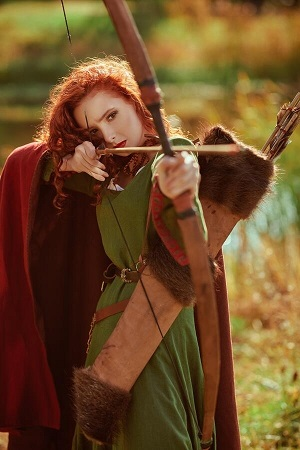
Salesca of the Hollow is the 'Player Character' for this story. A girl raised by her Ironsworn Uncle and then forging a close bond with Talia the Lightstep, who would go on to be an Ironsworn herself, and whose quest for vengeance would destroy her home of Taron's Hollow, Salesca is a girl of 18 years, with fiery red hair, a temper, and a legacy she feels the need to live up to. She burns for revenge, and also hopes to one day make a name for herself like that of her uncle Hallistar, or Talia herself, as one who aids others and makes the Ironlands safer for all those of good will.

When you create a character in Ironsworn, you assign your stats - one stat gets a 3, two get a 2, and two get a 1. Salesca, with her focus on archery and dance, puts 3 into Edge. Trained to track and to hunt stealthily, Shadow and Wits get the 2s, leaving the 1s for Heart and Iron. She is not especially physically strong or enduring (though she's no weakling) and she's not great with people, in part because she lets her temper and sense of righteousness get in the way.

Aside said:
Options exist to have a different spread of stats than 3, 2, 2, 1, 1, if you wish to make your character's life harder or easier, but I went with the default here.

For Assets, you get three to start, and she has Archer, Fletcher, and Dancer. As of beginning posting the 'chapters' of this actual play, she's upgraded the Dancer Asset once, so I'll include that on her 'sheet' below as well, but she won't have that second Dancer feature in the early 'chapters'.

Every new character has 3 starting Bonds. Salesca has four now, as of posting. Her starting three, however, were Talia the Lightstep, Sareta the Wayfinder and The Survivors of Taron's Hollow.

Aside said:
Bonds represent people or communities with whom your character has forged a relationship with. When you have a Bond with someone or a group, rolls interacting with that person or community will usually get a +1. Bonds are created with the Forge a Bond move. Every bond you have also gives you .25 on your Bonds Track (was with other Progress Tracks, this is represented with Ticks and Boxes in the actual Rules), which is used for the Write Your Epilogue move, which you can determine how your character's story ends when they 'retire' or 'step back'.

An optional rule I have seen discussed by players is how, given that a Bonds Track is effectively an Epic Track, if you want, you can reduce the 'Challenge Rank' of your Bonds Track to make it easier to eventually Write Your Epilogue, if you'd rather not have to forge 24 Bonds just to get to six, let alone 40 to get to 10. For this campaign, I have decided to effectively treat my Bonds Track as an 'Extreme' Track, and thus my Bonds Track will advance at .5 with every Bond, rather than .25)

Health, Supply, and Spirit all normally start at 5. If you started with the 'Battle-Scarred' Asset, you could have your starting/max health reduced to 5, but Salesca does not have that. Her Momentum starts at 2, and it refreshes at 2 when she Burns it.

Every character starts with at least one Vow, up to two. A 'Background Vow' and an Initial Vow. A Background Vow is essentially your 'Main Quest'. It's a vow that defines what your character is ultimately aiming to do. It's going to generally shape the main course of their story. Then you can also have an Initial Bow. Sort of a 'what your character is going to do first'. Their initial problem. The first thing they're going to address.

A character's story does not have to end when they complete their Background Vow. Maybe it opens up more story to tell, or you just want to keep going, but many players will end a campaign/story when their character fulfills their Background Vow.

Your background/Initial Vows do not need the Move Swear and Iron Vow to be made and rolled.

I didn't give Salesca an Initial Vow, but I did give her a Background Vow: "Avenge the Destruction of Taron's Hollow By Vesna." I set it at Formidable - a little low for a Background Vow, but in the loose idea I have for this campaign, I have notions for possible stories past resolving the Vesna issue.

In general especially for Background Vows or other 'high value' vows, it's good to somewhat open-ended, so you can have some flexibility on what counts as fulfilling and what counts as a milestone - you don't know how the Oracle, etc will shape what happens to your character, and so while 'Kill X' is a fine vow, if you kill the character with only two milestones marked because you ran into them earlier than you thought you would due to unlucky (or very lucky) dice rolls, you might find yourself in a poor position when it comes to rolling to Fulfill Your Vow.

When it comes to equipment, there isn't really much to it. Equipment is largely kept vague and encompassed with 'Supply'. It can be fairly assumed your character has some kind of weapon or weapons - but the baseline Ironsworn setting has a generally 'Dark Age' tech level, so if you're in something like the 'standard' Ironlands, work with that.

Salesca begins with a Bow (and a Quiver and Arrows), a Dagger, A travel Cloak, Basic Clothing, and Quilted Armor. She's added a few other items that are reflected on her sheet now, as of posting these first chapters.
 
Salesca of the Hollow New


Edge: 3
Heart: 1
Iron: 1
Shadow:
2
Wits: 2

Bonds: Talia The Lightstep, Sareta the Wayfinder, the Survivors of Taron's Hollow, Namba's Hall
Bonds Track: 2/10

Health: 5/5
Spirit: 4/5
Supply: 4/5
Momentum: 2/10
Momentum Reset: 2
Failure Track: 5/10

Equipment: Bow, Dagger, Quilted Armor, Quiver & Arrows, Basic Clothing, Cloak, Onyx Wolf Statuette (Artifact), The Bloodstained Heart (Artifact), Strange Coded Cultist Map

Active Vows:
Avenge the Destruction of Taron's Hollow By Vesna: 2/10

Assets:

Archer: If you wield a bow...
  • When you Secure an Advantageby taking a moment to aim, choose your approach and add +1.
    • Trust your instincts: Roll +wits, and take +2 momentum on a strong hit.
    • Line up your shot: Roll +edge, and take +1 momentum on a hit.

Fletcher:
  • When you Secure an Advantage by crafting arrows of fine quality, add +1. Then, take +1 supply or +1 momentum on a hit.
Dancer:
  • When you Secure an Advantage +edge by dancing for an audience, add +1 and take +2 momentum on a hit. On a strong hit, also add +2 (one time only) if you make a move to interact with someone in the audience.
  • When you Face Danger +edge in a fight by nimbly avoiding your foe's attacks, add +1 and take +1 momentum on a hit.
 
Back
Top