• The regular administrative staff are taking a vacation, and in the meantime, Biigoh is taking over. See here for more information.
  • A notice about Rule 3 regarding sites hosting pirated/unauthorized content has been made. Please see here for details.
  • Staff is working to deal with the problem of synonymous tags. See here for more information and to suggest tag mergers.
  • Due to issues with external spam filters, QQ is currently unable to send any mail to Microsoft E-mail addresses. This includes any account at live.com, hotmail.com or msn.com. Signing up to the forum with one of these addresses will result in your verification E-mail never arriving. For best results, please use a different E-mail provider for your QQ address.
  • For prospective new members, a word of warning: don't use common names like Dennis, Simon, or Kenny if you decide to create an account. Spammers have used them all before you and gotten those names flagged in the anti-spam databases. Your account registration will be rejected because of it.
  • Since it has happened MULTIPLE times now, I want to be very clear about this. You do not get to abandon an account and create a new one. You do not get to pass an account to someone else and create a new one. If you do so anyway, you will be banned for creating sockpuppets.
  • Due to the actions of particularly persistent spammers and trolls, we will be banning disposable email addresses from today onward.
Margin of Error
Created
Status
Incomplete
Watchers
94
Recent readers
292

Marcus Sinclair carries memories of a future no one else can see: humanity's first contact, its wars, its extinction. Reborn in 2130, he has decades to prepare Earth for threats lurking beyond the Mass Relays. Scientist, strategist, prophet unheeded. He builds from the shadows, knowing the price of failure is annihilation.
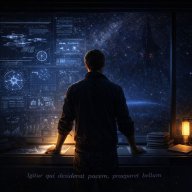
Igitur qui desiderat pacem, praeparet bellum.
Last edited:
0000: Prologue New

USSExplorer

Doing what's necessary, even if it causes chaos
Joined
Mar 4, 2019
Messages
575
Likes received
34,940
0000: Prologue
In my first life, my real life, though I was learning not to call it that, Edinburgh had been different: greyer, grimier, and louder. This Edinburgh gleamed. The trams ran silently on magnetic rails, and the castle had lights installed that adjusted to the weather. Even the rain smelled different: clean, scrubbed of the coal and petrol I remembered but had never breathed in this body.

I sat on my bed, a datapad resting on my knees, its screen casting pale light across my face. Eight years old, or so they told me. Eight years since I had opened my eyes in a crib I did not recognise, in a home that was not mine, wearing a body that responded in ways no infant's should.

Eight years of learning to be someone new while accepting that my former life was gone.

My name is Marcus Cormac Sinclair. It wasn't always.

Before, in the life I remembered as clearly now as the day I'd woken in the body of a babe, I'd been someone else entirely. A man grown, also, interestingly, from Scotland. I shared that link with this new life, but little else. Back then, I had gone to sleep one night, as I always did. The next morning, I woke up as Marcus. One moment there, the next… here.

Unable to speak, I couldn't scream or shout. I couldn't ask about what was happening, where I was, what had become of my former family. By the time I was able to make this form talk, I had realised that this life was mine now. I still didn't accept it truly; the images of what I had once been remained. The grief at who I had left behind, no idea of their fate, lingered.

Those nights I'd cried over what had been, my new parents had attributed it to bad dreams. What else could they think it was? I was a child, one not able to walk or talk, and I cried. No one would expect a child to weep for a former life no one else knew about.

By the time I could walk, by the time I was able to hold something approaching a conversation with my parents, I had made peace with the altered hand that was dealt. Yet I knew this world was different from what I knew. I was in Edinburgh; the city was the same, and yet it wasn't.

On the surface, it was close enough to ignore. Yet the moment one looked at it, it became clear it was different. Technology was more advanced, the air cleaner, and the mood was less constricting than what my former life had felt like.

By the time I could read, I was cataloguing the differences.

And with each passing day, those differences only ever increased.

I'd read the history of this world as best I could, as much as my parents allowed a child to do so. This world had diverged a century before. The beginning of the twenty-first century had been the pivot. Events either didn't occur or happened differently. No 9/11, no COVID, no rise of the fracturing of politics. At least not to the degree that I remembered from that former life.

In their place, the Oil Wars. The shadow conflicts over resources. And then, a revolution in nuclear power, and it was as if someone had flicked a switch: stability, peace, balance.

For a time, all the differences, all the alterations, the fact that it was a century after the point my former life had ended in a night, were the most jarring. There had been years when every new change and shift in the direction of Earth frightened me.

None of that frightened me anymore. What frightened me was what I carried inside.

I looked down at my hands. Small. A child's hands. Exactly as they should be, and yet they didn't feel like they were. I knew I wasn't normal in ways that went beyond the obvious.

I'd noticed it first in how fast I'd picked up things. Then, I'd simply assumed it was memories of my former life carrying into this one. Preschool was easy, too, yet it was more than that. Then, at five, I'd discovered the first hint that something was… off.

I'd caught a cup before consciously registering it was falling. Those around me hadn't reacted to the cup. Not until I put it back on the table. From there, everything was questioned and then tested.

A random scroll I had read in preschool once was remembered clearly. A training piece of music was learned and reproduced after seeing the teacher play it once. The fact that I was faster, stronger, and quicker than those around me.

This body, this mind… they were wrong. Or perhaps it was fairer to say that they were too right, too perfect. Either way, it was dangerous. To me, and to my family.

Downstairs, I could hear my father explaining something to Callum. My younger brother was five and, from everything I'd seen, ordinary. Or at least, not like I was. My mother was in the kitchen; I could hear her movements, could smell the herbs she was using even though I shouldn't. Keira, my older sister, had music playing in her room. It was proven to mute noise from travelling in or out, yet I could track the strings, hear the angst in the track. I could feel the faint, impossible vibrations in the old floor.

This was my family. My family, and yet it wasn't.

Not the one I remembered. They were gone, if they ever existed at all. This family, the Sinclairs, were my new family, Marcus' family. My parents had raised me, my sister had teased and embarrassed me, and my brother looked up to me. They loved me, and I loved them, though it had taken me years to truly accept that the affection wasn't a betrayal of what had come before.

My eyes trailed over the screen of my datapad. The one that contained my secrets.

A gift when I turned eight a few months ago. One I had hardened in ways no eight-year-old should know how to. No network connection, no cloud backup, no outside connection, a pass-string that couldn't be broken without dedicated software.

The entirety of my understanding of a possible truth.

Inside were my observations, catalogued with the precision that came too easily: timeline divergences, technological anachronisms, political movements that shouldn't exist. The file marked 'ANOMALIES' grew faster than the others. Yesterday, I'd added a note about the Mars exploration initiative: The funding suggested that they expected to find something beyond just rocks and dead volcanoes. What that was, I didn't know, though I had theories. None of those was comforting.

A second childhood stretched before me, years of growth and education ahead, and I refused to waste them. I refused to live a meek, simple life. This body, my memories, were given to me for a purpose. The feeling that something existed at the edge of my thoughts, understanding or knowledge that would help explain this new life grew stronger with each passing day.

I didn't know why I was here, what purpose this existence served, if there even was any. Perhaps there was none. Perhaps I was simply cosmic debris, swept from one existence to another by forces beyond comprehension.

My fingers tightened around the pad's edges. I didn't believe that. I couldn't.

The flickers of something in my head were proof. Knowledge that I shouldn't have, ideas that didn't quite align with how things in this world worked. Hints that, while everything was how it should be, that wasn't the case. As if there was a puzzle of galactic proportions in my head, yet I had no idea what it was meant to be.

Each time I learnt something new, each time I pushed for knowledge of this world, another piece was revealed. Another clue, however inconsequential, was gained. I had to know more; I would know more. I would learn the science of this world, use it to unlock what was trapped beyond my conscious thought.

It was the only path I had that offered any hope of answers.

The rain continued its patient assault on the window. I watched it fall, this child who was not a child, and made myself a promise.

Whatever had brought me here, whatever waited in the years ahead — I would be ready. I would build carefully, hide what needed hiding, and when the moment came that demanded I act...

I would not waste my second chance.

--- ***---

The letter sat on the kitchen table between us, cream-coloured paper bearing the crest of Caledonian Academy. My mother's tea had gone cold. My father hadn't touched his. I found amusement in their reactions and the fact that the Academy had sent a letter. Anachronistic, unpopular with many, and yet a sign of their standing and brand.

"They don't usually offer places to children your age," my father said, his engineer's mind working through the implications. "The standard intake is twelve, sometimes eleven for exceptional cases. You're not even ten."

I knew this. I had researched Caledonian extensively over the past year, alongside other such academies and institutes. I'd mapped their alumni networks, their academic reputations, their connections to key universities and industries: paths that would help define my path forward once I left their halls. Caledonian wasn't the most elite, the most widely known, nor the richest. It was, however, the most efficient for me.

Close to home, less rigorous physical checks and expectations, and access to several cutting-edge STEM programs. The best overall package, and one that, if I applied for, my parents could afford without damaging their lives or limiting the development of my siblings.

"Marcus." My mother's voice drew my focus, her tone carrying a hint of suspicion. "Did you apply for this?"

I shook my head. "No." The truth, though, only because I hadn't taken the final step. Draft letters had been written, stored on my air-gapped, secure datapad. None had been sent. Drawing attention to myself when there were so many unanswered questions about this world was a step too far. "My teachers must have submitted something. Mrs Patterson mentioned a programme for advanced students last term."

A half-truth. What I failed to mention was that I had guided those conversations, asking questions that reinforced that my displays in class weren't by chance. That I had the capability to go further, faster than those around me. My interactions and words showed enough to intrigue my teachers, but never enough to alarm.

It was exhausting, this constant need to calibrate myself. Every test was answered with small, deliberate errors scattered among the correct responses. Every class discussion was balanced between insight and age-appropriate ignorance. Two years of walking a line so fine it sometimes felt like it would cut me in half. Caledonian, and others like it, offered a chance to remove the limits I placed on myself, at least in part.

My parents exchanged a look; one I had learned to read. They were concerned yet proud. Uncertainty over whether they should nurture my gifts and push me, or protect them by allowing me to develop without impetus. They had noticed I was different, special. How could they not? But they attributed it to intelligence, to an old soul, to the luck of the genetic lottery brought forth by laws offering boosts for newborns. They didn't know the half of it.

They couldn't.

"It's a significant opportunity," my father said slowly. "The resources, the instruction, the connections you'd make. But you'd be years younger than your classmates. That comes with challenges."

Mum's hand was warm. Warm in the way that hands always feel when you're cold. I wanted to pull away and lean in at the same time. That's what made it so hard; this love felt real. It was real. Yet, letting it flow around me felt like a betrayal. Eight years ago, different hands had held mine. I couldn't remember the faces anymore, not clearly, but I remembered being loved before.

"I want to go," I said, genuine emotion colouring my voice; the eagerness of youth was displayed on this rare occasion.

It wasn't entirely a performance. The Academy meant access to laboratories, to libraries, to minds that might help me unlock the fragments of knowledge lodged behind my conscious thoughts. Every equation I learned seemed to shake something loose, to illuminate another corner of whatever vast understanding had been placed inside me. The chance to push a little faster and further, to learn more of what was locked in my mind, was one I couldn't afford to miss.

I needed that knowledge. With each passing month, the feeling grew that I was preparing for something, building toward a purpose I couldn't yet name. A reason why I was here.

There had to be a reason.

My mother reached across the table and took my hand. Her skin was warm, her grip gentle. "You're sure? Once you're there, you can't simply come home if it gets difficult."

I nodded. "I'm sure." I met her eyes, and for just a moment, let my guard slip. Not in full, never that, but something honest and earnest. "I need to learn, Mum. Everything I can. I don't know why yet, but I need to learn more to push myself."

She studied my face, and I saw something flicker in her expression. Recognition, perhaps, of the weight behind my words. Fiona Sinclair had spent her career navigating the gap between policy and implementation, reading the subtext beneath official statements. She knew when someone was holding back.

But she also knew when to trust.

"Alright." She squeezed my hand once before releasing it. "We'll visit next week. See the facilities, meet the staff. If it still feels right after that..."

"It will," I finished, certain now that the path was before me.

I pulled the letter to me, enjoying the feel of the paper between my fingertips. One tip traced the Academy's crest. A lion rampant, navy blue with claws extended, ready to strike. Fitting, I thought with amusement, for the path I was choosing.

In my room, the datapad waited with its encrypted files. Tomorrow, I would update my plans and adjust my timelines. The Academy accelerated everything by two years, opening doors I hadn't expected to reach so soon. That brought danger: the chance to draw unwanted attention I couldn't yet counter. However, the chance to learn more about this world, to see how it worked, and to understand the systems others failed to realise existed in society. Those were things I couldn't fail to grasp once they were presented to me.

I would have to be careful. Older students would watch me; teachers would scrutinise me. The child genius, some would call me. A spoilt brat, others would say. Both descriptions were right, and yet neither was. The truth was far more than anyone would realise, and because of that, I had to be cautious.

I could stand out, yes, but never too much. Never go too far too fast. Doing so led to more questions, the kind that often came with examinations and tests; the type of moments that led to discoveries I could not afford.

Yet the opportunity merited the risk. It had to be.

I knew there was a reason I was here, that I was given this second life. The knowledge in my head, the hints of paths that didn't seem right when compared to what I knew of this world, had to serve a purpose.

I wasn't arrogant enough to think I could change the world, that I could save it from some unseen disaster. Yet, if such an event lay in the future, I would meet it prepared.

The Academy was simply the next step.

I was still nine years old, but I had a future to build.

---***---

The gates of Caledonian Academy loomed before me, wrought iron crowned with that same rampant lion I'd seen on the letter. Beyond those gates, stone buildings sprawled across manicured grounds, their architecture a deliberate link to tradition, altered by the various displays of modernity. Old enough to impress, new enough to function.

Around me, other students streamed through the entrance, everyone older and taller than me. I saw many looking around in wonder, talking animatedly with others. First-years, lingering, taking in the sights, carrying their bags. A handful seemed nervous, likely due to the uncertainty of leaving home for the first time.

I was lucky. Caledonian was close enough to my home that I could head back each weekend. I would, my mother insisted. Many others, it seemed, were not as fortunate, no doubt having already seen their bags taken to the dorms at the northern end of the campus.

As I moved towards the gates, I felt the eyes of the other students, new and returning, on me. The looks came in waves, all carrying the same three emotions, or variants of them: curiosity, confusion, and amusement. I was a child among adolescents, barely reaching their chests, with my uniform crisp and new and slightly too large despite the tailoring. My parents had insisted on room to grow. They weren't wrong, though I suspected the growth would come faster than they anticipated.

Entering the grounds, I caught fragments of conversations.

"Why's a kid here?" someone asked, not quite quietly enough that I couldn't hear them.

"Fresh meat," another muttered, hints of amusement and possibly something darker in their tone.

"Whose little brother is that?"

I ignored them all, the comments washing over me. They weren't wrong to stare. In their place, I would have done the same, though with better grace. A nine-year-old entering secondary school was unusual enough to warrant attention. I needed to manage that attention, cultivate it to suit my purpose. Too much, and questions followed. Too little, and I became invisible, unable to build the connections that would matter in the years ahead.

Six years was how long I was meant to be here. Six years of classes, laboratories, and libraries. Six years to learn, grow, and unlock more of whatever knowledge lay dormant inside my mind. The fragments had seemed easier to discover during the last few months of preparing to enter Caledonian. Not enough to reveal secrets of use, but enough to show they were there just out of reach. Teasing challenges to unravel and use, at least if I could do so safely.

I had these six years to find those worth my time, to build connections with them as I built my foundation. Academic credentials were a given, but the right relationships could be worth more. Yearmates who would become colleagues, teachers who might open the doors to mentors, potentially even rivals who would sharpen me against their edges. The social architecture of a life took time to construct, and I intended to use every moment.

A group of older boys passed, their uniforms bearing the pins of third-years. One glanced down at me with the casual dismissal of someone who had already categorised and discarded what he saw. An irrelevant child beneath their notice.

Good.

Let them underestimate me. Let them see only the small frame and young face. By the time they realised their error, I would be too established to dismiss and too ingrained for them to ignore. That was the game I had chosen to play: the patience of youth that hid ambition behind earnestness.

I adjusted my bag on my shoulder and walked through the gates.

The Academy awaited. My future awaited. And somewhere, in the locked corners of my mind, answers awaited, too.

I intended to find them all.

---***---

A/N: Welcome to my newest story. Like the others, this will be a slow burn with world-building involved over a long ride.
 
In their place, the Oil Wars. The shadow conflicts over resources. And then, a revolution in nuclear power, and it was as if someone had flicked a switch: stability, peace, balance.
One can hope.

Ironically, we're about to get that revolution, when we should have had it 50 years ago, because NOW the elites want it for their data centers, rather than wanting to deny us as punishment.
 
Has humanity already discovered Eezo, or is it still to discover it? Does the MC know Eezo from his past life?
 
No. Eezo is 2148. Kid was born in 2130 and is now a 9 year old kid in academy. At best, eezo is around 9 years away.
Actually, eezo was first detected in 2147, and the ruins/archives on Mars were discovered/opened in 2148.
Or so says the official timeline. But something I discovered while writing this is the number of little details and lore that, when placed alongside other facts, cause issues. Nothing truly major, but enough to irritate me as I tried to align those I wanted to keep. I doubt any reader will notice, but we'll see.
 
0001: The Academy New
0001: The Academy
"Monsieur Sinclair, perhaps you'd like to attempt the passage?"

Madame Fournier's voice was in that tone that teachers used whenever they suspected that a student wasn't paying attention. Yet, while my mind had been elsewhere, I had been paying attention; it was just that the mysteries in my head were more appealing than the lesson.

I looked at the text on my datapad. A simple paragraph about a family visiting Paris, the kind of introductory material meant to ease students into verb conjugations and basic vocabulary. We'd covered it over the last twenty minutes, the teacher taking time to have us all enunciate the verbs, practice how to roll our tongues and shift our lips.

I'd needed to hear her say it just once. From there, I could repeat it. The grammar rules we'd touched on in the last class were already ingrained in my mind with crystal clarity.

I read the paragraph aloud. Slowly and deliberately, stumbling over a word I knew perfectly but that most would likely struggle with. A calculated performance with an error placed where a bright but young and ordinary student might falter. The sort I'd used in this class and others already in my first few weeks at Caledonian Academy.

Madame Fournier studied me with an expression I was learning to recognise. I was seeing it more and more from my teachers. The slight narrowing of the eyes and the tilt of the head. The realisation that something was just a little bit off about me. The sort of difference that was unusual, but, in the eyes of a teacher, in a good way.

"Your accent is remarkably good for a beginner," she said. "Have you studied French before?"

"My grandmother speaks it sometimes," I lied, speaking with the confidence of a child who shouldn't know any better. "I must have picked up more than I realised."

My grandmother had tried to teach me a foreign tongue when I was a bairn, but that had been Spanish. Just as in this class but back then I'd feigned ignorance and played at failure. My grandmother had simply smiled and said I'd get there eventually.

I watched as Madame Fournier held my gaze for a moment before she looked away. I hoped she accepted my answer.

Around me, I felt the weight of my classmates' attention. Boys and girls who were two years older than me. No doubt their minds already noted me as different. Not in the way the teachers did, but in that way that children did. A curiosity, a nuisance, or something weird. The sort of weird that was often avoided, investigated with child-like drive, or bullied.

That wasn't what I wanted. I had to hide more, pull back where I didn't need the attention, and where my focus wasn't placed.

Next time I was asked, I'd speak slower and make more mistakes. Changes I would enact to appear merely as a child who was advanced for their age, and not a genius. Though that line grew thinner each day with each passing class.
---***---
I sat quietly as Mr Hartley handed back the tests. He moved with the efficiency of a man who'd done that thousands of times. Papers slid across desks; some were met with relief, and others with resignation. Outwardly, I was calm, displaying just a hint of pleasure. Internally, I was disappointed. Not at my performance, but in myself.

Ninety-four per cent. Based on the unnamed table on the board, I was top of the class by three marks.

I had aimed for eighty-seven per cent. That would've been respectable, if not for my younger age compared to my classmates, and nothing overly remarkable. Safely in the upper third without challenging for the top. Instead, I was clear out in front.

I had chosen my errors carefully: a sign mistake in one place, a skipped step in another. The kind of small slips that any student might make when placed under a time constraint. My flaw had come in the final question.

That had been a multi-part problem involving quadratic functions, worth fifteen marks. I had intended to lose five of them, perhaps six. Instead, I had solved it completely, my hand moving through the working before my mind caught up to stop it; I'd only realised it after the data had been inputted.

I'd acted on muscle memory, except that wasn't muscle. It was something deeper, something in me that recognised patterns and actions faster than conscious thought could process and then intervene. The knowledge in my head didn't wait for permission. It was as if it wanted me to know it was there and hated being constrained.

"Well done, Sinclair," Mr Hartley said as he paused at my desk.

Nothing more was said as he moved to the next desk, yet I'd already seen the look he'd shared with his teaching assistant. Once more, I'd outperformed students two years my senior.

Around me, my classmates shifted in their seats. I didn't need to glance at them to feel their attention or to understand their thoughts as they reassessed me again. I was the child genius, the weird kid. The threat to their standing in a system that ranked and sorted us by our performances in class on digitised lists in a place where each of us was expected to excel. The brat who'd defeated them again without looking as if I was struggling.

For some, that would fuel resentment. For others, it would discourage them. So be it. That was their failing, not mine. Others would look at my performances and take on the challenge; they would see me as an obstacle they had to overcome. They would push themselves to do better, to surpass me.

They'd fail, of course. None of them was capable of matching me. None of them, nor my teachers, understood what shifted in my mind, or how everything came with an ease that went beyond simply recalling such studies from a previous life. In time, years from now, they might understand a fraction of it. Perhaps, I pondered, the whole world might if what drifted at the edges of my thoughts revealed itself.

I folded the test paper and slipped it into my bag, already calculating how to adjust not to stand out too much beyond this moment. The next assessment would need to be different. More errors in all aspects of the paper. Less perfection where it mattered.

I was getting better at failing; I simply wasn't good enough at it yet. Though the thought was growing that perhaps I should stop trying to hide in failure.
---***---
It was halfway through my second year at the Academy, yet I was now studying the third-year curriculum. My results over the first year had been enough to encourage all my teachers to push for my rapid advancement. A challenge I had, after some consideration, accepted.

I had grown impatient, at least to some degree, with hiding my abilities, holding myself back until I was almost bored to death. My life, beyond the early attempts to not stand out, had drifted. When the chance had come to push myself, to display just a hint of what I could do, I'd taken it, and now found myself among classmates three years my elders.

My teacher, Dr Morrison, had stopped asking if I understood the material months ago. Now she simply handed me the advanced problem sets and let me work while she guided the rest of the class through concepts I had mastered in the first month of the semester.

I knew how that made the others feel, but I no longer cared all that much. Either they accepted the challenge I represented, or they didn't. My intentions were far beyond them and above theirs. They could either try to soar with me or fall to the ground and live through whatever became of their existence.

As I'd done since my first week at the Academy, I was seated at the back of the classroom. I did so partly for the benefit of being able to work without being disturbed, and also because, as much as it shouldn't, it amused me to watch my classmates struggle with Newtonian mechanics while I pondered at the edges of something far more interesting than our classwork.

Most were fifteen, a handful sixteen. They had three years on me in age, and I had left them behind so thoroughly that Dr Morrison no longer bothered pretending otherwise. Outside of the Physical Education department, no teacher tried to make me seem normal.

The names other students called me had grown louder and stronger. Child genius had become Prodigy. Weird Kid had become Freak. Both were accurate, though neither captured the full truth.

I was better than them in every conceivable way. Not just in maths or physics, not just academically, but in ways they couldn't see and I couldn't show.

When Cameron Ross had shoved me in the corridor last month, testing the small boy who kept embarrassing his peers, I had let myself stumble. I had let him think he had power over me, that at least here, in a primitive display of size and strength, he was above me. The fact was, he wasn't, and he failed to realise that even as he and his friends had laughed.

I'd seen his hands coming long before they had. I'd heard the whispers with his friends, the trap, if one could call it that, they had laid. I could've avoided it, but that would only make the next step more dangerous for everyone.

When it came, I had watched, fighting my instincts. I tracked his movements and considered redirecting his momentum to put him down, or shatter his wrist, or a dozen other ways to prove his inferiority.

I knew how to do all that. I'd read the books the Academy had on self-defence, and I'd trained what they taught in private, in the dark of night, in my room until they became second nature. I didn't need them now, but I knew one day I would. A day would come when I would be forced to fight to protect myself, to defend what I knew, and what I created. When that came, even though I didn't know when, I would be ready.

The restraint I'd shown there, and elsewhere, was perhaps my greatest achievement at Caledonian, though no one would ever know it.

"Marcus." Dr Morrison's voice cut through my thoughts. "Would you walk the class through the third problem? I think they'd benefit from seeing your approach."

At the start of the year, I would've hesitated. Not to avoid standing out, but because I wasn't sure how advanced to make my answer. Now I simply rose and walked to the board, marker in hand, aware of the eyes tracking me. Some were resentful, some were curious, and a few were genuinely interested. Like Dr Morrison, all of them expected me to explain the problem as well as she could.

Even as I wrote out the solution and explained it, my mind wandered further down the pathways this class led to. Wondering how far my mind would reach as it grasped for understanding that I didn't yet realise. The knowledge that lived behind my thoughts stirred as I worked, whispering of connections between force and field and something deeper that this world's physics hadn't yet discovered.

"Excellent," Dr Morrison said when I finished, barely paying attention to anything yet never appearing to be inattentive. "Clear and precise, as always."

I returned to my seat, accepting the praise with a nod that was just shy of dismissive. The arrogance I had warned myself about when entering Caledonian was growing stronger, and the warnings weaker. The mild contempt I held for most of those around me had settled to the point it felt second nature.

I was twelve years old, surrounded by teenagers I could outthink and outfight, and cultivated by teachers who saw genius where the truth was far stranger.

It was difficult not to feel superior. Each day, I wondered how much longer I would have to restrain myself so heavily. How long would it be until the day came when I could remove my shackles and begin to truly push myself?
---***---
The Great Hall of Caledonian Academy had stood for two centuries. Its vaulted ceiling bore the names of distinguished alumni in gilded lettering. Judges, politicians, scientists, captains of industry, and other figures of note. The weight of expectation and history pressed down from those rafters, with silent authority on the students who now sat in the Great Hall.

Well, they pressed down on everyone else.

I sat in the front row, as tradition demanded of the Dux Scholae. The First Scholar. That was the highest honour the Academy could bestow upon a graduating student. The formal ceremonial robes used each year had been heavily altered to fit my frame. Around me, my classmates who were graduating alongside me sat. Their robes were just as ceremonial, but lacking the status of being the best.

I was fourteen, and had taken five years to reach a point it had taken all of them six. To many of the others, this might be one of the pinnacles of their lives. To others, it would mark the beginning of some grand adventure. To me, it was a point where I could move on and stop holding myself back as much as I had been.

I could have finished the Academy in four years easily, perhaps three, if I had truly unleashed myself. The coursework had never challenged me, not genuinely. Mathematics was so simple that I barely had to focus on it. The sciences flowed like water under my command. Languages, history, literature, and the other subjects hadn't troubled me, even if they never held my interest.

Yet speed of completion had never been my goal. Not after I'd realised how I could use my time here. I had stayed the extra year deliberately, spreading my focus across disciplines I might never use. The friendships I'd developed, if one could call them that, were unlikely to be of worth in the coming decades.

Still, I'd noted names, courses chosen, and cultivated links with those that might amount to something useful in the future. They would either be further cultivated, or more likely, disposed of from the mental spreadsheet I'd crafted them onto.

My main reason to take the time was to expand and broaden my knowledge, though not in the courses available at the Academy. The puzzle in my head, the one that remained elusive even as each piece was revealed, went beyond what I'd realised. It didn't just cover maths and physics, but spanned every science, hard and soft, offering fragments of a far wider and more complex picture than potentially should exist.

I'd long since determined the variances in the history of this world compared to the Earth I'd known from an earlier point in its timeline. I saw the lies and deceptions that had been placed in knowledge such that even adults seemed unaware of them, or simply chose not to challenge them, and I'd caught glimpses of what might lie underneath.

Things were presented too cleanly. Yes, there were conflicts, disagreements, and even wars throughout the last few hundred years. Yet, each time the solutions explained by the reports, by the textbooks and history felt… lacking. As if something was being hidden. It felt as if someone, likely many people in fact, all across the world, were keeping details from the masses.

One of the most glaring examples happened fifty years ago. In the waning days of the last century, the USA, Canada, and Mexico had merged, forming the United North American States. Then, striking first in New York, insurgents had fought against this new continent-sized nation.

The Statue of Liberty had been destroyed in what history books and recordings labelled as domestic terrorism. There was truth in that, but something was missing. That Second American Civil War had lasted three years, and when it had ended, the UNAS was victorious, but no longer the global power it had once been. From its secure position as the dominant superpower, it had become one of several major players. The same was true of the Chinese People's Federation, though its shift had happened earlier than with the UNAS.

The UK was still linked to both the UNAS and the European Federation. In my old life, the UK had broken those bonds with Europe, yet here they remained, though not to the same depths they once had in that other timeline. On the surface, all was well, but when one dove a little deeper and read between the lines, then things became less clear. The world was nowhere near as rosy and peaceful as every source painted it.

Such knowledge and understanding would be useful in the future. With the time I had, learning about the cracks in the truth of society now was more important than surging ahead and not realising the truth until it was too late. Still, it was now time to push forward again and to pick the path that offered the best balance of risk, challenge, and reward.

The offers had come flooding in during my final year, even before my final evaluations and tests were completed. Edinburgh, Cambridge, Imperial, ETH Zürich, and others had reached out to me instead of me applying to them. My grades were such that not only the locations but the choice of subject was vast, and it appeared to everyone else that I could pursue whatever path I wanted.

Yet, for all that my path seemed to open up before me, it wasn't, and perhaps it never truly had been.

The knowledge in my head, that vast reservoir of understanding that unlocked piece by piece with every equation mastered, every principle absorbed, pulled me in a clear direction. Physics, Mathematics, and Engineering. The sciences that would carry humanity beyond this single world, out into the void where our future waited.

I didn't know why I was so certain of that path into the void, but the feeling that was where I needed to head was undeniable. Almost as if there was a compass in my mind pointing upwards towards true north.

Whatever purpose had placed me here, whatever reason lay behind my resurrection into this strange and altered world, it pointed toward the stars.

"Marcus Cormac Sinclair."

I pushed thoughts of the future aside as Headmaster Buchanan's voice echoed through the hall. I rose, smoothing my robes with the precision that implied normalcy when I was anything but. The façade was perfect now, and only when I wished did I let hints of just how far beyond everyone here I was appear.

"In recognition of exceptional achievement across all disciplines, for scholarship that honours the finest traditions of this institution, and for conduct befitting the ideals we hold dear, the Academy names you Dux Scholae of the Class of 2145."

Applause filled the hall as the Headmaster spoke, and I walked towards him. I accepted my medal as Dux Scholae with a handshake and then turned to face the students, parents, and faculty. My own family sat in the fourth row. My parents were proud and smiling, Keira was rolling her eyes theatrically, and Callum was waving enthusiastically.

They saw their son and brother, their wee professor, had grown into something remarkable. They didn't see anything more than I wanted them to, or the knowledge that whispered of technologies this world had yet to imagine were possible.

I looked at the other faces. Classmates who had gone through resentment, then respect, before simply accepting that I wasn't someone who moved in the same air as them. Teachers who thought they'd nurtured a genius who already understood everything beyond what they had to offer.

Five years of careful cultivation of calculated excellence, and of laying foundations for whatever came next.

The Academy had been the first step. University would be the second. And beyond that, the path stretched toward something I could feel but not yet name: a purpose written in the stars, waiting for me to grow strong enough to claim it.

I was fourteen years old, Dux Scholae of Caledonian Academy, and I hadn't even begun.
---***---
A/N: Yeah, another chapter. My plan is for a chapter a day until the end of the month, taking the story to 0015.
After that, it will drop to 3 a month.
 

Users who are viewing this thread

Back
Top