• An addendum to Rule 3 regarding fan-translated works of things such as Web Novels has been made. Please see here for details.
  • We've issued a clarification on our policy on AI-generated work.
  • Our mod selection process has completed. Please welcome our new moderators.
  • Due to issues with external spam filters, QQ is currently unable to send any mail to Microsoft E-mail addresses. This includes any account at live.com, hotmail.com or msn.com. Signing up to the forum with one of these addresses will result in your verification E-mail never arriving. For best results, please use a different E-mail provider for your QQ address.
  • For prospective new members, a word of warning: don't use common names like Dennis, Simon, or Kenny if you decide to create an account. Spammers have used them all before you and gotten those names flagged in the anti-spam databases. Your account registration will be rejected because of it.
  • Since it has happened MULTIPLE times now, I want to be very clear about this. You do not get to abandon an account and create a new one. You do not get to pass an account to someone else and create a new one. If you do so anyway, you will be banned for creating sockpuppets.
  • Due to the actions of particularly persistent spammers and trolls, we will be banning disposable email addresses from today onward.
  • The rules regarding NSFW links have been updated. See here for details.
Is this viable? Assume that the Prince of 100,000 Leaves is as powerful as Gaia (Nasuverse).
It is viable, but not in a way you think. While technically Prince is only rank 8 XD, it is too abstract to fight in any conventional sense. What it would be doing is infecting Fate timeline, generating anomalies and lostbelts.
Also, the level of grossness and general horror would be much higher then usual Fate.
 
Last edited:
As a question when it comes to VTR. Looking at the rules I have a point when I look at Praestantia which is in the VII book and have my brain hurt looking at it as in my head I look at that and go "Wait does this stack with Celerity" before then looking at the rules and being "Wait, does Celerity add to dex rolls or just defense, initiative, speed?" Because, well, I have that moment of going "They wouldn't make something that broken" before remembering it is white wolf. Especially when the Akhud have Celerity in clan as well.

Plus it lets you go back again and not do what you would have otherwise done by using blood to have the action be a vision instead so you can try something else
 
As a question when it comes to VTR. Looking at the rules I have a point when I look at Praestantia which is in the VII book and have my brain hurt looking at it as in my head I look at that and go "Wait does this stack with Celerity" before then looking at the rules and being "Wait, does Celerity add to dex rolls or just defense, initiative, speed?" Because, well, I have that moment of going "They wouldn't make something that broken" before remembering it is white wolf. Especially when the Akhud have Celerity in clan as well.

Plus it lets you go back again and not do what you would have otherwise done by using blood to have the action be a vision instead so you can try something else
Reminds me of the broken Temporis/Celerity combos. And I am not talking about stacking extra actions, that's just cliche baby use.
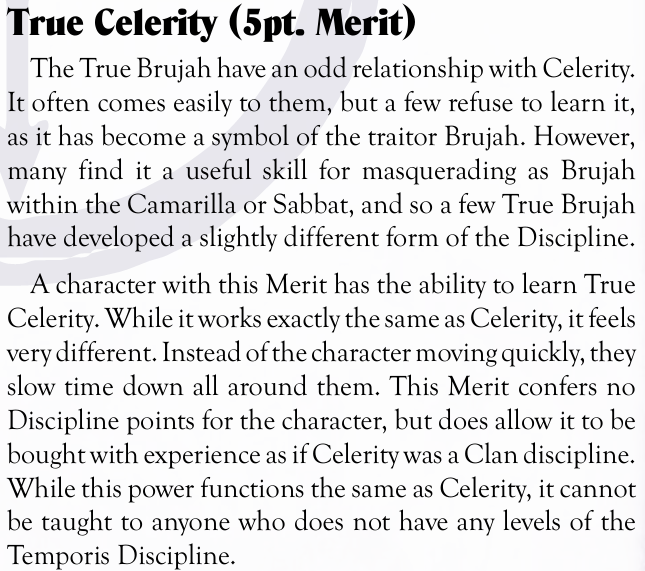
It happens when you realize nothing stops you from Celerity and Temporis at the same time. (Hell, True Brujah can have their own special True Celerity* alongside Temporis)

You see, you can't stack extra actions from Celerity and Temporis because game balance said so. But Celerity gives you +Celerity to all Dexterity pools as long as you aren't actively using them for Extra Actions. These extra passive bonuses was balanced around losing them if you use Extra Actions.
Meaning you can get your Extra Actions from Temporis but also have the passive Dexterity bonus from Celerity. Lastly, technically nothing but ST is stopping you from having Temporis, True Celerity and Celerity at the same time. Which leads to you having a +10 to all Dexterity pools from Celerity and True Celerity and extra actions from Temporis.

This lore wise even makes sense. Normal Celerity speeds you up physically. True Celerity slows down time around you. Temporis literally gives you extra time. Combine all of that and you will have the fastest vampire alive.

*
70fd41ecec2a.png
 
VII is the "brokenly powerful NPC-only splatbook" IIRC, so it would make sense for it to be the more powerful interpretation.
rereading VTR's rules. The potence and fortitude equivalents add dice to relevant skills meanwhile Celerity...just doesn't. It raises the defense roll and gives penalties to firearms attacks if you would be denied a defense roll. Praestantia effectively acts as celerity did in previous editions when it comes to raising dex rolls, while also no being allowed to use it for non stealth non combat maneuvers unlike VTM Celerity. The Takebacks ability seems to be...an attempt at balancing it for what was taken away and fact that you need to raise the celerity skill for the speed aspect.

But it also ADDS to defense as well as celerity so you still end up with BROKENLY POWERFUL dodge tank.
Reminds me of the broken Temporis/Celerity combos. And I am not talking about stacking extra actions, that's just cliche baby use.
It happens when you realize nothing stops you from Celerity and Temporis at the same time. (Hell, True Brujah can have their own special True Celerity* alongside Temporis)

You see, you can't stack extra actions from Celerity and Temporis because game balance said so. But Celerity gives you +Celerity to all Dexterity pools as long as you aren't actively using them for Extra Actions. These extra passive bonuses was balanced around losing them if you use Extra Actions.
Meaning you can get your Extra Actions from Temporis but also have the passive Dexterity bonus from Celerity. Lastly, technically nothing but ST is stopping you from having Temporis, True Celerity and Celerity at the same time. Which leads to you having a +10 to all Dexterity pools from Celerity and True Celerity and extra actions from Temporis.

This lore wise even makes sense. Normal Celerity speeds you up physically. True Celerity slows down time around you. Temporis literally gives you extra time. Combine all of that and you will have the fastest vampire alive.

*
70fd41ecec2a.png
I had thought there was a rule that you can't have celerity and true celerity at the same time.

I have however, gamed things such as Caitiff being able to learn True Celerity at their usual cost to learn disciplines without that merit.
 
I had thought there was a rule that you can't have celerity and true celerity at the same time.

I have however, gamed things such as Caitiff being able to learn True Celerity at their usual cost to learn disciplines without that merit.
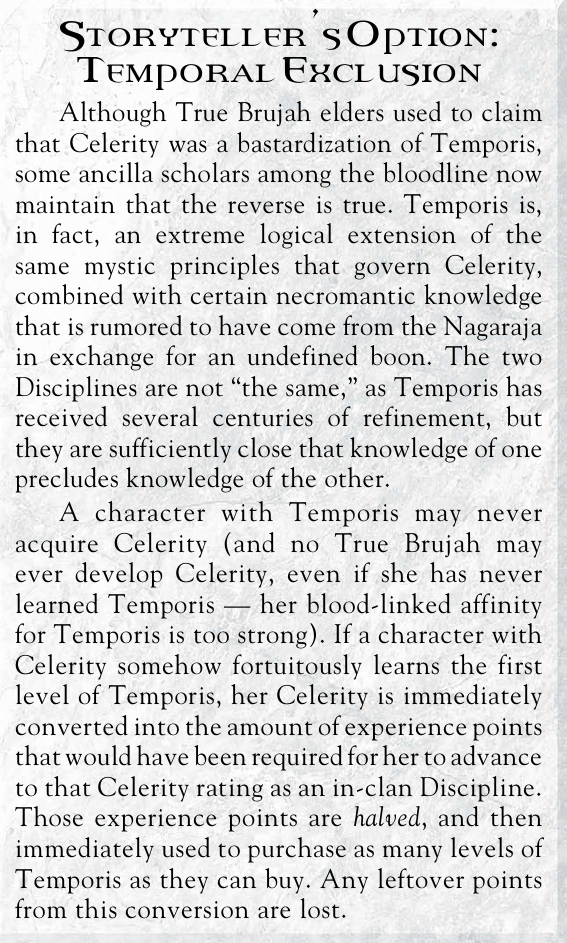
There is a rule in Revised Storyteller's Handbook about how you can't have any Celerity at all alongside Temporis but that's optional. (They really, really wanted to nerf Temporis even more.)
97566e08a718.png
Plus, even if you use that rule, V20's True Celerity is an exception so you can still have your extra actions and Dexterity bonus. Just not as much as you could have with both Celerity and True Celerity.
 
In MtAw 1e, was there ever a clarification on possibility/special requirements for casting spells on things in Twilight, while not being in Twilight yourself? It's made fairly clear that you need Spirit 4 to cast attack spells across the Gauntlet (Spirit 2 to scry) and Death 5 to cast into/out of the Underworld, but I don't recall seeing rules regarding Twilight (which, notably, is a lot "closer" than either of those). I mean, obviously you're not going to be doing much sensory casting without relevant Arcana (not sure even that would qualify, given that it's specifically mundane senses that count), but sympathetic casting is a thing.
 
I can't find a rule in any of my MtAw books and I think I've got the set.

Speculation:

I believe there is no universal rule because what actually can be done to something in twilight varies heavily. Psychic Projection (pg 215, Mind 4) talks about being subject to mind-affecting powers but you're immune to most damaging attack spells because you don't have corpus. In comparison, the basic Prime attack spell (Celestial Fire, pg 224, Prime 3) says:
This spell affects beings or objects in the Twilight state (although the mage needs "Supernal Vision," p. 221, or some other magical sense that allows him to see Twilight beings to be able to target such creatures, or else he fires blind).
so magic can definitely effect twilight entities without the appropriate schools, if it is applicable.

In the reverse, both the Mind and Death methods of entering Twilight in the core book very clearly allow you to target the physical world with magic while you're in regular twilight, plus ghosts/familiars/etc. can do it with numina and ghost mages with magic. I think the reason that e.g. raw Matter doesn't work in twilight without Spirit/Death to translate it is because there just isn't any matter in the twilight.
 
Thanks for looking. TBH I have nearly the full set of PDFs myself; I did search them myself before asking, though.

I mean, I'd definitely rule that most aimed spells wouldn't work on Twilight creatures - Thunderbolt, for instance, creates a lightning bolt from the end of your wand, and while you could certainly point it at a ghost it'd just go through. I think Celestial Fire's a case of "exception proves the rule" where this particular aimed spell actually does exist in Twilight as well.

But yeah, I was kinda leaning toward non-aimed spells working on Twilight (assuming you have some way of actually acquiring a target, and assuming the target is not otherwise invalid like trying to target a ghost with Life) since magic targets the Pattern and Twilight is actually part of the material realm.

In the reverse, both the Mind and Death methods of entering Twilight in the core book very clearly allow you to target the physical world with magic while you're in regular twilight,

Do they? I just reread them and I don't see any particular mention.
 
Do they? I just reread them and I don't see any particular mention.
You're right about Death sorry, I was thinking of Ghost Mages. But Psychic Projection (mind 4) opening paragraph before the description has:
Likewise, the mentally projecting mage cannot affect creatures or things physically except through magic.
which implies to my reading that like a ghost in Twilight, the psychic projection should be able to use magic on the material world.
 
I have put way too much thought into a prince or elder using Yi-Gi-Oh as coded messages.

Spies are monsters put face down, Diablerie is pot of greed. Referring to nazi vampires is a Blue Eyes White Dragon but calling it Aryan Nation Dragon, Cappadocians are Summoned Skull, Tremere are Blue Eyes White Dragon. If asking questions about Kuei-Jin send a message asking about the pricing difference of Chinese and Japanese packs. Sabbat is Right arm of the Forbidden One, Tal Mahe Ra are Left arm of the forbidden one.

A coterie enters the city with a police officer immediately giving them a ticket with a message or a gardener handing out a business card telling them to go to a specific game store where they end up being sent to a table where someone just hands them all decks an a binder full of primarily commons and uncommons while forcing them to learn both the game and the coded meanings before letting them out.

They presume it is a malkavian plot before learning most of the game stores in town are owned by the prince/elder who also has stock in the game company.

Hunters go to where they presume a congregation of vampires will be but see a bunch of people playing a yu-gi-oh tournament including a bunch of goths, furries, and old people before leaving.

Both neonates and ancillae look down at their cards thinking about how this theme has thrown multiple organizations off their trail too many times in the last few decades.
 
What does that make the whole Thing with Upper Deck, and do BreaKeys some how also factor into this? End-quiring minds want to know.
 
When I was reading the order books for MtAw 1e, I noticed a pretty-big problem with the Guardians of the Veil.

The basic worldview of the Guardians of the Veil is this:

1. The Abyss is widening, specifically because of Paradoxes.
2. Paradoxes are celestial punishment for mages being evil, in particular prideful.
3. There is an overall level of merit in mages' souls as a whole community, not just in individual mages' souls.
4. If this level of merit becomes sufficient, a mage (the Hieromagus) will appear who's immune to Paradox and will close the Abyss.

Their MO acting on that worldview is as follows:

1. Punish mages who act pridefully or cause Paradoxes.
2. Prevent Awakenings of people they believe will be prideful/evil mages by leading them down false paths of introspection and/or murdering them.
3. Sabotage any attempt to unite Pentacle mages, as this might lead to attempts to Do Things as a faction, and that's prideful.
4. Destroy magical items and writings that might be used for evil, in some cases replacing them with fakes that will kill the user.

The problem is that that worldview needs to be correct in every particular to justify their actions.

The Free Council believes that the Abyss is not widening. This is actually plausible; while the proportion of humanity that are mages has gone down over time, the absolute number of mages has gone up, and if the limiting factor is the Watchtowers then the baseline is "same number of mages" rather than "same proportion of mages" so the Watchtowers are becoming better at their job. If they're right, the Guardians are effectively Seers and ought to be exterminated - the efforts of the Free Council and Silver Ladder to topple the Exarchs are not making the situation worse, and could fix everything.

The Mysterium believes that the Abyss is widening, but not due to Paradoxes - rather, due to Pancryptia, the loss of Supernal lore over time. If they're right, the Guardians are effectively Scelesti (due to their lying and destruction of knowledge, speeding Pancryptia) and ought to be exterminated.

Essentially everyone in the World of Darkness believes that morality doesn't magically cause you to win. The right thing to do is the right thing to do, but for its own sake, not because God will reward it. This makes the Hieromagus prophecy extremely dubious, to the point of farce. And if it's false, then the Guardians are effectively Seers/Scelesti and ought to be exterminated; even if failed attempts to bridge the Abyss make things worse, the world is doomed anyway without a Hail Mary that succeeds so they might as well try.

The problem here is that the Guardians of the Veil are part of the Pentacle (by concealing MO #3, by a cell structure to make purging them difficult, and by ingratiating themselves with the Silver Ladder) and thus intended as a player-character faction, and the general theme of the Pentacle Orders is "they all have important pieces of the puzzle, but none have the full picture". The problem is, while most of the other orders can get a thing or two wrong and still be overall Good Guys, if the Guardians are wrong about anything then the best way to win - and in some cases the only way to win - is to destroy the entire order (and turn police work over to the Mysterium Censors and Silver Ladder Lictors), which in turn likely means massacre given their cell structure and how heavy their indoctrination is (part of the initiation process for new Guardians is attempted murder in service of the Guardians' philosophy). This means having loyal Guardians as PCs in a mixed-order cabal will likely, if/when this comes out, end in either PvP to the death or characters needing to go majorly OOC to avoid it, both of which are potentially disastrous for a gaming group and the whole reason the abovementioned theme exists in the first place.

I'm curious; did 2e notice the problem here and try to fix it in any way?
 
Last edited:
The problem is that that worldview needs to be correct in every particular to justify their actions.
The thing about Mages is that they really don't tend to question their worldview.
Article:
The great flaw of the Awakened is hubris, the certainty that their obsessions are an end worth any means, and the pride in their own abilities that comes before a terrible fall.

They have seen through the lie afterall, so what they now see has to be the "truth", right? RIGHT?

Is it Ironic that the ones that are fighting against "Hubris" are the once that may be the most arrogant? Yes it is, but that the theme of Mage.

I'm curious; did 2e notice the problem here and try to fix it in any way?
Article:
The Guardians consider it their duty to undermine charismatic leaders, expose the faults of wise sages, and force mages to doubt one another to remind them that their primary mission is to struggle with their own souls.
Source: 2e Corebook p.41

Pretty sure this is considered a feature and not a problem. The character journey from: "loyal Guardian" to "questioning the doctrine" and then you can either go with a tragic ending where the Awakend does not overcome his indoctrination and turn against the other members of the cabal or go with the happy ending of him "standing with his fellow Mages", sound like a good story to play out on your table.

That of course assuming that this even comes up, most tables don't deal with stuff where the Mages become influential enough that the Guardians would think that they need to stop them. There is much more conflict potential in the other doctrines with the PC from other orders (especially when those cause Paradox or feel that situation cause for drastic means which will undoubtly cause Paradox), but then again having a headstrong people whose believes don't 100% align having to work together and the conflicts that arise from those different worldviews is part of Mage.

To take VTM as an example simply because it's the most well know game, you know how the Kindred that from a Coterie have their own interest and loyalies that tend to clash during the game? It's the same for Mage just instead of Clan interest or what someones Sire wants in Mage (for both MtA and MtAw now that I think about it) it is clash between worldviews and as in VTM it is up to the table and the ST who much they want to lean into that.
 
That of course assuming that this even comes up, most tables don't deal with stuff where the Mages become influential enough that the Guardians would think that they need to stop them.
That's part of it, but there's also the question of what happens if the Guardians' little house of cards gets given a shove. If the Ladder were to find out about the Guardians' obstruction of a Grand Convocation, they'd flip from being the Guardians' only real defenders to wanting all their heads on pikes, and with the Mysterium and Free Council already hating their guts that's enough to get a pogrom going. And hence, well, if the Guardian's loyal, that's PvP bait.

I haven't actually read oWoD, just nWoD; I know VtR has some of these issues, but there are various mitigating factors there (A, most of the covenants have serious problems such that loyal PCs aren't really the norm, B, a good chunk of the appeal seems to be for thespians wanting to RP tragic figures, C, perhaps related to that, PvP as a possibility for a mixed-covenant coterie is much closer to being table stakes than it is with Mage - I seem to recall Coteries at least gesturing in the direction).


This debate is reminding me of another thing in MtAw that I thought fairly lousy game design: in Grimoire of Grimoires, there's a grimoire (shock! horror!) that any non-Free-Councillor will get orders from their order to destroy (because it's a Free Council grimoire full of stolen rotes from the other Pentacle orders), and then the Storyteller is basically told to drop rocks (literally!) on any PC who actually follows those orders.

According to knowledgeable Free Council members and those Guardians and Mysterium who have had the chance to study one of the grimoire-manuscripts in depth, the original manuscripts are under a very potent destiny, clearly woven by a Master in the Fate Arcanum.

Similar in nature to the "Gift of Fortune" spell (Mage: The Awakening, p.157), this effect causes destiny to warp and twist, arranging to move the book toward a specific end. Unlike that spell, however, these books keep on the move, constantly finding their way into the hands of Free Council members who may need a given rote, a bargaining chip of some kind to help them get ahead or something similar.

This magic is obscenely potent, though as with "Gift of Fortune" it is not something cast onto the book itself. Rather, it is woven into the Fate of the world; as such, there is nothing to dispel or overcome. This magic also extends to keeping the books clean and in good shape: nearly every one of them has been through firefights, escapes through sewers and all manner of other travails, but the only lasting damage fated to stay with them is that which comes over any book that is well-read. Even intentions to destroy the book outright are answered with sudden and utterly improbable events that prevent it, up to the Guardian who seized the book from a Free Councilor and was about to tear it in half, only to have an earthquake bury him beneath the roof of the building in which they stood, leaving only his hand holding the book untouched by rubble.

NB: Gift of Fortune can explicitly be dispelled; it's right there in the damned spell description. That's half of the balancing factor on it, the other half being "your ST has an explicit licence to kill you ironically for abusing this". The perfect defence and the undispellability are legal for a Fate 7 spell (the perfect attack, less so)... but still, choo choo motherfucker.
 
Last edited:
I'm curious; did 2e notice the problem here and try to fix it in any way?
Not precisely what you meant, but these are the subfactions listed for the Guardians of the Veil in Tome of the Pentacle:

Eumenides
Tool Yantra: Live vermin
Rote Skill: Intimidation
Named for a euphemism for the Greek Furies as the "Kindly
Ones," the Eumenides are one of the more social factions of the
Order — and despised for it. Eumenides take it upon themselves
to publicly punish mages for hubris, especially if they hold
positions of power. Where the Faceless quietly remove a threat,
Eumenides harrow the guilty in spectacular fashion as a warning
to anyone else considering the path of hubris. The punishment
generally fits the crime in an eye for an eye fashion, barely evading
legal sanction. For lesser offenses, Kindly Ones unleash vermin,
commit acts of vandalism, or when resources are scarce, deliver
enthusiastic beatings. Capital crimes merit gory, terrifying deaths.
Needless to say, Consilia usually hate these end-runs around
their own justice systems. But Awakened law typically affords
aggrieved mages the power to inflict proportional punishment
themselves, so there's not much they can do about it, provided
the Eumenides explain themselves. Sometimes, they seek the
permission of anyone wronged by these Guardians' targets.
Eumenides follow up with a public declaration and a dossier of
evidence justifying the horrors they unleashed.

Faceless
Tool Yantra: Objects stripped of their "identity" such as labels
and serial numbers
Rote Skill: Larceny
To the Faceless, humility requires anonymity, and anonymity
is a spiritual practice, though not one that separates them from
the world. Collectively infamous as assassins and saboteurs, the
Faceless take no credit for their actions. When a sorcerer dies in
a locked room and the local Guardians decline to express regret,
many infer that the Faceless were responsible. Some of the Faceless
admit their affiliation, but many do not, and sometimes pretend
to be members of other factions, and even other Orders if they
can get away with it.
While Faceless are rumored to be behind many catastrophes,
the average member isn't committing murder all the time. They
punish hubris proportionally or remove sources of temptation.
Sometimes it just takes a missing set of keys, or a chance meeting,
to achieve such objectives. Theirs is a pragmatic faction, devoted
to one spiritual practice in their anonymity, and given one task.
There's no need for them to add superfluous symbolism or ritual.
They wait for the Hieromagus quietly, needing no rite other than
their messiah's understanding.

Inheritors
Tool Yantra: Physical puzzles solved without help or magic
Rote Skill: Occult
When the unworthy stumble toward Awakening, it's an Inheritor's
job to delay their progress, divert them toward safe Sleep or
greater wisdom, or eliminate them by safe and expedient means.
Sleepers who wander toward Awakened secrets must also be
turned aside. The Inheritors use the Labyrinth — the Guardians'
custom of obscuring occult truths with lies and initiation rites
— to do it, but when that doesn't work, they take an active hand
influencing their subjects, saving violence for when all else fails.
While Inheritors defend magic from profane souls, they also
encourage promising seekers of wisdom to find Awakening if they
can, or a role helping the Guardians if they can't. Inheritors also
deal with paranormal investigators, turning evidence to hoaxes,
or following it up with blackmail, disappearances or lies that
point to Seers and other undesirable cults. Beyond managing the
Labyrinth, faction members are adept investigators, who build
detailed profiles of their subjects to better manipulate them.

Legion of the Lost (Heretical)
Prerequisites: The Masque Merit
Tool Yantra: Identification cards or papers belonging to others
Rote Skill: Empathy
The psychic disease called Legion affects Guardians who immerse
themselves in multiple identities and degrade their Wisdom
to the point where their original identities erode. The Rapt who
become Legion are most often Faceless, and while most continue
to follow Guardian ethics and objectives, they do so by instinct,
bereft of subtle judgments or outside guidance, because no "self"
exists to contemplate these matters. The Legion-Raptured are,
however, a minority of their own faction, the Legion of the Lost.
The Rapt are the Legion's holy figures; members who maintain
their identities help these blessed few and blame themselves
for "selfishly" identifying with their own names and memories.
To them, the Legion's Rapt are no deviation, but something to
aspire to. The ones who leave Wisdom behind are the purest
Guardians, unburdened by doubt and guilt even before the
Hieromagus has come.
The Lost (a name growing more popular, as "Legion" has several
other connotations among the Awakened) come in three varieties:
Mimics, Clusters, and Helpers. Mimics adopt others' lives, usually
killing and replacing the original at some point. Clusters share
real or fake identities, or their components, among each other.
Some Clusters all adopt the same identity, while others trade a set
cast of selves. Helpers are members who believe in the Legion's
ethos but aren't ready to give up their personal identities. They
perform all the tasks that require a fixed identity and look out for
members who have trouble taking care of themselves.

Messianics
Tool Yantra: Physical symbols of political or religious authority
(crowns, scepters, etc.).
Rote Skill: Occult
The Hieromagus is coming, and the Messianics prepare the way,
looking for omens and other evidence of their savior's arrival, while
growing the Guardians' occult and temporal power so the Order
is a worthy tool for whomever sits upon the sacred throne. The
Messianics represent the Guardians of the Veil as a religion, not just
an esoteric practice, and that requires more than an appreciation
of symbols and Supernal metaphysics. They must have the kind of
faith that resists adversity, and sometimes even contrary evidence.
What is evidence in the fluid realm of the Lie, anyway?
Messianics understand the Order needs stable management,
so they avoid sins against Wisdom to maintain acceptable, empathetic
appearances for other Orders and to help them guide
their own. Messianics counsel Guardians from the other factions,
moderating the judgments of souls frayed by more extreme approaches
to magic, and provide the sort of ceremonial leadership
the rest of the Pentacle understands, even if, internally, it's just
another mask. Messianics' concerns suit them to Sleeper religious
hierarchies. They keep an eye on faith groups connected to the
Labyrinth.

Ordeal Keepers
Tool Yantra: Blood, nails, hair, other elements of own body,
severed or extracted for use
Rote Skill: Survival
Ultimately, only the Hieromagus can make the Awakened truly
worthy of magic, but there are degrees of unworthiness — sedimentary
layers of egotism separating a mage from the Supernal
as much as the greater Lie. Ordeal Keepers scrape these layers
off. It's painful, but some say pain is of the Lie, so it must be
endured and transcended. An Ordeal Keeper embraces hardship,
choosing the most grueling tasks, or testing themselves against
the pain of the Lie with rituals of torment and ecstasy. This too,
can be a trap, however, as a Guardian can become as fixated on
asceticism as other mages are on the robes and other trappings
Ordeal Keepers reject. Magic comes from the pure Awakened self,
defined by the mind, body, and soul, so no other tools should
be necessary.
Ordeal Keepers stand out from other mages due to their
ascetic lifestyles, manifested in scars, unkempt appearances and
plain dress. Faction members clean up when the task demands
it and may even use the ostentatious methods of other mages
when they provide the greatest advantage, but they'll return to
original simplicity.

Prophets
Tool Yantra: Ledgers and diaries
Rote Skill: Socialize
The Prophets act as the Order's connection to the Pentacle in
everyday operations. From the outside, they seem like the most
reasonable Guardians to deal with. Prophets are exceptionally
sociable for Awakened, much less Guardians of the Veil, as they
methodically make friends, trade favors — and commit all their
interactions to well-honed memories or thorough documentation,
carefully protected. The Prophets exist to extend the influence of
their Order beyond its members by doing what they colloquially
call "Webwork": finding the paths of information and influence
between people.
Webwork is important to the Order because social connections
can either extend or bypass the Labyrinth, depending on how
they're used. While Prophets share their networks with the Order
to strengthen the Labyrinth, faction members draw accurate intel-
ligence from them, and trade information with other mages when
it would benefit the Order. Prophets can't win favors without
trading worthwhile information, so they rarely lie about it, and
approach the Pentacle as reliable, honest partners. This makes
them much more popular than Guardians from other factions.

Redeemers (Heretical)
Tool Yantra: Artifacts at least 1,000 years old, or believed to
predate the Schism (see below)
Rote Skill: Occult
Most Awakened treat the Lie as trivially accurate, since the
Fallen World compels people to live by its rules, but Redeemers
believe the Lie is more profound than even other mages believe.
Specifically, they believe that at least a thousand years ago, the
cosmic underwent the Schism: an event where the Hieromagus
arrived, and saved the world, but left a false reality to test the
Awakened. True time has stopped; all history since the Schism
is a continuing Lie, a fog over a renewed Awakened nation. The
Redeemers must purify what remains, and since all the other
Orders were wrong, they need to be laid low to save the rest.
Redeemers believe that except for those destined for Awakening,
Sleepers are puppets, as unreal as the false world they live
in. Their lives are of no consequence, though some believe they
represent a moral test, and should still be treated with care. The
Schism is a prison for the Awakened alone, where they've been
sequestered until the Guardians of the Veil can purify them by
eliminating the false beliefs of the other Orders. The Guardians
must be purged as well, since the majority don't believe in the
Schism, but the Redeemers apply themselves to that task more
gently than they do to eradicating non-Guardians.
There's no mention of deliberately sabotaging the Pentacle's cohesion there, at least not outside of the whole punishing others for hubris thing. That said, at the same time there's not really any groups that seem particularly invested in supporting the Pentacle outside of what's useful for keeping the Labyrinth running/furthering their own goals. Also, the Redeemers are nuts.
 
I think it's important to remember that the Guardians are not a monolith and are also pretty self aware of the (lower p) paradox of 'who watches the the watchmen' and other problems their doctrine can bring. This is shown in their final test for joining the order, the Black Veil, in which the potential member is given orders that just push the line but are given some kind of justification. The recruit then passes if they refuse the order because the Guardians of the Veil don't want fanatics or detached killers, they want intelligent and independent agents who are willing to act against the Order itself if it loses the way.

There are a lot of other factors that make the Guardians integral to the rest of the Pentacle: they find the most mages through the Labyrinth and pass most of them on to the other orders, they're the Pentacles counter-intelligence and the ones most capable of beating the Seers at their own game, for all that they're killers actual executions still very rare as they are always a last resort after everything else has failed. And one of the Guardians rules that is held as absolutely sacrosanct (and that they loudly broadcast to the other orders as sacrosanct) is that a member will never be asked to act against their cabalmates in any way.

Which isnt to say your points aren't valid, the Guardians do a lot of questionable shit for often questionable reasons, but the order is painfully aware that while circumstances can necessitate countless sins those sins can never truly be justified. But they willing damn their own souls so that other mages can keeps theirs clean and thier belief in the Hireomagus is in part a reflection of this inherent self loathing, when the Guardians promised messiah comes they won't liberate or congratulate the order, the Hireomagus will judge them and hold the order accountable for all it's misdeeds.
You forgot the bit where IIRC they specifically target and murder anyone that they think might be the Hieromagus.
There was an old discussion on SV that pointed out it's kind of poetic that the main qualifier to prove your the Hireomagus is having the overwhelming power needed to survive that constant assassination attempts to prove you aren't.
 
Last edited:

Users who are viewing this thread

  • Back
    Top